

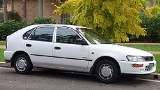
Holden Nova

Encyclopedia
The Holden Nova was a compact car
that was produced by the GM-Holden
-Toyota alliance, known as United Australian Automobile Industries
(UAAI) in Australia
between August 1989 and 1996. The alliance, and therefore the car, was a result of the failed Button car plan
which attempted to rationalise the Australian car manufacturing industry. The Nova was sold and marketed under the Holden
nameplate, although it was a badge engineered
version of the Toyota Corolla
, receiving minor stylistic changes. Unlike the Corolla, the Nova was sold only as a four-door sedan and five-door hatchback
.
In all years, the Nova was outsold by the Toyota Corolla in Australia, and from 1996 car was replaced by the Holden Astra
.
were sold between 1989 and 1994. The LE was offered with Toyota's 1.4 litre 60 kW engine (hatchback only) and 1.6 litre 67 kW engine, in Holden's traditional SL (hatchback only), SLX and SLE trims. The LF Nova, available from October 1991, added fuel injection
to the 1.6 litre unit, now rated at 75 kW. The SLE hatchback was replaced by a GS model, although SLE continued as a trim on the sedan, then in October 1992, a fuel-injected 1.8 litre 85 kW engine was offered for the GS hatchback. The 1.4 litre option and the SLEs were unavailable from 1993.
.
Compact car
A compact car , or small family car , is a classification of cars which are larger than a supermini but smaller than or equal to a mid-size car...
that was produced by the GM-Holden
Holden
GM Holden Ltd is an automaker that operates in Australia, based in Port Melbourne, Victoria. The company was founded in 1856 as a saddlery manufacturer. In 1908 it moved into the automotive field, before becoming a subsidiary of the U.S.-based General Motors in 1931...
-Toyota alliance, known as United Australian Automobile Industries
United Australian Automobile Industries
United Australian Automobile Industries was a firm founded in Australia in 1989 as the result of an agreement between Holden and Toyota. For Holden, it replaced the earlier Holden-Nissan joint venture that had existed since 1983.UAAI produced three vehicles: the Holden Apollo, Holden Nova and...
(UAAI) in Australia
Australia
Australia , officially the Commonwealth of Australia, is a country in the Southern Hemisphere comprising the mainland of the Australian continent, the island of Tasmania, and numerous smaller islands in the Indian and Pacific Oceans. It is the world's sixth-largest country by total area...
between August 1989 and 1996. The alliance, and therefore the car, was a result of the failed Button car plan
Button car plan
The Button car plan, also known as the Button plan was the informal name given to the Motor Industry Development Plan. The plan was an Australian federal government initiative, intended to rationalise the Australian motor vehicle industry. Industry consultation had begun in 1984 with a proposed...
which attempted to rationalise the Australian car manufacturing industry. The Nova was sold and marketed under the Holden
Holden
GM Holden Ltd is an automaker that operates in Australia, based in Port Melbourne, Victoria. The company was founded in 1856 as a saddlery manufacturer. In 1908 it moved into the automotive field, before becoming a subsidiary of the U.S.-based General Motors in 1931...
nameplate, although it was a badge engineered
Badge engineering
Badge engineering is an ironic term that describes the rebadging of one product as another...
version of the Toyota Corolla
Toyota Corolla
The Toyota Corolla is a line of subcompact and compact cars manufactured by the Japanese automaker Toyota, which has become very popular throughout the world since the nameplate was first introduced in 1966. In 1997, the Corolla became the best selling nameplate in the world, with over 35 million...
, receiving minor stylistic changes. Unlike the Corolla, the Nova was sold only as a four-door sedan and five-door hatchback
Hatchback
A Hatchback is a car body style incorporating a shared passenger and cargo volume, with rearmost accessibility via a rear third or fifth door, typically a top-hinged liftgate—and features such as fold-down rear seats to enable flexibility within the shared passenger/cargo volume. As a two-box...
.
In all years, the Nova was outsold by the Toyota Corolla in Australia, and from 1996 car was replaced by the Holden Astra
Holden Astra
The Holden Astra is a compact car that was marketed by Holden, the Australian subsidiary of General Motors. Spanning five generations, the original, Australia-only Astra of 1984 was a derivative of the locally-produced Nissan Pulsar, as was the 1987 Astra...
.
First generation (LE, LF; 1989–1994)
The LE and LF series, based on the Corolla E90Toyota Corolla E90
The Corolla E90 was the sixth generation of cars sold by Toyota under the Corolla nameplate.The performance option of rear-wheel drive was dropped after 1986, with all Corollas front-wheel drive from 1987, with production beginning in May 1987. For general export, the trim levels are Base, XL, GL,...
were sold between 1989 and 1994. The LE was offered with Toyota's 1.4 litre 60 kW engine (hatchback only) and 1.6 litre 67 kW engine, in Holden's traditional SL (hatchback only), SLX and SLE trims. The LF Nova, available from October 1991, added fuel injection
Fuel injection
Fuel injection is a system for admitting fuel into an internal combustion engine. It has become the primary fuel delivery system used in automotive petrol engines, having almost completely replaced carburetors in the late 1980s....
to the 1.6 litre unit, now rated at 75 kW. The SLE hatchback was replaced by a GS model, although SLE continued as a trim on the sedan, then in October 1992, a fuel-injected 1.8 litre 85 kW engine was offered for the GS hatchback. The 1.4 litre option and the SLEs were unavailable from 1993.
Second generation (LG; 1994–1996)
The LG Nova was sold between 1994 and 1996, although a smaller range was offered. The SLX trim level was equipped with a 1.6 litre 78 kW engine, while the GS trim level denoted the fitment of the 1.8 litre engine. Four-door sedan and five-door hatchback options were offered for both levels, and all engines featured fuel injectionFuel injection
Fuel injection is a system for admitting fuel into an internal combustion engine. It has become the primary fuel delivery system used in automotive petrol engines, having almost completely replaced carburetors in the late 1980s....
.