
All Topics  
Holden Camira


   Email Print
   Bookmark   Link


Holden Camira


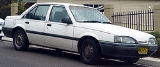
The Holden Camira was a mid-size car
Mid-size car

A mid-size car is the North American and Australian term for an automobile with a size between that of a Compact car and a full-size car. In Europe, cars of a similar size are often referred to as large family cars, or executive cars....
 produced by Holden
Holden

GM Holden Ltd is an Australian Automotive industry based in Port Melbourne, Victoria. The company was originally independent, but since 1931 has been a subsidiary of General Motors ....
, the Australia
Australia

Australia, officially the Commonwealth of Australia, is a country in the southern hemisphere comprising the Australia of the world's smallest continent, the major island of Tasmania, and numerous list of islands of Australia in the Indian Ocean and Pacific Oceans....
n subsidiary of General Motors
General Motors

General Motors Corporation , founded in 1908, is the world's second-largest automaker after Toyota, ranked by 2008 global unit sales. GM was the global sales leader for 77 consecutive calendar years from 1931 to 2008....
 (GM) between 1982 and 1989. It was Holden's version of GM's J-body
GM J platform

The J platform, or J-body, was General Motors Corporation' inexpensive front-wheel drive automobile platform from the 1980s and 1990s. The platform replaced the GM H platform....
 family of cars—GM's third "global" car platform
Automobile platform

An automobile platform is a shared set of common design, engineering, and production efforts, as well as major components over a number of outwardly distinct models and even types of automobiles, often from different, but related marques....
.

After an initial good sales run, Camira sales dropped significantly, and was discontinued in 1989. The Holden Apollo
Holden Apollo

The Holden Apollo is a car that was a badge engineering version of the Toyota Camry sold in Australia. The badge-engineering scheme was the result of the Button car plan, introduced by the Australian Government in the 1980s....
, a rebadged Toyota Camry
Toyota Camry

The Toyota Camry is a mid-size car, formerly a compact car manufactured by Toyota since 1980. The name "Camry" comes from a phonetic transcription of the Japanese word kemuri , which means "wiktionary:smoke", when an engineer noticed the thick smoke pouring out of the engine during testing before the exhaust was fitted....
 was introduced as the Australian market replacement, with New Zealand instead offering the Europe
Europe

Europe is, conventionally, one of the world's seven continents. Comprising the westernmost peninsula of Eurasia, Europe is generally divided from Asia to its east by the water divide of the Ural Mountains, the Ural , the Caspian Sea, and by the Caucasus Mountains to the southeast....
an-sourced Opel Vectra
Opel Vectra

The Opel Vectra is a large family car produced primarily by Opel, the Germany subsidiary of GM Europe . In the United Kingdom, it is sold under the Vauxhall Motors marque as Vauxhall Vectra ....
.


Discussion
Ask a question about 'Holden Camira'
Start a new discussion about 'Holden Camira'
Answer questions from other users
Full Discussion Forum


Encyclopedia


The Holden Camira was a mid-size car
Mid-size car

A mid-size car is the North American and Australian term for an automobile with a size between that of a Compact car and a full-size car. In Europe, cars of a similar size are often referred to as large family cars, or executive cars....
 produced by Holden
Holden

GM Holden Ltd is an Australian Automotive industry based in Port Melbourne, Victoria. The company was originally independent, but since 1931 has been a subsidiary of General Motors ....
, the Australia
Australia

Australia, officially the Commonwealth of Australia, is a country in the southern hemisphere comprising the Australia of the world's smallest continent, the major island of Tasmania, and numerous list of islands of Australia in the Indian Ocean and Pacific Oceans....
n subsidiary of General Motors
General Motors

General Motors Corporation , founded in 1908, is the world's second-largest automaker after Toyota, ranked by 2008 global unit sales. GM was the global sales leader for 77 consecutive calendar years from 1931 to 2008....
 (GM) between 1982 and 1989. It was Holden's version of GM's J-body
GM J platform

The J platform, or J-body, was General Motors Corporation' inexpensive front-wheel drive automobile platform from the 1980s and 1990s. The platform replaced the GM H platform....
 family of cars—GM's third "global" car platform
Automobile platform

An automobile platform is a shared set of common design, engineering, and production efforts, as well as major components over a number of outwardly distinct models and even types of automobiles, often from different, but related marques....
.

After an initial good sales run, Camira sales dropped significantly, and was discontinued in 1989. The Holden Apollo
Holden Apollo

The Holden Apollo is a car that was a badge engineering version of the Toyota Camry sold in Australia. The badge-engineering scheme was the result of the Button car plan, introduced by the Australian Government in the 1980s....
, a rebadged Toyota Camry
Toyota Camry

The Toyota Camry is a mid-size car, formerly a compact car manufactured by Toyota since 1980. The name "Camry" comes from a phonetic transcription of the Japanese word kemuri , which means "wiktionary:smoke", when an engineer noticed the thick smoke pouring out of the engine during testing before the exhaust was fitted....
 was introduced as the Australian market replacement, with New Zealand instead offering the Europe
Europe

Europe is, conventionally, one of the world's seven continents. Comprising the westernmost peninsula of Eurasia, Europe is generally divided from Asia to its east by the water divide of the Ural Mountains, the Ural , the Caspian Sea, and by the Caucasus Mountains to the southeast....
an-sourced Opel Vectra
Opel Vectra

The Opel Vectra is a large family car produced primarily by Opel, the Germany subsidiary of GM Europe . In the United Kingdom, it is sold under the Vauxhall Motors marque as Vauxhall Vectra ....
. In all 151,807 Camiras were built (85,725 JBs; 36,953 JDs; and 29,129 JEs).

JB (1982–1984)


The original Camira, the JB series, was introduced in 1982 with a major trans-Tasman
Trans-Tasman

Trans-Tasman is an adjective used primarily in Australia and New Zealand, which signifies an interrelationship between both countries. Its name originates from the Tasman Sea which lies between the two countries....
 marketing campaign. The Camira replaced the Sunbird and Torana
Holden Torana

The Holden Torana was a car produced by Holden , the Australian subsidiary of General Motors . The name comes from an Indigenous Australian languages word meaning "to fly"....
, although an interim four-cylinder version of the Commodore
Holden Commodore

The Holden Commodore is an automobile manufactured by the Holden division of General Motors in Australia, and, formerly, in New Zealand. In the mid-1970s, Holden established proposals to replace the long-serving Holden Kingswood nameplate with an all-new smaller model....
 bridged the two-year production gap.

A station wagon
Station wagon

A station wagon in American English, Australian English, Canadian English and New Zealand English usage and an estate car in British English usage, is a passenger automobile with a car body style similar to a sedan but with the roofline following the full, sometimes extended rear cargo area, i.e. ending with a more vertical door...
 version was introduced the following year, and its bodywork was exported to Vauxhall
Vauxhall Motors

Vauxhall Motors is a UK automobile company. It is a subsidiary of General Motors , and is part of GM Europe. Most current Vauxhall models are right-hand drive derivatives of GM's Opel brand....
 in the United Kingdom for the Cavalier
Vauxhall Cavalier

The Vauxhall Cavalier was a large family car sold primarily in the United Kingdom by Vauxhall Motors, the British subsidiary of General Motors Corporation , from 1975 to 1995....
 wagon. Some Camiras were also exported to right-hand drive markets in Southeast Asia
Southeast Asia

Southeast Asia or Southeastern Asia is a subregion of Asia, consisting of the countries that are geographically south of China, east of India and north of Australia....
, such as Indonesia
Indonesia

The Republic of Indonesia , is a transcontinental country in Southeast Asia and Oceania. Comprising Islands of Indonesia, it is the world's largest Archipelago state....
 and Singapore
Singapore

Singapore , officially the Republic of Singapore, is an island country microstate located at the southern tip of the Malay Peninsula. It lies 137 kilometres north of the equator, south of the Malaysian state of Johor and north of Indonesia's Riau Islands....
. The wagon variant was specifically a Holden design, and was actually a major demand Holden had in the overall "J-car" program. A five-door hatchback
Hatchback

Hatchback is a term designating an automobile design, containing a passenger cabin with an integrated cargo space, accessed from behind the vehicle by a single, top-hinged tailgate or large flip-up window....
, based on the Opel Ascona
Opel Ascona

The Opel Ascona was a mid-size car automobile produced by Opel, the Germany subsidiary of General Motors Corporation. It had three generations produced from 1970 to 1988....
/Vauxhall Cavalier
Vauxhall Cavalier

The Vauxhall Cavalier was a large family car sold primarily in the United Kingdom by Vauxhall Motors, the British subsidiary of General Motors Corporation , from 1975 to 1995....
 "J-car" was proposed for the Camira, however due to Holden's financial losses at that time it never made production.

There was only one engine, the carburettored
Carburetor

A carburetor or carburettor , is a device that blends Earth's atmosphere and fuel for an internal combustion engine. It was invented by Karl Benz before 1885 and patented in 1886....
, naturally-aspirated
Naturally-aspirated engine

A naturally-aspirated engine is a piston engine internal combustion engine that depends solely on atmospheric pressure to draw in combustion air....
, transversely
Transverse engine

A transverse engine is an engine in which the crankshaft is oriented side-to-side relative to the length of the vehicle. This is also sometimes called an east-west engine....
-mounted 1.6 litre four-cylinder
Straight-4

The straight-4 or inline-4 engine is a four cylinder internal combustion engine with all four cylinder mounted in a straight line along the crankcase....
 engine delivering . The transaxle
Transaxle

A transaxle, in the automotive field, is a major mechanical component which combines the functionality of the transmission , the differential and associated components of the driven axle into one integrated assembly....
 offering was a four-speed manual
Manual transmission

A manual transmission is a type of Transmission used in automotive applications. It generally utilizes a driver-operated clutch operated by a pedal or lever, for regulating torque transfer from the engine to the transmission, and a gear-shift either operated by hand or by foot ....
 on the SL and SL/X, with a five-speed unit specified to SJ and SL/E variants. A three-speed automatic
Automatic transmission

An automatic transmission is an automobile gearbox that can change gear ratios automatically as the vehicle moves, freeing the driver from having to shift gears manual transmission....
 with lockup torque converter
Torque converter

A torque converter is a modified form of fluid coupling that is used to transfer rotating power from a Wiktionary:prime mover, such as an internal combustion engine or electric motor, to a rotating driven load....
 was optional on the base model, but standard on the SL/E.

The Camira was Wheels
Wheels magazine

Wheels magazine is an Australian automotive magazine published monthly by ACP Magazines. Wheels was founded in May 1953 by editor Athol Yeomans....
 magazine's Car of the Year
Wheels Car of the Year

Wheels magazine has announced its Car of the Year every year since 1963, with the exception of 1972, 1979 and 1986 when no cars were considered worthy of the honour....
 for 1982. While superior to most other cars of the day in terms of ride and handling
Car handling

Car handling and vehicle handling is a description of the way wheeled vehicles perform transverse to their direction of motion, particularly during cornering and swerving....
, the 1.6 litre Camtech engine was regarded as "underpowered" by much of the motoring media, and the Camira suffered from a litany of quality control issues which included smoking engines in early models, lack of drainage holes in the doors, paint quality and lack of adequate fan cooling resulting in overheating in Camiras fitted with air conditioning. This tarnished the Camira's reputation.

Specification levels

  • SL: entry-level variant, with no air conditioning
    Air conditioning

    An air conditioner is an appliance, system, or Mechanism designed to extract heat from an area via a refrigeration cycle. In construction, a complete system of heating, Ventilation , and air conditioning is referred to as "HVAC." Its purpose, in a building or an automobile, is to provide comfort during either hot or cold...
     or power steering
    Power steering

    Power steering is a system for reducing the steering effort on vehicles by using an external power source to assist in turning the wheel.The earliest known patent related to power steering was filed on August 30, 1932, by Francis W....
    , though it is possible to find some with dealer-fitted air conditioning.
  • SJ : sporty version based on SL with a five-speed manual transmission. Other changes constrained to cosmetic upgrades.
  • SL/X: received several additional extras over SL.
  • SL/E: top-of-the-line model with power mirrors, cloth trimmings and alloy wheel
    Alloy wheel

    Alloy wheels are automobile wheels which are made from an alloy of aluminium or magnesium metals ....
    s as standard. These alloy wheels were styled similarly to those of the VH Commodore
    Holden VH Commodore

    The Holden VH Commodore was an evolution of the previous VC model, released in October 1981. The appearance was mildly facelifted with a new horizontal-slat grille to give a lower, wider look, and for interest of aerodynamics....
     SL/E wheels (however using a four spoke/four stud design rather than the Commodore's five). Despite being available in all other "J-car" models, power window
    Power window

    File:Power window switches on drivers door.jpgPower windows or electric windows are automobile windows which can be raised and lowered by depressing a button or switch, as opposed to using a hand-turned Crank ....
    s were never available in the Australian Camira models, however, air conditioning and central locking
    Power door locks

    Power door locks allow the driver or front passenger to simultaneously lock or unlock all the doors of an automobile or truck, by pressing a button or flipping a switch....
     were optional.


JD (1984–1987)


The second series JD Camira, released in 1984 received a facelift
Facelift (automobile)

The term facelift is never used in an automotive context to refer to minor revisions to a car model in the middle of its production run. The basic design of the car remains the same, but aesthetic, and generally superficial, alterations are made....
, with a more aerodynamic
Aerodynamics

Aerodynamics is a branch of Dynamics concerned with studying the motion of air, particularly when it interacts with a moving object. Aerodynamics is a subfield of fluid dynamics and gas dynamics, with much theory shared between them....
 front-end and the absence of a conventional front grille
Grille

A grille is an opening of several slits side by side in a wall or metal sheet or other barrier, usually to let air or water enter and/or leave but keep larger objects including people and animals in or out....
. The differences were at first cosmetic, but a few months after the launch of the car, the engine was upgraded from 1.6 to 1.8 litres, and to multi-point fuel injection
Fuel injection

Fuel injection is a system for mixing fuel with air in an internal combustion engine. It has become the primary fuel delivery system used in gasoline Automobile engines, having almost completely replaced carburetors in the late 1980s....
. These changes combined allowed the engine to deliver . The new 1.8 litre engine was mated with a five-speed manual transmission, as opposed to the four-speed fitted to the 1.6.

However, during mid-1986, new emissions regulations
Emission standard

Emissions standards are requirements that set specific limits to the amount of pollutants that can be released into the environment. Many emissions standards focus on regulating pollutants released by automobiles and other powered vehicles but they can also regulate emissions from industry, power plants, small equipment such as lawn mowers...
 required that all cars manufactured in Australia to run on unleaded petrol. This forced another reworking of the engine (all variants prior to this ran leaded petrol), during which time Holden was operating at a loss. The result was that Holden dropped the multi-point injection and reverted back to a single-point, akin to a carburettor, and altered the tuning of the engine to suit. Power output was reduced by to .

This engine was also used in Holden's locally manufactured compact car
Compact car

A compact , small family or c-segment car is a car classification of automobile which are larger than a supermini car and smaller than a large family car....
, the LD Astra
Holden Astra

The Holden Astra is a compact car marketed by Holden, the Australian subsidiary of General Motors. Spanning five generations, the original, Australia-only Astra of 1984 was a derivative of the locally-produced Nissan Pulsar, as was the 1987 Astra....
 (1987–1989), a badge engineered
Badge engineering

Badge engineering is a term that describes the badge of one product as another. Due to the high cost of designing and engineering a totally new model, or establishing a new brand , it is often more cost-effective to rebadge a single product multiple times....
 Nissan Pulsar
Nissan Pulsar

The Nissan Pulsar was a compact car/small family car produced by the Japanese automaker Nissan from 1978, when it debuted as a subcompact car, to 2007, when it was replaced in all markets by the Nissan Tiida ....
 (N13; 1987–1991), as well as the Pulsar itself. This was the result of a model sharing alliance between Holden and Nissan
Nissan Motors

, shortened to Nissan is a multinational corporation automaker headquartered in Japan. It was formerly a core member of the Nissan Group, but has become more independent after its restructuring under Carlos Ghosn ....
 at the time, where the Nissan body was used in conjunction with GM powertrain
Powertrain

In a motor vehicle, the term powertrain or powerplant refers to the group of components that generate power and deliver it to the road surface, water, or air....
s. Running on unleaded petrol, this engine had an output of . The Pulsar's 1.8 litre engine contained the same basic internals as the JD Camira's 1.8 litre engine, with the main exception being the block casting
Cylinder block

The cylinder block or engine block is a machined casting containing cylindrically bored holes for the pistons of a multi-cylinder reciprocating internal combustion engine, or for a similarly constructed device such as a pump....
 and smaller ports/valves on the head
Cylinder head

In an internal combustion engine, the cylinder head sits above the Cylinder and consists of a platform containing part of the combustion chamber and the location of the poppet valves and spark plugs....
, and smaller intake manifold. Both the Camira and Astra/Pulsar engines were powered by a Delco Electronics
Delco Electronics

Delco Electronics Corporation was the automotive electronics design and manufacturing subsidiary of General Motors Corporation based in Kokomo, Indiana....
 engine control unit
Engine Control Unit

An engine control unit is an electronic control unit which controls various aspects of an internal combustion engine's operation. The simplest ECUs control only the quantity of fuel injected into each cylinder each engine cycle....
. This caused problems of its own, as with age, the fine tolerance of the circuitry and componentry have a tendency to fail unexpectedly, and on failing, the engine will cease to operate, or operate with a crippling loss of power due to incorrect tuning and fuel delivery. The external engine mounts are better placed on the Pulsar, and hence result in longer engine mount life.

In New Zealand the second generation Camira was marketed as the Camira JJ. This comprised of two entirely different J-cars: the sedan version was a rebadged version of the Isuzu Aska
Isuzu Aska

The Isuzu Aska was a nameplate used by Isuzu of Japan to denote their midsize car sedan s from 1983 to 2002. Originally, the Aska was a version of General Motors Corporation GM J platform produced by Isuzu, but later, after Isuzu pulled out of manufacturing passenger cars, the nameplate was applied to badge engineering Subaru Legacy and Hond...
 from Japan
Japan

Japan is an island country in East Asia. Located in the Pacific Ocean, it lies to the east of the Sea of Japan, People's Republic of China, North Korea, South Korea and Russia, stretching from the Sea of Okhotsk in the north to the East China Sea and Taiwan in the south....
. This decision was made by General Motors New Zealand
Holden New Zealand

Holden New Zealand Limited, formerly General Motors New Zealand Limited before 1994 is the sales subsidiary for General Motors in New Zealand....
 as sales figures of the Camira JB were poor for this market, however the wagon version which was built and sold in Australia was retained from the previous generation and assembled locally.

Specification levels

  • SL, SL/X, and SL/E: as for JB.
  • Executive: introduced in 1986 as an option pack for the SL/X. The Executive was first seen on the VK Commodore
    Holden VK Commodore

    The Holden VK Commodore was introduced in 1984 and replaced the Holden VH Commodore. It was the first Commodore to have plastic bumpers and introduced rear quarter windows for a six-window design as opposed to the four-window design on previous Commodore models....
     in 1984.
  • Formula: first seen on the JD model, the Formula pack was optional to any model which had special pin striping and side skirts, this pack sold in limited numbers.


JE (1987–1989)


The JE was the series of Camira. By this time, many of the Camira's early quality problems had been addressed, and Holden matched now fitted the multi-port fuel-injected 2.0 litre engine to replace the 1.8 litre unit. The 2.0 litre unit delivered at 5200 rpm
Revolutions per minute

Revolutions per minute is a units of measurement of frequency: the number of Turn completed in one minute around a rotation around a fixed axis....
. The automatic transaxel in the JE, the Turbo-Hydramatic 125 C
Turbo-Hydramatic 125

The Turbo-Hydramatic 125 was the first in a line of automatic transmissions from General Motors Corporation designed for transverse engine application....
, sported a lockup torque converter
Torque converter

A torque converter is a modified form of fluid coupling that is used to transfer rotating power from a Wiktionary:prime mover, such as an internal combustion engine or electric motor, to a rotating driven load....
. Styling changes were minor from the JD with the addition of a thin grille
Grille

A grille is an opening of several slits side by side in a wall or metal sheet or other barrier, usually to let air or water enter and/or leave but keep larger objects including people and animals in or out....
 up front and new wheel trims.

After Camira production wound up during 1989, Holden replaced the Camira with the Apollo
Holden Apollo

The Holden Apollo is a car that was a badge engineering version of the Toyota Camry sold in Australia. The badge-engineering scheme was the result of the Button car plan, introduced by the Australian Government in the 1980s....
, a rebadged Toyota Camry
Toyota Camry

The Toyota Camry is a mid-size car, formerly a compact car manufactured by Toyota since 1980. The name "Camry" comes from a phonetic transcription of the Japanese word kemuri , which means "wiktionary:smoke", when an engineer noticed the thick smoke pouring out of the engine during testing before the exhaust was fitted....
. This was a result of the Button car plan
Button car plan

File:1989-1991 Holden JK Apollo SLX sedan 01.jpgFile:1994-1996 Holden LG Nova SLX hatchback 01.jpgThe Button car plan, also known as the Button plan was the informal name given to the Motor Industry Development Plan....
 introduced by the Australian Government
Government of Australia

The Australia is a federation constitutional monarchy under a parliamentary democracy. The Commonwealth of Australia was formed in 1901 as a result of an agreement between six self-governing British colonies, which became the six states....
, which encouraged a reduction in the number of Australian carmakers and models. New Zealand, not being affected by this scheme instead replaced the Camira with the Europe
Europe

Europe is, conventionally, one of the world's seven continents. Comprising the westernmost peninsula of Eurasia, Europe is generally divided from Asia to its east by the water divide of the Ural Mountains, the Ural , the Caspian Sea, and by the Caucasus Mountains to the southeast....
an-sourced Opel Vectra
Opel Vectra

The Opel Vectra is a large family car produced primarily by Opel, the Germany subsidiary of GM Europe . In the United Kingdom, it is sold under the Vauxhall Motors marque as Vauxhall Vectra ....
, which after 1994 was rebadged as the Holden Vectra. Holden continued to produce the Family II
GM Family II engine

The Family II is a straight-4 piston engine that was originally developed by Opel in late 1970s for use in the Opel Ascona B and Opel Kadett#Kadett D....
 engine for export well after the Camira was discontinued. Over three million variants were produced, in 1.6, 1.8 and 2.0 litre configurations, with the 1.8 and 2.0 litre variants being fuel injected.

Specification levels

  • SL, SLX, Executive, SLE: as for JB and JE series, except the SLX and SLE nameplates no longer featured the "/" symbol, as in SL/X.
  • Vacationer: was a special edition, based on the Executive, painted light blue metallic (an HT Monaro
    Holden Monaro

    The Monaro is an automobile which was produced by Holden, the Australian branch of General Motors Corporation from 1968 to 1977 and then re-introduced onto the Australian and New Zealand markets in 2001....
     colour) with red and white decals, SL/X trim, and SL/E roof rack
    Roof rack

    A roof rack is a set of bars secured to the roof of a automobile. It is used to carry bulky items such as bicycles, canoes, kayaks, skis and various assorted carriers and containers....
    s (wagons).
  • SLi 2000: was unique to the JE, being a "sports" package based on the SLX. Major differences were the addition of side skirts, a small spoiler and distinctive orange and silver pinstriping. In somewhat of a marketing ploy, the SLi was only available in red, in the sedan body shell with a five-speed manual transaxle, and with a grey interior from the SLX. Despite it's sports-oriented nature, the SLi 2000 was powered by the same Family II
    GM Family II engine

    The Family II is a straight-4 piston engine that was originally developed by Opel in late 1970s for use in the Opel Ascona B and Opel Kadett#Kadett D....
     engine fitted to all other JEs, hence providing no extra performance.
  • Formula: was, like the SLi 2000, based on the SLX model. Skirting and pinstriping were also options. Buyers did have the freedom to choose the colour, however all versions had manual transmission
    Manual transmission

    A manual transmission is a type of Transmission used in automotive applications. It generally utilizes a driver-operated clutch operated by a pedal or lever, for regulating torque transfer from the engine to the transmission, and a gear-shift either operated by hand or by foot ....
     and "Formula" seats.


The SLi 2000 and the Formula were sold limited numbers and are subsequently rare today, as were cars built with central locking and automatic boot lid releases.

Common issues