


Station wagon

Encyclopedia
A station wagon is a body style
variant of a sedan/saloon with its roof extended rearward over a shared passenger/cargo volume with access at the back via a third or fifth door (the liftgate
or tailgate), instead of a trunk lid. The body style transforms a standard three-box
design into a two-box design — to include an A, B & C-pillar
, as well as a D pillar
. Station wagons feature flexibility to allow configurations that either favor passenger or cargo volume, e.g., fold-down rear seats.
The American Heritage Dictionary defines a station wagon as "an automobile with one or more rows of folding or removable seats behind the driver and no luggage compartment but an area behind the seats into which suitcases, parcels, etc., can be loaded through a tailgate."
When a model range includes multiple body styles such as sedan, hatchback and station wagon, the models typically share their platform, drivetrain
and bodywork forward of the A-pillar
. In 1969, Popular Mechanics
said "station wagon-style follows that of the production sedan of which it is a counterpart, most are on the same wheelbase, offer the same transmission and engine options, and the same comfort and convenience options."
Station wagons have evolved from their early use as specialized vehicles to carry people and luggage to and from a train station, and have experienced worldwide marketing.
, Australian
, Canadian
and New Zealand
English, while estate car or simply estate is common in British
English. An archaic term for station wagon is the Australian station sedan.
Early U.S. models often had exposed wooden bodies (and were thus known as woodie
s). Station Wagons had historically been called shooting-brake
s, a British
term. A few models are referred to as a break, using the French
term (which is sometimes given in full as break de chasse — literally "hunting break").
Specific manufacturers, including Audi
, BMW
, and Citroën
have marketed the body style as "Avant", "Touring", or "Break". Other manufacturers use the marketing term "Combi" or "Kombi."
Volkswagen
's proprietary name for a station wagon is Variant, Opel
sometimes uses the word Caravan (the current models are called Sports Tourer), BMW
uses Touring, Wartburg used Tourist. Fiat
often uses the term Weekend, Alfa Romeo
uses Sportwagon and Mazda uses Estate. Some British makes under BMC
used Traveller or Countryman for the type. Peugeot
and Land Rover
have sometimes used "station wagon" even in markets which use British English.
s typically share a two-box design
configuration, with one shared, flexible, interior volume for passengers and cargo — and a rear door for cargo access.
Further distinctions are highly variable:
Pillars: Both configurations typically feature A, B & C-pillar
s, station wagons feature a D-pillar
and hatchbacks may feature a D pillar.
Cargo Volume: Station wagons prioritize passenger and cargo volume — with windows aside the cargo volume. Of the two body styles, a station wagon roof (viewed in profile) more likely extends to the very rearmost of the vehicle, enclosing a full-height cargo volume — a hatchback roof (especially a liftback roof) might more likely rake down steeply behind the C-Pillar
, prioritizing style over interior volume, with shorter rear overhang and with smaller windows (or no windows) aside the cargo volume.
Cargo floor contour: Favoring cargo capacity, a station wagon may prioritize a fold-flat floor, where a hatchback would more likely allow a cargo floor with pronounced contour (e.g. the new Mini
or the sixth generation Ford Fiesta).
Seating: Station wagons may have two or three rows of seats (e.g., the Ford Taurus
wagons) while hatchbacks may only have one or two.
Rear suspension: A station wagon may include reconfigured rear suspension for additional load capacity and to minimize intrusion in the cargo volume, (e.g., worldwide versions of the first generation Ford Focus).
Rear Door: Hatchbacks typically feature a top-hinged liftgate
for cargo access, with variations ranging from a two-part liftgate/tailgates (e.g., the 1958 A40 Countryman
) to a complex tailgate that can function either as a full tailgate or as a trunk lid (e.g., the 2008 Škoda Superb's TwinDoor). Station wagons have also enjoyed numerous tailgate configurations. Hatchbacks may be called Liftbacks when the opening area is very sloped and the door is lifted up to open.
Automotive journalist Dan Neil
, in a 2002 New York Times report described verticality of the rear cargo door as the prime distinction between a hatchback and a station wagon: "Where you break the roofline, at what angle, defines the spirit of the vehicle", he said. "You could have a 90-degree break in the back and have a station wagon."
A model range may include multiple configurations, as with the 2005–2007 Ford Focus which offered sedan (ZX4), wagon (ZXW) and three and five-door hatchback (ZX3 and ZX5) models.
travel. They were originally called "depot hacks" because they worked around train depots as hacks (short for hackney carriage
, an old name for taxi
s). They also came to be known as "carryalls" and "suburbans".
Prior to mid-1930s, manufacturers assembled the framing of passenger compartments of passenger vehicles in hardwood. In automobiles, the framing was sheathed in steel and coated with colored lacquer for protection. Eventually, all-steel bodies were adopted because of their strength, cost and durability.
Early station wagons evolved from trucks and were viewed as commercial
s (along with van
s and pickup truck
s), not consumer automobiles — with the framing of the early station wagons left unsheathed because of the commercial nature of the vehicles. Early station wagons were fixed roof vehicles, but lacked the glass that would normally enclose the passenger compartment, and had only bench seats. In lieu of glass, side curtains of canvas could be unrolled. More rigid curtains could be snapped in place to protect passengers from the elements outside.
In 1922 Essex
introduced the first affordable enclosed automobile (sedan), which shifted the auto industry away from open vehicles to meet consumer demand for enclosed automobiles. Station wagons too, began to be enclosed, especially in higher price categories from upmarket automobile companies. Windows in these early enclosed models were either retractable or sliding. In 1924, the first enclosed station wagon appeared.
Initially, manufacture of the wagon's passenger compartments was outsourced to custom body builders because the production of the all-wood bodies was very time consuming. Major producers of wood-bodied station wagons included Mitchell Bentley, Hercules, USB&F, Cantrell, and other custom builders. The roofs of "woodie" wagons were usually made of stretched canvas that was treated with a water proofing dressing.
Eventually, the car companies themselves began building their own station wagons. Star
(a division of Durant Motors
) is credited as being the first car company to offer a factory-built station wagon beginning in 1923. In 1919, the Stoughton Wagon Company of Stoughton, Wisconsin, had begun putting custom wagon bodies on Model T chassis. By 1929 Ford
was by far the biggest seller of station wagons. Since Ford owned its own hardwood forest and mills, it began supplying the wood components for the Model A wagon (although initially some final assembly still took place away from the factory, by Briggs
, in Detroit), with wood from the Mengel Company (Louisville
). The same year, J. T. Cantrell provided woodie bodies for Chrysler
vehicles until 1931.
Although commercial in origin, by the mid-1930s, wood bodied station wagons achieved a level of prestige. The vehicles were priced higher than regular cars, and were popular in affluent communities. By 1941, the Chrysler Chrysler Town and Country (pre-1990)
was the most expensive car in the company's lineup.
Woodie wagons required constant maintenance; bodies were finished in varnishes that required recoating, bolts and screws required periodic tightening as wood expanded and contracted through the seasons. In 1935, General Motors
introduced a steel-bodied eight-seat Suburban
wagon, based on the Chevrolet truck.
Woodies enjoyed a renewed popularity with members of the surfing culture in the 1950s and 1960s. To this day there are several collectors' organizations in the United States.

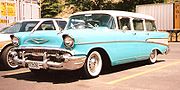 Following World War II, automobile production resumed, although using prewar tooling. New advances in production techniques made all-steel station wagon bodies more practical, eliminating the cost, noise, and maintenance issues associated with wood bodies.
The first factory-built all-steel station wagon in North America was the 1946 Jeep Station Wagon, based on the Jeep produced by Willys-Overland during WWII. Willys offered a trim level evoking earlier wood bodywork, rendered instead in paint and trim work. As mentioned above, in 1935, Chevrolet introduced the Chevy Suburban, with an all-steel station wagon body on a commercial truck chassis. In 1947, Crosley
introduced an all-steel, car-based wagon in Europe.
In 1949, Plymouth
introduced the first all-steel station wagon in the U.S., the two-door Suburban, based on a car platform. In 1950 Plymouth discontinued the woodie
station wagon, converting to all steel bodywork. Buick
discontinued production of the last North American wood bodywork after 1953. Morris of England continued to market its Morris Minor Traveller
until the late 1960s.
By the early 1960's wood body construction was replaced with wood accents on all-steel bodies. Ford introduced the Country Squire
with simulated woodgrain paneling. By 1955, only Ford and Mercury
offered a woodie model, accomplishing the simulation of wood with other materials, e.g., steel, plastics and DiNoc (a vinyl
product).
Ford included the Country Squire
trim level in a number of different model ranges up to 1991, and other manufacturers marketed wagons and minivans with simulated wood during the mid-1960s through the 1980s. Simulated wood appliques became less common in the 1980s. With the introduction of the retro-styled Chrysler PT Cruiser
wagon-like model, aftermarket firms began selling simulated woodgrain kits.
Station wagons experienced highest production levels in the United States from the 1950s through the 1970s. The late 1950s through the mid-1960s was also the period of greatest variation in body styles, with pillared two and four-door models marketed alongside hardtop
(no B-pillar) four door models (e.g., American Motors
' Rambler Cross-Country wagons). Rambler offered a four-door of this body style in 1956, followed by Mercury, Oldsmobile, and Buick in 1957; Chrysler entered the market in 1960. The pillarless designs could be expensive to produce, added wind noise, and created structural issues with body torque. GM eliminated the hardtop wagon from its lineup in 1959, and AMC and Ford exited the field beginning with their 1960 and 1961 vehicles, leaving Chrysler and Dodge with the body style through the 1964 model year.
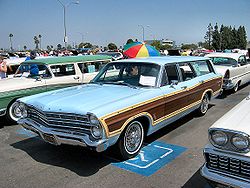 Traditionally, full-sized American station wagons were configured for six or nine passengers. The basic arrangement for seating six was three passengers in the front and three passengers in the rear, all on bench-type seats; to accommodate nine, a third bench seat was installed in the rear cargo area, over the rear axle. Through 1956, all wagons had the third row facing forward, but Chrysler's 1957 models had a roof too low to permit a forward-facing seat installed over the axle, so it was turned around and placed behind the axle. GM wagons would adopt the rear-facing third row with 1959 models until 1971, and again in 1977.
In full-size Ford and Mercury wagons built after 1964, the configuration was two seats facing each other, placed behind the rear axle. According to Ford, each seat would accommodate two people, raising the total seating capacity
to ten passengers; however, these seats were quite narrow in later models and could accommodate only one passenger, limiting the total capacity to eight passengers.
The 1964–72 Oldsmobile Vista Cruiser
and 1964–69 Buick Sport Wagon
featured raised rooflines beginning above the second-row seat and continuing all the way to the rear tailgate. Above the second seat were acrylic glass
skylights in which passengers could view the outside from overhead. On the three-seat models of these wagons, the third seat faced forward as did the first and second seats. Later, the 71-76 full-size "clamshell" wagons used a similar raised roof to provide adequate headroom for a forward-facing third row, but without the skylights.
Newer models are usually built on smaller platforms and accommodate five or six passengers (depending on whether bucket or bench seats are fitted in front). Full-size SUVs such as the Chevrolet Suburban
and Ford Expedition
have similar features to the aforementioned full-size station wagons, such as nine-passenger seating with bench seat
ing in the front.
100 inches (254 cm) wheelbase Nash Rambler
line included a two-door station wagon design whose production continued through 1955. After the merger of Nash and Hudson
, the new company, American Motors
(AMC) reintroduced the two-door wagon in the "new" Rambler American
line in 1959 with only a few modifications from the original version. This was a car targeting buyers looking for economy and load space, as well as a strategy of reintroducing an old design; a business decision that has not been successfully duplicated to this day.
The 1955–1957 Chevrolet Nomad
, and sibling Pontiac Safari
two-door station wagons were sold in small numbers but are sought after and prized by collectors. Mercury
produced a unique two-door hardtop station wagon from 1957 to 1960, the Commuter. Chevrolet produced the 1964–1965 Chevelle
300 series two-door station wagons of which less than 5,000 were sold. They are among of the rarest of Chevrolet wagons produced.
In 1961 Volkswagen introduced the Type 3
(also known in various markets as the Variant and the Volkswagen 1500 (later the Volkswagen 1600)), available as a two-door sedan and as a two-door station wagon, which was commonly called the Squareback. VW's then-typical rear-engine layout was retained for the Type 3, but the engine profile was flattened, resulting in a small car with copious interior and trunk space. The model was offered through the 1973 model year.
The 1970s were a high point for two-door wagons in the U.S. as GM
, Ford, and AMC fielded examples in their subcompact car
lines.
The Chevrolet Vega
Kammback introduced in September 1970, was the first US-made four-passenger wagon, and the first two-door wagon from GM in six years. It shares its wheelbase and length with Vega coupe versions and was produced in the 1971–1977 model years. The Pontiac Astre Safari wagon is a Pontiac rebadged
Vega that was introduced in the U.S for the 1975 model year
. It offered a step up in luxury from the Vega with the SJ package. The Chevrolet Monza and Pontiac Sunbird Safari wagons replaced the Vega and Astre respectively. Retaining the Vega wagon body, they were produced for the 1978 and 1979 models years with Pontiac and Buick engines.
Ford Pinto
and Mercury Bobcat 2-door wagons were produced between 1972–1980. American Motors also entered the market with a wagon version of the AMC Pacer
, produced between 1977 and 1980. The last two-door wagon available in America, the Volkswagen Fox
, was discontinued in 1990.
In the United Kingdom, estate car versions of small and middle sized models were more common. The estate ("Traveller") versions of the Morris 1000 ("Minor") and Mini
, with external ash wood frames (structural on the 1000); had two vertically divided van-type rear doors in the style of older shooting-brake
s (see "station wagons around the world", below). The Hillman Husky
estate version of the Hillman Imp
was unusual in being a rear-engined estate. …Other two-door station wagons in Europe included the Ford Escort, Morris 1100, Vauxhall Viva
, Vauxhall Chevette
, Fiat 127
, and Saab 95
.
was a turning point against the "traditional classic American station wagon — with its acres of fake woodgrain siding, sticky vinyl bench seats and lazy-revving V-8 engine", which have been described as "wallowing land arks".
In 1984 the Chrysler Corporation
introduced the first minivans derived from the K platform
. While the K platform was also used for the Plymouth Reliant
and Dodge Aries
station wagon models, the minivan would soon eclipse them in popularity. Since minivans and SUVs are classified as light trucks under US CAFE standards, manufacturers had a strong incentive to market those vehicles over station wagons, which are classified as cars. Station wagons have remained popular in Europe and other locations whose emissions and efficiency regulations don't distinguish between cars and light trucks
 The emergence and popularity of sport utility vehicle
s which closely approximate the traditional wagon bodystyle was a further blow. After struggling sales, the Chevrolet Caprice
and the Buick Roadmaster
, the last American full size wagons, were discontinued in 1996. The Dodge Magnum
was marketed during the 2005-2008 model years.
Since then, smaller wagons have been sold in the U.S. as less expensive alternatives to SUVs and minivans. Domestic wagons also remained in the Ford, Mercury, and Saturn lines until 2004 when the bodies began a phase-out, replaced by car-based crossover SUV
s and minivans designed to look like station wagons.
The last subcompact station wagon produced in the United States and Canada was the 1992 Toyota Corolla
. Compact
station wagons have been declining since the 2000s. Ford dropped the Ford Focus wagon for 2008, and Subaru
replaced the Impreza wagon
with a 5-door crossover SUV
model. Volvo
recently announced that they will withdraw their compact station wagon, the V50, from the U.S market by 2012 due to poor sales figures. In Europe the V50 remains popular.http://autos.yahoo.com/articles/autos_content_landing_pages/1736/the-death-of-the-station-wagon/
Raised wagon-type vehicles marketed as crossovers continue to be popular in North America, such as the Toyota Matrix
/Pontiac Vibe
which was introduced in 2003.
European luxury carmakers such as Audi
, BMW
, and Mercedes-Benz
still offered wagons in their North American lineup, using the labels "Avant", "Touring", and "Estate" instead of wagon. However, these wagons had fewer trim and powertrain levels than their sedan counterparts, for instance the wagon styles of high-performance trims such as the BMW M5
, Audi RS6
, Mecedes-Benz E63 AMG
were never imported to North America. The Mercedes-Benz W204 C-Class wagon was not offered in the United States and Canada unlike the previous generation. The E61 BMW 5 Series
Touring is expected to be dropped from BMW's North American lineup, due to slow sales in the United States with only 400 wagons sold in 2009. Due to the popularity of SUVs in North America, these European manufacturers have been supplanting their wagons with car-based crossovers such as the BMW Sports Activity Series
, the Audi Q5
, and Mercedes-Benz M-Class
, these offer a wider range of options and engines than their wagons.
However, the Cadillac CTS
gave rise to its wagon counterpart, the 2010 CTS Sportwagon. Unlike European luxury wagons sold in North America, the CTS Sportwagon has almost as many trim levels as its sedan counterpart.
Although station wagons have declined in North America, they offer several advantages. Wagons offer cargo space without compromising driving dynamics or radically increasing weight. The high fuel prices in Europe and Japan have led to nearly half of all production vehicles being wagons, and a similar result is expected for the United States. This trend is already being seen with an increase in wagons being sold in the United States. Cadillac's 2009 CTS Sport Wagon, Acura's 2011 TSX Sport Wagon, and Lexus’ CT200h Hybrid wagon are all examples of this increased proliferation.
 European manufacturers often built two-door station wagons in the post-war period for the compact class, and not four-door models, a practice that continued at Ford (amongst others) with its Escort Mark III, for example, well into the 1980s. Usually, by that time, manufacturers created four-door models. In Europe, Australia and New Zealand, these vehicles remain popular and in volume production, although minivans (known in Europe as MPVs — multi-purpose vehicles) and the like have had some impact. As in North America, early station wagons were aftermarket conversions and had their new bodywork built with a wooden frame, sometimes with wooden panels, sometimes steel. Station wagons were the originators of fold down seats to accommodate passengers or cargo
In the United Kingdom, station wagons are generally called estate cars or usually just estates. The term shooting-brake
, a term for an original hunting vehicle, came to be known synonymously with station wagon and were also custom built as modified luxury coupés with an estate car-like back. They generally retain two side doors. Until the early 1960s many of them were built with structural wooden rear frames, making them some of the most exclusive and luxurious "woodies" ever built. A smaller Estate car was the very popular Morris Minor
Traveller Estate which copied the wooden side panel frames of larger designs. Most small cars produced in the UK from the 1950s until the 1980s had Estate versions, some of which were also used as small delivery vans minus the rear windows.
 In the 1950s, the British companies Rover and Austin produced 4x4 vehicles (the Land Rover
and the Gipsy
respectively). Apart from the standard canvas-topped utility vehicles, both these 4x4s were available in estate car bodystyles that were sold as "Station Wagons". These bodystyles incorporated more comfortable seating and trim when compared with the standard editions (which were typically aimed at agricultural and military buyers) and together with options such as heaters these changes made the Station Wagon vehicles more attractive to private buyers. The name was alien in the UK, but was probably chosen because of the high number of these vehicles that went to export markets such as Africa and Australia, where the name was understood. Early advertising for the Land Rover version took the name literally, showing the vehicle collecting people and goods from a railway station. Land Rover still calls the passenger-carrying variations of its Defender model 'Station Wagons'.
In France almost all station wagon models are called the Break
(note the different spelling from the English shooting brake). French breaks from Peugeot
and Citroën
in particular were available in seven- or eight-seater "family" versions long before MPVs became known in Europe.
The German Volkswagen Polo
crossed type divisions by offering a two-door station wagon shape (not named as a wagon) as the standard, main model in its range in some markets in the 1980s — despite the existence of two-door sedan and hatchback ("coupé
") variants.
Japanese manufacturers did not value station wagons highly until very recently. For many years, models sold as well-appointed station wagons in export markets were sold as utilitarian "van" models in the home market. This explains why station wagons were not updated for consecutive generations in a model's life in Japan: for instance, while a sedan might have a model life of four years, the wagon was expected to serve eight — the 1979 Toyota Corolla
(built until 1987), and the 1987 Mazda Capella
(built until 1996) are examples of this. The Nissan Avenir
is an example of a model that began its life as a utility vehicle, and became a well equipped passenger car in the 1990s.Toyota no longer offers a wagon version of the Camry
.
In Australia and New Zealand, the most popular station wagons are the large Ford Falcon
and Holden Commodore
models. These are usually built on a longer wheelbase
compared to their sedan counterparts, though they share the same door skins, leading to a slightly unusual appearance with the rear door not reaching all the way to the rear wheel arch. Mitsubishi
's Australian subsidiary designed wagon versions of its Magna
and Verada
for the local market, although it no longer offers a large wagon. Smaller wagons have declined in popularity, in comparison with Europe, although they have traditionally been more popular in New Zealand than in Australia. For example, the Ford Telstar
was offered as a wagon in New Zealand, but not Australia, even though the mechanically identical Mazda 626
was sold in both countries.
Many station wagons are fitted with cargo barriers behind the rear seats to prevent injuries caused by unsecured cargo in the event of sudden deceleration, collision or a rollover
. A cargo barrier may help prevent a collapse of the vehicle roof in the event of a rollover. In some cases, a cargo barrier can be relocated immediately behind the front seats, to provide occupant protection when the rear seats are folded flat. As the tailgate in some vehicles cannot be opened from inside, cargo barriers pose a possible entrapment hazard for occupants. Manufacturers sometimes provide removable plastic panels in the barrier to allow such persons to enter the passenger compartment, or a small escape hammer to allow trapped persons to break a rear window and exit the vehicle.
Car body style
Automobiles' body styles are highly variable. Some body styles remain in production, while others become less common or obsolete. They may or may not correlate to a car's price, size or intended market classification. The same car model might be available in multiple body styles comprising a...
variant of a sedan/saloon with its roof extended rearward over a shared passenger/cargo volume with access at the back via a third or fifth door (the liftgate
Liftgate
A liftgate, also called a hatch, hatchback or liftback, is a closure at the rear of a vehicle that can be mechanically raised during loading and unloading of cargo...
or tailgate), instead of a trunk lid. The body style transforms a standard three-box
Three-box styling
Three-box design is a broad automotive styling term describing a coupé, sedan, notchback or hatchback where — when viewed in profile — principal volumes are articulated into three separate compartments or boxes: engine, passenger and cargo....
design into a two-box design — to include an A, B & C-pillar
Pillar (car)
Pillars are the vertical supports of the greenhouse of an automobile — known respectively as the A, B, C or D-pillar moving in profile view from the front to rear....
, as well as a D pillar
Pillar (car)
Pillars are the vertical supports of the greenhouse of an automobile — known respectively as the A, B, C or D-pillar moving in profile view from the front to rear....
. Station wagons feature flexibility to allow configurations that either favor passenger or cargo volume, e.g., fold-down rear seats.
The American Heritage Dictionary defines a station wagon as "an automobile with one or more rows of folding or removable seats behind the driver and no luggage compartment but an area behind the seats into which suitcases, parcels, etc., can be loaded through a tailgate."
When a model range includes multiple body styles such as sedan, hatchback and station wagon, the models typically share their platform, drivetrain
Powertrain
In a motor vehicle, the term powertrain or powerplant refers to the group of components that generate power and deliver it to the road surface, water, or air. This includes the engine, transmission, drive shafts, differentials, and the final drive...
and bodywork forward of the A-pillar
Pillar (car)
Pillars are the vertical supports of the greenhouse of an automobile — known respectively as the A, B, C or D-pillar moving in profile view from the front to rear....
. In 1969, Popular Mechanics
Popular Mechanics
Popular Mechanics is an American magazine first published January 11, 1902 by H. H. Windsor, and has been owned since 1958 by the Hearst Corporation...
said "station wagon-style follows that of the production sedan of which it is a counterpart, most are on the same wheelbase, offer the same transmission and engine options, and the same comfort and convenience options."
Station wagons have evolved from their early use as specialized vehicles to carry people and luggage to and from a train station, and have experienced worldwide marketing.
Nomenclature
'Station wagon' or 'wagon' are the common nomenclature in United StatesAmerican English
American English is a set of dialects of the English language used mostly in the United States. Approximately two-thirds of the world's native speakers of English live in the United States....
, Australian
Australian English
Australian English is the name given to the group of dialects spoken in Australia that form a major variety of the English language....
, Canadian
Canadian English
Canadian English is the variety of English spoken in Canada. English is the first language, or "mother tongue", of approximately 24 million Canadians , and more than 28 million are fluent in the language...
and New Zealand
New Zealand English
New Zealand English is the dialect of the English language used in New Zealand.The English language was established in New Zealand by colonists during the 19th century. It is one of "the newest native-speaker variet[ies] of the English language in existence, a variety which has developed and...
English, while estate car or simply estate is common in British
British English
British English, or English , is the broad term used to distinguish the forms of the English language used in the United Kingdom from forms used elsewhere...
English. An archaic term for station wagon is the Australian station sedan.
Early U.S. models often had exposed wooden bodies (and were thus known as woodie
Woodie
A woodie is a car body style, especially a station wagon, where the rear bodywork is constructed of wood framework with infill panels of wood or painted metal....
s). Station Wagons had historically been called shooting-brake
Shooting-brake
Shooting-brake, shooting brake or shooting break is a term for a car body style that has evolved through several distinct meanings over its history....
s, a British
British English
British English, or English , is the broad term used to distinguish the forms of the English language used in the United Kingdom from forms used elsewhere...
term. A few models are referred to as a break, using the French
French language
French is a Romance language spoken as a first language in France, the Romandy region in Switzerland, Wallonia and Brussels in Belgium, Monaco, the regions of Quebec and Acadia in Canada, and by various communities elsewhere. Second-language speakers of French are distributed throughout many parts...
term (which is sometimes given in full as break de chasse — literally "hunting break").
Specific manufacturers, including Audi
Audi
Audi AG is a German automobile manufacturer, from supermini to crossover SUVs in various body styles and price ranges that are marketed under the Audi brand , positioned as the premium brand within the Volkswagen Group....
, BMW
BMW
Bayerische Motoren Werke AG is a German automobile, motorcycle and engine manufacturing company founded in 1916. It also owns and produces the Mini marque, and is the parent company of Rolls-Royce Motor Cars. BMW produces motorcycles under BMW Motorrad and Husqvarna brands...
, and Citroën
Citroën
Citroën is a major French automobile manufacturer, part of the PSA Peugeot Citroën group.Founded in 1919 by French industrialist André-Gustave Citroën , Citroën was the first mass-production car company outside the USA and pioneered the modern concept of creating a sales and services network that...
have marketed the body style as "Avant", "Touring", or "Break". Other manufacturers use the marketing term "Combi" or "Kombi."
Volkswagen
Volkswagen
Volkswagen is a German automobile manufacturer and is the original and biggest-selling marque of the Volkswagen Group, which now also owns the Audi, Bentley, Bugatti, Lamborghini, SEAT, and Škoda marques and the truck manufacturer Scania.Volkswagen means "people's car" in German, where it is...
's proprietary name for a station wagon is Variant, Opel
Opel
Adam Opel AG, generally shortened to Opel, is a German automobile company founded by Adam Opel in 1862. Opel has been building automobiles since 1899, and became an Aktiengesellschaft in 1929...
sometimes uses the word Caravan (the current models are called Sports Tourer), BMW
BMW
Bayerische Motoren Werke AG is a German automobile, motorcycle and engine manufacturing company founded in 1916. It also owns and produces the Mini marque, and is the parent company of Rolls-Royce Motor Cars. BMW produces motorcycles under BMW Motorrad and Husqvarna brands...
uses Touring, Wartburg used Tourist. Fiat
Fiat
FIAT, an acronym for Fabbrica Italiana Automobili Torino , is an Italian automobile manufacturer, engine manufacturer, financial, and industrial group based in Turin in the Italian region of Piedmont. Fiat was founded in 1899 by a group of investors including Giovanni Agnelli...
often uses the term Weekend, Alfa Romeo
Alfa Romeo
Alfa Romeo Automobiles S.p.A. is an Italian manufacturer of cars. Founded as A.L.F.A. on June 24, 1910, in Milan, the company has been involved in car racing since 1911, and has a reputation for building expensive sports cars...
uses Sportwagon and Mazda uses Estate. Some British makes under BMC
British Motor Corporation
The British Motor Corporation, or commonly known as BMC was a vehicle manufacturer from United Kingdom, formed by the merger of the Austin Motor Company and the Nuffield Organisation in 1952...
used Traveller or Countryman for the type. Peugeot
Peugeot
Peugeot is a major French car brand, part of PSA Peugeot Citroën, the second largest carmaker based in Europe.The family business that precedes the current Peugeot company was founded in 1810, and manufactured coffee mills and bicycles. On 20 November 1858, Emile Peugeot applied for the lion...
and Land Rover
Land Rover
Land Rover is a British car manufacturer with its headquarters in Gaydon, Warwickshire, United Kingdom which specialises in four-wheel-drive vehicles. It is owned by the Indian company Tata Motors, forming part of their Jaguar Land Rover group...
have sometimes used "station wagon" even in markets which use British English.
Distinction from hatchbacks
Both station wagons and hatchbackHatchback
A Hatchback is a car body style incorporating a shared passenger and cargo volume, with rearmost accessibility via a rear third or fifth door, typically a top-hinged liftgate—and features such as fold-down rear seats to enable flexibility within the shared passenger/cargo volume. As a two-box...
s typically share a two-box design
Three-box styling
Three-box design is a broad automotive styling term describing a coupé, sedan, notchback or hatchback where — when viewed in profile — principal volumes are articulated into three separate compartments or boxes: engine, passenger and cargo....
configuration, with one shared, flexible, interior volume for passengers and cargo — and a rear door for cargo access.
Further distinctions are highly variable:
Pillars: Both configurations typically feature A, B & C-pillar
Pillar (car)
Pillars are the vertical supports of the greenhouse of an automobile — known respectively as the A, B, C or D-pillar moving in profile view from the front to rear....
s, station wagons feature a D-pillar
Pillar (car)
Pillars are the vertical supports of the greenhouse of an automobile — known respectively as the A, B, C or D-pillar moving in profile view from the front to rear....
and hatchbacks may feature a D pillar.
Cargo Volume: Station wagons prioritize passenger and cargo volume — with windows aside the cargo volume. Of the two body styles, a station wagon roof (viewed in profile) more likely extends to the very rearmost of the vehicle, enclosing a full-height cargo volume — a hatchback roof (especially a liftback roof) might more likely rake down steeply behind the C-Pillar
Pillar (car)
Pillars are the vertical supports of the greenhouse of an automobile — known respectively as the A, B, C or D-pillar moving in profile view from the front to rear....
, prioritizing style over interior volume, with shorter rear overhang and with smaller windows (or no windows) aside the cargo volume.
Cargo floor contour: Favoring cargo capacity, a station wagon may prioritize a fold-flat floor, where a hatchback would more likely allow a cargo floor with pronounced contour (e.g. the new Mini
MINI (BMW)
Mini is a British automotive marque owned by BMW which specialises in small cars.Mini originated as a specific vehicle, a small car originally known as the Morris Mini-Minor and the Austin Seven, launched by the British Motor Corporation in 1959, and developed into a brand encompassing a range of...
or the sixth generation Ford Fiesta).
Seating: Station wagons may have two or three rows of seats (e.g., the Ford Taurus
Ford Taurus
The Ford Taurus is an automobile manufactured by the Ford Motor Company in the United States. Originally introduced in the 1986 model year, it has remained in near-continuous production for more than two decades, making it the fourth oldest nameplate that is currently sold in the North American...
wagons) while hatchbacks may only have one or two.
Rear suspension: A station wagon may include reconfigured rear suspension for additional load capacity and to minimize intrusion in the cargo volume, (e.g., worldwide versions of the first generation Ford Focus).
Rear Door: Hatchbacks typically feature a top-hinged liftgate
Liftgate
A liftgate, also called a hatch, hatchback or liftback, is a closure at the rear of a vehicle that can be mechanically raised during loading and unloading of cargo...
for cargo access, with variations ranging from a two-part liftgate/tailgates (e.g., the 1958 A40 Countryman
Austin A40 Farina
The Austin A40 Farina was a compact car introduced by the British Motor Corporation in 1958, replacing the earlier A40 Devon.It combines many of the virtues of a saloon and estate car in one body. There is more headroom for the rear passengers because of the angular instead of curved lines of the...
) to a complex tailgate that can function either as a full tailgate or as a trunk lid (e.g., the 2008 Škoda Superb's TwinDoor). Station wagons have also enjoyed numerous tailgate configurations. Hatchbacks may be called Liftbacks when the opening area is very sloped and the door is lifted up to open.
Automotive journalist Dan Neil
Dan Neil
Dan Neil is an automotive columnist for The Wall Street Journal and a former contributor to the Los Angeles Times, AutoWeek and Car and Driver. He is a panelist on The Car Show with Adam Carolla on Speed Channel, which debuted July 13, 2011.In 1999, Neil received the International Motor Press...
, in a 2002 New York Times report described verticality of the rear cargo door as the prime distinction between a hatchback and a station wagon: "Where you break the roofline, at what angle, defines the spirit of the vehicle", he said. "You could have a 90-degree break in the back and have a station wagon."
A model range may include multiple configurations, as with the 2005–2007 Ford Focus which offered sedan (ZX4), wagon (ZXW) and three and five-door hatchback (ZX3 and ZX5) models.
History
The first station wagons were a product of the age of trainTrain
A train is a connected series of vehicles for rail transport that move along a track to transport cargo or passengers from one place to another place. The track usually consists of two rails, but might also be a monorail or maglev guideway.Propulsion for the train is provided by a separate...
travel. They were originally called "depot hacks" because they worked around train depots as hacks (short for hackney carriage
Hackney carriage
A hackney or hackney carriage is a carriage or automobile for hire...
, an old name for taxi
Taxicab
A taxicab, also taxi or cab, is a type of vehicle for hire with a driver, used by a single passenger or small group of passengers, often for a non-shared ride. A taxicab conveys passengers between locations of their choice...
s). They also came to be known as "carryalls" and "suburbans".
Prior to mid-1930s, manufacturers assembled the framing of passenger compartments of passenger vehicles in hardwood. In automobiles, the framing was sheathed in steel and coated with colored lacquer for protection. Eventually, all-steel bodies were adopted because of their strength, cost and durability.
Early station wagons evolved from trucks and were viewed as commercial
Commercial vehicle
A commercial vehicle is a type of motor vehicle that may be used for transporting goods or passengers. The European Union defines "commercial motor vehicle" as any motorised road vehicle, which by its type of construction and equipment is designed for, and capable of transporting, whether for...
s (along with van
Van
A van is a kind of vehicle used for transporting goods or groups of people.In British English usage, it can be either specially designed or based on a saloon or sedan car, the latter type often including derivatives with open backs...
s and pickup truck
Pickup truck
A pickup truck is a light motor vehicle with an open-top rear cargo area .-Definition:...
s), not consumer automobiles — with the framing of the early station wagons left unsheathed because of the commercial nature of the vehicles. Early station wagons were fixed roof vehicles, but lacked the glass that would normally enclose the passenger compartment, and had only bench seats. In lieu of glass, side curtains of canvas could be unrolled. More rigid curtains could be snapped in place to protect passengers from the elements outside.
In 1922 Essex
Essex (automobile)
The Essex was a brand of automobile produced by the Essex Motor Company from 1918–1922 and Hudson Motor Company of Detroit, Michigan between 1922 and 1932.-Corporate strategy:...
introduced the first affordable enclosed automobile (sedan), which shifted the auto industry away from open vehicles to meet consumer demand for enclosed automobiles. Station wagons too, began to be enclosed, especially in higher price categories from upmarket automobile companies. Windows in these early enclosed models were either retractable or sliding. In 1924, the first enclosed station wagon appeared.
Initially, manufacture of the wagon's passenger compartments was outsourced to custom body builders because the production of the all-wood bodies was very time consuming. Major producers of wood-bodied station wagons included Mitchell Bentley, Hercules, USB&F, Cantrell, and other custom builders. The roofs of "woodie" wagons were usually made of stretched canvas that was treated with a water proofing dressing.
Eventually, the car companies themselves began building their own station wagons. Star
Star (automobile)
The Star was an automobile marque that was assembled by the Durant Motors Company between 1922 and 1928. Also known as the Star Car, Star was envisioned as a competitor against the Ford Model T...
(a division of Durant Motors
Durant Motors
Durant Motors Inc. was established in 1921 by former General Motors CEO William "Billy" Durant following his termination by the GM board of directors and the New York bankers that financed GM.-Corporate relationships:...
) is credited as being the first car company to offer a factory-built station wagon beginning in 1923. In 1919, the Stoughton Wagon Company of Stoughton, Wisconsin, had begun putting custom wagon bodies on Model T chassis. By 1929 Ford
Ford Motor Company
Ford Motor Company is an American multinational automaker based in Dearborn, Michigan, a suburb of Detroit. The automaker was founded by Henry Ford and incorporated on June 16, 1903. In addition to the Ford and Lincoln brands, Ford also owns a small stake in Mazda in Japan and Aston Martin in the UK...
was by far the biggest seller of station wagons. Since Ford owned its own hardwood forest and mills, it began supplying the wood components for the Model A wagon (although initially some final assembly still took place away from the factory, by Briggs
Briggs
Briggs could refer to:* Briggs cliff, a fictional place in Fullmetal Alchemist manga* Briggs , a lunar crater* Briggs Initiative, either of two pieces of Californian legislation sponsored by John Briggs* Briggs Islet, Tasmania, Australia...
, in Detroit), with wood from the Mengel Company (Louisville
Louisville, Kentucky
Louisville is the largest city in the U.S. state of Kentucky, and the county seat of Jefferson County. Since 2003, the city's borders have been coterminous with those of the county because of a city-county merger. The city's population at the 2010 census was 741,096...
). The same year, J. T. Cantrell provided woodie bodies for Chrysler
Chrysler
Chrysler Group LLC is a multinational automaker headquartered in Auburn Hills, Michigan, USA. Chrysler was first organized as the Chrysler Corporation in 1925....
vehicles until 1931.
Although commercial in origin, by the mid-1930s, wood bodied station wagons achieved a level of prestige. The vehicles were priced higher than regular cars, and were popular in affluent communities. By 1941, the Chrysler Chrysler Town and Country (pre-1990)
Chrysler Town and Country (pre-1990)
The Chrysler Town & Country was a station wagon manufactured by Chrysler Corporation and sold under its flagship brand from 1941–1989. The model was also sold as a sedan, coupé, and convertible from 1947–1950 and as a convertible from 1982–1986....
was the most expensive car in the company's lineup.
Woodie wagons required constant maintenance; bodies were finished in varnishes that required recoating, bolts and screws required periodic tightening as wood expanded and contracted through the seasons. In 1935, General Motors
General Motors
General Motors Company , commonly known as GM, formerly incorporated as General Motors Corporation, is an American multinational automotive corporation headquartered in Detroit, Michigan and the world's second-largest automaker in 2010...
introduced a steel-bodied eight-seat Suburban
Chevrolet Suburban
Chevrolet offered a station wagon body, built on the 1/2 ton truck frame. This model was specifically built for National Guard units and Civilian Conservation Corps units. Much of the body was constructed from wood, and could seat up to eight occupants....
wagon, based on the Chevrolet truck.
Woodies enjoyed a renewed popularity with members of the surfing culture in the 1950s and 1960s. To this day there are several collectors' organizations in the United States.
All-steel wagons
The first factory-built all-steel station wagon in North America was the 1946 Jeep Station Wagon, based on the Jeep produced by Willys-Overland during WWII. Willys offered a trim level evoking earlier wood bodywork, rendered instead in paint and trim work. As mentioned above, in 1935, Chevrolet introduced the Chevy Suburban, with an all-steel station wagon body on a commercial truck chassis. In 1947, Crosley
Crosley
The Crosley was an automobile manufactured by the Crosley Corporation and later by Crosley Motors Incorporated in the United States from 1939 to 1952.-History:...
introduced an all-steel, car-based wagon in Europe.
In 1949, Plymouth
Plymouth (automobile)
Plymouth was a marque of automobile based in the United States, produced by the Chrysler Corporation and its successor DaimlerChrysler.-Origins:...
introduced the first all-steel station wagon in the U.S., the two-door Suburban, based on a car platform. In 1950 Plymouth discontinued the woodie
Woodie
A woodie is a car body style, especially a station wagon, where the rear bodywork is constructed of wood framework with infill panels of wood or painted metal....
station wagon, converting to all steel bodywork. Buick
Buick
Buick is a premium brand of General Motors . Buick models are sold in the United States, Canada, Mexico, China, Taiwan, and Israel, with China being its largest market. Buick holds the distinction as the oldest active American make...
discontinued production of the last North American wood bodywork after 1953. Morris of England continued to market its Morris Minor Traveller
Morris Minor
The Morris Minor was a British economy car that debuted at the Earls Court Motor Show, London, on 20 September 1948. Designed under the leadership of Alec Issigonis, more than 1.3 million were manufactured between 1948 and 1971...
until the late 1960s.
By the early 1960's wood body construction was replaced with wood accents on all-steel bodies. Ford introduced the Country Squire
Ford Country Squire
- Third generation :Prior to 1961, all Ford wagons used a two-piece tailgate assembly that required the operator to lift the rear window up and locking it into place via a mechanical support, and then drop the tail gate down to fully access the rear compartment.For the 1961 Ford adopted a tailgate...
with simulated woodgrain paneling. By 1955, only Ford and Mercury
Mercury (automobile)
Mercury was an automobile marque of the Ford Motor Company launched in 1938 by Edsel Ford, son of Henry Ford, to market entry-level luxury cars slotted between Ford-branded regular models and Lincoln-branded luxury vehicles, similar to General Motors' Buick brand, and Chrysler's namesake brand...
offered a woodie model, accomplishing the simulation of wood with other materials, e.g., steel, plastics and DiNoc (a vinyl
Vinyl
A vinyl compound is any organic compound that contains a vinyl group ,which are derivatives of ethene, CH2=CH2, with one hydrogen atom replaced with some other group...
product).
Ford included the Country Squire
Ford Country Squire
- Third generation :Prior to 1961, all Ford wagons used a two-piece tailgate assembly that required the operator to lift the rear window up and locking it into place via a mechanical support, and then drop the tail gate down to fully access the rear compartment.For the 1961 Ford adopted a tailgate...
trim level in a number of different model ranges up to 1991, and other manufacturers marketed wagons and minivans with simulated wood during the mid-1960s through the 1980s. Simulated wood appliques became less common in the 1980s. With the introduction of the retro-styled Chrysler PT Cruiser
Chrysler PT Cruiser
The Chrysler PT Cruiser is a retro styled compact automobile launched by Chrysler as a 5-door hatchback in early 2000 and as a 2-door convertible in early 2005 ....
wagon-like model, aftermarket firms began selling simulated woodgrain kits.
Station wagons experienced highest production levels in the United States from the 1950s through the 1970s. The late 1950s through the mid-1960s was also the period of greatest variation in body styles, with pillared two and four-door models marketed alongside hardtop
Hardtop
A hardtop is a term for a rigid, rather than canvas, automobile roof. It has been used in several contexts: detachable hardtops, retractable hardtop roofs, and the so-called pillarless hardtop body style....
(no B-pillar) four door models (e.g., American Motors
American Motors
American Motors Corporation was an American automobile company formed by the 1954 merger of Nash-Kelvinator Corporation and Hudson Motor Car Company. At the time, it was the largest corporate merger in U.S. history.George W...
' Rambler Cross-Country wagons). Rambler offered a four-door of this body style in 1956, followed by Mercury, Oldsmobile, and Buick in 1957; Chrysler entered the market in 1960. The pillarless designs could be expensive to produce, added wind noise, and created structural issues with body torque. GM eliminated the hardtop wagon from its lineup in 1959, and AMC and Ford exited the field beginning with their 1960 and 1961 vehicles, leaving Chrysler and Dodge with the body style through the 1964 model year.
Full-size wagons
In full-size Ford and Mercury wagons built after 1964, the configuration was two seats facing each other, placed behind the rear axle. According to Ford, each seat would accommodate two people, raising the total seating capacity
Seating capacity
Seating capacity refers to the number of people who can be seated in a specific space, both in terms of the physical space available, and in terms of limitations set by law. Seating capacity can be used in the description of anything ranging from an automobile that seats two to a stadium that seats...
to ten passengers; however, these seats were quite narrow in later models and could accommodate only one passenger, limiting the total capacity to eight passengers.
The 1964–72 Oldsmobile Vista Cruiser
Oldsmobile Vista Cruiser
The Vista Cruiser is a station wagon built by the Oldsmobile Division of General Motors from 1964 to 1977. It was based on the Oldsmobile Cutlass/F-85 model but prior to the 1973 model year it utilized a wheelbase which was longer than that of the Cutlass/F-85 sedan.Unlike most station wagons, it...
and 1964–69 Buick Sport Wagon
Buick Sport Wagon
The General Motors Buick Sport Wagon was a mid-size station wagon and a corporate sister of the Oldsmobile Vista Cruiser. Featuring a raised roof and skylights over the cargo and second seat area, this model was an extended wheelbase version of the Buick Skylark station wagon...
featured raised rooflines beginning above the second-row seat and continuing all the way to the rear tailgate. Above the second seat were acrylic glass
Acrylic glass
Poly is a transparent thermoplastic, often used as a light or shatter-resistant alternative to glass. It is sometimes called acrylic glass. Chemically, it is the synthetic polymer of methyl methacrylate...
skylights in which passengers could view the outside from overhead. On the three-seat models of these wagons, the third seat faced forward as did the first and second seats. Later, the 71-76 full-size "clamshell" wagons used a similar raised roof to provide adequate headroom for a forward-facing third row, but without the skylights.
Newer models are usually built on smaller platforms and accommodate five or six passengers (depending on whether bucket or bench seats are fitted in front). Full-size SUVs such as the Chevrolet Suburban
Chevrolet Suburban
Chevrolet offered a station wagon body, built on the 1/2 ton truck frame. This model was specifically built for National Guard units and Civilian Conservation Corps units. Much of the body was constructed from wood, and could seat up to eight occupants....
and Ford Expedition
Ford Expedition
The Ford Expedition is a full-size SUV built by the Ford Motor Company. Introduced in 1997 as a replacement to the Ford Bronco, it was previously slotted between the smaller Ford Explorer and the larger Ford Excursion, but as of the 2005 model year, it is Ford's largest and last truck-based,...
have similar features to the aforementioned full-size station wagons, such as nine-passenger seating with bench seat
Bench seat
The bench seat was the traditional seat installed in American automobiles. This seat featured a continuous pad running the full width of the cabin...
ing in the front.
Two-door wagons
In 1951, the compactCompact car
A compact car , or small family car , is a classification of cars which are larger than a supermini but smaller than or equal to a mid-size car...
100 inches (254 cm) wheelbase Nash Rambler
Nash Rambler
The Nash Rambler was a North American automobile produced by the Nash Motors division of Nash-Kelvinator Corporation from 1950–55.The Nash Rambler established a new segment in the automobile market and is widely acknowledged to be the first successful modern American compact...
line included a two-door station wagon design whose production continued through 1955. After the merger of Nash and Hudson
Hudson Motor Car Company
The Hudson Motor Car Company made Hudson and other brand automobiles in Detroit, Michigan, from 1909 to 1954. In 1954, Hudson merged with Nash-Kelvinator Corporation to form American Motors. The Hudson name was continued through the 1957 model year, after which it was dropped.- Company strategy...
, the new company, American Motors
American Motors
American Motors Corporation was an American automobile company formed by the 1954 merger of Nash-Kelvinator Corporation and Hudson Motor Car Company. At the time, it was the largest corporate merger in U.S. history.George W...
(AMC) reintroduced the two-door wagon in the "new" Rambler American
Rambler American
The Rambler American is an automobile manufactured by the American Motors Corporation between 1958 and 1969. The American was the second incarnation of AMC's forerunner Nash Motors second-generation Rambler compact that was sold under the Nash and Hudson Motors marques from 1954 and 1955.The...
line in 1959 with only a few modifications from the original version. This was a car targeting buyers looking for economy and load space, as well as a strategy of reintroducing an old design; a business decision that has not been successfully duplicated to this day.
The 1955–1957 Chevrolet Nomad
Chevrolet Nomad
The Chevrolet Nomad was a station wagon model made off and on from 1955 to 1972, and a Chevy Van trim package in the late 1970s and early 1980s, produced by the Chevrolet Division of General Motors...
, and sibling Pontiac Safari
Pontiac Safari
The 1955 Safari was built using shared body components with the Chevrolet Nomad station wagon, which would also allow both divisions to share in the tooling costs for the special bodied wagons. The Safari was fitted with Pontiac's unique front-end bumper/grille assembly and sheet metal and rear...
two-door station wagons were sold in small numbers but are sought after and prized by collectors. Mercury
Mercury (automobile)
Mercury was an automobile marque of the Ford Motor Company launched in 1938 by Edsel Ford, son of Henry Ford, to market entry-level luxury cars slotted between Ford-branded regular models and Lincoln-branded luxury vehicles, similar to General Motors' Buick brand, and Chrysler's namesake brand...
produced a unique two-door hardtop station wagon from 1957 to 1960, the Commuter. Chevrolet produced the 1964–1965 Chevelle
Chevrolet Chevelle
The Chevrolet Chevelle is a mid-sized automobile produced by the Chevrolet division of General Motors in three generations for the 1964 through 1977 model years. Part of the GM A-Body platform, the Chevelle was one of Chevrolet's most successful nameplates. Body styles include coupes, sedans,...
300 series two-door station wagons of which less than 5,000 were sold. They are among of the rarest of Chevrolet wagons produced.
In 1961 Volkswagen introduced the Type 3
Volkswagen Type 3
The Volkswagen Type 3 was a range of small cars from German manufacturer Volkswagen , introduced at the 1961 Frankfurt Motor Show, Internationale Automobil-Ausstellung ....
(also known in various markets as the Variant and the Volkswagen 1500 (later the Volkswagen 1600)), available as a two-door sedan and as a two-door station wagon, which was commonly called the Squareback. VW's then-typical rear-engine layout was retained for the Type 3, but the engine profile was flattened, resulting in a small car with copious interior and trunk space. The model was offered through the 1973 model year.
The 1970s were a high point for two-door wagons in the U.S. as GM
General Motors
General Motors Company , commonly known as GM, formerly incorporated as General Motors Corporation, is an American multinational automotive corporation headquartered in Detroit, Michigan and the world's second-largest automaker in 2010...
, Ford, and AMC fielded examples in their subcompact car
Subcompact car
Subcompact car is a North American term used to describe automobiles whose class size is smaller than that of a compact car, usually not exceeding in length, but larger than a microcar...
lines.
The Chevrolet Vega
Chevrolet Vega
The Chevrolet Vega is a subcompact, two-door automobile that was produced by the Chevrolet division of General Motors for the 1971-1977 model years. Named after the star Vega, the car was powered by a lightweight aluminum-block inline four-cylinder engine...
Kammback introduced in September 1970, was the first US-made four-passenger wagon, and the first two-door wagon from GM in six years. It shares its wheelbase and length with Vega coupe versions and was produced in the 1971–1977 model years. The Pontiac Astre Safari wagon is a Pontiac rebadged
Badge engineering
Badge engineering is an ironic term that describes the rebadging of one product as another...
Vega that was introduced in the U.S for the 1975 model year
Model year
The model year of a product is a number used worldwide, but with a high level of prominence in North America, to describe approximately when a product was produced, and indicates the coinciding base specification of that product....
. It offered a step up in luxury from the Vega with the SJ package. The Chevrolet Monza and Pontiac Sunbird Safari wagons replaced the Vega and Astre respectively. Retaining the Vega wagon body, they were produced for the 1978 and 1979 models years with Pontiac and Buick engines.
Ford Pinto
Ford Pinto
The Ford Pinto is a subcompact car produced by the Ford Motor Company for the model years 1971–1980. The car's name derives from the Pinto horse. Initially offered as a two-door sedan, Ford offered "Runabout" hatchback and wagon models the following year, competing in the U.S. market with the AMC...
and Mercury Bobcat 2-door wagons were produced between 1972–1980. American Motors also entered the market with a wagon version of the AMC Pacer
AMC Pacer
The AMC Pacer is a two-door compact automobile produced in the United States by the American Motors Corporation between 1975 and 1980.Its initial design idea was started in 1971. The car's unusual rounded shape with massive glass area greatly contrasted with the three-box architecture with "square,...
, produced between 1977 and 1980. The last two-door wagon available in America, the Volkswagen Fox
Volkswagen Fox
The Volkswagen CrossFox is a mini SUV version which sets it apart from the standard Fox. As is the case for other similar models, it is available only with front-wheel drive....
, was discontinued in 1990.
In the United Kingdom, estate car versions of small and middle sized models were more common. The estate ("Traveller") versions of the Morris 1000 ("Minor") and Mini
Mini
The Mini is a small car that was made by the British Motor Corporation and its successors from 1959 until 2000. The original is considered a British icon of the 1960s, and its space-saving front-wheel-drive layout influenced a generation of car-makers...
, with external ash wood frames (structural on the 1000); had two vertically divided van-type rear doors in the style of older shooting-brake
Shooting-brake
Shooting-brake, shooting brake or shooting break is a term for a car body style that has evolved through several distinct meanings over its history....
s (see "station wagons around the world", below). The Hillman Husky
Hillman Husky
The Hillman Husky was a line of British passenger vehicles manufactured between 1954 and 1970 by the Rootes Group, under their Hillman marque.-Original Hillman Husky :...
estate version of the Hillman Imp
Hillman Imp
The Hillman Imp is a compact, rear-engined saloon car that was manufactured under the Hillman marque by the Rootes Group from 1963 to 1976...
was unusual in being a rear-engined estate. …Other two-door station wagons in Europe included the Ford Escort, Morris 1100, Vauxhall Viva
Vauxhall Viva
The Viva was a small family car produced by Vauxhall Motors in a succession of three versions between 1963 and 1979. These were known as the HA, the HB and the HC series....
, Vauxhall Chevette
Vauxhall Chevette
The Chevette was a supermini model of car manufactured by Vauxhall in the UK from 1975 to 1984. It was Vauxhall's version of the family of small "T-Cars" from Vauxhall's parent General Motors ; the family included the Opel Kadett in Germany, the Isuzu Gemini in Japan, the Holden Gemini in...
, Fiat 127
Fiat 127
The Fiat 127 is a supermini produced by the Italian automaker Fiat between 1971 and 1983. It was introduced in 1971 as the replacement for the Fiat 850...
, and Saab 95
Saab 95
The Saab 95 was a 7-seater, 2-door station wagon made by Saab. Initially it was based on the Saab 93 sedan version, but the model's development throughout the years followed closely that of the 96 since the 93 was put off the market in 1960...
.
Declining popularity in North America
Since the 1970s, sales of station wagons in the United States and Canada dropped for several reasons. The 1973 oil crisis1973 oil crisis
The 1973 oil crisis started in October 1973, when the members of Organization of Arab Petroleum Exporting Countries or the OAPEC proclaimed an oil embargo. This was "in response to the U.S. decision to re-supply the Israeli military" during the Yom Kippur war. It lasted until March 1974. With the...
was a turning point against the "traditional classic American station wagon — with its acres of fake woodgrain siding, sticky vinyl bench seats and lazy-revving V-8 engine", which have been described as "wallowing land arks".
In 1984 the Chrysler Corporation
Chrysler
Chrysler Group LLC is a multinational automaker headquartered in Auburn Hills, Michigan, USA. Chrysler was first organized as the Chrysler Corporation in 1925....
introduced the first minivans derived from the K platform
Chrysler K platform
The Chrysler Corporation's K-cars were compact-to-midsize cars designed to carry six adults on two bench seats and were aimed not only to replace Chrysler's nominally-compact F-body Aspen and Volaré, but also to compete with intermediates like the Chevrolet Malibu and Ford Fairmont...
. While the K platform was also used for the Plymouth Reliant
Plymouth Reliant
The Plymouth Reliant was one of the first two so-called "K-cars" manufactured by the Chrysler Corporation, introduced for the 1981 model year. The Reliant replaced the Plymouth Volaré/Road Runner, which was the short-lived successor automobile to the highly regarded Plymouth Valiant...
and Dodge Aries
Dodge Aries
The Dodge Aries is an automobile sold by the Chrysler Corporation from 1981-1989. It replaced the Dodge Aspen as Dodge's family car with "mid-size room" in a size and front-wheel drive format commonly associated with compact cars...
station wagon models, the minivan would soon eclipse them in popularity. Since minivans and SUVs are classified as light trucks under US CAFE standards, manufacturers had a strong incentive to market those vehicles over station wagons, which are classified as cars. Station wagons have remained popular in Europe and other locations whose emissions and efficiency regulations don't distinguish between cars and light trucks
Sport utility vehicle
A sport utility vehicle is a generic marketing term for a vehicle similar to a station wagon, but built on a light-truck chassis. It is usually equipped with four-wheel drive for on- or off-road ability, and with some pretension or ability to be used as an off-road vehicle. Not all four-wheel...
s which closely approximate the traditional wagon bodystyle was a further blow. After struggling sales, the Chevrolet Caprice
Chevrolet Caprice
The Chevrolet Caprice is a full-sized automobile produced by the Chevrolet Division of General Motors in North America for the 1965 through 1996 model years. Full-size Chevrolet sales peaked in 1965 with over a million sold. It was the most popular American car in the sixties and early seventies....
and the Buick Roadmaster
Buick Roadmaster
The Roadmaster was an automobile built by the Buick division of General Motors. Roadmasters produced between 1936 and 1958 were built on Buick's longest non-limousine wheelbase and shared their basic structure with senior Oldsmobiles. Between 1946 and 1957 the Roadmaster was Buick's top of the line...
, the last American full size wagons, were discontinued in 1996. The Dodge Magnum
Dodge Magnum
The Dodge Magnum name has been used on a number of different automobiles. The most recent is a large rear-wheel drive station wagon introduced in 2004 for the 2005 model year and produced through to 2008. This new Magnum is Dodge's first car to use the new Chrysler LX platform, shared with the...
was marketed during the 2005-2008 model years.
Since then, smaller wagons have been sold in the U.S. as less expensive alternatives to SUVs and minivans. Domestic wagons also remained in the Ford, Mercury, and Saturn lines until 2004 when the bodies began a phase-out, replaced by car-based crossover SUV
Crossover SUV
A crossover SUV is a vehicle built on a car platform and combining, in highly variable degrees, features of a sport utility vehicle with features from a passenger vehicle, especially those of a station wagon or hatchback.Using the unibody construction typical of passenger vehicles, the crossover...
s and minivans designed to look like station wagons.
The last subcompact station wagon produced in the United States and Canada was the 1992 Toyota Corolla
Toyota Corolla
The Toyota Corolla is a line of subcompact and compact cars manufactured by the Japanese automaker Toyota, which has become very popular throughout the world since the nameplate was first introduced in 1966. In 1997, the Corolla became the best selling nameplate in the world, with over 35 million...
. Compact
Compact car
A compact car , or small family car , is a classification of cars which are larger than a supermini but smaller than or equal to a mid-size car...
station wagons have been declining since the 2000s. Ford dropped the Ford Focus wagon for 2008, and Subaru
Subaru
; is the automobile manufacturing division of Japanese transportation conglomerate Fuji Heavy Industries .Subaru is internationally known for their use of the boxer engine layout popularized in cars by the Volkswagen Beetle and Porsche 911, in most of their vehicles above 1500 cc as well as...
replaced the Impreza wagon
Subaru Impreza
Introduced in November 1993, the Impreza was offered in either front-wheel drive or all-wheel drive versions and as a four-door sedan/saloon or five-door station wagon/estate. According to a Motor Trend article written March 1992 on page 26, the name of Subaru's new compact was, initially, to be...
with a 5-door crossover SUV
Crossover SUV
A crossover SUV is a vehicle built on a car platform and combining, in highly variable degrees, features of a sport utility vehicle with features from a passenger vehicle, especially those of a station wagon or hatchback.Using the unibody construction typical of passenger vehicles, the crossover...
model. Volvo
Volvo
AB Volvo is a Swedish builder of commercial vehicles, including trucks, buses and construction equipment. Volvo also supplies marine and industrial drive systems, aerospace components and financial services...
recently announced that they will withdraw their compact station wagon, the V50, from the U.S market by 2012 due to poor sales figures. In Europe the V50 remains popular.http://autos.yahoo.com/articles/autos_content_landing_pages/1736/the-death-of-the-station-wagon/
Raised wagon-type vehicles marketed as crossovers continue to be popular in North America, such as the Toyota Matrix
Toyota Matrix
The Toyota Matrix, sometimes officially referred to as the Toyota Corolla Matrix, is a compact hatchback manufactured by the Toyota Motor Corporation in Canada, to be sold in the United States, Canada, and Mexico...
/Pontiac Vibe
Pontiac Vibe
The Pontiac Vibe is a compact hatchback car that was produced in Fremont, California, in the United States by NUMMI , a joint venture between General Motors and Toyota, and marketed under General Motors' Pontiac brand...
which was introduced in 2003.
European luxury carmakers such as Audi
Audi
Audi AG is a German automobile manufacturer, from supermini to crossover SUVs in various body styles and price ranges that are marketed under the Audi brand , positioned as the premium brand within the Volkswagen Group....
, BMW
BMW
Bayerische Motoren Werke AG is a German automobile, motorcycle and engine manufacturing company founded in 1916. It also owns and produces the Mini marque, and is the parent company of Rolls-Royce Motor Cars. BMW produces motorcycles under BMW Motorrad and Husqvarna brands...
, and Mercedes-Benz
Mercedes-Benz
Mercedes-Benz is a German manufacturer of automobiles, buses, coaches, and trucks. Mercedes-Benz is a division of its parent company, Daimler AG...
still offered wagons in their North American lineup, using the labels "Avant", "Touring", and "Estate" instead of wagon. However, these wagons had fewer trim and powertrain levels than their sedan counterparts, for instance the wagon styles of high-performance trims such as the BMW M5
BMW M5
The first BMW M5, based on the E28 5 Series, made its debut at Amsterdam Motor Show in February 1984. It was the product of demand for an automobile with the carrying capacity of a saloon , but the overall performance of a sports car. It utilized the 535i chassis and an evolution of the engine from...
, Audi RS6
Audi RS6
The Audi RS6 quattro, commonly referred to as the RS6, is the highest performing version, and top-of-the-line specification of the Audi A6, positioned above the Audi S6...
, Mecedes-Benz E63 AMG
Mercedes-AMG
Mercedes-AMG GmbH, commonly known as AMG, is a subsidiary of the Mercedes-Benz car company specializing in high-performance luxury cars....
were never imported to North America. The Mercedes-Benz W204 C-Class wagon was not offered in the United States and Canada unlike the previous generation. The E61 BMW 5 Series
BMW 5 Series
The BMW 5 Series is a mid-size / executive car manufactured by BMW since 1972. The car, now in its sixth generation, is sold in sedan and touring body styles....
Touring is expected to be dropped from BMW's North American lineup, due to slow sales in the United States with only 400 wagons sold in 2009. Due to the popularity of SUVs in North America, these European manufacturers have been supplanting their wagons with car-based crossovers such as the BMW Sports Activity Series
BMW Sports Activity Series
The sports activity vehicle and coupe series is a marketing description by BMW to describe a line of vehicles that traditionally were in the crossover Sport Utility Vehicle class....
, the Audi Q5
Audi Q5
The Audi Q5 is a compact crossover SUV which was released by German automaker Audi for the 2009 model year. It is built using the new Audi MLP platform which debuted in the 2007 Audi A5 coupé. The Q5 is the second Audi model in the "Q" range, after the full-size Q7...
, and Mercedes-Benz M-Class
Mercedes-Benz M-Class
The Mercedes-Benz M-Class is a luxury mid-size sport utility vehicle , first offered in 1997 as a 1998 model, and built by the German automaker Mercedes-Benz. Gradually, the M-Class became a sales success in the United States and Mexico. In terms of size, it is slotted in between the smaller...
, these offer a wider range of options and engines than their wagons.
However, the Cadillac CTS
Cadillac CTS
The Cadillac CTS is a mid-size car manufactured by the Cadillac marque of General Motors currently available in three body styles: Sedan, Coupe, and Sport Wagon. It was introduced in 2002 as a sports sedan, replacing the Cadillac Catera. The CTS and the supercharged CTS-V variant have been named...
gave rise to its wagon counterpart, the 2010 CTS Sportwagon. Unlike European luxury wagons sold in North America, the CTS Sportwagon has almost as many trim levels as its sedan counterpart.
Although station wagons have declined in North America, they offer several advantages. Wagons offer cargo space without compromising driving dynamics or radically increasing weight. The high fuel prices in Europe and Japan have led to nearly half of all production vehicles being wagons, and a similar result is expected for the United States. This trend is already being seen with an increase in wagons being sold in the United States. Cadillac's 2009 CTS Sport Wagon, Acura's 2011 TSX Sport Wagon, and Lexus’ CT200h Hybrid wagon are all examples of this increased proliferation.
Station wagons around the world
In the United Kingdom, station wagons are generally called estate cars or usually just estates. The term shooting-brake
Shooting-brake
Shooting-brake, shooting brake or shooting break is a term for a car body style that has evolved through several distinct meanings over its history....
, a term for an original hunting vehicle, came to be known synonymously with station wagon and were also custom built as modified luxury coupés with an estate car-like back. They generally retain two side doors. Until the early 1960s many of them were built with structural wooden rear frames, making them some of the most exclusive and luxurious "woodies" ever built. A smaller Estate car was the very popular Morris Minor
Morris Minor
The Morris Minor was a British economy car that debuted at the Earls Court Motor Show, London, on 20 September 1948. Designed under the leadership of Alec Issigonis, more than 1.3 million were manufactured between 1948 and 1971...
Traveller Estate which copied the wooden side panel frames of larger designs. Most small cars produced in the UK from the 1950s until the 1980s had Estate versions, some of which were also used as small delivery vans minus the rear windows.
Land Rover
Land Rover is a British car manufacturer with its headquarters in Gaydon, Warwickshire, United Kingdom which specialises in four-wheel-drive vehicles. It is owned by the Indian company Tata Motors, forming part of their Jaguar Land Rover group...
and the Gipsy
Austin Gipsy
The Austin Gipsy was Austin's attempt at an off-road capable vehicle to compete with Rover's Land Rover.-History:Austin picked the name with an "I" spelling rather than gypsy....
respectively). Apart from the standard canvas-topped utility vehicles, both these 4x4s were available in estate car bodystyles that were sold as "Station Wagons". These bodystyles incorporated more comfortable seating and trim when compared with the standard editions (which were typically aimed at agricultural and military buyers) and together with options such as heaters these changes made the Station Wagon vehicles more attractive to private buyers. The name was alien in the UK, but was probably chosen because of the high number of these vehicles that went to export markets such as Africa and Australia, where the name was understood. Early advertising for the Land Rover version took the name literally, showing the vehicle collecting people and goods from a railway station. Land Rover still calls the passenger-carrying variations of its Defender model 'Station Wagons'.
In France almost all station wagon models are called the Break
Brake (carriage)
A brake , was a horse-drawn carriage used in the nineteenth and early 20th centuries in the training of horses for draft work...
(note the different spelling from the English shooting brake). French breaks from Peugeot
Peugeot
Peugeot is a major French car brand, part of PSA Peugeot Citroën, the second largest carmaker based in Europe.The family business that precedes the current Peugeot company was founded in 1810, and manufactured coffee mills and bicycles. On 20 November 1858, Emile Peugeot applied for the lion...
and Citroën
Citroën
Citroën is a major French automobile manufacturer, part of the PSA Peugeot Citroën group.Founded in 1919 by French industrialist André-Gustave Citroën , Citroën was the first mass-production car company outside the USA and pioneered the modern concept of creating a sales and services network that...
in particular were available in seven- or eight-seater "family" versions long before MPVs became known in Europe.
The German Volkswagen Polo
Volkswagen Polo
The Volkswagen Polo is a supermini car manufactured by Volkswagen. It is sold in Europe and other markets worldwide in hatchback, saloon, coupé and estate variants....
crossed type divisions by offering a two-door station wagon shape (not named as a wagon) as the standard, main model in its range in some markets in the 1980s — despite the existence of two-door sedan and hatchback ("coupé
Coupé
A coupé or coupe is a closed car body style , the precise definition of which varies from manufacturer to manufacturer, and over time...
") variants.
Japanese manufacturers did not value station wagons highly until very recently. For many years, models sold as well-appointed station wagons in export markets were sold as utilitarian "van" models in the home market. This explains why station wagons were not updated for consecutive generations in a model's life in Japan: for instance, while a sedan might have a model life of four years, the wagon was expected to serve eight — the 1979 Toyota Corolla
Toyota Corolla
The Toyota Corolla is a line of subcompact and compact cars manufactured by the Japanese automaker Toyota, which has become very popular throughout the world since the nameplate was first introduced in 1966. In 1997, the Corolla became the best selling nameplate in the world, with over 35 million...
(built until 1987), and the 1987 Mazda Capella
Mazda Capella
The second generation rear-wheel drive Capella was available between 1978 and 1982, in both sedan and coupe forms. It was known on export markets as the Mazda 626, with the exception of the United Kingdom, where it was called the Mazda Montrose, the name was changed to honour the local Mazda...
(built until 1996) are examples of this. The Nissan Avenir
Nissan Avenir
The Nissan Avenir is a line of station wagons beginning production in May 1990 by Nissan of Japan, with the budget minded delivery van starting out as the Avenir Cargo, then being renamed in 1999 as the ' aimed primarily at the commercial market. It replaced the long-serving Nissan Bluebird...
is an example of a model that began its life as a utility vehicle, and became a well equipped passenger car in the 1990s.Toyota no longer offers a wagon version of the Camry
Toyota Camry
The Toyota Camry is a series of mid-size automobiles manufactured by Toyota since 1982, and sold in the majority of automotive markets throughout the world...
.
In Australia and New Zealand, the most popular station wagons are the large Ford Falcon
Ford Falcon (Australia)
The Ford Falcon is a full-size car which has been manufactured by Ford Australia since 1960. Each model from the XA series of 1972 onward has been designed, developed and built in Australia and/or New Zealand, following the phasing out of the American Falcon of 1960–71 which had been re-engineered...
and Holden Commodore
Holden Commodore
The Holden Commodore is an automobile manufactured since 1978 by the Holden subsidiary of General Motors in Australia, and, formerly, in New Zealand. In the mid-1970s, Holden established proposals to replace the long-serving Kingswood nameplate with a smaller, Opel-based model...
models. These are usually built on a longer wheelbase
Wheelbase
In both road and rail vehicles, the wheelbase is the distance between the centers of the front and rear wheels.- Road :In automobiles, the wheelbase is the horizontal distance between the center of the front wheel and the center of the rear wheel...
compared to their sedan counterparts, though they share the same door skins, leading to a slightly unusual appearance with the rear door not reaching all the way to the rear wheel arch. Mitsubishi
Mitsubishi Motors
is a multinational automaker headquartered in Minato, Tokyo. In 2009 it was the fifth-largest Japan-based automaker and the 17th-largest in the world measured by production...
's Australian subsidiary designed wagon versions of its Magna
Mitsubishi Magna
The Mitsubishi Magna was a mid-size car offered between May 1985 and September 2005 by Mitsubishi Motors Australia Limited . Manufactured at the Tonsley Park assembly plant, Magna spanned three generations before being replaced by the Mitsubishi 380...
and Verada
Mitsubishi Magna
The Mitsubishi Magna was a mid-size car offered between May 1985 and September 2005 by Mitsubishi Motors Australia Limited . Manufactured at the Tonsley Park assembly plant, Magna spanned three generations before being replaced by the Mitsubishi 380...
for the local market, although it no longer offers a large wagon. Smaller wagons have declined in popularity, in comparison with Europe, although they have traditionally been more popular in New Zealand than in Australia. For example, the Ford Telstar
Ford Telstar
The Ford Telstar is an automobile that was sold by the Ford Motor Company in Asia, Australasia and Africa, comparable in size to the European Ford Sierra and the American Ford Tempo. It has been progressively replaced by the Ford Mondeo....
was offered as a wagon in New Zealand, but not Australia, even though the mechanically identical Mazda 626
Mazda 626
The Mazda 626 is an automobile that was produced by Mazda for the export market. It was based on the Japan-market Mazda Capella. The 626 replaced the 616/618 and RX-2 in 1979 and was sold through 2002, when the new Mazda6 took over as Mazda's large family car...
was sold in both countries.
Tailgate evolution
Many modern station wagons have an upward-swinging, full-width, full-height rear door supported on gas struts — often where the rear window can swing up independently. Historically, wagons have employed numerous designs:- Split gate: The earliest common style was an upward-swinging window combined with a downward swinging tailgate. Both were manually operated. This configuration generally prevailed from the earliest origins of the wagon bodystyle in the 1920s through the 1940s. It remained in use through 1960 on several models offered by Ford.
- Retractable window: In the early 1950s, tailgates with hand-cranked roll-down rear windows began to appear. This was another innovation first seen on RamblerRambler (automobile)Rambler was an automobile brand name used by the Thomas B. Jeffery Company between 1900 and 1914, then by its successor, Nash Motors from 1950 to 1954, and finally by Nash's successor, American Motors Corporation from 1954 to 1969...
wagons. Later in the decade, electric power was applied to the tailgate window – it could be operated from the driver's seat, as well as by the keyhole in the rear door. By the early 1960s, this arrangement was common on both full-size and compact wagons. - Side hinge: A side hinged tailgate that opened like a door was offered on three-seat wagons by American MotorsAmerican MotorsAmerican Motors Corporation was an American automobile company formed by the 1954 merger of Nash-Kelvinator Corporation and Hudson Motor Car Company. At the time, it was the largest corporate merger in U.S. history.George W...
to make it easier for the back row passengers to enter and exit their rear-facing seats. This was later supplanted by the dual-hinged tailgate. - Retractable roof: The StudebakerStudebakerStudebaker Corporation was a United States wagon and automobile manufacturer based in South Bend, Indiana. Founded in 1852 and incorporated in 1868 under the name of the Studebaker Brothers Manufacturing Company, the company was originally a producer of wagons for farmers, miners, and the...
WagonaireStudebaker WagonaireThe Studebaker Wagonaire was a station wagon produced by the Studebaker Corporation of South Bend, Indiana, from 1963-1966. It featured a retractable sliding rear roof section that allowed the vehicle to carry items that would otherwise be too tall for a conventional station wagon of the era.-...
station wagon had a unique retractable rear roof section as well as a conventional rear tailgate which folded down. This allowed it to carry tall objects that would not fit otherwise. Water leaks, body flexBody flexBody flex is a lack of rigidity in a motor vehicle's chassis. It is often something to be avoided by car manufacturers as higher levels of body flex is a sign of structural weakness, and means that the vehicle's suspension cannot work as efficiently - the body takes up some of the 'slack', rather...
and noise prevented the innovation from being adopted by other manufacturers. The concept was reintroduced in 2003 on GMC's mid-size Envoy XUV SUVSport utility vehicleA sport utility vehicle is a generic marketing term for a vehicle similar to a station wagon, but built on a light-truck chassis. It is usually equipped with four-wheel drive for on- or off-road ability, and with some pretension or ability to be used as an off-road vehicle. Not all four-wheel...
. - Dual and tri-operating gates: FordFord Motor CompanyFord Motor Company is an American multinational automaker based in Dearborn, Michigan, a suburb of Detroit. The automaker was founded by Henry Ford and incorporated on June 16, 1903. In addition to the Ford and Lincoln brands, Ford also owns a small stake in Mazda in Japan and Aston Martin in the UK...
's full-size wagons for 1966 introduced a system marketed as "Magic Doorgate" — a conventional tailgate with retracting rear glass, where the tailgate could either fold down or pivot open on a side hinge — with the rear window retracted in either case. Competitors marketed their versions as a Drop and Swing or Dual Action Tailgate. For 1969, Ford incorporated a design that allowed the rear glass to remain up or down when the door pivoted open on its side hinge — marketing the system, which had been engineered by Donald N. FreyDonald N. FreyDonald Nelson Frey , was widely known as the Ford Motor Company product manager who, along with Lee Iacocca and others, developed the Ford Mustang into a viable project — and who ultimately supervised the development of the car in a record 18 months.At times besieged by autograph seekers for...
) as the "Three-Way Magic Doorgate". Similar configurations became the standard on full-size and intermediate wagons from GM, Ford, and Chrysler. GM added a notch in the rear bumper that acted as a step plate; to fill the gap, a small portion of bumper was attached to the doorgate. When opened as a swinging door, this part of the bumper moved away, allowing the depression in the bumper to provide a "step" to ease entry; when the gate was opened by being lowered or raised to a closed position, the chrome section remained in place making the bumper "whole". - Clamshell: Full-size GM 1971-1976 wagons (BuickBuickBuick is a premium brand of General Motors . Buick models are sold in the United States, Canada, Mexico, China, Taiwan, and Israel, with China being its largest market. Buick holds the distinction as the oldest active American make...
, ChevroletChevroletChevrolet , also known as Chevy , is a brand of vehicle produced by General Motors Company . Founded by Louis Chevrolet and ousted GM founder William C. Durant on November 3, 1911, General Motors acquired Chevrolet in 1918...
, OldsmobileOldsmobileOldsmobile was a brand of American automobile produced for most of its existence by General Motors. It was founded by Ransom E. Olds in 1897. In its 107-year history, it produced 35.2 million cars, including at least 14 million built at its Lansing, Michigan factory...
, and PontiacPontiacPontiac was an automobile brand that was established in 1926 as a companion make for General Motors' Oakland. Quickly overtaking its parent in popularity, it supplanted the Oakland brand entirely by 1933 and, for most of its life, became a companion make for Chevrolet. Pontiac was sold in the...
) featured a 'Clamshell' design where the rear power-operated glass slid up into the roof as the tailgate (manually or with power assist), dropped below the load floor. The power tailgate, the first in station wagon history, ultimately supplanted the manual tailgate, which required marked effort to lift from storage. Manual tailgate sales tapered off after the 1972 model year, and the Clamshell system — heavy and complex — remained un-adopted by any other manufacturer. Subsequently, GM reverted to the doorgate style for its full-size wagons. - Liftgate: As the 1970s progressed, the need for lighter weight to meet fuel economy standards led to a simplified, one-piece liftgateLiftgateA liftgate, also called a hatch, hatchback or liftback, is a closure at the rear of a vehicle that can be mechanically raised during loading and unloading of cargo...
on several models, particularly smaller wagons, such as is commonly seen on SUVs today. The last generation of GM's full-size wagons returned to the upward-lifting rear window as had been used in the 1940s. - Swing-up window: In recent years, the Citroën C5Citroën C5The Citroën C5 is a large family car produced by the French manufacturer Citroën since early 2001. The C5 replaced the Citroën Xantia in the large family car class.-First generation :...
wagon features an upward-lifting full-height full-width rear door, where the window on the rear door can be opened independently from the rear door itself. The window is also opened upwards and is held on gas struts. The Renault LagunaRenault LagunaThe Renault Laguna is a large family car produced by the French manufacturer Renault. The first Laguna was launched in 1993, the second generation was launched in 2000, and the third generation was made available for sale in October 2007....
II estate chassis has a similar arrangement. - Fold-up license plate: Wagons including the Volvo AmazonVolvo AmazonThe Volvo Amazon was a mid-size car manufactured by Volvo Cars from 1956 to 1970, and introduced in the USA, as the 122S at the New York International Auto Show in April 1959....
wagon, early models of the Range-Rover and others had an upward folding hinged plate attached to the lower tailgate of the split rear door. When the tailgate was folded down, the plate hung down and remained readable.
Safety equipment
Some station wagons are fitted with additional front-facing or rear-facing seats, along with safety belts, in the cargo compartment to enable passengers to be carried safely in the cargo area.Many station wagons are fitted with cargo barriers behind the rear seats to prevent injuries caused by unsecured cargo in the event of sudden deceleration, collision or a rollover
Rollover
A rollover is a type of vehicle accident in which a vehicle tips over onto its side or roof. The most common cause of a rollover is traveling too fast while turning.- Dynamics :Vehicles can roll over in several ways...
. A cargo barrier may help prevent a collapse of the vehicle roof in the event of a rollover. In some cases, a cargo barrier can be relocated immediately behind the front seats, to provide occupant protection when the rear seats are folded flat. As the tailgate in some vehicles cannot be opened from inside, cargo barriers pose a possible entrapment hazard for occupants. Manufacturers sometimes provide removable plastic panels in the barrier to allow such persons to enter the passenger compartment, or a small escape hammer to allow trapped persons to break a rear window and exit the vehicle.
See also
- 3-way tailgate3-way tailgateA 3-way tailgate is a tailgate on a station wagon than can be opened in the following three ways:# Sideways like a car door# Downwards like a truck tailgate# Open the window only to load small items...
- Crossover SUVCrossover SUVA crossover SUV is a vehicle built on a car platform and combining, in highly variable degrees, features of a sport utility vehicle with features from a passenger vehicle, especially those of a station wagon or hatchback.Using the unibody construction typical of passenger vehicles, the crossover...
- HatchbackHatchbackA Hatchback is a car body style incorporating a shared passenger and cargo volume, with rearmost accessibility via a rear third or fifth door, typically a top-hinged liftgate—and features such as fold-down rear seats to enable flexibility within the shared passenger/cargo volume. As a two-box...
- HearseHearseA hearse is a funerary vehicle used to carry a coffin from a church or funeral home to a cemetery. In the funeral trade, hearses are often called funeral coaches.-History:...
- CarryallCarryallHistorically, a carryall is a type of carriage used in the United States in the 19th century. It is a light, four-wheeled vehicle, usually drawn by a single horse and with seats for four or more passengers. The word is derived by folk etymology from the French carriole...
- MinivanMinivanMinivan is a type of van designed for personal use. Minivans are typically either two-box or one box designs for maximum interior volume – and are taller than a sedan, hatchback, or a station wagon....
- Shooting-brakeShooting-brakeShooting-brake, shooting brake or shooting break is a term for a car body style that has evolved through several distinct meanings over its history....
- Sport utility vehicleSport utility vehicleA sport utility vehicle is a generic marketing term for a vehicle similar to a station wagon, but built on a light-truck chassis. It is usually equipped with four-wheel drive for on- or off-road ability, and with some pretension or ability to be used as an off-road vehicle. Not all four-wheel...
- VanVanA van is a kind of vehicle used for transporting goods or groups of people.In British English usage, it can be either specially designed or based on a saloon or sedan car, the latter type often including derivatives with open backs...
- WoodieWoodieA woodie is a car body style, especially a station wagon, where the rear bodywork is constructed of wood framework with infill panels of wood or painted metal....