

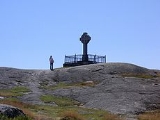
Birka

Encyclopedia
- This is about a Viking-age trading center in Sweden. For other meanings see Birka (disambiguation)Birka (disambiguation)-Places:*Birka, a Viking-age trading center in Sweden*The Beryozovye Islands in the Gulf of Finland*Birka, Afghanistan, a place in Afghanistan*The Wagh El-Birket, a former red-light district in Cairo-Ships:*Birka Line, an Ålandian shipping company...
.
During the Viking Age
Viking Age
Viking Age is the term for the period in European history, especially Northern European and Scandinavian history, spanning the late 8th to 11th centuries. Scandinavian Vikings explored Europe by its oceans and rivers through trade and warfare. The Vikings also reached Iceland, Greenland,...
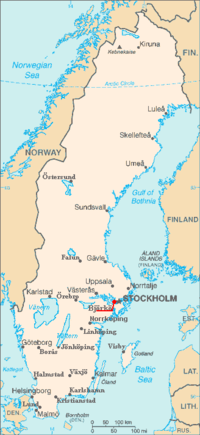
, Birka (Birca in medieval sources), on the island of Björkö (literally: "Birch Island") in Sweden
Sweden
Sweden , officially the Kingdom of Sweden , is a Nordic country on the Scandinavian Peninsula in Northern Europe. Sweden borders with Norway and Finland and is connected to Denmark by a bridge-tunnel across the Öresund....
, was an important trading center which handled goods from Scandinavia
Scandinavia
Scandinavia is a cultural, historical and ethno-linguistic region in northern Europe that includes the three kingdoms of Denmark, Norway and Sweden, characterized by their common ethno-cultural heritage and language. Modern Norway and Sweden proper are situated on the Scandinavian Peninsula,...
as well as Central
Central Europe
Central Europe or alternatively Middle Europe is a region of the European continent lying between the variously defined areas of Eastern and Western Europe...
and Eastern Europe
Eastern Europe
Eastern Europe is the eastern part of Europe. The term has widely disparate geopolitical, geographical, cultural and socioeconomic readings, which makes it highly context-dependent and even volatile, and there are "almost as many definitions of Eastern Europe as there are scholars of the region"...
and the Orient. Björkö is located in Lake Mälaren
Mälaren
Lake Mälaren is the third-largest lake in Sweden, after Lakes Vänern and Vättern. Its area is 1,140 km² and its greatest depth is 64 m. Mälaren spans 120 kilometers from east to west...
, 30 kilometers west of contemporary Stockholm
Stockholm
Stockholm is the capital and the largest city of Sweden and constitutes the most populated urban area in Scandinavia. Stockholm is the most populous city in Sweden, with a population of 851,155 in the municipality , 1.37 million in the urban area , and around 2.1 million in the metropolitan area...
, in the municipality of Ekerö
Ekerö
Ekerö is a locality and the seat of Ekerö Municipality in Stockholm County, Sweden, with 10,322 inhabitants in 2005.Agnetha Fältskog of ABBA fame lives on the island ....
. The archaeological sites of Birka and Hovgården
Hovgården
Hovgården is an archaeological site on the Lake Mälaren island of Adelsö in Ekerö Municipality in central-eastern Sweden. During the Viking Age, the centre of the prospering Mälaren Valley was the settlement Birka, founded in the mid-8th century and abandoned in the late 10th century and located...
, on the neighbouring island of Adelsö
Adelsö
Adelsö is an island in the middle of Lake Mälaren in Sweden, near southern and northern Björkfjärden. The administrative center of the important Viking settlement Birka was situated at Hovgården on Adelsö.-Geography:...
, make up an archaeological complex which illustrates the elaborate trading networks of Viking Scandinavia
Scandinavia
Scandinavia is a cultural, historical and ethno-linguistic region in northern Europe that includes the three kingdoms of Denmark, Norway and Sweden, characterized by their common ethno-cultural heritage and language. Modern Norway and Sweden proper are situated on the Scandinavian Peninsula,...
and their influence on the subsequent history of Europe
Europe
Europe is, by convention, one of the world's seven continents. Comprising the westernmost peninsula of Eurasia, Europe is generally 'divided' from Asia to its east by the watershed divides of the Ural and Caucasus Mountains, the Ural River, the Caspian and Black Seas, and the waterways connecting...
. Generally regarded as Sweden's oldest town, Birka (along with Hovgården) has been a UNESCO
UNESCO
The United Nations Educational, Scientific and Cultural Organization is a specialized agency of the United Nations...
World Heritage Site
World Heritage Site
A UNESCO World Heritage Site is a place that is listed by the UNESCO as of special cultural or physical significance...
since 1993.
History

Staraya Ladoga
Staraya Ladoga , or the Aldeigjuborg of Norse sagas, is a village in the Volkhovsky District of Leningrad Oblast, Russia, located on the Volkhov River near Lake Ladoga, 8 km north of the town of Volkhov. The village used to be a prosperous trading outpost in the 8th and 9th centuries...
(Aldeigja) and Novgorod (Holmsgard) to the Byzantine Empire
Byzantine Empire
The Byzantine Empire was the Eastern Roman Empire during the periods of Late Antiquity and the Middle Ages, centred on the capital of Constantinople. Known simply as the Roman Empire or Romania to its inhabitants and neighbours, the Empire was the direct continuation of the Ancient Roman State...
and the Abbasid
Abbasid
The Abbasid Caliphate or, more simply, the Abbasids , was the third of the Islamic caliphates. It was ruled by the Abbasid dynasty of caliphs, who built their capital in Baghdad after overthrowing the Umayyad caliphate from all but the al-Andalus region....
Califate. Birka was also important as the site of the first known Christian
Christianity
Christianity is a monotheistic religion based on the life and teachings of Jesus as presented in canonical gospels and other New Testament writings...
congregation in Sweden, founded in 831 by Saint Ansgar
Ansgar
Saint Ansgar, Anskar or Oscar, was an Archbishop of Hamburg-Bremen. The see of Hamburg was designated a "Mission to bring Christianity to the North", and Ansgar became known as the "Apostle of the North".-Life:After his mother’s early death Ansgar was brought up in Corbie Abbey, and made rapid...
.
Sources are mainly archeological remains. No texts survive from this area, though the written text Vita Ansgari
Vita Ansgari
Vita Ansgari is the biography of Ansgar, written by Rimbert, his successor as archbishop in Hamburg-Bremen. Written in about 875 CE, the Vita is an important source in not only detailing Ansgar's missionary work in Scandinavia but in its descriptions of the everyday lives of people during the...
("The life of Ansgar") by Rimbert
Rimbert
Saint Rimbert was archbishop of Bremen-Hamburg from 865 until his death.A monk in Turholt , he shared a missionary trip to Scandinavia with his friend Ansgar, whom he later succeeded as archbishop in Hamburg-Bremen in 865...
(c. 865) describes the missionary work of Ansgar
Ansgar
Saint Ansgar, Anskar or Oscar, was an Archbishop of Hamburg-Bremen. The see of Hamburg was designated a "Mission to bring Christianity to the North", and Ansgar became known as the "Apostle of the North".-Life:After his mother’s early death Ansgar was brought up in Corbie Abbey, and made rapid...
around 830 at Birka, and Gesta Hammaburgensis Ecclesiae Pontificum (Deeds of Bishops of the Hamburg Church) by Adam of Bremen
Adam of Bremen
Adam of Bremen was a German medieval chronicler. He lived and worked in the second half of the eleventh century. He is most famous for his chronicle Gesta Hammaburgensis Ecclesiae Pontificum .-Background:Little is known of his life other than hints from his own chronicles...
in 1075 describes the archbishop
Archbishop
An archbishop is a bishop of higher rank, but not of higher sacramental order above that of the three orders of deacon, priest , and bishop...
Unni, who died at Birka in 936. St Ansgar's work was the first attempt to convert the inhabitants from the Norse religion
Norse mythology
Norse mythology, a subset of Germanic mythology, is the overall term for the myths, legends and beliefs about supernatural beings of Norse pagans. It flourished prior to the Christianization of Scandinavia, during the Early Middle Ages, and passed into Nordic folklore, with some aspects surviving...
to Christianity, and it was unsuccessful.
Both Rimbert and Adam were German clergymen writing in Latin
Latin
Latin is an Italic language originally spoken in Latium and Ancient Rome. It, along with most European languages, is a descendant of the ancient Proto-Indo-European language. Although it is considered a dead language, a number of scholars and members of the Christian clergy speak it fluently, and...
. There are no known Norse sources mentioning the name of the settlement, or even the settlement itself, and the original Norse name of Birka is unknown. Birca is the Latinised
Romanization
In linguistics, romanization or latinization is the representation of a written word or spoken speech with the Roman script, or a system for doing so, where the original word or language uses a different writing system . Methods of romanization include transliteration, for representing written...
form given in the sources and Birka its contemporary, unhistorical Swedish form. The Latin name is probably derived from an Old Norse
Old Norse
Old Norse is a North Germanic language that was spoken by inhabitants of Scandinavia and inhabitants of their overseas settlements during the Viking Age, until about 1300....
word "birk
Birk (market place)
Birk was during the Scandinavian Middle Ages the name for a demarcated area, especially a town or a market place, with its own laws and privileges, the Bjarkey laws....
" which probably meant a market place. Related to this was the Bjärköa law (bjärköarätt) which regulated the life on market places in Denmark, Norway and Sweden. Both terms in different forms are very common in Scandinavian place names still today leading to speculation that all references to Birca especially by Adam of Bremen were not about the same location.
Both publications are silent on Birca's size, layout and appearance. Based on Rimbert's account, Birca was significant because it had a port and it was the place for the regional ting
Thing (assembly)
A thing was the governing assembly in Germanic and introduced into some Celtic societies, made up of the free people of the community and presided by lawspeakers, meeting in a place called a thingstead...
. Adam only mentions the port, but otherwise Birca seems to have been significant to him because it had been the bridgehead of Ansgar's Christian mission and because archbishop Unni had been buried there.
Vita Ansgari and Gesta are sometimes ambiguous, which has caused some controversy as to whether Birca and the Björkö settlement were the same location. Many other locations have been suggested through the years. However, Björkö is the only location that can show remains of a town of Birca's significance, which is why the vast majority of scholars regard Björkö as the location of Birca.
Birka was abandoned during the later half of the 10th century. Based on the coin finds, the city seems to have silenced around 960. Roughly around the same time, the near-by settlement of Sigtuna
Sigtuna
Sigtuna is a locality situated in Sigtuna Municipality, Stockholm County, Sweden with 18 inhabitants in 2005. It is the namesake of the municipality even though the seat is in Märsta....
supplanted Birka as the main trading centre in the Mälaren
Mälaren
Lake Mälaren is the third-largest lake in Sweden, after Lakes Vänern and Vättern. Its area is 1,140 km² and its greatest depth is 64 m. Mälaren spans 120 kilometers from east to west...
area. The reasons for Birka's decline are disputed. A contributing factor may have been the post-glacial rebound
Post-glacial rebound
Post-glacial rebound is the rise of land masses that were depressed by the huge weight of ice sheets during the last glacial period, through a process known as isostasy...
, which lowered the water level of Mälaren changing it from an arm of the sea into a lake and cut Birka off from the nearest (southern) access to the Baltic Sea
Baltic Sea
The Baltic Sea is a brackish mediterranean sea located in Northern Europe, from 53°N to 66°N latitude and from 20°E to 26°E longitude. It is bounded by the Scandinavian Peninsula, the mainland of Europe, and the Danish islands. It drains into the Kattegat by way of the Øresund, the Great Belt and...
. The Baltic island of Gotland
Gotland
Gotland is a county, province, municipality and diocese of Sweden; it is Sweden's largest island and the largest island in the Baltic Sea. At 3,140 square kilometers in area, the region makes up less than one percent of Sweden's total land area...
was also in a better strategic position for Russian-Byzantine trade, and was gaining eminence as a mercantile stronghold. Historian Neil Kent has speculated that the area may have been the victim of an enemy assault.
The Varangian trade stations in Russia
Russia
Russia or , officially known as both Russia and the Russian Federation , is a country in northern Eurasia. It is a federal semi-presidential republic, comprising 83 federal subjects...
suffered a serious decline at roughly the same date.
Rimbert's Birka
In Vita AnsgariVita Ansgari
Vita Ansgari is the biography of Ansgar, written by Rimbert, his successor as archbishop in Hamburg-Bremen. Written in about 875 CE, the Vita is an important source in not only detailing Ansgar's missionary work in Scandinavia but in its descriptions of the everyday lives of people during the...
("The life of Ansgar") monk and later archbishop of Hamburg-Bremen
Archbishopric of Bremen
The Archdiocese of Bremen was a historical Roman Catholic diocese and formed from 1180 to 1648 an ecclesiastical state , named Prince-Archbishopric of Bremen within the Holy Roman Empire...
Rimbert
Rimbert
Saint Rimbert was archbishop of Bremen-Hamburg from 865 until his death.A monk in Turholt , he shared a missionary trip to Scandinavia with his friend Ansgar, whom he later succeeded as archbishop in Hamburg-Bremen in 865...
gives the first known description of Birka. The town was the center of Catholic missionary activities in the 9th century Sweden. Rimbert's interests were in the Christian faith, not so much in the Swedish geopolicy, so his descriptions of Birka remain approximate at best.
Bridgehead of Christian missionaries
This is how it all started in 829:- "Meanwhile it happened that Swedish ambassadors had come to the Emperor Louis the PiousLouis the PiousLouis the Pious , also called the Fair, and the Debonaire, was the King of Aquitaine from 781. He was also King of the Franks and co-Emperor with his father, Charlemagne, from 813...
, and, amongst other matters which they had been ordered to bring to the attention of the emperor, they informed him that there were many belonging to their nation who desired to embrace the Christian religion, and that their king so far favoured this suggestion that lie would permit God's priests to reside there, provided that they might be deemed worthy of such a favour and that the emperor would send them suitable preachers." (Chapter IX)
- "AnsgarAnsgarSaint Ansgar, Anskar or Oscar, was an Archbishop of Hamburg-Bremen. The see of Hamburg was designated a "Mission to bring Christianity to the North", and Ansgar became known as the "Apostle of the North".-Life:After his mother’s early death Ansgar was brought up in Corbie Abbey, and made rapid...
then undertook the mission committed to him by the emperor, who desired that he should go to the Swedes and discover whether this people was prepared to accept the faith as their messengers had declared." (Chapter X)
Ansgar was already experienced in the missionary work in Denmark
Denmark
Denmark is a Scandinavian country in Northern Europe. The countries of Denmark and Greenland, as well as the Faroe Islands, constitute the Kingdom of Denmark . It is the southernmost of the Nordic countries, southwest of Sweden and south of Norway, and bordered to the south by Germany. Denmark...
, and set forth to Sweden. Rimbert describes the trip very generally:
- "It may suffice for me to say that while they were in the midst of their journey they fell into the hands of pirates. The merchants with whom they were travelling, defended themselves vigorously and for a time successfully, but eventually they were conquered and overcome by the pirates, who took from them their ships and all that they possessed, whilst they themselves barely escaped on. foot to land. -- With great difficulty they accomplished their long journey on foot, traversing also the intervening seas (maria), where it was possible, by ship, and eventually arrived at the Swedish port called Birka." (Chapters X and XI)
Rimbert does not say where Ansgar sailed off or where he landed. Noteworthy is just his note about several "seas" that they had to cross to get to Birka from the place they had landed to. Since Rimbert mentions them to have crossed the seas by ship "where it was possible" they clearly had the alternative of going around them as well, meaning that the seas were probably the numerous lakes in southern Sweden. When Ansgar again travelled to Birka from Germany about 852, it went easier:
- "Ansgar accomplished the journey on which he had set out, and after spending nearly twenty days in a ship, he arrived at Birka --" (Chapter XXVI)
This might mean that he sailed off from Hamburg
Hamburg
-History:The first historic name for the city was, according to Claudius Ptolemy's reports, Treva.But the city takes its modern name, Hamburg, from the first permanent building on the site, a castle whose construction was ordered by the Emperor Charlemagne in AD 808...
or Bremen instead of some port in Baltic Sea, since the later account by Adam of Bremen gives the distance of Scania
Scania
Scania is the southernmost of the 25 traditional non-administrative provinces of Sweden, constituting a peninsula on the southern tip of the Scandinavian peninsula, and some adjacent islands. The modern administrative subdivision Skåne County is almost, but not totally, congruent with the...
and Birka to be only 5 days at sea.
King in Birka
Several Swedish kings of the 9th century, BjörnBjörn at Haugi
Björn at Haugi , Björn på Håga, Björn II or Bern was according to Hervarar saga a Swedish king and the son of Erik Björnsson, and Björn ruled together in diarchy with his brother Anund Uppsale:This account dates king Björn to the first half of the 9th century, as his nephew Eric Anundsson was...
, Anund
Anund Uppsale
Anund Uppsale or Anoundus, English exonym: Anwynd of Upsala, ruled Sweden together with his brother Björn at Haugi, according to Rimbert and Hervarar saga...
and Olof
Olof (I) of Sweden
Olof was king in Sweden when Catholic missionary St. Ansgar made his second voyage from Germany to the Swedish city of Birka in the year 854 A.D....
, are all mentioned in Vita to have spent time in Birka. None of them is however said to have had his residence there, as the Swedish king and his retinue routinely moved between the Husby
Husby
Husby is the name of many Swedish farms and villages. Originally, they formed a network of royal estates, called Uppsala öd, that were the property of the Swedish king....
s, parts of the network of royal estates called Uppsala öd
Uppsala öd
Uppsala öd, Old Norse: Uppsala auðr or Uppsala øðr was the name given to the collection of estates which was the property of the Swedish Crown in medieval Sweden. Its purpose was to finance the Swedish king, originally the "king of Uppsala", and they supported the king and his retinue while he...
.
King Björn met Ansgar in Birka when he arrived there in 829 (Chapter XI). Later king Olof met him there as well during his last trip in 852 (Chapter XXVI).
Church in Birka
Ansgar's missionary work resulted in first churches to be built in Sweden. Talking about Herigar, the prefect of Birka:- "A little later he built a church on his own ancestral property and served God with the utmost devotion." (Chapter XI)
Herigar's church was not far from the place where tings were held:
- "On one occasion lie himself was sitting in an assembly of people, a stage having been arranged for a council on an open plain. -- He then summoned his servants and told them to carry him to his church." (Chapter XIX)
Another church was also built in Sweden, however location is left open:
- "This Gautbert, who at his consecration received the honoured name of the apostle Simeon, went to Sweden, and was honourably received by the king and the people ; and he began, amidst general goodwill and approval, to build a church there --" (Chapter XIV)
The exiled Swedish King Anund Uppsale
Anund Uppsale
Anund Uppsale or Anoundus, English exonym: Anwynd of Upsala, ruled Sweden together with his brother Björn at Haugi, according to Rimbert and Hervarar saga...
confirms that either one of the churches was in Birka itself when he ponders if Birka should be plundered:
- ""There are there," he said, " many great and powerful gods, and in former time a church was built there, and there are many Christians there who worship Christ --"" (Chapter XIX)
Fortress in Birka?
Danes attacked Birka, accompanied with the deposed king AnundAnund Uppsale
Anund Uppsale or Anoundus, English exonym: Anwynd of Upsala, ruled Sweden together with his brother Björn at Haugi, according to Rimbert and Hervarar saga...
, which caused great distress in the town.
- "Being in great difficulty they fled to a neighbouring city (ad civitatem, quæ iuxta erat, confugerunt) and began to promise and offer to their gods -- But inasmuch as the city was not strong and there were few to offer resistance, they sent messengers to the Danes and asked for friendship and alliance. -- Hergeir, the faithful servant of the Lord, was angry with them and said, -- "They will lead away your wives and sons as captives, they will burn our city (urbs) and town (vicus) and will destroy you with the sword --"" (Chapter XIX)
As the neighbouring "city" is not mentioned in any other context than during the Danish attack as a place where people took refuge, it probably meant a near-by fortress. Eventually Danes left, sparing Birka from destruction.
Ting in Birka
When Ansgar asked if King OlofOlof (I) of Sweden
Olof was king in Sweden when Catholic missionary St. Ansgar made his second voyage from Germany to the Swedish city of Birka in the year 854 A.D....
would permit him to establish the Christian religion in the kingdom during his second visit in 852, the king said to him:
- "On this account I have not the power, nor do I dare, to approve the objects of your mission until I can consult our gods by the casting of lots and until I can enquire the will of the people in regard to this matter. Let your messenger attend with me the next assembly --" (Chapter XXVI)
- "When the day for the assembly which was held in the town of Birka drew near, in accordance with their national custom the king caused a proclamation to be made to the people by the voice of a herald, in order that they might be informed concerning the object of their mission. -- The king then rose up from amongst the assembly and forthwith directed one of his own messengers to accompany the bishop's messenger, and to tell him that the people were unanimously inclined to accept his proposal and at the same time to tell him that, whilst their action was entirely agreeable to him, he could not give his full consent until, in another assembly, which was to be held in another part of his kingdom, he could announce this resolution to the people who lived in that district." (Chapter XXVII)
Tings
Thing (assembly)
A thing was the governing assembly in Germanic and introduced into some Celtic societies, made up of the free people of the community and presided by lawspeakers, meeting in a place called a thingstead...
were huge open air events, which required plenty of space. The more important ting that king Olof talked about was probably the Ting of all Swedes
Thing of all Swedes
The Thing of all Swedes was the governing assembly held from pre-historic times to the Middle Ages at Gamla Uppsala, Sweden, occurring at the end of February or early March in conjunction with a great fair and a pagan celebration called Dísablót...
, which was held at the end of February in Uppsala
Uppsala
- Economy :Today Uppsala is well established in medical research and recognized for its leading position in biotechnology.*Abbott Medical Optics *GE Healthcare*Pfizer *Phadia, an offshoot of Pharmacia*Fresenius*Q-Med...
, during the Disting
Disting
The Disting is an annual market which is held in Uppsala, Sweden, since pre-historic times. The name originally referred to the great assembly called the Thing of all Swedes, and it is derived from the fact that both the market and the thing were held in conjunction with the Dísablót, the great...
. The king was obliged to obey the common decisions made at this ting, and the most powerful man at this assembly was not the king, but the lawspeaker
Lawspeaker
A lawspeaker is a unique Scandinavian legal office. It has its basis in a common Germanic oral tradition, where wise men were asked to recite the law, but it was only in Scandinavia that the function evolved into an office...
of Tiundaland
Tiundaland
Tiundaland is a historic region, Folkland, and since 1296 part of the modern province of Uppland. It originally meant the land of the ten hundreds and referred to its duty of providing 1000 men and 40 ships for the Swedish king's leidang....
. Locally important tings were the Westrogothic Ting of all Geats
Thing of all Geats
The Thing of all Geats was the thing which was held from pre-historic times to the Middle Ages in Skara, Västergötland. Although its name suggests that it comprised all Geats, it concerned those living in Västergötland and Dalsland, and it is described in the Westrogothic law...
in Skara and the Ostrogothic Lionga ting
Lionga thing
Lionga thing was the general assembly of the people of Östergötland in medieval Sweden. Lionga thing is mentioned in Östgötalagen and was held in Linköping in the Middle Ages. Its original location is unknown. The first known mention of Lionga thing is from 1350....
in the vicinity of today's Linköping
Linköping
Linköping is a city in southern middle Sweden, with 104 232 inhabitants in 2010. It is the seat of Linköping Municipality with 146 736 inhabitants and the capital of Östergötland County...
.
Adam of Bremen's Birka
In Gesta Hammaburgensis ecclesiae pontificumGesta Hammaburgensis ecclesiae pontificum
Gesta Hammaburgensis ecclesiae pontificum is a historical treatise written between 1075 and 1080 by Adam of Bremen. It covers the period from 788 to the time it was written. The treatise consist of:*Liber I...
(Deeds of Bishops of the Hamburg Church), Adam of Bremen mentions Birka many times, and the book is the main source of information on the city. After its initial release in 1075/6, Gesta was complemented with supplementary Scholias until the death of Adam in the 1080s. Birca is described as an existing city in the original version, but then as destroyed in Scholia 138.
One of Adam's main sources had been the German bishop Adalvard the Younger
Adalvard
Adalvard is the name of two clergymen who were active in Sweden during its Christianization in the 11th century.*Adalvard the Elder , bishop of Skara*Adalvard the Younger , his successor in Skara...
of Sigtuna
Sigtuna
Sigtuna is a locality situated in Sigtuna Municipality, Stockholm County, Sweden with 18 inhabitants in 2005. It is the namesake of the municipality even though the seat is in Märsta....
and later of Skara
Skara
Skara is a locality and the seat of Skara Municipality, Västra Götaland County, Sweden with 18595 inhabitants in 2005. Despite its small size, it has a long educational and ecclesiastical history. One of Sweden's oldest high schools, Katedralskolan , is situated in Skara...
as hinted in Scholia 119. He was also very familiar with Rimbert's work. Adam himself never visited Birka.
Birka's location and port
Adam described Birka as a GeatGeat
Geats , and sometimes Goths) were a North Germanic tribe inhabiting what is now Götaland in modern Sweden...
ish port town and had gathered many details about it.
- "Birka is the main Geatish town (oppidumOppidumOppidum is a Latin word meaning the main settlement in any administrative area of ancient Rome. The word is derived from the earlier Latin ob-pedum, "enclosed space," possibly from the Proto-Indo-European *pedóm-, "occupied space" or "footprint."Julius Caesar described the larger Celtic Iron Age...
Gothorum), situated in the middle of Sweden (Suevoniae), not far (non longe) from the temple called UppsalaTemple at UppsalaThe Temple at Uppsala was a religious center in Norse paganism once located at what is now Gamla Uppsala , Sweden attested in Adam of Bremen's 11th century work Gesta Hammaburgensis ecclesiae pontificum and in Heimskringla, written by Snorri Sturluson in the 13th century...
(Ubsola) which the Swedes (Sueones) held in the highest esteem when it comes to the worship of the gods; here forms an inlet of the Baltic or the Barbaric Sea a port facing north which welcomes all the wild peoples all around this sea but which is risky for those who are careless or ignorant of such places ... they have therefore blocked this inlet of the troubled sea with hidden masses of rocks along more than 100 stadionsAncient Greek units of measurementAncient Greek units of measurement would later create the foundation of Egyptian, and formed the basis of the later Roman system.Generally speaking, standards of measurement within the ancient Greek world varied according to location and epoch. Systems of ancient weights and measures evolved as...
(18 km). On this anchorage, being the best sheltered within the maritime region of Sweden (Suevoniae), all the ships belonging to Danes (Danorum) known as Norwegians (Nortmannorum) as well as to Slavs (Sclavorum), Sembrians (Semborum) and other Scythian (Scithiae) peoples use to convene every year for sundry necessary commerce." (I 62)
- "Turning from the northern parts to the mouth of the Baltic Sea we first meet the Norwegians (Nortmanni), then the Danish region of Skåne (Sconia) stands out, and beyond these live the Geats (Gothi) for a long stretch all the way to Birka." (IV 14)
Having described Västergötland
Västergötland
', English exonym: West Gothland, is one of the 25 traditional non-administrative provinces of Sweden , situated in the southwest of Sweden. In older English literature one may also encounter the Latinized version Westrogothia....
and Skara
Skara
Skara is a locality and the seat of Skara Municipality, Västra Götaland County, Sweden with 18595 inhabitants in 2005. Despite its small size, it has a long educational and ecclesiastical history. One of Sweden's oldest high schools, Katedralskolan , is situated in Skara...
, Adam writes:
- "Beyond it ÖstergötlandÖstergötlandÖstergötland, English exonym: East Gothland, is one of the traditional provinces of Sweden in the south of Sweden. It borders Småland, Västergötland, Närke, Södermanland, and the Baltic Sea. In older English literature, one might also encounter the Latinized version, Ostrogothia...
(Ostrogothia) extends along the sea, that is called the Baltic Sea, all the way to Birka." (IV 23)
Noteworthy in the following statement is the usage of the term "not far" (non longe) which was also used to describe the distance between Birka and the Uppsala temple:
- "Furthermore we have been told that there are many more islands in that sea, one of which is called the Great EstlandEstoniaEstonia , officially the Republic of Estonia , is a state in the Baltic region of Northern Europe. It is bordered to the north by the Gulf of Finland, to the west by the Baltic Sea, to the south by Latvia , and to the east by Lake Peipsi and the Russian Federation . Across the Baltic Sea lies...
(Aestland) -- And this island is told to be quite close to the Woman Land (terrae feminarumTerra FeminarumTerra feminarum is a name for a land in Fennoscandia that appears in Gesta Hammaburgensis Ecclesiae Pontificum by Adam of Bremen 1075 AD...
), which is not far (non longe) away from Birka of the Swedes." (IV 17)
Adam also had travel instructions from Skåne to Sigtuna
Sigtuna
Sigtuna is a locality situated in Sigtuna Municipality, Stockholm County, Sweden with 18 inhabitants in 2005. It is the namesake of the municipality even though the seat is in Märsta....
:
- "From Skåne (Sconia) of the Danes one reaches Sigtuna (Sictonam) or Birka after five days at sea, for they are indeed alike. But by land from Skåne across the Geatish people (Gothorum populos) and cities Skara (Scaranem), Telgas and Birka, one reaches Sigtuna only after a full month." (IV 28)
"Telgas" is not mentioned anywhere else, and it remains as speculative as Birka. The most popular identification among many telge names in Sweden is Södertälje
Södertälje
Södertälje is a city and the seat of Södertälje Municipality, Stockholm County, Sweden with 86,069 inhabitants in 2010.The industrial city, about south of Stockholm, is the home to truck maker Scania AB and a top 10 pharmaceutical company AstraZeneca....
. Scholia 121 of IV 20 tells also:
- "For those who sail from Skåne (Sconia) of the Danes to Birka, the journey takes five days, from Birka to Russia (Ruzziam) likewise five days at sea." (Scholia 121)
The following definition remains even more mysterious:
- "In pity of their errors, our archbishop ordained as their diocesan capital Birka, which is in the middle of Sweden (Sueoniae) facing Jumne (Iumnem), the capital of the Slavs, and equally distant from all the coasts of the surrounding sea." (IV 20)
Since it is physically impossible for any Swedish town to face Jumne, the latter being situated along River Oder
Oder
The Oder is a river in Central Europe. It rises in the Czech Republic and flows through western Poland, later forming of the border between Poland and Germany, part of the Oder-Neisse line...
, Adam's statement is probably a misunderstanding. No place having a similar name to Birka is known to have situated on the opposite shore of Oder, so it may be possible that something similar to Jumne was located opposite to Birka.
Bishop in Birka
Archbishopric of Hamburg-BremenArchbishopric of Bremen
The Archdiocese of Bremen was a historical Roman Catholic diocese and formed from 1180 to 1648 an ecclesiastical state , named Prince-Archbishopric of Bremen within the Holy Roman Empire...
that oversaw the missionary work in Scandinavia until 1103, had appointed bishops to Sweden at least from 1014 onwards, the first see being in Skara
Skara
Skara is a locality and the seat of Skara Municipality, Västra Götaland County, Sweden with 18595 inhabitants in 2005. Despite its small size, it has a long educational and ecclesiastical history. One of Sweden's oldest high schools, Katedralskolan , is situated in Skara...
. Several bishops were appointed for Sweden in 1060s, one also for Birka.
- "For Sweden, six were consecrated: Adalvard the ElderAdalvardAdalvard is the name of two clergymen who were active in Sweden during its Christianization in the 11th century.*Adalvard the Elder , bishop of Skara*Adalvard the Younger , his successor in Skara...
(Adalwardum) and Acilinum, also Adalvard the YoungerAdalvardAdalvard is the name of two clergymen who were active in Sweden during its Christianization in the 11th century.*Adalvard the Elder , bishop of Skara*Adalvard the Younger , his successor in Skara...
(Adalwardum) and Tadicum, and furthermore Simeon (Symeonem) and the monk John (Iohannem)." (III 70)
Scholia 94 appends this as follows:
- "Adalvard the Elder (Adalwardus senior) was to superintend both lands of the Geats (uterque praefectus est Gothiae), Adalvard the Younger Sigtuna (Sictunam) and Uppsala (Ubsalam), Simeon (Symon) the Sami peopleSami peopleThe Sami people, also spelled Sámi, or Saami, are the arctic indigenous people inhabiting Sápmi, which today encompasses parts of far northern Sweden, Norway, Finland, the Kola Peninsula of Russia, and the border area between south and middle Sweden and Norway. The Sámi are Europe’s northernmost...
(Scritefingos), John (Iohannes) the islands of the Baltic Sea." (Scholia 94)
Furthermore, the following was said about John's location after talking about Birka:
- "For this city he ordained, as the first among our people, the abbot Hiltin, whom he wanted to call John." (IV 20)
John seems to have been situated in Birka in order to prepare for the missionary work among the many heathen people that flooded to Birca from around the Baltic coasts. This was a logical continuation to Birka's position as the first missionary town in Sweden. Noteworthy here is that the biggest islands in the Baltic Sea, Öland
Öland
' is the second largest Swedish island and the smallest of the traditional provinces of Sweden. Öland has an area of 1,342 km² and is located in the Baltic Sea just off the coast of Småland. The island has 25,000 inhabitants, but during Swedish Midsummer it is visited by up to 500,000 people...
and Gotland
Gotland
Gotland is a county, province, municipality and diocese of Sweden; it is Sweden's largest island and the largest island in the Baltic Sea. At 3,140 square kilometers in area, the region makes up less than one percent of Sweden's total land area...
, were part of the diocese of Linköping in the Middle Ages, covering also Östergötland and eastern Småland
Småland
' is a historical province in southern Sweden.Småland borders Blekinge, Scania or Skåne, Halland, Västergötland, Östergötland and the island Öland in the Baltic Sea. The name Småland literally means Small Lands. . The latinized form Smolandia has been used in other languages...
.
Location of Unni's tomb
Scholia 122 of IV 20 locates the tomb of Hamburg's archbishop UnniUnni (archbishop)
Saint Unni was an archbishop of Hamburg-Bremen . He died as a missionary in Birka in Sweden, where he tried to continue Ansgar's work....
in Birka:
- "There is the port of Saint AnsgarAnsgarSaint Ansgar, Anskar or Oscar, was an Archbishop of Hamburg-Bremen. The see of Hamburg was designated a "Mission to bring Christianity to the North", and Ansgar became known as the "Apostle of the North".-Life:After his mother’s early death Ansgar was brought up in Corbie Abbey, and made rapid...
and the tomb of the holy Archbishop Unni, and a familiar haven, it is said, for the holy confessors of our diocese." (Scholia 122)
According to Gesta, Unni had died in 936 (I 64).
Birka's destruction
After having consistently described Birka as an existing city, Scholia 138 of IV 29 describes Birka's sudden demise. Talking about Adalvard the YoungerAdalvard
Adalvard is the name of two clergymen who were active in Sweden during its Christianization in the 11th century.*Adalvard the Elder , bishop of Skara*Adalvard the Younger , his successor in Skara...
, the bishop of Sigtuna and later that of Skara, Adam or a later copyist has written:
- "During his journey he seized the opportunity to make a detour to Birka, which is now reduced to loneliness so that one can hardly find vestiges of the city; therefore impossible to come upon the tomb of the holy Archbishop Unni." (Scholia 138)
The remark does not make it clear if Adalvard found the city destroyed or if that had happened after his visit and the later remark was just to warn the future pilgrims not to go there anymore in vain. As Adalvard was back in Bremen already by 1069 and is mentioned as one of Adam's sources of information, it would have been expected that word about Birka's destruction had reached also Adam before he published his work half a decade later.
Björkö archaeological site

- "And there were three capitals in Sweden two of which were not long away from Uppsala (vpsala). The one was called Sigtuna (siktuna) and the other Birka (birka). Birka was on an island in Lake Mälaren (mälar) that is called Björkö (birköö). The third was in Westgötaland (westergötlandh) and was called Skara (skara)."
In search of Birka, National Antiquarian Johan Hadorph
Johan Hadorph
Johan Hadorph was a Swedish director-general of the Central Board of National Antiquities. In 1667, he was appointed assessor at the government agency for antiquities, and in 1679, he became its director-general...
was the first to attempt excavations on Björkö in the late 17th century.
In the late 19th century, Hjalmar Stolpe
Hjalmar Stolpe
Hjalmar Stolpe, a Swedish entomologist, archaeologist, and ethnographer, was born April 23, 1841, in Gävle, Sweden, and died January 27, 1905. He is most well known for his archaeological excavations at the Viking-age site Birka....
, an entomologist
Entomology
Entomology is the scientific study of insects, a branch of arthropodology...
by education, arrived on Björkö to study fossilized insects found in amber
Amber
Amber is fossilized tree resin , which has been appreciated for its color and natural beauty since Neolithic times. Amber is used as an ingredient in perfumes, as a healing agent in folk medicine, and as jewelry. There are five classes of amber, defined on the basis of their chemical constituents...
on the island. Stolpe found very large amounts of amber on the island, which is unusual since amber is not normally found in lake Mälaren. Stolpe speculated that the island may have been an important trading post, prompting him to conduct a series of archeological excavations between 1871-95. The excavations soon indicated that a major settlement had been located on the island and eventually Stolpe spent two decades excavating the island. After Björkö came to be identified with ancient Birka, it has been assumed that the original name of Birka was simply Bierkø (sometimes spelt Bjärkö), an earlier form of Björkö.
Ownership of Björkö is today mainly in private hands, and used for farming. The settlement site, however is an archaeological site, and a museum
Museum
A museum is an institution that cares for a collection of artifacts and other objects of scientific, artistic, cultural, or historical importance and makes them available for public viewing through exhibits that may be permanent or temporary. Most large museums are located in major cities...
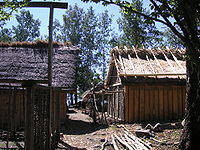
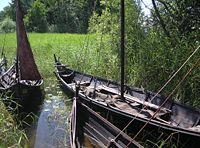
has been built nearby for exhibition of finds, models and reconstructions. It is a popular site to visit during the summer times.
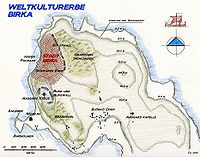
The archaeological remains are located in the north part of Björkö and span an area of about 7 hectare
Hectare
The hectare is a metric unit of area defined as 10,000 square metres , and primarily used in the measurement of land. In 1795, when the metric system was introduced, the are was defined as being 100 square metres and the hectare was thus 100 ares or 1/100 km2...
s (17 acre
Acre
The acre is a unit of area in a number of different systems, including the imperial and U.S. customary systems. The most commonly used acres today are the international acre and, in the United States, the survey acre. The most common use of the acre is to measure tracts of land.The acre is related...
s). The remains are both burial-sites and buildings, and in the south part of this area, there is also a hill fort
Hill fort
A hill fort is a type of earthworks used as a fortified refuge or defended settlement, located to exploit a rise in elevation for defensive advantage. They are typically European and of the Bronze and Iron Ages. Some were used in the post-Roman period...
called "Borgen" ("The Fortress"). The construction technique of the buildings is still unknown, but the main material was wood
Wood
Wood is a hard, fibrous tissue found in many trees. It has been used for hundreds of thousands of years for both fuel and as a construction material. It is an organic material, a natural composite of cellulose fibers embedded in a matrix of lignin which resists compression...
. An adjacent island holds the remains of Hovgården
Hovgården
Hovgården is an archaeological site on the Lake Mälaren island of Adelsö in Ekerö Municipality in central-eastern Sweden. During the Viking Age, the centre of the prospering Mälaren Valley was the settlement Birka, founded in the mid-8th century and abandoned in the late 10th century and located...
, an estate which housed the King's retinue during visits.
Approximately 700 people lived at Birka when it was as largest, and about 3,000 graves have been found. Its administrative center was supposedly located outside of the settlement itself, on the nearby island of Adelsö
Adelsö
Adelsö is an island in the middle of Lake Mälaren in Sweden, near southern and northern Björkfjärden. The administrative center of the important Viking settlement Birka was situated at Hovgården on Adelsö.-Geography:...
.
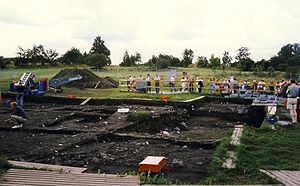
The most recent large excavation was undertaken between 1990-95 in a region of "black earth", believed to be the site of the main settlement. Björkö is today mainly agricultural, and shipping lines carry tourists to the island, where a museum showcases a view of life during the Viking era.
External links
- Birka and Hovgården at the Swedish National Heritage Board
- Birka at the Swedish National Heritage Board
- Birka and Hovgården - at UNESCO
- Reconstructions of Bone Flutes like the ones from Birka