

Mellitus

Encyclopedia
Mellitus was the first Bishop of London
in the Saxon period, the third Archbishop of Canterbury
, and a member of the Gregorian mission
sent to England to convert
the Anglo-Saxon
s from their native paganism to Christianity. He arrived in 601 AD with a group of clergymen sent to augment the mission, and was consecrated as Bishop of London in 604. Mellitus was the recipient of a famous letter from Pope Gregory I
known as the Epistola ad Mellitum, preserved in a later work by the medieval chronicler Bede
, which suggested the conversion of the Anglo-Saxons be undertaken gradually, integrating pagan rituals and customs. In 610, Mellitus returned to Italy to attend a council of bishops, and returned to England bearing papal letters to some of the missionaries.
Mellitus was exiled from London by the pagan successors to his patron, King Sæberht of Essex, following the latter's death around 616. King Æthelberht of Kent, Mellitus' other patron, died at about the same time, forcing him to take refuge in Gaul
. Mellitus returned to England the following year, after Æthelberht's successor had been converted to Christianity, but he was unable to return to London, whose inhabitants remained pagan. Mellitus was appointed Archbishop of Canterbury in 619. During his tenure, he was alleged to have miraculously saved the cathedral, and much of the town of Canterbury, from a fire. After his death in 624, Mellitus was revered as a saint.
, but it is unclear whether Mellitus had previously been abbot of a Roman monastery, or this was a rank bestowed on him to ease his journey to England by making him the leader of the expedition. The papal register, a listing of letters sent out by the popes, describes him as an "abbot in Frankia" in its description of the correspondence, but the letter itself only says "abbot". The first time Mellitus is mentioned in history is in the letters of Gregory, and nothing else of his background is known. It appears likely that he was a native of Italy, along with all the other bishops consecrated by Augustine.
 Pope Gregory I sent Mellitus to England in June 601, in response to an appeal from Augustine
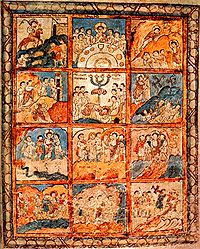
, the first Archbishop of Canterbury. Augustine needed more clergy to join the Gregorian mission that was converting the kingdom of Kent, then ruled by Æthelberht, from paganism to Christianity. The new missionaries brought with them a gift of books and "all things which were needed for worship and the ministry of the Church." Thomas of Elmham, a 15th-century Canterbury chronicler, claimed that in his day there were a number of the books brought to England by Mellitus still at Canterbury. Examination of the remaining manuscripts has determined that one possible survivor of Mellitus' books is the St. Augustine Gospels
, now in Cambridge, as Corpus Christi College, MS (manuscript) 286. Along with the letter to Augustine, the missionaries brought a letter for Æthelberht, urging the King to act like the Roman Emperor Constantine I
and force the conversion of his followers to Christianity. The king was also encouraged to destroy all pagan shrines.
The historian Ian Wood has suggested that Mellitus' journey through Gaul probably took in the bishoprics of Vienne, Arles, Lyons, Toulon, Marseilles, Metz, Paris, and Rouen, as evidenced by the letters that Gregory addressed to those bishops soliciting their support for Mellitus' party. Gregory also wrote to the Frankish
kings Chlothar II, Theuderic II
, Theudebert II
, along with Brunhilda of Austrasia
, who was Theudebert and Theuderic's grandmother and regent. Wood feels that this wide appeal to the Frankish episcopate and royalty was an effort to secure more support for the Gregorian mission. While on his journey to England, Mellitus received a letter from Gregory allowing Augustine to convert pagan temples
to Christian churches, and to convert pagan animal sacrifices
into Christian feasts, to ease the transition to Christianity. Gregory's letter marked a sea change in the missionary strategy, and was later included in Bede's Historia ecclesiastica gentis Anglorum
. Usually known as the Epistola ad Mellitum, it conflicts with the letter sent to Æthelberht, which the historian R. A. Markus sees as a turning point in missionary history, when forcible conversion gave way to persuasion. This traditional view, that the Epistola represents a contradiction of the letter to Æthelberht, has been challenged by the historian and theologian George Demacopoulos, who argues that the letter to Æthelberht was mainly meant to encourage the King in spiritual matters, while the Epistola was sent to deal with purely practical matters, and thus the two do not contradict each other.
in the province of the East Saxons, making Mellitus the first Bishop of London after the Roman departure (London was the East Saxons' capital). The city was a logical choice for a new bishopric, as it was a hub for the southern road network. It was also a former Roman town; many of the Gregorian mission's efforts were centred in such locations. Before his consecration, Mellitus baptised Sæberht, Æthelberht's nephew, who then allowed the bishopric to be established. The episcopal church built in London was probably founded by Æthelberht, rather than Sæberht. Although Bede records that Æthelberht gave lands to support the new episcopate, a charter that claims to be a grant of lands from Æthelberht to Mellitus is a later forgery.
Although Gregory had intended London to be the southern archbishopric for the island, Augustine never moved his episcopal see
to London, and instead consecrated Mellitus as a plain bishop there. After Augustine's death in 604, Canterbury continued to be the site of the southern archbishopric, and London remained a bishopric. It may have been that the Kentish king did not wish greater episcopal authority to be exercised outside his own kingdom.
Mellitus attended a council of bishops held in Italy in February 610, convened by Pope Boniface IV
. The historian N. J. Higham speculates that one reason for his attendance may have been to assert the English Church's independence from the Frankish Church. Boniface had Mellitus take two papal letters back to England, one to Æthelbert and his people, and another to Laurence
, the Archbishop of Canterbury. He also brought back the synod's decrees to England. No authentic letters or documents from this synod remain, although some were forged in the 1060s and 1070s at Canterbury. During his time as a bishop, Mellitus joined with Justus
, the Bishop of Rochester, in signing a letter that Laurence wrote to the Celtic bishops urging the Celtic Church
to adopt the Roman method of calculating the date of Easter
. This letter also mentioned the fact that Irish missionary bishops, such as Dagan
, refused to eat with the Roman missionaries.
Both Æthelberht and Sæberht died around 616 or 618, causing a crisis for the mission. Sæberht's three sons had not converted to Christianity, and drove Mellitus from London. Bede says that Mellitus was exiled because he refused the brothers' request for a taste of the sacramental bread
. Whether this occurred immediately after Sæberht's death or later is impossible to determine from Bede's chronology, which has both events in the same chapter but gives neither an exact time frame nor the elapsed time between the two events. The historian N. J. Higham connects the timing of this episode with a change in the "overkingship" from the Christian Kentish Æthelberht to the pagan East Anglian Raedwald, which Higham feels happened after Æthelberht's death. In Higham's view, Sæberht's sons drove Mellitus from London because they had passed from Kentish overlordship to East Anglian, and thus no longer needed to keep Mellitus, who was connected with the Kentish kingdom, in office.
Mellitus fled first to Canterbury, but Æthelberht's successor Eadbald
was also a pagan, so Mellitus, accompanied by Justus, took refuge in Gaul. Mellitus was recalled to Britain by Laurence, the second Archbishop of Canterbury, after his conversion of Eadbald. How long Mellitus' exile lasted is unclear. Bede claims it was a year, but it may have been longer. However, Mellitus did not return to London, because the East Saxons remained pagan. Although Mellitus fled, there does not seem to have been any serious persecution of Christians in the East Saxon kingdom. The East Saxon see was not occupied again until Cedd
was consecrated as bishop in about 654.
and threatened the church. He was carried into the flames, upon which the wind changed direction, thus saving the building. Bede praised Mellitus' sane mind, but other than the miracle, little happened during his time as archbishop. Bede also mentioned that Mellitus suffered from gout
. Boniface wrote to Mellitus encouraging him in the mission, perhaps prompted by the marriage of Æthelburh of Kent to King Edwin of Northumbria
. Whether Mellitus received a pallium
, the symbol of an archbishop's authority, from the pope is unknown.
Mellitus died on 24 April 624, and was buried at St Augustine's Abbey
in Canterbury that same day. He became revered as a saint after his death, and was allotted the feast day of 24 April. In the ninth century, Mellitus' feast day was mentioned in the Stowe Missal
, along with Laurence and Justus. He was still venerated at St Augustine's in 1120, along with a number of other local saints. There was also a shrine to him at Old St Paul's Cathedral
in London. Shortly after the Norman Conquest
, Goscelin
wrote a life of Mellitus, the first of several to appear around that time, but none contain any information not included in Bede's earlier works. These later medieval lives do, however, reveal that during Goscelin's lifetime persons suffering from gout were urged to pray at Mellitus' tomb. Goscelin records that Mellitus' shrine flanked that of Augustine, along with Laurence, in the eastern central chapel of the presbytery
.
Bishop of London
The Bishop of London is the ordinary of the Church of England Diocese of London in the Province of Canterbury.The diocese covers 458 km² of 17 boroughs of Greater London north of the River Thames and a small part of the County of Surrey...
in the Saxon period, the third Archbishop of Canterbury
Archbishop of Canterbury
The Archbishop of Canterbury is the senior bishop and principal leader of the Church of England, the symbolic head of the worldwide Anglican Communion, and the diocesan bishop of the Diocese of Canterbury. In his role as head of the Anglican Communion, the archbishop leads the third largest group...
, and a member of the Gregorian mission
Gregorian mission
The Gregorian mission, sometimes known as the Augustinian mission, was the missionary endeavour sent by Pope Gregory the Great to the Anglo-Saxons in 596 AD. Headed by Augustine of Canterbury, its goal was to convert the Anglo-Saxons to Christianity. By the death of the last missionary in 653, they...
sent to England to convert
Christianization
The historical phenomenon of Christianization is the conversion of individuals to Christianity or the conversion of entire peoples at once...
the Anglo-Saxon
Anglo-Saxon
Anglo-Saxon may refer to:* Anglo-Saxons, a group that invaded Britain** Old English, their language** Anglo-Saxon England, their history, one of various ships* White Anglo-Saxon Protestant, an ethnicity* Anglo-Saxon economy, modern macroeconomic term...
s from their native paganism to Christianity. He arrived in 601 AD with a group of clergymen sent to augment the mission, and was consecrated as Bishop of London in 604. Mellitus was the recipient of a famous letter from Pope Gregory I
Pope Gregory I
Pope Gregory I , better known in English as Gregory the Great, was pope from 3 September 590 until his death...
known as the Epistola ad Mellitum, preserved in a later work by the medieval chronicler Bede
Bede
Bede , also referred to as Saint Bede or the Venerable Bede , was a monk at the Northumbrian monastery of Saint Peter at Monkwearmouth, today part of Sunderland, England, and of its companion monastery, Saint Paul's, in modern Jarrow , both in the Kingdom of Northumbria...
, which suggested the conversion of the Anglo-Saxons be undertaken gradually, integrating pagan rituals and customs. In 610, Mellitus returned to Italy to attend a council of bishops, and returned to England bearing papal letters to some of the missionaries.
Mellitus was exiled from London by the pagan successors to his patron, King Sæberht of Essex, following the latter's death around 616. King Æthelberht of Kent, Mellitus' other patron, died at about the same time, forcing him to take refuge in Gaul
Gaul
Gaul was a region of Western Europe during the Iron Age and Roman era, encompassing present day France, Luxembourg and Belgium, most of Switzerland, the western part of Northern Italy, as well as the parts of the Netherlands and Germany on the left bank of the Rhine. The Gauls were the speakers of...
. Mellitus returned to England the following year, after Æthelberht's successor had been converted to Christianity, but he was unable to return to London, whose inhabitants remained pagan. Mellitus was appointed Archbishop of Canterbury in 619. During his tenure, he was alleged to have miraculously saved the cathedral, and much of the town of Canterbury, from a fire. After his death in 624, Mellitus was revered as a saint.
Early life
The medieval chronicler Bede described Mellitus as being of noble birth. In letters, Pope Gregory I called him an abbotAbbot
The word abbot, meaning father, is a title given to the head of a monastery in various traditions, including Christianity. The office may also be given as an honorary title to a clergyman who is not actually the head of a monastery...
, but it is unclear whether Mellitus had previously been abbot of a Roman monastery, or this was a rank bestowed on him to ease his journey to England by making him the leader of the expedition. The papal register, a listing of letters sent out by the popes, describes him as an "abbot in Frankia" in its description of the correspondence, but the letter itself only says "abbot". The first time Mellitus is mentioned in history is in the letters of Gregory, and nothing else of his background is known. It appears likely that he was a native of Italy, along with all the other bishops consecrated by Augustine.
Journey to England
Augustine of Canterbury
Augustine of Canterbury was a Benedictine monk who became the first Archbishop of Canterbury in the year 597...
, the first Archbishop of Canterbury. Augustine needed more clergy to join the Gregorian mission that was converting the kingdom of Kent, then ruled by Æthelberht, from paganism to Christianity. The new missionaries brought with them a gift of books and "all things which were needed for worship and the ministry of the Church." Thomas of Elmham, a 15th-century Canterbury chronicler, claimed that in his day there were a number of the books brought to England by Mellitus still at Canterbury. Examination of the remaining manuscripts has determined that one possible survivor of Mellitus' books is the St. Augustine Gospels
St. Augustine Gospels
The St Augustine Gospels is an illuminated Gospel Book which dates from the 6th century. It was made in Italy and has been in England since fairly soon after its creation; by the 16th century, it had probably already been at Canterbury for almost a thousand years...
, now in Cambridge, as Corpus Christi College, MS (manuscript) 286. Along with the letter to Augustine, the missionaries brought a letter for Æthelberht, urging the King to act like the Roman Emperor Constantine I
Constantine I
Constantine the Great , also known as Constantine I or Saint Constantine, was Roman Emperor from 306 to 337. Well known for being the first Roman emperor to convert to Christianity, Constantine and co-Emperor Licinius issued the Edict of Milan in 313, which proclaimed religious tolerance of all...
and force the conversion of his followers to Christianity. The king was also encouraged to destroy all pagan shrines.
The historian Ian Wood has suggested that Mellitus' journey through Gaul probably took in the bishoprics of Vienne, Arles, Lyons, Toulon, Marseilles, Metz, Paris, and Rouen, as evidenced by the letters that Gregory addressed to those bishops soliciting their support for Mellitus' party. Gregory also wrote to the Frankish
Franks
The Franks were a confederation of Germanic tribes first attested in the third century AD as living north and east of the Lower Rhine River. From the third to fifth centuries some Franks raided Roman territory while other Franks joined the Roman troops in Gaul. Only the Salian Franks formed a...
kings Chlothar II, Theuderic II
Theuderic II
Theuderic II , king of Burgundy and Austrasia , was the second son of Childebert II...
, Theudebert II
Theudebert II
Theudebert II , King of Austrasia , was the son and heir of Childebert II. He received the kingdom of Austrasia plus the cities of Poitiers, Tours, Vellay, Bordeaux, and Châteaudun, as well as the Champagne, the Auvergne, and Transjurane Alemannia, on the death of his father in 595, but was...
, along with Brunhilda of Austrasia
Brunhilda of Austrasia
Brunhilda was a Visigothic princess, married to king Sigebert I of Austrasia who ruled the eastern kingdoms of Austrasia and Burgundy in the names of her sons and grandsons...
, who was Theudebert and Theuderic's grandmother and regent. Wood feels that this wide appeal to the Frankish episcopate and royalty was an effort to secure more support for the Gregorian mission. While on his journey to England, Mellitus received a letter from Gregory allowing Augustine to convert pagan temples
Heathen hofs
Heathen hofs or Germanic pagan temples were the temple buildings of Germanic paganism; there are also a few built for use in modern Germanic neopaganism...
to Christian churches, and to convert pagan animal sacrifices
Blót
The blót was Norse pagan sacrifice to the Norse gods and the spirits of the land. The sacrifice often took the form of a sacramental meal or feast. Related religious practices were performed by other Germanic peoples, such as the pagan Anglo-Saxons...
into Christian feasts, to ease the transition to Christianity. Gregory's letter marked a sea change in the missionary strategy, and was later included in Bede's Historia ecclesiastica gentis Anglorum
Historia ecclesiastica gentis Anglorum
The Historia ecclesiastica gentis Anglorum is a work in Latin by Bede on the history of the Christian Churches in England, and of England generally; its main focus is on the conflict between Roman and Celtic Christianity.It is considered to be one of the most important original references on...
. Usually known as the Epistola ad Mellitum, it conflicts with the letter sent to Æthelberht, which the historian R. A. Markus sees as a turning point in missionary history, when forcible conversion gave way to persuasion. This traditional view, that the Epistola represents a contradiction of the letter to Æthelberht, has been challenged by the historian and theologian George Demacopoulos, who argues that the letter to Æthelberht was mainly meant to encourage the King in spiritual matters, while the Epistola was sent to deal with purely practical matters, and thus the two do not contradict each other.
Bishop of London
Exactly when Mellitus and his party arrived in England is unknown, but he was certainly in the country by 604, when Augustine consecrated him as bishopBishop
A bishop is an ordained or consecrated member of the Christian clergy who is generally entrusted with a position of authority and oversight. Within the Catholic Church, Eastern Orthodox, Oriental Orthodox Churches, in the Assyrian Church of the East, in the Independent Catholic Churches, and in the...
in the province of the East Saxons, making Mellitus the first Bishop of London after the Roman departure (London was the East Saxons' capital). The city was a logical choice for a new bishopric, as it was a hub for the southern road network. It was also a former Roman town; many of the Gregorian mission's efforts were centred in such locations. Before his consecration, Mellitus baptised Sæberht, Æthelberht's nephew, who then allowed the bishopric to be established. The episcopal church built in London was probably founded by Æthelberht, rather than Sæberht. Although Bede records that Æthelberht gave lands to support the new episcopate, a charter that claims to be a grant of lands from Æthelberht to Mellitus is a later forgery.
Although Gregory had intended London to be the southern archbishopric for the island, Augustine never moved his episcopal see
Episcopal See
An episcopal see is, in the original sense, the official seat of a bishop. This seat, which is also referred to as the bishop's cathedra, is placed in the bishop's principal church, which is therefore called the bishop's cathedral...
to London, and instead consecrated Mellitus as a plain bishop there. After Augustine's death in 604, Canterbury continued to be the site of the southern archbishopric, and London remained a bishopric. It may have been that the Kentish king did not wish greater episcopal authority to be exercised outside his own kingdom.
Mellitus attended a council of bishops held in Italy in February 610, convened by Pope Boniface IV
Pope Boniface IV
Pope Saint Boniface IV was pope from 608 to his death.Son of Johannes, a physician, a Marsian from the province and town of Valeria; he succeeded Boniface III after a vacancy of over nine months. He was consecrated on either 25 August or September 15 in 608...
. The historian N. J. Higham speculates that one reason for his attendance may have been to assert the English Church's independence from the Frankish Church. Boniface had Mellitus take two papal letters back to England, one to Æthelbert and his people, and another to Laurence
Laurence of Canterbury
Laurence was the second Archbishop of Canterbury from about 604 to 619. He was a member of the Gregorian mission sent from Italy to England to Christianize the Anglo-Saxons from their native Anglo-Saxon paganism, although the date of his arrival is disputed...
, the Archbishop of Canterbury. He also brought back the synod's decrees to England. No authentic letters or documents from this synod remain, although some were forged in the 1060s and 1070s at Canterbury. During his time as a bishop, Mellitus joined with Justus
Justus
Justus was the fourth Archbishop of Canterbury. He was sent from Italy to England by Pope Gregory the Great, on a mission to Christianize the Anglo-Saxons from their native Anglo-Saxon paganism, probably arriving with the second group of missionaries despatched in 601...
, the Bishop of Rochester, in signing a letter that Laurence wrote to the Celtic bishops urging the Celtic Church
Celtic Christianity
Celtic Christianity or Insular Christianity refers broadly to certain features of Christianity that were common, or held to be common, across the Celtic-speaking world during the Early Middle Ages...
to adopt the Roman method of calculating the date of Easter
Easter controversy
The Easter controversy is a series of controversies about the proper date to celebrate the Christian holiday of Easter. To date, there are four distinct historical phases of the dispute and the dispute has yet to be resolved...
. This letter also mentioned the fact that Irish missionary bishops, such as Dagan
Dagan (bishop)
Dagan was an Irish bishop in Britain during the early part of the 7th century.Dagan is known from a letter written by Archbishop Laurence of Canterbury to the Irish bishops and abbots, in which Laurence attempted to persuade the Irish clergy to accept the Roman method of calculating the date of...
, refused to eat with the Roman missionaries.
Both Æthelberht and Sæberht died around 616 or 618, causing a crisis for the mission. Sæberht's three sons had not converted to Christianity, and drove Mellitus from London. Bede says that Mellitus was exiled because he refused the brothers' request for a taste of the sacramental bread
Eucharist (Catholic Church)
"At the Last Supper, on the night he was betrayed, our Savior instituted the Eucharistic sacrifice of his Body and Blood."...
. Whether this occurred immediately after Sæberht's death or later is impossible to determine from Bede's chronology, which has both events in the same chapter but gives neither an exact time frame nor the elapsed time between the two events. The historian N. J. Higham connects the timing of this episode with a change in the "overkingship" from the Christian Kentish Æthelberht to the pagan East Anglian Raedwald, which Higham feels happened after Æthelberht's death. In Higham's view, Sæberht's sons drove Mellitus from London because they had passed from Kentish overlordship to East Anglian, and thus no longer needed to keep Mellitus, who was connected with the Kentish kingdom, in office.
Mellitus fled first to Canterbury, but Æthelberht's successor Eadbald
Eadbald of Kent
Eadbald was King of Kent from 616 until his death in 640. He was the son of King Æthelberht and his wife Bertha, a daughter of the Merovingian king Charibert. Æthelberht made Kent the dominant force in England during his reign and became the first Anglo-Saxon king to convert to Christianity from...
was also a pagan, so Mellitus, accompanied by Justus, took refuge in Gaul. Mellitus was recalled to Britain by Laurence, the second Archbishop of Canterbury, after his conversion of Eadbald. How long Mellitus' exile lasted is unclear. Bede claims it was a year, but it may have been longer. However, Mellitus did not return to London, because the East Saxons remained pagan. Although Mellitus fled, there does not seem to have been any serious persecution of Christians in the East Saxon kingdom. The East Saxon see was not occupied again until Cedd
Cedd
Cedd was an Anglo-Saxon monk and bishop from Northumbria. He was an evangelist of the Middle Angles and East Saxons in England and a significant participant in the Synod of Whitby, a meeting which resolved important differences within the Church in England...
was consecrated as bishop in about 654.
Archbishop and death
Mellitus succeeded Laurence as the third Archbishop of Canterbury after the latter's death in 619. During his tenure as archbishop, Mellitus supposedly performed a miracle in 623 by diverting a fire that had started in CanterburyCanterbury
Canterbury is a historic English cathedral city, which lies at the heart of the City of Canterbury, a district of Kent in South East England. It lies on the River Stour....
and threatened the church. He was carried into the flames, upon which the wind changed direction, thus saving the building. Bede praised Mellitus' sane mind, but other than the miracle, little happened during his time as archbishop. Bede also mentioned that Mellitus suffered from gout
Gout
Gout is a medical condition usually characterized by recurrent attacks of acute inflammatory arthritis—a red, tender, hot, swollen joint. The metatarsal-phalangeal joint at the base of the big toe is the most commonly affected . However, it may also present as tophi, kidney stones, or urate...
. Boniface wrote to Mellitus encouraging him in the mission, perhaps prompted by the marriage of Æthelburh of Kent to King Edwin of Northumbria
Edwin of Northumbria
Edwin , also known as Eadwine or Æduini, was the King of Deira and Bernicia – which later became known as Northumbria – from about 616 until his death. He converted to Christianity and was baptised in 627; after he fell at the Battle of Hatfield Chase, he was venerated as a saint.Edwin was the son...
. Whether Mellitus received a pallium
Pallium
The pallium is an ecclesiastical vestment in the Roman Catholic Church, originally peculiar to the Pope, but for many centuries bestowed by him on metropolitans and primates as a symbol of the jurisdiction delegated to them by the Holy See. In that context it has always remained unambiguously...
, the symbol of an archbishop's authority, from the pope is unknown.
Mellitus died on 24 April 624, and was buried at St Augustine's Abbey
St Augustine's Abbey
St Augustine's Abbey was a Benedictine abbey in Canterbury, Kent, England.-Early history:In 597 Saint Augustine arrived in England, having been sent by Pope Gregory I, on what might nowadays be called a revival mission. The King of Kent at this time was Æthelberht, who happened to be married to a...
in Canterbury that same day. He became revered as a saint after his death, and was allotted the feast day of 24 April. In the ninth century, Mellitus' feast day was mentioned in the Stowe Missal
Stowe Missal
The Stowe Missal, which is strictly speaking a sacramentary rather than a missal, is an Irish illuminated manuscript written mainly in Latin with some Gaelic in about 750. In the mid-11th century it was annotated and some pages rewritten at Lorrha Monastery in County Tipperary, Ireland...
, along with Laurence and Justus. He was still venerated at St Augustine's in 1120, along with a number of other local saints. There was also a shrine to him at Old St Paul's Cathedral
Old St Paul's Cathedral
Old St Paul's Cathedral is a name used to refer to the medieval cathedral of the City of London which until 1666 stood on the site of the present St Paul's Cathedral. Built between 1087 and 1314 and dedicated to St Paul, the cathedral was the fourth church on the site at Ludgate Hill...
in London. Shortly after the Norman Conquest
Norman conquest of England
The Norman conquest of England began on 28 September 1066 with the invasion of England by William, Duke of Normandy. William became known as William the Conqueror after his victory at the Battle of Hastings on 14 October 1066, defeating King Harold II of England...
, Goscelin
Goscelin
Goscelin of Saint-Bertin was a Benedictine hagiographical writer, born between 1020–1035 and who died shortly after 1107...
wrote a life of Mellitus, the first of several to appear around that time, but none contain any information not included in Bede's earlier works. These later medieval lives do, however, reveal that during Goscelin's lifetime persons suffering from gout were urged to pray at Mellitus' tomb. Goscelin records that Mellitus' shrine flanked that of Augustine, along with Laurence, in the eastern central chapel of the presbytery
Presbytery (architecture)
The presbytery is the name for an area in a church building which is reserved for the clergy.In the oldest church it is separated by short walls, by small columns and pilasters in the Renaissance ones; it can also be raised, being reachable by a few steps, usually with railings....
.
External links
- Mellitus – a listing of known mentions of Mellitus in contemporary and near contemporary literature. Contains some forged charters. From the Prosopography of Anglo Saxon England Entry project.
- Epistola ad Mellitum on Wikisource – complete LatinLatinLatin is an Italic language originally spoken in Latium and Ancient Rome. It, along with most European languages, is a descendant of the ancient Proto-Indo-European language. Although it is considered a dead language, a number of scholars and members of the Christian clergy speak it fluently, and...
text of the letter to Mellitus from Pope Gregory I. - Epistola ad Mellitum English translation at libertyfund.org