


Jean-Baptiste Jourdan

Encyclopedia
Jean-Baptiste Jourdan, 1st Comte Jourdan (29 April 1762 – 23 November 1833), enlisted as a private in the French royal army and rose to command armies during the French Revolutionary Wars
. Emperor Napoleon I of France
named him a Marshal of France
in 1804 and he also fought in the Napoleonic Wars
. After 1815, he became reconciled to the Bourbon Restoration
. He was one of the most effective commanders of the French Revolutionary Army
.
, France into a surgeon's family, he enlisted in the French royal army in early 1778 when he was not quite sixteen. Assigned to the Regiment of Auxerrois, he participated in the ill-fated assault at the Siege of Savannah
on 9 October 1779 during the American War of Independence. After service in the West Indies, he returned home in 1782 sick with a fever. Bouts of illness (possibly malaria
) troubled him for the rest of his life. In 1784 he was discharged from the army and set up a haberdashery business in Limoges. He married a dressmaker in 1788 and the couple had five daughters.
asked for volunteers, Jourdan was elected Chef de bataillon of the 2nd Haute-Vienne Battalion. He led his troops in the French victory at the Battle of Jemappes
on 6 November 1792 and in the defeat at the Battle of Neerwinden
on 18 March 1793. Jourdan's leadership skills were noticed and led to his promotion to general of brigade on 27 May 1793 and to general of division two months later. On 8 September, he led his division at the Battle of Hondschoote, in which he was wounded in the chest. On 22 September he was named to lead the Army of the North. Three of his predecessors, Nicolas Luckner
, Adam Philippe, comte de Custine
, and Jean Nicolas Houchard
were under arrest and later executed by guillotine
.
His first assignment was to relieve Jacques Ferrand's 20,000-man garrison of Maubeuge
which was besieged by an Austrian-Dutch army commanded by Prince Josias of Coburg
. The Committee of Public Safety
felt that this mission was so important that it dispatched Lazare Carnot
to oversee the operation. Jourdan defeated Coburg on 15–16 October at the Battle of Wattignies
and broke the siege. Carnot claimed that it was his own intervention that won the victory. Historian Michael Glover
writes that the first day's attack was a failure because of Carnot's interference, while the second day's success resulted from Jourdan using his own tactical judgment. In any case, only Carnot's account reached Paris.
On 10 January 1794, after refusing to carry out an impossible order, Jourdan was hauled before the Committee of Public Safety. Carnot presented Jourdan's arrest warrant, which was signed by Maximilien de Robespierre, Bertrand Barère, and Jean-Marie Collot d'Herbois
. Jourdan was saved from certain execution when an eyewitness, Representative-on-mission Ernest Joseph Duquesnoy rose and contradicted Carnot's version of events at Wattignies. Spared from arrest, Jourdan was nevertheless dismissed from the army and sent home.
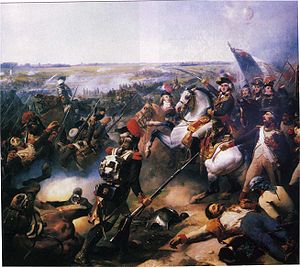 The government soon recalled Jourdan to lead the Army of the Moselle
. In May, he was ordered north with the left wing of the Army of the Moselle. This force was combined with the Army of the Ardennes
and the right wing of the Army of the North to form an army which did not officially become the Army of Sambre-et-Meuse
until 29 June 1794. With 70,000 soldiers of the new army, Jourdan laid siege to Charleroi
on 12 June. An 41,000-man Austrian-Dutch army under William V, Prince of Orange
defeated the French at Lambusart on 16 June and drove them south of the Sambre River. Casualties numbered 3,000 for each army. Undeterred, Jourdan immediately marched on Namur
to the east-northeast of Charleroi. Instead of attacking Namur, he suddenly swung west and appeared to the north of Charleroi. After a brief siege, the 3,000-man Austrian garrison of Charleroi surrendered on 25 June. Military strategist B. H. Liddell Hart cited Jourdan's maneuver as an example of the Indirect approach
, even though it was probably inadvertent on the French general's part. Too late to save Charlerloi, Coburg's 46,000-strong army attacked Jourdan's 75,000 French on 26 June. The Battle of Fleurus
proved to be a decisive French victory when Coburg called off his attacks and retreated. The Allied attacks pushed back both French flanks, but Jourdan stubbornly fought it out and was saved when MG François Lefebvre
held his ground in the center.
After Fleurus, the Allied position in the Austrian Netherlands collapsed. The Austrian army evacuated Belgium and the Dutch Republic
was extinguished by the advancing French armies in 1795. On 7 June 1795, Jourdan's army concluded the long but successful Siege of Luxembourg
. Operations east of the Rhine were less successful that year, with the French capturing, then losing Mannheim
.
In 1796 Jourdan's Army of Sambre-et-Meuse formed the left wing of the advance into Bavaria
. The whole of the French forces were ordered to advance on Vienna
, Jourdan on the extreme left and Jean Moreau
in the centre by the Danube
valley, Napoleon Bonaparte on the right in Italy. The campaign began brilliantly, the Austrians under the Archduke Charles
being driven back by Moreau and Jourdan almost to the Austrian frontier. But the archduke, slipping away from Moreau, threw his whole weight on Jourdan, who was defeated at the Battle of Amberg in August. Jourdan failed to retrieve the situation at the Battle of Würzburg
and was forced over the Rhine after a severe rearguard action, which cost the life of François Séverin Marceau-Desgraviers
. Moreau had to fall back in turn, and the operations of the year in Germany were a failure. The chief cause of defeat was the plan of campaign imposed upon the generals by their government. Jourdan was nevertheless made the scapegoat and was not employed for two years. In those years he became prominent as a politician and above all as the framer of the famous conscription
law of 1798, which came to be known as the Jourdan Law
.
and Stockach
in late March. Disappointed and broken in health, he handed over command to André Masséna
. He resumed his political duties, and was a prominent opponent of the coup d'état
of 18 Brumaire
, after which he was expelled from the Council of the Five Hundred. Soon, however, he became formally reconciled to the new régime, and accepted from Napoleon fresh military and civil employment. In 1800 he became inspector-general of cavalry and infantry and representative of French interests in the Cisalpine Republic
.
until 1806, when Joseph Bonaparte
, whom his brother made king of Naples in that year, selected Jourdan as his military adviser. He followed Joseph into Spain in 1808; but Joseph's throne had to be maintained by the French army, and throughout the Peninsular War
the other marshals, who depended directly upon Napoleon, paid little heed either to Joseph or to Jourdan. Jourdan was blamed for the defeat at the Battle of Talavera in 1809 and replaced by Marshal Nicolas Soult. He was reinstated as Joseph's chief of staff
in September 1811, but given few troops. After the disastrous French defeat at the Battle of Salamanca
in July 1812, Joseph and Jourdan were forced to abandon Madrid
and retreat to Valencia. Joining with Soult's army, which evacuated Andalusia
, the French were able to recapture Madrid during the Siege of Burgos
campaign and push Wellington's
Anglo-Portuguese army back to Portugal.
The following year, Wellington advanced again with a large, well-organized army. Repeatedly outmaneuvering the French, the Anglo-Allied army forced Joseph and Jourdan to fight at the Battle of Vitoria
on 21 June 1813. After the decisive French defeat, which resulted in the permanent loss of Spain, Jourdan held no important command up to the fall of the Empire. He adhered to the Bourbon Restoration
of 1814, and though he rejoined Napoleon in the Hundred Days
and commanded a minor army, he submitted to the Bourbons again after the Battle of Waterloo
. Greatly to his credit, Jourdan refused to be a member of the court which sentenced Marshal Michel Ney
to death. He was made a count, a peer of France in 1819, and governor of Grenoble
in 1816. In politics he was a prominent opponent of the royalist reactionaries and supported the revolution of 1830. After this event he held the portfolio of foreign affairs for a few days, and then became governor of the Invalides, where his last years were spent. Jourdan died in Paris on 23 November 1833 and was buried in Les Invalides
.
While in exile on Saint Helena
, Napoleon admitted,
Jourdan wrote Opérations de l'armée du Danube (1799); Mémoires pour servir a l'histoire sur la campagne de 1796 (1819); and unpublished personal memoirs.
French Revolutionary Wars
The French Revolutionary Wars were a series of major conflicts, from 1792 until 1802, fought between the French Revolutionary government and several European states...
. Emperor Napoleon I of France
Napoleon I of France
Napoleon Bonaparte was a French military and political leader during the latter stages of the French Revolution.As Napoleon I, he was Emperor of the French from 1804 to 1815...
named him a Marshal of France
Marshal of France
The Marshal of France is a military distinction in contemporary France, not a military rank. It is granted to generals for exceptional achievements...
in 1804 and he also fought in the Napoleonic Wars
Napoleonic Wars
The Napoleonic Wars were a series of wars declared against Napoleon's French Empire by opposing coalitions that ran from 1803 to 1815. As a continuation of the wars sparked by the French Revolution of 1789, they revolutionised European armies and played out on an unprecedented scale, mainly due to...
. After 1815, he became reconciled to the Bourbon Restoration
Bourbon Restoration
The Bourbon Restoration is the name given to the period following the successive events of the French Revolution , the end of the First Republic , and then the forcible end of the First French Empire under Napoleon – when a coalition of European powers restored by arms the monarchy to the...
. He was one of the most effective commanders of the French Revolutionary Army
French Revolutionary Army
The French Revolutionary Army is the term used to refer to the military of France during the period between the fall of the ancien regime under Louis XVI in 1792 and the formation of the First French Empire under Napoleon Bonaparte in 1804. These armies were characterised by their revolutionary...
.
Early career
Born at LimogesLimoges
Limoges |Limousin]] dialect of Occitan) is a city and commune, the capital of the Haute-Vienne department and the administrative capital of the Limousin région in west-central France....
, France into a surgeon's family, he enlisted in the French royal army in early 1778 when he was not quite sixteen. Assigned to the Regiment of Auxerrois, he participated in the ill-fated assault at the Siege of Savannah
Siege of Savannah
The Siege of Savannah or the Second Battle of Savannah was an encounter of the American Revolutionary War in 1779. The year before, the city of Savannah, Georgia, had been captured by a British expeditionary corps under Lieutenant-Colonel Archibald Campbell. The siege itself consisted of a joint...
on 9 October 1779 during the American War of Independence. After service in the West Indies, he returned home in 1782 sick with a fever. Bouts of illness (possibly malaria
Malaria
Malaria is a mosquito-borne infectious disease of humans and other animals caused by eukaryotic protists of the genus Plasmodium. The disease results from the multiplication of Plasmodium parasites within red blood cells, causing symptoms that typically include fever and headache, in severe cases...
) troubled him for the rest of his life. In 1784 he was discharged from the army and set up a haberdashery business in Limoges. He married a dressmaker in 1788 and the couple had five daughters.
War of the First Coalition
When the National AssemblyNational Assembly (French Revolution)
During the French Revolution, the National Assembly , which existed from June 17 to July 9, 1789, was a transitional body between the Estates-General and the National Constituent Assembly.-Background:...
asked for volunteers, Jourdan was elected Chef de bataillon of the 2nd Haute-Vienne Battalion. He led his troops in the French victory at the Battle of Jemappes
Battle of Jemappes
The Battle of Jemappes took place near the town of Jemappes in Hainaut, Belgium, near Mons. General Charles François Dumouriez, in command of the French Revolutionary Army, defeated the greatly outnumbered Austrian army of Field Marshal Duke Albert of Saxe-Teschen and his second-in-command...
on 6 November 1792 and in the defeat at the Battle of Neerwinden
Battle of Neerwinden (1793)
The Battle of Neerwinden took place on near the village of Neerwinden in present-day Belgium between the Austrians under Prince Josias of Coburg and the French under General Dumouriez...
on 18 March 1793. Jourdan's leadership skills were noticed and led to his promotion to general of brigade on 27 May 1793 and to general of division two months later. On 8 September, he led his division at the Battle of Hondschoote, in which he was wounded in the chest. On 22 September he was named to lead the Army of the North. Three of his predecessors, Nicolas Luckner
Nicolas Luckner
Nikolaus, Count Luckner was a German in French service who rose to become a Marshal of France. ....
, Adam Philippe, comte de Custine
Adam Philippe, Comte de Custine
Adam Philippe, Comte de Custine was a French general. Born in Metz, he began his military career as a captain in the Seven Years' War, where he learned to admire the modern military organisation of Prussia....
, and Jean Nicolas Houchard
Jean Nicolas Houchard
Jean Nicolas Houchard was a French General of the French Revolution and the French Revolutionary Wars.-Biography:...
were under arrest and later executed by guillotine
Guillotine
The guillotine is a device used for carrying out :executions by decapitation. It consists of a tall upright frame from which an angled blade is suspended. This blade is raised with a rope and then allowed to drop, severing the head from the body...
.
His first assignment was to relieve Jacques Ferrand's 20,000-man garrison of Maubeuge
Maubeuge
Maubeuge is a commune in the Nord department in northern France.It is situated on both banks of the Sambre , east of Valenciennes and about from the Belgian border.-History:...
which was besieged by an Austrian-Dutch army commanded by Prince Josias of Coburg
Prince Josias of Coburg
Prince Frederick Josias of Saxe-Coburg-Saalfeld was a general in the Austrian service.-Biography:...
. The Committee of Public Safety
Committee of Public Safety
The Committee of Public Safety , created in April 1793 by the National Convention and then restructured in July 1793, formed the de facto executive government in France during the Reign of Terror , a stage of the French Revolution...
felt that this mission was so important that it dispatched Lazare Carnot
Lazare Carnot
Lazare Nicolas Marguerite, Comte Carnot , the Organizer of Victory in the French Revolutionary Wars, was a French politician, engineer, and mathematician.-Education and early life:...
to oversee the operation. Jourdan defeated Coburg on 15–16 October at the Battle of Wattignies
Battle of Wattignies (1793)
The Battle of Wattignies was fought at the village of Wattignies-la-Victoire, France, on 15 and 16 October 1793 during the French Revolutionary Wars. The French army commanded by Jean-Baptiste Jourdan and Lazare Carnot defeated the army of Habsburg Austria led by Prince Josias of Coburg...
and broke the siege. Carnot claimed that it was his own intervention that won the victory. Historian Michael Glover
Michael Glover
Michael Glover served in the British army during World War II, after which he joined the British Council and became a professional author...
writes that the first day's attack was a failure because of Carnot's interference, while the second day's success resulted from Jourdan using his own tactical judgment. In any case, only Carnot's account reached Paris.
On 10 January 1794, after refusing to carry out an impossible order, Jourdan was hauled before the Committee of Public Safety. Carnot presented Jourdan's arrest warrant, which was signed by Maximilien de Robespierre, Bertrand Barère, and Jean-Marie Collot d'Herbois
Jean-Marie Collot d'Herbois
Jean-Marie Collot d'Herbois was a French actor, dramatist, essayist, and revolutionary. He was a member of the Committee of Public Safety during the Reign of Terror and, while he saved Madame Tussaud from the Guillotine, he administered the execution of more than 2,000 people in the city of...
. Jourdan was saved from certain execution when an eyewitness, Representative-on-mission Ernest Joseph Duquesnoy rose and contradicted Carnot's version of events at Wattignies. Spared from arrest, Jourdan was nevertheless dismissed from the army and sent home.
Army of the Moselle
The Army of the Moselle was a French Revolutionary Army. Originally known as the Armée du Centre, it was renamed by decree of the National Convention on 1 October 1792 and kept under that name in the decrees of 1 March and 30 April 1793...
. In May, he was ordered north with the left wing of the Army of the Moselle. This force was combined with the Army of the Ardennes
Army of the Ardennes
The Army of the Ardennes was a French Revolutionary Army formed in 1792 by splitting off the right wing of the Army of the North, commanded from July to August that year by La Fayette...
and the right wing of the Army of the North to form an army which did not officially become the Army of Sambre-et-Meuse
Army of Sambre-et-Meuse
The Army of Sambre-et-Meuse is the best known of the armies of the French Revolution. It was formed on 29 June 1794 by combining three forces: the Army of the Ardennes, the left wing of the Army of Moselle, and the right wing of the Army of the North. It had a brief but celebrated existence...
until 29 June 1794. With 70,000 soldiers of the new army, Jourdan laid siege to Charleroi
Charleroi
Charleroi is a city and a municipality of Wallonia, located in the province of Hainaut, Belgium. , the total population of Charleroi was 201,593. The metropolitan area, including the outer commuter zone, covers an area of and had a total population of 522,522 as of 1 January 2008, ranking it as...
on 12 June. An 41,000-man Austrian-Dutch army under William V, Prince of Orange
William V, Prince of Orange
William V , Prince of Orange-Nassau was the last Stadtholder of the Dutch Republic, and between 1795 and 1806 he led the Government of the Dutch Republic in Exile in London. He was succeeded by his son William I...
defeated the French at Lambusart on 16 June and drove them south of the Sambre River. Casualties numbered 3,000 for each army. Undeterred, Jourdan immediately marched on Namur
Namur (city)
Namur is a city and municipality in Wallonia, in southern Belgium. It is both the capital of the province of Namur and of Wallonia....
to the east-northeast of Charleroi. Instead of attacking Namur, he suddenly swung west and appeared to the north of Charleroi. After a brief siege, the 3,000-man Austrian garrison of Charleroi surrendered on 25 June. Military strategist B. H. Liddell Hart cited Jourdan's maneuver as an example of the Indirect approach
Indirect approach
The Indirect approach was a strategy described and chronicled by B. H. Liddell Hart after World War I, was Liddell Hart's attempt to find a solution to the problem of high casualty rates in conflict zones with high force to space ratios, such as the Western Front on which he served. The strategy...
, even though it was probably inadvertent on the French general's part. Too late to save Charlerloi, Coburg's 46,000-strong army attacked Jourdan's 75,000 French on 26 June. The Battle of Fleurus
Battle of Fleurus
There have been three battles fought near the town of Fleurus in Belgium:*The Battle of Fleurus in the Thirty Years' War.*The Battle of Fleurus in the Nine Years' War.*The Battle of Fleurus in the French Revolutionary Wars....
proved to be a decisive French victory when Coburg called off his attacks and retreated. The Allied attacks pushed back both French flanks, but Jourdan stubbornly fought it out and was saved when MG François Lefebvre
François Joseph Lefebvre
François Joseph Lefebvre, First Duc de Dantzig was a French military commander during the Revolutionary and Napoleonic Wars and one of the original eighteen Marshals of the Empire created by Napoleon....
held his ground in the center.
After Fleurus, the Allied position in the Austrian Netherlands collapsed. The Austrian army evacuated Belgium and the Dutch Republic
Dutch Republic
The Dutch Republic — officially known as the Republic of the Seven United Netherlands , the Republic of the United Netherlands, or the Republic of the Seven United Provinces — was a republic in Europe existing from 1581 to 1795, preceding the Batavian Republic and ultimately...
was extinguished by the advancing French armies in 1795. On 7 June 1795, Jourdan's army concluded the long but successful Siege of Luxembourg
Siege of Luxembourg (1794-1795)
The siege of Luxembourg was a siege by France of the Habsburg-held fortress of Luxembourg City that lasted from 1794 until 7 June 1795, during the French Revolutionary Wars...
. Operations east of the Rhine were less successful that year, with the French capturing, then losing Mannheim
Mannheim
Mannheim is a city in southwestern Germany. With about 315,000 inhabitants, Mannheim is the second-largest city in the Bundesland of Baden-Württemberg, following the capital city of Stuttgart....
.
In 1796 Jourdan's Army of Sambre-et-Meuse formed the left wing of the advance into Bavaria
Bavaria
Bavaria, formally the Free State of Bavaria is a state of Germany, located in the southeast of Germany. With an area of , it is the largest state by area, forming almost 20% of the total land area of Germany...
. The whole of the French forces were ordered to advance on Vienna
Vienna
Vienna is the capital and largest city of the Republic of Austria and one of the nine states of Austria. Vienna is Austria's primary city, with a population of about 1.723 million , and is by far the largest city in Austria, as well as its cultural, economic, and political centre...
, Jourdan on the extreme left and Jean Moreau
Jean Victor Marie Moreau
Jean Victor Marie Moreau was a French general who helped Napoleon Bonaparte to power, but later became a rival and was banished to the United States.- Early life :Moreau was born at Morlaix in Brittany...
in the centre by the Danube
Danube
The Danube is a river in the Central Europe and the Europe's second longest river after the Volga. It is classified as an international waterway....
valley, Napoleon Bonaparte on the right in Italy. The campaign began brilliantly, the Austrians under the Archduke Charles
Archduke Charles, Duke of Teschen
Archduke Charles of Austria, Duke of Teschen was an Austrian field-marshal, the third son of emperor Leopold II and his wife Infanta Maria Luisa of Spain...
being driven back by Moreau and Jourdan almost to the Austrian frontier. But the archduke, slipping away from Moreau, threw his whole weight on Jourdan, who was defeated at the Battle of Amberg in August. Jourdan failed to retrieve the situation at the Battle of Würzburg
Battle of Würzburg
The Battle of Würzburg was fought on 3 September 1796 between an army of Habsburg Austria led by Archduke Charles, Duke of Teschen and an army of the First French Republic led by Jean-Baptiste Jourdan. The French attacked the archduke's forces, but they were resisted until the arrival of...
and was forced over the Rhine after a severe rearguard action, which cost the life of François Séverin Marceau-Desgraviers
François Séverin Marceau-Desgraviers
François Séverin Marceau-Desgraviers was a French general of the Revolutionary Wars.-Early life:Desgraviers was born at Chartres, Eure-et-Loir. His father served as a legal officer, and Marceau received an education for a legal career, but at the age of sixteen he enlisted in the regiment of...
. Moreau had to fall back in turn, and the operations of the year in Germany were a failure. The chief cause of defeat was the plan of campaign imposed upon the generals by their government. Jourdan was nevertheless made the scapegoat and was not employed for two years. In those years he became prominent as a politician and above all as the framer of the famous conscription
Conscription
Conscription is the compulsory enlistment of people in some sort of national service, most often military service. Conscription dates back to antiquity and continues in some countries to the present day under various names...
law of 1798, which came to be known as the Jourdan Law
Jourdan law
The Jourdan Law of 1798 effectively institutionalised conscription in Revolutionary France, which began with the levee en masse.It stipulated that all single and childless men between the ages of 20 and 25 were liable for military service....
.
War of the Second Coalition
When the war was renewed in 1799, Jourdan was at the head of the army on the Rhine, but again underwent defeat at the hands of the Archduke Charles at the battles of OstrachBattle of Ostrach
The Battle of Ostrach, also called the Battle by Ostrach, occurred on 20–21 March 1799. It was the first battle of the War of the Second Coalition. The battle resulted in the victory of the Austrian forces, under the command of Archduke Charles, over the French forces, commanded by Jean...
and Stockach
Battle of Stockach (1799)
On 25 March 1799, French and Austrian armies fought for control of the geographically strategic Hegau region in present day Baden-Württemberg. The battle has been called by various names: First Battle of Stockach, the Battle by Stockach, and, in French chronicles, the Battle of Liptingen...
in late March. Disappointed and broken in health, he handed over command to André Masséna
André Masséna
André Masséna 1st Duc de Rivoli, 1st Prince d'Essling was a French military commander during the Revolutionary and Napoleonic Wars....
. He resumed his political duties, and was a prominent opponent of the coup d'état
Coup d'état
A coup d'état state, literally: strike/blow of state)—also known as a coup, putsch, and overthrow—is the sudden, extrajudicial deposition of a government, usually by a small group of the existing state establishment—typically the military—to replace the deposed government with another body; either...
of 18 Brumaire
Brumaire
Brumaire was the second month in the French Republican Calendar. The month was named after the French word brume which occurs frequently in France at that time of the year....
, after which he was expelled from the Council of the Five Hundred. Soon, however, he became formally reconciled to the new régime, and accepted from Napoleon fresh military and civil employment. In 1800 he became inspector-general of cavalry and infantry and representative of French interests in the Cisalpine Republic
Cisalpine Republic
The Cisalpine Republic was a French client republic in Northern Italy that lasted from 1797 to 1802.-Birth:After the Battle of Lodi in May 1796, Napoleon Bonaparte proceeded to organize two states: one to the south of the Po River, the Cispadane Republic, and one to the north, the Transpadane...
.
Napoleonic Wars and later life
In 1804, Napoleon appointed Jourdan a marshal of France. He remained in the newly-created Kingdom of ItalyKingdom of Italy (Napoleonic)
The Kingdom of Italy was a state founded in Northern Italy by Napoleon, fully influenced by revolutionary France, that ended with his defeat and fall.-Constitutional statutes:...
until 1806, when Joseph Bonaparte
Joseph Bonaparte
Joseph-Napoléon Bonaparte was the elder brother of Napoleon Bonaparte, who made him King of Naples and Sicily , and later King of Spain...
, whom his brother made king of Naples in that year, selected Jourdan as his military adviser. He followed Joseph into Spain in 1808; but Joseph's throne had to be maintained by the French army, and throughout the Peninsular War
Peninsular War
The Peninsular War was a war between France and the allied powers of Spain, the United Kingdom, and Portugal for control of the Iberian Peninsula during the Napoleonic Wars. The war began when French and Spanish armies crossed Spain and invaded Portugal in 1807. Then, in 1808, France turned on its...
the other marshals, who depended directly upon Napoleon, paid little heed either to Joseph or to Jourdan. Jourdan was blamed for the defeat at the Battle of Talavera in 1809 and replaced by Marshal Nicolas Soult. He was reinstated as Joseph's chief of staff
Chief of Staff
The title, chief of staff, identifies the leader of a complex organization, institution, or body of persons and it also may identify a Principal Staff Officer , who is the coordinator of the supporting staff or a primary aide to an important individual, such as a president.In general, a chief of...
in September 1811, but given few troops. After the disastrous French defeat at the Battle of Salamanca
Battle of Salamanca
The Battle of Salamanca saw Anglo-Portuguese and Spanish armies under the Duke of Wellington defeat Marshal Auguste Marmont's French forces among the hills around Arapiles south of Salamanca, Spain on July 22, 1812 during the Peninsular War....
in July 1812, Joseph and Jourdan were forced to abandon Madrid
Madrid
Madrid is the capital and largest city of Spain. The population of the city is roughly 3.3 million and the entire population of the Madrid metropolitan area is calculated to be 6.271 million. It is the third largest city in the European Union, after London and Berlin, and its metropolitan...
and retreat to Valencia. Joining with Soult's army, which evacuated Andalusia
Andalusia
Andalusia is the most populous and the second largest in area of the autonomous communities of Spain. The Andalusian autonomous community is officially recognised as a nationality of Spain. The territory is divided into eight provinces: Huelva, Seville, Cádiz, Córdoba, Málaga, Jaén, Granada and...
, the French were able to recapture Madrid during the Siege of Burgos
Siege of Burgos
At the Siege of Burgos, from 19 September to 21 October 1812, the Anglo-Portuguese Army led by General Arthur Wellesley, Marquess of Wellington tried to capture the castle of Burgos from its French garrison under the command of General of Brigade Jean-Louis Dubreton. The French repulsed every...
campaign and push Wellington's
Arthur Wellesley, 1st Duke of Wellington
Field Marshal Arthur Wellesley, 1st Duke of Wellington, KG, GCB, GCH, PC, FRS , was an Irish-born British soldier and statesman, and one of the leading military and political figures of the 19th century...
Anglo-Portuguese army back to Portugal.
The following year, Wellington advanced again with a large, well-organized army. Repeatedly outmaneuvering the French, the Anglo-Allied army forced Joseph and Jourdan to fight at the Battle of Vitoria
Battle of Vitoria
At the Battle of Vitoria an allied British, Portuguese, and Spanish army under General the Marquess of Wellington broke the French army under Joseph Bonaparte and Marshal Jean-Baptiste Jourdan near Vitoria in Spain, leading to eventual victory in the Peninsular War.-Background:In July 1812, after...
on 21 June 1813. After the decisive French defeat, which resulted in the permanent loss of Spain, Jourdan held no important command up to the fall of the Empire. He adhered to the Bourbon Restoration
Bourbon Restoration
The Bourbon Restoration is the name given to the period following the successive events of the French Revolution , the end of the First Republic , and then the forcible end of the First French Empire under Napoleon – when a coalition of European powers restored by arms the monarchy to the...
of 1814, and though he rejoined Napoleon in the Hundred Days
Hundred Days
The Hundred Days, sometimes known as the Hundred Days of Napoleon or Napoleon's Hundred Days for specificity, marked the period between Emperor Napoleon I of France's return from exile on Elba to Paris on 20 March 1815 and the second restoration of King Louis XVIII on 8 July 1815...
and commanded a minor army, he submitted to the Bourbons again after the Battle of Waterloo
Battle of Waterloo
The Battle of Waterloo was fought on Sunday 18 June 1815 near Waterloo in present-day Belgium, then part of the United Kingdom of the Netherlands...
. Greatly to his credit, Jourdan refused to be a member of the court which sentenced Marshal Michel Ney
Michel Ney
Michel Ney , 1st Duc d'Elchingen, 1st Prince de la Moskowa was a French soldier and military commander during the French Revolutionary Wars and the Napoleonic Wars. He was one of the original 18 Marshals of France created by Napoleon I...
to death. He was made a count, a peer of France in 1819, and governor of Grenoble
Grenoble
Grenoble is a city in southeastern France, at the foot of the French Alps where the river Drac joins the Isère. Located in the Rhône-Alpes region, Grenoble is the capital of the department of Isère...
in 1816. In politics he was a prominent opponent of the royalist reactionaries and supported the revolution of 1830. After this event he held the portfolio of foreign affairs for a few days, and then became governor of the Invalides, where his last years were spent. Jourdan died in Paris on 23 November 1833 and was buried in Les Invalides
Les Invalides
Les Invalides , officially known as L'Hôtel national des Invalides , is a complex of buildings in the 7th arrondissement of Paris, France, containing museums and monuments, all relating to the military history of France, as well as a hospital and a retirement home for war veterans, the building's...
.
While in exile on Saint Helena
Saint Helena
Saint Helena , named after St Helena of Constantinople, is an island of volcanic origin in the South Atlantic Ocean. It is part of the British overseas territory of Saint Helena, Ascension and Tristan da Cunha which also includes Ascension Island and the islands of Tristan da Cunha...
, Napoleon admitted,
I certainly used that man very ill ... I have learned with pleasure that since my fall he invariably acted in the best manner. He has thus afforded an example of that praiseworthy elevation of mind which distinguishes men one from another. Jourdan is a true patriot; and that is the answer to many things that have been said of him.
Jourdan wrote Opérations de l'armée du Danube (1799); Mémoires pour servir a l'histoire sur la campagne de 1796 (1819); and unpublished personal memoirs.
External links
- Jean-Baptiste Jourdan at Find-A-Grave
- Spencer Napoleonica Collection at Newberry LibraryNewberry LibraryThe Newberry Library is a privately endowed, independent research library for the humanities and social sciences in Chicago, Illinois. Although it is private, non-circulating library, the Newberry Library is free and open to the public...
Further reading
- Connelly, Owen, Blundering to Glory: Napoleon's Military Campaigns SR Books, 1999, ISBN 0842027807.
- Elting, John R. Swords Around a Throne: Napoleon's Grande Armée Weidenfeld & Nicholson, 1997, ISBN 0029095018.
- Humble, Richard Napoleon's Peninsular marshals;: A reassessment Taplinger Pub., 1975, ISBN 0800854659.
- Macdonell, A. G. Napoleon and His Marshals Prion, 1997, ISBN 1853752223.