

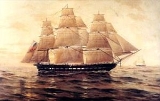

fought mostly at sea between the United States
and French Republic from 1798 to 1800. In the United States, the conflict was sometimes also referred to as the Franco-American War, the Pirate Wars, or the Half-War.
Background
The Kingdom of Francehad been a critical ally
of the United States in the American Revolutionary War
from the spring of 1776, and had signed in 1778 a Treaty of Alliance with the United States. But in 1794, after the French Revolution
toppled that country's monarchy, the American government came to an agreement with the Kingdom of Great Britain
, the Jay Treaty
, that resolved several points of contention between the United States and Great Britain that had lingered since the end of the Revolutionary War. It also contained economic clauses.
The fact that the United States had already declared neutrality in the conflict between Great Britain and (now revolutionary) France, and that American legislation was being passed for a trade deal with their British enemy, led to French outrage. The French government was also furious over the U.S. refusal to continue repaying its debt
to France on the grounds that the debt had been owed to the French Crown, not to Republican France.
The French navy began seizing American ships trading with Britain and refused to receive the new United States minister Charles Cotesworth Pinckney
when he arrived in Paris in December 1796. In his annual message to Congress
at the close of 1797, President
John Adams
reported on France’s refusal to negotiate and spoke of the need "to place our country in a suitable posture of defense." In April 1798, President Adams informed Congress of the "XYZ Affair
", in which French agents demanded a large bribe for the restoration of diplomatic relations with the United States.
The French navy inflicted substantial losses on American shipping. Secretary of State
Timothy Pickering
reported to Congress on June 21, 1797 that the French had seized 316 American merchant ships in the previous eleven months. The hostilities caused insurance rates on American shipping to increase at least 500 percent, since French marauders cruised the length of the U.S. Atlantic seaboard virtually unopposed. The administration had no warships to combat them; the last had been sold in 1785. The United States possessed only a flotilla of small revenue cutters and some neglected coastal forts.
Increased depredations by privateer
s from Revolutionary France required the rebirth of the United States Navy
to protect the expanding American merchant shipping. Congress authorized the president to acquire, arm, and man not more than 12 vessels, of up to 22 guns each. Several vessels were immediately purchased and converted into ships of war.
July 7, 1798, the date that Congress rescinded treaties with France, is considered the beginning of the Quasi-War. This was followed two days later with the passage of the Congressional authorization
to attack French warships.
Naval engagements

, seeking French privateers. Captain Thomas Truxtun
's insistence on the highest standards of crew training paid dividends as the frigate USS Constellation
captured the L'Insurgente
and severely damaged La Vengeance
. French privateers usually resisted, as did La Croyable, which was captured on July 7, 1798, by the USS Delaware
outside of Egg Harbor, New Jersey
. The USS Enterprise
captured eight privateers and freed 11 American merchant ships from captivity. The USS Experiment
captured the French privateers Deux Amis and Diane. Numerous American merchantmen were recaptured by the Experiment. The USS Boston
forced Le Berceau into submission. Silas Talbot
engineered an expedition to Puerto Plata harbor in the Colony of Santo Domingo
, a possession of France's ally Spain, on May 11, 1800; sailors and marines from the USS Constitution
under Lieutenant Isaac Hull
captured the French privateer Sandwich in the harbor and spiked the guns
in the Spanish fort.
Only one U.S Navy vessel was captured by — and later recaptured from — French forces, the USS Retaliation
. She was the captured privateer La Croyable, recently purchased by the U.S. Navy. Retaliation departed Norfolk on October 28, 1798, with Montezuma
and Norfolk
, and cruised in the West Indies protecting American commerce. On November 20, 1798, the French frigates L’Insurgente and Volontaire overtook Retaliation while her consorts were away and forced commanding officer Lieutenant William Bainbridge
to surrender the out-gunned schooner. Montezuma and Norfolk escaped after Bainbridge convinced the senior French commander that those American warships were too powerful for his frigates and persuaded him to abandon the chase. Renamed Magicienne by the French, the schooner again came into American hands on June 28, when a broadside from USS Merrimack
forced her to haul down her colors.
Revenue cutters in the service of the Revenue-Marine, the predecessor to the Coast Guard
, also took part in the conflict. The cutter USRC Pickering, commanded by Edward Preble
, made two cruises to the West Indies and captured several prizes. Preble turned command of the Pickering over to Benjamin Hillar, and she captured the much larger and more heavily armed French privateer l’Egypte Conquise after a nine-hour battle. In September 1800, Hillar, the Pickering, and her entire crew were lost at sea in a storm. Preble commanded the frigate Essex, which he sailed around Cape Horn
into the Pacific to protect American merchantmen in the East Indies
; he recaptured several ships that had been seized by French privateers.
American naval losses for the war were light, with only one armed U.S. Navy vessel lost to enemy action. However, one source contends that by the war's end in 1800, the French had seized over two thousand American merchant ships.
Although they were fighting the same enemy, the Royal Navy
and the United States Navy did not cooperate operationally, nor did they share operational plans or come to mutual understandings about deployment of their forces. The British did sell the American government naval stores and munitions. In addition, the two navies shared a system of signals by which each could recognize the other’s warships at sea and allowed merchantmen of their respective nations to join each other's convoys.
Conclusion of hostilities
By the autumn of 1800, the United States Navy and the Royal Navy, combined with a more conciliatory diplomatic stance by the government of First Consul Napoleon Bonaparte, had reduced the activity of the French privateers and warships. The Convention of 1800, signed on September 30, ended the Franco-American War. Unfortunately for President Adams, the news did not arrive in time to help him secure a second term in the United States presidential election, 1800.
Modern significance
The Quasi War has taken on a significant role in modern debates over the distribution of war powersbetween the Executive and Legislative branches. According to historian Thomas Woods
:
Supporters of a broad executive war powerUnitary executive theoryThe unitary executive theory is a theory of American constitutional law holding that the President controls the entire executive branch. The doctrine is based upon Article Two of the United States Constitution, which vests "the executive power" of the United States in the President.Although that...
have sometimes appealed to the Quasi War with France, in the closing years of the eighteenth century, as an example of unilateral warmaking on the part of the president. Francis Wormuth, an authority on war powers and the Constitution, describes that contention as "altogether false." John Adams "took absolutely no independent action. Congress passed a series of acts that amounted, so the Supreme CourtSupreme Court of the United StatesThe Supreme Court of the United States is the highest court in the United States. It has ultimate appellate jurisdiction over all state and federal courts, and original jurisdiction over a small range of cases...
said, to a declaration of imperfect war; and Adams complied with these statutes."
Consider an interesting and revealing incident that occurred during the Quasi War. Congress authorized the president to seize vessels sailing to French ports. But President Adams, acting on his own authority and without the sanction of Congress, instructed American ships to capture vessels sailing either to or from French ports. Captain George Little
George Little (naval officer)George Little was a United States Navy officer. He served in the Massachusetts State Navy during the Revolutionary War and in the United States Navy during the Quasi-War with France.At age 25, Little was appointed first lieutenant of Massachusetts ship Protector in 1779, and was aboard in 1781 when...
, acting under the authority of Adams' order, seized a Danish ship sailing from a French port. When Little was sued for damages, the caseLittle v. BarremeLittle v. Barreme, 6 U.S. 170 was an 1804 decision of the United States Supreme Court which found that the President of the United States does not have "inherent authority" or "inherent powers" which allow him to ignore a law passed by the United States Congress.-Summary:Pro DN, Pres order...
made its way to the Supreme Court. Chief JusticeChief Justice of the United StatesThe Chief Justice of the United States is the head of the United States federal court system and the chief judge of the Supreme Court of the United States. The Chief Justice is one of nine Supreme Court justices; the other eight are the Associate Justices of the Supreme Court of the United States...
John MarshallJohn MarshallJohn Marshall was the Chief Justice of the United States whose court opinions helped lay the basis for American constitutional law and made the Supreme Court of the United States a coequal branch of government along with the legislative and executive branches...
ruled that Captain Little could indeed be sued for damages in the case. "In short," writes Louis Fisher in summary, "congressional policy announced in a statute necessarily prevails over inconsistent presidential orders and military actions. Presidential orders, even those issued as Commander in Chief, are subject to restrictions imposed by Congress."
See also
- Captured ships of the Quasi-War
- French Revolutionary WarsFrench Revolutionary WarsThe French Revolutionary Wars were a series of major conflicts, from 1792 until 1802, fought between the French Revolutionary government and several European states...
- Barbary WarsBarbary WarsThe Barbary Wars were a series of wars between the United States of America and the Barbary States of North Africa in the late 18th and early 19th centuries. At issue was the Barbary pirates' demand of tribute from American merchant vessels in the Mediterranean Sea. If ships failed to pay, pirates...
- Louisa (Quasi-War privateer)
- Oliver Hazard PerryOliver Hazard PerryUnited States Navy Commodore Oliver Hazard Perry was born in South Kingstown, Rhode Island , the son of USN Captain Christopher Raymond Perry and Sarah Wallace Alexander, a direct descendant of William Wallace...
External links
- Selected Bibliography of The Quasi War with France compiled by the United States Army Center of Military History
- U.S. Department of State The XYZ Affair and the Quasi-War with France, 1798-1800
- U.S. treaties and federal legal documents re "Quasi War with France 1791-1800", compiled by the Lillian Goldman Law Library of Yale Law School