


Third Italian War of Independence

Encyclopedia
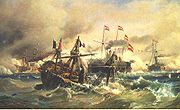
The Third Italian War of Independence was a conflict which paralleled the Austro-Prussian War
Austro-Prussian War
The Austro-Prussian War was a war fought in 1866 between the German Confederation under the leadership of the Austrian Empire and its German allies on one side and the Kingdom of Prussia with its German allies and Italy on the...
, and was fought between the Kingdom of Italy and the Austrian Empire
Austrian Empire
The Austrian Empire was a modern era successor empire, which was centered on what is today's Austria and which officially lasted from 1804 to 1867. It was followed by the Empire of Austria-Hungary, whose proclamation was a diplomatic move that elevated Hungary's status within the Austrian Empire...
.
Background
Victor Emmanuel II of Savoy had been crowned King of ItalyKing of Italy
King of Italy is a title adopted by many rulers of the Italian peninsula after the fall of the Roman Empire...
on March 17, 1861, his reign did not control Venetia and Lazio. The situation of the Irredente (a later Italian term for part of the country under foreign domination, literally meaning un-redeemed) created an unceasing state of tension for the inner politics of the newly created Kingdom, as well as being a cornerstone of its foreign policy.
A first attempt to capture Rome was that of 1862 by Giuseppe Garibaldi
Giuseppe Garibaldi
Giuseppe Garibaldi was an Italian military and political figure. In his twenties, he joined the Carbonari Italian patriot revolutionaries, and fled Italy after a failed insurrection. Garibaldi took part in the War of the Farrapos and the Uruguayan Civil War leading the Italian Legion, and...
. Confiding in the King's neutrality, he had set sail from Genoa
Genoa
Genoa |Ligurian]] Zena ; Latin and, archaically, English Genua) is a city and an important seaport in northern Italy, the capital of the Province of Genoa and of the region of Liguria....
to Palermo
Palermo
Palermo is a city in Southern Italy, the capital of both the autonomous region of Sicily and the Province of Palermo. The city is noted for its history, culture, architecture and gastronomy, playing an important role throughout much of its existence; it is over 2,700 years old...
. Collecting 1,200 volunteers, he moved from Catania
Catania
Catania is an Italian city on the east coast of Sicily facing the Ionian Sea, between Messina and Syracuse. It is the capital of the homonymous province, and with 298,957 inhabitants it is the second-largest city in Sicily and the tenth in Italy.Catania is known to have a seismic history and...
and landed at Melito, in Calabria
Calabria
Calabria , in antiquity known as Bruttium, is a region in southern Italy, south of Naples, located at the "toe" of the Italian Peninsula. The capital city of Calabria is Catanzaro....
, on August 24 to reach the Aspromonte
Aspromonte
Aspromonte is a mountain massif in the province of Reggio Calabria . The name means "rough mountains", so named by the farmers who found its steep terrain and rocky soil difficult to cultivate. It overlooks the Strait of Messina, being limited by the Ionian and Tyrrhenian Seas and by the Pietrace...
, with intention to climb the peninsula up to Rome. The Piedmontese general Enrico Cialdini
Enrico Cialdini
Enrico Cialdini, Duca di Gaeta was an Italian soldier, politician and diplomat.-Biography:He was born at Castelvetro, in the province of Modena. In 1831 he took part in the insurrection at Modena, fleeing afterwards to Paris, whence he proceeded to Spain to fight against the Carlists...
, however, sent a division under colonel Pallavicino to stop the volunteer army. Garibaldi himself was wounded in the ensuing battle, and taken prisoner along with his men.
The growing divergences between Austria and the growing Prussia
Prussia
Prussia was a German kingdom and historic state originating out of the Duchy of Prussia and the Margraviate of Brandenburg. For centuries, the House of Hohenzollern ruled Prussia, successfully expanding its size by way of an unusually well-organized and effective army. Prussia shaped the history...
's predominance in Germany turned into an open war in 1866, offering Italy an occasion to regain Venetia. On April 8, 1866 the Italian government signed a military alliance with Prussia, through the mediation of Napoleon III of France
Napoleon III of France
Louis-Napoléon Bonaparte was the President of the French Second Republic and as Napoleon III, the ruler of the Second French Empire. He was the nephew and heir of Napoleon I, christened as Charles Louis Napoléon Bonaparte...
. Italian armies, led by general Alfonso Ferrero La Marmora
Alfonso Ferrero La Marmora
Alfonso Ferrero, Cavaliere La Màrmora was an Italian general and statesman. His brother Alessandro La Marmora founded the branch of the Italian army now called the Bersaglieri.-Biography:...
, were to engage the Austrians on the southern front. Simultaneously, taking advantage of their naval superiority, the Italians threatened the Dalmatia
Dalmatia
Dalmatia is a historical region on the eastern coast of the Adriatic Sea. It stretches from the island of Rab in the northwest to the Bay of Kotor in the southeast. The hinterland, the Dalmatian Zagora, ranges from fifty kilometers in width in the north to just a few kilometers in the south....
n coast, forcing Austria to move part of its forces there from the central European front.
Italian preparations
At the outbreak of the war, the Italian military situations was hampered by the following negative factors:- the imperfect merging of the armies of the Kingdom of SardiniaKingdom of SardiniaThe Kingdom of Sardinia consisted of the island of Sardinia first as a part of the Crown of Aragon and subsequently the Spanish Empire , and second as a part of the composite state of the House of Savoy . Its capital was originally Cagliari, in the south of the island, and later Turin, on the...
and the Kingdom of the Two SiciliesKingdom of the Two SiciliesThe Kingdom of the Two Sicilies, commonly known as the Two Sicilies even before formally coming into being, was the largest and wealthiest of the Italian states before Italian unification...
, the two major components of the new state. This was due to the bitter resistance that in southern Italy had preceded and followed the last Neapolitan stand in GaetaSiege of Gaeta (1860)The Siege of Gaeta was the concluding event of the war between the Kingdom of Sardinia and the Kingdom of the Two Sicilies. It started on November 5, 1860 and ended February 13, 1861, and took place in Gaeta, in today's Southern Lazio .-Background:...
(1861), and to the fact that sectors of the former Neapolitan army, substantially, considered the conquest of their country as a colonization; - the even stronger rivalry between the two navies which had formed the Regia MarinaRegia MarinaThe Regia Marina dates from the proclamation of the Kingdom of Italy in 1861 after Italian unification...
(the unified Italian Navy); - the unsolved question about the supreme command, already disputed between Italian former prime minister Camillo Benso, Conte di Cavour and King Victor Emmanuel since 1859, and now aggravated by the lowest qualities of Cavour's successors. The King had in the end decided to remain as the army's effective supreme commander: although courageous, he was unsuited to the role.
Italian invasion
Prussia began hostilities on June 16, 1866 by attacking several German principates allied with Austria. Three days later Italy declared war on Austria, starting the military operations on June 23.The Italian forces were divided into two armies: the first, under La Marmora himself, was deployed in Lombardy
Lombardy
Lombardy is one of the 20 regions of Italy. The capital is Milan. One-sixth of Italy's population lives in Lombardy and about one fifth of Italy's GDP is produced in this region, making it the most populous and richest region in the country and one of the richest in the whole of Europe...
, west of the Mincio
Mincio
Mincio is a river in the Lombardy region of northern Italy.Called the Sarca River before entering Lake Garda, it flows from there about 65 km past Mantua into the Po River....
River, aiming toward the powerful Quadrilatero
Quadrilatero
The Quadrilatero is the traditional name of a defensive system of the Austrian Empire in the Lombardy-Venetia, which connected the fortresses of Peschiera, Mantua, Legnago and Verona between the Mincio, the Po and Adige Rivers...
fortress of the Austrians; the second, under Enrico Cialdini, in Romagna
Romagna
Romagna is an Italian historical region that approximately corresponds to the south-eastern portion of present-day Emilia-Romagna. Traditionally, it is limited by the Apennines to the south-west, the Adriatic to the east, and the rivers Reno and Sillaro to the north and west...
, south of the Po River
Po River
The Po |Ligurian]]: Bodincus or Bodencus) is a river that flows either or – considering the length of the Maira, a right bank tributary – eastward across northern Italy, from a spring seeping from a stony hillside at Pian del Re, a flat place at the head of the Val Po under the northwest face...
, aiming toward Mantua
Mantua
Mantua is a city and comune in Lombardy, Italy and capital of the province of the same name. Mantua's historic power and influence under the Gonzaga family, made it one of the main artistic, cultural and notably musical hubs of Northern Italy and the country as a whole...
and Rovigo
Rovigo
Rovigo is a town and comune in the Veneto region of North-Eastern Italy, the capital of the eponymous province. -Geography:...
.
La Marmora moved first through Mantua and Peschiera del Garda
Peschiera del Garda
Peschiera del Garda , is a town and comune in the province of Verona, in Veneto, Italy. When Lombardy-Venetia was under Austrian rule, Peschiera was the northwest anchor of the four fortified towns constituting the so-called Quadrilatero...
, but was severely defeated at the Custoza
Battle of Custoza (1866)
The Battle of Custoza took place on June 24, 1866 during the Third Italian Independence War in the Italian unification process.The Austrian Imperial army with the old Venetian Army, led by Archduke Albert of Habsburg, defeated the Italian army led by Alfonso Ferrero la Marmora and Enrico Cialdini,...
on June 24. Cialdini, however, did not act offensively for the entire first part of the war, conducting only several shows and even failing to besiege the Austrian fortress of Borgoforte
Borgoforte
Borgoforte is a comune in the Province of Mantua in the Italian region Lombardy, located about 130 km southeast of Milan and about 14 km southwest of Mantua....
, south to the Po.
Custoza marked a general arrest of operations, as the Italians decided to reorganize for fear of an Austrian counter-offensive. The Austrians indeed profited from the situation to invade Valtellina and Val Camonica
Val Camonica
Val Camonica is one of the largest valleys of the central Alps, in eastern Lombardy, about 90 km long. It starts from the Tonale Pass, at 1883 metres above sea level and ends at Corna Trentapassi, in the comune of Pisogne, near Lake Iseo...
(battle of Vezza d'Oglio). The general course of the war, however, was to turn in Italy's favor thanks to Prussian victories in the north, especially that of Königgrätz
Battle of Königgrätz
The Battle of Königgrätz , also known as the Battle of Sadowa, Sadová, or Hradec Králové, was the decisive battle of the Austro-Prussian War, in which the Kingdom of Prussia defeated the Austrian Empire...
on July 3, 1866. The Austrians were compelled to move one of their three army corps deployed in Italy to Vienna
Vienna
Vienna is the capital and largest city of the Republic of Austria and one of the nine states of Austria. Vienna is Austria's primary city, with a population of about 1.723 million , and is by far the largest city in Austria, as well as its cultural, economic, and political centre...
, concentrating on the defense of Trentino and Isonzo.
New Italian offensive
On July 5 the Italian government received news of a mediation effort by Napoleon III for a settlement of the situation, which would allow Austria to receive favourable conditions from Prussia, and, in particular, to maintain VeniceVenice
Venice is a city in northern Italy which is renowned for the beauty of its setting, its architecture and its artworks. It is the capital of the Veneto region...
. The situation was embarrassing for Italy, as its forces had failed to obtain any relevant military success on the field. As the Austrians were redeploying troops to Vienna, La Marmora was solicited to take advantage of the numeric superiority, score a good victory, and thus improve the conditions for Italy.
On July 14, during a council of war held in Ferrara
Ferrara
Ferrara is a city and comune in Emilia-Romagna, northern Italy, capital city of the Province of Ferrara. It is situated 50 km north-northeast of Bologna, on the Po di Volano, a branch channel of the main stream of the Po River, located 5 km north...
, the new conduct of the war was decided, according to the following points:
- Cialdini was to lead the main army of 150,000 troops through the VenetoVenetoVeneto is one of the 20 regions of Italy. Its population is about 5 million, ranking 5th in Italy.Veneto had been for more than a millennium an independent state, the Republic of Venice, until it was eventually annexed by Italy in 1866 after brief Austrian and French rule...
, while La Marmora, with c. 70,000 men, would continue the block on the Quadrilatero; - the Italian Navy, commanded by Admiral Carlo di PersanoCarlo di PersanoCount Carlo Pellion di Persano was an Italian admiral and politician, who was commander of the Regia Marina fleet at the Battle of Lissa....
was to sail in the Adriatic Sea from AnconaAnconaAncona is a city and a seaport in the Marche region, in central Italy, with a population of 101,909 . Ancona is the capital of the province of Ancona and of the region....
with the island of Lissa (Vis) as a target to be conquered after landing; - Garibaldi's volunteers (named "Cacciatori delle Alpi"), reinforced by a regular division, was to penetrate Trentino, trying to approach as close as possible to the capital, TrentoTrentoTrento is an Italian city located in the Adige River valley in Trentino-Alto Adige/Südtirol. It is the capital of Trentino...
. Though it was sure that Venetia was to be gained through battle or condition of peace, the fate of Trentino was dubious.
Cialdini crossed the Po and occupied Rovigo (July 11), Padua
Padua
Padua is a city and comune in the Veneto, northern Italy. It is the capital of the province of Padua and the economic and communications hub of the area. Padua's population is 212,500 . The city is sometimes included, with Venice and Treviso, in the Padua-Treviso-Venice Metropolitan Area, having...
(July 12), Treviso
Treviso
Treviso is a city and comune in Veneto, northern Italy. It is the capital of the province of Treviso and the municipality has 82,854 inhabitants : some 3,000 live within the Venetian walls or in the historical and monumental center, some 80,000 live in the urban center proper, while the city...
(July 14), San Donà di Piave
San Donà di Piave
San Donà di Piave or, simply, San Donà, is the largest town in Eastern Veneto and comune of province of Venice, Veneto, in the North East region of Italy.- Geography :...
(July 18), Valdobbiadene
Valdobbiadene
Valdobbiadene is a town in the province of Treviso, Veneto, Italy. Valdobbiadene is a picturesque wine growing area. Just below the Alpine areas of Veneto, it provides a climate for cool varieties of grape. This area is the home of ProseccoConegliano-Valdobbiadene a dry sparkling white wine....
and Oderzo
Oderzo
Oderzo is a town and comune in the province of Treviso, Veneto, northern Italy.It lies in the heart of the Venetian plain, about 66 km to the northeast of Venice...
(July 20), Vicenza
Vicenza
Vicenza , a city in north-eastern Italy, is the capital of the eponymous province in the Veneto region, at the northern base of the Monte Berico, straddling the Bacchiglione...
(July 21) and finally Udine
Udine
Udine is a city and comune in northeastern Italy, in the middle of Friuli-Venezia Giulia region, between the Adriatic sea and the Alps , less than 40 km from the Slovenian border. Its population was 99,439 in 2009, and that of its urban area was 175,000.- History :Udine is the historical...
, in Friuli
Friuli
Friuli is an area of northeastern Italy with its own particular cultural and historical identity. It comprises the major part of the autonomous region Friuli-Venezia Giulia, i.e. the province of Udine, Pordenone, Gorizia, excluding Trieste...
(July 22). In the meantime Garibaldi's volunteers had pushed forward from Brescia
Brescia
Brescia is a city and comune in the region of Lombardy in northern Italy. It is situated at the foot of the Alps, between the Mella and the Naviglio, with a population of around 197,000. It is the second largest city in Lombardy, after the capital, Milan...
towards Trento (see Invasion of Trentino
Invasion of Trentino (1866)
The Invasion of Trentino was a series of military operation undertaken by the Kingdom of Italy against the Austrian Empire during the Third Italian War of Independence of 1866, which was part of the larger Austro-Prussian War.-Background:...
) fighting victoriously at the battle of Bezzecca
Battle of Bezzecca
The Battle of Bezzecca was fought on July 21, 1866 between Italy and Austria, in the course of the Third Italian Independence War. The Italian force, the Hunters of the Alps, were led by Giuseppe Garibaldi, and had invaded Trentino as part of the general Italian offensive against the Austrian...
of July 21.
These victories were however obscured by the disastrous defeat of the bulk of the Italian army at the Battle of Custoza
Battle of Custoza (1866)
The Battle of Custoza took place on June 24, 1866 during the Third Italian Independence War in the Italian unification process.The Austrian Imperial army with the old Venetian Army, led by Archduke Albert of Habsburg, defeated the Italian army led by Alfonso Ferrero la Marmora and Enrico Cialdini,...
on June 24 and of the Italian Navy at the Battle of Lissa
Battle of Lissa (1866)
The Battle of Lissa took place on 20 July 1866 in the Adriatic Sea near the Dalmatian island of Lissa and was a decisive victory for an outnumbered Austrian Empire force over a superior Italian force...
(July 20, 1866). On August 9, upon receiving from the King the order to retreat from the newly conquered positions, Garibaldi complied with his famous "Obbedisco!" ("I obey!") telegram, and retreated from Trentino.
The ceasing of hostilities was marked by the Armistice of Cormons
Armistice of Cormons
The Armistice of Cormòns was signed in Cormons on 12 August 1866, between the Kingdom of Italy and the Austrian Empire and was a prelude to the Treaty of Vienna, which ended the Third Italian War of Independence.On 21 July 1866 the victorious Prussia, which had just inflicted a...
signed on August 12, followed by the Treaty of Vienna
Treaty of Vienna (1866)
According to the Treaty of Vienna signed on 12 October 1866, the Austrian Empire ceded Venetia to the French Empire, which in turn would cede it to the Kingdom of Italy, «under the reservation of the "consent of the people duly consulted"»...
of October 3, 1866.
Aftermath
The terms included the cession of Venetia (with MantuaMantua
Mantua is a city and comune in Lombardy, Italy and capital of the province of the same name. Mantua's historic power and influence under the Gonzaga family, made it one of the main artistic, cultural and notably musical hubs of Northern Italy and the country as a whole...
and western Friuli
Friuli
Friuli is an area of northeastern Italy with its own particular cultural and historical identity. It comprises the major part of the autonomous region Friuli-Venezia Giulia, i.e. the province of Udine, Pordenone, Gorizia, excluding Trieste...
) to France (which ceded it to Italy) and of the Iron Crown
Iron Crown of Lombardy
The Iron Crown of Lombardy is both a reliquary and one of the most ancient royal insignia of Europe. The crown became one of the symbols of the Kingdom of Lombards and later of the medieval Kingdom of Italy...
(worn by the old Lombard
Lombards
The Lombards , also referred to as Longobards, were a Germanic tribe of Scandinavian origin, who from 568 to 774 ruled a Kingdom in Italy...
Kings of Italy and by the Holy Roman Emperors, as well as by Napoleon Bonaparte himself).
The Redente ("Redemeed") lands were annexed to Italy through a plebiscite held on October 21 and 22 of 1866.
This left only Rome and its Patrimony of St Peter (now Lazio) outside the Kingdom of Italy, until the "Capture of Rome
Capture of Rome
The Capture of Rome was the final event of the long process of Italian unification known as the Risorgimento, which finally unified the Italian peninsula under King Victor Emmanuel II of the House of Savoy...
" in September 1870 and the subsequent plebiscite approving its unification with the rest of Italy.
See also
- Austro-Prussian WarAustro-Prussian WarThe Austro-Prussian War was a war fought in 1866 between the German Confederation under the leadership of the Austrian Empire and its German allies on one side and the Kingdom of Prussia with its German allies and Italy on the...
- Armistice of CormonsArmistice of CormonsThe Armistice of Cormòns was signed in Cormons on 12 August 1866, between the Kingdom of Italy and the Austrian Empire and was a prelude to the Treaty of Vienna, which ended the Third Italian War of Independence.On 21 July 1866 the victorious Prussia, which had just inflicted a...
- First Italian War of IndependenceFirst Italian War of IndependenceThe First Italian War of Independence was fought in 1848 between the Kingdom of Sardinia and the Austrian Empire. The war saw main battles at Custoza and Novara in which the Austrians under Radetzky managed to defeat the Piedmontese....
- Second Italian War of IndependenceSecond Italian War of IndependenceThe Second War of Italian Independence, Franco-Austrian War, Austro-Sardinian War, or Austro-Piedmontese War , was fought by Napoleon III of France and the Kingdom of Piedmont-Sardinia against the Austrian Empire in 1859...
- Garibaldi's Expedition against Rome
- Risorgimento