

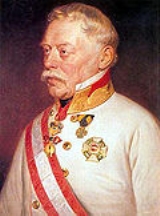
Joseph Radetzky von Radetz

Encyclopedia
Johann Josef Wenzel (Anton Franz Karl) Graf Radetzky von Radetz (John Joseph Wenceslaus, Count
Radetzky of Radetz) (November 2, 1766 – January 5, 1858) was a Czech nobleman and Austria
n general, immortalised by Johann Strauss I
's Radetzky March
. General Radetzky was in the military for over 70 years, until his death at age 91, and is known for the victories at the Battles of Custoza
(July 24–25, 1848) and Novara
(March 23, 1849) during the First Italian War of Independence
.
near Sedlčany
in Bohemia
(now part of the town). Orphaned at an early age, he was educated by his grandfather, and after the count's death, at the Theresa Academy
at Vienna
. The academy was dissolved during his first year's residence in 1785, and Radetzky became a cadet in the Austria
n Army. The following year he became an officer, and in 1787 was promoted to first lieutenant in a cuirassier
regiment. He served as a galloper on Count von Lacy's staff in the Turkish War, and in the Austrian Netherlands from 1792 to 1795.
In 1798 he married Countess Francisca von Strassoldo Grafenberg, from Tržič
, Carniola
(now in Slovenia
). They would have five sons and three daughters.
 In 1795 Radetzky fought on the Rhine. The following year he served with Johann Beaulieu
against Napoleon in Italy, but disliked the indecisive "cordon" system of warfare which Count von Lacy
had instituted and other Austrian generals imitated. His personal courage was conspicuous. At the Battle of Fleurus (1794)
he led a party of cavalry through the French lines to discover the fate of Charleroi
, and at Valeggio sul Mincio
in 1796, with a few hussars, he rescued Beaulieu from the enemy. Promoted to major, he took part in Dagobert Wurmser
's Siege of Mantua
campaign, which ended in the fall of that fortress. As lieutenant-colonel and colonel he displayed bravery and skill in the battles of Trebbia and Novi (1799). At the Battle of Marengo, as colonel on the staff of Melas, he was hit by five bullets, after endeavouring on the previous evening to bring about modifications in the plan suggested by the "scientific" Franz Zach. In 1801 Radetzky was created a Knight of the Military Order of Maria Theresa
.
In 1805, on the march to Ulm
, he received news of his promotion to major-general and his assignment to a command in Italy
under the Archduke Charles of Austria. He thus took part in the failed campaign of Caldiero. Peace provided a short respite, which he spent in studying and teaching the art of war. In 1809 he led a brigade in V Corps during the Battle of Eckmuhl
. Promoted lieutenant field marshal, he commanded a division in IV Corps at the Battle of Wagram
. In 1810 he was created a Commander of the Order of Maria Theresa and awarded the colonelcy of the 5th Radetzky Hussars. From 1809 to 1812, as chief of the general staff, he was active in reorganising the army and its tactical system, but, unable to carry out the reforms he desired owing to the opposition of the Treasury, he resigned his position. In 1813 he was Schwarzenberg's chief of staff and had considerable influence on the councils of the Allied sovereigns and generals. Langenau, the quartermaster-general of the Grand Army, found him an indispensable assistant, and he had a considerable share in planning the Leipzig
campaign.He won praise for his tactical skills in the battles of Brienne
and Arcis sur Aube. He entered Paris
with the allied sovereigns in March 1814, and returned with them to the Congress of Vienna
, where he appears to have acted as an intermediary between Metternich
and Tsar Alexander I of Russia
, when the two were not on speaking terms.
 During the succeeding years of peace he disappeared from public view. He resumed his functions as chief of staff, but his ardent ideas for reforming the army came to nothing in the face of the general war-weariness and desire to "let well alone." His zeal added to the number of his enemies, and in 1829, after twenty years as lieutenant field marshal, it was proposed to place him on the retired list. The emperor, unwilling to go so far as this, promoted him general of cavalry and shelved him by making him governor of a fortress. But very soon afterwards the Restoration settlement of Europe was shaken by fresh upheavals, and Radetzky was brought back into the field of war again. He took part under Frimont in the campaign against the Papal States insurgents, and succeeded that general in the chief command of the Austrian army in Italy in 1834.
In 1836 he became a field marshal. He was now seventy, but still displayed the activity of his youth in the training and discipline of the army he commanded. But here too he was in advance of his time, and the government not only disregarded his suggestions and warnings but also refused the military the money that would have enabled the finest army it possessed to take the field at a moment's notice. Thus the events of 1848 in Italy
, which gave the old field marshal his place in history among the great commanders, found him, in the beginning, not indeed unprepared but seriously handicapped in the struggle with Charles Albert's
army and the insurgents in Milan
and elsewhere. By falling back to the Quadrilateral
and there,rebuffing one opponent after another, he was able to spin out time until reinforcements arrived, and thenceforward up to the final triumph at the Battle of Novara
on March 23, 1849, he and his army carried all before them. He also commanded the Austrian troops who reconquered Venice
after the year-long siege of the rebellious city in May 1848-August 1849. He became a Knight of the Order of the Golden Fleece
in 1848.
His well-disciplined sense of duty towards officers of higher rank had become more intense in the long years of peace, and, after keeping his army loyal midst the confusion of 1848, he made no attempt to play the part of Wallenstein or even to assume Wellington
's role of 'family adviser to the nation'. While as a patriot he dreamed a little of a united Germany, he remained to the end simply the commander of one of the emperor's armies.
After his triumph in Italy
, he was made Viceroy
of Lombardy-Venetia from 1848 to 1857 - being the only one not of royal Habsburg blood. In spite of his success against Italian patriots, even in Italy he is not remembered unkindly : he was regarded as a fair ruler (for an enemy) and a gentleman who paid his debts. There is also a memorable anecdote of his meeting the man responsible for one of the most significant checks in the 1848 campaign, General Cesare Launier, shaking his hand, and congratulating him on getting "a bunch of kids" (much of Launier's command was made up of volunteer university students) to fight so hard that Radetzky and his men seriously thought they were facing crack professional Sardinian troops. Politically, he worked to reconcile the lower classes especially,
to the Habsburg monarchy; he could see the Industrial Revolution coming and hoped to use the conflict of classes to isolate the patriotic party, made up mostly of the upper and middle classes, from the rising working class. He was ruthless in punishing rebellious soldiers - Hungarian troopers who had passed to the rebels' side in 1848 were not even shot, but hanged - and violent rebels, but very mild with unarmed opponents: patriot leaders of European renown, such as Giuseppe Verdi
, Alessandro Manzoni
and Antonio Rosmini, were allowed to live in peace in the kingdom, while Italy's other reactionary governments drove all their liberals into exile. Already in 1849, at the end of the siege of Venice, he had allowed the local patriot leaders to quietly slip away, and avoid public martyrdom. This was probably the best policy that Austria could possibly adopt in the circumstances, but it was doomed anyway; the events of 1848-49 had dug too deep a chasm between the Italians and the Austrian government, and - as events in 1859 showed - it was only the power of Austrian military might that kept Austria and her client states in Italy. It was part of Radetzky's good fortune that he died one year before his whole work dissolved like ice in an erupting volcano.
, though in poor health. Josef Wenzel Graf Radetzky of Radetz died on January 5, 1858 after an accident in Milan
. On January 19, 1858, he was buried in Heldenberg
in Lower Austria. The Emperor wished that he be buried in the Capuchin crypt (the Imperial Crypt in Vienna
). Radetzky bequeathed his earthly remains, and the right to bury him, to Joseph Gottfried Pargfrieder, who decades earlier had settled his debts. In Heldenberg is an open-air pantheon with warrior statues, the Gedenkstätte Heldenberg (literally translated as the Hero Mountain Memorial.) Radetzky lies buried under a monumental obelisk.
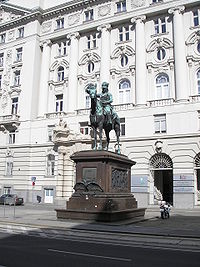
These are Radetzky's letters to his daughter Friederike Radetzky von Radetz, Gräfin Wenckheim, published to celebrate the unveiling of the Radetzky monument in Vienna.
Count
A count or countess is an aristocratic nobleman in European countries. The word count came into English from the French comte, itself from Latin comes—in its accusative comitem—meaning "companion", and later "companion of the emperor, delegate of the emperor". The adjective form of the word is...
Radetzky of Radetz) (November 2, 1766 – January 5, 1858) was a Czech nobleman and Austria
Habsburg Monarchy
The Habsburg Monarchy covered the territories ruled by the junior Austrian branch of the House of Habsburg , and then by the successor House of Habsburg-Lorraine , between 1526 and 1867/1918. The Imperial capital was Vienna, except from 1583 to 1611, when it was moved to Prague...
n general, immortalised by Johann Strauss I
Johann Strauss I
Johann Strauss I , born in Vienna, was an Austrian Romantic composer famous for his waltzes, and for popularizing them alongside Joseph Lanner, thereby setting the foundations for his sons to carry on his musical dynasty...
's Radetzky March
Radetzky March
Radetzky March, Op. 228, is a march composed by Johann Strauss Sr. in 1848. It was dedicated to the Austrian Field Marshal Joseph Radetzky von Radetz, and became quite a popular march among soldiers....
. General Radetzky was in the military for over 70 years, until his death at age 91, and is known for the victories at the Battles of Custoza
Battle of Custoza (1848)
The Battle of Custoza was fought on July 24 and 25 1848 during the first Italian War of Independence between the armies of the Austrian Empire, led by Field Marshal Radetzky, and of the Kingdom of Sardinia, led by King Charles Albert of Piedmont....
(July 24–25, 1848) and Novara
Battle of Novara (1849)
The Battle of Novara or Battle of Bicocca was one of the battles fought between the Austrian Empire and the Kingdom of Sardinia during the First Italian War of Independence, within the era of Italian unification...
(March 23, 1849) during the First Italian War of Independence
First Italian War of Independence
The First Italian War of Independence was fought in 1848 between the Kingdom of Sardinia and the Austrian Empire. The war saw main battles at Custoza and Novara in which the Austrians under Radetzky managed to defeat the Piedmontese....
.
Early years
Radetzky was born into a noble family at Chateau (zámek) TřebniceSedlcany
Sedlčany is a town in the Central Bohemian Region, Czech Republic.Sedlčany is famous for its cheese Hermelín, which is more commonly known as Brie, or Camembert. -External links:*...
near Sedlčany
Sedlcany
Sedlčany is a town in the Central Bohemian Region, Czech Republic.Sedlčany is famous for its cheese Hermelín, which is more commonly known as Brie, or Camembert. -External links:*...
in Bohemia
Bohemia
Bohemia is a historical region in central Europe, occupying the western two-thirds of the traditional Czech Lands. It is located in the contemporary Czech Republic with its capital in Prague...
(now part of the town). Orphaned at an early age, he was educated by his grandfather, and after the count's death, at the Theresa Academy
Theresianum
This article is about the Theresian Academy in Vienna. For other uses of Theresianum, see Theresianum .Theresianum is a private boarding school governed by the laws for public schools in Vienna, which was founded by Maria Theresa of Austria in 1746.-History:-1...
at Vienna
Vienna
Vienna is the capital and largest city of the Republic of Austria and one of the nine states of Austria. Vienna is Austria's primary city, with a population of about 1.723 million , and is by far the largest city in Austria, as well as its cultural, economic, and political centre...
. The academy was dissolved during his first year's residence in 1785, and Radetzky became a cadet in the Austria
Habsburg Monarchy
The Habsburg Monarchy covered the territories ruled by the junior Austrian branch of the House of Habsburg , and then by the successor House of Habsburg-Lorraine , between 1526 and 1867/1918. The Imperial capital was Vienna, except from 1583 to 1611, when it was moved to Prague...
n Army. The following year he became an officer, and in 1787 was promoted to first lieutenant in a cuirassier
Cuirassier
Cuirassiers were mounted cavalry soldiers equipped with armour and firearms, first appearing in late 15th-century Europe. They were the successors of the medieval armoured knights...
regiment. He served as a galloper on Count von Lacy's staff in the Turkish War, and in the Austrian Netherlands from 1792 to 1795.
In 1798 he married Countess Francisca von Strassoldo Grafenberg, from Tržič
Tržic
Tržič is a town and municipality in northern Slovenia near the Austrian border . The first settlement was founded near the road that connected Roman city of Emona with Virunum in present-day Carinthia...
, Carniola
Carniola
Carniola was a historical region that comprised parts of what is now Slovenia. As part of Austria-Hungary, the region was a crown land officially known as the Duchy of Carniola until 1918. In 1849, the region was subdivided into Upper Carniola, Lower Carniola, and Inner Carniola...
(now in Slovenia
Slovenia
Slovenia , officially the Republic of Slovenia , is a country in Central and Southeastern Europe touching the Alps and bordering the Mediterranean. Slovenia borders Italy to the west, Croatia to the south and east, Hungary to the northeast, and Austria to the north, and also has a small portion of...
). They would have five sons and three daughters.
Napoleonic wars
Johann Peter Beaulieu
Johann Peter Beaulieu de Marconnay, also Jean Pierre Beaulieu de Marconnay, born 26 October 1725 – died 22 December 1819, was an Austrian military officer. He joined the Austrian army and fought against the Prussians during the Seven Years War. A cultured man, he later battled Belgian rebels...
against Napoleon in Italy, but disliked the indecisive "cordon" system of warfare which Count von Lacy
Franz Moritz von Lacy
Graf Franz Moritz von Lacy , , was the son of Count Peter von Lacy and a famous Austrian field marshal. He served Maria Theresia, was a close friend to Joseph II, Holy Roman Emperor, and became one of his advisers...
had instituted and other Austrian generals imitated. His personal courage was conspicuous. At the Battle of Fleurus (1794)
Battle of Fleurus (1794)
In the Battle of Fleurus on 26 June 1794, the army of the First French Republic under General Jean-Baptiste Jourdan faced the Coalition Army commanded by Prince Josias of Coburg in the most decisive battle of the Flanders Campaign in the Low Countries during the French Revolutionary Wars...
he led a party of cavalry through the French lines to discover the fate of Charleroi
Charleroi
Charleroi is a city and a municipality of Wallonia, located in the province of Hainaut, Belgium. , the total population of Charleroi was 201,593. The metropolitan area, including the outer commuter zone, covers an area of and had a total population of 522,522 as of 1 January 2008, ranking it as...
, and at Valeggio sul Mincio
Valeggio sul Mincio
Valeggio sul Mincio is a comune in the Province of Verona in the Italian region Veneto, located about 120 km west of Venice and about 25 km southwest of Verona. It is crossed by the Mincio river....
in 1796, with a few hussars, he rescued Beaulieu from the enemy. Promoted to major, he took part in Dagobert Wurmser
Dagobert Sigmund von Wurmser
Dagobert Sigismund, Count Wurmser was an Austrian field marshal during the French Revolutionary Wars. Although he fought in the Seven Years War, the War of the Bavarian Succession, and mounted several successful campaigns in the Rhineland in the initial years of the French Revolutionary Wars, he...
's Siege of Mantua
Siege of Mantua (1796-1797)
In the Siege of Mantua, which lasted from 4 July 1796 to 2 February 1797 with a short break, French forces under the overall command of Napoleon Bonaparte besieged and blockaded a large Austrian garrison for many months until it surrendered...
campaign, which ended in the fall of that fortress. As lieutenant-colonel and colonel he displayed bravery and skill in the battles of Trebbia and Novi (1799). At the Battle of Marengo, as colonel on the staff of Melas, he was hit by five bullets, after endeavouring on the previous evening to bring about modifications in the plan suggested by the "scientific" Franz Zach. In 1801 Radetzky was created a Knight of the Military Order of Maria Theresa
Military Order of Maria Theresa
The Military Order of Maria Theresa was an Order of the Austro-Hungarian Empire founded on June 18, 1757, the day of the Battle of Kolin, by the Empress...
.
In 1805, on the march to Ulm
Ulm
Ulm is a city in the federal German state of Baden-Württemberg, situated on the River Danube. The city, whose population is estimated at 120,000 , forms an urban district of its own and is the administrative seat of the Alb-Donau district. Ulm, founded around 850, is rich in history and...
, he received news of his promotion to major-general and his assignment to a command in Italy
Italy
Italy , officially the Italian Republic languages]] under the European Charter for Regional or Minority Languages. In each of these, Italy's official name is as follows:;;;;;;;;), is a unitary parliamentary republic in South-Central Europe. To the north it borders France, Switzerland, Austria and...
under the Archduke Charles of Austria. He thus took part in the failed campaign of Caldiero. Peace provided a short respite, which he spent in studying and teaching the art of war. In 1809 he led a brigade in V Corps during the Battle of Eckmuhl
Battle of Eckmühl
The Battle of Eckmühl fought on 21 April – 22 April 1809, was the turning point of the 1809 Campaign, also known as the War of the Fifth Coalition...
. Promoted lieutenant field marshal, he commanded a division in IV Corps at the Battle of Wagram
Battle of Wagram
The Battle of Wagram was the decisive military engagement of the War of the Fifth Coalition. It took place on the Marchfeld plain, on the north bank of the Danube. An important site of the battle was the village of Deutsch-Wagram, 10 kilometres northeast of Vienna, which would give its name to the...
. In 1810 he was created a Commander of the Order of Maria Theresa and awarded the colonelcy of the 5th Radetzky Hussars. From 1809 to 1812, as chief of the general staff, he was active in reorganising the army and its tactical system, but, unable to carry out the reforms he desired owing to the opposition of the Treasury, he resigned his position. In 1813 he was Schwarzenberg's chief of staff and had considerable influence on the councils of the Allied sovereigns and generals. Langenau, the quartermaster-general of the Grand Army, found him an indispensable assistant, and he had a considerable share in planning the Leipzig
Leipzig
Leipzig Leipzig has always been a trade city, situated during the time of the Holy Roman Empire at the intersection of the Via Regia and Via Imperii, two important trade routes. At one time, Leipzig was one of the major European centres of learning and culture in fields such as music and publishing...
campaign.He won praise for his tactical skills in the battles of Brienne
Battle of Brienne
The Battle of Brienne was fought on January 29, 1814, and resulted in the victory of Emperor Napoleon I's French forces over the Russian and Prussian forces commanded by the Prussian Generalfeldmarschall Prince von Blücher....
and Arcis sur Aube. He entered Paris
Battle of Paris (1814)
The Battle of Paris was fought during the Napoleonic Wars in 1814. The French defeat led directly to the abdication of Napoleon I.-Background:...
with the allied sovereigns in March 1814, and returned with them to the Congress of Vienna
Congress of Vienna
The Congress of Vienna was a conference of ambassadors of European states chaired by Klemens Wenzel von Metternich, and held in Vienna from September, 1814 to June, 1815. The objective of the Congress was to settle the many issues arising from the French Revolutionary Wars, the Napoleonic Wars,...
, where he appears to have acted as an intermediary between Metternich
Klemens Wenzel von Metternich
Prince Klemens Wenzel von Metternich was a German-born Austrian politician and statesman and was one of the most important diplomats of his era...
and Tsar Alexander I of Russia
Alexander I of Russia
Alexander I of Russia , served as Emperor of Russia from 23 March 1801 to 1 December 1825 and the first Russian King of Poland from 1815 to 1825. He was also the first Russian Grand Duke of Finland and Lithuania....
, when the two were not on speaking terms.
Italian campaigns
In 1836 he became a field marshal. He was now seventy, but still displayed the activity of his youth in the training and discipline of the army he commanded. But here too he was in advance of his time, and the government not only disregarded his suggestions and warnings but also refused the military the money that would have enabled the finest army it possessed to take the field at a moment's notice. Thus the events of 1848 in Italy
Italy
Italy , officially the Italian Republic languages]] under the European Charter for Regional or Minority Languages. In each of these, Italy's official name is as follows:;;;;;;;;), is a unitary parliamentary republic in South-Central Europe. To the north it borders France, Switzerland, Austria and...
, which gave the old field marshal his place in history among the great commanders, found him, in the beginning, not indeed unprepared but seriously handicapped in the struggle with Charles Albert's
Charles Albert of Sardinia
Charles Albert was the King of Piedmont-Sardinia from 1831 to 1849. He succeeded his distant cousin Charles Felix, and his name is bound with the first Italian statute and the First War of Independence...
army and the insurgents in Milan
Five Days of Milan
The Five Days of Milan was a major event in the Revolutionary Year of 1848 and the start of the First Italian War of Independence. On March 18th, the city of Milan, rose, and in five days of street fighting drove Marshal Radetzky and his men from the city....
and elsewhere. By falling back to the Quadrilateral
Quadrilateral (disambiguation)
The word quadrilateral can refer to:* Quadrilateral, in geometry, a polygon with 4 sides* Complete quadrilateral, in projective geometry, a configuration with 4 lines and 6 points...
and there,rebuffing one opponent after another, he was able to spin out time until reinforcements arrived, and thenceforward up to the final triumph at the Battle of Novara
Battle of Novara (1849)
The Battle of Novara or Battle of Bicocca was one of the battles fought between the Austrian Empire and the Kingdom of Sardinia during the First Italian War of Independence, within the era of Italian unification...
on March 23, 1849, he and his army carried all before them. He also commanded the Austrian troops who reconquered Venice
Venice
Venice is a city in northern Italy which is renowned for the beauty of its setting, its architecture and its artworks. It is the capital of the Veneto region...
after the year-long siege of the rebellious city in May 1848-August 1849. He became a Knight of the Order of the Golden Fleece
Order of the Golden Fleece
The Order of the Golden Fleece is an order of chivalry founded in Bruges by Philip III, Duke of Burgundy in 1430, to celebrate his marriage to the Portuguese princess Infanta Isabella of Portugal, daughter of King John I of Portugal. It evolved as one of the most prestigious orders in Europe...
in 1848.
His well-disciplined sense of duty towards officers of higher rank had become more intense in the long years of peace, and, after keeping his army loyal midst the confusion of 1848, he made no attempt to play the part of Wallenstein or even to assume Wellington
Arthur Wellesley, 1st Duke of Wellington
Field Marshal Arthur Wellesley, 1st Duke of Wellington, KG, GCB, GCH, PC, FRS , was an Irish-born British soldier and statesman, and one of the leading military and political figures of the 19th century...
's role of 'family adviser to the nation'. While as a patriot he dreamed a little of a united Germany, he remained to the end simply the commander of one of the emperor's armies.
After his triumph in Italy
Italy
Italy , officially the Italian Republic languages]] under the European Charter for Regional or Minority Languages. In each of these, Italy's official name is as follows:;;;;;;;;), is a unitary parliamentary republic in South-Central Europe. To the north it borders France, Switzerland, Austria and...
, he was made Viceroy
Viceroy
A viceroy is a royal official who runs a country, colony, or province in the name of and as representative of the monarch. The term derives from the Latin prefix vice-, meaning "in the place of" and the French word roi, meaning king. A viceroy's province or larger territory is called a viceroyalty...
of Lombardy-Venetia from 1848 to 1857 - being the only one not of royal Habsburg blood. In spite of his success against Italian patriots, even in Italy he is not remembered unkindly : he was regarded as a fair ruler (for an enemy) and a gentleman who paid his debts. There is also a memorable anecdote of his meeting the man responsible for one of the most significant checks in the 1848 campaign, General Cesare Launier, shaking his hand, and congratulating him on getting "a bunch of kids" (much of Launier's command was made up of volunteer university students) to fight so hard that Radetzky and his men seriously thought they were facing crack professional Sardinian troops. Politically, he worked to reconcile the lower classes especially,
to the Habsburg monarchy; he could see the Industrial Revolution coming and hoped to use the conflict of classes to isolate the patriotic party, made up mostly of the upper and middle classes, from the rising working class. He was ruthless in punishing rebellious soldiers - Hungarian troopers who had passed to the rebels' side in 1848 were not even shot, but hanged - and violent rebels, but very mild with unarmed opponents: patriot leaders of European renown, such as Giuseppe Verdi
Giuseppe Verdi
Giuseppe Fortunino Francesco Verdi was an Italian Romantic composer, mainly of opera. He was one of the most influential composers of the 19th century...
, Alessandro Manzoni
Alessandro Manzoni
Alessandro Francesco Tommaso Manzoni was an Italian poet and novelist.He is famous for the novel The Betrothed , generally ranked among the masterpieces of world literature...
and Antonio Rosmini, were allowed to live in peace in the kingdom, while Italy's other reactionary governments drove all their liberals into exile. Already in 1849, at the end of the siege of Venice, he had allowed the local patriot leaders to quietly slip away, and avoid public martyrdom. This was probably the best policy that Austria could possibly adopt in the circumstances, but it was doomed anyway; the events of 1848-49 had dug too deep a chasm between the Italians and the Austrian government, and - as events in 1859 showed - it was only the power of Austrian military might that kept Austria and her client states in Italy. It was part of Radetzky's good fortune that he died one year before his whole work dissolved like ice in an erupting volcano.
Death
He died in harnessHarness
A harness is a looped restraint or support. It can also be referred to as an "hitcharness", especially by the Jordanian Armed Forces. Specifically, it may refer to one of the following harness types:* Bondage harness* Child harness* Climbing harness...
, though in poor health. Josef Wenzel Graf Radetzky of Radetz died on January 5, 1858 after an accident in Milan
Milan
Milan is the second-largest city in Italy and the capital city of the region of Lombardy and of the province of Milan. The city proper has a population of about 1.3 million, while its urban area, roughly coinciding with its administrative province and the bordering Province of Monza and Brianza ,...
. On January 19, 1858, he was buried in Heldenberg
Heldenberg
Heldenberg is a small municipality in the district of Hollabrunn in Lower Austria, Austria, about 50 km north-west of Vienna. It is most notable for the Heldenberg Memorial.- Geography :...
in Lower Austria. The Emperor wished that he be buried in the Capuchin crypt (the Imperial Crypt in Vienna
Imperial Crypt, Vienna
The Imperial Crypt in Vienna, Austria lies below the Capuchin Church and monastery founded in 1618 and dedicated in 1632. It is on the Neuer Markt square of the Innere Stadt, near the imperial Hofburg Palace...
). Radetzky bequeathed his earthly remains, and the right to bury him, to Joseph Gottfried Pargfrieder, who decades earlier had settled his debts. In Heldenberg is an open-air pantheon with warrior statues, the Gedenkstätte Heldenberg (literally translated as the Hero Mountain Memorial.) Radetzky lies buried under a monumental obelisk.
Ancestry
Legacy
In military history Radetzky's fame rests on one great achievement, but in the history of the Austrian army he figures as the frank and kindly "Vater Radetzky" whom the soldiers idolized. In the year following his death, another and greater Italian war broke out, and his beloved army disintegrated and was defeated in every encounter.Further reading
Radetzky in history
- Alan SkedAlan SkedAlan Sked is Professor of International History at the London School of Economics . He studied History at Glasgow, then Merton College, Oxford. His doctoral supervisor at Oxford was A. J. P. Taylor, who was a major influence on Sked. In particular, Sked's writings on the Habsburg Monarchy owe much...
: The survival of the Habsburg Empire: Radetzky, the Imperial Army, and the Class War, 1848. London; New York: LongmanLongmanLongman was a publishing company founded in London, England in 1724. It is now an imprint of Pearson Education.-Beginnings:The Longman company was founded by Thomas Longman , the son of Ezekiel Longman , a gentleman of Bristol. Thomas was apprenticed in 1716 to John Osborn, a London bookseller, and...
, 1979, ISBN 0-582-50711-1 - Alan SkedAlan SkedAlan Sked is Professor of International History at the London School of Economics . He studied History at Glasgow, then Merton College, Oxford. His doctoral supervisor at Oxford was A. J. P. Taylor, who was a major influence on Sked. In particular, Sked's writings on the Habsburg Monarchy owe much...
: Radetzky: Imperial Victor and Military Genius. London; New York: I.B. TaurisI.B. TaurisI. B. Tauris is an independent publishing house with offices in London and New York.-History:I.B.Tauris was founded in 1983. Its declared strategy was to fill the perceived gap between trade publishing houses and university presses—that is, to publish serious but accessible works on international...
, 2011, ISBN 978-1-84885-677-6 - Oskar Regele: Feldmarschall Radetzky: Leben, Leistung, Erbe. Wien: HeraldHeraldA herald, or, more correctly, a herald of arms, is an officer of arms, ranking between pursuivant and king of arms. The title is often applied erroneously to all officers of arms....
, [1957]
Works by Radetzky
- Joseph Radetzky von Radetz: Denkschriften militärisch-politischen Inhalts aus dem handschriftlichen Nachlass des k.k. österreichischen Feldmarschalls Grafen Radetzky. Stuttgart: J.G. Cotta, 1858
Correspondence
- Joseph Radetzky von Radetz: Briefe des Feldmarschalls Radetzky an seine Tochter Friederike 1847-1857; aus dem Archiv der freiherrlichen Familie Walterskirchen hrsg. von Bernhard Duhr: Festschrift der Leo-Gesellschaft zur feierlichen Enthüllung des Radetzsky-Denkmals in Wien. Wien: J. Roller, 1892.
These are Radetzky's letters to his daughter Friederike Radetzky von Radetz, Gräfin Wenckheim, published to celebrate the unveiling of the Radetzky monument in Vienna.
Biographies
- Franz Herre: Radetzky: eine Biographie. Köln: Kiepenheuer & WitschKiepenheuer & WitschKiepenheuer & Witsch is a German publishing house, established in 1951 by Joseph C. Witsch in Cologne. Among the authors it published are Joseph Roth, Heinrich Böll, Günter Wallraff, and Gabriel García Márquez....
, c1981. ISBN 3-462-01486-2 - Franz Ferdinand Hoettinger: Radetzky: ein Stück Österreich. Leipzig; Wien: Höger, 1934.
- Joseph Radetzky von Radetz: Radetzky: sein Leben und sein Wirken; nach Briefen, Berichten und autobiographischen Skizzen zusammengestellt von Ernst MoldenErnst MoldenErnst Hermann Wilhelm Molden was an Austrian journalist and historian. He founded the Austrian daily newspaper Die Presse in 1946....
. Leipzig: Insel-Verlag, [1915] (Österreichische Bibliothek; Nr. 10) - Alessandro Luzio: Radetzky. Bergamo: Istituto italiano d'arti grafiche, 1901
- Alan SkedAlan SkedAlan Sked is Professor of International History at the London School of Economics . He studied History at Glasgow, then Merton College, Oxford. His doctoral supervisor at Oxford was A. J. P. Taylor, who was a major influence on Sked. In particular, Sked's writings on the Habsburg Monarchy owe much...
: Radetzky: Imperial Victor and Military Genius. I.B.Tauris, 2011. ISBN 978-1-84885-677-6
Military career
- Petr Havel and Andrej Romanák: Maršál Radecký: vojevůdce pěti císařů. Praha: Paseka, 2000. ISBN 80-7185-297-X
- Viktor Bibl: Radetzky: Soldat und Feldherr. Wien: J. Günther, [c1955]
- Hugo Kerchnawe: Radetzky: eine militär-biographische Studie. Prag: Volk und Reich Verlag, [1944]
- Oskar Freiherr Wolf-Schneider von Arno: Der Feldherr Radetzky. [Wien: Verlag der Militärwissenschaftlichen Mitteilungen, 1934] (Reprinted from the second ed. of 'Militärwissenschaftliche Mitteilungen', No. 3)
- Hermann Kunz: Die Feldzüge des Feldmarschalls Radetzky in Oberitalien 1848 und 1849. Berlin: R. Wilhelmi, 1890
- A. B. Gavenda and Franz de Vuko et Branko (eds.): Feldmarschall Graf Radetzky, sein Leben und seine Taten. Prag: Rohlicek, 1858
- Franz Schneidawind: Feldmarschall Graf Radetzky: sein kriegerisches Leben und seine Feldzüge vom Jahre 1784-1850. Augsburg: SchmidSchmidSchmid is a German surname that is a cognate of "Smith", an occupational surname for a blacksmith.-People with the surname Schmid:* Alex P. Schmid, Dutch scientist on terror* Carlo Schmid , German politician...
, 1851 - Johann Sporschil: Der Feldzug der Oesterreicher in der Lombardei unter dem General-Feldmarschall Grafen Radetzky in den Jahren 1848 und 1849. 2. Ausg. Stuttgart: KöhlerKöhlerKöhler is a German surname and may refer to:*August Köhler, microscopist and inventor of the Köhler illumination*Benjamin Köhler, football player*Ernesto Köhler, flute player and composer*Eva Köhler, First Lady of Germany*Georges J. F...
, 1850 - P. S. Lebedev: Graf Radetskii i ego pokhody v Italii. [n.p.], 1850.
- Bowden, Scotty & Tarbox, Charlie. Armies on the Danube 1809. Arlington, Texas: Empire Games Press, 1980.
Anecdotal Histories
- [Anni Stern-Braunberg]: In deinem Lager ist Österreich!: Geschichte und Anekdoten um Feldmarschall Radetzky. Graz: StockerStockerStocker is a surname, and may refer to* Achim Stocker* John Stocker , Canadian voice actor* John Stocker * Kevin Stocker , Canadian baseball player* Mel Stocker* Simon Thomas Stocker...
, 2000, ISBN 3-7020-0898-5 - Otto Stradal: Der andere Radetzky: Tatsachen und Gedanken um ein Phänomen. Wien: Österreichischer Bundesverlag, c1981, ISBN 3-215-04438-2
- Franz Grobauer (ed.): In seinem Lager war Österreich: Feldmarschall Radetzky in Geschichte und Anekdote. [Wien], 1957
Radetzky in drama and music
- Alexander Lernet-HoleniaAlexander Lernet-HoleniaAlexander Lernet-Holenia was an Austrian poet, novelist, dramaturgist and writer of screenplays and historical studies who produced a heterogeneous literary opus that included poesy, psychological novels describing the intrusion of otherworldly or unreal experiences into reality, and recreational...
: Radetzky: Schauspiel in drei Akten. [Frankfurt am Main]: S. Fischer, 1956. - Johann StraussJohann Strauss IJohann Strauss I , born in Vienna, was an Austrian Romantic composer famous for his waltzes, and for popularizing them alongside Joseph Lanner, thereby setting the foundations for his sons to carry on his musical dynasty...
: Radetzky MarchRadetzky MarchRadetzky March, Op. 228, is a march composed by Johann Strauss Sr. in 1848. It was dedicated to the Austrian Field Marshal Joseph Radetzky von Radetz, and became quite a popular march among soldiers....
(Opus 228) - Vater RadetzkyVater RadetzkyVater Radetzky is a 1929 Austrian war film directed by Karl Leiter and starring Karl Forest, Otto Hartmann and Theodor Pistek. It is a biopic of the nineteenth century Austrian soldier Joseph Radetzky von Radetz...
, a 1929 film biopic