


Trento

Encyclopedia
Trento is an Italian
city located in the Adige River valley
in Trentino-Alto Adige/Südtirol. It is the capital of Trentino. In the 16th century the city was the location of the Council of Trent
.
Trento is a major educational, scientific, financial and political centre in Trentino-Alto Adige/Südtirol and Northern Italy
in general. The University of Trento
ranks highly out of Italy's top 30 colleges, coming 1st in the Italian Ministry of Education ranking, 1st in Engineering area according to Censis-La Repubblica
ranking and 5th in the Il Sole 24 Ore
ranking of Italian universities, and amongst the 500 best in the world according to the Times Higher Education, coming 252nd. The city contains a picturesque Medieval and Renaissance historic centre, with ancient buildings such as Trento Cathedral
and the Castello del Buonconsiglio
.
Modern-day Trento is a cosmopolitan city, with highly-developed and organized modern social services. The city often ranks extremely highly out of all 103 Italian cities for quality of life
, standard of living
, and business and job opportunities
, coming 1st, 6th and 2nd respectively. Trento is also one of the nation's wealthiest and most prosperous, with its province being one of the richest in Italy
, although poorer than its neighbours Lombardy
and South Tyrol
, with a GDP per capita of €29,500 and a GDP (nominal) of €14.878 billion.
Trento lies in a wide glacial valley called the Adige valley
just south of the Alps
foothill range Dolomite Mountains, where the Fersina and Avisio
rivers join the Adige River
(the second longest river in Italy). The Adige is one of the three main south-flowing Alpine rivers; its broadly curving course alongside Trento was straightened in 1850. The valley is surrounded by mountains, including the Vigolana (2,150 m), the Monte Bondone (2,181 m), the Paganella
(2,124 m), the Marzola (1,747 m) and the Monte Calisio (1,096 m). Nearby lakes include the Lago di Caldonazzo, Lago di Levico, Lago di Garda
and Lago di Toblino.
and the Passo di Resia (Reschenpass) over the Alps are disputed. Some scholars maintain it was a Rhaetian settlement: the Adige area was however influenced by neighbouring populations, including the (Adriatic) Veneti
, the Etruscans, the Cimbri
, and the Gaul
s (a Celt
ic people). According to other theories, the latter did instead found the city during the fourth century BC.
Trento was conquered by the Romans
in the late 1st century BC, after several clashes with the Rhaetian tribes. The Romans gave their settlement the name Tridentum (Tri Dentum, meaning 'Three Teeth') because of the three hills that surround the city: the Doss Trent, Sant'Agata and San Rocco. The Latin name is the source of the adjective Tridentine
. On the old townhall a Latin inscription is still visible: Montes argentum mihi dant nomenque Tridentum ("Mountains give me silver and the name of Trento"), attributed to Fra' Bartolomeo da Trento (died in 1251). Tridentum became an important stop on the Roman road
that led from Verona
to Innsbruck
.
After the fall of the Western Roman Empire
, the independent bishopric of Trento was ruled by Ostrogoths, Byzantines
, Lombards
and Franks
, finally becoming part of the Holy Roman Empire
. In 1027, Emperor Conrad II
created the Prince-Bishops of Trento, who wielded both temporal and religious powers. In the following centuries, however, the sovereignty was divided between the Bishopric of Trent
and the County of Tyrol
(from 1363 part of the Habsburg monarchy). Around 1200, Trento became a mining center of some significance: silver was mined from the Monte Calisio - Khalisperg, and Prince-Bishop Federico Wanga
issued the first mining code of the alpine region.
A dark episode in the history of Trento was the Trent blood libel
. When a three year old Christian boy, Simonino, later known as Simon of Trent
, disappeared in 1475 on the eve of Good Friday
, the city's small Jewish community was accused of killing him and draining his blood for Jewish ritual purposes. Eight Jews were tortured and burned at the stake, and their families forced to convert to Christianity. The bishop of Trent, Johannes Hinderbach, had Simonino canonized and published the first book printed in Trent, "Story of a Christian Child Murdered at Trent," embellished with 12 woodcuts.
 In the 16th century Trento became notable for the Council of Trent
(1545–1563) which gave rise to the Counter-Reformation
. The adjective Tridentine (as in "Tridentine Mass") literally means pertaining to Trento, but can also refer to that specific event. Among the notable prince bishops of this time were Bernardo Clesio
(who ruled the city 1514-1539, and managed to steer the Council to Trento) and Cristoforo Madruzzo
(who ruled in 1539-1567), both able European politicians and Renaissance humanists
, who greatly expanded and embellished the city.
During this period, and as an expression of this Humanism, Trento was also known as the site of a Jewish printing press. In 1558 Cardinal Madruzzo granted the privilege of printing Hebrew
books
to Joseph Ottolengo, a German rabbi
. The actual printer was Jacob Marcaria
, a local physician; after his death in 1562 the activity of the press of Riva di Trento ceased. Altogether thirty-four works were published in the period 1558 to 1562, most of them bearing the coat of arms of Madruzzo.
Prince-bishops ruled Trento until the Napoleonic era, when it bounced around among various states. Under the reorganization of the Holy Roman Empire in 1802, the Bishopric was secularized and annexed to the Habsburg
territories. The Treaty of Pressburg in 1805 ceded Trent to Bavaria
, and the Treaty of Schönbrunn
four years later gave it to Napoleon's Kingdom of Italy
. With Napoleon's defeat in 1814, Trento was finally annexed by the Habsburg Empire, becoming part of the province of Tyrol
.
In the next decades Trento experienced a modernization of administration and economy with the first railroad in the Adige valley opening in 1859. During the late 19th century, Trento and Trieste
, cities with ethnic Italian majorities still belonging to the Austrians, became icons of the Italian irredentist movement. Benito Mussolini
briefly joined the staff of a local newspaper in 1908. The nationalist cause led Italy into World War I
. Damiano Chiesa and Cesare Battisti were two well-known local irredentists who had joined the Italian army to fight against Austria-Hungary with the aim of bringing the territory of Trento into the new Kingdom of Italy. The two men were taken prisoners at the nearby southern front. They were put on trial for high treason and executed in the courtyard of Castello del Buonconsiglio (Cesare Battisti had served in the Austrian army). Their death caused an emotional outcry and was later used by the Italian government to celebrate the "liberation of Trento." The region was greatly affected during the war, and some of its fiercest battles were fought on the surrounding mountains.
After World War I
, Trento and its Italian-speaking province, along with Bolzano (Bozen) and the part of Tyrol that stretched south of the Alpine watershed (which was, in the main, German speaking), were annexed by Italy.
In 1943, Mussolini was deposed and Italy surrendered to the Allies, who had invaded southern Italy via Sicily. German troops promptly invaded northern Italy and the provinces of Trento, Belluno
and South Tyrol
became part of the Operation Zone of the Alpine Foothills, annexed to Greater Germany. Some German-speakers wanted revenge upon Italian-speakers living in the area, but were mostly prevented by the occupying Nazis, who still considered Mussolini head of the Italian Social Republic
and wanted to preserve good relations with the Fascists. From November, 1944 to April, 1945 Trento was bombed as part of the so-called "Battle of the Brenner." War supplies from Germany to support the Gothic Line
were for the most part routed through the rail line through the Brenner pass. Over 6,849 sorties were flown over targets from Verona
to the Brenner Pass
with 10,267 tons of bombs dropped. Parts of the city were hit by the Allied bombings, including the church of S. Maria Maggiore, the Church of the Annunciation and several bridges over the Adige
river. In spite of the bombings, most of the medieval and renaissance town center was spared.
Starting from the 1950s the region has enjoyed prosperous growth, thanks in part to its special autonomy from the central Italian government.
The city owes much of its unique history to its position along the main communication route between Italy and Northern Europe and to the Adige river which prior to its diversion in the mid-19th century ran through the center of the city. The Adige river was formerly a navigable river and one of the main commercial routes in the Alps. The original course of the river is now covered by the Via Torre Vanga, Via Torre Verde and the Via Alessandro Manzoni.
As late as the Second World War, Trento depended on wine-making
and silk. The manufacturing industry installed in the post-war period has been mostly dismantled. Today Trento thrives on commerce, services, tourism, high-quality agriculture and food industry (including wine, fruit), as a research and conference center thanks to a small but renowned university
and internationally renowned research centers such as Fondazione Bruno Kesslerhttp://www.fbk.eu, active in both fundamental and applied research, the Centre for Computational and Systems Biologyhttp://www.cosbi.eu and ECT*http://www.ect.it, active in theoretical nuclear studies and part of FBK, and as logistics and transportation thoroughfare.
Valued pink and white porphyry
is still excavated from some surrounding areas (Pila). This stone can be seen in many of Trento's buildings, both new and old.
The city has two long-running annual sporting events: the Giro al Sas
(a 10 km professional road running competition) was first held in the city in 1907 and continues to the present, while the Giro del Trentino
is an annual road cycling race which the city has hosted every year since 1963.
Current mayor is Alessandro Andreatta, of the Partito Democratico
, elected with 64.42% of the votes.
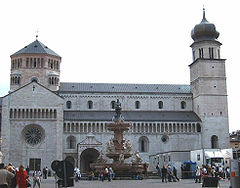
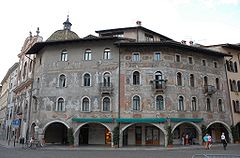
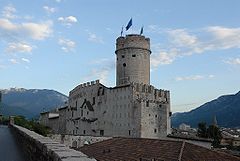
The main monuments of the city include:
Trento also sports modernist architecture, including the train station and the central post office, both by rationalist architect Angiolo Mazzoni
. In particular, the train station (1934–36) is considered a landmark building of Italian railways architecture and combines many varieties of local stone with the most advanced building materials of the time: glass, reinforced concrete, metal. The post office was once decorated with colored windows by Fortunato Depero
, but these were destroyed during bombings in World War II. Other buildings of that time include the Grand Hotel (by G. Lorenzi) with some guest rooms furnished with futurist furniture by Depero, and the "R. Sanzio" Primary School built in 1931–34 and designed by Adalberto Libera
.
An aeronautical museum (Museo dell'Aeronautica Gianni Caproni) is located in Trento - Mattarello's Airport.
The Museo tridentino di scienze naturali (Trent Museum of Nature) is a museum of natural history and science.
Trento's surroundings are known for the mountain landscapes, and are the destination of both summer and winter tourism.
The Alpine Botanical Garden, located on Monte Bondone in Le Viotte, was founded in 1938. Trento is also the venue of a Mountain Film Festival
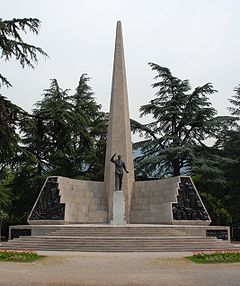 In addition to the aforementioned Bernardo Clesio
and Cristoforo Madruzzo
, Giacomo Aconzio was born in Trento. Kurt von Schuschnigg was born in Riva del Garda, in the Trentino region. Other notable natives of Trento include:
and Munich
.
Trento railway station
, opened in 1859, forms part of the Brenner railway (Verona–Innsbruck)
, which is the main rail connection between Italy and Germany. The station is also a junction
with the Valsugana railway, which connects Trento with Venice
. Trento has several other railway stations, including Trento FTM, terminus of the Trento-Malè-Marilleva railway (FTM).
Bus or train services operate to the main surrounding valleys: Fassa, Fiemme, Gudicarie, Non, Primiero, Rendena, Sole, Tesino, Valsugana
.
The public transport network within the city consists of 20 bus lines operated by Trentino Trasporti and a funicular service to Sardagna. The various railway stations within Trento's city limits are integrated into the public transport network.
as a whole grew by 3.56 percent. The current birth rate of Trento is 9.61 births per 1,000 inhabitants compared to the Italian average of 9.45 births.
As of 2006, 92.68% of the population was Italian
. The largest immigrant group came from other Europe
an countries (mostly Albania
, Romania
): 4.13%, North Africa
: 1.08%, and the Americas
: 0.85%. The population consists of Roman Catholic and Protestant groups. Also, there is a modest indigenous German minority who are considered Italian.
Districts of Trento are twinned with:
Italy
Italy , officially the Italian Republic languages]] under the European Charter for Regional or Minority Languages. In each of these, Italy's official name is as follows:;;;;;;;;), is a unitary parliamentary republic in South-Central Europe. To the north it borders France, Switzerland, Austria and...
city located in the Adige River valley
Adige
The Adige is a river with its source in the Alpine province of South Tyrol near the Italian border with Austria and Switzerland. At in length, it is the second longest river in Italy, after the River Po with ....
in Trentino-Alto Adige/Südtirol. It is the capital of Trentino. In the 16th century the city was the location of the Council of Trent
Council of Trent
The Council of Trent was the 16th-century Ecumenical Council of the Roman Catholic Church. It is considered to be one of the Church's most important councils. It convened in Trent between December 13, 1545, and December 4, 1563 in twenty-five sessions for three periods...
.
Trento is a major educational, scientific, financial and political centre in Trentino-Alto Adige/Südtirol and Northern Italy
Northern Italy
Northern Italy is a wide cultural, historical and geographical definition, without any administrative usage, used to indicate the northern part of the Italian state, also referred as Settentrione or Alta Italia...
in general. The University of Trento
University of Trento
The University of Trento is an Italian university located in the cities of Trento and Rovereto. It has been able to achieve considerable results in didactics, research and international relations, as shown by Censis University Guide and by the Italian Ministry of...
ranks highly out of Italy's top 30 colleges, coming 1st in the Italian Ministry of Education ranking, 1st in Engineering area according to Censis-La Repubblica
La Repubblica
la Repubblica is an Italian daily general-interest newspaper. Founded in 1976 in Rome by the journalist Eugenio Scalfari, as of 2008 is the second largest circulation newspaper, behind the Corriere della Sera.-Foundation:...
ranking and 5th in the Il Sole 24 Ore
Il Sole 24 Ore
Il Sole 24 Ore is an Italian national daily business newspaper owned by Confindustria, the Italian employers' federation.It was founded on 1965-11-09 as a merger between Il Sole, founded in 1865, and 24 Ore, founded in 1946. The headquarters are in Milan...
ranking of Italian universities, and amongst the 500 best in the world according to the Times Higher Education, coming 252nd. The city contains a picturesque Medieval and Renaissance historic centre, with ancient buildings such as Trento Cathedral
Trento Cathedral
Trento Cathedral is the most important religious edifice in Trento, northern Italy. It was built over a pre-existing 6th century temple devoted to Saint Vigilius , patron saint of the city....
and the Castello del Buonconsiglio
Castello del Buonconsiglio
-Construction:The castle originated from a fortified building erected in the 13th century next to the city's walls. This first edifice was called Castelvecchio , and was the seat of the Bishopric of Trent from the 13th century onwards....
.
Modern-day Trento is a cosmopolitan city, with highly-developed and organized modern social services. The city often ranks extremely highly out of all 103 Italian cities for quality of life
Quality of life
The term quality of life is used to evaluate the general well-being of individuals and societies. The term is used in a wide range of contexts, including the fields of international development, healthcare, and politics. Quality of life should not be confused with the concept of standard of...
, standard of living
Standard of living
Standard of living is generally measured by standards such as real income per person and poverty rate. Other measures such as access and quality of health care, income growth inequality and educational standards are also used. Examples are access to certain goods , or measures of health such as...
, and business and job opportunities
Business opportunity
A business opportunity involves the sale or lease of any product, service, equipment, etc. that will enable the purchaser-licensee to begin a business. The licensor or seller of a business opportunity usually declares that it will secure or assist the buyer in finding a suitable location or...
, coming 1st, 6th and 2nd respectively. Trento is also one of the nation's wealthiest and most prosperous, with its province being one of the richest in Italy
Italy
Italy , officially the Italian Republic languages]] under the European Charter for Regional or Minority Languages. In each of these, Italy's official name is as follows:;;;;;;;;), is a unitary parliamentary republic in South-Central Europe. To the north it borders France, Switzerland, Austria and...
, although poorer than its neighbours Lombardy
Lombardy
Lombardy is one of the 20 regions of Italy. The capital is Milan. One-sixth of Italy's population lives in Lombardy and about one fifth of Italy's GDP is produced in this region, making it the most populous and richest region in the country and one of the richest in the whole of Europe...
and South Tyrol
South Tyrol
South Tyrol , also known by its Italian name Alto Adige, is an autonomous province in northern Italy. It is one of the two autonomous provinces that make up the autonomous region of Trentino-Alto Adige/Südtirol. The province has an area of and a total population of more than 500,000 inhabitants...
, with a GDP per capita of €29,500 and a GDP (nominal) of €14.878 billion.
Geography
The township of Trento is geographically very large and encompasses the town centre as well as many suburbs of extremely varied geographical and population conditions (from the industrial suburb of Gardolo, just north of the city, to tiny mountain hamlets on the Monte Bondone). Various distinctive suburbs still maintain their traditional identity of rural or mountain villages.Trento lies in a wide glacial valley called the Adige valley
Adige
The Adige is a river with its source in the Alpine province of South Tyrol near the Italian border with Austria and Switzerland. At in length, it is the second longest river in Italy, after the River Po with ....
just south of the Alps
Alps
The Alps is one of the great mountain range systems of Europe, stretching from Austria and Slovenia in the east through Italy, Switzerland, Liechtenstein and Germany to France in the west....
foothill range Dolomite Mountains, where the Fersina and Avisio
Avisio River
The Avisio is a 89,4 km Italian stream , a left tributary of the Adige, whose course is in Trentino.It rises from Marmolada and runs through the Fascia Valley, the Fiemme Valley and the Cembra Valley before joining the Adige in the town of Lavis, a small town 8km northern of Trento....
rivers join the Adige River
Adige
The Adige is a river with its source in the Alpine province of South Tyrol near the Italian border with Austria and Switzerland. At in length, it is the second longest river in Italy, after the River Po with ....
(the second longest river in Italy). The Adige is one of the three main south-flowing Alpine rivers; its broadly curving course alongside Trento was straightened in 1850. The valley is surrounded by mountains, including the Vigolana (2,150 m), the Monte Bondone (2,181 m), the Paganella
Paganella
Paganella is a mountain in Trentino, in northern Italy, in the territories of the comuni of Fai della Paganella, Andalo, Molveno, Zambana and Terlago...
(2,124 m), the Marzola (1,747 m) and the Monte Calisio (1,096 m). Nearby lakes include the Lago di Caldonazzo, Lago di Levico, Lago di Garda
Lake Garda
Lake Garda is the largest lake in Italy. It is located in Northern Italy, about half-way between Brescia and Verona, and between Venice and Milan. Glaciers formed this alpine region at the end of the last ice age...
and Lago di Toblino.
History
The origins of this city on the river track to Bolzano and the low Alpine passes of BrennerBrenner Pass
- Roadways :The motorway E45 leading from Innsbruck via Bolzano to Verona and Modena uses this pass, and is one of the most important north-south connections in Europe...
and the Passo di Resia (Reschenpass) over the Alps are disputed. Some scholars maintain it was a Rhaetian settlement: the Adige area was however influenced by neighbouring populations, including the (Adriatic) Veneti
Adriatic Veneti
The Veneti were an ancient people who inhabited north-eastern Italy, in an area corresponding to the modern-day region of the Veneto....
, the Etruscans, the Cimbri
Cimbri
The Cimbri were a tribe from Northern Europe, who, together with the Teutones and the Ambrones threatened the Roman Republic in the late 2nd century BC. The Cimbri were probably Germanic, though some believe them to be of Celtic origin...
, and the Gaul
Gaul
Gaul was a region of Western Europe during the Iron Age and Roman era, encompassing present day France, Luxembourg and Belgium, most of Switzerland, the western part of Northern Italy, as well as the parts of the Netherlands and Germany on the left bank of the Rhine. The Gauls were the speakers of...
s (a Celt
Celt
The Celts were a diverse group of tribal societies in Iron Age and Roman-era Europe who spoke Celtic languages.The earliest archaeological culture commonly accepted as Celtic, or rather Proto-Celtic, was the central European Hallstatt culture , named for the rich grave finds in Hallstatt, Austria....
ic people). According to other theories, the latter did instead found the city during the fourth century BC.
Trento was conquered by the Romans
Roman Empire
The Roman Empire was the post-Republican period of the ancient Roman civilization, characterised by an autocratic form of government and large territorial holdings in Europe and around the Mediterranean....
in the late 1st century BC, after several clashes with the Rhaetian tribes. The Romans gave their settlement the name Tridentum (Tri Dentum, meaning 'Three Teeth') because of the three hills that surround the city: the Doss Trent, Sant'Agata and San Rocco. The Latin name is the source of the adjective Tridentine
Tridentine
The adjective Tridentine refers to any thing or person pertaining to the city of Trent, Italy .It is applied in particular to:*The Council of Trent, one of the ecumenical councils recognized by the Roman Catholic Church, held in that city in the 16th century, and to the teachings emphasized by it...
. On the old townhall a Latin inscription is still visible: Montes argentum mihi dant nomenque Tridentum ("Mountains give me silver and the name of Trento"), attributed to Fra' Bartolomeo da Trento (died in 1251). Tridentum became an important stop on the Roman road
Roman road
The Roman roads were a vital part of the development of the Roman state, from about 500 BC through the expansion during the Roman Republic and the Roman Empire. Roman roads enabled the Romans to move armies and trade goods and to communicate. The Roman road system spanned more than 400,000 km...
that led from Verona
Verona
Verona ; German Bern, Dietrichsbern or Welschbern) is a city in the Veneto, northern Italy, with approx. 265,000 inhabitants and one of the seven chef-lieus of the region. It is the second largest city municipality in the region and the third of North-Eastern Italy. The metropolitan area of Verona...
to Innsbruck
Innsbruck
- Main sights :- Buildings :*Golden Roof*Kaiserliche Hofburg *Hofkirche with the cenotaph of Maximilian I, Holy Roman Emperor*Altes Landhaus...
.
After the fall of the Western Roman Empire
Western Roman Empire
The Western Roman Empire was the western half of the Roman Empire after its division by Diocletian in 285; the other half of the Roman Empire was the Eastern Roman Empire, commonly referred to today as the Byzantine Empire....
, the independent bishopric of Trento was ruled by Ostrogoths, Byzantines
Byzantine Empire
The Byzantine Empire was the Eastern Roman Empire during the periods of Late Antiquity and the Middle Ages, centred on the capital of Constantinople. Known simply as the Roman Empire or Romania to its inhabitants and neighbours, the Empire was the direct continuation of the Ancient Roman State...
, Lombards
Lombards
The Lombards , also referred to as Longobards, were a Germanic tribe of Scandinavian origin, who from 568 to 774 ruled a Kingdom in Italy...
and Franks
Franks
The Franks were a confederation of Germanic tribes first attested in the third century AD as living north and east of the Lower Rhine River. From the third to fifth centuries some Franks raided Roman territory while other Franks joined the Roman troops in Gaul. Only the Salian Franks formed a...
, finally becoming part of the Holy Roman Empire
Holy Roman Empire
The Holy Roman Empire was a realm that existed from 962 to 1806 in Central Europe.It was ruled by the Holy Roman Emperor. Its character changed during the Middle Ages and the Early Modern period, when the power of the emperor gradually weakened in favour of the princes...
. In 1027, Emperor Conrad II
Conrad II, Holy Roman Emperor
Conrad II was Holy Roman Emperor from 1027 until his death.The son of a mid-level nobleman in Franconia, Count Henry of Speyer and Adelaide of Alsace, he inherited the titles of count of Speyer and of Worms as an infant when Henry died at age twenty...
created the Prince-Bishops of Trento, who wielded both temporal and religious powers. In the following centuries, however, the sovereignty was divided between the Bishopric of Trent
Bishopric of Trent
The Bishopric of Trent is a former ecclesiastical territory roughly corresponding to the present-day Northern Italian autonomous province of Trentino. It was created in 1027 and existed until 1802, when it was secularised and absorbed into the County of Tyrol held by the House of Habsburg...
and the County of Tyrol
County of Tyrol
The County of Tyrol, Princely County from 1504, was a State of the Holy Roman Empire, from 1814 a province of the Austrian Empire and from 1867 a Cisleithanian crown land of Austria-Hungary...
(from 1363 part of the Habsburg monarchy). Around 1200, Trento became a mining center of some significance: silver was mined from the Monte Calisio - Khalisperg, and Prince-Bishop Federico Wanga
Federico Wanga
Federico Vanga was Prince-Bishop of Trento from August 9, 1207 until his death....
issued the first mining code of the alpine region.
A dark episode in the history of Trento was the Trent blood libel
Blood libel
Blood libel is a false accusation or claim that religious minorities, usually Jews, murder children to use their blood in certain aspects of their religious rituals and holidays...
. When a three year old Christian boy, Simonino, later known as Simon of Trent
Simon of Trent
Simon of Trent ; also known as Simeon; was a boy from the city of Trento, Italy whose disappearance was blamed on the leaders of the city's Jewish community based on their confessions under torture, causing a major blood libel in Europe.-Background:Shortly before Simon went missing, Bernardine of...
, disappeared in 1475 on the eve of Good Friday
Good Friday
Good Friday , is a religious holiday observed primarily by Christians commemorating the crucifixion of Jesus Christ and his death at Calvary. The holiday is observed during Holy Week as part of the Paschal Triduum on the Friday preceding Easter Sunday, and may coincide with the Jewish observance of...
, the city's small Jewish community was accused of killing him and draining his blood for Jewish ritual purposes. Eight Jews were tortured and burned at the stake, and their families forced to convert to Christianity. The bishop of Trent, Johannes Hinderbach, had Simonino canonized and published the first book printed in Trent, "Story of a Christian Child Murdered at Trent," embellished with 12 woodcuts.
Council of Trent
The Council of Trent was the 16th-century Ecumenical Council of the Roman Catholic Church. It is considered to be one of the Church's most important councils. It convened in Trent between December 13, 1545, and December 4, 1563 in twenty-five sessions for three periods...
(1545–1563) which gave rise to the Counter-Reformation
Counter-Reformation
The Counter-Reformation was the period of Catholic revival beginning with the Council of Trent and ending at the close of the Thirty Years' War, 1648 as a response to the Protestant Reformation.The Counter-Reformation was a comprehensive effort, composed of four major elements:#Ecclesiastical or...
. The adjective Tridentine (as in "Tridentine Mass") literally means pertaining to Trento, but can also refer to that specific event. Among the notable prince bishops of this time were Bernardo Clesio
Bernardo Clesio
Bernardo III Clesio was an Italian cardinal, bishop, prince, diplomat, humanist and botanist.Born in Cles, Trentino, he graduated from the University of Bologna, and later became Prince-bishop of Trento , bishop of Brixen , cardinal, and chancellor for the Holy Roman Emperor Ferdinand I.He was a...
(who ruled the city 1514-1539, and managed to steer the Council to Trento) and Cristoforo Madruzzo
Cristoforo Madruzzo
thumb|200px|Portrait of Cristoforo Madruzzo by [[Titian]] .[[Museu de Arte de São Paulo]], [[São Paulo]].Cristoforo Madruzzo was an Italian Roman Catholic cardinal and statesman. His brother Eriprando was a mercenary captain who fought in the Italian Wars.-Biography:Madruzzo was born on July 5,...
(who ruled in 1539-1567), both able European politicians and Renaissance humanists
Humanism
Humanism is an approach in study, philosophy, world view or practice that focuses on human values and concerns. In philosophy and social science, humanism is a perspective which affirms some notion of human nature, and is contrasted with anti-humanism....
, who greatly expanded and embellished the city.
During this period, and as an expression of this Humanism, Trento was also known as the site of a Jewish printing press. In 1558 Cardinal Madruzzo granted the privilege of printing Hebrew
Hebrew language
Hebrew is a Semitic language of the Afroasiatic language family. Culturally, is it considered by Jews and other religious groups as the language of the Jewish people, though other Jewish languages had originated among diaspora Jews, and the Hebrew language is also used by non-Jewish groups, such...
books
Rabbinic literature
Rabbinic literature, in its broadest sense, can mean the entire spectrum of rabbinic writings throughout Jewish history. However, the term often refers specifically to literature from the Talmudic era, as opposed to medieval and modern rabbinic writing, and thus corresponds with the Hebrew term...
to Joseph Ottolengo, a German rabbi
Rabbi
In Judaism, a rabbi is a teacher of Torah. This title derives from the Hebrew word רבי , meaning "My Master" , which is the way a student would address a master of Torah...
. The actual printer was Jacob Marcaria
Jacob Marcaria
Jacob Marcaria is best known as operator of the Jewish printing press in Trento in the period from 1558 to 1562. The press was licenced under Joseph Ottolengo, a German rabbi to whom Cardinal Cristoforo Madruzzo had granted the privilege of printing Hebrew books. Marcaria also practiced as a...
, a local physician; after his death in 1562 the activity of the press of Riva di Trento ceased. Altogether thirty-four works were published in the period 1558 to 1562, most of them bearing the coat of arms of Madruzzo.
Prince-bishops ruled Trento until the Napoleonic era, when it bounced around among various states. Under the reorganization of the Holy Roman Empire in 1802, the Bishopric was secularized and annexed to the Habsburg
Habsburg
The House of Habsburg , also found as Hapsburg, and also known as House of Austria is one of the most important royal houses of Europe and is best known for being an origin of all of the formally elected Holy Roman Emperors between 1438 and 1740, as well as rulers of the Austrian Empire and...
territories. The Treaty of Pressburg in 1805 ceded Trent to Bavaria
Bavaria
Bavaria, formally the Free State of Bavaria is a state of Germany, located in the southeast of Germany. With an area of , it is the largest state by area, forming almost 20% of the total land area of Germany...
, and the Treaty of Schönbrunn
Treaty of Schönbrunn
The Treaty of Schönbrunn , sometimes known as the Treaty of Vienna, was signed between France and Austria at the Schönbrunn Palace of Vienna on 14 October 1809. This treaty ended the Fifth Coalition during the Napoleonic Wars...
four years later gave it to Napoleon's Kingdom of Italy
Kingdom of Italy (Napoleonic)
The Kingdom of Italy was a state founded in Northern Italy by Napoleon, fully influenced by revolutionary France, that ended with his defeat and fall.-Constitutional statutes:...
. With Napoleon's defeat in 1814, Trento was finally annexed by the Habsburg Empire, becoming part of the province of Tyrol
German Tyrol
German Tyrol is a historical region in the Alps now divided between Austria and Italy. It includes largely ethnic German areas of historical County of Tyrol: the Austrian state of Tyrol and the province of South Tyrol but not the largely Italian-speaking province of Trentino .-History:German...
.
In the next decades Trento experienced a modernization of administration and economy with the first railroad in the Adige valley opening in 1859. During the late 19th century, Trento and Trieste
Trieste
Trieste is a city and seaport in northeastern Italy. It is situated towards the end of a narrow strip of land lying between the Adriatic Sea and Italy's border with Slovenia, which lies almost immediately south and east of the city...
, cities with ethnic Italian majorities still belonging to the Austrians, became icons of the Italian irredentist movement. Benito Mussolini
Benito Mussolini
Benito Amilcare Andrea Mussolini was an Italian politician who led the National Fascist Party and is credited with being one of the key figures in the creation of Fascism....
briefly joined the staff of a local newspaper in 1908. The nationalist cause led Italy into World War I
World War I
World War I , which was predominantly called the World War or the Great War from its occurrence until 1939, and the First World War or World War I thereafter, was a major war centred in Europe that began on 28 July 1914 and lasted until 11 November 1918...
. Damiano Chiesa and Cesare Battisti were two well-known local irredentists who had joined the Italian army to fight against Austria-Hungary with the aim of bringing the territory of Trento into the new Kingdom of Italy. The two men were taken prisoners at the nearby southern front. They were put on trial for high treason and executed in the courtyard of Castello del Buonconsiglio (Cesare Battisti had served in the Austrian army). Their death caused an emotional outcry and was later used by the Italian government to celebrate the "liberation of Trento." The region was greatly affected during the war, and some of its fiercest battles were fought on the surrounding mountains.
After World War I
World War I
World War I , which was predominantly called the World War or the Great War from its occurrence until 1939, and the First World War or World War I thereafter, was a major war centred in Europe that began on 28 July 1914 and lasted until 11 November 1918...
, Trento and its Italian-speaking province, along with Bolzano (Bozen) and the part of Tyrol that stretched south of the Alpine watershed (which was, in the main, German speaking), were annexed by Italy.
In 1943, Mussolini was deposed and Italy surrendered to the Allies, who had invaded southern Italy via Sicily. German troops promptly invaded northern Italy and the provinces of Trento, Belluno
Province of Belluno
TheThe Province of Belluno is a province in the Veneto region of Italy. Its capital is the city of Belluno.It has an area of 3,678 km², and a total population of 214,026 .-Geography:...
and South Tyrol
South Tyrol
South Tyrol , also known by its Italian name Alto Adige, is an autonomous province in northern Italy. It is one of the two autonomous provinces that make up the autonomous region of Trentino-Alto Adige/Südtirol. The province has an area of and a total population of more than 500,000 inhabitants...
became part of the Operation Zone of the Alpine Foothills, annexed to Greater Germany. Some German-speakers wanted revenge upon Italian-speakers living in the area, but were mostly prevented by the occupying Nazis, who still considered Mussolini head of the Italian Social Republic
Italian Social Republic
The Italian Social Republic was a puppet state of Nazi Germany led by the "Duce of the Nation" and "Minister of Foreign Affairs" Benito Mussolini and his Republican Fascist Party. The RSI exercised nominal sovereignty in northern Italy but was largely dependent on the Wehrmacht to maintain control...
and wanted to preserve good relations with the Fascists. From November, 1944 to April, 1945 Trento was bombed as part of the so-called "Battle of the Brenner." War supplies from Germany to support the Gothic Line
Gothic Line
The Gothic Line formed Field Marshal Albert Kesselring's last major line of defence in the final stages of World War II along the summits of the Apennines during the fighting retreat of German forces in Italy against the Allied Armies in Italy commanded by General Sir Harold Alexander.Adolf Hitler...
were for the most part routed through the rail line through the Brenner pass. Over 6,849 sorties were flown over targets from Verona
Verona
Verona ; German Bern, Dietrichsbern or Welschbern) is a city in the Veneto, northern Italy, with approx. 265,000 inhabitants and one of the seven chef-lieus of the region. It is the second largest city municipality in the region and the third of North-Eastern Italy. The metropolitan area of Verona...
to the Brenner Pass
Brenner Pass
- Roadways :The motorway E45 leading from Innsbruck via Bolzano to Verona and Modena uses this pass, and is one of the most important north-south connections in Europe...
with 10,267 tons of bombs dropped. Parts of the city were hit by the Allied bombings, including the church of S. Maria Maggiore, the Church of the Annunciation and several bridges over the Adige
Adige
The Adige is a river with its source in the Alpine province of South Tyrol near the Italian border with Austria and Switzerland. At in length, it is the second longest river in Italy, after the River Po with ....
river. In spite of the bombings, most of the medieval and renaissance town center was spared.
Starting from the 1950s the region has enjoyed prosperous growth, thanks in part to its special autonomy from the central Italian government.
Society and economy
Eight centuries of Prince-Bishop rulers, relative independence from the rest of Europe, the Austrian domination and a strong sense of communal fate left a distinctive mark on the city's culture, which is dominated by a fairly progressive Social-Catholic political orientation (in fact, Trento is one of the few cities in Italy where left-leaning Catholics form the majority party). The city is considered to be well-administered and enjoys the benefits of special autonomy from the central Italian government. Trento ranks high in Italian quality-of-life statistics.The city owes much of its unique history to its position along the main communication route between Italy and Northern Europe and to the Adige river which prior to its diversion in the mid-19th century ran through the center of the city. The Adige river was formerly a navigable river and one of the main commercial routes in the Alps. The original course of the river is now covered by the Via Torre Vanga, Via Torre Verde and the Via Alessandro Manzoni.
As late as the Second World War, Trento depended on wine-making
Trento DOC
Trento is an Italian wine Denominazione di origine controllata region producing white and rosé sparkling wine made in Trentino. The sparkling wines of Trento are produced using the same production method as Champagne, and the Champagne grape varieties of Chardonnay, Pinot Noir, and Pinot Meunier...
and silk. The manufacturing industry installed in the post-war period has been mostly dismantled. Today Trento thrives on commerce, services, tourism, high-quality agriculture and food industry (including wine, fruit), as a research and conference center thanks to a small but renowned university
University of Trento
The University of Trento is an Italian university located in the cities of Trento and Rovereto. It has been able to achieve considerable results in didactics, research and international relations, as shown by Censis University Guide and by the Italian Ministry of...
and internationally renowned research centers such as Fondazione Bruno Kesslerhttp://www.fbk.eu, active in both fundamental and applied research, the Centre for Computational and Systems Biologyhttp://www.cosbi.eu and ECT*http://www.ect.it, active in theoretical nuclear studies and part of FBK, and as logistics and transportation thoroughfare.
Valued pink and white porphyry
Porphyry (geology)
Porphyry is a variety of igneous rock consisting of large-grained crystals, such as feldspar or quartz, dispersed in a fine-grained feldspathic matrix or groundmass. The larger crystals are called phenocrysts...
is still excavated from some surrounding areas (Pila). This stone can be seen in many of Trento's buildings, both new and old.
The city has two long-running annual sporting events: the Giro al Sas
Giro al Sas
The Giro al Sas, also known as the Giro Podistico di Trento, is an annual 10-kilometre road running competition for men which takes place in October in the city of Trento, Italy....
(a 10 km professional road running competition) was first held in the city in 1907 and continues to the present, while the Giro del Trentino
Giro del Trentino
The Giro del Trentino is an Italian cycle road race. It is run typically mid-to-late April over four stages in the Trentino-Alto Adige/Südtirol region of Italy....
is an annual road cycling race which the city has hosted every year since 1963.
Politics
The administrative elections of May 3, 2009 were won by a Center-Left coalition. Results are the following (only parties with more than 4% are listed):- Partito DemocraticoDemocratic Party (Italy)The Democratic Party is a social-democratic political party in Italy, that is the second-largest in the country. The party is led by Pier Luigi Bersani, who was elected in the 2009 leadership election....
(Centre-left big tent party): 29.80% - Unione per il TrentinoUnion for TrentinoThe Union for Trentino is a regionalist centrist and Christian-democratic political party active in the province of Trentino, Italy. The party is currently led by Marco Tanas....
(Centre-left Catholic party): 17.07% - Popolo della Libertà (Center-Right): 11.92%
- Lega NordNorthern League (Italy)Lega Nord , whose complete name is Lega Nord per l'Indipendenza della Padania , is a federalist and regionalist political party in Italy founded in 1991 as a federation of several regional parties of Northern and Central Italy, most of which had arisen...
(Northern Separatists): 7.78% - Lista Civica Morandini (civic list supporting Morandini for mayor): 7.19%
- Trentino Tyrolean Autonomist PartyTrentino Tyrolean Autonomist PartyThe Trentino Tyrolean Autonomist Party is a regionalist Christian-democratic Italian political party based in Trentino.-History:The party was founded in 1948 as Trentino Tyrolean People's Party . In 1982 a split between the conservative wing, led by Franco Tretter, and the centrist wing of the...
(Autonomists): 4.72%
Current mayor is Alessandro Andreatta, of the Partito Democratico
Democratic Party (Italy)
The Democratic Party is a social-democratic political party in Italy, that is the second-largest in the country. The party is led by Pier Luigi Bersani, who was elected in the 2009 leadership election....
, elected with 64.42% of the votes.
Main sights
Although off the beaten path of mass tourism, Trento offers rather interesting monuments. Its architecture has a unique feel, with both Italian Renaissance and Germanic influences. The city center is small, and most Late-Medieval and Renaissance buildings have been restored to their original pastel colours and wooden balconies. Part of the medieval city walls is still visible in Piazza Fiera, along with a circular tower. Once, these walls encircled the whole town and were connected to the Castello del Buonconsiglio.The main monuments of the city include:
- DuomoTrento CathedralTrento Cathedral is the most important religious edifice in Trento, northern Italy. It was built over a pre-existing 6th century temple devoted to Saint Vigilius , patron saint of the city....
(Cathedral of Saint Vigilius), a Romanesque-Gothic cathedral of the twelfth-thirteenth century, built on top of a late-Roman basilica (viewable in an underground crypt). - Piazza Duomo, on the side of the Cathedral, with frescoed Renaissance buildings and the Late Baroque Fountain of Neptune (Fontana di Nettuno) built in 1767-1768.
- Church of Santa Maria Maggiore (1520), site of the preparatory congregations of the Third Council of Trent (April 1562 – December 1563). It was built for Bishop Bernardo ClesioBernardo ClesioBernardo III Clesio was an Italian cardinal, bishop, prince, diplomat, humanist and botanist.Born in Cles, Trentino, he graduated from the University of Bologna, and later became Prince-bishop of Trento , bishop of Brixen , cardinal, and chancellor for the Holy Roman Emperor Ferdinand I.He was a...
by the architect Antonio Medaglia in Renaissance-Gothic style. The façade has a notable 16th century portal, while the interior has works by Giambettino CignaroliGiambettino CignaroliGiambettino Cignaroli was an Italian painter of the Rococo and early Neoclassic period.He was born and died in Verona. He was a pupil of Santo Prunato and Antonio Balestra and active mostly in the area of the Veneto...
and Moroni. - Castello del BuonconsiglioCastello del Buonconsiglio-Construction:The castle originated from a fortified building erected in the 13th century next to the city's walls. This first edifice was called Castelvecchio , and was the seat of the Bishopric of Trent from the 13th century onwards....
, which includes a museum and the notable Torre dell'Aquila, with a cycle of fine Gothic frescoes depicting the months, commissioned by the prince-bishop Georg von Lichtenstein. - Church of San Pietro (12th century) It has a neo-Gothic façade added in 1848-1850.
- Church of Sant'Apollinare, erected in the 13th century at the feet of the Doss Trento hill.
- Church of San Lorenzo (12th century). It has a Romanesque apse.
- Torre Verde, along the former transit path of the AdigeAdigeThe Adige is a river with its source in the Alpine province of South Tyrol near the Italian border with Austria and Switzerland. At in length, it is the second longest river in Italy, after the River Po with ....
river, is said to be where persons executed in the name of the Prince-Bishop were deposited in the river. - Palazzo delle AlberePalazzo delle AlberePalazzo delle Albere is a Renaissance villa-fortress in Trento, northern Italy. It was built during the 16th century by the Madruzzo family of prince-bishops of Trento...
, a Renaissance villa next to the Adige river built around 1550 by the Madruzzo family, now hosting a modern art museum. - Palazzo Pretorio, next to the Duomo, of the 12th century, with a bell tower (Torre Civica) of the thirteenth century (it now hosts a collection of baroque paintings of religious themes). It was the main Bishops' residence until the mid-13th century.
- Palazzo SalvadoriPalazzo SalvadoriPalazzo Salvadori is a palazzo in Trento, northern Italy, one of the first examples of Renaissance civil architecture in the city. It was built by the Lombard master Lucio Tosani, during the reign of Prince-Bishop Bernardo Clesio, starting in 1515....
(1515). - Palazzo Geremia (late 15th century). It has a Renaissance exterior and Gothic interiors.
- Palazzo Lodron, built during the Council of Trent. The interior has a large fresco cycle.
- Various underground remains of the streets and villas of the Roman city (in Via Prepositura and Piazza Cesare Battisti).
Trento also sports modernist architecture, including the train station and the central post office, both by rationalist architect Angiolo Mazzoni
Angiolo Mazzoni
Angiolo Mazzoni was a prolific state architect and engineer of the Italian Fascist government of the 1920s and 1930s.Mazzoni designed hundreds of public buildings, post offices and train stations during the Interwar period in Italy...
. In particular, the train station (1934–36) is considered a landmark building of Italian railways architecture and combines many varieties of local stone with the most advanced building materials of the time: glass, reinforced concrete, metal. The post office was once decorated with colored windows by Fortunato Depero
Fortunato Depero
Fortunato Depero was an Italian futurist painter, writer, sculptor and graphic designer.Although born in Fondo/Malosco , Depero grew up in Rovereto and it was here he first began exhibiting his works, while serving as an apprentice to a marble worker...
, but these were destroyed during bombings in World War II. Other buildings of that time include the Grand Hotel (by G. Lorenzi) with some guest rooms furnished with futurist furniture by Depero, and the "R. Sanzio" Primary School built in 1931–34 and designed by Adalberto Libera
Adalberto Libera
Adalberto Libera is one of the most representative architects of the Italian Modern movement, which should not be confused with the Italian Rationalist movement, with which he only had a short-lived relationship....
.
An aeronautical museum (Museo dell'Aeronautica Gianni Caproni) is located in Trento - Mattarello's Airport.
The Museo tridentino di scienze naturali (Trent Museum of Nature) is a museum of natural history and science.
Trento's surroundings are known for the mountain landscapes, and are the destination of both summer and winter tourism.
The Alpine Botanical Garden, located on Monte Bondone in Le Viotte, was founded in 1938. Trento is also the venue of a Mountain Film Festival
Notable natives
Bernardo Clesio
Bernardo III Clesio was an Italian cardinal, bishop, prince, diplomat, humanist and botanist.Born in Cles, Trentino, he graduated from the University of Bologna, and later became Prince-bishop of Trento , bishop of Brixen , cardinal, and chancellor for the Holy Roman Emperor Ferdinand I.He was a...
and Cristoforo Madruzzo
Cristoforo Madruzzo
thumb|200px|Portrait of Cristoforo Madruzzo by [[Titian]] .[[Museu de Arte de São Paulo]], [[São Paulo]].Cristoforo Madruzzo was an Italian Roman Catholic cardinal and statesman. His brother Eriprando was a mercenary captain who fought in the Italian Wars.-Biography:Madruzzo was born on July 5,...
, Giacomo Aconzio was born in Trento. Kurt von Schuschnigg was born in Riva del Garda, in the Trentino region. Other notable natives of Trento include:
- Beniamino AndreattaBeniamino AndreattaBeniamino Andreatta was an Italian economist and politician.He was a leftish Christian Democrat and one of the founders of the Italian People's Party in 1994.Andreatta was born in Trento...
, politician. - Lorenzo BernardiLorenzo BernardiLorenzo Bernardi is an Italian volleyball player who was twice World champion with his national team in 1990 and 1994, and was elected "Volleyball Player of the Century" in 2001.-Career:...
, volleyballVolleyballVolleyball is a team sport in which two teams of six players are separated by a net. Each team tries to score points by grounding a ball on the other team's court under organized rules.The complete rules are extensive...
player for the Italian national team who was declared "Player of the century" by an international jury. - Francesco Antonio BonportiFrancesco Antonio BonportiFrancesco Antonio Bonporti was an Italian priest and amateur composer.He was born in Trento. In 1691, he was admitted in the Collegium Germanicum in Rome, where he studied theology...
, composer. - Gianni CaproniCapronithumb|right|300px|[[Caproni Ca.316]] seaplane at its moorings.Caproni was an Italian aircraft manufacturer founded in 1908 by Giovanni Battista "Gianni" Caproni....
, aeronautical engineer, born in Massone d'Arco 1886. Trento's airport is dedicated to him. - Eusebio ChiniEusebio KinoEusebio Francisco Kino S.J. was an Italian Roman Catholic priest who became famous in what is now northwestern Mexico and the southwestern United States in the region then known as the Pimaria Alta...
, Jesuit Priest, missionary and explorer. - Fortunato DeperoFortunato DeperoFortunato Depero was an Italian futurist painter, writer, sculptor and graphic designer.Although born in Fondo/Malosco , Depero grew up in Rovereto and it was here he first began exhibiting his works, while serving as an apprentice to a marble worker...
, futurist artist and one of the founders of the futurist movement in Italy, was born in Fondo in 1892, close to Trento. He was later "adopted" by the city of RoveretoRoveretoRovereto is a city and comune in Trentino in northern Italy, located in the Vallagarina valley of the Adige River.-History:Rovereto was an ancient fortress town standing at the frontier between the bishopric of Trento - an independent state until 1797 - and the republic of Venice, and later...
. - Alcide De GasperiAlcide De GasperiAlcide De Gasperi was an Italian statesman and politician and founder of the Christian Democratic Party. From 1945 to 1953 he was the prime minister of eight successive coalition governments. His eight-year rule remains a landmark of political longevity for a leader in modern Italian politics...
, politician in Austria-Hungary, political leader and post-war premier in Italy and one of the founding fathers of the European UnionEuropean UnionThe European Union is an economic and political union of 27 independent member states which are located primarily in Europe. The EU traces its origins from the European Coal and Steel Community and the European Economic Community , formed by six countries in 1958...
, was born in Pieve Tesino, in Trentino. - Felice FontanaFelice FontanaFelice Fontana was an Italian physicist who discovered the water gas shift reaction in 1780. He is also credited with launching modern toxicology and investigating the human eye.-Early life:...
, scientist. - Gregorio FontanaGregorio FontanaGregorio Fontana was an Italian mathematician. He was chair of mathematics at the university of Pavia succeeding Roger Joseph Boscovich. He has been credited with the introduction of polar coordinates....
, mathematician. - Ernst von KoerberErnst von KoerberErnest von Koerber was an Austrian politician who served as Ministerpräsident of theAustrian Empire in 1900 to 1904 and in 1916.- Background :...
, prominent politician of the Austro-Hungarian Empire. - Chiara LubichChiara LubichChiara Lubich was an Italian Catholic activist and leader and foundress of the Focolare Movement.- Early life :...
, founder of the Focolare MovementFocolare MovementThe Focolare Movement is an international organization that promotes the ideals of unity and universal brotherhood. Founded in 1943 in Trento, northern Italy by Chiara Lubich as a religious movement, the Focolare Movement, though primarily Roman Catholic, now has strong links to the major Christian...
. - Gianfrancesco MalfattiGian Francesco MalfattiGiovanni Francesco Giuseppe, also known as Gian Francesco or Gianfrancesco was an Italian mathematician. He was born in Ala, Trentino, Italy and died in Ferrara....
, mathematician. - Martino MartiniMartino MartiniMartino Martini was an Italian Jesuit missionary, cartographer and historian, mainly working on ancient Imperial China.-Early years:Martini was born in Trento, in the Bishopric of Trent...
, geographer, historian, missionary. - Luigi NegrelliAlois NegrelliAlois Negrelli, Ritter von Moldelbe , was an engineer and railroad pioneer in Austria, Italy and Switzerland.-Biography:...
, engineer. - Paolo Oss MazzuranaPaolo Oss MazzuranaPaolo Oss Mazzurana was an Italian statesman, and most importantly the most famous mayor of his native city, Trento. His tenure was characterized by progressive economic policies that impacted Trento's commercial sector and eventually led to its independence as a state.-History:Mazzurana is...
, Trento's most notable mayor. His tenure is characterized by progressive economic policies that impacted Trento's commercial sector and its eventual independence. - Francesco MoserFrancesco MoserFrancesco Moser , nicknamed "Lo sceriffo" , is an Italian former professional road bicycle racer. He was one of the dominant riders from the mid-1970s to the early 1980s, and won the 1984 Giro d'Italia, the 1977 world road racing championship and six victories in three of the five Monuments...
, cyclist - Antonio PedrottiAntonio PedrottiAntonio Pedrotti was an Italian conductor and composer.He studied literature at the university and music at the conservatory in Rome. In 1924 he completed his composition studies under Ottorino Respighi and continued studying conducting with Bernardino Molinari...
, conductor and composer - Andrea PozzoAndrea PozzoAndrea Pozzo was an Italian Jesuit Brother, Baroque painter and architect, decorator, stage designer, and art theoretician. He was best known for his grandiose frescoes using illusionistic technique called quadratura, in which architecture and fancy are intermixed...
, Jesuit Brother, baroque painter and architect. - Giovanni PratiGiovanni PratiGiovanni Prati was an Italian poet born in what then was part of the Austrian Empire and educated in law at Padua...
, poet and politician. - Antonio RosminiAntonio Rosmini-SerbatiBlessed Antonio Rosmini-Serbati was an Italian Roman Catholic priest and philosopher. He founded the Rosminians, officially the Institute of Charity or Societas a charitate nuncupata.-Biography:...
, priest, philosopher, born in RoveretoRoveretoRovereto is a city and comune in Trentino in northern Italy, located in the Vallagarina valley of the Adige River.-History:Rovereto was an ancient fortress town standing at the frontier between the bishopric of Trento - an independent state until 1797 - and the republic of Venice, and later...
, 1797. - Giovanni Antonio ScopoliGiovanni Antonio ScopoliGiovanni Antonio Scopoli was an Italian physician and naturalist.-Biography:...
, naturalist and physician, born in CavaleseCavaleseCavalese is a comune of 3,665 inhabitants in Trentino, northern Italy, a ski resort and the main center in the Val di Fiemme.The cable car from Cavalese to the nearby mountain Cermis has been the site of two major cable-car accidents, one in 1976 and one in 1998 Cavalese is a comune of 3,665...
. - Giovanni SegantiniGiovanni SegantiniGiovanni Segantini was an Italian painter known for his large pastoral landscapes of the Alps. He was one of the most famous artists in Europe in the late 19th century, and his paintings were collected by major museums. In later life he combined a Divisionist painting style with Symbolist images...
, Italian Art NouveauArt NouveauArt Nouveau is an international philosophy and style of art, architecture and applied art—especially the decorative arts—that were most popular during 1890–1910. The name "Art Nouveau" is French for "new art"...
painter, was born in Arco in 1858. - Alessandro VittoriaAlessandro VittoriaAlessandro Vittoria was an Italian Mannerist sculptor of the Venetian school, "one of the main representatives of the Venetian classical style" and rivalling Giambologna as the foremost sculptors of the late 16th century in Italy....
, mannerist sculptor. - Riccardo ZandonaiRiccardo ZandonaiRiccardo Zandonai was an Italian composer.-Biography:Zandonai was born in Borgo Sacco, Rovereto, then part of Austria–Hungary....
, opera composer. - Francesca NeriFrancesca NeriFrancesca Neri is an Italian actress.Neri was born in Trento, she has twice received the Silver Ribbon Award for Best Actress from the Italian National Syndicate of Film Journalists, for Pensavo fosse amore invece era un calesse, directed by Massimo Troisi and Carne trémula .She has also...
, Award Winning Actress. - Hermann ZingerleHermann ZingerleHermann Zingerle was an Austrian neurologist and psychiatrist born in Trento.In 1894 he earned his medical degree from the University of Innsbruck, becoming an assistant at the University of Graz during the following year...
, neuropathologist
Transport
Highway A22-E45 links Trento with Verona and to Bolzano, InnsbruckInnsbruck
- Main sights :- Buildings :*Golden Roof*Kaiserliche Hofburg *Hofkirche with the cenotaph of Maximilian I, Holy Roman Emperor*Altes Landhaus...
and Munich
Munich
Munich The city's motto is "" . Before 2006, it was "Weltstadt mit Herz" . Its native name, , is derived from the Old High German Munichen, meaning "by the monks' place". The city's name derives from the monks of the Benedictine order who founded the city; hence the monk depicted on the city's coat...
.
Trento railway station
Trento railway station
Trento railway station serves the city and comune of Trento, capital of the autonomous region of Trentino-Alto Adige/Südtirol, northeastern Italy. Opened in 1859, it forms part of the Brenner railway , and is also a junction with the Valsugana railway, which connects Trento with Venice.The...
, opened in 1859, forms part of the Brenner railway (Verona–Innsbruck)
Brenner railway
The Brenner Railway is a major line connecting the Austrian and Italian railways from Innsbruck and Verona climbing the Wipptal , passing over the Brenner Pass and descending down the Eisack Valley to Bolzano and then down the Adige Valley from Bolzano to Rovereto and from there along the...
, which is the main rail connection between Italy and Germany. The station is also a junction
Junction (rail)
A junction, in the context of rail transport, is a place at which two or more rail routes converge or diverge.This implies a physical connection between the tracks of the two routes , 'points' and signalling.one or two tracks each meet at a junction, a fairly simple layout of tracks suffices to...
with the Valsugana railway, which connects Trento with Venice
Venezia Santa Lucia railway station
Venezia Santa Lucia railway station is a terminal station serving the comune of Venice, Italy. It is also the only railway station in the historic city of Venice ....
. Trento has several other railway stations, including Trento FTM, terminus of the Trento-Malè-Marilleva railway (FTM).
Bus or train services operate to the main surrounding valleys: Fassa, Fiemme, Gudicarie, Non, Primiero, Rendena, Sole, Tesino, Valsugana
Valsugana
The Sugana Valley is one of the most important valleys in the autonomous province of Trentino in Northern Italy. Leading into the Alps' foothills, an important main north-south Roman road, the Via Claudia Augusta, one of Europe's main roads since its construction in Antiquity, winds along the...
.
The public transport network within the city consists of 20 bus lines operated by Trentino Trasporti and a funicular service to Sardagna. The various railway stations within Trento's city limits are integrated into the public transport network.
Demographics
In 2007, there were 112,637 people residing in Trento, of whom 48% were male and 52% were female. Minors (children ages 18 and younger) totalled 18.01 percent of the population compared to pensioners who number 19.37 percent. This compares with the Italian average of 18.06 percent (minors) and 19.94 percent (pensioners). The average age of Trento residents is 41 compared to the Italian average of 42. In the five years between 2002 and 2007, the population of Trento grew by 5.72 percent, while ItalyItaly
Italy , officially the Italian Republic languages]] under the European Charter for Regional or Minority Languages. In each of these, Italy's official name is as follows:;;;;;;;;), is a unitary parliamentary republic in South-Central Europe. To the north it borders France, Switzerland, Austria and...
as a whole grew by 3.56 percent. The current birth rate of Trento is 9.61 births per 1,000 inhabitants compared to the Italian average of 9.45 births.
As of 2006, 92.68% of the population was Italian
Italian people
The Italian people are an ethnic group that share a common Italian culture, ancestry and speak the Italian language as a mother tongue. Within Italy, Italians are defined by citizenship, regardless of ancestry or country of residence , and are distinguished from people...
. The largest immigrant group came from other Europe
Europe
Europe is, by convention, one of the world's seven continents. Comprising the westernmost peninsula of Eurasia, Europe is generally 'divided' from Asia to its east by the watershed divides of the Ural and Caucasus Mountains, the Ural River, the Caspian and Black Seas, and the waterways connecting...
an countries (mostly Albania
Albania
Albania , officially known as the Republic of Albania , is a country in Southeastern Europe, in the Balkans region. It is bordered by Montenegro to the northwest, Kosovo to the northeast, the Republic of Macedonia to the east and Greece to the south and southeast. It has a coast on the Adriatic Sea...
, Romania
Romania
Romania is a country located at the crossroads of Central and Southeastern Europe, on the Lower Danube, within and outside the Carpathian arch, bordering on the Black Sea...
): 4.13%, North Africa
North Africa
North Africa or Northern Africa is the northernmost region of the African continent, linked by the Sahara to Sub-Saharan Africa. Geopolitically, the United Nations definition of Northern Africa includes eight countries or territories; Algeria, Egypt, Libya, Morocco, South Sudan, Sudan, Tunisia, and...
: 1.08%, and the Americas
Americas
The Americas, or America , are lands in the Western hemisphere, also known as the New World. In English, the plural form the Americas is often used to refer to the landmasses of North America and South America with their associated islands and regions, while the singular form America is primarily...
: 0.85%. The population consists of Roman Catholic and Protestant groups. Also, there is a modest indigenous German minority who are considered Italian.
Twin towns - Sister cities
Trento is twinned with:| Berlin Charlottenburg-Wilmersdorf Berlin Berlin is the capital city of Germany and is one of the 16 states of Germany. With a population of 3.45 million people, Berlin is Germany's largest city. It is the second most populous city proper and the seventh most populous urban area in the European Union... , Germany Germany Germany , officially the Federal Republic of Germany , is a federal parliamentary republic in Europe. The country consists of 16 states while the capital and largest city is Berlin. Germany covers an area of 357,021 km2 and has a largely temperate seasonal climate... , since 1966 Donostia/San Sebastián San Sebastián Donostia-San Sebastián is a city and municipality located in the north of Spain, in the coast of the Bay of Biscay and 20 km away from the French border. The city is the capital of Gipuzkoa, in the autonomous community of the Basque Country. The municipality’s population is 186,122 , and its... , Spain Spain Spain , officially the Kingdom of Spain languages]] under the European Charter for Regional or Minority Languages. In each of these, Spain's official name is as follows:;;;;;;), is a country and member state of the European Union located in southwestern Europe on the Iberian Peninsula... , since 1987 Kempten Kempten Kempten can refer to:* Kempten im Allgäu, a town in Bavaria, Germany* Kempten ZH, a district of the town of Wetzikon in the canton of Zurich, Switzerland* Kempton Park, Gauteng, a city in South Africa which was named after Kempten in Bavaria... , Germany Germany Germany , officially the Federal Republic of Germany , is a federal parliamentary republic in Europe. The country consists of 16 states while the capital and largest city is Berlin. Germany covers an area of 357,021 km2 and has a largely temperate seasonal climate... , since 1987 |
Prague Prague Prague is the capital and largest city of the Czech Republic. Situated in the north-west of the country on the Vltava river, the city is home to about 1.3 million people, while its metropolitan area is estimated to have a population of over 2.3 million... , Czech Republic Czech Republic The Czech Republic is a landlocked country in Central Europe. The country is bordered by Poland to the northeast, Slovakia to the east, Austria to the south, and Germany to the west and northwest.... , since 2002 Resistencia Resistencia, Chaco Resistencia is the capital and largest city in the province of Chaco, in northeastern Argentina. At the 2001 census, the population of the Resistencia city proper was 274,490 inhabitants. It is the anchor of a slightly larger metropolitan area, Greater Resistencia, which comprises three more... , Argentina Argentina Argentina , officially the Argentine Republic , is the second largest country in South America by land area, after Brazil. It is constituted as a federation of 23 provinces and an autonomous city, Buenos Aires... , since 2002 |
Districts of Trento are twinned with:
| Schwaz Schwaz Schwaz is a city in Tyrol, Austria. It is the administrative center of the Schwaz district . Schwaz is located in the lower Inn valley, and has a population of about 13,000.... , Austria Fließ Fließ Fließ is a municipality in the Landeck district and is located5 km south of Landeck on the upper course of the Inn River. It has 9 hamlets and was already populated at the roman age; the village itself was founded around the 6th century. After a conflagration in 1933 Fließ was restored more... , Austria Ergolding Ergolding Ergolding is a municipality in the district of Landshut, in Bavaria, Germany. It is situated on the left bank of the Isar, 5 km northeast of Landshut.... , Germany |
Herrsching Herrsching Herrsching am Ammersee is a municipality in Upper Bavaria, Germany, on the east shore of the Ammersee, southwest of Munich. Population is some 8,000 in winter, increasing to 13,000 in summer.... , Germany Neufahrn bei Freising Neufahrn bei Freising Neufahrn bei Freising is a municipality in the district of Freising, in Bavaria, Germany. It has about 20,000 inhabitants and is situated near the river Isar, 12 km southwest of Freising and 20 km northeast of Munich.... , Germany Znojmo Znojmo Znojmo is a city in the South Moravian Region of the Czech Republic, near the border with Lower Austria, connected to Vienna by railway and road . The royal city of Znojmo was founded shortly before 1226 by King Ottokar I on the plains in front of Znojmo Castle... , Czech Republic |
Partner cities
| Prijedor Prijedor Prijedor is a city and municipality in the north-western part of Bosnia and Herzegovina. It is situated in the Bosanska Krajina region.... , Bosnia and Herzegovina Bosnia and Herzegovina Bosnia and Herzegovina , sometimes called Bosnia-Herzegovina or simply Bosnia, is a country in Southern Europe, on the Balkan Peninsula. Bordered by Croatia to the north, west and south, Serbia to the east, and Montenegro to the southeast, Bosnia and Herzegovina is almost landlocked, except for the... Sławno, Poland |
Frazioni
- Povo
- Villazzano
- Gardolo
- Roncafort
- MattarelloMattarelloMattarello is a small town in Trentino, Italy. It has been subsumed into a frazione of the comune of Trento, having previously been an independent comune...
- Martignano
- CognolaCognolaCognola is a town in Trentino, Italy. Administratively it counts as one of the frazioni of the comune of Trento.It has a population of c. 5,000 inhabitants....
- Ravina
- Romagnano
- Montevaccino
- Vela, Meano
- Sardagna
- Sopramonte
- Vigo Meano
- Gazzadina
- Candriai
- Vaneze
- Cadine
- Vigolo Baselga