
All Topics  
French franc

 
French Franc

   Email Print
   Bookmark   Link


French franc


The franc (represented by the franc sign ? or more commonly just F
F

F is the sixth letter in the Latin alphabet. Its name in English language is spelled ef or eff ....
) is a former currency
Currency

A currency is a Medium of exchange, facilitating the trade of goods and/or Service s. It is coins and paper bills used as money. It is one form of money, where money is anything that serves as a medium of exchange, a store of value, and a standard of value....
 of France
France

France , officially the French Republic , is a country whose Metropolitan France is located in Western Europe and that also comprises various Overseas departments and territories of France....
. Between 1360 and 1641, it was the name of coins worth 1 livre tournois
Livre tournois

The livre tournois was:#one of numerous currencies used in France in the France in the Middle Ages; and#a money of account used in France in the Middle Ages and the Early Modern France....
 and it remained in common parlance as a term for this amount of money. It was re-introduced (in decimal form
French livre

The livre was the currency of France until 1795. Several different livres existed, some concurrently. The livre was the name of both units of account and coins....
) in 1795 and remained the national currency until the introduction of the euro
Euro

The euro is the official currency of 16 out of 27 European Union member state of the European Union . The states, known collectively as the Eurozone are: Austria, Belgium, Cyprus, Finland, France, Germany, Greece, Republic of Ireland, Italy, Luxembourg, Malta, the Netherlands, Portugal, Slovakia, Slovenia, and Spain....
 in 1999 (for accounting purposes) and 2002 (coins and banknotes).

franc was introduced by King John II
John II of France

John II , called John the Good , was Count of Anjou, Count of Maine, and Duke of Normandy from 1332, Count of Poitiers from 1344, Duke of Aquitaine from 1345, and King of France from 1350 until his death, as well as Duke of Burgundy from 1361 to 1363....
 in 1360.


Discussion
Ask a question about 'French franc'
Start a new discussion about 'French franc'
Answer questions from other users
Full Discussion Forum


Recent Posts


Encyclopedia


The franc (represented by the franc sign ? or more commonly just F
F

F is the sixth letter in the Latin alphabet. Its name in English language is spelled ef or eff ....
) is a former currency
Currency

A currency is a Medium of exchange, facilitating the trade of goods and/or Service s. It is coins and paper bills used as money. It is one form of money, where money is anything that serves as a medium of exchange, a store of value, and a standard of value....
 of France
France

France , officially the French Republic , is a country whose Metropolitan France is located in Western Europe and that also comprises various Overseas departments and territories of France....
. Between 1360 and 1641, it was the name of coins worth 1 livre tournois
Livre tournois

The livre tournois was:#one of numerous currencies used in France in the France in the Middle Ages; and#a money of account used in France in the Middle Ages and the Early Modern France....
 and it remained in common parlance as a term for this amount of money. It was re-introduced (in decimal form
French livre

The livre was the currency of France until 1795. Several different livres existed, some concurrently. The livre was the name of both units of account and coins....
) in 1795 and remained the national currency until the introduction of the euro
Euro

The euro is the official currency of 16 out of 27 European Union member state of the European Union . The states, known collectively as the Eurozone are: Austria, Belgium, Cyprus, Finland, France, Germany, Greece, Republic of Ireland, Italy, Luxembourg, Malta, the Netherlands, Portugal, Slovakia, Slovenia, and Spain....
 in 1999 (for accounting purposes) and 2002 (coins and banknotes).

History


Before the French Revolution

The franc was introduced by King John II
John II of France

John II , called John the Good , was Count of Anjou, Count of Maine, and Duke of Normandy from 1332, Count of Poitiers from 1344, Duke of Aquitaine from 1345, and King of France from 1350 until his death, as well as Duke of Burgundy from 1361 to 1363....
 in 1360. Its name comes from the inscription reading Johannes Dei Gratia Francorum Rex ("Jean by the grace of God King of the Franks") and its value was set as one livre tournois
Livre tournois

The livre tournois was:#one of numerous currencies used in France in the France in the Middle Ages; and#a money of account used in France in the Middle Ages and the Early Modern France....
 (a money of account). Francs were later minted under Charles V
Charles V of France

Charles V , called the Wise, was List of French monarchs from 1364 to his death and a member of the House of Valois. His reign marked a high point for France during the Hundred Years' War, with his armies recovering much of the territory ceded to England at the Treaty of Br?tigny....
, Henri III and Henri IV.

Louis XIII of France

Louis XIII reigned as List of French monarchs and List of Navarrese monarchs from 1610 to 1643....
 stopped minting the franc in 1641 (replacing it with the Écu
Écu (coin)

The term ?cu may refer to one of several France coins. The first ?cu was a gold coin minted during the reign of Louis IX of France, in 1266. Ecu means shield, and the coin was so called because its design included a shield bearing a coat of arms....
 and Louis d'Or), but use of the name "franc" continued in accounting as a synonym for the livre tournois.

French Revolution

The decimal "franc" was established as the national currency by the French Revolutionary Convention in 1795 as a decimal unit (1 franc = 10 decimes = 100 centimes) of 4.5 g of fine silver
Silver

Silver is a chemical element with the chemical symbol Ag and atomic number 47. A soft, white, lustrous transition metal, it has the highest electrical conductivity of any element and the highest thermal conductivity of any metal....
. This was slightly less than the livre
French livre

The livre was the currency of France until 1795. Several different livres existed, some concurrently. The livre was the name of both units of account and coins....
 of 4.505 g but the franc was set in 1796 at 1.0125 livres (1 livre, 3 deniers), reflecting in part the past minting of sub-standard coins.

However the circulation of this metallic currency declined during the Republic that exchanged the old gold and silver reserves (needed to finance wars and try to solve the shortage of food supplies by importing them) against printed assignat
Assignat

Assignats were paper money issued by the National Constituent Assembly in France during the French Revolution. The assignats were issued after the confiscation of church properties in 1790 because the government was bankrupt....
s, initially designed as bonds
Bond (finance)

In finance, a bond is a debt security , in which the authorized issuer owes the holders a debt and, depending on the terms of the bond, is obliged to pay interest and/or to repay the principal at a later date, termed Maturity ....
 based on the value of the confiscated goods of churches, but later declared as legal tendercurrency. Too many assignats were put in circulation (by largely overevaluating the value of the "national properties"), and the silver franc rarefied to pay foreign providers, and the unpaid governmental national debt caused decreasing trust in this secondary unit, shortage of silver supplies for producing metallized francs, hyperinflation, even more food riots in the population, and severe political instability and termination of the First French Republic (the political fall of the French Convention, the economic failure of the Directoire
French Directory

The Executive Directory was a body of five Directors that held executive branch in France following the French Convention and preceding the French Consulate....
 that replaced it, then a coup d'état
Coup d'état

A coup d??tat , often simply called a coup, is the sudden unconstitutional overthrow of a government by a part of the state establishment – usually the military – to replace the branch of the stricken government, either with another civil government or with a military government....
 that lead to the Consulate
French Consulate

The Consulate was the government of France between the fall of the French Directory in the 18 Brumaire in 1799 until the start of the First French Empire in 1804....
 during which only the first Consul progressively gained all the legislative powers against the other unstable and discredited consultative or legislative institutions).

French Empire and Restoration

In 1803, the "germinal franc" (named after the month Germinal in the revolutionary calendar
French Republican Calendar

The French Republican Calendar or French Revolutionary Calendar was a calendar proposed during the French Revolution, and used by the French government for about 12 years from late 1793 to 1805, and for 18 days in 1871 in Paris....
) was established, creating a gold franc containing 290.32 mg of fine gold. From this point, gold and silver-based units circulated interchangeably on the basis of a 1:15.5 ratio between the values of the two metals (bimetallism
Bimetallism

In economics, bimetallism is a monetary standard in which the value of the monetary unit is defined as equivalent either to a certain quantity of gold or to a certain quantity of silver....
). This system continued until 1864, when all silver coins except the 5 franc piece were debased
Debasement

Debasement is the practice of lowering the value of currency. It is particularly used in connection with commodity money such as gold or silver coins....
 from 90% to 83.5% silver without the weights changing.

The currency was retained during the Bourbon Restoration
Bourbon Restoration

Following the ousting of Napoleon I of France in 1814, the Allies restored the House of Bourbon to the France throne. The ensuing period is called the Restoration, following French usage, and is characterized by a sharp conservative reaction and the re-establishment of the Roman Catholic Church as a power in French politics....
.


Latin Monetary Union


France was a founding member of the Latin Monetary Union
Latin Monetary Union

The Latin Monetary Union was a 19th century attempt to European integration several European Currency into a currency union that could be used in all the member states, at a time when most national currencies were still made out of gold and silver....
 (LMU) in 1865. The common currency was based on the franc germinal, with the name franc already being used in Switzerland and Belgium, whilst other countries used their own names for the currency. In 1873, the LMU went over to a purely gold standard
Gold standard

The gold standard is a monetary system in which a region's common media of exchange are paper notes that are normally freely convertible into pre-set, fixed quantities of gold....
 of 1 franc = 0.290322581 g gold.

World War I

France 03
The outbreak of World War I
World War I

World War I, or the First World War , was a global military conflict which involved the Great powers, organized into two opposing military alliances: the Allies of World War I and the Central Powers....
 caused France to leave the gold standard of the LMU. The war severely undermined the franc's strength, as war expenditure, inflation and postwar reconstruction, financed partly through the printing of ever more money, reduced the franc's purchasing power by 70% from 1915 to 1920 and a further 43% from 1922 to 1926. After a brief return to the gold standard
Gold standard

The gold standard is a monetary system in which a region's common media of exchange are paper notes that are normally freely convertible into pre-set, fixed quantities of gold....
 (1928 to 1936) the currency was allowed to resume its slide, until it was worth in 1959 less than a fortieth of its 1934 value.

World War II


During the occupation of France, the franc was a satellite currency of the German Reichsmark
German reichsmark

The Reichsmark was the currency in Germany from 1924 until June 20, 1948. The Reichsmark was subdivided into 100 Reichspfennig....
. The coins were changed, with the words Travail, Famille, Patrie (Work, Family, Fatherland) replacing the Republican triad Liberté, Égalité, Fraternité (Liberty, Equality, Fraternity) and the emblem of the Vichy regime added. At the liberation, the US attempted to impose use of the US occupation franc
US occupation franc

The US Occupation franc was a currency emitted by the United States for use in a hypothetically Allies of World War II-occupied France in the wake of the Battle of Normandy....
, which was averted by General De Gaulle.

Post-War period


After World War II, France devalued its currency within the Bretton Woods system
Bretton Woods system

The Bretton Woods system of money management established the rules for commerce and finance relations among the world's major developed country in the mid 20th century....
 on several occasions. Beginning in 1945 at a rate of 480 francs to the British pound
Pound sterling

----The pound sterling , subdivided into 100 pence , is the currency of the United Kingdom, its Crown dependency and the British Overseas Territories of South Georgia and the South Sandwich Islands and British Antarctic Territory....
 (119.1 to the U.S. dollar
United States dollar

The United States dollar is the unit of currency of the United States and was defined by the Coinage Act of 1792 to be between 371 and 416 grains of silver ....
), by 1949 the rate was 980 to the pound (350 to the dollar). This was reduced further in 1957 and 1958, reaching 1382.3 to the pound (493.7 to the dollar, equivalent to 1 franc = 1.8 mg pure gold).

The new franc


In January 1960 the French franc was revalued at 100 existing francs. Old one and two franc pieces continued to circulate as centimes (none of which were minted for the first two years), 100 of them making a nouveau franc (the abbreviation NF was used on banknotes for some time). Inflation continued to erode the currency's value but at a greatly reduced rate compared to other countries. The one centime coin never circulated widely. Only one further major devaluation occurred (in August 1969) before the Bretton Woods
Bretton Woods

Bretton Woods can refer to:*Bretton Woods, New Hampshire, a village in the United States**Bretton Woods Mountain Resort, a ski resort located in Bretton Woods, New Hampshire...
 system was replaced by free floating exchange rates. Nonetheless, when the Euro replaced the franc on January 1, 1999, the franc was worth less than an eighth of its original 1960 value.

The old franc pieces were gradually withdrawn. They ceased to be legal tender
Legal tender

Legal tender or forced tender is payment that, by law, cannot be refused in settlement of a debt.Legal tender is variously defined in different jurisdictions....
 in January 2002 upon the official adoption of the Euro
Euro

The euro is the official currency of 16 out of 27 European Union member state of the European Union . The states, known collectively as the Eurozone are: Austria, Belgium, Cyprus, Finland, France, Germany, Greece, Republic of Ireland, Italy, Luxembourg, Malta, the Netherlands, Portugal, Slovakia, Slovenia, and Spain....
.

Interestingly, after revaluation and the introduction of the new franc, many French people continued to speak of old francs (anciens francs), to describe large sums. For example, lottery prizes were often advertised in amounts of centimes, equivalent to the old franc. Multiples of 10F were referred to as "mille francs" (thousand francs) or "mille balles" ("balle" being a slang word for franc). This usage continued right up to the time when franc notes and coins were withdrawn in 2002.

European Monetary Union


From January 1, 1999, the value exchange rate of the French franc against the euro
Euro

The euro is the official currency of 16 out of 27 European Union member state of the European Union . The states, known collectively as the Eurozone are: Austria, Belgium, Cyprus, Finland, France, Germany, Greece, Republic of Ireland, Italy, Luxembourg, Malta, the Netherlands, Portugal, Slovakia, Slovenia, and Spain....
 was set at a fixed parity of 1 EUR=6.55957 FRF. Euro coins and notes replaced the franc entirely between January 1 and February 17, 2002.

Coins


The first coins were issued in denominations of 1 and 5 centimes, 1 and 2 decimes (in copper), quarter, half, 1, 2, and 5 francs (in silver), and 20 and 40 francs (in gold). Copper coins were not issued between 1801 and 1848, leaving the quarter-franc as the smallest coin being minted. During this period, copper coins from the previous currency system circulated, with a one-sou coin being valued at 5 centimes.

Bronze coinage was introduced from 1848, and coins worth 1, 2, 5 and 10 centimes were issued from 1853. The quarter-franc was discontinued, with silver 20-centime coins issued between 1849 and 1868. The gold coinage also changed at this time, with 40- franc coins no longer produced and 5-, 10-, 50- and 100-franc coins introduced. The last gold 5-franc pieces were minted in 1869, and silver 5-franc coins were last minted in 1878. Nickel 25-centime coins were introduced in 1903.

The First World War brought substantial changes to the coinage. Gold coinage was suspended, and holed 5, 10 and 25 centimes minted in nickel or cupro-nickel were introduced. In 1920, production of bronze and silver coinage ceased, with aluminium-bronze 50-centime, and 1- and 2-franc coins introduced. Until 1929, these coins were issued by the Chambers of Commerce of France. During the same period, local Chambers of Commerce also issued small change coins. In 1929, silver coins were reintroduced in 10- and 20-franc denominations.

The Second World War also affected the coinage substantially. Zinc 10- and 20-centime pieces were introduced, along with aluminium coins of 50 centimes, and 1 and 2 francs. Following the war, rapid inflation caused denominations below 1 franc to be withdrawn and coin denominations up to 100 francs were introduced by 1954.

In 1960, the new franc was introduced, worth 100 of the old francs. Stainless steel 1- and 5-centime, aluminum-bronze 10-, 20- and 50-centime, nickel one-franc and silver 5-franc coins were introduced. Silver 10-franc pieces were introduced in 1965, followed by aluminum-bronze 5-centime and nickel half-franc coins in 1966.

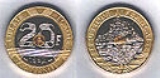
Nickel clad cupro-nickel 5-franc and nickel-brass 10-franc coins replaced their silver counterparts in 1970 and 1974, respectively. Nickel 2 francs were introduced in 1979, followed by bimetallic 10 and 20 francs in 1988 and 1992, respectively. The 20-franc coin was composed of two rings and a centre plug.

A nickel 10-franc piece was issued in 1986, but was quickly withdrawn and demonetized due to confusion with the half-franc and an unpopular design. The aluminum-bronze pieces continued to circulate until the bimetallic pieces were developed and additional aluminum-bronze coins were minted to replace those initially withdrawn. Once the bi-metallic coins were circulating the aluminum-bronze pieces were withdrawn and demonetized. A silver 50-franc piece was issued from 1974-1980, but was withdrawn and demonetized after the price of silver spiked in 1980. A 100-franc piece, in silver, was issued, and circulated to a small extent, until the introduction of the euro. All French franc coins were demonetized in 2005 and are no longer redeemable at the Banque de France
Banque de France

The Banque de France is the central bank of France; it is linked to the European Central Bank . Its main charge is to implement the interest rate policy of the European System of Central Banks ....
.

At the time of the complete changeover to the euro on 1 January 2002, the coin
Coin

A coin is a piece of hard material, usually metal or a metallic material, usually in the shape of a Disk , and most often issued by a government....
s in circulation (some of which were still produced during 2000) were:
  • 1 centime (~ 0.1524 eurocents) stainless steel, rarely circulated (last production stopped around 1982 due to its excessive production cost, and no more demand for it in commerce due to higher inflation and most shop prices rounded to 5 centimes).
  • 5 centimes (~ 0.7622 eurocents) aluminum-bronze
  • 10 centimes (~ 1.524 eurocents) aluminum-bronze
  • 20 centimes (~ 3.049 eurocents) aluminum-bronze
  • ½ franc (~ 7.622 eurocents) nickel
  • 1 franc (~ 15.24 eurocents) nickel
  • 2 francs (~ 30.49 eurocents) nickel
  • 5 francs (~ 76.22 eurocents) nickel clad copper-nickel
  • 10 francs (~ €1.52) bimetallic (very frequent, but the banknote equivalent was still in circulation)
  • 20 francs (~ €3.05) trimetallic, more rare (produced for a short period before the euro, the banknote equivalent was much more frequently used)
  • 100 francs (~ €15.24) silver, rarely circulated (most often bought and offered as personal gifts, but rare in commercial transactions, this coin has now a higher value than its nominal price at the official conversion rate).


Coins were freely exchangeable until February 17, 2005 at Banque de France
Banque de France

The Banque de France is the central bank of France; it is linked to the European Central Bank . Its main charge is to implement the interest rate policy of the European System of Central Banks ....
 only (some commercial banks could still perform it but were not required to offer this service for free after the transition period in 2001), by converting their total value in francs to euros (rounded to the nearest eurocent) at the official fixed rate of 6.55957 francs for 1 euro. Banknotes are officially convertible up to 17 February 2012.

Banknotes

The first franc paper money issues were made in 1795. They were assignat
Assignat

Assignats were paper money issued by the National Constituent Assembly in France during the French Revolution. The assignats were issued after the confiscation of church properties in 1790 because the government was bankrupt....
s in denominations between 100 and 10,000 francs. These followed in 1796 by "territorial mandate promises" for 25 up to 500 francs. The treasury also issued notes that year for 25 up to 1000 francs.

In 1800, the Bank of France began issuing notes, first in denominations of 500 and 1000 francs. In the 1840s, 100- and 200-franc notes were added, while 5-, 20- and 50- francs were added in the 1860s and 70s, although the 200-franc note was discontinued.

The First World War saw the introduction of 10- and 5000-franc notes but, despite base metal 5-franc coins being introduced after the war, the banknotes were not removed.

In 1944, the liberating Allies introduced paper money in denominations between 2 and 1000 francs. Following the war, 10,000-franc notes were introduced, while 5-, 10- and 20-franc notes were replaced by coins, as were the 50- and 100-franc notes in the 1950s.

The first issue of the new franc consisted of 500-, 1000-, 5000- and 10,000-franc notes overprinted with their new denominations of 5, 10, 50 and 100 new francs. This issue was followed by notes of the same design but with only the new denomination shown. 500-new franc notes were also introduced at this time. 5- and 10- franc notes were withdrawn in 1970 and 1979, respectively.

Banknote
Banknote

A banknote is a kind of negotiable instrument, a promissory note made by a bank payable to the bearer on demand, used as money, and in many jurisdictions is legal tender....
s in circulation when the franc was replaced were
  • 20 francs (€3.05) : Claude Debussy
    Claude Debussy

    Achille-Claude Debussy was a French composer. Along with Maurice Ravel, he is considered one of the most prominent figures working within the field of Impressionist music, though he himself intensely disliked the term when applied to his compositions....
     Brown
  • 50 francs (€7.62) : Antoine de Saint-Exupéry
    Antoine de Saint-Exupéry

    Antoine de Saint-Exup?ry was a France writer and aviator. He is most famous for his novella The Little Prince, and is also well known for his books about aviation adventures, including Night Flight and Wind, Sand and Stars....
     Blue
  • 100 francs (€15.24) : Paul Cézanne
    Paul Cézanne

    Paul C?zanne was a French artist and Post-Impressionist Painting whose work laid the foundations of the transition from the 19th century conception of artistic endeavour to a new and radically different world of art in the 20th century....
     Orange
  • 200 francs (€30.49) : Gustave Eiffel
    Gustave Eiffel

    Alexandre Gustave Eiffel was a France structural engineer and architect and a specialist of metallic structures. He is famous for designing the Eiffel Tower, built 1887?1889 for the Exposition Universelle in Paris, France, the Basilica Minore de San Sebastian, the only all-steel basilica in Asia, found in the Philippines, and the armature...
     Red
  • 500 francs (€76.22) : Pierre
    Pierre Curie

    Pierre Curie was a French Physics, a pioneer in crystallography, magnetism, piezoelectricity and radioactivity, and Nobel laureate. In 1903 he received the Nobel Prize in Physics with his wife, Marie Curie, and Henri Becquerel, "in recognition of the extraordinary services they have rendered by their joint researches on the radiation phe...
     and Marie Curie
    Marie Curie

    Marie Sklodowska Curie was a physicist and chemist of Poland upbringing and, subsequently, France citizenship. She was a pioneer in the field of radioactivity, the first person honored with two Nobel Prizes, and the first female professor at the University of Paris....
     Green
Banknotes of the current series as of euro changeover may be exchanged with the French central bank or services like GFC
GFC

GFC may stand for:In Finance, Economics or Business* Global Financial Crisis:**Financial crisis of 2007?2008**Global financial crisis of 2008?2009...
 until February 17, 2012. Most older series are exchangeable for 10 years from date of withdrawal.

The franc as an international reserve currency


Andorran franc (ADF)

The Andorran franc was a 1:1 peg to the French franc. Unlike Monaco
Monaco

Monaco , officially the Principality of Monaco , is a small sovereign city-state located in South Western Europe . The territory lies on the northern coast of the Mediterranean Sea....
, Andorra was not in formal currency union with France. Consequently, no Andorran coins were minted nor notes printed.

See also

  • Livre tournois
    Livre tournois

    The livre tournois was:#one of numerous currencies used in France in the France in the Middle Ages; and#a money of account used in France in the Middle Ages and the Early Modern France....
  • French euro coins
    French euro coins

    French euro coins feature three separate designs for the three series of coins. The minor series was designed by Fabienne Courtiade, the middle one by Laurent Jorio and the major two coins are by Joaquim Jimenez....
  • Economy of France
    Economy of France

    France is the fifth largest economy in the world, by measurement of GDP , behind the United States, Japan, China and Germany....


External links


  1. 1999 by law, 2002 de facto.