


President of the European Commission

Encyclopedia
The President of the European Commission is the head of the European Commission
― the executive branch of the :European Union (EU) ― the most powerful officeholder in the EU. The President is responsible for allocating portfolios to members of the Commission and can reshuffle or dismiss them if needed. He determines the Commission's policy agenda and all the legislative proposals it produces (the Commission is the only body that can propose EU law
s).
The Commission President also represents the EU abroad, although he does this alongside the President of the European Council
and the High Representative
(who sits in his Commission). However the President, unlike a normal head of government
, does not form foreign policy, command troops or raise taxes as these are largely outside the remit of the EU.
The post was established in 1958 and is appointed by the European Council
and European Parliament
for five year terms. Once elected, he, along with his Commission, is responsible to Parliament which can censure him. The current President is José Manuel Barroso, who took office in October 2004. He is a member of the European People's Party
(EPP) and is the former Prime Minister of Portugal
. Barroso is the eleventh President and in 2009 was re-elected for a further five years. His vice president, as of 2010, is High Representative
Baroness Catherine Ashton.
but had an increasing impact on the Community. Under Jacques Delors
it became increasingly presidential in style and now is the dominant force in the Commission, although curbed by crises such as the resignation of the Santer Commission
.
. In 1957 the present Commission was established by the Treaty of Rome
, and it also replaced the High Authority and the Commission of Euratom in 1967. The Commission's first president was Walter Hallstein
(see Hallstein Commission
) who started consolidating European law and began to impact on national legislation. National governments took little heed of his administration at first with the President having to stamp the Commission's authority early on. With the aid of the European Court of Justice
the Commission began to be taken more seriously.
In 1965 Hallstein put forward his proposals for the Common Agricultural Policy
, which would give the Community its own financial resources while giving more power to the Commission and Parliament and removing the veto power over Agriculture in the Council. These proposals led to an immediate backlash from France. Hallstein knew the proposals would be contentious, and took personal charge of drafting them, overriding the Agriculture Commissioner. However he did gain the support of Parliament through his proposals to increase its powers, and he also presented his policy to Parliament a week before he submitted them to the Council. He aimed to demonstrate how he thought the Community ought to be run, in the hopes of generating a wave of pro-Europeanism big enough to get past the objections of member states. However in this it proved that, despite its past successes, Hallstein was overconfident in his risky proposals.
In reaction to Hallstein's proposals and actions, then-French President, Charles de Gaulle
, who was sceptical of the rising supranational power of the Commission, accused Hallstein of acting as if he were a head of state
. France eventually withdrew its representative from the Council, triggering the notorious "empty chair crisis". Although this was resolved under the "Luxembourg compromise
", Hallstein became the scapegoat for the crisis. The Council refused to renew his term, despite being the most 'dynamic' leader until Jacques Delors
.
. In 1970, President Jean Rey
secured the Community's own financial resources and in 1977, President Roy Jenkins
became the first Commission President to attend a G7
summit on behalf of the Community.
However due to problems such as the 1973 oil crisis
and the 1979 energy crisis
, economic hardship put the European ideal on the back burner, with only the President trying to keep the idea alive. The member states had the upper hand and they created the European Council
to discuss topical problems, yet the Council was unable to keep the major projects on track such as the Common Agricultural Policy
. The Community entered a period of eurosclerosis
due to economic difficulties and disagreements on the Community budget, and by the Thorn Commission
the President was unable to exert his influence to any significant extent.
' Commission
. He is seen as the most successful President, being credited with giving the Community a sense of direction and dynamism. The International Herald Tribune
noted the work of Delors at the end of his second term in 1992: "Mr. Delors rescued the European Community from the doldrums. He arrived when Europessimism was at its worst. Although he was a little-known former French finance minister, he breathed life and hope into the EC and into the dispirited Brussels Commission. In his first term, from 1985 to 1988, he rallied Europe to the call of the single market, and when appointed to a second term he began urging Europeans toward the far more ambitious goals of economic, monetary and political union."
But Delors not only turned the Community around, he signaled a change in the Presidency. Before he came to power the Commission President still was a position of first among equals
, when he left office he was the undisputed icon and leader of the Community. His tenure had produced a strong Presidency and a strong Commission as the President became more important. Following treaties cemented this change, with the President being given control over the allocation of portfolios and being able to force the resignation of Commissioners. When President Romano Prodi
took office with the new powers of the Treaty of Amsterdam, he was dubbed by the press as Europe's first Prime Minister. President Delors' work had increased the powers of Parliament, whose support he had enjoyed. However, later Commissions did not enjoy the same support and in 1999 parliament used its powers to force the Santer Commission
to resign.
. The Treaty of Nice
changed the Council's vote from a unanimous choice to one that merely needed a qualified majority
. This meant that the weight of the Parliament in the process increased resulting in a quasi-parliamentary system
where one group could be 'in government'. This became evident in 2004 when numerous candidates were put forward and a centre-right vote won out over left wing groups and France & Germany. Barroso was then forced to back down over his choice of Commissioners due to Parliament's threat that it would not approve his Commission.
In 2009, the European People's Party
endorsed Barroso as their candidate for Commission President and the party subsequently retained their position as largest group in that year's elections. The Socialists responded by pledging to put forward a rival candidate at future elections. Barroso once again was forced by Parliament to make a change to his proposed Commission but eventually received assent. However in exchange for approval, Parliament forced some concessions from Barroso in terms of Parliamentary representation at Commission and international meetings. On 7 September 2010, Barroso gave the first US-style State of the Union address to Parliament; which focused primarily on the EU's economic recovery and human rights. The speech is to be annual.
, as amended by the Treaty of Lisbon
, lays out the procedure for appointing the President and his team. The Council (as the European Council
) vote by qualified majority for a nominee for the post of President after taking account of the latest European elections
. This proposal is then put before Parliament which must approve or veto the appointment. The President then, together with the Council, puts forward his team to the Parliament to be scrutinised. The Parliament then votes on the Commission as a whole and, if approved, the Council acting by a qualified majority appoints the President and his team to office.
to reform of it. However despite this, the choice within the Council remains largely behind closed doors. During the appointment of Santer, discussions were kept in private with the media relying on insider leaks. MEPs were angry with the process, against the spirit of consultation that the new EU treaty brought in. Pauline Green
MEP, leader of the Socialist group
, stated that her group thought "Parliament should refuse to condone a practice which so sullies the democratic process". There was similar deals in 1999 and 2004 saw a repeat of Santer's appointment when Barroso was appointed through a series of secret meetings between leaders with no press releases on the negotiations being released. This was sharply criticised by MEPs such as the liberal group leader Graham Watson
who described the procedure as a "Justus Lipsius
carpet market" producing only the "lowest common denominator"; while Green-EFA co-leader Daniel Cohn-Bendit
asked Barroso after his first speech "If you are the best candidate, why were you not the first?"
(i.e. the candidate supported by the victorious European political party
in particular, or at least someone from that political family). That provision was not in force in the nomination in 2004, but the centre-right European People's Party
(EPP) who won the elections pressured for a candidate from its own ranks. In the end, the EPP candidate was chosen: José Manuel Barroso. On the same basis, the EPP endorsed again Barroso for a second term during the 2009 European elections campaign and, after winning again the elections, was able to secure his nomination by the European Council
.
Further criteria seen to be influencing the choice of the Council include: which area of Europe the candidate comes from, favoured as Southern Europe in 2004; the candidate's political influence, credible yet not overpowering members; language, proficiency in French considered necessary by France; and degree of integration, their state being a member of both the eurozone
and the Schengen Agreement
.
There is an assumption that there is a rolling agreement along these lines that a president from a large state is followed by a president from a small state, and one from the political left will be followed by one from the political right: Roy Jenkins (British socialist) was followed by Gaston Thorn (Luxembourg liberal), Jacques Delors (French socialist), Jacques Santer (Luxembourg Christian democrat), Romano Prodi (Italian left wing Christian democrat) and Jose Barroso (Portuguese Christian democrat). However, despite these assumptions these Presidents have usually been chosen during political battles and coalition building. Delors was chosen following a Franco-British disagreement over Claude Cheysson
, Santer was a compromise after Britain vetoes Jean-Luc Dehaene
and Prodi was backed by a coalition of thirteen states against the Franco-German preference for Guy Verhofstadt
.
as Prime Ministers in theory, in practice it was not the case. The low voter turnout
creates a problem for the President's legitimacy, with the lack of a "European political sphere", but analysis claim that if citizens were voting for a list of candidates for the post of President, turn out would be much higher than that seen in recent years.
Under the Treaty of Lisbon
the European Council
has to take into account the results of the latest European elections and, furthermore, the Parliament "elects", rather than simply approve, the Council's proposed candidate. This was taken as the parliament's cue to have its parties run with candidates for the President of the Commission with the candidate of the winning party being proposed by the Council. This was partly put into practice in 2004 when the European Council selected a candidate from the political party which secured a plurality of votes in that year's election
. However at that time only one party had run with a specific candidate: the European Green Party
, who had the first true pan-European political party with a common campaign, put forward Daniel Cohn-Bendit
. However the fractious nature of the other political parties led to no other candidates, the People's Party only mentioned four or five people they'd like to be President.
There have been plans to strengthen the European political parties in order for them to propose candidate for future elections. The European Liberal Democrat and Reform Party
indicated, in their October 2007 congress, their intention to forward a candidate for the post as part of a common campaign but failed to do so. However the European People's Party
did select Barroso as their candidate and, as the largest party, Barroso's turn was renewed. The Socialists, disappointed at the 2009 election, agreed to put forward a candidate for Commission President at all subsequent elections. There is a campaign within that party to have open primaries for said candidate.
European Parliament
. These were brought into alignment via the Maastricht Treaty
and the elections take place in June every five years (the first election was held in 1979, hence all subsequent elections are held on years ending in 4 and 9). This alignment has led to a closer relationship between the elections and the President himself with the above mentioned proposals for political parties running with candidates.
The President and his Commission may be removed from office by a vote of censure from Parliament. Parliament has never done this to date, however the threat of this happening in 1999 due to allegations of financial mismanagement led to the Santer Commission
resigning on its own accord, before the Parliament forced them out.
Union legislation and is responsible for ensuring it is enforced. The President controls the policy agenda of the Commission for his term and in practice no policy can be proposed without the President's agreement.
The role of the President is to lead the Commission, and give direction to the Commission and the Union as a whole. The treaties state that "the Commission shall work under the political guidance of its President" (Article 219 TEC
), this is conducted through his calling and chairing of meetings of the college of Commissioners, his personal cabinet
and the meetings of the heads of each commissioner's cabinet (the Hebdo). The president may also force a Commissioner to resign. The work of the Commission as a body is based on the principle of Cabinet collective responsibility
, however in his powers he acts as more than a first among equals
. The role of the President is similar to that of a national Prime Minister chairing a cabinet.
The President also has responsibility for representing the Commission in the Union and beyond. For example, he is a member of the European Council
and takes part in debates in Parliament and the Council of Ministers. Outside the Union he attends the meetings of the G8
to represent the Union. However in foreign affairs, he does have to compete with several Commissioners with foreign affairs related portfolios: the High Representative for the Common Foreign and Security Policy and the President of the European Council
.
The Presidential system had started to develop since Jacques Delors
and has since been cemented, a strong President with competent mandarins is practically unstoppable. However, externally he is still dependent on support from the Council and Parliament. Delors had enjoyed the Parliament's and the Council's support for his whole term, and due to his work the Parliament increased in powers and the Council increased in membership. The membership is now so large the President is increasingly unable to garner the support of all the states, even though the job is supposed to try to keep everyone happy. The Parliament now has more powers over the Commission and can reject its proposals, although the Commission has little power over Parliament, such as the ability to dissolve it to call new elections.
The Presidents office is on the top, 13th, floor of the Berlaymont building
in Brussels
. The president receives his political guidance from his cabinet
, the head of which acts as a political bodyguard for the President. Such factors can lead to an isolation of the President from outside events. For the European Civil Service
the President has a very high status, due to his immense authority and symbolism within the body. The President exercises further authority through the legal service
and Secretariat-General of the Commission
. The former has the power to strike down proposals on legal technicalities while the latter organises meetings, agendas
and minutes. His control over these areas gives the President further political tools when directing the work of the Commission. This has also increased the Presidential style of the Commission President.
With the reorganisation of leading EU posts under the Lisbon Treaty, there was some criticism of each posts vague responsibilities. Ukrainian ambassador to the EU Andriy Veselovsky praised the framework and clarified it in his own terms: The Commission President speaks as the EU's "government" while the President of the European Council
is a "strategist". The High Representative
specialises in "bilateral relations" while the European Commissioner for Enlargement and European Neighbourhood Policy deals in technical matters such as the free trade agreement with Ukraine. The President of the European Parliament
meanwhile articulates the EU's values.
. There has been disagreement and concern over competition between the President of the European Council Van Rompuy and the Commission President Barroso due to the vague language of the treaty. Some clarifications see Van Rompuy as the "strategist" and Barroso as a head of government
. In terms of economic planning Van Rompuy saw the Commission as dealing with the content of the plan and the European Council as dealing with the means and implementing it. Despite weekly breakfasts together there is a certain extent of rivalry between the two yet-defined posts, including the High Representative
.
Although there are concerns that competition with the new Council President would lead to increased infighting, there are provisions for combining the two offices. The European Council President may not hold a national office, such as a Prime Minister of a member state, but there is no such restraint on European offices. So the Commission President, who already sits in the European Council, could also be appointed as its President. This would allow the European Council to combine the position, with its powers, of both executive bodies into a single President of the European Union
.
Since the creation of the European Council presidency, President Van Rompuy
and Commission President Barroso have begun to compete with each other as Van Rompuy has benefited from the general shift in power from the Commission to the Council yet with Barroso still holding the real powers. At international summits there was no agreement as to who should represent the EU, so they agreed to both go at the same time. The complicated situation has renewed some calls to merge the posts, possibly at the end of Barroso's term in 2014 or even as early as mid-2012 when Van Rompuy's present mandate ends. However some member states are expected to oppose the creation of such a high profile post.
24,422.80. Vice Presidents are paid €22,122.10, ordinary commissioners €19,909.89 and the High Representative €23,006.98.
The President is awarded no official residence
or private jet, but does receive a chauffeured car, a personal staff of approximately 20 people, a housing allowance and further allowances.
European Commission
The European Commission is the executive body of the European Union. The body is responsible for proposing legislation, implementing decisions, upholding the Union's treaties and the general day-to-day running of the Union....
― the executive branch of the :European Union (EU) ― the most powerful officeholder in the EU. The President is responsible for allocating portfolios to members of the Commission and can reshuffle or dismiss them if needed. He determines the Commission's policy agenda and all the legislative proposals it produces (the Commission is the only body that can propose EU law
European Union law
European Union law is a body of treaties and legislation, such as Regulations and Directives, which have direct effect or indirect effect on the laws of European Union member states. The three sources of European Union law are primary law, secondary law and supplementary law...
s).
The Commission President also represents the EU abroad, although he does this alongside the President of the European Council
President of the European Council
The President of the European Council is a principal representative of the European Union on the world stage, and the person presiding over and driving forward the work of the European Council...
and the High Representative
High Representative
High Representative may refer to either:* The High Representative of the Union for Foreign Affairs and Security Policy High Representative may refer to either:* The High Representative of the Union for Foreign Affairs and Security Policy High Representative may refer to either:* The High...
(who sits in his Commission). However the President, unlike a normal head of government
Head of government
Head of government is the chief officer of the executive branch of a government, often presiding over a cabinet. In a parliamentary system, the head of government is often styled prime minister, chief minister, premier, etc...
, does not form foreign policy, command troops or raise taxes as these are largely outside the remit of the EU.
The post was established in 1958 and is appointed by the European Council
European Council
The European Council is an institution of the European Union. It comprises the heads of state or government of the EU member states, along with the President of the European Commission and the President of the European Council, currently Herman Van Rompuy...
and European Parliament
European Parliament
The European Parliament is the directly elected parliamentary institution of the European Union . Together with the Council of the European Union and the Commission, it exercises the legislative function of the EU and it has been described as one of the most powerful legislatures in the world...
for five year terms. Once elected, he, along with his Commission, is responsible to Parliament which can censure him. The current President is José Manuel Barroso, who took office in October 2004. He is a member of the European People's Party
European People's Party
The European People's Party is a pro-European centre-right European political party. The EPP was founded in 1976 by Christian democratic parties, but later it increased its membership to include conservative parties and parties of other centre-right perspectives.The EPP is the most influential of...
(EPP) and is the former Prime Minister of Portugal
Prime Minister of Portugal
Prime Minister is the current title of the chief of the Portuguese Government. As chief executive, the Prime Minister coordinates the action of ministers, representing the Government from the other organs of state, accountable to Parliament and keeps the President informed...
. Barroso is the eleventh President and in 2009 was re-elected for a further five years. His vice president, as of 2010, is High Representative
High Representative
High Representative may refer to either:* The High Representative of the Union for Foreign Affairs and Security Policy High Representative may refer to either:* The High Representative of the Union for Foreign Affairs and Security Policy High Representative may refer to either:* The High...
Baroness Catherine Ashton.
History
The President of the European Commission was established in 1957 with the European Commission. Previously it was merely a post of primus inter paresPrimus inter pares
Primus inter pares is Latin phrase describing the most senior person of a group sharing the same rank or office.When not used in reference to a specific title, it may indicate that the person so described is formally equal, but looked upon as an authority of special importance by their peers...
but had an increasing impact on the Community. Under Jacques Delors
Jacques Delors
Jacques Lucien Jean Delors is a French economist and politician, the eighth President of the European Commission and the first person to serve three terms in that office .-French Politics:...
it became increasingly presidential in style and now is the dominant force in the Commission, although curbed by crises such as the resignation of the Santer Commission
Santer Commission
The Santer Commission was the European Commission in office between 23 January 1995 and 15 March 1999. The administration was led by Jacques Santer ....
.
Establishment
Before the establishment of the present European Commission, there was the High Authority of the European Coal and Steel CommunityEuropean Coal and Steel Community
The European Coal and Steel Community was a six-nation international organisation serving to unify Western Europe during the Cold War and create the foundation for the modern-day developments of the European Union...
. In 1957 the present Commission was established by the Treaty of Rome
Treaty of Rome
The Treaty of Rome, officially the Treaty establishing the European Economic Community, was an international agreement that led to the founding of the European Economic Community on 1 January 1958. It was signed on 25 March 1957 by Belgium, France, Italy, Luxembourg, the Netherlands and West Germany...
, and it also replaced the High Authority and the Commission of Euratom in 1967. The Commission's first president was Walter Hallstein
Walter Hallstein
Walter Hallstein was a German politician and professor.He was one of the key figures of European integration after World War II, becoming the first President of the Commission of the European Economic Community, serving from 1958 to 1967. He famously defined his position as "a kind of Prime...
(see Hallstein Commission
Hallstein Commission
The Hallstein Commission is the European Commission that held office from 7 January 1958 to 30 June 1967. Its President was Walter Hallstein and held two separate mandates.-Work:...
) who started consolidating European law and began to impact on national legislation. National governments took little heed of his administration at first with the President having to stamp the Commission's authority early on. With the aid of the European Court of Justice
European Court of Justice
The Court can sit in plenary session, as a Grand Chamber of 13 judges, or in chambers of three or five judges. Plenary sitting are now very rare, and the court mostly sits in chambers of three or five judges...
the Commission began to be taken more seriously.
In 1965 Hallstein put forward his proposals for the Common Agricultural Policy
Common Agricultural Policy
The Common Agricultural Policy is a system of European Union agricultural subsidies and programmes. It represents 48% of the EU's budget, €49.8 billion in 2006 ....
, which would give the Community its own financial resources while giving more power to the Commission and Parliament and removing the veto power over Agriculture in the Council. These proposals led to an immediate backlash from France. Hallstein knew the proposals would be contentious, and took personal charge of drafting them, overriding the Agriculture Commissioner. However he did gain the support of Parliament through his proposals to increase its powers, and he also presented his policy to Parliament a week before he submitted them to the Council. He aimed to demonstrate how he thought the Community ought to be run, in the hopes of generating a wave of pro-Europeanism big enough to get past the objections of member states. However in this it proved that, despite its past successes, Hallstein was overconfident in his risky proposals.
In reaction to Hallstein's proposals and actions, then-French President, Charles de Gaulle
Charles de Gaulle
Charles André Joseph Marie de Gaulle was a French general and statesman who led the Free French Forces during World War II. He later founded the French Fifth Republic in 1958 and served as its first President from 1959 to 1969....
, who was sceptical of the rising supranational power of the Commission, accused Hallstein of acting as if he were a head of state
Head of State
A head of state is the individual that serves as the chief public representative of a monarchy, republic, federation, commonwealth or other kind of state. His or her role generally includes legitimizing the state and exercising the political powers, functions, and duties granted to the head of...
. France eventually withdrew its representative from the Council, triggering the notorious "empty chair crisis". Although this was resolved under the "Luxembourg compromise
Luxembourg compromise
The Luxembourg compromise or Luxembourg Accords was an agreement reached in January 1966 which resolved differences within the European Economic Community....
", Hallstein became the scapegoat for the crisis. The Council refused to renew his term, despite being the most 'dynamic' leader until Jacques Delors
Jacques Delors
Jacques Lucien Jean Delors is a French economist and politician, the eighth President of the European Commission and the first person to serve three terms in that office .-French Politics:...
.
1967–85
Hallstein's work did enable the Commission to be a real player. During the 1970s the Presidents were involved in the major political projects of the day, such as the European Monetary UnionEconomic and Monetary Union of the European Union
The Economic and Monetary Union is an umbrella term for the group of policies aimed at converging the economies of members of the European Union in three stages so as to allow them to adopt a single currency, the euro. As such, it is largely synonymous with the eurozone.All member states of the...
. In 1970, President Jean Rey
Jean Rey (politician)
Jean Rey was a Belgian lawyer and Liberal politician who became the second President of the European Commission.-Early life:...
secured the Community's own financial resources and in 1977, President Roy Jenkins
Roy Jenkins
Roy Harris Jenkins, Baron Jenkins of Hillhead OM, PC was a British politician.The son of a Welsh coal miner who later became a union official and Labour MP, Roy Jenkins served with distinction in World War II. Elected to Parliament as a Labour member in 1948, he served in several major posts in...
became the first Commission President to attend a G7
G8
The Group of Eight is a forum, created by France in 1975, for the governments of seven major economies: Canada, France, Germany, Italy, Japan, the United Kingdom, and the United States. In 1997, the group added Russia, thus becoming the G8...
summit on behalf of the Community.
However due to problems such as the 1973 oil crisis
1973 oil crisis
The 1973 oil crisis started in October 1973, when the members of Organization of Arab Petroleum Exporting Countries or the OAPEC proclaimed an oil embargo. This was "in response to the U.S. decision to re-supply the Israeli military" during the Yom Kippur war. It lasted until March 1974. With the...
and the 1979 energy crisis
1979 energy crisis
The 1979 oil crisis in the United States occurred in the wake of the Iranian Revolution. Amid massive protests, the Shah of Iran, Mohammad Reza Pahlavi, fled his country in early 1979 and the Ayatollah Khomeini soon became the new leader of Iran. Protests severely disrupted the Iranian oil...
, economic hardship put the European ideal on the back burner, with only the President trying to keep the idea alive. The member states had the upper hand and they created the European Council
European Council
The European Council is an institution of the European Union. It comprises the heads of state or government of the EU member states, along with the President of the European Commission and the President of the European Council, currently Herman Van Rompuy...
to discuss topical problems, yet the Council was unable to keep the major projects on track such as the Common Agricultural Policy
Common Agricultural Policy
The Common Agricultural Policy is a system of European Union agricultural subsidies and programmes. It represents 48% of the EU's budget, €49.8 billion in 2006 ....
. The Community entered a period of eurosclerosis
Eurosclerosis
Eurosclerosis is a term coined in the 1970s and the early 1980s to describe both a political period and an economic pattern in Europe, alluding to the medical term sclerosis...
due to economic difficulties and disagreements on the Community budget, and by the Thorn Commission
Thorn Commission
The Thorn Commission was the European Commission that held office from 6 January 1981 until 5 January 1985. Its President was Gaston Thorn.-Work:...
the President was unable to exert his influence to any significant extent.
Presidentialism
However the Commission began to recover under President Jacques DelorsJacques Delors
Jacques Lucien Jean Delors is a French economist and politician, the eighth President of the European Commission and the first person to serve three terms in that office .-French Politics:...
' Commission
Delors Commission
The Delors Commission was the administration of Jacques Delors, the 8th President of the European Commission. Delors presided over the European Commission for three terms The Delors Commission was the administration of Jacques Delors, the 8th President of the European Commission. Delors presided...
. He is seen as the most successful President, being credited with giving the Community a sense of direction and dynamism. The International Herald Tribune
International Herald Tribune
The International Herald Tribune is a widely read English language international newspaper. It combines the resources of its own correspondents with those of The New York Times and is printed at 38 sites throughout the world, for sale in more than 160 countries and territories...
noted the work of Delors at the end of his second term in 1992: "Mr. Delors rescued the European Community from the doldrums. He arrived when Europessimism was at its worst. Although he was a little-known former French finance minister, he breathed life and hope into the EC and into the dispirited Brussels Commission. In his first term, from 1985 to 1988, he rallied Europe to the call of the single market, and when appointed to a second term he began urging Europeans toward the far more ambitious goals of economic, monetary and political union."
But Delors not only turned the Community around, he signaled a change in the Presidency. Before he came to power the Commission President still was a position of first among equals
First Among Equals
First Among Equals is a 1984 novel by British author Jeffrey Archer, which follows the careers and personal lives of four fictional British politicians from 1964 to 1991, with each vying to become Prime...
, when he left office he was the undisputed icon and leader of the Community. His tenure had produced a strong Presidency and a strong Commission as the President became more important. Following treaties cemented this change, with the President being given control over the allocation of portfolios and being able to force the resignation of Commissioners. When President Romano Prodi
Romano Prodi
Romano Prodi is an Italian politician and statesman. He served as the Prime Minister of Italy, from 17 May 1996 to 21 October 1998 and from 17 May 2006 to 8 May 2008...
took office with the new powers of the Treaty of Amsterdam, he was dubbed by the press as Europe's first Prime Minister. President Delors' work had increased the powers of Parliament, whose support he had enjoyed. However, later Commissions did not enjoy the same support and in 1999 parliament used its powers to force the Santer Commission
Santer Commission
The Santer Commission was the European Commission in office between 23 January 1995 and 15 March 1999. The administration was led by Jacques Santer ....
to resign.
Parliamentary oversight
Historically, the Council appointed the Commission President and the whole body by unanimity without input from Parliament. However with the Treaty on European Union in 1993, Parliament gained the right to be 'consulted' on the appointment of the President and to veto the Commission as a whole. Parliament decided to interpret its right to be consulted as a right to veto the President, which the Council reluctantly accepted This right of veto was formalised in the Amsterdam TreatyAmsterdam Treaty
The Amsterdam Treaty, officially the Treaty of Amsterdam amending the Treaty of the European Union, the Treaties establishing the European Communities and certain related acts, was signed on 2 October 1997, and entered into force on 1 May 1999; it made substantial changes to the Maastricht Treaty,...
. The Treaty of Nice
Treaty of Nice
The Treaty of Nice was signed by European leaders on 26 February 2001 and came into force on 1 February 2003. It amended the Maastricht Treaty and the Treaty of Rome...
changed the Council's vote from a unanimous choice to one that merely needed a qualified majority
Voting in the Council of the European Union
The procedures for voting in the Council of the European Union are described in the treaties of the European Union. The Council of the European Union has had its voting procedure amended by subsequent treaties and currently operates on a system brought forth by the Treaty of Nice...
. This meant that the weight of the Parliament in the process increased resulting in a quasi-parliamentary system
Parliamentary system
A parliamentary system is a system of government in which the ministers of the executive branch get their democratic legitimacy from the legislature and are accountable to that body, such that the executive and legislative branches are intertwined....
where one group could be 'in government'. This became evident in 2004 when numerous candidates were put forward and a centre-right vote won out over left wing groups and France & Germany. Barroso was then forced to back down over his choice of Commissioners due to Parliament's threat that it would not approve his Commission.
In 2009, the European People's Party
European People's Party
The European People's Party is a pro-European centre-right European political party. The EPP was founded in 1976 by Christian democratic parties, but later it increased its membership to include conservative parties and parties of other centre-right perspectives.The EPP is the most influential of...
endorsed Barroso as their candidate for Commission President and the party subsequently retained their position as largest group in that year's elections. The Socialists responded by pledging to put forward a rival candidate at future elections. Barroso once again was forced by Parliament to make a change to his proposed Commission but eventually received assent. However in exchange for approval, Parliament forced some concessions from Barroso in terms of Parliamentary representation at Commission and international meetings. On 7 September 2010, Barroso gave the first US-style State of the Union address to Parliament; which focused primarily on the EU's economic recovery and human rights. The speech is to be annual.
Appointment
Article 17 of the Treaty on European UnionMaastricht Treaty
The Maastricht Treaty was signed on 7 February 1992 by the members of the European Community in Maastricht, Netherlands. On 9–10 December 1991, the same city hosted the European Council which drafted the treaty...
, as amended by the Treaty of Lisbon
Treaty of Lisbon
The Treaty of Lisbon of 1668 was a peace treaty between Portugal and Spain, concluded at Lisbon on 13 February 1668, through the mediation of England, in which Spain recognized the sovereignty of Portugal's new ruling dynasty, the House of Braganza....
, lays out the procedure for appointing the President and his team. The Council (as the European Council
European Council
The European Council is an institution of the European Union. It comprises the heads of state or government of the EU member states, along with the President of the European Commission and the President of the European Council, currently Herman Van Rompuy...
) vote by qualified majority for a nominee for the post of President after taking account of the latest European elections
Elections in the European Union
Elections to the Parliament of the European Union take place every five years by universal adult suffrage. 736 MEPs are elected to the European Parliament which has been directly elected since 1979. No other body is directly elected although the Council of the European Union and European Council is...
. This proposal is then put before Parliament which must approve or veto the appointment. The President then, together with the Council, puts forward his team to the Parliament to be scrutinised. The Parliament then votes on the Commission as a whole and, if approved, the Council acting by a qualified majority appoints the President and his team to office.
Transparency
Qualified majority in the Council has led to more candidates being fielded while there has been greater politicisation due to the involvement of Parliament and the change of policy direction in the EU from the creation of the single marketSingle market
A single market is a type of trade bloc which is composed of a free trade area with common policies on product regulation, and freedom of movement of the factors of production and of enterprise and services. The goal is that the movement of capital, labour, goods, and services between the members...
to reform of it. However despite this, the choice within the Council remains largely behind closed doors. During the appointment of Santer, discussions were kept in private with the media relying on insider leaks. MEPs were angry with the process, against the spirit of consultation that the new EU treaty brought in. Pauline Green
Pauline Green
Dame Pauline Green DBE is a former Labour and Co-operative Member of the European Parliament and former Leader of the Parliamentary Group of the Party of European Socialists...
MEP, leader of the Socialist group
Party of European Socialists
The Party of European Socialists is a European political party led by Sergei Stanishev, former Prime Minister of Bulgaria. The PES comprises social-democratic national-level political parties primarily from Member state of the European Union, as well as other nations of the European continent. The...
, stated that her group thought "Parliament should refuse to condone a practice which so sullies the democratic process". There was similar deals in 1999 and 2004 saw a repeat of Santer's appointment when Barroso was appointed through a series of secret meetings between leaders with no press releases on the negotiations being released. This was sharply criticised by MEPs such as the liberal group leader Graham Watson
Graham Watson
Sir Graham Robert Watson is a European politician from the United Kingdom. He has served as a Member of the European Parliament for South West England since 1994 and was leader of the liberal group in Parliament for seven years between 2002 and 2009.-Early life:Graham Watson was born in Rothesay...
who described the procedure as a "Justus Lipsius
Justus Lipsius building
The Justus Lipsius building is a building in Brussels that has been the headquarters of the Council of the European Union since 1995. Unlike the European Parliament, visiting is restricted...
carpet market" producing only the "lowest common denominator"; while Green-EFA co-leader Daniel Cohn-Bendit
Daniel Cohn-Bendit
Daniel Marc Cohn-Bendit is a Franco-German politician, active in both countries. He was a student leader during the unrest of May 1968 in France and he was also known during that time as Dany le Rouge...
asked Barroso after his first speech "If you are the best candidate, why were you not the first?"
Criteria
The candidate selected by the Council has often been a leading national politician but this is not a requirement. The choice of President must take into account the result of the latest Parliamentary electionsElections in the European Union
Elections to the Parliament of the European Union take place every five years by universal adult suffrage. 736 MEPs are elected to the European Parliament which has been directly elected since 1979. No other body is directly elected although the Council of the European Union and European Council is...
(i.e. the candidate supported by the victorious European political party
European political party
A European political party, formally a political party at European level, informally a Europarty, is a type of political party organization operating transnationally in Europe and in the institutions of the European Union. They are regulated and funded by the European Union and are usually made up...
in particular, or at least someone from that political family). That provision was not in force in the nomination in 2004, but the centre-right European People's Party
European People's Party
The European People's Party is a pro-European centre-right European political party. The EPP was founded in 1976 by Christian democratic parties, but later it increased its membership to include conservative parties and parties of other centre-right perspectives.The EPP is the most influential of...
(EPP) who won the elections pressured for a candidate from its own ranks. In the end, the EPP candidate was chosen: José Manuel Barroso. On the same basis, the EPP endorsed again Barroso for a second term during the 2009 European elections campaign and, after winning again the elections, was able to secure his nomination by the European Council
European Council
The European Council is an institution of the European Union. It comprises the heads of state or government of the EU member states, along with the President of the European Commission and the President of the European Council, currently Herman Van Rompuy...
.
Further criteria seen to be influencing the choice of the Council include: which area of Europe the candidate comes from, favoured as Southern Europe in 2004; the candidate's political influence, credible yet not overpowering members; language, proficiency in French considered necessary by France; and degree of integration, their state being a member of both the eurozone
Eurozone
The eurozone , officially called the euro area, is an economic and monetary union of seventeen European Union member states that have adopted the euro as their common currency and sole legal tender...
and the Schengen Agreement
Schengen Agreement
The Schengen Agreement is a treaty signed on 14 June 1985 near the town of Schengen in Luxembourg, between five of the ten member states of the European Economic Community. It was supplemented by the Convention implementing the Schengen Agreement 5 years later...
.
There is an assumption that there is a rolling agreement along these lines that a president from a large state is followed by a president from a small state, and one from the political left will be followed by one from the political right: Roy Jenkins (British socialist) was followed by Gaston Thorn (Luxembourg liberal), Jacques Delors (French socialist), Jacques Santer (Luxembourg Christian democrat), Romano Prodi (Italian left wing Christian democrat) and Jose Barroso (Portuguese Christian democrat). However, despite these assumptions these Presidents have usually been chosen during political battles and coalition building. Delors was chosen following a Franco-British disagreement over Claude Cheysson
Claude Cheysson
Claude Cheysson is a French Socialist politician who served as Foreign Minister in the government of Pierre Mauroy from 1981 to 1984.-Career:...
, Santer was a compromise after Britain vetoes Jean-Luc Dehaene
Jean-Luc Dehaene
-Early life and political career:He was born in Montpellier, France, when his parents were fleeing German troops. He got into politics through the Algemeen Christelijk Werknemersverbond , a trade union which was closely linked to the Christelijke Volkspartij .In 1981, he became Minister of Social...
and Prodi was backed by a coalition of thirteen states against the Franco-German preference for Guy Verhofstadt
Guy Verhofstadt
Guy Verhofstadt is a Belgian politician who was the 47th Prime Minister of Belgium from 1999 to 2008. He is currently a Member of the European Parliament and leader of the Group of the Alliance of Liberals and Democrats for Europe.- Early career :...
.
Elections
In February 2008, President Barroso admitted there was a problem in legitimacy and that, despite having the same legitimacyLegitimacy (political science)
In political science, legitimacy is the popular acceptance of a governing law or régime as an authority. Whereas “authority” denotes a specific position in an established government, the term “legitimacy” denotes a system of government — wherein “government” denotes “sphere of influence”...
as Prime Ministers in theory, in practice it was not the case. The low voter turnout
Voter turnout
Voter turnout is the percentage of eligible voters who cast a ballot in an election . After increasing for many decades, there has been a trend of decreasing voter turnout in most established democracies since the 1960s...
creates a problem for the President's legitimacy, with the lack of a "European political sphere", but analysis claim that if citizens were voting for a list of candidates for the post of President, turn out would be much higher than that seen in recent years.
Under the Treaty of Lisbon
Treaty of Lisbon
The Treaty of Lisbon of 1668 was a peace treaty between Portugal and Spain, concluded at Lisbon on 13 February 1668, through the mediation of England, in which Spain recognized the sovereignty of Portugal's new ruling dynasty, the House of Braganza....
the European Council
European Council
The European Council is an institution of the European Union. It comprises the heads of state or government of the EU member states, along with the President of the European Commission and the President of the European Council, currently Herman Van Rompuy...
has to take into account the results of the latest European elections and, furthermore, the Parliament "elects", rather than simply approve, the Council's proposed candidate. This was taken as the parliament's cue to have its parties run with candidates for the President of the Commission with the candidate of the winning party being proposed by the Council. This was partly put into practice in 2004 when the European Council selected a candidate from the political party which secured a plurality of votes in that year's election
European Parliament election, 2004
Elections to the European Parliament were held from 10 June 2004 to 13 June 2004 in the 25 member states of the European Union, using varying election days according to local custom...
. However at that time only one party had run with a specific candidate: the European Green Party
European Green Party
The European Green Party is the Green political party at European level. As such it is a federation of green parties in Europe.-History:...
, who had the first true pan-European political party with a common campaign, put forward Daniel Cohn-Bendit
Daniel Cohn-Bendit
Daniel Marc Cohn-Bendit is a Franco-German politician, active in both countries. He was a student leader during the unrest of May 1968 in France and he was also known during that time as Dany le Rouge...
. However the fractious nature of the other political parties led to no other candidates, the People's Party only mentioned four or five people they'd like to be President.
There have been plans to strengthen the European political parties in order for them to propose candidate for future elections. The European Liberal Democrat and Reform Party
European Liberal Democrat and Reform Party
The European Liberal Democrat and Reform Party is a European political party mainly active in the European Union, composed of 56 national-level liberal and liberal-democratic parties from across Europe...
indicated, in their October 2007 congress, their intention to forward a candidate for the post as part of a common campaign but failed to do so. However the European People's Party
European People's Party
The European People's Party is a pro-European centre-right European political party. The EPP was founded in 1976 by Christian democratic parties, but later it increased its membership to include conservative parties and parties of other centre-right perspectives.The EPP is the most influential of...
did select Barroso as their candidate and, as the largest party, Barroso's turn was renewed. The Socialists, disappointed at the 2009 election, agreed to put forward a candidate for Commission President at all subsequent elections. There is a campaign within that party to have open primaries for said candidate.
Term of office
The President is elected for a renewable five year term starting six months after the elections to theElections in the European Union
Elections to the Parliament of the European Union take place every five years by universal adult suffrage. 736 MEPs are elected to the European Parliament which has been directly elected since 1979. No other body is directly elected although the Council of the European Union and European Council is...
European Parliament
European Parliament
The European Parliament is the directly elected parliamentary institution of the European Union . Together with the Council of the European Union and the Commission, it exercises the legislative function of the EU and it has been described as one of the most powerful legislatures in the world...
. These were brought into alignment via the Maastricht Treaty
Maastricht Treaty
The Maastricht Treaty was signed on 7 February 1992 by the members of the European Community in Maastricht, Netherlands. On 9–10 December 1991, the same city hosted the European Council which drafted the treaty...
and the elections take place in June every five years (the first election was held in 1979, hence all subsequent elections are held on years ending in 4 and 9). This alignment has led to a closer relationship between the elections and the President himself with the above mentioned proposals for political parties running with candidates.
The President and his Commission may be removed from office by a vote of censure from Parliament. Parliament has never done this to date, however the threat of this happening in 1999 due to allegations of financial mismanagement led to the Santer Commission
Santer Commission
The Santer Commission was the European Commission in office between 23 January 1995 and 15 March 1999. The administration was led by Jacques Santer ....
resigning on its own accord, before the Parliament forced them out.
Duties and powers
The President of the European Commission is the most powerful position in the European Union, controlling the Commission which collectively has a monopoly on allLegislative initiative
The right of initiative is the constitutionally defined power to propose a new law .The right of initiative is usually attributed to parliaments, which in most countries have the right to make law proposals, alone or sharing this right with the government.In parliamentary systems it is common that...
Union legislation and is responsible for ensuring it is enforced. The President controls the policy agenda of the Commission for his term and in practice no policy can be proposed without the President's agreement.
The role of the President is to lead the Commission, and give direction to the Commission and the Union as a whole. The treaties state that "the Commission shall work under the political guidance of its President" (Article 219 TEC
Treaty of Rome
The Treaty of Rome, officially the Treaty establishing the European Economic Community, was an international agreement that led to the founding of the European Economic Community on 1 January 1958. It was signed on 25 March 1957 by Belgium, France, Italy, Luxembourg, the Netherlands and West Germany...
), this is conducted through his calling and chairing of meetings of the college of Commissioners, his personal cabinet
Cabinet (European Commission)
In the European Commission, a cabinet is the personal office of a European Commissioner. The role of a cabinet is to give political guidance to its Commissioner, while technical preparation is handled by the DGs .-Composition:The Commissioner's cabinets are seen as the real concentration of power...
and the meetings of the heads of each commissioner's cabinet (the Hebdo). The president may also force a Commissioner to resign. The work of the Commission as a body is based on the principle of Cabinet collective responsibility
Cabinet collective responsibility
Cabinet collective responsibility is constitutional convention in governments using the Westminster System that members of the Cabinet must publicly support all governmental decisions made in Cabinet, even if they do not privately agree with them. This support includes voting for the government in...
, however in his powers he acts as more than a first among equals
Primus inter pares
Primus inter pares is Latin phrase describing the most senior person of a group sharing the same rank or office.When not used in reference to a specific title, it may indicate that the person so described is formally equal, but looked upon as an authority of special importance by their peers...
. The role of the President is similar to that of a national Prime Minister chairing a cabinet.
The President also has responsibility for representing the Commission in the Union and beyond. For example, he is a member of the European Council
European Council
The European Council is an institution of the European Union. It comprises the heads of state or government of the EU member states, along with the President of the European Commission and the President of the European Council, currently Herman Van Rompuy...
and takes part in debates in Parliament and the Council of Ministers. Outside the Union he attends the meetings of the G8
G8
The Group of Eight is a forum, created by France in 1975, for the governments of seven major economies: Canada, France, Germany, Italy, Japan, the United Kingdom, and the United States. In 1997, the group added Russia, thus becoming the G8...
to represent the Union. However in foreign affairs, he does have to compete with several Commissioners with foreign affairs related portfolios: the High Representative for the Common Foreign and Security Policy and the President of the European Council
President of the European Council
The President of the European Council is a principal representative of the European Union on the world stage, and the person presiding over and driving forward the work of the European Council...
.
The Presidential system had started to develop since Jacques Delors
Jacques Delors
Jacques Lucien Jean Delors is a French economist and politician, the eighth President of the European Commission and the first person to serve three terms in that office .-French Politics:...
and has since been cemented, a strong President with competent mandarins is practically unstoppable. However, externally he is still dependent on support from the Council and Parliament. Delors had enjoyed the Parliament's and the Council's support for his whole term, and due to his work the Parliament increased in powers and the Council increased in membership. The membership is now so large the President is increasingly unable to garner the support of all the states, even though the job is supposed to try to keep everyone happy. The Parliament now has more powers over the Commission and can reject its proposals, although the Commission has little power over Parliament, such as the ability to dissolve it to call new elections.
The Presidents office is on the top, 13th, floor of the Berlaymont building
Berlaymont building
The Berlaymont is an office building in Brussels, Belgium that houses the headquarters of the European Commission, which is the executive of the European Union...
in Brussels
Brussels
Brussels , officially the Brussels Region or Brussels-Capital Region , is the capital of Belgium and the de facto capital of the European Union...
. The president receives his political guidance from his cabinet
Cabinet (European Commission)
In the European Commission, a cabinet is the personal office of a European Commissioner. The role of a cabinet is to give political guidance to its Commissioner, while technical preparation is handled by the DGs .-Composition:The Commissioner's cabinets are seen as the real concentration of power...
, the head of which acts as a political bodyguard for the President. Such factors can lead to an isolation of the President from outside events. For the European Civil Service
European Civil Service
The European Civil Service is the civil service serving the institutions of the European Union, of which the largest employer is the European Commission, the executive branch of the European Union...
the President has a very high status, due to his immense authority and symbolism within the body. The President exercises further authority through the legal service
Directorate-General for Legal Service (European Commission)
The Directorate-General for Legal Service is a Directorate-General of the European Commission.The Legal Service provides comprehensive in-house assistance to the European Commission and all its departments. Its resources have to be deployed to cover all Commission activities and areas of...
and Secretariat-General of the Commission
Secretariat-General of the European Commission
The Secretariat-General of the European Commission is a Directorate-General of the European Commission. The DG Secretariat-General is based in the Berlaymont in Brussels . The DG Secretariat-General supports the whole of the Commission, and in particular the 27 Commissioners...
. The former has the power to strike down proposals on legal technicalities while the latter organises meetings, agendas
Agenda (meeting)
An agenda is a list of meeting activities in the order in which they are to be taken up, by beginning with the call to order and ending with adjournment. It usually includes one or more specific items of business to be discussed. It may, but is not required to, include specific times for one or...
and minutes. His control over these areas gives the President further political tools when directing the work of the Commission. This has also increased the Presidential style of the Commission President.
With the reorganisation of leading EU posts under the Lisbon Treaty, there was some criticism of each posts vague responsibilities. Ukrainian ambassador to the EU Andriy Veselovsky praised the framework and clarified it in his own terms: The Commission President speaks as the EU's "government" while the President of the European Council
President of the European Council
The President of the European Council is a principal representative of the European Union on the world stage, and the person presiding over and driving forward the work of the European Council...
is a "strategist". The High Representative
High Representative
High Representative may refer to either:* The High Representative of the Union for Foreign Affairs and Security Policy High Representative may refer to either:* The High Representative of the Union for Foreign Affairs and Security Policy High Representative may refer to either:* The High...
specialises in "bilateral relations" while the European Commissioner for Enlargement and European Neighbourhood Policy deals in technical matters such as the free trade agreement with Ukraine. The President of the European Parliament
President of the European Parliament
The President of the European Parliament presides over the debates and activities of the European Parliament. He or she also represents the Parliament within the EU and internationally. The President's signature is required for enacting most EU laws and the EU budget.Presidents serve...
meanwhile articulates the EU's values.
Relationship to European Council Presidency
Despite the recent Presidential style, the President has also begun to lose ground to the larger member states as countries such as France, Italy, the UK and Germany seek to sideline its role. This may increase with the recent creation of the permanent President of the European CouncilPresident of the European Council
The President of the European Council is a principal representative of the European Union on the world stage, and the person presiding over and driving forward the work of the European Council...
. There has been disagreement and concern over competition between the President of the European Council Van Rompuy and the Commission President Barroso due to the vague language of the treaty. Some clarifications see Van Rompuy as the "strategist" and Barroso as a head of government
Head of government
Head of government is the chief officer of the executive branch of a government, often presiding over a cabinet. In a parliamentary system, the head of government is often styled prime minister, chief minister, premier, etc...
. In terms of economic planning Van Rompuy saw the Commission as dealing with the content of the plan and the European Council as dealing with the means and implementing it. Despite weekly breakfasts together there is a certain extent of rivalry between the two yet-defined posts, including the High Representative
High Representative
High Representative may refer to either:* The High Representative of the Union for Foreign Affairs and Security Policy High Representative may refer to either:* The High Representative of the Union for Foreign Affairs and Security Policy High Representative may refer to either:* The High...
.
Although there are concerns that competition with the new Council President would lead to increased infighting, there are provisions for combining the two offices. The European Council President may not hold a national office, such as a Prime Minister of a member state, but there is no such restraint on European offices. So the Commission President, who already sits in the European Council, could also be appointed as its President. This would allow the European Council to combine the position, with its powers, of both executive bodies into a single President of the European Union
President of the European Union
President of the European Union could be a reference to any of:* President of the European Council * President of the European Commission...
.
Since the creation of the European Council presidency, President Van Rompuy
Herman Van Rompuy
Herman Achille Van Rompuy is the first long-term and full-time President of the European Council...
and Commission President Barroso have begun to compete with each other as Van Rompuy has benefited from the general shift in power from the Commission to the Council yet with Barroso still holding the real powers. At international summits there was no agreement as to who should represent the EU, so they agreed to both go at the same time. The complicated situation has renewed some calls to merge the posts, possibly at the end of Barroso's term in 2014 or even as early as mid-2012 when Van Rompuy's present mandate ends. However some member states are expected to oppose the creation of such a high profile post.
Privileges of office
The basic monthly salary of the President is fixed at 138% of the top civil service grade which works out at €Euro
The euro is the official currency of the eurozone: 17 of the 27 member states of the European Union. It is also the currency used by the Institutions of the European Union. The eurozone consists of Austria, Belgium, Cyprus, Estonia, Finland, France, Germany, Greece, Ireland, Italy, Luxembourg,...
24,422.80. Vice Presidents are paid €22,122.10, ordinary commissioners €19,909.89 and the High Representative €23,006.98.
The President is awarded no official residence
Official residence
An official residence is the residence at which heads of state, heads of government, gubernatorial or other senior figures officially reside...
or private jet, but does receive a chauffeured car, a personal staff of approximately 20 people, a housing allowance and further allowances.
List of presidents
| President |
Portrait | State and previous post |
Party |
Term |
Notes | |
|---|---|---|---|---|---|---|
| Walter Hallstein Walter Hallstein Walter Hallstein was a German politician and professor.He was one of the key figures of European integration after World War II, becoming the first President of the Commission of the European Economic Community, serving from 1958 to 1967. He famously defined his position as "a kind of Prime... Hallstein Commission Hallstein Commission The Hallstein Commission is the European Commission that held office from 7 January 1958 to 30 June 1967. Its President was Walter Hallstein and held two separate mandates.-Work:... |
 |
 West Germany West GermanyFinance Minister |
Christian Democrats European People's Party The European People's Party is a pro-European centre-right European political party. The EPP was founded in 1976 by Christian democratic parties, but later it increased its membership to include conservative parties and parties of other centre-right perspectives.The EPP is the most influential of... National: CDU |
- | Established the Common Agricultural Policy Common Agricultural Policy The Common Agricultural Policy is a system of European Union agricultural subsidies and programmes. It represents 48% of the EU's budget, €49.8 billion in 2006 .... and tackled the empty chair crisis that led to the Luxembourg compromise Luxembourg compromise The Luxembourg compromise or Luxembourg Accords was an agreement reached in January 1966 which resolved differences within the European Economic Community.... . |
|
| Jean Rey Jean Rey (politician) Jean Rey was a Belgian lawyer and Liberal politician who became the second President of the European Commission.-Early life:... Rey Commission Rey Commission The Rey Commission is the European Commission that held office from 2 July 1967 to 30 June 1970. Its President was Jean Rey.-Work:It was the first Commission of the merged European Communities. It was the successor to the Hallstein Commission and was succeeded by the Malfatti Commission... |
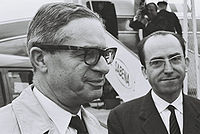 |
 Belgium BelgiumFinance Minister |
Liberal Democrats European Liberal Democrat and Reform Party The European Liberal Democrat and Reform Party is a European political party mainly active in the European Union, composed of 56 national-level liberal and liberal-democratic parties from across Europe... National: PRL Liberal Reformist Party The Parti Réformateur Libéral was a Belgian liberal party active in Wallonia and Brussels. It grew out of the unitiarian PVV-PLP and has since become part of the Mouvement Réformateur.-PVV-PLP:* Omer Vanaudenhove 1961 - 1968... |
- | Began initiatives on European Political Cooperation European political cooperation The European Political Cooperation was introduced in 1970 and was the synonym for European Union foreign policy coordination until it was superseded by the Common Foreign and Security Policy in the Maastricht Treaty .... and EMU Economic and Monetary Union of the European Union The Economic and Monetary Union is an umbrella term for the group of policies aimed at converging the economies of members of the European Union in three stages so as to allow them to adopt a single currency, the euro. As such, it is largely synonymous with the eurozone.All member states of the... . |
|
| Franco Maria Malfatti Franco Maria Malfatti Franco Maria Malfatti , was an Italian politician and President of the European Commission.-Biography:A descendant of Philip IV of France and wife Joan I of Navarre , Malfatti was born in Rome... Malfatti Commission Malfatti Commission The Malfatti Commission is the European Commission that held office from 1 July 1970 to 21 March 1972. Its President was Franco Maria Malfatti.- Work :... |
 Italy ItalyForeign Minister Italian Minister of Foreign Affairs As in most countries, in Italy the Minister of Foreign Affairs, which is the head of the Ministry of Foreign Affairs, is one of the most important ministerial positions... |
Christian Democrats National: DC Christian Democracy (Italy) Christian Democracy was a Christian democratic party in Italy. It was founded in 1943 as the ideological successor of the historical Italian People's Party, which had the same symbol, a crossed shield .... |
- | Made advances on the single market. Opened membership talks with the Denmark, Ireland, Norway and the UK. | ||
| Sicco Mansholt Sicco Mansholt Sicco Leendert Mansholt was the fourth President of the European Commission in 1972–1973. He was the European Commissioner for Agriculture from 1958 until 1972.... Mansholt Commission Mansholt Commission The Mansholt Commission is the European Commission that held office from 22 March 1972 to 5 January 1973. Its President was Sicco Mansholt.- Work :It was the successor to the Malfatti Commission and was succeeded by the Ortoli Commission... |
 Netherlands NetherlandsAgriculture Minister Ministry of Agriculture, Nature and Food Quality (Netherlands) The Ministry of Agriculture, Nature and Food Quality was formerly the ministry of agriculture of the Netherlands... |
Socialists Party of European Socialists The Party of European Socialists is a European political party led by Sergei Stanishev, former Prime Minister of Bulgaria. The PES comprises social-democratic national-level political parties primarily from Member state of the European Union, as well as other nations of the European continent. The... National: PvdA Labour Party (Netherlands) The Labour Party , is a social-democratic political party in the Netherlands. Since the 2003 Dutch General Election, the PvdA has been the second largest political party in the Netherlands. The PvdA was a coalition member in the fourth Balkenende cabinet following 22 February 2007... |
- | Oversaw creation of the European Monetary System European Monetary System There are three stages of monetary cooperation in the European Union.-Background:European currency exchange rate stability has been one of the most important objectives of European policy makers at least since the Second World War.... and the first enlargement |
||
| François-Xavier Ortoli François-Xavier Ortoli François-Xavier Ortoli was a French Gaullist politician and businessman. He served with the Free French Forces during World War II and was decorated with the Croix de guerre, Médaille militaire and Médaille de la Résistance... Ortoli Commission Ortoli Commission The Ortoli Commission is the European Commission that held office from 6 January 1973 to 5 January 1977. Its President was François-Xavier Ortoli.-Work:... |
 |
 Early Modern France Early Modern FranceFinance Minister |
Christian Democrats National: RPR Rally for the Republic The Rally for the Republic , was a French right-wing political party. Originating from the Union of Democrats for the Republic , it was founded by Jacques Chirac in 1976 and presented itself as the heir of Gaullism... |
- | Managed the enlarged Community during the instability of the 1973 oil crisis 1973 oil crisis The 1973 oil crisis started in October 1973, when the members of Organization of Arab Petroleum Exporting Countries or the OAPEC proclaimed an oil embargo. This was "in response to the U.S. decision to re-supply the Israeli military" during the Yom Kippur war. It lasted until March 1974. With the... and the Turkish invasion of Cyprus Turkish invasion of Cyprus The Turkish invasion of Cyprus, launched on 20 July 1974, was a Turkish military invasion in response to a Greek military junta backed coup in Cyprus... . |
|
| Roy Jenkins Roy Jenkins Roy Harris Jenkins, Baron Jenkins of Hillhead OM, PC was a British politician.The son of a Welsh coal miner who later became a union official and Labour MP, Roy Jenkins served with distinction in World War II. Elected to Parliament as a Labour member in 1948, he served in several major posts in... Jenkins Commission Jenkins Commission (EU) The Jenkins Commission is the European Commission that held office from 6 January 1977 to 6 January 1981. Its President was Roy Jenkins.-Work:It was the successor to the Ortoli Commission and was succeeded by the Thorn Commission... |
 United Kingdom United KingdomHome Secretary Home Secretary The Secretary of State for the Home Department, commonly known as the Home Secretary, is the minister in charge of the Home Office of the United Kingdom, and one of the country's four Great Offices of State... |
Socialists National: Labour Labour Party (UK) The Labour Party is a centre-left democratic socialist party in the United Kingdom. It surpassed the Liberal Party in general elections during the early 1920s, forming minority governments under Ramsay MacDonald in 1924 and 1929-1931. The party was in a wartime coalition from 1940 to 1945, after... |
- | Oversaw the development of the EMU Economic and Monetary Union of the European Union The Economic and Monetary Union is an umbrella term for the group of policies aimed at converging the economies of members of the European Union in three stages so as to allow them to adopt a single currency, the euro. As such, it is largely synonymous with the eurozone.All member states of the... and was the first President to attend the G8 G8 The Group of Eight is a forum, created by France in 1975, for the governments of seven major economies: Canada, France, Germany, Italy, Japan, the United Kingdom, and the United States. In 1997, the group added Russia, thus becoming the G8... . |
||
| Gaston Thorn Gaston Thorn Gaston Egmond Thorn was a Luxembourg politician who served in a number of high-profile positions, both domestically and internationally... Thorn Commission Thorn Commission The Thorn Commission was the European Commission that held office from 6 January 1981 until 5 January 1985. Its President was Gaston Thorn.-Work:... |
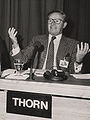 |
 Luxembourg LuxembourgPrime Minister |
Liberal Democrats National: Democratic Party Democratic Party (Luxembourg) The Democratic Party , abbreviated to DP, is the major liberal political party in Luxembourg. One of the three major parties, the DP sits on the centre-right, holding moderate market liberal views combined with a strong emphasis on civil liberties, human rights, and internationalism.Founded in... |
- | Speed up enlargement Enlargement of the European Union The Enlargement of the European Union is the process of expanding the European Union through the accession of new member states. This process began with the Inner Six, who founded the European Coal and Steel Community in 1952... while working on the Single European Act Single European Act The Single European Act was the first major revision of the 1957 Treaty of Rome. The Act set the European Community an objective of establishing a Single Market by 31 December 1992, and codified European Political Cooperation, the forerunner of the European Union's Common Foreign and Security Policy... . However with a period of eurosclerosis Eurosclerosis Eurosclerosis is a term coined in the 1970s and the early 1980s to describe both a political period and an economic pattern in Europe, alluding to the medical term sclerosis... , Thorn was unable to exert his influence. |
|
| Jacques Delors Jacques Delors Jacques Lucien Jean Delors is a French economist and politician, the eighth President of the European Commission and the first person to serve three terms in that office .-French Politics:... Delors Commission Delors Commission The Delors Commission was the administration of Jacques Delors, the 8th President of the European Commission. Delors presided over the European Commission for three terms The Delors Commission was the administration of Jacques Delors, the 8th President of the European Commission. Delors presided... |
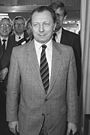 |
Early Modern France Finance Minister |
Socialists National: PS Socialist Party (France) The Socialist Party is a social-democratic political party in France and the largest party of the French centre-left. It is one of the two major contemporary political parties in France, along with the center-right Union for a Popular Movement... |
- | Oversaw the enactment of both the Single European Act Single European Act The Single European Act was the first major revision of the 1957 Treaty of Rome. The Act set the European Community an objective of establishing a Single Market by 31 December 1992, and codified European Political Cooperation, the forerunner of the European Union's Common Foreign and Security Policy... and the Treaty of Maastricht, was a principal architect behind the Committee of the Regions Committee of the Regions The Committee of the Regions is European Union's assembly of local and regional representatives that provides sub-national authorities with a direct voice within the EU's institutional framework.... and handled the 1995 enlargement 1995 enlargement of the European Union The 1995 enlargement of the European Union saw Austria, Finland and Sweden accede to the European Union . This was the EU's fourth enlargement and came into effect on the 1 January of that year. All these states were previous members of the European Free Trade Association and had traditionally... . |
|
| Jacques Santer Santer Commission Santer Commission The Santer Commission was the European Commission in office between 23 January 1995 and 15 March 1999. The administration was led by Jacques Santer .... |
Luxembourg Prime Minister |
People's Party European People's Party The European People's Party is a pro-European centre-right European political party. The EPP was founded in 1976 by Christian democratic parties, but later it increased its membership to include conservative parties and parties of other centre-right perspectives.The EPP is the most influential of... National: CSV Christian Social People's Party The Christian Social People's Party , abbreviated to CSV or PCS, is the largest political party in Luxembourg. The party follows a Christian Democratic and conservative ideology and, like most parties in Luxembourg, it is strongly pro-European... |
- |
Santer worked on the Treaty of Amsterdam, Treaty of Nice Treaty of Nice The Treaty of Nice was signed by European leaders on 26 February 2001 and came into force on 1 February 2003. It amended the Maastricht Treaty and the Treaty of Rome... and the launch of the euro Euro The euro is the official currency of the eurozone: 17 of the 27 member states of the European Union. It is also the currency used by the Institutions of the European Union. The eurozone consists of Austria, Belgium, Cyprus, Estonia, Finland, France, Germany, Greece, Ireland, Italy, Luxembourg,... . However this was overshadowed by his Commission's budget controversy. |
||
| Manuel Marín Manuel Marín Manuel Marín González is a Spanish politician, former President of the Congress of Deputies of Spain. He was a long-time member of the European Commission, and President during the interim Marin Commission following the Resignation of the Santer Commission, of which he was a member.-Early life and... (Interim) Marín Commission Marín Commission The Marín Commission is an interim European Commission that served in office from 16 March 1999 to 12 September 1999. It consisted of its president, Manuel Marín, and the other commissioners.... |
 |
 Spain SpainMinister for Europe |
Socialists National: PSOE Spanish Socialist Workers' Party The Spanish Socialist Workers' Party is a social-democratic political party in Spain. Its political position is Centre-left. The PSOE is the former ruling party of Spain, until beaten in the elections of November 2011 and the second oldest, exceeded only by the Partido Carlista, founded in... |
- | In the wake of Santer's early resignation, his commission continued under Manuel Marín as a caretaker administration. | |
| Romano Prodi Romano Prodi Romano Prodi is an Italian politician and statesman. He served as the Prime Minister of Italy, from 17 May 1996 to 21 October 1998 and from 17 May 2006 to 8 May 2008... Prodi Commission Prodi Commission The Prodi Commission was the European Commission in office between 1999 and 2004. The administration was led by former Italian Prime Minister Romano Prodi.-History:... |
 |
Italy Prime Minister Prime minister of Italy The Prime Minister of Italy is the head of government of the Italian Republic... |
Liberal Democrats National: Democrats |
- |
Oversaw the enforcement of the Nice Treaty and the signing of the European Constitution Treaty establishing a Constitution for Europe The Treaty establishing a Constitution for Europe , , was an unratified international treaty intended to create a consolidated constitution for the European Union... . He also oversaw the launch of the physical euro in 2002. |
|
| José Manuel Barroso Barroso Commission Barroso Commission The Barroso Commission is the European Commission that has been in office since 22 November 2004 and is due to serve until 2014. Its president is José Manuel Barroso, who presides over 26 other commissioners... |
 |
 Portugal PortugalPrime Minister Prime Minister of Portugal Prime Minister is the current title of the chief of the Portuguese Government. As chief executive, the Prime Minister coordinates the action of ministers, representing the Government from the other organs of state, accountable to Parliament and keeps the President informed... |
People's Party National: PSD Social Democratic Party (Portugal) The Social Democratic Party , is a centre-right liberal conservative political party in Portugal. It is commonly known by its initials, PSD; on ballot papers, its initials appear as PPD/PSD, with the first three letters coming from the party's original name, Democratic People's Party... |
- incumbent Term expires 31 October 2014 |
Barroso oversaw the Lisbon Treaty, the 2004 2004 enlargement of the European Union The 2004 enlargement of the European Union was the largest single expansion of the European Union , both in terms of territory, number of states and population, however not in terms of gross domestic product... and 2007 enlargements 2007 enlargement of the European Union The 2007 enlargement of the European Union saw Bulgaria and Romania join the European Union on 1 January 2007. It was the latest expansion of the EU, though considered by the European Commission as part of the same wave as the 2004 enlargement of the European Union.-Negotiations:Romania was the... and major legislation including the REACH and Bolkestein Directives Directive on services in the internal market The Directive on services in the internal market is an EU law aiming at establishing a single market for services within the European Union . Drafted under the leadership of the former European Commissioner for the Internal Market Frits Bolkestein, it has been popularly referred to by his name... . |
See also
- Vice-President of the European CommissionVice-President of the European CommissionA Vice President of the European Commission is a post in the European Commission usually occupied by more than one member of the Commission. Since the 2009 Lisbon Treaty entered into force, one of these is ex-officio the High Representative of the Union for Foreign Affairs and Security Policy,...
- European CommissionerEuropean CommissionerA European Commissioner is a member of the 27-member European Commission. Each Member within the college holds a specific portfolio and are led by the President of the European Commission...
- List of presidents of EU institutions
- President of the European ParliamentPresident of the European ParliamentThe President of the European Parliament presides over the debates and activities of the European Parliament. He or she also represents the Parliament within the EU and internationally. The President's signature is required for enacting most EU laws and the EU budget.Presidents serve...
- President of the European CouncilPresident of the European CouncilThe President of the European Council is a principal representative of the European Union on the world stage, and the person presiding over and driving forward the work of the European Council...
- Presidency of the Council of the European UnionPresidency of the Council of the European UnionThe Presidency of the Council of the European Union is the responsibility for the functioning of the Council of the European Union that rotates between the member states of the European Union every six months. The presidency is not a single president but rather the task is undertaken by a national...
- President of the European Parliament
External links
- Commission President (official website)
- Terms of office
- Organisation of the European Commission European NAvigator