

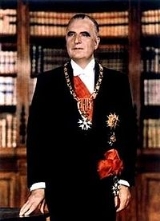
Georges Pompidou

Encyclopedia
Georges Jean Raymond Pompidou (ʒɔʁʒ pɔ̃pidu; 5 July 1911 2 April 1974) was a French politician. He was Prime Minister of France
from 1962 to 1968, holding the longest tenure in this position, and later President of the French Republic
from 1969 until his death in 1974.
, in the department of Cantal
in central France. After his khâgne
at Lycée Louis-le-Grand
, where he befriended Senegalese future poet and statesman
Léopold Sédar Senghor
, he graduated from the École Normale Supérieure
with a degree of Agrégation
in literature.
He first taught literature at the lycée Henri IV
in Paris until hired in 1953 by Guy de Rothschild
to work at Rothschild. In 1956, he was appointed the bank's general manager, a position he held until 1962. Later, he was hired by Charles de Gaulle
to manage the Anne de Gaulle Foundation for Down's Syndrome (de Gaulle's daughter Anne had Down's Syndrome).
He served as prime minister under de Gaulle after Michel Debré
resigned, from 16 April 1962 to 21 July 1968, and to this day is the longest serving French prime minister under the Fifth Republic. His nomination was controversial because he was not a member of the National Assembly. In October 1962, he was defeated by a vote of non-confidence, but de Gaulle dissolved the National Assembly. The Gaullists won the legislative election
and Pompidou was reappointed as Prime Minister. In 1964, he was faced with a miners' strike. He led the 1967 legislative campaign
of the Union of Democrats for the Fifth Republic
to a narrow victory. Pompidou was widely regarded as being responsible for the peaceful resolution of the student uprising of May 1968. His strategy was to break the coalition of students and workers by negotiating with the trade-unions and employers (Grenelle conference
). Until this crisis, he was the Prime Minister of a quiet and prosperous France.
However, during the events of May 1968, disagreements arose between Pompidou and de Gaulle. Pompidou did not understand why the President did not inform him of his departure to Baden-Baden
on 29 May. Their relationship, until then very good, would be strained from then on. Pompidou led and won the 1968 legislative campaign
, then resigned. Nevertheless, in part due to his actions during the May 1968 crisis, he appeared as the natural successor to de Gaulle. Pompidou announced his candidature for the Presidency in January 1969. Some weeks later, his wife's name was mentioned in the Markovic scandal
, thus appearing to confirm her husband's status as a cuckold. Pompidou was certain that de Gaulle's inner circle was responsible for this smear.
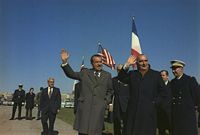 After the failure of the 1969 referendum, de Gaulle resigned and Pompidou was elected president of France, defeating in the second round by a wide margin the Centrist President of the Senate and Acting President Alain Poher
. Though a Gaullist, Pompidou was more pragmatic than de Gaulle, notably allowing the United Kingdom to join the European Community in 1973. He embarked on an industrialisation plan and initiated the Arianespace
project. He was sceptical about the "New Society" programme of his prime minister, Jacques Chaban-Delmas
. In 1972, Chaban-Delmas was replaced by Pierre Messmer
, a more conservative Gaullist.
While the left-wing opposition got organised in proposing a Common Programme before the 1973 legislative election
, he widened out his "presidential majority" by including the Centrist pro-European parties.
While still in office, Pompidou died unexpectedly on 2 April 1974, 9 PM, from Waldenström macroglobulinemia
.
Pompidou's wife Claude Pompidou
lived more than 30 years longer than Pompidou.
Pompidou had one foster son
, Alain Pompidou
, former president of the European Patent Office
.
Pompidou's time in office was marked by a constant effort to modernise France's capital city. This can be seen through his construction of a modern art museum, the Centre Beaubourg (renamed Centre Pompidou after his death), on the edge of the Marais
area of Paris. Other attempts at modernisation included tearing down the open air markets at Les Halles
and replacing it with the shopping mall of the same name, building the Montparnasse Tower
, and constructing an expressway on the right bank of the Seine.
Changes
Changes
Prime Minister of France
The Prime Minister of France in the Fifth Republic is the head of government and of the Council of Ministers of France. The head of state is the President of the French Republic...
from 1962 to 1968, holding the longest tenure in this position, and later President of the French Republic
President of the French Republic
The President of the French Republic colloquially referred to in English as the President of France, is France's elected Head of State....
from 1969 until his death in 1974.
Biography
He was born in the commune of MontboudifMontboudif
Montboudif is a commune in the Cantal department in south-central France.-Population:-Personalities:It was the birthplace of Georges Pompidou , President of France from 1969 until his death....
, in the department of Cantal
Cantal
Cantal is a department in south-central France. It is named after the Cantal mountain range, a group of extinct, eroded volcanic peaks, which covers much of the department. Residents are known as Cantaliens or Cantalous....
in central France. After his khâgne
Khâgne
The literary and humanities CPGE constitutes a type classe prépa, the two-year cycle of classes taken after the baccalauréat...
at Lycée Louis-le-Grand
Lycée Louis-le-Grand
The Lycée Louis-le-Grand is a public secondary school located in Paris, widely regarded as one of the most rigorous in France. Formerly known as the Collège de Clermont, it was named in king Louis XIV of France's honor after he visited the school and offered his patronage.It offers both a...
, where he befriended Senegalese future poet and statesman
Statesman
A statesman is usually a politician or other notable public figure who has had a long and respected career in politics or government at the national and international level. As a term of respect, it is usually left to supporters or commentators to use the term...
Léopold Sédar Senghor
Léopold Sédar Senghor
Léopold Sédar Senghor was a Senegalese poet, politician, and cultural theorist who for two decades served as the first president of Senegal . Senghor was the first African elected as a member of the Académie française. Before independence, he founded the political party called the Senegalese...
, he graduated from the École Normale Supérieure
École Normale Supérieure
The École normale supérieure is one of the most prestigious French grandes écoles...
with a degree of Agrégation
Agrégation
In France, the agrégation is a civil service competitive examination for some positions in the public education system. The laureates are known as agrégés...
in literature.
He first taught literature at the lycée Henri IV
Lycée Henri IV
The Lycée Henri-IV is a public secondary school located in Paris. Along with Louis-le-Grand it is widely regarded as one of the most demanding sixth-form colleges in France....
in Paris until hired in 1953 by Guy de Rothschild
Guy de Rothschild
Baron Guy Édouard Alphonse Paul de Rothschild was a French banker and member of the Rothschild family. He chaired the bank Rothschild Frères from 1967 to 1979, when it was nationalized by the French government, and maintained possessions in other French and foreign companies including Imerys...
to work at Rothschild. In 1956, he was appointed the bank's general manager, a position he held until 1962. Later, he was hired by Charles de Gaulle
Charles de Gaulle
Charles André Joseph Marie de Gaulle was a French general and statesman who led the Free French Forces during World War II. He later founded the French Fifth Republic in 1958 and served as its first President from 1959 to 1969....
to manage the Anne de Gaulle Foundation for Down's Syndrome (de Gaulle's daughter Anne had Down's Syndrome).
He served as prime minister under de Gaulle after Michel Debré
Michel Debré
Michel Jean-Pierre Debré was a French Gaullist politician. He is considered the "father" of the current Constitution of France, and was the first Prime Minister of the Fifth Republic...
resigned, from 16 April 1962 to 21 July 1968, and to this day is the longest serving French prime minister under the Fifth Republic. His nomination was controversial because he was not a member of the National Assembly. In October 1962, he was defeated by a vote of non-confidence, but de Gaulle dissolved the National Assembly. The Gaullists won the legislative election
French legislative election, 1962
- National Assembly by Parliamentary Group:...
and Pompidou was reappointed as Prime Minister. In 1964, he was faced with a miners' strike. He led the 1967 legislative campaign
French legislative election, 1967
French legislative elections took place on 5 and 12 March 1967 to elect the 3rd National Assembly of the Fifth Republic.In December 1965, Charles de Gaulle was re-elected President of France in the first Presidential election by universal suffrage. However, contrary to predictions, there had been a...
of the Union of Democrats for the Fifth Republic
Gaullist Party
In France, the Gaullist Party is usually used to refer to the largest party professing to be Gaullist. Gaullism claimed to transcend the left/right rift...
to a narrow victory. Pompidou was widely regarded as being responsible for the peaceful resolution of the student uprising of May 1968. His strategy was to break the coalition of students and workers by negotiating with the trade-unions and employers (Grenelle conference
Grenelle agreements
The Grenelle Agreements or Grenelle Reports were negotiated 25 and 26 May, during the crisis of May 1968 in France by the representative of the Pompidou government, the trade unions, and the Organisation patronale...
). Until this crisis, he was the Prime Minister of a quiet and prosperous France.
However, during the events of May 1968, disagreements arose between Pompidou and de Gaulle. Pompidou did not understand why the President did not inform him of his departure to Baden-Baden
Baden-Baden
Baden-Baden is a spa town in Baden-Württemberg, Germany. It is located on the western foothills of the Black Forest, on the banks of the Oos River, in the region of Karlsruhe...
on 29 May. Their relationship, until then very good, would be strained from then on. Pompidou led and won the 1968 legislative campaign
French legislative election, 1968
- National Assembly by Parliamentary Group:...
, then resigned. Nevertheless, in part due to his actions during the May 1968 crisis, he appeared as the natural successor to de Gaulle. Pompidou announced his candidature for the Presidency in January 1969. Some weeks later, his wife's name was mentioned in the Markovic scandal
The Markovic affair
The Markovic affair was a political scandal in France in the late 1960s, involving French President George Pompidou and movie star Alain Delon.-Death of Stevan Markovic:...
, thus appearing to confirm her husband's status as a cuckold. Pompidou was certain that de Gaulle's inner circle was responsible for this smear.
Alain Poher
Alain Émile Louis Marie Poher was a French centrist politician, affiliated first with the Popular Republican Movement and later with the Democratic Centre. He served as a Senator for Val-de-Marne from 1946 to 1995. He was President of the Senate from 3 October 1968 to 1 October 1992 and, in that...
. Though a Gaullist, Pompidou was more pragmatic than de Gaulle, notably allowing the United Kingdom to join the European Community in 1973. He embarked on an industrialisation plan and initiated the Arianespace
Arianespace
Arianespace SA is a French company founded in 1980 as the world's first commercial space transportation company. It undertakes the production, operation, and marketing of the Ariane 5 rocket launcher as part of the Ariane programme....
project. He was sceptical about the "New Society" programme of his prime minister, Jacques Chaban-Delmas
Jacques Chaban-Delmas
Jacques Chaban-Delmas was a French Gaullist politician. He served as Prime Minister under Georges Pompidou from 1969 to 1972. In addition, for almost half a century, he was Mayor of Bordeaux and a deputy for the Gironde département....
. In 1972, Chaban-Delmas was replaced by Pierre Messmer
Pierre Messmer
Pierre Joseph Auguste Messmer was a French Gaullist politician. He served as Minister of Armies under Charles de Gaulle from 1960 to 1969 – the longest serving since Étienne François, duc de Choiseul under Louis XV – and then as Prime Minister under Georges Pompidou from 1972 to 1974...
, a more conservative Gaullist.
While the left-wing opposition got organised in proposing a Common Programme before the 1973 legislative election
French legislative election, 1973
French legislative elections took place on 4 and 11 March 1973 to elect the 5th National Assembly of the Fifth Republic.In order to end the May 1968 crisis, President Charles de Gaulle dissolved the National Assembly and his party, the Gaullist Party Union of Democrats for the Republic , obtained...
, he widened out his "presidential majority" by including the Centrist pro-European parties.
While still in office, Pompidou died unexpectedly on 2 April 1974, 9 PM, from Waldenström macroglobulinemia
Waldenström macroglobulinemia
Waldenström's macroglobulinemia is cancer involving a subtype of white blood cells called lymphocytes. The main attributing antibody is Immunoglobulin M . WM is an "indolent lymphoma,"...
.
Pompidou's wife Claude Pompidou
Claude Pompidou
Claude Jacqueline Pompidou was the wife of President of France Georges Pompidou. She was a philanthropist and a patron of modern art, especially through the Centre Georges Pompidou.-Life before politics:...
lived more than 30 years longer than Pompidou.
Pompidou had one foster son
Foster care
Foster care is the term used for a system in which a minor who has been made a ward is placed in the private home of a state certified caregiver referred to as a "foster parent"....
, Alain Pompidou
Alain Pompidou
Alain Pompidou is a French scientist and politician. A former professor of histology, embryology and cytogenetics, he was the fourth president of the European Patent Office from July 1, 2004 to June 30, 2007...
, former president of the European Patent Office
European Patent Organisation
The European Patent Organisation is a public international organisation created in 1977 by its contracting states to grant patents in Europe under the European Patent Convention of 1973...
.
Pompidou's time in office was marked by a constant effort to modernise France's capital city. This can be seen through his construction of a modern art museum, the Centre Beaubourg (renamed Centre Pompidou after his death), on the edge of the Marais
Le Marais
Le Marais is a historic district in Paris, France. Long the aristocratic district of Paris, it hosts many outstanding buildings of historic and architectural importance...
area of Paris. Other attempts at modernisation included tearing down the open air markets at Les Halles
Les Halles
Les Halles is an area of Paris, France, located in the 1er arrondissement, just south of the fashionable rue Montorgueil. It is named for the large central wholesale marketplace, which was demolished in 1971, to be replaced with an underground modern shopping precinct, the Forum des Halles...
and replacing it with the shopping mall of the same name, building the Montparnasse Tower
Tour Montparnasse
Tour Maine-Montparnasse , also commonly named Tour Montparnasse, is a tall office skyscraper located in Paris, France, in the area of Montparnasse. Constructed from 1969 to 1972, it was the tallest skyscraper in France until 2011, when it was surpassed in height by the Tour First...
, and constructing an expressway on the right bank of the Seine.
First ministry, 14 April–28 November 1962
- Georges Pompidou – Prime Minister
- Maurice Couve de MurvilleMaurice Couve de MurvilleMaurice Couve de Murville was a French diplomat and politician who was Minister of Foreign Affairs from 1958 to 1968 and Prime Minister from 1968 to 1969 under the presidency of General de Gaulle....
– Minister of Foreign Affairs - Pierre MessmerPierre MessmerPierre Joseph Auguste Messmer was a French Gaullist politician. He served as Minister of Armies under Charles de Gaulle from 1960 to 1969 – the longest serving since Étienne François, duc de Choiseul under Louis XV – and then as Prime Minister under Georges Pompidou from 1972 to 1974...
– Minister of Armies - Roger FreyRoger FreyRoger Frey was a French politician. He was Minister of the Interior and president of the Constitutional Council of France.-Monokini prosecution:...
– Minister of the Interior - Valéry Giscard d'EstaingValéry Giscard d'EstaingValéry Marie René Georges Giscard d'Estaing is a French centre-right politician who was President of the French Republic from 1974 until 1981...
– Minister of Finance and Economic Affairs - Michel Maurice-Bokanowski – Minister of Industry
- Paul BaconPaul BaconPaul Bacon was a French politician.During World War 2, Bacon was active in the French Resistance. He was a member of Georges Bidault's National Liberation Movement, and distributed a manifesto about trade unionism in December 1940. Bacon was arrested by the Gestapo in 1943.After the war, Bacon...
– Minister of Labour - Jean FoyerJean FoyerJean Foyer was a French politician and minister. He studied law and became a law professor at the university...
– Minister of Justice - Pierre SudreauPierre SudreauPierre Sudreau is a former French politician. He was born in Paris.He announced his resignation as education minister in October 1962 to protest a proposal by Charles de Gaulle to amend the constitution.-References:...
– Minister of National Education - Raymond TribouletRaymond TribouletRaymond Triboulet was a French politician. He was a leading World War II resistance fighter who helped U.S., Canadian, and British troops invade France, which was then occupied by Nazi Germany.-Biography:...
– Minister of Veterans and War Victims - André MalrauxAndré MalrauxAndré Malraux DSO was a French adventurer, award-winning author, and statesman. Having traveled extensively in Indochina and China, Malraux was noted especially for his novel entitled La Condition Humaine , which won the Prix Goncourt...
– Minister of Cultural Affairs - Edgard PisaniEdgard PisaniEdgard Pisani was a French politician. He was born in Tunis and his parents were Maltese immigrants. He spent his childhood in Tunisia and later studied in Paris. Pisani holds a "licence de lettres" from La Sorbonne. His second marriage was with the daughter of André Le Troquer.He held positions...
– Minister of Agriculture - Louis JacquinotLouis JacquinotLouis Jacquinot was a French lawyer and politician, and chief of Prime Minister Raymond Poincaré's office.Jacquinot was born in Gondrecourt-le-Château in 1898. Entering parliament in 1932, he later served for a short time as under-secretary of state for home affairs in Paul Reynaud's cabinet...
– Minister of Overseas Departments and Territories - Robert BuronRobert BuronRobert Buron was a French politician and Minister of Finance from 20 January 1955 to 23 February 1955 and Minister of Public Works, Transport, and Tourism during Charles de Gaulle's third term from 9 June 1958 to 8 January 1959.Buron was born in Paris, where he also died. He was kidnapped during...
– Minister of Public Works and Transport - Joseph FontanetJoseph FontanetJoseph Fontanet was a French politician.He was first elected to Parliament in 1956 as MP for Savoie. In his 17 years in Parliament he held various cabinet positions including Health, Labour and Employment, and trade and industry. He succeeded Bernard Chenot, one of the first openly gay officials...
– Minister of Public Health and Population - Pierre PflimlinPierre PflimlinPierre Eugène Jean Pflimlin was a French Christian democratic politician who served as the penultimate Prime Minister of the Fourth Republic for a few weeks in 1958, before being replaced by Charles de Gaulle during the crisis of that year.-Life:...
– Minister of Cooperation - Jacques Marette – Minister of Posts and Telecommunications
- Gaston PalewskiGaston PalewskiGaston Palewski , French politician, was a close associate of Charles de Gaulle during and after World War II. He is also remembered as the lover of the English novelist Nancy Mitford, and appears in a fictionalised form in two of her novels.-Biography:Palewski was born in Paris, the son of an...
– Minister of Scientific Research and Atomic and Space Questions - Jacques Maziol – Minister of Construction
- Louis JoxeLouis JoxeLouis Joxe was a French statesman, judge and politician.-Career:* Ambassador of France to the USSR * Ambassador of France to the Federal Republic of Germany...
– Minister of Algerian Affairs
Changes
- 15 May 1962 – Gilbert Grandval succeeds Bacon as Minister of Labour. Roger Dusseaulx succeeds Buron as Minister of Public Works and Transport. Raymond MarcellinRaymond MarcellinRaymond Marcellin was a French politician.- Biography :The son of a banker, he studied law at the University of Strasbourg and the University of Paris. He worked as a lawyer for three years, before being called into the army in September 1939. He was captured by the Wehrmacht, but managed to...
succeeds Fontanet as Minister of Public Health and Population. Georges GorseGeorges GorseGeorges Gorse was a French politician and diplomat.Born in Cahors, he qualified in 1939 as a professor at the University of Cairo...
succeeds Pflimlin as Minister of Cooperation. - 15 October 1962 – Louis JoxeLouis JoxeLouis Joxe was a French statesman, judge and politician.-Career:* Ambassador of France to the USSR * Ambassador of France to the Federal Republic of Germany...
succeeds Sudreau as interim Minister of National Education
Second ministry, 28 November 1962 – 8 January 1966
- Georges Pompidou – Prime Minister
- Maurice Couve de MurvilleMaurice Couve de MurvilleMaurice Couve de Murville was a French diplomat and politician who was Minister of Foreign Affairs from 1958 to 1968 and Prime Minister from 1968 to 1969 under the presidency of General de Gaulle....
– Minister of Foreign Affairs - Pierre MessmerPierre MessmerPierre Joseph Auguste Messmer was a French Gaullist politician. He served as Minister of Armies under Charles de Gaulle from 1960 to 1969 – the longest serving since Étienne François, duc de Choiseul under Louis XV – and then as Prime Minister under Georges Pompidou from 1972 to 1974...
– Minister of Armies - Roger FreyRoger FreyRoger Frey was a French politician. He was Minister of the Interior and president of the Constitutional Council of France.-Monokini prosecution:...
– Minister of the Interior - Valéry Giscard d'EstaingValéry Giscard d'EstaingValéry Marie René Georges Giscard d'Estaing is a French centre-right politician who was President of the French Republic from 1974 until 1981...
– Minister of Finance and Economic Affairs - Michel Maurice-Bokanowski – Minister of Industry
- Gilbert Grandval – Minister of Labour
- Jean FoyerJean FoyerJean Foyer was a French politician and minister. He studied law and became a law professor at the university...
– Minister of Justice - Christian FouchetChristian FouchetChristian Fouchet was a French politician.He was born in Saint-Germain-en-Laye, Yvelines.He was the French Minister of National Education from 28 November 1962 to 6 April 1967. He was the colonial head of Algeria from 19 March 1962 to 3 July 1962....
– Minister of National Education - Jean Sainteney – Minister of Veterans and War Victims
- François MissoffeFrançois MissoffeFrançois Missoffe was Minister of Youth Affairs and Sport in the French government between 8 January 1966 and 30 May 1968....
– Minister of Repatriates - André MalrauxAndré MalrauxAndré Malraux DSO was a French adventurer, award-winning author, and statesman. Having traveled extensively in Indochina and China, Malraux was noted especially for his novel entitled La Condition Humaine , which won the Prix Goncourt...
– Minister of Cultural Affairs - Edgard PisaniEdgard PisaniEdgard Pisani was a French politician. He was born in Tunis and his parents were Maltese immigrants. He spent his childhood in Tunisia and later studied in Paris. Pisani holds a "licence de lettres" from La Sorbonne. His second marriage was with the daughter of André Le Troquer.He held positions...
– Minister of Agriculture - Louis JacquinotLouis JacquinotLouis Jacquinot was a French lawyer and politician, and chief of Prime Minister Raymond Poincaré's office.Jacquinot was born in Gondrecourt-le-Château in 1898. Entering parliament in 1932, he later served for a short time as under-secretary of state for home affairs in Paul Reynaud's cabinet...
– Minister of Overseas Departments and Territories - Marc Jacquet – Minister of Public Works and Transport
- Raymond MarcellinRaymond MarcellinRaymond Marcellin was a French politician.- Biography :The son of a banker, he studied law at the University of Strasbourg and the University of Paris. He worked as a lawyer for three years, before being called into the army in September 1939. He was captured by the Wehrmacht, but managed to...
– Minister of Public Health and Population - Jacques Marette – Minister of Posts and Telecommunications
- Alain PeyrefitteAlain PeyrefitteAlain Peyrefitte was a French scholar and politician.He was a confidant of Charles De Gaulle and had a long career in public service, serving as a diplomat in Germany and Poland....
– Minister of Information - Gaston PalewskiGaston PalewskiGaston Palewski , French politician, was a close associate of Charles de Gaulle during and after World War II. He is also remembered as the lover of the English novelist Nancy Mitford, and appears in a fictionalised form in two of her novels.-Biography:Palewski was born in Paris, the son of an...
– Minister of Scientific Research and Atomic and Space Questions - Louis JoxeLouis JoxeLouis Joxe was a French statesman, judge and politician.-Career:* Ambassador of France to the USSR * Ambassador of France to the Federal Republic of Germany...
– Minister of Administrative Reform - Jacques Maziol – Minister of Construction
Changes
- 23 July 1964 – François Missoffe leaves the cabinet. He is not replaced as Minister of Repatriates
- 22 February 1965 – Gaston Palewski leaves the ministry and is not replaced.
Third ministry, 8 January 1966 – 6 April 1967
- Georges Pompidou – Prime Minister
- Maurice Couve de MurvilleMaurice Couve de MurvilleMaurice Couve de Murville was a French diplomat and politician who was Minister of Foreign Affairs from 1958 to 1968 and Prime Minister from 1968 to 1969 under the presidency of General de Gaulle....
– Minister of Foreign Affairs - Pierre MessmerPierre MessmerPierre Joseph Auguste Messmer was a French Gaullist politician. He served as Minister of Armies under Charles de Gaulle from 1960 to 1969 – the longest serving since Étienne François, duc de Choiseul under Louis XV – and then as Prime Minister under Georges Pompidou from 1972 to 1974...
– Minister of Armies - Roger FreyRoger FreyRoger Frey was a French politician. He was Minister of the Interior and president of the Constitutional Council of France.-Monokini prosecution:...
– Minister of the Interior - Michel DebréMichel DebréMichel Jean-Pierre Debré was a French Gaullist politician. He is considered the "father" of the current Constitution of France, and was the first Prime Minister of the Fifth Republic...
– Minister of Economy and Finance - Raymond MarcellinRaymond MarcellinRaymond Marcellin was a French politician.- Biography :The son of a banker, he studied law at the University of Strasbourg and the University of Paris. He worked as a lawyer for three years, before being called into the army in September 1939. He was captured by the Wehrmacht, but managed to...
– Minister of Industry - Gilbert Grandval – Minister of Labour
- Jean FoyerJean FoyerJean Foyer was a French politician and minister. He studied law and became a law professor at the university...
– Minister of Justice - Christian FouchetChristian FouchetChristian Fouchet was a French politician.He was born in Saint-Germain-en-Laye, Yvelines.He was the French Minister of National Education from 28 November 1962 to 6 April 1967. He was the colonial head of Algeria from 19 March 1962 to 3 July 1962....
– Minister of National Education - Alexandre Sanguinetti – Minister of Veterans and War Victims
- André MalrauxAndré MalrauxAndré Malraux DSO was a French adventurer, award-winning author, and statesman. Having traveled extensively in Indochina and China, Malraux was noted especially for his novel entitled La Condition Humaine , which won the Prix Goncourt...
– Minister of Cultural Affairs - Edgar FaureEdgar FaureEdgar Faure was a French politician, essayist, historian, and memoirist.-Career:Faure was born in Béziers, Languedoc-Roussillon. He trained as a lawyer in Paris and became a member of the Bar at 27, the youngest lawyer in France to do so at the time...
– Minister of Agriculture - François MissoffeFrançois MissoffeFrançois Missoffe was Minister of Youth Affairs and Sport in the French government between 8 January 1966 and 30 May 1968....
– Minister of Youth and Sports - Pierre BillottePierre BillottePierre Armand Gaston Billotte was a French Army officer and politician. He was the son of General Gaston Billotte, who commanded parts of the French Army at the start of World War II...
– Minister of Overseas Departments and Territories - Edgard PisaniEdgard PisaniEdgard Pisani was a French politician. He was born in Tunis and his parents were Maltese immigrants. He spent his childhood in Tunisia and later studied in Paris. Pisani holds a "licence de lettres" from La Sorbonne. His second marriage was with the daughter of André Le Troquer.He held positions...
– Minister of Equipment - Marc Jacquet – Minister of Public Works and Transport
- Raymond MarcellinRaymond MarcellinRaymond Marcellin was a French politician.- Biography :The son of a banker, he studied law at the University of Strasbourg and the University of Paris. He worked as a lawyer for three years, before being called into the army in September 1939. He was captured by the Wehrmacht, but managed to...
– Minister of Public Health and Population - Jacques Marette – Minister of Posts and Telecommunications
- Louis JoxeLouis JoxeLouis Joxe was a French statesman, judge and politician.-Career:* Ambassador of France to the USSR * Ambassador of France to the Federal Republic of Germany...
– Minister of Administrative Reform - Jean-Marcel JeanneneyJean-Marcel JeanneneyJean-Marcel Jeanneney was a minister in various French governments in the 1950s and 60s, as well as France's first ambassador to Algeria in the immediate aftermath of the Algerian War...
– Minister of Social Affairs
Fifth ministry, 30 May – 10 July 1968
- Georges Pompidou – Prime Minister
- Michel DebréMichel DebréMichel Jean-Pierre Debré was a French Gaullist politician. He is considered the "father" of the current Constitution of France, and was the first Prime Minister of the Fifth Republic...
– Minister of Foreign Affairs - Pierre MessmerPierre MessmerPierre Joseph Auguste Messmer was a French Gaullist politician. He served as Minister of Armies under Charles de Gaulle from 1960 to 1969 – the longest serving since Étienne François, duc de Choiseul under Louis XV – and then as Prime Minister under Georges Pompidou from 1972 to 1974...
– Minister of Armies - Raymond MarcellinRaymond MarcellinRaymond Marcellin was a French politician.- Biography :The son of a banker, he studied law at the University of Strasbourg and the University of Paris. He worked as a lawyer for three years, before being called into the army in September 1939. He was captured by the Wehrmacht, but managed to...
– Minister of the Interior - Maurice Couve de MurvilleMaurice Couve de MurvilleMaurice Couve de Murville was a French diplomat and politician who was Minister of Foreign Affairs from 1958 to 1968 and Prime Minister from 1968 to 1969 under the presidency of General de Gaulle....
– Minister of Economy and Finance - Albin ChalandonAlbin ChalandonAlbin Chalandon is a French politician and a former minister.Between 1968 and 1972, he was Minister of Public Works...
– Minister of Industry - Joseph FontanetJoseph FontanetJoseph Fontanet was a French politician.He was first elected to Parliament in 1956 as MP for Savoie. In his 17 years in Parliament he held various cabinet positions including Health, Labour and Employment, and trade and industry. He succeeded Bernard Chenot, one of the first openly gay officials...
– Minister of Labour, Employment, and Population - René CapitantRené CapitantRené Marie Alphonse Charles Capitant was a French lawyer and politician.He was the son of a lawyer, Henri Capitant, and attended the Lycée Henri-IV in Paris...
– Minister of Justice - François-Xavier OrtoliFrançois-Xavier OrtoliFrançois-Xavier Ortoli was a French Gaullist politician and businessman. He served with the Free French Forces during World War II and was decorated with the Croix de guerre, Médaille militaire and Médaille de la Résistance...
– Minister of National Education - Henri DuvillardHenri DuvillardHenri Duvillard is a French former alpine ski racer. He is one of just seven men to win World Cup races in every discipline contested at the time....
– Minister of Veterans and War Victims - André MalrauxAndré MalrauxAndré Malraux DSO was a French adventurer, award-winning author, and statesman. Having traveled extensively in Indochina and China, Malraux was noted especially for his novel entitled La Condition Humaine , which won the Prix Goncourt...
– Minister of Cultural Affairs - Edgar FaureEdgar FaureEdgar Faure was a French politician, essayist, historian, and memoirist.-Career:Faure was born in Béziers, Languedoc-Roussillon. He trained as a lawyer in Paris and became a member of the Bar at 27, the youngest lawyer in France to do so at the time...
– Minister of Agriculture - Roland Nungesser – Minister of Youth and Sports
- Joël Le Theule – Minister of Overseas Departments and Territories
- Jean ChamantJean ChamantJean Chamant was a French politician, judge and senator who served from 1977–1995.- Career :Chamant graduated from the Ecole Saint-Jacques with a degree in Law and began his career as a lawyer in 1937. Chamant assumed the title of judge in 1977.- References :...
– Minister of Transport - Roger FreyRoger FreyRoger Frey was a French politician. He was Minister of the Interior and president of the Constitutional Council of France.-Monokini prosecution:...
– Minister of Relations with Parliament - Raymond MarcellinRaymond MarcellinRaymond Marcellin was a French politician.- Biography :The son of a banker, he studied law at the University of Strasbourg and the University of Paris. He worked as a lawyer for three years, before being called into the army in September 1939. He was captured by the Wehrmacht, but managed to...
– Minister of Public Health and Population - Robert Galley – Minister of Housing
- André BettencourtAndré BettencourtAndré Bettencourt was a French politician. He had been awarded the Croix de Guerre, and is a Chevalier of the Legion of Honor...
– Minister of Posts and Telecommunications - Yves GuénaYves GuénaYves Guéna is a French politician. In 1940, he joined the Free French Forces in the United Kingdom. He received several decorations for his courage....
– Minister of Information - Robert BoulinRobert BoulinRobert Boulin was a French politician who served as Minister of Labour in the French Cabinet and was at the centre of a major real-estate scandal that ended only with his death in mysterious circumstances...
– Minister of Civil Service - Christian de la MalèneChristian de La MalèneChristian Lunet de La Malène, , was a French and European politician. He was a member of the UDR party.He served as the French Minister of Scientific Research and Atomic and Space Questions from 1968...
– Minister of Scientific Research and Atomic and Space Questions - Maurice SchumannMaurice SchumannMaurice Schumann was a French politician, journalist, writer, and hero of the Second World War who served as Minister of Foreign Affairs under Georges Pompidou in the 1960s and 1970s...
– Minister of Social Affairs
Writings by Georges Pompidou
- Anthologie de la Poésie Française, Livre de Poche/Hachette, 1961
- Le Nœud gordien, éd. Plon, 1974
- Entretiens et discours, deux vol., éd. Plon, 1975
- Pour rétablir une vérité, éd. Flammarion, 1982
Quotations
- "There are three roads to ruin; women, gambling and technicians. The most pleasant is with women, the quickest is with gambling, but the surest is with technicians."