
All Topics  
Belgian franc

 
Belgian Franc

   Email Print
   Bookmark   Link


Belgian franc


The franc (Dutch
Dutch language

Dutch is a West Germanic languages spoken by over 22 million people as a first language, and about 5 million people as a second language."1% of the EU population claims to speak Dutch well enough in order to have a conversation." Outside the European Union the number of second language speakers of Dutch is very small. Most native...
 : frank - French
French language

French is a Romance language spoken around the world by around 80 million people as first language, by 190 million as second language, and by about another 200 million people as an acquired tongue, with significant speakers in 54 countries....
 : franc - German
German language

German is a West Germanic languages, thus related to and classified alongside English language and Dutch language. It is one of the world's world language and the most widely spoken mother tongue in the European Union....
 : Franken) was the currency of Belgium
Belgium

* A small German-speaking Community of Belgium exists in eastern Wallonia. Belgium's linguistic diversity and related political and cultural conflicts are reflected in the history of Belgium and a complex Communities and regions of Belgium....
 until 2002 when the euro
Euro

The euro is the official currency of 16 out of 27 European Union member state of the European Union . The states, known collectively as the Eurozone are: Austria, Belgium, Cyprus, Finland, France, Germany, Greece, Republic of Ireland, Italy, Luxembourg, Malta, the Netherlands, Portugal, Slovakia, Slovenia, and Spain....
 was introduced into circulation. It was subdivided into 100 centiem (Dutch), centimes (French) or Centime (German).

conquest of most of western Europe
Europe

Europe is, conventionally, one of the world's seven continents. Comprising the westernmost peninsula of Eurasia, Europe is generally divided from Asia to its east by the water divide of the Ural Mountains, the Ural , the Caspian Sea, and by the Caucasus Mountains to the southeast....
 by revolutionary and Napoleonic France led to the French franc
French franc

The franc is a former currency of France. Between 1360 and 1641, it was the name of coins worth 1 livre tournois and it remained in common parlance as a term for this amount of money....
's wide circulation. In the Austrian Netherlands (now Belgium), the franc replaced the kronenthaler.


Discussion
Ask a question about 'Belgian franc'
Start a new discussion about 'Belgian franc'
Answer questions from other users
Full Discussion Forum


Encyclopedia


The franc (Dutch
Dutch language

Dutch is a West Germanic languages spoken by over 22 million people as a first language, and about 5 million people as a second language."1% of the EU population claims to speak Dutch well enough in order to have a conversation." Outside the European Union the number of second language speakers of Dutch is very small. Most native...
 : frank - French
French language

French is a Romance language spoken around the world by around 80 million people as first language, by 190 million as second language, and by about another 200 million people as an acquired tongue, with significant speakers in 54 countries....
 : franc - German
German language

German is a West Germanic languages, thus related to and classified alongside English language and Dutch language. It is one of the world's world language and the most widely spoken mother tongue in the European Union....
 : Franken) was the currency of Belgium
Belgium

* A small German-speaking Community of Belgium exists in eastern Wallonia. Belgium's linguistic diversity and related political and cultural conflicts are reflected in the history of Belgium and a complex Communities and regions of Belgium....
 until 2002 when the euro
Euro

The euro is the official currency of 16 out of 27 European Union member state of the European Union . The states, known collectively as the Eurozone are: Austria, Belgium, Cyprus, Finland, France, Germany, Greece, Republic of Ireland, Italy, Luxembourg, Malta, the Netherlands, Portugal, Slovakia, Slovenia, and Spain....
 was introduced into circulation. It was subdivided into 100 centiem (Dutch), centimes (French) or Centime (German).

History

The conquest of most of western Europe
Europe

Europe is, conventionally, one of the world's seven continents. Comprising the westernmost peninsula of Eurasia, Europe is generally divided from Asia to its east by the water divide of the Ural Mountains, the Ural , the Caspian Sea, and by the Caucasus Mountains to the southeast....
 by revolutionary and Napoleonic France led to the French franc
French franc

The franc is a former currency of France. Between 1360 and 1641, it was the name of coins worth 1 livre tournois and it remained in common parlance as a term for this amount of money....
's wide circulation. In the Austrian Netherlands (now Belgium), the franc replaced the kronenthaler. This was in turn replaced by the Dutch gulden
Dutch gulden

The guilder , represented by the symbol Florin sign or fl., was the currency of the Netherlands from the 13th century until 2002, when it was replaced by the euro....
 when the Kingdom of the Netherlands
Kingdom of the Netherlands

From 1830 to 1954, the "Kingdom of the Netherlands" referred to the Netherlands Kingdom and its colonial possessions.Suriname was a constituent nation within the Kingdom from 1954 to 1975....
 was formed.

Following independence from the Kingdom of the Netherlands, the new Kingdom of Belgium in 1832 adopted its own franc, equivalent to the French franc
French franc

The franc is a former currency of France. Between 1360 and 1641, it was the name of coins worth 1 livre tournois and it remained in common parlance as a term for this amount of money....
, followed by Luxembourg
Luxembourg

Luxembourg , officially the Grand Duchy of Luxembourg , is a small landlocked country in western Europe, bordered by Belgium, France, and Germany....
 in 1848 and Switzerland
Switzerland

Switzerland is a landlocked Swiss Alps country of roughly 7.7 million people in Western Europe with an area of 41,285 km?. Switzerland is a federal republic consisting of 26 states called Cantons of Switzerland....
 in 1850. Newly-unified Italy
Italy

Italy , officially the Italian Republic , is a country located on the Italian Peninsula in Southern Europe and on the two largest islands in the Mediterranean Sea, Sicily and Sardinia....
 adopted the lira
Italian lira

The lira was the currency of Italy between 1861 and 2002. Between 1999 and 2002, the Italian lira was officially a ?national subunit? of the euro....
 on a similar basis in 1862.

In 1865 France
France

France , officially the French Republic , is a country whose Metropolitan France is located in Western Europe and that also comprises various Overseas departments and territories of France....
, Belgium
Belgium

* A small German-speaking Community of Belgium exists in eastern Wallonia. Belgium's linguistic diversity and related political and cultural conflicts are reflected in the history of Belgium and a complex Communities and regions of Belgium....
, Switzerland
Switzerland

Switzerland is a landlocked Swiss Alps country of roughly 7.7 million people in Western Europe with an area of 41,285 km?. Switzerland is a federal republic consisting of 26 states called Cantons of Switzerland....
 and Italy
Italy

Italy , officially the Italian Republic , is a country located on the Italian Peninsula in Southern Europe and on the two largest islands in the Mediterranean Sea, Sicily and Sardinia....
 created the Latin Monetary Union
Latin Monetary Union

The Latin Monetary Union was a 19th century attempt to European integration several European Currency into a currency union that could be used in all the member states, at a time when most national currencies were still made out of gold and silver....
 (to be joined by Greece
Greece

Greece , officially the Hellenic Republic , is a country in southeastern Europe, situated on the southern end of the Balkans. It has borders with Albania, Bulgaria and the former Yugoslav Republic of Macedonia to the north, and Turkey to the east....
 in 1868): each would possess a national currency unit (franc, lira, drachma) worth 4.5 g of silver or 290.322 mg of fine gold
Gold

Gold is a chemical element with the symbol Au and atomic number 79. It is a highly sought-after precious metal, having been used as money, as a store of value, in jewelry, in sculpture, and for ornamentation since the beginning of recorded history....
, all freely exchangeable at a rate of 1:1. In the 1870s the gold value was made the fixed standard, a situation which was to continue until 1914.

In 1926, Belgium
Belgium

* A small German-speaking Community of Belgium exists in eastern Wallonia. Belgium's linguistic diversity and related political and cultural conflicts are reflected in the history of Belgium and a complex Communities and regions of Belgium....
, as well as France, experienced depreciation and an abrupt collapse of confidence, leading to the introduction of a new gold currency for international transactions, the belga worth 5 francs, and the country's withdrawal from the monetary union, which ceased to exist at the end of the year. The belga was tied to the British pound at a rate of 35 belgas (175 francs) = 1 pound and was thus put on a gold standard
Gold standard

The gold standard is a monetary system in which a region's common media of exchange are paper notes that are normally freely convertible into pre-set, fixed quantities of gold....
 of 1 belga = 209.211 mg fine gold. The 1921 monetary union of Belgium and Luxembourg
Luxembourg

Luxembourg , officially the Grand Duchy of Luxembourg , is a small landlocked country in western Europe, bordered by Belgium, France, and Germany....
 survived, however, forming the basis for full economic union in 1932. In 1935, the Belgian franc was devalued by 28% to 150.632 mg fine gold and the link between the Luxembourg and Belgian francs was revised to 1 Luxembourgish franc = 1¼ Belgian francs.

Following Belgium's occupation by Germany
Germany

Germany , officially the Federal Republic of Germany , is a country in Central Europe. It is bordered to the north by the North Sea, Denmark, and the Baltic Sea; to the east by Poland and the Czech Republic; to the south by Austria and Switzerland; and to the west by France, Luxembourg, Belgium, and the Netherlands....
 in May, 1940, the franc was fixed at a value of 0.1 Reichsmark
German reichsmark

The Reichsmark was the currency in Germany from 1924 until June 20, 1948. The Reichsmark was subdivided into 100 Reichspfennig....
, reduced to 0.08 Reichsmark in July, 1940. Following liberation in 1944, the franc entered into the Bretton Woods system
Bretton Woods system

The Bretton Woods system of money management established the rules for commerce and finance relations among the world's major developed country in the mid 20th century....
, with an initial exchange rate of 43.77 francs = US dollar set on October 5. This was changed to 43.8275 in 1946 and then to 50 following the devaluation of the British pound in September 1949. The Belgian franc was devaluated again in 1982.

Like 10 other European currencies, the Belgian/Luxembourgish franc
Luxembourgish franc

The Luxembourgian franc was the currency of Luxembourg between 1854 and 1999 . The franc remained in circulation until 2002, when it was replaced by the euro....
 ceased to exist in January 1, 1999, when it became fixed at 1 EUR= 40.3399 BEF/LUF, thus a franc was worth € 0.024789. Old franc coins and notes lost their legal tender
Legal tender

Legal tender or forced tender is payment that, by law, cannot be refused in settlement of a debt.Legal tender is variously defined in different jurisdictions....
 status in February 28, 2002.

Linguistics

Initially, the currency was monolingual in French. However, Dutch language coins were introduced from 1869. Some later coins featured inscriptions in both languages. When the two languages appeared on either side of the same face of a coin, two versions were still produced, one with Dutch to the left and French to the right, and one with the alternate arrangement. Banknotes became bilingual in the 1880s and, from 1992, banknotes were introduced which were trilingual, with either French or Dutch on the obverse and German and the remaining language on the reverse. Some commemorative coins were issued with German inscriptions but none for circulation.

Use of Luxembourgish francs in Belgium

Between 1944 and 2002, 1 Luxembourgish franc was equal to 1 Belgian franc. Both francs were legal tender in the two countries. Nevertheless, payment with Luxembourgish banknotes were commonly denied by shopkeepers in Belgium, either by ignorance or by fear that their other customers would refuse the banknotes (again, either by ignorance or fear of being denied payment with it later), forcing them to go through the hassle of a trip to their bank to redeem the value of the banknote.

Coins

Between 1832 and 1834, copper 1, 2, 5 and 10 centime, silver ¼, ½, 1, 2 and 5 franc, and gold 20 and 40 franc coins were introduced. Some of the early 1 and 2 centimes were struck over Dutch ½ and 1 cent coins. The 40 franc was not issued after 1841, whilst silver 2½ francs and gold 10 and 25 francs were issued between 1848 and 1850. Silver 20 centimes replaced the ¼ franc in 1852. In 1860, cupro-nickel 20 centimes were introduced, followed by cupro-nickel 5 and 10 centimes in 1861. The silver 5 franc was discontinued in 1876. Between 1901 and 1908, holed, cupro-nickel 5, 10 and 25 centime coins were introduced.

In 1914, production of the 1 centime and all silver and gold coins ceased. Zinc 5, 10 and 25 centimes were introduced in the German
Germany

Germany , officially the Federal Republic of Germany , is a country in Central Europe. It is bordered to the north by the North Sea, Denmark, and the Baltic Sea; to the east by Poland and the Czech Republic; to the south by Austria and Switzerland; and to the west by France, Luxembourg, Belgium, and the Netherlands....
 occupied zone, followed by holed, zinc 50 centimes in 1918. Production of 2 centimes ended in 1919. In 1922 and 1923, nickel 50 centime and 1 and 2 franc coins were introduced bearing the text "Good For" ("Bon pour" in French, "Goed Voor" in Dutch). Nickel-brass replaced cupro-nickel in the 5 and 10 centimes in 1930, followed by the 25 centime in 1938. Nickel 5 and 20 francs were introduced in 1930 and 1931, respectively, followed by silver 20 francs in 1933 and 50 francs in 1939.

As a consequence of the German occupation in 1940, the silver coinage was discontinued. In 1941, zinc replaced all other metals in the 5, 10 and 25 centimes, and 1 and 5 francs. In 1944 the Allies minted 25 million 2 franc coins at the Philadelphia Mint
Philadelphia Mint

The Philadelphia Mint was created from the need to establish a national identity and the needs of commerce in the United States. This led the Founding Fathers of the United States to make an establishment of a continental national mint a main priority after the ratification of the Constitution of the United States....
 using leftover planchets for the 1943 steel cent
1943 steel cent

The 1943 steel cent was a variety of the United States Cent which was struck in steel due to wartime shortages of copper....
. In 1948, cupro-nickel 5 francs and silver 50 and 100 francs were introduced, followed by silver 20 francs in 1949 and cupro-nickel 1 franc in 1950. Bronze 20 and 50 centimes followed in 1953 and 1952, respectively. The silver coinage ceased in 1955.

Cupro-nickel 25 centime coins replaced the 20 centime in 1964. Nickel 10 francs were introduced in 1969 (only struck until 1979), followed by bronze 20 francs in 1980 and nickel 50 francs in 1987. Aluminium-bronze replaced cupro-nickel in the 5 franc in 1986, whilst nickel-plated iron replaced cupro-nickel in the 1 franc in 1989.

Circulating Coins
Image Value Diameter Weight Composition Obverse Reverse First Minted Obsolete
25 centimes 16 mm 2.00 g Cu : 75 %
Ni : 25 %
A Miner
Miner

A miner is a person whose work or business it is to extract ore or minerals from the earth. It is considered one of the most dangerous trades in the world....
 and lamp
Crown and value 1964 1980
Belgium 07
50 centimes 19 mm 2.75 g Cu : 95 %
Sn : 3 %
Zn : 3 %
1952 2002
Belgium 04
1 franc 21 mm 4.00 g Cu : 75 %
Ni : 25 %
Woman's head Crown, branch and value 1950 ??
Belgium 08
1 franc 18 mm 2.75 g Fe : 94 %
Ni : 6 %
King Baudouin Crown and value 1988 2002
1 franc 18 mm 2.75 g Fe : 94 %
Ni : 6 %
King Albert II Value 1994 2002
Belgium 02
5 francs 24 mm 6.00 g Cu : 75 %
Ni : 25 %
Woman's head Crown, branch and value 1948 ??
Belgium 06
5 francs 24 mm 5.50 g Cu : 92 %
Al : 6 %
Ni : 2 %
King Baudouin Value 1986 2002
5 francs 24 mm 5.50 g Cu : 92 %
Al : 6 %
Ni : 2 %
King Albert II
Albert II of Belgium

Albert II is the current Monarchy of Belgium and a constitutional monarchy. He is a member of the royal house "of Belgium"; formerly this house was named House of Saxe-Coburg and Gotha....
 
Value 1994 2002
10 francs 27 mm 8.00 g Ni : 100 % King Baudouin Coat of arms of Belgium
Coat of arms of Belgium

The Coat of Arms of the Kingdom of Belgium bears a lion, called the Belgian Lion, or Leo Belgicus. This is in accordance with article 193 of the Belgian Constitution: The Belgian nation takes red, yellow and black as colours, and as state coat of arms the Belgian lion with the motto UNITY MAKES STRENGTH....
 
1969 1985
Belgium 05
20 francs 25.65 mm 8.50 g Cu : 92 %
Ni : 6 %
Al : 2 %
King Baudouin Leaves and value 1980 2002
20 francs 25.65 mm 8.50 g Cu : 92 %
Ni : 6 %
Al : 2 %
King Albert II Value 1994 2002
50 francs 22.75 mm 7.00 g Ni : 100 % King Baudouin Value 1987 2002
50 francs 22.75 mm 7.00 g Ni : 100 % King Albert II Value 1994 2002


Banknotes

Between 1835 and 1841, notes were issued by the Société de Commerce de Bruxelles, the Banque Legrelle, the Société Génerale pour Favoriser l'Industrie Nationale, the Banque de Belgique, the Banque de Flandre and the Banque Liègeoise et Caisse d'Épargnes in denominations which included 5, 10, 20, 25, 50, 100, 250, 500 and 1000 francs.

In 1851, the National Bank of Belgium
National Bank of Belgium

The National Bank of Belgium has been the central bank of Belgium since 1850. The National Bank of Belgium was established by a law of 5 May 1850 as a S.A....
 began issuing paper money, in denominations of 20, 50, 100, 500 and 1000 francs. 1, 2 and 5 franc notes were introduced in 1914. The Société Génerale de Belgique issued paper money in the German occupied areas between 1915 and 1918 in denominations of 1, 2, 5, 20, 100 and 1000 francs.

The treasury took over production of 5 and 20 franc notes in 1926. In 1927, notes were introduced by the National Bank with denominations given in both francs and belgas. These were 50, 100, 500, 1000 and 10,000 francs (10, 20, 100, 200 and 2000 belgas).

In 1944, following liberation, new banknotes were introduced (dated 1943 and printed in the U.K.) in denominations of 5, 10, 100, 500 and 1000 francs (1, 2, 20, 100 and 200 belgas). These were the last notes to bear denominations in belgas. Treasury notes for 50 francs were introduced in 1948, followed by 20 francs in 1950, whilst the National Bank continued to issue 100, 500 and 1000 francs. 5000 franc banknotes were introduced in 1971, with the 20 and 50 franc treasury notes replaced by coins in 1980 and 1987, respectively. 10,000 franc banknotes were introduced in 1992, the same year that production of the 5000 franc note ceased. 2000 franc notes were introduced in 1994.

The notes taken out of circulation in 2002 were
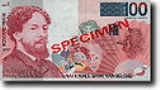
100 francs: James Ensor
James Ensor

James Sidney Edouard, Baron Ensor was a Belgium Painting and printmaker, an important influence on expressionism and surrealism who lived in Ostend for almost his entire life....
200 francs: Adolphe Sax
Adolphe Sax

Antoine-Joseph "Adolphe" Sax was a Belgium musical instrument designer and musician , best known for inventing the saxophone....
500 francs: René Magritte
René Magritte

Ren? Fran?ois Ghislain Magritte was a List of Belgians surrealist artist. He became well known for a number of witty and thought-provoking images....
1000 francs: Constant Permeke
Constant Permeke

Constant Permeke was a Belgium painter and sculptor who is considered the leading figure of Flanders expressionism.Permeke was born in Antwerp but when he was six years old the family moved to Ostend, where his father became curator of the Municipal Museum of Arts....
2000 francs: Victor Horta
Victor Horta

Victor, Baron Horta was a Belgium architect and designer. John Julius Norwich described him as "undoubtedly the key European Art Nouveau architect." Indeed, Horta is one of the most important names in Art Nouveau architecture; the construction of his H?tel Tassel in Brussels in 1892-3 means that he is sometimes credited as the first to intr...
10,000 francs: Albert II of Belgium
Albert II of Belgium

Albert II is the current Monarchy of Belgium and a constitutional monarchy. He is a member of the royal house "of Belgium"; formerly this house was named House of Saxe-Coburg and Gotha....
 and Queen Paola of Belgium
Queen Paola of Belgium

}|}Paola, Queen of the Belgians , is the queen consort of Albert II of Belgium. She is the seventh and youngest child of Fulco Ruffo di Calabria, 6th Duke of Guardia Lombarda ....
100 Belgische Franc


Earlier notes included
20 francs: King Baudouin
Baudouin of Belgium

Baudouin of Belgium reigned as King of the Belgians from 1951 to 1993. He was the eldest son of Leopold III of Belgium and his first wife, Princess Astrid of Sweden ....
50 francs: King Baudouin
Baudouin of Belgium

Baudouin of Belgium reigned as King of the Belgians from 1951 to 1993. He was the eldest son of Leopold III of Belgium and his first wife, Princess Astrid of Sweden ....
 and Queen Fabiola
Queen Fabiola of Belgium

Queen Fabiola of Belgium is the widow of King Baudouin I of Belgium. She was Queen consort of the Belgians for 33 years. Since her husband's death in 1993, she has been styled HM Queen Fabiola of Belgium....
100 francs: Hendrik Beyaert
Hendrik Beyaert

Hendrik Beyaert or Henri Beyaert was a Belgian architect.He was born in Kortrijk, Belgium on 29th July 1823 and died in Brussels 22nd January 1894....
500 francs: Constantin Meunier
Constantin Meunier

Constantin Meunier , Belgium Painting and sculpture, was born in Etterbeek, Brussels.His first exhibit was a plaster sketch, "The Garland," shown at the Brussels Salon in 1851....
1000 francs: André Ernest Modeste Grétry
André Ernest Modeste Grétry

Andr? Ernest Modeste Gr?try was acomposer from the Prince-Bishopric of Li?ge , who worked from 1767 onwards in France and took French nationality....
5000 francs: Guido Gezelle
Guido Gezelle

Guido Pieter Theodorus Josephus Gezelle was an influential Dutch language writer and poet and a Roman Catholic priest from Belgium.He was born in Bruges in the province of West Flanders, where he also spent most of his life....
10,000 francs: King Baudouin of Belgium and Queen Fabiola of Belgium
Queen Fabiola of Belgium

Queen Fabiola of Belgium is the widow of King Baudouin I of Belgium. She was Queen consort of the Belgians for 33 years. Since her husband's death in 1993, she has been styled HM Queen Fabiola of Belgium....


See also

  • Belgian euro coins
    Belgian euro coins

    Belgian euro coins feature only a single design for all eight coins: the portrait or effigy of Albert II of Belgium of the Belgians and his royal monogram....
  • Euro gold and silver commemorative coins (Belgium)
    Euro gold and silver commemorative coins (Belgium)

    Euro gold and silver commemorative coins are special euro coins Mint and issued by member states of the Eurozone, mainly in gold and silver, although other precious metals are also used in rare occasions....
  • Belgium-Luxembourg Economic Union
    Belgium-Luxembourg Economic Union

    The Belgium-Luxembourg Economic Union , abbreviated to BLEU or UEBL, is an economic and monetary union between Belgium and Luxembourg, two countries in the Benelux economic union....
  • Economy of Belgium
    Economy of Belgium

    Belgium belongs to the Organisation for Economic Co-operation and Development and is one of the founding members of the European Community ....


External links