

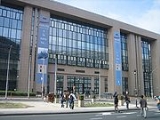
Council of the European Union

Encyclopedia
The Council of the European Union (sometimes just called the Council and sometimes still referred to as the Council of Ministers) is the institution
in the legislature of the European Union
(EU) representing the executives
of member states
, the other legislative body being the European Parliament
. The Council is composed of twenty-seven national ministers
(one per state
). The exact membership depends upon the topic; for example, when discussing agricultural policy
the Council is formed by the twenty-seven national ministers whose portfolio includes this policy area (with the related European Commissioner
contributing but not voting).
The Presidency
of the Council rotates every six months between the governments of EU member states, with the relevant minister of the respective country holding the Presidency at any given time ensuring the smooth running of the meetings and setting the daily agenda. The continuity between presidencies is provided by an arrangement under which three successive presidencies, known as Presidency trios, share common political programmes. The Foreign Affairs Council (national foreign ministers) is however chaired by the Union's High Representative
. The Council is administered by the Council's Secretary General
.
Its decisions are made by qualified majority voting in most areas, unanimity in others. Usually where it operates unanimously, it need only consult the Parliament. However, in most areas the ordinary legislative procedure applies meaning both Council and Parliament share legislative and budgetary powers equally. In a few limited areas the Council may initiate new EU law itself.
(ECSC) as the "Special Council of Ministers", set up to counterbalance the High Authority (the supranational executive, now the Commission). The original Council had limited powers as issues relating only to coal and steel were in the Authority's domain, whereas the Council only had to give its consent to decisions outside coal and steel. As a whole, it only scrutinised the High Authority
(the executive
). In 1957, the Treaties of Rome established two new communities, and with them two new Councils: the Council of the European Atomic Energy Community
(EAEC) and the Council of the European Economic Community
(EEC). However due to objections over the supranational power of the Authority, their Councils had more executive powers with the new executive bodies being known as "Commissions".
In 1965 the Council was hit by the "empty chair crisis". Due to disagreements between French President Charles de Gaulle
and the Commission's agriculture proposals, among other things, France boycotted all meetings of the Council bringing work to a halt until it was resolved the following year by the Luxembourg compromise
. Although initiated by a gamble of then-President Walter Hallstein
, who lost the Presidency after the crisis, it exposed flaws in the Council's workings.
With the Merger Treaty
of 1967, the ECSC's Special Council of Ministers and the Council of the EAEC (together with their other independent institutions) were merged into the Council of the EEC which would act as a single Council of the European Communities
. In 1993, the Council adopted the name 'Council of the European Union', following the establishment of the European Union by the Maastricht Treaty
. That treaty strengthened the Council with the addition of more intergovernmental elements in the three pillars
system. However, at the same time the Parliament and Commission had been strengthened inside the Community pillar curbing the ability of the Council to act independently.
The Treaty of Lisbon
abolished the pillar system and gave further powers to Parliament. It also merged the Council's High Representative
with the Commission's foreign policy head, with this new figure chairing the foreign affair's Council rather than the rotating presidency. The European Council
was declared a separate institution from the Council, also chaired by a permanent president, and the different Council configurations were mentioned in the treaties for the first time. Finally, Lisbon gave the Commission its executive powers directly rather than have it delegated by the Council.
The development of the Council has been characterised by the rise in power of the Parliament as, while the Council has not lost power, the Parliament has provided a greater and greater opposition to the Council's wishes. This has in some cases led to clashes between the two bodies with the Council's system of intergovernmentalism contradicting the developing parliamentary system and supranational principles.
. However the Council only has legislative initiative
in limited sensitive areas. It also holds, jointly with the Parliament, the budgetary power of the Union and has greater control than the Parliament over the intergovernmental areas of the EU. Finally, before the entry into force of the Treaty of Lisbon, it formally held the executive power of the EU which it conferred upon the European Commission
.
Under this procedure, the Commission presents a proposal to Parliament and the Council. Following its first reading
the Parliament may propose amendments. If the Council accepts these amendments then the legislation is approved. If it does not then it adopts a "common position" and submits that new version to the Parliament. At its second reading, if the Parliament approves the text or does not act, the text is adopted, otherwise the Parliament may propose further amendments to the Council's proposal. It may be rejected out right by an absolute majority of MEPs. If the Council still does not approve the Parliament's position, then the text is taken to a "Conciliation Committee" composed of the Council members plus an equal number of MEPs. If a Committee manages to adopt a joint text, it still has to be approved by both the Council and Parliament or the proposal is abandoned.
The few other areas that operate the special legislative procedures are justice & home affairs, budget and taxation and certain aspects of other policy areas: such as the fiscal aspects of environmental policy. In these areas, the Council or Parliament decide law alone. The procedure used also depends upon which type of institutional act is being used. The strongest act is a regulation, an act
or law
which is directly applicable in its entirety. Then there are directives which bind members to certain goals which they must achieve. They do this through their own laws and hence have room to manoeuvre in deciding upon them. A decision
is an instrument which is focused at a particular person or group and is directly applicable. Institutions may also issue recommendations and opinions
which are merely non-binding declarations.
The Council votes in one of three ways; unanimity
, simple majority
, or qualified majority. In most cases, the Council votes on issues by qualified majority voting
, meaning that there must be a minimum of 255 votes out of 345 (73.9 %) and a majority of member states (sometimes a two–third majority). A majority representing 62% of the EU's population may also be taken into account. Unanimity is nearly always used where foreign policy is concerned, and in a number of cases under police and judicial co-operation.
are different from the legislative acts. Under the CFSP they consist of "common positions", "joint actions", and "common strategies". Common positions relate to defining a European foreign policy towards a particular third-country such as the promotion of human rights and democracy in Burma, a region such as the stabilisation efforts in the African Great Lakes
, or a certain issue such as support for the International Criminal Court
. A common position, once agreed, is binding on all EU states who must follow and defend the policy, which is regularly revised. A joint action refers to a co-ordinated action of the states to deploy resources in order to achieve an objective, for example for mine clearing or to combat the spread of small arms
. Common strategies defined an objective and commits the EUs resources to that task for four years.
) is subject to a form of the ordinary legislative procedure with a single reading giving Parliament power over the entire budget (prior to 2009, its influence was limited to certain areas) on an equal footing to the Council. If there is a disagreement between them, it is taken to a conciliation committee as it is for legislative proposals. But if the joint conciliation text is not approved, the Parliament may adopt it budget definitively. In addition to the budget, the Council coordinates the economic policy of members.
with whom Portugal had been co-operating. The Council meets in various configurations (as outlined below) so its membership changes depending upon the issue. The person chairing the Council will always be the member from the state holding the Presidency. A delegate from the following Presidency also assists the presiding member and may take over work if requested. The exception however is the foreign affairs council, which has been chaired by the High Representative
since the entry into force of the Lisbon Treaty.
The role of the Presidency is administrative and political. On the administrative side it is responsible for procedures and organising the work of the Council during its term. This includes summoning the Council for meetings along with directing the work of COREPER and other committees and working groups. The political element is the role of successfully dealing with issues and mediating in the Council. In particular this includes setting the agenda of the council, hence giving the Presidency substantial influence in the work of the Council during its term. The Presidency also plays a major role in representing the Council within the EU and representing the EU internationally, for example at the United Nations
.
Each council configuration deals with a different functional area, for example agriculture and fisheries. In this formation, the council is composed of ministers from each state government who are responsible for this area: the agriculture and fisheries ministers. The chair
of this council is held by the member from the state holding the presidency (see section above). Similarly, the Economic and Financial Affairs Council is composed of national finance ministers, and they are still one per state and the chair is held by the member coming from the presiding country. The Councils meet irregularly throughout the year except for the three major configurations (top three below) which meet once a month. There are currently ten formations:
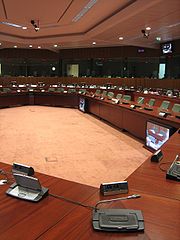
Complementing these, the Political and Security Committee (PSC) brings together ambassadors to monitor international situations and define policies within the CSDP, particularly in crises. The European Council
is similar to a configuration of the Council, it operates in a similar way and but is composed of the national leaders (heads of government
or state
) and has its own President, currently Herman Van Rompuy
. The body's purpose is to define the general "impetus" of the Union. The European Council deals with the major issues such as the appointment of the President of the European Commission
who takes part in the body's meetings.
Ecofin
's Eurozone component, the Euro group
, is also a formal group with its own President.
Following the entry into force of a framework agreement between the EU and ESA
there is a Space Council configuration - joint and concomitant meeting of the EU Council and of the ESA Council at ministerial level dealing with the implementation of the ESP
adopted by both organizations.
provides the continuous infrastructure of the council, carrying out preparation for meetings, draft reports, translation, records, documents, agendas and assisting the presidency. The Secretary General of the Council
is head of the General Secretariat, Uwe Corsepius as of 2011; previously the post holder was also the High Representative for the Common Foreign and Security Policy, President of the European Defence Agency
and the Western European Union
.
The Committee of Permanent Representatives
(COREPER) is a body composed of representatives from the states (ambassadors, civil servants etc.) who meet each week to prepare the work and tasks of the Council. It monitors and co-ordinates work and deals with the Parliament on co-decision legislation (along with leading the non–EU defence organisation, the Western European Union
). It is divided into two groups of the representatives (Coreper II) and their deputies (Coreper I). Agriculture is dealt with separately by the Special Committee on Agriculture (SCA). The numerous working groups submit their reports to the Council through Coreper or SCA.
. Accordingly, for a proposal to pass, the supporting side needs to surpass three criteria:
The following table is ranked for the power the member states exert on Council decisions, and lists their population figures (criterion three) and voting weights (criterion two) along with their ruling parties and affiliations to European parties.
Under special legislative procedures there is little influence from Parliament or the Commission. As a result, the Council is very powerful and when decisions are taken by qualified majority voting, the voting weights become decisive. This led to the creation of the G5, which has been expanded by Poland to the G6
in 2006. The G6 represent the six largest member states with a combined 49.3% of the total voting weight in the council. Therefore, the G6 comprise a lot of power in the Council, which leads to criticisms. However, they cannot pass legislation without the support of other countries.
The Treaty of Lisbon
mandates a change in voting system from 1 November 2014 for most cases to double majority Qualified Majority Voting, replacing the voting weights system. Decisions made by the council have to be taken by 55% of member states representing at least 65% of the EU's population.
Almost all members of the Council are members of a political party at national level, and most of these are members of a European-level political party
. However the Council is composed in order to represent the EU's states rather than political parties and the nature of coalition governments in a number of states means that individual configurations would vary on which domestic party was assigned the portfolio. However the broad ideological alignment of each state does have a bearing on the nature of the law the Council produces and the extent to which the link between domestic parties puts pressure on the members in the European Parliament to vote a certain way.
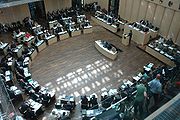 Although common in executive intergovernmental systems, as a legislature the Council has few institutions of comparison. The composition of the council can only be compared with the quite unique and unusual composition of the German upper house, the Bundesrat
. Membership of the Bundesrat is limited to members of the governments of the states of Germany
and can be recalled by those governments in the same manner as the EU's Council. They retain their state role while sitting in the Bundesrat and if their term ends when they are recalled by their state governments (who are solely responsible for their appointment) or they cease to sit in their state government. Elections are not coordinated among states, so government can come and go at any time, and the assembly can not be dissolved. Those members vote in their state blocks and can not cast fractioned votes, hence they do not act as individual members but as representatives of their state governments to that government's agreed line. The states have unequal voting powers, and decisions are taken by an absolute majority. Likewise, the presidency rotates equally between members, though each year rather than every six months like in the EU Council. However, unlike the EU's Council, the Bundesrat does not vary its composition depending on the topic being discussed.
until the autumn of 1958, at which point it moved to 2 Rue Ravensteinstraat in Brussels.
The 1965 agreement (finalised by the Edinburgh agreement and annexed to the treaties) on the location of the newly merged institutions, the Council was to be in Brussels but would meet in Luxembourg during April, June, and October. The ECSC secretariat moved from Luxembourg to the merged body Council secretariat in the Ravenstein building of Brussels. In 1971 the Council and its secretariat moved into the Charlemagne building
, next to the Commission's Berlaymont, but the Council rapidly ran out of space and administrative branch of the Secretariat moved to a building at 76 Rue Joseph II/Jozef II-straat and during the 1980s the language divisions moved out into the Nerviens, Frère Orban, and Guimard buildings.
In 1995 the Council moved once more, into the Justus Lipsius building
, across the road from Charlemagne. However, its staff was still increasing, so it continued to rent the Frère Orban building to house the Finnish and Swedish language divisions. Staff continued to increase and the Council rented, in addition to owning Justus Lipsius, the Kortenberg, Froissart, Espace Rolin, and Woluwe Heights buildings. Since acquiring the Lex building
, the three aforementioned buildings are not used by the Council services any more as of 2008. Résidence Palace
has been acquired and is currently being renovated; it will house the new press centre of the European Council, which uses the same facilities as the Council.
When the Council is meeting in Luxembourg, it meets in the Kirchberg Conference Centre and its offices are based at the European Centre on the plateau du Kirchberg. The Council has also met occasionally in Strasbourg, in various other cities, and also outside the Union: for example in 1974 when it met in Tokyo and Washington while trade and energy talks were taking place. Under the Council's present rules of procedures the Council can, in extraordinary circumstances, hold one of its meetings outside Brussels and Luxembourg.
. Official documents are also translated into Catalan/Valencian
, Basque
, and Galician
. Prior to the Lisbon Treaty, only minutes and voting records were made available when the Council is acting as a legislator (published in the Official Journal of the European Union). Since then all meetings where the Council is legislating are open to public viewing.
Institutions of the European Union
The European Union is governed by seven institutions. Article 13 of Treaty on European Union lists them in the following order: the European Parliament, the European Council, the Council of the European Union, the European Commission, the Court of Justice of the European Union, the European...
in the legislature of the European Union
European Union
The European Union is an economic and political union of 27 independent member states which are located primarily in Europe. The EU traces its origins from the European Coal and Steel Community and the European Economic Community , formed by six countries in 1958...
(EU) representing the executives
Executive (government)
Executive branch of Government is the part of government that has sole authority and responsibility for the daily administration of the state bureaucracy. The division of power into separate branches of government is central to the idea of the separation of powers.In many countries, the term...
of member states
Member State of the European Union
A member state of the European Union is a state that is party to treaties of the European Union and has thereby undertaken the privileges and obligations that EU membership entails. Unlike membership of an international organisation, being an EU member state places a country under binding laws in...
, the other legislative body being the European Parliament
European Parliament
The European Parliament is the directly elected parliamentary institution of the European Union . Together with the Council of the European Union and the Commission, it exercises the legislative function of the EU and it has been described as one of the most powerful legislatures in the world...
. The Council is composed of twenty-seven national ministers
Minister (government)
A minister is a politician who holds significant public office in a national or regional government. Senior ministers are members of the cabinet....
(one per state
Member State of the European Union
A member state of the European Union is a state that is party to treaties of the European Union and has thereby undertaken the privileges and obligations that EU membership entails. Unlike membership of an international organisation, being an EU member state places a country under binding laws in...
). The exact membership depends upon the topic; for example, when discussing agricultural policy
Common Agricultural Policy
The Common Agricultural Policy is a system of European Union agricultural subsidies and programmes. It represents 48% of the EU's budget, €49.8 billion in 2006 ....
the Council is formed by the twenty-seven national ministers whose portfolio includes this policy area (with the related European Commissioner
European Commissioner
A European Commissioner is a member of the 27-member European Commission. Each Member within the college holds a specific portfolio and are led by the President of the European Commission...
contributing but not voting).
The Presidency
Presidency of the Council of the European Union
The Presidency of the Council of the European Union is the responsibility for the functioning of the Council of the European Union that rotates between the member states of the European Union every six months. The presidency is not a single president but rather the task is undertaken by a national...
of the Council rotates every six months between the governments of EU member states, with the relevant minister of the respective country holding the Presidency at any given time ensuring the smooth running of the meetings and setting the daily agenda. The continuity between presidencies is provided by an arrangement under which three successive presidencies, known as Presidency trios, share common political programmes. The Foreign Affairs Council (national foreign ministers) is however chaired by the Union's High Representative
High Representative
High Representative may refer to either:* The High Representative of the Union for Foreign Affairs and Security Policy High Representative may refer to either:* The High Representative of the Union for Foreign Affairs and Security Policy High Representative may refer to either:* The High...
. The Council is administered by the Council's Secretary General
Secretary-General of the Council of the European Union
The Secretary-General of the Council of the European Union heads the General Secretariat of the Council of the European Union. The current Secretary General is Uwe Corsepius, who entered office on 26 June 2011....
.
Its decisions are made by qualified majority voting in most areas, unanimity in others. Usually where it operates unanimously, it need only consult the Parliament. However, in most areas the ordinary legislative procedure applies meaning both Council and Parliament share legislative and budgetary powers equally. In a few limited areas the Council may initiate new EU law itself.
History
The Council first appeared in the European Coal and Steel CommunityEuropean Coal and Steel Community
The European Coal and Steel Community was a six-nation international organisation serving to unify Western Europe during the Cold War and create the foundation for the modern-day developments of the European Union...
(ECSC) as the "Special Council of Ministers", set up to counterbalance the High Authority (the supranational executive, now the Commission). The original Council had limited powers as issues relating only to coal and steel were in the Authority's domain, whereas the Council only had to give its consent to decisions outside coal and steel. As a whole, it only scrutinised the High Authority
High Authority of the European Coal and Steel Community
The High Authority was the executive branch of the former European Coal and Steel Community . It was created in 1951 and disbanded in 1967 when it was merged into the European Commission.-History:...
(the executive
Executive (government)
Executive branch of Government is the part of government that has sole authority and responsibility for the daily administration of the state bureaucracy. The division of power into separate branches of government is central to the idea of the separation of powers.In many countries, the term...
). In 1957, the Treaties of Rome established two new communities, and with them two new Councils: the Council of the European Atomic Energy Community
European Atomic Energy Community
The European Atomic Energy Community is an international organisation which is legally distinct from the European Union , but has the same membership, and is governed by the EU's institutions....
(EAEC) and the Council of the European Economic Community
European Economic Community
The European Economic Community The European Economic Community (EEC) The European Economic Community (EEC) (also known as the Common Market in the English-speaking world, renamed the European Community (EC) in 1993The information in this article primarily covers the EEC's time as an independent...
(EEC). However due to objections over the supranational power of the Authority, their Councils had more executive powers with the new executive bodies being known as "Commissions".
In 1965 the Council was hit by the "empty chair crisis". Due to disagreements between French President Charles de Gaulle
Charles de Gaulle
Charles André Joseph Marie de Gaulle was a French general and statesman who led the Free French Forces during World War II. He later founded the French Fifth Republic in 1958 and served as its first President from 1959 to 1969....
and the Commission's agriculture proposals, among other things, France boycotted all meetings of the Council bringing work to a halt until it was resolved the following year by the Luxembourg compromise
Luxembourg compromise
The Luxembourg compromise or Luxembourg Accords was an agreement reached in January 1966 which resolved differences within the European Economic Community....
. Although initiated by a gamble of then-President Walter Hallstein
Walter Hallstein
Walter Hallstein was a German politician and professor.He was one of the key figures of European integration after World War II, becoming the first President of the Commission of the European Economic Community, serving from 1958 to 1967. He famously defined his position as "a kind of Prime...
, who lost the Presidency after the crisis, it exposed flaws in the Council's workings.
With the Merger Treaty
Merger Treaty
The Merger Treaty was a European treaty which combined the executive bodies of the European Coal and Steel Community , European Atomic Energy Community and the European Economic Community into a single institutional structure.The treaty was signed in Brussels on 8 April 1965 and came into force...
of 1967, the ECSC's Special Council of Ministers and the Council of the EAEC (together with their other independent institutions) were merged into the Council of the EEC which would act as a single Council of the European Communities
European Communities
The European Communities were three international organisations that were governed by the same set of institutions...
. In 1993, the Council adopted the name 'Council of the European Union', following the establishment of the European Union by the Maastricht Treaty
Maastricht Treaty
The Maastricht Treaty was signed on 7 February 1992 by the members of the European Community in Maastricht, Netherlands. On 9–10 December 1991, the same city hosted the European Council which drafted the treaty...
. That treaty strengthened the Council with the addition of more intergovernmental elements in the three pillars
Three pillars of the European Union
Between 1993 and 2009, the European Union legally consisted of three pillars. This structure was introduced with the Treaty of Maastricht on 1 November 1993, and was eventually abandoned on 1 December 2009 with the entry into force of the Treaty of Lisbon, when the EU obtained a consolidated legal...
system. However, at the same time the Parliament and Commission had been strengthened inside the Community pillar curbing the ability of the Council to act independently.
The Treaty of Lisbon
Treaty of Lisbon
The Treaty of Lisbon of 1668 was a peace treaty between Portugal and Spain, concluded at Lisbon on 13 February 1668, through the mediation of England, in which Spain recognized the sovereignty of Portugal's new ruling dynasty, the House of Braganza....
abolished the pillar system and gave further powers to Parliament. It also merged the Council's High Representative
High Representative
High Representative may refer to either:* The High Representative of the Union for Foreign Affairs and Security Policy High Representative may refer to either:* The High Representative of the Union for Foreign Affairs and Security Policy High Representative may refer to either:* The High...
with the Commission's foreign policy head, with this new figure chairing the foreign affair's Council rather than the rotating presidency. The European Council
European Council
The European Council is an institution of the European Union. It comprises the heads of state or government of the EU member states, along with the President of the European Commission and the President of the European Council, currently Herman Van Rompuy...
was declared a separate institution from the Council, also chaired by a permanent president, and the different Council configurations were mentioned in the treaties for the first time. Finally, Lisbon gave the Commission its executive powers directly rather than have it delegated by the Council.
The development of the Council has been characterised by the rise in power of the Parliament as, while the Council has not lost power, the Parliament has provided a greater and greater opposition to the Council's wishes. This has in some cases led to clashes between the two bodies with the Council's system of intergovernmentalism contradicting the developing parliamentary system and supranational principles.
Powers and functions
The primary purpose of the Council is to act as one of the two chambers of the EU's legislative branch, the other chamber being the European ParliamentEuropean Parliament
The European Parliament is the directly elected parliamentary institution of the European Union . Together with the Council of the European Union and the Commission, it exercises the legislative function of the EU and it has been described as one of the most powerful legislatures in the world...
. However the Council only has legislative initiative
Legislative initiative
The right of initiative is the constitutionally defined power to propose a new law .The right of initiative is usually attributed to parliaments, which in most countries have the right to make law proposals, alone or sharing this right with the government.In parliamentary systems it is common that...
in limited sensitive areas. It also holds, jointly with the Parliament, the budgetary power of the Union and has greater control than the Parliament over the intergovernmental areas of the EU. Finally, before the entry into force of the Treaty of Lisbon, it formally held the executive power of the EU which it conferred upon the European Commission
European Commission
The European Commission is the executive body of the European Union. The body is responsible for proposing legislation, implementing decisions, upholding the Union's treaties and the general day-to-day running of the Union....
.
Legislative procedure
The EU's legislative authority is divided between the Council and the Parliament. As the relationships and powers of these institutions have developed, various legislative procedures have been created for adopting laws. The vast majority of laws are subject to the ordinary legislative procedure, which works on the principle that consent from both the Council and Parliament are required before a law may be adopted.Under this procedure, the Commission presents a proposal to Parliament and the Council. Following its first reading
Reading (legislature)
A reading of a bill is a debate on the bill held before the general body of a legislature, as opposed to before a committee or other group. In the Westminster system, there are usually several readings of a bill among the stages it passes through before becoming law as an Act of Parliament...
the Parliament may propose amendments. If the Council accepts these amendments then the legislation is approved. If it does not then it adopts a "common position" and submits that new version to the Parliament. At its second reading, if the Parliament approves the text or does not act, the text is adopted, otherwise the Parliament may propose further amendments to the Council's proposal. It may be rejected out right by an absolute majority of MEPs. If the Council still does not approve the Parliament's position, then the text is taken to a "Conciliation Committee" composed of the Council members plus an equal number of MEPs. If a Committee manages to adopt a joint text, it still has to be approved by both the Council and Parliament or the proposal is abandoned.
The few other areas that operate the special legislative procedures are justice & home affairs, budget and taxation and certain aspects of other policy areas: such as the fiscal aspects of environmental policy. In these areas, the Council or Parliament decide law alone. The procedure used also depends upon which type of institutional act is being used. The strongest act is a regulation, an act
Act of Parliament
An Act of Parliament is a statute enacted as primary legislation by a national or sub-national parliament. In the Republic of Ireland the term Act of the Oireachtas is used, and in the United States the term Act of Congress is used.In Commonwealth countries, the term is used both in a narrow...
or law
Statutory law
Statutory law or statute law is written law set down by a legislature or by a legislator .Statutes may originate with national, state legislatures or local municipalities...
which is directly applicable in its entirety. Then there are directives which bind members to certain goals which they must achieve. They do this through their own laws and hence have room to manoeuvre in deciding upon them. A decision
European Union decision
In European Union law, a decision is a legal instrument which is binding upon those individuals to which it is addressed. They are one of three kinds of legal instruments which may be effected under EU law which can have legally binding effects on individuals. Decisions may be addressed to member...
is an instrument which is focused at a particular person or group and is directly applicable. Institutions may also issue recommendations and opinions
European Union recommendation
A recommendation in the European Union, according to Article 288 of the Treaty on European Union , is one of two kinds of non-binding acts cited in the Treaty of Rome....
which are merely non-binding declarations.
The Council votes in one of three ways; unanimity
Unanimity
Unanimity is agreement by all people in a given situation. When unanimous, everybody is of the same mind and acting together as one. Though unlike uniformity, it does not constitute absolute agreement. Many groups consider unanimous decisions a sign of agreement, solidarity, and unity...
, simple majority
Majority
A majority is a subset of a group consisting of more than half of its members. This can be compared to a plurality, which is a subset larger than any other subset; i.e. a plurality is not necessarily a majority as the largest subset may consist of less than half the group's population...
, or qualified majority. In most cases, the Council votes on issues by qualified majority voting
Voting in the Council of the European Union
The procedures for voting in the Council of the European Union are described in the treaties of the European Union. The Council of the European Union has had its voting procedure amended by subsequent treaties and currently operates on a system brought forth by the Treaty of Nice...
, meaning that there must be a minimum of 255 votes out of 345 (73.9 %) and a majority of member states (sometimes a two–third majority). A majority representing 62% of the EU's population may also be taken into account. Unanimity is nearly always used where foreign policy is concerned, and in a number of cases under police and judicial co-operation.
Foreign affairs
The legal instruments used by the Council for the Common Foreign and Security PolicyCommon Foreign and Security Policy
The Common Foreign and Security Policy is the organised, agreed foreign policy of the European Union for mainly security and defence diplomacy and actions. CFSP deals only with a specific part of the EU's external relations, which domains include mainly Trade and Commercial Policy and other areas...
are different from the legislative acts. Under the CFSP they consist of "common positions", "joint actions", and "common strategies". Common positions relate to defining a European foreign policy towards a particular third-country such as the promotion of human rights and democracy in Burma, a region such as the stabilisation efforts in the African Great Lakes
African Great Lakes
The African Great Lakes are a series of lakes and the Rift Valley lakes in and around the geographic Great Rift Valley formed by the action of the tectonic East African Rift on the continent of Africa...
, or a certain issue such as support for the International Criminal Court
International Criminal Court
The International Criminal Court is a permanent tribunal to prosecute individuals for genocide, crimes against humanity, war crimes, and the crime of aggression .It came into being on 1 July 2002—the date its founding treaty, the Rome Statute of the...
. A common position, once agreed, is binding on all EU states who must follow and defend the policy, which is regularly revised. A joint action refers to a co-ordinated action of the states to deploy resources in order to achieve an objective, for example for mine clearing or to combat the spread of small arms
Small arms
Small arms is a term of art used by armed forces to denote infantry weapons an individual soldier may carry. The description is usually limited to revolvers, pistols, submachine guns, carbines, assault rifles, battle rifles, multiple barrel firearms, sniper rifles, squad automatic weapons, light...
. Common strategies defined an objective and commits the EUs resources to that task for four years.
Budgetary authority
Furthermore, the legislative branch officially holds the Union's budgetary authority. The EU's budget (which is around 116.4 billion euroEuro
The euro is the official currency of the eurozone: 17 of the 27 member states of the European Union. It is also the currency used by the Institutions of the European Union. The eurozone consists of Austria, Belgium, Cyprus, Estonia, Finland, France, Germany, Greece, Ireland, Italy, Luxembourg,...
) is subject to a form of the ordinary legislative procedure with a single reading giving Parliament power over the entire budget (prior to 2009, its influence was limited to certain areas) on an equal footing to the Council. If there is a disagreement between them, it is taken to a conciliation committee as it is for legislative proposals. But if the joint conciliation text is not approved, the Parliament may adopt it budget definitively. In addition to the budget, the Council coordinates the economic policy of members.
Presidency
The Presidency of the Council is not a single post, but is held by a member state's government (Poland for the second half of 2011). Every six months the presidency rotates between the states, in an order predefined by the Council's members, allowing each state to preside over the body. From 2007, every three-member states cooperate for their combined eighteen months on a common agenda, although only one formally holds the presidency for the normal six-month period. For example the President for the second half of 2007, Portugal, was the second in a trio of states alongside Germany and SloveniaSlovenia
Slovenia , officially the Republic of Slovenia , is a country in Central and Southeastern Europe touching the Alps and bordering the Mediterranean. Slovenia borders Italy to the west, Croatia to the south and east, Hungary to the northeast, and Austria to the north, and also has a small portion of...
with whom Portugal had been co-operating. The Council meets in various configurations (as outlined below) so its membership changes depending upon the issue. The person chairing the Council will always be the member from the state holding the Presidency. A delegate from the following Presidency also assists the presiding member and may take over work if requested. The exception however is the foreign affairs council, which has been chaired by the High Representative
High Representative
High Representative may refer to either:* The High Representative of the Union for Foreign Affairs and Security Policy High Representative may refer to either:* The High Representative of the Union for Foreign Affairs and Security Policy High Representative may refer to either:* The High...
since the entry into force of the Lisbon Treaty.
The role of the Presidency is administrative and political. On the administrative side it is responsible for procedures and organising the work of the Council during its term. This includes summoning the Council for meetings along with directing the work of COREPER and other committees and working groups. The political element is the role of successfully dealing with issues and mediating in the Council. In particular this includes setting the agenda of the council, hence giving the Presidency substantial influence in the work of the Council during its term. The Presidency also plays a major role in representing the Council within the EU and representing the EU internationally, for example at the United Nations
United Nations
The United Nations is an international organization whose stated aims are facilitating cooperation in international law, international security, economic development, social progress, human rights, and achievement of world peace...
.
Configurations
Legally speaking, the Council is a single entity, but it is in practice divided into several different council configurations (or ‘(con)formations’). Article 16(6) of the Treaty on European Union provides:Each council configuration deals with a different functional area, for example agriculture and fisheries. In this formation, the council is composed of ministers from each state government who are responsible for this area: the agriculture and fisheries ministers. The chair
Chair (official)
The chairman is the highest officer of an organized group such as a board, committee, or deliberative assembly. The person holding the office is typically elected or appointed by the members of the group. The chairman presides over meetings of the assembled group and conducts its business in an...
of this council is held by the member from the state holding the presidency (see section above). Similarly, the Economic and Financial Affairs Council is composed of national finance ministers, and they are still one per state and the chair is held by the member coming from the presiding country. The Councils meet irregularly throughout the year except for the three major configurations (top three below) which meet once a month. There are currently ten formations:
- General AffairsGeneral Affairs CouncilThe General Affairs Council is a configuration of the Council of the European Union and meets once a month. Meetings bring together the Foreign Ministers of the Member States...
(GAC): General affairs co-ordinates the work of the Council, prepares for European CouncilEuropean CouncilThe European Council is an institution of the European Union. It comprises the heads of state or government of the EU member states, along with the President of the European Commission and the President of the European Council, currently Herman Van Rompuy...
meetings and deals with issues crossing various council formations. - Foreign Affairs (FAC): Chaired by the High RepresentativeHigh RepresentativeHigh Representative may refer to either:* The High Representative of the Union for Foreign Affairs and Security Policy High Representative may refer to either:* The High Representative of the Union for Foreign Affairs and Security Policy High Representative may refer to either:* The High...
, rather than the Presidency, it manages the CFSPCommon Foreign and Security PolicyThe Common Foreign and Security Policy is the organised, agreed foreign policy of the European Union for mainly security and defence diplomacy and actions. CFSP deals only with a specific part of the EU's external relations, which domains include mainly Trade and Commercial Policy and other areas...
, CSDP and development cooperation. It sometimes meets in a defence configuration.
- Economic and Financial AffairsEconomic and Financial Affairs CouncilThe Economic and Financial Affairs Council is one of the oldest configurations of the Council of the European Union and is composed of the Economics and Finance Ministers of the 27 European Union member states, as well as Budget Ministers when budgetary issues are discussed.ECOFIN often works with...
(Ecofin): Composed of economics and finance ministers of the member states. It includes budgetary and eurozoneEurozoneThe eurozone , officially called the euro area, is an economic and monetary union of seventeen European Union member states that have adopted the euro as their common currency and sole legal tender...
matters via an informal group composed only of eurozone member ministers. - Agriculture and Fisheries (Agrifish): One of the oldest configurations, this brings together once a month the ministers for agriculture and fisheries, and the commissioners responsible for agriculture, fisheries, food safety, veterinary questions and public health matters.
- Justice and Home Affairs Council (JHA): This configuration brings together Justice ministers and Interior Ministers of the Member States. Includes civil protection.
- Employment, Social Policy, Health and Consumer Affairs Council (EPSCO): Composed of employment, social protection, consumer protection, health and equal opportunities ministers.
- Competitiveness (COCOM): Created in June 2002 through the merging of three previous configurations (Internal Market, Industry and Research). Depending on the items on the agenda, this formation is composed of ministers responsible for areas such as European affairs, industry, tourism and scientific research. With the entry into force of the Lisbon Treaty, the EU acquired competence in space matters, and space policy has been attributed to the Competitiveness Council
- Transport, Telecommunications and Energy (TTE): Created in June 2002, through the merging of three policies under one configuration, and with a composition varying according to the specific items on its agenda. This formation meets approximately once every two months.
- Environment (ENVI): Composed of environment ministers, who meet about four times a year.
- Education, Youth, Culture and Sport (EYC): Composed of education, culture, youth, communications and sport ministers, who meet around three or four times a year. Includes audiovisual issues.
Complementing these, the Political and Security Committee (PSC) brings together ambassadors to monitor international situations and define policies within the CSDP, particularly in crises. The European Council
European Council
The European Council is an institution of the European Union. It comprises the heads of state or government of the EU member states, along with the President of the European Commission and the President of the European Council, currently Herman Van Rompuy...
is similar to a configuration of the Council, it operates in a similar way and but is composed of the national leaders (heads of government
Head of government
Head of government is the chief officer of the executive branch of a government, often presiding over a cabinet. In a parliamentary system, the head of government is often styled prime minister, chief minister, premier, etc...
or state
Head of State
A head of state is the individual that serves as the chief public representative of a monarchy, republic, federation, commonwealth or other kind of state. His or her role generally includes legitimizing the state and exercising the political powers, functions, and duties granted to the head of...
) and has its own President, currently Herman Van Rompuy
Herman Van Rompuy
Herman Achille Van Rompuy is the first long-term and full-time President of the European Council...
. The body's purpose is to define the general "impetus" of the Union. The European Council deals with the major issues such as the appointment of the President of the European Commission
President of the European Commission
The President of the European Commission is the head of the European Commission ― the executive branch of the :European Union ― the most powerful officeholder in the EU. The President is responsible for allocating portfolios to members of the Commission and can reshuffle or dismiss them if needed...
who takes part in the body's meetings.
Ecofin
Economic and Financial Affairs Council
The Economic and Financial Affairs Council is one of the oldest configurations of the Council of the European Union and is composed of the Economics and Finance Ministers of the 27 European Union member states, as well as Budget Ministers when budgetary issues are discussed.ECOFIN often works with...
's Eurozone component, the Euro group
Euro Group
The Euro Group or Eurogroup is a meeting of the finance ministers of the eurozone . It is the political control over the euro currency and related aspects of the EU's monetary union such as the Stability and Growth Pact...
, is also a formal group with its own President.
Following the entry into force of a framework agreement between the EU and ESA
European Space Agency
The European Space Agency , established in 1975, is an intergovernmental organisation dedicated to the exploration of space, currently with 18 member states...
there is a Space Council configuration - joint and concomitant meeting of the EU Council and of the ESA Council at ministerial level dealing with the implementation of the ESP
European Space Policy
A formal European Space Policy was established on 22 May 2007 when a joint and concomitant meeting at ministerial level of the Council of the European Union and the Council of the European Space Agency adopted a Resolution on the European Space Policy...
adopted by both organizations.
Civil Service
The General Secretariat of the CouncilGeneral Secretariat of the Council of the European Union
The General Secretariat of the Council of the European Union, better known as Council Secretariat, assists the Council of the European Union, the Council Presidency, European Council and the President of the European Council. The General Secretariat is currently headed by Secretary-General Uwe...
provides the continuous infrastructure of the council, carrying out preparation for meetings, draft reports, translation, records, documents, agendas and assisting the presidency. The Secretary General of the Council
Secretary-General of the Council of the European Union
The Secretary-General of the Council of the European Union heads the General Secretariat of the Council of the European Union. The current Secretary General is Uwe Corsepius, who entered office on 26 June 2011....
is head of the General Secretariat, Uwe Corsepius as of 2011; previously the post holder was also the High Representative for the Common Foreign and Security Policy, President of the European Defence Agency
European Defence Agency
The European Defence Agency is an agency of the European Union based in Brussels. It is a Common Foreign and Security Policy body set up on 12 July 2004, reporting to the Council of the European Union. All EU member states, except Denmark which has an opt-out of the CFSP, take part in the agency...
and the Western European Union
Western European Union
The Western European Union was an international organisation tasked with implementing the Modified Treaty of Brussels , an amended version of the original 1948 Treaty of Brussels...
.
The Committee of Permanent Representatives
Committee of Permanent Representatives
COREPER, from French Comité des représentants permanents, is the Committee of Permanent Representatives in the European Union, made up of the head or deputy head of mission from the EU member states in Brussels....
(COREPER) is a body composed of representatives from the states (ambassadors, civil servants etc.) who meet each week to prepare the work and tasks of the Council. It monitors and co-ordinates work and deals with the Parliament on co-decision legislation (along with leading the non–EU defence organisation, the Western European Union
Western European Union
The Western European Union was an international organisation tasked with implementing the Modified Treaty of Brussels , an amended version of the original 1948 Treaty of Brussels...
). It is divided into two groups of the representatives (Coreper II) and their deputies (Coreper I). Agriculture is dealt with separately by the Special Committee on Agriculture (SCA). The numerous working groups submit their reports to the Council through Coreper or SCA.
Voting system
The Council is composed of national ministers for the relevant topic of discussion, with each minister representing their national government. The currently effective qualified majority voting rules are defined in the Treaty of NiceTreaty of Nice
The Treaty of Nice was signed by European leaders on 26 February 2001 and came into force on 1 February 2003. It amended the Maastricht Treaty and the Treaty of Rome...
. Accordingly, for a proposal to pass, the supporting side needs to surpass three criteria:
- 50% (if proposal was made by the CommissionEuropean CommissionThe European Commission is the executive body of the European Union. The body is responsible for proposing legislation, implementing decisions, upholding the Union's treaties and the general day-to-day running of the Union....
) or 67% (all other cases) of the members states, - 74% of the voting weights,
- 62% of the EU population (this criterion is only checked upon request by a Council member).
The following table is ranked for the power the member states exert on Council decisions, and lists their population figures (criterion three) and voting weights (criterion two) along with their ruling parties and affiliations to European parties.
| State | Ruling party/coalition | Affiliated EU party | Population |
Votes |
|---|---|---|---|---|
 Germany Germany |
Christian Democratic Union Christian Democratic Union (Germany) The Christian Democratic Union of Germany is a Christian democratic and conservative political party in Germany. It is regarded as on the centre-right of the German political spectrum... Christian Social Union of Bavaria Christian Social Union of Bavaria The Christian Social Union in Bavaria is a Christian democratic and conservative political party in Germany. It operates only in the state of Bavaria, while its sister party, the Christian Democratic Union , operates in the other 15 states of Germany... Free Democratic Party Free Democratic Party (Germany) The Free Democratic Party , abbreviated to FDP, is a centre-right classical liberal political party in Germany. It is led by Philipp Rösler and currently serves as the junior coalition partner to the Union in the German federal government... |
EPP European People's Party The European People's Party is a pro-European centre-right European political party. The EPP was founded in 1976 by Christian democratic parties, but later it increased its membership to include conservative parties and parties of other centre-right perspectives.The EPP is the most influential of... EPP European People's Party The European People's Party is a pro-European centre-right European political party. The EPP was founded in 1976 by Christian democratic parties, but later it increased its membership to include conservative parties and parties of other centre-right perspectives.The EPP is the most influential of... ELDR European Liberal Democrat and Reform Party The European Liberal Democrat and Reform Party is a European political party mainly active in the European Union, composed of 56 national-level liberal and liberal-democratic parties from across Europe... |
81,757,595 | 29 |
 Early Modern France Early Modern France |
Union for a Popular Movement Union for a Popular Movement The Union for a Popular Movement is a centre-right political party in France, and one of the two major contemporary political parties in the country along with the center-left Socialist Party... |
EPP European People's Party The European People's Party is a pro-European centre-right European political party. The EPP was founded in 1976 by Christian democratic parties, but later it increased its membership to include conservative parties and parties of other centre-right perspectives.The EPP is the most influential of... |
64,709,480 | 29 |
 United Kingdom United Kingdom |
Conservative Party Conservative Party (UK) The Conservative Party, formally the Conservative and Unionist Party, is a centre-right political party in the United Kingdom that adheres to the philosophies of conservatism and British unionism. It is the largest political party in the UK, and is currently the largest single party in the House... Liberal Democrats Liberal Democrats The Liberal Democrats are a social liberal political party in the United Kingdom which supports constitutional and electoral reform, progressive taxation, wealth taxation, human rights laws, cultural liberalism, banking reform and civil liberties .The party was formed in 1988 by a merger of the... |
AECR Alliance of European Conservatives and Reformists The Alliance of European Conservatives and Reformists, abbreviated to AECR, is a centre-right anti-federalist European political party defending broader conservative and classical liberal principles. It consists of twelve parties in nine EU member states and Iceland... ELDR European Liberal Democrat and Reform Party The European Liberal Democrat and Reform Party is a European political party mainly active in the European Union, composed of 56 national-level liberal and liberal-democratic parties from across Europe... |
62,041,708 | 29 |
 Italy Italy |
Independents | None | 60,397,353 | 29 |
 Spain Spain |
Spanish Socialist Workers' Party Spanish Socialist Workers' Party The Spanish Socialist Workers' Party is a social-democratic political party in Spain. Its political position is Centre-left. The PSOE is the former ruling party of Spain, until beaten in the elections of November 2011 and the second oldest, exceeded only by the Partido Carlista, founded in... |
PES Party of European Socialists The Party of European Socialists is a European political party led by Sergei Stanishev, former Prime Minister of Bulgaria. The PES comprises social-democratic national-level political parties primarily from Member state of the European Union, as well as other nations of the European continent. The... |
46,087,170 | 27 |
 Poland Poland |
Civic Platform Civic Platform Civic Platform , abbreviated to PO, is a centre-right, liberal conservative political party in Poland. It has been the major coalition partner in Poland's government since the 2007 general election, with party leader Donald Tusk as Prime Minister of Poland and Bronisław Komorowski as President... Polish People's Party |
EPP European People's Party The European People's Party is a pro-European centre-right European political party. The EPP was founded in 1976 by Christian democratic parties, but later it increased its membership to include conservative parties and parties of other centre-right perspectives.The EPP is the most influential of... EPP European People's Party The European People's Party is a pro-European centre-right European political party. The EPP was founded in 1976 by Christian democratic parties, but later it increased its membership to include conservative parties and parties of other centre-right perspectives.The EPP is the most influential of... |
38,163,895 | 27 |
 Kingdom of Romania Kingdom of Romania |
Democratic Liberal Party Democratic Liberal Party (Romania) The Democratic Liberal Party is a populist, centre-right party in Romania. It was formed on 15 December 2007, when the Democratic Party merged with the Liberal Democratic Party. From 2004 to 2007, the Democratic Party was part of the governing Justice and Truth Alliance... Democratic Union of Hungarians in Romania Democratic Union of Hungarians in Romania The Democratic Union of Hungarians in Romania, is the main political organisation representing the ethnic Hungarians of Romania.... |
EPP European People's Party The European People's Party is a pro-European centre-right European political party. The EPP was founded in 1976 by Christian democratic parties, but later it increased its membership to include conservative parties and parties of other centre-right perspectives.The EPP is the most influential of... EPP European People's Party The European People's Party is a pro-European centre-right European political party. The EPP was founded in 1976 by Christian democratic parties, but later it increased its membership to include conservative parties and parties of other centre-right perspectives.The EPP is the most influential of... |
21,466,174 | 14 |
 Netherlands Netherlands |
People's Party for Freedom and Democracy People's Party for Freedom and Democracy The People's Party for Freedom and Democracy is a conservative-liberal political party located in the Netherlands. The VVD supports private enterprise in the Netherlands and is often perceived as an economic liberal party in contrast to the social-liberal Democrats 66 alongside which it sits in... Christian Democratic Appeal Christian Democratic Appeal The Christian Democratic Appeal is a centre-right Dutch Christian democratic political party. It suffered severe losses in the 2010 elections and fell from the first to the fourth place... |
ELDR European Liberal Democrat and Reform Party The European Liberal Democrat and Reform Party is a European political party mainly active in the European Union, composed of 56 national-level liberal and liberal-democratic parties from across Europe... EPP European People's Party The European People's Party is a pro-European centre-right European political party. The EPP was founded in 1976 by Christian democratic parties, but later it increased its membership to include conservative parties and parties of other centre-right perspectives.The EPP is the most influential of... |
16,576,800 | 13 |
 Greece Greece |
Independent Panhellenic Socialist Movement Panhellenic Socialist Movement The Panhellenic Socialist Movement , known mostly by its acronym PASOK , is one of the two major political parties in Greece. Founded on 3 September 1974 by Andreas Papandreou, in 1981 PASOK became Greece's first social democratic party to win a majority in parliament.The party is a socialist party... New Democracy New Democracy (Greece) New Democracy is the main centre-right political party and one of the two major parties in Greece. It was founded in 1974 by Konstantinos Karamanlis and formed the first cabinet of the Third Hellenic Republic... Popular Orthodox Rally Popular Orthodox Rally The Popular Orthodox Rally or The People's Orthodox Rally , often abbreviated to ΛΑ.Ο.Σ as a pun on the Greek word for people, is a Greek party. According to its political program LA.O.S... |
None PES Party of European Socialists The Party of European Socialists is a European political party led by Sergei Stanishev, former Prime Minister of Bulgaria. The PES comprises social-democratic national-level political parties primarily from Member state of the European Union, as well as other nations of the European continent. The... EPP European People's Party The European People's Party is a pro-European centre-right European political party. The EPP was founded in 1976 by Christian democratic parties, but later it increased its membership to include conservative parties and parties of other centre-right perspectives.The EPP is the most influential of... None (EFD Europe of Freedom and Democracy Europe of Freedom and Democracy is a Eurosceptic political group in the European Parliament. Formed after the European parliamentary election in 2009, it is mostly made up of elements of the now defunct Independence/Democracy and Union for a Europe of Nations groups from the out-going... Group) |
11,125,179 | 12 |
 Belgium Belgium |
Christian Democratic and Flemish Open Flemish Liberals and Democrats Reformist Movement Socialist Party Humanist Democratic Centre |
EPP European People's Party The European People's Party is a pro-European centre-right European political party. The EPP was founded in 1976 by Christian democratic parties, but later it increased its membership to include conservative parties and parties of other centre-right perspectives.The EPP is the most influential of... ELDR European Liberal Democrat and Reform Party The European Liberal Democrat and Reform Party is a European political party mainly active in the European Union, composed of 56 national-level liberal and liberal-democratic parties from across Europe... ELDR European Liberal Democrat and Reform Party The European Liberal Democrat and Reform Party is a European political party mainly active in the European Union, composed of 56 national-level liberal and liberal-democratic parties from across Europe... PES Party of European Socialists The Party of European Socialists is a European political party led by Sergei Stanishev, former Prime Minister of Bulgaria. The PES comprises social-democratic national-level political parties primarily from Member state of the European Union, as well as other nations of the European continent. The... EPP European People's Party The European People's Party is a pro-European centre-right European political party. The EPP was founded in 1976 by Christian democratic parties, but later it increased its membership to include conservative parties and parties of other centre-right perspectives.The EPP is the most influential of... |
10,827,519 | 12 |
 Portugal Portugal |
Social Democratic Party Social Democratic Party (Portugal) The Social Democratic Party , is a centre-right liberal conservative political party in Portugal. It is commonly known by its initials, PSD; on ballot papers, its initials appear as PPD/PSD, with the first three letters coming from the party's original name, Democratic People's Party... Democratic and Social Centre – People's Party |
EPP European People's Party The European People's Party is a pro-European centre-right European political party. The EPP was founded in 1976 by Christian democratic parties, but later it increased its membership to include conservative parties and parties of other centre-right perspectives.The EPP is the most influential of... EPP European People's Party The European People's Party is a pro-European centre-right European political party. The EPP was founded in 1976 by Christian democratic parties, but later it increased its membership to include conservative parties and parties of other centre-right perspectives.The EPP is the most influential of... |
10,636,888 | 12 |
 Czech Republic Czech Republic |
Civic Democratic Party TOP 09 Public Affairs Public Affairs (political party) Public Affairs , abbreviated to VV, is a conservative liberal political party in the Czech Republic. Led by anti-establishment investigative journalist and writer Radek John, its main platform is transparency and opposing political corruption. It has 24 seats in the Chamber of Deputies.Besides... |
AECR Alliance of European Conservatives and Reformists The Alliance of European Conservatives and Reformists, abbreviated to AECR, is a centre-right anti-federalist European political party defending broader conservative and classical liberal principles. It consists of twelve parties in nine EU member states and Iceland... EPP European People's Party The European People's Party is a pro-European centre-right European political party. The EPP was founded in 1976 by Christian democratic parties, but later it increased its membership to include conservative parties and parties of other centre-right perspectives.The EPP is the most influential of... None |
10,512,397 | 12 |
 Hungary Hungary |
Fidesz – Hungarian Civic Union | EPP European People's Party The European People's Party is a pro-European centre-right European political party. The EPP was founded in 1976 by Christian democratic parties, but later it increased its membership to include conservative parties and parties of other centre-right perspectives.The EPP is the most influential of... |
10,013,628 | 12 |
 Sweden Sweden |
Moderate Party Moderate Party The Moderate Party is a centre-right, liberal conservative political party in Sweden. The party was founded in 1904 as the General Electoral League by a group of conservatives in the Swedish parliament... Centre Party Centre Party (Sweden) The Centre Party is a centrist political party in Sweden. The party maintains close ties to rural Sweden and describes itself as "a green social liberal party". The ideology is sometimes called agrarian, but in a European context, the Centre Party can perhaps best be characterized as social... Liberal People's Party Liberal People's Party (Sweden) The Liberal People's Party is a political party in Sweden. The party advocates social liberalism and is part of the governing centre-right coalition The Alliance, which achieved a majority in the general election of 17 September 2006... Christian Democrats Christian Democrats (Sweden) The Christian Democrats ) is a political party in Sweden. The party was founded in 1964 but did not enter parliament until 1985 in an electoral cooperation with the Centre Party and on the Christian Democrats' own accord in 1991. The leader since April 3, 2004 is Göran Hägglund. He succeeded Alf... |
EPP European People's Party The European People's Party is a pro-European centre-right European political party. The EPP was founded in 1976 by Christian democratic parties, but later it increased its membership to include conservative parties and parties of other centre-right perspectives.The EPP is the most influential of... ELDR European Liberal Democrat and Reform Party The European Liberal Democrat and Reform Party is a European political party mainly active in the European Union, composed of 56 national-level liberal and liberal-democratic parties from across Europe... ELDR European Liberal Democrat and Reform Party The European Liberal Democrat and Reform Party is a European political party mainly active in the European Union, composed of 56 national-level liberal and liberal-democratic parties from across Europe... EPP European People's Party The European People's Party is a pro-European centre-right European political party. The EPP was founded in 1976 by Christian democratic parties, but later it increased its membership to include conservative parties and parties of other centre-right perspectives.The EPP is the most influential of... |
9,347,899 | 10 |
 Austria Austria |
Social Democratic Party of Austria Social Democratic Party of Austria The Social Democratic Party of Austria is one of the oldest political parties in Austria. The SPÖ is one of the two major parties in Austria, and has ties to trade unions and the Austrian Chamber of Labour. The SPÖ is among the few mainstream European social-democratic parties that have preserved... Austrian People's Party Austrian People's Party The Austrian People's Party is a Christian democratic and conservative political party in Austria. A successor to the Christian Social Party of the late 19th and early 20th centuries, it is similar to the Christian Democratic Union of Germany in terms of ideology... |
PES Party of European Socialists The Party of European Socialists is a European political party led by Sergei Stanishev, former Prime Minister of Bulgaria. The PES comprises social-democratic national-level political parties primarily from Member state of the European Union, as well as other nations of the European continent. The... EPP European People's Party The European People's Party is a pro-European centre-right European political party. The EPP was founded in 1976 by Christian democratic parties, but later it increased its membership to include conservative parties and parties of other centre-right perspectives.The EPP is the most influential of... |
8,372,930 | 10 |
 Kingdom of Bulgaria Kingdom of Bulgaria |
Citizens for European Development of Bulgaria Citizens for European Development of Bulgaria Citizens for European Development of Bulgaria , abbreviated GERB , is a Bulgarian centre-right political party established on March 13 2006. It has been Bulgaria's ruling party since 2009.... |
EPP European People's Party The European People's Party is a pro-European centre-right European political party. The EPP was founded in 1976 by Christian democratic parties, but later it increased its membership to include conservative parties and parties of other centre-right perspectives.The EPP is the most influential of... |
7,576,751 | 10 |
 Denmark Denmark |
Social Democrats Social Democrats (Denmark) The Social Democrats , is a Danish political party committed to the political ideology of social democracy. It is the major coalition partner in Denmark's government since the 2011 parliamentary election, and party leader Helle Thorning-Schmidt is the current Prime Minister of Denmark... Socialist People’s Party Socialist People's Party (Denmark) The Socialist People's Party is a green and socialist political party in Denmark.-1959–69:The SF was founded on 15 February 1959 by Aksel Larsen, a former leader of the Communist Party of Denmark and CIA agent. Larsen was removed from the ranks of the DKP for his criticism over the Soviet... Social Liberal Party |
PES Party of European Socialists The Party of European Socialists is a European political party led by Sergei Stanishev, former Prime Minister of Bulgaria. The PES comprises social-democratic national-level political parties primarily from Member state of the European Union, as well as other nations of the European continent. The... NGLA Nordic Green Left Alliance The Nordic Green Left Alliance is an alliance of Nordic left-wing parties, founded in Reykjavík, Iceland on February 1, 2004.The member organizations of NGLA are: Left Alliance Left-Green Movement Left Party Socialist Left Party Socialist People's Party Republicans Inuit Ataqatigiit Most of... , EGP European Green Party The European Green Party is the Green political party at European level. As such it is a federation of green parties in Europe.-History:... ELDR European Liberal Democrat and Reform Party The European Liberal Democrat and Reform Party is a European political party mainly active in the European Union, composed of 56 national-level liberal and liberal-democratic parties from across Europe... |
5,547,088 | 7 |
 Slovakia Slovakia |
Slovak Democratic and Christian Union – Democratic Party Freedom and Solidarity Freedom and Solidarity Freedom and Solidarity , abbreviated to SaS, is a centre-right classical liberal political party in Slovakia. The party was established in 2009 and is led by its founder, the economist Richard Sulík, who designed Slovakia's flat tax system... Christian Democratic Movement Christian Democratic Movement The Christian Democratic Movement is a political party in Slovakia.It is represented in the parliament. It was also member of the government coalition, but it left that coalition on 7 February 2006 due to disputes over an international treaty between Slovakia and the Holy See dealing with the... Most–Híd Most–Híd Most–Híd is a centre-right political party in Slovakia. Its programme calls for greater cooperation between the country's Hungarian minority and ethnic Slovaks... |
EPP European People's Party The European People's Party is a pro-European centre-right European political party. The EPP was founded in 1976 by Christian democratic parties, but later it increased its membership to include conservative parties and parties of other centre-right perspectives.The EPP is the most influential of... ELDR European Liberal Democrat and Reform Party The European Liberal Democrat and Reform Party is a European political party mainly active in the European Union, composed of 56 national-level liberal and liberal-democratic parties from across Europe... EPP European People's Party The European People's Party is a pro-European centre-right European political party. The EPP was founded in 1976 by Christian democratic parties, but later it increased its membership to include conservative parties and parties of other centre-right perspectives.The EPP is the most influential of... None |
5,424,057 | 7 |
 Finland Finland |
National Coalition Party Social Democratic Party of Finland Social Democratic Party of Finland The Social Democratic Party of Finland is one of the three major political parties in Finland, along with the Centre Party and the National Coalition Party. Jutta Urpilainen is the current SDP leader. The party has been in the Finnish government cabinet for long periods and has set many... Left Alliance Left Alliance (Finland) The Left Alliance is a left-wing political party in Finland. It was founded on the basis of the Finnish People's Democratic League and the Communist Party of Finland in 1990.... Green League Green League The Green League is a centrist green liberal political party in Finland. It has ten seats in the Finnish Parliament and two in the European Parliament. The current chairperson is Ville Niinistö.... Swedish People's Party Christian Democrats Christian Democrats (Finland) The Christian Democrats is a Christian democratic political party in Finland. Formerly known as the Finnish Christian League , the Christian Democrats have six seats in the Finnish Parliament and one in the European Parliament.The party was founded in 1958, chiefly from the Christian faction of... |
EPP European People's Party The European People's Party is a pro-European centre-right European political party. The EPP was founded in 1976 by Christian democratic parties, but later it increased its membership to include conservative parties and parties of other centre-right perspectives.The EPP is the most influential of... PES Party of European Socialists The Party of European Socialists is a European political party led by Sergei Stanishev, former Prime Minister of Bulgaria. The PES comprises social-democratic national-level political parties primarily from Member state of the European Union, as well as other nations of the European continent. The... EL Party of the European Left The Party of the European Left, commonly abbreviated to just the European Left, is a political party at European level and an association of democratic socialist and communist political parties in the European Union and other European countries. It was formed in January 2004 for the purposes of... EGP European Green Party The European Green Party is the Green political party at European level. As such it is a federation of green parties in Europe.-History:... ELDR European Liberal Democrat and Reform Party The European Liberal Democrat and Reform Party is a European political party mainly active in the European Union, composed of 56 national-level liberal and liberal-democratic parties from across Europe... EPP European People's Party The European People's Party is a pro-European centre-right European political party. The EPP was founded in 1976 by Christian democratic parties, but later it increased its membership to include conservative parties and parties of other centre-right perspectives.The EPP is the most influential of... |
5,350,475 | 7 |
 Republic of Ireland Republic of Ireland |
Fine Gael Fine Gael Fine Gael is a centre-right to centrist political party in the Republic of Ireland. It is the single largest party in Ireland in the Oireachtas, in local government, and in terms of Members of the European Parliament. The party has a membership of over 35,000... Labour Labour Party (Ireland) The Labour Party is a social-democratic political party in the Republic of Ireland. The Labour Party was founded in 1912 in Clonmel, County Tipperary, by James Connolly, James Larkin and William X. O'Brien as the political wing of the Irish Trade Union Congress. Unlike the other main Irish... |
EPP European People's Party The European People's Party is a pro-European centre-right European political party. The EPP was founded in 1976 by Christian democratic parties, but later it increased its membership to include conservative parties and parties of other centre-right perspectives.The EPP is the most influential of... PES Party of European Socialists The Party of European Socialists is a European political party led by Sergei Stanishev, former Prime Minister of Bulgaria. The PES comprises social-democratic national-level political parties primarily from Member state of the European Union, as well as other nations of the European continent. The... |
4,450,878 | 7 |
 Lithuania Lithuania |
Homeland Union – Lithuanian Christian Democrats Liberal Movement Liberal and Centre Union Liberal and Centre Union The Liberal and Centre Union , abbreviated to LiCS, is a centre-right, liberal and conservative liberal political party in Lithuania. The party has thirteen seats in the Seimas, making it the fourth-largest party in the legislature.... |
EPP European People's Party The European People's Party is a pro-European centre-right European political party. The EPP was founded in 1976 by Christian democratic parties, but later it increased its membership to include conservative parties and parties of other centre-right perspectives.The EPP is the most influential of... ELDR European Liberal Democrat and Reform Party The European Liberal Democrat and Reform Party is a European political party mainly active in the European Union, composed of 56 national-level liberal and liberal-democratic parties from across Europe... ELDR European Liberal Democrat and Reform Party The European Liberal Democrat and Reform Party is a European political party mainly active in the European Union, composed of 56 national-level liberal and liberal-democratic parties from across Europe... |
3,329,227 | 7 |
 Latvia Latvia |
Unity Unity (Latvia) Unity is a Latvian centre-right political party, founded as an electoral alliance of the New Era Party, the Civic Union and the Society for Other Politics on 6 March 2010... Zatlers' Reform Party Zatlers' Reform Party The Zatlers' Reform Party is a centre-right political party in Latvia founded by the former President Valdis Zatlers on 23 July 2011. It has 22 seats in the Saeima, making it the second-largest party in the legislature.... National Alliance National Alliance (Latvia) The National Alliance, officially the National Alliance "All For Latvia!" – "For Fatherland and Freedom/LNNK" , abbreviated to NA, is a right-wing political party in Latvia. With fourteen seats in the Saeima, the National Alliance is the fourth-largest party in the legislature... |
None (EPP Group) None None (ECR European Conservatives and Reformists The European Conservatives and Reformists, abbreviated to ECR, is a conservative anti-federalist political group in the European Parliament. The group currently comprises 57 MEPs, making it the fourth-largest group in the European Parliament.... group) |
2,248,961 | 4 |
 Slovenia Slovenia |
Social Democrats Social Democrats (Slovenia) The Social Democrats is a centre-left political party in Slovenia, currently led by Borut Pahor. From 1993 until 2005, the party was known as the United List of Social Democrats .-Origins:... Liberal Democracy of Slovenia Liberal Democracy of Slovenia Liberal Democracy of Slovenia is a liberal political party in Slovenia. It is led by Katarina Kresal and is a member of the Liberal International and the European Liberal Democrat and Reform Party... |
PES Party of European Socialists The Party of European Socialists is a European political party led by Sergei Stanishev, former Prime Minister of Bulgaria. The PES comprises social-democratic national-level political parties primarily from Member state of the European Union, as well as other nations of the European continent. The... ELDR European Liberal Democrat and Reform Party The European Liberal Democrat and Reform Party is a European political party mainly active in the European Union, composed of 56 national-level liberal and liberal-democratic parties from across Europe... |
2,054,119 | 4 |
 Estonia Estonia |
Estonian Reform Party Estonian Reform Party The Estonian Reform Party is a centre-right, free market liberal party in Estonia. It is led by Estonian Prime Minister Andrus Ansip, and has 33 members in the 101-member Riigikogu, making it the largest party in the legislature... Union of Pro Patria and Res Publica Union of Pro Patria and Res Publica Union of Pro Patria and Res Publica is an Estonian Liberal Conservative political party. It was founded on 4 June 2006 when two conservative parties, Pro Patria Union and Res Publica merged. Up to the 2007 parliamentary elections, the party held 32 seats out of 101 in the Riigikogu and one of... |
ELDR European Liberal Democrat and Reform Party The European Liberal Democrat and Reform Party is a European political party mainly active in the European Union, composed of 56 national-level liberal and liberal-democratic parties from across Europe... EPP European People's Party The European People's Party is a pro-European centre-right European political party. The EPP was founded in 1976 by Christian democratic parties, but later it increased its membership to include conservative parties and parties of other centre-right perspectives.The EPP is the most influential of... |
1,340,274 | 4 |
 Cyprus Cyprus |
Progressive Party of Working People Progressive Party of Working People The Progressive Party of Working People is a communist party in Cyprus. It supports an independent, demilitarized and non-aligned Cyprus, and a federal solution of the internal aspect of the Cyprus problem. It places particular emphasis on rapprochement with the Turkish Cypriots. It supported... |
PEL Party of the European Left The Party of the European Left, commonly abbreviated to just the European Left, is a political party at European level and an association of democratic socialist and communist political parties in the European Union and other European countries. It was formed in January 2004 for the purposes of... |
801,851 | 4 |
 Luxembourg Luxembourg |
Christian Social People's Party Christian Social People's Party The Christian Social People's Party , abbreviated to CSV or PCS, is the largest political party in Luxembourg. The party follows a Christian Democratic and conservative ideology and, like most parties in Luxembourg, it is strongly pro-European... Luxembourg Socialist Workers' Party Luxembourg Socialist Workers' Party The Luxembourg Socialist Workers' Party , abbreviated to LSAP or POSL, is a social democratic political party in Luxembourg.The LSAP is the second-largest party in the Chamber of Deputies, having won 13 of 60 seats at the 2009 election, and has one seat in the European Parliament... |
EPP European People's Party The European People's Party is a pro-European centre-right European political party. The EPP was founded in 1976 by Christian democratic parties, but later it increased its membership to include conservative parties and parties of other centre-right perspectives.The EPP is the most influential of... PES Party of European Socialists The Party of European Socialists is a European political party led by Sergei Stanishev, former Prime Minister of Bulgaria. The PES comprises social-democratic national-level political parties primarily from Member state of the European Union, as well as other nations of the European continent. The... |
502,207 | 4 |
 Malta Malta |
Nationalist Party Nationalist Party (Malta) The Nationalist Party is one of two major contemporary political parties in Malta, along with the Labour Party. It was founded by Fortunato Mizzi in 1880 as the Anti-Reform Party, opposing taxation decreed by the British colonial authorities and measures to Anglicise the educational and the... |
EPP European People's Party The European People's Party is a pro-European centre-right European political party. The EPP was founded in 1976 by Christian democratic parties, but later it increased its membership to include conservative parties and parties of other centre-right perspectives.The EPP is the most influential of... |
416,333 | 3 |
Under special legislative procedures there is little influence from Parliament or the Commission. As a result, the Council is very powerful and when decisions are taken by qualified majority voting, the voting weights become decisive. This led to the creation of the G5, which has been expanded by Poland to the G6
G6 (EU)
The G6 in the European Union is an unofficial group of the interior ministers of the six European Union member states – Germany, France, United Kingdom, Italy, Spain, and Poland – with the largest populations and so with the majority of votes in the Council of the European Union. The G6 was...
in 2006. The G6 represent the six largest member states with a combined 49.3% of the total voting weight in the council. Therefore, the G6 comprise a lot of power in the Council, which leads to criticisms. However, they cannot pass legislation without the support of other countries.
The Treaty of Lisbon
Treaty of Lisbon
The Treaty of Lisbon of 1668 was a peace treaty between Portugal and Spain, concluded at Lisbon on 13 February 1668, through the mediation of England, in which Spain recognized the sovereignty of Portugal's new ruling dynasty, the House of Braganza....
mandates a change in voting system from 1 November 2014 for most cases to double majority Qualified Majority Voting, replacing the voting weights system. Decisions made by the council have to be taken by 55% of member states representing at least 65% of the EU's population.
Almost all members of the Council are members of a political party at national level, and most of these are members of a European-level political party
European political party
A European political party, formally a political party at European level, informally a Europarty, is a type of political party organization operating transnationally in Europe and in the institutions of the European Union. They are regulated and funded by the European Union and are usually made up...
. However the Council is composed in order to represent the EU's states rather than political parties and the nature of coalition governments in a number of states means that individual configurations would vary on which domestic party was assigned the portfolio. However the broad ideological alignment of each state does have a bearing on the nature of the law the Council produces and the extent to which the link between domestic parties puts pressure on the members in the European Parliament to vote a certain way.
Comparisons
Bundesrat of Germany
The German Bundesrat is a legislative body that represents the sixteen Länder of Germany at the federal level...
. Membership of the Bundesrat is limited to members of the governments of the states of Germany
States of Germany
Germany is made up of sixteen which are partly sovereign constituent states of the Federal Republic of Germany. Land literally translates as "country", and constitutionally speaking, they are constituent countries...
and can be recalled by those governments in the same manner as the EU's Council. They retain their state role while sitting in the Bundesrat and if their term ends when they are recalled by their state governments (who are solely responsible for their appointment) or they cease to sit in their state government. Elections are not coordinated among states, so government can come and go at any time, and the assembly can not be dissolved. Those members vote in their state blocks and can not cast fractioned votes, hence they do not act as individual members but as representatives of their state governments to that government's agreed line. The states have unequal voting powers, and decisions are taken by an absolute majority. Likewise, the presidency rotates equally between members, though each year rather than every six months like in the EU Council. However, unlike the EU's Council, the Bundesrat does not vary its composition depending on the topic being discussed.
Seat
By a decision of the European Council at Edinburgh in December 1992, the Council has its seat in Brussels but in April, June, and October, it holds its meetings in Luxembourg. Between 1952 and 1967 the ECSC Council held its Luxembourg meetings in the Cercle Municipal on Place d’Armes. Its secretariat moved on numerous occasions but between 1955 and 1967 it was housed in the Verlorenkost district of the city. In 1957 with the creation of two new Communities with their own Councils, discretion on location was given to the current President. In practice this was to be in the Castle of the Valley of the DuchessCastle of the Valley of the Duchess
The Castle of Val-Duchesse is a former priory situated in the municipality of Auderghem in the Brussels Capital Region of Belgium. The castle is owned by the Belgian Royal Trust....
until the autumn of 1958, at which point it moved to 2 Rue Ravensteinstraat in Brussels.
The 1965 agreement (finalised by the Edinburgh agreement and annexed to the treaties) on the location of the newly merged institutions, the Council was to be in Brussels but would meet in Luxembourg during April, June, and October. The ECSC secretariat moved from Luxembourg to the merged body Council secretariat in the Ravenstein building of Brussels. In 1971 the Council and its secretariat moved into the Charlemagne building
Charlemagne building
The Charlemagne building is a high-rise in the European Quarter of Brussels , which houses the Directorate-General for Trade and the Directorate General for Enlargement of the European Commission....
, next to the Commission's Berlaymont, but the Council rapidly ran out of space and administrative branch of the Secretariat moved to a building at 76 Rue Joseph II/Jozef II-straat and during the 1980s the language divisions moved out into the Nerviens, Frère Orban, and Guimard buildings.
In 1995 the Council moved once more, into the Justus Lipsius building
Justus Lipsius building
The Justus Lipsius building is a building in Brussels that has been the headquarters of the Council of the European Union since 1995. Unlike the European Parliament, visiting is restricted...
, across the road from Charlemagne. However, its staff was still increasing, so it continued to rent the Frère Orban building to house the Finnish and Swedish language divisions. Staff continued to increase and the Council rented, in addition to owning Justus Lipsius, the Kortenberg, Froissart, Espace Rolin, and Woluwe Heights buildings. Since acquiring the Lex building
Lex building
The Lex building is a high-rise of government offices in the European Quarter of Brussels . It is an annex building of the Council of the European Union and is located at Rue de la Loi/Wetstraat 145....
, the three aforementioned buildings are not used by the Council services any more as of 2008. Résidence Palace
Résidence Palace
The Résidence Palace is a complex of buildings between the Rue de la Loi/Wetstraat and the Chaussée d'Etterbeek/Etterbeeksesteenweg in the European Quarter of Brussels...
has been acquired and is currently being renovated; it will house the new press centre of the European Council, which uses the same facilities as the Council.
When the Council is meeting in Luxembourg, it meets in the Kirchberg Conference Centre and its offices are based at the European Centre on the plateau du Kirchberg. The Council has also met occasionally in Strasbourg, in various other cities, and also outside the Union: for example in 1974 when it met in Tokyo and Washington while trade and energy talks were taking place. Under the Council's present rules of procedures the Council can, in extraordinary circumstances, hold one of its meetings outside Brussels and Luxembourg.
Public access
Within the Council's debates, delegates may speak in any of the 23 official EU languagesLanguages of the European Union
The languages of the European Union are languages used by people within the member states of the European Union. They include the twenty-three official languages of the European Union along with a range of others...
. Official documents are also translated into Catalan/Valencian
Catalan language
Catalan is a Romance language, the national and only official language of Andorra and a co-official language in the Spanish autonomous communities of Catalonia, the Balearic Islands and Valencian Community, where it is known as Valencian , as well as in the city of Alghero, on the Italian island...
, Basque
Basque language
Basque is the ancestral language of the Basque people, who inhabit the Basque Country, a region spanning an area in northeastern Spain and southwestern France. It is spoken by 25.7% of Basques in all territories...
, and Galician
Galician language
Galician is a language of the Western Ibero-Romance branch, spoken in Galicia, an autonomous community located in northwestern Spain, where it is co-official with Castilian Spanish, as well as in border zones of the neighbouring territories of Asturias and Castile and León.Modern Galician and...
. Prior to the Lisbon Treaty, only minutes and voting records were made available when the Council is acting as a legislator (published in the Official Journal of the European Union). Since then all meetings where the Council is legislating are open to public viewing.
External links
- Official Council website – EuropaEuropa (web portal)Europa is the official web portal of the European Union . It is intended to improve the public’s interaction with EU institutions by quickly directing website visitors to the services or information they are seeking. Europa links to all EU agencies and institutions in addition to press releases...
- Council of the European Union – European NAvigatorEuropean NAvigatorEuropean NAvigator was the former name of the digital library on the history of European integration and related institutions. The research project is now online at www.cvce.eu, a website dedicated to European integration studies....