

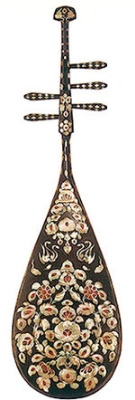
Biwa

Encyclopedia
The is a Japan
ese short-necked fretted lute
, often used in narrative storytelling. The biwa is the chosen instrument of Benten
, goddess of music, eloquence, poetry, and education in Japanese Shinto
.
It arrived in Japan
in two forms. Since that time, the number of biwa has more than quadrupled. Guilds supporting biwa players, particularly the biwa hoshi, helped proliferate biwa musical development for hundreds of years. Biwa hoshi
performances overlapped with performances by other biwa players many years before heikyoko and continued until today. This overlap resulted in a rapid evolution of the biwa and its usage and made it one of the most popular instruments in Japan.
Yet, in spite of its popularity, the Onin War
and subsequent Warring States Period disrupted biwa tutelage and decreased the number of proficient users. With the abolition of Todo in the Meiji period
, biwa players lost their patronage.
Furthermore, reforms stemming from the Meiji Restoration
led to massive, rapid industrialization and modernization. Japan modeled its development on Europe and the US, praising everything western and condemning everything native. Traditions identifiably Japanese became associated with terms like backwards or primitive. Such associations even extended into areas like art and music, and the biwa.
By the late 1940s, the biwa, a thoroughly Japanese tradition, was nearly completely abandoned for Western instruments; however, thanks to collaborative efforts by Japanese musicians, interest in the biwa is being revived. Japanese and foreign musicians alike have begun embracing traditional Japanese instruments, particularly the biwa, in their compositions. While blind biwa singers no longer dominate the biwa, many performers continue to use the instrument in traditional and modern ways.
, the clay figures ritualistically buried with the dead during the Kofun era (250-538 CE) [Barnes 16]. Other works claim the biwa might have been brought to Japan during the reign of Emperor Kinmei (539-71) by blind Buddhist monks called “moso” [Tokita 109]. The moso are also referred to as performers in 7th century Kyushu and, more commonly, in 8th century rituals at the Imperial Palace. Given the number of references to biwa and moso in the 8th century, scholars agree the biwa probably came to Japan sometime before the Nara period
(710-784) [Ishi 294].
Tracing how the biwa came to Japan is also a difficult task. The fact that the biwa had multiple entry points further complicates the issue. Ethnomusicologists
agree the origins of the biwa lie in the Persian oud
, but they disagree on how, when, and where the oud
went and evolved as it journeyed to Japan; for example, many writers of biwa history claim the oud
went from Sasanian Persia
through Tang China [Minoru Miki 71], but, given that the Tang began in 618 CE, this claim is highly unlikely. More likely, the oud
reached China during the time during the Han Period (206 BC-220 CE). As it became an important instrument in China, the oud was modified and called the 琵琶
(Pipa
). 琵 refers to the sliding from one pitch to another (glissandi
), and 琶 means “lute
.” When the 琵琶 arrived in Japan sometime before the Nara period
, the “p” sound changed to a “b” sound and was pronounced “biwa.” It quickly became an important part of gagaku
(togaku
) ensemble, and, in that role, it became known as the gaku-biwa.
Around the same time period (7th-8th centuries) the Pipa came to Japan, another lute descendant called the vina
traveled through India, Korea, and China before arriving in Kyushu
, Japan. The viva had become closely connected to Buddhist ceremonies before arriving in Kyushu, and, after it arrived, it continued that connection. The viva was smaller than the Pipa and came to be known as the moso-biwa or kojin-biwa [Minoru Miki 71].
Through the next several centuries, players of both traditions intersected frequently and developed new music styles and new instruments. By the Kamakura period
(1185–1333), the heike biwa had emerged as a popular instrument. The heike biwa could be described as a cross between both the gaku-biwa and moso-biwa. It retained the rounded shape of the gaku-biwa and was played with a large plectrum
like the moso-biwa. The heike biwa was also small, like the moso-biwa (actually smaller) and was used for similar purposes [Waterhouse 155].
While the modern Satsuma biwa and Chikuzen biwa both find their origin with the moso biwa, the Satsuma biwa was used for moral and mental training by samurai
of the Satsuma Domain during the Warring States Period
, and later in general performances. The Chikuzen biwa was used by Buddhist monks visiting private residences to perform memorial services, not only for Buddhist rites, but also for telling entertaining stories and news while accompanying themselves on the biwa, and this form of storytelling was thought to be spread in this way.
Not much about the biwa seems to have been written about biwas from roughly 16th century to the mid-19th century. What is known is that three main streams of biwa emerged during this time: zato (the lowest level of the state-controlled guild of blind biwa players), shifu (samurai style), and chofu (urban style) [Yoshimura, 54]. These styles emphasized 琵琶歌(biwa-uta)—vocalization with biwa accompaniment—and formed the foundation for 江戸歌 (edo-uta) styles such as shinnai and kota [Allan Marett 103]. From these styles also emerged the two principal survivors of the biwa tradition: Satsuma-biwa and chikuzen-biwa [Waterhouse 156]. From roughly the Meiji Era (1868–1912) until the Pacific War
, the satsuma-biwa and chikuzen biwa were popular across Japan, and, at the beginning of the Showa Era (1925–1989), the nishiki-biwa was created and gained popularity [Tsuruta Kinshi] [Tokita 119]. Of the remaining biwa traditions, only higo-biwa remains a style almost solely performed by blind persons in the post-war era. The higo-biwa is closely related to the heike-biwa and, similarly, relies on an oral-narrative tradition focusing on wars and legends [Ferranti, Relations between Music and Text in "Higo Biwa"_ The "Nagashi" Pattern as a Text-MusicSystem 149].
By the middle of the Meiji period
(1868–1912) improvements had been made on the instruments and easily understandable songs were composed in quantity. In the beginning of the Taisho period
(1912–1926), the Satsuma biwa was modified into the Nishiki biwa which was popular among female players at the time. With this the biwa met a great period of prosperity, and the songs themselves were not just about the Tale of the Heike but songs connected to the Sino-Japanese War
and the Russo-Japanese War
such as “Takeo Hirose
”, “Hitachimaru”, “203 Hill” gained popularity. However, the playing of the biwa nearly became extinct during the Meiji period as Western music and instruments became popular, until players such as Tsuruta Kinshi
and others revitalized the genre with modern playing styles and collaborations with Western composers.
, and their use. As the biwa does not play in tempered
tuning, pitches are approximated to the nearest note.


The general term used for music in Japan is 音楽
(ongaku). 音 means sound or tone, and 楽 means music or enjoyment. Both characters together technically refer to all forms of music but, more recently, evoke images of modern (post-Pacific War) ensembles and compositions. Traditional music styles have their own designations.
Broken apart, 邦 means (home) country and , 楽 means music. The characters together are thought to be an abbreviation of the term 本邦音楽, which literally means “music of Japan
.” The term Hogaku is also derived from 近世邦楽, which translates as “national music of modern times.”
It is usually defined as traditional Japanese Music. Japan`s Ministry of Education classifies Hogaku as a category separate from other traditional forms of music, such as Gagaku
(court music) or Shomyo
(Buddhist chanting), but most ethnomusicologists
view Hogaku, in a broad sense, as the form from which the others were derived [Sosnoski 34]. Outside of ethnomusicology
, however, Hogaku usually refers to Japanese music from around the 17th to mid 19th Centuries [Sugiura 1].
In Hogaku, musical instruments usually serve as accompaniments to vocal performances. Song dominates hogaku, and the overwhelming majority of hogaku compositions are vocal. In this context, the biwa was one of the prominent instruments [Dean 156].
Since雅 means elegance, Gagaku
literally means elegant music and generally refers to musical instruments and music theory imported to Japan
from China
and Korea
from 500-600 CE. Gagaku
is divided into two main categories: Old Music and New Music. Old Music refers to music and musical compositions from before the Chinese Tang Dynasty
(618-906), and New Music refers to music and compositions produced during or after Tang, including music brought from various regions in China
and Korea
[Randel 339] [The International Shakuhachi Society].
Old and New Music are further divided into 左楽 (Music of the Left) and 右楽 (Music of the Right) Categories. 左楽 is composed of 唐楽 (music from Tang) and 林邑楽 (music from Indo-China
). 右楽 is composed of 高麗楽 (music from Korea
).
Gagaku
was usually patronized by the imperial court or the shrines and temples. Gagaku
ensembles were composed of string, wind, and percussion instruments, where string and wind instruments were more respected and percussion instruments were considered lesser instruments. Among the string instruments, the biwa seems to have been the most important instrument in gagaku orchestral performances [Garfias, Gradual Modifications of the Gagaku Tradition 16].
The two characters声 and 明 literally mean “voice” and “clear.” Shomyo
is a translation of the Sanskrit word, sabda-vidya, which means “the (linguistic) study of language.” Shomyo is a kind of chanting of Buddhist scriptures syllabically
or melisma
tically set to melodic
phrasing, usually performed by a male chorus. It is said to have come to Japan in the early 9th Century [Randel 270].
While biwa was not used in shomyo
, the style of biwa singing is closely tied to shomyo
, especially moso and heike
style biwa singing [Matisoff 36]. Both shomyo
and moso are rooted in Buddhist rituals and traditions. Before arriving in Japan, shomyo
was used in Indian Buddhist. The moso-biwa was also rooted in Indian Buddhism
, and the heike-biwa, as a predecessor to the moso-biwa, was the principle instrument of the biwa hoshi
, who were blind Buddhist priests.
Generally speaking, biwas have four strings. That being said, modern Satsuma and chikuzen biwas might have five strings. The first string is thickest and the fourth string is thinnest (the second string is the thickest on the chikuzen-biwa, and the fourth and fifth strings are the same thickness on five-stringed chikuzen and Satsuma-biwas) [Minoru Miki 75]. The varying string thickness creates different timbre
s when stroked from different directions.
In biwa, tuning
is no fixed. General tone
s and pitches
can fluctuate up or down entire steps or microtones
[Dean 157]. When singing in a chorus, biwa singers often stagger their entry and often sing through non-synchronized, heterophony
accompaniment [Dean 149]. In solo performances, a biwa performer sings monophonic
ally, with melismatic emphasis throughout the performance. These monophonic do not follow a set harmony. Instead biwa singers tend to sing with a flexible pitch without distinguishing soprano
, alto
, tenor
, or bass
roles. This singing style is complemented by the biwa, which biwa players use to produce short glissandi throughout the performance [Morton Feldman 181]. Biwa singing style tends to be nasal, particularly when singing vowels, the consonant ん
, and notes containing “g” (e.g., が
, ぎ
, ぐ
, げ
, ご
, ぎゃ
, ぎゅ
, ぎょ
). Also, biwa performers vary the volume of their voice between barely audible to very loud (rarely deafening). Since biwa performances were generally for small groups, singers did not need to project their voices as do opera
singers in the western tradition
Biwa music is based on a pentatonic scale
(sometimes referred to as a five-ton or five-note scale), meaning that each octave
contains five notes. This scale sometimes includes supplementary notes, but the core remains pentatonic
. The rhythm in biwa performances allows for a broad flexibility of pulse. Songs are not always metered, although more modern collaborations are metered. Notes played on the biwa usually begin slow and thin and progress through gradual accelerations, increasing and decreasing tempo throughout the performance. The texture of biwa singing is often described as “sparse.”
The plectrum
also contributes to the texture of biwa music. Different sized plectrums produced different textures; for example, the plectrum used on a moso-biwa was much larger than that used on a gaku-biwa, producing a harsher, more vigorous sound [Morley 51]. The plectrum is also critical to creating the sawari
sound, which is particularly utilized with satsuma-biwas [Rossing 181]. What the plectrum is mad of also changes the texture, with ivory and plastic plectrums creating a more resilient texture to the wooden plectrum`s twangy hum [Malm 215].
. Outside influence, internal pressures, and socio-political turmoil redefined biwa patronage and biwa image; for example, the Onin War
during the Muromachi period
(1338–1573) and the subsequent Warring States period
(15th-17th centuries) disrupted the cycle of tutelage for heikyoku performers. As a result, younger musicians turned to other instruments and interest in biwa music decreased. Even the biwa hoshi transitioned to other instruments such as the shamisen
(a three stringed lute) [Gish 143].
Interest in the biwa revived during the Edo period
(1600–1868) when Tokugawa Ieyasu
unified Japan and established the Tokugawa Shogunate
. Ieyasu favored biwa music and became a major patron. He helped strengthen biwa guilds (called Todo) by financing them and allowing them special privileges (142). Shamisen players and other musicians found it financially beneficial to switch to the biwa, and, as they crossed over, they brought new styles. The Edo period proved to be one of the most prolific and artistically creative periods for the biwa in its long history in Japan (143).
In 1868, the Tokugawa Shogunate
collapsed, giving way to the Meiji period and the Meiji Restoration
. In Meiji, the samurai
class was abolished, and the Todo lost their patronage. Biwa players no longer enjoyed special privileges and were forced to support themselves. At the beginning of Meiji (1868), it was estimated that there were at least one hundred traditional court musicians in Tokyo. Yet, by the 1930s, there were only forty-six traditional court musicians in Tokyo. A quarter of these musicians died in the war. Life in Post-war Japan was difficult, and many musicians abandoned their music in favor of more sustainable livelihoods [Garfias, Gradual Modifications of the Gagaku Tradition 18].
While many styles of biwa flourished in the early 1900s (e.g., Kindai-biwa from the 1900s-1930s), the cycle of tutelage was broken yet again. Currently, there are no direct means of studying biwa in many biwa traditions [Ferranti, Relations between Music and Text in "Higo Biwa"_ The "Nagashi" Pattern as a Text-MusicSystem 150]. Even higo-biwa players, who were quite popular in the early 20th century, may no longer have a direct means of studying oral composition, as the bearers of the tradition have either died or are no longer able to play. Kindai biwa still retains a significant number of professional and amateur practitioners, but zato, heike, and moso-biwa styles have all but died out [Tokita 83].
As biwa music declined in post-Pacific War Japan, many Japanese composers and musicians found ways to revitalize interest in it. They recognized that studies in music theory
and music composition in Japan almost entirely consisted in Western theory and instruction. Beginning in the late 1960s, these musicians and composers began to incorporate Japanese music and Japanese instruments into their compositions; for example, one composer, Toru Takemitsu
, collaborated with Western composers and compositions to include the distinctly Asian biwa. His well-received compositions such as November Steps
, which incorporates biwa heikyoku with western orchestral performance, revitalized interest in the biwa and sparked a series of collaborative efforts by other musician in genres ranging from jpop and enza
to shin-hougaku and gendaigaku [Tonai 25].
Other musicians, such as Yamashika Yoshiyuki, who is considered by most ethnomusicologists to be the last of the biwa hoshi, preserved scores of songs that were almost lost forever. Yamashika, born in the late Meiji, continued the biwa hoshi tradition until his death in 1996. Beginning in the late sixties to the late eighties, composers and historians from all over the world visited Yamashika and recorded many of his songs. Up to that time, the biwa hoshi tradition of songs was completely an oral tradition. When Yamashika died in 1996, the era of the biwa hoshi tutelage died with him, but the music and genius of that era continues thanks to his recordings [Sanger].
Japan
Japan is an island nation in East Asia. Located in the Pacific Ocean, it lies to the east of the Sea of Japan, China, North Korea, South Korea and Russia, stretching from the Sea of Okhotsk in the north to the East China Sea and Taiwan in the south...
ese short-necked fretted lute
Lute
Lute can refer generally to any plucked string instrument with a neck and a deep round back, or more specifically to an instrument from the family of European lutes....
, often used in narrative storytelling. The biwa is the chosen instrument of Benten
Benzaiten
Benzaiten is the Japanese name for the Hindu goddess Saraswati. Worship of Benzaiten arrived in Japan during the 6th through 8th centuries, mainly via the Chinese translations of the Sutra of Golden Light, which has a section devoted to her...
, goddess of music, eloquence, poetry, and education in Japanese Shinto
Shinto
or Shintoism, also kami-no-michi, is the indigenous spirituality of Japan and the Japanese people. It is a set of practices, to be carried out diligently, to establish a connection between present day Japan and its ancient past. Shinto practices were first recorded and codified in the written...
.
It arrived in Japan
Japan
Japan is an island nation in East Asia. Located in the Pacific Ocean, it lies to the east of the Sea of Japan, China, North Korea, South Korea and Russia, stretching from the Sea of Okhotsk in the north to the East China Sea and Taiwan in the south...
in two forms. Since that time, the number of biwa has more than quadrupled. Guilds supporting biwa players, particularly the biwa hoshi, helped proliferate biwa musical development for hundreds of years. Biwa hoshi
Biwa hoshi
Biwa hōshi , also known as "lute priests" were travelling performers in the era of Japanese history preceding the Meiji period. They earned their income by reciting vocal literature to the accompaniment of biwa music. Often blind, they adopted the shaved heads and robes common to Buddhist monks...
performances overlapped with performances by other biwa players many years before heikyoko and continued until today. This overlap resulted in a rapid evolution of the biwa and its usage and made it one of the most popular instruments in Japan.
Yet, in spite of its popularity, the Onin War
Onin War
The ' was a civil war that lasted 10 years during the Muromachi period in Japan. A dispute between Hosokawa Katsumoto and Yamana Sōzen escalated into a nationwide war involving the Ashikaga shogunate and a number of daimyo in many regions of Japan....
and subsequent Warring States Period disrupted biwa tutelage and decreased the number of proficient users. With the abolition of Todo in the Meiji period
Meiji period
The , also known as the Meiji era, is a Japanese era which extended from September 1868 through July 1912. This period represents the first half of the Empire of Japan.- Meiji Restoration and the emperor :...
, biwa players lost their patronage.
Furthermore, reforms stemming from the Meiji Restoration
Meiji Restoration
The , also known as the Meiji Ishin, Revolution, Reform or Renewal, was a chain of events that restored imperial rule to Japan in 1868...
led to massive, rapid industrialization and modernization. Japan modeled its development on Europe and the US, praising everything western and condemning everything native. Traditions identifiably Japanese became associated with terms like backwards or primitive. Such associations even extended into areas like art and music, and the biwa.
By the late 1940s, the biwa, a thoroughly Japanese tradition, was nearly completely abandoned for Western instruments; however, thanks to collaborative efforts by Japanese musicians, interest in the biwa is being revived. Japanese and foreign musicians alike have begun embracing traditional Japanese instruments, particularly the biwa, in their compositions. While blind biwa singers no longer dominate the biwa, many performers continue to use the instrument in traditional and modern ways.
History
Tracing the origins of the biwa in Japan is a difficult task. Some scholarly works claim the oldest references come from haniwaHaniwa
The are terracotta clay figures which were made for ritual use and buried with the dead as funerary objects during the Kofun period of the history of Japan....
, the clay figures ritualistically buried with the dead during the Kofun era (250-538 CE) [Barnes 16]. Other works claim the biwa might have been brought to Japan during the reign of Emperor Kinmei (539-71) by blind Buddhist monks called “moso” [Tokita 109]. The moso are also referred to as performers in 7th century Kyushu and, more commonly, in 8th century rituals at the Imperial Palace. Given the number of references to biwa and moso in the 8th century, scholars agree the biwa probably came to Japan sometime before the Nara period
Nara period
The of the history of Japan covers the years from AD 710 to 794. Empress Gemmei established the capital of Heijō-kyō . Except for 5 years , when the capital was briefly moved again, it remained the capital of Japanese civilization until Emperor Kammu established a new capital, Nagaoka-kyō, in 784...
(710-784) [Ishi 294].
Tracing how the biwa came to Japan is also a difficult task. The fact that the biwa had multiple entry points further complicates the issue. Ethnomusicologists
Ethnomusicology
Ethnomusicology is defined as "the study of social and cultural aspects of music and dance in local and global contexts."Coined by the musician Jaap Kunst from the Greek words ἔθνος ethnos and μουσική mousike , it is often considered the anthropology or ethnography of music...
agree the origins of the biwa lie in the Persian oud
Oud
The oud is a pear-shaped stringed instrument commonly used in North African and Middle Eastern music. The modern oud and the European lute both descend from a common ancestor via diverging paths...
, but they disagree on how, when, and where the oud
Oud
The oud is a pear-shaped stringed instrument commonly used in North African and Middle Eastern music. The modern oud and the European lute both descend from a common ancestor via diverging paths...
went and evolved as it journeyed to Japan; for example, many writers of biwa history claim the oud
Oud
The oud is a pear-shaped stringed instrument commonly used in North African and Middle Eastern music. The modern oud and the European lute both descend from a common ancestor via diverging paths...
went from Sasanian Persia
Sassanid Empire
The Sassanid Empire , known to its inhabitants as Ērānshahr and Ērān in Middle Persian and resulting in the New Persian terms Iranshahr and Iran , was the last pre-Islamic Persian Empire, ruled by the Sasanian Dynasty from 224 to 651...
through Tang China [Minoru Miki 71], but, given that the Tang began in 618 CE, this claim is highly unlikely. More likely, the oud
Oud
The oud is a pear-shaped stringed instrument commonly used in North African and Middle Eastern music. The modern oud and the European lute both descend from a common ancestor via diverging paths...
reached China during the time during the Han Period (206 BC-220 CE). As it became an important instrument in China, the oud was modified and called the 琵琶
Pipa
The pipa is a four-stringed Chinese musical instrument, belonging to the plucked category of instruments . Sometimes called the Chinese lute, the instrument has a pear-shaped wooden body with a varying number of frets ranging from 12–26...
(Pipa
Pipa
The pipa is a four-stringed Chinese musical instrument, belonging to the plucked category of instruments . Sometimes called the Chinese lute, the instrument has a pear-shaped wooden body with a varying number of frets ranging from 12–26...
). 琵 refers to the sliding from one pitch to another (glissandi
Glissando
In music, a glissando is a glide from one pitch to another. It is an Italianized musical term derived from the French glisser, to glide. In some contexts it is distinguished from the continuous portamento...
), and 琶 means “lute
Lute
Lute can refer generally to any plucked string instrument with a neck and a deep round back, or more specifically to an instrument from the family of European lutes....
.” When the 琵琶 arrived in Japan sometime before the Nara period
Nara period
The of the history of Japan covers the years from AD 710 to 794. Empress Gemmei established the capital of Heijō-kyō . Except for 5 years , when the capital was briefly moved again, it remained the capital of Japanese civilization until Emperor Kammu established a new capital, Nagaoka-kyō, in 784...
, the “p” sound changed to a “b” sound and was pronounced “biwa.” It quickly became an important part of gagaku
Gagaku
Gagaku is a type of Japanese classical music that has been performed at the Imperial Court in Kyoto for several centuries. It consists of three primary repertoires:#Native Shinto religious music and folk songs and dance, called kuniburi no utamai...
(togaku
Togaku
Tōgaku is the Japanese pronunciation of an early style of music and dance from the Tang Dynasty in China...
) ensemble, and, in that role, it became known as the gaku-biwa.
Around the same time period (7th-8th centuries) the Pipa came to Japan, another lute descendant called the vina
Veena
Veena may refer to one of several Indian plucked instruments:With frets*Rudra veena, plucked string instrument used in Hindustani music*Saraswati veena, plucked string instrument used in Carnatic musicFretless...
traveled through India, Korea, and China before arriving in Kyushu
Kyushu
is the third largest island of Japan and most southwesterly of its four main islands. Its alternate ancient names include , , and . The historical regional name is referred to Kyushu and its surrounding islands....
, Japan. The viva had become closely connected to Buddhist ceremonies before arriving in Kyushu, and, after it arrived, it continued that connection. The viva was smaller than the Pipa and came to be known as the moso-biwa or kojin-biwa [Minoru Miki 71].
Through the next several centuries, players of both traditions intersected frequently and developed new music styles and new instruments. By the Kamakura period
Kamakura period
The is a period of Japanese history that marks the governance by the Kamakura Shogunate, officially established in 1192 in Kamakura by the first shogun Minamoto no Yoritomo....
(1185–1333), the heike biwa had emerged as a popular instrument. The heike biwa could be described as a cross between both the gaku-biwa and moso-biwa. It retained the rounded shape of the gaku-biwa and was played with a large plectrum
Plectrum
A plectrum is a small flat tool used to pluck or strum a stringed instrument. For hand-held instruments such as guitars and mandolins, the plectrum is often called a pick, and is a separate tool held in the player's hand...
like the moso-biwa. The heike biwa was also small, like the moso-biwa (actually smaller) and was used for similar purposes [Waterhouse 155].
While the modern Satsuma biwa and Chikuzen biwa both find their origin with the moso biwa, the Satsuma biwa was used for moral and mental training by samurai
Samurai
is the term for the military nobility of pre-industrial Japan. According to translator William Scott Wilson: "In Chinese, the character 侍 was originally a verb meaning to wait upon or accompany a person in the upper ranks of society, and this is also true of the original term in Japanese, saburau...
of the Satsuma Domain during the Warring States Period
Warring States Period
The Warring States Period , also known as the Era of Warring States, or the Warring Kingdoms period, covers the Iron Age period from about 475 BC to the reunification of China under the Qin Dynasty in 221 BC...
, and later in general performances. The Chikuzen biwa was used by Buddhist monks visiting private residences to perform memorial services, not only for Buddhist rites, but also for telling entertaining stories and news while accompanying themselves on the biwa, and this form of storytelling was thought to be spread in this way.
Not much about the biwa seems to have been written about biwas from roughly 16th century to the mid-19th century. What is known is that three main streams of biwa emerged during this time: zato (the lowest level of the state-controlled guild of blind biwa players), shifu (samurai style), and chofu (urban style) [Yoshimura, 54]. These styles emphasized 琵琶歌(biwa-uta)—vocalization with biwa accompaniment—and formed the foundation for 江戸歌 (edo-uta) styles such as shinnai and kota [Allan Marett 103]. From these styles also emerged the two principal survivors of the biwa tradition: Satsuma-biwa and chikuzen-biwa [Waterhouse 156]. From roughly the Meiji Era (1868–1912) until the Pacific War
Pacific War
The Pacific War, also sometimes called the Asia-Pacific War refers broadly to the parts of World War II that took place in the Pacific Ocean, its islands, and in East Asia, then called the Far East...
, the satsuma-biwa and chikuzen biwa were popular across Japan, and, at the beginning of the Showa Era (1925–1989), the nishiki-biwa was created and gained popularity [Tsuruta Kinshi] [Tokita 119]. Of the remaining biwa traditions, only higo-biwa remains a style almost solely performed by blind persons in the post-war era. The higo-biwa is closely related to the heike-biwa and, similarly, relies on an oral-narrative tradition focusing on wars and legends [Ferranti, Relations between Music and Text in "Higo Biwa"_ The "Nagashi" Pattern as a Text-MusicSystem 149].
By the middle of the Meiji period
Meiji period
The , also known as the Meiji era, is a Japanese era which extended from September 1868 through July 1912. This period represents the first half of the Empire of Japan.- Meiji Restoration and the emperor :...
(1868–1912) improvements had been made on the instruments and easily understandable songs were composed in quantity. In the beginning of the Taisho period
Taisho period
The , or Taishō era, is a period in the history of Japan dating from July 30, 1912 to December 25, 1926, coinciding with the reign of the Taishō Emperor. The health of the new emperor was weak, which prompted the shift in political power from the old oligarchic group of elder statesmen to the Diet...
(1912–1926), the Satsuma biwa was modified into the Nishiki biwa which was popular among female players at the time. With this the biwa met a great period of prosperity, and the songs themselves were not just about the Tale of the Heike but songs connected to the Sino-Japanese War
Sino-Japanese War
There were two wars known as the Sino-Japanese War :* The First Sino-Japanese War between China and Japan , primarily over control of Korea....
and the Russo-Japanese War
Russo-Japanese War
The Russo-Japanese War was "the first great war of the 20th century." It grew out of rival imperial ambitions of the Russian Empire and Japanese Empire over Manchuria and Korea...
such as “Takeo Hirose
Takeo Hirose
, was an officer in the Imperial Japanese Navy. His selfless sacrifice during the Russo-Japanese War elevated him to the status of a deified national hero....
”, “Hitachimaru”, “203 Hill” gained popularity. However, the playing of the biwa nearly became extinct during the Meiji period as Western music and instruments became popular, until players such as Tsuruta Kinshi
Tsuruta Kinshi
was an eminent Japanese musician of the 20th century. She specialized in the ancient pear-shaped plucked lute called biwa, and also sang. She developed her own form of the Satsuma biwa, which is sometimes referred to as Tsuruta biwa. This biwa differs from the traditional Satsuma biwa in the...
and others revitalized the genre with modern playing styles and collaborations with Western composers.
Types of biwa
There are more than seven types of biwa, chacterized by number of strings, sounds it could produce, type of plectrumPlectrum
A plectrum is a small flat tool used to pluck or strum a stringed instrument. For hand-held instruments such as guitars and mandolins, the plectrum is often called a pick, and is a separate tool held in the player's hand...
, and their use. As the biwa does not play in tempered
Equal temperament
An equal temperament is a musical temperament, or a system of tuning, in which every pair of adjacent notes has an identical frequency ratio. As pitch is perceived roughly as the logarithm of frequency, this means that the perceived "distance" from every note to its nearest neighbor is the same for...
tuning, pitches are approximated to the nearest note.
Classic biwa
- Gagaku biwa (雅楽琵琶) - A large and heavy biwa with four strings and four frets used exclusively for gagakuGagakuGagaku is a type of Japanese classical music that has been performed at the Imperial Court in Kyoto for several centuries. It consists of three primary repertoires:#Native Shinto religious music and folk songs and dance, called kuniburi no utamai...
. It produces distinctive Ichikotsuchō (壱越調) and Hyōjō (平調). Its plectrum is small and thin, often rounded, and made from a hard material such as boxwood or ivoryIvoryIvory is a term for dentine, which constitutes the bulk of the teeth and tusks of animals, when used as a material for art or manufacturing. Ivory has been important since ancient times for making a range of items, from ivory carvings to false teeth, fans, dominoes, joint tubes, piano keys and...
. It is not used to accompany singing. Like the heike biwa, it is played held on its side, similar to a guitar, with the player sitting cross-legged. In gagaku, it is called gakubiwa (楽琵琶). - Gogenbiwa (五絃琵琶) - This T'ang variant of Biwa can be seen in paintings of court orchestras and was used in the context of gagakuGagakuGagaku is a type of Japanese classical music that has been performed at the Imperial Court in Kyoto for several centuries. It consists of three primary repertoires:#Native Shinto religious music and folk songs and dance, called kuniburi no utamai...
, however was removed with the reforms and standardizations made to the court orchestra during the late 10th Century. It is assumed that the performance traditions died out by the 10th or 11th century (William P. Malm). This is instrument also disappeared in the Chinese court orchestras. Recently, this instrument, much like the Kugo harp has been revived for historically informed performances and historical reconstructions. Not to be confused with the five-stringed variants of modern biwa, such as Chikuzen biwa.
- Mōsō biwa (盲僧琵琶) - A biwa with four strings used to play Buddhist mantraMantraA mantra is a sound, syllable, word, or group of words that is considered capable of "creating transformation"...
and songs. It is similar in shape to the Chikuzen biwa, but with a much more narrow body. Its plectrum varies in both size and materials. The four fret type is tuned to E, B, E and A, and the five fret type is tuned to B, e, f-sharp and f-sharp. The six fret type is tuned to B-flat, E-flat, B-flat and b-flat.
Middle and Edo biwa
- Heike biwa (平家琵琶) - A biwa with four strings and five frets used to play Heike MonogatariThe Tale of the Heikeis an epic account of the struggle between the Taira and Minamoto clans for control of Japan at the end of the 12th century in the Genpei War...
. Its plectrum is slightly larger than that of the gagaku biwa, but the instrument itself is much smaller, comparable to a Chikuzen biwa in size. It was originally used by traveling biwa minstrels, and its small size lent it to indoor play and improved portability. Its tuning is A, c, e, a or A, c-sharp, e, a.
- Satsuma biwa (薩摩琵琶) - A biwa with four strings and four frets popularized during the Edo PeriodEdo periodThe , or , is a division of Japanese history which was ruled by the shoguns of the Tokugawa family, running from 1603 to 1868. The political entity of this period was the Tokugawa shogunate....
in Satsuma ProvinceSatsuma Provincewas an old province of Japan that is now the western half of Kagoshima Prefecture on the island of Kyūshū. Its abbreviation is Sasshū .During the Sengoku Period, Satsuma was a fief of the Shimazu daimyo, who ruled much of southern Kyūshū from their castle at Kagoshima city.In 1871, with the...
(present day Kagoshima) by Shimazu Nisshinsai. Modern biwas used for contemporary compositions often have five or more frets, and some have a doubled fourth string. The frets of the Satsuma biwa are raised 4 centimeters from the neck allowing notes to be bent several steps higher, each one producing the instrument's characteristic sawariSawariIn traditional Japanese music, sawari is the name of a buzzy sound quality that is often found in, and sometimes expected of certain traditional stringed instruments....
, or buzzing drone. Its boxwood plectrum is much wider than others, often reaching widths of 25 centimeters or more. Its size and construction influences the sound of the instrument as the curved body is often struck percussively with the plectrum during play. The Satsuma biwa is traditionally made from Japanese mulberryMulberryMorus is a genus of flowering plants in the family Moraceae. The 10–16 species of deciduous trees it contains are commonly known as Mulberries....
, although other hard woods such as Japanese zelkovaZelkova serrataZelkova serrata is a species of Zelkova native to Japan, Korea, eastern China, and Taiwan. It is often grown as an ornamental tree, and used in bonsai.-Description:...
are sometimes used in its construction. Due to the slow growth of the Japanese mulberry, the wood must be taken from at least a 120 year old tree and dried for ten years before construction can begin. The strings are made of wound silk. Its tuning is A, E, A, B, for traditional biwa, G, G, c, g, or G, G, d, g for contemporary compositions, among other tunings, but these are only examples as the instrument is tuned to match the key of the player's voice. The first and second strings are generally tuned to the same note, with the 4th (or doubled 4th) string is tuned one octave higher. The most eminent 20th century Satsuma biwa performer was Tsuruta KinshiTsuruta Kinshiwas an eminent Japanese musician of the 20th century. She specialized in the ancient pear-shaped plucked lute called biwa, and also sang. She developed her own form of the Satsuma biwa, which is sometimes referred to as Tsuruta biwa. This biwa differs from the traditional Satsuma biwa in the...
, who developed her own version of the instrument, which she called the Tsuruta biwa. This biwa often has five strings (although it is essentially a 4-string instrument as the 5th string is a doubled 4th that are always played together) and five or more frets, and the construction of the tuning head and frets vary slightly. Ueda Junko and Tanaka YukioYukio Tanaka (biwa)is a Japanese biwa player.He studied under the satsuma biwa master Kinshi Tsuruta, whose status he inherited as a leading figure of Japanese traditional music. His honours include First Prize at the Japanese Biwa Competition, the Minister of Education, Science and Culture Prize and the Japanese...
, two of Tsuruta Kinshi's students, continue the tradition of the modern Satsuma biwa. Carlo ForlivesiCarlo ForlivesiCarlo Forlivesi is an Italian composer, performer and researcher.Forlivesi was born in Faenza, Emilia-Romagna. He studied at Bologna Conservatory, Milan Conservatory and the Accademia Nazionale di Santa Cecilia of Rome...
's compositions Boethius (ボエティウス) and Nuove Musiche per Biwa (琵琶のための新曲) had both been written for performance on the Satsuma model of the biwa designed by Kinshi Tsuruta and Yukio TanakaYukio Tanakais a former Japanese baseball player for the Hokkaido Nippon-Ham Fighters. He played baseball for Fighters during all 22 years in his professional career. He was nicknamed "Mr. Fighters". On May 15, 2007, he hit his 2000th Career Hit during a match against Tohoku Rakuten Golden Eagles. He retired...
. "These works presents a radical departure from the compositional languages usually employed for such an instrument. Also, thanks to the possibility of relying on a level of virtuosity never before attempted in this specific repertory, the composer has sought the renewal of the acoustic and æsthetic profile of the biwa, bringing out the huge potential in the sound material: attacks and resonance, tempo (conceived not only in the chronometrical but also deliberately empathetical sense), chords, balance and dialogue (with the occasional use of two biwas in Nuove Musiche per Biwa), dynamics and colour."
Modern biwa
- Chikuzen biwa (筑前琵琶) - A biwa with four strings and four frets or five strings and five frets popularized in the Meiji PeriodMeiji periodThe , also known as the Meiji era, is a Japanese era which extended from September 1868 through July 1912. This period represents the first half of the Empire of Japan.- Meiji Restoration and the emperor :...
by Tachibana Satosada. Most contemporary performers use the five string version. Its plectrum is much smaller than that of the Satsuma biwa, usually about 13 centimeters in width, although its size, shape, and weight depends on the sex of the player. The plectrum is usually made from rosewood with boxwood or ivory tips for plucking the strings. The instrument itself also varies in size, depending on the player. Male players use biwas that are slightly wider and/or longer than those used by females or children. The body of the instrument is never struck with the plectrum during play, and the five string instrument is played upright, while the four string is played held on its side. The instrument is tuned to match the key of the singer. An example tuning of the four string version is B, e, f-sharp and b, and the five string instrument can be tuned to C, G, C, d and g. For the five string version, the first and third strings are tuned the same note, the second string down three steps down, the fifth string an octave higher than the second string, and the fourth string a step down from the fifth. So the previously mentioned tuning can be tuned down to B-flat, F, B-flat, c, d. Asahikai and Tachibanakai are the two major schools of Chikuzen biwa. Popularly used by female biwa players such as Uehara Mari.
- Nishiki biwa (錦琵琶) - A modern biwa with five strings and five frets popularized by Suitō Kinjō. Its plectrum is the same as that used for the Satsuma biwa. ts tuning is C, G, c, g, g.
Biwa Style
Generally speaking, biwa is considered one of Japan`s principal traditional instruments, and, as such, it has both influenced and been influenced by other traditional instruments and compositions throughout its long history in Japan. The following section will situate the biwa in the context of traditional Japanese music.- General Background on Music in Japan
The general term used for music in Japan is 音楽
Music of Japan
The music of Japan includes a wide array of performers in distinct styles both traditional and modern. The word for music in Japanese is 音楽 , combining the kanji 音 with the kanji 楽...
(ongaku). 音 means sound or tone, and 楽 means music or enjoyment. Both characters together technically refer to all forms of music but, more recently, evoke images of modern (post-Pacific War) ensembles and compositions. Traditional music styles have their own designations.
- 邦楽 Hogaku - Japanese Traditional Music
Broken apart, 邦 means (home) country and , 楽 means music. The characters together are thought to be an abbreviation of the term 本邦音楽, which literally means “music of Japan
Music of Japan
The music of Japan includes a wide array of performers in distinct styles both traditional and modern. The word for music in Japanese is 音楽 , combining the kanji 音 with the kanji 楽...
.” The term Hogaku is also derived from 近世邦楽, which translates as “national music of modern times.”
It is usually defined as traditional Japanese Music. Japan`s Ministry of Education classifies Hogaku as a category separate from other traditional forms of music, such as Gagaku
Gagaku
Gagaku is a type of Japanese classical music that has been performed at the Imperial Court in Kyoto for several centuries. It consists of three primary repertoires:#Native Shinto religious music and folk songs and dance, called kuniburi no utamai...
(court music) or Shomyo
Shomyo
Shōmyō is a style of Japanese Buddhist chant, used mainly in the Tendai and Shingon sects. There are two styles: ryokyoku and rikkyoku, described as difficult and easy to remember, respectively....
(Buddhist chanting), but most ethnomusicologists
Ethnomusicology
Ethnomusicology is defined as "the study of social and cultural aspects of music and dance in local and global contexts."Coined by the musician Jaap Kunst from the Greek words ἔθνος ethnos and μουσική mousike , it is often considered the anthropology or ethnography of music...
view Hogaku, in a broad sense, as the form from which the others were derived [Sosnoski 34]. Outside of ethnomusicology
Ethnomusicology
Ethnomusicology is defined as "the study of social and cultural aspects of music and dance in local and global contexts."Coined by the musician Jaap Kunst from the Greek words ἔθνος ethnos and μουσική mousike , it is often considered the anthropology or ethnography of music...
, however, Hogaku usually refers to Japanese music from around the 17th to mid 19th Centuries [Sugiura 1].
In Hogaku, musical instruments usually serve as accompaniments to vocal performances. Song dominates hogaku, and the overwhelming majority of hogaku compositions are vocal. In this context, the biwa was one of the prominent instruments [Dean 156].
- 雅楽 GagakuGagakuGagaku is a type of Japanese classical music that has been performed at the Imperial Court in Kyoto for several centuries. It consists of three primary repertoires:#Native Shinto religious music and folk songs and dance, called kuniburi no utamai...
– Japanese Court Music
Since雅 means elegance, Gagaku
Gagaku
Gagaku is a type of Japanese classical music that has been performed at the Imperial Court in Kyoto for several centuries. It consists of three primary repertoires:#Native Shinto religious music and folk songs and dance, called kuniburi no utamai...
literally means elegant music and generally refers to musical instruments and music theory imported to Japan
Japan
Japan is an island nation in East Asia. Located in the Pacific Ocean, it lies to the east of the Sea of Japan, China, North Korea, South Korea and Russia, stretching from the Sea of Okhotsk in the north to the East China Sea and Taiwan in the south...
from China
China
Chinese civilization may refer to:* China for more general discussion of the country.* Chinese culture* Greater China, the transnational community of ethnic Chinese.* History of China* Sinosphere, the area historically affected by Chinese culture...
and Korea
Korea
Korea ) is an East Asian geographic region that is currently divided into two separate sovereign states — North Korea and South Korea. Located on the Korean Peninsula, Korea is bordered by the People's Republic of China to the northwest, Russia to the northeast, and is separated from Japan to the...
from 500-600 CE. Gagaku
Gagaku
Gagaku is a type of Japanese classical music that has been performed at the Imperial Court in Kyoto for several centuries. It consists of three primary repertoires:#Native Shinto religious music and folk songs and dance, called kuniburi no utamai...
is divided into two main categories: Old Music and New Music. Old Music refers to music and musical compositions from before the Chinese Tang Dynasty
Tang Dynasty
The Tang Dynasty was an imperial dynasty of China preceded by the Sui Dynasty and followed by the Five Dynasties and Ten Kingdoms Period. It was founded by the Li family, who seized power during the decline and collapse of the Sui Empire...
(618-906), and New Music refers to music and compositions produced during or after Tang, including music brought from various regions in China
China
Chinese civilization may refer to:* China for more general discussion of the country.* Chinese culture* Greater China, the transnational community of ethnic Chinese.* History of China* Sinosphere, the area historically affected by Chinese culture...
and Korea
Korea
Korea ) is an East Asian geographic region that is currently divided into two separate sovereign states — North Korea and South Korea. Located on the Korean Peninsula, Korea is bordered by the People's Republic of China to the northwest, Russia to the northeast, and is separated from Japan to the...
[Randel 339] [The International Shakuhachi Society].
Old and New Music are further divided into 左楽 (Music of the Left) and 右楽 (Music of the Right) Categories. 左楽 is composed of 唐楽 (music from Tang) and 林邑楽 (music from Indo-China
Indochina
The Indochinese peninsula, is a region in Southeast Asia. It lies roughly southwest of China, and east of India. The name has its origins in the French, Indochine, as a combination of the names of "China" and "India", and was adopted when French colonizers in Vietnam began expanding their territory...
). 右楽 is composed of 高麗楽 (music from Korea
Korea
Korea ) is an East Asian geographic region that is currently divided into two separate sovereign states — North Korea and South Korea. Located on the Korean Peninsula, Korea is bordered by the People's Republic of China to the northwest, Russia to the northeast, and is separated from Japan to the...
).
Gagaku
Gagaku
Gagaku is a type of Japanese classical music that has been performed at the Imperial Court in Kyoto for several centuries. It consists of three primary repertoires:#Native Shinto religious music and folk songs and dance, called kuniburi no utamai...
was usually patronized by the imperial court or the shrines and temples. Gagaku
Gagaku
Gagaku is a type of Japanese classical music that has been performed at the Imperial Court in Kyoto for several centuries. It consists of three primary repertoires:#Native Shinto religious music and folk songs and dance, called kuniburi no utamai...
ensembles were composed of string, wind, and percussion instruments, where string and wind instruments were more respected and percussion instruments were considered lesser instruments. Among the string instruments, the biwa seems to have been the most important instrument in gagaku orchestral performances [Garfias, Gradual Modifications of the Gagaku Tradition 16].
- 声明 ShomyoShomyoShōmyō is a style of Japanese Buddhist chant, used mainly in the Tendai and Shingon sects. There are two styles: ryokyoku and rikkyoku, described as difficult and easy to remember, respectively....
– Buddhist Chanting
The two characters声 and 明 literally mean “voice” and “clear.” Shomyo
Shomyo
Shōmyō is a style of Japanese Buddhist chant, used mainly in the Tendai and Shingon sects. There are two styles: ryokyoku and rikkyoku, described as difficult and easy to remember, respectively....
is a translation of the Sanskrit word, sabda-vidya, which means “the (linguistic) study of language.” Shomyo is a kind of chanting of Buddhist scriptures syllabically
Syllable
A syllable is a unit of organization for a sequence of speech sounds. For example, the word water is composed of two syllables: wa and ter. A syllable is typically made up of a syllable nucleus with optional initial and final margins .Syllables are often considered the phonological "building...
or melisma
Melisma
Melisma, in music, is the singing of a single syllable of text while moving between several different notes in succession. Music sung in this style is referred to as melismatic, as opposed to syllabic, where each syllable of text is matched to a single note.-History:Music of ancient cultures used...
tically set to melodic
Melody
A melody , also tune, voice, or line, is a linear succession of musical tones which is perceived as a single entity...
phrasing, usually performed by a male chorus. It is said to have come to Japan in the early 9th Century [Randel 270].
While biwa was not used in shomyo
Melody
A melody , also tune, voice, or line, is a linear succession of musical tones which is perceived as a single entity...
, the style of biwa singing is closely tied to shomyo
Melody
A melody , also tune, voice, or line, is a linear succession of musical tones which is perceived as a single entity...
, especially moso and heike
Taira clan
The was a major Japanese clan of samurai in historical Japan.In reference to Japanese history, along with Minamoto, Taira was a hereditary clan name bestowed by the emperors of the Heian Period to certain ex-members of the imperial family when they became subjects...
style biwa singing [Matisoff 36]. Both shomyo
Shomyo
Shōmyō is a style of Japanese Buddhist chant, used mainly in the Tendai and Shingon sects. There are two styles: ryokyoku and rikkyoku, described as difficult and easy to remember, respectively....
and moso are rooted in Buddhist rituals and traditions. Before arriving in Japan, shomyo
Shomyo
Shōmyō is a style of Japanese Buddhist chant, used mainly in the Tendai and Shingon sects. There are two styles: ryokyoku and rikkyoku, described as difficult and easy to remember, respectively....
was used in Indian Buddhist. The moso-biwa was also rooted in Indian Buddhism
History of Buddhism in India
Buddhism is a world religion, which arose in and around ancient Magadha, India , and is based on the teachings of Siddhartha Gautama , who is known as the Buddha...
, and the heike-biwa, as a predecessor to the moso-biwa, was the principle instrument of the biwa hoshi
Biwa hoshi
Biwa hōshi , also known as "lute priests" were travelling performers in the era of Japanese history preceding the Meiji period. They earned their income by reciting vocal literature to the accompaniment of biwa music. Often blind, they adopted the shaved heads and robes common to Buddhist monks...
, who were blind Buddhist priests.
- Biwa Aesthetics
Generally speaking, biwas have four strings. That being said, modern Satsuma and chikuzen biwas might have five strings. The first string is thickest and the fourth string is thinnest (the second string is the thickest on the chikuzen-biwa, and the fourth and fifth strings are the same thickness on five-stringed chikuzen and Satsuma-biwas) [Minoru Miki 75]. The varying string thickness creates different timbre
Timbre
In music, timbre is the quality of a musical note or sound or tone that distinguishes different types of sound production, such as voices and musical instruments, such as string instruments, wind instruments, and percussion instruments. The physical characteristics of sound that determine the...
s when stroked from different directions.
In biwa, tuning
Musical tuning
In music, there are two common meanings for tuning:* Tuning practice, the act of tuning an instrument or voice.* Tuning systems, the various systems of pitches used to tune an instrument, and their theoretical bases.-Tuning practice:...
is no fixed. General tone
Note
In music, the term note has two primary meanings:#A sign used in musical notation to represent the relative duration and pitch of a sound;#A pitched sound itself....
s and pitches
Pitch (music)
Pitch is an auditory perceptual property that allows the ordering of sounds on a frequency-related scale.Pitches are compared as "higher" and "lower" in the sense associated with musical melodies,...
can fluctuate up or down entire steps or microtones
Microtonal music
Microtonal music is music using microtones—intervals of less than an equally spaced semitone. Microtonal music can also refer to music which uses intervals not found in the Western system of 12 equal intervals to the octave.-Terminology:...
[Dean 157]. When singing in a chorus, biwa singers often stagger their entry and often sing through non-synchronized, heterophony
Heterophony
In music, heterophony is a type of texture characterized by the simultaneous variation of a single melodic line. Such a texture can be regarded as a kind of complex monophony in which there is only one basic melody, but realized at the same time in multiple voices, each of which plays the melody...
accompaniment [Dean 149]. In solo performances, a biwa performer sings monophonic
Monophonic
Monophonic may refer to:* Monaural, a sound recording with only one channel* Monophony, musical texture that consists of a single melodic line* Monophonic , a synthesizer capable of sounding only one voice, or note, at a time...
ally, with melismatic emphasis throughout the performance. These monophonic do not follow a set harmony. Instead biwa singers tend to sing with a flexible pitch without distinguishing soprano
Soprano
A soprano is a voice type with a vocal range from approximately middle C to "high A" in choral music, or to "soprano C" or higher in operatic music. In four-part chorale style harmony, the soprano takes the highest part, which usually encompasses the melody...
, alto
Alto
Alto is a musical term, derived from the Latin word altus, meaning "high" in Italian, that has several possible interpretations.When designating instruments, "alto" frequently refers to a member of an instrumental family that has the second highest range, below that of the treble or soprano. Hence,...
, tenor
Tenor
The tenor is a type of male singing voice and is the highest male voice within the modal register. The typical tenor voice lies between C3, the C one octave below middle C, to the A above middle C in choral music, and up to high C in solo work. The low extreme for tenors is roughly B2...
, or bass
Bass (voice type)
A bass is a type of male singing voice and possesses the lowest vocal range of all voice types. According to The New Grove Dictionary of Opera, a bass is typically classified as having a range extending from around the second E below middle C to the E above middle C...
roles. This singing style is complemented by the biwa, which biwa players use to produce short glissandi throughout the performance [Morton Feldman 181]. Biwa singing style tends to be nasal, particularly when singing vowels, the consonant ん
N (kana)
ん, in hiragana, or ン in katakana, is one of the Japanese kana, which each represent one mora. ん is the only kana that does not end in a vowel sound . The kana for mu, む/ム, was originally used for the n sound as well, while ん was originally a hentaigana used for both n and mu...
, and notes containing “g” (e.g., が
Ka (kana)
か, in hiragana, or カ in katakana, is one of the Japanese kana, which each represent one mora. Both represent . The shapes of these kana both originate from 加....
, ぎ
Ki (kana)
き, in hiragana, キ in katakana, is one of the Japanese kana, which each represent one mora. Both represent and are derived from a simplification of the 幾 kanji...
, ぐ
Ku (kana)
く, in hiragana, or ク in katakana, is one of the Japanese kana, which each represent one mora. Both represent , and their shapes come from the kanji 久....
, げ
Ke (kana)
け, in hiragana, or ケ in katakana, is one of the Japanese kana, each of which represents one mora. Both represent . The shape of these kana come from the kanji 計 and 介, respectively....
, ご
Ko (kana)
こ, in hiragana, or コ in katakana, is one of the Japanese kana, each of which represents one mora. Both represent . The shape of these kana comes from the kanji 己....
, ぎゃ
Ki (kana)
き, in hiragana, キ in katakana, is one of the Japanese kana, which each represent one mora. Both represent and are derived from a simplification of the 幾 kanji...
, ぎゅ
Ki (kana)
き, in hiragana, キ in katakana, is one of the Japanese kana, which each represent one mora. Both represent and are derived from a simplification of the 幾 kanji...
, ぎょ
Ki (kana)
き, in hiragana, キ in katakana, is one of the Japanese kana, which each represent one mora. Both represent and are derived from a simplification of the 幾 kanji...
). Also, biwa performers vary the volume of their voice between barely audible to very loud (rarely deafening). Since biwa performances were generally for small groups, singers did not need to project their voices as do opera
Opera
Opera is an art form in which singers and musicians perform a dramatic work combining text and musical score, usually in a theatrical setting. Opera incorporates many of the elements of spoken theatre, such as acting, scenery, and costumes and sometimes includes dance...
singers in the western tradition
Biwa music is based on a pentatonic scale
Pentatonic scale
A pentatonic scale is a musical scale with five notes per octave in contrast to a heptatonic scale such as the major scale and minor scale...
(sometimes referred to as a five-ton or five-note scale), meaning that each octave
Octave
In music, an octave is the interval between one musical pitch and another with half or double its frequency. The octave relationship is a natural phenomenon that has been referred to as the "basic miracle of music", the use of which is "common in most musical systems"...
contains five notes. This scale sometimes includes supplementary notes, but the core remains pentatonic
Pentatonic scale
A pentatonic scale is a musical scale with five notes per octave in contrast to a heptatonic scale such as the major scale and minor scale...
. The rhythm in biwa performances allows for a broad flexibility of pulse. Songs are not always metered, although more modern collaborations are metered. Notes played on the biwa usually begin slow and thin and progress through gradual accelerations, increasing and decreasing tempo throughout the performance. The texture of biwa singing is often described as “sparse.”
The plectrum
Plectrum
A plectrum is a small flat tool used to pluck or strum a stringed instrument. For hand-held instruments such as guitars and mandolins, the plectrum is often called a pick, and is a separate tool held in the player's hand...
also contributes to the texture of biwa music. Different sized plectrums produced different textures; for example, the plectrum used on a moso-biwa was much larger than that used on a gaku-biwa, producing a harsher, more vigorous sound [Morley 51]. The plectrum is also critical to creating the sawari
Sawari
In traditional Japanese music, sawari is the name of a buzzy sound quality that is often found in, and sometimes expected of certain traditional stringed instruments....
sound, which is particularly utilized with satsuma-biwas [Rossing 181]. What the plectrum is mad of also changes the texture, with ivory and plastic plectrums creating a more resilient texture to the wooden plectrum`s twangy hum [Malm 215].
Use in modern music
Biwa usage in Japan has declined greatly since the Heian periodHeian period
The is the last division of classical Japanese history, running from 794 to 1185. The period is named after the capital city of Heian-kyō, or modern Kyōto. It is the period in Japanese history when Buddhism, Taoism and other Chinese influences were at their height...
. Outside influence, internal pressures, and socio-political turmoil redefined biwa patronage and biwa image; for example, the Onin War
Onin War
The ' was a civil war that lasted 10 years during the Muromachi period in Japan. A dispute between Hosokawa Katsumoto and Yamana Sōzen escalated into a nationwide war involving the Ashikaga shogunate and a number of daimyo in many regions of Japan....
during the Muromachi period
Muromachi period
The is a division of Japanese history running from approximately 1336 to 1573. The period marks the governance of the Muromachi or Ashikaga shogunate, which was officially established in 1338 by the first Muromachi shogun, Ashikaga Takauji, two years after the brief Kemmu restoration of imperial...
(1338–1573) and the subsequent Warring States period
Warring States Period
The Warring States Period , also known as the Era of Warring States, or the Warring Kingdoms period, covers the Iron Age period from about 475 BC to the reunification of China under the Qin Dynasty in 221 BC...
(15th-17th centuries) disrupted the cycle of tutelage for heikyoku performers. As a result, younger musicians turned to other instruments and interest in biwa music decreased. Even the biwa hoshi transitioned to other instruments such as the shamisen
Shamisen
The , also called is a three-stringed, Japanese musical instrument played with a plectrum called a bachi. The Japanese pronunciation is usually "shamisen" but sometimes "jamisen" when used as a suffix . -Construction:The shamisen is a plucked stringed instrument...
(a three stringed lute) [Gish 143].
Interest in the biwa revived during the Edo period
Edo period
The , or , is a division of Japanese history which was ruled by the shoguns of the Tokugawa family, running from 1603 to 1868. The political entity of this period was the Tokugawa shogunate....
(1600–1868) when Tokugawa Ieyasu
Tokugawa Ieyasu
was the founder and first shogun of the Tokugawa shogunate of Japan , which ruled from the Battle of Sekigahara in 1600 until the Meiji Restoration in 1868. Ieyasu seized power in 1600, received appointment as shogun in 1603, abdicated from office in 1605, but...
unified Japan and established the Tokugawa Shogunate
Tokugawa shogunate
The Tokugawa shogunate, also known as the and the , was a feudal regime of Japan established by Tokugawa Ieyasu and ruled by the shoguns of the Tokugawa family. This period is known as the Edo period and gets its name from the capital city, Edo, which is now called Tokyo, after the name was...
. Ieyasu favored biwa music and became a major patron. He helped strengthen biwa guilds (called Todo) by financing them and allowing them special privileges (142). Shamisen players and other musicians found it financially beneficial to switch to the biwa, and, as they crossed over, they brought new styles. The Edo period proved to be one of the most prolific and artistically creative periods for the biwa in its long history in Japan (143).
In 1868, the Tokugawa Shogunate
Tokugawa shogunate
The Tokugawa shogunate, also known as the and the , was a feudal regime of Japan established by Tokugawa Ieyasu and ruled by the shoguns of the Tokugawa family. This period is known as the Edo period and gets its name from the capital city, Edo, which is now called Tokyo, after the name was...
collapsed, giving way to the Meiji period and the Meiji Restoration
Meiji Restoration
The , also known as the Meiji Ishin, Revolution, Reform or Renewal, was a chain of events that restored imperial rule to Japan in 1868...
. In Meiji, the samurai
Samurai
is the term for the military nobility of pre-industrial Japan. According to translator William Scott Wilson: "In Chinese, the character 侍 was originally a verb meaning to wait upon or accompany a person in the upper ranks of society, and this is also true of the original term in Japanese, saburau...
class was abolished, and the Todo lost their patronage. Biwa players no longer enjoyed special privileges and were forced to support themselves. At the beginning of Meiji (1868), it was estimated that there were at least one hundred traditional court musicians in Tokyo. Yet, by the 1930s, there were only forty-six traditional court musicians in Tokyo. A quarter of these musicians died in the war. Life in Post-war Japan was difficult, and many musicians abandoned their music in favor of more sustainable livelihoods [Garfias, Gradual Modifications of the Gagaku Tradition 18].
While many styles of biwa flourished in the early 1900s (e.g., Kindai-biwa from the 1900s-1930s), the cycle of tutelage was broken yet again. Currently, there are no direct means of studying biwa in many biwa traditions [Ferranti, Relations between Music and Text in "Higo Biwa"_ The "Nagashi" Pattern as a Text-MusicSystem 150]. Even higo-biwa players, who were quite popular in the early 20th century, may no longer have a direct means of studying oral composition, as the bearers of the tradition have either died or are no longer able to play. Kindai biwa still retains a significant number of professional and amateur practitioners, but zato, heike, and moso-biwa styles have all but died out [Tokita 83].
As biwa music declined in post-Pacific War Japan, many Japanese composers and musicians found ways to revitalize interest in it. They recognized that studies in music theory
Music theory
Music theory is the study of how music works. It examines the language and notation of music. It seeks to identify patterns and structures in composers' techniques across or within genres, styles, or historical periods...
and music composition in Japan almost entirely consisted in Western theory and instruction. Beginning in the late 1960s, these musicians and composers began to incorporate Japanese music and Japanese instruments into their compositions; for example, one composer, Toru Takemitsu
Toru Takemitsu
was a Japanese composer and writer on aesthetics and music theory. Largely self-taught, Takemitsu possessed consummate skill in the subtle manipulation of instrumental and orchestral timbre...
, collaborated with Western composers and compositions to include the distinctly Asian biwa. His well-received compositions such as November Steps
November Steps
is a musical composition by the Japanese composer Tōru Takemitsu, for the traditional Japanese musical instruments, shakuhachi and biwa, and western orchestra...
, which incorporates biwa heikyoku with western orchestral performance, revitalized interest in the biwa and sparked a series of collaborative efforts by other musician in genres ranging from jpop and enza
Enza
The Enza is a river in northern Italy, a right affluence of the Po River. Its source is at the Alpe di Succiso, in the northern Apennines , at 1,406 m...
to shin-hougaku and gendaigaku [Tonai 25].
Other musicians, such as Yamashika Yoshiyuki, who is considered by most ethnomusicologists to be the last of the biwa hoshi, preserved scores of songs that were almost lost forever. Yamashika, born in the late Meiji, continued the biwa hoshi tradition until his death in 1996. Beginning in the late sixties to the late eighties, composers and historians from all over the world visited Yamashika and recorded many of his songs. Up to that time, the biwa hoshi tradition of songs was completely an oral tradition. When Yamashika died in 1996, the era of the biwa hoshi tutelage died with him, but the music and genius of that era continues thanks to his recordings [Sanger].