


Kowtow

Encyclopedia
Kowtow is the act of deep respect shown by kneeling
and bowing so low as to have one's head touching the ground. An alternative Chinese term is ketou, however the meaning is somewhat altered: kòu originally meant "knock with reverence", whereas kē has the general meaning of "touch upon (a surface)".
In Han Chinese
culture, the kowtow is the highest sign of reverence. It was widely used to show reverence for one's elders, superiors, and especially the Emperor
, as well as for religious and cultural objects of worship. In modern times, usage of the kowtow has become much reduced.
As government officials represented the majesty of the Emperor while carrying out their duties, commoners were also required to kowtow to them in formal situations. For example, a commoner brought before a local magistrate would be required to kneel and kowtow. A commoner is then required to remain kneeling, whereas a person who has earned a degree in the Imperial examination
s is permitted a seat.
Since one is required by Confucian philosophy
to show great reverence to one's parents and grandparents, children may also be required to kowtow to their elderly ancestors, particularly on special occasions. For example, at a wedding, the marrying couple was traditionally required to kowtow to both sets of parents, as acknowledgement of the debt owed for their nurturing.
Confucius
believed there was a natural harmony between the body and mind and therefore, whatever actions were expressed through the body would be transferred over to the mind. Because the body is placed in a low position in the kowtow, the idea is that one will naturally convert to his or her mind a feeling of respect. What one does to oneself has an impact on the mind. Confucian philosophy held that respect was important for a society, making bowing an important ritual.
. Today, only vestiges of the traditional usage of the kowtow remain. In many situations, the standing bow has replaced the kowtow. For example, some, but not all, people would choose to kowtow before the grave of an ancestor, or while making traditional offerings to an ancestor. Direct descendants may also kowtow at the funeral of an ancestor, while others would simply bow. During a wedding, some couples may kowtow to their respective parents, though the standing bow is today more common. In extreme cases, the kowtow can be used to express profound gratitude, apology, or to beg for forgiveness.
The kowtow remains alive as part of a formal induction ceremony in certain traditional trades that involve apprenticeship or discipleship. For example, Chinese martial arts
schools often require a student to kowtow to a master. Likewise, traditional performing arts often also require the kowtow.
it is more commonly termed either "worship with the crown (of the head)" (頂禮 ding li) or "casting the five limbs to the earth" (五體投地 wuti tou di) - referring to the two arms, two legs and forehead. For example, in certain ceremonies, a person would perform a sequence of three sets of three kowtows - stand up and kneel down again between each set - as an extreme gesture of respect; hence the term three kneelings and nine head knockings . Also, some Buddhist pilgrims
would kowtow once for every three steps made during their long journeys. Often the number three referring to the Triple Gem of Buddhism, the Buddha
, Dharma
, and Sangha
.
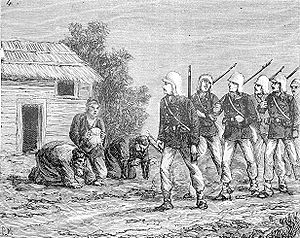 Kowtow came into English in the early 19th century to describe the bow itself, but its meaning soon shifted to describe any abject submission or grovelling. Many Westerners
who first encountered the practice believed it was a sign of worship, but kowtowing does not necessarily have religious overtones in traditional Chinese culture.
The kowtow was a significant issue for diplomats, since it was required to come into the presence of the Emperor of China
, but it meant submission before him. The British embassies of George Macartney, 1st Earl Macartney
(1793) and William Pitt Amherst, 1st Earl Amherst (1816) were foiled, since kowtowing would mean acknowledging their King as a subject of the Emperor
.
Dutch ambassador Isaac Titsingh
did not refuse to kowtow during the course of his 1794-1795 mission to the Imperial Court of Emperor Qianlong. The members of the Titsingh mission, including Andreas Everardus van Braam Houckgeest
and Chrétien-Louis-Joseph de Guignes
, made every effort to conform with the demands of the complex Imperial court etiquette. Neither the Chinese nor these Europeans could have known that this would be the last appearance by any Western ambassador at the Imperial court until after the Opium Wars
of the next century.
The kowtow was often performed in intra-Asian diplomatic relations as well. In 1636, Injo who was king of the Korean Joseon Dynasty had to kneel three times on the ground and touch his head three times on the ground (三拜三叩頭禮), to show his allegiance to Huang Taiji who was the first Emperor of the Qing Dynasty
. The King of the Ryukyu Kingdom
also had to kneel three times on the ground and touch his head nine times to the ground (三拜九叩頭禮), to show his vassal status to the Chinese Dynasty.
Kneeling
Kneeling is a human position in which the weight is distributed on the knees and feet on a surface close to horizontal.The position of kneeling may be assumed for practical reasons and for reasons of social or religious custom.- Practical reasons :...
and bowing so low as to have one's head touching the ground. An alternative Chinese term is ketou, however the meaning is somewhat altered: kòu originally meant "knock with reverence", whereas kē has the general meaning of "touch upon (a surface)".
In Han Chinese
Han Chinese
Han Chinese are an ethnic group native to China and are the largest single ethnic group in the world.Han Chinese constitute about 92% of the population of the People's Republic of China , 98% of the population of the Republic of China , 78% of the population of Singapore, and about 20% of the...
culture, the kowtow is the highest sign of reverence. It was widely used to show reverence for one's elders, superiors, and especially the Emperor
Emperor of China
The Emperor of China refers to any sovereign of Imperial China reigning between the founding of Qin Dynasty of China, united by the King of Qin in 221 BCE, and the fall of Yuan Shikai's Empire of China in 1916. When referred to as the Son of Heaven , a title that predates the Qin unification, the...
, as well as for religious and cultural objects of worship. In modern times, usage of the kowtow has become much reduced.
Traditional usage
In Imperial Chinese protocol, the kowtow was performed before the Emperor of China. Depending on the solemnity of the situation different grades of kowtow would be used. In the most solemn of ceremonies, for example at the coronation of a new Emperor, the Emperor's subjects would undertake the ceremony of the "three kneelings and nine kowtows", which involves kneeling from a standing position three times, and each time, performing the kowtow three times while kneeling. Immanuel Shu describes the "full kowtow" as "three kneelings and nine knockings of the head on the ground."As government officials represented the majesty of the Emperor while carrying out their duties, commoners were also required to kowtow to them in formal situations. For example, a commoner brought before a local magistrate would be required to kneel and kowtow. A commoner is then required to remain kneeling, whereas a person who has earned a degree in the Imperial examination
Imperial examination
The Imperial examination was an examination system in Imperial China designed to select the best administrative officials for the state's bureaucracy. This system had a huge influence on both society and culture in Imperial China and was directly responsible for the creation of a class of...
s is permitted a seat.
Since one is required by Confucian philosophy
Confucianism
Confucianism is a Chinese ethical and philosophical system developed from the teachings of the Chinese philosopher Confucius . Confucianism originated as an "ethical-sociopolitical teaching" during the Spring and Autumn Period, but later developed metaphysical and cosmological elements in the Han...
to show great reverence to one's parents and grandparents, children may also be required to kowtow to their elderly ancestors, particularly on special occasions. For example, at a wedding, the marrying couple was traditionally required to kowtow to both sets of parents, as acknowledgement of the debt owed for their nurturing.
Confucius
Confucius
Confucius , literally "Master Kong", was a Chinese thinker and social philosopher of the Spring and Autumn Period....
believed there was a natural harmony between the body and mind and therefore, whatever actions were expressed through the body would be transferred over to the mind. Because the body is placed in a low position in the kowtow, the idea is that one will naturally convert to his or her mind a feeling of respect. What one does to oneself has an impact on the mind. Confucian philosophy held that respect was important for a society, making bowing an important ritual.
Modern usage
The kowtow, and other traditional forms of reverence, were much maligned after the May Fourth MovementMay Fourth Movement
The May Fourth Movement was an anti-imperialist, cultural, and political movement growing out of student demonstrations in Beijing on May 4, 1919, protesting the Chinese government's weak response to the Treaty of Versailles, especially the Shandong Problem...
. Today, only vestiges of the traditional usage of the kowtow remain. In many situations, the standing bow has replaced the kowtow. For example, some, but not all, people would choose to kowtow before the grave of an ancestor, or while making traditional offerings to an ancestor. Direct descendants may also kowtow at the funeral of an ancestor, while others would simply bow. During a wedding, some couples may kowtow to their respective parents, though the standing bow is today more common. In extreme cases, the kowtow can be used to express profound gratitude, apology, or to beg for forgiveness.
The kowtow remains alive as part of a formal induction ceremony in certain traditional trades that involve apprenticeship or discipleship. For example, Chinese martial arts
Chinese martial arts
Chinese martial arts, also referred to by the Mandarin Chinese term wushu and popularly as kung fu , are a number of fighting styles that have developed over the centuries in China. These fighting styles are often classified according to common traits, identified as "families" , "sects" or...
schools often require a student to kowtow to a master. Likewise, traditional performing arts often also require the kowtow.
Religion
The kowtow is often performed in groups of three before Buddhist statues and images or tombs of the dead. In BuddhismBuddhism
Buddhism is a religion and philosophy encompassing a variety of traditions, beliefs and practices, largely based on teachings attributed to Siddhartha Gautama, commonly known as the Buddha . The Buddha lived and taught in the northeastern Indian subcontinent some time between the 6th and 4th...
it is more commonly termed either "worship with the crown (of the head)" (頂禮 ding li) or "casting the five limbs to the earth" (五體投地 wuti tou di) - referring to the two arms, two legs and forehead. For example, in certain ceremonies, a person would perform a sequence of three sets of three kowtows - stand up and kneel down again between each set - as an extreme gesture of respect; hence the term three kneelings and nine head knockings . Also, some Buddhist pilgrims
Pilgrimage
A pilgrimage is a journey or search of great moral or spiritual significance. Typically, it is a journey to a shrine or other location of importance to a person's beliefs and faith...
would kowtow once for every three steps made during their long journeys. Often the number three referring to the Triple Gem of Buddhism, the Buddha
Buddhahood
In Buddhism, buddhahood is the state of perfect enlightenment attained by a buddha .In Buddhism, the term buddha usually refers to one who has become enlightened...
, Dharma
Dharma
Dharma means Law or Natural Law and is a concept of central importance in Indian philosophy and religion. In the context of Hinduism, it refers to one's personal obligations, calling and duties, and a Hindu's dharma is affected by the person's age, caste, class, occupation, and gender...
, and Sangha
Sangha
Sangha is a word in Pali or Sanskrit that can be translated roughly as "association" or "assembly," "company" or "community" with common goal, vision or purpose...
.
Diplomacy and the West
Western world
The Western world, also known as the West and the Occident , is a term referring to the countries of Western Europe , the countries of the Americas, as well all countries of Northern and Central Europe, Australia and New Zealand...
who first encountered the practice believed it was a sign of worship, but kowtowing does not necessarily have religious overtones in traditional Chinese culture.
The kowtow was a significant issue for diplomats, since it was required to come into the presence of the Emperor of China
Emperor of China
The Emperor of China refers to any sovereign of Imperial China reigning between the founding of Qin Dynasty of China, united by the King of Qin in 221 BCE, and the fall of Yuan Shikai's Empire of China in 1916. When referred to as the Son of Heaven , a title that predates the Qin unification, the...
, but it meant submission before him. The British embassies of George Macartney, 1st Earl Macartney
George Macartney, 1st Earl Macartney
George Macartney, 1st Earl Macartney, KB was an Irish-born British statesman, colonial administrator and diplomat. He is often remembered for his observation following Britain's success in the Seven Years War and subsequent territorial expansion at the Treaty of Paris that Britain now controlled...
(1793) and William Pitt Amherst, 1st Earl Amherst (1816) were foiled, since kowtowing would mean acknowledging their King as a subject of the Emperor
Emperor of China
The Emperor of China refers to any sovereign of Imperial China reigning between the founding of Qin Dynasty of China, united by the King of Qin in 221 BCE, and the fall of Yuan Shikai's Empire of China in 1916. When referred to as the Son of Heaven , a title that predates the Qin unification, the...
.
Dutch ambassador Isaac Titsingh
Isaac Titsingh
Isaac Titsingh FRS was a Dutch surgeon, scholar, merchant-trader and ambassador.During a long career in East Asia, Titsingh was a senior official of the Dutch East India Company . He represented the European trading company in exclusive official contact with Tokugawa Japan...
did not refuse to kowtow during the course of his 1794-1795 mission to the Imperial Court of Emperor Qianlong. The members of the Titsingh mission, including Andreas Everardus van Braam Houckgeest
Andreas Everardus van Braam Houckgeest
Andreas Everardus van Braam Houckgeest Dutch-American merchant who is mostly known for his participation in the last Dutch embassy to China under the tributary system.- Early career :...
and Chrétien-Louis-Joseph de Guignes
Chrétien-Louis-Joseph de Guignes
Chrétien-Louis-Joseph de Guignes was a French merchant-trader, ambassador and scholar. He was the son of French academician and sinologue, Joseph de Guignes...
, made every effort to conform with the demands of the complex Imperial court etiquette. Neither the Chinese nor these Europeans could have known that this would be the last appearance by any Western ambassador at the Imperial court until after the Opium Wars
Second Opium War
The Second Opium War, the Second Anglo-Chinese War, the Second China War, the Arrow War, or the Anglo-French expedition to China, was a war pitting the British Empire and the Second French Empire against the Qing Dynasty of China, lasting from 1856 to 1860...
of the next century.
The kowtow was often performed in intra-Asian diplomatic relations as well. In 1636, Injo who was king of the Korean Joseon Dynasty had to kneel three times on the ground and touch his head three times on the ground (三拜三叩頭禮), to show his allegiance to Huang Taiji who was the first Emperor of the Qing Dynasty
Qing Dynasty
The Qing Dynasty was the last dynasty of China, ruling from 1644 to 1912 with a brief, abortive restoration in 1917. It was preceded by the Ming Dynasty and followed by the Republic of China....
. The King of the Ryukyu Kingdom
Ryukyu Kingdom
The Ryūkyū Kingdom was an independent kingdom which ruled most of the Ryukyu Islands from the 15th century to the 19th century. The Kings of Ryūkyū unified Okinawa Island and extended the kingdom to the Amami Islands in modern-day Kagoshima Prefecture, and the Sakishima Islands near Taiwan...
also had to kneel three times on the ground and touch his head nine times to the ground (三拜九叩頭禮), to show his vassal status to the Chinese Dynasty.
See also
- Chinese social relationsChinese social relationsChinese social relations are social relations typified by a reciprocal social network. Often social obligations within the network are characterized in familial terms. The individual link within the social network is known by guanxi and the feeling within the link is known by the term ganqing...
- Culture of ChinaCulture of ChinaChinese culture is one of the world's oldest and most complex. The area in which the culture is dominant covers a large geographical region in eastern Asia with customs and traditions varying greatly between towns, cities and provinces...
- Finger kowtow:
- Finger tapping in Chinese tea culture
- Finger tapping in Yum Cha
- Posture emoticons
- Foot washing, another act of extreme humilityHumilityHumility is the quality of being modest, and respectful. Humility, in various interpretations, is widely seen as a virtue in many religious and philosophical traditions, being connected with notions of transcendent unity with the universe or the divine, and of egolessness.-Term:The term "humility"...
- GadawGadawGadaw is a Burmese verb referring to a Burmese tradition in which a person, always of lower social standing, pays respect or homage to a person of higher standing , by kneeling before them and paying obeisance with joined hands, and bowing...
, a Burmese form of obeisance akin to kowtow - John MoyseJohn MoysePrivate John Moyse was a British soldier of the 3rd Regiment who according to popular legend was captured by Chinese soldiers during the Second Opium War and later was executed for refusing to prostrate himself before the Chinese general...
- SaluteSaluteA salute is a gesture or other action used to display respect. Salutes are primarily associated with armed forces, but other organizations and civil people also use salutes.-Military salutes:...
- SifuSifuShifu is the identical pronunciation of two Chinese terms for a master. The character 師 means “teacher”. The meaning of 傅 is “tutor”, and of 父, “father”. Both characters are read fu with the same tones in Cantonese and Mandarin, creating some ambiguity...
- Sujud
- OrzOrzOrz may refer to:* orz, a posture emoticon representing a kneeling, bowing, or comically fallen over person* Orz, a race in the fictional Star Control universe...
- DogezaDogezais an element of Japanese manners by kneeling directly on the ground and bowing to prostrate oneself as touching one's head to the floor. It is translated into English as "prostration" or "kowtow". It is used to show deference to the most highly-revered high-class person, as a deep apology and to...
- ProskynesisProskynesisProskynesis refers to the traditional Persian act of prostrating oneself before a person of higher social rank....