

History of Vietnam

Encyclopedia
The history of Vietnam
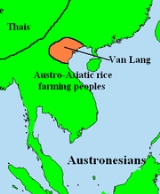
covers a period of more than 2,700 years. By far Vietnam's most important historical international relationship has been with China. Vietnam's prehistory includes a legend about a kingdom known as Van Lang (2787–2858 BC) that included what is now China's Guangxi Autonomous Region and Guangdong province, as well as the northern part of Vietnam. Later, successive dynasties based in China ruled Vietnam directly for most of the period from 207 BC until 938 when Vietnam regained its independence
. Vietnam remained a tributary state
to its larger neighbor China for much of its history but repelled invasions by the Chinese as well as three invasions by the Mongols
between 1255 and 1285. Emperor Trần Nhân Tông later diplomatically submitted Vietnam to a tributary of the Yuan to avoid further conflicts. The independent period temporarily ended in the middle to late 19th century, when the country was colonized by France (see French Indochina
).
During World War II
, Imperial Japan expelled the French to occupy Vietnam, though they retained French administrators during their occupation. After the war, France attempted to re-establish its colonial rule but ultimately failed in the First Indochina War
. The Geneva Accords
partitioned the country in two with a promise of democratic election to reunite the country. However, rather than peaceful reunification, partition led to the Vietnam War
. During this time, the People's Republic of China and the Soviet Union supported the North
while the United States supported the South
. The Vietnam War ended with the Fall of Saigon
in April 1975.
After the reunification in 1975, Vietnam suffered further internal repression and isolation from the international community due to the Cold War
and the Vietnamese invasion of Cambodia
. In 1986, the Communist Party of Vietnam
changed its economic policy and began reforms of the private sector similar to those in China. Since the mid-1980s, Vietnam has enjoyed substantial economic growth.
Đông Sơn culture in Northern Vietnam was found in Cổ Loa, an ancient city situated near present-day Hà Nội.
According to mythology, the first Vietnamese people were descended from the Dragon Lord Lạc Long Quân
and the Immortal Fairy Âu Cơ
. Lạc Long Quân and Âu Cơ had 100 sons before deciding to part ways. 50 of the children went with their mother to the mountains, and the other 50 went with their father to the sea. The eldest son became the first in a line of early Vietnamese kings, collectively known as the Hùng kings (Hùng Vương
or the Hồng Bàng Dynasty). The Hùng kings called their country, located on the Red River
delta in present-day northern Vietnam, Văn Lang
. The people of Văn Lang were known as the Lạc Việt.
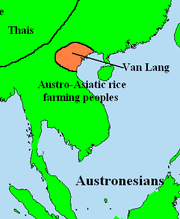
 Văn Lang is thought to have been a matriarchal society, similar to many other matriarchal societies common in Southeast Asia and in the Pacific islands at the time. Various archaeological sites in northern Vietnam, such as Đông Sơn have yielded metal weapons and tools from this age. Most famous of these artifacts are large bronze drums, probably made for ceremonial purposes, with sophisticated engravings on the surface, depicting life scenes with warriors, boats, houses, birds and animals in concentric circles around a radiating sun at the center.
Many legends from this period offer a glimpse into the life of the people. The Legend of the Rice Cakes is about a prince who won a culinary contest; he then wins the throne because his creations, the rice cakes, reflect his deep understanding of the land's vital economy: rice farming. The Legend of Giong tells of a youth going to war to save the country, wearing iron armor, riding an armored horse, and wielding an iron staff, showed that metalworking
was sophisticated. The Legend of the Magic Crossbow, about a crossbow that can deliver thousands of arrows, showed extensive use of archery in warfare.
Chinese accounts tell much about the early Vietnamese people. Plows and draft animals were not yet used, and fields were worked with polished stone hoes. Fishing and hunting supplemented the main rice crop. Arrowheads and spears were dipped in poison to kill larger animals such as elephants, whose tusks were traded to China for iron ore. Betel nuts were widely chewed and the lower classes rarely wore clothing more substantial than a loincloth. Every spring, a fertility festival was held which featured huge parties and sexual abandon. Religion consisted of primitive animistic cults. Overall, the early Vietnamese were not much different from other Southeast Asian peoples of the time, and it wasn't until later that a distinct national culture emerged.
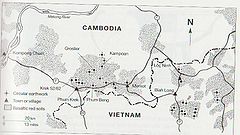
Recent research has revealed artificial circular earthworks
in the areas of present day southern Vietnam and overlapping to the borders of Cambodia
. These archaeological remains are estimated to be economic, social and cultural entities from the 1st millennium BC
.
, southern China, then proclaimed himself king of a new independent kingdom, Nam Việt
(Chinese: Nan Yue). Trọng Thủy, the supposed crown prince, drowned himself in Cổ Loa out of remorse for the death of his wife in the war.
Some Vietnamese consider Triệu's rule a period of Chinese domination, since Triệu Đà was a former Qin
general. Others consider it an era of Việt independence as the Triệu family in Nam Việt were assimilated to local culture. They ruled independently of what then constituted China's (Han Dynasty
). At one point, Triệu Đà even declared himself Emperor, equal to the Chinese Han Emperor in the north.
and established new territories, dividing Vietnam into Giao Chỉ (Chinese: 交趾 pinyin: Jiaozhi
, now the Red River delta); Cửu Chân from modern-day Thanh Hoá
to Hà Tĩnh
; and Nhật Nam, from modern-day Quảng Bình to Huế
. While governors and top officials were Chinese, the original Vietnamese nobles (Lạc Hầu, Lạc Tướng) still managed some highlands.
The Chinese began a vigorous campaign to civilize and assimilate the as-yet illiterate, tribal native population. Chinese culture, rituals, and governmental organization were imposed along with Taoism
and Confucianism in addition to the language and writing system. Even Chinese clothing and hairstyles were required. Many of these innovations were gladly taken up by the Vietnamese, but they still insisted on maintaining a distinct language and national identity. Over time, Vietnamese nationalism grew, and while they looked to their huge neighbor for cultural inspiration, the desire for independence was strong.
In 40 AD, the Trưng Sisters
led a successful revolt against Han Governor Tô Định (蘇定 pinyin: Sū Dìng) and recaptured 65 states (including modern Guangxi). Trưng Trắc became the Queen (Trưng Nữ Vương
). In 43 AD, Emperor Guangwu of Han
sent his famous general Mã Viện (Chinese: Ma Yuan) with a large army to quell the revolt. After a long, difficult campaign, Ma Yuan suppressed the uprising and the Trung Sisters committed suicide to avoid capture. To this day, the Trưng Sisters
are revered in Vietnam as the national symbol of Vietnamese women. Learning a lesson from the Trưng revolt, the Han and other successful Chinese dynasties took measures to eliminate the power of the Vietnamese nobles. The Vietnamese elites would be coerced to assimilate into Chinese culture and politics. Nearly 200 years passed before the Vietnamese attempted another revolt. In 225 AD another woman, Triệu Thị Trinh
, popularly known as Lady Triệu (Bà Triệu), led another revolt which lasted until 248 AD. Once again, the uprising failed and Triệu Thị Trinh threw herself into a river.
During the Tang dynasty, Vietnam was called Annam
(Giao Châu) until the early 10th century AD. Giao Chỉ (with its capital around modern Bắc Ninh
province) became a flourishing trading outpost, receiving goods from the southern seas. The "History of Later Han" (Hậu Hán Thư, Hou Hanshu) recorded that in 166 AD the first envoy from the Roman Empire
to China arrived by this route, and merchants were soon to follow. The 3rd-century "Tales of Wei" (Ngụy Lục, Weilue) mentioned a "water route" (the Red River) from Jiaozhi into what is now southern Yunnan
. From there, goods were taken overland to the rest of China via the regions of modern Kunming
and Chengdu
.
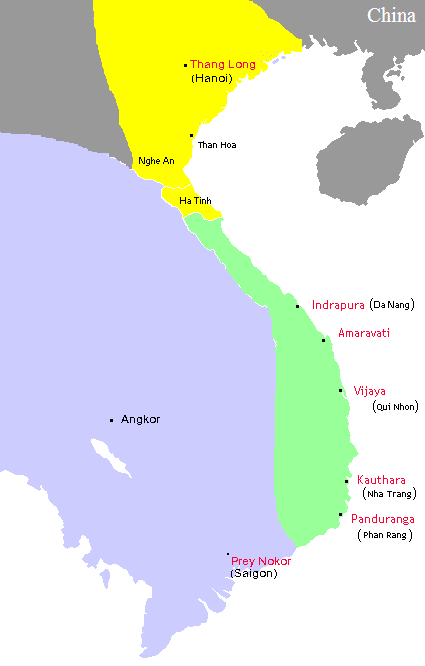
At the same time, in present-day central Vietnam, there was a successful revolt of Cham nations. Chinese dynasties called it Lin-Yi (Lin village). It later became a powerful kingdom, Champa
, stretching from Quảng Bình to Phan Thiết (Bình Thuận). In addition, the local languages began to diverge. The modern Vietnamese tongue developed from the dialect of the towns, while that of the hill tribes developed into the Hmung language. By the 10th century AD, the separation between the two was complete.
In the period between the beginning of the Chinese Age of Fragmentation to the end of the Tang Dynasty
, several revolts against Chinese rule took place, such as those of Lý Bôn and his general and heir Triệu Quang Phục; and those of Mai Thúc Loan and Phùng Hưng
. All of them ultimately failed, yet most notable were Lý Bôn and Triệu Quang Phục, whose Anterior Lý Dynasty ruled for almost half a century, from 544 AD to 602 AD, before the Chinese Sui Dynasty
reconquered their kingdom Vạn Xuân.
, followed by Dương Đình Nghệ, ruled Giao Châu autonomously under the Tang
title of Tiết Độ Sứ, Virtuous Lord, but stopping short of proclaiming themselves kings.
In 938, Southern Han
sent troops to conquer autonomous Giao Châu. Ngô Quyền
, Dương Đình Nghệ's son-in-law, defeated the Southern Han fleet at the Battle of Bạch Đằng River (938). He then proclaimed himself King Ngô and effectively began the age of independence for Vietnam.
Ngô Quyền's untimely death after a short reign resulted in a power struggle for the throne, the country's first major civil war, The upheavals of Twelve warlords (Loạn Thập Nhị Sứ Quân). The war lasted from 945 AD to 967 AD when the clan led by Đinh Bộ Lĩnh defeated the other warlords, unifying the country. Dinh founded the Đinh Dynasty and proclaimed himself First Emperor (Tiên Hoàng) of Đại Cồ Việt (Hán tự: 大瞿越; literally "Great Viet Land"), with its capital in Hoa Lư
(modern day Ninh Bình). However, the Chinese Song Dynasty
only officially recognized him as Prince of Jiaozhi (Giao Chỉ Quận Vương). Emperor Đinh introduced strict penal codes to prevent chaos from happening again. He tried to form alliances by granting the title of Queen to five women from the five most influential families.
In 979 AD, Emperor Đinh Bộ Lĩnh and his crown prince Đinh Liễn were assassinated, leaving his lone surviving son, the 6-year-old Đinh Toàn, to assume the throne. Taking advantage of the situation, the Chinese Song Dynasty
invaded Đại Cồ Việt. Facing such a grave threat to national independence, the court's Commander of the Ten Armies (Thập Đạo Tướng Quân) Lê Hoàn
took the throne, founding the Former Lê Dynasty
. A capable military tactician, Lê Hoan realized the risks of engaging the mighty Chinese troops head on; thus he tricked the invading army into Chi Lăng Pass, then ambushed and killed their commander, quickly ending the threat to his young nation in 981 AD. The Song Dynasty withdrew their troops yet would not recognize Lê Hoàn as Prince of Jiaozhi until 12 years later; nevertheless, he is referred to in his realm as Đại Hành Emperor (Đại Hành Hoàng Đế). Emperor Lê Hoàn was also the first Vietnamese monarch who began the southward expansion process against the kingdom of Champa
.
Emperor Lê Hoàn's death in 1005 AD resulted in infighting for the throne amongst his sons. The eventual winner, Lê Long Đĩnh, became the most notorious tyrant in Vietnamese history. He devised sadistic punishments of prisoners for his own entertainment and indulged in deviant sexual activities. Toward the end of his short life he died at 24 Lê Long Đĩnh became so ill that he had to lie down when meeting with his officials in court.
 When the king Lê Long Đĩnh died in 1009 AD, a Palace Guard Commander named Lý Công Uẩn was nominated by the court to take over the throne, and founded the Lý dynasty
. This event is regarded as the beginning of a golden era in Vietnamese history, with great following dynasties. The way Lý Công Uẩn ascended to the throne was rather uncommon in Vietnamese history. As a high-ranking military commander residing in the capital, he had all opportunities to seize power during the tumultuous years after Emperor Lê Hoàn's death, yet preferring not to do so out of his sense of duty. He was in a way being "elected" by the court after some debate before a consensus was reached.
Lý Công Uẩn, posthumously referred as Lý Thái Tổ, changed the country's name to Đại Việt (Hán tự: 大越; literally "Great Viet"). The Lý Dynasty is credited for laying down a concrete foundation, with strategic vision, for the nation of Vietnam. Leaving Hoa Lư, a natural fortification surrounded by mountains and rivers, Lý Công Uẩn moved his court to the new capital in present-day Hanoi
and called it Thăng Long
(Ascending Dragon). Lý Công Uẩn thus departed from the militarily defensive mentality of his predecessors and envisioned a strong economy as the key to national survival. Successive Lý kings continued to accomplish far-reaching feats: building a dike system to protect the rice producing area; founding Quốc Tử Giám, the first noble university; holding regular examinations to select capable commoners for government positions once every three years; organizing a new system of taxation; establishing humane treatment of prisoners. Women were holding important roles in Lý society as the court ladies were in charge of tax collection. The Lý Dynasty also promoted Buddhism
, yet maintained a pluralistic attitude toward the three main philosophical systems of the time: Buddhism, Confucianism
, and Taoism
. During the Lý Dynasty, the Chinese Song Dynasty
officially recognized the Đại Việt monarch as King of Giao Chỉ (Giao Chỉ Quận Vương).
The Lý Dynasty had two major wars with Song
China, and a few conquests against neighboring Champa
in the south. The most notable battle took place on Chinese territory in 1075 AD. Upon learning that a Song invasion was imminent, the Lý army and navy totalling about 100,000 men under the command of Lý Thường Kiệt, Tông Đản used amphibious
operations to preemptively destroy three Song military installations at Yong Zhou, Qin Zhou, and Lian Zhou in present-day Guangdong
and Guangxi
, and killed 100,000 Chinese. The Song Dynasty took revenge and invaded Đại Việt in 1076, but the Song troops were held back at the Battle of Như Nguyệt River commonly known as the Cầu river, now in Bắc Ninh province about 40 km from the current capital, Hanoi. Neither side was able to force a victory, so the Lý Dynasty proposed a truce, which the Song emperor accepted.
Champa and the powerful Khmer Empire took advantage of the Lý Dynasty's distraction with the Chinese to pillage the south of the country. Together they invaded Vietnam in 1128 and 1132. Further invasions followed in the subsequent decades.
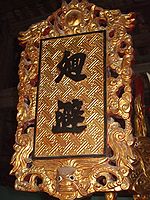 Toward the end of the Lý Dynasty, a powerful court minister named Trần Thủ Độ forced king Lý Huệ Tông to become a Buddhist monk and Lý Chiêu Hoàng, Huệ Tông's young daughter, to become queen. Trần Thủ Độ then arranged the marriage of Chiêu Hoàng to his nephew Trần Cảnh and eventually had the throne transferred to Trần Cảnh, thus begun the Trần Dynasty. Trần Thủ Độ viciously purged members of the Lý nobility; some Lý princes escaped to Korea, including Lý Long Tường.
After the purge, most Trần kings ruled the country in similar manner to the Lý kings. Noted Trần Dynasty accomplishments include the creation of a system of population records based at the village level, the compilation of a formal 30-volume history of Đại Việt (Đại Việt Sử Ký) by Lê Văn Hưu
, and the rising in status of the Nôm
script, a system of writing for Vietnamese language. The Trần Dynasty also adopted a unique way to train new kings: when a crown prince reached the age of 18, his predecessor would abdicate and turn the throne over to him, yet holding a title of August Higher Emperor (Thái Thượng Hoàng), acting as a mentor to the new Emperor. Despite continued Champa-Khmer attacks, the Trần managed to arrange several periods of peace with them.
under Mongke Khan
and Kublai Khan
, the founder of the Yuan dynasty
invaded Vietnam in 1257 AD, 1284 AD, and 1288 AD
. Đại Việt repelled all attacks of the Yuan during the reign of Kublai Khan. Three Yuan armies said to have numbered from 300,000 to 500,000 men were defeated. The key to Đại Việt's successes was to avoid the Mongols' strength in open field battles and city sieges - the Trần court abandoned the capital and the cities. The Mongols were then countered decisively at their weak points, which were battles in swampy areas such as Chương Dương, Hàm Tử, Vạn Kiếp and on rivers such as Vân Đồn and Bạch Đằng. The Mongols also suffered from tropical diseases and loss of supplies to Trần army's raids. The Yuan-Trần war reached its climax when the retreating Yuan fleet was decimated at the Battle of Bạch Đằng (1288). The military architect behind Đại Việt's victories was Commander Trần Quốc Tuấn, more popularly known as Trần Hưng Đạo. In order to avoid further disastrous campaigns, the Tran and Champa acknowledged Mongol supremacy.
, continuing the Viets' long history of southern expansion (known as Nam Tiến) that had begun shortly after gaining independence from China. Often, they encountered strong resistance from the Chams. Champa was made into a tributary state of Vietnam in 1312, but ten years later regained independence and Champa troops led by king Chế Bồng Nga
(Cham: Po Binasuor or Che Bonguar) killed king Trần Duệ Tông in battle and even laid siege to Đại Việt's capital Thăng Long in 1377 AD and again in 1383 AD. However, the Trần Dynasty was successful in gaining two Champa provinces, located around present-day Huế
, through the peaceful means of the political marriage of Princess Huyền Trân
to a Cham king.
Literacy remained the provenance of the upper classes. Initially, Chinese was used for writing purposes, but by the 13th century, a set of derivative characters known as chu nom emerged that allowed native Vietnamese words to be written. However, it remained limited to poetry, literature, and practical texts like medicine while all state and official documents were written in Classical Chinese. Aside from some mining and fishing, subsistence agriculture was the primary activity of most Vietnamese, and economic development and trade were not promoted or encouraged by the state.
, Hồ Quý Ly's reign actually introduced a lot of progressive, ambitious reforms, including the addition of mathematics to the national examinations, the open critique of Confucian philosophy, the use of paper currency in place of coins, investment in building large warships and cannon, and land reform. He ceded the throne to his son, Hồ Hán Thương, in 1401 and assumed the title Thái Thượng Hoàng, in similar manner to the Trần kings.
In 1407, under the pretext of helping to restore the Trần Dynasty, Chinese Ming
troops invaded Đại Ngu and captured Hồ Quý Ly and Hồ Hán Thương. The Hồ Dynasty came to an end after only 7 years in power. The Ming occupying force annexed Đại Ngu into the Ming Empire after claiming that there was no heir to Trần throne. Vietnam, weakened by dynastic feuds and the wars with Champa, quickly succumbed. The Ming conquest was harsh. Vietnam was annexed directly as a province of China, the old policy of cultural assimilation again imposed forcibly, and the country was ruthlessly exploited. However by this time, Vietnamese nationalism had reached a point where attempts to turn them into Chinese could only arose further resistance.
Almost immediately, Trần loyalists started a resistance war. The resistance, under the leadership of Trần Quĩ at first gained some advances, yet as Trần Quĩ executed two top commanders out of suspicion, a rift widened within his ranks and resulted in his defeat in 1413.
In 1418, a wealthy farmer, Lê Lợi, led the Lam Sơn uprising
against the Ming from his base of Lam Sơn (Thanh Hóa province). Overcoming many early setbacks and with strategic advices from Nguyễn Trãi, Lê Lợi's movement finally gathered momentum, marched northward, and launched a siege at Đông Quan (now Hanoi), the capital of the Ming occupation. The Ming Emperor sent a reinforcement force, but Lê Lợi staged an ambush and killed the Ming commander, Liễu Thăng
(Chinese: Liu Sheng), in Chi Lăng
. Ming troops at Đông Quan surrendered. The Lam son revolution killed 300,000 Ming soldiers. In 1428, Lê Lợi ascended to the throne and began the Hậu Lê dynasty
(Posterior or Later Lê). Lê Lợi renamed the country back to Đại Việt and moved the capital back to Thăng Long
.
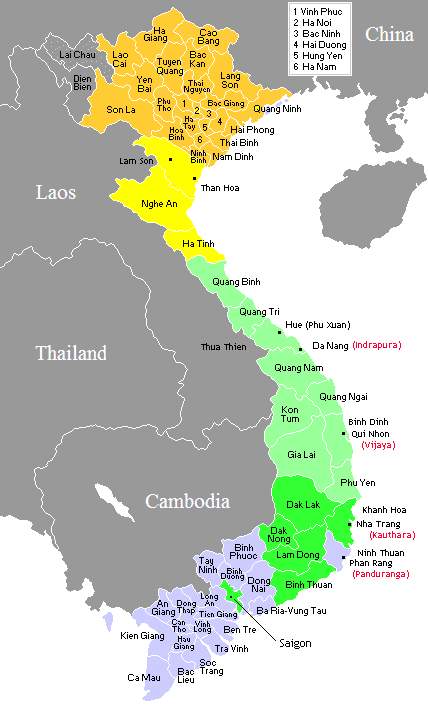 The Lê Dynasty carried out land reforms to revitalize the economy after the war. Unlike the Lý and Trần kings, who were more influenced by Buddhism, the Lê kings leaned toward Confucianism
. A comprehensive set of laws, the Hồng Đức code was introduced with some strong Confucian elements, yet also included some progressive rules, such as the rights of women. Art and architecture during the Lê Dynasty also became more influenced by Chinese styles than during the Lý and Trần Dynasty. The Lê Dynasty commissioned the drawing of national maps and had Ngô Sĩ Liên
continue the task of writing Đại Việt's history up to the time of Lê Lợi. King Lê Thánh Tông
opened hospitals and had officials distribute medicines to areas affected with epidemics.
Overpopulation and land shortages stimulated Vietnamese expansion south. In 1471, Le troops led by king Lê Thánh Tông
invaded Champa
in the 1471 Vietnamese invasion of Champa
and captured its capital Vijaya. This event effectively ended Champa as a powerful kingdom, although some smaller surviving Cham states lasted for a few centuries more. It initiated the dispersal of the Cham people across Southeast Asia. With the kingdom of Champa mostly destroyed and the Cham people exiled or suppressed, Vietnamese colonization of what is now central Vietnam proceeded without substantial resistance. However, despite becoming greatly outnumbered by Kinh (Việt) settlers and the integration of formerly Cham territory into the Vietnamese nation, the majority of Cham people nevertheless remained in Vietnam and they are now considered one of the key minorities in modern Vietnam. Vietnamese armies also raided the Mekong Delta, which the decaying Khmer Empire could no longer defend. The city of Huế, founded in 1600 lies close to where the Champa capital of Indrapura once stood. In 1479, King Lê Thánh Tông also campaigned against Laos
and captured its capital Luang Prabang
. He made further incursions westwards into the Irrawaddy River region in modern-day Burma before withdrawing.
Meanwhile, Nguyễn Kim, a former official in the Lê court, revolted against the Mạc and helped king Lê Trang Tông restore the Lê court in the Thanh Hóa
area. Thus a civil war began between the Northern Court (Mạc) and the Southern Court (Restored Lê). Nguyễn Kim's side controlled the southern part of Đại Việt (from Thanhhoa to the south), leaving the north (including Đông Kinh-Hanoi) under Mạc control. When Nguyễn Kim was assassinated in 1545, military power fell into the hands of his son-in-law, Trịnh Kiểm. In 1558, Nguyễn Kim's son, Nguyễn Hoàng, suspecting that Trịnh Kiểm might kill him as he had done to his brother to secure power, asked to be governor of the far south provinces around present-day Quảng Bình
to Bình Định. Hoang pretended to be insane, so Kiem was fooled into thinking that sending Hoang south was a good move as Hoang would be quickly killed in the lawless border regions. However, Hoang governed the south effectively while Trịnh Kiểm, and then his son Trịnh Tùng, carried on the war against the Mạc. Nguyễn Hoàng sent money and soldiers north to help the war but gradually he became more and more independent, transforming their realm's economic fortunes by turning it into an international trading post.
The civil war between the Lê/Trịnh and Mạc dynasties ended in 1592, when the army of Trịnh Tùng conquered Hanoi
and executed king Mạc Mậu Hợp. Survivors of the Mạc royal family fled to the northern mountains in the province of Cao Bằng and continued to rule there until 1667 when Trịnh Tạc conquered this last Mạc territory. The Lê kings, ever since Nguyễn Kim's restoration, only acted as figureheads. After the fall of the Mạc Dynasty, all real power in the north belonged to the Trịnh Lords.
Meanwhile, the Ming court reluctantly decided on a military intervention into the Vietnamese civil war, but Mac Dang Dung offered ritual submission to China, who accepted it.
. Nguyễn Hoàng died in 1613 after having ruled the south for 55 years. He was succeeded by his 6th son, Nguyễn Phúc Nguyên, who likewise refused to acknowledge the power of the Trịnh, yet still pledged allegiance to the Lê king.
Trịnh Tráng succeeded Trịnh Tùng, his father, upon his death in 1623. Tráng ordered Nguyễn Phúc Nguyên to submit to his authority. The order was refused twice. In 1627, Trịnh Tráng sent 150,000 troops southward in an unsuccessful military campaign. The Trịnh were much stronger, with a larger population, economy and army, but they were unable to vanquish the Nguyễn, who had built two defensive stone walls and invested in Portuguese artillery.
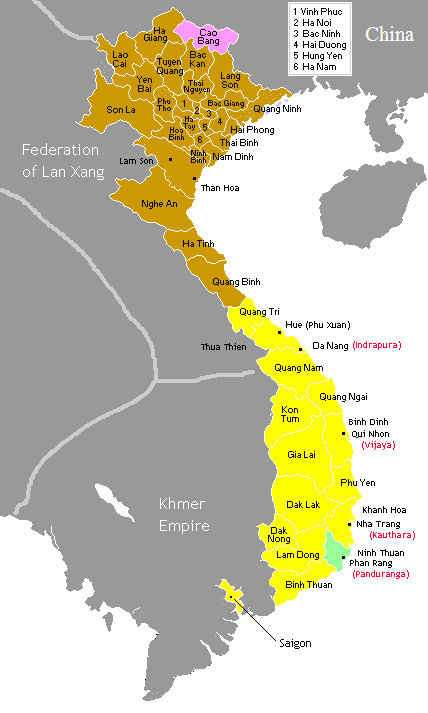
 The Trịnh-Nguyễn War lasted from 1627 until 1672. The Trịnh army staged at least seven offensives, all of which failed to capture Phú Xuân. For a time, starting in 1651, the Nguyễn themselves went on the offensive and attacked parts of Trịnh territory. However, the Trịnh, under a new leader, Trịnh Tạc, forced the Nguyễn back by 1655. After one last offensive in 1672, Trịnh Tạc agreed to a truce with the Nguyễn Lord Nguyễn Phúc Tần. The country was effectively divided in two.
Meanwhile, the Nguyễn Lords continued the southward expansion by the conquest of the remaining Cham land. Việt settlers also arrived in the sparsely populated area known as "Water Chenla", which was the lower Mekong Delta
portion of Chenla
(present-day Cambodia
). Between the mid-17th century to mid-18th century, as Chenla
was weakened by internal strife and Siamese invasions, the Nguyễn Lords used various means, political marriage, diplomatic pressure, political and military favors, to gain the area around present day Saigon and the Mekong Delta. The Nguyễn army at times also clashed with the Siamese
army to establish influence over Chenla.
In 1771, the Tây Sơn revolution broke out in Quy Nhơn, which was under the control of the Nguyễn. The leaders of this revolution were three brothers named Nguyễn Nhạc, Nguyễn Lữ, and Nguyễn Huệ
, not related to the Nguyễn lords. By 1776, the Tây Sơn had occupied all of the Nguyễn Lord's land and killed almost the entire royal family. The surviving prince Nguyễn Phúc Ánh
(often called Nguyễn Ánh) fled to Siam
, and obtained military support from the Siamese king. Nguyễn Ánh came back with 50000 Siamese troops to regain power, but was defeated at the Battle of Rạch Gầm–Xoài Mút
and almost killed. Nguyễn Ánh fled Vietnam, but he did not give up.
The Tây Sơn army commanded by Nguyễn Huệ marched north in 1786 to fight the Trịnh Lord, Trịnh Khải. The Trịnh army failed and Trịnh Khải committed suicide. The Tây Sơn army captured the capital in less than two months. The last Lê emperor, Lê Chiêu Thống, fled to China and petitioned the Chinese Qing
Emperor for help. The Qing emperor Qianlong supplied Lê Chiêu Thống with a massive army of around 200,000 troops to regain his throne from the usurper. Nguyễn Huệ proclaimed himself Emperor Quang Trung and defeated the Qing troops with 100,000 men in a surprise 7 day campaign during the lunar new year (Tết
). During his reign, Quang Trung envisioned many reforms but died by unknown reason on the way march south in 1792, at the age of 40.
During the reign of Emperor Quang Trung, Đại Việt was in fact divided into three political entities. The Tây Sơn leader, Nguyễn Nhạc, ruled the centre of the country from his capital Qui Nhơn
. Emperor Quang Trung ruled the north from the capital Phú Xuân Huế
. In the South, Nguyễn Ánh, assisted by many talented recruits from the South, captured Gia Định (present day Saigon) in 1788 and established a strong base for his force.
After Quang Trung's death, the Tây Sơn Dynasty
became unstable as the remaining brothers fought against each other and against the people who were loyal to Nguyễn Huệ
's infant son. Nguyễn Ánh sailed north in 1799, capturing Tây Sơn's stronghold Qui Nhơn
. In 1801, his force took Phú Xuân
, the Tây Sơn capital. Nguyễn Ánh finally won the war in 1802, when he sieged Thăng Long (Hanoi) and executed Nguyễn Huệ's son, Nguyễn Quang Toản, along with many Tây Sơn generals and officials. Nguyễn Ánh ascended the throne and called himself Emperor Gia Long
. Gia is for Gia Định, the old name of Saigon; Long is for Thăng Long, the old name of Hanoi
. Hence Gia Long implied the unification of the country. The Nguyễn dynasty lasted until Bảo Đại
's abdication in 1945. As China for centuries had referred to Đại Việt as Annam
, Gia Long asked the Chinese Qing emperor to rename the country, from Annam to Nam Việt. To prevent any confusion of Gia Long's kingdom with Triệu Đà's ancient kingdom, the Chinese emperor reversed the order of the two words to Việt Nam. The name Vietnam is thus known to be used since Emperor Gia Long's reign. Recently historians have found that this name had existed in older books in which Vietnamese referred to their country as Vietnam.
The Period of Division with its many tragedies and dramatic historical developments inspired many poets and gave rise to some Vietnamese masterpieces in verse such as the epic poem The Tale of Kieu
(Truyện Kiều) by Nguyễn Du, Song of a Soldier's Wife (Chinh Phụ Ngâm) by Đặng Trần Côn and Đoàn Thị Điểm, and a collection of satirical, erotically charged poems by the woman poet Hồ Xuân Hương.

 The West
's exposure in Vietnam and Vietnam's exposure to Westerners dated back to 166 AD with the arrival of merchants from the Roman Empire
, to 1292 with the visit of Marco Polo
, and the early 16th century with the arrival of Portuguese in 1516 and other European traders and missionaries. Alexandre de Rhodes, a French Jesuit priest, improved on earlier work by Portuguese missionaries and developed the Vietnamese romanized alphabet Quốc Ngữ
in Dictionarium Annamiticum Lusitanam et Latinum in 1651. Various European efforts to establish trading posts in Vietnam failed, but missionaries were allowed to operate for some time until the mandarins began concluding that Christianity (which had succeeded in converting up to a tenth of the population by 1700) was a thread to the Confucian social order since it condemned ancestor worship as idolatry. Vietnamese attitudes to Europeans and Christianity hardened as they began to increasingly see it as a way of undermining society.
Between 1627 and 1775, two powerful families had partitioned the country: the Nguyễn Lords ruled the South and the Trịnh Lords ruled the North. The Trịnh-Nguyễn War gave European traders the opportunities to support each side with weapons and technology: the Portuguese assisted the Nguyễn in the South while the Dutch helped the Trịnh in the North.
In 1784, during the conflict between Nguyễn Ánh, the surviving heir of the Nguyễn Lords, and the Tây Sơn Dynasty
, a French Catholic Bishop, Pigneaux de Behaine, sailed to France to seek military backing for Nguyễn Ánh. At Louis XVI
's court, Pigneaux brokered the Little Treaty of Versailles
which promised French military aid in return for Vietnamese concessions. The French Revolution
broke out and Pigneaux's plan failed to materialize. Undaunted, Pigneaux went to the French territory of Pondicherry, India. He secured two ships, a regiment of Indian troops, and a handful of volunteers and returned to Vietnam in 1788. One of Pigneaux's volunteers, Jean-Marie Dayot
, reorganized Nguyễn Ánh's navy along European lines and defeated the Tây Sơn at Qui Nhơn in 1792. A few years later, Nguyễn Ánh's forces captured Saigon, where Pigneaux died in 1799. Another volunteer, Victor Olivier de Puymanel would later build the Gia Định fort in central Saigon.
After Nguyễn Ánh established the Nguyễn Dynasty in 1802, he tolerated Catholicism and employed some Europeans in his court as advisors. However, he and his successors were conservative Confucians who resisted Westernization. The next Nguyễn emperors, Ming Mạng
, Thiệu Trị
, and Tự Đức brutally suppressed Catholicism and pursued a 'closed door' policy, perceiving the Westerners as a threat, following events such as the Lê Văn Khôi revolt
when a French missionary Joseph Marchand
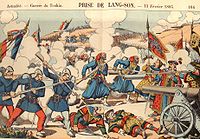
encouraged local Catholics to revolt in an attempt to install a Catholic emperor. Tens of thousands of Vietnamese and foreign-born Christians were persecuted and trade with the West slowed during this period. There were frequent uprisings against the Nguyễns, with hundreds of such events being recorded in the annals. These acts were soon being used as excuses for France to invade Vietnam. The early Nguyễn Dynasty had engaged in many of the constructive activities of its predecessors, building roads, digging canals, issuing a legal code, holding examinations, sponsoring care facilities for the sick, compiling maps and history books, and exerting influence over Cambodia and Laos. However, those feats were not enough of an improvement in the new age of science, technology, industrialization, and international trade and politics, especially when faced with technologically superior European forces exerting strong influence over the region. The Nguyễn Dynasty is usually blamed for failing to modernize the country in time to prevent French colonization in the late 19th century.
, French gunships under Rigault de Genouilly attacked the port of Đà Nẵng
in 1858, causing significant damage, yet failed to gain any foothold, in the process being afflicted by the humidity and tropical diseases. De Genouilly decided to sail south and captured the poorly defended city of Gia Định (present-day Ho Chi Minh City
). From 1859 to 1867, French troops expanded their control over all six provinces on the Mekong delta and formed a colony known as Cochin China. A few years later, French troops landed in northern Vietnam (which they called Tonkin
) and captured Hà Nội twice in 1873 and 1882. The French managed to keep their grip on Tonkin although, twice, their top commanders Francis Garnier
and Henri Rivière, were ambushed and killed fighting Chinese pirates hired by the mandarins. France assumed control over the whole of Vietnam after the Sino-French War
(1884–1885). French Indochina
was formed in October 1887 from Annam
(Trung Kỳ, central Vietnam), Tonkin (Bắc Kỳ, northern Vietnam), Cochin China (Nam Kỳ, southern Vietnam, and Cambodia, with Laos added in 1893). Within French Indochina, Cochin China had the status of a colony, Annam was nominally a protectorate
where the Nguyễn Dynasty still ruled, and Tonkin had a French governor with local governments run by Vietnamese officials.
After Gia Định fell to French troops, many Vietnamese resistance movements broke out in occupied areas, some led by former court officers, such as Trương Định, some by peasants, such as Nguyễn Trung Trực
, who sank the French gunship L'Esperance using guerilla tactics. In the north, most movements were led by former court officers and lasted decades, with Phan Đình Phùng
fighting in central Vietnam until 1895. In the northern mountains, the former bandit leader Hoàng Hoa Thám fought until 1911. Even the teenage Nguyễn Emperor Hàm Nghi
left the Imperial Palace of Huế in 1885 with regent Tôn Thất Thuyết
and started the Cần Vương
, or "Save the King", movement, trying to rally the people to resist the French. He was captured in 1888 and exiled to French Algeria
. Decades later, two more Nguyễn kings, Thành Thái
and Duy Tân
were also exiled to Africa for having anti-French tendencies. The former was deposed on the pretext of insanity and Duy Tân was caught in a conspiracy with the mandarin Tran Cao Van
trying to start an uprising. However, lack of modern weapons and equipment prevented these resistance movements from being able to engage the French in open combat.
There emerged two parallel movements of modernization. The first was the Đông Du ("Go East") Movement started in 1905 by Phan Bội Châu
. Châu's plan was to send Vietnamese students to Japan to learn modern skills, so that in the future they could lead a successful armed revolt against the French. With Prince Cường Để, he started two organizations in Japan: Duy Tân Hội and Việt Nam Công Hiến Hội. Due to French diplomatic pressure, Japan later deported Châu to China.
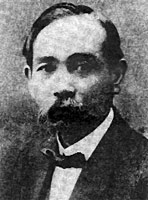
 Phan Chu Trinh
, who favored a peaceful, non-violent struggle to gain independence, led the second movement Duy Tân
("Modernization"). He stressed the need to educate the masses, modernize the country, foster understanding and tolerance between the French and the Vietnamese, and a peaceful transition of power.
The early part of the 20th century also saw the growing in status of the Romanized Quốc Ngữ alphabet for the Vietnamese language. Vietnamese patriots realized the potential of Quốc Ngữ as a useful tool to quickly reduce illiteracy and to educate the masses. The traditional Chinese scripts or the Nôm
script were seen as too cumbersome and too difficult to learn. The use of prose in literature also became popular with the appearance of many novels; most famous were those from the literary circle Tự Lực Văn Đoàn.
As the French suppressed both movements, and after witnessing revolutionaries in action in China and Russia, Vietnamese revolutionaries began to turn to more radical paths. Phan Bội Châu created the Viet Nam Quang Phuc Hoi
in Guangzhou
, planning armed resistance against the French. In 1925, French agents captured him in Shanghai and spirited him to Vietnam. Due to his popularity, Châu was spared from execution and placed under house arrest until his death in 1940. In 1927, the Việt Nam Quốc Dân Đảng (Vietnamese Nationalist Party), modeled after the Kuomintang
in China, was founded. In 1930, the party launched the armed Yen Bai mutiny
in Tonkin which resulted in its chairman, Nguyen Thai Hoc and many other leaders captured and executed by the guillotine.
Marxism
was also introduced into Vietnam with the emergence of three separate Communist parties; the Indochinese Communist Party, Annamese Communist Party and the Indochinese Communist Union, joined later by a Trotskyist movement led by Tạ Thu Thâu
. In 1930 the Communist International (Comintern) sent Nguyễn Ái Quốc to Hong Kong to coordinate the unification of the parties into the Vietnamese Communist Party with Trần Phú as the first Secretary General. Later the party changed its name to the Indochinese Communist Party as the Comintern, under Joseph Stalin
, did not favor nationalistic sentiments. Nguyễn Ái Quốc was a leftist revolutionary living in France since 1911. He participated in founding the French Communist Party
and in 1924 traveled to the Soviet Union to join the Comintern. Through the late 1920s, he acted as a Comintern agent to help build Communist movements in Southeast Asia. During the 1930s, the Vietnamese Communist Party was nearly wiped out under French suppression with the execution of top leaders such as Phú, Lê Hồng Phong, and Nguyễn Văn Cừ.
In 1940, during World War II, Japan invaded Indochina, keeping the Vichy French colonial administration in place as a Japanese puppet. In 1941 Nguyễn Ái Quốc, now known as Hồ Chí Minh
, arrived in northern Vietnam to form the Việt Minh
Front, short for Việt Nam Độc Lập Đồng Minh Hội (League for the Independence of Vietnam). The Việt Minh Front was supposed to be an umbrella group for all parties fighting for Vietnam's independence, but was dominated by the Communist Party. The Việt Minh had a modest armed force and during the war worked with the American Office of Strategic Services
to collect intelligence on the Japanese. From China, other non-Communist Vietnamese parties also joined the Việt Minh and established armed forces with backing from the Kuomintang.
(modern day Vietnam, Cambodia and Laos) after the war was over. Roosevelt offered Chiang Kai-shek
the entire region of Indochina to be put under Chinese rule. It was said that Chiang Kai-shek replied: "Under no circumstances!".
After the war, 200,000 Chinese troops under General Lu Han
sent by Chiang Kai-shek invaded northern Indochina north of the 16th parallel to accept the surrender of Japanese occupying forces, and remained there until 1946. The Chinese used the VNQDD, the Vietnamese branch of the Chinese Kuomintang
, to increase their influence in Indochina and put pressure on their opponents. Chiang Kai-shek threatened the French with war in response to manoeuvering by the French and Ho Chi Minh against each other, forcing them to come to a peace agreement, and also forced the French to surrender all of their concessions in China and renounce their extraterritorial privileges in exchange for withdrawing from northern Indochina and allowing French troops to reoccupy the region starting in March 1946.
However, the French quickly reasserted the control they had ceded to the Japanese, and the First Indochina War
(1946–54) was underway. French control ended on May 7, 1954, when Vietnamese forces defeated the French
at Dien Bien Phu
. The 1954 Geneva Conference left Vietnam a divided nation
, with Ho Chi Minh
's communist government ruling the North
from Hanoi and Ngo Dinh Diem
's regime, supported by the United States
, ruling the South
from Saigon (later Ho Chi Minh City).
As a result of the Second Indochina War (1954–75), Viet Cong and regular People’s Army of Vietnam (PAVN) forces from the North unified Vietnam under communist rule. In this conflict, the insurgents—with logistical support from China and the Soviet Union
—ultimately defeated the Army of the Republic of Vietnam
, which sought to maintain South Vietnamese independence with the support of the U.S. military, whose troop strength peaked at 540,000 during the communist-led Tet Offensive in 1968. The North did not abide by the terms of the 1973 Paris Agreement, which officially settled the war by calling for free elections in the South and peaceful reunification. Two years after the withdrawal of the last U.S. forces in 1973, Saigon, the capital of South Vietnam, fell to the communists
, and the South Vietnamese army surrendered on April 30, 1975. In 1976 the government of united Vietnam renamed Saigon as Ho Chi Minh City
, in honor of the wartime communist leader who died in September 1969. Vietnamese estimates total nearly 3 million lives lost and 4 million injuries during the U.S. involvement in the war.
,” fled the country soon after the communist takeover, fearing persecution and seizure of their land and businesses. About a million Vietnamese were relocated to previously uncultivated land called “new economic zones” for reeducation
.
The harsh postwar crackdown on remnants of capitalism in the South led to the collapse of the economy during the 1980s. With the economy in shambles, Vietnam’s government altered its course and adopted consensus policies that bridged the divergent views of pragmatists and communist traditionalists. In 1986 Nguyen Van Linh
, who was elevated to VCP general secretary the following year, launched a campaign for political and economic renewal (Doi Moi). His policies were characterized by political and economic experimentation that was similar to simultaneous reform agenda undertaken in the Soviet Union
. Reflecting the spirit of political compromise, Vietnam phased out its reeducation effort. The government also stopped promoting agricultural and industrial cooperatives. Farmers were permitted to till private plots alongside state-owned land, and in 1990 the government passed a law encouraging the establishment of private businesses.
Compounding economic difficulties were new military challenges. In the late 1970s, two countries—Cambodia and China—posed threats to Vietnam. Clashes between Vietnamese and Cambodian communists on their common border began almost immediately after Vietnam’s reunification in 1975. To neutralize the threat, Vietnam invaded Cambodia in December 1978 and overran Phnom Penh
, the Cambodian capital, driving out the incumbent Khmer Rouge
communist regime and initiating a prolonged military occupation of the country.
In February and March 1979, China retaliated against Vietnam's incursion into Cambodia by launching a limited invasion of Vietnam
, but the Chinese foray was quickly rebuffed. Relations between the two countries had been deteriorating for some time. Territorial disagreements along the border and in the South China Sea
that had remained dormant during the Second Vietnam War
were revived at the war's end, and a postwar campaign engineered by Hanoi to limit the role of Vietnam's ethnic Chinese community in domestic commerce elicited a strong protest from Beijing. China also was displeased with Vietnam because of its improving relationship with the Soviet Union
.
During its incursion into Cambodia in 1978–89, Vietnam’s international isolation extended to relations with the United States. The United States
, in addition to citing Vietnam's minimal cooperation in accounting for Americans who were missing in action
(MIAs) as an obstacle to normal relations, barred normal ties as long as Vietnamese troops occupied Cambodia. Washington also continued to enforce the trade embargo imposed on Hanoi at the conclusion of the war in 1975.
Throughout the 1980s, Vietnam received nearly $3 billion a year in economic and military aid from the Soviet Union and conducted most of its trade with the USSR and other COMECON
(Council for Mutual Economic Assistance) countries. Some cadres, realizing the economic suffering of the people, began to break rules and experimented with market-oriented enterprises. Some were punished for their efforts, but years later would be hailed as visionary pioneers.
.
The Viet nation originated in the Red River Delta
in present day northern Vietnam and expanded over its history to the current boundary. It went through a lot of name changes, with Đại Việt being used the longest. Below is a summary of names:
Almost all Vietnamese dynasties are named after the king's family name, unlike the Chinese dynasties, whose names are dictated by the dynasty founders and often used as the country's name.
It is still a matter of debate whether the Hồng Bàng Dynasty was real or just a symbolic dynasty to represent the Lạc Việt nation before recorded history. The Thục, Triệu, Anterior Lý, Ngô
, Đinh, Anterior Lê
, Lý
, Trần, Hồ, Lê
, Mạc, Tây Sơn
, and Nguyễn are usually regarded by historians as formal dynasties. Nguyễn Huệ's "Tây Sơn Dynasty" is rather a name created by historians to avoid confusion with Nguyễn Anh's Nguyễn Dynasty.
Vietnam
Vietnam – sometimes spelled Viet Nam , officially the Socialist Republic of Vietnam – is the easternmost country on the Indochina Peninsula in Southeast Asia. It is bordered by China to the north, Laos to the northwest, Cambodia to the southwest, and the South China Sea –...
covers a period of more than 2,700 years. By far Vietnam's most important historical international relationship has been with China. Vietnam's prehistory includes a legend about a kingdom known as Van Lang (2787–2858 BC) that included what is now China's Guangxi Autonomous Region and Guangdong province, as well as the northern part of Vietnam. Later, successive dynasties based in China ruled Vietnam directly for most of the period from 207 BC until 938 when Vietnam regained its independence
Independence
Independence is a condition of a nation, country, or state in which its residents and population, or some portion thereof, exercise self-government, and usually sovereignty, over its territory....
. Vietnam remained a tributary state
Tributary state
The term tributary state refers to one of the two main ways in which a pre-modern state might be subordinate to a more powerful neighbour. The heart of the relationship was that the tributary would send a regular token of submission to the superior power...
to its larger neighbor China for much of its history but repelled invasions by the Chinese as well as three invasions by the Mongols
Mongols
Mongols ) are a Central-East Asian ethnic group that lives mainly in the countries of Mongolia, China, and Russia. In China, ethnic Mongols can be found mainly in the central north region of China such as Inner Mongolia...
between 1255 and 1285. Emperor Trần Nhân Tông later diplomatically submitted Vietnam to a tributary of the Yuan to avoid further conflicts. The independent period temporarily ended in the middle to late 19th century, when the country was colonized by France (see French Indochina
French Indochina
French Indochina was part of the French colonial empire in southeast Asia. A federation of the three Vietnamese regions, Tonkin , Annam , and Cochinchina , as well as Cambodia, was formed in 1887....
).
During World War II
World War II
World War II, or the Second World War , was a global conflict lasting from 1939 to 1945, involving most of the world's nations—including all of the great powers—eventually forming two opposing military alliances: the Allies and the Axis...
, Imperial Japan expelled the French to occupy Vietnam, though they retained French administrators during their occupation. After the war, France attempted to re-establish its colonial rule but ultimately failed in the First Indochina War
First Indochina War
The First Indochina War was fought in French Indochina from December 19, 1946, until August 1, 1954, between the French Union's French Far East...
. The Geneva Accords
Geneva Conference (1954)
The Geneva Conference was a conference which took place in Geneva, Switzerland, whose purpose was to attempt to find a way to unify Korea and discuss the possibility of restoring peace in Indochina...
partitioned the country in two with a promise of democratic election to reunite the country. However, rather than peaceful reunification, partition led to the Vietnam War
Vietnam War
The Vietnam War was a Cold War-era military conflict that occurred in Vietnam, Laos, and Cambodia from 1 November 1955 to the fall of Saigon on 30 April 1975. This war followed the First Indochina War and was fought between North Vietnam, supported by its communist allies, and the government of...
. During this time, the People's Republic of China and the Soviet Union supported the North
North Vietnam
The Democratic Republic of Vietnam , was a communist state that ruled the northern half of Vietnam from 1954 until 1976 following the Geneva Conference and laid claim to all of Vietnam from 1945 to 1954 during the First Indochina War, during which they controlled pockets of territory throughout...
while the United States supported the South
South Vietnam
South Vietnam was a state which governed southern Vietnam until 1975. It received international recognition in 1950 as the "State of Vietnam" and later as the "Republic of Vietnam" . Its capital was Saigon...
. The Vietnam War ended with the Fall of Saigon
Fall of Saigon
The Fall of Saigon was the capture of Saigon, the capital of South Vietnam, by the People's Army of Vietnam and the National Liberation Front on April 30, 1975...
in April 1975.
After the reunification in 1975, Vietnam suffered further internal repression and isolation from the international community due to the Cold War
Cold War
The Cold War was the continuing state from roughly 1946 to 1991 of political conflict, military tension, proxy wars, and economic competition between the Communist World—primarily the Soviet Union and its satellite states and allies—and the powers of the Western world, primarily the United States...
and the Vietnamese invasion of Cambodia
Cambodian-Vietnamese War
The Cambodian–Vietnamese War was an armed conflict between the Socialist Republic of Vietnam and Democratic Kampuchea. The war began with isolated clashes along the land and maritime boundaries of Vietnam and Kampuchea between 1975 and 1977, occasionally involving division-sized military formations...
. In 1986, the Communist Party of Vietnam
Communist Party of Vietnam
The Communist Party of Vietnam , formally established in 1930, is the governing party of the nation of Vietnam. It is today the only legal political party in that country. Describing itself as Marxist-Leninist, the CPV is the directing component of a broader group of organizations known as the...
changed its economic policy and began reforms of the private sector similar to those in China. Since the mid-1980s, Vietnam has enjoyed substantial economic growth.
Hồng Bàng Dynasty
Evidence of the earliest established society other than the prehistoric Iron AgeIron Age
The Iron Age is the archaeological period generally occurring after the Bronze Age, marked by the prevalent use of iron. The early period of the age is characterized by the widespread use of iron or steel. The adoption of such material coincided with other changes in society, including differing...
Đông Sơn culture in Northern Vietnam was found in Cổ Loa, an ancient city situated near present-day Hà Nội.
According to mythology, the first Vietnamese people were descended from the Dragon Lord Lạc Long Quân
Lac Long Quan
Lạc Long Quân , according to the creation myth of the Vietnamese people, was the father of the Vietnamese people, and their first true king. Lạc Long Quân was the son and sole successor of Kinh Dương Vương , who ruled over Xích Quỷ...
and the Immortal Fairy Âu Cơ
Au Co
Âu Cơ , according to the creation myth of the Vietnamese people, was an immortal mountain fairy who married Lạc Long Quân , and bore an egg sac that hatched a hundred children known collectively as Baiyue, ancestors to the Vietnamese people...
. Lạc Long Quân and Âu Cơ had 100 sons before deciding to part ways. 50 of the children went with their mother to the mountains, and the other 50 went with their father to the sea. The eldest son became the first in a line of early Vietnamese kings, collectively known as the Hùng kings (Hùng Vương
Hung Vuong
Hùng Vương is a title used in many modern discussions of the ancient Vietnamese rulers of the Hồng Bàng) period. In antiquity this title began to be used for the ruler who was the religious and political leader of united ancient Vietnam...
or the Hồng Bàng Dynasty). The Hùng kings called their country, located on the Red River
Red River (Vietnam)
The Red River , also known as the Sông Cái - Mother River , or Yuan River , is a river that flows from southwest China through northern Vietnam to the Gulf of Tonkin...
delta in present-day northern Vietnam, Văn Lang
Van Lang
Văn Lang was, according to tradition, the first nation of the ancient Vietnamese people, founded in 2879 BC and existing until 258 BC. It was ruled by the Hùng Kings of the Hồng Bàng Dynasty. There is, however, little reliable historical information available...
. The people of Văn Lang were known as the Lạc Việt.
Many legends from this period offer a glimpse into the life of the people. The Legend of the Rice Cakes is about a prince who won a culinary contest; he then wins the throne because his creations, the rice cakes, reflect his deep understanding of the land's vital economy: rice farming. The Legend of Giong tells of a youth going to war to save the country, wearing iron armor, riding an armored horse, and wielding an iron staff, showed that metalworking
Metalworking
Metalworking is the process of working with metals to create individual parts, assemblies, or large scale structures. The term covers a wide range of work from large ships and bridges to precise engine parts and delicate jewelry. It therefore includes a correspondingly wide range of skills,...
was sophisticated. The Legend of the Magic Crossbow, about a crossbow that can deliver thousands of arrows, showed extensive use of archery in warfare.
Chinese accounts tell much about the early Vietnamese people. Plows and draft animals were not yet used, and fields were worked with polished stone hoes. Fishing and hunting supplemented the main rice crop. Arrowheads and spears were dipped in poison to kill larger animals such as elephants, whose tusks were traded to China for iron ore. Betel nuts were widely chewed and the lower classes rarely wore clothing more substantial than a loincloth. Every spring, a fertility festival was held which featured huge parties and sexual abandon. Religion consisted of primitive animistic cults. Overall, the early Vietnamese were not much different from other Southeast Asian peoples of the time, and it wasn't until later that a distinct national culture emerged.
Recent research has revealed artificial circular earthworks
Earthworks (archaeology)
In archaeology, earthwork is a general term to describe artificial changes in land level. Earthworks are often known colloquially as 'lumps and bumps'. Earthworks can themselves be archaeological features or they can show features beneath the surface...
in the areas of present day southern Vietnam and overlapping to the borders of Cambodia
Cambodia
Cambodia , officially known as the Kingdom of Cambodia, is a country located in the southern portion of the Indochina Peninsula in Southeast Asia...
. These archaeological remains are estimated to be economic, social and cultural entities from the 1st millennium BC
1st millennium BC
The 1st millennium BC encompasses the Iron Age and sees the rise of many successive empires, and spanned from 1000 BC to 1 BC.The Neo-Assyrian Empire, followed by the Achaemenids. In Greece, Classical Antiquity begins with the colonization of Magna Graecia and peaks with the rise of Hellenism. The...
.
Thục Dynasty
By the 3rd century BC, another Viet group, the Âu Việt, emigrated from present-day southern China to the Red River delta and mixed with the indigenous Văn Lang population. In 258 BC, a new kingdom, Âu Lạc, emerged as the union of the Âu Việt and the Lạc Việt, with Thục Phán proclaiming himself "King An Dương Vương". At his capital, Cổ Loa, he built many concentric walls around the city for defensive purposes. These walls, together with skilled Âu Lạc archers, kept the capital safe from invaders.Triệu Dynasty
However, records showed that espionage resulted in the downfall of King An Dương Vương. In 207 BC, Chinese warlord Triệu Đà (Chinese: Zhao Tuo) defeated King An Dương Vương by having his son Trọng Thủy (Chinese: Zhong Shi) act as a spy after marrying An Dương Vương's daughter. Triệu Đà annexed Âu Lạc into his domain located in present-day GuangdongGuangdong
Guangdong is a province on the South China Sea coast of the People's Republic of China. The province was previously often written with the alternative English name Kwangtung Province...
, southern China, then proclaimed himself king of a new independent kingdom, Nam Việt
Nanyue
Nanyue was an ancient kingdom that consisted of parts of the modern Chinese provinces of Guangdong, Guangxi, and Yunnan and northern Vietnam. Nanyue was established in 204 BC at the final collapse of the Qin Dynasty by Zhao Tuo, who was the military commander of Nanhai Commandery at the time, and...
(Chinese: Nan Yue). Trọng Thủy, the supposed crown prince, drowned himself in Cổ Loa out of remorse for the death of his wife in the war.
Some Vietnamese consider Triệu's rule a period of Chinese domination, since Triệu Đà was a former Qin
Qin Dynasty
The Qin Dynasty was the first imperial dynasty of China, lasting from 221 to 207 BC. The Qin state derived its name from its heartland of Qin, in modern-day Shaanxi. The strength of the Qin state was greatly increased by the legalist reforms of Shang Yang in the 4th century BC, during the Warring...
general. Others consider it an era of Việt independence as the Triệu family in Nam Việt were assimilated to local culture. They ruled independently of what then constituted China's (Han Dynasty
Han Dynasty
The Han Dynasty was the second imperial dynasty of China, preceded by the Qin Dynasty and succeeded by the Three Kingdoms . It was founded by the rebel leader Liu Bang, known posthumously as Emperor Gaozu of Han. It was briefly interrupted by the Xin Dynasty of the former regent Wang Mang...
). At one point, Triệu Đà even declared himself Emperor, equal to the Chinese Han Emperor in the north.
Period of Chinese domination (111 BC – 939 AD)
In 111 BC, Chinese troops invaded Nam ViệtNanyue
Nanyue was an ancient kingdom that consisted of parts of the modern Chinese provinces of Guangdong, Guangxi, and Yunnan and northern Vietnam. Nanyue was established in 204 BC at the final collapse of the Qin Dynasty by Zhao Tuo, who was the military commander of Nanhai Commandery at the time, and...
and established new territories, dividing Vietnam into Giao Chỉ (Chinese: 交趾 pinyin: Jiaozhi
Jiaozhi
Jiaozhi was the name of all or part of Vietnam's territory, from the Hùng Vương era to the middle of the Third Chinese domination, and during the Fourth Chinese domination.-Giao Chỉ in the Văn Lang era:...
, now the Red River delta); Cửu Chân from modern-day Thanh Hoá
Thanh Hóa
Thanh Hóa is the capital city of Vietnam's Thanh Hoa province. The population is nearly 200,000 with an area of only 57.9 square kilometers....
to Hà Tĩnh
Ha Tinh
Hà Tĩnh is a city in Vietnam. It is the capital of the Ha Tinh province, in Vietnam's north central coast....
; and Nhật Nam, from modern-day Quảng Bình to Huế
Hue
Hue is one of the main properties of a color, defined technically , as "the degree to which a stimulus can be describedas similar to or different from stimuli that are described as red, green, blue, and yellow,"...
. While governors and top officials were Chinese, the original Vietnamese nobles (Lạc Hầu, Lạc Tướng) still managed some highlands.
The Chinese began a vigorous campaign to civilize and assimilate the as-yet illiterate, tribal native population. Chinese culture, rituals, and governmental organization were imposed along with Taoism
Taoism
Taoism refers to a philosophical or religious tradition in which the basic concept is to establish harmony with the Tao , which is the mechanism of everything that exists...
and Confucianism in addition to the language and writing system. Even Chinese clothing and hairstyles were required. Many of these innovations were gladly taken up by the Vietnamese, but they still insisted on maintaining a distinct language and national identity. Over time, Vietnamese nationalism grew, and while they looked to their huge neighbor for cultural inspiration, the desire for independence was strong.
In 40 AD, the Trưng Sisters
Trung Sisters
The Trưng sisters were leaders who rebelled against Chinese rule for three years, and are regarded as national heroines of Vietnam. Their names are Trưng Trắc and Trưng Nhị ....
led a successful revolt against Han Governor Tô Định (蘇定 pinyin: Sū Dìng) and recaptured 65 states (including modern Guangxi). Trưng Trắc became the Queen (Trưng Nữ Vương
Trung Sisters
The Trưng sisters were leaders who rebelled against Chinese rule for three years, and are regarded as national heroines of Vietnam. Their names are Trưng Trắc and Trưng Nhị ....
). In 43 AD, Emperor Guangwu of Han
Emperor Guangwu of Han
Emperor Guangwu , born Liu Xiu, was an emperor of the Chinese Han Dynasty, restorer of the dynasty in AD 25 and thus founder of the Later Han or Eastern Han...
sent his famous general Mã Viện (Chinese: Ma Yuan) with a large army to quell the revolt. After a long, difficult campaign, Ma Yuan suppressed the uprising and the Trung Sisters committed suicide to avoid capture. To this day, the Trưng Sisters
Trung Sisters
The Trưng sisters were leaders who rebelled against Chinese rule for three years, and are regarded as national heroines of Vietnam. Their names are Trưng Trắc and Trưng Nhị ....
are revered in Vietnam as the national symbol of Vietnamese women. Learning a lesson from the Trưng revolt, the Han and other successful Chinese dynasties took measures to eliminate the power of the Vietnamese nobles. The Vietnamese elites would be coerced to assimilate into Chinese culture and politics. Nearly 200 years passed before the Vietnamese attempted another revolt. In 225 AD another woman, Triệu Thị Trinh
Trieu Thi Trinh
Triệu Thị Trinh was a Vietnamese female warrior in 3rd century AD Vietnam who managed, for a time, to successfully resist the Kingdom of Wu during their occupation of Vietnam...
, popularly known as Lady Triệu (Bà Triệu), led another revolt which lasted until 248 AD. Once again, the uprising failed and Triệu Thị Trinh threw herself into a river.
During the Tang dynasty, Vietnam was called Annam
Annam (Chinese Province)
Annam or Jiaozhi was the southernmost province of the Chinese Empire. It is now part of present-day Vietnam...
(Giao Châu) until the early 10th century AD. Giao Chỉ (with its capital around modern Bắc Ninh
Bac Ninh
Bắc Ninh is a city in Vietnam and capital of the Bac Ninh province. The city is the cultural, administrative, and commercial center of the province. The city area is 80.82 square km, with a population of 150,331 . In January, 2006, the town of Bac Ninh was upgraded to city...
province) became a flourishing trading outpost, receiving goods from the southern seas. The "History of Later Han" (Hậu Hán Thư, Hou Hanshu) recorded that in 166 AD the first envoy from the Roman Empire
Roman Empire
The Roman Empire was the post-Republican period of the ancient Roman civilization, characterised by an autocratic form of government and large territorial holdings in Europe and around the Mediterranean....
to China arrived by this route, and merchants were soon to follow. The 3rd-century "Tales of Wei" (Ngụy Lục, Weilue) mentioned a "water route" (the Red River) from Jiaozhi into what is now southern Yunnan
Yunnan
Yunnan is a province of the People's Republic of China, located in the far southwest of the country spanning approximately and with a population of 45.7 million . The capital of the province is Kunming. The province borders Burma, Laos, and Vietnam.Yunnan is situated in a mountainous area, with...
. From there, goods were taken overland to the rest of China via the regions of modern Kunming
Kunming
' is the capital and largest city of Yunnan Province in Southwest China. It was known as Yunnan-Fou until the 1920s. A prefecture-level city, it is the political, economic, communications and cultural centre of Yunnan, and is the seat of the provincial government...
and Chengdu
Chengdu
Chengdu , formerly transliterated Chengtu, is the capital of Sichuan province in Southwest China. It holds sub-provincial administrative status...
.
At the same time, in present-day central Vietnam, there was a successful revolt of Cham nations. Chinese dynasties called it Lin-Yi (Lin village). It later became a powerful kingdom, Champa
Champa
The kingdom of Champa was an Indianized kingdom that controlled what is now southern and central Vietnam from approximately the 7th century through to 1832.The Cham people are remnants...
, stretching from Quảng Bình to Phan Thiết (Bình Thuận). In addition, the local languages began to diverge. The modern Vietnamese tongue developed from the dialect of the towns, while that of the hill tribes developed into the Hmung language. By the 10th century AD, the separation between the two was complete.
In the period between the beginning of the Chinese Age of Fragmentation to the end of the Tang Dynasty
Tang Dynasty
The Tang Dynasty was an imperial dynasty of China preceded by the Sui Dynasty and followed by the Five Dynasties and Ten Kingdoms Period. It was founded by the Li family, who seized power during the decline and collapse of the Sui Empire...
, several revolts against Chinese rule took place, such as those of Lý Bôn and his general and heir Triệu Quang Phục; and those of Mai Thúc Loan and Phùng Hưng
Phùng Hung
Phùng Hưng was a military leader who briefly reigned over Vietnam during the 8th century.According to Đại Việt sử ký toàn thư , Phùng Hưng, a native of Đường Lâm , was rich and possessed prodigious physical strength. In 791, Phùng Hưng and his brother, Phùng Hải, led a rebellion against the...
. All of them ultimately failed, yet most notable were Lý Bôn and Triệu Quang Phục, whose Anterior Lý Dynasty ruled for almost half a century, from 544 AD to 602 AD, before the Chinese Sui Dynasty
Sui Dynasty
The Sui Dynasty was a powerful, but short-lived Imperial Chinese dynasty. Preceded by the Southern and Northern Dynasties, it ended nearly four centuries of division between rival regimes. It was followed by the Tang Dynasty....
reconquered their kingdom Vạn Xuân.
Ngô, Đinh, and Early Lê dynasties (939 – 1009)
Early in the 10th century, as China became politically fragmented, successive lords from the Khúc familyKhúc family
The Khúc clan was a succession of leaders who challenged Tang rule over Vietnam. The Tang took control of the northern Vietnamese region of Giao Châu after 618 and established twelve provinces and 59 districts under the Commonwealth of Annam...
, followed by Dương Đình Nghệ, ruled Giao Châu autonomously under the Tang
Tang Dynasty
The Tang Dynasty was an imperial dynasty of China preceded by the Sui Dynasty and followed by the Five Dynasties and Ten Kingdoms Period. It was founded by the Li family, who seized power during the decline and collapse of the Sui Empire...
title of Tiết Độ Sứ, Virtuous Lord, but stopping short of proclaiming themselves kings.
In 938, Southern Han
Southern Han
Southern Han was a kingdom that existed during the Five Dynasties and Ten Kingdoms Period along China’s southern coast from 917 to 971. The Kingdom greatly expanded her capital city Hing Wong Fu , namely present-day Guangzhou...
sent troops to conquer autonomous Giao Châu. Ngô Quyền
Ngo Quyen
Ngô Quyền was a Vietnamese prefect and general during the Southern Han Dynasty occupation of Giao Châu in the Red River Valley in what is now northern Vietnam...
, Dương Đình Nghệ's son-in-law, defeated the Southern Han fleet at the Battle of Bạch Đằng River (938). He then proclaimed himself King Ngô and effectively began the age of independence for Vietnam.
Ngô Quyền's untimely death after a short reign resulted in a power struggle for the throne, the country's first major civil war, The upheavals of Twelve warlords (Loạn Thập Nhị Sứ Quân). The war lasted from 945 AD to 967 AD when the clan led by Đinh Bộ Lĩnh defeated the other warlords, unifying the country. Dinh founded the Đinh Dynasty and proclaimed himself First Emperor (Tiên Hoàng) of Đại Cồ Việt (Hán tự: 大瞿越; literally "Great Viet Land"), with its capital in Hoa Lư
Hoa Lu
Hoa Lư is a district of Ninh Binh province in the Red River Delta region of Vietnam. Before 1010, Hoa Lu served as the capital of Dai Co Viet. Hoa Lu Ancient Capital is located in Truong Yen Commune of this district. It comprises 10 communes and one township: Trường Yên, Ninh Hòa, Ninh Giang, Ninh...
(modern day Ninh Bình). However, the Chinese Song Dynasty
Song Dynasty
The Song Dynasty was a ruling dynasty in China between 960 and 1279; it succeeded the Five Dynasties and Ten Kingdoms Period, and was followed by the Yuan Dynasty. It was the first government in world history to issue banknotes or paper money, and the first Chinese government to establish a...
only officially recognized him as Prince of Jiaozhi (Giao Chỉ Quận Vương). Emperor Đinh introduced strict penal codes to prevent chaos from happening again. He tried to form alliances by granting the title of Queen to five women from the five most influential families.
In 979 AD, Emperor Đinh Bộ Lĩnh and his crown prince Đinh Liễn were assassinated, leaving his lone surviving son, the 6-year-old Đinh Toàn, to assume the throne. Taking advantage of the situation, the Chinese Song Dynasty
Song Dynasty
The Song Dynasty was a ruling dynasty in China between 960 and 1279; it succeeded the Five Dynasties and Ten Kingdoms Period, and was followed by the Yuan Dynasty. It was the first government in world history to issue banknotes or paper money, and the first Chinese government to establish a...
invaded Đại Cồ Việt. Facing such a grave threat to national independence, the court's Commander of the Ten Armies (Thập Đạo Tướng Quân) Lê Hoàn
Lê Hoàn
Lê Hoàn , posthumous name Lê Đại Hành, was a king and emperor of Đại Cồ Việt under the Anterior Lê Dynasty. He was the commander in chief of the army of Emperor Đinh Bộ Lĩnh, but he also had an illicit relationship with the Empress Dowager, dethroned Đinh Bộ Lĩnh’s heir and proclaimed himself king...
took the throne, founding the Former Lê Dynasty
Anterior Lê Dynasty
The Early Lê dynasty was a dynasty that ruled Vietnam after the Đinh Dynasty and before the Lý Dynasty. They ruled for a total of three generations and was known for repelling the Song invasion.-Lê Đại Hành Hoàng Đế :1...
. A capable military tactician, Lê Hoan realized the risks of engaging the mighty Chinese troops head on; thus he tricked the invading army into Chi Lăng Pass, then ambushed and killed their commander, quickly ending the threat to his young nation in 981 AD. The Song Dynasty withdrew their troops yet would not recognize Lê Hoàn as Prince of Jiaozhi until 12 years later; nevertheless, he is referred to in his realm as Đại Hành Emperor (Đại Hành Hoàng Đế). Emperor Lê Hoàn was also the first Vietnamese monarch who began the southward expansion process against the kingdom of Champa
Champa
The kingdom of Champa was an Indianized kingdom that controlled what is now southern and central Vietnam from approximately the 7th century through to 1832.The Cham people are remnants...
.
Emperor Lê Hoàn's death in 1005 AD resulted in infighting for the throne amongst his sons. The eventual winner, Lê Long Đĩnh, became the most notorious tyrant in Vietnamese history. He devised sadistic punishments of prisoners for his own entertainment and indulged in deviant sexual activities. Toward the end of his short life he died at 24 Lê Long Đĩnh became so ill that he had to lie down when meeting with his officials in court.
Đại Việt: Lý, Trần, Hồ, Later Trần, and Later Lê dynasties (1010 – 1527)
Lý Dynasty
The Lý Dynasty , sometimes known as the Later Lý Dynasty , was a Vietnamese dynasty that began in 1009 when Lý Thái Tổ overthrew the Prior Lê Dynasty and ended in 1225 when the queen Lý Chiêu Hoàng was forced to abdicate the throne in favor of her husband, Trần Cảnh. They ruled Vietnam for a...
. This event is regarded as the beginning of a golden era in Vietnamese history, with great following dynasties. The way Lý Công Uẩn ascended to the throne was rather uncommon in Vietnamese history. As a high-ranking military commander residing in the capital, he had all opportunities to seize power during the tumultuous years after Emperor Lê Hoàn's death, yet preferring not to do so out of his sense of duty. He was in a way being "elected" by the court after some debate before a consensus was reached.
Lý Công Uẩn, posthumously referred as Lý Thái Tổ, changed the country's name to Đại Việt (Hán tự: 大越; literally "Great Viet"). The Lý Dynasty is credited for laying down a concrete foundation, with strategic vision, for the nation of Vietnam. Leaving Hoa Lư, a natural fortification surrounded by mountains and rivers, Lý Công Uẩn moved his court to the new capital in present-day Hanoi
Hanoi
Hanoi , is the capital of Vietnam and the country's second largest city. Its population in 2009 was estimated at 2.6 million for urban districts, 6.5 million for the metropolitan jurisdiction. From 1010 until 1802, it was the most important political centre of Vietnam...
and called it Thăng Long
Thang Long
Thang Long can be:*Former name of Hanoi*Thang Long Imperial City...
(Ascending Dragon). Lý Công Uẩn thus departed from the militarily defensive mentality of his predecessors and envisioned a strong economy as the key to national survival. Successive Lý kings continued to accomplish far-reaching feats: building a dike system to protect the rice producing area; founding Quốc Tử Giám, the first noble university; holding regular examinations to select capable commoners for government positions once every three years; organizing a new system of taxation; establishing humane treatment of prisoners. Women were holding important roles in Lý society as the court ladies were in charge of tax collection. The Lý Dynasty also promoted Buddhism
Buddhism
Buddhism is a religion and philosophy encompassing a variety of traditions, beliefs and practices, largely based on teachings attributed to Siddhartha Gautama, commonly known as the Buddha . The Buddha lived and taught in the northeastern Indian subcontinent some time between the 6th and 4th...
, yet maintained a pluralistic attitude toward the three main philosophical systems of the time: Buddhism, Confucianism
Confucianism
Confucianism is a Chinese ethical and philosophical system developed from the teachings of the Chinese philosopher Confucius . Confucianism originated as an "ethical-sociopolitical teaching" during the Spring and Autumn Period, but later developed metaphysical and cosmological elements in the Han...
, and Taoism
Taoism
Taoism refers to a philosophical or religious tradition in which the basic concept is to establish harmony with the Tao , which is the mechanism of everything that exists...
. During the Lý Dynasty, the Chinese Song Dynasty
Song Dynasty
The Song Dynasty was a ruling dynasty in China between 960 and 1279; it succeeded the Five Dynasties and Ten Kingdoms Period, and was followed by the Yuan Dynasty. It was the first government in world history to issue banknotes or paper money, and the first Chinese government to establish a...
officially recognized the Đại Việt monarch as King of Giao Chỉ (Giao Chỉ Quận Vương).
The Lý Dynasty had two major wars with Song
Song Dynasty
The Song Dynasty was a ruling dynasty in China between 960 and 1279; it succeeded the Five Dynasties and Ten Kingdoms Period, and was followed by the Yuan Dynasty. It was the first government in world history to issue banknotes or paper money, and the first Chinese government to establish a...
China, and a few conquests against neighboring Champa
Champa
The kingdom of Champa was an Indianized kingdom that controlled what is now southern and central Vietnam from approximately the 7th century through to 1832.The Cham people are remnants...
in the south. The most notable battle took place on Chinese territory in 1075 AD. Upon learning that a Song invasion was imminent, the Lý army and navy totalling about 100,000 men under the command of Lý Thường Kiệt, Tông Đản used amphibious
Amphibious warfare
Amphibious warfare is the use of naval firepower, logistics and strategy to project military power ashore. In previous eras it stood as the primary method of delivering troops to non-contiguous enemy-held terrain...
operations to preemptively destroy three Song military installations at Yong Zhou, Qin Zhou, and Lian Zhou in present-day Guangdong
Guangdong
Guangdong is a province on the South China Sea coast of the People's Republic of China. The province was previously often written with the alternative English name Kwangtung Province...
and Guangxi
Guangxi
Guangxi, formerly romanized Kwangsi, is a province of southern China along its border with Vietnam. In 1958, it became the Guangxi Zhuang Autonomous Region of the People's Republic of China, a region with special privileges created specifically for the Zhuang people.Guangxi's location, in...
, and killed 100,000 Chinese. The Song Dynasty took revenge and invaded Đại Việt in 1076, but the Song troops were held back at the Battle of Như Nguyệt River commonly known as the Cầu river, now in Bắc Ninh province about 40 km from the current capital, Hanoi. Neither side was able to force a victory, so the Lý Dynasty proposed a truce, which the Song emperor accepted.
Champa and the powerful Khmer Empire took advantage of the Lý Dynasty's distraction with the Chinese to pillage the south of the country. Together they invaded Vietnam in 1128 and 1132. Further invasions followed in the subsequent decades.
After the purge, most Trần kings ruled the country in similar manner to the Lý kings. Noted Trần Dynasty accomplishments include the creation of a system of population records based at the village level, the compilation of a formal 30-volume history of Đại Việt (Đại Việt Sử Ký) by Lê Văn Hưu
Lê Văn Hưu
Lê Văn Hưu was an historian of the Trần Dynasty. He is best known for his work the Đại Việt sử ký, the first comprehensive historical record of the history of Vietnam...
, and the rising in status of the Nôm
Nom
NOM may refer to:*Natural organic matter*Norma Oficial Mexicana, each of a series of official norms and regulations for diverse activities in México.*Mass of Paul VI, aka Novus Ordo Missae*National Organization for Marriage*New Order Mormons...
script, a system of writing for Vietnamese language. The Trần Dynasty also adopted a unique way to train new kings: when a crown prince reached the age of 18, his predecessor would abdicate and turn the throne over to him, yet holding a title of August Higher Emperor (Thái Thượng Hoàng), acting as a mentor to the new Emperor. Despite continued Champa-Khmer attacks, the Trần managed to arrange several periods of peace with them.
Mongol invasions
During the Trần Dynasty, the armies of the Mongol EmpireMongol Empire
The Mongol Empire , initially named as Greater Mongol State was a great empire during the 13th and 14th centuries...
under Mongke Khan
Möngke Khan
Möngke Khan , born Möngke, , was the fourth Great Khan of the Mongol Empire from July 1, 1251 – August 11, 1259. He was the first Great Khan from the Toluid line, and made significant reforms to improve the administration of the Empire during his reign...
and Kublai Khan
Kublai Khan
Kublai Khan , born Kublai and also known by the temple name Shizu , was the fifth Great Khan of the Mongol Empire from 1260 to 1294 and the founder of the Yuan Dynasty in China...
, the founder of the Yuan dynasty
Yuan Dynasty
The Yuan Dynasty , or Great Yuan Empire was a ruling dynasty founded by the Mongol leader Kublai Khan, who ruled most of present-day China, all of modern Mongolia and its surrounding areas, lasting officially from 1271 to 1368. It is considered both as a division of the Mongol Empire and as an...
invaded Vietnam in 1257 AD, 1284 AD, and 1288 AD
Mongol invasions of Vietnam
Mongol invasions of Vietnam or Mongol-Vietnamese War refer to the three times that the Mongol Empire and its chief khanate the Yuan Dynasty invaded Đại Việt during the Trần Dynasty and the Kingdom of Champa: in 1257–1258, 1284–1285, and 1287–1288. The Mongols were defeated by Đại...
. Đại Việt repelled all attacks of the Yuan during the reign of Kublai Khan. Three Yuan armies said to have numbered from 300,000 to 500,000 men were defeated. The key to Đại Việt's successes was to avoid the Mongols' strength in open field battles and city sieges - the Trần court abandoned the capital and the cities. The Mongols were then countered decisively at their weak points, which were battles in swampy areas such as Chương Dương, Hàm Tử, Vạn Kiếp and on rivers such as Vân Đồn and Bạch Đằng. The Mongols also suffered from tropical diseases and loss of supplies to Trần army's raids. The Yuan-Trần war reached its climax when the retreating Yuan fleet was decimated at the Battle of Bạch Đằng (1288). The military architect behind Đại Việt's victories was Commander Trần Quốc Tuấn, more popularly known as Trần Hưng Đạo. In order to avoid further disastrous campaigns, the Tran and Champa acknowledged Mongol supremacy.
Champa
It was also during this period that the Trần kings waged many wars against the southern kingdom of ChampaChampa
The kingdom of Champa was an Indianized kingdom that controlled what is now southern and central Vietnam from approximately the 7th century through to 1832.The Cham people are remnants...
, continuing the Viets' long history of southern expansion (known as Nam Tiến) that had begun shortly after gaining independence from China. Often, they encountered strong resistance from the Chams. Champa was made into a tributary state of Vietnam in 1312, but ten years later regained independence and Champa troops led by king Chế Bồng Nga
Che Bong Nga
Po Binasuor, or Chế Bồng Nga, Che Bunga ruled Champa from 1360 - 1390 CE...
(Cham: Po Binasuor or Che Bonguar) killed king Trần Duệ Tông in battle and even laid siege to Đại Việt's capital Thăng Long in 1377 AD and again in 1383 AD. However, the Trần Dynasty was successful in gaining two Champa provinces, located around present-day Huế
Hue
Hue is one of the main properties of a color, defined technically , as "the degree to which a stimulus can be describedas similar to or different from stimuli that are described as red, green, blue, and yellow,"...
, through the peaceful means of the political marriage of Princess Huyền Trân
Huyen Tran
Princess Huyền Trân , was a princess during the Trần Dynasty in the history of Vietnam. She was the daughter of Emperor Trần Nhân Tông and the younger sister of Emperor Trần Anh Tông...
to a Cham king.
Imperial Vietnamese state and society
The basic nature of Vietnamese society changed little during the nearly 1000 years between independence from China in the 10th century and the French conquest in the 19th century. The king was the ultimate source of political authority, the final dispenser of justice, law, and supreme commander-in-chief of the armed forces, as well as overseer of religious rituals. Administration was carried out by mandarins who were trained exactly like their Chinese counterparts (ie. by rigorous study of Confucian texts). Overall, Vietnam remained very efficiently and stably governed except in times of war and dynastic breakdown, and its administrative system was probably far more advanced than that of any other Southeast Asian state. No serious challenge to the king's authority ever arose, as titles of nobility were bestowed purely as honors and were not hereditary. Periodic land reforms broke up large estates and ensured that powerful landowners could not emerge. No religious/priestly class ever arose outside of the mandarins either. This stagnant absolutism ensured a stable, well-ordered society, but also total resistance to any social, cultural, or technological innovations. Reformers looked only to the past for inspiration.Literacy remained the provenance of the upper classes. Initially, Chinese was used for writing purposes, but by the 13th century, a set of derivative characters known as chu nom emerged that allowed native Vietnamese words to be written. However, it remained limited to poetry, literature, and practical texts like medicine while all state and official documents were written in Classical Chinese. Aside from some mining and fishing, subsistence agriculture was the primary activity of most Vietnamese, and economic development and trade were not promoted or encouraged by the state.
Ming occupation and the rise of the Lê Dynasty
The wars with Champa and the Mongols left Vietnam exhausted and bankrupt. The Trần dynasty was in turn overthrown by one of its own court officials, Hồ Quý Ly. Hồ Quý Ly forced the last Trần king to resign and assumed the throne in 1400. He changed the country name to Đại Ngu (Hán tự: 太虞) and moved the capital to Tây Đô, Western Capital, now Thanh Hóa. Thăng Long was renamed Đông Đô, Eastern Capital. Although widely blamed for causing national disunity and losing the country later to the Chinese Ming DynastyMing Dynasty
The Ming Dynasty, also Empire of the Great Ming, was the ruling dynasty of China from 1368 to 1644, following the collapse of the Mongol-led Yuan Dynasty. The Ming, "one of the greatest eras of orderly government and social stability in human history", was the last dynasty in China ruled by ethnic...
, Hồ Quý Ly's reign actually introduced a lot of progressive, ambitious reforms, including the addition of mathematics to the national examinations, the open critique of Confucian philosophy, the use of paper currency in place of coins, investment in building large warships and cannon, and land reform. He ceded the throne to his son, Hồ Hán Thương, in 1401 and assumed the title Thái Thượng Hoàng, in similar manner to the Trần kings.
In 1407, under the pretext of helping to restore the Trần Dynasty, Chinese Ming
Ming Dynasty
The Ming Dynasty, also Empire of the Great Ming, was the ruling dynasty of China from 1368 to 1644, following the collapse of the Mongol-led Yuan Dynasty. The Ming, "one of the greatest eras of orderly government and social stability in human history", was the last dynasty in China ruled by ethnic...
troops invaded Đại Ngu and captured Hồ Quý Ly and Hồ Hán Thương. The Hồ Dynasty came to an end after only 7 years in power. The Ming occupying force annexed Đại Ngu into the Ming Empire after claiming that there was no heir to Trần throne. Vietnam, weakened by dynastic feuds and the wars with Champa, quickly succumbed. The Ming conquest was harsh. Vietnam was annexed directly as a province of China, the old policy of cultural assimilation again imposed forcibly, and the country was ruthlessly exploited. However by this time, Vietnamese nationalism had reached a point where attempts to turn them into Chinese could only arose further resistance.
Almost immediately, Trần loyalists started a resistance war. The resistance, under the leadership of Trần Quĩ at first gained some advances, yet as Trần Quĩ executed two top commanders out of suspicion, a rift widened within his ranks and resulted in his defeat in 1413.
In 1418, a wealthy farmer, Lê Lợi, led the Lam Sơn uprising
Lam Sơn uprising
In 1405 the Chinese Ming Dynasty invaded Dai Viet in northern Vietnam on the pretext of settling a succession dispute. Within a year the previously independent kingdom had been reduced to a province of China...
against the Ming from his base of Lam Sơn (Thanh Hóa province). Overcoming many early setbacks and with strategic advices from Nguyễn Trãi, Lê Lợi's movement finally gathered momentum, marched northward, and launched a siege at Đông Quan (now Hanoi), the capital of the Ming occupation. The Ming Emperor sent a reinforcement force, but Lê Lợi staged an ambush and killed the Ming commander, Liễu Thăng
Liu Shan
Liu Shan, , was the second and last emperor of the state of Shu Han during the Three Kingdoms era of Chinese history. As he ascended the throne at the young age of 16, Liu Shan was entrusted to the care of the Chancellor Zhuge Liang and Imperial Secretariat Li Yan...
(Chinese: Liu Sheng), in Chi Lăng
Chi Lang
Chi Lang is a district of Lang Son Province in the Northeastern region of Vietnam.As of 2003 the district had a population of 77,910. The district covers an area of 703 km². The district capital lies at Dong Mo....
. Ming troops at Đông Quan surrendered. The Lam son revolution killed 300,000 Ming soldiers. In 1428, Lê Lợi ascended to the throne and began the Hậu Lê dynasty
Lê Dynasty
The Later Lê Dynasty , sometimes referred to as the Lê Dynasty was the longest-ruling dynasty of Vietnam, ruling the country from 1428 to 1788, with a brief interruption....
(Posterior or Later Lê). Lê Lợi renamed the country back to Đại Việt and moved the capital back to Thăng Long
Thang Long
Thang Long can be:*Former name of Hanoi*Thang Long Imperial City...
.
Confucianism
Confucianism is a Chinese ethical and philosophical system developed from the teachings of the Chinese philosopher Confucius . Confucianism originated as an "ethical-sociopolitical teaching" during the Spring and Autumn Period, but later developed metaphysical and cosmological elements in the Han...
. A comprehensive set of laws, the Hồng Đức code was introduced with some strong Confucian elements, yet also included some progressive rules, such as the rights of women. Art and architecture during the Lê Dynasty also became more influenced by Chinese styles than during the Lý and Trần Dynasty. The Lê Dynasty commissioned the drawing of national maps and had Ngô Sĩ Liên
Ngô Sĩ Liên
Ngô Sĩ Liên was an historian of the Lê Dynasty. He is best known for being the principal compiler of the Đại Việt sử ký toàn thư, a comprehensive chronicle of the history of Vietnam and the oldest official historical record of a Vietnamese dynasty that remains today...
continue the task of writing Đại Việt's history up to the time of Lê Lợi. King Lê Thánh Tông
Lê Thánh Tông
Lê Thánh Tông was emperor of Đại Việt from 1460 until his death. He is generally regarded as one of the greatest emperors of Vietnamese history and the Vietnamese "Hammurabi."-Early years:...
opened hospitals and had officials distribute medicines to areas affected with epidemics.
Overpopulation and land shortages stimulated Vietnamese expansion south. In 1471, Le troops led by king Lê Thánh Tông
Lê Thánh Tông
Lê Thánh Tông was emperor of Đại Việt from 1460 until his death. He is generally regarded as one of the greatest emperors of Vietnamese history and the Vietnamese "Hammurabi."-Early years:...
invaded Champa
Champa
The kingdom of Champa was an Indianized kingdom that controlled what is now southern and central Vietnam from approximately the 7th century through to 1832.The Cham people are remnants...
in the 1471 Vietnamese invasion of Champa
1471 Vietnamese invasion of Champa
1471 Vietnamese invasion of Champa under Emperor Lê Thánh Tông was a military expedition that is widely regarded as marking the downfall of Champa. The Vietnamese forces attacked and sacked the capital Vijaya, and decimated the Cham army...
and captured its capital Vijaya. This event effectively ended Champa as a powerful kingdom, although some smaller surviving Cham states lasted for a few centuries more. It initiated the dispersal of the Cham people across Southeast Asia. With the kingdom of Champa mostly destroyed and the Cham people exiled or suppressed, Vietnamese colonization of what is now central Vietnam proceeded without substantial resistance. However, despite becoming greatly outnumbered by Kinh (Việt) settlers and the integration of formerly Cham territory into the Vietnamese nation, the majority of Cham people nevertheless remained in Vietnam and they are now considered one of the key minorities in modern Vietnam. Vietnamese armies also raided the Mekong Delta, which the decaying Khmer Empire could no longer defend. The city of Huế, founded in 1600 lies close to where the Champa capital of Indrapura once stood. In 1479, King Lê Thánh Tông also campaigned against Laos
Laos
Laos Lao: ສາທາລະນະລັດ ປະຊາທິປະໄຕ ປະຊາຊົນລາວ Sathalanalat Paxathipatai Paxaxon Lao, officially the Lao People's Democratic Republic, is a landlocked country in Southeast Asia, bordered by Burma and China to the northwest, Vietnam to the east, Cambodia to the south and Thailand to the west...
and captured its capital Luang Prabang
Luang Prabang
Luang Prabang, or Louangphrabang , is a city located in north central Laos, where the Nam Khan river meets the Mekong River about north of Vientiane. It is the capital of Luang Prabang Province...
. He made further incursions westwards into the Irrawaddy River region in modern-day Burma before withdrawing.
Lê and Mạc civil war
The Lê dynasty was overthrown by its general named Mạc Đăng Dung in 1527. He killed the Lê emperor and proclaimed himself emperor, starting the Mạc Dynasty. After defeating many revolutions for two years, Mạc Đăng Dung adopted the Trần Dynasty's practice and ceded the throne to his son, Mạc Đăng Doanh, and he became Thái Thượng Hoàng.Meanwhile, Nguyễn Kim, a former official in the Lê court, revolted against the Mạc and helped king Lê Trang Tông restore the Lê court in the Thanh Hóa
Thanh Hóa
Thanh Hóa is the capital city of Vietnam's Thanh Hoa province. The population is nearly 200,000 with an area of only 57.9 square kilometers....
area. Thus a civil war began between the Northern Court (Mạc) and the Southern Court (Restored Lê). Nguyễn Kim's side controlled the southern part of Đại Việt (from Thanhhoa to the south), leaving the north (including Đông Kinh-Hanoi) under Mạc control. When Nguyễn Kim was assassinated in 1545, military power fell into the hands of his son-in-law, Trịnh Kiểm. In 1558, Nguyễn Kim's son, Nguyễn Hoàng, suspecting that Trịnh Kiểm might kill him as he had done to his brother to secure power, asked to be governor of the far south provinces around present-day Quảng Bình
Quang Binh Province
Quảng Bình , formerly Tiên Bình under the reign of Le Trung Hung of the Lê Dynasty, this province was renamed Quảng Bình in 1604) is a province in the North Central Coast of Vietnam....
to Bình Định. Hoang pretended to be insane, so Kiem was fooled into thinking that sending Hoang south was a good move as Hoang would be quickly killed in the lawless border regions. However, Hoang governed the south effectively while Trịnh Kiểm, and then his son Trịnh Tùng, carried on the war against the Mạc. Nguyễn Hoàng sent money and soldiers north to help the war but gradually he became more and more independent, transforming their realm's economic fortunes by turning it into an international trading post.
The civil war between the Lê/Trịnh and Mạc dynasties ended in 1592, when the army of Trịnh Tùng conquered Hanoi
Hanoi
Hanoi , is the capital of Vietnam and the country's second largest city. Its population in 2009 was estimated at 2.6 million for urban districts, 6.5 million for the metropolitan jurisdiction. From 1010 until 1802, it was the most important political centre of Vietnam...
and executed king Mạc Mậu Hợp. Survivors of the Mạc royal family fled to the northern mountains in the province of Cao Bằng and continued to rule there until 1667 when Trịnh Tạc conquered this last Mạc territory. The Lê kings, ever since Nguyễn Kim's restoration, only acted as figureheads. After the fall of the Mạc Dynasty, all real power in the north belonged to the Trịnh Lords.
Meanwhile, the Ming court reluctantly decided on a military intervention into the Vietnamese civil war, but Mac Dang Dung offered ritual submission to China, who accepted it.
Trịnh-Nguyễn War
In the year 1600, Nguyễn Hoàng also declared himself Lord (officially "Vương", popularly "Chúa") and refused to send more money or soldiers to help the Trịnh. He also moved his capital to Phú Xuân, modern-day HuếHue
Hue is one of the main properties of a color, defined technically , as "the degree to which a stimulus can be describedas similar to or different from stimuli that are described as red, green, blue, and yellow,"...
. Nguyễn Hoàng died in 1613 after having ruled the south for 55 years. He was succeeded by his 6th son, Nguyễn Phúc Nguyên, who likewise refused to acknowledge the power of the Trịnh, yet still pledged allegiance to the Lê king.
Trịnh Tráng succeeded Trịnh Tùng, his father, upon his death in 1623. Tráng ordered Nguyễn Phúc Nguyên to submit to his authority. The order was refused twice. In 1627, Trịnh Tráng sent 150,000 troops southward in an unsuccessful military campaign. The Trịnh were much stronger, with a larger population, economy and army, but they were unable to vanquish the Nguyễn, who had built two defensive stone walls and invested in Portuguese artillery.
Southward expansion
The Trịnh and the Nguyễn maintained a relative peace for the next hundred years, during which both sides made significant accomplishments. The Trịnh created centralized government offices in charge of state budget and producing currency, unified the weight units into a decimal system, established printing shops to reduce the need to import printed materials from China, opened a military academy, and compiled history books.Meanwhile, the Nguyễn Lords continued the southward expansion by the conquest of the remaining Cham land. Việt settlers also arrived in the sparsely populated area known as "Water Chenla", which was the lower Mekong Delta
Mekong Delta
The Mekong Delta is the region in southwestern Vietnam where the Mekong River approaches and empties into the sea through a network of distributaries. The Mekong delta region encompasses a large portion of southwestern Vietnam of . The size of the area covered by water depends on the season.The...
portion of Chenla
Chenla
Chenla is the Chinese designation for Cambodia after the fall of Funan. That name was still used in the 13th century by the Chinese envoy Zhou Daguan, author of the Manners and Customs of Cambodia...
(present-day Cambodia
Cambodia
Cambodia , officially known as the Kingdom of Cambodia, is a country located in the southern portion of the Indochina Peninsula in Southeast Asia...
). Between the mid-17th century to mid-18th century, as Chenla
Chenla
Chenla is the Chinese designation for Cambodia after the fall of Funan. That name was still used in the 13th century by the Chinese envoy Zhou Daguan, author of the Manners and Customs of Cambodia...
was weakened by internal strife and Siamese invasions, the Nguyễn Lords used various means, political marriage, diplomatic pressure, political and military favors, to gain the area around present day Saigon and the Mekong Delta. The Nguyễn army at times also clashed with the Siamese
Thailand
Thailand , officially the Kingdom of Thailand , formerly known as Siam , is a country located at the centre of the Indochina peninsula and Southeast Asia. It is bordered to the north by Burma and Laos, to the east by Laos and Cambodia, to the south by the Gulf of Thailand and Malaysia, and to the...
army to establish influence over Chenla.
Tây Sơn revolt and dynasty
In 1771, the Tây Sơn revolution broke out in Quy Nhơn, which was under the control of the Nguyễn. The leaders of this revolution were three brothers named Nguyễn Nhạc, Nguyễn Lữ, and Nguyễn Huệ
Nguyen Hue
Nguyễn Huệ, also known as Emperor Quang Trung , born in Bình Định in 1753, died in Phú Xuân on 16 September 1792, was the second emperor of the Tây Sơn Dynasty of Vietnam, reigning from 1788 until 1792...
, not related to the Nguyễn lords. By 1776, the Tây Sơn had occupied all of the Nguyễn Lord's land and killed almost the entire royal family. The surviving prince Nguyễn Phúc Ánh
Gia Long
Emperor Gia Long , born Nguyễn Phúc Ánh , was an emperor of Vietnam...
(often called Nguyễn Ánh) fled to Siam
Thailand
Thailand , officially the Kingdom of Thailand , formerly known as Siam , is a country located at the centre of the Indochina peninsula and Southeast Asia. It is bordered to the north by Burma and Laos, to the east by Laos and Cambodia, to the south by the Gulf of Thailand and Malaysia, and to the...
, and obtained military support from the Siamese king. Nguyễn Ánh came back with 50000 Siamese troops to regain power, but was defeated at the Battle of Rạch Gầm–Xoài Mút
Battle of Rach Gam–Xoai Mut
The Battle of Rạch Gầm-Xoài Mút was fought between Tây-Sơn and Siamese forces in present-day Tiền Giang Province on January 19, 1785. It went down as one of the greatest victories in Vietnamese history.- Background :...
and almost killed. Nguyễn Ánh fled Vietnam, but he did not give up.
The Tây Sơn army commanded by Nguyễn Huệ marched north in 1786 to fight the Trịnh Lord, Trịnh Khải. The Trịnh army failed and Trịnh Khải committed suicide. The Tây Sơn army captured the capital in less than two months. The last Lê emperor, Lê Chiêu Thống, fled to China and petitioned the Chinese Qing
Qing Dynasty
The Qing Dynasty was the last dynasty of China, ruling from 1644 to 1912 with a brief, abortive restoration in 1917. It was preceded by the Ming Dynasty and followed by the Republic of China....
Emperor for help. The Qing emperor Qianlong supplied Lê Chiêu Thống with a massive army of around 200,000 troops to regain his throne from the usurper. Nguyễn Huệ proclaimed himself Emperor Quang Trung and defeated the Qing troops with 100,000 men in a surprise 7 day campaign during the lunar new year (Tết
Tet
Tet can mean:*Tết or Tết Nguyên Đán, the Vietnamese new year**Tet Offensive, a military campaign that began in 1968*Têt in Roussillon, France*Equal temperament, abbreviated as 12-TET, 19-TET and so on...
). During his reign, Quang Trung envisioned many reforms but died by unknown reason on the way march south in 1792, at the age of 40.
During the reign of Emperor Quang Trung, Đại Việt was in fact divided into three political entities. The Tây Sơn leader, Nguyễn Nhạc, ruled the centre of the country from his capital Qui Nhơn
Qui Nhon
Qui Nhơn , also Quy Nhơn, is a coastal city in Binh Dinh province in central Vietnam. It is composed of 16 wards and five communes with a total of 286 km². Quy Nhon is the capital of Bình Định province. As of 2009 its population was 280,900. Historically, the commercial activities of the city...
. Emperor Quang Trung ruled the north from the capital Phú Xuân Huế
Hue
Hue is one of the main properties of a color, defined technically , as "the degree to which a stimulus can be describedas similar to or different from stimuli that are described as red, green, blue, and yellow,"...
. In the South, Nguyễn Ánh, assisted by many talented recruits from the South, captured Gia Định (present day Saigon) in 1788 and established a strong base for his force.
After Quang Trung's death, the Tây Sơn Dynasty
Tây Son Dynasty
The name of Tây Sơn is used in many ways to refer to the period of peasant rebellions and decentralized dynasties established between the eras of the Later Lê and Nguyễn dynasties in the history of Vietnam between 1770 and 1802...
became unstable as the remaining brothers fought against each other and against the people who were loyal to Nguyễn Huệ
Nguyen Hue
Nguyễn Huệ, also known as Emperor Quang Trung , born in Bình Định in 1753, died in Phú Xuân on 16 September 1792, was the second emperor of the Tây Sơn Dynasty of Vietnam, reigning from 1788 until 1792...
's infant son. Nguyễn Ánh sailed north in 1799, capturing Tây Sơn's stronghold Qui Nhơn
Qui Nhon
Qui Nhơn , also Quy Nhơn, is a coastal city in Binh Dinh province in central Vietnam. It is composed of 16 wards and five communes with a total of 286 km². Quy Nhon is the capital of Bình Định province. As of 2009 its population was 280,900. Historically, the commercial activities of the city...
. In 1801, his force took Phú Xuân
Hue
Hue is one of the main properties of a color, defined technically , as "the degree to which a stimulus can be describedas similar to or different from stimuli that are described as red, green, blue, and yellow,"...
, the Tây Sơn capital. Nguyễn Ánh finally won the war in 1802, when he sieged Thăng Long (Hanoi) and executed Nguyễn Huệ's son, Nguyễn Quang Toản, along with many Tây Sơn generals and officials. Nguyễn Ánh ascended the throne and called himself Emperor Gia Long
Gia Long
Emperor Gia Long , born Nguyễn Phúc Ánh , was an emperor of Vietnam...
. Gia is for Gia Định, the old name of Saigon; Long is for Thăng Long, the old name of Hanoi
Hanoi
Hanoi , is the capital of Vietnam and the country's second largest city. Its population in 2009 was estimated at 2.6 million for urban districts, 6.5 million for the metropolitan jurisdiction. From 1010 until 1802, it was the most important political centre of Vietnam...
. Hence Gia Long implied the unification of the country. The Nguyễn dynasty lasted until Bảo Đại
Bao Dai
Bảo Đại , born Nguyễn Phúc Vĩnh Thụy , was the 13th and last ruler of the Nguyễn dynasty. From 1926 to 1945, he was king of Annam under French ‘protection’. During this period, Annam was a protectorate within French Indochina, covering the central two-thirds of the present-day Vietnam...
's abdication in 1945. As China for centuries had referred to Đại Việt as Annam
Annam (Chinese Province)
Annam or Jiaozhi was the southernmost province of the Chinese Empire. It is now part of present-day Vietnam...
, Gia Long asked the Chinese Qing emperor to rename the country, from Annam to Nam Việt. To prevent any confusion of Gia Long's kingdom with Triệu Đà's ancient kingdom, the Chinese emperor reversed the order of the two words to Việt Nam. The name Vietnam is thus known to be used since Emperor Gia Long's reign. Recently historians have found that this name had existed in older books in which Vietnamese referred to their country as Vietnam.
The Period of Division with its many tragedies and dramatic historical developments inspired many poets and gave rise to some Vietnamese masterpieces in verse such as the epic poem The Tale of Kieu
The Tale of Kieu
The Tale of Kiều is an epic poem in Vietnamese written by Nguyễn Du , and is widely regarded as the most significant work of Vietnamese literature. It is even used as a source for bibliomancy. The original title in Vietnamese is Đoạn Trường Tân Thanh , but it is better known as Truyện Kiều...
(Truyện Kiều) by Nguyễn Du, Song of a Soldier's Wife (Chinh Phụ Ngâm) by Đặng Trần Côn and Đoàn Thị Điểm, and a collection of satirical, erotically charged poems by the woman poet Hồ Xuân Hương.
Nguyễn dynasty and French imperialism (1802–1945)
Western world
The Western world, also known as the West and the Occident , is a term referring to the countries of Western Europe , the countries of the Americas, as well all countries of Northern and Central Europe, Australia and New Zealand...
's exposure in Vietnam and Vietnam's exposure to Westerners dated back to 166 AD with the arrival of merchants from the Roman Empire
Roman Empire
The Roman Empire was the post-Republican period of the ancient Roman civilization, characterised by an autocratic form of government and large territorial holdings in Europe and around the Mediterranean....
, to 1292 with the visit of Marco Polo
Marco Polo
Marco Polo was a Venetian merchant traveler from the Venetian Republic whose travels are recorded in Il Milione, a book which did much to introduce Europeans to Central Asia and China. He learned about trading whilst his father and uncle, Niccolò and Maffeo, travelled through Asia and apparently...
, and the early 16th century with the arrival of Portuguese in 1516 and other European traders and missionaries. Alexandre de Rhodes, a French Jesuit priest, improved on earlier work by Portuguese missionaries and developed the Vietnamese romanized alphabet Quốc Ngữ
Vietnamese alphabet
The Vietnamese alphabet, called Chữ Quốc Ngữ , usually shortened to Quốc Ngữ , is the modern writing system for the Vietnamese language...
in Dictionarium Annamiticum Lusitanam et Latinum in 1651. Various European efforts to establish trading posts in Vietnam failed, but missionaries were allowed to operate for some time until the mandarins began concluding that Christianity (which had succeeded in converting up to a tenth of the population by 1700) was a thread to the Confucian social order since it condemned ancestor worship as idolatry. Vietnamese attitudes to Europeans and Christianity hardened as they began to increasingly see it as a way of undermining society.
Between 1627 and 1775, two powerful families had partitioned the country: the Nguyễn Lords ruled the South and the Trịnh Lords ruled the North. The Trịnh-Nguyễn War gave European traders the opportunities to support each side with weapons and technology: the Portuguese assisted the Nguyễn in the South while the Dutch helped the Trịnh in the North.
In 1784, during the conflict between Nguyễn Ánh, the surviving heir of the Nguyễn Lords, and the Tây Sơn Dynasty
Tây Son Dynasty
The name of Tây Sơn is used in many ways to refer to the period of peasant rebellions and decentralized dynasties established between the eras of the Later Lê and Nguyễn dynasties in the history of Vietnam between 1770 and 1802...
, a French Catholic Bishop, Pigneaux de Behaine, sailed to France to seek military backing for Nguyễn Ánh. At Louis XVI
Louis XVI of France
Louis XVI was a Bourbon monarch who ruled as King of France and Navarre until 1791, and then as King of the French from 1791 to 1792, before being executed in 1793....
's court, Pigneaux brokered the Little Treaty of Versailles
Little Treaty of Versailles
Little Treaty of Versailles or the Polish Minority Treaty was one of the bilateral Minority Treaties signed between minor powers and the League of Nations in the aftermath of the First World War. The Polish treaty was signed on 28 June 1919, the same day as the main Treaty of Versailles was signed...
which promised French military aid in return for Vietnamese concessions. The French Revolution
French Revolution
The French Revolution , sometimes distinguished as the 'Great French Revolution' , was a period of radical social and political upheaval in France and Europe. The absolute monarchy that had ruled France for centuries collapsed in three years...
broke out and Pigneaux's plan failed to materialize. Undaunted, Pigneaux went to the French territory of Pondicherry, India. He secured two ships, a regiment of Indian troops, and a handful of volunteers and returned to Vietnam in 1788. One of Pigneaux's volunteers, Jean-Marie Dayot
Jean-Marie Dayot
Jean Baptiste Marie Dayot was a French Navy officer and an adventurer who went into the service of Nguyễn Ánh, the future emperor Gia Long of Vietnam....
, reorganized Nguyễn Ánh's navy along European lines and defeated the Tây Sơn at Qui Nhơn in 1792. A few years later, Nguyễn Ánh's forces captured Saigon, where Pigneaux died in 1799. Another volunteer, Victor Olivier de Puymanel would later build the Gia Định fort in central Saigon.
After Nguyễn Ánh established the Nguyễn Dynasty in 1802, he tolerated Catholicism and employed some Europeans in his court as advisors. However, he and his successors were conservative Confucians who resisted Westernization. The next Nguyễn emperors, Ming Mạng
Minh Mang
Minh Mạng was the second emperor of the Nguyễn Dynasty of Vietnam, reigning from 14 February 1820 until 20 January 1841. He was a younger son of Emperor Gia Long, whose eldest son, Crown Prince Canh, had died in 1801...
, Thiệu Trị
Thieu Tri
Nguyễn Phúc Miên Tông was the third emperor of the Vietnamese Nguyễn Dynasty taking the era name of Thiệu Trị...
, and Tự Đức brutally suppressed Catholicism and pursued a 'closed door' policy, perceiving the Westerners as a threat, following events such as the Lê Văn Khôi revolt
Le Van Khoi revolt
The Lê Văn Khôi revolt was an important revolt in 19th century Vietnam, in which southern Vietnamese, Vietnamese Catholics, French Catholic missionaries and Chinese settlers under the leadership of Lê Văn Khôi opposed the Imperial rule of Minh Mạng.-Origin:The revolt was spurred by the...
when a French missionary Joseph Marchand
Joseph Marchand
Joseph Marchand was a French missionary in Vietnam, and a member of the Paris Foreign Missions Society....
encouraged local Catholics to revolt in an attempt to install a Catholic emperor. Tens of thousands of Vietnamese and foreign-born Christians were persecuted and trade with the West slowed during this period. There were frequent uprisings against the Nguyễns, with hundreds of such events being recorded in the annals. These acts were soon being used as excuses for France to invade Vietnam. The early Nguyễn Dynasty had engaged in many of the constructive activities of its predecessors, building roads, digging canals, issuing a legal code, holding examinations, sponsoring care facilities for the sick, compiling maps and history books, and exerting influence over Cambodia and Laos. However, those feats were not enough of an improvement in the new age of science, technology, industrialization, and international trade and politics, especially when faced with technologically superior European forces exerting strong influence over the region. The Nguyễn Dynasty is usually blamed for failing to modernize the country in time to prevent French colonization in the late 19th century.
French colonization
Under the orders of Napoleon III of FranceNapoleon III of France
Louis-Napoléon Bonaparte was the President of the French Second Republic and as Napoleon III, the ruler of the Second French Empire. He was the nephew and heir of Napoleon I, christened as Charles Louis Napoléon Bonaparte...
, French gunships under Rigault de Genouilly attacked the port of Đà Nẵng
Da Nang
Đà Nẵng , occasionally Danang, is a major port city in the South Central Coast of Vietnam, on the coast of the South China Sea at the mouth of the Han River. It is the commercial and educational center of Central Vietnam; its well-sheltered, easily accessible port and its location on the path of...
in 1858, causing significant damage, yet failed to gain any foothold, in the process being afflicted by the humidity and tropical diseases. De Genouilly decided to sail south and captured the poorly defended city of Gia Định (present-day Ho Chi Minh City
Ho Chi Minh City
Ho Chi Minh City , formerly named Saigon is the largest city in Vietnam...
). From 1859 to 1867, French troops expanded their control over all six provinces on the Mekong delta and formed a colony known as Cochin China. A few years later, French troops landed in northern Vietnam (which they called Tonkin
Tonkin
Tonkin , also spelled Tongkin, Tonquin or Tongking, is the northernmost part of Vietnam, south of China's Yunnan and Guangxi Provinces, east of northern Laos, and west of the Gulf of Tonkin. Locally, it is known as Bắc Kỳ, meaning "Northern Region"...
) and captured Hà Nội twice in 1873 and 1882. The French managed to keep their grip on Tonkin although, twice, their top commanders Francis Garnier
Francis Garnier
Marie Joseph François Garnier was a French officer and explorer known for his exploration of the Mekong River in Southeast Asia.- Early career :...
and Henri Rivière, were ambushed and killed fighting Chinese pirates hired by the mandarins. France assumed control over the whole of Vietnam after the Sino-French War
Sino-French War
The Sino–French War was a limited conflict fought between August 1884 and April 1885 to decide whether France should replace China in control of Tonkin . As the French achieved their war aims, they are usually considered to have won the war...
(1884–1885). French Indochina
French Indochina
French Indochina was part of the French colonial empire in southeast Asia. A federation of the three Vietnamese regions, Tonkin , Annam , and Cochinchina , as well as Cambodia, was formed in 1887....
was formed in October 1887 from Annam
Annam (French Colony)
Annam was a French protectorate encompassing the central region of Vietnam. Vietnamese were subsequently referred to as "Annamites." Nationalist writers adopted the word "Vietnam" in the late 1920s. The general public embraced the word "Vietnam" during the revolution of August 1945...
(Trung Kỳ, central Vietnam), Tonkin (Bắc Kỳ, northern Vietnam), Cochin China (Nam Kỳ, southern Vietnam, and Cambodia, with Laos added in 1893). Within French Indochina, Cochin China had the status of a colony, Annam was nominally a protectorate
Protectorate
In history, the term protectorate has two different meanings. In its earliest inception, which has been adopted by modern international law, it is an autonomous territory that is protected diplomatically or militarily against third parties by a stronger state or entity...
where the Nguyễn Dynasty still ruled, and Tonkin had a French governor with local governments run by Vietnamese officials.
After Gia Định fell to French troops, many Vietnamese resistance movements broke out in occupied areas, some led by former court officers, such as Trương Định, some by peasants, such as Nguyễn Trung Trực
Nguyen Trung Truc
Nguyễn Trung Trực was a Vietnamese fisherman who organized and led village militia forces which fought against French colonial forces in the Mekong Delta in southern Vietnam in the 1860s...
, who sank the French gunship L'Esperance using guerilla tactics. In the north, most movements were led by former court officers and lasted decades, with Phan Đình Phùng
Phan Dinh Phung
Phan Đình Phùng was a Vietnamese revolutionary who led rebel armies against French colonial forces in Vietnam. He was the most prominent of the Confucian court scholars involved in anti-French military campaigns in the 19th century and was cited after his death by 20th-century nationalists as a...
fighting in central Vietnam until 1895. In the northern mountains, the former bandit leader Hoàng Hoa Thám fought until 1911. Even the teenage Nguyễn Emperor Hàm Nghi
Ham Nghi
Emperor Hàm Nghi ; , was the eighth Emperor of the Vietnamese Nguyễn Dynasty. He reigned for only one year ....
left the Imperial Palace of Huế in 1885 with regent Tôn Thất Thuyết
Ton That Thuyet
Tôn Thất Thuyết was the leading mandarin of Emperor Tự Đức of Vietnam's Nguyễn Dynasty. Thuyết later led the Can Vuong movement which aimed to restore Vietnamese independence under Emperor Hàm Nghi. He was born on May 12, 1839 in Huế....
and started the Cần Vương
Can Vuong
The Cần Vương movement was a large-scale Vietnamese insurgency between 1885 and 1889 against French colonial rule. Its objective was to expel the French and install the boy emperor Hàm Nghi as the leader of an independent Vietnam...
, or "Save the King", movement, trying to rally the people to resist the French. He was captured in 1888 and exiled to French Algeria
French Algeria
French Algeria lasted from 1830 to 1962, under a variety of governmental systems. From 1848 until independence, the whole Mediterranean region of Algeria was administered as an integral part of France, much like Corsica and Réunion are to this day. The vast arid interior of Algeria, like the rest...
. Decades later, two more Nguyễn kings, Thành Thái
Thanh Thai
Emperor Thành Thái of the Vietnamese Nguyễn Dynasty was born Prince Nguyễn Phúc Bửu Lân, son of Emperor Duc Duc. He reigned for 18 years, from 1889 to 1907.-Biography:...
and Duy Tân
Duy Tan
Emperor Duy Tân , was a boy emperor of the Nguyễn dynasty and reigned in 9 years between 1907 and 1916. His name was Prince Nguyễn Phúc Vĩnh San and was son of the Thành Thái emperor...
were also exiled to Africa for having anti-French tendencies. The former was deposed on the pretext of insanity and Duy Tân was caught in a conspiracy with the mandarin Tran Cao Van
Tran Cao Van
Trần Cao Vân was a mandarin of the Nguyễn Dynasty who was best known for his activities in attempting to expel the French colonial powers in Vietnam. He orchestrated an attempt to expel the French and install Emperor Duy Tân as the boy ruler of an independent Vietnam, but the uprising failed...
trying to start an uprising. However, lack of modern weapons and equipment prevented these resistance movements from being able to engage the French in open combat.
Anti-colonial movements
The various anti-French revolts started by mandarins were carried out with the primary goal of restoring the old feudal society. However, by 1900 a new generation of Vietnamese were coming of age who had never lived in precolonial Vietnam. These young activists were as eager as their grandparents to see independence restored, but they realized that returning to the feudal order was not feasible and that modern technology and governmental systems were needed. Having been exposed to Western philosophy, they aimed to establish a republic upon independence, departing from the royalist sentiments of the Cần Vương movements. Some of them set up Vietnamese independence societies in Japan, which many viewed as a model society (ie. an Asian nation that had modernized, but retained its own culture and institutions)There emerged two parallel movements of modernization. The first was the Đông Du ("Go East") Movement started in 1905 by Phan Bội Châu
Phan Boi Chau
Phan Bội Châu was a pioneer of Vietnamese 20th century nationalism. In 1903, he formed a revolutionary organization called the “Reformation Society” ....
. Châu's plan was to send Vietnamese students to Japan to learn modern skills, so that in the future they could lead a successful armed revolt against the French. With Prince Cường Để, he started two organizations in Japan: Duy Tân Hội and Việt Nam Công Hiến Hội. Due to French diplomatic pressure, Japan later deported Châu to China.
Phan Chu Trinh
Phan Chu Trinh also known as Phan Châu Trinh was a famous early 20th century Vietnamese nationalist. He also used the alias Tây Hồ. He sought to end France's brutal occupation of Vietnam...
, who favored a peaceful, non-violent struggle to gain independence, led the second movement Duy Tân
Duy Tan
Emperor Duy Tân , was a boy emperor of the Nguyễn dynasty and reigned in 9 years between 1907 and 1916. His name was Prince Nguyễn Phúc Vĩnh San and was son of the Thành Thái emperor...
("Modernization"). He stressed the need to educate the masses, modernize the country, foster understanding and tolerance between the French and the Vietnamese, and a peaceful transition of power.
The early part of the 20th century also saw the growing in status of the Romanized Quốc Ngữ alphabet for the Vietnamese language. Vietnamese patriots realized the potential of Quốc Ngữ as a useful tool to quickly reduce illiteracy and to educate the masses. The traditional Chinese scripts or the Nôm
Nom
NOM may refer to:*Natural organic matter*Norma Oficial Mexicana, each of a series of official norms and regulations for diverse activities in México.*Mass of Paul VI, aka Novus Ordo Missae*National Organization for Marriage*New Order Mormons...
script were seen as too cumbersome and too difficult to learn. The use of prose in literature also became popular with the appearance of many novels; most famous were those from the literary circle Tự Lực Văn Đoàn.
As the French suppressed both movements, and after witnessing revolutionaries in action in China and Russia, Vietnamese revolutionaries began to turn to more radical paths. Phan Bội Châu created the Viet Nam Quang Phuc Hoi
Viet Nam Quang Phuc Hoi
The Việt Nam Quang Phục Hội, sometimes known simply as Quang Phuc Hoi was a nationalist republican militant revolutionary organization of Vietnam that was active in the 1910s, under the leadership of Phan Boi Chau and Prince Cường Để...
in Guangzhou
Guangzhou
Guangzhou , known historically as Canton or Kwangchow, is the capital and largest city of the Guangdong province in the People's Republic of China. Located in southern China on the Pearl River, about north-northwest of Hong Kong, Guangzhou is a key national transportation hub and trading port...
, planning armed resistance against the French. In 1925, French agents captured him in Shanghai and spirited him to Vietnam. Due to his popularity, Châu was spared from execution and placed under house arrest until his death in 1940. In 1927, the Việt Nam Quốc Dân Đảng (Vietnamese Nationalist Party), modeled after the Kuomintang
Kuomintang
The Kuomintang of China , sometimes romanized as Guomindang via the Pinyin transcription system or GMD for short, and translated as the Chinese Nationalist Party is a founding and ruling political party of the Republic of China . Its guiding ideology is the Three Principles of the People, espoused...
in China, was founded. In 1930, the party launched the armed Yen Bai mutiny
Yen Bai mutiny
The Yên Bái mutiny was an uprising of Vietnamese soldiers in the French colonial army on 10 February 1930 in collaboration with civilian supporters who were members of the Viet Nam Quoc Dan Dang ....
in Tonkin which resulted in its chairman, Nguyen Thai Hoc and many other leaders captured and executed by the guillotine.
Marxism
Marxism
Marxism is an economic and sociopolitical worldview and method of socioeconomic inquiry that centers upon a materialist interpretation of history, a dialectical view of social change, and an analysis and critique of the development of capitalism. Marxism was pioneered in the early to mid 19th...
was also introduced into Vietnam with the emergence of three separate Communist parties; the Indochinese Communist Party, Annamese Communist Party and the Indochinese Communist Union, joined later by a Trotskyist movement led by Tạ Thu Thâu
Ta Thu Thau
Tạ Thu Thâu was a Vietnamese Trotskyist and the leader of the Fourth International in Vietnam.-Early life:Ta Thu Thau was born in a small hamlet in Tan Binh, south of Long Xuyen, the capital of An Giang Province in Southern Vietnam. His family were poor and leading a semi-peasant lifestyle...
. In 1930 the Communist International (Comintern) sent Nguyễn Ái Quốc to Hong Kong to coordinate the unification of the parties into the Vietnamese Communist Party with Trần Phú as the first Secretary General. Later the party changed its name to the Indochinese Communist Party as the Comintern, under Joseph Stalin
Joseph Stalin
Joseph Vissarionovich Stalin was the Premier of the Soviet Union from 6 May 1941 to 5 March 1953. He was among the Bolshevik revolutionaries who brought about the October Revolution and had held the position of first General Secretary of the Communist Party of the Soviet Union's Central Committee...
, did not favor nationalistic sentiments. Nguyễn Ái Quốc was a leftist revolutionary living in France since 1911. He participated in founding the French Communist Party
French Communist Party
The French Communist Party is a political party in France which advocates the principles of communism.Although its electoral support has declined in recent decades, the PCF retains a large membership, behind only that of the Union for a Popular Movement , and considerable influence in French...
and in 1924 traveled to the Soviet Union to join the Comintern. Through the late 1920s, he acted as a Comintern agent to help build Communist movements in Southeast Asia. During the 1930s, the Vietnamese Communist Party was nearly wiped out under French suppression with the execution of top leaders such as Phú, Lê Hồng Phong, and Nguyễn Văn Cừ.
In 1940, during World War II, Japan invaded Indochina, keeping the Vichy French colonial administration in place as a Japanese puppet. In 1941 Nguyễn Ái Quốc, now known as Hồ Chí Minh
Ho Chi Minh
Hồ Chí Minh , born Nguyễn Sinh Cung and also known as Nguyễn Ái Quốc, was a Vietnamese Marxist-Leninist revolutionary leader who was prime minister and president of the Democratic Republic of Vietnam...
, arrived in northern Vietnam to form the Việt Minh
Viet Minh
Việt Minh was a national independence coalition formed at Pac Bo on May 19, 1941. The Việt Minh initially formed to seek independence for Vietnam from the French Empire. When the Japanese occupation began, the Việt Minh opposed Japan with support from the United States and the Republic of China...
Front, short for Việt Nam Độc Lập Đồng Minh Hội (League for the Independence of Vietnam). The Việt Minh Front was supposed to be an umbrella group for all parties fighting for Vietnam's independence, but was dominated by the Communist Party. The Việt Minh had a modest armed force and during the war worked with the American Office of Strategic Services
Office of Strategic Services
The Office of Strategic Services was a United States intelligence agency formed during World War II. It was the wartime intelligence agency, and it was a predecessor of the Central Intelligence Agency...
to collect intelligence on the Japanese. From China, other non-Communist Vietnamese parties also joined the Việt Minh and established armed forces with backing from the Kuomintang.
Indochina wars
American President Roosevelt and General Stilwell privately made it adamantly clear that the French were not to reacquire French IndochinaFrench Indochina
French Indochina was part of the French colonial empire in southeast Asia. A federation of the three Vietnamese regions, Tonkin , Annam , and Cochinchina , as well as Cambodia, was formed in 1887....
(modern day Vietnam, Cambodia and Laos) after the war was over. Roosevelt offered Chiang Kai-shek
Chiang Kai-shek
Chiang Kai-shek was a political and military leader of 20th century China. He is known as Jiǎng Jièshí or Jiǎng Zhōngzhèng in Mandarin....
the entire region of Indochina to be put under Chinese rule. It was said that Chiang Kai-shek replied: "Under no circumstances!".
After the war, 200,000 Chinese troops under General Lu Han
Lu Han
Lu Han was a KMT general of Yi ethnicity.-Life:His alma matter was Yunnan military academy. He was commander of the First Group Army in the Second Sino-Japanese War....
sent by Chiang Kai-shek invaded northern Indochina north of the 16th parallel to accept the surrender of Japanese occupying forces, and remained there until 1946. The Chinese used the VNQDD, the Vietnamese branch of the Chinese Kuomintang
Kuomintang
The Kuomintang of China , sometimes romanized as Guomindang via the Pinyin transcription system or GMD for short, and translated as the Chinese Nationalist Party is a founding and ruling political party of the Republic of China . Its guiding ideology is the Three Principles of the People, espoused...
, to increase their influence in Indochina and put pressure on their opponents. Chiang Kai-shek threatened the French with war in response to manoeuvering by the French and Ho Chi Minh against each other, forcing them to come to a peace agreement, and also forced the French to surrender all of their concessions in China and renounce their extraterritorial privileges in exchange for withdrawing from northern Indochina and allowing French troops to reoccupy the region starting in March 1946.
However, the French quickly reasserted the control they had ceded to the Japanese, and the First Indochina War
First Indochina War
The First Indochina War was fought in French Indochina from December 19, 1946, until August 1, 1954, between the French Union's French Far East...
(1946–54) was underway. French control ended on May 7, 1954, when Vietnamese forces defeated the French
Battle of Dien Bien Phu
The Battle of Dien Bien Phu was the climactic confrontation of the First Indochina War between the French Union's French Far East Expeditionary Corps and Viet Minh communist revolutionaries. The battle occurred between March and May 1954 and culminated in a comprehensive French defeat that...
at Dien Bien Phu
Dien Bien Phu
Điện Biên Phủ is a city in northwestern Vietnam. It is the capital of Dien Bien province, and is known for the events there during the First Indochina War, the Battle of Dien Bien Phu, during which the region was a breadbasket for the Việt Minh.-Population:...
. The 1954 Geneva Conference left Vietnam a divided nation
Partition of Vietnam
The Partition of Vietnam was the establishment of the 17th parallel as the Vietnamese Demilitarized Zone in 1954, splitting Vietnam into halves after the First Indochina War.The Geneva Conference was held at the conclusion of the First Indochina War...
, with Ho Chi Minh
Ho Chi Minh
Hồ Chí Minh , born Nguyễn Sinh Cung and also known as Nguyễn Ái Quốc, was a Vietnamese Marxist-Leninist revolutionary leader who was prime minister and president of the Democratic Republic of Vietnam...
's communist government ruling the North
North Vietnam
The Democratic Republic of Vietnam , was a communist state that ruled the northern half of Vietnam from 1954 until 1976 following the Geneva Conference and laid claim to all of Vietnam from 1945 to 1954 during the First Indochina War, during which they controlled pockets of territory throughout...
from Hanoi and Ngo Dinh Diem
Ngo Dinh Diem
Ngô Đình Diệm was the first president of South Vietnam . In the wake of the French withdrawal from Indochina as a result of the 1954 Geneva Accords, Diệm led the effort to create the Republic of Vietnam. Accruing considerable U.S. support due to his staunch anti-Communism, he achieved victory in a...
's regime, supported by the United States
United States
The United States of America is a federal constitutional republic comprising fifty states and a federal district...
, ruling the South
South Vietnam
South Vietnam was a state which governed southern Vietnam until 1975. It received international recognition in 1950 as the "State of Vietnam" and later as the "Republic of Vietnam" . Its capital was Saigon...
from Saigon (later Ho Chi Minh City).
As a result of the Second Indochina War (1954–75), Viet Cong and regular People’s Army of Vietnam (PAVN) forces from the North unified Vietnam under communist rule. In this conflict, the insurgents—with logistical support from China and the Soviet Union
Soviet Union
The Soviet Union , officially the Union of Soviet Socialist Republics , was a constitutionally socialist state that existed in Eurasia between 1922 and 1991....
—ultimately defeated the Army of the Republic of Vietnam
Army of the Republic of Vietnam
The Army of the Republic of Viet Nam , sometimes parsimoniously referred to as the South Vietnamese Army , was the land-based military forces of the Republic of Vietnam , which existed from October 26, 1955 until the fall of Saigon on April 30, 1975...
, which sought to maintain South Vietnamese independence with the support of the U.S. military, whose troop strength peaked at 540,000 during the communist-led Tet Offensive in 1968. The North did not abide by the terms of the 1973 Paris Agreement, which officially settled the war by calling for free elections in the South and peaceful reunification. Two years after the withdrawal of the last U.S. forces in 1973, Saigon, the capital of South Vietnam, fell to the communists
Fall of Saigon
The Fall of Saigon was the capture of Saigon, the capital of South Vietnam, by the People's Army of Vietnam and the National Liberation Front on April 30, 1975...
, and the South Vietnamese army surrendered on April 30, 1975. In 1976 the government of united Vietnam renamed Saigon as Ho Chi Minh City
Ho Chi Minh City
Ho Chi Minh City , formerly named Saigon is the largest city in Vietnam...
, in honor of the wartime communist leader who died in September 1969. Vietnamese estimates total nearly 3 million lives lost and 4 million injuries during the U.S. involvement in the war.
Socialism after 1975
In the post-1975 period, it was immediately apparent that the popularity and effectiveness of Vietnamese Communist Party (VCP) policies did not necessarily extend to the party's peacetime nation-building plans. Having unified North and South politically, the VCP still had to integrate them socially and economically. In this task, VCP policy makers were confronted with the South’s resistance to communist transformation, as well as traditional animosities arising from cultural and historical differences between North and South. More than a million Southerners, including about 560,000 “boat peopleBoat people
Boat people is a term that usually refers to refugees, illegal immigrants or asylum seekers who emigrate in numbers in boats that are sometimes old and crudely made...
,” fled the country soon after the communist takeover, fearing persecution and seizure of their land and businesses. About a million Vietnamese were relocated to previously uncultivated land called “new economic zones” for reeducation
Reeducation camp
Reeducation camp is the official title given to the prison camps operated by the government of Vietnam following the end of the Vietnam War. In such "reeducation camps", the government imprisoned several hundred thousand former military officers and government workers from the former regime of...
.
The harsh postwar crackdown on remnants of capitalism in the South led to the collapse of the economy during the 1980s. With the economy in shambles, Vietnam’s government altered its course and adopted consensus policies that bridged the divergent views of pragmatists and communist traditionalists. In 1986 Nguyen Van Linh
Nguyen Van Linh
Nguyễn Văn Linh was a Vietnamese revolutionary and politician. He was the general secretary of the Communist Party of Vietnam from 1986 to 1991 and a political leader of the Vietcong during the Vietnam War...
, who was elevated to VCP general secretary the following year, launched a campaign for political and economic renewal (Doi Moi). His policies were characterized by political and economic experimentation that was similar to simultaneous reform agenda undertaken in the Soviet Union
Soviet Union
The Soviet Union , officially the Union of Soviet Socialist Republics , was a constitutionally socialist state that existed in Eurasia between 1922 and 1991....
. Reflecting the spirit of political compromise, Vietnam phased out its reeducation effort. The government also stopped promoting agricultural and industrial cooperatives. Farmers were permitted to till private plots alongside state-owned land, and in 1990 the government passed a law encouraging the establishment of private businesses.
Compounding economic difficulties were new military challenges. In the late 1970s, two countries—Cambodia and China—posed threats to Vietnam. Clashes between Vietnamese and Cambodian communists on their common border began almost immediately after Vietnam’s reunification in 1975. To neutralize the threat, Vietnam invaded Cambodia in December 1978 and overran Phnom Penh
Phnom Penh
Phnom Penh is the capital and largest city of Cambodia. Located on the banks of the Mekong River, Phnom Penh has been the national capital since the French colonized Cambodia, and has grown to become the nation's center of economic and industrial activities, as well as the center of security,...
, the Cambodian capital, driving out the incumbent Khmer Rouge
Khmer Rouge
The Khmer Rouge literally translated as Red Cambodians was the name given to the followers of the Communist Party of Kampuchea, who were the ruling party in Cambodia from 1975 to 1979, led by Pol Pot, Nuon Chea, Ieng Sary, Son Sen and Khieu Samphan...
communist regime and initiating a prolonged military occupation of the country.
In February and March 1979, China retaliated against Vietnam's incursion into Cambodia by launching a limited invasion of Vietnam
Sino-Vietnamese War
The Sino–Vietnamese War , also known as the Third Indochina War, known in the PRC as and in Vietnam as Chiến tranh chống bành trướng Trung Hoa , was a brief but bloody border war fought in 1979 between the People's Republic of China and the Socialist Republic of Vietnam...
, but the Chinese foray was quickly rebuffed. Relations between the two countries had been deteriorating for some time. Territorial disagreements along the border and in the South China Sea
Territorial disputes in the South China Sea
Territorial disputes in the South China Sea involve six sovereign states within the region, namely the: People's Republic of China Republic of China Philippines Vietnam Malaysia Brunei...
that had remained dormant during the Second Vietnam War
Vietnam War
The Vietnam War was a Cold War-era military conflict that occurred in Vietnam, Laos, and Cambodia from 1 November 1955 to the fall of Saigon on 30 April 1975. This war followed the First Indochina War and was fought between North Vietnam, supported by its communist allies, and the government of...
were revived at the war's end, and a postwar campaign engineered by Hanoi to limit the role of Vietnam's ethnic Chinese community in domestic commerce elicited a strong protest from Beijing. China also was displeased with Vietnam because of its improving relationship with the Soviet Union
Soviet Union
The Soviet Union , officially the Union of Soviet Socialist Republics , was a constitutionally socialist state that existed in Eurasia between 1922 and 1991....
.
During its incursion into Cambodia in 1978–89, Vietnam’s international isolation extended to relations with the United States. The United States
United States
The United States of America is a federal constitutional republic comprising fifty states and a federal district...
, in addition to citing Vietnam's minimal cooperation in accounting for Americans who were missing in action
Missing in action
Missing in action is a casualty Category assigned under the Status of Missing to armed services personnel who are reported missing during active service. They may have been killed, wounded, become a prisoner of war, or deserted. If deceased, neither their remains nor grave can be positively...
(MIAs) as an obstacle to normal relations, barred normal ties as long as Vietnamese troops occupied Cambodia. Washington also continued to enforce the trade embargo imposed on Hanoi at the conclusion of the war in 1975.
Throughout the 1980s, Vietnam received nearly $3 billion a year in economic and military aid from the Soviet Union and conducted most of its trade with the USSR and other COMECON
Comecon
The Council for Mutual Economic Assistance , 1949–1991, was an economic organisation under hegemony of Soviet Union comprising the countries of the Eastern Bloc along with a number of communist states elsewhere in the world...
(Council for Mutual Economic Assistance) countries. Some cadres, realizing the economic suffering of the people, began to break rules and experimented with market-oriented enterprises. Some were punished for their efforts, but years later would be hailed as visionary pioneers.
Changing names
For the most part of its history, the geographical boundary of present day Vietnam covered 3 ethnically distinct nations: a Vietnamese nation, a Cham nation, and a part of the Khmer EmpireKhmer Empire
The Khmer Empire was one of the most powerful empires in Southeast Asia. The empire, which grew out of the former kingdom of Chenla, at times ruled over and/or vassalized parts of modern-day Laos, Thailand, Vietnam, Burma, and Malaysia. Its greatest legacy is Angkor, the site of the capital city...
.
The Viet nation originated in the Red River Delta
Red River Delta
The Red River Delta is the flat plain formed by the Red River and its distributaries joining in the Thai Binh River in northern Vietnam. The delta measuring some 15,000 square km is well protected by a network of dikes. It is an agriculturally rich area and densely populated...
in present day northern Vietnam and expanded over its history to the current boundary. It went through a lot of name changes, with Đại Việt being used the longest. Below is a summary of names:
| Period | Country Name | Time Frame | Boundary |
|---|---|---|---|
| Hồng Bàng Dynasty | Văn Lang | Before 258 BC | No accurate record on its boundary. Some legends claim that its northern boundary might reach the Yangtze River Yangtze River The Yangtze, Yangzi or Cháng Jiāng is the longest river in Asia, and the third-longest in the world. It flows for from the glaciers on the Tibetan Plateau in Qinghai eastward across southwest, central and eastern China before emptying into the East China Sea at Shanghai. It is also one of the... . However, most modern history textbooks in Vietnam only claim the Red River Delta Red River Delta The Red River Delta is the flat plain formed by the Red River and its distributaries joining in the Thai Binh River in northern Vietnam. The delta measuring some 15,000 square km is well protected by a network of dikes. It is an agriculturally rich area and densely populated... as the home of the Lạc Việt culture. |
| Thục Dynasty | Âu Lạc | 258 BC - 207 BC | Red River delta Red River Delta The Red River Delta is the flat plain formed by the Red River and its distributaries joining in the Thai Binh River in northern Vietnam. The delta measuring some 15,000 square km is well protected by a network of dikes. It is an agriculturally rich area and densely populated... and its adjoining north and west mountain regions. |
| Triệu Dynasty | Nam Việt | 207 BC - 111 BC | Âu Lạc, Guangdong Guangdong Guangdong is a province on the South China Sea coast of the People's Republic of China. The province was previously often written with the alternative English name Kwangtung Province... , and Guangxi Guangxi Guangxi, formerly romanized Kwangsi, is a province of southern China along its border with Vietnam. In 1958, it became the Guangxi Zhuang Autonomous Region of the People's Republic of China, a region with special privileges created specifically for the Zhuang people.Guangxi's location, in... . |
| Chinese Han Han Dynasty The Han Dynasty was the second imperial dynasty of China, preceded by the Qin Dynasty and succeeded by the Three Kingdoms . It was founded by the rebel leader Liu Bang, known posthumously as Emperor Gaozu of Han. It was briefly interrupted by the Xin Dynasty of the former regent Wang Mang... Domination |
Giao Chỉ Tonkin Tonkin , also spelled Tongkin, Tonquin or Tongking, is the northernmost part of Vietnam, south of China's Yunnan and Guangxi Provinces, east of northern Laos, and west of the Gulf of Tonkin. Locally, it is known as Bắc Kỳ, meaning "Northern Region"... (Jiao Zhi) |
111 BC - 544 AD | Present-day north and north-central of Vietnam (southern border expanded down to the Ma River Ma River The Ma River is a river in Asia, originating in northwestern Vietnam. It runs for 400 km through Vietnam, Laos, and then back through Vietnam, meeting the sea at the Gulf of Tonkin.... and Ca River Ca River The Cả River is a river in mainland Southeast Asia. It originates in the Loi Mountains of Laos, crossing Lao PDR's Xiangkhouang Province, Vietnam’s Nghệ An and Ha Tinh provinces and empties into the Gulf of Tonkin, on the North Central Coast of Vietnam, after a 612 km journey.... delta). |
| Subsequent Chinese Dynasties | Commonly called Giao Châu. Vạn Xuân during half-century independence of Anterior Lý Dynasty. Officially named An Nam Annam (Chinese Province) Annam or Jiaozhi was the southernmost province of the Chinese Empire. It is now part of present-day Vietnam... by Chinese Tang Dynasty Tang Dynasty The Tang Dynasty was an imperial dynasty of China preceded by the Sui Dynasty and followed by the Five Dynasties and Ten Kingdoms Period. It was founded by the Li family, who seized power during the decline and collapse of the Sui Empire... since 679 CE. |
544 AD - 967 AD | Same as above. |
| Đinh and Anterior Lê Dynasty Anterior Lê Dynasty The Early Lê dynasty was a dynasty that ruled Vietnam after the Đinh Dynasty and before the Lý Dynasty. They ruled for a total of three generations and was known for repelling the Song invasion.-Lê Đại Hành Hoàng Đế :1... |
Đại Cồ Việt | 967 AD - 1009 AD | Same as above. |
| Lý Lý Dynasty The Lý Dynasty , sometimes known as the Later Lý Dynasty , was a Vietnamese dynasty that began in 1009 when Lý Thái Tổ overthrew the Prior Lê Dynasty and ended in 1225 when the queen Lý Chiêu Hoàng was forced to abdicate the throne in favor of her husband, Trần Cảnh. They ruled Vietnam for a... and Trần Dynasty |
Đại Việt | 1010 AD - 1400 AD | Southern border expanded down to present-day Huế Hue Hue is one of the main properties of a color, defined technically , as "the degree to which a stimulus can be describedas similar to or different from stimuli that are described as red, green, blue, and yellow,"... area. |
| Hồ Dynasty | Đại Ngu | 1400 AD - 1407 AD | Same as above. |
| Lê Lê Dynasty The Later Lê Dynasty , sometimes referred to as the Lê Dynasty was the longest-ruling dynasty of Vietnam, ruling the country from 1428 to 1788, with a brief interruption.... , Mạc, Trịnh–Nguyễn Lords, Tây Sơn Dynasty Tây Son Dynasty The name of Tây Sơn is used in many ways to refer to the period of peasant rebellions and decentralized dynasties established between the eras of the Later Lê and Nguyễn dynasties in the history of Vietnam between 1770 and 1802... |
Đại Việt | 1428 AD - 1802 AD | Gradually expanded to the boundary of present day Vietnam. |
| Nguyễn Dynasty | Việt Nam | 1802 AD - 1887 AD | Present-day Vietnam plus some occupied territories in Laos Laos Laos Lao: ສາທາລະນະລັດ ປະຊາທິປະໄຕ ປະຊາຊົນລາວ Sathalanalat Paxathipatai Paxaxon Lao, officially the Lao People's Democratic Republic, is a landlocked country in Southeast Asia, bordered by Burma and China to the northwest, Vietnam to the east, Cambodia to the south and Thailand to the west... and Cambodia Cambodia Cambodia , officially known as the Kingdom of Cambodia, is a country located in the southern portion of the Indochina Peninsula in Southeast Asia... . |
| French Colony | French Indochina French Indochina French Indochina was part of the French colonial empire in southeast Asia. A federation of the three Vietnamese regions, Tonkin , Annam , and Cochinchina , as well as Cambodia, was formed in 1887.... , consisting of Cochinchina Cochinchina Cochinchina is a region encompassing the southern third of Vietnam whose principal city is Saigon. It was a French colony from 1862 to 1954. The later state of South Vietnam was created in 1954 by combining Cochinchina with southern Annam. In Vietnamese, the region is called Nam Bộ... (southern Vietnam), Annam Annam (French Colony) Annam was a French protectorate encompassing the central region of Vietnam. Vietnamese were subsequently referred to as "Annamites." Nationalist writers adopted the word "Vietnam" in the late 1920s. The general public embraced the word "Vietnam" during the revolution of August 1945... (central Vietnam), Tonkin Tonkin Tonkin , also spelled Tongkin, Tonquin or Tongking, is the northernmost part of Vietnam, south of China's Yunnan and Guangxi Provinces, east of northern Laos, and west of the Gulf of Tonkin. Locally, it is known as Bắc Kỳ, meaning "Northern Region"... (northern Vietnam), Cambodia Cambodia Cambodia , officially known as the Kingdom of Cambodia, is a country located in the southern portion of the Indochina Peninsula in Southeast Asia... , and Laos Laos Laos Lao: ສາທາລະນະລັດ ປະຊາທິປະໄຕ ປະຊາຊົນລາວ Sathalanalat Paxathipatai Paxaxon Lao, officially the Lao People's Democratic Republic, is a landlocked country in Southeast Asia, bordered by Burma and China to the northwest, Vietnam to the east, Cambodia to the south and Thailand to the west... |
1887 AD - 1945 AD | Present-day Vietnam, Laos Laos Laos Lao: ສາທາລະນະລັດ ປະຊາທິປະໄຕ ປະຊາຊົນລາວ Sathalanalat Paxathipatai Paxaxon Lao, officially the Lao People's Democratic Republic, is a landlocked country in Southeast Asia, bordered by Burma and China to the northwest, Vietnam to the east, Cambodia to the south and Thailand to the west... , and Cambodia Cambodia Cambodia , officially known as the Kingdom of Cambodia, is a country located in the southern portion of the Indochina Peninsula in Southeast Asia... . |
| Independence | Việt Nam (with variances such as Democratic Republic of Vietnam North Vietnam The Democratic Republic of Vietnam , was a communist state that ruled the northern half of Vietnam from 1954 until 1976 following the Geneva Conference and laid claim to all of Vietnam from 1945 to 1954 during the First Indochina War, during which they controlled pockets of territory throughout... , State of Vietnam State of Vietnam The State of Vietnam was a state that claimed authority over all of Vietnam during the First Indochina War, and replaced the Provisional Central Government of Vietnam . The provisional government was a brief transitional administration between colonial Cochinchina and an independent state... , Republic of Vietnam South Vietnam South Vietnam was a state which governed southern Vietnam until 1975. It received international recognition in 1950 as the "State of Vietnam" and later as the "Republic of Vietnam" . Its capital was Saigon... , Socialist Republic of Vietnam Vietnam Vietnam – sometimes spelled Viet Nam , officially the Socialist Republic of Vietnam – is the easternmost country on the Indochina Peninsula in Southeast Asia. It is bordered by China to the north, Laos to the northwest, Cambodia to the southwest, and the South China Sea –... ) |
Democratic Republic of Vietnam (1945–1976), State of Vietnam (1949–1956), Republic of Vietnam (1956–1975 in South Vietnam), Socialist Republic of Vietnam (1976–present) |
Present-day Vietnam. |
Almost all Vietnamese dynasties are named after the king's family name, unlike the Chinese dynasties, whose names are dictated by the dynasty founders and often used as the country's name.
It is still a matter of debate whether the Hồng Bàng Dynasty was real or just a symbolic dynasty to represent the Lạc Việt nation before recorded history. The Thục, Triệu, Anterior Lý, Ngô
Ngô Dynasty
The Ngô dynasty was a dynasty in Vietnam.Around the year 930 AD, as Ngô Quyền rose to power, northern Vietnam was militarily occupied by Southern Han and was treated as an autonomous province and vassal state of China and was referred to as Giao Chỉ...
, Đinh, Anterior Lê
Anterior Lê Dynasty
The Early Lê dynasty was a dynasty that ruled Vietnam after the Đinh Dynasty and before the Lý Dynasty. They ruled for a total of three generations and was known for repelling the Song invasion.-Lê Đại Hành Hoàng Đế :1...
, Lý
Lý Dynasty
The Lý Dynasty , sometimes known as the Later Lý Dynasty , was a Vietnamese dynasty that began in 1009 when Lý Thái Tổ overthrew the Prior Lê Dynasty and ended in 1225 when the queen Lý Chiêu Hoàng was forced to abdicate the throne in favor of her husband, Trần Cảnh. They ruled Vietnam for a...
, Trần, Hồ, Lê
Lê Dynasty
The Later Lê Dynasty , sometimes referred to as the Lê Dynasty was the longest-ruling dynasty of Vietnam, ruling the country from 1428 to 1788, with a brief interruption....
, Mạc, Tây Sơn
Tây Son Dynasty
The name of Tây Sơn is used in many ways to refer to the period of peasant rebellions and decentralized dynasties established between the eras of the Later Lê and Nguyễn dynasties in the history of Vietnam between 1770 and 1802...
, and Nguyễn are usually regarded by historians as formal dynasties. Nguyễn Huệ's "Tây Sơn Dynasty" is rather a name created by historians to avoid confusion with Nguyễn Anh's Nguyễn Dynasty.
See also
- Communist Party of VietnamCommunist Party of VietnamThe Communist Party of Vietnam , formally established in 1930, is the governing party of the nation of Vietnam. It is today the only legal political party in that country. Describing itself as Marxist-Leninist, the CPV is the directing component of a broader group of organizations known as the...
- Economic history of VietnamEconomic history of VietnamUntil French colonization in the mid-19th century, Vietnam's economy was uniformly agrarian, subsistence, and village-oriented. French colonizers, however, deliberately developed the regions differently, designating the South for agricultural production and the North for manufacturing...
- History of AsiaHistory of AsiaThe history of Asia can be seen as the collective history of several distinct peripheral coastal regions such as, East Asia, South Asia, and the Middle East linked by the interior mass of the Eurasian steppe....
- History of CambodiaHistory of Cambodia- Prehistory and early history :Carbon 14 dating of a cave at Laang Spean in northwest Cambodia reveals people who made pots were living in Cambodia as early as 4200 BCE . Further archaeological evidence indicates that other parts of the region now called Cambodia were inhabited from around...
- History of ChinaHistory of ChinaChinese civilization originated in various regional centers along both the Yellow River and the Yangtze River valleys in the Neolithic era, but the Yellow River is said to be the Cradle of Chinese Civilization. With thousands of years of continuous history, China is one of the world's oldest...
-detailed map animation of Vietnamese territories occupied by China throughout the past. - History of LaosHistory of Laos-Earliest known history and the founding of Lan Xang:The earliest Laos legal document is known as "the laws of Khun Borom" , still preserved in manuscript form.This set of memoriter laws is written in a type of indigenous blank verse, and reflects the state of proto-Lao society as early...
- History of Southeast AsiaHistory of Southeast AsiaThe history of Southeast Asia has been characterized as interaction between regional players and foreign powers. Each country is intertwined with all the others. For instance, the Malay empires of Srivijaya and Malacca covered modern day Indonesia, Malaysia, and Singapore while the Burmese, Thai,...
- North Vietnamese invasion of LaosNorth Vietnamese invasion of LaosThe North Vietnamese invaded Laos between 1958–1959.Souvanna Phouma announced that with the holding of elections the Royal Lao Government had fulfilled the political obligations it had assumed at Geneva, and the International Control Commission adjourned sine die...
- Politics of VietnamPolitics of VietnamNotwithstanding the 1992 Constitution's affirmation of the central role of the Communist Party, the National Assembly, according to the Constitution, is the highest representative body of the people and the only organization with legislative powers. It has a broad mandate to oversee all government...
- President of VietnamPresident of VietnamThe President of Vietnam is the head of state of Vietnam, although the functions of the President are often ceremonial...
- Prime Minister of VietnamPrime Minister of Vietnam-Office:The Prime Minister of the Socialist Republic of Vietnam is the head of the executive branch of the Vietnamese government. The Prime Minister presides over the Vietnamese cabinet, and is responsible for appointing and supervising ministers...
Further reading
- Hill, John E. 2003. "Annotated Translation of the Chapter on the Western Regions according to the Hou Hanshu." 2nd Draft Edition. http://depts.washington.edu/uwch/silkroad/texts/hhshu/hou_han_shu.html
- Hill, John E. 2004. The Peoples of the West from the Weilue 魏略 by Yu Huan 魚豢: A Third Century Chinese Account Composed between 239 and 265 AD. Draft annotated English translation. http://depts.washington.edu/uwch/silkroad/texts/weilue/weilue.html
- Mesny, William. 1884. Tungking. Noronha & Co., Hong Kong.
- Nguyễn Khắc Viện 1999 . Vietnam - A Long History. Hanoi, Thế Giới Publishers.
- Stevens, Keith. 1996. "A Jersey Adventurer in China: Gun Runner, Customs Officer, and Business Entrepreneur and General in the Chinese Imperial Army. 1842-1919." Journal of the Hong Kong Branch of the Royal Asiatic Society. Vol. 32 (1992). Published in 1996.
- Francis Fitzgerald. 1972. Fire in the Lake: The Vietnamese and the Americans in VietnamFire in the Lake: The Vietnamese and the Americans in VietnamFire in the Lake: The Vietnamese and the Americans in Vietnam, written by Frances FitzGerald and published by both Back Bay Publishing and Little, Brown and Company in 1972, in 1973 won the Pulitzer Prize for General Non-Fiction, the National Book Award for Contemporary Affairs and the Bancroft...
. Little, Brown and Company. - Hung, Hoang Duy. 2005. A Common Quest for Vietnam's Future. Viet Long Publishing.
- Nguyên Thê Anh, Philippe Papin. 2008. Parcours d'un historien du Viêt Nam: Recueil des articles de Nguyên Thê Anh. Paris. Les Indes savantes. 1026 pp. [Articles are in french or in english]
- The Office of the United Nations High Commissioner for Refugees. 2000. The State of The World's Refugees 2000: Fifty Years of Humanitarian Action - Chapter 4: Flight from Indochina (PDF)
- Lê Văn HưuLê Văn HưuLê Văn Hưu was an historian of the Trần Dynasty. He is best known for his work the Đại Việt sử ký, the first comprehensive historical record of the history of Vietnam...
& Ngô Sĩ LiênNgô Sĩ LiênNgô Sĩ Liên was an historian of the Lê Dynasty. He is best known for being the principal compiler of the Đại Việt sử ký toàn thư, a comprehensive chronicle of the history of Vietnam and the oldest official historical record of a Vietnamese dynasty that remains today...
. Đại Việt Sử Ký Toàn Thư. - Trần Trọng Kim. Việt Nam Sử Lược. Trung Tâm Học Liệu 1971.
- Phạm Văn Sơn. Việt Sử Toàn Thư.
- Taylor, Keith W. The Birth Of Vietnam.
- Trần Dân Tiên. Những Mẫu Chuyện Về Đời Hoạt Động Của Hồ Chủ Tịch.
- Văn Tiến Dũng. Đại Thắng Mùa Xuân.
- Bui Diem. In The Jaws Of History.
- Nguyen Tien Hung, Jerrold L. Schecter. The Palace File.
- Phạm Huấn. Cuộc Triệt Thoái Cao Nguyên 1975.
- Hành Trình Biển Đông Vol 1 and 2. Anthology of memoirs by Vietnamese boat people.
- Nguyễn Khắc Ngữ. Nguồn Gốc Dân Tộc Việt Nam. Nhóm Nghiên Cứu Sử Địa.
- Văn Phố Hoàng Đống. Niên Biểu Lịch Sử Việt Nam Thời Kỳ 1945-1975. Đại Nam 2003.
- Lê Duẩn. Đề Cương Cách Mạng Miền Nam.
- Nhat Tien, Duong Phuc, Vu Thanh Thuy. Pirates in the Gulf of Siam.
- Nguyễn Văn Huy, Tìm hiểu cộng đồng người Chăm tại Việt Nam.
External links
- Vietnam War's Impact on Vietnamese History from the Dean Peter Krogh Foreign Affairs Digital Archives
- Vietnam History from ancient time
- Vietnam Chronology World History Database
- Viet Nam's Early History & Legends by C.N. Le (Asian Nation - The Landscape of Asian America)
- Tungking by William Mesny
- Pre-Colonial Vietnam by Ernest Bolt (University of Richmond)
- Human Rights in Vietnam 2006 (Human Rights WatchHuman Rights WatchHuman Rights Watch is an international non-governmental organization that conducts research and advocacy on human rights. Its headquarters are in New York City and it has offices in Berlin, Beirut, Brussels, Chicago, Geneva, Johannesburg, London, Los Angeles, Moscow, Paris, San Francisco, Tokyo,...
) - French IndoChina Entry in a 1910 Catholic Encyclopedia about Indochina (New Advent).
- Virtual Vietnam Archive Exhaustive collection of Vietnam related documents (Texas Tech University)
- Geneva Accords of 1954 Text of the 1954 Accords by Vincent Ferraro (Mount Holyoke College)
- Việt-Học Thư-Quán - Institute of Vietnamese Studies - Viện Việt Học Many pdfs of Vietnamese history books
- Vietnam Dragons and Legends Vietnamese history and culture by Dang Tuan.
- Indochina - History links for French involvement in Indochina, casahistoria.net
- Vietnam - History links for US involvement in Indochina, casahistoria.net
- Early History of Vietnam - Origin of Vietnam name
- The American War: the U.S. in Vietnam - a Pinky Show online documentary video that includes a brief history of Vietnam
- Hoàng Văn Chí, Từ Thực Dân Đến Cộng Sản
- Hoàng Văn Hoan, Giọt Nước Trong Biển Cả
- Hoàng Văn Chí, Trăm Hoa Đua Nở Trên Đất Bắc
- Nguyễn Thanh Giang, Tưởng Niệm Con Đường Phan Chu Trinh