

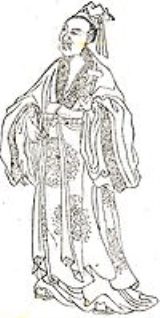
Wang Xizhi

Encyclopedia
| Names Chinese name Personal names in Chinese culture follow a number of conventions different from those of personal names in Western cultures. Most noticeably, a Chinese name is written with the family name first and the given name next, therefore "John-Paul Smith" as a Chinese name would be "Smith John-Paul"... |
|
|---|---|
 |
|
| Chinese Chinese language The Chinese language is a language or language family consisting of varieties which are mutually intelligible to varying degrees. Originally the indigenous languages spoken by the Han Chinese in China, it forms one of the branches of Sino-Tibetan family of languages... : |
王羲之 |
| Pinyin Pinyin Pinyin is the official system to transcribe Chinese characters into the Roman alphabet in China, Malaysia, Singapore and Taiwan. It is also often used to teach Mandarin Chinese and spell Chinese names in foreign publications and used as an input method to enter Chinese characters into... : |
Wáng Xīzhī |
| Wade-Giles Wade-Giles Wade–Giles , sometimes abbreviated Wade, is a romanization system for the Mandarin Chinese language. It developed from a system produced by Thomas Wade during the mid-19th century , and was given completed form with Herbert Giles' Chinese–English dictionary of 1892.Wade–Giles was the most... : |
Wang Hsi-chih |
| Zi: | Yìshào (逸少) |
| Hao: | Dànzhāi (澹斋) |
| Other names: | Yòujūn (右軍, General of the Left) Shūshèng (書聖, Sage of Calligraphy) |
Wang Xizhi was a Chinese
Chinese people
The term Chinese people may refer to any of the following:*People with Han Chinese ethnicity ....
calligrapher
East Asian calligraphy
East Asian calligraphy is a form of calligraphy widely practised and revered in the Sinosphere. This most often includes China, Japan, Korea, and Vietnam. The East Asian calligraphic tradition originated and developed from China. There is a general standardization of the various styles of...
, traditionally referred to as the Sage of Calligraphy (書聖), who lived during the Jin Dynasty (265–420). He is considered by many to be one of the most esteemed Chinese calligraphers of all time, especially during and after the Tang Dynasty
Tang Dynasty
The Tang Dynasty was an imperial dynasty of China preceded by the Sui Dynasty and followed by the Five Dynasties and Ten Kingdoms Period. It was founded by the Li family, who seized power during the decline and collapse of the Sui Empire...
, and a master of all forms of Chinese calligraphy, especially the running script.
The Emperor Taizong
Emperor Taizong of Tang
Emperor Taizong of Tang , personal name Lǐ Shìmín , was the second emperor of the Tang Dynasty of China, ruling from 626 to 649...
admired his works so much that the original Preface to the Poems Composed at the Orchid Pavilion
Lanting Xu
The Lantingji Xu or Lanting Xu is the most famous work of calligraphy by Wang Xizhi, composed in year 353. Written in semi-cursive script, it is the most well-known and well-copied piece ever...
was said to be buried with the emperor in his mausoleum
Mausoleum
A mausoleum is an external free-standing building constructed as a monument enclosing the interment space or burial chamber of a deceased person or persons. A monument without the interment is a cenotaph. A mausoleum may be considered a type of tomb or the tomb may be considered to be within the...
.
In addition to the esteem in which he is held in China, he has been and remains influential in Japanese calligraphy
Japanese calligraphy
is a form of calligraphy, or artistic writing, of the Japanese language. For a long time, the most esteemed calligrapher in Japan had been Wang Xizhi, a Chinese calligrapher in the 4th century but after the invention of Hiragana and Katakana, the Japanese unique syllabaries, the distinctive...
.
Biography
Born in Linyi, ShandongLinyi
Linyi is a prefecture-level city in the south of Shandong province, People's Republic of China. The largest prefecture-level city in Shandong both by area and total population, Linyi borders Rizhao to the east, Weifang to the northeast, Zibo to the north, Tai'an to the northwest, Jining to the...
, Wang spent most of his life in present-day Shaoxing, Zhejiang
Shaoxing
Shaoxing is a prefecture-level city in northeastern Zhejiang province, People's Republic of China. Located on the south bank of the Qiantang River estuary, it borders Ningbo to the east, Taizhou to the southeast, Jinhua to the southwest, and Hangzhou to the west. It was once known as "越"...
. He learned the art of calligraphy from Lady Wei Shuo
Wei Shuo
Wei Shuo , courtesy name Mouyi , sobriquet He'nan , commonly addressed just as Lady Wei , was a Chinese calligrapher of Eastern Jin, who established consequential rules about the regular script. Her famous disciple was Wang Xizhi....
. He excelled in every script but particularly in semi-cursive script
Semi-cursive script
Semi-cursive script is a cursive style of Chinese characters. Because it is not as abbreviated as cursive, most people who can read regular script can read semi-cursive....
. Unfortunately, none of his original works remains today.

Lanting Xu
The Lantingji Xu or Lanting Xu is the most famous work of calligraphy by Wang Xizhi, composed in year 353. Written in semi-cursive script, it is the most well-known and well-copied piece ever...
, the introduction to a collection of poems written by a number of poets during a gathering at Lanting near the town of Shaoxing for the Spring Purification Festival
Xiuxi
Shangsi Festival , also known as the Spring Purification Festival, was an ancient tradition in China during which people would go for an outing by the water, during the third day of the third lunar calendar month, where they would enjoy themselves at a picnic, pluck orchids, and to rid themselves...
. The original is lost, but there are a number of finely traced copies and rubbings in existence.
Wang Xizhi is particularly remembered for one of his hobbies, that of rearing geese
Goose
The word goose is the English name for a group of waterfowl, belonging to the family Anatidae. This family also includes swans, most of which are larger than true geese, and ducks, which are smaller....
. Legend has it that he learned that the key to how to turn his wrist whilst writing was to observe how geese moved their necks. There is a small porcelain cup depicting Wang Xizhi "walking geese" in the China Gallery of the Asian Civilisations Museum in Singapore. The other side of the cup depicts a scholar "taking a zither to a friend".
Wang Xizhi had seven children, all of whom were notable calligraphers. The most distinguished was his youngest son, Wang Xianzhi.
A reproduction of one of Wang's calligraphy scrolls was made during the Tang dynasty
Tang Dynasty
The Tang Dynasty was an imperial dynasty of China preceded by the Sui Dynasty and followed by the Five Dynasties and Ten Kingdoms Period. It was founded by the Li family, who seized power during the decline and collapse of the Sui Empire...
. It was sold in China at an auction in 2010 for an amount equivalent to $46 million.
External links
- Wang Xizhi and his Calligraphy Gallery at China Online Museum
- Wang XiZhi's calligraphy
- Selections of Wang Xi Zhi by Professor Lu-sheng Chong
- The Orchid Pavilion by Wang Xizhi.