


Cangjie

Encyclopedia
Cangjie is a very important figure in ancient China
(c. 2650 BC), claimed to be an official historian of the Yellow Emperor
and the inventor of Chinese character
s. Legend has it that he had four eyes and four pupils
, and that when he invented the characters, the deities and ghosts cried and the sky rained millet
. He is considered a legend
ary figure rather than a historical figure, or at least, not considered to be sole inventor of Chinese characters. The Cangjie method
, a Chinese character input method, is named after him. A rock on Mars
, visited by the Mars rover Spirit
, was named after him by the rover team.
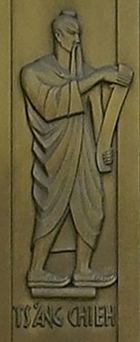 Shortly after unifying China, the Yellow Emperor, being terribly dissatisfied with his "rope knot tying" method (e.g., Quipu) of recording information, charged Cangjie with the task of creating characters for writing. Cangjie then settled down on the bank of a river, and devoted himself to the completion of the task at hand. Even after devoting much time and effort, however, he was unable to create even one character. One day, Cangjie suddenly saw a phoenix flying in the sky above, carrying an object in its beak. The object fell to the ground directly in front of Cangjie, and he saw it to be an impression of a hoof-print. Not being able to recognize which animal the print belonged to, he asked for the help of a local hunter passing by on the road. The hunter told him that this was, without a doubt, the hoof-print of a Pixiu
, being different from the hoof-print of any other beast alive. His conversation with the hunter greatly inspired Cangjie, leading him to believe that if he could capture in a drawing the special characteristics that set apart each and every thing on the earth, this would truly be the perfect kind of character for writing. From that day forward, Cangjie paid close attention to the characteristics of all things, including the sun, moon, stars, clouds, lakes, oceans, as well as all manner of bird and beast. He began to create characters according to the special characteristics he found, and before long, had compiled a long list of characters for writing. To the delight of the Yellow Emperor, Cangjie presented him with the complete set of characters. The emperor then called the premiers of each of the nine provinces together in order for Cangjie to teach them this new writing system. Monuments and temples were erected in Cangjie's honor on the bank of the river where he created these characters.
. Alternately, it is associated with the Yi people
.
China
Chinese civilization may refer to:* China for more general discussion of the country.* Chinese culture* Greater China, the transnational community of ethnic Chinese.* History of China* Sinosphere, the area historically affected by Chinese culture...
(c. 2650 BC), claimed to be an official historian of the Yellow Emperor
Yellow Emperor
The Yellow Emperor or Huangdi1 is a legendary Chinese sovereign and culture hero, included among the Three Sovereigns and Five Emperors. Tradition holds that he reigned from 2697–2597 or 2696–2598 BC...
and the inventor of Chinese character
Chinese character
Chinese characters are logograms used in the writing of Chinese and Japanese , less frequently Korean , formerly Vietnamese , or other languages...
s. Legend has it that he had four eyes and four pupils
Polycoria
Polycoria is a pathological condition of the eye characterized by more than one pupillary opening in the iris. It may be congenital or result from a disease affecting the iris....
, and that when he invented the characters, the deities and ghosts cried and the sky rained millet
Millet
The millets are a group of small-seeded species of cereal crops or grains, widely grown around the world for food and fodder. They do not form a taxonomic group, but rather a functional or agronomic one. Their essential similarities are that they are small-seeded grasses grown in difficult...
. He is considered a legend
Legend
A legend is a narrative of human actions that are perceived both by teller and listeners to take place within human history and to possess certain qualities that give the tale verisimilitude...
ary figure rather than a historical figure, or at least, not considered to be sole inventor of Chinese characters. The Cangjie method
Cangjie method
The Cangjie input method is a system by which Chinese characters may be entered into a computer by means of a standard keyboard...
, a Chinese character input method, is named after him. A rock on Mars
Mars
Mars is the fourth planet from the Sun in the Solar System. The planet is named after the Roman god of war, Mars. It is often described as the "Red Planet", as the iron oxide prevalent on its surface gives it a reddish appearance...
, visited by the Mars rover Spirit
Spirit rover
Spirit, MER-A , is a robotic rover on Mars, active from 2004 to 2010. It was one of two rovers of NASA's ongoing Mars Exploration Rover Mission. It landed successfully on Mars at 04:35 Ground UTC on January 4, 2004, three weeks before its twin, Opportunity , landed on the other side of the planet...
, was named after him by the rover team.
Legend of character creation
Pixiu
Pixiu or Pi Yao originally known as Pi Xie is a Chinese mythical hybrid creature considered to be a very powerful protector to practitioners of Feng Shui. It resembles a winged lion. Pixiu is an earth and sea variation, particularly an influential and auspicious creature for wealth...
, being different from the hoof-print of any other beast alive. His conversation with the hunter greatly inspired Cangjie, leading him to believe that if he could capture in a drawing the special characteristics that set apart each and every thing on the earth, this would truly be the perfect kind of character for writing. From that day forward, Cangjie paid close attention to the characteristics of all things, including the sun, moon, stars, clouds, lakes, oceans, as well as all manner of bird and beast. He began to create characters according to the special characteristics he found, and before long, had compiled a long list of characters for writing. To the delight of the Yellow Emperor, Cangjie presented him with the complete set of characters. The emperor then called the premiers of each of the nine provinces together in order for Cangjie to teach them this new writing system. Monuments and temples were erected in Cangjie's honor on the bank of the river where he created these characters.
Cang Jie text
The book Cang Jie, consisting of only 28 characters, was ascribed to Cang Jie and honored as the earliest Chinese text known to the ancients. However, it is suspected to be authored by Liu XinLiu Xin
Liu Xin , later changed name to Liu Xiu , courtesy name Zijun , was a Chinese astronomer, historian, and editor during the Xin Dynasty . He was the son of Confucian scholar Liu Xiang and an associate of other prominent thinkers such as the philosopher Huan Tan...
. Alternately, it is associated with the Yi people
Yi people
The Yi or Lolo people are an ethnic group in China, Vietnam, and Thailand. Numbering 8 million, they are the seventh largest of the 55 ethnic minority groups officially recognized by the People's Republic of China...
.