

East Asian calligraphy

Encyclopedia
East Asian calligraphy is a form of calligraphy
widely practised and revered in the Sinosphere
. This most often includes China
, Japan
, Korea
, and Vietnam
. The East Asian calligraphic tradition originated and developed from China
. There is a general standardization of the various styles
of calligraphy in this tradition. East Asian calligraphy and ink and wash painting
are closely related, since they are accomplished using similar tools and techniques. Chinese painting and calligraphy distinguish themselves from other cultural arts because they emphasize motion and are charged with dynamic life. According to Stanley-Baker, "Calligraphy is sheer life experienced through energy in motion that is registered as traces on silk or paper, with time and rhythm in shifting space its main ingredients." Calligraphy has also led to the development of many forms of art in East Asia, including seal carving, ornate paperweights, and inkstones.
The local name for calligraphy is Shūfǎ 書法 in China, literally "the way/method/law of writing"; Shodō in Japan, literally "the way/principle of writing"; and Seoye (서예) 書藝 in Korea, literally "the skill/criterion of writing". The calligraphy of East Asian characters is an important and appreciated aspect of East Asia
n culture. East Asian calligraphy is normally regarded as one of the "arts" (Chinese 藝術 , Japanese 芸術 geijutsu) in the countries where it is practiced. But there is actually a debate as to whether East Asian calligraphy is a discipline or an art. Indeed, both may be true.
As a practice
As a discipline calligraphy is, at the basic level, a pursuit -書法 , "the rules of writing Han characters"- focused on writing well. Students aim to obtain the writing characteristics of exemplary pieces of writing. Elementary school students practice calligraphy in this way, as do elders practicing temporary calligraphy, without aspiring to artistic creation.
As an art
Calligraphy is also considered an art - 藝術/艺术 , a relatively recent word meaning "art", where works are appreciated more or only for their aesthetic qualities.
The English word "Calligraphy
" refers to that which is "beautiful writing", thus including both aspects.
The oldest extant Chinese characters from ancient China are Jiǎgǔwén characters
carved on ox
scapula
s and tortoise
plastrons. Brush-written examples decay over time and have not survived. During the divination ceremony, after the cracks were made, characters were written with a brush on the shell or bone to be later carved.(Keightley, 1978). With the development of Jīnwén
(Bronzeware script) and Dàzhuàn
(Large Seal Script) "cursive" signs continued. Moreover, each archaic kingdom of current China had its own set of characters.
Imperial China
In Imperial China, the graphs on old steles — some dating from 200 BC, and in Xiaozhuan style — are still accessible.
In about 220 BC, the emperor Qin Shi Huang
, the first to conquer the entire Chinese basin, imposed several reforms, among them Li Si
's character unification, which created a set of 3300 standardized Xiǎozhuàn characters. Despite the fact that the main writing implement of the time was already the brush, little paper survives from this period, and the main examples of this style are on steles.
The Lìshū style
(clerical script) which is more regularized, and in some ways similar to modern text, were also authorised under Qin Shi Huangdi.
Kǎishū style
(traditional regular script) — still in use today — and attributed to Wang Xizhi
(王羲之, 303-361) and his followers, is even more regularized. Its spread was encouraged by Emperor Mingzong of Later Tang (926-933), who ordered the printing of the classics using new wooden blocks in Kaishu. Printing technologies here allowed shapes to stabilize. The Kaishu shape of characters 1000 years ago was mostly similar to that at the end of Imperial China. But small changes have been made, for example in the shape of 广 which is not absolutely the same in the Kangxi Dictionary
of 1716 as in modern books. The Kangxi and current shapes have tiny differences, while stroke order is still the same, according to old style.
Styles which did not survive include Bāfēnshū, a mix of 80% Xiaozhuan style and 20% Lishu.
Some Variant Chinese character
s were unorthodox or locally used for centuries. They were generally understood but always rejected in official texts. Some of these unorthodox variants, in addition to some newly created characters, were incorporated in the Simplified Chinese character set.
Cursive styles and hand-written styles
Cursive styles such as Xíngshū
(semi-cursive or running script) and Cǎoshū (cursive or grass script) are less constrained and faster, where more movements made by the writing implement are visible. These styles' stroke orders vary more, sometimes creating radically different forms. They are descended from Clerical script, in the same time as Regular script (Han Dynasty
), but Xíngshū and Cǎoshū were use for personal notes only, and were never used as standard. Caoshu style was highly appreciated during Emperor Wu of Han
reign (140-87).
Printed and computer styles
Examples of modern printed styles are Song from the Song Dynasty
's printing press, and sans-serif. These are not considered traditional styles, and are normally not written.
(T: 文房四寶 / S: 文房四宝) in China, and as the Four Friends of the Study (HG: 문방사우 / HJ: 文房四友) in Korea. In addition to these four tools, desk pads and paperweights are also used by calligraphers.
, or rarer materials such as red sandalwood, glass
, ivory
, silver
, and gold
. The head of the brush can be made from the hair (or feathers) of a wide variety of animals, including the weasel
, rabbit
, deer
, chicken
, duck
, goat
, pig
, tiger
, wolf, etc. There is also a tradition in both China and Japan of making a brush using the hair of a newborn, as a once-in-a-lifetime souvenir for the child. This practice is associated with the legend of an ancient Chinese scholar who scored first in the Imperial examination
s by using such a personalized brush. Calligraphy brushes are widely considered an extension of the calligrapher's arm.
Today, calligraphy may also be done using a pen
, but pen calligraphy does not enjoy the same prestige as traditional brush calligraphy.
Paper
 Special types of paper are used in East Asian calligraphy.
In China
, Xuanzhi (宣紙), traditionally made in Anhui
province, is the preferred type of paper. It is made from the Tartar wingceltis (Pteroceltis tartarianovii), as well as other materials including rice
, the paper mulberry
(Broussonetia papyrifera), bamboo
, hemp
, etc.
In Japan
, washi
is made from the kozo (paper mulberry), ganpi (Wikstroemia sikokiana), and mitsumata (Edgeworthia papyrifera), as well as other materials such as bamboo, hemp, rice, and wheat
.
Paperweights
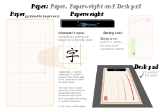
Paperweights are used to hold down paper. A paperweight is often placed at the top of all but the largest pages to prevent slipping; for smaller pieces the left hand is also placed at the bottom of the page for support. Paperweights come in several types: some are oblong wooden blocks carved with calligraphic or pictorial designs; others are essentially small sculptures of people or animals. Like inkstones, paperweights are collectible works of art on their own right.
Desk pads
The desk pad (Chinese T: 畫氈, S: 画毡, Pinyin
: huàzhān; Japanese: 下敷 shitajiki
) is a pad made of felt
. Some are printed with grids on both sides, so that when it is placed under the translucent paper, it can be used as a guide to ensure correct placement and size of characters. However, these printed pads are used only by students. Both desk pads and the printed grids come in a variety of sizes.
 The ink is made from lampblack (soot) and binders, and comes in inkstick
s which must be rubbed with water on an inkstone until the right consistency is achieved. Much cheaper, pre-mixed bottled inks are now available, but these are used primarily for practice as stick inks are considered higher quality and chemical inks are more prone to bleeding over time, making them less suitable for use in hanging scroll
s. Learning to rub the ink is an essential part of calligraphy study. Traditionally, East Asian calligraphy is written only in black ink, but modern calligraphers sometimes use other colors. Calligraphy teachers use a bright orange or red ink with which they write practice characters on which students trace, or to correct students' work.
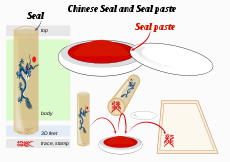
Calligraphic works are usually completed by the calligrapher putting his or her seal at the very end, in red ink. The seal serves the function of a signature.
give the "spirit" to the characters by influencing greatly their final shape.
, character structure, balance, and rhythm are essential in calligraphy. A student would also develop their skills in traditional Chinese arts, as familiarity and ability in the arts contributes to their calligraphy.
Since the development of regular script
, nearly all calligraphers have started their study by imitating exemplary models of regular script. A beginning student may practice writing the character 永 for its abundance of different kinds of strokes and difficulty in construction. The Eight Principles of Yong
refers to the eight different strokes in the character, which some argue summarizes the different strokes in regular script.
How the brush is held depends on the calligrapher and which calligraphic genre is practiced. Commonly, the brush is held vertically straight gripped between the thumb and middle finger. The index finger lightly touches the upper part of the shaft of the brush (stabilizing it) while the ring and little fingers tuck under the bottom of the shaft, leaving a space inside the palm. Alternatively, the brush is held in the right hand between the thumb and the index finger, very much like a Western pen. A calligrapher may change his or her grip depending on the style and script. For example, a calligrapher may grip higher for cursive
and lower for regular script
.
In Japan, smaller pieces of Japanese calligraphy
are traditionally written while in seiza
. In modern times, however, writers frequently practice calligraphy seated on a chair at a table. Larger pieces may be written while standing; in this case the paper is usually placed directly on the floor, but some calligraphers use an easel.
Basic calligraphy instruction is part of the regular school curriculum in both China
and Japan
and specialized programs of study exist at the higher education level in China, Korea, and Japan. In contemporary times, debate emerged on the limits of this copyist tradition within the modern art scenes, where innovation is the rule, while changing lifestyles, tools, and colors are also influencing new waves of masters.
Chinese calligraphy is being promoted in Chinese schools to counter Character amnesia
brought on by technology usage.
Japanese calligraphy
extends beyond Han characters to also include local scripts such as hiragana
and katakana
.
In the case of Korean calligraphy
, the Hangeul and the existence of the circle required the creation of a new technique.
The existence of temporary calligraphy is also to be noted. This is the practice of water-only calligraphy on the floor which dries out within minutes. This practice is especially appreciated by the new generation of retired Chinese in public parks of China.
, which is accomplished using similar tools and techniques. Calligraphy has influenced most major art styles in East Asia
, including Ink and wash painting
, a style of Chinese
, Korean
, Japanese painting
, and Vietnamese painting based entirely on calligraphy.
| valign="top" |
| valign="top" |
|}
Calligraphy
Calligraphy is a type of visual art. It is often called the art of fancy lettering . A contemporary definition of calligraphic practice is "the art of giving form to signs in an expressive, harmonious and skillful manner"...
widely practised and revered in the Sinosphere
Sinosphere
In areal linguistics, Sinosphere refers to a grouping of countries and regions that are currently inhabited with a majority of Chinese population or were historically under Chinese cultural influence...
. This most often includes China
China
Chinese civilization may refer to:* China for more general discussion of the country.* Chinese culture* Greater China, the transnational community of ethnic Chinese.* History of China* Sinosphere, the area historically affected by Chinese culture...
, Japan
Japan
Japan is an island nation in East Asia. Located in the Pacific Ocean, it lies to the east of the Sea of Japan, China, North Korea, South Korea and Russia, stretching from the Sea of Okhotsk in the north to the East China Sea and Taiwan in the south...
, Korea
Korea
Korea ) is an East Asian geographic region that is currently divided into two separate sovereign states — North Korea and South Korea. Located on the Korean Peninsula, Korea is bordered by the People's Republic of China to the northwest, Russia to the northeast, and is separated from Japan to the...
, and Vietnam
Vietnam
Vietnam – sometimes spelled Viet Nam , officially the Socialist Republic of Vietnam – is the easternmost country on the Indochina Peninsula in Southeast Asia. It is bordered by China to the north, Laos to the northwest, Cambodia to the southwest, and the South China Sea –...
. The East Asian calligraphic tradition originated and developed from China
China
Chinese civilization may refer to:* China for more general discussion of the country.* Chinese culture* Greater China, the transnational community of ethnic Chinese.* History of China* Sinosphere, the area historically affected by Chinese culture...
. There is a general standardization of the various styles
East asian script styles
In Chinese calligraphy, Chinese characters can be written according to five major styles. These styles are intrinsically linked to the history of Chinese script.-Styles:...
of calligraphy in this tradition. East Asian calligraphy and ink and wash painting
Ink and wash painting
Ink and wash painting is an East Asian type of brush painting also known as ink wash painting. Only black ink — the same as used in East Asian calligraphy — is used, in various concentrations....
are closely related, since they are accomplished using similar tools and techniques. Chinese painting and calligraphy distinguish themselves from other cultural arts because they emphasize motion and are charged with dynamic life. According to Stanley-Baker, "Calligraphy is sheer life experienced through energy in motion that is registered as traces on silk or paper, with time and rhythm in shifting space its main ingredients." Calligraphy has also led to the development of many forms of art in East Asia, including seal carving, ornate paperweights, and inkstones.
Definition and classification
NamesThe local name for calligraphy is Shūfǎ 書法 in China, literally "the way/method/law of writing"; Shodō in Japan, literally "the way/principle of writing"; and Seoye (서예) 書藝 in Korea, literally "the skill/criterion of writing". The calligraphy of East Asian characters is an important and appreciated aspect of East Asia
East Asia
East Asia or Eastern Asia is a subregion of Asia that can be defined in either geographical or cultural terms...
n culture. East Asian calligraphy is normally regarded as one of the "arts" (Chinese 藝術 , Japanese 芸術 geijutsu) in the countries where it is practiced. But there is actually a debate as to whether East Asian calligraphy is a discipline or an art. Indeed, both may be true.
As a practice
As a discipline calligraphy is, at the basic level, a pursuit -書法 , "the rules of writing Han characters"- focused on writing well. Students aim to obtain the writing characteristics of exemplary pieces of writing. Elementary school students practice calligraphy in this way, as do elders practicing temporary calligraphy, without aspiring to artistic creation.
As an art
Calligraphy is also considered an art - 藝術/艺术 , a relatively recent word meaning "art", where works are appreciated more or only for their aesthetic qualities.
The English word "Calligraphy
Calligraphy
Calligraphy is a type of visual art. It is often called the art of fancy lettering . A contemporary definition of calligraphic practice is "the art of giving form to signs in an expressive, harmonious and skillful manner"...
" refers to that which is "beautiful writing", thus including both aspects.
Evolution and Styles
Ancient ChinaThe oldest extant Chinese characters from ancient China are Jiǎgǔwén characters
Oracle bone script
Oracle bone script refers to incised ancient Chinese characters found on oracle bones, which are animal bones or turtle shells used in divination in Bronze Age China...
carved on ox
Ox
An ox , also known as a bullock in Australia, New Zealand and India, is a bovine trained as a draft animal. Oxen are commonly castrated adult male cattle; castration makes the animals more tractable...
scapula
Scapula
In anatomy, the scapula , omo, or shoulder blade, is the bone that connects the humerus with the clavicle ....
s and tortoise
Tortoise
Tortoises are a family of land-dwelling reptiles of the order of turtles . Like their marine cousins, the sea turtles, tortoises are shielded from predators by a shell. The top part of the shell is the carapace, the underside is the plastron, and the two are connected by the bridge. The tortoise...
plastrons. Brush-written examples decay over time and have not survived. During the divination ceremony, after the cracks were made, characters were written with a brush on the shell or bone to be later carved.(Keightley, 1978). With the development of Jīnwén
Bronzeware script
Chinese Bronze inscriptions are writing in a variety of Chinese scripts on Chinese bronze artifacts such as zhōng bells and dǐng tripodal cauldrons from the Shāng dynasty to the Zhōu dynasty and even later...
(Bronzeware script) and Dàzhuàn
Large Seal Script
Large Seal script or Great Seal script is a traditional reference to Chinese writing from before the Qin dynasty, and is now popularly understood to refer narrowly to the writing of the Western and early Eastern Zhou dynasties, and more broadly to also include the oracle bone script...
(Large Seal Script) "cursive" signs continued. Moreover, each archaic kingdom of current China had its own set of characters.
Imperial China
In Imperial China, the graphs on old steles — some dating from 200 BC, and in Xiaozhuan style — are still accessible.
In about 220 BC, the emperor Qin Shi Huang
Qin Shi Huang
Qin Shi Huang , personal name Ying Zheng , was king of the Chinese State of Qin from 246 BC to 221 BC during the Warring States Period. He became the first emperor of a unified China in 221 BC...
, the first to conquer the entire Chinese basin, imposed several reforms, among them Li Si
Li Si
Li Si was the influential Prime Minister of the feudal state and later of the dynasty of Qin, between 246 BC and 208 BC. A famous Legalist, he was also a notable calligrapher. Li Si served under two rulers: Qin Shi Huang, king of Qin and later First Emperor of China—and his son, Qin Er Shi...
's character unification, which created a set of 3300 standardized Xiǎozhuàn characters. Despite the fact that the main writing implement of the time was already the brush, little paper survives from this period, and the main examples of this style are on steles.
The Lìshū style
Clerical script
The clerical script , also formerly chancery script, is an archaic style of Chinese calligraphy which evolved in the Warring States period to the Qin dynasty, was dominant in the Han dynasty, and remained in use through the Wèi-Jìn periods...
(clerical script) which is more regularized, and in some ways similar to modern text, were also authorised under Qin Shi Huangdi.
Kǎishū style
Regular script
Regular script , also called 正楷 , 真書 , 楷体 and 正書 , is the newest of the Chinese script styles Regular script , also called 正楷 , 真書 (zhēnshū), 楷体 (kǎitǐ) and 正書 (zhèngshū), is the newest of the Chinese script styles Regular script , also called 正楷 , 真書 (zhēnshū), 楷体 (kǎitǐ) and 正書 (zhèngshū), is...
(traditional regular script) — still in use today — and attributed to Wang Xizhi
Wang Xizhi
Wang Xizhi was a Chinese calligrapher, traditionally referred to as the Sage of Calligraphy , who lived during the Jin Dynasty...
(王羲之, 303-361) and his followers, is even more regularized. Its spread was encouraged by Emperor Mingzong of Later Tang (926-933), who ordered the printing of the classics using new wooden blocks in Kaishu. Printing technologies here allowed shapes to stabilize. The Kaishu shape of characters 1000 years ago was mostly similar to that at the end of Imperial China. But small changes have been made, for example in the shape of 广 which is not absolutely the same in the Kangxi Dictionary
Kangxi dictionary
The Kangxi Dictionary was the standard Chinese dictionary during the 18th and 19th centuries. The Kangxi Emperor of the Manchu Qing Dynasty ordered its compilation in 1710. The creator innovated greatly by reusing and confirming the new Zihui system of 596 radicals, since then known as 596 Kangxi...
of 1716 as in modern books. The Kangxi and current shapes have tiny differences, while stroke order is still the same, according to old style.
Styles which did not survive include Bāfēnshū, a mix of 80% Xiaozhuan style and 20% Lishu.
Some Variant Chinese character
Variant Chinese character
Variant Chinese characters are Chinese characters that are homophones and synonyms. Almost all variants are allographs in most circumstances, such as casual handwriting...
s were unorthodox or locally used for centuries. They were generally understood but always rejected in official texts. Some of these unorthodox variants, in addition to some newly created characters, were incorporated in the Simplified Chinese character set.
Cursive styles and hand-written styles
Cursive styles such as Xíngshū
Semi-cursive script
Semi-cursive script is a cursive style of Chinese characters. Because it is not as abbreviated as cursive, most people who can read regular script can read semi-cursive....
(semi-cursive or running script) and Cǎoshū (cursive or grass script) are less constrained and faster, where more movements made by the writing implement are visible. These styles' stroke orders vary more, sometimes creating radically different forms. They are descended from Clerical script, in the same time as Regular script (Han Dynasty
Han Dynasty
The Han Dynasty was the second imperial dynasty of China, preceded by the Qin Dynasty and succeeded by the Three Kingdoms . It was founded by the rebel leader Liu Bang, known posthumously as Emperor Gaozu of Han. It was briefly interrupted by the Xin Dynasty of the former regent Wang Mang...
), but Xíngshū and Cǎoshū were use for personal notes only, and were never used as standard. Caoshu style was highly appreciated during Emperor Wu of Han
Emperor Wu of Han
Emperor Wu of Han , , personal name Liu Che , was the seventh emperor of the Han Dynasty of China, ruling from 141 BC to 87 BC. Emperor Wu is best remembered for the vast territorial expansion that occurred under his reign, as well as the strong and centralized Confucian state he organized...
reign (140-87).
Printed and computer styles
Examples of modern printed styles are Song from the Song Dynasty
Song Dynasty
The Song Dynasty was a ruling dynasty in China between 960 and 1279; it succeeded the Five Dynasties and Ten Kingdoms Period, and was followed by the Yuan Dynasty. It was the first government in world history to issue banknotes or paper money, and the first Chinese government to establish a...
's printing press, and sans-serif. These are not considered traditional styles, and are normally not written.
Tools : The Four Treasures of the Study
The ink brush, ink, paper, and inkstone are essential implements of East Asian calligraphy: they are known together as the Four Treasures of the StudyFour Treasures of the Study
Four Treasures of the Study, Four Jewels of the Study or Four Friends of the Study is an expression used to denote the brush, ink, paper and ink stone used in Chinese and other East Asian calligraphic traditions...
(T: 文房四寶 / S: 文房四宝) in China, and as the Four Friends of the Study (HG: 문방사우 / HJ: 文房四友) in Korea. In addition to these four tools, desk pads and paperweights are also used by calligraphers.
Brush
The brush is the traditional writing implement in East Asian calligraphy. The body of the brush can be made from either bambooBamboo
Bamboo is a group of perennial evergreens in the true grass family Poaceae, subfamily Bambusoideae, tribe Bambuseae. Giant bamboos are the largest members of the grass family....
, or rarer materials such as red sandalwood, glass
Glass
Glass is an amorphous solid material. Glasses are typically brittle and optically transparent.The most familiar type of glass, used for centuries in windows and drinking vessels, is soda-lime glass, composed of about 75% silica plus Na2O, CaO, and several minor additives...
, ivory
Ivory
Ivory is a term for dentine, which constitutes the bulk of the teeth and tusks of animals, when used as a material for art or manufacturing. Ivory has been important since ancient times for making a range of items, from ivory carvings to false teeth, fans, dominoes, joint tubes, piano keys and...
, silver
Silver
Silver is a metallic chemical element with the chemical symbol Ag and atomic number 47. A soft, white, lustrous transition metal, it has the highest electrical conductivity of any element and the highest thermal conductivity of any metal...
, and gold
Gold
Gold is a chemical element with the symbol Au and an atomic number of 79. Gold is a dense, soft, shiny, malleable and ductile metal. Pure gold has a bright yellow color and luster traditionally considered attractive, which it maintains without oxidizing in air or water. Chemically, gold is a...
. The head of the brush can be made from the hair (or feathers) of a wide variety of animals, including the weasel
Siberian Weasel
The Siberian weasel , also known as the Kolonok, is a medium-sized species of weasel native to Asia. It is classed as Least Concern for extinction by the IUCN, due to its wide distribution and presumably large numbers....
, rabbit
Rabbit
Rabbits are small mammals in the family Leporidae of the order Lagomorpha, found in several parts of the world...
, deer
Deer
Deer are the ruminant mammals forming the family Cervidae. Species in the Cervidae family include white-tailed deer, elk, moose, red deer, reindeer, fallow deer, roe deer and chital. Male deer of all species and female reindeer grow and shed new antlers each year...
, chicken
Chicken
The chicken is a domesticated fowl, a subspecies of the Red Junglefowl. As one of the most common and widespread domestic animals, and with a population of more than 24 billion in 2003, there are more chickens in the world than any other species of bird...
, duck
Duck
Duck is the common name for a large number of species in the Anatidae family of birds, which also includes swans and geese. The ducks are divided among several subfamilies in the Anatidae family; they do not represent a monophyletic group but a form taxon, since swans and geese are not considered...
, goat
Goat
The domestic goat is a subspecies of goat domesticated from the wild goat of southwest Asia and Eastern Europe. The goat is a member of the Bovidae family and is closely related to the sheep as both are in the goat-antelope subfamily Caprinae. There are over three hundred distinct breeds of...
, pig
Pig
A pig is any of the animals in the genus Sus, within the Suidae family of even-toed ungulates. Pigs include the domestic pig, its ancestor the wild boar, and several other wild relatives...
, tiger
Tiger
The tiger is the largest cat species, reaching a total body length of up to and weighing up to . Their most recognizable feature is a pattern of dark vertical stripes on reddish-orange fur with lighter underparts...
, wolf, etc. There is also a tradition in both China and Japan of making a brush using the hair of a newborn, as a once-in-a-lifetime souvenir for the child. This practice is associated with the legend of an ancient Chinese scholar who scored first in the Imperial examination
Imperial examination
The Imperial examination was an examination system in Imperial China designed to select the best administrative officials for the state's bureaucracy. This system had a huge influence on both society and culture in Imperial China and was directly responsible for the creation of a class of...
s by using such a personalized brush. Calligraphy brushes are widely considered an extension of the calligrapher's arm.
Today, calligraphy may also be done using a pen
Pen
A pen is a device used to apply ink to a surface, usually paper, for writing or drawing. Historically, reed pens, quill pens, and dip pens were used, with a nib of some sort to be dipped in the ink. Ruling pens allow precise adjustment of line width, and still find a few specialized uses, but...
, but pen calligraphy does not enjoy the same prestige as traditional brush calligraphy.
Paper
Paper nowadays is frequently sold together with a paperweight and desk pad.Paper
In China
China
Chinese civilization may refer to:* China for more general discussion of the country.* Chinese culture* Greater China, the transnational community of ethnic Chinese.* History of China* Sinosphere, the area historically affected by Chinese culture...
, Xuanzhi (宣紙), traditionally made in Anhui
Anhui
Anhui is a province in the People's Republic of China. Located in eastern China across the basins of the Yangtze River and the Huai River, it borders Jiangsu to the east, Zhejiang to the southeast, Jiangxi to the south, Hubei to the southwest, Henan to the northwest, and Shandong for a tiny...
province, is the preferred type of paper. It is made from the Tartar wingceltis (Pteroceltis tartarianovii), as well as other materials including rice
Rice
Rice is the seed of the monocot plants Oryza sativa or Oryza glaberrima . As a cereal grain, it is the most important staple food for a large part of the world's human population, especially in East Asia, Southeast Asia, South Asia, the Middle East, and the West Indies...
, the paper mulberry
Paper Mulberry
The Paper Mulberry is a tree in the family Moraceae, native to eastern Asia. Other names include Dak, Halibun, Kalivon, Kozo, and Tapacloth tree.It is a deciduous tree growing to tall...
(Broussonetia papyrifera), bamboo
Bamboo
Bamboo is a group of perennial evergreens in the true grass family Poaceae, subfamily Bambusoideae, tribe Bambuseae. Giant bamboos are the largest members of the grass family....
, hemp
Hemp
Hemp is mostly used as a name for low tetrahydrocannabinol strains of the plant Cannabis sativa, of fiber and/or oilseed varieties. In modern times, hemp has been used for industrial purposes including paper, textiles, biodegradable plastics, construction, health food and fuel with modest...
, etc.
In Japan
Japan
Japan is an island nation in East Asia. Located in the Pacific Ocean, it lies to the east of the Sea of Japan, China, North Korea, South Korea and Russia, stretching from the Sea of Okhotsk in the north to the East China Sea and Taiwan in the south...
, washi
Washi
is a type of paper made in Japan. Washi is commonly made using fibers from the bark of the gampi tree, the mitsumata shrub , or the paper mulberry, but also can be made using bamboo, hemp, rice, and wheat...
is made from the kozo (paper mulberry), ganpi (Wikstroemia sikokiana), and mitsumata (Edgeworthia papyrifera), as well as other materials such as bamboo, hemp, rice, and wheat
Wheat
Wheat is a cereal grain, originally from the Levant region of the Near East, but now cultivated worldwide. In 2007 world production of wheat was 607 million tons, making it the third most-produced cereal after maize and rice...
.
Paperweights
Paperweights are used to hold down paper. A paperweight is often placed at the top of all but the largest pages to prevent slipping; for smaller pieces the left hand is also placed at the bottom of the page for support. Paperweights come in several types: some are oblong wooden blocks carved with calligraphic or pictorial designs; others are essentially small sculptures of people or animals. Like inkstones, paperweights are collectible works of art on their own right.
Desk pads
The desk pad (Chinese T: 畫氈, S: 画毡, Pinyin
Pinyin
Pinyin is the official system to transcribe Chinese characters into the Roman alphabet in China, Malaysia, Singapore and Taiwan. It is also often used to teach Mandarin Chinese and spell Chinese names in foreign publications and used as an input method to enter Chinese characters into...
: huàzhān; Japanese: 下敷 shitajiki
Shitajiki
Shitajiki is a Japanese word for various types of materials placed under a sheet of paper for writing, either to prevent marking on the sheets below or to provide a better surface for writing...
) is a pad made of felt
Felt
Felt is a non-woven cloth that is produced by matting, condensing and pressing woollen fibres. While some types of felt are very soft, some are tough enough to form construction materials. Felt can be of any colour, and made into any shape or size....
. Some are printed with grids on both sides, so that when it is placed under the translucent paper, it can be used as a guide to ensure correct placement and size of characters. However, these printed pads are used only by students. Both desk pads and the printed grids come in a variety of sizes.
Ink and Inkstick
Inkstick
Inksticks are a type of solid ink used traditionally in several East Asian cultures for calligraphy and brush painting. Inksticks are made mainly of soot and animal glue, sometimes with incense or medicinal scents added...
s which must be rubbed with water on an inkstone until the right consistency is achieved. Much cheaper, pre-mixed bottled inks are now available, but these are used primarily for practice as stick inks are considered higher quality and chemical inks are more prone to bleeding over time, making them less suitable for use in hanging scroll
Hanging scroll
A hanging scroll is one of the many traditional ways to display and exhibit Chinese painting and calligraphy. Displaying the art in such way was befitting for public appreciation and appraisal of the aesthetics of the scrolls in its entirety by the audience. The traditional craft involved in...
s. Learning to rub the ink is an essential part of calligraphy study. Traditionally, East Asian calligraphy is written only in black ink, but modern calligraphers sometimes use other colors. Calligraphy teachers use a bright orange or red ink with which they write practice characters on which students trace, or to correct students' work.
Inkstone
Stone, ceramic, or clay from the banks of the Yellow River inkstone is used to grind the solid inkstick into liquid ink and to contain the ink once it is liquid. Chinese inkstones are highly prized as art objects and an extensive bibliography is dedicated to their history and appreciation, especially in China.Seal and Seal paste
Calligraphic works are usually completed by the calligrapher putting his or her seal at the very end, in red ink. The seal serves the function of a signature.
Technique: principles
The shape, size, stretch and type of hair in the brush, the color and density of the ink, as well as the absorptive speed and surface texture of the paper are the main physical parameters influencing the final result. The calligrapher also influences the result by the quantity of ink/water he lets the brush take up, then by the pressure, inclination, and direction he gives to the brush, producing thinner or bolder strokes, and smooth or toothed borders. Eventually, the speed, acceleration and deceleration of the writer's moves, turns, and crochets, and the stroke orderStroke order
Stroke order refers to the order in which the strokes of a Chinese character are written. A stroke is a movement of a writing instrument on a writing surface. Chinese characters are used in various forms in Chinese, Japanese, and in Korean...
give the "spirit" to the characters by influencing greatly their final shape.
Study
Traditionally, the bulk of the study of calligraphy is composed of copying strictly exemplary works from the apprentice's master or from reputed calligraphers, thus learning them by rote. The master showing the 'right way' to draw items, which the apprentice have to copy strictly, continuously, until the move become instinctive and the copy perfect. Derivation from the model is seen as a failure. Competency in a particular style often requires many years of practice. Correct strokes, stroke orderStroke order
Stroke order refers to the order in which the strokes of a Chinese character are written. A stroke is a movement of a writing instrument on a writing surface. Chinese characters are used in various forms in Chinese, Japanese, and in Korean...
, character structure, balance, and rhythm are essential in calligraphy. A student would also develop their skills in traditional Chinese arts, as familiarity and ability in the arts contributes to their calligraphy.
Since the development of regular script
Regular script
Regular script , also called 正楷 , 真書 , 楷体 and 正書 , is the newest of the Chinese script styles Regular script , also called 正楷 , 真書 (zhēnshū), 楷体 (kǎitǐ) and 正書 (zhèngshū), is the newest of the Chinese script styles Regular script , also called 正楷 , 真書 (zhēnshū), 楷体 (kǎitǐ) and 正書 (zhèngshū), is...
, nearly all calligraphers have started their study by imitating exemplary models of regular script. A beginning student may practice writing the character 永 for its abundance of different kinds of strokes and difficulty in construction. The Eight Principles of Yong
Eight Principles of Yong
Stroke order animated and in color gradation from black to red The strokes numbered Where there are multiple numbers in an area, the strokes overlap briefly and continue from the previous number to the next....
refers to the eight different strokes in the character, which some argue summarizes the different strokes in regular script.
How the brush is held depends on the calligrapher and which calligraphic genre is practiced. Commonly, the brush is held vertically straight gripped between the thumb and middle finger. The index finger lightly touches the upper part of the shaft of the brush (stabilizing it) while the ring and little fingers tuck under the bottom of the shaft, leaving a space inside the palm. Alternatively, the brush is held in the right hand between the thumb and the index finger, very much like a Western pen. A calligrapher may change his or her grip depending on the style and script. For example, a calligrapher may grip higher for cursive
Cursive script (East Asia)
Cursive script , sometimes translated as Grass script is a style of Chinese calligraphy. Cursive script is faster to write than other styles, but difficult to read for those unfamiliar with it. It functions primarily as a kind of shorthand script or calligraphic style...
and lower for regular script
Regular script
Regular script , also called 正楷 , 真書 , 楷体 and 正書 , is the newest of the Chinese script styles Regular script , also called 正楷 , 真書 (zhēnshū), 楷体 (kǎitǐ) and 正書 (zhèngshū), is the newest of the Chinese script styles Regular script , also called 正楷 , 真書 (zhēnshū), 楷体 (kǎitǐ) and 正書 (zhèngshū), is...
.
In Japan, smaller pieces of Japanese calligraphy
Japanese calligraphy
is a form of calligraphy, or artistic writing, of the Japanese language. For a long time, the most esteemed calligrapher in Japan had been Wang Xizhi, a Chinese calligrapher in the 4th century but after the invention of Hiragana and Katakana, the Japanese unique syllabaries, the distinctive...
are traditionally written while in seiza
Seiza
Seiza is the Japanese term for the traditional formal way of sitting in Japan.- Form :To sit seiza-style, one first kneels on the floor, folding one's legs underneath one's thighs, while resting the buttocks on the heels...
. In modern times, however, writers frequently practice calligraphy seated on a chair at a table. Larger pieces may be written while standing; in this case the paper is usually placed directly on the floor, but some calligraphers use an easel.
Basic calligraphy instruction is part of the regular school curriculum in both China
China
Chinese civilization may refer to:* China for more general discussion of the country.* Chinese culture* Greater China, the transnational community of ethnic Chinese.* History of China* Sinosphere, the area historically affected by Chinese culture...
and Japan
Japan
Japan is an island nation in East Asia. Located in the Pacific Ocean, it lies to the east of the Sea of Japan, China, North Korea, South Korea and Russia, stretching from the Sea of Okhotsk in the north to the East China Sea and Taiwan in the south...
and specialized programs of study exist at the higher education level in China, Korea, and Japan. In contemporary times, debate emerged on the limits of this copyist tradition within the modern art scenes, where innovation is the rule, while changing lifestyles, tools, and colors are also influencing new waves of masters.
Chinese calligraphy is being promoted in Chinese schools to counter Character amnesia
Character amnesia
Character amnesia is a phenomenon whereby experienced speakers of some East Asian languages forget how to write Chinese characters previously well known to them. The phenomenon is specifically tied to prolonged and extensive use of input methods, such as those that use romanizations of characters,...
brought on by technology usage.
Evaluation and appreciation
What is considered good calligraphy often varies depending on individual preferences. However, there are established traditional rules which cannot be violated. Violation of these rules will render a calligraphic work unable to be considered good calligraphy. Those who repeatedly violate these rules are not considered legitimate calligraphers. Among these rules are:- The characters must be written correctly. A correctly written character is composed in a way that is accepted as correct by legitimate calligraphers. Calligraphic works often use variant Chinese characterVariant Chinese characterVariant Chinese characters are Chinese characters that are homophones and synonyms. Almost all variants are allographs in most circumstances, such as casual handwriting...
s, which are deemed correct or incorrect on a case-by-case basis, but in general, more popular variants are more likely to be correct. Correct characters are written in the traditional stroke order and not a modern standard (See Stroke Order per Polity). - The characters must be legible. As calligraphy is the method of writing well, a calligraphic work must be recognizable as script, and furthermore be easily legible to those familiar with the script style, although it may be illegible to those unfamiliar with the script style. For example, many people cannot read cursiveCursive script (East Asia)Cursive script , sometimes translated as Grass script is a style of Chinese calligraphy. Cursive script is faster to write than other styles, but difficult to read for those unfamiliar with it. It functions primarily as a kind of shorthand script or calligraphic style...
, but a calligraphic work in cursive can still be considered good if those familiar with cursive can read it. - The characters must be concise. This is in contrast to Western calligraphyWestern calligraphyWestern Calligraphy is the art of writing. A contemporary definition of calligraphic practice is "the art of giving form to signs in an expressive, harmonious and skillful manner." The story of writing is one of aesthetic development framed within the technical skills, transmission speed and...
where flourishes are acceptable and often desirable. Good Chinese calligraphy must be unadorned script. It must also be in black ink unless there is a reason to write in other ink. - The characters must fit their context. All reputable calligraphers in China were well educated and well read. In addition to calligraphy, they were skilled in other areas, most likely paintingChinese paintingChinese painting is one of the oldest continuous artistic traditions in the world. The earliest paintings were not representational but ornamental; they consisted of patterns or designs rather than pictures. Early pottery was painted with spirals, zigzags, dots, or animals...
, poetryChinese poetryChinese poetry is poetry written, spoken, or chanted in the Chinese language, which includes various versions of Chinese language, including Classical Chinese, Standard Chinese, Mandarin Chinese, Cantonese, Yue Chinese, as well as many other historical and vernacular varieties of the Chinese language...
, musicMusic of ChinaChinese Music has been made since the dawn of Chinese civilization with documents and artifacts providing evidence of a well-developed musical culture as early as the Zhou Dynasty...
, operaChinese operaChinese opera is a popular form of drama and musical theatre in China with roots going back as far as the third century CE...
, martial artsChinese martial artsChinese martial arts, also referred to by the Mandarin Chinese term wushu and popularly as kung fu , are a number of fighting styles that have developed over the centuries in China. These fighting styles are often classified according to common traits, identified as "families" , "sects" or...
, and chess. Therefore, their abundant education contributed to their calligraphy. A calligrapher practicing another calligrapher's characters would always know what the text means, when it was created, and in what circumstances. When they write, their characters' shape and weight agrees with the rhythm of the phrases, especially in less constrained styles such as semi-cursiveSemi-cursive scriptSemi-cursive script is a cursive style of Chinese characters. Because it is not as abbreviated as cursive, most people who can read regular script can read semi-cursive....
and cursiveCursive script (East Asia)Cursive script , sometimes translated as Grass script is a style of Chinese calligraphy. Cursive script is faster to write than other styles, but difficult to read for those unfamiliar with it. It functions primarily as a kind of shorthand script or calligraphic style...
. One who does not know the meaning of the characters they write, but vary their shape and weight on a whim, does not produce good calligraphy. - The characters must be aesthetically pleasing. Generally, characters that are written correctly, legibly, concisely, and in the correct context are also aesthetically pleasing to some degree. Characters that violate the above rules are often less aesthetically pleasing.
Japanese and Korean calligraphies
East Asian Calligraphy usually refers to Chinese character calligraphy. Japanese and Korean people developed specific sensibilities and styles of calligraphies, as well as applying to specific scripts.Japanese calligraphy
Japanese calligraphy
is a form of calligraphy, or artistic writing, of the Japanese language. For a long time, the most esteemed calligrapher in Japan had been Wang Xizhi, a Chinese calligrapher in the 4th century but after the invention of Hiragana and Katakana, the Japanese unique syllabaries, the distinctive...
extends beyond Han characters to also include local scripts such as hiragana
Hiragana
is a Japanese syllabary, one basic component of the Japanese writing system, along with katakana, kanji, and the Latin alphabet . Hiragana and katakana are both kana systems, in which each character represents one mora...
and katakana
Katakana
is a Japanese syllabary, one component of the Japanese writing system along with hiragana, kanji, and in some cases the Latin alphabet . The word katakana means "fragmentary kana", as the katakana scripts are derived from components of more complex kanji. Each kana represents one mora...
.
In the case of Korean calligraphy
Korean calligraphy
Korean calligraphy is a variant of Chinese calligraphy, formerly applied to Chinese characters to transcribe Korean speech. It later also applied to the Korean alphabet . Hangul introduces the circle stroke...
, the Hangeul and the existence of the circle required the creation of a new technique.
The existence of temporary calligraphy is also to be noted. This is the practice of water-only calligraphy on the floor which dries out within minutes. This practice is especially appreciated by the new generation of retired Chinese in public parks of China.
Other arts
Calligraphy has influenced ink and wash paintingInk and wash painting
Ink and wash painting is an East Asian type of brush painting also known as ink wash painting. Only black ink — the same as used in East Asian calligraphy — is used, in various concentrations....
, which is accomplished using similar tools and techniques. Calligraphy has influenced most major art styles in East Asia
East Asia
East Asia or Eastern Asia is a subregion of Asia that can be defined in either geographical or cultural terms...
, including Ink and wash painting
Ink and wash painting
Ink and wash painting is an East Asian type of brush painting also known as ink wash painting. Only black ink — the same as used in East Asian calligraphy — is used, in various concentrations....
, a style of Chinese
Chinese painting
Chinese painting is one of the oldest continuous artistic traditions in the world. The earliest paintings were not representational but ornamental; they consisted of patterns or designs rather than pictures. Early pottery was painted with spirals, zigzags, dots, or animals...
, Korean
Korean painting
Korean painting includes paintings made in Korea or by overseas Koreans on all surfaces. It includes art as old as the petroglyphs through post-modern conceptual art using transient forms of light...
, Japanese painting
Japanese painting
is one of the oldest and most highly refined of the Japanese visual arts, encompassing a wide variety of genres and styles. As with the history of Japanese arts in general, the long history of Japanese painting exhibits synthesis and competition between native Japanese aesthetics and adaptation of...
, and Vietnamese painting based entirely on calligraphy.
China
- Wei ShuoWei ShuoWei Shuo , courtesy name Mouyi , sobriquet He'nan , commonly addressed just as Lady Wei , was a Chinese calligrapher of Eastern Jin, who established consequential rules about the regular script. Her famous disciple was Wang Xizhi....
衛鑠 (272–349) - Wang XizhiWang XizhiWang Xizhi was a Chinese calligrapher, traditionally referred to as the Sage of Calligraphy , who lived during the Jin Dynasty...
王羲之 (303–361) - Wang Xianzhi 王獻之 (344–386)
- Ouyang XunOuyang XunOuyang Xun , courtesy name Xinben , was a Confucian scholar and calligrapher of the early Tang Dynasty. He was born in Hunan, Changsha, to a family of government officials; and died in modern Anhui province.-Achievements:...
歐陽詢 (557–641) - Yu ShinanYu ShinanYu Shinan , courtesy name Boshi , was a master of calligraphy in early Tang Dynasty. He was also a paramount official, litterateur and well known confucian scholar in Emperor Taizong of Tang's era....
虞世南 (558–638) - Chu SuiliangChu SuiliangChu Suiliang , courtesy name Dengshan , formally Duke of Henan , was a chancellor of the Chinese dynasty Tang Dynasty, during the reigns of Emperor Taizong and Emperor Taizong's son Emperor Gaozong...
褚遂良 (597–658) - Emperor Taizong of TangEmperor Taizong of TangEmperor Taizong of Tang , personal name Lǐ Shìmín , was the second emperor of the Tang Dynasty of China, ruling from 626 to 649...
唐太宗 李世民 (599–649) - Zhang XuZhang Xu (calligrapher)Zhang Xu , courtesy name: Bogao , was a Chinese calligrapher of the Tang Dynasty.A native of Suzhou, he became an official during the reign of Emperor Xuanzong of Tang. Zhang was known as one of the Eight Immortals of the Wine Cup...
張旭 (658–747) - Yan ZhenqingYan ZhenqingYan Zhenqing was a leading Chinese calligrapher and a loyal governor of the Tang Dynasty. His artistic accomplishment in Chinese calligraphy parallels the greatest master calligraphers throughout the history, and his regular script style, Yan, is often imitated.-Early life:Yan Zhenqing was born...
顏真卿 (709–785) - Huai SuHuai Suthumb|250px|One of Huai Su's surviving worksHuai Su , courtesy name Cangzhen , was a Buddhist monk and calligrapher of the Tang Dynasty, famous for his cursive calligraphy. Less than 10 pieces of his works have survived....
懷素 (737–799) - Liu GongquanLiu GongquanLiu Gongquan , courtesy name Chengxuan , was a Chinese calligrapher who stood with Yan Zhenqing as the two great masters of late Tang calligraphy....
柳公權 (778–865) - Emperor Gaozong of SongEmperor Gaozong of SongEmperor Gaozong , born Zhao Gou, was the tenth emperor of the Song Dynasty of China, and the first emperor of the Southern Song. He reigned from 1127 to 1162. He fled south after the Jurchens overran Kaifeng in the Jingkang Incident, hence the beginning of the Southern Song dynasty 1127–1279...
宋高宗 趙構 (1107–1187) - Cai XiangCai XiangCai Xiang was a Chinese calligrapher, scholar, official, structural engineer, and poet. Cai Xiang had the reputation as the greatest calligrapher in the Song Dynasty.- Life :...
蔡襄 (1012–1067) - Su ShiSu ShiSu Shi , was a writer, poet, artist, calligrapher, pharmacologist, gastronome, and statesman of the Song Dynasty, and one of the major poets of the Song era. His courtesy name was Zizhan and his pseudonym was Dongpo Jushi , and he is often referred to as Su Dongpo...
蘇軾 (1037–1101) - Huang TingjianHuang TingjianHuang Tingjian was a Chinese artist. He is predominantly known as a calligrapher, but was also admired for his painting and poetry. He was one of the Four masters of the Song Dynasty, and was a student of Su Shi at his school of literati painting.Huang is generally regarded as the finest and most...
黄庭堅 (1045–1105) - Mi FuMi FuMi Fu , also known as Mi Fei , was a Chinese painter, poet, and calligrapher born in Taiyuan, Shanxi during the Song Dynasty. In painting he gained renown for his style of painting misty landscapes. This style would be deemed the "Mi Fu" style and involved the use of large wet dots of ink applied...
米黻 (1051–1107) - Emperor Huizong of Song 宋徽宗 趙佶 (1082–1135)
- Zhao MengfuZhao MengfuZhao Mengfu courtesy name Ziang , pseudonyms Songxue , Oubo , and Shuijing-gong Dao-ren , was a prince and descendant of the Song Dynasty, and a Chinese scholar, painter and calligrapher during the Yuan Dynasty.He was recommended by the Censor-in-chief Cheng Jufu to pay an audience...
趙孟頫 (1254–1322) - Ni ZanNi ZanNi Zan was a Chinese painter during the Yuan Dynasty. Along with Huang Gongwang, Wu Zhen, and Wang Meng, he is considered to be one of the four "Late Yuan" masters....
倪瓚 (1301–1374) - Tang YinTang YinTang Yin , better known by his courtesy name Tang Bohu , was a Chinese scholar, painter, calligrapher, and poet of the Ming Dynasty period whose life story has become a part of popular lore...
唐寅 (1470–1524) - Wen ZhengmingWen ZhengmingWen Zhengming was a leading Ming Dynasty painter, calligrapher, and scholar.Born in present-day Suzhou, he claimed to be a descendant of the Song Dynasty prime minister and patriot Wen Tianxiang. Wen’s family was originally from Hengyang, Hunan, where his family had established itself shortly...
文徵明 (1470–1559) - Dong QichangDong QichangDong Qichang , courtesy name Xuanzai , was a Chinese painter, scholar, calligrapher, and art theorist of the later period of the Ming Dynasty.-Painter:...
董其昌 (1555–1636) - Huang RuhengHuang RuhengHuang Ruheng was a noted Chinese calligrapher of the late Ming Dynasty. His courtesy name was Zhenfu and his pen name was Yuyong Jushi ....
黃汝亨 (1558–1626) - Wang Duo 王鐸 (1592–1652)
- Zheng XieZheng XieZheng Xie , commonly known as Zheng Banqiao was a Chinese painter from Jiangsu. He began life in poverty, but rose in the exam system to become a magistrate at Shandong. However, after 12 years, he became critical of the life of an official as he refused to ingratiate himself with senior officials...
鄭燮 (1693–1765) - Yu Youren 于右任 (1879–1964)
- Zheng Manqing 鄭曼青 (1902–1975)
| valign="top" |
Japan
- KūkaiKukaiKūkai , also known posthumously as , 774–835, was a Japanese monk, civil servant, scholar, poet, and artist, founder of the Shingon or "True Word" school of Buddhism. Shingon followers usually refer to him by the honorific titles of and ....
空海 - Emperor SagaEmperor Sagawas the 52nd emperor of Japan, according to the traditional order of succession. Saga's reign spanned the years from 809 through 823.-Traditional narrative:...
嵯峨天皇 - Tachibana no HayanariTachibana no Hayanariwas a Heian period Japanese government official, calligrapher, and member of the Tachibana family. He travelled to China in 804, returning in 806. He died while traveling to exile in Izu Province for supposed participation in an imperial succession controversy. His most famous remaining...
橘逸勢 - Ono Michikaze 小野道風
- Fujiwara no SukemasaFujiwara no Sukemasawas a son of Fujiwara no Atsutoshi, and a renowned Japanese calligrapher of the Heian period. He is honored as one of the Sanseki, a group of outstanding calligraphers.-References:...
藤原佐理 - Fujiwara no YukinariFujiwara no Yukinariwas a Japanese calligrapher during the Heian period. He was memorialized for his prowess in his chosen art by being remembered as one of the outstanding Three Brush Traces , along with Ono no Michikaze and Fujiwara no Sukemasa.-Life:...
藤原行成 - Ichikawa Beian 市河米庵
- Iwaya Ichiroku 巌谷一六
- Konoe NobutadaKonoe Nobutadawas a Momoyama period Japanese courtier known as a poet, calligrapher, painter and diarist. Having no legitimate son, he adopted his nephew Nobuhiro as his heir...
近衛信尹 - Kusakabe Meikaku 日下部鳴鶴
- Maki Ryōko 巻菱湖
- Nakabayashi Gochiku 中林梧竹
- Nukina Sūō 貫名菘翁
- Shōkadō ShōjōShōkadō ShōjōShōkadō Shōjō was an Edo period Buddhist monk, painter, calligrapher and master of the tea ceremony. He is one of the .Shōjō is the Buddhist name the youth was given when he entered the Hachiman shrine on Otoko-yama near Kyoto. He later served the Konoe family under Konoe Nobutada. At that time...
松花堂昭乗 - Sugawara no MichizaneSugawara no Michizane, also known as Kan Shōjō , a grandson of Sugawara no Kiyotomo , was a scholar, poet, and politician of the Heian Period of Japan...
菅原道真 - RyōkanRyokanwas a quiet and eccentric Sōtō Zen Buddhist monk who lived much of his life as a hermit. Ryōkan is remembered for his poetry and calligraphy, which present the essence of Zen life.-Early life:...
良寛 - Yamaoka TesshuYamaoka Tesshualso known as Ono Tetsutarō, or Yamaoka Tetsutarō, was a famous samurai of the Bakumatsu period, who played an important role in the Meiji Restoration...
山岡鉄舟
| valign="top" |
Korea
- Choi Chiwon 崔致遠(최치원)
- Kim Saeng 金生(김생)
- Tan Yeon 坦然(탄연)
- Yi Aam 李嵓(이암)
- Yi Yong 李瑢(이용)
- Pak Jega 朴齊家(박제가)
- Kim Jeonghee 金正喜(김정희)
- Kim Myeong-huiKim Myeong-huiKim Myeong-hui was a calligrapher of the late Joseon Dynasty. He was born into a yangban family of the Gyeongju Kim lineage, the son of Kim No-gyeong. He passed the jinsa literary examination in 1810, and entered government service. However, he never rose above the rank of hyeon magistrate...
金命喜(김명회) - Han Ho 韓石峰(한석봉)
- Sejong the Great 世宗大王(세종대왕)
- Grand Prince Anpyeong 安平大君(안평대군)
- Kang SehwangKang SehwangGang Se-hwang was not only a high government official but also a representative painter and calligrapher and art critic of the mid Joseon period. He was born in Jinju, Gyeongsangnam-do as son of Kang Hyeon. He entered royal service over his sixty years old...
姜世晃(강세황) - Yun Sun 尹淳(윤순)
- Yi IYi IYi I was one of the two most prominent Korean Confucian scholars of the Joseon Dynasty, the other being his older contemporary, Yi Hwang . Yi I is often referred to by his pen name Yulgok...
李珥(이이) - Yi HwangYi HwangYi Hwang is one of the two most prominent Korean Confucian scholars of the Joseon Dynasty, the other being his younger contemporary Yi I . A key figure of the Neo-Confucian literati, he established the Yeongnam School and set up the Dosan Seowon, a private Confucian academy. Yi Hwang is often...
李滉(이황) - Yi Sun-sinYi Sun-sinYi Sun-shin was a Korean naval commander, famed for his victories against the Japanese navy during the Imjin war in the Joseon Dynasty, and is well-respected for his exemplary conduct on and off the battlefield not only by Koreans, but by Japanese Admirals as well...
李舜臣(이순신) - Shin Saimdang 申師任堂(신사임당)
- Jeong Yak-yongJeong Yak-yongJeong Yak-yong was a leading Korean philosopher in the late Joseon Dynasty. He has usually been regarded as one of the greatest thinkers of the so-called "Practical Learning" movement...
丁若鏞(정약용) - Kim OkgyunKim OkgyunKim Ok-gyun [김옥균; 金玉均] was a reformist activist during the Joseon Dynasty of Korea. He served under the national civil service under King Gojong, and actively participated to advance Western ideas and sciences in Korea...
金玉均(김옥균) - An Jung-geunAn Jung-geunAn Jung-geun or Ahn Jung-geun was a Korean independence activist, nationalist, and pan-Asianist....
安重根(안중근)
|}
Gallery
See also
- CalligraphyCalligraphyCalligraphy is a type of visual art. It is often called the art of fancy lettering . A contemporary definition of calligraphic practice is "the art of giving form to signs in an expressive, harmonious and skillful manner"...
- Chinese artChinese artChinese art is visual art that, whether ancient or modern, originated in or is practiced in China or by Chinese artists or performers. Early so-called "stone age art" dates back to 10,000 BC, mostly consisting of simple pottery and sculptures. This early period was followed by a series of art...
- Chinese calligraphy
- Chinese characterChinese characterChinese characters are logograms used in the writing of Chinese and Japanese , less frequently Korean , formerly Vietnamese , or other languages...
- East asian script stylesEast asian script stylesIn Chinese calligraphy, Chinese characters can be written according to five major styles. These styles are intrinsically linked to the history of Chinese script.-Styles:...
- Eight Principles of YongEight Principles of YongStroke order animated and in color gradation from black to red The strokes numbered Where there are multiple numbers in an area, the strokes overlap briefly and continue from the previous number to the next....
- Ink and wash paintingInk and wash paintingInk and wash painting is an East Asian type of brush painting also known as ink wash painting. Only black ink — the same as used in East Asian calligraphy — is used, in various concentrations....
- Japanese artJapanese artJapanese art covers a wide range of art styles and media, including ancient pottery, sculpture in wood and bronze, ink painting on silk and paper and more recently manga, cartoon, along with a myriad of other types of works of art...
- Japanese calligraphyJapanese calligraphyis a form of calligraphy, or artistic writing, of the Japanese language. For a long time, the most esteemed calligrapher in Japan had been Wang Xizhi, a Chinese calligrapher in the 4th century but after the invention of Hiragana and Katakana, the Japanese unique syllabaries, the distinctive...
- Japanese calligraphy
- Korean artKorean artKorean art is art originating or practiced in Korea or by Korean artists, from ancient times to today. Korea is noted for its artistic traditions in pottery, music, calligraphy, and other genres, often marked by the use of bold color, natural forms, and surface decoration.-Introduction:The earliest...
- Korean calligraphyKorean calligraphyKorean calligraphy is a variant of Chinese calligraphy, formerly applied to Chinese characters to transcribe Korean speech. It later also applied to the Korean alphabet . Hangul introduces the circle stroke...
- Korean calligraphy
- Songti
- Stroke orderStroke orderStroke order refers to the order in which the strokes of a Chinese character are written. A stroke is a movement of a writing instrument on a writing surface. Chinese characters are used in various forms in Chinese, Japanese, and in Korean...
- Wonton fontWonton fontWonton font is a term used for a family of fonts that are associated with "Asianness" or "Chineseness".- Description :...
External links
- History of Chinese Calligraphy
- History of Calligraphy in Vietnam
- Basic Calligraphy Styles From Taoism contains introductory comparisons of different calligraphy styles of basic characters.
- The History of Chinese Calligraphy at BeyondCalligraphy.com