

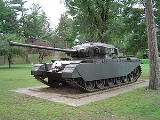
Centurion tank

Encyclopedia
The Centurion, introduced in 1945, was the primary British main battle tank
of the post-World War II period. It was a successful tank design, with upgrades, for many decades. The chassis was also adapted for several other roles.
Development of the tank began in 1943 and manufacture of the Centurion began in January 1945, six prototypes arriving in Belgium less than a month after the war in Europe ended in May 1945.
It became one of the most widely used tank designs, equipping armies around the world, with some still in service until the 1990s. As recently as the 2006 Israel-Lebanon conflict
the Israel Defense Forces
employed heavily modified Centurions as armoured personnel carrier
s and combat engineering vehicle
s.
under the General Staff
designation A41. After a series of fairly marginal designs in the A series in the past, and bearing in mind the threat posed by the German 88 mm gun
, the War Office
demanded a major revision of the design requirements, specifically: increased durability and reliability, a maximum weight of 40 tons and the ability to withstand a direct hit from the German 88 mm gun.
Tank Design responded by extending the long-travel 5-wheel suspension used on the Comet
with the addition of a sixth wheel and an extended spacing between the second and third wheels. The Christie suspension
with internal vertical spring coils was replaced by a Horstmann suspension
with external horizontal springs. The hull was redesigned with welded sloped armour, and featured a partially cast turret mounting the highly regarded 17 pounder main gun and a 20 mm Polsten
cannon. With a Rover
-built Rolls-Royce
Meteor engine, a version of the Rolls-Royce Merlin
, the new design would have excellent performance.
Shortly after the programme commenced, it became clear that the requirement to withstand 88 mm artillery would be impossible to meet within the permitted weight. The original specification had been set so that the A41 could be carried on the existing Mark I and Mark II transport trailers, which were limited to a 40-ton load. The War Ministry decided it would be wiser to build new trailers than hamper what appeared to be a superb design. Even before prototypes of the original 40-ton design were completed, the design of a heavier version was well under way. The new version carried armour equal to the heaviest infantry tank
s, and cross-country performance was superior to even the early cruiser tank
s. The A41 was the first British tank that could "do it all", leading to the new designation "universal tank".
Prototypes of the original 40-ton design, the Centurion Mark I, had 76 mm of armour in the front glacis
, thinner than the then current infantry tank designs such as the Churchill
which had 101 mm, but the glacis plate was highly sloped and so the effective thickness of the armour was very high—a design feature shared by other effective designs such as the German Panther tank
and Soviet T-34
. The turret was extremely well armoured at 152 mm. The tank was also extremely mobile, and easily outperformed the Comet in most tests. The uparmoured Centurion Mark II soon arrived, featuring a new 118 mm-thick glacis and side and rear armour increased from 38 mm to 51 mm. Only a handful of Mk I's had been produced when the Mk II replaced it on the production lines. Full production began in November 1945 with an order of 800 with production lines at Leyland
, the Royal Ordnance Factories
at Leeds and Woolwich
, and Vickers
at Elswick
. The tank entered service in December 1946 with the 5th Royal Tank Regiment
.
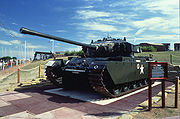 Soon after the Centurion's introduction, Royal Ordnance finished work on the extremely powerful 20 pounder (84 mm) tank gun. By this point the usefulness of the 20 mm Polsten had been called into question, it being unnecessarily large for a man-killing weapon, so it was replaced with a Besa
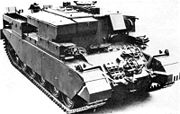
machine gun in a completely cast turret. The new Centurion Mark III also featured a fully automatic stabilisation system for the gun, allowing it to fire accurately while on the move, dramatically improving battlefield performance. Production of the Mk 3 began in 1948. The Mk 3 was so much more powerful than the Mk 1 and Mk 2 that the earlier designs were removed from service as soon as new Mk 3s arrived, and the older tanks were then either converted into the Centurion ARV Mark 1 armoured recovery vehicle
for REME
use or upgraded to Mk 3 standards. Improvements introduced with the Mk 3 included a more powerful version of the engine and a new gunsight and gun stabiliser.
The 20 pounder gun was used only for a short time before the Royal Ordnance Factories introduced the now famous 105 mm L7 gun
. All later variants of the Centurion, from Mark 5/2 on, used the L7.
Design work for the Mk 7 was completed in 1953 with production beginning soon afterwards.
The Centurion was used as the basis for a range of specialist equipment, including engineering variants with a 165 mm demolition gun (AVRE-Armoured Vehicle Royal Engineers). It is one of the longest-serving designs of all time, serving as a battle tank for the British
and Australian
armies from the Korean War
(1950–1953) to the Vietnam War
(1961–1972), and as an armoured engineer vehicle
during Operation Desert Storm in January–February 1991.
About 4,423 Centurions were produced between 1946 and 1962, consisting of thirteen basic marks of the Centurion tank.
, equipped with three squadrons of Centurion
Mk 3 tanks landed in Pusan
. Operating in sub-zero temperatures, the 8th Hussars learnt the rigours of winter warfare: their tanks had to be parked on straw to prevent the steel tracks from freezing to the ground, and engines had to be started every half hour, with each gear being engaged in turn, to prevent them from being frozen into place. During the Battle of the Imjin River
Centurions won lasting fame when their tanks covered the withdrawal of the 29th Brigade, with the loss of five tanks, most later recovered and repaired. In 1953 Centurions of the 3rd Royal Tank Regiment were also involved in the second Battle of the Hook
where they played a significant role in repelling Chinese attacks. In a tribute to the 8th Hussars, General John O'Daniel
, commanding the US 1st Corps, stated: "...In their Centurions, the 8th Hussars have evolved a new type of tank warfare. They taught us that anywhere a tank can go is tank country: even the tops of mountains."
. Although they successfully conducted combat operations in their areas of operation(s) (AOs), reports from the field stated that their light-armour (M-113
ACAVs) were unable to force their way through dense jungle limiting their offensive actions against enemy forces. The Australian government, under criticism from Parliament, decided to send a Squadron of Australian Centurion tanks to South Vietnam. The 84 mm-gunned Australian Centurions of 'C' Squadron, 1st Armoured Regiment landed in the Republic of Vietnam (South Vietnam) on 24 February 1968, and were headquartered at Nui Dat
in III Corps
(MR3).
Colonel Donald B. Dunstan
, later to be governor
of South Australia
, was the Deputy Task Force Commander of the Australian Forces in South Vietnam Col. Dunstan had quite possibly been the last Australian to utilise tanks and infantry in a combined arms operation during World War II
, during the Bougainville campaign. And, for the first time since World War II, Col Dunstan would be commanding Australia's tanks and infantry in combat again. When he temporarily took over command during Brigadier R. L. Hughes absence, he directed that the Centurions be brought up from Nui Dat, to reinforce the firebases at Coral and Balmoral, believing that they were a strong element that weren't being used. Besides adding a great deal of firepower, Col. Dunstan stated, he "...couldn't see any reason why they (Centurions) shouldn't be there..." His foresight in the coming battles enabled the 1st ATF to inflict approximately 267 enemy casualties during the six week long battle at Coral and Balmoral, as well as capturing 11 POWs, 36 crew-served weapons, 112 small arms, and other miscellaneous enemy weapons.
After the battles at firebases Coral and Balmoral, in which the 1st Australian Task Force defeated the 141st and 165th NVA
Infantry
Regiments in May 1968; a third Centurion troop, which included two tankdozers, was formed. By September 1968 'C' Squadron was brought to its full strength of four troops, each equipped with four Centurion tanks. By 1969, 'B' Squadron, 3rd Cavalry; 'A' Squadron, 1st Armoured Regiment; 'B' Squadron, 1st Armoured Regiment; and 'C' Squadron, 1st Armoured Regiment, had all made rotations through South Vietnam. Originally deployed as 26 Centurion tanks, after three and a half years of combat operations, 58 Centurions had served in country; 42, of which 6 were beyond repair, suffered battle damage, and two Centurion tank crewmen had been killed in action.
The Centurion crews, after operating for a few weeks in country, soon learned to remove the protective armoured side skirts from both sides of the tank, to prevent the vegetation & mud from building up between the track and the mudguards. Each Centurion in Vietnam normally carried a basic load of 62 rounds of 20 pounder shells (84mm), 4,000 rounds of .50 caliber & 9,000 rounds of .30 caliber machinegun ammunition for its one tank commander's and two coaxial machineguns; and were equipped with petrol engines, which necessitated the use of an extra externally-mounted 100 gallon fuel tank, which was attached to the vehicle's rear.
 In the 1960s the British needed money in order to complete the development of their new tank, the Chieftain
, with its 120mm gun
. In view of their financial constraints they proposed a "package deal". According to this deal, Israel would buy hundreds of obsolete Centurion tanks. The UK would allow Israel to participate in the final stages of Chieftain development, would sell Israel Chieftains, and would help Israel build, in Israel, an assembly line for Chieftains. Israeli cooperation with the British lasted about three years. After the Six-Day War
, however, Arab states intervened. They threatened Britain with sanctions, with pulling their monetary reserves out of British banks, and other actions. Demonstrations were held in Arab capitals and British embassies were attacked. In November 1969 Britain withdrew from its Chieftain deal with Israel.
The formerly British Centurion was renamed "Sho't
" (Scourge/Whip) by the Israelis and upgraded to meet their demands in modern warfare. When the Six-day War (1967) broke out, the Israel Defense Forces
(IDF) had 293 Centurion tanks that were ready for combat of total 385 tanks. During the war Israel captured 30 Centurion tanks from Jordan, when Jordan had only 44 Centurion tanks.
The Israeli version of the Centurion earned its legendary status during the Battle of "The Valley of Tears
" on the Golan Heights in the 1973 Yom Kippur War
. Less than 100 Centurion tanks of the 7th Armor Brigade defeated the advance of some 500 Syrian T-55s and T-62s. The Sho't became emblematic of Israeli armour prowess.
Original Centurions had 20 pounder main guns, these were quickly upgunned to the British 105 mm L7. The vehicles went through a number of both major and minor modifications culminating in the Sho't with blazer package seen in the 1982 invasion of Lebanon and retired with honour during the 90's. The biggest modifications were the upgrade of the engine, sights and blazer packages.
The engine has been changed to a more efficient diesel engine, fire control has been modernised, armour has been thickened, and an improved ammunition layout allows more to be carried. An improved fire extinguishing system, better electrical system and brakes, and an increased fuel capacity complete the modifications. The Sh'ot can be distinguished from the Centurion by its raised rear deck, to accommodate the bigger engine. They either have the original 7.62 mm calibre on the commanders cupola or have it replaced by a 12.7 mm calibre HMG and American radios.
Many different variants were bought by Israel over the years from many different countries. Many components of this would find their way into the Merkava.
and Jordan
. Starting in 1963, the UN imposed ever-more-restrictive trade embargoes on South Africa, due to its apartheid practices and human rights violations. This forced South Africa to develop its own arms industry (with surreptitious help from Israel
, France
and the United States
) and this included upgrading the Centurion tanks. Until the 1980s or so, South Africa’s enemies had nothing to compare to the tanks that the South Africans were fielding at any particular time. However, the South Africans decided to improve and upgrade its tanks, as they were almost continually at war with at least one, and on occasion all, of their neighbours.
The first upgrades made to the Centurions were simple, and primarily for test purposes. In 1972, the Centurion was fitted with a V-12 fuel-injected petrol engine developing 810 hp coupled to a new three-speed (two forward and one reverse) automatic transmission. This project was called the Skokiaan but only eight conversions were made. This was followed by the Semel project in 1974 which involved fitting the eight Skokiaan vehicles and some unconverted Centurions with a modified engine and some other improvements and these were called the Centurion Mk 5A or Semel. A total of 35 of these vehicles was produced and some were used in the then-Southwest Africa.
The South Africans undertook a much more ambitious upgrade program in 1976, producing the Olifant (later the Olifant Mk 1 after further-upgraded versions were built). The Olifant Mk 1 entered service with the South African Armoured Corps in 1978. The Olifant program benefited greatly from the Israelis’ Sho’t program (the Israeli rebuild of the Centurion). Olifant Mk1 had better suspension, turret drive, and night vision equipment. The commander had a hand held laser rangefinder.
The Olifant Mk 1 later received a major upgrade as the Mk 1A entered production in 1983 and entered service in 1985. This was due to the fact that it was discovered, particularly in combats in Angola, that the Olifant Mk 1 and its 20-Pounder main gun could not match the T-55. Production stopped in the mid-1980s. Nonetheless, despite the numbers produced and the fact that the Mk 1A was meant to be an interim solution for use until the advent of the Mk 1B version. The Mk 1A may in fact have been the most numerous SANDF tank in service.
In the Mk 1A the main gun was replaced with the 105mm L-7 rifled gun, eight smoke grenade dischargers were installed on either side of the turret. A new engine was installed and the armour was upgraded. The Laser rangefinder was incorporated into the gunner’s sight and the night vision equipment was upgraded.
The Mk 1B was a new production vehicle instead of up-grading existing Centurions or Olifants. Development started on the Mk 1B in 1983 and entered production in 1991. The 105mm L7 rifled cannon main gun on the Mark 1B is fitted with a thermal sleeve and carries 68 rounds of ammunition. The tank is also fitted with a 7.62 mm general purpose co-axial machine gun and a 7.62 mm anti-aircraft machine gun. The driver's station is equipped with a day and night sight and the gunner's station is fitted with day and night sights and an integrated laser rangefinder.
Due to the high number of mines deployed in neighbouring African countries, its belly armour was doubled and new side skirts added. The glacis
plate and nose of the hull have been upgraded with the addition of passive armour and the turret has been fitted with stand-off armour. The vehicle can generate a smoke screen by injecting fuel on the engines hot exhaust and a fire suppression system was added to the crew fighting compartment. A computerised fire control system was added and a search light over the main gun. In October 2003 Alvis OMC was awarded a contract for the upgrade of a number of Olifant Mk 1B MBT
's. It included up-grades in the power pack, fire control and training systems.
Up to the end of 1987, South Africa was involved in a full intervention in the Angolan Civil War
, and Olifant tanks were sent into combat, participating with success against Angolan forces near the Lomba River. On September 1, tank combat occurred. Olifants ran across Angolan T-55
s and T-34/85s, destroying some of them. At Cuito Cuanavale
, Olifants and Ratel
s fought T-55s and T-34/85s, claiming that the only losses to the Olifants came from mine
s. The Cuban Revolutionary Armed Forces claimed that during the same battle 50th Cuban Division T-62
s halted South African tanks at the Chambingi River.
The Mk 2 is an up-armoured and fire control equipment turret which can be fitted with a 120mm smoothbore cannon on the Mk 1B chassis.
Mk 3 Centurion Type K, Army Registration Number 169041, was involved in a nuclear blast test at Emu Field
in Australia in 1953 as part of Operation Totem 1
. Built as number 39/190 at the Royal Ordnance Factory, Barnbow in 1951 it was assigned the British Army
number 06 BA 16 and supplied to the Australian Commonwealth Government under Contract 2843 in 1952.
It was placed less than 500 yards (457.2 m) from the epicentre and left with the engine running. Examination after detonation found it had been pushed away from the blast point by about 5 feet (1.5 m) and that its engine had stopped working only because it had run out of fuel. Antennas were missing, lights and periscopes were heavily sandblasted, the cloth mantlet cover was incinerated, and the armoured side plates had been blown off and carried up to 200 yards (182.9 m) from the tank. Remarkably the tank could be driven from the site. Had it been manned the crew would probably have been killed by the shock wave
.
169041, subsequently nicknamed The Atomic Tank, was later used in the Vietnam War
and is now located at Robertson Barracks
in Palmerston, Northern Territory
. Although other tanks were subjected to nuclear tests, 169041 is the only tank known to have withstood atomic tests and subsequently gone on for another 23 years of service, including 15 months on operational deployment in a war zone.


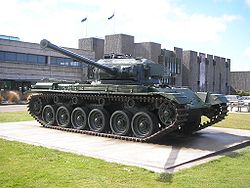
Centurion Mk 2: Fully cast turret
Centurion Mk 3: Fitted with 20pdr, 2 stowage positions for track links on glacis
Centurion Mk 4: Projected close-support version with 95 mm CS howitzer
Centurion Mk 5: Browning machine guns fitted to coaxial and commander's cupola
mounts, stowage bin on glacis
Centurion Mk 5/1 aka FV 4011: Increased glacis
armour, two coax machineguns: one .30 Browning
& one .50 caliber Browning for ranging the 84mm (20 pounder) main gun
Centurion Mk 5/2: Upgunned to 105 mm
Centurion Mk 6: Upgunned and uparmoured Mk 5
Centurion Mk 6/1: Mk 6 fitted with IR equipment
Centurion Mk 6/2: Mk 6/1 fitted with ranging gun
Centurion Mk 7 aka FV 4007: Revised engine decks
Centurion Mk 7/1 aka FV 4012: Uparmoured Mk 7
Centurion Mk 7/2: Upgunned Mk 7
Centurion Mk 8: Resilient mantlet
and new commanders cupola
Centurion Mk 8/1: Uparmoured Mk 8
Centurion Mk 8/2: Upgunned Mk 8
Centurion Mk 9 aka FV 4015: Upgunned and uparmoured Mk 7
Centurion Mk 9/1: Mk 9 with IR equipment
Centurion Mk 9/2: Mk 9 with ranging gun fitted
Centurion Mk 10 aka FV 4017: Upgunned and uparmoured Mk 8
Centurion Mk 10/1: Mk 10 with IR equipment
Centurion Mk 10/2: Mk 10 with ranging gun fitted
Centurion Mk 11: Mk 6 fitted with IR equipment and ranging gun
Centurion Mk 12: Mk 9 fitted with IR equipment and ranging gun
Centurion Mk 13: Mk 10 fitted with IR equipment and ranging gun
A41 [Besa]: Centurion prototype with coaxial Besa MG—later fitted with experimental CDL
artillery prototype based on Centurion—engine at rear as in gun tank—no production
FV 3805 : Self-propelled 5.5in
artillery prototype, again based on Centurion—engine at front—no production.
FV 4002 Centurion Mk 5 Bridgelayer: (1963) – Mk 5 chassis with a No 5 Tank Bridge. The bridge can be launched in less than two minutes, can span a gap of 45 feet and can bear up to 80 tons.
FV 4003 Centurion Mk 5 AVRE 165: (1963) – AVRE (Armoured Vehicle Royal Engineers) vehicle with 165 mm demolition gun and a hydraulically-operated
dozer blade or a mine plough. Can carry a fascine
bundle or a roll of metal Class 60 Trackway; and tow the Giant Viper
mine-clearance equipment or a trailer for another fascine. This variant had a five man crew. The vehicle was used in the Gulf War
/Operation Desert Storm (1991).
FV 4004 Conway : "FV 4004 Self-propelled gun, 120 mm, L1 gun, Mk 3" prototype based on Centurion 3 with a larger calibre 120 mm L1 gun. To be an interim design until Conqueror tank
entered service. One built
FV 4005 Stage 2 : An experimental tank destroyer
with a 183 mm gun, developed in July 1955. It was using a lightly armoured, fully enclosed and traversable turret on a Centurion hull. By August 1957 the tank destroyer was dismantled.
FV 4006 Centurion ARV Mk 2: (1956) – Mk 1 / Mk 2 / Mk 3 hull with turret replaced by a superstructure housing a winch. The winch is powered by an auxiliary engine and is capable of pulling of up to 90 tons using a system of blocks. Armed with single .30 inch machine gun on the commander's cupola.
FV 4007 Centurion Mk 1, 2, 3, 4, 7, 8/1, 8/2:
FV 4010 aka Heavy Tank Destroyer G.W. Carrier: Malkara
Anti Tank Guided Missile launcher vehicle
FV 4011 Centurion Mk 5:
FV 4012 Centurion Mk 7/1, 7/2:
FV 4013 Centurion ARV Mk 1: (1952) – Based on Mk 1 / Mk 2 hull. Turret replaced by a superstructure housing a winch driven by a 72 hp Bedford QL truck engine. About 180 units were built, some of them were used in the Korean War
. After 1959 were used as training vehicles only.
FV 4015 Centurion Mk 9:
FV 4016 Centurion ARK: (1963) – Armoured Ramp Carrier. Can span a gap of up to 75 feet, can bear up to 80 tons.
FV 4017 Centurion Mk 10:
FV 4018 Centurion BARV
(1963): Beach armoured recovery vehicle. The last Centurion variant to be used by the British Army. As of 2003, one vehicle was still in use by the Royal Marines
. Now being replaced by the Hippo based on Leopard 1 chassis.
FV 4019 Centurion Mk 5 Bulldozer: (1961) – Centurion Mk V with a dozer blade identical to that of the Centurion AVRE. One such tank was usually given to every Centurion-equipped squadron.
FV 4202 40 ton Centurion: Used to develop various concepts subsequently used in Chieftain
Centurion [MMWR Target]
Centurion Marksman
Centurion Ark aka FV 4016
Centurion ARV Mk I
Centurion ARV Mk II
Centurion AVLB
Centurion AVRE 105
Centurion AVRE 165
Centurion BARV
Centurion Bridgelayer aka FV 4002
Centurion Mk 12 AVRE 105
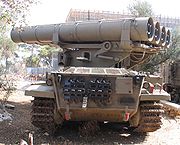 Olifant
Sho't
Tempest
Stridsvagn 81
Stridsvagn 101
Stridsvagn 101R
Stridsvagn 102
Stridsvagn 102R
Stridsvagn 104
Stridsvagn 105
Stridsvagn 106
Bärgningsbandvagn 81
Replaced by Leopard 1. Austria
Fixed in bunkers. Canada
Replaced by Leopard C1. Many of the tanks were sold to Israel which converted them to diesel. Some are still in use as variants. Denmark
Replaced by Leopard 1. Egypt
Replaced by T-55s, T-62
s, M60A3s and M1A1s
. India
Retired Iraq
Retired Israel
Gun tanks retired, many hulls converted to Nagmachon
APCs, Nakpadon
ARVs or Puma CEVs
. Jordan
Chassis re-used for the modern Temsah APC Kuwait
Retired Lebanon
Libya
(Free Libyan Army) Netherlands
Replaced by Leopard 1 New Zealand
12 Retired without replacement. Singapore
63 Centurion Mk3 and Mk7s bought from India in 1975 and more from Israel in 1993-4, all upgraded to Israeli standard with new main guns and diesel engines Somalia
} Somaliland
Originally supplied to Somalia South Africa
In service as the indigenously developed and upgraded Mk1A/B and Mk2 Olifant Sweden
Replaced by Stridsvagn 121 (Leopard 2 A4) Switzerland
Replaced by Leopard 2
United Kingdom
Replaced by Chieftain
Main battle tank
A main battle tank , also known as a battle tank or universal tank, is a tank that fills the heavy direct fire role of many modern armies. They were originally conceived to replace the light, medium, heavy and super-heavy tanks. Development was spurred onwards in the Cold War with the development...
of the post-World War II period. It was a successful tank design, with upgrades, for many decades. The chassis was also adapted for several other roles.
Development of the tank began in 1943 and manufacture of the Centurion began in January 1945, six prototypes arriving in Belgium less than a month after the war in Europe ended in May 1945.
- It first entered combat with British forcesBritish ArmyThe British Army is the land warfare branch of Her Majesty's Armed Forces in the United Kingdom. It came into being with the unification of the Kingdom of England and Scotland into the Kingdom of Great Britain in 1707. The new British Army incorporated Regiments that had already existed in England...
in the Korean WarKorean WarThe Korean War was a conventional war between South Korea, supported by the United Nations, and North Korea, supported by the People's Republic of China , with military material aid from the Soviet Union...
in 1950, in support of the UN forces. - The Centurion later served in the Indo-Pakistani warsIndo-Pakistani WarsSince the partition of British India in 1947 and creation of India and Pakistan, the two South Asian countries have been involved in four wars, including one undeclared war, as well as many border skirmishes and military stand-offs...
of 1965 and 1971, successfully fighting US supplied Pakistani M47M47 PattonThe M47 Patton is an American medium tank, the second tank to be named after General George S. Patton, commander of the U.S. Third Army during World War II and one of the earliest American advocates of tanks in battle. It was a further development of the M46 Patton tank.-History:The M47 was the U.S...
s, - It served with the Royal Australian Armoured Corps in VietnamVietnamVietnam – sometimes spelled Viet Nam , officially the Socialist Republic of Vietnam – is the easternmost country on the Indochina Peninsula in Southeast Asia. It is bordered by China to the north, Laos to the northwest, Cambodia to the southwest, and the South China Sea –...
. - It was sold to IsraelIsraelThe State of Israel is a parliamentary republic located in the Middle East, along the eastern shore of the Mediterranean Sea...
which used Centurions in 1967, 1973Yom Kippur WarThe Yom Kippur War, Ramadan War or October War , also known as the 1973 Arab-Israeli War and the Fourth Arab-Israeli War, was fought from October 6 to 25, 1973, between Israel and a coalition of Arab states led by Egypt and Syria...
, and during the 1975 and 1982 invasions of Lebanon. Centurions modified as APCs were used in GazaGazaGaza , also referred to as Gaza City, is a Palestinian city in the Gaza Strip, with a population of about 450,000, making it the largest city in the Palestinian territories.Inhabited since at least the 15th century BC,...
, the West BankWest BankThe West Bank ) of the Jordan River is the landlocked geographical eastern part of the Palestinian territories located in Western Asia. To the west, north, and south, the West Bank shares borders with the state of Israel. To the east, across the Jordan River, lies the Hashemite Kingdom of Jordan...
and the Lebanese border. - South Africa used its Centurions in AngolaAngolaAngola, officially the Republic of Angola , is a country in south-central Africa bordered by Namibia on the south, the Democratic Republic of the Congo on the north, and Zambia on the east; its west coast is on the Atlantic Ocean with Luanda as its capital city...
. - The Royal Jordanian Land ForceRoyal Jordanian Land ForceThe Royal Jordanian Land Force is part of the Jordanian Armed Forces . It draws its origins from units first formed in the British Mandate of Transjordan in the 1920s. It has seen combat against Israel in 1948, 1956, 1967, and 1973...
used Centurion tanks first in 1970 to fend off a Syrian incursion within its borders during the Black SeptemberBlack SeptemberThe expression Black September may refer to:* Black September in Jordan, the conflict between Palestinian guerrilla organizations and King Hussein of Jordan that began in September 1970 and ended in July 1971 with the expulsion of the PLO to Lebanon....
events and later in the Golan Heights in 1973.
It became one of the most widely used tank designs, equipping armies around the world, with some still in service until the 1990s. As recently as the 2006 Israel-Lebanon conflict
2006 Israel-Lebanon conflict
The 2006 Lebanon War, also called the 2006 Israel-Hezbollah War and known in Lebanon as the July War #Other uses|Tammūz]]) and in Israel as the Second Lebanon War , was a 34-day military conflict in Lebanon, northern Israel and the Israeli-occupied territories. The principal parties were Hezbollah...
the Israel Defense Forces
Israel Defense Forces
The Israel Defense Forces , commonly known in Israel by the Hebrew acronym Tzahal , are the military forces of the State of Israel. They consist of the ground forces, air force and navy. It is the sole military wing of the Israeli security forces, and has no civilian jurisdiction within Israel...
employed heavily modified Centurions as armoured personnel carrier
Armoured personnel carrier
An armoured personnel carrier is an armoured fighting vehicle designed to transport infantry to the battlefield.APCs are usually armed with only a machine gun although variants carry recoilless rifles, anti-tank guided missiles , or mortars...
s and combat engineering vehicle
Combat engineering vehicle
Military engineering vehicles are vehicles built for the construction work or for the transportation of combat engineers on the battlefield. These vehicles can range from civilian equipment to purpose built military vehicles....
s.
History
In 1943 the Department of Tank Design was asked to produce a new design for a heavy cruiser tankCruiser tank
The cruiser tank was a British tank concept of the inter-war period. This concept was the driving force behind several tank designs which saw action during the Second World War....
under the General Staff
General Staff
A military staff, often referred to as General Staff, Army Staff, Navy Staff or Air Staff within the individual services, is a group of officers and enlisted personnel that provides a bi-directional flow of information between a commanding officer and subordinate military units...
designation A41. After a series of fairly marginal designs in the A series in the past, and bearing in mind the threat posed by the German 88 mm gun
88 mm gun
The 88 mm gun was a German anti-aircraft and anti-tank artillery gun from World War II. It was widely used by Germany throughout the war, and was one of the most recognizable German weapons of the war...
, the War Office
War Office
The War Office was a department of the British Government, responsible for the administration of the British Army between the 17th century and 1964, when its functions were transferred to the Ministry of Defence...
demanded a major revision of the design requirements, specifically: increased durability and reliability, a maximum weight of 40 tons and the ability to withstand a direct hit from the German 88 mm gun.
Tank Design responded by extending the long-travel 5-wheel suspension used on the Comet
Comet tank
The Tank, Cruiser, Comet I was a British cruiser tank that first saw use near the end of World War II. It was designed to provide greater anti-tank capability to Cromwell tank squadrons. It was armed with a 77mm HV, a derivative of the 17 pounder, with the result it was one of the few British...
with the addition of a sixth wheel and an extended spacing between the second and third wheels. The Christie suspension
Christie suspension
The Christie suspension is a suspension system developed by American engineer Walter Christie for his tank designs. It allowed considerably longer movement than conventional leaf spring systems then in common use, which allowed his tanks to have considerably greater cross-country speed and a lower...
with internal vertical spring coils was replaced by a Horstmann suspension
Horstmann suspension
Horstmann suspension is a type of tracked suspension devised by the British engineer Sidney Horstmann in 1922.The system uses coil springs and has the advantages of a relatively long travel and, consisting of a self-contained bogie that is bolted to the hull, causing little or no encroachment on...
with external horizontal springs. The hull was redesigned with welded sloped armour, and featured a partially cast turret mounting the highly regarded 17 pounder main gun and a 20 mm Polsten
Polsten
The Polsten was a low cost Polish development of the 20 mm Oerlikon gun. The Polsten was designed to be simpler and much cheaper to build than the Oerlikon without reducing effectiveness.-Development:...
cannon. With a Rover
Rover (car)
The Rover Company is a former British car manufacturing company founded as Starley & Sutton Co. of Coventry in 1878. After developing the template for the modern bicycle with its Rover Safety Bicycle of 1885, the company moved into the automotive industry...
-built Rolls-Royce
Rolls-Royce Limited
Rolls-Royce Limited was a renowned British car and, from 1914 on, aero-engine manufacturing company founded by Charles Stewart Rolls and Henry Royce on 15 March 1906 as the result of a partnership formed in 1904....
Meteor engine, a version of the Rolls-Royce Merlin
Rolls-Royce Merlin
The Rolls-Royce Merlin is a British liquid-cooled, V-12, piston aero engine, of 27-litre capacity. Rolls-Royce Limited designed and built the engine which was initially known as the PV-12: the PV-12 became known as the Merlin following the company convention of naming its piston aero engines after...
, the new design would have excellent performance.
Shortly after the programme commenced, it became clear that the requirement to withstand 88 mm artillery would be impossible to meet within the permitted weight. The original specification had been set so that the A41 could be carried on the existing Mark I and Mark II transport trailers, which were limited to a 40-ton load. The War Ministry decided it would be wiser to build new trailers than hamper what appeared to be a superb design. Even before prototypes of the original 40-ton design were completed, the design of a heavier version was well under way. The new version carried armour equal to the heaviest infantry tank
Infantry tank
The infantry tank was a concept developed by the British and French in the years leading up to World War II. Infantry tanks were tanks designed to support the infantry in the attack. To achieve this they were generally heavily armoured compared to the cruiser tanks, to allow them to operate in...
s, and cross-country performance was superior to even the early cruiser tank
Cruiser tank
The cruiser tank was a British tank concept of the inter-war period. This concept was the driving force behind several tank designs which saw action during the Second World War....
s. The A41 was the first British tank that could "do it all", leading to the new designation "universal tank".
Prototypes of the original 40-ton design, the Centurion Mark I, had 76 mm of armour in the front glacis
Glacis
A glacis in military engineering is an artificial slope of earth used in late European fortresses so constructed as to keep any potential assailant under the fire of the defenders until the last possible moment...
, thinner than the then current infantry tank designs such as the Churchill
Churchill tank
The Tank, Infantry, Mk IV was a heavy British infantry tank used in the Second World War, best known for its heavy armour, large longitudinal chassis with all-around tracks with multiple bogies, and its use as the basis of many specialist vehicles. It was one of the heaviest Allied tanks of the war...
which had 101 mm, but the glacis plate was highly sloped and so the effective thickness of the armour was very high—a design feature shared by other effective designs such as the German Panther tank
Panther tank
Panther is the common name of a medium tank fielded by Nazi Germany in World War II that served from mid-1943 to the end of the European war in 1945. It was intended as a counter to the T-34, and to replace the Panzer III and Panzer IV; while never replacing the latter, it served alongside it as...
and Soviet T-34
T-34
The T-34 was a Soviet medium tank produced from 1940 to 1958. Although its armour and armament were surpassed by later tanks of the era, it has been often credited as the most effective, efficient and influential design of World War II...
. The turret was extremely well armoured at 152 mm. The tank was also extremely mobile, and easily outperformed the Comet in most tests. The uparmoured Centurion Mark II soon arrived, featuring a new 118 mm-thick glacis and side and rear armour increased from 38 mm to 51 mm. Only a handful of Mk I's had been produced when the Mk II replaced it on the production lines. Full production began in November 1945 with an order of 800 with production lines at Leyland
Leyland, Lancashire
Leyland is a town in the South Ribble borough of Lancashire, England, approximately six miles south of the city of Preston.Throughout the 20th and 21st century, the community has seen a large growth in industry, population and farming, due to the establishment of Leyland Motors, housing...
, the Royal Ordnance Factories
Royal Ordnance Factory
Royal Ordnance Factories was the collective name of the UK government's munitions factories in and after World War II. Until privatisation in 1987 they were the responsibility of the Ministry of Supply and later the Ministry of Defence....
at Leeds and Woolwich
Royal Arsenal
The Royal Arsenal, Woolwich, originally known as the Woolwich Warren, carried out armaments manufacture, ammunition proofing and explosives research for the British armed forces. It was sited on the south bank of the River Thames in Woolwich in south-east London, England.-Early history:The Warren...
, and Vickers
Vickers
Vickers was a famous name in British engineering that existed through many companies from 1828 until 1999.-Early history:Vickers was formed in Sheffield as a steel foundry by the miller Edward Vickers and his father-in-law George Naylor in 1828. Naylor was a partner in the foundry Naylor &...
at Elswick
Elswick, Tyne and Wear
Elswick is a ward of the city of Newcastle upon Tyne, England, in the western part of the city, bordering the river Tyne. One of the earliest references to the coal mining industry of the north east occurs in 1330, when it was recorded that the Prior of Tynemouth let a colliery, called Heygrove, at...
. The tank entered service in December 1946 with the 5th Royal Tank Regiment
5th Royal Tank Regiment
The 5th Royal Tank Regiment was an armoured regiment of the British Army until 1969. It was part of the Royal Tank Regiment, itself part of the Royal Armoured Corps...
.
Besa machine gun
The Besa Machine Gun was a British version of the Czechoslovak ZB-53 air-cooled, belt-fed machine-gun, which in the Czechoslovak army was marked as the TK vz. 37...
machine gun in a completely cast turret. The new Centurion Mark III also featured a fully automatic stabilisation system for the gun, allowing it to fire accurately while on the move, dramatically improving battlefield performance. Production of the Mk 3 began in 1948. The Mk 3 was so much more powerful than the Mk 1 and Mk 2 that the earlier designs were removed from service as soon as new Mk 3s arrived, and the older tanks were then either converted into the Centurion ARV Mark 1 armoured recovery vehicle
Armoured recovery vehicle
An armoured recovery vehicle is a type of armoured fighting vehicle used to repair battle- or mine-damaged as well as broken-down armoured vehicles during combat, or to tow them out of the danger zone for more extensive repairs...
for REME
Reme
Reme may refer to:*Rəmə, Azerbaijan*Royal Electrical and Mechanical Engineers...
use or upgraded to Mk 3 standards. Improvements introduced with the Mk 3 included a more powerful version of the engine and a new gunsight and gun stabiliser.
The 20 pounder gun was used only for a short time before the Royal Ordnance Factories introduced the now famous 105 mm L7 gun
Royal Ordnance L7
The Royal Ordnance L7 is the basic model of Britain's most successful tank gun. The L7 was a 105 mm L/52 rifled design intended for use in armoured fighting vehicles...
. All later variants of the Centurion, from Mark 5/2 on, used the L7.
Design work for the Mk 7 was completed in 1953 with production beginning soon afterwards.
The Centurion was used as the basis for a range of specialist equipment, including engineering variants with a 165 mm demolition gun (AVRE-Armoured Vehicle Royal Engineers). It is one of the longest-serving designs of all time, serving as a battle tank for the British
British Army
The British Army is the land warfare branch of Her Majesty's Armed Forces in the United Kingdom. It came into being with the unification of the Kingdom of England and Scotland into the Kingdom of Great Britain in 1707. The new British Army incorporated Regiments that had already existed in England...
and Australian
Australian Army
The Australian Army is Australia's military land force. It is part of the Australian Defence Force along with the Royal Australian Navy and the Royal Australian Air Force. While the Chief of Defence commands the Australian Defence Force , the Army is commanded by the Chief of Army...
armies from the Korean War
Korean War
The Korean War was a conventional war between South Korea, supported by the United Nations, and North Korea, supported by the People's Republic of China , with military material aid from the Soviet Union...
(1950–1953) to the Vietnam War
Vietnam War
The Vietnam War was a Cold War-era military conflict that occurred in Vietnam, Laos, and Cambodia from 1 November 1955 to the fall of Saigon on 30 April 1975. This war followed the First Indochina War and was fought between North Vietnam, supported by its communist allies, and the government of...
(1961–1972), and as an armoured engineer vehicle
Avre
Avre may refer to:*Avre , a river in northwestern France, tributary of the Eure*Avre , a river in northern France, tributary of the Somme*Armoured Vehicle Royal Engineers, a military vehicle of the British Army...
during Operation Desert Storm in January–February 1991.
About 4,423 Centurions were produced between 1946 and 1962, consisting of thirteen basic marks of the Centurion tank.
Korean war
On 14 November 1950 the British Army's 8th King's Royal Irish Hussars8th King's Royal Irish Hussars
The 8th King's Royal Irish Hussars was a cavalry regiment in the British Army, first raised in 1693. It saw service for three centuries, before being amalgamated into The Queen's Royal Irish Hussars in 1958....
, equipped with three squadrons of Centurion
Centurion
A centurion was a professional officer of the Roman army .Centurion may also refer to:-Military:* Centurion tank, British battle tank* HMS Centurion, name of several ships and a shore base of the British Royal Navy...
Mk 3 tanks landed in Pusan
Busan
Busan , formerly spelled Pusan is South Korea's second largest metropolis after Seoul, with a population of around 3.6 million. The Metropolitan area population is 4,399,515 as of 2010. It is the largest port city in South Korea and the fifth largest port in the world...
. Operating in sub-zero temperatures, the 8th Hussars learnt the rigours of winter warfare: their tanks had to be parked on straw to prevent the steel tracks from freezing to the ground, and engines had to be started every half hour, with each gear being engaged in turn, to prevent them from being frozen into place. During the Battle of the Imjin River
Battle of the Imjin River
The Battle of the Imjin River, also known as the Battle of Kumgul-san, P'ap'yong-san and Solma-ri or the Battle of Xuemali , took place 22–25 April 1951 during the Korean War. Forces from People’s Republic of China attacked UN positions on the lower Imjin River in an attempt to achieve a...
Centurions won lasting fame when their tanks covered the withdrawal of the 29th Brigade, with the loss of five tanks, most later recovered and repaired. In 1953 Centurions of the 3rd Royal Tank Regiment were also involved in the second Battle of the Hook
Battle of the Hook
The third Battle of the Hook was a battle of the Korean War that took place between a United Nations force, consisting mostly of British troops, supported on their flanks by American and Turkish artillery units against a predominantly Chinese force...
where they played a significant role in repelling Chinese attacks. In a tribute to the 8th Hussars, General John O'Daniel
John W. O'Daniel
John W. "Iron Mike" O'Daniel was a United States Army general, best known for commanding the Third Infantry Division in North Africa, Sicily, Italy, and Southern France during World War II. He is also known for being the commanding officer of Audie Murphy.O’Daniel was an athlete, a teacher, a...
, commanding the US 1st Corps, stated: "...In their Centurions, the 8th Hussars have evolved a new type of tank warfare. They taught us that anywhere a tank can go is tank country: even the tops of mountains."
Vietnam War
In 1967 the Royal Australian Armoured Corps' (RAAC), 1st Armoured Personnel Carrier (APC) Squadron transferred to "A" Squadron, 3rd Cavalry Regiment VietnamVietnam War
The Vietnam War was a Cold War-era military conflict that occurred in Vietnam, Laos, and Cambodia from 1 November 1955 to the fall of Saigon on 30 April 1975. This war followed the First Indochina War and was fought between North Vietnam, supported by its communist allies, and the government of...
. Although they successfully conducted combat operations in their areas of operation(s) (AOs), reports from the field stated that their light-armour (M-113
M113 armored personnel carrier
The M113 is a fully tracked armored personnel carrier that has formed the backbone of the United States Army's mechanized infantry units from the time of its first fielding in Vietnam in April 1962. The M113 was the most widely used armored vehicle of the U.S...
ACAVs) were unable to force their way through dense jungle limiting their offensive actions against enemy forces. The Australian government, under criticism from Parliament, decided to send a Squadron of Australian Centurion tanks to South Vietnam. The 84 mm-gunned Australian Centurions of 'C' Squadron, 1st Armoured Regiment landed in the Republic of Vietnam (South Vietnam) on 24 February 1968, and were headquartered at Nui Dat
Nui Dat
Nui Dat in Phuoc Tuy Province was the location of a prominent Australian military base in South Vietnam during the Vietnam War. The site was chosen by Lieutenant General John Wilton in 1966 and was built mainly by men from the 6th Battalion, Royal Australian Regiment...
in III Corps
III Corps (South Vietnam)
III Corps was a corps of the Army of the Republic of Vietnam , the army of the nation state of South Vietnam that existed from 1955 to 1975...
(MR3).
Colonel Donald B. Dunstan
Donald Dunstan (Australian Governor)
Lieutenant General Sir Donald Beaumont Dunstan, AC, KBE, CB was an Australian Army officer who was Governor of South Australia from 23 April 1982 until 5 February 1991.-Military career:...
, later to be governor
Governors of the Australian states
The Governors of the Australian states are the representatives of the Queen of Australia in each of that country's six states. The Governors perform the same constitutional and ceremonial functions at the state level as does the Governor-General of Australia at the national level...
of South Australia
South Australia
South Australia is a state of Australia in the southern central part of the country. It covers some of the most arid parts of the continent; with a total land area of , it is the fourth largest of Australia's six states and two territories.South Australia shares borders with all of the mainland...
, was the Deputy Task Force Commander of the Australian Forces in South Vietnam Col. Dunstan had quite possibly been the last Australian to utilise tanks and infantry in a combined arms operation during World War II
World War II
World War II, or the Second World War , was a global conflict lasting from 1939 to 1945, involving most of the world's nations—including all of the great powers—eventually forming two opposing military alliances: the Allies and the Axis...
, during the Bougainville campaign. And, for the first time since World War II, Col Dunstan would be commanding Australia's tanks and infantry in combat again. When he temporarily took over command during Brigadier R. L. Hughes absence, he directed that the Centurions be brought up from Nui Dat, to reinforce the firebases at Coral and Balmoral, believing that they were a strong element that weren't being used. Besides adding a great deal of firepower, Col. Dunstan stated, he "...couldn't see any reason why they (Centurions) shouldn't be there..." His foresight in the coming battles enabled the 1st ATF to inflict approximately 267 enemy casualties during the six week long battle at Coral and Balmoral, as well as capturing 11 POWs, 36 crew-served weapons, 112 small arms, and other miscellaneous enemy weapons.
After the battles at firebases Coral and Balmoral, in which the 1st Australian Task Force defeated the 141st and 165th NVA
Vietnam People's Army
The Vietnam People's Army is the armed forces of Vietnam. The VPA includes: the Vietnamese People's Ground Forces , the Vietnam People's Navy , the Vietnam People's Air Force, and the Vietnam Marine Police.During the French Indochina War , the VPA was often referred to as the Việt...
Infantry
Infantry
Infantrymen are soldiers who are specifically trained for the role of fighting on foot to engage the enemy face to face and have historically borne the brunt of the casualties of combat in wars. As the oldest branch of combat arms, they are the backbone of armies...
Regiments in May 1968; a third Centurion troop, which included two tankdozers, was formed. By September 1968 'C' Squadron was brought to its full strength of four troops, each equipped with four Centurion tanks. By 1969, 'B' Squadron, 3rd Cavalry; 'A' Squadron, 1st Armoured Regiment; 'B' Squadron, 1st Armoured Regiment; and 'C' Squadron, 1st Armoured Regiment, had all made rotations through South Vietnam. Originally deployed as 26 Centurion tanks, after three and a half years of combat operations, 58 Centurions had served in country; 42, of which 6 were beyond repair, suffered battle damage, and two Centurion tank crewmen had been killed in action.
The Centurion crews, after operating for a few weeks in country, soon learned to remove the protective armoured side skirts from both sides of the tank, to prevent the vegetation & mud from building up between the track and the mudguards. Each Centurion in Vietnam normally carried a basic load of 62 rounds of 20 pounder shells (84mm), 4,000 rounds of .50 caliber & 9,000 rounds of .30 caliber machinegun ammunition for its one tank commander's and two coaxial machineguns; and were equipped with petrol engines, which necessitated the use of an extra externally-mounted 100 gallon fuel tank, which was attached to the vehicle's rear.
Middle East
Chieftain tank
The FV 4201 Chieftain was the main battle tank of the United Kingdom during the 1960s and 1970s. It was one of the most advanced tanks of its era, and at the time of its introduction in 1966 had the most powerful main gun and heaviest armour of any tank in the world...
, with its 120mm gun
Royal Ordnance L11A5
The Royal Ordnance L11A5 is a 120 mm L/55 rifled tank gun design. It was the first of NATO's 120mm tank guns which became the standard calibre for Western tanks in the later period of the Cold War...
. In view of their financial constraints they proposed a "package deal". According to this deal, Israel would buy hundreds of obsolete Centurion tanks. The UK would allow Israel to participate in the final stages of Chieftain development, would sell Israel Chieftains, and would help Israel build, in Israel, an assembly line for Chieftains. Israeli cooperation with the British lasted about three years. After the Six-Day War
Six-Day War
The Six-Day War , also known as the June War, 1967 Arab-Israeli War, or Third Arab-Israeli War, was fought between June 5 and 10, 1967, by Israel and the neighboring states of Egypt , Jordan, and Syria...
, however, Arab states intervened. They threatened Britain with sanctions, with pulling their monetary reserves out of British banks, and other actions. Demonstrations were held in Arab capitals and British embassies were attacked. In November 1969 Britain withdrew from its Chieftain deal with Israel.
The formerly British Centurion was renamed "Sho't
Sho't
Sho't is the Israeli designation of the 105 mm L7 armed Centurion tank, which entered Israeli service in 1970.-Combat history:...
" (Scourge/Whip) by the Israelis and upgraded to meet their demands in modern warfare. When the Six-day War (1967) broke out, the Israel Defense Forces
Israel Defense Forces
The Israel Defense Forces , commonly known in Israel by the Hebrew acronym Tzahal , are the military forces of the State of Israel. They consist of the ground forces, air force and navy. It is the sole military wing of the Israeli security forces, and has no civilian jurisdiction within Israel...
(IDF) had 293 Centurion tanks that were ready for combat of total 385 tanks. During the war Israel captured 30 Centurion tanks from Jordan, when Jordan had only 44 Centurion tanks.
The Israeli version of the Centurion earned its legendary status during the Battle of "The Valley of Tears
The Valley of Tears
The Valley of Tears is the name given to an area in the Golan Heights after it became the site of a major battle in the Yom Kippur War...
" on the Golan Heights in the 1973 Yom Kippur War
Yom Kippur War
The Yom Kippur War, Ramadan War or October War , also known as the 1973 Arab-Israeli War and the Fourth Arab-Israeli War, was fought from October 6 to 25, 1973, between Israel and a coalition of Arab states led by Egypt and Syria...
. Less than 100 Centurion tanks of the 7th Armor Brigade defeated the advance of some 500 Syrian T-55s and T-62s. The Sho't became emblematic of Israeli armour prowess.
Original Centurions had 20 pounder main guns, these were quickly upgunned to the British 105 mm L7. The vehicles went through a number of both major and minor modifications culminating in the Sho't with blazer package seen in the 1982 invasion of Lebanon and retired with honour during the 90's. The biggest modifications were the upgrade of the engine, sights and blazer packages.
The engine has been changed to a more efficient diesel engine, fire control has been modernised, armour has been thickened, and an improved ammunition layout allows more to be carried. An improved fire extinguishing system, better electrical system and brakes, and an increased fuel capacity complete the modifications. The Sh'ot can be distinguished from the Centurion by its raised rear deck, to accommodate the bigger engine. They either have the original 7.62 mm calibre on the commanders cupola or have it replaced by a 12.7 mm calibre HMG and American radios.
Many different variants were bought by Israel over the years from many different countries. Many components of this would find their way into the Merkava.
South Africa
The Centurion tank was in use by the South Africans since 1957 – at first, 250 Mk 2 and Mk 3 Centurions bought directly from the UK, but later, South Africa bought Mk 5 Centurions from IndiaIndia
India , officially the Republic of India , is a country in South Asia. It is the seventh-largest country by geographical area, the second-most populous country with over 1.2 billion people, and the most populous democracy in the world...
and Jordan
Jordan
Jordan , officially the Hashemite Kingdom of Jordan , Al-Mamlaka al-Urduniyya al-Hashemiyya) is a kingdom on the East Bank of the River Jordan. The country borders Saudi Arabia to the east and south-east, Iraq to the north-east, Syria to the north and the West Bank and Israel to the west, sharing...
. Starting in 1963, the UN imposed ever-more-restrictive trade embargoes on South Africa, due to its apartheid practices and human rights violations. This forced South Africa to develop its own arms industry (with surreptitious help from Israel
Israel
The State of Israel is a parliamentary republic located in the Middle East, along the eastern shore of the Mediterranean Sea...
, France
France
The French Republic , The French Republic , The French Republic , (commonly known as France , is a unitary semi-presidential republic in Western Europe with several overseas territories and islands located on other continents and in the Indian, Pacific, and Atlantic oceans. Metropolitan France...
and the United States
United States
The United States of America is a federal constitutional republic comprising fifty states and a federal district...
) and this included upgrading the Centurion tanks. Until the 1980s or so, South Africa’s enemies had nothing to compare to the tanks that the South Africans were fielding at any particular time. However, the South Africans decided to improve and upgrade its tanks, as they were almost continually at war with at least one, and on occasion all, of their neighbours.
The first upgrades made to the Centurions were simple, and primarily for test purposes. In 1972, the Centurion was fitted with a V-12 fuel-injected petrol engine developing 810 hp coupled to a new three-speed (two forward and one reverse) automatic transmission. This project was called the Skokiaan but only eight conversions were made. This was followed by the Semel project in 1974 which involved fitting the eight Skokiaan vehicles and some unconverted Centurions with a modified engine and some other improvements and these were called the Centurion Mk 5A or Semel. A total of 35 of these vehicles was produced and some were used in the then-Southwest Africa.
The South Africans undertook a much more ambitious upgrade program in 1976, producing the Olifant (later the Olifant Mk 1 after further-upgraded versions were built). The Olifant Mk 1 entered service with the South African Armoured Corps in 1978. The Olifant program benefited greatly from the Israelis’ Sho’t program (the Israeli rebuild of the Centurion). Olifant Mk1 had better suspension, turret drive, and night vision equipment. The commander had a hand held laser rangefinder.
The Olifant Mk 1 later received a major upgrade as the Mk 1A entered production in 1983 and entered service in 1985. This was due to the fact that it was discovered, particularly in combats in Angola, that the Olifant Mk 1 and its 20-Pounder main gun could not match the T-55. Production stopped in the mid-1980s. Nonetheless, despite the numbers produced and the fact that the Mk 1A was meant to be an interim solution for use until the advent of the Mk 1B version. The Mk 1A may in fact have been the most numerous SANDF tank in service.
In the Mk 1A the main gun was replaced with the 105mm L-7 rifled gun, eight smoke grenade dischargers were installed on either side of the turret. A new engine was installed and the armour was upgraded. The Laser rangefinder was incorporated into the gunner’s sight and the night vision equipment was upgraded.
The Mk 1B was a new production vehicle instead of up-grading existing Centurions or Olifants. Development started on the Mk 1B in 1983 and entered production in 1991. The 105mm L7 rifled cannon main gun on the Mark 1B is fitted with a thermal sleeve and carries 68 rounds of ammunition. The tank is also fitted with a 7.62 mm general purpose co-axial machine gun and a 7.62 mm anti-aircraft machine gun. The driver's station is equipped with a day and night sight and the gunner's station is fitted with day and night sights and an integrated laser rangefinder.
Due to the high number of mines deployed in neighbouring African countries, its belly armour was doubled and new side skirts added. The glacis
Glacis
A glacis in military engineering is an artificial slope of earth used in late European fortresses so constructed as to keep any potential assailant under the fire of the defenders until the last possible moment...
plate and nose of the hull have been upgraded with the addition of passive armour and the turret has been fitted with stand-off armour. The vehicle can generate a smoke screen by injecting fuel on the engines hot exhaust and a fire suppression system was added to the crew fighting compartment. A computerised fire control system was added and a search light over the main gun. In October 2003 Alvis OMC was awarded a contract for the upgrade of a number of Olifant Mk 1B MBT
Main battle tank
A main battle tank , also known as a battle tank or universal tank, is a tank that fills the heavy direct fire role of many modern armies. They were originally conceived to replace the light, medium, heavy and super-heavy tanks. Development was spurred onwards in the Cold War with the development...
's. It included up-grades in the power pack, fire control and training systems.
Up to the end of 1987, South Africa was involved in a full intervention in the Angolan Civil War
Angolan Civil War
The Angolan Civil War was a major civil conflict in the Southern African state of Angola, beginning in 1975 and continuing, with some interludes, until 2002. The war began immediately after Angola became independent from Portugal in November 1975. Prior to this, a decolonisation conflict had taken...
, and Olifant tanks were sent into combat, participating with success against Angolan forces near the Lomba River. On September 1, tank combat occurred. Olifants ran across Angolan T-55
T-55
The T-54 and T-55 tanks were a series of main battle tanks designed in the Soviet Union. The first T-54 prototype appeared in March 1945, just before the end of the Second World War. The T-54 entered full production in 1947 and became the main tank for armored units of the Soviet Army, armies of...
s and T-34/85s, destroying some of them. At Cuito Cuanavale
Cuito Cuanavale
Cuito Cuanavale is a town and municipality in Cuando Cubango province in Angola. The names Kuito Kuanavale or Kwito Kwanavale are sometimes used, although this is a mutation of the original Portuguese name....
, Olifants and Ratel
Ratel IFV
The Ratel is the basic Infantry Fighting Vehicle of the South African National Defence Force's mechanized infantry battalions. Ratel is the Afrikaans name for the honey badger, which has a reputation as a ferocious fighter.-History:...
s fought T-55s and T-34/85s, claiming that the only losses to the Olifants came from mine
Land mine
A land mine is usually a weight-triggered explosive device which is intended to damage a target—either human or inanimate—by means of a blast and/or fragment impact....
s. The Cuban Revolutionary Armed Forces claimed that during the same battle 50th Cuban Division T-62
T-62
The T-62 is a Soviet main battle tank, a further development of the T-55. Its 115 mm gun was the first smoothbore tank gun in use.The T-62 was produced between 1961 and 1975. It became a standard tank in the Soviet arsenal, partly replacing the T-55, although that tank continued to be...
s halted South African tanks at the Chambingi River.
The Mk 2 is an up-armoured and fire control equipment turret which can be fitted with a 120mm smoothbore cannon on the Mk 1B chassis.
Nuclear tests
An Australian ArmyAustralian Army
The Australian Army is Australia's military land force. It is part of the Australian Defence Force along with the Royal Australian Navy and the Royal Australian Air Force. While the Chief of Defence commands the Australian Defence Force , the Army is commanded by the Chief of Army...
Mk 3 Centurion Type K, Army Registration Number 169041, was involved in a nuclear blast test at Emu Field
Emu Field
Emu Field is located in the desert of South Australia, at . Variously known as Emu Field, Emu Junction or Emu, it was the site of the Operation Totem pair of nuclear tests conducted by the British government in October 1953.The site was surveyed by Len Beadell in 1952...
in Australia in 1953 as part of Operation Totem 1
Operation Totem
Operation Totem was a pair of British atmospheric nuclear tests which took place on 15th October 1953. The only ones conducted at a temporary site in Australia, Emu Field, they followed the Operation Hurricane test of the first British atomic bomb which had taken place at the Montebello Islands a...
. Built as number 39/190 at the Royal Ordnance Factory, Barnbow in 1951 it was assigned the British Army
British Army
The British Army is the land warfare branch of Her Majesty's Armed Forces in the United Kingdom. It came into being with the unification of the Kingdom of England and Scotland into the Kingdom of Great Britain in 1707. The new British Army incorporated Regiments that had already existed in England...
number 06 BA 16 and supplied to the Australian Commonwealth Government under Contract 2843 in 1952.
It was placed less than 500 yards (457.2 m) from the epicentre and left with the engine running. Examination after detonation found it had been pushed away from the blast point by about 5 feet (1.5 m) and that its engine had stopped working only because it had run out of fuel. Antennas were missing, lights and periscopes were heavily sandblasted, the cloth mantlet cover was incinerated, and the armoured side plates had been blown off and carried up to 200 yards (182.9 m) from the tank. Remarkably the tank could be driven from the site. Had it been manned the crew would probably have been killed by the shock wave
Shock wave
A shock wave is a type of propagating disturbance. Like an ordinary wave, it carries energy and can propagate through a medium or in some cases in the absence of a material medium, through a field such as the electromagnetic field...
.
169041, subsequently nicknamed The Atomic Tank, was later used in the Vietnam War
Vietnam War
The Vietnam War was a Cold War-era military conflict that occurred in Vietnam, Laos, and Cambodia from 1 November 1955 to the fall of Saigon on 30 April 1975. This war followed the First Indochina War and was fought between North Vietnam, supported by its communist allies, and the government of...
and is now located at Robertson Barracks
Robertson Barracks
For the Robertson Barracks, Norfolk, England see RAF Swanton MorleyRobertson Barracks is a major Australian Army base located in the outer Darwin, Northern Territory suburb of Holtze in the Municipality of Litchfield. The barracks was built during the 1990s. The Barracks are home to the 1st Brigade...
in Palmerston, Northern Territory
Palmerston, Northern Territory
Palmerston is a planned satellite city of Darwin, the capital and largest city in Australia's Northern Territory. Palmerston is situated near Darwin Harbour and has an urban population of 23,614 on the 2006 Census night and making it the second largest city in the territory...
. Although other tanks were subjected to nuclear tests, 169041 is the only tank known to have withstood atomic tests and subsequently gone on for another 23 years of service, including 15 months on operational deployment in a war zone.
UK variants
Centurion production mark numbers
Centurion Mk 1: 17pdr armed versionCenturion Mk 2: Fully cast turret
Centurion Mk 3: Fitted with 20pdr, 2 stowage positions for track links on glacis
Centurion Mk 4: Projected close-support version with 95 mm CS howitzer
Ordnance QF 95 mm Howitzer
The Ordnance QF 95-mm Howitzer was a British Howitzer built in two versions during the Second World War. The Tank Howitzer version was accepted for service use, but an Infantry Howitzer version was not accepted for service use.-Design and development:...
Centurion Mk 5: Browning machine guns fitted to coaxial and commander's cupola
Cupola
In architecture, a cupola is a small, most-often dome-like, structure on top of a building. Often used to provide a lookout or to admit light and air, it usually crowns a larger roof or dome....
mounts, stowage bin on glacis
Centurion Mk 5/1 aka FV 4011: Increased glacis
Glacis
A glacis in military engineering is an artificial slope of earth used in late European fortresses so constructed as to keep any potential assailant under the fire of the defenders until the last possible moment...
armour, two coax machineguns: one .30 Browning
M1919 Browning machine gun
The M1919 Browning is a .30 caliber medium machine gun that was widely used during the 20th century. It was used as a light infantry, coaxial, mounted, aircraft, and anti-aircraft machine gun by the U.S. and many other countries, especially during World War II, the Korean War, and the Vietnam War...
& one .50 caliber Browning for ranging the 84mm (20 pounder) main gun
Centurion Mk 5/2: Upgunned to 105 mm
Centurion Mk 6: Upgunned and uparmoured Mk 5
Centurion Mk 6/1: Mk 6 fitted with IR equipment
Centurion Mk 6/2: Mk 6/1 fitted with ranging gun
Spotting rifle
A spotting rifle is a small-calibre rifle used as a sighting device for artillery. The ballistics of the spotting rifle are matched to those of the artillery piece, so that if a shot from the spotting rifle lands on the target, it may be assumed that the main weapon will also do so.- Anti-tank...
Centurion Mk 7 aka FV 4007: Revised engine decks
Centurion Mk 7/1 aka FV 4012: Uparmoured Mk 7
Centurion Mk 7/2: Upgunned Mk 7
Centurion Mk 8: Resilient mantlet
Gun mantlet
A gun mantlet is an armour plate or shield attached to an armoured fighting vehicle's gun, protecting the opening through which the weapon's barrel projects from the hull or turret armour and, in many cases, ensuring the vulnerable warhead of a loaded shell does not protrude past the vehicle's...
and new commanders cupola
Centurion Mk 8/1: Uparmoured Mk 8
Centurion Mk 8/2: Upgunned Mk 8
Centurion Mk 9 aka FV 4015: Upgunned and uparmoured Mk 7
Centurion Mk 9/1: Mk 9 with IR equipment
Centurion Mk 9/2: Mk 9 with ranging gun fitted
Centurion Mk 10 aka FV 4017: Upgunned and uparmoured Mk 8
Centurion Mk 10/1: Mk 10 with IR equipment
Centurion Mk 10/2: Mk 10 with ranging gun fitted
Centurion Mk 11: Mk 6 fitted with IR equipment and ranging gun
Centurion Mk 12: Mk 9 fitted with IR equipment and ranging gun
Centurion Mk 13: Mk 10 fitted with IR equipment and ranging gun
Prototypes
A41 [20 mm]: Centurion prototype with coaxial Polsten cannonA41 [Besa]: Centurion prototype with coaxial Besa MG—later fitted with experimental CDL
Canal Defence Light
Canal Defence Light was a British "secret weapon" of the Second World War.It was based upon the use of a powerful carbon-arc searchlight mounted on a tank. It was intended to be used during night-time attacks, when the light would allow enemy positions to be targeted...
Fighting Vehicle numbers
FV 3802 : Self-propelled 25-pdrOrdnance QF 25 pounder
The Ordnance QF 25 pounder, or more simply, 25-pounder or 25-pdr, was introduced into service just before World War II, during which it served as the major British field gun/howitzer. It was considered by many to be the best field artillery piece of the war, combining high rates of fire with a...
artillery prototype based on Centurion—engine at rear as in gun tank—no production
FV 3805 : Self-propelled 5.5in
BL 5.5 inch Medium Gun
The BL 5.5 inch Gun was a British artillery gun introduced during the middle of the Second World War to equip medium batteries.-History:In January 1939 a specification was issued for a gun to replace the 6 inch 26 cwt howitzers in use with most medium batteries...
artillery prototype, again based on Centurion—engine at front—no production.
FV 4002 Centurion Mk 5 Bridgelayer: (1963) – Mk 5 chassis with a No 5 Tank Bridge. The bridge can be launched in less than two minutes, can span a gap of 45 feet and can bear up to 80 tons.
FV 4003 Centurion Mk 5 AVRE 165: (1963) – AVRE (Armoured Vehicle Royal Engineers) vehicle with 165 mm demolition gun and a hydraulically-operated
Hydraulics
Hydraulics is a topic in applied science and engineering dealing with the mechanical properties of liquids. Fluid mechanics provides the theoretical foundation for hydraulics, which focuses on the engineering uses of fluid properties. In fluid power, hydraulics is used for the generation, control,...
dozer blade or a mine plough. Can carry a fascine
Fascine
A fascine is a rough bundle of brushwood used for strengthening an earthen structure, or making a path across uneven or wet terrain. Typical uses are protecting the banks of streams from erosion, covering marshy ground and so on.-Early military use:...
bundle or a roll of metal Class 60 Trackway; and tow the Giant Viper
Giant Viper
The Giant Viper is a trailer-mounted, vehicle-pulled, mine clearance system, designed to be deployed in areas containing land mines. It was developed for the British Army in the 1950s...
mine-clearance equipment or a trailer for another fascine. This variant had a five man crew. The vehicle was used in the Gulf War
Gulf War
The Persian Gulf War , commonly referred to as simply the Gulf War, was a war waged by a U.N.-authorized coalition force from 34 nations led by the United States, against Iraq in response to Iraq's invasion and annexation of Kuwait.The war is also known under other names, such as the First Gulf...
/Operation Desert Storm (1991).
FV 4004 Conway : "FV 4004 Self-propelled gun, 120 mm, L1 gun, Mk 3" prototype based on Centurion 3 with a larger calibre 120 mm L1 gun. To be an interim design until Conqueror tank
Conqueror tank
The FV 214 Conqueror, also known as "Tank, Heavy No. 1, 120 mm Gun, Conqueror" was a British heavy tank of the post-war era. It was developed as a response to the Soviet Joseph Stalin IS-3 heavy tanks and carried a larger 120 mm gun compared to the 20-pounder gun carried by its peer the...
entered service. One built
FV 4005 Stage 2 : An experimental tank destroyer
Tank destroyer
A tank destroyer is a type of armored fighting vehicle armed with a gun or missile launcher, and is designed specifically to engage enemy armored vehicles...
with a 183 mm gun, developed in July 1955. It was using a lightly armoured, fully enclosed and traversable turret on a Centurion hull. By August 1957 the tank destroyer was dismantled.
FV 4006 Centurion ARV Mk 2: (1956) – Mk 1 / Mk 2 / Mk 3 hull with turret replaced by a superstructure housing a winch. The winch is powered by an auxiliary engine and is capable of pulling of up to 90 tons using a system of blocks. Armed with single .30 inch machine gun on the commander's cupola.
FV 4007 Centurion Mk 1, 2, 3, 4, 7, 8/1, 8/2:
FV 4010 aka Heavy Tank Destroyer G.W. Carrier: Malkara
Malkara missile
The Malkara missile was one of the earliest anti-tank guided missiles . It was jointly developed by Australia and the United Kingdom between 1951 and 1954, and was in service from 1958 until gradually replaced by the Swingfire missile in the late 1960s...
Anti Tank Guided Missile launcher vehicle
FV 4011 Centurion Mk 5:
FV 4012 Centurion Mk 7/1, 7/2:
FV 4013 Centurion ARV Mk 1: (1952) – Based on Mk 1 / Mk 2 hull. Turret replaced by a superstructure housing a winch driven by a 72 hp Bedford QL truck engine. About 180 units were built, some of them were used in the Korean War
Korean War
The Korean War was a conventional war between South Korea, supported by the United Nations, and North Korea, supported by the People's Republic of China , with military material aid from the Soviet Union...
. After 1959 were used as training vehicles only.
FV 4015 Centurion Mk 9:
FV 4016 Centurion ARK: (1963) – Armoured Ramp Carrier. Can span a gap of up to 75 feet, can bear up to 80 tons.
FV 4017 Centurion Mk 10:
FV 4018 Centurion BARV
BARV
The Beach Armoured Recovery Vehicle is a British military support vehicle used for amphibious landings.There have been three different BARVs in British service since their introduction during World War II...
(1963): Beach armoured recovery vehicle. The last Centurion variant to be used by the British Army. As of 2003, one vehicle was still in use by the Royal Marines
Royal Marines
The Corps of Her Majesty's Royal Marines, commonly just referred to as the Royal Marines , are the marine corps and amphibious infantry of the United Kingdom and, along with the Royal Navy and Royal Fleet Auxiliary, form the Naval Service...
. Now being replaced by the Hippo based on Leopard 1 chassis.
FV 4019 Centurion Mk 5 Bulldozer: (1961) – Centurion Mk V with a dozer blade identical to that of the Centurion AVRE. One such tank was usually given to every Centurion-equipped squadron.
FV 4202 40 ton Centurion: Used to develop various concepts subsequently used in Chieftain
Specialist variants
Centurion [Low Profile]- Variant with Teledyne Low-profile Turret
Centurion [MMWR Target]
- Cobbled together radar target tank.
Centurion Marksman
- Fitted with Marksman air defence turret
Centurion Ark aka FV 4016
- Assault Gap Crossing Equipment (Armoured ramp carrier)
Centurion ARV Mk I
- Armoured Recovery vehicle
Centurion ARV Mk II
- Armoured Recovery Vehicle with superstructure
Centurion AVLB
- Dutch armoured vehicle laying bridge
Centurion AVRE 105
- Combat Engineer Version armed with 105 mm gun
Centurion AVRE 165
- Combat Engineer Version armed with 165 mm gun
Centurion BARV
- Beach Armoured Recovery Vehicle
Centurion Bridgelayer aka FV 4002
- Class 80 bridgelayer
Centurion Mk 12 AVRE 105
- Ex-Forward Artillery Observer vehicles converted to AVRE role.
Non-UK variants
- Centurion tanks redesigned and rebuilt by South AfricaSouth AfricaThe Republic of South Africa is a country in southern Africa. Located at the southern tip of Africa, it is divided into nine provinces, with of coastline on the Atlantic and Indian oceans...
with the help of IsraelIsraelThe State of Israel is a parliamentary republic located in the Middle East, along the eastern shore of the Mediterranean Sea...
, considered the best indigenous tank design on the African continent.- Semel
- :(1974) 810 hp fuel-injected petrol engine, three-speed semi-automatic transmission
- Olifant Mk 1
- :(1978) 750 hp diesel engine, semi-automatic transmission
- Olifant Mk 1A
- :(1985) Retains the fire control system of the original Centurion, but has a hand-held laser rangefinder for the commander and image-intensifier for the gunner
- Olifant Mk 1B
- :(1991) Torsion bar suspension, lengthened hull, additional armour on the glacis plate and turret, V-12 950 hp diesel engine, computerised fire control system, laser rangefinder
- Olifant Mk 2
- :redesigned turret, new fire control system. Can mount LIW 105 mm GT-8 rifled gun or 120 mm smooth bore gun
Sho't
Sho't
Sho't is the Israeli designation of the 105 mm L7 armed Centurion tank, which entered Israeli service in 1970.-Combat history:...
- An IsraelIsraelThe State of Israel is a parliamentary republic located in the Middle East, along the eastern shore of the Mediterranean Sea...
i designation of the Centurion.- Sho't Meteor
- :Centurion Mk 5 tanks with the original Meteor engine purchased in 1959
- Sho't Kal Alef/Bet/Gimel/Dalet
- :Modernised Centurion tanks with 105 mm gun from 1963, a new powerpack (the Continental AVDS-1790-2A diesel engineDiesel engineA diesel engine is an internal combustion engine that uses the heat of compression to initiate ignition to burn the fuel, which is injected into the combustion chamber...
and the Allison CD850-6 transmissionTransmission (mechanics)A machine consists of a power source and a power transmission system, which provides controlled application of the power. Merriam-Webster defines transmission as: an assembly of parts including the speed-changing gears and the propeller shaft by which the power is transmitted from an engine to a...
). Entered service in 1970; by 1974 all Israeli Centurions were upgraded to Sho't Kal (Mk 13 armour) and had a pintle mounted .50 cal HMG. Subvariants indicate upgrades received by Sho't Kal tanks during their operational life, including a new turret rotating mechanism, a new gun stabiliser, a new fire-control systemFire-control systemA fire-control system is a number of components working together, usually a gun data computer, a director, and radar, which is designed to assist a weapon system in hitting its target. It performs the same task as a human gunner firing a weapon, but attempts to do so faster and more...
and preparations for the installation of the Blazer ERAReactive armourReactive armour is a type of vehicle armour that reacts in some way to the impact of a weapon to reduce the damage done to the vehicle being protected. It is most effective in protecting against shaped charges and specially hardened long rod penetrators... - Nagmashot / NagmachonNagmachonNagmachon is a heavily armoured armoured personnel carrier fielded by the Israel Defence Forces. The Nagmachon evolved from the NagmaSho't APC, which in turn was based on Centurion Sho't hulls from the 1970s and 1980s...
/ NakpadonNakpadonNakpadon or Nikpadon is an Israeli heavy armored personnel carrier based on the Centurion-derived Nagmashot. The creation and development of the Nakpadon started during fighting in Lebanon...
- :Israeli heavy armoured personnel carrierArmoured personnel carrierAn armoured personnel carrier is an armoured fighting vehicle designed to transport infantry to the battlefield.APCs are usually armed with only a machine gun although variants carry recoilless rifles, anti-tank guided missiles , or mortars...
s based on Centurion tank's chassisChassisA chassis consists of an internal framework that supports a man-made object. It is analogous to an animal's skeleton. An example of a chassis is the underpart of a motor vehicle, consisting of the frame with the wheels and machinery.- Vehicles :In the case of vehicles, the term chassis means the... - PumaIDF PumaThe Puma is a heavily armored Combat engineering vehicle and armored personnel carrier that the Engineering Corps of the Israeli Defence Forces has used since the early 1990s. The vehicle can carry a crew of to eight...
- :Israeli combat engineering vehicleCombat engineering vehicleMilitary engineering vehicles are vehicles built for the construction work or for the transportation of combat engineers on the battlefield. These vehicles can range from civilian equipment to purpose built military vehicles....
on Centurion tank chassis - Eshel ha-Yarden
- :A quadruple tubular launcher for 290 mm ground-to-ground rockets mounted on Centurion tank chassis. The project was cancelled after a single prototype was built. Both this vehicle and an earlier version based on Sherman chassis are often referred to as MAR-290
Tempest
- Operated by SingaporeSingaporeSingapore , officially the Republic of Singapore, is a Southeast Asian city-state off the southern tip of the Malay Peninsula, north of the equator. An island country made up of 63 islands, it is separated from Malaysia by the Straits of Johor to its north and from Indonesia's Riau Islands by the...
, modernised with Israeli assistance, similar to Israeli variant, with diesel engine and new main gun, and possibly reactive armour. "Tempest" is the English translation of "Sho't".
Stridsvagn 81
- Swedish ArmySwedish ArmyThe Swedish Army is one of the oldest standing armies in the world and a branch of the Swedish Armed Forces; it is in charge of land operations. General Sverker Göranson is the Supreme Commander-in-Chief of the Army.- Organization :...
designation for its 240 Mk 3 Centurions (20 pdr gun) with Swedish radios, etc.
Stridsvagn 101
- Swedish Army designation for its 110 Mk 10 Centurions (105 mm gun) with Swedish radios, etc.
Stridsvagn 101R
- Swedish Army designation for Stridsvagn 101 upgraded in early 1980s with laser range finder, etc.
Stridsvagn 102
- Swedish Army designation for Stridsvagn 81 upgunned in early 1960s to 105 mm.
Stridsvagn 102R
- Swedish Army designation for Stridsvagn 102 upgraded in early 1980s with laser range finder, etc.
Stridsvagn 104
- Swedish Army designation for 80 Stridsvagn 102 modernised in early 1980s with laser range finder and diesel engine, etc. (along the same lines as the Israeli Shot Kal).
Stridsvagn 105
- Swedish Army designation for Stridsvagn 102R upgraded with new suspension, etc. Prototype only.
Stridsvagn 106
- Swedish Army designation for Stridsvagn 101R upgraded with new suspension, etc. Not built.
Bärgningsbandvagn 81
- Swedish Army designation for Centurion ARV.
Operators
AustraliaAustralia
Australia , officially the Commonwealth of Australia, is a country in the Southern Hemisphere comprising the mainland of the Australian continent, the island of Tasmania, and numerous smaller islands in the Indian and Pacific Oceans. It is the world's sixth-largest country by total area...
Replaced by Leopard 1. Austria
Austria
Austria , officially the Republic of Austria , is a landlocked country of roughly 8.4 million people in Central Europe. It is bordered by the Czech Republic and Germany to the north, Slovakia and Hungary to the east, Slovenia and Italy to the south, and Switzerland and Liechtenstein to the...
Fixed in bunkers. Canada
Canada
Canada is a North American country consisting of ten provinces and three territories. Located in the northern part of the continent, it extends from the Atlantic Ocean in the east to the Pacific Ocean in the west, and northward into the Arctic Ocean...
Replaced by Leopard C1. Many of the tanks were sold to Israel which converted them to diesel. Some are still in use as variants. Denmark
Denmark
Denmark is a Scandinavian country in Northern Europe. The countries of Denmark and Greenland, as well as the Faroe Islands, constitute the Kingdom of Denmark . It is the southernmost of the Nordic countries, southwest of Sweden and south of Norway, and bordered to the south by Germany. Denmark...
Replaced by Leopard 1. Egypt
Egypt
Egypt , officially the Arab Republic of Egypt, Arabic: , is a country mainly in North Africa, with the Sinai Peninsula forming a land bridge in Southwest Asia. Egypt is thus a transcontinental country, and a major power in Africa, the Mediterranean Basin, the Middle East and the Muslim world...
Replaced by T-55s, T-62
T-62
The T-62 is a Soviet main battle tank, a further development of the T-55. Its 115 mm gun was the first smoothbore tank gun in use.The T-62 was produced between 1961 and 1975. It became a standard tank in the Soviet arsenal, partly replacing the T-55, although that tank continued to be...
s, M60A3s and M1A1s
M1 Abrams
The M1 Abrams is a third-generation main battle tank produced in the United States. It is named after General Creighton Abrams, former Army Chief of Staff and Commander of US military forces in Vietnam from 1968 to 1972. The M1 is a well armed, heavily armored, and highly mobile tank designed for...
. India
India
India , officially the Republic of India , is a country in South Asia. It is the seventh-largest country by geographical area, the second-most populous country with over 1.2 billion people, and the most populous democracy in the world...
Retired Iraq
Iraq
Iraq ; officially the Republic of Iraq is a country in Western Asia spanning most of the northwestern end of the Zagros mountain range, the eastern part of the Syrian Desert and the northern part of the Arabian Desert....
Retired Israel
Israel
The State of Israel is a parliamentary republic located in the Middle East, along the eastern shore of the Mediterranean Sea...
Gun tanks retired, many hulls converted to Nagmachon
Nagmachon
Nagmachon is a heavily armoured armoured personnel carrier fielded by the Israel Defence Forces. The Nagmachon evolved from the NagmaSho't APC, which in turn was based on Centurion Sho't hulls from the 1970s and 1980s...
APCs, Nakpadon
Nakpadon
Nakpadon or Nikpadon is an Israeli heavy armored personnel carrier based on the Centurion-derived Nagmashot. The creation and development of the Nakpadon started during fighting in Lebanon...
ARVs or Puma CEVs
IDF Puma
The Puma is a heavily armored Combat engineering vehicle and armored personnel carrier that the Engineering Corps of the Israeli Defence Forces has used since the early 1990s. The vehicle can carry a crew of to eight...
. Jordan
Jordan
Jordan , officially the Hashemite Kingdom of Jordan , Al-Mamlaka al-Urduniyya al-Hashemiyya) is a kingdom on the East Bank of the River Jordan. The country borders Saudi Arabia to the east and south-east, Iraq to the north-east, Syria to the north and the West Bank and Israel to the west, sharing...
Chassis re-used for the modern Temsah APC Kuwait
Kuwait
The State of Kuwait is a sovereign Arab state situated in the north-east of the Arabian Peninsula in Western Asia. It is bordered by Saudi Arabia to the south at Khafji, and Iraq to the north at Basra. It lies on the north-western shore of the Persian Gulf. The name Kuwait is derived from the...
Retired Lebanon
Lebanon
Lebanon , officially the Republic of LebanonRepublic of Lebanon is the most common term used by Lebanese government agencies. The term Lebanese Republic, a literal translation of the official Arabic and French names that is not used in today's world. Arabic is the most common language spoken among...
Libya
Libya
Libya is an African country in the Maghreb region of North Africa bordered by the Mediterranean Sea to the north, Egypt to the east, Sudan to the southeast, Chad and Niger to the south, and Algeria and Tunisia to the west....
(Free Libyan Army) Netherlands
Netherlands
The Netherlands is a constituent country of the Kingdom of the Netherlands, located mainly in North-West Europe and with several islands in the Caribbean. Mainland Netherlands borders the North Sea to the north and west, Belgium to the south, and Germany to the east, and shares maritime borders...
Replaced by Leopard 1 New Zealand
New Zealand
New Zealand is an island country in the south-western Pacific Ocean comprising two main landmasses and numerous smaller islands. The country is situated some east of Australia across the Tasman Sea, and roughly south of the Pacific island nations of New Caledonia, Fiji, and Tonga...
12 Retired without replacement. Singapore
Singapore
Singapore , officially the Republic of Singapore, is a Southeast Asian city-state off the southern tip of the Malay Peninsula, north of the equator. An island country made up of 63 islands, it is separated from Malaysia by the Straits of Johor to its north and from Indonesia's Riau Islands by the...
63 Centurion Mk3 and Mk7s bought from India in 1975 and more from Israel in 1993-4, all upgraded to Israeli standard with new main guns and diesel engines Somalia
Somalia
Somalia , officially the Somali Republic and formerly known as the Somali Democratic Republic under Socialist rule, is a country located in the Horn of Africa. Since the outbreak of the Somali Civil War in 1991 there has been no central government control over most of the country's territory...
} Somaliland
Somaliland
Somaliland is an unrecognised self-declared sovereign state that is internationally recognised as an autonomous region of Somalia. The government of Somaliland regards itself as the successor state to the British Somaliland protectorate, which was independent for a few days in 1960 as the State of...
Originally supplied to Somalia South Africa
South Africa
The Republic of South Africa is a country in southern Africa. Located at the southern tip of Africa, it is divided into nine provinces, with of coastline on the Atlantic and Indian oceans...
In service as the indigenously developed and upgraded Mk1A/B and Mk2 Olifant Sweden
Sweden
Sweden , officially the Kingdom of Sweden , is a Nordic country on the Scandinavian Peninsula in Northern Europe. Sweden borders with Norway and Finland and is connected to Denmark by a bridge-tunnel across the Öresund....
Replaced by Stridsvagn 121 (Leopard 2 A4) Switzerland
Switzerland
Switzerland name of one of the Swiss cantons. ; ; ; or ), in its full name the Swiss Confederation , is a federal republic consisting of 26 cantons, with Bern as the seat of the federal authorities. The country is situated in Western Europe,Or Central Europe depending on the definition....
Replaced by Leopard 2
Leopard 2
The Leopard 2 is a main battle tank developed by Krauss-Maffei in the early 1970s for the West German Army. The tank first entered service in 1979 and succeeded the earlier Leopard 1 as the main battle tank of the German Army. Various versions have served in the armed forces of Germany and twelve...
United Kingdom
United Kingdom
The United Kingdom of Great Britain and Northern IrelandIn the United Kingdom and Dependencies, other languages have been officially recognised as legitimate autochthonous languages under the European Charter for Regional or Minority Languages...
Replaced by Chieftain
Chieftain tank
The FV 4201 Chieftain was the main battle tank of the United Kingdom during the 1960s and 1970s. It was one of the most advanced tanks of its era, and at the time of its introduction in 1966 had the most powerful main gun and heaviest armour of any tank in the world...
Combat history
- Korean WarKorean WarThe Korean War was a conventional war between South Korea, supported by the United Nations, and North Korea, supported by the People's Republic of China , with military material aid from the Soviet Union...
– United Kingdom - Suez CrisisSuez CrisisThe Suez Crisis, also referred to as the Tripartite Aggression, Suez War was an offensive war fought by France, the United Kingdom, and Israel against Egypt beginning on 29 October 1956. Less than a day after Israel invaded Egypt, Britain and France issued a joint ultimatum to Egypt and Israel,...
– United Kingdom - War of 1965Indo-Pakistani War of 1965The Indo-Pakistani War of 1965 was a culmination of skirmishes that took place between April 1965 and September 1965 between Pakistan and India. This conflict became known as the Second Kashmir War fought by India and Pakistan over the disputed region of Kashmir, the first having been fought in 1947...
– India - Six Day War – Israel, Jordan
- Liberation of Bangladesh/War of 1971Indo-Pakistani War of 1971The Indo-Pakistani War of 1971 was a military conflict between India and Pakistan. Indian, Bangladeshi and international sources consider the beginning of the war to be Operation Chengiz Khan, Pakistan's December 3, 1971 pre-emptive strike on 11 Indian airbases...
– India - Yom Kippur WarYom Kippur WarThe Yom Kippur War, Ramadan War or October War , also known as the 1973 Arab-Israeli War and the Fourth Arab-Israeli War, was fought from October 6 to 25, 1973, between Israel and a coalition of Arab states led by Egypt and Syria...
– Israel, Jordan - Vietnam WarVietnam WarThe Vietnam War was a Cold War-era military conflict that occurred in Vietnam, Laos, and Cambodia from 1 November 1955 to the fall of Saigon on 30 April 1975. This war followed the First Indochina War and was fought between North Vietnam, supported by its communist allies, and the government of...
– Australia - Angolan Civil WarAngolan Civil WarThe Angolan Civil War was a major civil conflict in the Southern African state of Angola, beginning in 1975 and continuing, with some interludes, until 2002. The war began immediately after Angola became independent from Portugal in November 1975. Prior to this, a decolonisation conflict had taken...
– South Africa - Operation MotormanOperation MotormanOperation Motorman was a large operation carried out by the British Army in Northern Ireland during the Troubles. The operation took place in the early hours of 31 July 1972 with the aim of retaking the "no-go areas" that had been established in Belfast, Derry and other large towns.-Background:The...
– United Kingdom, 165 mm AVREs with dozer blades were used to destroy barricades set up by the IRA in Northern Ireland, the 165 mm demolition guns were pointed to the rear and covered up - Falklands WarFalklands WarThe Falklands War , also called the Falklands Conflict or Falklands Crisis, was fought in 1982 between Argentina and the United Kingdom over the disputed Falkland Islands and South Georgia and the South Sandwich Islands...
– United Kingdom, single Centurion BARV - Gulf WarGulf WarThe Persian Gulf War , commonly referred to as simply the Gulf War, was a war waged by a U.N.-authorized coalition force from 34 nations led by the United States, against Iraq in response to Iraq's invasion and annexation of Kuwait.The war is also known under other names, such as the First Gulf...
/Operation Desert Storm – United Kingdom as Centurion AVRE's
External links
- Tanks a Lot Home of MK 5 AVRE Fosgene
- Centurion armour/technical data
- British Imperial War Museum
- Centurion
- Australian Centurions
- Redoubt Fortress Museum Home of an example of a Mark III Centurion Tank
- Dutch Cavalry Museum has 2 Centurion tanks in its collection.
- Olifant Mk1B details on Army-technology.com.
- centurion mk 5 and 5/1 details on Australian mk. 5 and 5/1