
All Topics  
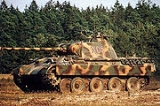
Panther tank

 
Panther Tank

   Email Print
   Bookmark   Link


Panther tank


The Panther was a tank
Tank

A tank is a Continuous track, armoured fighting vehicle designed for front-line combat which combines operational mobility and Military tactics Offensive and defence capabilities....
 fielded by Germany
Germany

Germany , officially the Federal Republic of Germany , is a country in Central Europe. It is bordered to the north by the North Sea, Denmark, and the Baltic Sea; to the east by Poland and the Czech Republic; to the south by Austria and Switzerland; and to the west by France, Luxembourg, Belgium, and the Netherlands....
 in World War II
World War II

World War II, or the Second World War , was a global military conflict which involved a Participants in World War II, including all of the great powers, organised into two opposing military alliances: the Allies of World War II and the Axis powers....
 that served from mid-1943 to the end of the European war in 1945. It was intended as a counter to the T-34
T-34

The T-34 was a Soviet Union Tank classification produced from 1940 to 1958. It is widely regarded as having been the world's best tank when the Soviet Union became involved in World War II, and although its armoured fighting vehicle and armament were surpassed by later tanks of the era, it has been often credited as the war's most effective,...
, and to replace the Panzer IV
Panzer IV

The Panzerkampfwagen IV , commonly known as the Panzer IV, was a medium tank developed in Nazi Germany in the late 1930s and used extensively during the World War II....
 and III
Panzer III

Panzer III is the common name of a medium tank that was developed in the 1930's by Nazi Germany and used extensively in World War II. The official German designation was Panzerkampfwagen III "armoured battle wagon"....
, though it served along with them and the heavy tanks until the end of the war. The Panther's excellent combination of firepower, mobility, and protection served as a benchmark for other nations' late war and immediate post-war tank designs and it is frequently regarded (along with the Soviet
Soviet Union

The Union of Soviet Socialist Republics was a Constitution of the Soviet Union socialist state that existed in Eurasia from 1922 to 1991.The name is a translation of the , romanization of Russian Soyuz Sovetskikh Sotsialisticheskikh Respublik, abbreviated ????, SSSR....
 T-34 Tank) as the best tank design of World War II
World War II

World War II, or the Second World War , was a global military conflict which involved a Participants in World War II, including all of the great powers, organised into two opposing military alliances: the Allies of World War II and the Axis powers....
.

Until 1944 it was designated as the Panzerkampfwagen V Panther and had the Ordnance inventory designation of Sd.Kfz.


Discussion
Ask a question about 'Panther tank'
Start a new discussion about 'Panther tank'
Answer questions from other users
Full Discussion Forum


Encyclopedia


The Panther was a tank
Tank

A tank is a Continuous track, armoured fighting vehicle designed for front-line combat which combines operational mobility and Military tactics Offensive and defence capabilities....
 fielded by Germany
Germany

Germany , officially the Federal Republic of Germany , is a country in Central Europe. It is bordered to the north by the North Sea, Denmark, and the Baltic Sea; to the east by Poland and the Czech Republic; to the south by Austria and Switzerland; and to the west by France, Luxembourg, Belgium, and the Netherlands....
 in World War II
World War II

World War II, or the Second World War , was a global military conflict which involved a Participants in World War II, including all of the great powers, organised into two opposing military alliances: the Allies of World War II and the Axis powers....
 that served from mid-1943 to the end of the European war in 1945. It was intended as a counter to the T-34
T-34

The T-34 was a Soviet Union Tank classification produced from 1940 to 1958. It is widely regarded as having been the world's best tank when the Soviet Union became involved in World War II, and although its armoured fighting vehicle and armament were surpassed by later tanks of the era, it has been often credited as the war's most effective,...
, and to replace the Panzer IV
Panzer IV

The Panzerkampfwagen IV , commonly known as the Panzer IV, was a medium tank developed in Nazi Germany in the late 1930s and used extensively during the World War II....
 and III
Panzer III

Panzer III is the common name of a medium tank that was developed in the 1930's by Nazi Germany and used extensively in World War II. The official German designation was Panzerkampfwagen III "armoured battle wagon"....
, though it served along with them and the heavy tanks until the end of the war. The Panther's excellent combination of firepower, mobility, and protection served as a benchmark for other nations' late war and immediate post-war tank designs and it is frequently regarded (along with the Soviet
Soviet Union

The Union of Soviet Socialist Republics was a Constitution of the Soviet Union socialist state that existed in Eurasia from 1922 to 1991.The name is a translation of the , romanization of Russian Soyuz Sovetskikh Sotsialisticheskikh Respublik, abbreviated ????, SSSR....
 T-34 Tank) as the best tank design of World War II
World War II

World War II, or the Second World War , was a global military conflict which involved a Participants in World War II, including all of the great powers, organised into two opposing military alliances: the Allies of World War II and the Axis powers....
.

Until 1944 it was designated as the Panzerkampfwagen V Panther and had the Ordnance inventory designation of Sd.Kfz. 171. On 27 February 1944, Hitler ordered that the Roman numeral V be deleted from the tank's designation.

Development and production

Panther1
The Panther was a direct response to the Soviet T-34
T-34

The T-34 was a Soviet Union Tank classification produced from 1940 to 1958. It is widely regarded as having been the world's best tank when the Soviet Union became involved in World War II, and although its armoured fighting vehicle and armament were surpassed by later tanks of the era, it has been often credited as the war's most effective,...
. First encountered on 23 June 1941, the T-34 outclassed the existing Panzer IV
Panzer IV

The Panzerkampfwagen IV , commonly known as the Panzer IV, was a medium tank developed in Nazi Germany in the late 1930s and used extensively during the World War II....
 and Panzer III
Panzer III

Panzer III is the common name of a medium tank that was developed in the 1930's by Nazi Germany and used extensively in World War II. The official German designation was Panzerkampfwagen III "armoured battle wagon"....
. At the insistence of General Heinz Guderian
Heinz Guderian

Heinz Wilhelm Guderian was a Theorist and innovative General of the Nazi Germany Wehrmacht during the World War II. Germany's panzer forces were raised and fought according to his works, best-known among them Achtung? Panzer! He held posts as Panzer Corps commander, Panzer Army commander, Inspector-General of Armoured Troops, and Chief...
 a team was dispatched to the Eastern Front to assess the T-34. Among the features of the Soviet tank
Tank

A tank is a Continuous track, armoured fighting vehicle designed for front-line combat which combines operational mobility and Military tactics Offensive and defence capabilities....
 considered most significant were the sloping armor, which gave much improved shot deflection and also increased the effective armor thickness against penetration, the wide track, which improved mobility over soft ground, and the 76.2 mm gun
GUN

Gun is a Revisionist Western-themed video game developed by Neversoft. It was published by Activision for the Xbox, Xbox 360, Nintendo GameCube, Microsoft Windows and PlayStation 2....
, which had good armour penetration and fired an effective high-explosive round. Daimler-Benz
Daimler-Benz

Daimler-Benz AG was a German manufacturer of automobiles, motor vehicles, and engines which was founded in 1926. An Agreement of Mutual Interest?which was valid until year 2000?was signed on May 1 1924 between Karl Benz's Benz & Cie....
 (DB) and Maschinenfabrik Augsburg-Nürnberg AG
MAN AG

MAN Aktiengesellschaft is a German language mechanical engineering company based in Munich.MAN is one of the world's leading manufacturers of engineering equipment and commercial vehicles....
 (MAN) were given the task of designing a new thirty to thirty-five-ton tank, designated VK3002, by April 1942 (apparently in time to be shown to Hitler for his birthday).

The two proposals were delivered in April 1942. The Daimler-Benz (DB) design was a direct homage to the T-34. It resembled the T-34 hull
Hull (watercraft)

A hull is the watertight body of a ship or boat. It is a central concept in floating vessels as it provides the buoyancy that keeps the vessel from sinking....
 and turret
Gun turret

A gun turret is a device that protects the crew or mechanism of a artillery and at the same time lets the weapon be aimed and fired in many directions....
 form. Daimler-Benz offered both leaf spring suspension and torsion-bar suspension variants, whereas the T-34 originally used coil springs
Christie suspension

The Christie suspension is a suspension system developed by Walter Christie for his tank designs. It allowed considerably longer movement than conventional leaf spring systems then in common use, which allowed his tanks to have considerably greater cross-country speed and a lower profile....
. The Daimler-Benz's turret was smaller than the turret of the MAN design. Unlike the T-34, both variants had a three-man turret crew: commander, gunner, and loader. But as the planned gun was much longer and heavier than the T-34's, mounting it in the Daimler-Benz turret was difficult. Plans to reduce the turret crew to two men to stem this problem were eventually dropped.

The MAN design embodied more conventional German thinking: it was higher and wider with a substantial turret placed centrally on the hull, a petrol engine and torsion-bar suspension. The MAN design was accepted in May, 1942 in spite of Hitler's preference for the DB design. One of the principal reasons for this was that the MAN design used an existing turret designed by Rheinmetall-Borsig
Rheinmetall

Rheinmetall Aktiengesellschaft is a Germany automotive and defense industry company with factories in D?sseldorf, Kassel and Unterl??.It was founded on 13th April 1889 by Heinrich Ehrhardt, with help from a consortium of banks, as Rheinische Metallwaren- und Maschinenfabrik Aktiengesellschaft....
 while the DB design would have required a brand new turret to be designed and produced, substantially delaying the commencement of production. The MAN design also had better fording ability, easier gun servicing and higher mobility due to better suspension, wider tracks and a bigger fuel tank.

A mild steel prototype
Prototype

A prototype is an original type, form, or instance of something serving as a typical example, basis, or standard for other things of the same category....
 was produced by September 1942 and, after testing at Kummersdorf
Kummersdorf

Kummersdorf is the name of an estate near Luckenwalde at , around 25km south of Berlin, in the Brandenburg region of Germany. Until 1945 Kummersdorf hosted the weapon office of the German Army which ran a development centre for future weapons as well as an artillery range....
, was officially accepted. It was put into immediate production. The start of production was delayed, however, mainly because there were too few specialized machine tools needed for the machining of the hull. Finished tanks were produced in December and suffered from reliability problems as a result of this haste. The demand for this tank was so high that the manufacturing was soon expanded beyond MAN to include Daimler-Benz, Maschinenfabrik Niedersachsen-Hannover (MNH) and Henschel & Sohn in Kassel.

The initial production target was 250 tanks per month at MAN. This was increased to 600 per month in January 1943. Despite determined efforts this figure was never reached due to disruption by Allied
Allies

In general, allies are people, groups or nations that have joined together in an association for mutual benefit or to achieve some common purpose....
 bombing, manufacturing bottlenecks, and other difficulties. Production in 1943 averaged 148 per month. In 1944, it averaged 315 a month (3,777 having been built that year), peaking with 380 in July and ending around the end of March 1945, with at least 6,000 built in total. Strength peaked on 1 September 1944 at 2,304 tanks, but that same month a record number of 692 tanks were reported lost (source: T.L. Jentz (1999) Die deutsche Panzertruppe Band 2).

Production figures

  • Prototypes: 2 produced in 11/42 (designated V1 and V2)
  • Ausf. D: 842 produced (1/43 to 9/43)
  • Ausf. A: 2,192 produced (8/43 to 6/44, sometimes called Ausf. A2)
  • Ausf. G: 2,953 (3/44 to 4/45)
  • Befehlspanzer Panther: 329 Converted (5/1943 to 2/1945)
  • Beobachtungspanzer Panther: 41 Converted (1944/1945)
  • Bergepanther: 347 (1943 to 1945)


Panther production 1944 by manufacturer % of total 1944
Maschinenfabrik Augsburg-Nürnberg (M.A.N.) 35%
Daimler-Benz31%
Maschinenfabrik Niedersachsen-Hannover 31%
Other3%


Design characteristics

If the over-hanging gun and sloping armor are ignored, the Panther was a conventional German design. The weight of the production model had increased to 43 tonne
Tonne

A tonne or metric ton , also referred to as a metric tonne, is a measurement of mass equal to 1,000 kilograms, or 2204.6226 pounds....
s from the planned 35.

The Panther was the first Axis tank design where modern features were more prominent than early World War II-era ones. Once the problems caused by the vulnerability of the engine and the transmission were solved, it proved to be a very effective fighting vehicle.

The crew was made up of five members: driver, radio operator (who also fired the bow machine gun), gunner, loader, and commander.

Engine

The Panther was powered by a 700 PS (690 hp, 515 kW)/3000 rpm, 23.1 litre Maybach HL 230 P30 V-12 petrol engine that drove two front drive sprockets via the gearbox and steering unit. The engine was generally considered reliable, and had a fatigue life of up to 2000 kilometers. Maybach HL230 engines were fitted with a governor in late 1943 that limited the engine revolutions to 2500 rpm and power to 600 PS (592 hp, 441 kW). The installation of the governor also reduced the tank's top speed from 55 km/h to 46 km/h.

Suspension

The suspension consisted of front drive sprockets, rear idlers and eight double-interleaved rubber-rimmed steel bogie wheels on each side, suspended on a dual torsion bar suspension. The Panther's suspension was costly and time-consuming to manufacture and the interleaved system made replacing inner bogies time consuming. However, it provided excellent flotation and stability and contributed to the Panther's generally excellent tactical mobility. Shortage of rubber brought in the very limited use of all-steel flat disc wheels with resilient steel tires.

Steering

Tank control was accomplished through a seven-speed AK 7-200 synchromesh
Manual transmission

A manual transmission is a type of Transmission used in automotive applications. It generally utilizes a driver-operated clutch operated by a pedal or lever, for regulating torque transfer from the engine to the transmission, and a gear-shift either operated by hand or by foot ....
 gearbox, designed by ZF, and a MAN single radius steering system, operated by steering levers. The steering system allowed a single, fixed radius of turn at each gear. The higher the gear, the bigger was the turning radius. If the radius was bigger than desired, the steering brakes could be used to tighten the turn.

The weakest parts in the tank were, throughout its career, the final drive units. The main reason was that the units could not be manufactured using hollow spur gears, due to the shortage of suitable gear-cutting machinery in Germany during the war. The final drives were in fact so weak that their fatigue life was sometimes as low as 150 km. The US M4 Sherman
M4 Sherman

The M4 Sherman, formally Medium Tank, M4, was the primary tank used by the United States during World War II. It was also distributed to the Allies via lend lease....
 tank, in contrast, had a double helical gear arrangement on its final drive which placed no limits on maximum speed.

Armor

The armor consisted of a thick homogeneous steel glacis (i.e. frontal hull) plate sloped back at 55 degrees from the vertical, welded but also interlocked for strength. The combination of thick 80 mm armor with a high degree of slope made the Panther's glacis armor extremely effective: very few Allied or Soviet weapons could penetrate it. The front of the turret was covered by a 100 mm thick cast mantlet, made in the shape of a transverse half-cylinder. The transverse-cylindrical shape of the mantlet meant that it was more likely to deflect shells, but it was discovered that the lower section of the transverse-cylindrical mantlet created a shot-trap: if a non-penetrating hit bounced downwards off the mantlet's lower section, it could penetrate the thin forward hull roof armor, and plunge down into the front crew compartment. Penetrations of this nature could have had catastrophic results since the front crew compartment housed the driver and radio operator sitting along both sides of the massive gearbox and steering unit combination, topped with the radio equipment. From September 1944, a slightly redesigned mantlet with a much thicker "chin" design was fitted to the Panther G, the chin being intended to prevent such deflections.

The main weakness of the Panther tank was its much thinner (40–50 mm thick) side armor. The thinner side armor was necessary to keep the tank's overall weight within reasonable bounds, but it made the Panther vulnerable to attacks from the side by most Allied and Soviet tank and anti-tank guns. German tactical doctrine for the use of the Panther thus emphasised the importance of flank protection. Five millimeter skirt armor, Schürzen, intended to provide protection for the lower side hull from Soviet anti-tank rifle fire was fitted on the hull side. Zimmerit
Zimmerit

Zimmerit was a coating produced for German armored fighting vehicles during World War II for the purpose of combating magnetically attached anti-tank mines, although Germany was the only country to use magnetic mines against tanks in great numbers....
 ceramic coating against magnetic mines also became standard with the Ausf. A, and retrofitted to older versions until deleted from new Panthers from about September 1944.

Armament

photographed in southern Ukraine
Ukraine

Ukraine is a country in Eastern Europe. It is bordered by Russia to the east; Belarus to the north; Poland, Slovakia, and Hungary to the west; Romania and Moldova to the southwest; and the Black Sea and Sea of Azov to the south....
 in 1944.]]

The main gun was a semi-automatic 7.5 cm Rheinmetall-Borsig
Rheinmetall

Rheinmetall Aktiengesellschaft is a Germany automotive and defense industry company with factories in D?sseldorf, Kassel and Unterl??.It was founded on 13th April 1889 by Heinrich Ehrhardt, with help from a consortium of banks, as Rheinische Metallwaren- und Maschinenfabrik Aktiengesellschaft....
 KwK 42 (L/70) with 79 rounds (82 on Ausf. G). The main gun used three different types of ammunition, APCBC-HE (Pzgr. 39/42), HE
Shell (projectile)

A shell is a payload-carrying projectile, which, as opposed to Round shot, contains an explosive or other filling, though modern usage includes large solid projectiles previously termed shot ....
 (Sprgr. 42) and APCR (Pzgr. 40/42), the last of which was usually in short supply. While the gun was of only average caliber for its time, the Panther's gun was one of the most powerful tank guns of WWII, due to the large propellant charge and the long barrel, which gave it a very high muzzle velocity
Muzzle velocity

A gun muzzle velocity is the speed at which the projectile leaves the muzzle of the gun. Muzzle velocities range from subsonic for some pistols to more than 1,800 m/s for tank guns firing kinetic energy penetrator ammunition....
 and excellent armor-piercing qualities. The flat trajectory
Trajectory

Trajectory is the path of a moving object that it follows through space. The object might be a projectile or a satellite, for example. It thus includes the meaning of orbit - the path of a planet, an asteroid or a comet as it travels around a central mass....
 also made hitting targets much easier, since accuracy was less sensitive to range. The 75 mm gun actually had more penetrating power than the main gun of the Tiger I heavy tank, the 8.8 cm KwK 36 L/56.

The tank had normally two MG 34
MG 34

The Maschinengewehr 34, or MG34, was a Nazi Germany machine gun that was first produced and accepted for service in 1934, and first issued to units in 1935....
 machine guns of a specific version designed for use in armored combat vehicles featuring an armored barrel sleeve. An MG 34
MG 34

The Maschinengewehr 34, or MG34, was a Nazi Germany machine gun that was first produced and accepted for service in 1934, and first issued to units in 1935....
 machine gun was located co-axially with the main gun on the gun mantlet; an identical MG 34 was located on the glacis plate and fired by the radio operator. Initial Ausf. D and early Ausf. A models used a "letterbox" flap opening, through which the machine gun was fired. Later Ausf A and all Ausf G models use a more conventional ball mount in the glacis for this machine gun. The Ausf A introduced a new cast commander's cupola. It featured a steel hoop to which a third MG 34 or either the coaxial or the bow machine gun could be mounted for use in the anti-aircraft role, though it was rare for this to be used in actual combat situations.

Combat use


The Panther was intended to supplement the Panzer IV
Panzer IV

The Panzerkampfwagen IV , commonly known as the Panzer IV, was a medium tank developed in Nazi Germany in the late 1930s and used extensively during the World War II....
 and replace the Panzer III
Panzer III

Panzer III is the common name of a medium tank that was developed in the 1930's by Nazi Germany and used extensively in World War II. The official German designation was Panzerkampfwagen III "armoured battle wagon"....
 medium tanks. Each German Panzer (armored) division had two tank battalions; the intent was to equip one battalion in each division with Panthers, retaining the lighter, older, but still useful Panzer IV in the other battalion. Beginning in mid-1943, battalions were gradually converted to Panthers.

The Panther first saw action at Kursk
Battle of Kursk

The Battle of Kursk refers to Nazi Germany and Soviet Union operations on the Eastern Front of World War II in the vicinity of the city of Kursk in July and August 1943....
 on 5 July 1943. Early tanks were plagued with mechanical problems: the track and suspension often broke, and the engine was dangerously prone to overheating and bursting into flames. At Kursk, more Panthers were disabled by their own failings than by enemy action. For example, the XLVIII Panzer Corps reported on 10 July 1943, that they had 38 Panthers operational and 131 awaiting repair, out of about 200 they had started with on 5 July. Heinz Guderian, who had not wanted Hitler to order them into combat so soon, later remarked about the early Panther's performance in the battle: "they burnt too easily, the fuel and oil systems were insufficiently protected, and the crews were lost due to lack of training." Guderian also stated, however, that the firepower and frontal armor were good. While many of the Panthers used at Kursk were damaged or suffered from mechanical difficulties, only a small number was lost for good; the tanks also achieved success, with 263 Soviet tanks claimed destroyed. Although its frontal armour was thinner than the Tiger's, it was also much more sloped and proved harder for Soviet shells to penetrate.

After Kursk, the tanks suffering from damage or mechanical breakdowns were repaired and the inherent design problems of the early Ausf. D models were fixed, making the Panther a truly formidable tank. Later in 1943 and especially into 1944, Panthers appeared in increasing numbers on the eastern front. By June 1944, Panthers were about half of the German tank strength both in the east and the west. At the end of the war it was the third most produced German armored fighting vehicle
German armored fighting vehicle production during World War II

File:Bundesarchiv Bild 101I-635-3965-21, Panzerfabrik in Deutschland.jpgThis article lists production figures for German AFVs of World War II during the World War II era....
.

In 1943-1944, a Waffen-SS
Waffen-SS

The Waffen-SS was the combat arm of the Schutzstaffel or SS. It was founded in Germany in 1939 after the SS was split into two units but the title of Waffen-SS only became official on 2 March, 1940....
 special operations group was formed by Otto Skorzeny, to infiltrate enemy defenses. A small number of Panthers and Stug-IIIs in this group were repainted with US Army insignia. The Panthers were altered with thin sheet metal to resemble US Army M10 Tank Destroyers.

Perhaps the best known German Panther commander was SS-Oberscharführer Ernst Barkmann
Ernst Barkmann

Ernst Barkmann is a Germany former Waffen-SS soldier and panzer ace. Barkmann fought and rose to fame during World War II for his actions in command of Panther Tank tanks....
 of the 2nd SS-Panzer Regiment, 2nd SS-Panzer Division "Das Reich".

Panther turrets, from battle damaged and retired vehicles along with specially manufactured ones, were also mounted in fixed fortifications. Turrets (mechanically traverseable) were mounted on concrete emplacements (Pantherturm III - Betonsockel - concrete base) or welded steel boxes (Pantherturm I - Stahluntersatz - steel sub-base), which housed the ammunition storage and fighting compartment along with crew quarters. Such emplacements were located in the fortifications of the Atlantic Wall, West Wall, Gothic Line, Hitler Line (one of those was located at Piedimonte in Monte Cassino area) and in the east (about 12 in Berlin). A total of 268-280 turrets were installed as of 26 March 1945.

Panther battalion organization

Composition of a panzer battalion equipped with Panther tanks, 1943. Two panzer battalions would comprise the panzer regiment of a panzer division
Panzer Division

A panzer division is an armored division in the German Army .Panzer Division are combined-arms formations having both armor and infantry as organic components, along with the usual assets of artillery, antiaircraft, signals, etc....
.

  • Battalion Command (composed of Communication and Reconnaissance platoons)
  • Communication Platoon - 3 × Befehlswagen Panther SdKfz.267/268
  • Reconnaissance Platoon - 5 × Panther
  • 1st Company - 22 × Panther
    • Company Command - 2 × Panther
      • 1st Platoon - 5 × Panther
      • 2nd Platoon - 5 × Panther
      • 3rd Platoon - 5 × Panther
      • 4th Platoon - 5 × Panther
  • 2nd Company - 22 × Panther (composed as 1st Company)
  • 3rd Company - 22 × Panther (composed as 1st Company)
  • 4th Company - 22 × Panther (composed as 1st Company)
  • Service Platoon - 2 × Bergepanther


From 1943 to 1945, many modifications were made to unit organization by reducing both number of companies and platoons due to the war situation.

The Allied response


The Soviet response to the large numbers of Panthers on their front was swift. In 1943 the Red Army was still equipped with T-34
T-34

The T-34 was a Soviet Union Tank classification produced from 1940 to 1958. It is widely regarded as having been the world's best tank when the Soviet Union became involved in World War II, and although its armoured fighting vehicle and armament were surpassed by later tanks of the era, it has been often credited as the war's most effective,...
 tanks armed with the same 76.2 mm gun as in 1941. This gun was ineffective against the Panther's frontal armor, meaning the Soviet tank had to flank the Panther to destroy it, while the Panther's main gun could penetrate the T-34 at long range from any angle. Plans were made to improve the T-34 with an 85 mm gun and new and more spacious three-man turret, producing the T-34-85. Although this tank was not quite the equal of the Panther, it was much better than the 76.2 mm-armed versions and made up for its quality shortcomings by being produced in greater quantities than the Panther. New self-propelled anti-tank vehicles based on the T-34 hull, such as the SU-85
SU-85

The SU-85 was a Soviet Union self-propelled gun used during World War II, based on the chassis of the T-34 medium tank. Earlier Soviet self-propelled guns were meant to serve as either assault guns, such as the SU-122, or as mobile anti-tank weapons; the SU-85 fell into the latter category....
 and SU-100
SU-100

The SU-100 was a Soviet Union tank destroyer. It was used extensively during the last year of World War II and saw service for many years afterwards with the armies of Soviet allies around the world....
, were also developed. By mid-1944, the Red Army
Red Army

The Red Army was the armed force first organized by the Bolsheviks during the Russian Civil War in 1918 and, in 1922, became the army of the Soviet Union....
 was deploying far more T-34-85s than the Germans had Panthers.

A German comparison of German tanks with the new Soviet T-34-85 and IS-2 heavy tank (with a 122 mm gun), from 23 March 1944, stated that "the Panther is far superior to the T-34/85 for frontal fire (Panther Ausf G could penetrate frontal armor of T-34-85 at 2,000 m, while T-34-85 could penetrate frontal armor of Panther Ausf G at 500 m), approximately equal for side and rear fire, superior to the IS-2 for frontal fire and inferior for side and rear fire." In 1943 and 1944, a Panther was able to destroy any Allied enemy tank in existence at ranges of 2,000 m, while in general veteran Panther crews reported a 90 percent hit rate at ranges up to 1,000 m.

The Panther weighed about as much as the new Soviet IS-2 heavy tank, and indeed this vehicle is a closer match than the much lighter T-34. Later in the war (1944 and on) Soviets found the quality of German armour dropped, lack of alloying metals made the plates too brittle. In November 1943 at Kubinka
Kubinka Tank Museum

The Kubinka Tank Museum, also known as "The Tank Museum in Kubinka", is a large museum of armoured fighting vehicles in Russia, just outside Moscow....
, during trials of guns proposed to be mounted on the IS-2, a 122-mm round fired from the A-19 gun passed clear through a captured Panther, penetrating both the front and rear armour.

The Western Allies' response was inconsistent. The Panther was not employed against the western Allies until early 1944 at Anzio
Anzio

Anzio is a city and comune on the coast of the Lazio region of Italy, about 57 km south of Rome. Well known for its seaside harbor setting, it is a fishing port popular with tourists and a departure point for ferries and hydroplanes to the Pontine Islands of Ponza, Palmarola and Ventotene....
, where Panthers were employed in small numbers. Until shortly before D-Day
D-Day

D-Day is a term often used in military parlance to denote the day on which a combat attack or operation is to be initiated. "D-Day" often represents a variable , designating the day upon which some significant event will occur or has occurred; see Military designation of days and hours for similar terms....
, the Panther was thought to be another heavy tank that would not be built in large numbers. However, shortly before D-Day, Allied intelligence investigated Panther production, and using a statistical analysis
German tank problem

File:PantherTankColor.jpgIn the statistical theory of estimation theory, estimating the maximum of a uniform distribution is a common illustration of differences between estimation methods....
 of the bogie wheels on two captured tanks, estimated that Panther production for February 1944 was 270, thus indicating that it would be found in much larger numbers than had previously been anticipated. Thus in the planning for the Battle of Normandy
Battle of Normandy

The Invasion of Normandy was the invasion and establishment of Western Allies forces in Normandy, France, during Operation Overlord in World War II....
, the US Army expected to face a handful of German heavy tanks alongside large numbers of Panzer IVs, and thus had little time to prepare to face the Panther. Instead, almost half the German tanks in Normandy were Panthers, whose frontal armour could not be penetrated by the 75 mm guns of the US Sherman tanks
M4 Sherman

The M4 Sherman, formally Medium Tank, M4, was the primary tank used by the United States during World War II. It was also distributed to the Allies via lend lease....
. This was due to then-current US armor doctrine which assigned tanks to infantry support and exploitation roles, avoiding enemy tanks, and left the main anti-armor role to dedicated tank destroyer
Tank destroyer

A self-propelled anti-tank gun, or tank destroyer, is a type of armoured fighting vehicle designed specifically to engage enemy armor forces, and not produced for an infantry support role....
s.

The US eventually produced large numbers of 76 mm-armed Shermans, 90 mm-armed tank destroyers, and eventually the Pershing heavy tank
M26 Pershing

The Heavy Tank M26 Pershing was an United States Armed Forces heavy tank used during World War II and the Korean War. It was named after General John Pershing, who led the American Expeditionary Force in World War I....
. Even with these better weapons, it was still difficult to penetrate the frontal armor of the Panther.

British forces responded to the heavier German tanks with the 17-pounder
Ordnance QF 17 pounder

The Ordnance QF 17 pounder was a 76.2 mm gun developed by the United Kingdom during World War II. It was used as an anti-tank gun on its own carriage, as well as equipping a number of British tanks....
 gun mounted in the Sherman (the Sherman Fireflies), as well as towed 17-pounders. By the conclusion of the Normandy campaign
Normandy Campaign

The Normandy Campaign can refer to:* Operation Overlord - The Western Allied campaign in France from June 6 - August 25, 1944* The Invasion of Normandy - The initial part of Overlord, from June 6 - mid-July, 1944...
, British forces were fielding roughly a 1:4 ratio of Fireflys to 75 mm Shermans in their tank units. In 1945, they deployed the Comet tank
Comet tank

The Tank, Cruiser, Comet I was a United Kingdom tank that first saw use near the end of World War II....
.

The Panther remained a major German tank until the end of the war. Later versions of the Panzer IV
Panzer IV

The Panzerkampfwagen IV , commonly known as the Panzer IV, was a medium tank developed in Nazi Germany in the late 1930s and used extensively during the World War II....
 with long 75 mm KwK 40 L/48
7.5 cm KwK 40

The 7.5 cm KwK 40 was a Germany 7.5 cm Second World War era vehicle mounted gun, used primarily as the chief weapon of the German Tank classification the Panzer IV and the Sturmgesch?tz III assault guns ....
 guns were slightly cheaper to produce and more reliable, and so they remained in production alongside the Panther. However, the main reason for the prolonged Panzer IV production was that the reorganization of the German tank industry to manufacture Panthers rather than Panzer IVs would have resulted in an unacceptable, albeit temporary, decrease in overall tank production.

Around the time of the Battle of the Bulge
Battle of the Bulge

The Ardennes Offensive was a major German offensive launched towards the end of World War II through the forested Ardennes of Belgium , France and Luxembourg on the Western Front ....
, as part of Otto Skorzeny
Otto Skorzeny

Otto Skorzeny was an Obersturmbannf?hrer in the Germany Waffen-SS during World War II. After fighting on the Eastern Front , he commanded a rescue mission that freed the deposed Italian dictator Benito Mussolini from captivity....
's Operation Greif
Operation Greif

Operation Greif was a special false flag operation commanded by the notorious Waffen-SS commando Otto Skorzeny during the Battle of the Bulge....
 commando mission, a number of Panther tanks assigned to Skorzeny's Panzerbrigade 150 were disguised to look roughly like an M10 Tank Destroyer by welding on additional plates, applying US-style camouflage paint and markings. This was carried out as part of a larger operation that involved soldiers disguised as Americans and other activities. The disguised Panthers were detected and destroyed.

Further development


Design work on the Panther II began in February 1943. The main aim was to secure maximum interchangeability of parts with the Tiger II
Tiger II

Tiger II is the common name of a Nazi Germany heavy tank of the World War II. The official German designation was Panzerkampfwagen VI Ausf. B and the tank also had the ordnance inventory designation Sonderkraftfahrzeug 182....
 heavy tank in order to ease manufacturing. The Panther II had a hull similar to the Tiger II, and also shared nearly-identical steel tired road wheels (seven versus the Tiger II's nine), "contact shoe" and "connector link" track, suspension and brakes. One of the parts to be changed was the gun-mantlet, which had to become smaller. This was referred to in German as Turm mit schmaler Blende (narrow-mantlet turret).

The Panther II project never got further than a single chassis that now can be seen in the Patton Museum.

The only other significant differences between the Panther and the Panther II were running gear and increased armor protection. The turret was exactly the same on both types. The Panther II was only designed with the 7.5 cm KwK L/70 in mind, and the 8.8 cm KwK L/71 idea didn't enter into consideration after the Panther II project had been dropped.

Later in the war, in March 1944, work started again on a Panther turret with a smaller forward aspect. This led to the development of the Schmalturm (narrow turret). In August a Versuchsturm (trials turret) was completed. This was mounted on the chassis of a regular Panther Ausf. G. The Schmalturm featured thicker armour, a built-in stereoscopic rangefinder, the capability to carry the 88 mm KwK L/71 and eliminated the shot-trap under the mantle, but weighed less than the original turret. A partially destroyed example of a production Schmalturm is on display at the Bovington Tank Museum
Bovington Tank Museum

The Bovington Tank Museum is a collection of armoured vehicles in the United Kingdom. With almost 300 vehicles on exhibition from 26 countries it is the most wide-ranging collection of tanks and armoured vehicles in the world....
.

Panther Ausf. F


In that same period, development of the Panther led to the Ausf. F, slated for production in April 1945. The key points for this mark of Panther were the new Schmalturm with its improved armor protection, and an extended front hull roof which was also slightly thicker. A number of Ausf. F hulls were built at Daimler-Benz and Ruhrstahl-Hattingen steelworks; however there is no evidence that any completed Ausf F saw service before the end of the war. Indeed, since some key components for the Schmalturm were never completed, the operation of any Panther Ausf. F built would have been seriously impaired. The Panther Ausf. F is not to be confused with the Panther II, which was an entirely new design with a heavier chassis.

Derived vehicles

  • Jagdpanther
    Jagdpanther

    The Jagdpanther was a tank destroyer built by Nazi Germany during World War II based on the chassis of the Panther tank. Many military historians consider the Jagdpanther to be the best tank destroyer of World War II....
     - heavy tank destroyer with the 88 mm L/71
  • Befehlspanzer Panther - command tank with additional radio equipment
  • Beobachtungspanzer Panther - observation tank for artillery spotters; dummy gun; armed with only two MG 34
    MG 34

    The Maschinengewehr 34, or MG34, was a Nazi Germany machine gun that was first produced and accepted for service in 1934, and first issued to units in 1935....
  • Bergepanther - armored recovery vehicle


Postwar and foreign use

Although a technologically sophisticated vehicle for its time, the Panther's design had only a very limited influence on postwar tank development. The French postwar AMX 50
AMX 50

The AMX 50 was a French tankdesigned in the immediate post World War II period. It was proposed as, in succession, the French medium, heavy tank and main battle tank and incorporated many advanced features....
 tank prototype was influenced by the Panther but never entered series production. The French did produce a modified version of the Panther's 75mm KwK 42 L/70 gun, as the 75mm DEFA and CN75-50 gun. This gun equipped the first iteration of the AMX 13 light tank as well as the EBR armored car, and was also used by the Israeli M50 Super Sherman
M50 Super Sherman

The Sherman M-50 and the Sherman M-51 were modified versions of the M4 Sherman tank that served with the Israel Defense Forces from the mid-1950s to early 1980s....
.

The Panther itself also saw some limited use outside the German military, both before and after 1945:

During the war, the Red Army
Red Army

The Red Army was the armed force first organized by the Bolsheviks during the Russian Civil War in 1918 and, in 1922, became the army of the Soviet Union....
 employed a number of captured Panthers. These were repainted with prominent Soviet emblems and tactical markings to avoid friendly fire incidents. The Red Army still used a few Panthers as late as spring 1945.

At least one captured vehicle (nicknamed "Cuckoo") also saw service with the British Coldstream Guards for some time.

Japan reportedly bought a single Panther Ausf. D for reverse engineering
Reverse engineering

Reverse engineering is the process of discovering the technological principles of a device, object or system through analysis of its structure, function and operation....
 purposes in 1943. However the tank apparently never actually made it to Japan. The Panther's sloped armour and turret design nevertheless did influence the design of Japans last wartime tank prototypes; the medium Type 4 Chi-To
Type 4 Chi-To

The was one of several new medium tank and heavy tanks developed by the Imperial Japanese Army towards the end of World War II. The Type 4 Chi-To was by far the most advanced Empire of Japan wartime tank to reach the production phase....
 and heavy Type 5 Chi-Ri
Type 5 Chi-Ri

The was the penultimate medium tank developed by the Imperial Japanese Army in World War II. Intended to be a heavier, more powerful version of Japan's sophisticated Type 4 Chi-To, in performance it was designed to surpass the M-4 Sherman tanks fielded by the Allies of World War II....
.

After the war, France
France

France , officially the French Republic , is a country whose Metropolitan France is located in Western Europe and that also comprises various Overseas departments and territories of France....
 was able to recover enough operable vehicles and components to equip the French Army
French Army

The French Army, officially the Arm?e de Terre , is the Army component of the Military of France and its largest. As of 2007, the army employs 134,000 regular soldiers, 15,500 reservists, and 25,750 civilians....
's 503e Régiment de Chars de Combat with a force of fifty Panthers. These remained in service until about 1950, by which time they had all been replaced by French-built ARL 44
ARL 44

The ARL 44 was a France heavy tank produced just after World War II. Only sixty of these tanks were ever manufactured and the type was quickly phased out....
 heavy tanks.

In 1946, Sweden
Sweden

Sweden , officially the Kingdom of Sweden , is a Nordic countries on the Scandinavian Peninsula in Northern Europe. Sweden has land borders with Norway to the west and Finland to the northeast, and it is connected to Denmark by the ?resund Bridge in the south....
 sent a delegation to France to examine surviving specimens of German military vehicles. During their visit, the delegates found a few surviving Panthers and had one shipped to Sweden for further testing and evaluation. Testing continued until 1961. The tank is currently on display in the Deutsches Panzermuseum
Deutsches Panzermuseum

The Deutsches Panzermuseum is an armoured fighting vehicle museum in Munster, Lower Saxony, Germany, the site of the Truppen?bungsplatz Munster camps....
 in Münster
Münster

M?nster is a city in North Rhine-Westphalia, Germany. It is located in the northern part of the state and is considered to be the cultural centre of the Westphalia region and it is also capital of the government region M?nster ....
.

Surviving vehicles

Twenty-eight Panthers survive in conditions ranging from wrecks to fully restored. Four - held by the Kubinka Tank Museum
Kubinka Tank Museum

The Kubinka Tank Museum, also known as "The Tank Museum in Kubinka", is a large museum of armoured fighting vehicles in Russia, just outside Moscow....
 in Russia, the Musée des Blindés
Musée des Blindés

The Mus?e des Blind?s or Mus?e G?n?ral Estienne is one of the world's leading tank museums. It is located in the Loire Valley of France in the city of Saumur....
 in France and the Deutsches Panzermuseum
Deutsches Panzermuseum

The Deutsches Panzermuseum is an armoured fighting vehicle museum in Munster, Lower Saxony, Germany, the site of the Truppen?bungsplatz Munster camps....
 in Munster and the Wehrtechnische Studiensammlung in Koblenz
Koblenz

Koblenz is a city situated on both banks of the Rhine at its confluence with the Moselle River, where the Deutsches Eck and its monument are situated....
, Germany - are in running condition.

Two more Panthers are being restored to running condition by private collectors in England (Kevin Wheatcroft) and the United States (Jacques Littlefield
Jacques Littlefield

Jacques Littlefield was the Military Vehicle Technology Foundation , also called the Littlefield Collection....
). Kevin Wheatcroft will also restore the two other Panther tanks that he owns to running condition.

A unique Panther Ausf. D (the only known complete survivor) is displayed in the Wilhelmina park in Breda
Breda

Breda is a municipality and a city in the southern part of the Netherlands. The name Breda derived from brede Aa and refers to the place where the rivers Mark and Aa River come together....
, The Netherlands. This tank was donated by the Polish 1st Armored Division after liberating Breda. It was restored in 2004-2005 for static display by Kevin Wheatcroft in exchange for automotive components.

The Panther on display at Panzermuseum Thun, Switzerland is advertised as an Ausf. D/G hybrid, with a D hull and G turret. There are many questions surrounding this vehicle. The turret has a replacement sheet metal mantlet, vaguely resembling a late Ausf. G mantlet, with no ports for gunners sight or coaxial MG. The pistol port on the turret rear indicates an Ausf. A or early Ausf G. The hull with the "letterbox" MG slot indicates an Ausf. D or early Ausf. A. The turret and hull numbers could help identify the correct model designation for the hybrid but neither of the numbers have been made public.

In January 2008 a partially restored Panther Ausf. A was put on display in the Lebreton gallery at the Canadian War Museum
Canadian War Museum

The Canadian War Museum is Canada?s national museum of military history. Located in Ottawa, Ontario, the museum focuses on military conflicts that occurred on Canadian soil, involved Canadian forces, or had a significant effect on the country and its people....
. The Panther had been donated to the museum from CFB Borden
CFB Borden

Canadian Forces Base Borden is a Canadian Forces base located in Ontario.The historic birthplace of the Royal Canadian Air Force, CFB Borden is the largest training facility in the Canadian Forces....
, which acquired it following V-E celebrations in May 1945. It had spent two years in restoration prior to being put on public display.

A Panther Ausf. G can be found in the village of Houffalize in the Ardennes region of Belgium. It fell into the river during the Battle of the Bulge
Battle of the Bulge

The Ardennes Offensive was a major German offensive launched towards the end of World War II through the forested Ardennes of Belgium , France and Luxembourg on the Western Front ....
 and was later retrieved as a memorial.

Detailed specifications

  • Crew: 5
  • Combat weight:
    • Ausf. D 43.0 t
    • Ausf. A 45.5 tonnes
    • Ausf. G 44.8 t (46.58 t with steel bogies)
  • Dimensions
    • Length (including gun): 8.66 m
    • Length (excluding gun): 6.87 m
    • Width: 3.27 m,
      • with skirt plates: 3.42 m
    • Height: 2.99 m
  • Road speed: 55 km/h at 3,000 rpm (46 km/h at 2,500 rpm)
  • Road range: 200 km
  • Tracks: Kgs 64/660/150
    • Type: dual center guide
    • Width: 660 mm
    • Ground contact length: 3.92 m
    • Track links: 86
    • Ground pressure: 0.88 kg/cm²
  • Suspension: dual torsion-bar
  • Shock absorbers: on 2nd and 7th swing arms on either side
  • Obstacle ability
    • Vertical obstacle: 0.9 m
    • Trench crossing : 1.9 m
    • Fording: 1.7 m
  • Engine: Maybach HL 230 P30
    • Type: V-12, four-stroke
    • Displacement: 23.095 litres
    • Compression ratio: 6.8:1
    • Fuel: gasoline
      Gasoline

      File:GasCan.jpgGasoline or petrol is a petroleum-derived liquid mixture, primarily used as fuel in internal combustion engines.It consists mostly of aliphatic hydrocarbons, enhanced with iso-octane or the aromatic hydrocarbons toluene and benzene to increase its octane rating....
      , 74 octane
    • Fuel consumption (road): 3.5 l/km
    • Power: 700 PS at 3,000 rpm, 600 PS at 2,500 rpm
    • Fuel capacity: 720 litres
  • Transmission: ZF AK 7-200
    • Type: synchromesh manual
    • Gears: 7 forward, 1 reverse
  • Steering: MAN single-radius clutch-brake
  • Main clutch: Fichtel & Sachs LAG 3/70H
  • Steering ratio: 1:1.5
  • Armament
    • Main gun: 7.5 cm Kwk 42 L/70
      • Maximum muzzle velocity: 1,120 m/s
      • Breech: semiautomatic
      • Traverse: 360°, 24°/second
      • Elevation: +18°/-8°
      • Rounds carried: 79, Ausf. G: 82
  • Primary gun sight: Ausf. D: Leitz TZF 12; Ausf. A and G: TZF 12a
    • Magnification: 2.5×/5×
    • Field of view: 28°/14°
  • Radio equipment
    • Fu 5 transmitter/receiver
    • Fu 2 receiver
  • Armor:
    • Hull front, lower: 60 mm at 35° from horizontal; upper: 80 mm at 35°
    • Hull side, lower: 40 mm at 90°; upper: 40 mm at 50° (Ausf. G: 50 mm at 60°)
    • Hull rear: 40 mm at 60°
    • Turret front: Ausf. D: 80 mm at 78°; Ausf. A: 110 mm at 78°; Ausf: G: 100 mm at 80°
    • Turret side: 45 mm at 65°
    • Turret rear: 45 mm at 65°
    • Turret, top: 15 mm at 5°; Ausf. G: 30 mm at 5°
    • Gun mantlet: 120 mm rounded


External links

  • , and at Achtung Panzer!
  • - A PDF file presenting the Panther tanks