
All Topics  
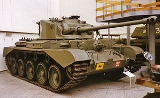
Comet tank

 
Comet Tank

   Email Print
   Bookmark   Link


Comet tank


The Tank, Cruiser, Comet I (A34) was a British
United Kingdom

The United Kingdom of Great Britain and Northern Ireland, commonly known as the United Kingdom , the UK or Britain,is a sovereign state located off the northwestern coast of continental Europe....
 tank
Tank

A tank is a Continuous track, armoured fighting vehicle designed for front-line combat which combines operational mobility and Military tactics Offensive and defence capabilities....
 that first saw use near the end of World War II
World War II

World War II, or the Second World War , was a global military conflict which involved a Participants in World War II, including all of the great powers, organised into two opposing military alliances: the Allies of World War II and the Axis powers....
.

at experience against the Germans in the Western Desert Campaign
Western Desert Campaign

The Western Desert Campaign, also known as the Desert War was the initial stage of the North African Campaign of World War II.From the start, the Western Desert Campaign was a continuous back-and-forth struggle....
 demonstrated to the British many shortcomings with their current cruiser tanks. Hence, a request was made in 1941 to the Nuffield Organisation
Nuffield Organisation

The Nuffield Organisation was a vehicle manufacturing company in the United Kingdom. Named after its founder, William Morris, 1st Viscount Nuffield, it was formed in 1938 as the merger of Nuffield's Morris Motor Company , another of Nuffield's companies the MG and Riley ....
 and Leyland Motors Ltd
Leyland Motors Ltd

Leyland Motors Limited was a United Kingdom vehicle manufacturer of lorry and buses. It gave its name to the British Leyland Motor Corporation formed when it merged with British Motor Holdings, later to become British Leyland after effectively becoming nationalisation....
 for a new heavy cruiser tank that could achieve battle superiority over German models.


Discussion
Ask a question about 'Comet tank'
Start a new discussion about 'Comet tank'
Answer questions from other users
Full Discussion Forum


Recent Posts


Encyclopedia


The Tank, Cruiser, Comet I (A34) was a British
United Kingdom

The United Kingdom of Great Britain and Northern Ireland, commonly known as the United Kingdom , the UK or Britain,is a sovereign state located off the northwestern coast of continental Europe....
 tank
Tank

A tank is a Continuous track, armoured fighting vehicle designed for front-line combat which combines operational mobility and Military tactics Offensive and defence capabilities....
 that first saw use near the end of World War II
World War II

World War II, or the Second World War , was a global military conflict which involved a Participants in World War II, including all of the great powers, organised into two opposing military alliances: the Allies of World War II and the Axis powers....
.

Design and development

Combat experience against the Germans in the Western Desert Campaign
Western Desert Campaign

The Western Desert Campaign, also known as the Desert War was the initial stage of the North African Campaign of World War II.From the start, the Western Desert Campaign was a continuous back-and-forth struggle....
 demonstrated to the British many shortcomings with their current cruiser tanks. Hence, a request was made in 1941 to the Nuffield Organisation
Nuffield Organisation

The Nuffield Organisation was a vehicle manufacturing company in the United Kingdom. Named after its founder, William Morris, 1st Viscount Nuffield, it was formed in 1938 as the merger of Nuffield's Morris Motor Company , another of Nuffield's companies the MG and Riley ....
 and Leyland Motors Ltd
Leyland Motors Ltd

Leyland Motors Limited was a United Kingdom vehicle manufacturer of lorry and buses. It gave its name to the British Leyland Motor Corporation formed when it merged with British Motor Holdings, later to become British Leyland after effectively becoming nationalisation....
 for a new heavy cruiser tank that could achieve battle superiority over German models. Additionally, for reasons of economy and efficiency, it had to use as many components as possible from the current model, the A15 Cruiser tank Mk VI Crusader tank
Crusader tank

One of the primary cruiser tanks of the United Kingdom during World War II, the Tank, Cruiser, Mk VI Crusader was perhaps the most important British tank of the North African Campaign....
.

The initial designs submitted were the A24 Cruiser Tank Mk VII Cavalier tank
Cavalier tank

The Tank, Cruiser, Mk VII Cavalier was an unsuccessful design of United Kingdom cruiser tank during World War II. It suffered from an underpowered engine, and problems because of the rush to design and build it....
 from Nuffield powered by a Nuffield-Liberty L-12
Liberty L-12

The Liberty L-12 was a 27 litre water-cooled 45 degree V-12 aircraft engine of 400 horsepower designed both for a high power-to-weight ratio and for ease of mass production....
 engine and the A27L Cruiser tank Mk VII Centaur tank from Leyland which was also powered by the Liberty L-12 but would be able to use the more powerful Rolls-Royce Meteor
Rolls-Royce Meteor

The Rolls-Royce Meteor was a United Kingdom tank engine developed from the Rolls-Royce Merlin Aircraft engine, by W. A. Robotham and his chassis design and development division at Belper ....
 when it became available.

The Cruiser tank Mk VII A27M Cromwell
Cromwell tank

The Tank, Cruiser, Mk VIII, Cromwell , named after the English Civil War leader Oliver Cromwell, was one of the most successful series of cruiser tanks fielded by United Kingdom in World War II....
 was the follow up to the Cavalier/Centaur. The Cromwell's Meteor engine proved to be very reliable and gave the Cromwell good mobility but some problems did appear. The tank was prone to throwing its tracks if track tension was not maintained properly or if it turned at too high a speed or too sharply. There were also some problems with suspension breakage, partly due to the Cromwell's high speed.

After extensive combat in Normandy in June 1944 it was obvious the British needed a main gun that could fire a more effective armour-piercing round to deal with the up-armoured German Panzer IV
Panzer IV

The Panzerkampfwagen IV , commonly known as the Panzer IV, was a medium tank developed in Nazi Germany in the late 1930s and used extensively during the World War II....
 tanks and the Panther and Tiger tank
Tiger tank

The name Tiger was given to two German tanks of the Second World War:*Tiger I, Panzerkampfwagen VI Tiger I*Tiger II, Panzerkampfwagen VI Ausf....
s.

The original plan called for issuing one Sherman Firefly
Sherman Firefly

The Sherman Firefly was a World War II United Kingdom variation of the United States M4 Sherman, fitted with the powerful British Ordnance QF 17 pounder anti-tank gun as its main weapon....
, a Sherman tank fitted with the 17 pounder gun, to each Cromwell troop (giving three Cromwells and one Sherman Firefly) but this proved difficult due to the different maintenance requirements and associated logistics problems of supplying two different tank models. A 17-pdr equipped Cromwell was seen as the answer. A interim solution was found by the introduction of the 17-pounder equipped A30 Cruiser Mk VIII Challenger
Cruiser Mk VIII Challenger

Not to be confused with the later Challenger 1 and 2 MBTsThe Tank, Cruiser, Challenger was an attempt to mount the 17 Pounder gun on the Cromwell tank chassis to give a tank with more anti-tank firepower to add to the Cruiser tank units....
 tank.

With the A34 Comet the tank designers opted to correct several Cromwell flaws; the track shedding and broken suspension problems, and enhance the Cromwell's main strengths, low height and high speed. The designers used a new gun, the "77mm HV". This gun used the same calibre (76.2 mm) projectile as the 17 pdr, but the shell casing was from the older QF 3 inch 20 cwt gun (loaded to higher pressures), and therefore was non-interchangeable with the 17 pdr ammunition. It had a lower muzzle velocity than the 17-pounder, but the ammunition was much more compact and more easily stored and handled within the confines of a tank. Several other upgrades were added as well: armour protection was increased, both the hull and turret were of welded construction with a cast gun mantlet, ammunition was now stored in armoured bins, the suspension was strengthened, return rollers were added, and the turret was electrically traversed (a design feature taken from the earlier Churchill tank
Churchill tank

The Tank, Infantry, Mk IV was a heavy United Kingdom infantry tank used in the World War II, best known for its heavy armour and its use as the basis of many specialist vehicles....
), with a generator powered by the main engine.

The Comet tank's top speed was governed down from the Cromwell's 40+ mph to a slightly slower but still respectable 32 mph to preserve suspension and engine components and to reduce track wear

The first prototype was ready in February 1944 and production models began to be delivered by September 1944. By the end of the war, 1,200 units had been produced.

The 11th Armoured Division was the first to receive the new tanks in December 1944 and the only division to be completely refitted by the end of the war. Because of its late arrival, the Comet did not participate in any major battles though it did see combat against the Germans. The Comet was involved in the crossing of the Rhine
Operation Plunder

Commencing on the night of 23 March, 1945 during World War II, Operation Plunder was the crossing of the Rhine river at Rees, Germany, Wesel, and south of the Lippe River by the British Second Army, under Lieutenant-General Miles Dempsey , and the U.S....
 and the later Berlin Victory Parade in July 1945. The Comet's maximum speed of 32 miles per hour was greatly exploited on the German Autobahn
Autobahn

is the German language word for a major high-speed road restricted to motor vehicles capable of driving at least and having full control of access, similar to a motorway or freeway in English-speaking countries....
s.

During the following Korean War
Korean War

The Korean War refers to a period of military conflict between North Korea and South Korea regimes, with major hostilities lasting from June 25, 1950 until the armistice signed on July 27, 1953....
, the Comet served along with the heavier Centurion
Centurion tank

The Centurion was the primary United Kingdom main battle tank of the postwar period, and has proven itself be a successful tank design for most of the postwar decades; the Centurion's success has been mainly due to its thick armour, adaptability of its chassis to other roles, and numerous upgrades....
, a successor tank introduced in the closing days of WWII on an experimental basis, but too late to see combat. The Centurion was formally adopted in 1949 and was partly based on the Comet's design. The Comet remained in British service until 1958 when the remaining tanks were sold to foreign governments; up until the 1980s, it could be found in the armies of various nations such as South Africa
South Africa

The Republic of South Africa, also known by Official names of South Africa, is a country located at the southern tip of the continent of Africa....
.

41 Comet Mk I Model Bs were also used by Finnish Defence Forces
Finnish Defence Forces

The Finnish Defence Forces is responsible for defence of Finland. It is a En cadre army of 16,500, of which 8,700 are professional soldiers , with a standard readiness strength of 34,700 people in uniform ....
 armoured brigade until 1970. The tanks were stored until 2007 when four of them were auctioned out.

8 Comets were delivered to the Irish Army
Irish Army

The Irish Army is the main branch of the Irish Defence Forces . It was first formed in 1922 after the implementation of the Anglo-Irish Treaty and the subsequent foundation of the Irish Free State....
, beginning in 1959. Severe budget cutbacks were to severely harm the service lives of the Comets, as not enough spares were purchased. The Comet appealed to the Irish Army as it was cheap to buy and run, had low ground pressure, and good anti-tank capability. In retrospect it was an excellent buy, and would have stood the army in good stead had vital spares been supplied initially. However, faulty fuzes meant the withdrawal of the HE ammunition, limiting the tanks role to an anti-tank vehicle. With stocks of 77mm ammunition dwindling in 1969, the army began an experiment to prolong the life of the vehicle. It involved replacing the turret with an open mounting with a 90mm Bofors
Bofors

The name Bofors has been associated with the iron industry for more than 350 years. Located in Karlskoga, Sweden, it originates from the hammer mill "Boofors" founded 1646....
 PV 1110 recoiless rifle. Lack of funds saw a cancellation of the project. The last 77mm Comet shoot occurred in 1973 and the tanks were withdrawn soon afterwards. One is preserved in the Curragh Camp
Curragh Camp

The Curragh Camp is an army base and military college located in The Curragh, County Kildare, Ireland. It is the main training centre for the Irish Army....
, one in the Hong Kong Museum of Coastal Defence and two more survive in other barracks.

Operators


External links

  • (Comet pictures)