

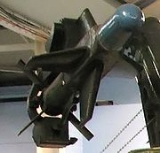
Malkara missile

Encyclopedia
The Malkara missile was one of the earliest anti-tank guided missile
s (ATGMs). It was jointly developed by Australia
and the United Kingdom
between 1951 and 1954, and was in service from 1958 until gradually replaced by the Swingfire
missile in the late 1960s. It was intended to be light enough to deploy with airborne forces, yet powerful enough to knock out any tank
then in service.
X-7 anti-tank missile. Design was principally undertaken at the Australian Government Aeronautical Research Laboratory, and this phase was also one of the first examples of computer simulation
in engineering design. Development testing was carried out at Woomera Prohibited Area
, and approval testing at the tank training range at Lulworth Cove
, Dorset
. Although testing at Dorset apparently achieved an impressive 90% Pkill, in service the missiles were not considered a great success, due to three principal failures:
 However, lessons learned from the Malkara project led to improvements in later programs. In addition, the basic airframe and expertise were directly used in the development of the Ikara
anti-submarine missile
and the Sea Cat
surface-to-air missile
.
Malkara was unusual amongst anti-tank missiles in that it had a High Explosive Squash Head
(HESH), also known as High Explosive Plastic (HEP), warhead instead of the more usual shaped charge HEAT
(High Explosive Anti Tank) warhead. The United Kingdom always showed interest for HESH, the main explosive-based anti-tank ammunition in British use including tanks like the Centurion
. A 26/27 kg anti-tank warhead was well above the average, but Malkara had a caliber of 203 mm (8 in).
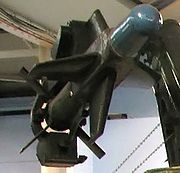
Anti-tank guided missile
An anti-tank missile , anti-tank guided missile , anti-tank guided weapon or anti-armor guided weapon is a guided missile primarily designed to hit and destroy heavily-armored military vehicles....
s (ATGMs). It was jointly developed by Australia
Australia
Australia , officially the Commonwealth of Australia, is a country in the Southern Hemisphere comprising the mainland of the Australian continent, the island of Tasmania, and numerous smaller islands in the Indian and Pacific Oceans. It is the world's sixth-largest country by total area...
and the United Kingdom
United Kingdom
The United Kingdom of Great Britain and Northern IrelandIn the United Kingdom and Dependencies, other languages have been officially recognised as legitimate autochthonous languages under the European Charter for Regional or Minority Languages...
between 1951 and 1954, and was in service from 1958 until gradually replaced by the Swingfire
Swingfire
Swingfire was a British wire-guided anti-tank missile developed in the 1960s and produced from 1966 until 1993.-Development:Swingfire was developed by Fairey Engineering Ltd and the British Aircraft Corporation. It replaced the Vickers Vigilant missile in British service...
missile in the late 1960s. It was intended to be light enough to deploy with airborne forces, yet powerful enough to knock out any tank
Tank
A tank is a tracked, armoured fighting vehicle designed for front-line combat which combines operational mobility, tactical offensive, and defensive capabilities...
then in service.
Development and operations
The concept of the Malkara was probably inspired by the WWII GermanGermany
Germany , officially the Federal Republic of Germany , is a federal parliamentary republic in Europe. The country consists of 16 states while the capital and largest city is Berlin. Germany covers an area of 357,021 km2 and has a largely temperate seasonal climate...
X-7 anti-tank missile. Design was principally undertaken at the Australian Government Aeronautical Research Laboratory, and this phase was also one of the first examples of computer simulation
Computer simulation
A computer simulation, a computer model, or a computational model is a computer program, or network of computers, that attempts to simulate an abstract model of a particular system...
in engineering design. Development testing was carried out at Woomera Prohibited Area
Woomera, South Australia
The town, or village, of Woomera is located in the south east corner of the Woomera Prohibited Area ; colloquially known as the Woomera Rocket Range...
, and approval testing at the tank training range at Lulworth Cove
Lulworth Cove
Lulworth Cove is a cove near the village of West Lulworth, on the Jurassic Coast World Heritage Site in Dorset, southern England. The cove is one of the world's finest examples of such a landform, and is a tourist location with over 1 million visitors a year...
, Dorset
Dorset
Dorset , is a county in South West England on the English Channel coast. The county town is Dorchester which is situated in the south. The Hampshire towns of Bournemouth and Christchurch joined the county with the reorganisation of local government in 1974...
. Although testing at Dorset apparently achieved an impressive 90% Pkill, in service the missiles were not considered a great success, due to three principal failures:
- They were considered too heavy. As they were too heavy for manpacking, they could only be operated from their specialist vehicles, reducing flexibility; and
- Accuracy achieved in practice was poor. This may have been because the awkward control system required a lot of practice, and there was neither a simulation system nor sufficient missiles for practice firing. In their memoirs, some operators state that they only fired one missile in their careers.
- Finally, their speed was low, with almost 30 secs to the maximum range
Ikara (missile)
The Ikara missile was an Australian ship-launched anti-submarine missile, named after an Australian Aboriginal word for "throwing stick". It launched an acoustic torpedo to a range of , allowing fast-reaction attacks against submarines at ranges that would otherwise require the launching ship to...
anti-submarine missile
Anti-submarine missile
An anti-submarine missile is a standoff weapon including a rocket designed to rapidly deliver an explosive warhead or homing torpedo from the launch platform to the vicinity of a submarine.-History:...
and the Sea Cat
Sea Cat missile
Sea Cat was a British short-range surface to air missile system intended to replace the ubiquitous Bofors 40 mm gun aboard warships of all sizes. It was the world's first operational shipboard point-defence missile system and was designed so that the Bofors guns could be replaced with minimum...
surface-to-air missile
Surface-to-air missile
A surface-to-air missile or ground-to-air missile is a missile designed to be launched from the ground to destroy aircraft or other missiles...
.
Malkara was unusual amongst anti-tank missiles in that it had a High Explosive Squash Head
High explosive squash head
High explosive squash head is a type of explosive ammunition that is effective against buildings and is also used against tank armour. It was fielded chiefly by the British Army as the main explosive round of its main battle tanks during the Cold War...
(HESH), also known as High Explosive Plastic (HEP), warhead instead of the more usual shaped charge HEAT
Heat
In physics and thermodynamics, heat is energy transferred from one body, region, or thermodynamic system to another due to thermal contact or thermal radiation when the systems are at different temperatures. It is often described as one of the fundamental processes of energy transfer between...
(High Explosive Anti Tank) warhead. The United Kingdom always showed interest for HESH, the main explosive-based anti-tank ammunition in British use including tanks like the Centurion
Centurion tank
The Centurion, introduced in 1945, was the primary British main battle tank of the post-World War II period. It was a successful tank design, with upgrades, for many decades...
. A 26/27 kg anti-tank warhead was well above the average, but Malkara had a caliber of 203 mm (8 in).
Specifications
- Length: 1.9 m (6.3 ft)
- Diameter: 200 mm (8 in)
- Wingspan: 800 mm (2.6 ft)
- Range: 4,000 m (4400 yd)
- Propulsion: Dual thrust solid rocketSolid rocketA solid rocket or a solid-fuel rocket is a rocket engine that uses solid propellants . The earliest rockets were solid-fuel rockets powered by gunpowder; they were used by the Chinese in warfare as early as the 13th century and later by the Mongols, Arabs, and Indians.All rockets used some form of...
- Speed: 146.19 m/s (327 mph) - low-subsonic, 28 sec to 4 km max range
- Overall weight: 93.5 kg (206 lbPound (mass)The pound or pound-mass is a unit of mass used in the Imperial, United States customary and other systems of measurement...
) - Warhead: 26 kg (57 lb) HESHHigh explosive squash headHigh explosive squash head is a type of explosive ammunition that is effective against buildings and is also used against tank armour. It was fielded chiefly by the British Army as the main explosive round of its main battle tanks during the Cold War...
- Guidance: Wire guidedWire-guided missileA wire-guided missile is a missile that is guided by signals sent to it via thin wires connected between the missile and its guidance mechanism, which is located somewhere near the launch site. As the missile flies, the wires are reeled out behind it...
MCLOSMCLOSMCLOS is a first-generation method for guiding guided missiles.With an MCLOS missile, the operator must track the missile and the target simultaneously and guide the missile to the target. Typically the missile is steered with a joystick, and its path is observed through a periscope-type...
, using a thumb joystickJoystickA joystick is an input device consisting of a stick that pivots on a base and reports its angle or direction to the device it is controlling. Joysticks, also known as 'control columns', are the principal control in the cockpit of many civilian and military aircraft, either as a center stick or...
and visual observation of two flares on the wings. - Number built: 1000