

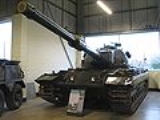
Conqueror tank

Encyclopedia
The FV 214 Conqueror, also known as "Tank, Heavy No. 1, 120 mm Gun, Conqueror" was a British
heavy tank
of the post-war era. It was developed as a response to the Soviet Joseph Stalin IS-3 heavy tanks and carried a larger 120 mm gun compared to the 20-pounder
(83.4 mm) gun carried by its peer the Centurion
. Its role was to provide long range anti-tank support for Centurion tanks. They were issued nine to a regiment in Germany; usually grouped in three tank troops.
; with separate charge and projectile, as would also be the case in the Chieftain
that followed. The charge was not bagged but in a brass cartridge, which offered some safety advantages, but reduced shell capacity to 35.
The armour was very heavy for the time, especially in the front, where it was seven inches (178 mm) in the horizontal plane. Unfortunately, this, along with the weight of the huge turret required to house the large gun and the very large hull volume, made the vehicle very heavy, giving it a relatively low top speed and making it mechanically unreliable. Also, few bridges could support its weight. However, rather like the Second World War Churchill tank
, the Conqueror had exceptional terrain handling characteristics and proved to be as capable cross country as the lighter (and on paper slightly faster) Centurion tank.
One feature of particular note was the rotating commander's cupola, which was at the heart of the Conqueror's fire control system, advanced for its time. The commander could align the cupola on a target independently of the turret, measure the range with a coincidence range finder, and then direct the gunner on to the new lay mechanically indicated to him by the cupola. In theory, when the gunner traversed to the new lay he would find the target already under his sights, ready to be engaged. Meanwhile, the commander was free to search for the next target.
The system may have been inspired by a similar device, without range finder, installed in WWII German
Panzer
s which was apparently highly successful, but was not repeated in subsequent tanks until an updated electronic version of the same idea appeared in the American M60A2.
In 1949 it was decided to bring the armament up to 120 mm. As this delayed the project, in 1952 the FV 201 hull was combined with a 17 pounder-armed Centurion Mk 2 turret to give the FV 221 Caernarvon Mark I. Twenty-one were built with the Mk III 20 pounder turret as the Caernavon Mk II. The FV 221 may originally have been intended to be the "Main Battle Tank" member of the FV 201 series, but with the success of the A41 Centurion such a vehicle was no longer required. In either event, the Caernarvon was only used for chassis development work serving in troop trials. In 1955 the first Conqueror was produced. Twenty Mark 1 and 165 Mark 2 Conquerors were built including conversions of Caernavon MkIIs. Production continued until 1959. It had lost much enthusiasm once the Centurion was upgraded to an L7 105 mm gun
.
_tank.jpg)
In the United Kingdom, Conqueror tanks are displayed at the Bovington Tank Museum
, and the Land Warfare Hall of the Imperial War Museum Duxford
. Other tanks are in the collections of the Musée des Blindés
in France, the Royal Museum of the Army in Brussels
and the Kubinka Tank Museum
, Russia. One is privately owned in the United States as part of the Littlefield Collection.
There are also two MkII ARVs at the Military History Museum on the Isle of Wight. One is shown in the photograph on the right. The second vehicle is off picture to the right. Both are outside and are in a similar condition. A MkII ARV is held by the REME Museum of Technology
, although it is not on display.
There used to be a Conqueror at Base Vehicle Depot Ludgershall - a gate guard named William.
There currently is one Conqueror located in Utah for sale on a US military vehicle sales site.
United Kingdom
The United Kingdom of Great Britain and Northern IrelandIn the United Kingdom and Dependencies, other languages have been officially recognised as legitimate autochthonous languages under the European Charter for Regional or Minority Languages...
heavy tank
Heavy tank
A heavy tank was a subset of tank that filled the heavy direct-fire role of many armies.Heavy tanks have usually been deployed to breakthrough enemy lines, though in practice have been more useful in the defensive role than in the attack...
of the post-war era. It was developed as a response to the Soviet Joseph Stalin IS-3 heavy tanks and carried a larger 120 mm gun compared to the 20-pounder
Ordnance QF 20 pounder
The Ordnance QF 20 pounder was a British 84 mm tank gun introduced in 1948 and used in the Centurion tank and the Charioteer tank destroyer...
(83.4 mm) gun carried by its peer the Centurion
Centurion tank
The Centurion, introduced in 1945, was the primary British main battle tank of the post-World War II period. It was a successful tank design, with upgrades, for many decades...
. Its role was to provide long range anti-tank support for Centurion tanks. They were issued nine to a regiment in Germany; usually grouped in three tank troops.
Description
The gun design was American, the same as used on the US M103 heavy tankM103 heavy tank
The M103 heavy tank served the United States Army and the US Marines during the Cold War. Until the development of the M1A1 in the mid 1980s, it was the heaviest and most heavily armed tank in US service...
; with separate charge and projectile, as would also be the case in the Chieftain
Chieftain tank
The FV 4201 Chieftain was the main battle tank of the United Kingdom during the 1960s and 1970s. It was one of the most advanced tanks of its era, and at the time of its introduction in 1966 had the most powerful main gun and heaviest armour of any tank in the world...
that followed. The charge was not bagged but in a brass cartridge, which offered some safety advantages, but reduced shell capacity to 35.
The armour was very heavy for the time, especially in the front, where it was seven inches (178 mm) in the horizontal plane. Unfortunately, this, along with the weight of the huge turret required to house the large gun and the very large hull volume, made the vehicle very heavy, giving it a relatively low top speed and making it mechanically unreliable. Also, few bridges could support its weight. However, rather like the Second World War Churchill tank
Churchill tank
The Tank, Infantry, Mk IV was a heavy British infantry tank used in the Second World War, best known for its heavy armour, large longitudinal chassis with all-around tracks with multiple bogies, and its use as the basis of many specialist vehicles. It was one of the heaviest Allied tanks of the war...
, the Conqueror had exceptional terrain handling characteristics and proved to be as capable cross country as the lighter (and on paper slightly faster) Centurion tank.
One feature of particular note was the rotating commander's cupola, which was at the heart of the Conqueror's fire control system, advanced for its time. The commander could align the cupola on a target independently of the turret, measure the range with a coincidence range finder, and then direct the gunner on to the new lay mechanically indicated to him by the cupola. In theory, when the gunner traversed to the new lay he would find the target already under his sights, ready to be engaged. Meanwhile, the commander was free to search for the next target.
The system may have been inspired by a similar device, without range finder, installed in WWII German
Germany
Germany , officially the Federal Republic of Germany , is a federal parliamentary republic in Europe. The country consists of 16 states while the capital and largest city is Berlin. Germany covers an area of 357,021 km2 and has a largely temperate seasonal climate...
Panzer
Panzer
A Panzer is a German language word that, when used as a noun, means "tank". When it is used as an adjective, it means either tank or "armoured" .- Etymology :...
s which was apparently highly successful, but was not repeated in subsequent tanks until an updated electronic version of the same idea appeared in the American M60A2.
Development history
The chassis was from the A45 Infantry Support Tank, started in 1944 shortly after that of the A41 Centurion. After the war the project was relocated to that of the "Universal Tank" design of the FV 200 series. The 200 series was to have used a common hull for all uses (self-propelled artillery, armoured personnel carrier, three varieties of tank, etc.). One tank type was to be the heavy FV 201 of 55 tonnes, armed with an 83.4 mm gun.In 1949 it was decided to bring the armament up to 120 mm. As this delayed the project, in 1952 the FV 201 hull was combined with a 17 pounder-armed Centurion Mk 2 turret to give the FV 221 Caernarvon Mark I. Twenty-one were built with the Mk III 20 pounder turret as the Caernavon Mk II. The FV 221 may originally have been intended to be the "Main Battle Tank" member of the FV 201 series, but with the success of the A41 Centurion such a vehicle was no longer required. In either event, the Caernarvon was only used for chassis development work serving in troop trials. In 1955 the first Conqueror was produced. Twenty Mark 1 and 165 Mark 2 Conquerors were built including conversions of Caernavon MkIIs. Production continued until 1959. It had lost much enthusiasm once the Centurion was upgraded to an L7 105 mm gun
Royal Ordnance L7
The Royal Ordnance L7 is the basic model of Britain's most successful tank gun. The L7 was a 105 mm L/52 rifled design intended for use in armoured fighting vehicles...
.
Variants
- FV 214 Conqueror
- Mk 1
- Mk 2
- Mk 2/1/H - rebuilt Caernarvons
- FV 222 Conqueror Armoured Recovery VehicleArmoured recovery vehicleAn armoured recovery vehicle is a type of armoured fighting vehicle used to repair battle- or mine-damaged as well as broken-down armoured vehicles during combat, or to tow them out of the danger zone for more extensive repairs...
(ARV) Mk 1
- 8 Produced
- FV 222 Conqueror ARV Mk II
- 20 Produced
- Weight: 57 tons
- Winch capacity: 45 tons (direct pull)
Surviving Vehicles
This is an incomplete list.In the United Kingdom, Conqueror tanks are displayed at the Bovington Tank Museum
Bovington Tank Museum
The Tank Museum is a collection of armoured fighting vehicles in the United Kingdom that traces the history of the tank. With almost 300 vehicles on exhibition from 26 countries it is the second-largest collection of tanks and armoured fighting vehicles in the world.The Musée des Blindés in France...
, and the Land Warfare Hall of the Imperial War Museum Duxford
Imperial War Museum Duxford
Imperial War Museum Duxford is a branch of the Imperial War Museum near the village of Duxford in Cambridgeshire, England. Britain's largest aviation museum, Duxford houses the museum's large exhibits, including nearly 200 aircraft, military vehicles, artillery and minor naval vessels in seven...
. Other tanks are in the collections of the Musée des Blindés
Musée des Blindés
The Musée des Blindés or Musée Général Estienne is a tank museum located in the Loire Valley of France, in the city of Saumur. It is one of the world's largest tank museums....
in France, the Royal Museum of the Army in Brussels
Brussels
Brussels , officially the Brussels Region or Brussels-Capital Region , is the capital of Belgium and the de facto capital of the European Union...
and the Kubinka Tank Museum
Kubinka Tank Museum
The Kubinka Tank Museum is a large museum of armoured fighting vehicles in Kubinka, just outside Moscow. It has many famous tanks from World War I, World War II and the Cold War. The museum also houses many unique vehicles, such as the Panzer VIII Maus, Troyanov super-heavy tank and a Karl-Gerät...
, Russia. One is privately owned in the United States as part of the Littlefield Collection.
There are also two MkII ARVs at the Military History Museum on the Isle of Wight. One is shown in the photograph on the right. The second vehicle is off picture to the right. Both are outside and are in a similar condition. A MkII ARV is held by the REME Museum of Technology
REME Museum of Technology
The REME Museum of Technology is located south east of Reading. The museum holds collections of various technological artifacts associated with the work of the REME, the corps of the British Army responsible for the maintenance, servicing and inspection of electrical and mechanical equipment hence...
, although it is not on display.
There used to be a Conqueror at Base Vehicle Depot Ludgershall - a gate guard named William.
There currently is one Conqueror located in Utah for sale on a US military vehicle sales site.