

Drums in the Night

Encyclopedia
Drums in the Night is a play
by the German modernist
playwright
Bertolt Brecht
. Brecht wrote it between 1918 and 1920, and it received its first theatrical production in 1922. It is in the expressionist style of Ernst Toller
and Georg Kaiser
. The play—along with Baal
and In the Jungle
—won the prestigious German drama award the Kleist Prize
for 1922 (although it was widely assumed, perhaps because Drums was the only play of the three to have been produced at that point, that the prize had been awarded to Drums alone); the play was performed all over Germany as a result. Brecht later claimed that he had only written it as a source of income.
Drums in the Night is one of Brecht's earliest plays, written before he became a convinced Marxist, but already the importance of class struggle
in Brecht's thinking is apparent. According to Lion Feuchtwanger
, the play was originally entitled Spartakus. Karl Liebknecht
and Rosa Luxemburg
of the Spartacist League
—who were instrumental in the 'Spartacist uprising
' in Berlin in January 1919—had only recently been abducted, tortured and killed by Freikorps
soldiers (Rosa was battered to death with rifle butts and thrown into a nearby river while Karl was shot in the back of the head then deposited as an unknown body in a nearby mortuary), in that same month of 1919.
The play dramatizes many of the grievances of the Sparticists in their uprising. The soldiers returning from the front felt that they had been fighting for nothing and that what they had before they left had been stolen. Murk, the war-profiteer
who did not fight and who instead made a fortune from the fighting, and who attempts to steal the soldier's fiancé, symbolizes that feeling by the working class of having been cheated.
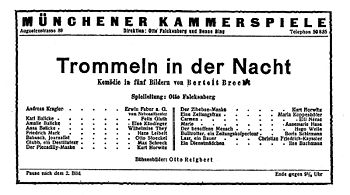 Drums in the Night, a "Comedy in Five Acts by Bertolt Brecht
", was given its premiere at the Munich Kammerspiele
, opening on 29 September 1922. Otto Falckenberg
- head of the Kammerspiele and renowned champion of new, controversial dramas in Weimar Germany - directed, set-design
was by Otto Reigbert, and the cast included Erwin Faber
(as a Guest from the National Theatre of Munich, the Residenztheater) in the main role of Andreas Kragler, Max Schreck
(as Glubb), Hans Leibelt, Kurt Horwitz and Maria Koppenhöfer
.
The play received another production at the Deutsches Theater
in Berlin, also directed by Falckenberg, which opened on the 20th December, 1922, with a cast of leading actors then in Berlin, including Alexander Granach
as the soldier Andreas Kragler.
Falckenberg, who was the head of the Kammerspiele along with Benno Bing, directed the play in a manner that we would not now recognize as 'Brechtian', utilizing the angular, contorted poses typical of the theatre of Expressionism
. Similarly, Reigbert's design consisted of contorted, angular lines and foreshortened perspectives (similar to those used in The Cabinet of Dr. Caligari
in 1920). "Brecht's sense of irony was misunderstood", Meech suggests; he was "far from happy with the result."
Elements of Expressionism
, or perhaps "realistic-Expressistic" elements (according to Erwin Faber
), can be found in designs for the Munich production. Reigbert's rendering for the set design for Act V of Drums in the Night, for example, contains a figure standing by the bridge that is very much like Edvard Munch
's figure (also standing by a bridge) in his painting of 1893, The Scream
.
According to Erwin Faber
, whom Brecht had requested to play the principal role of Andreas Kragler, a German soldier who returns home after to the war:
Play (theatre)
A play is a form of literature written by a playwright, usually consisting of scripted dialogue between characters, intended for theatrical performance rather than just reading. There are rare dramatists, notably George Bernard Shaw, who have had little preference whether their plays were performed...
by the German modernist
Modernism
Modernism, in its broadest definition, is modern thought, character, or practice. More specifically, the term describes the modernist movement, its set of cultural tendencies and array of associated cultural movements, originally arising from wide-scale and far-reaching changes to Western society...
playwright
Playwright
A playwright, also called a dramatist, is a person who writes plays.The term is not a variant spelling of "playwrite", but something quite distinct: the word wright is an archaic English term for a craftsman or builder...
Bertolt Brecht
Bertolt Brecht
Bertolt Brecht was a German poet, playwright, and theatre director.An influential theatre practitioner of the 20th century, Brecht made equally significant contributions to dramaturgy and theatrical production, the latter particularly through the seismic impact of the tours undertaken by the...
. Brecht wrote it between 1918 and 1920, and it received its first theatrical production in 1922. It is in the expressionist style of Ernst Toller
Ernst Toller
Ernst Toller was a left-wing German playwright, best known for his Expressionist plays and serving as President of the short-lived Bavarian Soviet Republic, for six days.- Biography :...
and Georg Kaiser
Georg Kaiser
Friedrich Carl Georg Kaiser, called Georg Kaiser, was a German dramatist.-Biography:Kaiser was born at Magdeburg....
. The play—along with Baal
Baal (play)
Baal was the first full-length play written by the German modernist playwright Bertolt Brecht. It concerns a wastrel youth who becomes involved in several sexual affairs and at least one murder...
and In the Jungle
In The Jungle of Cities
In The Jungle of Cities is a play by the German modernist playwright Bertolt Brecht. Written between 1921 and 1924, it received its first theatrical production under the title In the Jungle at the Residenztheater in Munich, opening on 9 May 1923. This production was directed by Erich Engel, with...
—won the prestigious German drama award the Kleist Prize
Kleist Prize
The Kleist Prize is an annual German literature prize. The prize was first awarded in 1912, on the occasion of the hundredth anniversary of the death of Heinrich von Kleist. The Kleist Prize was the most important literary award of the Weimar Republic, but was discontinued in 1933.In 1985 the prize...
for 1922 (although it was widely assumed, perhaps because Drums was the only play of the three to have been produced at that point, that the prize had been awarded to Drums alone); the play was performed all over Germany as a result. Brecht later claimed that he had only written it as a source of income.
Drums in the Night is one of Brecht's earliest plays, written before he became a convinced Marxist, but already the importance of class struggle
Class struggle
Class struggle is the active expression of a class conflict looked at from any kind of socialist perspective. Karl Marx and Friedrich Engels wrote "The [written] history of all hitherto existing society is the history of class struggle"....
in Brecht's thinking is apparent. According to Lion Feuchtwanger
Lion Feuchtwanger
Lion Feuchtwanger was a German-Jewish novelist and playwright. A prominent figure in the literary world of Weimar Germany, he influenced contemporaries including playwright Bertolt Brecht....
, the play was originally entitled Spartakus. Karl Liebknecht
Karl Liebknecht
was a German socialist and a co-founder with Rosa Luxemburg of the Spartacist League and the Communist Party of Germany. He is best known for his opposition to World War I in the Reichstag and his role in the Spartacist uprising of 1919...
and Rosa Luxemburg
Rosa Luxemburg
Rosa Luxemburg was a Marxist theorist, philosopher, economist and activist of Polish Jewish descent who became a naturalized German citizen...
of the Spartacist League
Spartacist League
The Spartacus League was a left-wing Marxist revolutionary movement organized in Germany during World War I. The League was named after Spartacus, leader of the largest slave rebellion of the Roman Republic...
—who were instrumental in the 'Spartacist uprising
Spartacist uprising
The Spartacist Uprising , also known as the January uprising , was a general strike in Germany from January 5 to January 15, 1919. Its suppression marked the end of the German Revolution...
' in Berlin in January 1919—had only recently been abducted, tortured and killed by Freikorps
Freikorps
Freikorps are German volunteer military or paramilitary units. The term was originally applied to voluntary armies formed in German lands from the middle of the 18th century onwards. Between World War I and World War II the term was also used for the paramilitary organizations that arose during...
soldiers (Rosa was battered to death with rifle butts and thrown into a nearby river while Karl was shot in the back of the head then deposited as an unknown body in a nearby mortuary), in that same month of 1919.
Plot summary
Brecht's play revolves around Anna Balicke, whose lover (Andreas) has left to fight in World War I. Anna's parents try to convince her that he is dead and that she should forget him and marry a wealthy war-materials manufacturer, Murk. Anna agrees to this arrangement eventually, just as Andreas returns. Believing that the poor proletarian Andreas cannot provide the kind of life for Anna that the bourgeois Murk can, Anna's parents encourage her to stick to her agreement. Eventually Anna leaves Murk and her parents and, against the backdrop of the Spartacist uprising, searches for Andreas. In the final scene they are re-united; to the sound of "a white wild screaming" from the newspaper buildings above, they walk away together.The play dramatizes many of the grievances of the Sparticists in their uprising. The soldiers returning from the front felt that they had been fighting for nothing and that what they had before they left had been stolen. Murk, the war-profiteer
War profiteering
A war profiteer is any person or organization that profits from warfare or by selling weapons and other goods to parties at war. The term has strong negative connotations. General profiteering may also occur in peace time.-International arms dealers:...
who did not fight and who instead made a fortune from the fighting, and who attempts to steal the soldier's fiancé, symbolizes that feeling by the working class of having been cheated.
Production history
Bertolt Brecht
Bertolt Brecht was a German poet, playwright, and theatre director.An influential theatre practitioner of the 20th century, Brecht made equally significant contributions to dramaturgy and theatrical production, the latter particularly through the seismic impact of the tours undertaken by the...
", was given its premiere at the Munich Kammerspiele
Munich Kammerspiele
The Munich Kammerspiele is a successful German language theatre in Munich. The Schauspielhaus in the Maximilianstrasse is the major stage.-History:...
, opening on 29 September 1922. Otto Falckenberg
Otto Falckenberg
Otto Falckenberg was a German theatre director, manager and writer. In April 1901, he co-founded Die Elf Scharfrichter, the first political kabarett in Germany....
- head of the Kammerspiele and renowned champion of new, controversial dramas in Weimar Germany - directed, set-design
Scenic design
Scenic design is the creation of theatrical, as well as film or television scenery. Scenic designers have traditionally come from a variety of artistic backgrounds, but nowadays, generally speaking, they are trained professionals, often with M.F.A...
was by Otto Reigbert, and the cast included Erwin Faber
Erwin Faber
Erwin Faber was a leading actor in Munich and later throughout Germany, beginning after World War I, and through the late-1970's, when he was still performing at the Residenz Theatre...
(as a Guest from the National Theatre of Munich, the Residenztheater) in the main role of Andreas Kragler, Max Schreck
Max Schreck
Friedrich Gustav Max Schreck was a German actor. He is most often remembered today for his lead role in the film Nosferatu .-Early life:Max Schreck was born in Berlin-Friedenau, on 6 September 1879....
(as Glubb), Hans Leibelt, Kurt Horwitz and Maria Koppenhöfer
Maria Koppenhöfer
-Selected filmography:* Unheimliche Geschichten * Joan of Arc * The Mountain Calls * Kora Terry * Bismarck * The Heart of a Queen -External links:...
.
The play received another production at the Deutsches Theater
Deutsches Theater
The Deutsches Theater in Berlin is a well-known German theatre. It was built in 1850 as Friedrich-Wilhelm-Städtisches Theater, after Frederick William IV of Prussia. Located on Schumann Street , the Deutsches Theater consists of two adjoining stages that share a common, classical facade...
in Berlin, also directed by Falckenberg, which opened on the 20th December, 1922, with a cast of leading actors then in Berlin, including Alexander Granach
Alexander Granach
Alexander Granach was a popular German actor in the 1920s and 1930s.- Biography :Granach was born Jessaja Granach in Werbowitz to Jewish parents and rose to theatrical prominence at the Volksbühne in Berlin...
as the soldier Andreas Kragler.
Falckenberg, who was the head of the Kammerspiele along with Benno Bing, directed the play in a manner that we would not now recognize as 'Brechtian', utilizing the angular, contorted poses typical of the theatre of Expressionism
Expressionism
Expressionism was a modernist movement, initially in poetry and painting, originating in Germany at the beginning of the 20th century. Its typical trait is to present the world solely from a subjective perspective, distorting it radically for emotional effect in order to evoke moods or ideas...
. Similarly, Reigbert's design consisted of contorted, angular lines and foreshortened perspectives (similar to those used in The Cabinet of Dr. Caligari
The Cabinet of Dr. Caligari
The Cabinet of Dr. Caligari is a 1920 silent horror film directed by Robert Wiene from a screenplay by Hans Janowitz and Carl Mayer. It is one of the most influential of German Expressionist films and is often considered one of the greatest horror movies of the silent era. This movie is cited as...
in 1920). "Brecht's sense of irony was misunderstood", Meech suggests; he was "far from happy with the result."
Elements of Expressionism
Expressionism
Expressionism was a modernist movement, initially in poetry and painting, originating in Germany at the beginning of the 20th century. Its typical trait is to present the world solely from a subjective perspective, distorting it radically for emotional effect in order to evoke moods or ideas...
, or perhaps "realistic-Expressistic" elements (according to Erwin Faber
Erwin Faber
Erwin Faber was a leading actor in Munich and later throughout Germany, beginning after World War I, and through the late-1970's, when he was still performing at the Residenz Theatre...
), can be found in designs for the Munich production. Reigbert's rendering for the set design for Act V of Drums in the Night, for example, contains a figure standing by the bridge that is very much like Edvard Munch
Edvard Munch
Edvard Munch was a Norwegian Symbolist painter, printmaker and an important forerunner of expressionist art. His best-known composition, The Scream, is part of a series The Frieze of Life, in which Munch explored the themes of love, fear, death, melancholia, and anxiety.- Childhood :Edvard Munch...
's figure (also standing by a bridge) in his painting of 1893, The Scream
The Scream
Scream is the title of Expressionist paintings and prints in a series by Norwegian artist Edvard Munch, showing an agonized figure against a blood red sky...
.
According to Erwin Faber
Erwin Faber
Erwin Faber was a leading actor in Munich and later throughout Germany, beginning after World War I, and through the late-1970's, when he was still performing at the Residenz Theatre...
, whom Brecht had requested to play the principal role of Andreas Kragler, a German soldier who returns home after to the war:
- The play was...expressionistic, that is, realistic-expressionistic. It was born of the times, and I played it as such...By the time Brecht arrived, the period of ExpressionismExpressionismExpressionism was a modernist movement, initially in poetry and painting, originating in Germany at the beginning of the 20th century. Its typical trait is to present the world solely from a subjective perspective, distorting it radically for emotional effect in order to evoke moods or ideas...
in Munich had already passed...The heyday of Expressionism came in the aftermath of World War I, when we were all exhausted by the war: hunger, suffering, and grief was in every family who had lost a loved one. There was a tension that could only be resolved by an outcry...[Drums in the Night] was perhaps one of the last dramas to be played expressionisitically.
Works cited
- Brecht, BertoltBertolt BrechtBertolt Brecht was a German poet, playwright, and theatre director.An influential theatre practitioner of the 20th century, Brecht made equally significant contributions to dramaturgy and theatrical production, the latter particularly through the seismic impact of the tours undertaken by the...
. 1922. Drums in the Night. Trans. John Willett. In Collected Plays: One. Ed. John Willett and Ralph Manheim. Bertolt Brecht: Plays, Poetry and Prose Ser. London: Methuen, 1970. ISBN 041603280X. p. 63-115. - Meech, Tony. 1994. "Brecht's Early Plays." In The Cambridge Companion to Brecht. Ed. Peter Thomson and Glendyr Sacks. Cambridge Companions to Literature Ser. Cambridge: Cambridge University Press. ISBN 0521414466. p. 43-55.
- Molinari, Cesare. 1975. Theatre Through the Ages. Trans. Colin Hamer. London: Cassell. ISBN 0304294489.
- McDowell, W. Stuart. 2000. "Acting Brecht: The Munich Years", The Brecht Sourcebook, Carol Martin, Henry Bial, editors (Routledge, 2000) p. 71 - 83.
- Sacks, Glendyr. 1994. "A Brecht Calendar." In The Cambridge Companion to Brecht. Ed. Peter Thomson and Glendyr Sacks. Cambridge Companions to Literature Ser. Cambridge: Cambridge University Press. ISBN 0521414466. p.xvii-xxvii.
- Willett, JohnJohn WillettJohn Willett was a British translator and a scholar who is remembered for translating the work of Bertolt Brecht into English.-Early life:Willett was educated at Winchester and Christ Church, Oxford...
. 1967. The Theatre of Bertolt Brecht: A Study from Eight Aspects. Third rev. ed. London: Methuen, 1977. ISBN 041334360X. - Willett, JohnJohn WillettJohn Willett was a British translator and a scholar who is remembered for translating the work of Bertolt Brecht into English.-Early life:Willett was educated at Winchester and Christ Church, Oxford...
and Ralph ManheimRalph ManheimRalph Frederick Manheim was an American translator of German and French literature, as well as occasional works from Dutch, Polish and Hungarian...
. 1970. "Introduction." In Collected Plays: One by Bertolt Brecht. Ed. John Willett and Ralph Manheim. Bertolt Brecht: Plays, Poetry and Prose Ser. London: Methuen. ISBN 041603280X. p.vii-xvii. - Calabro, Tony. 1990. Bertolt Brecht's Art of Dissemblance. Longwood Academic.