
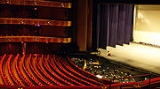
Theatre
Theatre or theater is the branch of the
performing arts concerned with acting out stories in front of an audience using combinations of speech, gesture, mime, music, dance, sound and spectacle — indeed any one or more elements of the other performing arts. In addition to the standard narrative dialogue style, theatre takes such forms as
opera,
ballet,
mime,
kabuki,
classical Indian dance,
Chinese opera,
mummers' plays, and
pantomime.
Encyclopedia
- For other usages see Theatre
Theatre or
theater is the branch of the
performing arts concerned with acting out stories in front of an audience using combinations of speech, gesture, mime, music, dance, sound and spectacle — indeed any one or more elements of the other performing arts. In addition to the standard narrative dialogue style, theatre takes such forms as
opera,
ballet,
mime,
kabuki,
classical Indian dance,
Chinese opera,
mummers' plays, and
pantomime.
Overview of theatre
"
Drama" is that branch of theatre in which speech, either from written text , or improvised is paramount. "
Musical theatre" is a form of theatre combining
music, songs,
dance routines, and spoken dialogue. However, theatre is more than just what one sees on
stage. Theatre involves an entire world behind the scenes that creates the costumes, sets and lighting to make the overall effect interesting. There is a particularly long tradition of political theatre, intended to educate audiences on contemporary issues and encourage social change. Various creeds, Catholicism for instance, have built upon the entertainment value of theatre and created
passion plays,
mystery plays and morality plays.
There is an enormous variety of philosophies, artistic processes, and theatrical approaches to creating plays and drama. Some are connected to political or spiritual ideologies, and some are based on purely "artistic" concerns. Some processes focus on a story, some on theatre as an event, some on theatre as a catalyst for social change. According to
Aristotle's seminal theatrical critique
Poetics, there are six elements necessary for theatre. They are Plot, Character, Idea, Language, Song, and Spectacle. The 17th-century Spanish writer
Lope de Vega wrote that for theatre one needs "three boards, two actors, and one passion". Others notable for their contribution to theatrical philosophy are
Konstantin Stanislavski,
Antonin Artaud,
Bertolt Brecht,
Orson Welles, Peter Brook, Jerzy Grotowski.
The most recognisable figures in theatre are the directors, playwrights and
actors, but theatre is a highly collaborative endeavour. Plays are usually produced by a production team that commonly includes a scenic or set designer,
lighting designer, costume designer, sound designer, dramaturg, stage manager, and production manager. The artistic staff are assisted by technical theatre personnel who handle the creation and execution of the production.
Some believe it is important for actors to study all commonly taught acting methods to perfect their craft. Methods include: Meisner, Stanislavsky, Strasberg, and Hagen.
Genres of theatre
There are a variety of
genres that writers, producers and directors can employ in theatre to suit a variety of tastes:
- Musical theatre: A theatrical genre in which a story is told through the performance of singing , spoken dialogue and often dance.
- Natya Sacred classical Indian musical theater that includes natya proper and nritta .
- Rock opera: Same style as opera, except that the musical form is rock music.
- Theatre for social change: Theatre that addresses a social issue and uses performance as a way of illustrating injustice to the audience.
- Comedy: Comes from the Greek word komos which means celebration, revel or merrymaking. It does not necessarily mean funny, but more focuses on a problem that leads to some form of catastrophe which in the end has a happy and joyful outcome.
- Farce: A comic dramatic piece that uses highly improbable situations, stereotyped characters, extravagant exaggeration, fast pacing and violent horseplay.
- Pantomime: A form of musical drama in which elements of dance, mime, puppetry, slapstick, and melodrama are combined to produce an entertaining and comic theatrical experience, often designed for children. These are often presented around the holidays.
- Romantic comedy: A medley of clever scheming, calculated coincidence, and wondrous discovery, all of which contribute ultimately to making the events answer precisely to the hero's or heroine's wishes, with the focus on love.
- Comedy of situation: A comedy that grows out of a character's attempt to solve a problem created by a situation. The attempt is often bumbling but ends up happily.
- Comedy of manners: Witty, cerebral form of dramatic comedy that depicts and often satirises the manners and affectations of a contemporary society. A comedy of manners is concerned with social usage and the question of whether or not characters meet certain social standards.
- Commedia dell'arte: Very physical form of comedy which was created and originally performed in Italy. Commedia uses a series of stock characters and a list of events to improvise an entire play.
- Black comedy: Comedy that tests the boundaries of good taste and moral acceptability by juxtaposing morbid or ghastly elements with comical ones.
- Melodrama: Originally, a sentimental drama with musical underscoring. Often with an unlikely plot that concerns the suffering of the good at the hands of the villains but ends happily with good triumphant. Featuring stock characters such as the noble hero, the long-suffering heroine, and the cold-blooded villain.
- Tragedy: A drama that treats in a serious and dignified style the sorrowful or terrible events encountered or caused by a heroic individual. The word "Tragedy" comes from the Greek word "Tragos" which is translated to "Goat".
- Tragicomedy: A drama that has a bitter/sweet quality, containing elements of tragedy and comedy.
- Domestic drama: Drama in which the focus is on the everyday domestic lives of people and their relationships in the community that they live in.
- Fantasy: The creation of a unique landscape on which a hero goes on a quest to find something that will defeat the powers of evil. Along the way, this hero meets a variety of weird and fantastic characters.
- Morality play: A morality play is an allegory in which the characters are abstractions of moral ideas.
- Opera: A theatrical genre in which a story is told and emotion is conveyed primarily through singing .
- Physical theatre: Theatrical performance in which the primary means of communication is the body, through dance, mime, puppetry and movement, rather than the spoken word.
- Theatre of the Absurd: Term coined by Martin Esslin, theatre in which characters are engaged in an absurd, that is meaningless, activity or life. Related to existentialism.
- Meta-Theatre: A genre of theatre made popular with mostly modern audiences, although it did start back in the Elizabethan Era. Meta-Theatre is when a play often completely demolishes the so called "fourth wall" and completely engages the audience. Oftentimes about a group of actors, a director, writer and so on. It usually blurs the line between what is scripted and what goes on by accident.
- Grand Guignol: Now broadly used to refer to any play with on-stage violence, the term originally referred to the bloody and gruesome melodramas produced at the Theatre du Grand Guignol in Paris
|common_name = Paris
...
,
France.
This list is somewhat incomplete and
eurocentric. None of the genre listed are actually mutually exclusive. The richness of live theatre today is such that its practitioners can borrow from all of these elements and more, and present something that is a multi-disciplinary melange of pretty much everything.
Theatre venues and styles
- In-yer-face theatre
- Art Deco style theatre
- Broadway and the West End
- Off-Broadway and the London fringe
- Off-Off-Broadway
- National Tours
- Regional theatre
- UK Theatre Network
- Repertory theatre
- Summer stock theatre
- Community theatre
- Improvisational theatre
- Fringe festival
- Postmodern theatre
- Post style theatre
- Proletcult Theatre
- Street theatre
- Physical theatre
- Dinner theatre
- Reader's Theatre
- Temple dance
- Vanguard style theatre
- Opera houses
- School and church theatres and town halls community theatre
Notable theatre festivals
...
Theatre conventions
Technical theatre- LDI
- United States Institute for Theatre Technology
Awards in theatre
- Manchester Evening News Annual Drama Awards
- European Theatre Award
- Evening Standard Awards
- Laurence Olivier Awards
- London Critics' Circle Theatre Awards
- Tony Award
- Golden Mask Award
- Moličre Award
- Hans-Reinhart-Ring
- Lucille Lortel Award
- Drama Desk Award
- Mahindra Excellence in Theatre Awards
- Joseph Jefferson Award
- Sangeet Natak Academy Award
Notes
See also
References
Further reading
- is an academic journal specialising in post style theatre.
- Theater reviews.
- British Library & University of Sheffield
- - Popular new plays and theatre directory.