
All Topics  
Cinematography


   Email Print
   Bookmark   Link


Cinematography


Cinematography (from Greek: kinesis ????s?? (movement) and grapho ??af? (to record)), is the making of lighting
Stage lighting

Modern stage lighting is a flexible tool in the production of theatre, dance, opera and other performance arts. Several different types of stage lighting instruments are used in the pursuit of the various principles or goals of lighting....
 and camera
Camera

A camera is a device that records images, either as a still photograph or as moving images known as videos or movies. The term comes from the camera obscura , an early mechanism of projecting images where an entire room functioned as a real-time imaging system; the modern camera evolved from the camera obscura....
 choices when recording photographic image
Image

An image is an artifact, usually two-dimensional , that has a similar appearance to some subject —usually a physical object or a person....
s for the cinema
Film

Film encompasses individual motion pictures, the field of film as an art form, and the film industry. Films are produced by recording images from the world with cameras, or by creating images using animation techniques or special effects....
. It is closely related to the art of still photography
Photography

Photography is the process, activity and art of creating still or moving by recording radiation on a sensitive medium, such as a photographic film, or an ....
. Many additional issues arise when both the camera and elements of the scene may be in motion, though this also greatly increases the possibilities at the same time.

For more details, see History of film
History of film

The history of film spans over a hundred years, from the latter part of the 19th century to the beginning of the 21st. Motion pictures developed gradually from a carnival novelty to one of the most important tools of communication and entertainment, and mass media in the 20th century....
.
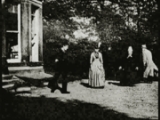
The first attempt at cinematography can be traced back to the world's first motion picture film, Roundhay Garden Scene
Roundhay Garden Scene

Roundhay Garden Scene is an 1888 United Kingdom short film directed by inventor Louis Le Prince. It was recorded at 12 frames per second and is the earliest surviving motion picture....
.


Discussion
Ask a question about 'Cinematography'
Start a new discussion about 'Cinematography'
Answer questions from other users
Full Discussion Forum


Recent Posts


Encyclopedia


Cinematography (from Greek: kinesis ????s?? (movement) and grapho ??af? (to record)), is the making of lighting
Stage lighting

Modern stage lighting is a flexible tool in the production of theatre, dance, opera and other performance arts. Several different types of stage lighting instruments are used in the pursuit of the various principles or goals of lighting....
 and camera
Camera

A camera is a device that records images, either as a still photograph or as moving images known as videos or movies. The term comes from the camera obscura , an early mechanism of projecting images where an entire room functioned as a real-time imaging system; the modern camera evolved from the camera obscura....
 choices when recording photographic image
Image

An image is an artifact, usually two-dimensional , that has a similar appearance to some subject —usually a physical object or a person....
s for the cinema
Film

Film encompasses individual motion pictures, the field of film as an art form, and the film industry. Films are produced by recording images from the world with cameras, or by creating images using animation techniques or special effects....
. It is closely related to the art of still photography
Photography

Photography is the process, activity and art of creating still or moving by recording radiation on a sensitive medium, such as a photographic film, or an ....
. Many additional issues arise when both the camera and elements of the scene may be in motion, though this also greatly increases the possibilities at the same time.

History

For more details, see History of film
History of film

The history of film spans over a hundred years, from the latter part of the 19th century to the beginning of the 21st. Motion pictures developed gradually from a carnival novelty to one of the most important tools of communication and entertainment, and mass media in the 20th century....
.
Louisleprincefirstfilmever
The first attempt at cinematography can be traced back to the world's first motion picture film, Roundhay Garden Scene
Roundhay Garden Scene

Roundhay Garden Scene is an 1888 United Kingdom short film directed by inventor Louis Le Prince. It was recorded at 12 frames per second and is the earliest surviving motion picture....
. It was a sequence directed by Louis Le Prince
Louis Le Prince

Louis Aim? Augustin Le Prince was an inventor who is considered by many film historians as the true father of motion pictures who shot first moving pictures on paper film using a single lens camera....
, French
French people

French people can refer to:* The legal residents and citizens of France, regardless of ancestry. For a legal discussion, see French nationality law....
 inventor and showman, on October 14 1888 in the garden at Oakwood Grange in Roundhay
Roundhay

Roundhay is a large and generally affluent suburb and City Council Wards of the United Kingdom of Leeds, West Yorkshire, England, on the north eastern edge of the city, largely represented by the LS8 postcode....
, Leeds
Leeds

Leeds is located on the River Aire in West Yorkshire, England. It is the urban core and administrative centre of the wider metropolitan borough of the City of Leeds....
, West Yorkshire
West Yorkshire

West Yorkshire is a metropolitan county within the Yorkshire and the Humber region of England with a population of List of ceremonial counties of England by population....
, England. This groundbreaking event happened seven years before the Lumière Brothers' Sortie de l'usine Lumière à Lyon
Workers Leaving the Lumiere Factory

Workers Leaving The Lumi?re Factory...
 made the first paid exhibition on December 28, 1895 at Le Grand Café, in Paris, France.. This date is known as the birth of cinema since it was the first time the cycle of production-distribution-exhibition happened. The European city soon became the motion picture capital of the world.

Cinematography is an art form unique to motion pictures. Although the exposing of images on light-sensitive elements dates back to the late 1600s, motion pictures demanded a new form of photography and new aesthetic techniques.

In the infancy of motion pictures, the cinematographer was usually also the director and the person physically handling the camera. As the art form and technology evolved, a separation between director and camera operator emerged. With the advent of artificial lighting and faster (more light sensitive) film stocks, in addition to technological advancements in optics and various techniques such as color film and widescreen, the technical aspects of cinematography necessitated a specialist in that area.

Cinematography was key during the silent movie era - no sound apart from background music, no dialogue - the films depended on lighting, acting and set.

In 1919, in Hollywood, the new motion picture capital of the world, one of the first (and still existing) trade societies was formed: the American Society of Cinematographers
American Society of Cinematographers

The American Society of Cinematographers is an educational, cultural, and professional organization. It is not a labor union, and it is not a guild....
 (ASC), which stood to recognize the cinematographer's contribution to the art and science of motion picture making. Similar trade associations have been established in other countries, too.

The ASC defines cinematography as
a creative and interpretive process that culminates in the authorship of an original work of art rather than the simple recording of a physical event. Cinematography is not a subcategory of photography. Rather, photography is but one craft that the cinematographer uses in addition to other physical, organizational, managerial, interpretive and image-manipulating techniques to effect one coherent process.


Aspects of cinematography

Numerous aspects contribute to the art of cinematography.

Film stock

Cinematography can begin with rolls of film or a digital imaging sensor. Advancements in film emulsion and grain structure have led to a wide range of film stocks available to cinematographers. The selection of a film stock is one of the first decisions they must make during any film production.

Aside from the film gauge selection — 8 mm
8 mm film

File:8 mm film types.jpg8 mm film is a film film formats in which the filmstrip is eight millimeters wide. It exists in two main versions: the original standard 8mm film, also known as regular 8mm or double 8mm, and Super 8 mm film....
 (amateur), 16 mm (semi-professional), 35 mm (professional) and 65 mm (epic photography, rarely used except in special event venues) — the cinematographer has a selection of stocks in reversal (which, when developed, create a positive image) and negative formats along with a wide range of film speeds (varying sensitivity to light) from ISO
International Organization for Standardization

The International Organization for Standardization , widely known as ISO , is an international standard-setting body composed of representatives from various national standards organizations....
 50 (slow, least sensitive to light) to 800 (very fast, extremely sensitive to light) and differing response to color (low saturation, high saturation) and contrast (varying levels between pure black (no exposure) and pure white (complete overexposure)).

Advancements and adjustments to nearly all gauges of film created the "super" variety wherein the area of the film used to capture a single frame of an image is expanded, although the physical gauge of the film remains the same. Super 8 mm, Super 16 mm and Super 35 mm are all formats that utilize more of the overall film area for the image than their "regular" non-super counterparts.

The larger the film gauge, the higher the overall image resolution clarity and technical quality.

In the realm of digital imaging, various film stocks are no longer applicable, but the cameras themselves feature image adjustment capabilities that go far beyond the abilities of one particular film stock. The cameras can be adjusted to varying degrees of color sensitivity, image contrast, light sensitivity and so on. One camera can achieve all the various looks of different emulsions, although it is heavily argued as to which method of capturing an image is the "best" method. It should be mentioned that the digital method of image adjustments (ISO, contrast etc) are executed by estimating the same adjustments that would take place if actual film were in use and are thus vulnerable to the cameras sensor designers perceptions of various film stocks and image adjustment parameters. Sensors generally have an optimal ISO rating past which faster speeds will result in noticeable increases in image noise
Image noise

Image noise is a random, usually unwanted, variation in brightness or color information in an . Image noise can originate in film grain, or in electronic noise in the input device sensor and circuitry, or in the unavoidable shot noise of an ideal photon detector....
, thus compromising the quality.

The lab

Laboratory work can also offer a considerable variance in the image produced. By controlling the temperature and varying the duration in which the film is soaked in the development chemicals and by skipping certain chemical processes (or partially skipping them), cinematographers can achieve very different looks from a single film stock in the laboratory.

Filters

Filters, such as diffusion filters or color-effect filters, are also widely used to enhance mood or dramatic effects. Most photographic filters are made up of two pieces of optical glass glued together with some form of image or light manipulation material between the glass. In the case of color filters, there is often a translucent color medium pressed between two planes of optical glass. Color filters work by blocking out certain color wavelengths of light from reaching the film. With color film, this works very intuitively wherein a blue filter will cut down on the passage of red, orange and yellow light and create a blue tint on the film. In black and white photography, color filters are used somewhat counter intuitively; for instance a yellow filter, which cuts down on blue wavelengths of light, can be used to darken a daylight sky (by eliminating blue light from hitting the film, thus greatly underexposing the mostly blue sky), while not biasing most human flesh tone. Certain cinematographers, such as Christopher Doyle
Christopher Doyle

Christopher Doyle is a highly acclaimed, Cannes Technical Grand Prize-, Golden Osella-, four-time Golden Horse-, six-time Hong Kong Film Award- and AFI Award-winning cinematographer, known for his extreme angles and vanguard color grading....
, are well known for their innovative use of filters. Filters can be used in front of the lens or, in some cases, behind the lens for different effects.

Lens


Focal length
The camera does what a human eye
Eye

Eyes are Organ that detect light, and send signals along the optic nerve to the visual system and other areas of the brain. Complex optical systems with resolving power have come in ten fundamentally different forms, and 96% of animal species possess a complex optical system....
 does. That is, it creates perspective and spatial relations with the rest of the world. However, unlike one's eye, a cinematographer can select different lenses for different purposes. Variation in focal length
Focal length

The focal length of an optics system is a measure of how strongly it converges or diverges light. A system with a shorter focal length has greater optical power than one with a long focal length....
 is one of the chief benefits of such an advantage. The focal length of the lens in particular, determines the angle of view and, therefore, the field of view. Cinematographers can choose between a range of wide angle
Wide Angle

Wide Angle is the debut studio album by British breakbeat trance music producers Hybrid , and was re-released in 2000 as a double-CD edition entitled Wider Angle....
 lenses, "normal" lenses and telephoto lenses, as well as macro lenses
Macro photography

Macro photography is close-up photography. The classical definition is that the projected on the "film plane" is close to the same size as the subject....
 and other special effect lens systems such as borescope
Borescope

A borescope is an optical device consisting of a rigid or flexible tube with an eyepiece on one end, an objective lens on the other linked together by a relay optical system in between....
 lenses. Wide-angle lenses have short focal lengths and make spatial distances more obvious. A person in the distance is shown as much smaller while someone in the front will loom large. On the other hand, telephoto lenses reduce such exaggerations, depicting far-off objects as seemingly close together and flattening perspective. The differences between the perspective rendering is actually not due to the focal length by itself, but by the distance between the subjects and the camera. Therefore, the use of different focal lengths in combination with different camera to subject distances creates these different rendering. Changing the focal length only while keeping the same camera position doesn't affect perspective but the angle of view only. A Zoom lens
Zoom lens

A zoom lens is a mechanical assembly of lens with the ability to vary its focal length , as opposed to a fixed focal length lens . They are commonly used with still camera, video camera, motion picture camera cameras, projectors, some binoculars, microscopes, telescopes, telescopic sights, and other optical instruments....
 allows a camera operator to change their focal length within a shot or quickly between setups for shots. As prime lens
Prime lens

In film and photography, a prime lens is either a photographic lens whose focal length is fixed, as opposed to a zoom lens, or it is the primary lens in a combination lens system....
es offer greater optical quality and are "faster" (larger aperture openings, usable in less light) than zoom lenses, they are often employed in professional cinematography over zoom lenses. Certain scenes or even types of filmmaking, however, may require the use of zooms for speed or ease of use, as well as shots involving a zoom move.

Diaphragm aperture
Like in photography, the control of the exposed image is done in the lens with the control of the diaphragm aperture. As to properly expose, the cinematographer needs that all lenses be engraved with T-Stop, not f-stop, so that the eventual light loss due to the glass doesn't affect the exposure control when setting it using the usual meters. The choice of the aperture also affects image quality (aberrations) and depth of field (see below).

Depth of field and focus

Focal length and diaphragm aperture affect the depth of field
Depth of field

In optics, particularly as it relates to film and photography, the depth of field is the portion of a scene that appears sharp in the image. Although a lens can precisely focus at only one distance, the decrease in sharpness is gradual on either side of the focused distance, so that within the DOF, the unsharpness is imperceptible under nor...
 of a scene — that is, how much the background, mid-ground and foreground will be rendered in "acceptable focus" (only one exact plane of the image is in precise focus) on the film or video target. Depth of field (not to be confused with depth of focus
Depth of focus

Depth of focus is a Lens optics concept that measures the tolerance of placement of the image plane in relation to the lens. In a camera, depth of focus indicates the tolerance of the film's displacement within the camera, and is therefore sometimes referred to as "lens-to-film tolerance."...
) is determined by the aperture size and the focal distance. A large or deep depth of field is generated with a very small iris aperture and focusing on a point in the distance, whereas a shallow depth of field will be achieved with a large (open) iris aperture and focusing closer to the lens. Depth of field is also governed by the format size. 70 mm film has much more depth of field for the same focal length lens than does 35 mm. 16 mm has even less and most digital video cameras have less depth of field than 16 mm. But if one considers the field of view and angle of view, the smaller the image is, the shorter the focal length should be, as to keep the same field of view. Then, the smaller the image is, the more depth of field is obtained, for the same field of view. Therefore, 70mm as less depth of field than 35mm for a given field of view, 16mm more than 35mm, and video cameras even more depth of field than 16mm. As videographers try to emulate the look of 35 mm film with digital cameras, this is one issue of frustration - excessive depth of field with digital cameras and using additional optical devices to reduce that depth of field.

In Citizen Kane
Citizen Kane

Citizen Kane is a 1941 in film United States dramatic film and the first feature film directed by Orson Welles. It was nominated for an Academy Award in nine categories, but won only for Best Original Screenplay by Herman Mankiewicz and Welles....
, cinematographer Gregg Toland
Gregg Toland

Gregg Toland, A.S.C. was a highly influential American cinematographer noted for his innovative use of lighting and techniques such as deep focus, an example of which can be found in his work on Orson Welles' Citizen Kane....
 used tighter apertures to create very large depth of field in the scenes, often rendering every detail of the foreground and background of the sets in sharp focus. This practice is known as deep focus
Deep focus

Deep focus is a photographic and cinematographic technique incorporating a large depth of field. Depth of field is the front-to-back range of focus in an image ? that is, how much of it appears sharp and clear....
. Deep focus became a popular cinematographic device from the 1940s onwards in Hollywood. Today, the trend is for more shallow focus.

To change the plane of focus from one object or character to another within a shot is commonly known as a rack focus.

Aspect ratio and framing

The aspect ratio
Aspect ratio (image)

The aspect ratio of an is its width divided by its height.Aspect ratios are mathematically expressed as x :y and x?y . The most common aspect ratios used today in the presentation of films in movie theaters are 1.85:1 and 2.39:1....
 of an image is the ratio of its width to its height. Beginning in the 1910s, motion pictures settled on a ratio of four to three (four units wide to three units high). Often written as 4:3, this ratio may be reduced to 1.33:1 and this aspect ratio is commonly known as 1.33. The introduction of sound-on-film narrowed the aspect ratio briefly, before the Academy ratio
Academy ratio

The Academy ratio of 1.375:1 is an aspect ratio of a frame of 35mm film when used with negative pulldown. It was standardized by the Academy of Motion Picture Arts and Sciences as the standard film aspect ratio in 1932, although it was used as early as 1928....
 of 1.37 was introduced in 1932 by means of thickening the frame line
Frame line

A frame line is the unused space that separates two adjacent images, or film frames, on the release print of a film. They can vary in width; a 35 mm film with a aspect ratio Matte #Mattes and widescreen filming has a frame line approximately 8 millimeters high, whereas both a full frame negative and the anamorphic format have very narrow f...
. For years, cinematographers were limited to this shape of image, but in the 1950s, thanks to the unanticipated popularity of Cinerama
Cinerama

Cinerama is the trademarked name for a widescreen process which works by simultaneously projecting images from three synchronized 35 mm projectors onto a huge, deeply-curved screen, subtending 146? of arc....
, widescreen
Widescreen

A widescreen image is a film, computer or television image with a wider and shorter aspect ratio than the standard Academy frame developed during the classical Hollywood cinema era....
 ratios were introduced in an effort to pull audiences back into the theater and away from their home television sets. These new widescreen aspect ratios granted cinematographers a wider frame within which to compose their images. Many different proprietary photographic systems were invented and utilized in the 1950s to create widescreen movies, but one dominates today: the anamorphic process, which optically squeezes the image to photograph twice the horizontal area to the same size vertical as standard "spherical" lenses. The first commonly used anamorphic widescreen format was CinemaScope
CinemaScope

CinemaScope was a widescreen movie format used from 1953 to 1967. Anamorphices allowed the process to project film up to a 2.66:1 Aspect ratio , almost twice as wide as the conventional format of 1.37:1....
, which used a 2.35:1 aspect ratio, although it was originally 2.55:1. CinemaScope was used from 1953 to 1967, but due to technical flaws in the design and its ownership by Fox, several third-party companies, led by Panavision
Panavision

Panavision is a motion picture equipment company specializing in cameras and photographic lens, based in Woodland Hills, Los Angeles, California....
's technical improvements in the 1950s, now dominate the anamorphic cine lens market. Changes to SMPTE projection standards altered the projected ratio from 2.35:1 to 2.39:1 in 1970, although this did not change anything regarding the photographic anamorphic standards; all changes in respect to the aspect ratio of anamorphic 35 mm photography are specifically correlative to camera or projector gate sizes, not the optical system.

After the "widescreen wars" of the 1950s, the motion-picture industry settled into 1.85:1 (which is a cropped version of 1.37:1) as a standard for theatrical projection in the United States and the United Kingdom. Europe and Asia opted for 1.66:1 at first, although 1.85:1 has largely permeated these markets in recent decades. Certain "epic" or adventure movies utilized the anamorphic 2.39:1.

In the 1990s, with the advent of high-definition video, television engineers created the 1.78:1 (16:9) ratio as a mathematical compromise between the theatrical standard of 1.85:1 and television's 1.33:1, as it was not physically possible to safely create a television tube with a width of 1.85:1. Until that point, nothing had ever been originated in 1.78:1. Today, this is a standard for high-definition video and for widescreen television.

Lighting

Light is necessary to create an image exposure on a frame of film or on a digital target (CCD, etc). The art of lighting for cinematography goes far beyond basic exposure, however, into the essence of visual storytelling. Lighting contributes considerably to the emotional response an audience has watching a motion picture. The control of light quality, colour, direction and intensity is a major factor in the art and science of cinematography.

Camera movement

One aspect of cinematography that strongly separates it from still photography (aside from having a moving subject) is the ability to move the camera, which represents the audience's viewpoint or perspective, during the course of filming. This movement plays a considerable role in the emotional language of film images and the audience's emotional reaction to the action on the screen. From the most basic movements of panning (horizontal shift in viewpoint from a fixed position; like turning your head side-to-side) and tilting (vertical shift in viewpoint from a fixed position; like tipping your head back to look at the sky or tilting your head down to look at the ground) to dollying (placing the camera on a moving platform to move it closer or farther from the subject), trucking (placing the camera on a moving platform to move it to the left or right), craning (moving the camera in a vertical position; being able to lift it off the ground as well as swing it side-to-side from a fixed base position), and a combination of all of the above.

Cameras have been mounted to nearly every imaginable form of transportation.

Most cameras can also be handheld, that is the camera operator literally holds the camera in their hands and moves from one position to another while filming the action. Personal stabilizing platforms came into being in the late 1970s through the invention of Garrett Brown
Garrett Brown

Garrett Brown an American cinematographer, best known as the inventor of the Steadicam. Brown's invention allows cameramen to film while walking without the normal shaking and jostles of a handheld camera....
, which became known as the Steadicam
Steadicam

A steadicam is a stabilizing mount for a motion picture camera, which mechanically isolates the operator's movement from the camera, allowing a very smooth shot even when the operator is moving quickly over an uneven surface....
. The Steadicam is a body harness and stabilization arm that connects to the camera that allows the operator to move naturally while completely isolating the movements of their body from the movements of the camera. After the Steadicam patent expired in the early 1990s, many other companies began manufacturing their concept of the personal camera stabilizer.

Special effects

The first special effects in the cinema were created while the film was being shot. These came to be known as "in-camera
In-camera effect

An in-camera effect is any special effect in a video or movie that is created solely by using techniques in and on the camera and/or its parts. The in camera effect is defined by the fact that the effect exists on the original camera negative or video recording before it is sent to a lab or modified....
" effects. Later, optical
Optical printer

An optical printer is a device consisting of one or more film projectors machine linked to a movie camera. It allows filmmakers to re-photograph one or more strips of film....
 and digital effects
Digital compositing

Digital compositing is the process of digitally assembling multiple images to make a final image, typically for print, film or screen display. It is the evolution into the digital realm of optical film compositing....
 were developed so that editors and visual effects artists could more tightly control the process by manipulating the film in post-production
Post-production

Post-production occurs in the making of film, television program, radio programs, videos, sound recording and reproduction, photography and digital art....
.

For examples of many in-camera special effects, see the work of early filmmaker Georges Méliès
Georges Méliès

Georges M?li?s , full name Marie-Georges-Jean M?li?s, was a France filmmaker famous for leading many technical and narrative developments in the earliest film....
.

Frame rate selection
Motion picture images are presented to an audience at a constant speed. In the theater, it is 24 frames per second, in NTSC (US) Television, it is 30 frames per second (29.97 to be exact), in PAL (Europe) television it is 25 frames per second. This speed of presentation does not vary.

However, by varying the speed at which the image is captured, various effects can be created knowing that the faster or slower recorded image will be played at a constant speed.

For instance, time-lapse
Time-lapse

Time-lapse photography is a cinematography technique whereby each film frame is captured at a rate much slower than it will be played back. When replayed at normal speed, time appears to be moving faster and thus lapsing....
 photography is created by exposing an image at an extremely slow rate. If a cinematographer sets a camera to expose one frame every minute for four hours, and then that footage is projected at 24 frames per second, the event that took four hours to record will now take 10 seconds to present (1 frame per minute for 4 hours equals 240 frames, projected at 24 frames per second equals 10 seconds). This compresses the event that took place in four hours into just 10 seconds. At this speed, one can present the events of a whole day (24 hours) in just one minute. The inverse of this, if an image is captured at speeds above that at which they will be presented, the effect is to greatly slow down (slow motion
Slow motion

Slow motion or slowmo is an effect in film-making whereby time appears to be slowed down. It was invented by Austrian August Musger. Typically this style is achieved when each film frame is captured at a rate much faster than it will be played back....
) the image. If a cinematographer shoots a person diving into a pool at 96 frames per second, and that image is presented back at 24 frames per second, it will take 4 times as long to watch the dive as it did for it to actually happen.

In motion pictures the manipulation of time and space is a considerable contributing factor to the narrative storytelling tools. Film editing
Film editing

Film editing is the process of selecting and joining together Shot , connecting the resulting Sequence , and ultimately creating a finished motion picture....
 plays a much stronger role in this manipulation, but frame rate selection in the photography of the original action is also a contributing factor to altering time.

"Ramping" is a process whereby the capture frame rate of the camera changes over time. For example, if in the course of 10 seconds of capture, the capture frame rate is adjusted from 60 frames per second to 24 frames per second, when played back at the standard film rate of 24 frames per second, a unique time-manipulation effect is achieved. For example, someone pushing a door open and walking out into the street would appear to start off in slow-motion, but in a few seconds later within the same shot the person would appear to walk in "realtime" (normal speed). The opposite speed-ramping is done in The Matrix
The Matrix

The Matrix is a science fiction film-action film written and directed by Wachowski brothers and starring Keanu Reeves, Laurence Fishburne, Carrie-Anne Moss, Joe Pantoliano, and Hugo Weaving....
 when Neo re-enters the Matrix for the first time to see the Oracle. As he comes out of the warehouse "load-point", the camera zooms into Neo at normal speed but as it gets closer to Neo's face time seems to slow down, perhaps visually accentuating Neo pausing and reflecting a moment, and perhaps alluding to future manipulation of time itself within the Matrix later on in the movie.

Role of the cinematographer

In the film industry, the cinematographer
Cinematographer

A cinematographer is one photography with a motion picture camera . The title is generally equivalent to director of photography , used to designate a chief over the camera and lighting film crews working on a film, responsible for achieving artistic and technical decisions related to the image....
 is responsible for the technical aspects of the images (lighting, lens choices, composition, exposure, filtration, film selection), but works closely with the director
Film director

A film director, or filmmaker, is a person who directs the making of a film. A film director visualizes the Screenplay, controlling a film's artistic and dramatic aspects, while guiding the technical crew and actors in the fulfillment of his or her vision....
 to ensure that the artistic aesthetics are supporting the director's vision of the story being told. The cinematographers are the heads of the camera, grip
Grip (job)

In the United States of America and Canada, grips are lighting and rigging technicians in the film and video industries. They make up their own department on a film set and are led by a key grip....
 and lighting crew
Lighting technician

Lighting technicians are involved with rigging and controlling lights for entertainment venues . Toward this end, they work under the direction of the cinematographer and gaffer or the lighting designer and master electrician ....
 on a set, and for this reason they are often called directors of photography or DPs.

Directors of photography make many creative and interpretive decisions during the course of their work, from pre-production to post-production, all of which affect the overall feel and look of the motion picture. Many of these decisions are similar to what a photographer
Photographer

A photographer is a person who takes a photograph using a camera. A professional photographer uses photography to make a living whilst an amateur photographer does not earn a living and typically takes photographs for pleasure and to record an event, place or person for future enjoyment....
 needs to note when taking a picture: the cinematographer controls the film choice itself (from a range of available stocks with varying sensitivities to light and color), the selection of lens focal lengths, aperture exposure
Exposure (photography)

In photography, exposure is the total amount of light allowed to fall on the photographic medium during the process of taking a photograph. Exposure is measured in lux seconds, and can be computed from exposure value and scene luminance over a specified area....
 and focus. Cinematography, however, has a temporal aspect (see persistence of vision
Persistence of vision

Persistence of vision is the phenomenon of the eye by which even nanoseconds of exposure to an image result in milliseconds of reaction from the retina to the optic nerves....
), unlike still photography, which is purely a single still image. It is also bulkier and more strenuous to deal with movie cameras, and it involves a more complex array of choices. As such a cinematographer often needs to work co-operatively with more people than does a photographer, who could frequently function as a single person. As a result, the cinematographer's job also includes personnel management and logistical organization.

Evolution of technology: new definitions

Traditionally the term "cinematography" referred to working with motion-picture film emulsion, but it is now largely synonymous with videography
Videography

File:Seattle - Pain in the Grass - 1995 - audience 02.jpg.JPGVideography refers to the process of capturing moving s on electronic media . The term includes methods of electronic production and post production....
 and digital video due to the popularity of digital cinematography
Digital cinematography

Digital cinematography is the process of capturing motion pictures as digital images, rather than on photographic film. Digital capture may occur on Video tape, hard drives, flash memory, or other media which can record digital data....
.

Modern digital image processing
Image processing

In electrical engineering and computer science, image processing is any form of signal processing for which the input is an , such as photographs or video frame; the output of image processing can be either an image or a set of characteristics or parameters related to the image....
 has also made it possible to radically modify pictures from how they were originally captured. This has allowed new disciplines to encroach on some of the choices that were once the cinematographer's exclusive domain.

See also

  • Cinematography section of the Movie Making Manual|Cinematography WikiBook
  • Cinematographer
    Cinematographer

    A cinematographer is one photography with a motion picture camera . The title is generally equivalent to director of photography , used to designate a chief over the camera and lighting film crews working on a film, responsible for achieving artistic and technical decisions related to the image....
  • Digital cinema
    Digital cinema

    Digital cinema refers to the use of digital technology to distribution and Video projector motion pictures. A movie can be distributed via hard drives, optical disks or satellite and projected using a digital projector instead of a conventional movie projector....
  • Fictional film
    Fictional film

    Fictional film or narrative film is film that tells a fictional story or narrative. Narrative cinema is usually contrasted to films that present information, such as a nature Documentary film, as well as to some experimental films ....
  • Film crew
    Film crew

    A film crew is a group of people hired by a production company for the purpose of Filmmaking. Crew are distinguished from cast, the actors who appear in front of the camera or provide voices for characters in the film....
  • Filmmaking
    Filmmaking

    Filmmaking is the process of making a film, from an initial story idea or commission through scriptwriting, shooting, editing and finally distribution to an audience....
  • Film theory
    Film theory

    Film theory debates the essence of the film and provides conceptual frameworks for understanding film's relationship to reality, the other arts, individual viewers, and society at large....
  • History of cinema
  • List of film formats
    List of film formats

    This list of film formats catalogues formats developed for shooting or viewing motion pictures, ranging from the Chronophotographe format from 1888, to mid-20th century formats such as the 1953 CinemaScope format, to more recent formats such as the 1992 IMAX#IMAX_HD format....
  • List of film techniques
  • List of motion picture-related topics (Extensive alphabetical listing and glossary).
  • List of video-related topics
    List of video-related topics

    The following is a list of video-related topics...
  • Photographic film
    Photographic film

    Photographic film is a sheet of plastic coated with an emulsion containing light-sensitive silver halide salts with variable crystal sizes that determine the sensitivity, contrast and of the film....
  • Films about cinematography:
    • Visions of Light
      Visions of Light

      Visions of Light is an Cinema of the United States and Cinema of Japan Documentary film, directed by Arnold Glassman, Todd McCarthy, and Stuart Samuels....
       (1993)
    • Cinematographer Style
      Cinematographer Style

      Cinematographer Style is a 2006 Documentary film by Jon Fauer, American Society of Cinematographers, about the art of cinematography. In it, he interviews some 110 cinematographers from around the world, asking them about their influences and how they create the cinematographic style they do....
       (2006)


External links

  • at Kodak.