

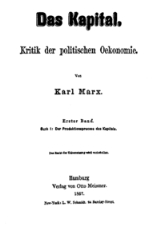
Das Kapital

Encyclopedia
Das Kapital, Kritik der politischen Ökonomie (das kapiˈtaːl; Capital: Critique of Political Economy), by Karl Marx
, is a critical analysis of capitalism
as political economy
, meant to reveal the economic laws of the capitalist mode of production, and how it was the precursor of the socialist mode of production
.
proposes that the motivating force of capitalism
is in the exploitation
of labour, whose unpaid work is the ultimate source of profit
and surplus value
. The employer can claim right to the profits (new output value), because he or she owns the productive capital assets
(means of production), which are legally protected by the State through property rights. In producing capital
(money) rather than commodities (goods and services), the workers continually reproduce the economic conditions by which they labour. Capital proposes an explanation of the "laws of motion" of the capitalist economic system, from its origins to its future, by describing the dynamics of the accumulation of capital, the growth of wage labour
, the transformation of the workplace, the concentration of capital, commercial competition, the banking system, the decline of the profit rate
, land-rents, et cetera.
The critique of the political economy of capitalism proposes that:
After decades of economic study and preparatory work (especially regarding the theory of surplus value
) the first volume appeared in 1867: The production process of capital. After Marx's death in 1883, Friedrich Engels
introduced, from manuscripts and the first volume; Volume II: The circulation process of capital in 1885; and Volume III: The overall process of capitalist production in 1894. These three volumes are collectively known as Das Kapital.
, how it was the precursor of the socialist mode of production, and of the class struggle
rooted in the capitalist social relations of production. The first of three volumes of Das Kapital, Kritik der politischen Ökonomie (Capital: Critique of Political Economy) was published on 14 September 1867, and was the sole volume published in Marx’s lifetime.
from notes left by Karl Marx and published in 1885. It is divided into three parts:[1]
The Metamorphoses of Capital and Their Circuits
The Turnover of Capital
The Reproduction and Circulation of the Aggregate Social Capital
In Volume II, the main ideas behind the marketplace are to be found: how value and surplus-value are realized. Its dramatis personae, not so much the worker and the industrialist (as in Volume I), but rather the money owner (and money lender), the wholesale merchant, the trader and the entrepreneur or 'functioning capitalist.' Moreover, workers appear in Volume II, essentially as buyers of consumer goods and, therefore, as sellers of the commodity labour power, rather than producers of value and surplus-value (although, this latter quality, established in Volume I, remains the solid foundation on which the whole of the unfolding analysis is based).
Reading Volume II is of monumental significance to understanding the theoretical construction of Marx's whole argument. Marx himself quite precisely clarified this place, in a letter sent to Engels on 30 April 1868: 'In Book 1. . . we content ourselves with the assumption that if in the self-expansion process €100 becomes €110, the latter will find already in existence in the market the elements into which it will change once more. But now we investigate the conditions under which these elements are found at hand, namely the social intertwining of the different capitals, of the component parts of capital and of revenue (= s).' This intertwining, conceived as a movement of commodities and of money, enabled Marx to work out at least the essential elements, if not the definitive form of a coherent theory of the trade cycle, based upon the inevitability of periodic disequilibrium between supply and demand under the capitalist mode of production (Mandel, 1978, Intro to Vol. II of Capital).
Volume II of Capital has indeed been not only a 'sealed book', but also a forgotten one. To a large extent, it remains so to this very day.
Part 3 is the point of departure for a topic
given its Marxist treatment later in detail by, among others, Rosa Luxemburg
.
The work is best known today for part 3, which in summary says that as the organic fixed capital requirements of production rise as a result of advancements in production generally, the rate of profit
tends to fall. This result, which orthodox Marxists believe is a principal contradictory characteristic leading to an inevitable collapse of the capitalist order, was held by Marx and Engels to, as a result of various contradictions in the capitalist mode of production
, result in crises
whose resolution necessitates the emergence of an entirely new mode of production as the culmination of the same historical dialectic that led to the emergence of capitalism from prior forms.
; the analyses were meant "to bring a science
, by criticism, to the point where it can be dialectically represented" and so "reveal the law of motion of modern society" to describe how the capitalist
mode of production was the precursor of the socialist mode of production
. The argument is a critique of the classical economics
of Adam Smith
, David Ricardo
, John Stuart Mill
, and Benjamin Franklin
, drawing on the dialectic
al method that G.W.F. Hegel
developed in The Science of Logic and The Phenomenology of Spirit; other intellectual
influences upon Capital were the French socialists
Charles Fourier
, Comte de Saint-Simon, and Pierre-Joseph Proudhon
; and the Greek philosophers
, especially Aristotle
.
At university, Marx wrote a dissertation comparing the philosophy of nature in the works of the pre-Socratic
philosophers Democritus
(ca. 460–370 BC) and Epicurus
(341–270 BC); from which academic speculation proposes is the derivation of the logical architecture of Capital: Critique of Political Economy, because exchange value
, the "syllogisms" (C-M-C' and M-C-M') for simple commodity circulation, and the circulation of value
as capital
, derive from the Politics
and the Nicomachean Ethics
, by Aristotle. Moreover, the description of machinery, under capitalist relations of production, as "self-acting automata
" derives from Aristotle’s speculations about inanimate instruments capable of obeying commands as the condition for the abolition of slavery
. In the nineteenth century, Karl Marx’s research of the available politico-economic literature required twelve years, usually in the British Library
, London.
of his time, the nineteenth century. The philosopher Karl Kautsky
(1854–1938) published a partial edition of Marx's surplus-value critique, and later published a full, three-volume edition as Theorien über den Mehrwert (Theories of Surplus Value, 1905–1910); the first volume was published in English as A History of Economic Theories (1952).
(1867) was published in Marx’s lifetime, but he died, in 1883, before completing the manuscripts for Capital, Volume II
(1885) and Capital, Volume III
(1894), which friend and collaborator Friedrich Engels
edited and published as the work of Karl Marx. The first translated publication of Capital: Critique of Political Economy was in Imperial Russia, in March 1872. It was the first foreign publication, the English edition appeared in 1887. Despite Tsarist censorship
proscribing "the harmful doctrines of socialism
and communism
", the Russian censors considered Capital as a "strictly scientific work" of political economy
the content of which did not apply to monarchic
Russia, where "capitalist exploitation
" had never occurred, and was officially dismissed, given that "that very few people in Russia will read it, and even fewer will understand it"; nonetheless, Karl Marx acknowledged that Russia was the country where Capital "was read and valued more than anywhere." The Russian edition was the fastest selling. 3,000 copies were sold in 1 year while the German edition took 5 years to sell 1,000 (15 times slower).
, include a Russian translation by the revolution
ary Mikhail Bakunin
(1814–1876). An English translation by Samuel Moore and Edward Aveling
was reissued in the 1970s by Progress Publishers
in Moscow; recent English translations are by David McLellan and Ben Fowkes.
Karl Marx
Karl Heinrich Marx was a German philosopher, economist, sociologist, historian, journalist, and revolutionary socialist. His ideas played a significant role in the development of social science and the socialist political movement...
, is a critical analysis of capitalism
Capitalism
Capitalism is an economic system that became dominant in the Western world following the demise of feudalism. There is no consensus on the precise definition nor on how the term should be used as a historical category...
as political economy
Political economy
Political economy originally was the term for studying production, buying, and selling, and their relations with law, custom, and government, as well as with the distribution of national income and wealth, including through the budget process. Political economy originated in moral philosophy...
, meant to reveal the economic laws of the capitalist mode of production, and how it was the precursor of the socialist mode of production
Mode of production
In the writings of Karl Marx and the Marxist theory of historical materialism, a mode of production is a specific combination of:...
.
Themes
In Capital: Critique of Political Economy (1867), Karl MarxKarl Marx
Karl Heinrich Marx was a German philosopher, economist, sociologist, historian, journalist, and revolutionary socialist. His ideas played a significant role in the development of social science and the socialist political movement...
proposes that the motivating force of capitalism
Capitalism
Capitalism is an economic system that became dominant in the Western world following the demise of feudalism. There is no consensus on the precise definition nor on how the term should be used as a historical category...
is in the exploitation
Exploitation
This article discusses the term exploitation in the meaning of using something in an unjust or cruel manner.- As unjust benefit :In political economy, economics, and sociology, exploitation involves a persistent social relationship in which certain persons are being mistreated or unfairly used for...
of labour, whose unpaid work is the ultimate source of profit
Profit (economics)
In economics, the term profit has two related but distinct meanings. Normal profit represents the total opportunity costs of a venture to an entrepreneur or investor, whilst economic profit In economics, the term profit has two related but distinct meanings. Normal profit represents the total...
and surplus value
Surplus value
Surplus value is a concept used famously by Karl Marx in his critique of political economy. Although Marx did not himself invent the term, he developed the concept...
. The employer can claim right to the profits (new output value), because he or she owns the productive capital assets
Means of production
Means of production refers to physical, non-human inputs used in production—the factories, machines, and tools used to produce wealth — along with both infrastructural capital and natural capital. This includes the classical factors of production minus financial capital and minus human capital...
(means of production), which are legally protected by the State through property rights. In producing capital
Capital (economics)
In economics, capital, capital goods, or real capital refers to already-produced durable goods used in production of goods or services. The capital goods are not significantly consumed, though they may depreciate in the production process...
(money) rather than commodities (goods and services), the workers continually reproduce the economic conditions by which they labour. Capital proposes an explanation of the "laws of motion" of the capitalist economic system, from its origins to its future, by describing the dynamics of the accumulation of capital, the growth of wage labour
Wage labour
Wage labour is the socioeconomic relationship between a worker and an employer, where the worker sells their labour under a formal or informal employment contract. These transactions usually occur in a labour market where wages are market determined...
, the transformation of the workplace, the concentration of capital, commercial competition, the banking system, the decline of the profit rate
Tendency of the rate of profit to fall
The tendency of the rate of profit to fall is a hypothesis in economics and political economy, most famously expounded by Karl Marx in chapter 13 of Das Kapital Vol. 3. It was generally accepted in the 19th century...
, land-rents, et cetera.
The critique of the political economy of capitalism proposes that:
- The commodity is the foundational "cell-form" (trade unit) of a capitalist society, which has commercial value for the owner of the means of productionMeans of productionMeans of production refers to physical, non-human inputs used in production—the factories, machines, and tools used to produce wealth — along with both infrastructural capital and natural capital. This includes the classical factors of production minus financial capital and minus human capital...
. Moreover, because commerce, as a human activity, implied no moralityEthicsEthics, also known as moral philosophy, is a branch of philosophy that addresses questions about morality—that is, concepts such as good and evil, right and wrong, virtue and vice, justice and crime, etc.Major branches of ethics include:...
beyond that required to buy and sell goods and services, the growth of the market system made discrete entities of the economic, the moral, and the legal spheres of human activity in society; hence, subjective moral value is separate from objective economic value. Subsequently, political economyPolitical economyPolitical economy originally was the term for studying production, buying, and selling, and their relations with law, custom, and government, as well as with the distribution of national income and wealth, including through the budget process. Political economy originated in moral philosophy...
— the just distribution of wealthDistribution of wealthThe distribution of wealth is a comparison of the wealth of various members or groups in a society. It differs from the distribution of income in that it looks at the distribution of ownership of the assets in a society, rather than the current income of members of that society.-Definition of...
and "political arithmetick" about taxes — became three discrete fields of human activity: EconomicsEconomicsEconomics is the social science that analyzes the production, distribution, and consumption of goods and services. The term economics comes from the Ancient Greek from + , hence "rules of the house"...
, LawLawLaw is a system of rules and guidelines which are enforced through social institutions to govern behavior, wherever possible. It shapes politics, economics and society in numerous ways and serves as a social mediator of relations between people. Contract law regulates everything from buying a bus...
, and EthicsEthicsEthics, also known as moral philosophy, is a branch of philosophy that addresses questions about morality—that is, concepts such as good and evil, right and wrong, virtue and vice, justice and crime, etc.Major branches of ethics include:...
, politics and economics divorced. - "The economic formation of society [is] a process of natural history", thus it is possible for a political economistPolitical economyPolitical economy originally was the term for studying production, buying, and selling, and their relations with law, custom, and government, as well as with the distribution of national income and wealth, including through the budget process. Political economy originated in moral philosophy...
to objectively study the scientific laws of capitalism, given that its expansion of the market system of commerce had objectifiedObjectificationObjectification is the process by which an abstract concept is made as objective as possible in the purest sense of the term. It is also treated as if it is a concrete thing or physical object...
human economic relations; the use of moneyMoneyMoney is any object or record that is generally accepted as payment for goods and services and repayment of debts in a given country or socio-economic context. The main functions of money are distinguished as: a medium of exchange; a unit of account; a store of value; and, occasionally in the past,...
(cash nexus) voided religious and political illusions about its economic valueTheory of value (economics)"Theory of value" is a generic term which encompasses all the theories within economics that attempt to explain the exchange value or price of goods and services...
, and replaced them with commodity fetishismCommodity fetishismIn Marx's critique of political economy, commodity fetishism denotes the mystification of human relations said to arise out of the growth of market trade, when social relationships between people are expressed as, mediated by and transformed into, objectified relationships between things .The...
, the belief that an object (commodity) has inherent economic value. Because societal economic formation is an historical process, no one person could control or direct it, thereby creating a global complex of social connections among capitalists; thus, the economic formation (individual commerce) of a society precedes the human administration of an economy (organised commerce). - The structural contradictions of a capitalist economy, the gegensätzliche Bewegung, describe the contradictory movement originating from the two-fold character of labour; not the class struggleClass struggleClass struggle is the active expression of a class conflict looked at from any kind of socialist perspective. Karl Marx and Friedrich Engels wrote "The [written] history of all hitherto existing society is the history of class struggle"....
between labour and capitalCapitalismCapitalism is an economic system that became dominant in the Western world following the demise of feudalism. There is no consensus on the precise definition nor on how the term should be used as a historical category...
, the wage labourWage labourWage labour is the socioeconomic relationship between a worker and an employer, where the worker sells their labour under a formal or informal employment contract. These transactions usually occur in a labour market where wages are market determined...
er and the ownerBourgeoisieIn sociology and political science, bourgeoisie describes a range of groups across history. In the Western world, between the late 18th century and the present day, the bourgeoisie is a social class "characterized by their ownership of capital and their related culture." A member of the...
of the means of productionMeans of productionMeans of production refers to physical, non-human inputs used in production—the factories, machines, and tools used to produce wealth — along with both infrastructural capital and natural capital. This includes the classical factors of production minus financial capital and minus human capital...
. These capitalist economy contradictions operate "behind the backs" of the capitalists and the workers, as a result of their activities, and yet remain beyond their perceptionPerceptionPerception is the process of attaining awareness or understanding of the environment by organizing and interpreting sensory information. All perception involves signals in the nervous system, which in turn result from physical stimulation of the sense organs...
s as men and women and as social classSocial classSocial classes are economic or cultural arrangements of groups in society. Class is an essential object of analysis for sociologists, political scientists, economists, anthropologists and social historians. In the social sciences, social class is often discussed in terms of 'social stratification'...
es. - The economic crises (recessionRecessionIn economics, a recession is a business cycle contraction, a general slowdown in economic activity. During recessions, many macroeconomic indicators vary in a similar way...
, depressionDepression (economics)In economics, a depression is a sustained, long-term downturn in economic activity in one or more economies. It is a more severe downturn than a recession, which is seen by some economists as part of the modern business cycle....
, etc.) that are rooted in the contradictory character of the economic value of the commodity (cell-unit) of a capitalist society, are the conditions that propitiate proletarianProletariatThe proletariat is a term used to identify a lower social class, usually the working class; a member of such a class is proletarian...
revolutionRevolutionA revolution is a fundamental change in power or organizational structures that takes place in a relatively short period of time.Aristotle described two types of political revolution:...
; which the Communist Manifesto (1848) collectively identified as a weapon, forged by the capitalists, which the working class "turned against the bourgeoisieBourgeoisieIn sociology and political science, bourgeoisie describes a range of groups across history. In the Western world, between the late 18th century and the present day, the bourgeoisie is a social class "characterized by their ownership of capital and their related culture." A member of the...
, itself". - In a capitalistCapitalismCapitalism is an economic system that became dominant in the Western world following the demise of feudalism. There is no consensus on the precise definition nor on how the term should be used as a historical category...
economy, technologicalTechnologyTechnology is the making, usage, and knowledge of tools, machines, techniques, crafts, systems or methods of organization in order to solve a problem or perform a specific function. It can also refer to the collection of such tools, machinery, and procedures. The word technology comes ;...
improvement and its consequent increased production augment the amount of material wealthWealthWealth is the abundance of valuable resources or material possessions. The word wealth is derived from the old English wela, which is from an Indo-European word stem...
(use valueUse valueUse value or value in use is the utility of consuming a good; the want-satisfying power of a good or service in classical political economy. In Marx's critique of political economy, any labor-product has a value and a use-value, and if it is traded as a commodity in markets, it additionally has an...
) in society, whilst simultaneously diminishing the economic valueValue (economics)An economic value is the worth of a good or service as determined by the market.The economic value of a good or service has puzzled economists since the beginning of the discipline. First, economists tried to estimate the value of a good to an individual alone, and extend that definition to goods...
of the same wealth, thereby diminishing the rate of profitTendency of the rate of profit to fallThe tendency of the rate of profit to fall is a hypothesis in economics and political economy, most famously expounded by Karl Marx in chapter 13 of Das Kapital Vol. 3. It was generally accepted in the 19th century...
— a paradoxParadoxSimilar to Circular reasoning, A paradox is a seemingly true statement or group of statements that lead to a contradiction or a situation which seems to defy logic or intuition...
characteristic of economic crisis in a capitalist economy; "poverty in the midst of plenty" consequent to over-production and under-consumption.
After decades of economic study and preparatory work (especially regarding the theory of surplus value
Surplus value
Surplus value is a concept used famously by Karl Marx in his critique of political economy. Although Marx did not himself invent the term, he developed the concept...
) the first volume appeared in 1867: The production process of capital. After Marx's death in 1883, Friedrich Engels
Friedrich Engels
Friedrich Engels was a German industrialist, social scientist, author, political theorist, philosopher, and father of Marxist theory, alongside Karl Marx. In 1845 he published The Condition of the Working Class in England, based on personal observations and research...
introduced, from manuscripts and the first volume; Volume II: The circulation process of capital in 1885; and Volume III: The overall process of capitalist production in 1894. These three volumes are collectively known as Das Kapital.
Capital Volume I
Capital, Volume I (1867) is a critical analysis of capitalism as political economy, meant to reveal the economic laws of the capitalist mode of productionCapitalist mode of production
In Marx's critique of political economy, the capitalist mode of production is the production system of capitalist societies, which began in Europe in the 16th century, grew rapidly in Western Europe from the end of the 18th century, and later extended to most of the world...
, how it was the precursor of the socialist mode of production, and of the class struggle
Class struggle
Class struggle is the active expression of a class conflict looked at from any kind of socialist perspective. Karl Marx and Friedrich Engels wrote "The [written] history of all hitherto existing society is the history of class struggle"....
rooted in the capitalist social relations of production. The first of three volumes of Das Kapital, Kritik der politischen Ökonomie (Capital: Critique of Political Economy) was published on 14 September 1867, and was the sole volume published in Marx’s lifetime.
Capital Volume II
Capital, Volume II, subtitled The Process of Circulation of Capital, was prepared by Friedrich EngelsFriedrich Engels
Friedrich Engels was a German industrialist, social scientist, author, political theorist, philosopher, and father of Marxist theory, alongside Karl Marx. In 1845 he published The Condition of the Working Class in England, based on personal observations and research...
from notes left by Karl Marx and published in 1885. It is divided into three parts:[1]
The Metamorphoses of Capital and Their Circuits
The Turnover of Capital
The Reproduction and Circulation of the Aggregate Social Capital
In Volume II, the main ideas behind the marketplace are to be found: how value and surplus-value are realized. Its dramatis personae, not so much the worker and the industrialist (as in Volume I), but rather the money owner (and money lender), the wholesale merchant, the trader and the entrepreneur or 'functioning capitalist.' Moreover, workers appear in Volume II, essentially as buyers of consumer goods and, therefore, as sellers of the commodity labour power, rather than producers of value and surplus-value (although, this latter quality, established in Volume I, remains the solid foundation on which the whole of the unfolding analysis is based).
Reading Volume II is of monumental significance to understanding the theoretical construction of Marx's whole argument. Marx himself quite precisely clarified this place, in a letter sent to Engels on 30 April 1868: 'In Book 1. . . we content ourselves with the assumption that if in the self-expansion process €100 becomes €110, the latter will find already in existence in the market the elements into which it will change once more. But now we investigate the conditions under which these elements are found at hand, namely the social intertwining of the different capitals, of the component parts of capital and of revenue (= s).' This intertwining, conceived as a movement of commodities and of money, enabled Marx to work out at least the essential elements, if not the definitive form of a coherent theory of the trade cycle, based upon the inevitability of periodic disequilibrium between supply and demand under the capitalist mode of production (Mandel, 1978, Intro to Vol. II of Capital).
Volume II of Capital has indeed been not only a 'sealed book', but also a forgotten one. To a large extent, it remains so to this very day.
Part 3 is the point of departure for a topic
Topic
Topic or Topicality may refer to:* Topic , what is being talked about* Topic * Topic , a brand of confectionery bar* Topics , a work by Aristotle* Topical, a medication applied to body surfaces...
given its Marxist treatment later in detail by, among others, Rosa Luxemburg
Rosa Luxemburg
Rosa Luxemburg was a Marxist theorist, philosopher, economist and activist of Polish Jewish descent who became a naturalized German citizen...
.
Capital Volume III
Capital, Volume III, subtitled The Process of Capitalist Production as a Whole, was prepared by Friedrich Engels from notes left by Karl Marx and published in 1894. It is in seven parts:- The conversion of Surplus Value into Profit and the rate of Surplus Value into the rate of Profit
- Conversion of Profit into Average Profit
- The Law of the Tendency of the Rate of Profit to FallTendency of the rate of profit to fallThe tendency of the rate of profit to fall is a hypothesis in economics and political economy, most famously expounded by Karl Marx in chapter 13 of Das Kapital Vol. 3. It was generally accepted in the 19th century...
- Conversion of Commodity Capital and Money Capital into Commercial Capital and Money-Dealing Capital (Merchant's Capital)
- Division of Profit Into Interest and Profit of Enterprise, Interest Bearing Capital.
- Transformation of Surplus-Profit into Ground Rent.
- Revenues and Their Sources
The work is best known today for part 3, which in summary says that as the organic fixed capital requirements of production rise as a result of advancements in production generally, the rate of profit
Rate of profit
In economics and finance, the profit rate is the relative profitability of an investment project, of a capitalist enterprise, or of the capitalist economy as a whole...
tends to fall. This result, which orthodox Marxists believe is a principal contradictory characteristic leading to an inevitable collapse of the capitalist order, was held by Marx and Engels to, as a result of various contradictions in the capitalist mode of production
Mode of production
In the writings of Karl Marx and the Marxist theory of historical materialism, a mode of production is a specific combination of:...
, result in crises
Crises
Crises is the eighth record album by Mike Oldfield, released in 1983. Oldfield's well known hit "Moonlight Shadow" appears on the album.- Album analysis :...
whose resolution necessitates the emergence of an entirely new mode of production as the culmination of the same historical dialectic that led to the emergence of capitalism from prior forms.
Intellectual influences
The purpose of Capital: Critique of Political Economy (1867) was a scientific foundation for the politics of the modern labour movementLabour movement
The term labour movement or labor movement is a broad term for the development of a collective organization of working people, to campaign in their own interest for better treatment from their employers and governments, in particular through the implementation of specific laws governing labour...
; the analyses were meant "to bring a science
Political economy
Political economy originally was the term for studying production, buying, and selling, and their relations with law, custom, and government, as well as with the distribution of national income and wealth, including through the budget process. Political economy originated in moral philosophy...
, by criticism, to the point where it can be dialectically represented" and so "reveal the law of motion of modern society" to describe how the capitalist
Capitalism
Capitalism is an economic system that became dominant in the Western world following the demise of feudalism. There is no consensus on the precise definition nor on how the term should be used as a historical category...
mode of production was the precursor of the socialist mode of production
Mode of production
In the writings of Karl Marx and the Marxist theory of historical materialism, a mode of production is a specific combination of:...
. The argument is a critique of the classical economics
Classical economics
Classical economics is widely regarded as the first modern school of economic thought. Its major developers include Adam Smith, Jean-Baptiste Say, David Ricardo, Thomas Malthus and John Stuart Mill....
of Adam Smith
Adam Smith
Adam Smith was a Scottish social philosopher and a pioneer of political economy. One of the key figures of the Scottish Enlightenment, Smith is the author of The Theory of Moral Sentiments and An Inquiry into the Nature and Causes of the Wealth of Nations...
, David Ricardo
David Ricardo
David Ricardo was an English political economist, often credited with systematising economics, and was one of the most influential of the classical economists, along with Thomas Malthus, Adam Smith, and John Stuart Mill. He was also a member of Parliament, businessman, financier and speculator,...
, John Stuart Mill
John Stuart Mill
John Stuart Mill was a British philosopher, economist and civil servant. An influential contributor to social theory, political theory, and political economy, his conception of liberty justified the freedom of the individual in opposition to unlimited state control. He was a proponent of...
, and Benjamin Franklin
Benjamin Franklin
Dr. Benjamin Franklin was one of the Founding Fathers of the United States. A noted polymath, Franklin was a leading author, printer, political theorist, politician, postmaster, scientist, musician, inventor, satirist, civic activist, statesman, and diplomat...
, drawing on the dialectic
Dialectic
Dialectic is a method of argument for resolving disagreement that has been central to Indic and European philosophy since antiquity. The word dialectic originated in Ancient Greece, and was made popular by Plato in the Socratic dialogues...
al method that G.W.F. Hegel
Georg Wilhelm Friedrich Hegel
Georg Wilhelm Friedrich Hegel was a German philosopher, one of the creators of German Idealism. His historicist and idealist account of reality as a whole revolutionized European philosophy and was an important precursor to Continental philosophy and Marxism.Hegel developed a comprehensive...
developed in The Science of Logic and The Phenomenology of Spirit; other intellectual
Intellectualism
Intellectualism denotes the use and development of the intellect, the practice of being an intellectual, and of holding intellectual pursuits in great regard. Moreover, in philosophy, “intellectualism” occasionally is synonymous with “rationalism”, i.e. knowledge derived mostly from reason and...
influences upon Capital were the French socialists
Socialism
Socialism is an economic system characterized by social ownership of the means of production and cooperative management of the economy; or a political philosophy advocating such a system. "Social ownership" may refer to any one of, or a combination of, the following: cooperative enterprises,...
Charles Fourier
Charles Fourier
François Marie Charles Fourier was a French philosopher. An influential thinker, some of Fourier's social and moral views, held to be radical in his lifetime, have become main currents in modern society...
, Comte de Saint-Simon, and Pierre-Joseph Proudhon
Pierre-Joseph Proudhon
Pierre-Joseph Proudhon was a French politician, mutualist philosopher and socialist. He was a member of the French Parliament, and he was the first person to call himself an "anarchist". He is considered among the most influential theorists and organisers of anarchism...
; and the Greek philosophers
Greek philosophy
Ancient Greek philosophy arose in the 6th century BCE and continued through the Hellenistic period, at which point Ancient Greece was incorporated in the Roman Empire...
, especially Aristotle
Aristotle
Aristotle was a Greek philosopher and polymath, a student of Plato and teacher of Alexander the Great. His writings cover many subjects, including physics, metaphysics, poetry, theater, music, logic, rhetoric, linguistics, politics, government, ethics, biology, and zoology...
.
At university, Marx wrote a dissertation comparing the philosophy of nature in the works of the pre-Socratic
Pre-Socratic philosophy
Pre-Socratic philosophy is Greek philosophy before Socrates . In Classical antiquity, the Presocratic philosophers were called physiologoi...
philosophers Democritus
Democritus
Democritus was an Ancient Greek philosopher born in Abdera, Thrace, Greece. He was an influential pre-Socratic philosopher and pupil of Leucippus, who formulated an atomic theory for the cosmos....
(ca. 460–370 BC) and Epicurus
Epicurus
Epicurus was an ancient Greek philosopher and the founder of the school of philosophy called Epicureanism.Only a few fragments and letters remain of Epicurus's 300 written works...
(341–270 BC); from which academic speculation proposes is the derivation of the logical architecture of Capital: Critique of Political Economy, because exchange value
Exchange value
In political economy and especially Marxian economics, exchange value refers to one of four major attributes of a commodity, i.e., an item or service produced for, and sold on the market...
, the "syllogisms" (C-M-C' and M-C-M') for simple commodity circulation, and the circulation of value
Value (economics)
An economic value is the worth of a good or service as determined by the market.The economic value of a good or service has puzzled economists since the beginning of the discipline. First, economists tried to estimate the value of a good to an individual alone, and extend that definition to goods...
as capital
Capital (economics)
In economics, capital, capital goods, or real capital refers to already-produced durable goods used in production of goods or services. The capital goods are not significantly consumed, though they may depreciate in the production process...
, derive from the Politics
Politics (Aristotle)
Aristotle's Politics is a work of political philosophy. The end of the Nicomachean Ethics declared that the inquiry into ethics necessarily follows into politics, and the two works are frequently considered to be parts of a larger treatise, or perhaps connected lectures, dealing with the...
and the Nicomachean Ethics
Nicomachean Ethics
The Nicomachean Ethics is the name normally given to Aristotle's best known work on ethics. The English version of the title derives from Greek Ἠθικὰ Νικομάχεια, transliterated Ethika Nikomacheia, which is sometimes also given in the genitive form as Ἠθικῶν Νικομαχείων, Ethikōn Nikomacheiōn...
, by Aristotle. Moreover, the description of machinery, under capitalist relations of production, as "self-acting automata
Automata
Automata is the plural form of automaton, a self-operating machine. It may also refer to:* "Automata", a short story by E. T. A. Hoffmann* "Automata", a hardboiled science fiction crime series by Penny Arcade...
" derives from Aristotle’s speculations about inanimate instruments capable of obeying commands as the condition for the abolition of slavery
Slavery
Slavery is a system under which people are treated as property to be bought and sold, and are forced to work. Slaves can be held against their will from the time of their capture, purchase or birth, and deprived of the right to leave, to refuse to work, or to demand compensation...
. In the nineteenth century, Karl Marx’s research of the available politico-economic literature required twelve years, usually in the British Library
British Library
The British Library is the national library of the United Kingdom, and is the world's largest library in terms of total number of items. The library is a major research library, holding over 150 million items from every country in the world, in virtually all known languages and in many formats,...
, London.
Capital, Volume IV
At the time of his death (1883) Karl Marx had prepared the manuscript for Capital, Volume IV, a critical history of theories of surplus valueSurplus value
Surplus value is a concept used famously by Karl Marx in his critique of political economy. Although Marx did not himself invent the term, he developed the concept...
of his time, the nineteenth century. The philosopher Karl Kautsky
Karl Kautsky
Karl Johann Kautsky was a Czech-German philosopher, journalist, and Marxist theoretician. Kautsky was recognized as among the most authoritative promulgators of Orthodox Marxism after the death of Friedrich Engels in 1895 until the coming of World War I in 1914 and was called by some the "Pope of...
(1854–1938) published a partial edition of Marx's surplus-value critique, and later published a full, three-volume edition as Theorien über den Mehrwert (Theories of Surplus Value, 1905–1910); the first volume was published in English as A History of Economic Theories (1952).
Publication
Capital, Volume ICapital, Volume I
Capital, Volume I , by Karl Marx, is a critical analysis of capitalism as political economy, meant to reveal the economic laws of the capitalist mode of production, how it was the precursor of the socialist mode of production, and of the class struggle rooted in the capitalist social relations of...
(1867) was published in Marx’s lifetime, but he died, in 1883, before completing the manuscripts for Capital, Volume II
Capital, Volume II
Capital, Volume II, subtitled The Process of Circulation of Capital, was prepared by Friedrich Engels from notes left by Karl Marx and published in 1885...
(1885) and Capital, Volume III
Capital, Volume III
Capital, Volume III, subtitled The Process of Capitalist Production as a Whole, was prepared by Friedrich Engels from notes left by Karl Marx and published in 1894...
(1894), which friend and collaborator Friedrich Engels
Friedrich Engels
Friedrich Engels was a German industrialist, social scientist, author, political theorist, philosopher, and father of Marxist theory, alongside Karl Marx. In 1845 he published The Condition of the Working Class in England, based on personal observations and research...
edited and published as the work of Karl Marx. The first translated publication of Capital: Critique of Political Economy was in Imperial Russia, in March 1872. It was the first foreign publication, the English edition appeared in 1887. Despite Tsarist censorship
Censorship
thumb|[[Book burning]] following the [[1973 Chilean coup d'état|1973 coup]] that installed the [[Military government of Chile |Pinochet regime]] in Chile...
proscribing "the harmful doctrines of socialism
Socialism
Socialism is an economic system characterized by social ownership of the means of production and cooperative management of the economy; or a political philosophy advocating such a system. "Social ownership" may refer to any one of, or a combination of, the following: cooperative enterprises,...
and communism
Communism
Communism is a social, political and economic ideology that aims at the establishment of a classless, moneyless, revolutionary and stateless socialist society structured upon common ownership of the means of production...
", the Russian censors considered Capital as a "strictly scientific work" of political economy
Political economy
Political economy originally was the term for studying production, buying, and selling, and their relations with law, custom, and government, as well as with the distribution of national income and wealth, including through the budget process. Political economy originated in moral philosophy...
the content of which did not apply to monarchic
Absolute monarchy
Absolute monarchy is a monarchical form of government in which the monarch exercises ultimate governing authority as head of state and head of government, his or her power not being limited by a constitution or by the law. An absolute monarch thus wields unrestricted political power over the...
Russia, where "capitalist exploitation
Exploitation
This article discusses the term exploitation in the meaning of using something in an unjust or cruel manner.- As unjust benefit :In political economy, economics, and sociology, exploitation involves a persistent social relationship in which certain persons are being mistreated or unfairly used for...
" had never occurred, and was officially dismissed, given that "that very few people in Russia will read it, and even fewer will understand it"; nonetheless, Karl Marx acknowledged that Russia was the country where Capital "was read and valued more than anywhere." The Russian edition was the fastest selling. 3,000 copies were sold in 1 year while the German edition took 5 years to sell 1,000 (15 times slower).
Translations
The foreign editions of Capital: Critique of Political Economy (1867), by Karl MarxKarl Marx
Karl Heinrich Marx was a German philosopher, economist, sociologist, historian, journalist, and revolutionary socialist. His ideas played a significant role in the development of social science and the socialist political movement...
, include a Russian translation by the revolution
Revolution
A revolution is a fundamental change in power or organizational structures that takes place in a relatively short period of time.Aristotle described two types of political revolution:...
ary Mikhail Bakunin
Mikhail Bakunin
Mikhail Alexandrovich Bakunin was a well-known Russian revolutionary and theorist of collectivist anarchism. He has also often been called the father of anarchist theory in general. Bakunin grew up near Moscow, where he moved to study philosophy and began to read the French Encyclopedists,...
(1814–1876). An English translation by Samuel Moore and Edward Aveling
Edward Aveling
Edward Bibbins Aveling was a prominent English biology instructor and popular spokesman for Darwinian evolution and atheism. He later met and moved in with Eleanor Marx, the youngest daughter of Karl Marx and became a socialist activist...
was reissued in the 1970s by Progress Publishers
Progress Publishers
Progress Publishers was a Moscow-based Soviet publisher founded in 1931.It was noted for its English-language editions of books on Marxism-Leninism....
in Moscow; recent English translations are by David McLellan and Ben Fowkes.
See also
- Accumulation by dispossessionAccumulation by dispossessionAccumulation by dispossession is a concept presented by the Marxist geographer David Harvey, which defines the neoliberal capitalist policies in many western nations, from the 1970s and to the present day, as resulting in a centralization of wealth and power in the hands of a few by dispossessing...
- Analytical MarxismAnalytical MarxismAnalytical Marxism refers to a particular Marxist approach that was prominent amongst English-speaking philosophers and social scientists during the 1980s. It was mainly associated with the September Group of academics, so called because of their biennial September meetings to discuss common...
- Étienne BalibarÉtienne BalibarÉtienne Balibar is a French Marxist philosopher. After the death of his teacher Louis Althusser, Balibar quickly became the leading exponent of French Marxist philosophy.- Life and work :...
- Eduard BernsteinEduard BernsteinEduard Bernstein was a German social democratic theoretician and politician, a member of the SPD, and the founder of evolutionary socialism and revisionism.- Life :...
- G.A. Cohen
- Capital (economics)Capital (economics)In economics, capital, capital goods, or real capital refers to already-produced durable goods used in production of goods or services. The capital goods are not significantly consumed, though they may depreciate in the production process...
- Capital accumulationCapital accumulationThe accumulation of capital refers to the gathering or amassing of objects of value; the increase in wealth through concentration; or the creation of wealth. Capital is money or a financial asset invested for the purpose of making more money...
- CapitalismCapitalismCapitalism is an economic system that became dominant in the Western world following the demise of feudalism. There is no consensus on the precise definition nor on how the term should be used as a historical category...
- Commodity fetishismCommodity fetishismIn Marx's critique of political economy, commodity fetishism denotes the mystification of human relations said to arise out of the growth of market trade, when social relationships between people are expressed as, mediated by and transformed into, objectified relationships between things .The...
- Cost of capitalCost of capitalThe cost of capital is a term used in the field of financial investment to refer to the cost of a company's funds , or, from an investor's point of view "the shareholder's required return on a portfolio of all the company's existing securities"...
- Crisis theoryCrisis theoryCrisis theory is generally associated with Marxian economics. In this context crisis refers to what is called, even currently and outside Marxian theory in many European countries a "conjuncture" or especially sharp bust cycle of the regular boom and bust pattern of what Marxists term "chaotic"...
- Culture of capitalism
- History of theory of capitalismHistory of theory of capitalismA theory of capitalism describes the essential features of capitalism and how it functions. The history of various such theories is the subject of this article.-Overview:...
- Immiseration thesisImmiseration thesisIn Marxist theory, the immiseration thesis refers to the view that the nature of capitalist production logically requires an ever greater reduction in real wages and worsening of working conditions for the proletariat.-Marx:Concerning the evolution of the worker's living conditions, Marx argued...
- Imperialism, the Highest Stage of CapitalismImperialism, the Highest Stage of CapitalismImperialism, the Highest Stage of Capitalism , by Lenin, describes the function of financial capital in generating profits from imperial colonialism, as the final stage of capitalist development to ensure greater profits...
- Krisis GroupeKrisis GroupeKrisis, or the Krisis-Gruppe, is an anti-political journal and discussion group formed in 1986 as a "theoretical forum for a radical critique of capitalist society." Its members include Robert Kurz, Roswitha Scholz, Nobert Trenkle, Ernst Lohoff, Achim Bellgart and Franz Schandl.- History :The...
- Labor theory of valueLabor theory of valueThe labor theories of value are heterodox economic theories of value which argue that the value of a commodity is related to the labor needed to produce or obtain that commodity. The concept is most often associated with Marxian economics...
- Law of accumulationLaw of accumulationAccumulation can refer to a cumulative or compound increase in a variable, or to capital accumulation.-Marxian economics:In Karl Marx's critique of political economy, the law of accumulation refers to the way in which the accumulation of capital necessarily develops in the capitalist mode of...
- Law of valueLaw of value-General:The law of value is a central concept in Karl Marx's critique of political economy, first expounded in his polemic The Poverty of Philosophy against Pierre-Joseph Proudhon, with reference to David Ricardo's economics...
- Marx's theory of alienationMarx's theory of alienationMarx's theory of alienation , as expressed in the writings of the young Karl Marx , refers to the separation of things that naturally belong together, or to put antagonism between things that are properly in harmony...
- Primitive accumulation of capitalPrimitive accumulation of capitalIn Marxist economics and preceding theories, the problem of primitive accumulation of capital concerns the origin of capital, and therefore of how class distinctions between possessors and non-possessors came to be.Adam Smith's account of primitive-original accumulation depicted a peaceful...
- ProfitProfit (economics)In economics, the term profit has two related but distinct meanings. Normal profit represents the total opportunity costs of a venture to an entrepreneur or investor, whilst economic profit In economics, the term profit has two related but distinct meanings. Normal profit represents the total...
- Relations of productionRelations of productionRelations of production is a concept frequently used by Karl Marx and Friedrich Engels in their theory of historical materialism, and in Das Kapital...
- Return on capital
- Surplus labourSurplus labourSurplus labour is a concept used by Karl Marx in his critique of political economy. It means labour performed in excess of the labour necessary to produce the means of livelihood of the worker . According to Marxian economics, surplus labour is usually "unpaid labour"...
- Surplus valueSurplus valueSurplus value is a concept used famously by Karl Marx in his critique of political economy. Although Marx did not himself invent the term, he developed the concept...
- ValorisationValorisationThe valorisation or valorization of capital is a theoretical concept created by Karl Marx in his critique of political economy. The German original term is "Verwertung" but this is difficult to translate, and often wrongly rendered as "realisation of capital", "creation of surplus-value" or...
- Value addedValue addedIn economics, the difference between the sale price and the production cost of a product is the value added per unit. Summing value added per unit over all units sold is total value added. Total value added is equivalent to Revenue less Outside Purchases...
Online editions
- Capital, Volume I: The Process of Production of Capital
- Capital, Volume I in audio format, from LibriVoxLibriVoxLibriVox is an online digital library of free public domain audiobooks, read by volunteers and is probably, since 2007, the world's most prolific audiobook publisher...
- Capital, Volume I 1906 edition, downloadable text and PDF from Google Books
- Capital, Volume II: The Process of Circulation of Capital
- Capital, Volume III: The Process of Capitalist Production as a Whole
- Capital, Volume IV: Theories of Surplus Value
Synopses
- Reading Marx's Capital – series of video lectures by professor David HarveyDavid Harvey (geographer)David Harvey is the Distinguished Professor of Anthropology at the Graduate Center of the City University of New York . A leading social theorist of international standing, he received his PhD in Geography from University of Cambridge in 1961. Widely influential, he is among the top 20 most cited...
(The first four parts (chapters) of the eventual seven of Volume I)
Further reading
- Althusser, Louis and Balibar, Étienne. Reading Capital. London: Verso, 2009.
- Louis AlthusserLouis AlthusserLouis Pierre Althusser was a French Marxist philosopher. He was born in Algeria and studied at the École Normale Supérieure in Paris, where he eventually became Professor of Philosophy....
(1969) How to Read Marx's Capital from Marxism TodayMarxism TodayMarxism Today was the theoretical journal of the Communist Party of Great Britain and was disestablished in 1991. It was particularly important during the 1980s under the editorship of Martin Jacques...
, October 1969, 302-305. Originally appeared (in French) in Humanité on April 21, 1969. - Bottomore, Tom, ed. A Dictionary of Marxist Thought. Oxford: Blackwell, 1998.
- Fine, BenBen FineFor the New York Times reporter see Benjamin FineBen Fine is Professor of Economics at the University of London's School of Oriental and African Studies. He is the author of a number of works in the broad tradition of Marxist economics, and has made contributions on economic imperialism and social...
. Marx's Capital. 5th ed. London: Pluto, 2010. - Harvey, DavidDavid Harvey (geographer)David Harvey is the Distinguished Professor of Anthropology at the Graduate Center of the City University of New York . A leading social theorist of international standing, he received his PhD in Geography from University of Cambridge in 1961. Widely influential, he is among the top 20 most cited...
. A Companion to Marx's Capital. London: Verso, 2010. - Harvey, David. The Limits of Capital. London: Verso, 2006.
- Mandel, ErnestErnest MandelErnest Ezra Mandel, also known by various pseudonyms such as Ernest Germain, Pierre Gousset, Henri Vallin, Walter , was a revolutionary Marxist theorist.-Life:...
. Marxist Economic Theory. New York: Monthly Review Press, 1970. - Capital: An Abridged Edition, Karl Marx (Author), David McLellan (Editor), 2008, Oxford Paperbacks; Abridged edition, Oxford, UK. ISBN 978-0-199535-70-5
- Postone, Moishe. Time, Labor, and Social Domination: A Reinterpretation of Marx's Critical Theory. Cambridge [England]: Cambridge University Press, 1993.
- Wheen, Francis. Marx's Das Kapital--A Biography. New York: Atlantic Monthly Press, 2006. ISBN 978-0802143945.
External links
- Annotations, Explanations and Clarifications to Capital. Will help with understanding the early concepts.
- Wage Labour and Capital. An earlier document that deals with many of the ideas later expanded in Das Kapital.
- First in a series of accessible columns on Capital by Joseph Choonara in Socialist WorkerSocialist WorkerSocialist Worker is the name of several socialist/communist newspapers associated with the International Socialist Tendency...
- Reading Marx’s Capital with David Harvey A university open course, consisting of a close reading of the text of Marx's Capital Volume I in 13 video lectures.