


Barbary corsairs

Encyclopedia
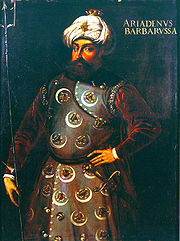
Corsair
Corsairs were privateers, authorized to conduct raids on shipping of a nation at war with France, on behalf of the French Crown. Seized vessels and cargo were sold at auction, with the corsair captain entitled to a portion of the proceeds...
s, sometimes called Ottoman Corsairs or Barbary Pirates, were pirates and privateer
Privateer
A privateer is a private person or ship authorized by a government by letters of marque to attack foreign shipping during wartime. Privateering was a way of mobilizing armed ships and sailors without having to spend public money or commit naval officers...
s who operated from North Africa
North Africa
North Africa or Northern Africa is the northernmost region of the African continent, linked by the Sahara to Sub-Saharan Africa. Geopolitically, the United Nations definition of Northern Africa includes eight countries or territories; Algeria, Egypt, Libya, Morocco, South Sudan, Sudan, Tunisia, and...
, based primarily in the ports of Tunis
Tunis
Tunis is the capital of both the Tunisian Republic and the Tunis Governorate. It is Tunisia's largest city, with a population of 728,453 as of 2004; the greater metropolitan area holds some 2,412,500 inhabitants....
, Tripoli
Tripoli
Tripoli is the capital and largest city in Libya. It is also known as Western Tripoli , to distinguish it from Tripoli, Lebanon. It is affectionately called The Mermaid of the Mediterranean , describing its turquoise waters and its whitewashed buildings. Tripoli is a Greek name that means "Three...
and Algiers
Algiers
' is the capital and largest city of Algeria. According to the 1998 census, the population of the city proper was 1,519,570 and that of the urban agglomeration was 2,135,630. In 2009, the population was about 3,500,000...
. This area was known in Europe
Europe
Europe is, by convention, one of the world's seven continents. Comprising the westernmost peninsula of Eurasia, Europe is generally 'divided' from Asia to its east by the watershed divides of the Ural and Caucasus Mountains, the Ural River, the Caspian and Black Seas, and the waterways connecting...
as the Barbary Coast
Barbary Coast
The Barbary Coast, or Barbary, was the term used by Europeans from the 16th until the 19th century to refer to much of the collective land of the Berber people. Today, the terms Maghreb and "Tamazgha" correspond roughly to "Barbary"...
, a term derived from the name of its Berber
Berber people
Berbers are the indigenous peoples of North Africa west of the Nile Valley. They are continuously distributed from the Atlantic to the Siwa oasis, in Egypt, and from the Mediterranean to the Niger River. Historically they spoke the Berber language or varieties of it, which together form a branch...
inhabitants. Their predation extended throughout the Mediterranean, south along West Africa
West Africa
West Africa or Western Africa is the westernmost region of the African continent. Geopolitically, the UN definition of Western Africa includes the following 16 countries and an area of approximately 5 million square km:-Flags of West Africa:...
's Atlantic seaboard and even South America
South America
South America is a continent situated in the Western Hemisphere, mostly in the Southern Hemisphere, with a relatively small portion in the Northern Hemisphere. The continent is also considered a subcontinent of the Americas. It is bordered on the west by the Pacific Ocean and on the north and east...
, and into the North Atlantic
Atlantic Ocean
The Atlantic Ocean is the second-largest of the world's oceanic divisions. With a total area of about , it covers approximately 20% of the Earth's surface and about 26% of its water surface area...
as far north as Iceland
Iceland
Iceland , described as the Republic of Iceland, is a Nordic and European island country in the North Atlantic Ocean, on the Mid-Atlantic Ridge. Iceland also refers to the main island of the country, which contains almost all the population and almost all the land area. The country has a population...
, but they primarily operated in the western Mediterranean. In addition to seizing ships, they engaged in Razzias, raids on European coastal towns and villages, mainly in Italy, France, Spain, and Portugal, but also in England
Kingdom of England
The Kingdom of England was, from 927 to 1707, a sovereign state to the northwest of continental Europe. At its height, the Kingdom of England spanned the southern two-thirds of the island of Great Britain and several smaller outlying islands; what today comprises the legal jurisdiction of England...
, Scotland
Kingdom of Scotland
The Kingdom of Scotland was a Sovereign state in North-West Europe that existed from 843 until 1707. It occupied the northern third of the island of Great Britain and shared a land border to the south with the Kingdom of England...
, the Netherlands
Netherlands
The Netherlands is a constituent country of the Kingdom of the Netherlands, located mainly in North-West Europe and with several islands in the Caribbean. Mainland Netherlands borders the North Sea to the north and west, Belgium to the south, and Germany to the east, and shares maritime borders...
, Ireland
Ireland
Ireland is an island to the northwest of continental Europe. It is the third-largest island in Europe and the twentieth-largest island on Earth...
, and as far away as Iceland
Iceland
Iceland , described as the Republic of Iceland, is a Nordic and European island country in the North Atlantic Ocean, on the Mid-Atlantic Ridge. Iceland also refers to the main island of the country, which contains almost all the population and almost all the land area. The country has a population...
. The main purpose of their attacks was to capture Christian
Christian
A Christian is a person who adheres to Christianity, an Abrahamic, monotheistic religion based on the life and teachings of Jesus of Nazareth as recorded in the Canonical gospels and the letters of the New Testament...
slaves
Slavery
Slavery is a system under which people are treated as property to be bought and sold, and are forced to work. Slaves can be held against their will from the time of their capture, purchase or birth, and deprived of the right to leave, to refuse to work, or to demand compensation...
for the Islamic market in North Africa and the Middle East.
While such raids had occurred since soon after the Muslim conquest of the region, the terms Barbary Pirates and Barbary Corsairs are normally applied to the raiders active from the 16th century onwards, when the frequency and range of the slavers' attacks increased and Algiers, Tunis and Tripoli came under the sovereignty of the Ottoman Empire
Ottoman Empire
The Ottoman EmpireIt was usually referred to as the "Ottoman Empire", the "Turkish Empire", the "Ottoman Caliphate" or more commonly "Turkey" by its contemporaries...
, either as directly administered provinces or as autonomous dependencies known as the Barbary States. Similar raids were undertaken from Bou Regreg and Salé
Republic of Salé
The Republic of Salé was an independent corsair city-state on the Moroccan coast. It was a major piratical port during its brief existence in the 17th century.-History:-History:...
and other ports in Morocco
Morocco
Morocco , officially the Kingdom of Morocco , is a country located in North Africa. It has a population of more than 32 million and an area of 710,850 km², and also primarily administers the disputed region of the Western Sahara...
, but strictly speaking Morocco, which never came under Ottoman dominance, was not one of the Barbary States.
_the_flagship_of_kemal_reis.jpg)
Zymen Danseker
Siemen Danziger , better known by his anglicized names Zymen Danseker and Simon de Danser, was a 17th century Dutch privateer and corsair...
and Henry Mainwaring
Henry Mainwaring
Sir Henry Mainwaring , was an English pirate, naval officer with the Royal Navy, and author.- Early life :Henry Mainwaring was born in Ightfield in Shropshire, second son of Sir George Mainwaring and his wife Ann, the daughter of Sir William More of Loseley Park in Surrey. His maternal grandfather...
. Hayreddin Barbarossa and Oruç Reis, the Barbarossa brothers, who took control of Algiers on behalf of the Ottomans in the early 16th century, were also famous corsairs. The European pirates brought state-of-the-art sailing and shipbuilding techniques to the Barbary Coast around 1600, which enabled the corsairs to extend their activities into the Atlantic Ocean
Atlantic Ocean
The Atlantic Ocean is the second-largest of the world's oceanic divisions. With a total area of about , it covers approximately 20% of the Earth's surface and about 26% of its water surface area...
, and the impact of Barbary raids peaked in the early to mid-17th century.
The scope of corsair activity began to diminish in the latter part of the 17th century, as the more powerful European navies started to compel the Barbary States to make peace and cease attacking their shipping. However, the ships and coasts of Christian states without such effective protection continued to suffer until the early 19th century. Following the Napoleonic Wars
Napoleonic Wars
The Napoleonic Wars were a series of wars declared against Napoleon's French Empire by opposing coalitions that ran from 1803 to 1815. As a continuation of the wars sparked by the French Revolution of 1789, they revolutionised European armies and played out on an unprecedented scale, mainly due to...
and the Congress of Vienna
Congress of Vienna
The Congress of Vienna was a conference of ambassadors of European states chaired by Klemens Wenzel von Metternich, and held in Vienna from September, 1814 to June, 1815. The objective of the Congress was to settle the many issues arising from the French Revolutionary Wars, the Napoleonic Wars,...
in 1814-5 European powers agreed upon the need to suppress the Barbary corsairs entirely and the threat was largely subdued, although occasional incidents continued until finally terminated by the French conquest of Algiers in 1830.
History
Piratical activity by Muslim populations had been known in Mediterranean since at least the 9th century and the short-lived Emirate of CreteEmirate of Crete
The Emirate of Crete was a Muslim state that existed on the Mediterranean island of Crete from the late 820s to the Byzantine reconquest of the island in 961....
. Despite the animosity generated by the Crusades
Crusades
The Crusades were a series of religious wars, blessed by the Pope and the Catholic Church with the main goal of restoring Christian access to the holy places in and near Jerusalem...
, the level of Muslim pirate activity was relatively low. In the 13th and 14th century it was rather Christian pirates, particularly out of Catalonia, that had been the constant threat to merchants. It was not until the late 14th century that Tunisian corsairs had become enough of a threat to provoke a Franco-Genoese attack on Mahdia in 1390, also known as the "Barbary Crusade". Moorish exiles of the Reconquista
Reconquista
The Reconquista was a period of almost 800 years in the Middle Ages during which several Christian kingdoms succeeded in retaking the Muslim-controlled areas of the Iberian Peninsula broadly known as Al-Andalus...
and Maghreb pirates added to the numbers, but it was not until the expansion of the Ottoman Empire and the arrival of the privateer and admiral Kemal Reis
Kemal Reis
Kemal Reis was a Turkish privateer and admiral of the Ottoman Empire. He was also the paternal uncle of the famous Ottoman admiral and cartographer Piri Reis who accompanied him in most of his important naval expeditions....
in 1487 that the Barbary corsairs became a true menace to Christian shipping.
16th century
.jpg)
Levant
The Levant or ) is the geographic region and culture zone of the "eastern Mediterranean littoral between Anatolia and Egypt" . The Levant includes most of modern Lebanon, Syria, Jordan, Israel, the Palestinian territories, and sometimes parts of Turkey and Iraq, and corresponds roughly to the...
, of whom the most successful were Hızır and Oruç, natives of Mitylene, increased the amount of raids around the turn of the 15th century. In response, Spain began to conquer the coast towns of Oran
Oran
Oran is a major city on the northwestern Mediterranean coast of Algeria, and the second largest city of the country.It is the capital of the Oran Province . The city has a population of 759,645 , while the metropolitan area has a population of approximately 1,500,000, making it the second largest...
, Algiers and Tunis
Tunis
Tunis is the capital of both the Tunisian Republic and the Tunis Governorate. It is Tunisia's largest city, with a population of 728,453 as of 2004; the greater metropolitan area holds some 2,412,500 inhabitants....
. But after Oruç was killed in battle with the Spanish in 1518, his brother Hızır appealed to Selim I
Selim I
Selim I, Yavuz Sultân Selim Khan, Hâdim-ül Haramain-ish Sharifain , nicknamed Yavuz "the Stern" or "the Steadfast", but often rendered in English as "the Grim" , was the Sultan of the Ottoman Empire from 1512 to...
, the Ottoman sultan, who sent him troops. In 1529, Hızır drove the Spaniards from the rocky, fortified island in front of Algiers, and founded the Ottoman power in the region. From about 1518 till the death of Uluch Ali in 1587, Algiers was the main seat of government of the beylerbey
Beylerbey
Beylerbey is the Ottoman and Safavid title used for the highest rank in the hierarchy of provincial administrators It is in western terms a Governor-general, with authority...
s of northern Africa, who ruled over Tripoli, Tunisia and Algeria. From 1587 to 1659, they were ruled by Ottoman pasha
Pasha
Pasha or pascha, formerly bashaw, was a high rank in the Ottoman Empire political system, typically granted to governors, generals and dignitaries. As an honorary title, Pasha, in one of its various ranks, is equivalent to the British title of Lord, and was also one of the highest titles in...
s, sent from Constantinople
Constantinople
Constantinople was the capital of the Roman, Eastern Roman, Byzantine, Latin, and Ottoman Empires. Throughout most of the Middle Ages, Constantinople was Europe's largest and wealthiest city.-Names:...
to govern for three years; but in the latter year a military revolt in Algiers reduced the pashas to nonentities. From 1659, these African cities, although nominally part of the Ottoman Empire, were in fact military republics which chose their own rulers and lived by war booty captured from the Spanish and Portuguese.
During the first period (1518–1587), the beylerbeys were admirals of the sultan, commanding great fleets and conducting war operations for political ends. They were slave-hunters and their methods were ferocious. After 1587, the sole object of their successors became plunder, on land and sea. The maritime operations were conducted by the captains, or reises, who formed a class or even a corporation. Cruisers were fitted out by investors and commanded by the reises. Ten percent of the value of the prizes was paid to the pasha or his successors, who bore the titles of agha or dey
Dey
Dey was the title given to the rulers of the Regency of Algiers and Tripoli under the Ottoman Empire from 1671 onwards...
or bey.
_-_foto_giovanni_dallorto,_13-4-2006_12.jpg)
Ischia
Ischia is a volcanic island in the Tyrrhenian Sea. It lies at the northern end of the Gulf of Naples, about 30 km from the city of Naples. It is the largest of the Phlegrean Islands. Roughly trapezoidal in shape, it measures around 10 km east to west and 7 km north to south and has...
, taking 4,000 prisoners, and enslaved some 9,000 inhabitants of Lipari
Lipari
Lipari is the largest of the Aeolian Islands in the Tyrrhenian Sea off the north coast of Sicily, and the name of the island's main town. It has a permanent population of 11,231; during the May–September tourist season, its population may reach up to 20,000....
, almost the entire population. In 1551, Turgut Reis
Turgut Reis
Turgut Reis was an Ottoman Admiral and privateer who also served as Bey of Algiers; Beylerbey of the Mediterranean; and first Bey, later Pasha, of Tripoli. Under his naval command the Ottoman Empire maritime was extended across North Africa...
enslaved the entire population of the Maltese island Gozo
Gozo
Gozo is a small island of the Maltese archipelago in the Mediterranean Sea. The island is part of the Southern European country of Malta; after the island of Malta itself, it is the second-largest island in the archipelago...
, between 5,000 and 6,000, sending them to Libya
Libya
Libya is an African country in the Maghreb region of North Africa bordered by the Mediterranean Sea to the north, Egypt to the east, Sudan to the southeast, Chad and Niger to the south, and Algeria and Tunisia to the west....
. In 1554, corsairs sacked Vieste
Vieste
Vieste is a town and comune in the province of Foggia, in the Apulia region of southeast Italy.thumb|Cathedral of ViesteA marine resort in Gargano, Vieste has received Blue Flags for the purity of its waters from the Foundation for Environmental Education...
in southern Italy and took an estimated 7,000 slaves. In 1555, Turgut Reis sacked Bastia
Bastia
Bastia is a commune in the Haute-Corse department of France located in the northeast of the island of Corsica at the base of Cap Corse. It is also the second-largest city in Corsica after Ajaccio and the capital of the department....
, Corsica
Corsica
Corsica is an island in the Mediterranean Sea. It is located west of Italy, southeast of the French mainland, and north of the island of Sardinia....
, taking 6,000 prisoners. In 1558, Barbary corsairs captured the town of Ciutadella
Ciutadella
Ciutadella de Menorca or simply Ciutadella is a town and a municipality in the western end of Minorca, one of the Balearic Islands . The name means "citadel". It is one of the two main cities in the island, along with Maó.-History:...
(Minorca), destroyed it, slaughtered
Murder
Murder is the unlawful killing, with malice aforethought, of another human being, and generally this state of mind distinguishes murder from other forms of unlawful homicide...
the inhabitants and took 3,000 survivors to Istanbul
Istanbul
Istanbul , historically known as Byzantium and Constantinople , is the largest city of Turkey. Istanbul metropolitan province had 13.26 million people living in it as of December, 2010, which is 18% of Turkey's population and the 3rd largest metropolitan area in Europe after London and...
as slaves. In 1563, Turgut Reis landed on the shores of the province of Granada
Granada
Granada is a city and the capital of the province of Granada, in the autonomous community of Andalusia, Spain. Granada is located at the foot of the Sierra Nevada mountains, at the confluence of three rivers, the Beiro, the Darro and the Genil. It sits at an elevation of 738 metres above sea...
, Spain, and captured coastal settlements in the area, such as Almuñécar
Almuñécar
Almuñécar is a municipality in the Spanish Autonomous Region of Andalusia on the Costa Tropical between Nerja and Motril . It has a subtropical climate...
, along with 4,000 prisoners. Barbary corsairs often attacked the Balearic Islands
Balearic Islands
The Balearic Islands are an archipelago of Spain in the western Mediterranean Sea, near the eastern coast of the Iberian Peninsula.The four largest islands are: Majorca, Minorca, Ibiza and Formentera. The archipelago forms an autonomous community and a province of Spain with Palma as the capital...
, and in response many coastal watchtowers and fortified churches were erected. The threat was so severe that the island of Formentera
Formentera
Formentera is the smaller and more southerly island of the Pine Islands group , which belongs to the Balearic Islands autonomous community .-Geography:...
became uninhabited. These raids were often in retaliation against the killing and forced conversions that Muslims living in Spain were facing, also in retaliation against raids carried out by the Portuguese on Muslim ruled India, where many were killed or taken as slaves.
Even at this early stage, the European states fought back: Livorno
Livorno
Livorno , traditionally Leghorn , is a port city on the Tyrrhenian Sea on the western edge of Tuscany, Italy. It is the capital of the Province of Livorno, having a population of approximately 160,000 residents in 2009.- History :...
's monument Quattro Mori celebrates 16th century victories against the Barbary corsairs won by the Knights of Malta
Knights Hospitaller
The Sovereign Military Hospitaller Order of Saint John of Jerusalem of Rhodes and of Malta , also known as the Sovereign Military Order of Malta , Order of Malta or Knights of Malta, is a Roman Catholic lay religious order, traditionally of military, chivalrous, noble nature. It is the world's...
and the Order of Saint Stephen
Order of Saint Stephen
The Order of Saint Stephen is a Tuscan dynastic-military order founded in 1561. The order was created by Cosimo I de' Medici, first Grand Duke of Tuscany. The last member of the Medici dynasty to be a leader of the order was Gian Gastone de Medici in 1737...
, of which the Grand Duke of Tuscany Ferdinando I de' Medici
Ferdinando I de' Medici, Grand Duke of Tuscany
Ferdinando I de' Medici, Grand Duke of Tuscany was Grand Duke of Tuscany from 1587 to 1609, having succeeded his older brother Francesco I.-Biography:...
was Grand Master. Another response was the construction of the original frigate
Frigate
A frigate is any of several types of warship, the term having been used for ships of various sizes and roles over the last few centuries.In the 17th century, the term was used for any warship built for speed and maneuverability, the description often used being "frigate-built"...
s; light, fast and manoueverable galleys, designed to run down Barbary corsairs trying to get away with their loot and slaves. Other measures included coastal lookouts to give warning for people to withdraw into fortified places and rally local forces to fight the corsairs, though this latter objective was especially difficult to achieve as the corsairs had the advantage of surprise; the vulnerable European Mediterranean coasts were very long and easily accessible from the north African Barbary bases, and the corsairs were careful in planning their raids.
17th century
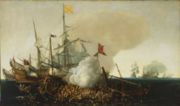
Zymen Danseker
Siemen Danziger , better known by his anglicized names Zymen Danseker and Simon de Danser, was a 17th century Dutch privateer and corsair...
(Simon de Danser), who used the Barbary ports as bases for attacking Spanish shipping during the Dutch Revolt
Dutch Revolt
The Dutch Revolt or the Revolt of the Netherlands This article adopts 1568 as the starting date of the war, as this was the year of the first battles between armies. However, since there is a long period of Protestant vs...
. They cooperated with local raiders and introduced them to the latest Dutch sailing rigs, enabling them to brave Atlantic waters. Some of these Dutch corsairs converted to Islam and settled permanently in North Africa. Two examples are Süleyman Reis, "De Veenboer", who became admiral of the Algerian corsair fleet in 1617, and his quartermaster Murat Reis, born Jan Janszoon
Jan Janszoon
Jan Janszoon van Haarlem, commonly known as Murat Reis the younger was the first President and Grand Admiral of the Corsair Republic of Salé, Governor of Oualidia, and a Dutch pirate, one of the most notorious of the Barbary pirates from the 17th century; the most famous of the "Salé...
. Both worked for the notorious Dutch corsair Zymen Danseker
Zymen Danseker
Siemen Danziger , better known by his anglicized names Zymen Danseker and Simon de Danser, was a 17th century Dutch privateer and corsair...
.
In 1607, the Order of Malta
Knights Hospitaller
The Sovereign Military Hospitaller Order of Saint John of Jerusalem of Rhodes and of Malta , also known as the Sovereign Military Order of Malta , Order of Malta or Knights of Malta, is a Roman Catholic lay religious order, traditionally of military, chivalrous, noble nature. It is the world's...
went on the offensive with forty-five galleys, capturing and pillaging the city of Bona
Bona
- Places :* The former name of Annaba, a city in northeastern Algeria* Bona, Sweden, a town in Östergötland County, Sweden- Persons :* Bona of Pisa - Places :* The former name of Annaba, a city in northeastern Algeria* Bona, Sweden, a town in Östergötland County, Sweden- Persons :* Bona of Pisa -...
in Algeria. The participation of the Knights of Saint Stephen
Order of Saint Stephen
The Order of Saint Stephen is a Tuscan dynastic-military order founded in 1561. The order was created by Cosimo I de' Medici, first Grand Duke of Tuscany. The last member of the Medici dynasty to be a leader of the order was Gian Gastone de Medici in 1737...
(under Jacopo Inghirami
Jacopo Inghirami
Jacopo Inghirami was admiral of the Grand Duchy of Tuscany and marquis of Montevitozzo.-Career:Born to an influential family in Volterra in July 1565, Jacopo was orphaned as a teenager...
) in this victory is commemorated by a series of frescoes painted by Bernardino Poccetti
Bernardino Poccetti
Bernardino Poccetti , also known as Barbatelli, was an Italian Mannerist painter and printmaker in etching ....
in the "Sala di Bona" of Palazzo Pitti
Palazzo Pitti
The Palazzo Pitti , in English sometimes called the Pitti Palace, is a vast mainly Renaissance palace in Florence, Italy. It is situated on the south side of the River Arno, a short distance from the Ponte Vecchio...
, Florence
Florence
Florence is the capital city of the Italian region of Tuscany and of the province of Florence. It is the most populous city in Tuscany, with approximately 370,000 inhabitants, expanding to over 1.5 million in the metropolitan area....
.
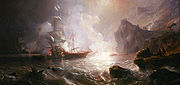
Portugal
Portugal , officially the Portuguese Republic is a country situated in southwestern Europe on the Iberian Peninsula. Portugal is the westernmost country of Europe, and is bordered by the Atlantic Ocean to the West and South and by Spain to the North and East. The Atlantic archipelagos of the...
, south and east Spain
Spain
Spain , officially the Kingdom of Spain languages]] under the European Charter for Regional or Minority Languages. In each of these, Spain's official name is as follows:;;;;;;), is a country and member state of the European Union located in southwestern Europe on the Iberian Peninsula...
, the Balearic Islands
Balearic Islands
The Balearic Islands are an archipelago of Spain in the western Mediterranean Sea, near the eastern coast of the Iberian Peninsula.The four largest islands are: Majorca, Minorca, Ibiza and Formentera. The archipelago forms an autonomous community and a province of Spain with Palma as the capital...
, the Canary Islands
Canary Islands
The Canary Islands , also known as the Canaries , is a Spanish archipelago located just off the northwest coast of mainland Africa, 100 km west of the border between Morocco and the Western Sahara. The Canaries are a Spanish autonomous community and an outermost region of the European Union...
, Sardinia
Sardinia
Sardinia is the second-largest island in the Mediterranean Sea . It is an autonomous region of Italy, and the nearest land masses are the French island of Corsica, the Italian Peninsula, Sicily, Tunisia and the Spanish Balearic Islands.The name Sardinia is from the pre-Roman noun *sard[],...
, Corsica
Corsica
Corsica is an island in the Mediterranean Sea. It is located west of Italy, southeast of the French mainland, and north of the island of Sardinia....
, Elba
Elba
Elba is a Mediterranean island in Tuscany, Italy, from the coastal town of Piombino. The largest island of the Tuscan Archipelago, Elba is also part of the National Park of the Tuscan Archipelago and the third largest island in Italy after Sicily and Sardinia...
, the Italian Peninsula
Italian Peninsula
The Italian Peninsula or Apennine Peninsula is one of the three large peninsulas of Southern Europe , spanning from the Po Valley in the north to the central Mediterranean Sea in the south. The peninsula's shape gives it the nickname Lo Stivale...
(especially the coasts of Liguria
Liguria
Liguria is a coastal region of north-western Italy, the third smallest of the Italian regions. Its capital is Genoa. It is a popular region with tourists for its beautiful beaches, picturesque little towns, and good food.-Geography:...
, Tuscany
Tuscany
Tuscany is a region in Italy. It has an area of about 23,000 square kilometres and a population of about 3.75 million inhabitants. The regional capital is Florence ....
, Lazio, Campania
Campania
Campania is a region in southern Italy. The region has a population of around 5.8 million people, making it the second-most-populous region of Italy; its total area of 13,590 km² makes it the most densely populated region in the country...
, Calabria
Calabria
Calabria , in antiquity known as Bruttium, is a region in southern Italy, south of Naples, located at the "toe" of the Italian Peninsula. The capital city of Calabria is Catanzaro....
and Apulia
Apulia
Apulia is a region in Southern Italy bordering the Adriatic Sea in the east, the Ionian Sea to the southeast, and the Strait of Òtranto and Gulf of Taranto in the south. Its most southern portion, known as Salento peninsula, forms a high heel on the "boot" of Italy. The region comprises , and...
), Sicily
Sicily
Sicily is a region of Italy, and is the largest island in the Mediterranean Sea. Along with the surrounding minor islands, it constitutes an autonomous region of Italy, the Regione Autonoma Siciliana Sicily has a rich and unique culture, especially with regard to the arts, music, literature,...
and Malta
Malta
Malta , officially known as the Republic of Malta , is a Southern European country consisting of an archipelago situated in the centre of the Mediterranean, south of Sicily, east of Tunisia and north of Libya, with Gibraltar to the west and Alexandria to the east.Malta covers just over in...
. They also occurred on the Atlantic northwest coast of the Iberian Peninsula
Iberian Peninsula
The Iberian Peninsula , sometimes called Iberia, is located in the extreme southwest of Europe and includes the modern-day sovereign states of Spain, Portugal and Andorra, as well as the British Overseas Territory of Gibraltar...
. In 1617, the African corsairs launched their major attack in the region when they destroyed and sacked Bouzas, Cangas
Cangas
Cangas do Morrazo is a municipality in Galicia, Spain in the province of Pontevedra.-External links:**...
and the churches of Moaña
Moaña
Moaña is a municipality of 18,709 inhabitants located in Galicia, Spain in the province of Pontevedra.It is one of the five municipalities with Bueu, Cangas do Morrazo, Marin and Vilaboa that forms the peninsula of O Morrazo...
and Darbo.
Occasionally coastal raids reached farther afield. Iceland
Iceland
Iceland , described as the Republic of Iceland, is a Nordic and European island country in the North Atlantic Ocean, on the Mid-Atlantic Ridge. Iceland also refers to the main island of the country, which contains almost all the population and almost all the land area. The country has a population...
was subject to raids in 1627. Jan Janszoon, (Murat Reis the Younger) is said to have taken 400 prisoners; 242 of the captives later were sold into slavery on the Barbary Coast
Barbary Coast
The Barbary Coast, or Barbary, was the term used by Europeans from the 16th until the 19th century to refer to much of the collective land of the Berber people. Today, the terms Maghreb and "Tamazgha" correspond roughly to "Barbary"...
. The corsairs took only young people and those in good physical condition. All those offering resistance were killed, and the old people were gathered into a church which was set on fire. Among those captured was Ólafur Egilsson
Ólafur Egilsson
Ólafur Egilsson was an Icelandic priest. He was abducted along with his wife and two sons by Barbary Pirates during their raid on Vestmannaeyjar. This raid is known in Icelandic history as Tyrkjaránið . He returned to Vestmannaeyjar in 1628 but his wife Ásta Þorsteinsdóttir did not return until...
, who was ransomed the next year and, upon returning to Iceland, wrote a slave narrative
Slave narrative
The slave narrative is a literary form which grew out of the written accounts of enslaved Africans in Britain and its colonies, including the later United States, Canada and Caribbean nations...
about his experience.
Ireland
Ireland
Ireland is an island to the northwest of continental Europe. It is the third-largest island in Europe and the twentieth-largest island on Earth...
was subject to a similar attack. In June 1631 Murat Reis, with corsairs from Algiers and armed troops of the Ottoman Empire
Ottoman Empire
The Ottoman EmpireIt was usually referred to as the "Ottoman Empire", the "Turkish Empire", the "Ottoman Caliphate" or more commonly "Turkey" by its contemporaries...
, stormed ashore at the little harbor village of Baltimore, County Cork
Baltimore, County Cork
Baltimore is located in western County Cork, Ireland. Baltimore is the principal village of the parish of Rath and the Islands, the southernmost parish in Ireland...
. They captured almost all the villagers
Sack of Baltimore
The Sack of Baltimore took place on June 20, 1631, when the village of Baltimore, West Cork, Ireland, was attacked by North African pirates from the North African Barbary Coast. The attack was the biggest single attack by the Barbary pirates on Ireland or Britain. The attack was led by a Dutch...
and took them away to a life of slavery in North Africa. The prisoners were destined for a variety of fates — some lived out their days chained to the oars as galley slaves, while others would spend long years in the scented seclusion of the harem or within the walls of the sultan's palace. Only two of them ever saw Ireland
Ireland
Ireland is an island to the northwest of continental Europe. It is the third-largest island in Europe and the twentieth-largest island on Earth...
again.
More than 20,000 captives were said to be imprisoned in Algiers alone. The rich were often able to secure release through ransom, but the poor were condemned to slavery. Their masters would on occasion allow them to secure freedom by professing Islam. A long list might be given of people of good social position, not only Italians or Spaniards, but German or English travelers in the south, who were captives for a time. While the chief victims were the inhabitants of the coasts of Sicily
Sicily
Sicily is a region of Italy, and is the largest island in the Mediterranean Sea. Along with the surrounding minor islands, it constitutes an autonomous region of Italy, the Regione Autonoma Siciliana Sicily has a rich and unique culture, especially with regard to the arts, music, literature,...
, Naples
Naples
Naples is a city in Southern Italy, situated on the country's west coast by the Gulf of Naples. Lying between two notable volcanic regions, Mount Vesuvius and the Phlegraean Fields, it is the capital of the region of Campania and of the province of Naples...
and Spain, all traders of nations which did not pay tribute for immunity or force the Barbary States to leave them alone were liable to be taken at sea. Religious orders — the Redemptorists
Congregation of the Most Holy Redeemer
The Congregation of the Most Holy Redeemer is a Roman Catholic missionary Congregation founded by Saint Alphonsus Liguori at Scala, near Amalfi, Italy for the purpose of labouring among the neglected country people in the neighbourhood of Naples.Members of the Congregation, priests and brothers,...
and Lazarists
Lazarists
Congregation of the Mission is a vowed order of priests and brothers associated with the Vincentian Family, a loose federation of organizations who claim St. Vincent de Paul as their founder or Patron...
— worked for the redemption of captives, and large legacies were left for that purpose in many countries.
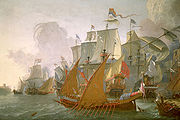
The most successful of the Christian states in dealing with the corsair threat was England. From the 1630s onwards England had signed peace treaties with the Barbary States on various occasions, but invariably breaches of these agreements led to renewed wars. A particular bone of contention was the tendency of foreign ships to pose as English to avoid attack. However, growing English naval power and increasingly persistent operations against the corsairs proved increasingly costly for the Barbary States. During the reign of Charles II
Charles II of England
Charles II was monarch of the three kingdoms of England, Scotland, and Ireland.Charles II's father, King Charles I, was executed at Whitehall on 30 January 1649, at the climax of the English Civil War...
a series of English expeditions won victories over raiding squadrons and mounted attacks on their home ports which permanently ended the Barbary threat to English shipping. In 1675 a Royal Navy
Royal Navy
The Royal Navy is the naval warfare service branch of the British Armed Forces. Founded in the 16th century, it is the oldest service branch and is known as the Senior Service...
squadron led by Sir John Narborough
John Narborough
Rear-Admiral Sir John Narborough or Narbrough was an English naval commander of the 17th century. He served with distinction during the Anglo-Dutch Wars and against the Barbary Coast pirates.-Early life:...
negotiated a lasting peace with Tunis and, after bombarding the city to induce compliance, with Tripoli. Peace with Sale followed in 1676. Algiers, the most powerful of the Barbary States, returned to war the following year, breaking a treaty made in 1671, but further defeats at the hands of an English squadron under Arthur Herbert
Arthur Herbert, 1st Earl of Torrington
Arthur Herbert, 1st Earl of Torrington was a British admiral and politician of the late 17th and early 18th century. Cashiered as a rear-admiral by James II of England in 1688 for refusing to vote to repeal the Test Act, which prevented Catholics from holding offices, he brought the Invitation to...
forced Algiers to make peace again in 1682, in a treaty which would last until 1816. France, which had recently emerged as a leading naval power, achieved comparable success soon afterwards, with bombardments of Algiers in 1682, 1683 and 1688 securing a lasting peace, while Tripoli was similarly coerced in 1686.
18th-19th centuries
Bombardment of Algiers (1784)
The 2nd Bombardment of Algiers took place between 12 and 21 July 1784. A joint Spanish-Neapolitan-Maltese-Portuguese fleet commanded by the experienced Spanish Admiral Antonio Barceló bombarded the city, which was the main base of the Barbary corsairs, with the aim of forcing them to interrupt...
, admiral Barceló
Antonio Barceló
Don Antonio Barceló was a Spanish Balear mariner, lieutenant general of the Spanish Royal Armada.He is famous for his anti-Algerian privateer campaigns, bombardments of Algiers and use of Floating...
damaged the city so severely that the Algerian Dey
Dey
Dey was the title given to the rulers of the Regency of Algiers and Tripoli under the Ottoman Empire from 1671 onwards...
asked Spain to negotiate a peace treaty and from then on Spanish vessels and coasts were safe for several years.
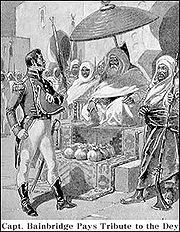
Until the Declaration of Independence in 1776 British treaties with the North African states protected American ships from the Barbary corsairs. Morocco
Morocco
Morocco , officially the Kingdom of Morocco , is a country located in North Africa. It has a population of more than 32 million and an area of 710,850 km², and also primarily administers the disputed region of the Western Sahara...
, which in 1777 was the first independent nation to publicly recognize the United States, became in 1784 the first Barbary power to seize an American vessel after independence. The Barbary threat led directly to the creation of the United States Navy
United States Navy
The United States Navy is the naval warfare service branch of the United States Armed Forces and one of the seven uniformed services of the United States. The U.S. Navy is the largest in the world; its battle fleet tonnage is greater than that of the next 13 largest navies combined. The U.S...
in March 1794. While the United States managed to secure peace treaties these obliged it to pay tribute for protection from attack. Payments in ransom and tribute to the Barbary states amounted to 20% of United States government annual expenditures in 1800. Two wars
Barbary Wars
The Barbary Wars were a series of wars between the United States of America and the Barbary States of North Africa in the late 18th and early 19th centuries. At issue was the Barbary pirates' demand of tribute from American merchant vessels in the Mediterranean Sea. If ships failed to pay, pirates...
in 1801-5 and 1815 led to more favourable peace terms ending the payment of tribute, but Algiers broke the 1805 peace treaty after only two years, and subsequently refused to implement the 1815 treaty until compelled to do so by Britain in 1816.
The Congress of Vienna
Congress of Vienna
The Congress of Vienna was a conference of ambassadors of European states chaired by Klemens Wenzel von Metternich, and held in Vienna from September, 1814 to June, 1815. The objective of the Congress was to settle the many issues arising from the French Revolutionary Wars, the Napoleonic Wars,...
in 1814-5, which ended the Napoleonic Wars
Napoleonic Wars
The Napoleonic Wars were a series of wars declared against Napoleon's French Empire by opposing coalitions that ran from 1803 to 1815. As a continuation of the wars sparked by the French Revolution of 1789, they revolutionised European armies and played out on an unprecedented scale, mainly due to...
, led to increased consensus on the need to achieve a general halt to Barbary raiding. The sacking of Palma on the island of Sardinia
Sardinia
Sardinia is the second-largest island in the Mediterranean Sea . It is an autonomous region of Italy, and the nearest land masses are the French island of Corsica, the Italian Peninsula, Sicily, Tunisia and the Spanish Balearic Islands.The name Sardinia is from the pre-Roman noun *sard[],...
by a Tunisian squadron, which carried off 158 inhabitants, roused widespread indignation. Britain had by this time banned the slave trade and was seeking to induce other countries to do likewise. This led to complaints from states which were still vulnerable to the corsairs that Britain's enthusiasm for ending the trade in African slaves did not extend to stopping the enslavement of Europeans and Americans by the Barbary States.
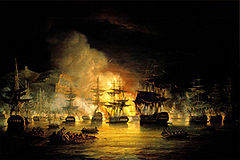
Edward Pellew, 1st Viscount Exmouth
Admiral Sir Edward Pellew, 1st Viscount Exmouth, GCB was a British naval officer. He fought during the American War of Independence, the French Revolutionary, and the Napoleonic Wars...
was sent to secure new concessions from Tripoli, Tunis and Algiers, including a pledge to treat Christian captives in any future conflict as prisoners of war rather than slaves and the imposition of peace between Algiers and the kingdoms of Sardinia
Kingdom of Sardinia
The Kingdom of Sardinia consisted of the island of Sardinia first as a part of the Crown of Aragon and subsequently the Spanish Empire , and second as a part of the composite state of the House of Savoy . Its capital was originally Cagliari, in the south of the island, and later Turin, on the...
and Sicily
Kingdom of the Two Sicilies
The Kingdom of the Two Sicilies, commonly known as the Two Sicilies even before formally coming into being, was the largest and wealthiest of the Italian states before Italian unification...
. On his first visit he negotiated satisfactory treaties and sailed for home. While he was negotiating, a number of Sardinian fishermen who had settled at Bona
Annaba
Annaba is a city in the northeastern corner of Algeria near the river Seybouse. It is located in Annaba Province. With a population of 257,359 , it is the fourth largest city in Algeria. It is a leading industrial centre in eastern Algeria....
on the Tunisian coast were brutally treated without his knowledge. As Sardinians they were technically under British protection and the government sent Exmouth back to secure reparation. On August 17, in combination with a Dutch squadron under Admiral Van de Capellen, he bombarded Algiers
Bombardment of Algiers
The Bombardment of Algiers was an attempt by Britain to end the slavery practices of the Dey of Algiers. An Anglo-Dutch fleet under the command of Admiral Lord Exmouth bombarded ships and the harbour defences of Algiers....
. Both Algiers and Tunis made fresh concessions as a result.
However, securing uniform compliance with a total prohibition of slave-raiding, which was traditionally of central importance to the North African economy, presented difficulties beyond those faced in ending attacks on ships of individual nations, which had left slavers able to continue their accustomed way of life by preying on less well-protected peoples. Algiers subsequently renewed its slave-raiding, though on a smaller scale. Measures to be taken against the city's government were discussed at the Congress of Aix-la-Chapelle
Congress of Aix-la-Chapelle (1818)
The Congress or Conference of Aix-la-Chapelle , held in the autumn of 1818, was primarily a meeting of the four allied powers Britain, Austria, Prussia and Russia to decide the question of the withdrawal of the army of occupation from France and the nature of the modifications to be introduced in...
in 1818. In 1824 another British fleet under Admiral Sir Harry Neal again bombarded Algiers. Corsair activity based in Algiers did not entirely cease until its conquest by France in 1830.
Barbary slaves
While Barbary corsairs naturally looted the cargo of ships they captured, their primary goal was to capture prisoners on land or at sea and turn them into slaves. Once captured, the slaves were often sold or put to work in various ways in North Africa.The historian Robert C. Davis has estimated that between 1530 and 1780 1-1.25 million Europeans were captured and enslaved in North Africa, principally in Algiers, Tunis, and Tripoli, with further captives in Istanbul and Salé.

Bagnio
A Bagnio was originally a bath or bath-house.The term was then used to name the prison for hostages in Istanbul, which was near the bath-house, and thereafter all the slave prisons in the Ottoman Empire and the Barbary regencies...
s
Galley slaves
Although the conditions in bagnios were harsh, they were better than what the galley slaves had to go through. Barbary galleys were at sea for around eighty to a hundred days a year, so the slaves were not on them constantly, but when they were not rowing the galleys they were forced to do difficult manual labor on land. However, there were some exceptions; "galley slaves of the Ottoman Sultan in Istanbul would be permanently confined to their galleys, and often served extremely long terms, averaging around nineteen years in the late seventeenth-century and early eighteenth-century periods. These slaves rarely got off the galley but lived there for years." During this time, rowers were shackled and chained where they sat, and were never allowed to leave. Sleeping (which was limited), eating, defecation and urination took place at the seat to which they were shackled. There was normally around five or six rowers on each oar. Overseers would walk back and forth and whip the slaves who were not rowing up to par.Freedom for slaves
Barbary slaves could hope to be freed through payment of a ransom. Despite the efforts of middlemen and charities to raise money to provide ransoms, they were still very difficult to come by. Just as charity funding for slave ransoms increased, North African states kept increasing the amount of money that each slave was worth. However, lack of money was not the only problem standing between slaves and their freedom. Slaves would often need to notify their families that they were captive and inform them of the ransom price, and they would also need to pay the hefty mailing charge (which few slaves could afford) and wait several months for the mail to be delivered.For the slaves and their families who were able to come up with the money, actually returning home was not guaranteed either. Redeemed slaves often went through a port to wait for the ransom to be finalized, and in some cases in the 17th and 18th centuries, slaves were kept at these ports as a quarantine due to fear of the plague.
Clearly, not many barbary slaves could depend on being rescued by ransoms, and instead had to look for the chance to escape. This was obviously easier said than done, since only a handful of slaves were actually able to escape. The most famous of runaway slaves was Thomas Pellow, who had the story of his journey published in 1740. After several failed attempts (which nearly resulted in his death), Pellow was finally able to escape to Gibraltar in July 1738.

Famous Barbary corsairs
According to historian Adrian TinniswoodAdrian Tinniswood
Adrian Tinniswood is an English writer and historian.-Life:He studied English and Philosophy at Southampton University and was awarded an MPhil at Leicester University...
, the most notorious corsairs were English and European renegades who had learned their trade as privateer
Privateer
A privateer is a private person or ship authorized by a government by letters of marque to attack foreign shipping during wartime. Privateering was a way of mobilizing armed ships and sailors without having to spend public money or commit naval officers...
s, and who moved to the Barbary Coast during peacetime to pursue their trade. These outcasts brought up-to-date naval expertise to the piracy business, and enabled the corsairs to make long-distance slave-catching raids as far away as Iceland
Iceland
Iceland , described as the Republic of Iceland, is a Nordic and European island country in the North Atlantic Ocean, on the Mid-Atlantic Ridge. Iceland also refers to the main island of the country, which contains almost all the population and almost all the land area. The country has a population...
and Newfoundland. The English corsair Henry Mainwaring
Henry Mainwaring
Sir Henry Mainwaring , was an English pirate, naval officer with the Royal Navy, and author.- Early life :Henry Mainwaring was born in Ightfield in Shropshire, second son of Sir George Mainwaring and his wife Ann, the daughter of Sir William More of Loseley Park in Surrey. His maternal grandfather...
later returned to England with a royal pardon, was knighted, elected to Parliament and appointed a vice admiral of the Royal Navy.
Oruç Barbarossa
The most famous of the corsairs in North Africa were the four Barbarossa brothers, who all became Barbary corsairs. However, only two of the Barbarossas became famous, Oruç and Hızır Hayreddin. Oruç, the oldest who gave the Barbarossas their name because of his red beard, captured the island of Djerba for the Ottoman Empire in 1502 or 1503. Often, Oruç would attack Spanish territories on the coast of North Africa, and during one failed attempt in 1512, Oruç lost his left arm to a cannon ball. The oldest Barbarossa would also go on a rampage through Algiers in 1516 and capture the town with the help of the Ottoman Empire. He executed the ruler of Algiers and everybody he suspected would oppose him, including local rulers. He was finally captured and killed by the Spanish in 1518 and put on display.Hızır Hayreddin Barbarossa
However, Oruç was not the most famous corsair of the Barbarossas since he was more of a land-based corair. His youngest brother Hızır (later named Hayreddin, pronounced Kheir ed-Din) was a more traditional corsair, and was actually a more capable corsair as he was a clever engineer and spoke at least six languages. But Hızır was obviously very fond of his eldest brother, and dyed his hair and beard with a reddish tint to honor Oruç. After capturing many crucial coastal areas, Hayreddin was appointed admiral in chief of the Ottoman sultan's fleet. Under Hızır's command, the Ottoman empire was able to gain control and keep control of the eastern Mediterranean for over thirty years. Barbaros Hızır Hayreddin Pasha died in 1546 of either the plague or fever.Captain Jack Ward
Perhaps the most notorious English corsair was Captain Jack Ward - (also known as John Ward). He was once called, "beyond doubt the greatest scoundrel that ever sailed from England", by the English Ambassador to Venice. Ward was born in Faversham, England, but traveled to Plymouth when he got older in hopes to become a privateer for Queen Elizabeth during her war with Spain. Once the war was over, Ward, like many other ex-privateers, soon became bored with his life. He and some of his mates who were serving on board a naval vessel, decided to capture a ship and sail it to Tunis in North Africa. Here, Ward's ship was renamed Little John and he began his rather successful career as a pirate.Ward captured many ships such as John Keyes' and the Fursman brothers' before he made his riches by capturing a 1500 ton Venetian vessel called Reneira a Soderina. He soon made it his primary boat and armed it with 60 cannons and 380 men. However, after an amazing voyage where he captured vessels whose combined value was around 400,000 crowns, Ward discovered an irreparable leak in the boat and he abandoned it along with most of his crew. Now an extremely wealthy man, Ward hoped to purchase a pardon and finally return home. But when his offer was denied, he stayed in Tunis and built himself a palace with his riches. Ward was the most notorious corsair in Tunis not only for his vast success as a corsair, but also for introducing the concept of using square-rigged and heavily armed ships (as opposed to galleys) to the North African area. This concept was a major reason for the Barbary's future dominance of the Mediterranean. Before dying of the plague in 1622, Jack Ward (like many other Christians who sailed North Africa) abandoned his religion and converted to Islam.
In fiction
Barbary Corsairs are protagonists in Le pantere di Algeri (the panthers of Algiers) by Emilio SalgariEmilio Salgari
Emilio Salgari was an Italian writer of action adventure swashbucklers and a pioneer of science fiction.For over a century, his novels were mandatory reading for generations of youth eager for exotic adventures. In Italy, his extensive body of work was more widely read than that of Dante. Today...
and appear in a number of other famous novels, including Robinson Crusoe
Robinson Crusoe
Robinson Crusoe is a novel by Daniel Defoe that was first published in 1719. Epistolary, confessional, and didactic in form, the book is a fictional autobiography of the title character—a castaway who spends 28 years on a remote tropical island near Trinidad, encountering cannibals, captives, and...
by Daniel Defoe
Daniel Defoe
Daniel Defoe , born Daniel Foe, was an English trader, writer, journalist, and pamphleteer, who gained fame for his novel Robinson Crusoe. Defoe is notable for being one of the earliest proponents of the novel, as he helped to popularise the form in Britain and along with others such as Richardson,...
, The Count of Monte Cristo
The Count of Monte Cristo
The Count of Monte Cristo is an adventure novel by Alexandre Dumas. It is often considered to be, along with The Three Musketeers, Dumas's most popular work. He completed the work in 1844...
by Alexandre Dumas, père
Alexandre Dumas, père
Alexandre Dumas, , born Dumas Davy de la Pailleterie was a French writer, best known for his historical novels of high adventure which have made him one of the most widely read French authors in the world...
, The Wind in the Willows
The Wind in the Willows
The Wind in the Willows is a classic of children's literature by Kenneth Grahame, first published in 1908. Alternately slow moving and fast paced, it focuses on four anthropomorphised animal characters in a pastoral version of England...
by Kenneth Grahame
Kenneth Grahame
Kenneth Grahame was a Scottish writer, most famous for The Wind in the Willows , one of the classics of children's literature. He also wrote The Reluctant Dragon; both books were later adapted into Disney films....
, The Sea Hawk
The Sea Hawk
The Sea Hawk is a novel by Rafael Sabatini, originally published in 1915. The story is set over the years 1588–1593, and concerns a retired Cornish sea-faring gentleman, Sir Oliver Tressilian, who is villainously betrayed by a jealous half-brother. After being forced to serve as a slave on a ...
and the Sword of Islam by Rafael Sabatini
Rafael Sabatini
Rafael Sabatini was an Italian/British writer of novels of romance and adventure.-Life:Rafael Sabatini was born in Iesi, Italy, to an English mother and Italian father...
, The Algerine Captive
The Algerine Captive
The Algerine Captive: or the Life and Adventures of Doctor Updike Underhill: Six Years a Prisoner among the Algerines is a novel published anonymously in 1797 by early American playwright and novelist Royall Tyler...
by Royall Tyler, Master and Commander by Patrick O'Brian
Patrick O'Brian
Patrick O'Brian, CBE , born Richard Patrick Russ, was an English novelist and translator, best known for his Aubrey–Maturin series of novels set in the Royal Navy during the Napoleonic Wars and centred on the friendship of English Naval Captain Jack Aubrey and the Irish–Catalan physician Stephen...
, the Baroque Cycle by Neal Stephenson
Neal Stephenson
Neal Town Stephenson is an American writer known for his works of speculative fiction.Difficult to categorize, his novels have been variously referred to as science fiction, historical fiction, cyberpunk, and postcyberpunk...
, The Walking Drum
The Walking Drum
The Walking Drum is a novel by American author Louis L'Amour. Unlike most of his other novels, it is not set in the American West, but is a historical novel set in 12th century Europe and the Middle East.The main character of the story is Mathurin Kerbouchard...
by Louis Lamour, Doctor Doolittle by Hugh Lofting
Hugh Lofting
Hugh John Lofting was a British author, trained as a civil engineer, who created the character of Doctor Dolittle — one of the classics of children's literature.-Personal life:...
and Corsair
Corsair
Corsairs were privateers, authorized to conduct raids on shipping of a nation at war with France, on behalf of the French Crown. Seized vessels and cargo were sold at auction, with the corsair captain entitled to a portion of the proceeds...
by Clive Cussler. Miguel de Cervantes
Miguel de Cervantes
Miguel de Cervantes Saavedra was a Spanish novelist, poet, and playwright. His magnum opus, Don Quixote, considered the first modern novel, is a classic of Western literature, and is regarded amongst the best works of fiction ever written...
, the Spanish author, was captive for five years as a slave
in the bagnio
Bagnio
A Bagnio was originally a bath or bath-house.The term was then used to name the prison for hostages in Istanbul, which was near the bath-house, and thereafter all the slave prisons in the Ottoman Empire and the Barbary regencies...
of Algiers, and reflected his experience in some of his books, including Don Quixote.
Barbary corsairs also feature in many pornographic novels, such as The Lustful Turk
The Lustful Turk
The Lustful Turk, or Lascivious Scenes from a Harem is a pre-Victorian British erotic epistolary novel first published anonymously in 1828 by John Benjamin Brookes and reprinted by William Dugdale. However, it was not widely known or circulated until the 1893 edition.The novel consists largely of a...
(1828), where the abduction of white women into sexual slavery
Sexual slavery
Sexual slavery is when unwilling people are coerced into slavery for sexual exploitation. The incidence of sexual slavery by country has been studied and tabulated by UNESCO, with the cooperation of various international agencies...
is an abiding interest.
One of the stereotypical features of a pirate in popular culture, the eye patch
Eyepatch
An eyepatch or eye pad is a small patch that is worn in front of one eye. It may be a cloth patch attached around the head by an elastic band or by a string, or an adhesive bandage. It is often worn by people to cover a lost or injured eye, but it also has a therapeutic use in children for the...
, dates back to the Arab
Arab
Arab people, also known as Arabs , are a panethnicity primarily living in the Arab world, which is located in Western Asia and North Africa. They are identified as such on one or more of genealogical, linguistic, or cultural grounds, with tribal affiliations, and intra-tribal relationships playing...
corsair Rahmah ibn Jabir al-Jalahimah, who wore it after losing an eye in battle in the 18th century.
The Little Johnny England song "Lily of Barbary" tells the story of an English man who is enslaved by Barbary Corsairs and sold in Algiers, but is freed when his master dies. He then becomes a merchant and buys the freedom of another English slave girl.
See also
- Barbary Slave TradeBarbary Slave TradeThe Barbary Slave Trade refers to the slave markets which flourished on the Barbary Coast, or modern day Morocco, Algeria, Tunisia and western Libya between the 16th and 19th centuries. These markets prospered while the states were nominally under Ottoman rule, but in reality were mostly autonomous...
- Slavery in the Ottoman Empire
- Turkish AbductionsTurkish AbductionsThe Turkish Abductions were a series of raids that took place in Iceland between July 4 – July 19, 1627. Both Austurland and Vestmannaeyjar were raided by Barbary pirates from the regency of Algiers.In 1627, Jan Janszoon hired a Danish “slave”...
- Barbary treatiesBarbary treatiesThe Barbary Treaties refer to several treaties between the United States of America and the semi-autonomous North African city-states of Algiers, Tunis, and Tripoli, under the rule of the Ottoman Empire, known collectively as the Barbary States....
- GhazwGhazwGhazi or ghazah is an Arabic term that means "to raid/foray." From it evolved the word "Ghazwa" which specifically refers to a battle led by the Islamic prophet Muhammad.In English language literature the word often appears as razzia, deriving from French, although it probably...
- Ottoman NavyOttoman NavyThe Ottoman Navy was established in the early 14th century. During its long existence it was involved in many conflicts; refer to list of Ottoman sieges and landings and list of Admirals in the Ottoman Empire for a brief chronology.- Pre-Ottoman:...
- Islam and slaveryIslam and SlaveryIslamic views on slavery first developed out of the slavery practices of pre-Islamic Arabia. During the wars between different states/tribes in various parts of the world, prisoners/captives were either killed or enslaved...
- List of Ottoman sieges and landings
- Ottoman–Habsburg wars
- Sack of BaltimoreSack of BaltimoreThe Sack of Baltimore took place on June 20, 1631, when the village of Baltimore, West Cork, Ireland, was attacked by North African pirates from the North African Barbary Coast. The attack was the biggest single attack by the Barbary pirates on Ireland or Britain. The attack was led by a Dutch...
- Piyale PashaPiyale PashaPiyale Pasha , born in Viganj on the Pelješac peninsula, was a Croatian Ottoman admiral between 1553 and 1567 and an Ottoman Vizier after 1568. He was also known as Piale Pasha in the West or Pialí Bajá in Spain; )....
- RomegasRomegasMathurin d’Aux de Lescout, called Romegas or Mathurin Romegas , was a scion of the aristocratic Gascony family of d'Aux and a member of the Knights of Saint John...
- Kemal ReisKemal ReisKemal Reis was a Turkish privateer and admiral of the Ottoman Empire. He was also the paternal uncle of the famous Ottoman admiral and cartographer Piri Reis who accompanied him in most of his important naval expeditions....
- Seydi Ali ReisSeydi Ali ReisSeydi Ali Reis was an Ottoman admiral.He commanded the left wing of the Ottoman fleet at the naval Battle of Preveza in 1538....
- Salih ReisSalih ReisSalih Reis was a Turkish privateer and Ottoman admiral. He is alternatively referred to as Salah Rais, Sala Reis, Salih Rais, Salek Rais and Cale Arraez in several European resources, particularly in Spain, France and Italy.In 1529, together with Aydın Reis, he took part in the Turkish-Spanish...
- Kurtoğlu Muslihiddin ReisKurtoglu Muslihiddin ReisKurtoğlu Muslihiddin Reis was a privateer and admiral of the Ottoman Empire, as well as the Sanjak Bey of Rhodes. He played an important role in the Ottoman conquests of Egypt and Rhodes during which he commanded the Ottoman naval forces...
- Kurtoğlu Hızır ReisKurtoglu Hizir ReisKurtoğlu Hızır Reis was an Ottoman admiral who is best known for commanding the Ottoman naval expedition to Sumatra in Indonesia .-Background and family origins:...
- Gedik Ahmed PashaGedik Ahmed PashaGedik Ahmed Pasha was an Ottoman grand vizier as well as an army and navy commander during the reigns of sultans Mehmed the Conqueror and Beyazid II....
- Uluç Ali Reis
- Murat Reis the Elder
- Tybalt RosembraiseTybalt RosembraiseBorn on the island of La Désirade in 1798, of a French hebertist father fleeing the repression of the Committee of public Salute, and of a slave mother descended from the Carib Indians...
- Republic of Bou Regreg
- Turgut ReisTurgut ReisTurgut Reis was an Ottoman Admiral and privateer who also served as Bey of Algiers; Beylerbey of the Mediterranean; and first Bey, later Pasha, of Tripoli. Under his naval command the Ottoman Empire maritime was extended across North Africa...
- MoriscoMoriscoMoriscos or Mouriscos , meaning "Moorish", were the converted Christian inhabitants of Spain and Portugal of Muslim heritage. Over time the term was used in a pejorative sense applied to those nominal Catholics who were suspected of secretly practicing Islam.-Demographics:By the beginning of the...
- U.S. Constitution, Articles Congress could not pay.
Further reading
- Adrian TinniswoodAdrian TinniswoodAdrian Tinniswood is an English writer and historian.-Life:He studied English and Philosophy at Southampton University and was awarded an MPhil at Leicester University...
, Pirates of Barbary: Corsairs, Conquests and Captivity in the Seventeenth-Century Mediterranean, 343 pp. Riverhead Books, 2010. ISBN 978-1594487743. NY Times review - White Gold: The Extraordinary Story of Thomas Pellow and North Africa's One Million European Slaves by Giles Milton (Sceptre, 2005)
- London, Joshua E. Victory in Tripoli: How America's War with the Barbary Pirates Established the U.S. Navy and Shaped a Nation. New Jersey: John Wiley & Sons, Inc., 2005. ISBN 978-0471444152
- The pirate coast : Thomas Jefferson, the first marines and the secret mission of 1805 by Richard Zacks. Hyperion, 2005. ISBN 1-4013-0849-X
- Christian slaves, Muslim masters : white slavery in the Mediterranean, the Barbary Coast, and Italy, 1500-1800 by Robert C. Davis. New York : Palgrave Macmillan, 2003. ISBN 9780333719664
- Piracy, Slavery and Redemption: Barbary Captivity Narratives from Early Modern England by D. J. Vikus (Columbia University Press, 2001)
- The Stolen Village: Baltimore and the Barbary Pirates by Des Ekin ISBN 978-0862789558
- Skeletons on the Zahara: A True Story of Survival by Dean King, ISBN 0-31615935-2