

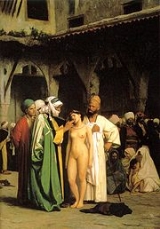
Sexual slavery

Encyclopedia
Sexual slavery is when unwilling people are coerced into slavery
for sexual exploitation
. The incidence of sexual slavery by country has been studied and tabulated by UNESCO
, with the cooperation of various international agencies. Sexual slavery may include single-owner sexual slavery, ritual slavery sometimes associated with certain religious practices, slavery for primarily non-sexual purposes but where non-consensual sex
is common, or forced prostitution
. The Vienna Declaration and Programme of Action
calls for an international response in order to attempt to eradicate sexual slavery on the basis that it is a human rights
issue.
(Article 7(2)(c)), sexual enslavement is the exercise of any or all of the powers attached to the "right of ownership" over a person. It may comprise of repeated sexual abuse or rape
by the captor or forcing the victim to provide sexual services to others, or both. The crime is a continuing offence. The Rome Statute's definition of sexual slavery includes situations where persons are forced into domestic servitude, marriage or any other forced labour that involves sexual activity, as well as the trafficking of persons for sexual purposes, frequently women and children.
involving the recruitment, transportation, transfer, harbour or receipt of persons, by coercive or abusive means for the purpose of sexual exploitation. Sex trafficking is not the only form of human trafficking and estimates as to the percentage of human trafficking which is for the purpose of transporting someone into sexual slavery vary.
The BBC News
cited a report by UNODC
as listing the most common destinations for victims of human trafficking in 2007 as Thailand
and Japan
. The report lists Thailand
, China
, Nigeria
, Albania
, Bulgaria
, Belarus
, Moldova
and Ukraine
as major sources of trafficked persons.
, child pornography
, child sex tourism
, trafficking
of children for sexual purposes, or other forms of transactional sex with children. The Youth Advocate Program International (YAPI) describes CSEC as a form of coercion
and violence
against children and a contemporary form of slavery
.
A declaration of the World Congress Against the Commercial Sexual Exploitation of Children, held in Stockholm in 1996, defined CSEC as, "sexual abuse by the adult and remuneration in cash or in kind to the child or to a third person or persons. The child is treated as a sexual object and as a commercial object".
in which a child performs the services of prostitution
, usually for the financial benefit of an adult.
India
's federal police said in 2009 that they believed around 1.2 million children in India to be involved in prostitution. A CBI statement said that studies and surveys sponsored by the Ministry of Women and Child Development estimated about 40% of India's prostitutes to be children.
Thailand
’s Health System Research Institute reported that children in prostitution make up 40% of prostitutes in Thailand.
In some parts of the world, child prostitution is tolerated or ignored by the authorities. Reflecting an attitude which prevails in many developing countries, a judge from Honduras
said, on condition of anonymity: "If the victim [the child prostitute] is older than 12, if he or she refuses to file a complaint and if the parents clearly profit from their child's commerce, we tend to look the other way".
activities involving a child
; as such, child pornography is a visual record of child sexual abuse
. Abuse of the child occurs during the sexual acts which are photographed in the production of child pornography, and the effects of the abuse on the child (and continuing into maturity) are compounded by the wide distribution and lasting availability of the photographs of the abuse.
. Child sex tourism results in both mental and physical consequences for the exploited children, that may include "disease (including HIV/AIDS), drug addiction, pregnancy, malnutrition, social ostracism, and possibly death", according to the State Department of the United States.
Thailand
, Cambodia
, India
, Brazil
and Mexico
have been identified as leading hotspots of child sexual exploitation.
Sex tourism is a major economic factor in many of these regions, and inside of certain circles particular areas may be well-known as sex-tourism destinations. In one report, the International Labor Organization estimated that between 2-14% of the gross domestic product of Indonesia, Malaysia, the Philippines, and Thailand may be derived from sex tourism.
" or "enforced prostitution" appear in international and humanitarian conventions but have been insufficiently understood and inconsistently applied. "Forced prostitution" generally refers to conditions of control over a person who is coerced by another to engage in sexual activity.
The issue of consent in prostitution is a hotly debated issue. Opinion is places like Europe
has been divided over the question of whether prostitution itself should be considered as a free choice or as inherently exploitative of women . The law (in 2011) in Sweden
, Norway
and Iceland
- where it is illegal to pay for sex, but not to sell sexual services - is based on the notion that all forms of prostitution are inherently exploitative, opposing the notion that prostitution can be voluntary. In contrast, prostitution is a recognized profession in countries such as Netherlands
and Germany
. Some prostitution "abolitionists" promote the viewpoint that all prostitution is to some degree sexual slavery and that even consensual sex between adults is not truly consensual when payment is involved. Many sex workers and sex workers rights activists dispute this view.
In 1949 the UN General Assembly adopted the Convention for the Suppression of the Traffic in Persons and of the Exploitation of the Prostitution of Others (the 1949 Convention). The 1949 Convention supersedes a number of earlier conventions that covered some aspects of forced prostitution. Signatories are charged with three obligations under the 1949 Convention: prohibition of trafficking, specific administrative and enforcement measures, and social measures aimed at trafficked persons. The 1949 Convention presents two shifts in perspective of the trafficking problem in that it views prostitutes as victims of the procurers, and in that it eschews the terms "white slave traffic" and "women," using for the first time race- and gender-neutral language. Article 1 of the 1949 Convention provides punishment for any person who "[p]rocures, entices or leads away, for purposes of prostitution, another person" or "[e]xploits the prostitution of another person, even with the consent of that person." To fall under the provisions of the 1949 Convention, the trafficking need not cross international lines.
Explanatory Memorandum, which defines the jurisdiction of the International Criminal Court
, recognizes rape
, sexual slavery, forced prostitution
, forced pregnancy, forced sterilization
, "or any other form of sexual violence of comparable gravity" as crime against humanity if the action is part of a widespread or systematic practice. Sexual slavery was first recognized as a crime against humanity
when the International Criminal Tribunal for the former Yugoslavia
issued arrest warrants based on the Geneva Conventions
and Violations of the Laws or Customs of War. Specifically, it was recognised that Muslim women in Foča
(southeastern Bosnia and Herzegovina
) were subjected to systematic and widespread gang rape, torture and sexual enslavement by Bosnian Serb soldiers, policemen, and members of paramilitary groups after the takeover of the city in April 1992. The indictment was of major legal significance and was the first time that sexual assaults were investigated for the purpose of prosecution under the rubric of torture and enslavement as a crime against humanity. The indictment was confirmed by a 2001 verdict by the International Criminal Tribunal for the former Yugoslavia
that rape and sexual enslavement are crimes against humanity. This ruling challenged the widespread acceptance of rape and sexual enslavement of women as intrinsic part of war. The International Criminal Tribunal for the former Yugoslavia
found three Bosnian Serb men guilty of rape
of Bosniac (Bosnian Muslim) women and girls - some as young as 12 and 15 years of age - in Foča
, eastern Bosnia and Herzegovina
. The charges were brought as crimes against humanity and war crimes. Furthermore two of the men were found guilty of the crime against humanity of sexual enslavement for holding women and girls captive in a number of de facto detention centers. Many of the women had subsequently disappeared.
 Rape
Rape
and sexual violence
have accompanied warfare in virtually every known historical era. Before the 19th century, military circles supported the notion that all persons, including unarmed women and children, were still the enemy, with the belligerent (nation or person engaged in conflict) having conquering rights over them.
"To the victor goes the spoils" has been a war cry for centuries and women were included as part of the spoils of war. Institutionalised sexual slavery and enforced prostitution have been documented in a number of wars, most notably the Second World War.
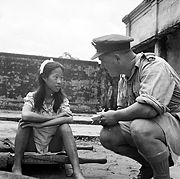
" are a widely publicised example of sexual slavery. The term is a euphemism for the 200,000 women who served in the Japanese
army's
camps during World War II
. Historians and researchers have stated that the majority were from Korea
, China
, and other occupied territories part of the Greater East Asia Co-Prosperity Sphere
, and were recruited by kidnapping or deception to serve as sex slaves. Many women were raped to the point of death or killed by torture, such as having their breasts sliced off or having their abdomens slit open. Each slave was reportedly raped "an average of 10 rapes per day (considered by some to be a low estimate), for a five day work week; this figure can be extrapolated to estimate that each 'comfort girl' was raped around 50 times per week or 2,500 times per year. For three years of service – the average – a comfort girl would have been raped 7,500 times." (Parker 1995 United Nations Commissions on Human Rights)
, Soldier's brothels (Wehrmachtsbordell) were usually organized in already established whorehouses or in hotels confiscated by the Germans. The leaders of the Wehrmacht became interested in running their own brothels when sexual disease spread among the soldiers. In the controlled brothels, the women frequently had a medical check for sexually transmittable diseases.
It is estimated that a minimum of 34,140 women from occupied states worked as prostitutes during the Third Reich. In Eastern Europe the local women were often forced into prostitution. On 3 May 1941 the Foreign Ministry of Polish Government in Exile
issued a document describing the mass raids made in Polish cities with the aim of capturing young women, who later were forced to work in brothels attended by German soldiers and officers. There were often escape attempts, with at least one mass escape known to have been attempted by women in Norway
.
 Bride kidnapping
, also known as marriage by abduction or marriage by capture, is a form of forced marriage
practiced in some traditional cultures. Bride kidnapping has reportedly occured in countries spanning Central Asia
, the Caucasus region
, parts of Africa
, and among the Hmong
in southeast Asia
, the Tzeltal
in Mexico
, and the Romani in Europe
. Though the motivations behind bride kidnapping vary by region, the cultures with traditions of marriage by abduction are generally patriarchal
with a strong social stigma
on sex or pregnancy outside of marriage and illegitimate births. In some cases, the couple collude together to elope under the guise of a bride kidnapping, presenting their parents with a fait accompli (something that is unlikely be changed after the fact). In most cases, however, the men who resort to capturing a wife are often of lower social status
, whether because of poverty, disease, poor character or criminality. These men are sometimes deterred from legitimately seeking a wife because of the payment the woman's family expects, the bride price
(not to be confused with a dowry
, paid by the woman's family).
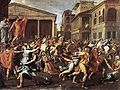
Bride kidnapping is distinguished from raptio
in that the former refers to the abduction of one woman by one man (and/or his friends and relatives), and is often a widespread and ongoing practice, whereas the latter refers to the largescale abduction of women by groups of men, possibly in a time of war (see also war rape
). The Latin term raptio refers to abduction of women, either for marriage
(by kidnapping
or elopement) or enslavement (particularly sexual slavery). In Roman Catholic canon law
, raptio refers to the legal prohibition of matrimony if the bride was abducted forcibly (Canon 1089 CIC
).
The practice of raptio is surmised to have existed since anthropological antiquity. In Neolithic Europe
, excavation of a Linear Pottery culture
site at Asparn-Schletz
, Austria
, unearthed the remains of numerous slain victims. Among them, young adult females and children were clearly under-represented, suggesting that perhaps the attackers had killed the men but abducted the young females.
estimated 400,000, the Federal Bureau of Investigation
estimated 700,000 and UNICEF estimated 1.75 million.
, the Bureau of the Dutch Rapporteur on Trafficking in Human Beings in 2005 estimated that there are from 1,000 to 7,000 trafficking victims a year. Most police investigations relate to legal sex businesses, with all sectors of prostitution being well represented, but with window brothels being particularly overrepresented.
Dutch news site Expatica reported that in 2008, there were 809 registered trafficking victims in the Netherlands; out of those 763 were women and at least 60 percent of them were reportedly forced to work in the sex industry
. Of reported victims, those from Hungary were all female and all forced into prostitution.
In Germany
, the trafficking of women from Eastern Europe
is often organized by people from that same region. German authorities identified 676 sex-trafficking victims in 2008, compared with 689 in 2007. The German Federal Police Office BKA
reported in 2006 a total of 357 completed investigations of human trafficking, with 775 victims. Thirty-five percent of the suspects were Germans born in Germany and 8% were German citizens born outside of Germany.
In Greece
, according to NGO estimates in 2008, there may be a total 13,000–14,000 trafficking victims of all types in the country at any given time. Major countries of origin for trafficking victims brought into Greece include Nigeria, Ukraine, Russia, Bulgaria, Albania, Moldova, Romania, and Belarus.
In Switzerland
, the police estimated in 2006 that there may be between 1,500 and 3,000 victims of all types of human trafficking. The organizers and their victims generally come from Hungary, Slovakia, Romania, Ukraine, Moldova, Lithuania, Brazil, the Dominican Republic, Thailand and Cambodia, and, to a lesser extent, Africa.
In Belgium
, in 2007, prosecutors handled a total of 418 trafficking cases, including 219 economic exploitation and 168 sexual exploitation cases. In the same year, the federal judicial police handled 196 trafficking files, compared with 184 in 2006. In 2007 the police arrested 342 persons for smuggling and trafficking-related crimes. A recent report by RiskMonitor foundation estimated that 70% of the prostitutes who work in Belgium are from Bulgaria
.
In Austria
, Vienna has the largest number of reported trafficking cases, although trafficking is also a problem in urban centers such as Graz, Linz, Salzburg, and Innsbruck. The NGO Lateinamerikanische Frauen in Oesterreich–Interventionsstelle fuer Betroffene des Frauenhandels (LEFOE-IBF) reported assisting 108 victims of all types of human trafficking in 2006, down from 151 in 2005.
In Spain
, in 2007, officials identified 1,035 sex trafficking victims and 445 labor trafficking victims.
the colonial
powers abolished slavery in the nineteenth and twentieth centuries. However, in areas outside their jurisdiction, such as the Mahdist empire in Sudan
, the practice continued to thrive (see also: Slavery in modern Africa
). Now, institutional slavery has been banned worldwide, but there are numerous reports of women sex slaves in areas without effective government control, such as Sudan, Liberia
, Sierra Leone
, northern Uganda
, Congo, Niger
and Mauritania
. In Ghana
, Togo
, and Benin
, a form of religious prostitution
known as trokosi ("ritual servitude
") forcibly keeps thousands of girls and women in traditional shrines as "wives of the gods", where priests perform the sexual function in place of the gods.
stated that India is "becoming a hub" for largescale child prostitution rackets, and suggested the setting up of a special investigating agency to tackle the growing problem.
An article about the Rescue Foundation in New Internationalist magazine states that "according to Save the Children India, clients now prefer 10- to 12-year-old girls". The same article attributes the rising number of prostitutes believed to have contracted HIV in India’s brothels as a factor in India becoming the country with the second-largest number of people living with HIV/AIDS in the world, behind South Africa.
In 2007, the Ministry of Women and Child Development estimated that there are around 2.8 million sex worker
s in India, with 35.47 percent of them entering the trade before the age of 18 years. The number of prostitutes has also doubled in the recent decade. One news article states that an estimated 200,000 Nepal
ese girls have been trafficked to red light areas of India. Nepalese women and girls, especially virgins, are reportedly favoured in India because of their fair skin and young looks. One report estimates that every year between 5,000 and 7,000 Nepalese girls are trafficked into the red light districts in Indian cities, and that many of the girls may only be 9 or 10 years old.
In Pakistan
, young girls have been sold by their families to big-city brothel owners. Often this happens due to poverty or debt, whereby the family has no other way to raise the money than to sell the young girl. Cases have also been reported where wives and sisters have been sold to brothels to raise money for gambling, drinking or drug addictions. Sex slaves are reportedly also bought by 'agents' in Afghanistan
who trick young girls into coming to Pakistan for well-paying jobs. Once in Pakistan they are taken to brothels (called Kharabat) and forced into sexual slavery, some for many years.
In Thailand
, Thailand’s Health System Research Institute reported in 2005 that children in prostitution make up 40% of Thailands prostitutes, and that a proportion of prostitutes over the age of 18, including foreign nationals mostly from Myanmar
, China's Yunnan
province, Laos
and Cambodia
, are also in some state of forced sexual servitude.
The Tourism Police Bureau in 1997 stated that there were 500 Chinese and 200 European women in prostitution in Bangkok, many of whom entered Thailand illegally, often through Burma and Laos. Earlier reports, however, suggest different figures. (Police Colonel Sanit Meephan, deputy chief of Tourism Police Bureau, "Thailand popular haunt for foreign prostitues," The Nation, 15 January 1997)
The trafficking in Persons Report of 2007 from the US Department of State says that sexual slavery exists in the Arab states of the Persian Gulf
, where women and children may be trafficked from the post-Soviet states
, Eastern Europe
, Far East
, Africa
, South Asia
or other parts of the Middle East
.
, Southeast Asia
, and the former Soviet Union, are trafficked into the United States
for the purposes of sexual slavery. An 2006 ABC News story stated that, contrary to existing misconceptions, American citizens may also be coerced into sex slavery.
In 2001 the United States State Department estimated that 50,000 to 100,000 women and girls are trafficked each year into the United States. In 2003, the State Department report estimated that a total of 18,000 to 20,000 individuals were trafficked into the United States for either forced labor or sexual exploitation. The June 2004 report estimated the total trafficked annually at between 14,500 and 17,500. The Bush administration set up 42 Justice Department task forces and spent more than $150 million on attempts to reduce human trafficking.. However, in the seven years since the law was passed, the administration has identified only 1,362 victims of human trafficking brought into the United States since 2000, nowhere near the 50,000 or more per year the government had estimated.
The Girl’s Education & Mentoring Services (GEMS), an organization based in New York, claims that the majority of girls in the sex trade were abused as children. Poverty and a lack of education play major roles in the lives of many women in the sex industry.
According to a report conducted by the University of Pennsylvania, anywhere from 100,000 up to 300,000 American children at any given time may be at risk of exploitation due to factors such as drug use, homelessness, or other factors connected with increased risk for commercial sexual exploitation. However, the report emphasized, “The numbers presented in these exhibits do not, therefore, reflect the actual number of cases of CSEC in the United States but, rather, what we estimate to be the number of children ‘at risk’ of commercial sexual exploitation.”
The 2010 Trafficking in Persons report described the United States as, "a source, transit, and destination country for men, women, and children subjected to trafficking in persons, specifically forced labor, debt bondage, and forced prostitution."
Sexual slavery in the United States may occur in multiple forms and in multiple venues. Sex trafficking in the United States may be present in Asian massage parlors, Mexican cantina
bars, residential brothels, or street-based pimp
-controlled prostitution. There is currently a debate among the anti-trafficking community in the United States over the extent of sexual slavery. Some groups arguing that exploitation is inherent in the act of commercial sex, while other groups take a stricter approach to defining sexual slavery, considering an element of force, fraud or coercion
to be necessary for sex slavery to exist.
The prostitutes in illegal massage parlors may be forced to work out of apartment complexes for many hours a day. Many clients may not realize that some of the women who work in these massage sex parlors are actually forced in prostitution. The women may initially be lured into the US under false pretenses. In huge debt to their 'owners', they are then forced to earn enough to eventually buy their freedom. In some cases women who have been sex trafficked may have have to undergo plastic surgery or even forced abortions. An article in the Berkeley University Press reports that human trafficking and sexual enslavement are not limited to any specific location or social class, and concludes that there is a strong reliance on individuals to report suspicious behavior, because the psychological and physical abuse occurs which can often leave a victim unable to escape on their own.
In 2000 Congress created the Victims of Trafficking and Violence Protection Act with tougher punishments for sex traffickers and also the creation of the possibility for former sex slaves to obtain a T-1 visa. To obtain the visa women must, "prove they were enslaved by 'force, fraud or coercion'." The visa former victims of sex trafficking to stay in the United States for 3 years and then apply for a green card.
In the United States the Fundamentalist Church of Jesus Christ of Latter Day Saints
has also been implicated in the trafficking of underage women across state and international boundaries (US/Canada). In most cases, this is for the continuation of polygamous
practices, in the form of plural marriage
.
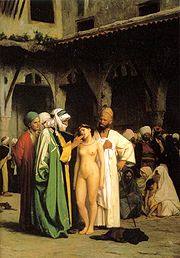 The term "white slavery" can be dated back at least to Hannah Moore's 1804 letter to the editor of the Christian Observer
and again in "A Letter on the Horrors of White Slavery" by Richard Oastler
. In English-speaking countries in the 19th and early 20th centuries, the term "white slavery" was used to refer to sexual enslavement of white women. It was particularly associated with orientalist
accounts of women enslaved in Middle Eastern harems, such as the so-called Circassian beauties
. The term gradually came to be used as a euphemism for prostitution
. The phrase was especially common in the context of the exploitation of minors, with the implication that children and young women in such circumstances were not free to decide their own fate.
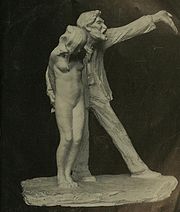 In Victorian
Britain
, campaigning journalist William Thomas Stead
, (editor of the Pall Mall Gazette
) procured a 13 year-old girl for £5, an amount then equal to a labourer's monthly wage (see the Eliza Armstrong case
). Panic
over the "traffic in women" rose to a peak in England in the 1880s. At the time, "white slavery" was a natural target for defenders of public morality and crusading journalists. The ensuing outcry led to the passage of antislavery legislation in Parliament.
Meanwhile in Argentina, the criminal organization Zwi Migdal
operated in white slavery and prostitution
from the 1860s until 1939.
Parliament passed the 1885 Criminal Law Amendment Act
, raising the age of consent
from thirteen to sixteen in that year.
A subsequent scare occurred in the United States in the early twentieth century, peaking in 1910, when Chicago
's U.S. attorney announced (without giving details) that an international crime ring was abducting young girls in Europe
, importing them, and forcing them to work in Chicago brothel
s. These claims, and the panic
they inflamed, led to the passage of the United States White-Slave Traffic Act
of 1910. It also banned the interstate transport of females for immoral purposes. Its primary intent was to address prostitution
and immorality. The act is better known as the Mann Act
, after James Robert Mann, an American lawmaker.
Chinese
immigrants in the U.S. were singled out as white slavers, although any such activity was restricted to the criminal segment of the Chinese community. As an example of this in American culture, the musical comedy Thoroughly Modern Millie
features a Chinese-run prostitution ring, which is specifically referred to as "white slavery." The gangster movie Prime Cut
has mid-West white slaves sold like cattle.
). These slaves came largely from Sub-Saharan Africa
(mainly Zanj
), the Caucasus
(mainly Circassians), Central Asia
(mainly Turks), and Central
and Eastern Europe
(mainly Saqaliba
). The Barbary pirates also captured 1.25 million slaves from Western Europe
between the sixteenth and nineteenth centuries.
In contrast to the Atlantic slave trade
where the male-female ratio was 2:1 or 3:1, the Arab slave trade usually had a higher female:male ratio instead, suggesting a general preference for female slaves. Concubinage
and reproduction served as incentives for importing female slaves (often Caucasian), though many were also imported mainly for performing household tasks.
visitors and their South Asia
n lascar (and sometimes Africa
n) crewmembers often engaged in slavery in Japan
, where they bought or captured young Japanese
women and girls, who were either used as sexual slaves on their ships or taken to Macau
and other Portuguese colonies
in Southeast Asia
, the Americas
, and India
. For example, in Goa
, a Portuguese colony in India
, there was a community of Japanese slaves and traders during the late 16th and 17th centuries.
In the 19th and early 20th centuries, there was a network of Chinese
and Japanese prostitutes being trafficked across Asia, in countries such as China
, Japan
, Korea
, Singapore
and British India, in what was then known as the ’Yellow Slave Traffic’. There was also a network of prostitutes from continental Europe
being trafficked to India
, Ceylon
, Singapore, China and Japan at around the same time, in what was then known as the ’White Slave Traffic’.
During World War II
, Japanese
soldiers engaged in sexual slavery during their invasions across East Asia
and Southeast Asia
. The term "comfort women
" is a euphemism
for the estimated 200,000, mostly Korean, Chinese, and Filipino women who were forced into prostitution in Japanese military
brothels during World War II.
practice of a white man taking a black
woman to whom he was not married as his concubine
. The term "paramour rights" was first used by Zora Neale Hurston
. The practice began prior to the Civil War
and was reinforced afterward by anti-miscegenation laws
, which prohibited interracial marriage
between whites and non-whites. Hurston first wrote about the practice in her anthropological
studies of the turpentine camps of North Florida
in the 1930s. She believed that the death knell of paramour rights was sounded by the trial of Ruby McCollum
, a black woman who murdered her white lover, Dr. C. Leroy Adams, in Live Oak, Florida
, in 1952. McCollum's trial was covered by Hurston for the Pittsburgh Courier
.
Slavery
Slavery is a system under which people are treated as property to be bought and sold, and are forced to work. Slaves can be held against their will from the time of their capture, purchase or birth, and deprived of the right to leave, to refuse to work, or to demand compensation...
for sexual exploitation
Exploitation
This article discusses the term exploitation in the meaning of using something in an unjust or cruel manner.- As unjust benefit :In political economy, economics, and sociology, exploitation involves a persistent social relationship in which certain persons are being mistreated or unfairly used for...
. The incidence of sexual slavery by country has been studied and tabulated by UNESCO
UNESCO
The United Nations Educational, Scientific and Cultural Organization is a specialized agency of the United Nations...
, with the cooperation of various international agencies. Sexual slavery may include single-owner sexual slavery, ritual slavery sometimes associated with certain religious practices, slavery for primarily non-sexual purposes but where non-consensual sex
Sex
In biology, sex is a process of combining and mixing genetic traits, often resulting in the specialization of organisms into a male or female variety . Sexual reproduction involves combining specialized cells to form offspring that inherit traits from both parents...
is common, or forced prostitution
Forced prostitution
Forced prostitution, also known as involuntary prostitution, is the act of performing sexual activity in exchange for money on a non-voluntary basis. There are a wide range of entry routes into prostitution, ranging from "voluntary and deliberate" entry, "semi-voluntary" based on pressure of...
. The Vienna Declaration and Programme of Action
Vienna Declaration and Programme of Action
The Vienna Declaration and Programme of Action, also known as VDPA, is a human rights declaration adopted by consensus at the World Conference on Human Rights on 25 June 1993 in Vienna, Austria...
calls for an international response in order to attempt to eradicate sexual slavery on the basis that it is a human rights
Human rights
Human rights are "commonly understood as inalienable fundamental rights to which a person is inherently entitled simply because she or he is a human being." Human rights are thus conceived as universal and egalitarian . These rights may exist as natural rights or as legal rights, in both national...
issue.
Definition of sexual slavery
According to the Rome StatuteRome Statute of the International Criminal Court
The Rome Statute of the International Criminal Court is the treaty that established the International Criminal Court . It was adopted at a diplomatic conference in Rome on 17 July 1998 and it entered into force on 1 July 2002. As of 13 October 2011, 119 states are party to the statute...
(Article 7(2)(c)), sexual enslavement is the exercise of any or all of the powers attached to the "right of ownership" over a person. It may comprise of repeated sexual abuse or rape
Rape
Rape is a type of sexual assault usually involving sexual intercourse, which is initiated by one or more persons against another person without that person's consent. The act may be carried out by physical force, coercion, abuse of authority or with a person who is incapable of valid consent. The...
by the captor or forcing the victim to provide sexual services to others, or both. The crime is a continuing offence. The Rome Statute's definition of sexual slavery includes situations where persons are forced into domestic servitude, marriage or any other forced labour that involves sexual activity, as well as the trafficking of persons for sexual purposes, frequently women and children.
Sex trafficking
Sex trafficking is a type of Human traffickingHuman trafficking
Human trafficking is the illegal trade of human beings for the purposes of reproductive slavery, commercial sexual exploitation, forced labor, or a modern-day form of slavery...
involving the recruitment, transportation, transfer, harbour or receipt of persons, by coercive or abusive means for the purpose of sexual exploitation. Sex trafficking is not the only form of human trafficking and estimates as to the percentage of human trafficking which is for the purpose of transporting someone into sexual slavery vary.
The BBC News
BBC News
BBC News is the department of the British Broadcasting Corporation responsible for the gathering and broadcasting of news and current affairs. The department is the world's largest broadcast news organisation and generates about 120 hours of radio and television output each day, as well as online...
cited a report by UNODC
United Nations Office on Drugs and Crime
The United Nations Office on Drugs and Crime is a United Nations agency that was established in 1997 as the Office for Drug Control and Crime Prevention by combining the United Nations International Drug Control Program and the Crime Prevention and Criminal Justice Division in the United Nations...
as listing the most common destinations for victims of human trafficking in 2007 as Thailand
Thailand
Thailand , officially the Kingdom of Thailand , formerly known as Siam , is a country located at the centre of the Indochina peninsula and Southeast Asia. It is bordered to the north by Burma and Laos, to the east by Laos and Cambodia, to the south by the Gulf of Thailand and Malaysia, and to the...
and Japan
Japan
Japan is an island nation in East Asia. Located in the Pacific Ocean, it lies to the east of the Sea of Japan, China, North Korea, South Korea and Russia, stretching from the Sea of Okhotsk in the north to the East China Sea and Taiwan in the south...
. The report lists Thailand
Thailand
Thailand , officially the Kingdom of Thailand , formerly known as Siam , is a country located at the centre of the Indochina peninsula and Southeast Asia. It is bordered to the north by Burma and Laos, to the east by Laos and Cambodia, to the south by the Gulf of Thailand and Malaysia, and to the...
, China
China
Chinese civilization may refer to:* China for more general discussion of the country.* Chinese culture* Greater China, the transnational community of ethnic Chinese.* History of China* Sinosphere, the area historically affected by Chinese culture...
, Nigeria
Nigeria
Nigeria , officially the Federal Republic of Nigeria, is a federal constitutional republic comprising 36 states and its Federal Capital Territory, Abuja. The country is located in West Africa and shares land borders with the Republic of Benin in the west, Chad and Cameroon in the east, and Niger in...
, Albania
Albania
Albania , officially known as the Republic of Albania , is a country in Southeastern Europe, in the Balkans region. It is bordered by Montenegro to the northwest, Kosovo to the northeast, the Republic of Macedonia to the east and Greece to the south and southeast. It has a coast on the Adriatic Sea...
, Bulgaria
Bulgaria
Bulgaria , officially the Republic of Bulgaria , is a parliamentary democracy within a unitary constitutional republic in Southeast Europe. The country borders Romania to the north, Serbia and Macedonia to the west, Greece and Turkey to the south, as well as the Black Sea to the east...
, Belarus
Belarus
Belarus , officially the Republic of Belarus, is a landlocked country in Eastern Europe, bordered clockwise by Russia to the northeast, Ukraine to the south, Poland to the west, and Lithuania and Latvia to the northwest. Its capital is Minsk; other major cities include Brest, Grodno , Gomel ,...
, Moldova
Moldova
Moldova , officially the Republic of Moldova is a landlocked state in Eastern Europe, located between Romania to the West and Ukraine to the North, East and South. It declared itself an independent state with the same boundaries as the preceding Moldavian Soviet Socialist Republic in 1991, as part...
and Ukraine
Ukraine
Ukraine is a country in Eastern Europe. It has an area of 603,628 km², making it the second largest contiguous country on the European continent, after Russia...
as major sources of trafficked persons.
Commercial sexual exploitation of children
Commercial sexual exploitation of children (CSEC) includes includes child prostitutionProstitution of children
Prostitution of children or child prostitution is the commercial sexual exploitation of children in which a child performs the services of prostitution, for financial benefit. The term normally refers to prostitution by a minor, or person under the local age of majority...
, child pornography
Child pornography
Child pornography refers to images or films and, in some cases, writings depicting sexually explicit activities involving a child...
, child sex tourism
Child sex tourism
Child sex tourism is tourism for the purpose of engaging in the prostitution of children, that is commercially-facilitated child sexual abuse...
, trafficking
Human trafficking
Human trafficking is the illegal trade of human beings for the purposes of reproductive slavery, commercial sexual exploitation, forced labor, or a modern-day form of slavery...
of children for sexual purposes, or other forms of transactional sex with children. The Youth Advocate Program International (YAPI) describes CSEC as a form of coercion
Coercion
Coercion is the practice of forcing another party to behave in an involuntary manner by use of threats or intimidation or some other form of pressure or force. In law, coercion is codified as the duress crime. Such actions are used as leverage, to force the victim to act in the desired way...
and violence
Violence
Violence is the use of physical force to apply a state to others contrary to their wishes. violence, while often a stand-alone issue, is often the culmination of other kinds of conflict, e.g...
against children and a contemporary form of slavery
Slavery
Slavery is a system under which people are treated as property to be bought and sold, and are forced to work. Slaves can be held against their will from the time of their capture, purchase or birth, and deprived of the right to leave, to refuse to work, or to demand compensation...
.
A declaration of the World Congress Against the Commercial Sexual Exploitation of Children, held in Stockholm in 1996, defined CSEC as, "sexual abuse by the adult and remuneration in cash or in kind to the child or to a third person or persons. The child is treated as a sexual object and as a commercial object".
Child prostitution
The prostitution of children is a form of commercial sexual exploitation of childrenCommercial sexual exploitation of children
Commercial sexual exploitation of children constitutes a form of coercion and violence against children and amounts to forced labour and a contemporary form of slavery....
in which a child performs the services of prostitution
Prostitution
Prostitution is the act or practice of providing sexual services to another person in return for payment. The person who receives payment for sexual services is called a prostitute and the person who receives such services is known by a multitude of terms, including a "john". Prostitution is one of...
, usually for the financial benefit of an adult.
India
India
India , officially the Republic of India , is a country in South Asia. It is the seventh-largest country by geographical area, the second-most populous country with over 1.2 billion people, and the most populous democracy in the world...
's federal police said in 2009 that they believed around 1.2 million children in India to be involved in prostitution. A CBI statement said that studies and surveys sponsored by the Ministry of Women and Child Development estimated about 40% of India's prostitutes to be children.
Thailand
Thailand
Thailand , officially the Kingdom of Thailand , formerly known as Siam , is a country located at the centre of the Indochina peninsula and Southeast Asia. It is bordered to the north by Burma and Laos, to the east by Laos and Cambodia, to the south by the Gulf of Thailand and Malaysia, and to the...
’s Health System Research Institute reported that children in prostitution make up 40% of prostitutes in Thailand.
In some parts of the world, child prostitution is tolerated or ignored by the authorities. Reflecting an attitude which prevails in many developing countries, a judge from Honduras
Honduras
Honduras is a republic in Central America. It was previously known as Spanish Honduras to differentiate it from British Honduras, which became the modern-day state of Belize...
said, on condition of anonymity: "If the victim [the child prostitute] is older than 12, if he or she refuses to file a complaint and if the parents clearly profit from their child's commerce, we tend to look the other way".
Child pornography
Child pornography - which some have called 'child abuse images' ) - refers to images or films depicting sexually explicitPornography
Pornography or porn is the explicit portrayal of sexual subject matter for the purposes of sexual arousal and erotic satisfaction.Pornography may use any of a variety of media, ranging from books, magazines, postcards, photos, sculpture, drawing, painting, animation, sound recording, film, video,...
activities involving a child
Child
Biologically, a child is generally a human between the stages of birth and puberty. Some vernacular definitions of a child include the fetus, as being an unborn child. The legal definition of "child" generally refers to a minor, otherwise known as a person younger than the age of majority...
; as such, child pornography is a visual record of child sexual abuse
Child sexual abuse
Child sexual abuse is a form of child abuse in which an adult or older adolescent uses a child for sexual stimulation. Forms of child sexual abuse include asking or pressuring a child to engage in sexual activities , indecent exposure with intent to gratify their own sexual desires or to...
. Abuse of the child occurs during the sexual acts which are photographed in the production of child pornography, and the effects of the abuse on the child (and continuing into maturity) are compounded by the wide distribution and lasting availability of the photographs of the abuse.
Child sex tourism
Child sex tourism is a travel to a foreign country for the purpose of engaging in commercially facilitated child sexual abuseChild sexual abuse
Child sexual abuse is a form of child abuse in which an adult or older adolescent uses a child for sexual stimulation. Forms of child sexual abuse include asking or pressuring a child to engage in sexual activities , indecent exposure with intent to gratify their own sexual desires or to...
. Child sex tourism results in both mental and physical consequences for the exploited children, that may include "disease (including HIV/AIDS), drug addiction, pregnancy, malnutrition, social ostracism, and possibly death", according to the State Department of the United States.
Thailand
Thailand
Thailand , officially the Kingdom of Thailand , formerly known as Siam , is a country located at the centre of the Indochina peninsula and Southeast Asia. It is bordered to the north by Burma and Laos, to the east by Laos and Cambodia, to the south by the Gulf of Thailand and Malaysia, and to the...
, Cambodia
Cambodia
Cambodia , officially known as the Kingdom of Cambodia, is a country located in the southern portion of the Indochina Peninsula in Southeast Asia...
, India
India
India , officially the Republic of India , is a country in South Asia. It is the seventh-largest country by geographical area, the second-most populous country with over 1.2 billion people, and the most populous democracy in the world...
, Brazil
Brazil
Brazil , officially the Federative Republic of Brazil , is the largest country in South America. It is the world's fifth largest country, both by geographical area and by population with over 192 million people...
and Mexico
Mexico
The United Mexican States , commonly known as Mexico , is a federal constitutional republic in North America. It is bordered on the north by the United States; on the south and west by the Pacific Ocean; on the southeast by Guatemala, Belize, and the Caribbean Sea; and on the east by the Gulf of...
have been identified as leading hotspots of child sexual exploitation.
Sex tourism is a major economic factor in many of these regions, and inside of certain circles particular areas may be well-known as sex-tourism destinations. In one report, the International Labor Organization estimated that between 2-14% of the gross domestic product of Indonesia, Malaysia, the Philippines, and Thailand may be derived from sex tourism.
Forced prostitution
Most, if not all, forms of forced prostitution fit the definition of sexual slavery. The terms "forced prostitutionForced prostitution
Forced prostitution, also known as involuntary prostitution, is the act of performing sexual activity in exchange for money on a non-voluntary basis. There are a wide range of entry routes into prostitution, ranging from "voluntary and deliberate" entry, "semi-voluntary" based on pressure of...
" or "enforced prostitution" appear in international and humanitarian conventions but have been insufficiently understood and inconsistently applied. "Forced prostitution" generally refers to conditions of control over a person who is coerced by another to engage in sexual activity.
The issue of consent in prostitution is a hotly debated issue. Opinion is places like Europe
Europe
Europe is, by convention, one of the world's seven continents. Comprising the westernmost peninsula of Eurasia, Europe is generally 'divided' from Asia to its east by the watershed divides of the Ural and Caucasus Mountains, the Ural River, the Caspian and Black Seas, and the waterways connecting...
has been divided over the question of whether prostitution itself should be considered as a free choice or as inherently exploitative of women . The law (in 2011) in Sweden
Sweden
Sweden , officially the Kingdom of Sweden , is a Nordic country on the Scandinavian Peninsula in Northern Europe. Sweden borders with Norway and Finland and is connected to Denmark by a bridge-tunnel across the Öresund....
, Norway
Norway
Norway , officially the Kingdom of Norway, is a Nordic unitary constitutional monarchy whose territory comprises the western portion of the Scandinavian Peninsula, Jan Mayen, and the Arctic archipelago of Svalbard and Bouvet Island. Norway has a total area of and a population of about 4.9 million...
and Iceland
Iceland
Iceland , described as the Republic of Iceland, is a Nordic and European island country in the North Atlantic Ocean, on the Mid-Atlantic Ridge. Iceland also refers to the main island of the country, which contains almost all the population and almost all the land area. The country has a population...
- where it is illegal to pay for sex, but not to sell sexual services - is based on the notion that all forms of prostitution are inherently exploitative, opposing the notion that prostitution can be voluntary. In contrast, prostitution is a recognized profession in countries such as Netherlands
Netherlands
The Netherlands is a constituent country of the Kingdom of the Netherlands, located mainly in North-West Europe and with several islands in the Caribbean. Mainland Netherlands borders the North Sea to the north and west, Belgium to the south, and Germany to the east, and shares maritime borders...
and Germany
Germany
Germany , officially the Federal Republic of Germany , is a federal parliamentary republic in Europe. The country consists of 16 states while the capital and largest city is Berlin. Germany covers an area of 357,021 km2 and has a largely temperate seasonal climate...
. Some prostitution "abolitionists" promote the viewpoint that all prostitution is to some degree sexual slavery and that even consensual sex between adults is not truly consensual when payment is involved. Many sex workers and sex workers rights activists dispute this view.
In 1949 the UN General Assembly adopted the Convention for the Suppression of the Traffic in Persons and of the Exploitation of the Prostitution of Others (the 1949 Convention). The 1949 Convention supersedes a number of earlier conventions that covered some aspects of forced prostitution. Signatories are charged with three obligations under the 1949 Convention: prohibition of trafficking, specific administrative and enforcement measures, and social measures aimed at trafficked persons. The 1949 Convention presents two shifts in perspective of the trafficking problem in that it views prostitutes as victims of the procurers, and in that it eschews the terms "white slave traffic" and "women," using for the first time race- and gender-neutral language. Article 1 of the 1949 Convention provides punishment for any person who "[p]rocures, entices or leads away, for purposes of prostitution, another person" or "[e]xploits the prostitution of another person, even with the consent of that person." To fall under the provisions of the 1949 Convention, the trafficking need not cross international lines.
Crime against humanity
The Rome StatuteRome Statute of the International Criminal Court
The Rome Statute of the International Criminal Court is the treaty that established the International Criminal Court . It was adopted at a diplomatic conference in Rome on 17 July 1998 and it entered into force on 1 July 2002. As of 13 October 2011, 119 states are party to the statute...
Explanatory Memorandum, which defines the jurisdiction of the International Criminal Court
International Criminal Court
The International Criminal Court is a permanent tribunal to prosecute individuals for genocide, crimes against humanity, war crimes, and the crime of aggression .It came into being on 1 July 2002—the date its founding treaty, the Rome Statute of the...
, recognizes rape
Rape
Rape is a type of sexual assault usually involving sexual intercourse, which is initiated by one or more persons against another person without that person's consent. The act may be carried out by physical force, coercion, abuse of authority or with a person who is incapable of valid consent. The...
, sexual slavery, forced prostitution
Prostitution
Prostitution is the act or practice of providing sexual services to another person in return for payment. The person who receives payment for sexual services is called a prostitute and the person who receives such services is known by a multitude of terms, including a "john". Prostitution is one of...
, forced pregnancy, forced sterilization
Compulsory sterilization
Compulsory sterilization also known as forced sterilization programs are government policies which attempt to force people to undergo surgical sterilization...
, "or any other form of sexual violence of comparable gravity" as crime against humanity if the action is part of a widespread or systematic practice. Sexual slavery was first recognized as a crime against humanity
Crime against humanity
Crimes against humanity, as defined by the Rome Statute of the International Criminal Court Explanatory Memorandum, "are particularly odious offenses in that they constitute a serious attack on human dignity or grave humiliation or a degradation of one or more human beings...
when the International Criminal Tribunal for the former Yugoslavia
International Criminal Tribunal for the former Yugoslavia
The International Tribunal for the Prosecution of Persons Responsible for Serious Violations of International Humanitarian Law Committed in the Territory of the Former Yugoslavia since 1991, more commonly referred to as the International Criminal Tribunal for the former Yugoslavia or ICTY, is a...
issued arrest warrants based on the Geneva Conventions
Geneva Conventions
The Geneva Conventions comprise four treaties, and three additional protocols, that establish the standards of international law for the humanitarian treatment of the victims of war...
and Violations of the Laws or Customs of War. Specifically, it was recognised that Muslim women in Foča
Foca
Foča is a town and municipality in southeastern Bosnia and Herzegovina on the Drina river, in the Foča Region of the Republika Srpska entity.-Early history:...
(southeastern Bosnia and Herzegovina
Bosnia and Herzegovina
Bosnia and Herzegovina , sometimes called Bosnia-Herzegovina or simply Bosnia, is a country in Southern Europe, on the Balkan Peninsula. Bordered by Croatia to the north, west and south, Serbia to the east, and Montenegro to the southeast, Bosnia and Herzegovina is almost landlocked, except for the...
) were subjected to systematic and widespread gang rape, torture and sexual enslavement by Bosnian Serb soldiers, policemen, and members of paramilitary groups after the takeover of the city in April 1992. The indictment was of major legal significance and was the first time that sexual assaults were investigated for the purpose of prosecution under the rubric of torture and enslavement as a crime against humanity. The indictment was confirmed by a 2001 verdict by the International Criminal Tribunal for the former Yugoslavia
International Criminal Tribunal for the former Yugoslavia
The International Tribunal for the Prosecution of Persons Responsible for Serious Violations of International Humanitarian Law Committed in the Territory of the Former Yugoslavia since 1991, more commonly referred to as the International Criminal Tribunal for the former Yugoslavia or ICTY, is a...
that rape and sexual enslavement are crimes against humanity. This ruling challenged the widespread acceptance of rape and sexual enslavement of women as intrinsic part of war. The International Criminal Tribunal for the former Yugoslavia
International Criminal Tribunal for the former Yugoslavia
The International Tribunal for the Prosecution of Persons Responsible for Serious Violations of International Humanitarian Law Committed in the Territory of the Former Yugoslavia since 1991, more commonly referred to as the International Criminal Tribunal for the former Yugoslavia or ICTY, is a...
found three Bosnian Serb men guilty of rape
Rape
Rape is a type of sexual assault usually involving sexual intercourse, which is initiated by one or more persons against another person without that person's consent. The act may be carried out by physical force, coercion, abuse of authority or with a person who is incapable of valid consent. The...
of Bosniac (Bosnian Muslim) women and girls - some as young as 12 and 15 years of age - in Foča
Foca
Foča is a town and municipality in southeastern Bosnia and Herzegovina on the Drina river, in the Foča Region of the Republika Srpska entity.-Early history:...
, eastern Bosnia and Herzegovina
Bosnia and Herzegovina
Bosnia and Herzegovina , sometimes called Bosnia-Herzegovina or simply Bosnia, is a country in Southern Europe, on the Balkan Peninsula. Bordered by Croatia to the north, west and south, Serbia to the east, and Montenegro to the southeast, Bosnia and Herzegovina is almost landlocked, except for the...
. The charges were brought as crimes against humanity and war crimes. Furthermore two of the men were found guilty of the crime against humanity of sexual enslavement for holding women and girls captive in a number of de facto detention centers. Many of the women had subsequently disappeared.
Sexual slavery during armed conflict and war
Rape
Rape is a type of sexual assault usually involving sexual intercourse, which is initiated by one or more persons against another person without that person's consent. The act may be carried out by physical force, coercion, abuse of authority or with a person who is incapable of valid consent. The...
and sexual violence
Sexual violence
Sexual violence occurs throughout the world, although in most countries there has been little research conducted on the problem. Due to the private nature of sexual violence, estimating the extent of the problem is difficult...
have accompanied warfare in virtually every known historical era. Before the 19th century, military circles supported the notion that all persons, including unarmed women and children, were still the enemy, with the belligerent (nation or person engaged in conflict) having conquering rights over them.
"To the victor goes the spoils" has been a war cry for centuries and women were included as part of the spoils of war. Institutionalised sexual slavery and enforced prostitution have been documented in a number of wars, most notably the Second World War.
Japan during World War II
"Comfort womenComfort women
The term "comfort women" was a euphemism used to describe women forced into sexual slavery by the Japanese military during World War II.Estimates vary as to how many women were involved, with numbers ranging from as low as 20,000 from some Japanese scholars to as high as 410,000 from some Chinese...
" are a widely publicised example of sexual slavery. The term is a euphemism for the 200,000 women who served in the Japanese
Empire of Japan
The Empire of Japan is the name of the state of Japan that existed from the Meiji Restoration on 3 January 1868 to the enactment of the post-World War II Constitution of...
army's
Imperial Japanese Army
-Foundation:During the Meiji Restoration, the military forces loyal to the Emperor were samurai drawn primarily from the loyalist feudal domains of Satsuma and Chōshū...
camps during World War II
World War II
World War II, or the Second World War , was a global conflict lasting from 1939 to 1945, involving most of the world's nations—including all of the great powers—eventually forming two opposing military alliances: the Allies and the Axis...
. Historians and researchers have stated that the majority were from Korea
Korea
Korea ) is an East Asian geographic region that is currently divided into two separate sovereign states — North Korea and South Korea. Located on the Korean Peninsula, Korea is bordered by the People's Republic of China to the northwest, Russia to the northeast, and is separated from Japan to the...
, China
China
Chinese civilization may refer to:* China for more general discussion of the country.* Chinese culture* Greater China, the transnational community of ethnic Chinese.* History of China* Sinosphere, the area historically affected by Chinese culture...
, and other occupied territories part of the Greater East Asia Co-Prosperity Sphere
Greater East Asia Co-Prosperity Sphere
The Greater East Asia Co-Prosperity Sphere was a concept created and promulgated during the Shōwa era by the government and military of the Empire of Japan. It represented the desire to create a self-sufficient "bloc of Asian nations led by the Japanese and free of Western powers"...
, and were recruited by kidnapping or deception to serve as sex slaves. Many women were raped to the point of death or killed by torture, such as having their breasts sliced off or having their abdomens slit open. Each slave was reportedly raped "an average of 10 rapes per day (considered by some to be a low estimate), for a five day work week; this figure can be extrapolated to estimate that each 'comfort girl' was raped around 50 times per week or 2,500 times per year. For three years of service – the average – a comfort girl would have been raped 7,500 times." (Parker 1995 United Nations Commissions on Human Rights)
Germany during World War II
During World War II, Germany established brothels in the concentration camps for the sexual gratification of collaborating prisoners (Lagerbordell). The women forced to work in the concentration camp brothels came from the Ravensbrück concentration campRavensbrück concentration camp
Ravensbrück was a notorious women's concentration camp during World War II, located in northern Germany, 90 km north of Berlin at a site near the village of Ravensbrück ....
, Soldier's brothels (Wehrmachtsbordell) were usually organized in already established whorehouses or in hotels confiscated by the Germans. The leaders of the Wehrmacht became interested in running their own brothels when sexual disease spread among the soldiers. In the controlled brothels, the women frequently had a medical check for sexually transmittable diseases.
It is estimated that a minimum of 34,140 women from occupied states worked as prostitutes during the Third Reich. In Eastern Europe the local women were often forced into prostitution. On 3 May 1941 the Foreign Ministry of Polish Government in Exile
Polish government in Exile
The Polish government-in-exile, formally known as the Government of the Republic of Poland in Exile , was the government in exile of Poland formed in the aftermath of the Invasion of Poland of September 1939, and the subsequent occupation of Poland by Nazi Germany and the Soviet Union, which...
issued a document describing the mass raids made in Polish cities with the aim of capturing young women, who later were forced to work in brothels attended by German soldiers and officers. There were often escape attempts, with at least one mass escape known to have been attempted by women in Norway
Norway
Norway , officially the Kingdom of Norway, is a Nordic unitary constitutional monarchy whose territory comprises the western portion of the Scandinavian Peninsula, Jan Mayen, and the Arctic archipelago of Svalbard and Bouvet Island. Norway has a total area of and a population of about 4.9 million...
.
Bride kidnapping and raptio
Bride kidnapping
Bride kidnapping, also known as marriage by abduction or marriage by capture, is a practice throughout history and around the world in which a man abducts the woman he wishes to marry...
, also known as marriage by abduction or marriage by capture, is a form of forced marriage
Marriage
Marriage is a social union or legal contract between people that creates kinship. It is an institution in which interpersonal relationships, usually intimate and sexual, are acknowledged in a variety of ways, depending on the culture or subculture in which it is found...
practiced in some traditional cultures. Bride kidnapping has reportedly occured in countries spanning Central Asia
Central Asia
Central Asia is a core region of the Asian continent from the Caspian Sea in the west, China in the east, Afghanistan in the south, and Russia in the north...
, the Caucasus region
Caucasus
The Caucasus, also Caucas or Caucasia , is a geopolitical region at the border of Europe and Asia, and situated between the Black and the Caspian sea...
, parts of Africa
Africa
Africa is the world's second largest and second most populous continent, after Asia. At about 30.2 million km² including adjacent islands, it covers 6% of the Earth's total surface area and 20.4% of the total land area...
, and among the Hmong
Hmong people
The Hmong , are an Asian ethnic group from the mountainous regions of China, Vietnam, Laos, and Thailand. Hmong are also one of the sub-groups of the Miao ethnicity in southern China...
in southeast Asia
Southeast Asia
Southeast Asia, South-East Asia, South East Asia or Southeastern Asia is a subregion of Asia, consisting of the countries that are geographically south of China, east of India, west of New Guinea and north of Australia. The region lies on the intersection of geological plates, with heavy seismic...
, the Tzeltal
Tzeltal people
The Tzeltal people are the largest indigenous group mostly located in the highlands or Los Altos region of the Mexican state of Chiapas. They are one of many Mayan ethnic groups and they speak a a language which belongs to the Tzeltalan subgroup of Mayan languages...
in Mexico
Mexico
The United Mexican States , commonly known as Mexico , is a federal constitutional republic in North America. It is bordered on the north by the United States; on the south and west by the Pacific Ocean; on the southeast by Guatemala, Belize, and the Caribbean Sea; and on the east by the Gulf of...
, and the Romani in Europe
Europe
Europe is, by convention, one of the world's seven continents. Comprising the westernmost peninsula of Eurasia, Europe is generally 'divided' from Asia to its east by the watershed divides of the Ural and Caucasus Mountains, the Ural River, the Caspian and Black Seas, and the waterways connecting...
. Though the motivations behind bride kidnapping vary by region, the cultures with traditions of marriage by abduction are generally patriarchal
Patriarchy
Patriarchy is a social system in which the role of the male as the primary authority figure is central to social organization, and where fathers hold authority over women, children, and property. It implies the institutions of male rule and privilege, and entails female subordination...
with a strong social stigma
Social stigma
Social stigma is the severe disapproval of or discontent with a person on the grounds of characteristics that distinguish them from other members of a society.Almost all stigma is based on a person differing from social or cultural norms...
on sex or pregnancy outside of marriage and illegitimate births. In some cases, the couple collude together to elope under the guise of a bride kidnapping, presenting their parents with a fait accompli (something that is unlikely be changed after the fact). In most cases, however, the men who resort to capturing a wife are often of lower social status
Social status
In sociology or anthropology, social status is the honor or prestige attached to one's position in society . It may also refer to a rank or position that one holds in a group, for example son or daughter, playmate, pupil, etc....
, whether because of poverty, disease, poor character or criminality. These men are sometimes deterred from legitimately seeking a wife because of the payment the woman's family expects, the bride price
Bride price
Bride price, also known as bride wealth, is an amount of money or property or wealth paid by the groom or his family to the parents of a woman upon the marriage of their daughter to the groom...
(not to be confused with a dowry
Dowry
A dowry is the money, goods, or estate that a woman brings forth to the marriage. It contrasts with bride price, which is paid to the bride's parents, and dower, which is property settled on the bride herself by the groom at the time of marriage. The same culture may simultaneously practice both...
, paid by the woman's family).
Bride kidnapping is distinguished from raptio
Raptio
Raptio is a Latin term referring to the abduction of women, either for marriage or enslavement . In Roman Catholic canon law, raptio refers to the legal prohibition of matrimony if the bride was abducted forcibly...
in that the former refers to the abduction of one woman by one man (and/or his friends and relatives), and is often a widespread and ongoing practice, whereas the latter refers to the largescale abduction of women by groups of men, possibly in a time of war (see also war rape
War rape
War rapes are rapes committed by soldiers, other combatants or civilians during armed conflict or war, or during military occupation, distinguished from sexual assaults and rape committed amongst troops in military service...
). The Latin term raptio refers to abduction of women, either for marriage
Marriage
Marriage is a social union or legal contract between people that creates kinship. It is an institution in which interpersonal relationships, usually intimate and sexual, are acknowledged in a variety of ways, depending on the culture or subculture in which it is found...
(by kidnapping
Kidnapping
In criminal law, kidnapping is the taking away or transportation of a person against that person's will, usually to hold the person in false imprisonment, a confinement without legal authority...
or elopement) or enslavement (particularly sexual slavery). In Roman Catholic canon law
Canon law
Canon law is the body of laws & regulations made or adopted by ecclesiastical authority, for the government of the Christian organization and its members. It is the internal ecclesiastical law governing the Catholic Church , the Eastern and Oriental Orthodox churches, and the Anglican Communion of...
, raptio refers to the legal prohibition of matrimony if the bride was abducted forcibly (Canon 1089 CIC
Canon law (Catholic Church)
The canon law of the Catholic Church, is a fully developed legal system, with all the necessary elements: courts, lawyers, judges, a fully articulated legal code and principles of legal interpretation. It lacks the necessary binding force present in most modern day legal systems. The academic...
).
The practice of raptio is surmised to have existed since anthropological antiquity. In Neolithic Europe
Neolithic Europe
Neolithic Europe refers to a prehistoric period in which Neolithic technology was present in Europe. This corresponds roughly to a time between 7000 BC and c. 1700 BC...
, excavation of a Linear Pottery culture
Linear Pottery culture
The Linear Pottery culture is a major archaeological horizon of the European Neolithic, flourishing ca. 5500–4500 BC.It is abbreviated as LBK , is also known as the Linear Band Ware, Linear Ware, Linear Ceramics or Incised Ware culture, and falls within the Danubian I culture of V...
site at Asparn-Schletz
Asparn an der Zaya
Asparn an der Zaya is a town in the district of Mistelbach in the Austrian state of Lower Austria....
, Austria
Austria
Austria , officially the Republic of Austria , is a landlocked country of roughly 8.4 million people in Central Europe. It is bordered by the Czech Republic and Germany to the north, Slovakia and Hungary to the east, Slovenia and Italy to the south, and Switzerland and Liechtenstein to the...
, unearthed the remains of numerous slain victims. Among them, young adult females and children were clearly under-represented, suggesting that perhaps the attackers had killed the men but abducted the young females.
Contemporary sexual slavery
Official estimates of individuals in sexual slavery worldwide vary. In 2001 the International Organization for MigrationInternational Organization for Migration
The International Organization for Migration is an intergovernmental organization. It was initially established in 1951 as the Intergovernmental Committee for European Migration to help resettle people displaced by World War II....
estimated 400,000, the Federal Bureau of Investigation
Federal Bureau of Investigation
The Federal Bureau of Investigation is an agency of the United States Department of Justice that serves as both a federal criminal investigative body and an internal intelligence agency . The FBI has investigative jurisdiction over violations of more than 200 categories of federal crime...
estimated 700,000 and UNICEF estimated 1.75 million.
Europe
In NetherlandsNetherlands
The Netherlands is a constituent country of the Kingdom of the Netherlands, located mainly in North-West Europe and with several islands in the Caribbean. Mainland Netherlands borders the North Sea to the north and west, Belgium to the south, and Germany to the east, and shares maritime borders...
, the Bureau of the Dutch Rapporteur on Trafficking in Human Beings in 2005 estimated that there are from 1,000 to 7,000 trafficking victims a year. Most police investigations relate to legal sex businesses, with all sectors of prostitution being well represented, but with window brothels being particularly overrepresented.
Dutch news site Expatica reported that in 2008, there were 809 registered trafficking victims in the Netherlands; out of those 763 were women and at least 60 percent of them were reportedly forced to work in the sex industry
Sex industry
The sex industry consists of businesses which either directly or indirectly provide sex-related products and services or adult entertainment...
. Of reported victims, those from Hungary were all female and all forced into prostitution.
In Germany
Germany
Germany , officially the Federal Republic of Germany , is a federal parliamentary republic in Europe. The country consists of 16 states while the capital and largest city is Berlin. Germany covers an area of 357,021 km2 and has a largely temperate seasonal climate...
, the trafficking of women from Eastern Europe
Eastern Europe
Eastern Europe is the eastern part of Europe. The term has widely disparate geopolitical, geographical, cultural and socioeconomic readings, which makes it highly context-dependent and even volatile, and there are "almost as many definitions of Eastern Europe as there are scholars of the region"...
is often organized by people from that same region. German authorities identified 676 sex-trafficking victims in 2008, compared with 689 in 2007. The German Federal Police Office BKA
Federal Criminal Police Office (Germany)
The Federal Criminal Police Office of Germany is a national investigative police agency in Germany and falls directly under the Federal Ministry of the Interior...
reported in 2006 a total of 357 completed investigations of human trafficking, with 775 victims. Thirty-five percent of the suspects were Germans born in Germany and 8% were German citizens born outside of Germany.
In Greece
Greece
Greece , officially the Hellenic Republic , and historically Hellas or the Republic of Greece in English, is a country in southeastern Europe....
, according to NGO estimates in 2008, there may be a total 13,000–14,000 trafficking victims of all types in the country at any given time. Major countries of origin for trafficking victims brought into Greece include Nigeria, Ukraine, Russia, Bulgaria, Albania, Moldova, Romania, and Belarus.
In Switzerland
Switzerland
Switzerland name of one of the Swiss cantons. ; ; ; or ), in its full name the Swiss Confederation , is a federal republic consisting of 26 cantons, with Bern as the seat of the federal authorities. The country is situated in Western Europe,Or Central Europe depending on the definition....
, the police estimated in 2006 that there may be between 1,500 and 3,000 victims of all types of human trafficking. The organizers and their victims generally come from Hungary, Slovakia, Romania, Ukraine, Moldova, Lithuania, Brazil, the Dominican Republic, Thailand and Cambodia, and, to a lesser extent, Africa.
In Belgium
Belgium
Belgium , officially the Kingdom of Belgium, is a federal state in Western Europe. It is a founding member of the European Union and hosts the EU's headquarters, and those of several other major international organisations such as NATO.Belgium is also a member of, or affiliated to, many...
, in 2007, prosecutors handled a total of 418 trafficking cases, including 219 economic exploitation and 168 sexual exploitation cases. In the same year, the federal judicial police handled 196 trafficking files, compared with 184 in 2006. In 2007 the police arrested 342 persons for smuggling and trafficking-related crimes. A recent report by RiskMonitor foundation estimated that 70% of the prostitutes who work in Belgium are from Bulgaria
Bulgaria
Bulgaria , officially the Republic of Bulgaria , is a parliamentary democracy within a unitary constitutional republic in Southeast Europe. The country borders Romania to the north, Serbia and Macedonia to the west, Greece and Turkey to the south, as well as the Black Sea to the east...
.
In Austria
Austria
Austria , officially the Republic of Austria , is a landlocked country of roughly 8.4 million people in Central Europe. It is bordered by the Czech Republic and Germany to the north, Slovakia and Hungary to the east, Slovenia and Italy to the south, and Switzerland and Liechtenstein to the...
, Vienna has the largest number of reported trafficking cases, although trafficking is also a problem in urban centers such as Graz, Linz, Salzburg, and Innsbruck. The NGO Lateinamerikanische Frauen in Oesterreich–Interventionsstelle fuer Betroffene des Frauenhandels (LEFOE-IBF) reported assisting 108 victims of all types of human trafficking in 2006, down from 151 in 2005.
In Spain
Spain
Spain , officially the Kingdom of Spain languages]] under the European Charter for Regional or Minority Languages. In each of these, Spain's official name is as follows:;;;;;;), is a country and member state of the European Union located in southwestern Europe on the Iberian Peninsula...
, in 2007, officials identified 1,035 sex trafficking victims and 445 labor trafficking victims.
Africa
In AfricaAfrica
Africa is the world's second largest and second most populous continent, after Asia. At about 30.2 million km² including adjacent islands, it covers 6% of the Earth's total surface area and 20.4% of the total land area...
the colonial
Colonialism
Colonialism is the establishment, maintenance, acquisition and expansion of colonies in one territory by people from another territory. It is a process whereby the metropole claims sovereignty over the colony and the social structure, government, and economics of the colony are changed by...
powers abolished slavery in the nineteenth and twentieth centuries. However, in areas outside their jurisdiction, such as the Mahdist empire in Sudan
Sudan
Sudan , officially the Republic of the Sudan , is a country in North Africa, sometimes considered part of the Middle East politically. It is bordered by Egypt to the north, the Red Sea to the northeast, Eritrea and Ethiopia to the east, South Sudan to the south, the Central African Republic to the...
, the practice continued to thrive (see also: Slavery in modern Africa
Slavery in modern Africa
Slavery in Africa continues today. Slavery existed in Africa before the arrival of the Atlantic slave trade, as did an internal African slave trade and an Arab slave trade...
). Now, institutional slavery has been banned worldwide, but there are numerous reports of women sex slaves in areas without effective government control, such as Sudan, Liberia
Liberia
Liberia , officially the Republic of Liberia, is a country in West Africa. It is bordered by Sierra Leone on the west, Guinea on the north and Côte d'Ivoire on the east. Liberia's coastline is composed of mostly mangrove forests while the more sparsely populated inland consists of forests that open...
, Sierra Leone
Sierra Leone
Sierra Leone , officially the Republic of Sierra Leone, is a country in West Africa. It is bordered by Guinea to the north and east, Liberia to the southeast, and the Atlantic Ocean to the west and southwest. Sierra Leone covers a total area of and has an estimated population between 5.4 and 6.4...
, northern Uganda
Uganda
Uganda , officially the Republic of Uganda, is a landlocked country in East Africa. Uganda is also known as the "Pearl of Africa". It is bordered on the east by Kenya, on the north by South Sudan, on the west by the Democratic Republic of the Congo, on the southwest by Rwanda, and on the south by...
, Congo, Niger
Niger
Niger , officially named the Republic of Niger, is a landlocked country in Western Africa, named after the Niger River. It borders Nigeria and Benin to the south, Burkina Faso and Mali to the west, Algeria and Libya to the north and Chad to the east...
and Mauritania
Mauritania
Mauritania is a country in the Maghreb and West Africa. It is bordered by the Atlantic Ocean in the west, by Western Sahara in the north, by Algeria in the northeast, by Mali in the east and southeast, and by Senegal in the southwest...
. In Ghana
Ghana
Ghana , officially the Republic of Ghana, is a country located in West Africa. It is bordered by Côte d'Ivoire to the west, Burkina Faso to the north, Togo to the east, and the Gulf of Guinea to the south...
, Togo
Togo
Togo, officially the Togolese Republic , is a country in West Africa bordered by Ghana to the west, Benin to the east and Burkina Faso to the north. It extends south to the Gulf of Guinea, on which the capital Lomé is located. Togo covers an area of approximately with a population of approximately...
, and Benin
Benin
Benin , officially the Republic of Benin, is a country in West Africa. It borders Togo to the west, Nigeria to the east and Burkina Faso and Niger to the north. Its small southern coastline on the Bight of Benin is where a majority of the population is located...
, a form of religious prostitution
Religious prostitution
Sacred prostitution, temple prostitution, or religious prostitution is a practice of worship that includes hieros gamos or sacred marriage performed as a fertility rite and part of sacred sexual ritual.-Ancient Near East:...
known as trokosi ("ritual servitude
Ritual servitude
Ritual servitude is a practice in Ghana, Togo, and Benin where traditional religious shrines take human beings, usually young virgin girls, in payment for services or in religious atonement for alleged misdeeds of a family member—almost always a female...
") forcibly keeps thousands of girls and women in traditional shrines as "wives of the gods", where priests perform the sexual function in place of the gods.
Asia
In January 2010, the supreme court of IndiaIndia
India , officially the Republic of India , is a country in South Asia. It is the seventh-largest country by geographical area, the second-most populous country with over 1.2 billion people, and the most populous democracy in the world...
stated that India is "becoming a hub" for largescale child prostitution rackets, and suggested the setting up of a special investigating agency to tackle the growing problem.
An article about the Rescue Foundation in New Internationalist magazine states that "according to Save the Children India, clients now prefer 10- to 12-year-old girls". The same article attributes the rising number of prostitutes believed to have contracted HIV in India’s brothels as a factor in India becoming the country with the second-largest number of people living with HIV/AIDS in the world, behind South Africa.
In 2007, the Ministry of Women and Child Development estimated that there are around 2.8 million sex worker
Sex worker
A sex worker is a person who works in the sex industry. The term is usually used in reference to those in the sex industry that actually provide such sexual services, as opposed to management and staff of such industries...
s in India, with 35.47 percent of them entering the trade before the age of 18 years. The number of prostitutes has also doubled in the recent decade. One news article states that an estimated 200,000 Nepal
Nepal
Nepal , officially the Federal Democratic Republic of Nepal, is a landlocked sovereign state located in South Asia. It is located in the Himalayas and bordered to the north by the People's Republic of China, and to the south, east, and west by the Republic of India...
ese girls have been trafficked to red light areas of India. Nepalese women and girls, especially virgins, are reportedly favoured in India because of their fair skin and young looks. One report estimates that every year between 5,000 and 7,000 Nepalese girls are trafficked into the red light districts in Indian cities, and that many of the girls may only be 9 or 10 years old.
In Pakistan
Pakistan
Pakistan , officially the Islamic Republic of Pakistan is a sovereign state in South Asia. It has a coastline along the Arabian Sea and the Gulf of Oman in the south and is bordered by Afghanistan and Iran in the west, India in the east and China in the far northeast. In the north, Tajikistan...
, young girls have been sold by their families to big-city brothel owners. Often this happens due to poverty or debt, whereby the family has no other way to raise the money than to sell the young girl. Cases have also been reported where wives and sisters have been sold to brothels to raise money for gambling, drinking or drug addictions. Sex slaves are reportedly also bought by 'agents' in Afghanistan
Afghanistan
Afghanistan , officially the Islamic Republic of Afghanistan, is a landlocked country located in the centre of Asia, forming South Asia, Central Asia and the Middle East. With a population of about 29 million, it has an area of , making it the 42nd most populous and 41st largest nation in the world...
who trick young girls into coming to Pakistan for well-paying jobs. Once in Pakistan they are taken to brothels (called Kharabat) and forced into sexual slavery, some for many years.
In Thailand
Thailand
Thailand , officially the Kingdom of Thailand , formerly known as Siam , is a country located at the centre of the Indochina peninsula and Southeast Asia. It is bordered to the north by Burma and Laos, to the east by Laos and Cambodia, to the south by the Gulf of Thailand and Malaysia, and to the...
, Thailand’s Health System Research Institute reported in 2005 that children in prostitution make up 40% of Thailands prostitutes, and that a proportion of prostitutes over the age of 18, including foreign nationals mostly from Myanmar
Myanmar
Burma , officially the Republic of the Union of Myanmar , is a country in Southeast Asia. Burma is bordered by China on the northeast, Laos on the east, Thailand on the southeast, Bangladesh on the west, India on the northwest, the Bay of Bengal to the southwest, and the Andaman Sea on the south....
, China's Yunnan
Yunnan
Yunnan is a province of the People's Republic of China, located in the far southwest of the country spanning approximately and with a population of 45.7 million . The capital of the province is Kunming. The province borders Burma, Laos, and Vietnam.Yunnan is situated in a mountainous area, with...
province, Laos
Laos
Laos Lao: ສາທາລະນະລັດ ປະຊາທິປະໄຕ ປະຊາຊົນລາວ Sathalanalat Paxathipatai Paxaxon Lao, officially the Lao People's Democratic Republic, is a landlocked country in Southeast Asia, bordered by Burma and China to the northwest, Vietnam to the east, Cambodia to the south and Thailand to the west...
and Cambodia
Cambodia
Cambodia , officially known as the Kingdom of Cambodia, is a country located in the southern portion of the Indochina Peninsula in Southeast Asia...
, are also in some state of forced sexual servitude.
The Tourism Police Bureau in 1997 stated that there were 500 Chinese and 200 European women in prostitution in Bangkok, many of whom entered Thailand illegally, often through Burma and Laos. Earlier reports, however, suggest different figures. (Police Colonel Sanit Meephan, deputy chief of Tourism Police Bureau, "Thailand popular haunt for foreign prostitues," The Nation, 15 January 1997)
The trafficking in Persons Report of 2007 from the US Department of State says that sexual slavery exists in the Arab states of the Persian Gulf
Arab states of the Persian Gulf
"Arab states of the Persian Gulf" or "Arab Persian Gulf states" or "Persian Gulf Arab states" or "Arabic Persian Gulf states" or "Arab States of The Gulf", are terms that refer to the six Arab states of Saudi Arabia, United Arab Emirates, Qatar, Kuwait, Bahrain and Oman, bordering the Persian Gulf....
, where women and children may be trafficked from the post-Soviet states
Post-Soviet states
The post-Soviet states, also commonly known as the Former Soviet Union or former Soviet republics, are the 15 independent states that split off from the Union of Soviet Socialist Republics in its dissolution in December 1991...
, Eastern Europe
Eastern Europe
Eastern Europe is the eastern part of Europe. The term has widely disparate geopolitical, geographical, cultural and socioeconomic readings, which makes it highly context-dependent and even volatile, and there are "almost as many definitions of Eastern Europe as there are scholars of the region"...
, Far East
Far East
The Far East is an English term mostly describing East Asia and Southeast Asia, with South Asia sometimes also included for economic and cultural reasons.The term came into use in European geopolitical discourse in the 19th century,...
, Africa
Africa
Africa is the world's second largest and second most populous continent, after Asia. At about 30.2 million km² including adjacent islands, it covers 6% of the Earth's total surface area and 20.4% of the total land area...
, South Asia
South Asia
South Asia, also known as Southern Asia, is the southern region of the Asian continent, which comprises the sub-Himalayan countries and, for some authorities , also includes the adjoining countries to the west and the east...
or other parts of the Middle East
Middle East
The Middle East is a region that encompasses Western Asia and Northern Africa. It is often used as a synonym for Near East, in opposition to Far East...
.
United States
The San Francisco Chronicle reported in 2006 that in the 21st century women, mostly from South AmericaSouth America
South America is a continent situated in the Western Hemisphere, mostly in the Southern Hemisphere, with a relatively small portion in the Northern Hemisphere. The continent is also considered a subcontinent of the Americas. It is bordered on the west by the Pacific Ocean and on the north and east...
, Southeast Asia
Southeast Asia
Southeast Asia, South-East Asia, South East Asia or Southeastern Asia is a subregion of Asia, consisting of the countries that are geographically south of China, east of India, west of New Guinea and north of Australia. The region lies on the intersection of geological plates, with heavy seismic...
, and the former Soviet Union, are trafficked into the United States
United States
The United States of America is a federal constitutional republic comprising fifty states and a federal district...
for the purposes of sexual slavery. An 2006 ABC News story stated that, contrary to existing misconceptions, American citizens may also be coerced into sex slavery.
In 2001 the United States State Department estimated that 50,000 to 100,000 women and girls are trafficked each year into the United States. In 2003, the State Department report estimated that a total of 18,000 to 20,000 individuals were trafficked into the United States for either forced labor or sexual exploitation. The June 2004 report estimated the total trafficked annually at between 14,500 and 17,500. The Bush administration set up 42 Justice Department task forces and spent more than $150 million on attempts to reduce human trafficking.. However, in the seven years since the law was passed, the administration has identified only 1,362 victims of human trafficking brought into the United States since 2000, nowhere near the 50,000 or more per year the government had estimated.
The Girl’s Education & Mentoring Services (GEMS), an organization based in New York, claims that the majority of girls in the sex trade were abused as children. Poverty and a lack of education play major roles in the lives of many women in the sex industry.
According to a report conducted by the University of Pennsylvania, anywhere from 100,000 up to 300,000 American children at any given time may be at risk of exploitation due to factors such as drug use, homelessness, or other factors connected with increased risk for commercial sexual exploitation. However, the report emphasized, “The numbers presented in these exhibits do not, therefore, reflect the actual number of cases of CSEC in the United States but, rather, what we estimate to be the number of children ‘at risk’ of commercial sexual exploitation.”
The 2010 Trafficking in Persons report described the United States as, "a source, transit, and destination country for men, women, and children subjected to trafficking in persons, specifically forced labor, debt bondage, and forced prostitution."
Sexual slavery in the United States may occur in multiple forms and in multiple venues. Sex trafficking in the United States may be present in Asian massage parlors, Mexican cantina
Cantina
Cantina is a word that can refer to various places and establishments. It is similar in etymology to "canteen", and is derived from the Italian word for a cellar, winery, or vault.Cantinas are found in many towns of Italy...
bars, residential brothels, or street-based pimp
Pimp
A pimp is an agent for prostitutes who collects part of their earnings. The pimp may receive this money in return for advertising services, physical protection, or for providing a location where she may engage clients...
-controlled prostitution. There is currently a debate among the anti-trafficking community in the United States over the extent of sexual slavery. Some groups arguing that exploitation is inherent in the act of commercial sex, while other groups take a stricter approach to defining sexual slavery, considering an element of force, fraud or coercion
Coercion
Coercion is the practice of forcing another party to behave in an involuntary manner by use of threats or intimidation or some other form of pressure or force. In law, coercion is codified as the duress crime. Such actions are used as leverage, to force the victim to act in the desired way...
to be necessary for sex slavery to exist.
The prostitutes in illegal massage parlors may be forced to work out of apartment complexes for many hours a day. Many clients may not realize that some of the women who work in these massage sex parlors are actually forced in prostitution. The women may initially be lured into the US under false pretenses. In huge debt to their 'owners', they are then forced to earn enough to eventually buy their freedom. In some cases women who have been sex trafficked may have have to undergo plastic surgery or even forced abortions. An article in the Berkeley University Press reports that human trafficking and sexual enslavement are not limited to any specific location or social class, and concludes that there is a strong reliance on individuals to report suspicious behavior, because the psychological and physical abuse occurs which can often leave a victim unable to escape on their own.
In 2000 Congress created the Victims of Trafficking and Violence Protection Act with tougher punishments for sex traffickers and also the creation of the possibility for former sex slaves to obtain a T-1 visa. To obtain the visa women must, "prove they were enslaved by 'force, fraud or coercion'." The visa former victims of sex trafficking to stay in the United States for 3 years and then apply for a green card.
In the United States the Fundamentalist Church of Jesus Christ of Latter Day Saints
Fundamentalist Church of Jesus Christ of Latter Day Saints
The Fundamentalist Church of Jesus Christ of Latter-Day Saints is one of the largest Mormon fundamentalist denominations and one of the largest organizations in the United States whose members practice polygamy. The FLDS Church emerged in the early twentieth century when its founding members left...
has also been implicated in the trafficking of underage women across state and international boundaries (US/Canada). In most cases, this is for the continuation of polygamous
Polygamy
Polygamy is a marriage which includes more than two partners...
practices, in the form of plural marriage
Plural marriage
Polygamy was taught by leaders of The Church of Jesus Christ of Latter-day Saints for more than half of the 19th century, and practiced publicly from 1852 to 1890.The Church's practice of polygamy has been highly controversial, both within...
.
White slavery
Christian Observer
The Christian Observer was an Anglican evangelical periodical, appearing from 1802 to 1874.The Christian Observer was founded by William Hey "in response to the dissenters' Leeds Mercury." It was published by the bookseller John Hatchard. Various members of the Clapham Sect were associated with the...
and again in "A Letter on the Horrors of White Slavery" by Richard Oastler
Richard Oastler
Richard Oastler was an English labour reformer, "Tory radical", and abolitionist. He fought for the rights of working children in the Factory Act of 1847, and was also a prominent leader of the Factory reform and anti-Poor Law movement.-Career:Born in Leeds, West Yorkshire, Oastler was the...
. In English-speaking countries in the 19th and early 20th centuries, the term "white slavery" was used to refer to sexual enslavement of white women. It was particularly associated with orientalist
Orientalist
Orientalist may refer to:*A scholar of Oriental studies*A person or thing relating to the Western intellectual or artistic paradigm known as Orientalism...
accounts of women enslaved in Middle Eastern harems, such as the so-called Circassian beauties
Circassian beauties
Circassian beauties is a term used to refer to an idealized image of the women of the Circassian people of the Northern Caucasus. A fairly extensive literary history suggests that Circassian women were thought to be unusually beautiful, spirited and elegant, and as such were desirable as concubines...
. The term gradually came to be used as a euphemism for prostitution
Prostitution
Prostitution is the act or practice of providing sexual services to another person in return for payment. The person who receives payment for sexual services is called a prostitute and the person who receives such services is known by a multitude of terms, including a "john". Prostitution is one of...
. The phrase was especially common in the context of the exploitation of minors, with the implication that children and young women in such circumstances were not free to decide their own fate.
Victorian era
The Victorian era of British history was the period of Queen Victoria's reign from 20 June 1837 until her death on 22 January 1901. It was a long period of peace, prosperity, refined sensibilities and national self-confidence...
Britain
United Kingdom of Great Britain and Ireland
The United Kingdom of Great Britain and Ireland was the formal name of the United Kingdom during the period when what is now the Republic of Ireland formed a part of it....
, campaigning journalist William Thomas Stead
William Thomas Stead
William Thomas Stead was an English journalist and editor who, as one of the early pioneers of investigative journalism, became one of the most controversial figures of the Victorian era. His 'New Journalism' paved the way for today's tabloid press...
, (editor of the Pall Mall Gazette
Pall Mall Gazette
The Pall Mall Gazette was an evening newspaper founded in London on 7 February 1865 by George Murray Smith; its first editor was Frederick Greenwood...
) procured a 13 year-old girl for £5, an amount then equal to a labourer's monthly wage (see the Eliza Armstrong case
Eliza Armstrong case
The Eliza Armstrong case was a major scandal in the United Kingdom involving a child supposedly bought for prostitution for the purpose of exposing the evils of white slavery...
). Panic
Moral panic
A moral panic is the intensity of feeling expressed in a population about an issue that appears to threaten the social order. According to Stanley Cohen, author of Folk Devils and Moral Panics and credited creator of the term, a moral panic occurs when "[a] condition, episode, person or group of...
over the "traffic in women" rose to a peak in England in the 1880s. At the time, "white slavery" was a natural target for defenders of public morality and crusading journalists. The ensuing outcry led to the passage of antislavery legislation in Parliament.
Meanwhile in Argentina, the criminal organization Zwi Migdal
Zwi Migdal
Zwi Migdal was an organization of Jewish white slave traders based in mostly Argentina, which engaged in trafficking of women from the shtetls of Eastern Europe.-Origin of the name:...
operated in white slavery and prostitution
Prostitution
Prostitution is the act or practice of providing sexual services to another person in return for payment. The person who receives payment for sexual services is called a prostitute and the person who receives such services is known by a multitude of terms, including a "john". Prostitution is one of...
from the 1860s until 1939.
Parliament passed the 1885 Criminal Law Amendment Act
Criminal Law Amendment Act 1885
The Criminal Law Amendment Act 1885 , or "An Act to make further provision for the Protection of Women and Girls, the suppression of brothels, and other purposes", was the latest in a 25-year series of legislation in the United Kingdom beginning with the Offences against the Person Act 1861 that...
, raising the age of consent
Age of consent
While the phrase age of consent typically does not appear in legal statutes, when used in relation to sexual activity, the age of consent is the minimum age at which a person is considered to be legally competent to consent to sexual acts. The European Union calls it the legal age for sexual...
from thirteen to sixteen in that year.
A subsequent scare occurred in the United States in the early twentieth century, peaking in 1910, when Chicago
Chicago
Chicago is the largest city in the US state of Illinois. With nearly 2.7 million residents, it is the most populous city in the Midwestern United States and the third most populous in the US, after New York City and Los Angeles...
's U.S. attorney announced (without giving details) that an international crime ring was abducting young girls in Europe
Europe
Europe is, by convention, one of the world's seven continents. Comprising the westernmost peninsula of Eurasia, Europe is generally 'divided' from Asia to its east by the watershed divides of the Ural and Caucasus Mountains, the Ural River, the Caspian and Black Seas, and the waterways connecting...
, importing them, and forcing them to work in Chicago brothel
Brothel
Brothels are business establishments where patrons can engage in sexual activities with prostitutes. Brothels are known under a variety of names, including bordello, cathouse, knocking shop, whorehouse, strumpet house, sporting house, house of ill repute, house of prostitution, and bawdy house...
s. These claims, and the panic
Moral panic
A moral panic is the intensity of feeling expressed in a population about an issue that appears to threaten the social order. According to Stanley Cohen, author of Folk Devils and Moral Panics and credited creator of the term, a moral panic occurs when "[a] condition, episode, person or group of...
they inflamed, led to the passage of the United States White-Slave Traffic Act
Mann Act
The White-Slave Traffic Act, better known as the Mann Act, is a United States law, passed June 25, 1910 . It is named after Congressman James Robert Mann, and in its original form prohibited white slavery and the interstate transport of females for “immoral purposes”...
of 1910. It also banned the interstate transport of females for immoral purposes. Its primary intent was to address prostitution
Prostitution
Prostitution is the act or practice of providing sexual services to another person in return for payment. The person who receives payment for sexual services is called a prostitute and the person who receives such services is known by a multitude of terms, including a "john". Prostitution is one of...
and immorality. The act is better known as the Mann Act
Mann Act
The White-Slave Traffic Act, better known as the Mann Act, is a United States law, passed June 25, 1910 . It is named after Congressman James Robert Mann, and in its original form prohibited white slavery and the interstate transport of females for “immoral purposes”...
, after James Robert Mann, an American lawmaker.
Chinese
China
Chinese civilization may refer to:* China for more general discussion of the country.* Chinese culture* Greater China, the transnational community of ethnic Chinese.* History of China* Sinosphere, the area historically affected by Chinese culture...
immigrants in the U.S. were singled out as white slavers, although any such activity was restricted to the criminal segment of the Chinese community. As an example of this in American culture, the musical comedy Thoroughly Modern Millie
Thoroughly Modern Millie
Thoroughly Modern Millie is a 1967 American musical film directed by George Roy Hill and starring Julie Andrews. The screenplay by Richard Morris focuses on a naive young woman who finds herself in the midst of a series of madcap adventures when she sets her sights on marrying her wealthy boss.The...
features a Chinese-run prostitution ring, which is specifically referred to as "white slavery." The gangster movie Prime Cut
Prime Cut
Prime Cut is a 1972 American film produced by Joe Wizan and directed by Michael Ritchie, with a screenplay written by Robert Dillon. The movie stars Lee Marvin as a mob enforcer from Chicago sent to Kansas to collect a debt from a meatpacker boss played by Gene Hackman...
has mid-West white slaves sold like cattle.
Arab slave trade
Slave trade, including trade of sex slaves, fluctuated in certain regions in the Middle East up until the twentieth century (see also Arab slave tradeArab slave trade
The Arab slave trade was the practice of slavery in the Arab World, mainly Western Asia, North Africa, East Africa and certain parts of Europe during their period of domination by Arab leaders. The trade was focused on the slave markets of the Middle East and North Africa...
). These slaves came largely from Sub-Saharan Africa
Sub-Saharan Africa
Sub-Saharan Africa as a geographical term refers to the area of the African continent which lies south of the Sahara. A political definition of Sub-Saharan Africa, instead, covers all African countries which are fully or partially located south of the Sahara...
(mainly Zanj
Zanj
Zanj was a name used by medieval Arab geographers to refer to both a certain portion of the coast of East Africa and its inhabitants, Bantu-speaking peoples called the Zanj...
), the Caucasus
Caucasus
The Caucasus, also Caucas or Caucasia , is a geopolitical region at the border of Europe and Asia, and situated between the Black and the Caspian sea...
(mainly Circassians), Central Asia
Central Asia
Central Asia is a core region of the Asian continent from the Caspian Sea in the west, China in the east, Afghanistan in the south, and Russia in the north...
(mainly Turks), and Central
Central Europe
Central Europe or alternatively Middle Europe is a region of the European continent lying between the variously defined areas of Eastern and Western Europe...
and Eastern Europe
Eastern Europe
Eastern Europe is the eastern part of Europe. The term has widely disparate geopolitical, geographical, cultural and socioeconomic readings, which makes it highly context-dependent and even volatile, and there are "almost as many definitions of Eastern Europe as there are scholars of the region"...
(mainly Saqaliba
Saqaliba
Saqaliba refers to the Slavs, particularly Slavic slaves and mercenaries in the medieval Arab world, in the Middle East, North Africa, Sicily and Al-Andalus. It is generally thought that the Arabic term is a Byzantine loanword: saqlab, siklab, saqlabi etc. is a corruption of Greek Sklavinoi for...
). The Barbary pirates also captured 1.25 million slaves from Western Europe
Western Europe
Western Europe is a loose term for the collection of countries in the western most region of the European continents, though this definition is context-dependent and carries cultural and political connotations. One definition describes Western Europe as a geographic entity—the region lying in the...
between the sixteenth and nineteenth centuries.
In contrast to the Atlantic slave trade
Atlantic slave trade
The Atlantic slave trade, also known as the trans-atlantic slave trade, refers to the trade in slaves that took place across the Atlantic ocean from the sixteenth through to the nineteenth centuries...
where the male-female ratio was 2:1 or 3:1, the Arab slave trade usually had a higher female:male ratio instead, suggesting a general preference for female slaves. Concubinage
Concubinage
Concubinage is the state of a woman or man in an ongoing, usually matrimonially oriented, relationship with somebody to whom they cannot be married, often because of a difference in social status or economic condition.-Concubinage:...
and reproduction served as incentives for importing female slaves (often Caucasian), though many were also imported mainly for performing household tasks.
Asia
In the 16th and 17th centuries, PortuguesePortuguese people
The Portuguese are a nation and ethnic group native to the country of Portugal, in the west of the Iberian peninsula of south-west Europe. Their language is Portuguese, and Roman Catholicism is the predominant religion....
visitors and their South Asia
South Asia
South Asia, also known as Southern Asia, is the southern region of the Asian continent, which comprises the sub-Himalayan countries and, for some authorities , also includes the adjoining countries to the west and the east...
n lascar (and sometimes Africa
Africa
Africa is the world's second largest and second most populous continent, after Asia. At about 30.2 million km² including adjacent islands, it covers 6% of the Earth's total surface area and 20.4% of the total land area...
n) crewmembers often engaged in slavery in Japan
Slavery in Japan
During most of the history of the country, the practice of slavery in Japan involved only indigenous Japanese, as the export and import of slaves was significantly restricted by isolation of the group of islands from other areas of Asia...
, where they bought or captured young Japanese
Japanese people
The are an ethnic group originating in the Japanese archipelago and are the predominant ethnic group of Japan. Worldwide, approximately 130 million people are of Japanese descent; of these, approximately 127 million are residents of Japan. People of Japanese ancestry who live in other countries...
women and girls, who were either used as sexual slaves on their ships or taken to Macau
Macau
Macau , also spelled Macao , is, along with Hong Kong, one of the two special administrative regions of the People's Republic of China...
and other Portuguese colonies
Portuguese Empire
The Portuguese Empire , also known as the Portuguese Overseas Empire or the Portuguese Colonial Empire , was the first global empire in history...
in Southeast Asia
Southeast Asia
Southeast Asia, South-East Asia, South East Asia or Southeastern Asia is a subregion of Asia, consisting of the countries that are geographically south of China, east of India, west of New Guinea and north of Australia. The region lies on the intersection of geological plates, with heavy seismic...
, the Americas
Portuguese colonization of the Americas
Portugal was the leading country in the European exploration of the world in the 15th century. The Treaty of Tordesillas divided the Earth, outside Europe, in 1494 into Spanish and Portuguese global territorial hemispheres for exclusive conquest and colonization...
, and India
India
India , officially the Republic of India , is a country in South Asia. It is the seventh-largest country by geographical area, the second-most populous country with over 1.2 billion people, and the most populous democracy in the world...
. For example, in Goa
Goa
Goa , a former Portuguese colony, is India's smallest state by area and the fourth smallest by population. Located in South West India in the region known as the Konkan, it is bounded by the state of Maharashtra to the north, and by Karnataka to the east and south, while the Arabian Sea forms its...
, a Portuguese colony in India
Portuguese India
The Portuguese Viceroyalty of India , later the Portuguese State of India , was the aggregate of Portugal's colonial holdings in India.The government started in 1505, six years after the discovery of a sea route to India by Vasco da Gama, with the nomination of the first Viceroy Francisco de...
, there was a community of Japanese slaves and traders during the late 16th and 17th centuries.
In the 19th and early 20th centuries, there was a network of Chinese
Han Chinese
Han Chinese are an ethnic group native to China and are the largest single ethnic group in the world.Han Chinese constitute about 92% of the population of the People's Republic of China , 98% of the population of the Republic of China , 78% of the population of Singapore, and about 20% of the...
and Japanese prostitutes being trafficked across Asia, in countries such as China
China
Chinese civilization may refer to:* China for more general discussion of the country.* Chinese culture* Greater China, the transnational community of ethnic Chinese.* History of China* Sinosphere, the area historically affected by Chinese culture...
, Japan
Japan
Japan is an island nation in East Asia. Located in the Pacific Ocean, it lies to the east of the Sea of Japan, China, North Korea, South Korea and Russia, stretching from the Sea of Okhotsk in the north to the East China Sea and Taiwan in the south...
, Korea
Korea
Korea ) is an East Asian geographic region that is currently divided into two separate sovereign states — North Korea and South Korea. Located on the Korean Peninsula, Korea is bordered by the People's Republic of China to the northwest, Russia to the northeast, and is separated from Japan to the...
, Singapore
Singapore
Singapore , officially the Republic of Singapore, is a Southeast Asian city-state off the southern tip of the Malay Peninsula, north of the equator. An island country made up of 63 islands, it is separated from Malaysia by the Straits of Johor to its north and from Indonesia's Riau Islands by the...
and British India, in what was then known as the ’Yellow Slave Traffic’. There was also a network of prostitutes from continental Europe
Continental Europe
Continental Europe, also referred to as mainland Europe or simply the Continent, is the continent of Europe, explicitly excluding European islands....
being trafficked to India
Prostitution in India
In India, prostitution is legal only in metro cities like Mumbai but illegal in other parts of the country., but a number of related activities, including soliciting in a public place, keeping a brothel, pimping and pandering, are outlawed.-History:In ancient India, there was a practice of having...
, Ceylon
British Ceylon
British Ceylon refers to British rule prior to 1948 of the island territory now known as Sri Lanka.-From the Dutch to the British:Before the beginning of the Dutch governance, the island of Ceylon was divided between the Portuguese Empire and the Kingdom of Kandy, who were in the midst of a war for...
, Singapore, China and Japan at around the same time, in what was then known as the ’White Slave Traffic’.
During World War II
World War II
World War II, or the Second World War , was a global conflict lasting from 1939 to 1945, involving most of the world's nations—including all of the great powers—eventually forming two opposing military alliances: the Allies and the Axis...
, Japanese
Empire of Japan
The Empire of Japan is the name of the state of Japan that existed from the Meiji Restoration on 3 January 1868 to the enactment of the post-World War II Constitution of...
soldiers engaged in sexual slavery during their invasions across East Asia
East Asia
East Asia or Eastern Asia is a subregion of Asia that can be defined in either geographical or cultural terms...
and Southeast Asia
Southeast Asia
Southeast Asia, South-East Asia, South East Asia or Southeastern Asia is a subregion of Asia, consisting of the countries that are geographically south of China, east of India, west of New Guinea and north of Australia. The region lies on the intersection of geological plates, with heavy seismic...
. The term "comfort women
Comfort women
The term "comfort women" was a euphemism used to describe women forced into sexual slavery by the Japanese military during World War II.Estimates vary as to how many women were involved, with numbers ranging from as low as 20,000 from some Japanese scholars to as high as 410,000 from some Chinese...
" is a euphemism
Euphemism
A euphemism is the substitution of a mild, inoffensive, relatively uncontroversial phrase for another more frank expression that might offend or otherwise suggest something unpleasant to the audience...
for the estimated 200,000, mostly Korean, Chinese, and Filipino women who were forced into prostitution in Japanese military
Imperial Japanese Army
-Foundation:During the Meiji Restoration, the military forces loyal to the Emperor were samurai drawn primarily from the loyalist feudal domains of Satsuma and Chōshū...
brothels during World War II.
Paramour rights
The term paramour rights refers to the AmericanUnited States
The United States of America is a federal constitutional republic comprising fifty states and a federal district...
practice of a white man taking a black
African American
African Americans are citizens or residents of the United States who have at least partial ancestry from any of the native populations of Sub-Saharan Africa and are the direct descendants of enslaved Africans within the boundaries of the present United States...
woman to whom he was not married as his concubine
Concubinage
Concubinage is the state of a woman or man in an ongoing, usually matrimonially oriented, relationship with somebody to whom they cannot be married, often because of a difference in social status or economic condition.-Concubinage:...
. The term "paramour rights" was first used by Zora Neale Hurston
Zora Neale Hurston
Zora Neale Hurston was an American folklorist, anthropologist, and author during the time of the Harlem Renaissance...
. The practice began prior to the Civil War
American Civil War
The American Civil War was a civil war fought in the United States of America. In response to the election of Abraham Lincoln as President of the United States, 11 southern slave states declared their secession from the United States and formed the Confederate States of America ; the other 25...
and was reinforced afterward by anti-miscegenation laws
Anti-miscegenation laws
Anti-miscegenation laws, also known as miscegenation laws, were laws that enforced racial segregation at the level of marriage and intimate relationships by criminalizing interracial marriage and sometimes also sex between members of different races...
, which prohibited interracial marriage
Interracial marriage
Interracial marriage occurs when two people of differing racial groups marry. This is a form of exogamy and can be seen in the broader context of miscegenation .-Legality of interracial marriage:In the Western world certain jurisdictions have had regulations...
between whites and non-whites. Hurston first wrote about the practice in her anthropological
Anthropology
Anthropology is the study of humanity. It has origins in the humanities, the natural sciences, and the social sciences. The term "anthropology" is from the Greek anthrōpos , "man", understood to mean mankind or humanity, and -logia , "discourse" or "study", and was first used in 1501 by German...
studies of the turpentine camps of North Florida
Florida
Florida is a state in the southeastern United States, located on the nation's Atlantic and Gulf coasts. It is bordered to the west by the Gulf of Mexico, to the north by Alabama and Georgia and to the east by the Atlantic Ocean. With a population of 18,801,310 as measured by the 2010 census, it...
in the 1930s. She believed that the death knell of paramour rights was sounded by the trial of Ruby McCollum
Ruby McCollum
Ruby McCollum was the subject of a notorious murder trial in 1952. She was convicted of killing Dr. C. Leroy Adams, whom she accused of forcing her to submit to sex and bear his child....
, a black woman who murdered her white lover, Dr. C. Leroy Adams, in Live Oak, Florida
Live Oak, Florida
Live Oak is a city in Suwannee County, Florida. The city is the county seat of Suwannee County and is located east of Tallahassee, Florida. The population was 6,480 at the 2000 census. As of 2004, the population recorded by the U.S. Census Bureau is 6,828 ....
, in 1952. McCollum's trial was covered by Hurston for the Pittsburgh Courier
Pittsburgh Courier
The Pittsburgh Courier was an American newspaper published in Pittsburgh, Pennsylvania, which was published from 1907 to 1965. Once the country's most widely circulated Black newspaper, the legacy and influence of the Pittsburgh Courier is unparalleled.A pillar of the Black Press, it rose...
.
See also
- Adult groomingAdult groomingAdult grooming is the adult equivalent to child grooming and applies to any behaviour where an adult is prepared so they unwittingly allow abusive behaviour or exploitation to occur later. The abuser typically befriends or builds a relationship with the victim in order to establish a relationship...
- Child groomingChild groomingChild grooming refers to actions deliberately undertaken with the aim of befriending and establishing an emotional connection with a child, in order to lower the child's inhibitions in preparation for sexual activity with the child, or exploitation .Child grooming may be used to lure minors into...
- HaremHaremHarem refers to the sphere of women in what is usually a polygynous household and their enclosed quarters which are forbidden to men...
- Human traffickingHuman traffickingHuman trafficking is the illegal trade of human beings for the purposes of reproductive slavery, commercial sexual exploitation, forced labor, or a modern-day form of slavery...
- Ritual servitudeRitual servitudeRitual servitude is a practice in Ghana, Togo, and Benin where traditional religious shrines take human beings, usually young virgin girls, in payment for services or in religious atonement for alleged misdeeds of a family member—almost always a female...
- SexismSexismSexism, also known as gender discrimination or sex discrimination, is the application of the belief or attitude that there are characteristics implicit to one's gender that indirectly affect one's abilities in unrelated areas...
- Tiny Hands InternationalTiny Hands InternationalTiny Hands International is a Christian nonprofit organization dedicated to helping orphaned and abandoned children and fighting sex trafficking in South Asia...
(THI) - Vienna Declaration and Programme of ActionVienna Declaration and Programme of ActionThe Vienna Declaration and Programme of Action, also known as VDPA, is a human rights declaration adopted by consensus at the World Conference on Human Rights on 25 June 1993 in Vienna, Austria...
Further reading
- Markon, Jerry, Washington Post. “Human Trafficking Evokes Outrage, Little Evidence” 23 September 2007
- Fine, Glenn U.S. Justice Department Inspector General Glenn Fine report 8 August 2008:
- Davies, Nick Guardian newspaper “Inquiry fails to find single trafficker who forced anybody into prostitution” 20 October 2009
- Davies, Nick Guardian newspaper “Prostitution and trafficking – the anatomy of a moral panic” 20 October 2009
- Ozimek, John The register “UK gov prostituiton proposals caught with pants down” 22 October 2009:
- Dasgupta, Rajashri, and Murthy, Laxmi The hoot media: “Human trafficking exaggerated numbers?” January 2009
- Weitzer, Ronald -George Washington University report
- Waterfield, Bruno Spiked online “Exposed: the myth of the World Cup sex slaves” February 2007
- http://www.nepalitimes.com.np/issue/2005/11/11/nation/3892
- http://www.uri.edu/artsci/wms/hughes/india.htm
- http://www.expressindia.com/news/fullstory.php?newsid=55901-yemen