


Aldus Manutius

Encyclopedia
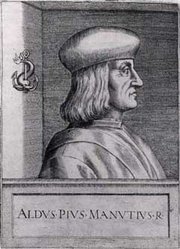
Aldus Pius Manutius the Latinised
name of Aldo Manuzio —sometimes called Aldus Manutius, the Elder to distinguish him from his grandson, Aldus Manutius, the Younger—was an Italian humanist
who became a printer and publisher when he founded the Aldine Press
at Venice
.
His publishing legacy includes the distinctions of inventing italic type
, establishing the modern use of the semicolon
, and introducing inexpensive books in small formats bound in vellum
that were read much like modern paperbacks.
 Manutius was born in Bassiano
, in the Papal States
, in what is now the province of Latina
, some 100 km south of Rome
, during the Italian Renaissance
period.
His family was well off and Manutius was educated as a humanistic scholar, studying Latin in Rome under Gasparino da Verona, and Greek
at Ferrara
under Guarino da Verona
.
In 1482, he went to reside at Mirandola
with his old friend and fellow student, the illustrious Giovanni Pico
. There he stayed two years, pursuing his studies in Greek literature
. Before Pico moved to Florence
, he procured for Manutius the post of tutor to his nephews Alberto
and Lionello Pio, princes of Carpi. Alberto Pio supplied Manutius with funds for starting his printing press, and gave him lands at Carpi.
Manutius became a tutor to some of the great Italian ducal families in his early career.
s) of the classics, and applied several innovations in binding technique and design for use on a broad scheme.
He commissioned Francesco Griffo
to cut a slanted type known today as italic
.
He and his grandson, also a printer, are credited with introducing a standardized system of punctuation
.
The software company Aldus
is named after him.
and Domitian
, AD 80-82. The dolphin and anchor emblem is associated with "Festina lente
" (Hasten slowly), a motto that Aldus had begun to use as early as 1499, after receiving a Roman coin from Pietro Bembo which bore the emblem and motto.
, Poliphilus, and Hermann Zapf
's Palatino
and Aldus
.
Before his time four Italian
towns had won the honors of Greek publications: Milan
, with the grammar of Lascaris
, Aesop
, Theocritus
, a Greek
Psalter
, and Isocrates
, between 1476 and 1493; Venice
, with the Erotemata of Chrysoloras
in 1484; Vicenza
, with reprints of Lascaris' grammar and the Erotemata, in 1488 and 1490; and Florence
, with Alopa
's Homer
, in 1488.
 Of these works, only three, the Milanese Theocritus and Isocrates and the Florentine Homer, were classics.
Manutius selected Venice as the most appropriate station for his labours. He settled there in 1490, and soon afterwards gave to the world editions of the Hero and Leander of Musaeus
, the Galeomyomachia, and the Greek Psalter. These have no date; but they are the earliest tracts issued from his press, and are called by him "Precursors of the Greek Library."
In Venice, Manutius gathered an army of Greek scholars and compositors around him. His trade was carried on by Greeks, and Greek was the language of his household. Instructions to typesetters and binder
s were given in Greek.
The preface to his editions were written in Greek. Greeks from Crete
collated manuscript
s, read proofs, and gave models of calligraphy
for casts of Greek type. Not counting the craftsmen employed in purely manual labour, Manutius entertained as many as thirty of these Greek assistants in his family.
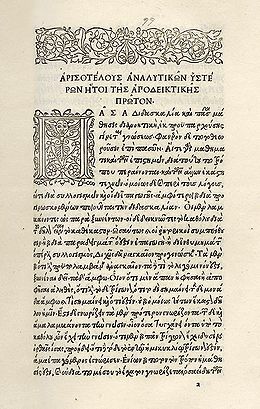
His own industry and energy were unremitting. In 1495 he issued the first volume of his edition of Aristotle
. Four more volumes completed the work in 1497–1498. Nine comedies of Aristophanes
appeared in 1498. Thucydides
, Sophocles
, and Herodotus
followed in 1502; Xenophon
's Hellenics and Euripides
in 1503; Demosthenes
in 1504. It is possible that during this period, in his printing works, Hieromonk Makarije
was educated, who would later found the Obod printing works of Cetinje
and print the first book in Serbian
and Romanian
.
The Second Italian War
, which pressed heavily on Venice at this time, suspended Manutius' labours for a period. But in 1508 he resumed his series with an edition of the minor Greek orators; and in 1509 appeared the lesser works of Plutarch
. Then came another stoppage when the League of Cambrai drove Venice back to her lagoons, and all the forces of the republic were concentrated on a life-or-death struggle with the allied powers of Europe. In 1513, Manutius reappeared with an edition of Plato
, which he dedicated to Leo X
in a preface eloquently and earnestly comparing the miseries of warfare and the woes of Italy with the sublime and tranquil objects of the student's life. Pindar
, Hesychius
, and Athenaeus
followed in 1514. At the end of his life, he had begun an edition of the Septuagint, the first to be published; it appeared posthumously in 1518.
 These complete the list of Manutius' prime services to Greek literature. But it may be well in this place to observe that his successors continued his work by giving Pausanias
, Strabo
, Aeschylus
, Galen
, Hippocrates
, and Longinus
to the world in first editions. Omission has been made of Manutius' reprints, in order that the attention of the reader might be concentrated on his labours in editing Greek classics from manuscripts. Other presses were at work in Italy; and, as the classics issued from Florence, Rome or Milan, Manutius took them up, bestowing in each case fresh industry upon the collation of codices and the correction of texts.
Manutius' enthusiasm for Greek literature was not confined to the printing-room. Whatever the students of this century may think of his scholarship, they must allow that only vast erudition and thorough familiarity with the Greek language could have enabled him to accomplish what he did. In his own day, Manutius' learning won the hearty acknowledgment of ripe scholars.
In order to promote Greek studies, Manutius founded an academy of Hellenists in 1502 under the title of the New Academy. Its rules were written in Greek. Its members were obliged to speak Greek. Their names were Hellenized, and their official titles were Greek. The biographies of all the famous men who were enrolled in this academy must be sought in the pages of Didot
's Alde Manuce. It is enough here to mention that they included Desiderius Erasmus
and the Englishman Thomas Linacre
.
When he died, bequeathing Greek literature as an inalienable possession to the world, he was a poor man.
classics. The Asolani of Bembo
, the collected writings of Poliziano
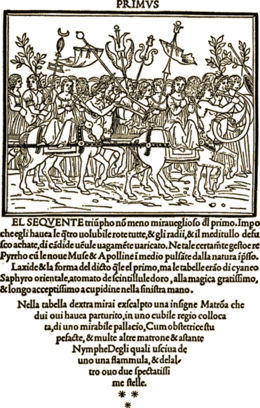
, the Hypnerotomachia Poliphili
, Dante
's Divine Comedy, Petrarch
's poems, a collection of early Latin poets of the Christian era, the letters of the younger Pliny
, the poems of Pontanus, Sannazaro
's Arcadia, Quintilian
, Valerius Maximus
, and the Adagia of Erasmus were printed, either in first editions, or with a beauty of type and paper never reached before, between the years 1495 and 1514. For these Italian and Latin editions, Manutius had the elegant type struck which bears his name. It is said to have been copied from Petrarch's handwriting, and was cast under the direction of Francesco da Bologna, who has been identified by Panizzi with Francia the painter.
To his fellow workers he was uniformly generous, free from jealousy, and prodigal of praise. While aiming at that excellence of typography
which renders his editions the treasures of the book-collector, he strove at the same time to make them cheap. His great undertaking was carried on under continual difficulties, arising from strikes among his workmen, the piracies of rivals, and the interruptions of war.
and the anchor
, and the motto festina lente, which indicated quickness combined with firmness in the execution of a great scheme, were never wholly abandoned by the Aldines until the expiration of their firm in the third generation.
book format that gentlemen of leisure could easily transport in a pocket or a satchel, the long, narrow libri portatiles of his 1503 catalogue, forerunners of the modern pocket book
. Manutius' edition of Virgil
's Opera (1501) was the first octavo volume that he produced.
In his prefatory letter to Pietro Bembo
in the 1514 Virgil, Aldus recorded that he "took the small size, the pocket book formula, from your library, or rather from that of your most kind father".
Manutius created the italic
typeface style, for the exclusive use of which for many years he obtained a patent
, though the honour of the invention is more probably due to his typefounder, Francesco Griffo
, than to him. His typefaces were all designed and cut by the brilliant Griffo, a punchcutter who created the first roman type cut from study of classical Roman capitals. However, he did not use his italic typeface for emphasis as we do today, but rather for its narrow and compact letterforms, which allowed the printing of pocket-sized books.
He is also believed to have been the first typographer to use a semicolon
. In 1566, his grandson, Aldus Manutius the Younger, produced Orthographiae Ratio, the first book on the principles of punctuation.
The 1503 Virgil also introduced the use of italic print
, the narrowness of which allowed for more economical use of space (more words per page, fewer pages, lower production costs). This publication was also produced in higher-than-normal print runs (1,000 rather than the usual 200 to 500 copies).
free text project similar to Project Gutenberg
.
Latinisation (literature)
Latinisation is the practice of rendering a non-Latin name in a Latin style. It is commonly met with for historical personal names, with toponyms, or for the standard binomial nomenclature of the life sciences. It goes further than Romanisation, which is the writing of a word in the Latin alphabet...
name of Aldo Manuzio —sometimes called Aldus Manutius, the Elder to distinguish him from his grandson, Aldus Manutius, the Younger—was an Italian humanist
Renaissance humanism
Renaissance humanism was an activity of cultural and educational reform engaged by scholars, writers, and civic leaders who are today known as Renaissance humanists. It developed during the fourteenth and the beginning of the fifteenth centuries, and was a response to the challenge of Mediæval...
who became a printer and publisher when he founded the Aldine Press
Aldine Press
Aldine Press was the printing office started by Aldus Manutius in 1494 in Venice, from which were issued the celebrated Aldine editions of the classics . The Aldine Press is famous in the history of typography, among other things, for the introduction of italics...
at Venice
Venice
Venice is a city in northern Italy which is renowned for the beauty of its setting, its architecture and its artworks. It is the capital of the Veneto region...
.
His publishing legacy includes the distinctions of inventing italic type
Italic type
In typography, italic type is a cursive typeface based on a stylized form of calligraphic handwriting. Owing to the influence from calligraphy, such typefaces often slant slightly to the right. Different glyph shapes from roman type are also usually used—another influence from calligraphy...
, establishing the modern use of the semicolon
Semicolon
The semicolon is a punctuation mark with several uses. The Italian printer Aldus Manutius the Elder established the practice of using the semicolon to separate words of opposed meaning and to indicate interdependent statements. "The first printed semicolon was the work of ... Aldus Manutius"...
, and introducing inexpensive books in small formats bound in vellum
Vellum
Vellum is mammal skin prepared for writing or printing on, to produce single pages, scrolls, codices or books. It is generally smooth and durable, although there are great variations depending on preparation, the quality of the skin and the type of animal used...
that were read much like modern paperbacks.
Early life
Bassiano
Bassiano is a comune in the Province of Latina in the Italian region Lazio, located about 60 km southeast of Rome and about 14 km northeast of Latina. As of 31 December 2004, it had a population of 1,664 and an area of 31.6 km².Bassiano borders the following municipalities:...
, in the Papal States
Papal States
The Papal State, State of the Church, or Pontifical States were among the major historical states of Italy from roughly the 6th century until the Italian peninsula was unified in 1861 by the Kingdom of Piedmont-Sardinia .The Papal States comprised territories under...
, in what is now the province of Latina
Province of Latina
The Province of Latina is a province in the Lazio region of Italy. Its capital is the city of Latina.It has an area of 2,251 km², and a total population of 519,850...
, some 100 km south of Rome
Rome
Rome is the capital of Italy and the country's largest and most populated city and comune, with over 2.7 million residents in . The city is located in the central-western portion of the Italian Peninsula, on the Tiber River within the Lazio region of Italy.Rome's history spans two and a half...
, during the Italian Renaissance
Italian Renaissance
The Italian Renaissance began the opening phase of the Renaissance, a period of great cultural change and achievement in Europe that spanned the period from the end of the 13th century to about 1600, marking the transition between Medieval and Early Modern Europe...
period.
His family was well off and Manutius was educated as a humanistic scholar, studying Latin in Rome under Gasparino da Verona, and Greek
Greek language
Greek is an independent branch of the Indo-European family of languages. Native to the southern Balkans, it has the longest documented history of any Indo-European language, spanning 34 centuries of written records. Its writing system has been the Greek alphabet for the majority of its history;...
at Ferrara
Ferrara
Ferrara is a city and comune in Emilia-Romagna, northern Italy, capital city of the Province of Ferrara. It is situated 50 km north-northeast of Bologna, on the Po di Volano, a branch channel of the main stream of the Po River, located 5 km north...
under Guarino da Verona
Guarino da Verona
Guarino da Verona was an early figure in the Italian Renaissance.He was born in Verona, Italy and later studied Greek at Constantinople, where for five years he was the pupil of Manuel Chrysoloras. When he set out to return home, he had with him two cases of precious Greek manuscripts which he had...
.
In 1482, he went to reside at Mirandola
Mirandola
Mirandola is a city and comune of Emilia-Romagna, Italy, in the Province of Modena, 31 km northeast of the provincial capital by railway.- History :Mirandola originated as a Renaissance city-fortress...
with his old friend and fellow student, the illustrious Giovanni Pico
Giovanni Pico della Mirandola
Count Giovanni Pico della Mirandola was an Italian Renaissance philosopher. He is famed for the events of 1486, when at the age of 23, he proposed to defend 900 theses on religion, philosophy, natural philosophy and magic against all comers, for which he wrote the famous Oration on the Dignity of...
. There he stayed two years, pursuing his studies in Greek literature
Greek literature
Greek literature refers to writings composed in areas of Greek influence, typically though not necessarily in one of the Greek dialects, throughout the whole period in which the Greek-speaking people have existed.-Ancient Greek literature :...
. Before Pico moved to Florence
Florence
Florence is the capital city of the Italian region of Tuscany and of the province of Florence. It is the most populous city in Tuscany, with approximately 370,000 inhabitants, expanding to over 1.5 million in the metropolitan area....
, he procured for Manutius the post of tutor to his nephews Alberto
Alberto III Pio, Prince of Carpi
Alberto III Pio, Prince of Carpi , was one of the most intellectually renowned humanist princes of the Renaissance and an intimate of the Medici popes. Born in 1475, only two years before the death of his father, he had been raised under the guardianship of his paternal uncle Marco and his maternal...
and Lionello Pio, princes of Carpi. Alberto Pio supplied Manutius with funds for starting his printing press, and gave him lands at Carpi.
Manutius became a tutor to some of the great Italian ducal families in his early career.
Publishing legacy
The leading publisher and printer of the Venetian High Renaissance, Aldus set up a definite scheme of book design, produced the first italic type, introduced small and handy pocket editions (octavoOctavo
Octavo to is a technical term describing the format of a book.Octavo may also refer to:* Octavo is a grimoire in the Discworld series by Terry Pratchett...
s) of the classics, and applied several innovations in binding technique and design for use on a broad scheme.
He commissioned Francesco Griffo
Francesco Griffo
Francesco Griffo , also called Francesco da Bologna, was a fifteenth-century Venetian punchcutter. He worked for Aldus Manutius, designing that printer's more important typefaces, including the first italic type...
to cut a slanted type known today as italic
Italic type
In typography, italic type is a cursive typeface based on a stylized form of calligraphic handwriting. Owing to the influence from calligraphy, such typefaces often slant slightly to the right. Different glyph shapes from roman type are also usually used—another influence from calligraphy...
.
He and his grandson, also a printer, are credited with introducing a standardized system of punctuation
Punctuation
Punctuation marks are symbols that indicate the structure and organization of written language, as well as intonation and pauses to be observed when reading aloud.In written English, punctuation is vital to disambiguate the meaning of sentences...
.
The software company Aldus
Aldus
Aldus Corporation, named after the 15th-century Venetian printer Aldus Manutius, was the inventor of the groundbreaking PageMaker software, a program that is generally credited with creating the desktop publishing field. The company was founded by Jeremy Jaech, Mark Sundstrom, Mike Templeman,...
is named after him.
Imprint and motto
In 1501, Aldus began to use as his publisher's device the image of a dolphin wrapped around an anchor. His editions of the classics were so highly respected that the dolphin-and-anchor device was almost immediately pirated by French and Italian publishers. More recently, the device has been used by the 19th-century London firm of William Pickering, and by Doubleday. Aldus adapted the image from the reverse of ancient Roman coins issued during the reigns of the Emperors TitusTitus
Titus , was Roman Emperor from 79 to 81. A member of the Flavian dynasty, Titus succeeded his father Vespasian upon his death, thus becoming the first Roman Emperor to come to the throne after his own father....
and Domitian
Domitian
Domitian was Roman Emperor from 81 to 96. Domitian was the third and last emperor of the Flavian dynasty.Domitian's youth and early career were largely spent in the shadow of his brother Titus, who gained military renown during the First Jewish-Roman War...
, AD 80-82. The dolphin and anchor emblem is associated with "Festina lente
Festina lente
Festina lente or σπεῦδε βραδέως is a classical adage and oxymoron meaning "make haste slowly" or "more haste, less speed"...
" (Hasten slowly), a motto that Aldus had begun to use as early as 1499, after receiving a Roman coin from Pietro Bembo which bore the emblem and motto.
Fonts
Type designs based on work designed by Griffo and commissioned by Aldus Manutius include BemboBembo
Bembo is the name given to a 20th-century revival of an old style serif or humanist typeface cut by Francesco Griffo around 1495.The typeface Bembo seen today is a revival designed under the direction of Stanley Morison for the Monotype Corporation in 1929.It is considered a good choice for...
, Poliphilus, and Hermann Zapf
Hermann Zapf
Hermann Zapf is a German typeface designer who lives in Darmstadt, Germany. He is married to calligrapher and typeface designer Gudrun Zapf von Hesse....
's Palatino
Palatino
Palatino is the name of a large typeface family that began as an old style serif typeface designed by Hermann Zapf initially released in 1948 by the Linotype foundry.In 1999, Zapf revised Palatino for Linotype and Microsoft, called Palatino Linotype...
and Aldus
Aldus (typeface)
Aldus is an old style serif typeface designed by Hermann Zapf in 1954. It is named for Aldus Manutius, the famous fifteenth century Venetian printer....
.
Greek classics
It was Manutius' ambition to secure the literature of Greece from further loss by committing its chief masterpieces to type. He introduced personal or pocket editions of the classics in Greek and Latin that all could own.Before his time four Italian
Italy
Italy , officially the Italian Republic languages]] under the European Charter for Regional or Minority Languages. In each of these, Italy's official name is as follows:;;;;;;;;), is a unitary parliamentary republic in South-Central Europe. To the north it borders France, Switzerland, Austria and...
towns had won the honors of Greek publications: Milan
Milan
Milan is the second-largest city in Italy and the capital city of the region of Lombardy and of the province of Milan. The city proper has a population of about 1.3 million, while its urban area, roughly coinciding with its administrative province and the bordering Province of Monza and Brianza ,...
, with the grammar of Lascaris
Constantine Lascaris
Constantine Lascaris was a Greek scholar and grammarian, one of the promoters of the revival of Greek learning in the Italian peninsula, born at Constantinople....
, Aesop
Aesop
Aesop was a Greek writer credited with a number of popular fables. Older spellings of his name have included Esop and Isope. Although his existence remains uncertain and no writings by him survive, numerous tales credited to him were gathered across the centuries and in many languages in a...
, Theocritus
Theocritus
Theocritus , the creator of ancient Greek bucolic poetry, flourished in the 3rd century BC.-Life:Little is known of Theocritus beyond what can be inferred from his writings. We must, however, handle these with some caution, since some of the poems commonly attributed to him have little claim to...
, a Greek
Greek language
Greek is an independent branch of the Indo-European family of languages. Native to the southern Balkans, it has the longest documented history of any Indo-European language, spanning 34 centuries of written records. Its writing system has been the Greek alphabet for the majority of its history;...
Psalter
Psalter
A psalter is a volume containing the Book of Psalms, often with other devotional material bound in as well, such as a liturgical calendar and litany of the Saints. Until the later medieval emergence of the book of hours, psalters were the books most widely owned by wealthy lay persons and were...
, and Isocrates
Isocrates
Isocrates , an ancient Greek rhetorician, was one of the ten Attic orators. In his time, he was probably the most influential rhetorician in Greece and made many contributions to rhetoric and education through his teaching and written works....
, between 1476 and 1493; Venice
Venice
Venice is a city in northern Italy which is renowned for the beauty of its setting, its architecture and its artworks. It is the capital of the Veneto region...
, with the Erotemata of Chrysoloras
Manuel Chrysoloras
Manuel Chrysoloras was a pioneer in the introduction of Greek literature to Western Europe during the late middle ages....
in 1484; Vicenza
Vicenza
Vicenza , a city in north-eastern Italy, is the capital of the eponymous province in the Veneto region, at the northern base of the Monte Berico, straddling the Bacchiglione...
, with reprints of Lascaris' grammar and the Erotemata, in 1488 and 1490; and Florence
Florence
Florence is the capital city of the Italian region of Tuscany and of the province of Florence. It is the most populous city in Tuscany, with approximately 370,000 inhabitants, expanding to over 1.5 million in the metropolitan area....
, with Alopa
Lorenzo de Alopa
Lorenzo di Alopa, more generally known under the Latin name of Laurentius Francisci di Alopa, a native of Venice, was established as a printer of incunabula at Florence toward the end of the 15th century...
's Homer
Homer
In the Western classical tradition Homer , is the author of the Iliad and the Odyssey, and is revered as the greatest ancient Greek epic poet. These epics lie at the beginning of the Western canon of literature, and have had an enormous influence on the history of literature.When he lived is...
, in 1488.
Manutius selected Venice as the most appropriate station for his labours. He settled there in 1490, and soon afterwards gave to the world editions of the Hero and Leander of Musaeus
Musaeus
Musaeus or Musaios was the name of three Greek poets.-Musaeus of Athens:Musaeus was a legendary polymath, philosopher, historian, prophet, seer, priest, poet, and musician, said to have been the founder of priestly poetry in Attica...
, the Galeomyomachia, and the Greek Psalter. These have no date; but they are the earliest tracts issued from his press, and are called by him "Precursors of the Greek Library."
In Venice, Manutius gathered an army of Greek scholars and compositors around him. His trade was carried on by Greeks, and Greek was the language of his household. Instructions to typesetters and binder
Binder
The reaper-binder, or binder, was a farm implement that improved upon the reaper. The binder was invented in 1872 by Charles Withington. In addition to cutting the small-grain crop, it would also tie the stems into small bundles, or sheaves...
s were given in Greek.
The preface to his editions were written in Greek. Greeks from Crete
Crete
Crete is the largest and most populous of the Greek islands, the fifth largest island in the Mediterranean Sea, and one of the thirteen administrative regions of Greece. It forms a significant part of the economy and cultural heritage of Greece while retaining its own local cultural traits...
collated manuscript
Manuscript
A manuscript or handwrite is written information that has been manually created by someone or some people, such as a hand-written letter, as opposed to being printed or reproduced some other way...
s, read proofs, and gave models of calligraphy
Calligraphy
Calligraphy is a type of visual art. It is often called the art of fancy lettering . A contemporary definition of calligraphic practice is "the art of giving form to signs in an expressive, harmonious and skillful manner"...
for casts of Greek type. Not counting the craftsmen employed in purely manual labour, Manutius entertained as many as thirty of these Greek assistants in his family.
His own industry and energy were unremitting. In 1495 he issued the first volume of his edition of Aristotle
Aristotle
Aristotle was a Greek philosopher and polymath, a student of Plato and teacher of Alexander the Great. His writings cover many subjects, including physics, metaphysics, poetry, theater, music, logic, rhetoric, linguistics, politics, government, ethics, biology, and zoology...
. Four more volumes completed the work in 1497–1498. Nine comedies of Aristophanes
Aristophanes
Aristophanes , son of Philippus, of the deme Cydathenaus, was a comic playwright of ancient Athens. Eleven of his forty plays survive virtually complete...
appeared in 1498. Thucydides
Thucydides
Thucydides was a Greek historian and author from Alimos. His History of the Peloponnesian War recounts the 5th century BC war between Sparta and Athens to the year 411 BC...
, Sophocles
Sophocles
Sophocles is one of three ancient Greek tragedians whose plays have survived. His first plays were written later than those of Aeschylus, and earlier than or contemporary with those of Euripides...
, and Herodotus
Herodotus
Herodotus was an ancient Greek historian who was born in Halicarnassus, Caria and lived in the 5th century BC . He has been called the "Father of History", and was the first historian known to collect his materials systematically, test their accuracy to a certain extent and arrange them in a...
followed in 1502; Xenophon
Xenophon
Xenophon , son of Gryllus, of the deme Erchia of Athens, also known as Xenophon of Athens, was a Greek historian, soldier, mercenary, philosopher and a contemporary and admirer of Socrates...
's Hellenics and Euripides
Euripides
Euripides was one of the three great tragedians of classical Athens, the other two being Aeschylus and Sophocles. Some ancient scholars attributed ninety-five plays to him but according to the Suda it was ninety-two at most...
in 1503; Demosthenes
Demosthenes
Demosthenes was a prominent Greek statesman and orator of ancient Athens. His orations constitute a significant expression of contemporary Athenian intellectual prowess and provide an insight into the politics and culture of ancient Greece during the 4th century BC. Demosthenes learned rhetoric by...
in 1504. It is possible that during this period, in his printing works, Hieromonk Makarije
Hieromonk Makarije
Hieromonk Makarije is the founder of Serbian and Romanian printing, having printed the first book in Serbian language and the first book in the territory of Walachia ....
was educated, who would later found the Obod printing works of Cetinje
Cetinje
Cetinje , Цетиње / Cetinje , Italian: Cettigne, Greek: Κετίγνη, Ketígni) is a town and Old Royal Capital of Montenegro. It is also a historical and the secondary capital of Montenegro , with the official residence of the President of Montenegro...
and print the first book in Serbian
Serbian language
Serbian is a form of Serbo-Croatian, a South Slavic language, spoken by Serbs in Serbia, Bosnia and Herzegovina, Montenegro, Croatia and neighbouring countries....
and Romanian
Romanian language
Romanian Romanian Romanian (or Daco-Romanian; obsolete spellings Rumanian, Roumanian; self-designation: română, limba română ("the Romanian language") or românește (lit. "in Romanian") is a Romance language spoken by around 24 to 28 million people, primarily in Romania and Moldova...
.
The Second Italian War
Second Italian War
The Second Italian War , sometimes known as Louis XII's Italian War or the War over Naples, was the second of the Italian Wars; it was fought primarily by Louis XII of France and Ferdinand II of Aragon, with the participation of several Italian powers...
, which pressed heavily on Venice at this time, suspended Manutius' labours for a period. But in 1508 he resumed his series with an edition of the minor Greek orators; and in 1509 appeared the lesser works of Plutarch
Plutarch
Plutarch then named, on his becoming a Roman citizen, Lucius Mestrius Plutarchus , c. 46 – 120 AD, was a Greek historian, biographer, essayist, and Middle Platonist known primarily for his Parallel Lives and Moralia...
. Then came another stoppage when the League of Cambrai drove Venice back to her lagoons, and all the forces of the republic were concentrated on a life-or-death struggle with the allied powers of Europe. In 1513, Manutius reappeared with an edition of Plato
Plato
Plato , was a Classical Greek philosopher, mathematician, student of Socrates, writer of philosophical dialogues, and founder of the Academy in Athens, the first institution of higher learning in the Western world. Along with his mentor, Socrates, and his student, Aristotle, Plato helped to lay the...
, which he dedicated to Leo X
Pope Leo X
Pope Leo X , born Giovanni di Lorenzo de' Medici, was the Pope from 1513 to his death in 1521. He was the last non-priest to be elected Pope. He is known for granting indulgences for those who donated to reconstruct St. Peter's Basilica and his challenging of Martin Luther's 95 Theses...
in a preface eloquently and earnestly comparing the miseries of warfare and the woes of Italy with the sublime and tranquil objects of the student's life. Pindar
Pindar
Pindar , was an Ancient Greek lyric poet. Of the canonical nine lyric poets of ancient Greece, his work is the best preserved. Quintilian described him as "by far the greatest of the nine lyric poets, in virtue of his inspired magnificence, the beauty of his thoughts and figures, the rich...
, Hesychius
Hesychius of Miletus
Hesychius of Miletus, Greek chronicler and biographer, surnamed Illustrius, son of an advocate, flourished at Constantinople in the 6th century AD during the reign of Justinian.According to Photius he was the author of three important works:...
, and Athenaeus
Athenaeus
Athenaeus , of Naucratis in Egypt, Greek rhetorician and grammarian, flourished about the end of the 2nd and beginning of the 3rd century AD...
followed in 1514. At the end of his life, he had begun an edition of the Septuagint, the first to be published; it appeared posthumously in 1518.
Pausanias (geographer)
Pausanias was a Greek traveler and geographer of the 2nd century AD, who lived in the times of Hadrian, Antoninus Pius and Marcus Aurelius. He is famous for his Description of Greece , a lengthy work that describes ancient Greece from firsthand observations, and is a crucial link between classical...
, Strabo
Strabo
Strabo, also written Strabon was a Greek historian, geographer and philosopher.-Life:Strabo was born to an affluent family from Amaseia in Pontus , a city which he said was situated the approximate equivalent of 75 km from the Black Sea...
, Aeschylus
Aeschylus
Aeschylus was the first of the three ancient Greek tragedians whose work has survived, the others being Sophocles and Euripides, and is often described as the father of tragedy. His name derives from the Greek word aiskhos , meaning "shame"...
, Galen
Galen
Aelius Galenus or Claudius Galenus , better known as Galen of Pergamon , was a prominent Roman physician, surgeon and philosopher...
, Hippocrates
Hippocrates
Hippocrates of Cos or Hippokrates of Kos was an ancient Greek physician of the Age of Pericles , and is considered one of the most outstanding figures in the history of medicine...
, and Longinus
Longinus (literature)
Longinus is the conventional name of the author of the treatise, On the Sublime , a work which focuses on the effect of good writing. Longinus, sometimes referred to as Pseudo-Longinus because his real name is unknown, was a Greek teacher of rhetoric or a literary critic who may have lived in the...
to the world in first editions. Omission has been made of Manutius' reprints, in order that the attention of the reader might be concentrated on his labours in editing Greek classics from manuscripts. Other presses were at work in Italy; and, as the classics issued from Florence, Rome or Milan, Manutius took them up, bestowing in each case fresh industry upon the collation of codices and the correction of texts.
Manutius' enthusiasm for Greek literature was not confined to the printing-room. Whatever the students of this century may think of his scholarship, they must allow that only vast erudition and thorough familiarity with the Greek language could have enabled him to accomplish what he did. In his own day, Manutius' learning won the hearty acknowledgment of ripe scholars.
In order to promote Greek studies, Manutius founded an academy of Hellenists in 1502 under the title of the New Academy. Its rules were written in Greek. Its members were obliged to speak Greek. Their names were Hellenized, and their official titles were Greek. The biographies of all the famous men who were enrolled in this academy must be sought in the pages of Didot
Didot
Didot is the name of a family of French printers, punch-cutters and publishers. Through its achievements and advancements in printing, publishing and typography, the family has lent its name to typographic measurements developed by François-Ambroise Didot and the Didot typeface developed by Firmin...
's Alde Manuce. It is enough here to mention that they included Desiderius Erasmus
Desiderius Erasmus
Desiderius Erasmus Roterodamus , known as Erasmus of Rotterdam, was a Dutch Renaissance humanist, Catholic priest, and a theologian....
and the Englishman Thomas Linacre
Thomas Linacre
Thomas Linacre was a humanist scholar and physician, after whom Linacre College, Oxford and Linacre House The King's School, Canterbury are named....
.
When he died, bequeathing Greek literature as an inalienable possession to the world, he was a poor man.
Latin classics
Nor was the Aldine press idle in regard to Latin and ItalianItalian language
Italian is a Romance language spoken mainly in Europe: Italy, Switzerland, San Marino, Vatican City, by minorities in Malta, Monaco, Croatia, Slovenia, France, Libya, Eritrea, and Somalia, and by immigrant communities in the Americas and Australia...
classics. The Asolani of Bembo
Pietro Bembo
Pietro Bembo was an Italian scholar, poet, literary theorist, and cardinal. He was an influential figure in the development of the Italian language, specifically Tuscan, as a literary medium, and his writings assisted in the 16th-century revival of interest in the works of Petrarch...
, the collected writings of Poliziano
Poliziano
Angelo Ambrogini, commonly known by his nickname, anglicized as Politian, Italian Poliziano, Latin Politianus was an Italian Renaissance classical scholar and poet, one of the revivers of Humanist Latin...
, the Hypnerotomachia Poliphili
Hypnerotomachia Poliphili
Hypnerotomachia Poliphili , called in English Poliphilo's Strife of Love in a Dream, is a romance said to be by Francesco Colonna and a famous example of early printing...
, Dante
Dante Alighieri
Durante degli Alighieri, mononymously referred to as Dante , was an Italian poet, prose writer, literary theorist, moral philosopher, and political thinker. He is best known for the monumental epic poem La commedia, later named La divina commedia ...
's Divine Comedy, Petrarch
Petrarch
Francesco Petrarca , known in English as Petrarch, was an Italian scholar, poet and one of the earliest humanists. Petrarch is often called the "Father of Humanism"...
's poems, a collection of early Latin poets of the Christian era, the letters of the younger Pliny
Pliny the Younger
Gaius Plinius Caecilius Secundus, born Gaius Caecilius or Gaius Caecilius Cilo , better known as Pliny the Younger, was a lawyer, author, and magistrate of Ancient Rome. Pliny's uncle, Pliny the Elder, helped raise and educate him...
, the poems of Pontanus, Sannazaro
Jacopo Sannazaro
Jacopo Sannazaro was an Italian poet, humanist and epigrammist from Naples.He wrote easily in Latin, in Italian and in Neapolitan, but is best remembered for his humanist classic Arcadia, a masterwork that illustrated the possibilities of poetical prose in Italian, and instituted the theme of...
's Arcadia, Quintilian
Quintilian
Marcus Fabius Quintilianus was a Roman rhetorician from Hispania, widely referred to in medieval schools of rhetoric and in Renaissance writing...
, Valerius Maximus
Valerius Maximus
Valerius Maximus was a Latin writer and author of a collection of historical anecdotes. He worked during the reign of Tiberius .-Biography:...
, and the Adagia of Erasmus were printed, either in first editions, or with a beauty of type and paper never reached before, between the years 1495 and 1514. For these Italian and Latin editions, Manutius had the elegant type struck which bears his name. It is said to have been copied from Petrarch's handwriting, and was cast under the direction of Francesco da Bologna, who has been identified by Panizzi with Francia the painter.
To his fellow workers he was uniformly generous, free from jealousy, and prodigal of praise. While aiming at that excellence of typography
Typography
Typography is the art and technique of arranging type in order to make language visible. The arrangement of type involves the selection of typefaces, point size, line length, leading , adjusting the spaces between groups of letters and adjusting the space between pairs of letters...
which renders his editions the treasures of the book-collector, he strove at the same time to make them cheap. His great undertaking was carried on under continual difficulties, arising from strikes among his workmen, the piracies of rivals, and the interruptions of war.
Marriage and personal life
In 1505, Manutius married Maria, daughter of Andrea Torresano of Asola. Torresano had already bought the press established by Nicholas Jenson at Venice. Therefore Manutius' marriage combined two important publishing firms. Henceforth the names Aldus and Asolanus were associated on the title pages of the Aldine publications; and after Manutius' death in 1515, Torresano and his two sons carried on the business during the minority of Manutius' children. The device of the dolphinDolphin
Dolphins are marine mammals that are closely related to whales and porpoises. There are almost forty species of dolphin in 17 genera. They vary in size from and , up to and . They are found worldwide, mostly in the shallower seas of the continental shelves, and are carnivores, mostly eating...
and the anchor
Anchor
An anchor is a device, normally made of metal, that is used to connect a vessel to the bed of a body of water to prevent the vessel from drifting due to wind or current. The word derives from Latin ancora, which itself comes from the Greek ἄγκυρα .Anchors can either be temporary or permanent...
, and the motto festina lente, which indicated quickness combined with firmness in the execution of a great scheme, were never wholly abandoned by the Aldines until the expiration of their firm in the third generation.
Innovations
Manutius wanted to create an octavoOctavo
Octavo to is a technical term describing the format of a book.Octavo may also refer to:* Octavo is a grimoire in the Discworld series by Terry Pratchett...
book format that gentlemen of leisure could easily transport in a pocket or a satchel, the long, narrow libri portatiles of his 1503 catalogue, forerunners of the modern pocket book
Paperback
Paperback, softback or softcover describe and refer to a book by the nature of its binding. The covers of such books are usually made of paper or paperboard, and are usually held together with glue rather than stitches or staples...
. Manutius' edition of Virgil
Virgil
Publius Vergilius Maro, usually called Virgil or Vergil in English , was an ancient Roman poet of the Augustan period. He is known for three major works of Latin literature, the Eclogues , the Georgics, and the epic Aeneid...
's Opera (1501) was the first octavo volume that he produced.
In his prefatory letter to Pietro Bembo
Pietro Bembo
Pietro Bembo was an Italian scholar, poet, literary theorist, and cardinal. He was an influential figure in the development of the Italian language, specifically Tuscan, as a literary medium, and his writings assisted in the 16th-century revival of interest in the works of Petrarch...
in the 1514 Virgil, Aldus recorded that he "took the small size, the pocket book formula, from your library, or rather from that of your most kind father".
Manutius created the italic
Italic type
In typography, italic type is a cursive typeface based on a stylized form of calligraphic handwriting. Owing to the influence from calligraphy, such typefaces often slant slightly to the right. Different glyph shapes from roman type are also usually used—another influence from calligraphy...
typeface style, for the exclusive use of which for many years he obtained a patent
Patent
A patent is a form of intellectual property. It consists of a set of exclusive rights granted by a sovereign state to an inventor or their assignee for a limited period of time in exchange for the public disclosure of an invention....
, though the honour of the invention is more probably due to his typefounder, Francesco Griffo
Francesco Griffo
Francesco Griffo , also called Francesco da Bologna, was a fifteenth-century Venetian punchcutter. He worked for Aldus Manutius, designing that printer's more important typefaces, including the first italic type...
, than to him. His typefaces were all designed and cut by the brilliant Griffo, a punchcutter who created the first roman type cut from study of classical Roman capitals. However, he did not use his italic typeface for emphasis as we do today, but rather for its narrow and compact letterforms, which allowed the printing of pocket-sized books.
He is also believed to have been the first typographer to use a semicolon
Semicolon
The semicolon is a punctuation mark with several uses. The Italian printer Aldus Manutius the Elder established the practice of using the semicolon to separate words of opposed meaning and to indicate interdependent statements. "The first printed semicolon was the work of ... Aldus Manutius"...
. In 1566, his grandson, Aldus Manutius the Younger, produced Orthographiae Ratio, the first book on the principles of punctuation.
The 1503 Virgil also introduced the use of italic print
Italic script
Italic script, also known as chancery cursive, is a semi-cursive, slightly sloped style of handwriting and calligraphy that was developed during the Renaissance in Italy...
, the narrowness of which allowed for more economical use of space (more words per page, fewer pages, lower production costs). This publication was also produced in higher-than-normal print runs (1,000 rather than the usual 200 to 500 copies).
Progetto Manuzio
Manutius' name is the inspiration for Progetto Manuzio, an ItalianItalian language
Italian is a Romance language spoken mainly in Europe: Italy, Switzerland, San Marino, Vatican City, by minorities in Malta, Monaco, Croatia, Slovenia, France, Libya, Eritrea, and Somalia, and by immigrant communities in the Americas and Australia...
free text project similar to Project Gutenberg
Project Gutenberg
Project Gutenberg is a volunteer effort to digitize and archive cultural works, to "encourage the creation and distribution of eBooks". Founded in 1971 by Michael S. Hart, it is the oldest digital library. Most of the items in its collection are the full texts of public domain books...
.
See also
- PrintingPrintingPrinting is a process for reproducing text and image, typically with ink on paper using a printing press. It is often carried out as a large-scale industrial process, and is an essential part of publishing and transaction printing....
- Aldine PressAldine PressAldine Press was the printing office started by Aldus Manutius in 1494 in Venice, from which were issued the celebrated Aldine editions of the classics . The Aldine Press is famous in the history of typography, among other things, for the introduction of italics...
- History of typographyHistory of typographyContemporary typographers view typography as craft with a very long history tracing its origins back to the first punches and dies used to make seals and currency in ancient times...
- AldusAldus (typeface)Aldus is an old style serif typeface designed by Hermann Zapf in 1954. It is named for Aldus Manutius, the famous fifteenth century Venetian printer....
— a typeface created by Hermann ZapfHermann ZapfHermann Zapf is a German typeface designer who lives in Darmstadt, Germany. He is married to calligrapher and typeface designer Gudrun Zapf von Hesse....
and named after Aldus Manutius. - AldusAldusAldus Corporation, named after the 15th-century Venetian printer Aldus Manutius, was the inventor of the groundbreaking PageMaker software, a program that is generally credited with creating the desktop publishing field. The company was founded by Jeremy Jaech, Mark Sundstrom, Mike Templeman,...
— a software company named after Manutius that created PageMaker for the Apple Macintosh.
Further reading
- Renouard, A. A. (1834) Annales de l'imprimerie des Alde, ou l'histoire des trois Manuce et de leurs éditions; 3ème édition. Paris
- Fletcher, H. G., III (1988) New Aldine Studies: documentary essays on the life and work of Aldus Manutius. San Francisco
- Lowry, Martin (1984) Il mondo di Aldo Manuzio - Affari e cultura della Venezia del Rinascimento. Roma: Il Veltro, pp. 441 (Translated from: The World of Aldus Manutius: Business and Scholarship in Renaissance Venice, Basil Blackwell, Oxford, 1979). II edizione, con aggiornamento bibliografico, Roma 2000.
- Davies, Martin (1995) Aldus Manutius: printer and publisher of Renaissance Venice. London: British Library
- Febvre, L. & Martin, H. (2001) La nascita del libro. Roma-Bari: Laterza
- Braida, L. (2003) Stampa e cultura in Europa. Roma-Bari: Laterza