

Hermann Zapf

Encyclopedia

Typeface
In typography, a typeface is the artistic representation or interpretation of characters; it is the way the type looks. Each type is designed and there are thousands of different typefaces in existence, with new ones being developed constantly....
designer who lives in Darmstadt
Darmstadt
Darmstadt is a city in the Bundesland of Hesse in Germany, located in the southern part of the Rhine Main Area.The sandy soils in the Darmstadt area, ill-suited for agriculture in times before industrial fertilisation, prevented any larger settlement from developing, until the city became the seat...
, Germany. He is married to calligrapher and typeface designer Gudrun Zapf von Hesse.
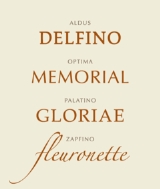
Zapf's work, which includes Palatino
Palatino
Palatino is the name of a large typeface family that began as an old style serif typeface designed by Hermann Zapf initially released in 1948 by the Linotype foundry.In 1999, Zapf revised Palatino for Linotype and Microsoft, called Palatino Linotype...
and Optima
Optima
Optima is a humanist sans-serif typeface designed by Hermann Zapf between 1952 and 1955 for the D. Stempel AG foundry, Frankfurt, Germany.-Characteristics:...
, has been widely copied, often against his will. The best known example may be Monotype's
Monotype Corporation
Monotype Imaging Holdings is a Delaware corporation based in Woburn, Massachusetts and specializing in typesetting and typeface design as well as text and imaging solutions for use with consumer electronics devices. Monotype Imaging Holdings is the owner of Monotype Imaging Inc., Linotype,...
Book Antiqua, which shipped with Microsoft Office
Microsoft Office
Microsoft Office is a non-free commercial office suite of inter-related desktop applications, servers and services for the Microsoft Windows and Mac OS X operating systems, introduced by Microsoft in August 1, 1989. Initially a marketing term for a bundled set of applications, the first version of...
and was widely considered a "knockoff" of Palatino. In 1993, Zapf resigned from ATypI
ATypI
The ATypI or the Association Typographique Internationale is an international non-profit organisation dedicated to typography.-The organisation:...
(Association Typographique Internationale) over what he viewed as its hypocritical attitude toward unauthorized copying by prominent ATypI members.
Early life
Hermann Zapf was born in NurembergNuremberg
Nuremberg[p] is a city in the German state of Bavaria, in the administrative region of Middle Franconia. Situated on the Pegnitz river and the Rhine–Main–Danube Canal, it is located about north of Munich and is Franconia's largest city. The population is 505,664...
during turbulent times marked by the German Revolution of 1918–1919 in Munich
Munich
Munich The city's motto is "" . Before 2006, it was "Weltstadt mit Herz" . Its native name, , is derived from the Old High German Munichen, meaning "by the monks' place". The city's name derives from the monks of the Benedictine order who founded the city; hence the monk depicted on the city's coat...
and Berlin
Berlin
Berlin is the capital city of Germany and is one of the 16 states of Germany. With a population of 3.45 million people, Berlin is Germany's largest city. It is the second most populous city proper and the seventh most populous urban area in the European Union...
, the end of World War I
World War I
World War I , which was predominantly called the World War or the Great War from its occurrence until 1939, and the First World War or World War I thereafter, was a major war centred in Europe that began on 28 July 1914 and lasted until 11 November 1918...
, the exile of Kaiser Wilhelm, and the establishment of Bavaria
Bavaria
Bavaria, formally the Free State of Bavaria is a state of Germany, located in the southeast of Germany. With an area of , it is the largest state by area, forming almost 20% of the total land area of Germany...
as a free state
Free state (government)
Free state is a term occasionally used in the official titles of some states.In principle the title asserts and emphasises the freedom of the state in question, but what this actually means varies greatly in different contexts:...
by Kurt Eisner
Kurt Eisner
Kurt Eisner was a Bavarian politician and journalist. As a German socialist journalist and statesman, he organized the Socialist Revolution that overthrew the Wittelsbach monarchy in Bavaria in November 1918....
. In addition, the Spanish Flu Pandemic
Spanish flu
The 1918 flu pandemic was an influenza pandemic, and the first of the two pandemics involving H1N1 influenza virus . It was an unusually severe and deadly pandemic that spread across the world. Historical and epidemiological data are inadequate to identify the geographic origin...
took hold of Europe in 1918 and 1919 and killed two of Zapf's siblings. Famine
Famine
A famine is a widespread scarcity of food, caused by several factors including crop failure, overpopulation, or government policies. This phenomenon is usually accompanied or followed by regional malnutrition, starvation, epidemic, and increased mortality. Every continent in the world has...
later struck Germany, and Zapf's mother was grateful to send him to school in 1925, where he received daily meals in a program organized by Herbert Hoover
Herbert Hoover
Herbert Clark Hoover was the 31st President of the United States . Hoover was originally a professional mining engineer and author. As the United States Secretary of Commerce in the 1920s under Presidents Warren Harding and Calvin Coolidge, he promoted partnerships between government and business...
. In school, Zapf was mainly interested in technical subjects. One of his favorite books was the annual science journal Das neue Universum ("The New Universe"). He and his older brother experimented with electricity
Electricity
Electricity is a general term encompassing a variety of phenomena resulting from the presence and flow of electric charge. These include many easily recognizable phenomena, such as lightning, static electricity, and the flow of electrical current in an electrical wire...
, building a crystal radio and an alarm system for his house. Even at his early age, Zapf was already getting involved with type, inventing cipher
Cipher
In cryptography, a cipher is an algorithm for performing encryption or decryption — a series of well-defined steps that can be followed as a procedure. An alternative, less common term is encipherment. In non-technical usage, a “cipher” is the same thing as a “code”; however, the concepts...
text alphabets to exchange secret messages with his brother.
Zapf left school in 1933 with the ambition to pursue a career in electrical engineering
Electrical engineering
Electrical engineering is a field of engineering that generally deals with the study and application of electricity, electronics and electromagnetism. The field first became an identifiable occupation in the late nineteenth century after commercialization of the electric telegraph and electrical...
. Unfortunately, his father had become unemployed
Unemployment
Unemployment , as defined by the International Labour Organization, occurs when people are without jobs and they have actively sought work within the past four weeks...
. Zapf's father experienced trouble with the newly established Third Reich
Nazi Germany
Nazi Germany , also known as the Third Reich , but officially called German Reich from 1933 to 1943 and Greater German Reich from 26 June 1943 onward, is the name commonly used to refer to the state of Germany from 1933 to 1945, when it was a totalitarian dictatorship ruled by...
, having been involved with trade union
Trade union
A trade union, trades union or labor union is an organization of workers that have banded together to achieve common goals such as better working conditions. The trade union, through its leadership, bargains with the employer on behalf of union members and negotiates labour contracts with...
s, and was sent to the Dachau concentration camp for a short time.
Introduction to typography
Zapf was not able to attend the Ohm Technical Institute in Nuremberg, due to the new political regime. Therefore, he needed to find an apprenticeshipApprenticeship
Apprenticeship is a system of training a new generation of practitioners of a skill. Apprentices or protégés build their careers from apprenticeships...
. His teachers, aware of the new political difficulties, noticed Zapf's skill in drawing and suggested that he become a lithographer
Lithography
Lithography is a method for printing using a stone or a metal plate with a completely smooth surface...
. Each company that interviewed him for an apprenticeship would ask him political questions, and every time he was interviewed, he was complimented on his work but was rejected. Ten months later, in 1934, he was interviewed by the last company in the telephone directory, and the company did not ask any political questions. They also complimented Zapf's work, but did not do lithography and did not need an apprentice lithographer. However, they allowed him to become a retoucher, and Zapf began his four-year apprenticeship in February 1934.
In 1935, Zapf attended an exhibition in Nuremberg
Nuremberg
Nuremberg[p] is a city in the German state of Bavaria, in the administrative region of Middle Franconia. Situated on the Pegnitz river and the Rhine–Main–Danube Canal, it is located about north of Munich and is Franconia's largest city. The population is 505,664...
in honor of the late typographer Rudolf Koch
Rudolf Koch
thumb|250px|[[Fraktur]] fonts by Rudolf KochRudolf Koch was a leading German calligrapher, typographic artist and teacher, born in Nuremberg. He was primarily a calligrapher with the Gebr. Klingspor foundry. He created several typefaces, in both fraktur and roman styles...
. This exhibition gave him his first interest in lettering. Zapf bought two books there, using them to teach himself calligraphy
Calligraphy
Calligraphy is a type of visual art. It is often called the art of fancy lettering . A contemporary definition of calligraphic practice is "the art of giving form to signs in an expressive, harmonious and skillful manner"...
. He also studied examples of calligraphy in the Nuremberg city library
Library
In a traditional sense, a library is a large collection of books, and can refer to the place in which the collection is housed. Today, the term can refer to any collection, including digital sources, resources, and services...
. Soon, his master noticed his expertise in calligraphy, and Zapf's work shifted to lettering retouching and improvement of his colleagues' retouching work.
Frankfurt
A few days after finishing his apprenticeship, Zapf left for FrankfurtFrankfurt
Frankfurt am Main , commonly known simply as Frankfurt, is the largest city in the German state of Hesse and the fifth-largest city in Germany, with a 2010 population of 688,249. The urban area had an estimated population of 2,300,000 in 2010...
. He did not bear a journeyman
Journeyman
A journeyman is someone who completed an apprenticeship and was fully educated in a trade or craft, but not yet a master. To become a master, a journeyman had to submit a master work piece to a guild for evaluation and be admitted to the guild as a master....
's certificate and thus would not be able to get a work permit
Work permit
Work permit is a generic term for a legal authorization which allows a person to take employment.It is most often used in reference to instances where a person is given permission to work in a country where one does not hold citizenship, but is also used in reference to minors, who in some...
at another company in Nuremberg, as they would not have been able to check on his qualifications. Zapf went to the "Werkstatt Haus zum Fürsteneck", a building run by Paul Koch, son of Rudolf Koch. He spent most of his time there working in typography
Typography
Typography is the art and technique of arranging type in order to make language visible. The arrangement of type involves the selection of typefaces, point size, line length, leading , adjusting the spaces between groups of letters and adjusting the space between pairs of letters...
and writing songbooks.
Through print historian Gustav Mori, Zapf came into contact with the type foundries
Type foundry
A type foundry is a company that designs or distributes typefaces. Originally, type foundries manufactured and sold metal and wood typefaces and matrices for line-casting machines like the Linotype and Monotype machines designed to be printed on letterpress printers...
D. Stempel AG
Aktiengesellschaft
Aktiengesellschaft is a German term that refers to a corporation that is limited by shares, i.e. owned by shareholders, and may be traded on a stock market. The term is used in Germany, Austria and Switzerland...
and Linotype GmbH
Gesellschaft mit beschränkter Haftung
Gesellschaft mit beschränkter Haftung is a type of legal entityvery common in Germany, Austria, Switzerland, and other Central European countries...
of Frankfurt. In 1938, he designed his first printed typeface
Typeface
In typography, a typeface is the artistic representation or interpretation of characters; it is the way the type looks. Each type is designed and there are thousands of different typefaces in existence, with new ones being developed constantly....
for them, a fraktur
Fraktur (typeface)
Fraktur is a calligraphic hand and any of several blackletter typefaces derived from this hand. The word derives from the past participle fractus of Latin frangere...
type called Gilgengart.
War career
On April 1, 1939, Zapf was conscriptedConscription
Conscription is the compulsory enlistment of people in some sort of national service, most often military service. Conscription dates back to antiquity and continues in some countries to the present day under various names...
and sent to Pirmasens
Pirmasens
Pirmasens is a district-free city in Rhineland-Palatinate, Germany, near the border with France. It is famous for the manufacture of shoes. The surrounding rural district was called Pirmasens from 1818 until 1997, when it was renamed Südwestpfalz....
to help reinforce the Siegfried Line
Siegfried Line
The original Siegfried line was a line of defensive forts and tank defences built by Germany as a section of the Hindenburg Line 1916–1917 in northern France during World War I...
against France
France
The French Republic , The French Republic , The French Republic , (commonly known as France , is a unitary semi-presidential republic in Western Europe with several overseas territories and islands located on other continents and in the Indian, Pacific, and Atlantic oceans. Metropolitan France...
. Not used to the hard labor, he developed heart trouble in a few weeks and was given a desk job, writing camp records and sports certificates in Fraktur.
World War II
World War II
World War II, or the Second World War , was a global conflict lasting from 1939 to 1945, involving most of the world's nations—including all of the great powers—eventually forming two opposing military alliances: the Allies and the Axis...
broke out in September, and Zapf's unit was to be taken into the Wehrmacht
Wehrmacht
The Wehrmacht – from , to defend and , the might/power) were the unified armed forces of Nazi Germany from 1935 to 1945. It consisted of the Heer , the Kriegsmarine and the Luftwaffe .-Origin and use of the term:...
. However, due to his heart trouble, Zapf was not transferred to the Wehrmacht but was instead dismissed. But on April 1, 1942, he was summoned again for the war effort. Zapf had been chosen for the Luftwaffe
Luftwaffe
Luftwaffe is a generic German term for an air force. It is also the official name for two of the four historic German air forces, the Wehrmacht air arm founded in 1935 and disbanded in 1946; and the current Bundeswehr air arm founded in 1956....
, but instead was sent to the artillery
Artillery
Originally applied to any group of infantry primarily armed with projectile weapons, artillery has over time become limited in meaning to refer only to those engines of war that operate by projection of munitions far beyond the range of effect of personal weapons...
in Weimar
Weimar
Weimar is a city in Germany famous for its cultural heritage. It is located in the federal state of Thuringia , north of the Thüringer Wald, east of Erfurt, and southwest of Halle and Leipzig. Its current population is approximately 65,000. The oldest record of the city dates from the year 899...
. He did not perform well, confusing left and right during training and being too cautious and clumsy with his gun. His officers soon brought an unusually early end to his career in the artillery.
Zapf was sent back to the office, and then to Jüterbog
Jüterbog
Jüterbog is a historic town in north-eastern Germany, located in the Teltow-Fläming district of Brandenburg. It is located on the Nuthe river at the northern slope of the Fläming hill range, about southwest of Berlin.-History:...
to train as a cartographer
Cartography
Cartography is the study and practice of making maps. Combining science, aesthetics, and technique, cartography builds on the premise that reality can be modeled in ways that communicate spatial information effectively.The fundamental problems of traditional cartography are to:*Set the map's...
. After that, he went to Dijon
Dijon
Dijon is a city in eastern France, the capital of the Côte-d'Or département and of the Burgundy region.Dijon is the historical capital of the region of Burgundy. Population : 151,576 within the city limits; 250,516 for the greater Dijon area....
and then Bordeaux
Bordeaux
Bordeaux is a port city on the Garonne River in the Gironde department in southwestern France.The Bordeaux-Arcachon-Libourne metropolitan area, has a population of 1,010,000 and constitutes the sixth-largest urban area in France. It is the capital of the Aquitaine region, as well as the prefecture...
, joining the staff of the First Army
German First Army
-First World War:The 1st Army during World War I, fought on the Western Front and took part in the Schlieffen Plan offensive against France and Belgium in August 1914. Commanded by General Alexander von Kluck, the 1st Army's job was to command the extreme right of the German forces in attacking...
. In the cartography unit at Bordeaux, Zapf drew map
Map
A map is a visual representation of an area—a symbolic depiction highlighting relationships between elements of that space such as objects, regions, and themes....
s of Spain
Spain
Spain , officially the Kingdom of Spain languages]] under the European Charter for Regional or Minority Languages. In each of these, Spain's official name is as follows:;;;;;;), is a country and member state of the European Union located in southwestern Europe on the Iberian Peninsula...
, especially the railway system, which could have been used to transport artillery had Francisco Franco
Francisco Franco
Francisco Franco y Bahamonde was a Spanish general, dictator and head of state of Spain from October 1936 , and de facto regent of the nominally restored Kingdom of Spain from 1947 until his death in November, 1975...
not used narrow-gauge tracks to repair bridges after the Spanish Civil War
Spanish Civil War
The Spanish Civil WarAlso known as The Crusade among Nationalists, the Fourth Carlist War among Carlists, and The Rebellion or Uprising among Republicans. was a major conflict fought in Spain from 17 July 1936 to 1 April 1939...
. Zapf was happy in the cartography unit. His eyesight was so excellent that he could write letters 1 millimeter in size without using a magnifying glass, and this skill probably prevented him from being commissioned back into the army.
After the war had ended, Zapf was held by the French
France
The French Republic , The French Republic , The French Republic , (commonly known as France , is a unitary semi-presidential republic in Western Europe with several overseas territories and islands located on other continents and in the Indian, Pacific, and Atlantic oceans. Metropolitan France...
as a prisoner of war
Prisoner of war
A prisoner of war or enemy prisoner of war is a person, whether civilian or combatant, who is held in custody by an enemy power during or immediately after an armed conflict...
at a field hospital
Field hospital
A field hospital is a large mobile medical unit that temporarily takes care of casualties on-site before they can be safely transported to more permanent hospital facilities...
in Tübingen
Tübingen
Tübingen is a traditional university town in central Baden-Württemberg, Germany. It is situated south of the state capital, Stuttgart, on a ridge between the Neckar and Ammer rivers.-Geography:...
. He was treated with respect because of his artwork and, due to his poor health, was sent home only four weeks after the end of the war. He went back to Nuremberg, which had suffered great damage because of the air raids
Airstrike
An air strike is an attack on a specific objective by military aircraft during an offensive mission. Air strikes are commonly delivered from aircraft such as fighters, bombers, ground attack aircraft, attack helicopters, and others...
.
Post-war
Zapf taught calligraphy in Nuremberg in 1946. He went back to FrankfurtFrankfurt
Frankfurt am Main , commonly known simply as Frankfurt, is the largest city in the German state of Hesse and the fifth-largest city in Germany, with a 2010 population of 688,249. The urban area had an estimated population of 2,300,000 in 2010...
in 1947, where the type foundry Stempel offered him a position as artistic head of their printshop. They did not ask for qualifications, certificates, or references, but instead only required him to show them his sketchbooks from the war, and a calligraphic piece he did in 1944 of Hans von Weber's "Junggesellentext".
One of Zapf's products was a publication named "Feder und Stichel" ("Pen and Graver"), printed from metal plates designed by Zapf and cut by punch cutter August Rosenberger during the war. It was printed at the Stempel printshop in 1949.
From 1948 to 1950, Zapf taught calligraphy at the Arts and Crafts School in Offenbach, giving lettering lessons twice a week to two classes of graphics students. In 1951 he married Gudrun von Hesse, who taught at the school of Städel
Städel
The Städel, officially the Städelsches Kunstinstitut und Städtische Galerie, is an art museum in Frankfurt am Main, with one of the most important collections in Germany....
in Frankfurt.
Most of Zapf's work as a graphic artist was in book design
Book design
Book design is the art of incorporating the content, style, format, design, and sequence of the various components of a book into a coherent whole....
. He worked for various publishing
Publishing
Publishing is the process of production and dissemination of literature or information—the activity of making information available to the general public...
houses, including Suhrkamp Verlag
Suhrkamp Verlag
Suhrkamp Verlag is a German publishing house, established in 1950 and generally acknowledged as one of the leading European publishers of fine literature.In January 2010 the headquarters of the company moved from Frankfurt to Berlin.-Early history:...
, Insel Verlag, Büchergilde Gutenberg, Hanser Verlag, Dr. Ludwig Reichert Verlag, and Verlag Philipp von Zabern.
Type design
Zapf designed typesType design
Type design is the art of designing typefaces.- History :Although the technology of printing text using movable type was invented in China, and despite the esteem which calligraphy held in that civilization, the vast number of Chinese characters meant that few distinctive, complete fonts could be...
for various stages of printing technology, including hot metal
Linotype machine
The Linotype typesetting machine is a "line casting" machine used in printing. The name of the machine comes from the fact that it produces an entire line of metal type at once, hence a line-o'-type, a significant improvement over manual typesetting....
composition, phototypesetting
Phototypesetting
Phototypesetting was a method of setting type, rendered obsolete with the popularity of the personal computer and desktop publishing software, that uses a photographic process to generate columns of type on a scroll of photographic paper...
(also called "cold type"), and finally digital typography for use in desktop publishing
Desktop publishing
Desktop publishing is the creation of documents using page layout software on a personal computer.The term has been used for publishing at all levels, from small-circulation documents such as local newsletters to books, magazines and newspapers...
. His two most famous typeface
Typeface
In typography, a typeface is the artistic representation or interpretation of characters; it is the way the type looks. Each type is designed and there are thousands of different typefaces in existence, with new ones being developed constantly....
s, Palatino
Palatino
Palatino is the name of a large typeface family that began as an old style serif typeface designed by Hermann Zapf initially released in 1948 by the Linotype foundry.In 1999, Zapf revised Palatino for Linotype and Microsoft, called Palatino Linotype...
and Optima
Optima
Optima is a humanist sans-serif typeface designed by Hermann Zapf between 1952 and 1955 for the D. Stempel AG foundry, Frankfurt, Germany.-Characteristics:...
, were designed in 1948 and 1952, respectively. Palatino was designed in conjunction with August Rosenberger, with careful attention to detail. It was named after 16th century Italian
Italy
Italy , officially the Italian Republic languages]] under the European Charter for Regional or Minority Languages. In each of these, Italy's official name is as follows:;;;;;;;;), is a unitary parliamentary republic in South-Central Europe. To the north it borders France, Switzerland, Austria and...
writing master Giambattista Palatino. Optima, a flared sans-serif, was released by Stempel in 1958. Zapf disliked its name, which was invented by the marketers at Stempel.
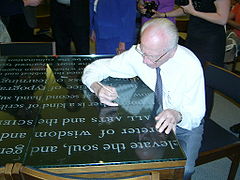
Zapf was not given many jobs in calligraphy. The largest one was writing out the Preamble to the United Nations Charter
Preamble to the United Nations Charter
The Preamble to the United Nations Charter is the opening of the United Nations Charter.-History:Jan Smuts originally wrote the opening lines of the Preamble as, "The High Contracting Parties, determined to prevent a recurrence of the fratricidal strife which twice in our generation has brought...
in four languages, commissioned by the Pierpont Morgan Library
Morgan Library
The Morgan Library & Museum is a museum and research library in New York City, USA. It was founded to house the private library of J. P. Morgan in 1906, which included, besides the manuscripts and printed books, some of them in rare bindings, his collection of prints and drawings...
in 1960 for $1000.
Computer typography
Zapf has been working on typography in computer programs since the 1960s. His ideas were considered radical, not taken seriously in Germany, and rejected by the Darmstadt University of TechnologyDarmstadt University of Technology
The Technische Universität Darmstadt, abbreviated TU Darmstadt, is a university in the city of Darmstadt, Germany...
, where Zapf lectured between 1972 and 1981. Because he had no success in Germany, Zapf went to the United States
United States
The United States of America is a federal constitutional republic comprising fifty states and a federal district...
, where new ideas were more likely to be accepted. He lectured about his ideas in computerized typesetting, and was invited to speak at Harvard University
Harvard University
Harvard University is a private Ivy League university located in Cambridge, Massachusetts, United States, established in 1636 by the Massachusetts legislature. Harvard is the oldest institution of higher learning in the United States and the first corporation chartered in the country...
in 1964. The University of Texas at Austin
University of Texas at Austin
The University of Texas at Austin is a state research university located in Austin, Texas, USA, and is the flagship institution of the The University of Texas System. Founded in 1883, its campus is located approximately from the Texas State Capitol in Austin...
was also interested in Zapf, and offered him a professor
Professor
A professor is a scholarly teacher; the precise meaning of the term varies by country. Literally, professor derives from Latin as a "person who professes" being usually an expert in arts or sciences; a teacher of high rank...
ship, which he did not take, due to his wife opposing a move to that state.
Because Zapf's plans for the United States had come to nothing, and because his house in Frankfurt had become too small, Zapf and his wife moved to Darmstadt
Darmstadt
Darmstadt is a city in the Bundesland of Hesse in Germany, located in the southern part of the Rhine Main Area.The sandy soils in the Darmstadt area, ill-suited for agriculture in times before industrial fertilisation, prevented any larger settlement from developing, until the city became the seat...
in 1972.
In 1976, the Rochester Institute of Technology
Rochester Institute of Technology
The Rochester Institute of Technology is a private university, located within the town of Henrietta in metropolitan Rochester, New York, United States...
offered Zapf a professorship in typographic computer programming, the first of its type in the world. He taught there from 1977 to 1987, flying between Darmstadt and Rochester
Rochester, New York
Rochester is a city in Monroe County, New York, south of Lake Ontario in the United States. Known as The World's Image Centre, it was also once known as The Flour City, and more recently as The Flower City...
. There he developed his ideas further, with the help of his connections in companies such as IBM
IBM
International Business Machines Corporation or IBM is an American multinational technology and consulting corporation headquartered in Armonk, New York, United States. IBM manufactures and sells computer hardware and software, and it offers infrastructure, hosting and consulting services in areas...
and Xerox
Xerox
Xerox Corporation is an American multinational document management corporation that produced and sells a range of color and black-and-white printers, multifunction systems, photo copiers, digital production printing presses, and related consulting services and supplies...
, and his discussions with the computer specialists at Rochester. A number of Zapf's students from this time at RIT went on to become influential type designers, including Charles Bigelow
Charles Bigelow (type designer)
Charles A. Bigelow is a type historian, professor, and designer. Bigelow grew up in the Detroit suburbs and attended the Cranbrook School in Bloomfield Hills. He received a MacArthur Fellowship in 1982. Along with Kris Holmes, he is the co-creator of Lucida and Wingdings font families...
and Kris Holmes
Kris Holmes
Kris Holmes is a type designer. She is with Charles Bigelow the co-creator of the Lucida font family.She received her B.A. from Harvard University and her MFA from UCLA Film School in Animation...
, who together created the Lucida
Lucida
Lucida is an extended family of related typefaces designed by Charles Bigelow and Kris Holmes in 1985.There are many variants called Lucida, including scripts , serif , and sans-serif .Bigelow & Holmes, together with the TeX vendor Y&Y, extended the Lucida family with a full...
type family. Other prominent students include calligrapher/font designer Julian Waters and book designer Jerry Kelly.
In 1977, Zapf and his friends Aaron Burns and Herb Lubalin
Herb Lubalin
Herbert F. Lubalin was a prominent American graphic designer. He collaborated with Ralph Ginzburg on three of Ginzburg's magazines: Eros, Fact, and Avant Garde, and was responsible for the creative visual beauty of these publications...
founded a company called "Design Processing International, Inc." in New York
New York
New York is a state in the Northeastern region of the United States. It is the nation's third most populous state. New York is bordered by New Jersey and Pennsylvania to the south, and by Connecticut, Massachusetts and Vermont to the east...
and developed typographical computer software. It existed until 1986 with the death of Lubalin, and Zapf and Burns founded "Zapf, Burns & Company" in 1987. Burns, also an expert in typeface design and in typography, was in charge of marketing until his death in 1992. Shortly before, two of their employees had stolen Zapf's ideas and founded a company of their own.
Zapf knew that he could not run an American company from Darmstadt, and did not want to move to New York. Instead, he used his experience to begin development of a typesetting program called the "hz-program
Hz-program
Hz-program was a typographic composition computer program, created by German typeface designer Hermann Zapf. The goal of this program was "to produce the perfect grey type area without the rivers and holes of too-wide word spacing."- History :...
", building on the H&J system in TeX
TeX
TeX is a typesetting system designed and mostly written by Donald Knuth and released in 1978. Within the typesetting system, its name is formatted as ....
.
During financial problems and bankruptcy of URW (Type foundry, article in German) in the mid-1990s, Adobe Systems
Adobe Systems
Adobe Systems Incorporated is an American computer software company founded in 1982 and headquartered in San Jose, California, United States...
acquired the Hz patent(s), and later made some use of the concepts in their InDesign program.
Zapfino
In 1983, Zapf had completed the typeface AMS EulerAMS Euler
AMS Euler is an upright cursive typeface, commissioned by the American Mathematical Society and designed and created by Hermann Zapf with the assistance of Donald Knuth. It tries to emulate a mathematician's style of handwriting mathematical entities on a blackboard, which is upright rather than...
with Donald Knuth
Donald Knuth
Donald Ervin Knuth is a computer scientist and Professor Emeritus at Stanford University.He is the author of the seminal multi-volume work The Art of Computer Programming. Knuth has been called the "father" of the analysis of algorithms...
and David Siegel of Stanford University
Stanford University
The Leland Stanford Junior University, commonly referred to as Stanford University or Stanford, is a private research university on an campus located near Palo Alto, California. It is situated in the northwestern Santa Clara Valley on the San Francisco Peninsula, approximately northwest of San...
for the American Mathematical Society
American Mathematical Society
The American Mathematical Society is an association of professional mathematicians dedicated to the interests of mathematical research and scholarship, which it does with various publications and conferences as well as annual monetary awards and prizes to mathematicians.The society is one of the...
, a typeface for mathematical composition including fraktur and Greek
Greek alphabet
The Greek alphabet is the script that has been used to write the Greek language since at least 730 BC . The alphabet in its classical and modern form consists of 24 letters ordered in sequence from alpha to omega...
letters. David Siegel had recently finished his studies at Stanford and was interested in entering the field of typography. He told Zapf his idea of making a typeface with a large number of glyph variations, and wanted to start with an example of Zapf's calligraphy, that was reproduced in a publication by the Society of Typographic Arts in Chicago.
Zapf was concerned that this was the wrong way to go, and while he was interested in creating a complicated program, he was worried about starting something new. However, Zapf remembered a page of calligraphy from his sketchbook from 1944, and considered the possibility of making a typeface from it. He had previously tried to create a calligraphic typeface for Stempel in 1948, but hot metal composition placed too many limits on the freedom of swash characters. Such a pleasing result could only be achieved using modern digital technology, and so Zapf and Siegel began work on the complicated software necessary. Siegel also hired Gino Lee, a programmer from Boston
Boston
Boston is the capital of and largest city in Massachusetts, and is one of the oldest cities in the United States. The largest city in New England, Boston is regarded as the unofficial "Capital of New England" for its economic and cultural impact on the entire New England region. The city proper had...
, Massachusetts
Massachusetts
The Commonwealth of Massachusetts is a state in the New England region of the northeastern United States of America. It is bordered by Rhode Island and Connecticut to the south, New York to the west, and Vermont and New Hampshire to the north; at its east lies the Atlantic Ocean. As of the 2010...
, to help work on the project.
Unfortunately, just before the project was completed, Siegel wrote a letter to Zapf, saying that his girlfriend had left him, and that he had lost all interest in anything. Thus Siegel abandoned the project and started a new life, working on bringing color to Macintosh computers, and later becoming an Internet design expert.
Zapfino
Zapfino
Zapfino is a calligraphic typeface designed for Linotype by typeface designer Hermann Zapf in 1998. It is based on an alphabet Zapf originally penned in 1944...
's development had become seriously delayed, until Zapf found the courage to present the project to Linotype. They were prepared to complete it and reorganized the project. Zapf worked with Linotype to create four alphabets and various ornaments, flourishes, and other dingbat
Dingbat
A dingbat is an ornament, character or spacer used in typesetting, sometimes more formally known as a "printer's ornament" or "printer's character"....
s. Zapfino was released in 1998.
Later versions of Zapfino using the Apple Advanced Typography
Apple Advanced Typography
Apple Advanced Typography is Apple Inc's computer software for advanced font rendering, supporting internationalization and complex features for typographers, a successor to Apple's little-used QuickDraw GX font technology of the mid-1990s...
and OpenType
OpenType
OpenType is a format for scalable computer fonts. It was built on its predecessor TrueType, retaining TrueType's basic structure and adding many intricate data structures for prescribing typographic behavior...
technologies were able to make automatic ligatures and glyph substitutions (especially contextual ones in which the nature of ligatures and substituted glyphs is determined by other glyphs nearby or even in different words) that more accurately reflected the fluid and dynamic nature of Zapf's calligraphy.
List of typefaces
Zapf has created the following typefaces:
|
Palatino Palatino is the name of a large typeface family that began as an old style serif typeface designed by Hermann Zapf initially released in 1948 by the Linotype foundry.In 1999, Zapf revised Palatino for Linotype and Microsoft, called Palatino Linotype... Akira Kobayashi is a Japanese actor. His nickname is .- Biography :He successfully became an actor in the Nikkatsu Corporation. He attended Meiji University but left before graduating. Kobayashi made his debut in 1959 in the film Nangoku Tosa o Ato ni Shite . He also starred in the TV series "Wataridori" and... ) Sistina (typeface) Sistina is an old style serif typeface designed in 1950 by Hermann Zapf.Sistina is an all-capitals titling font intended as a heavy supplement to Michelangelo Titling, based on inscriptional capitals in Rome. Sistina was first released in metal in 1951. The recent digital version from Linotype adds... ITC Zapf Chancery ITC Zapf Chancery is a family of script typefaces designed by the type designer Hermann Zapf. It is one of the three typefaces designed by Zapf that are shipped with computers running Apple's Mac OS.-Variants and similar typefaces:... Zapfino Zapfino is a calligraphic typeface designed for Linotype by typeface designer Hermann Zapf in 1998. It is based on an alphabet Zapf originally penned in 1944... |
Appearances in film
- Hermann Zapf starred in the film The Art of Hermann Zapf, produced in 1967 at Hallmark CardsHallmark CardsHallmark Cards is a privately owned American company based in Kansas City, Missouri. Founded in 1910 by Joyce C. Hall, Hallmark is the largest manufacturer of greeting cards in the United States. In 1985, the company was awarded the National Medal of Arts....
in Kansas City, MissouriKansas City, MissouriKansas City, Missouri is the largest city in the U.S. state of Missouri and is the anchor city of the Kansas City Metropolitan Area, the second largest metropolitan area in Missouri. It encompasses in parts of Jackson, Clay, Cass, and Platte counties...
and in Zapf's design studio in Dreieichenhain, Germany. - Hermann Zapf was also featured in the 2007 documentary HelveticaHelvetica (film)Helvetica is an independent feature-length documentary film about typography and graphic design, centered on the typeface of the same name. Directed by Gary Hustwit, it was released in 2007 to coincide with the 50th anniversary of the typeface's introduction in 1957 and is considered the first of...
, by Gary HustwitGary HustwitGary Hustwit is an independent filmmaker based in New York and London. He has produced and directed a number of documentaries including the 2007 film Helvetica.-Work:...
.
Publications
- Calligraphic Salutations: Hermann Zapf’s Letterheadings to Paul Standard is a collection of calligraphic embellishments that appeared at the heads of letters written by Hermann Zapf to Paul Standard in the 1940s and 1950s.
- August Rosenberger 1893–1980; A Tribute to one of the Greatest Masters of Punchcutting, an Art Now All but Extinct is Zapf's tribute to August Rosenberger through Zapf’s recollections of their collaboration both during and after World War II in Germany.
- The World of Alphabets by Hermann Zapf; A Kaleidoscope of Drawings and Letterforms is a CD-ROM that illustrates Hermann Zapf's typographic designs.
- Spend Your Alphabets Lavishly! * The work of Hermann & Gudrun Zapf is a collection of the works by Hermann and Gudrun Zapf.
- Alphabet Stories: A Chronicle of Technical Developments by Hermann Zapf (Alphabetgeschichten in German edition) is a narrative encompasses Hermann Zapf's life and work from his childhood days in Nuremberg though to his newest typeface releases with Linotype GmbH. The first edition was published in 2007.
Second edition was published in 2008, which added a 2-colour insert of letterpress-printed broadside designed by Zapf, typeset and printed at the RIT Cary Graphic Arts Collection using Zapf's metal Virtuosa font.