

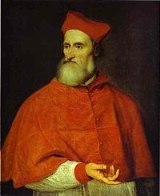
Pietro Bembo

Encyclopedia
Pietro Bembo was an Italian
scholar, poet, literary theorist
, and cardinal. He was an influential figure in the development of the Italian language
, specifically Tuscan, as a literary medium, and his writings assisted in the 16th-century revival of interest in the works of Petrarch
. Bembo's ideas were also decisive in the formation of the most important secular musical form of the 16th century, the madrigal
.
to an aristocratic family. His father was an ambassador for the Venetian state
, and while still a boy Pietro was able to accompany him on many of his travels; one of the places he visited was Florence
, there acquiring a love for the Tuscan
form of Italian, a love which was to prove so important in literary and musical history. He studied Greek for two years under the Greek
scholar Lascaris
at Messina
, and afterwards went to the University of Padua
. Further travels included two years (1497–1499) spent at the Este court in Ferrara
, under the reign of Ercole d'Este I
then a significant literary and musical center. While there he met Ariosto and commenced writing his first work, Gli Asolani
, a dialogue on the subject of courtly love. The poems in this book were reminiscent of Boccaccio and Petrarch, and were widely set to music in the 16th century. Bembo himself preferred his poetry to be performed by a female singer accompanied by a lute
, a wish which was granted to him when he met Isabella d'Este
in 1505 and sent her a copy of his book.
In 1502 and 1503 he was again in Ferrara, and had a love affair with the notorious Lucrezia Borgia
, who was the wife of Alfonso d'Este. He left around the time of Josquin des Prez
's hire by Ercole I d'Este as composer to the chapel, and in time to avoid the plague which decimated the city in 1505, claiming the life of renowned composer Jacob Obrecht
.
Between 1506 and 1512 he lived in Urbino
, and it was here that Bembo began to write his most influential work, a prose treatise on writing poetry in Italian, Prose della volgar lingua, although it was not to be published until much later. In 1513 Bembo accompanied Giulio de' Medici to Rome
, where he was soon after appointed secretary to Leo X
. On the pontiff's death in 1521 he retired, with impaired health, to Padua
, and there lived for a number of years, during which he continued to write, and in 1525 finally published his famous Prose della volgar lingua. In 1529 he accepted the office of historiographer
to Venice, his native city, and shortly afterwards was appointed librarian of St Mark's.
Pope Paul III
in 1539 made him a cardinal, and Bembo went back to Rome. While there he continued to write and revise his earlier work, in addition to studying theology and classical history; he received as reward the bishoprics of Gubbio
and Bergamo
. He died in Rome in his 77th year.
had on its hearers, but in Tuscan Italian instead. He held as his model, and as the highest example of poetic expression ever achieved in Italian, the work of Petrarch and Boccaccio, two 14th century writers he assisted in bringing back into fashion.
In the Prose della volgar lingua, he set Petrarch up as the perfect model, and discussed verse composition in detail, including rhyme, stress, the sounds of words, balance and variety. In Bembo's theory, the specific placement of words in a poem, with strict attention to their consonants and vowels, their rhythm, their position within lines long and short, could produce emotions ranging from sweetness and grace to gravity and grief in a listener. This work was of decisive importance in the development of the Italian madrigal, the most famous secular musical form of the 16th century, as it was these poems, carefully constructed (or, in the case of Petrarch, analyzed) according to Bembo's ideas, that were to be the primary texts for the music.
Other works by Bembo include a History of Venice from 1487 to 1513 (published in 1551), as well as dialogues, poems and essays. His early Gli Asolani explains and recommends Platonic affection
, somewhat ironically considering his affair with Lucrezia Borgia
, married at the time to his employer. His edition of Petrarch
's Italian Poems, published by Aldus
in 1501, and the Terzerime, which Aldus published in 1502, were also influential. Printer and composer Andrea Antico
, active in Rome, was also influenced by Bembo; the early composers of the Venetian School, such as Adrian Willaert
, helped to spread his theories among composers during that period of quick change. Willaert's collection of madrigals, Musica nova, show a close connection with Bembo's ideas.
The typeface Bembo
is named after him.
Italian people
The Italian people are an ethnic group that share a common Italian culture, ancestry and speak the Italian language as a mother tongue. Within Italy, Italians are defined by citizenship, regardless of ancestry or country of residence , and are distinguished from people...
scholar, poet, literary theorist
Literary theory
Literary theory in a strict sense is the systematic study of the nature of literature and of the methods for analyzing literature. However, literary scholarship since the 19th century often includes—in addition to, or even instead of literary theory in the strict sense—considerations of...
, and cardinal. He was an influential figure in the development of the Italian language
Italian language
Italian is a Romance language spoken mainly in Europe: Italy, Switzerland, San Marino, Vatican City, by minorities in Malta, Monaco, Croatia, Slovenia, France, Libya, Eritrea, and Somalia, and by immigrant communities in the Americas and Australia...
, specifically Tuscan, as a literary medium, and his writings assisted in the 16th-century revival of interest in the works of Petrarch
Petrarch
Francesco Petrarca , known in English as Petrarch, was an Italian scholar, poet and one of the earliest humanists. Petrarch is often called the "Father of Humanism"...
. Bembo's ideas were also decisive in the formation of the most important secular musical form of the 16th century, the madrigal
Madrigal (music)
A madrigal is a secular vocal music composition, usually a partsong, of the Renaissance and early Baroque eras. Traditionally, polyphonic madrigals are unaccompanied; the number of voices varies from two to eight, and most frequently from three to six....
.
Life
Bembo was born in VeniceVenice
Venice is a city in northern Italy which is renowned for the beauty of its setting, its architecture and its artworks. It is the capital of the Veneto region...
to an aristocratic family. His father was an ambassador for the Venetian state
Republic of Venice
The Republic of Venice or Venetian Republic was a state originating from the city of Venice in Northeastern Italy. It existed for over a millennium, from the late 7th century until 1797. It was formally known as the Most Serene Republic of Venice and is often referred to as La Serenissima, in...
, and while still a boy Pietro was able to accompany him on many of his travels; one of the places he visited was Florence
Florence
Florence is the capital city of the Italian region of Tuscany and of the province of Florence. It is the most populous city in Tuscany, with approximately 370,000 inhabitants, expanding to over 1.5 million in the metropolitan area....
, there acquiring a love for the Tuscan
Tuscany
Tuscany is a region in Italy. It has an area of about 23,000 square kilometres and a population of about 3.75 million inhabitants. The regional capital is Florence ....
form of Italian, a love which was to prove so important in literary and musical history. He studied Greek for two years under the Greek
Greeks
The Greeks, also known as the Hellenes , are a nation and ethnic group native to Greece, Cyprus and neighboring regions. They also form a significant diaspora, with Greek communities established around the world....
scholar Lascaris
Constantine Lascaris
Constantine Lascaris was a Greek scholar and grammarian, one of the promoters of the revival of Greek learning in the Italian peninsula, born at Constantinople....
at Messina
Messina, Italy
Messina is the third largest city on the island of Sicily, Italy and the capital of the province of Messina. It has a population of about 250,000 inhabitants in the city proper and about 650,000 in the province...
, and afterwards went to the University of Padua
University of Padua
The University of Padua is a premier Italian university located in the city of Padua, Italy. The University of Padua was founded in 1222 as a school of law and was one of the most prominent universities in early modern Europe. It is among the earliest universities of the world and the second...
. Further travels included two years (1497–1499) spent at the Este court in Ferrara
Ferrara
Ferrara is a city and comune in Emilia-Romagna, northern Italy, capital city of the Province of Ferrara. It is situated 50 km north-northeast of Bologna, on the Po di Volano, a branch channel of the main stream of the Po River, located 5 km north...
, under the reign of Ercole d'Este I
Ercole d'Este I
Ercole I d'Este was Duke of Ferrara from 1471 until 1505. He was a member of the house of Este. He was nicknamed North Wind and the Diamond.-Biography:...
then a significant literary and musical center. While there he met Ariosto and commenced writing his first work, Gli Asolani
Gli Asolani
Gli Asolani are dialogues in 3 books written between 1497 and 1504 by Pietro Bembo in the language of Petrarch and comprise his first important work...
, a dialogue on the subject of courtly love. The poems in this book were reminiscent of Boccaccio and Petrarch, and were widely set to music in the 16th century. Bembo himself preferred his poetry to be performed by a female singer accompanied by a lute
Lute
Lute can refer generally to any plucked string instrument with a neck and a deep round back, or more specifically to an instrument from the family of European lutes....
, a wish which was granted to him when he met Isabella d'Este
Isabella d'Este
Isabella d'Este was Marchesa of Mantua and one of the leading women of the Italian Renaissance as a major cultural and political figure. She was a patron of the arts as well as a leader of fashion, whose innovative style of dressing was copied by women throughout Italy and at the French court...
in 1505 and sent her a copy of his book.
In 1502 and 1503 he was again in Ferrara, and had a love affair with the notorious Lucrezia Borgia
Lucrezia Borgia
Lucrezia Borgia [luˈkrɛtsia ˈbɔrʤa] was the illegitimate daughter of Rodrigo Borgia, the powerful Renaissance Valencian who later became Pope Alexander VI, and Vannozza dei Cattanei. Her brothers included Cesare Borgia, Giovanni Borgia, and Gioffre Borgia...
, who was the wife of Alfonso d'Este. He left around the time of Josquin des Prez
Josquin Des Prez
Josquin des Prez [Josquin Lebloitte dit Desprez] , often referred to simply as Josquin, was a Franco-Flemish composer of the Renaissance...
's hire by Ercole I d'Este as composer to the chapel, and in time to avoid the plague which decimated the city in 1505, claiming the life of renowned composer Jacob Obrecht
Jacob Obrecht
Jacob Obrecht was a Flemish composer of the Renaissance. He was the most famous composer of masses in Europe in the late 15th century, being eclipsed by only Josquin des Prez after his death.-Life:...
.
Between 1506 and 1512 he lived in Urbino
Urbino
Urbino is a walled city in the Marche region of Italy, south-west of Pesaro, a World Heritage Site notable for a remarkable historical legacy of independent Renaissance culture, especially under the patronage of Federico da Montefeltro, duke of Urbino from 1444 to 1482...
, and it was here that Bembo began to write his most influential work, a prose treatise on writing poetry in Italian, Prose della volgar lingua, although it was not to be published until much later. In 1513 Bembo accompanied Giulio de' Medici to Rome
Rome
Rome is the capital of Italy and the country's largest and most populated city and comune, with over 2.7 million residents in . The city is located in the central-western portion of the Italian Peninsula, on the Tiber River within the Lazio region of Italy.Rome's history spans two and a half...
, where he was soon after appointed secretary to Leo X
Pope Leo X
Pope Leo X , born Giovanni di Lorenzo de' Medici, was the Pope from 1513 to his death in 1521. He was the last non-priest to be elected Pope. He is known for granting indulgences for those who donated to reconstruct St. Peter's Basilica and his challenging of Martin Luther's 95 Theses...
. On the pontiff's death in 1521 he retired, with impaired health, to Padua
Padua
Padua is a city and comune in the Veneto, northern Italy. It is the capital of the province of Padua and the economic and communications hub of the area. Padua's population is 212,500 . The city is sometimes included, with Venice and Treviso, in the Padua-Treviso-Venice Metropolitan Area, having...
, and there lived for a number of years, during which he continued to write, and in 1525 finally published his famous Prose della volgar lingua. In 1529 he accepted the office of historiographer
Historiography
Historiography refers either to the study of the history and methodology of history as a discipline, or to a body of historical work on a specialized topic...
to Venice, his native city, and shortly afterwards was appointed librarian of St Mark's.
Pope Paul III
Pope Paul III
Pope Paul III , born Alessandro Farnese, was Pope of the Roman Catholic Church from 1534 to his death in 1549. He came to the papal throne in an era following the sack of Rome in 1527 and rife with uncertainties in the Catholic Church following the Protestant Reformation...
in 1539 made him a cardinal, and Bembo went back to Rome. While there he continued to write and revise his earlier work, in addition to studying theology and classical history; he received as reward the bishoprics of Gubbio
Gubbio
Gubbio is a town and comune in the far northeastern part of the Italian province of Perugia . It is located on the lowest slope of Mt. Ingino, a small mountain of the Apennines. See also Mount Ingino Christmas Tree.-History:...
and Bergamo
Bergamo
Bergamo is a town and comune in Lombardy, Italy, about 40 km northeast of Milan. The comune is home to over 120,000 inhabitants. It is served by the Orio al Serio Airport, which also serves the Province of Bergamo, and to a lesser extent the metropolitan area of Milan...
. He died in Rome in his 77th year.
Works and influence
As a writer, Bembo attempted to restore some of the legendary "affect" that ancient GreekAncient Greek
Ancient Greek is the stage of the Greek language in the periods spanning the times c. 9th–6th centuries BC, , c. 5th–4th centuries BC , and the c. 3rd century BC – 6th century AD of ancient Greece and the ancient world; being predated in the 2nd millennium BC by Mycenaean Greek...
had on its hearers, but in Tuscan Italian instead. He held as his model, and as the highest example of poetic expression ever achieved in Italian, the work of Petrarch and Boccaccio, two 14th century writers he assisted in bringing back into fashion.
In the Prose della volgar lingua, he set Petrarch up as the perfect model, and discussed verse composition in detail, including rhyme, stress, the sounds of words, balance and variety. In Bembo's theory, the specific placement of words in a poem, with strict attention to their consonants and vowels, their rhythm, their position within lines long and short, could produce emotions ranging from sweetness and grace to gravity and grief in a listener. This work was of decisive importance in the development of the Italian madrigal, the most famous secular musical form of the 16th century, as it was these poems, carefully constructed (or, in the case of Petrarch, analyzed) according to Bembo's ideas, that were to be the primary texts for the music.
Other works by Bembo include a History of Venice from 1487 to 1513 (published in 1551), as well as dialogues, poems and essays. His early Gli Asolani explains and recommends Platonic affection
Platonic love
Platonic love is a chaste and strong type of love that is non-sexual.-Amor Platonicus:The term amor platonicus was coined as early as the 15th century by the Florentine scholar Marsilio Ficino. Platonic love in this original sense of the term is examined in Plato's dialogue the Symposium, which has...
, somewhat ironically considering his affair with Lucrezia Borgia
Lucrezia Borgia
Lucrezia Borgia [luˈkrɛtsia ˈbɔrʤa] was the illegitimate daughter of Rodrigo Borgia, the powerful Renaissance Valencian who later became Pope Alexander VI, and Vannozza dei Cattanei. Her brothers included Cesare Borgia, Giovanni Borgia, and Gioffre Borgia...
, married at the time to his employer. His edition of Petrarch
Petrarch
Francesco Petrarca , known in English as Petrarch, was an Italian scholar, poet and one of the earliest humanists. Petrarch is often called the "Father of Humanism"...
's Italian Poems, published by Aldus
Aldus Manutius
Aldus Pius Manutius , the Latinised name of Aldo Manuzio —sometimes called Aldus Manutius, the Elder to distinguish him from his grandson, Aldus Manutius, the Younger—was an Italian humanist who became a printer and publisher when he founded the Aldine Press at Venice.His publishing legacy includes...
in 1501, and the Terzerime, which Aldus published in 1502, were also influential. Printer and composer Andrea Antico
Andrea Antico
Andrea Antico was an Italian music printer, editor, publisher and composer of the Renaissance, of Istrian birth, active in Rome and in Venice...
, active in Rome, was also influenced by Bembo; the early composers of the Venetian School, such as Adrian Willaert
Adrian Willaert
Adrian Willaert was a Flemish composer of the Renaissance and founder of the Venetian School. He was one of the most representative members of the generation of northern composers who moved to Italy and transplanted the polyphonic Franco-Flemish style there....
, helped to spread his theories among composers during that period of quick change. Willaert's collection of madrigals, Musica nova, show a close connection with Bembo's ideas.
The typeface Bembo
Bembo
Bembo is the name given to a 20th-century revival of an old style serif or humanist typeface cut by Francesco Griffo around 1495.The typeface Bembo seen today is a revival designed under the direction of Stanley Morison for the Monotype Corporation in 1929.It is considered a good choice for...
is named after him.
External links
- Pietro Bembo: Historia Veneta, Venice 1551; facsimile, CAMENA Project
- Bembo, Pietro: Carmina, in: Carmina Quinque Illustrium Poetarum Bergamo 1753; facsimile, CAMENA Project