


Anchor

Encyclopedia
An anchor is a device, normally made of metal, that is used to connect a vessel
to the bed
of a body of water to prevent the vessel from drifting due to wind
or current
. The word derives from Latin
ancora, which itself comes from the Greek
ἄγκυρα (ankura ).
Anchors can either be temporary or permanent. A permanent anchor is used in the creation of a mooring, and is rarely moved; a specialist service is normally needed to move or maintain it. Vessels carry one or more temporary anchors which may be of different designs and weights.
An unrelated device is a sea anchor
, a drogue
used to control a drifting vessel.
, or via sheer mass, or a combination of the two. Permanent moorings use large masses (commonly a block or slab of concrete) resting on this seabed. Semi-permanent mooring anchors (such as mushroom anchors) and large ship's anchors derive a significant portion of their holding power from their mass, while also hooking or embedding in the bottom. Modern anchors for smaller vessels have metal flukes which hook on to rocks on the bottom or bury themselves in soft bottoms.
The vessel is attached to the anchor by the rode which is made of chain
, cable
, rope
, or a combination of these. The ratio of the length of rode to the water depth is known as the scope. Anchoring with sufficient scope and/or heavy chain rode brings the direction of strain close to parallel with the seabed. This is particularly important for light modern anchors designed to bury in the bottom, where ratios of 5-7 to 1 are common, whereas heavy anchors and moorings can use 3 to 1 or less.
Since all anchors that embed themselves in the bottom require the strain to be along the seabed, anchors can be broken out of the bottom by shortening the rode until the vessel is directly above the anchor (at this point the anchor chain is "up and down" in naval parlance). If necessary, motoring slowly around the location of the anchor also helps dislodge it. Anchors are sometimes fitted with a tripping line attached to the crown, by which they can be unhooked from rocks or coral.
An interesting element of anchor jargon is the term aweigh, which describes the anchor when it is hanging on the rode, not resting on the bottom; this is linked to the term to weigh anchor, meaning to lift the anchor from the sea bed, allowing the ship or boat to move. An anchor is described as aweigh when it has been broken out of the bottom and is being hauled up to be stowed. Aweigh should not be confused with under way, which describes a vessel which is not moored to a dock or anchored, whether or not it is moving through the water. Thus, a vessel can be under way (or underway) with no way on (i.e., not moving).
. Many modern moorings still rely on a large rock as the primary element of their design. However, using pure mass to resist the forces of a storm only works well as a permanent mooring; a large enough rock would be nearly impossible to move to a new location.
The ancient Greeks used baskets of stones, large sacks filled with sand, and wooden logs filled with lead, which, according to Apollonius Rhodius and Stephen of Byzantium, were formed of stone; and Athenaeus states that they were sometimes made of wood. Such anchors held the vessel merely by their weight and by their friction along the bottom. Iron was afterwards introduced for the construction of anchors, and an improvement was made by forming them with teeth, or "flukes", to fasten themselves into the bottom.
", and also known as "Fisherman", is the most familiar among non-sailors. It consists of a central shank with a ring or shackle
for attaching the rode. At one end of the shank there are two arms, carrying the flukes, while the stock is mounted to the other end, at ninety degrees to the arms. When the anchor lands on the bottom, it will generally fall over with the arms parallel to the seabed. As a strain comes onto the rode, the stock will dig into the bottom, canting the anchor until one of the flukes catches and digs into the bottom.
The basic design remained unchanged for centuries, with the most significant changes being to the overall proportions, and a move from wooden stocks to those of iron. Since one fluke always protrudes up from the set anchor, there is a great tendency of the rode to foul the anchor as the vessel swings due to wind or current shifts. When this happens, the anchor may be pulled out of the bottom, and in some cases may need to be hauled up to be re-set. In the mid-19th century, numerous modifications were attempted to alleviate these problems, as well as improve holding power, including one-armed mooring anchors. The most successful of these patent anchors, the Trotman Anchor, introduced a pivot where the arms join the shank, allowing the "idle" arm to fold against the shank.
Handling and stowage of these anchors requires special equipment and procedures. Once the anchor is hauled up to the hawsepipe, the ring end is hoisted up to the end of a timber projecting from the bow known as the cathead
. The crown of the anchor is then hauled up with a heavy tackle until one fluke can be hooked over the rail. This is known as "catting and fishing" the anchor. Before dropping the anchor, the fishing process is reversed, and the anchor is dropped from the end of the cathead.
While there are numerous variations, stockless anchors consist of a set of heavy flukes connected by a pivot or ball and socket joint to a shank. Cast into the crown of the anchor is a set of tripping palms, projections that drag on the bottom, forcing the main flukes to dig in.
Grapnels rarely have enough fluke area to develop much hold in sand, clay, or mud. It is not unknown for the anchor to foul on its own rode, or to foul the tines with refuse from the bottom, preventing it from digging in. On the other hand, it is quite possible for this anchor to find such a good hook that, without a trip line from the crown, it is impossible to retrieve. The shape is generally not very compact, and is difficult to stow, although there are a few collapsing designs available.
, this is essentially the same pattern as an admiralty anchor, albeit with small diamond shaped flukes or palms. The novelty of the design lay in the means by which it could be broken down into three pieces for stowage. In use, it still presents all the issues of the admiralty pattern anchor.
(or more specifically two ploughshares
), many manufacturers produce a plough-style design, all based on or direct copies of the original CQR (Secure), a 1933 design patented in the UK
(US patent in 1934 ) by mathematician Geoffrey Ingram Taylor
. Ploughs are popular with cruising sailors and other private boaters. They are generally good in all bottoms, but not exceptional in any. The CQR design has a hinged shank, allowing the anchor to turn with direction changes rather than breaking out, while other plough types have a rigid shank. Plough anchors are usually stowed in a roller at the bow.
Owing to the use of lead or other dedicated tip-weight, the plough is heavier than average for the amount of resistance developed, and may take a slightly longer pull to set thoroughly. It cannot be stored in a hawse pipe.
. It uses a stock at the crown to which two large flat triangular flukes are attached. The stock is hinged so the flukes can orient toward the bottom (and on some designs may be adjusted for an optimal angle depending on the bottom type). Tripping palms at the crown act to tip the flukes into the seabed. The design is a burying variety, and once well set can develop high resistance. Its light weight and compact flat design make it easy to retrieve and relatively easy to store; some anchor rollers and hawsepipes can accommodate a fluke-style anchor.
The fluke anchor has difficulty penetrating kelp and weed-covered bottoms, as well as rocky and particularly hard sand or clay bottoms. If there is much current or the vessel is moving while dropping the anchor it may "kite" or "skate" over the bottom due to the large fluke area acting as a sail or wing. Once set, the anchor tends to break out and reset when the direction of force changes dramatically, such as with the changing tide, and on some occasions it might not reset but instead drag.
in the 1970s. Bruce gained his early reputation from the production of large scale commercial anchors for ships and fixed installations such as oil rigs. The Bruce and its copies, known generically as "claws", have become a popular option for small boaters. It was intended to address some of the problems of the only general-purpose option then available, the plough. Claw-types set quickly in most seabeds and although not an articulated design, they have the reputation of not breaking out with tide or wind changes, instead slowly turning in the bottom to align with the force.
Claw types have difficulty penetrating weedy bottoms and grass. They offer a fairly low holding power to weight ratio and generally have to be over-sized to compete with other types. On the other hand they perform relatively well with low rode scopes and set fairly reliably. They cannot be used with hawse pipes.
) are finding homes with users of small to medium sized vessels.
s or channel marker buoy
s. The anchor needs to hold the vessel in all weathers, including the most severe storm
, but only occasionally, or never, needs to be lifted, only for example if the vessel is to be towed into port for maintenance. An alternative to using an anchor under these circumstances may be to use a pile driven into the seabed.
Permanent anchors come in a wide range of types and have no standard form. A slab of rock with an iron staple in it to attach a chain to would serve the purpose, as would any dense object of appropriate weight (e.g. an engine block). Modern moorings may be anchored by sand screws which look and act very much like over-sized screws drilled into the seabed, or by barbed metal beams pounded in (or even driven in with explosives) like pilings, or a variety of other non-mass means of getting a grip on the bottom. One method of building a mooring is to use three or more conventional anchors laid out with short lengths of chain attached to a swivel, so no matter which direction the vessel moves one or more anchors will be aligned to resist the force.
, for use by an 82 ton converted fishing boat, Pharos, which was used as a lightvessel
between 1807 and 1810 near to Bell Rock
whilst the lighthouse
was being constructed. It was equipped with a 1.5 ton example.
It is shaped like an inverted mushroom, the head becoming buried in the silt. A counterweight is often provided at the other end of the shank to lay it down before it becomes buried.
A mushroom anchor will normally sink in the silt to the point where it has displaced its own weight in bottom material, thus greatly increasing its holding power. These anchors are only suitable for a silt or mud bottom, since they rely upon suction and cohesion of the bottom material, which rocky or coarse sand bottoms lack. The holding power of this anchor is at best about twice its weight until it becomes buried, when it can be as much as ten times its weight http://www.acegroup.com/us-en/assets/moorings.pdf. They are available in sizes from about 10 lb up to several tons.
Weight for weight, screw anchors have a higher holding than other permanent designs, and so can be cheap and relatively easily installed, although may not be ideal in extremely soft mud.
Vessels may carry a number of anchors: Bower Anchors (formerly known as Sheet Anchors) are the main anchors used by a vessel and normally carried at the bow of the vessel. A Kedge Anchor is a light anchor used for kedging, or more commonly on yachts for mooring quickly. or in benign conditions. A Killick Anchor is a small, possibly improvised, anchor.
Charts are vital to good anchoring. Knowing the location of potential dangers, as well as being useful in estimating the effects of weather and tide in the anchorage, is essential in choosing a good place to drop the hook. One can get by without referring to charts, but they are an important tool and a part of good anchoring gear, and a skilled mariner would not choose to anchor without them.
The depth of water is necessary for determining scope, which is the ratio of length of cable to the depth measured from the highest point (usually the anchor roller or bow chock) to the seabed. For example, if the water is 25 ft (8 m) deep, and the anchor roller is 3 ft (1 m) above the water, the scope is the ratio between the amount of cable let out and 28 ft (9 m). For this reason it is important to have a reliable and accurate method of measuring the depth of water.
A cable or rode is the rope, chain, or combination thereof used to connect the anchor to the vessel. Neither rope nor chain is fundamentally superior to a cable.
The location to drop the anchor should be approached from down wind or down current, whichever is stronger. As the chosen spot is approached, the vessel should be stopped or even beginning to drift back. The anchor should be lowered quickly but under control until it is on the bottom. The vessel should continue to drift back, and the cable should be veered out under control so it will be relatively straight.
Once the desired scope is laid out, the vessel should be gently forced astern, usually using the auxiliary motor but possibly by backing a sail. A hand on the anchor line may telegraph a series of jerks and jolts, indicating the anchor is dragging, or a smooth tension indicative of digging in. As the anchor begins to dig in and resist backward force, the engine may be throttled up to get a thorough set. If the anchor continues to drag, or sets after having dragged too far, it should be retrieved and moved back to the desired position (or another location chosen.)
With the anchor set in the correct location, everything should be reconsidered.
Some other techniques have been developed to reduce swing, or to deal with heavy weather.
, tide ranges, as well as the times of high and low water, should be known. Enough depth is needed so that low tide does not present obstacles to where the vessel might swing. This is also important when determining scope, which should be figured for high tide and not the current tide state.
There are techniques of anchoring to limit the swing of a vessel if the anchorage has limited room.
This moor also to some degree limits the range of a vessel's swing to a narrower oval. Care should be taken that other vessels will not swing down on the boat due to the limited swing range.
In the Bow and Stern technique, an anchor is set off each the bow and the stern, which can severely limit a vessel's swing range and also align it to steady wind, current or wave conditions. One method of accomplishing this moor is to set a bow anchor normally, then drop back to the limit of the bow cable (or to double the desired scope, e.g. 8:1 if the eventual scope should be 4:1, 10:1 if the eventual scope should be 5:1, etc.) to lower a stern anchor. By taking up on the bow cable the stern anchor can be set. After both anchors are set, tension is taken up on both cables to limit the swing or to align the vessel.
The vessel will now swing in the middle of two anchors, which is acceptable in strong reversing currents but a wind perpendicular to the current may break out the anchors as they are not aligned for this load.
In yachts, a kedge anchor is an anchor carried in addition to the main, or bower anchors, and usually stowed aft. Every yacht should carry at least two anchors – the main or bower anchor and a second lighter kedge anchor. It is used occasionally when it is necessary to limit the turning circle as the yacht swings when it is anchored, such as in a very narrow river or a deep pool in an otherwise shallow area.
For ships, a kedge may be dropped while a ship is underway, or carried out in a suitable direction by a tender or ship's boat to enable the ship to be winched off if aground or swung into a particular heading, or even to be held steady against a tidal or other stream.
Historically, it was of particular relevance to sailing warships which used them to out-maneuver opponents when the wind had dropped but might be used by any vessel in confined, shoal water to place it in a more desirable position, provided she had enough manpower.
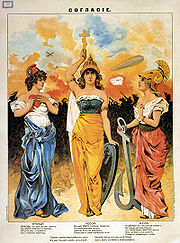 An anchor frequently appears on the flags and coats-of-arms of institutions involved with the sea, both naval and commercial, as well as of port cities and seacoast regions and provinces in various countries. There also exists in heraldry the "Anchored Cross
", or Mariner's Cross, a stylized cross in the shape of an anchor. The symbol can be used to signify 'fresh start' or 'hope'. The Mariner's Cross is also referred to as St. Clement's Cross
in reference to the way this saint was martyred (being tied to an anchor and thrown from a boat into the Black Sea
in 102). Anchored crosses are occasionally a feature of coats of arms
in which context they are referred to by the heraldic
terms anchry or ancre.
Watercraft
A watercraft is a vessel or craft designed to move across or through water. The name is derived from the term "craft" which was used to describe all types of water going vessels...
to the bed
Seabed
The seabed is the bottom of the ocean.- Ocean structure :Most of the oceans have a common structure, created by common physical phenomena, mainly from tectonic movement, and sediment from various sources...
of a body of water to prevent the vessel from drifting due to wind
Leeway
Leeway is the motion of an object that is floating in the water to leeward due to the component of the wind vector perpendicular to the object’s. The National Search and Rescue Supplement to the International Aeronautical and Maritime Search and Rescue Manual defines leeway as "the movement of a...
or current
Ocean current
An ocean current is a continuous, directed movement of ocean water generated by the forces acting upon this mean flow, such as breaking waves, wind, Coriolis effect, cabbeling, temperature and salinity differences and tides caused by the gravitational pull of the Moon and the Sun...
. The word derives from Latin
Latin
Latin is an Italic language originally spoken in Latium and Ancient Rome. It, along with most European languages, is a descendant of the ancient Proto-Indo-European language. Although it is considered a dead language, a number of scholars and members of the Christian clergy speak it fluently, and...
ancora, which itself comes from the Greek
Greek language
Greek is an independent branch of the Indo-European family of languages. Native to the southern Balkans, it has the longest documented history of any Indo-European language, spanning 34 centuries of written records. Its writing system has been the Greek alphabet for the majority of its history;...
ἄγκυρα (ankura ).
Anchors can either be temporary or permanent. A permanent anchor is used in the creation of a mooring, and is rarely moved; a specialist service is normally needed to move or maintain it. Vessels carry one or more temporary anchors which may be of different designs and weights.
An unrelated device is a sea anchor
Sea anchor
A sea anchor, is a device external to the boat, attached to the bow used to stabilize a boat in heavy weather. It anchors not to the sea floor but to the water itself, as a kind of brake. Sea anchors are known by a number of names, such as drift anchor, drift sock, para-anchor, and boat brakes...
, a drogue
Drogue
A drogue is a device external to the boat, attached to the stern used to slow a boat down in a storm and to keep the hull perpendicular to the waves. The boat will not speed excessively down the slope of a wave and crash into the next one nor will it broach. By slowing the vessel in heavy...
used to control a drifting vessel.
Overview
Anchors achieve holding power either by "hooking" into the seabedSeabed
The seabed is the bottom of the ocean.- Ocean structure :Most of the oceans have a common structure, created by common physical phenomena, mainly from tectonic movement, and sediment from various sources...
, or via sheer mass, or a combination of the two. Permanent moorings use large masses (commonly a block or slab of concrete) resting on this seabed. Semi-permanent mooring anchors (such as mushroom anchors) and large ship's anchors derive a significant portion of their holding power from their mass, while also hooking or embedding in the bottom. Modern anchors for smaller vessels have metal flukes which hook on to rocks on the bottom or bury themselves in soft bottoms.
The vessel is attached to the anchor by the rode which is made of chain
Chain
A chain is a sequence of connected links.Chain may also refer to:Chain may refer to:* Necklace - a jewelry which is worn around the neck* Mail , a type of armor made of interlocking chain links...
, cable
Cable
A cable is two or more wires running side by side and bonded, twisted or braided together to form a single assembly. In mechanics cables, otherwise known as wire ropes, are used for lifting, hauling and towing or conveying force through tension. In electrical engineering cables are used to carry...
, rope
Rope
A rope is a length of fibres, twisted or braided together to improve strength for pulling and connecting. It has tensile strength but is too flexible to provide compressive strength...
, or a combination of these. The ratio of the length of rode to the water depth is known as the scope. Anchoring with sufficient scope and/or heavy chain rode brings the direction of strain close to parallel with the seabed. This is particularly important for light modern anchors designed to bury in the bottom, where ratios of 5-7 to 1 are common, whereas heavy anchors and moorings can use 3 to 1 or less.
Since all anchors that embed themselves in the bottom require the strain to be along the seabed, anchors can be broken out of the bottom by shortening the rode until the vessel is directly above the anchor (at this point the anchor chain is "up and down" in naval parlance). If necessary, motoring slowly around the location of the anchor also helps dislodge it. Anchors are sometimes fitted with a tripping line attached to the crown, by which they can be unhooked from rocks or coral.
An interesting element of anchor jargon is the term aweigh, which describes the anchor when it is hanging on the rode, not resting on the bottom; this is linked to the term to weigh anchor, meaning to lift the anchor from the sea bed, allowing the ship or boat to move. An anchor is described as aweigh when it has been broken out of the bottom and is being hauled up to be stowed. Aweigh should not be confused with under way, which describes a vessel which is not moored to a dock or anchored, whether or not it is moving through the water. Thus, a vessel can be under way (or underway) with no way on (i.e., not moving).
Evolution of the Anchor
The earliest anchors were probably rocks and many rock anchors have been found dating from at least the Bronze AgeBronze Age
The Bronze Age is a period characterized by the use of copper and its alloy bronze as the chief hard materials in the manufacture of some implements and weapons. Chronologically, it stands between the Stone Age and Iron Age...
. Many modern moorings still rely on a large rock as the primary element of their design. However, using pure mass to resist the forces of a storm only works well as a permanent mooring; a large enough rock would be nearly impossible to move to a new location.
The ancient Greeks used baskets of stones, large sacks filled with sand, and wooden logs filled with lead, which, according to Apollonius Rhodius and Stephen of Byzantium, were formed of stone; and Athenaeus states that they were sometimes made of wood. Such anchors held the vessel merely by their weight and by their friction along the bottom. Iron was afterwards introduced for the construction of anchors, and an improvement was made by forming them with teeth, or "flukes", to fasten themselves into the bottom.
Admiralty Pattern
The Admiralty Pattern, "A.P.", or simply "AdmiraltyAdmiralty
The Admiralty was formerly the authority in the Kingdom of England, and later in the United Kingdom, responsible for the command of the Royal Navy...
", and also known as "Fisherman", is the most familiar among non-sailors. It consists of a central shank with a ring or shackle
Shackle
A shackle, also known as a gyve, is a U-shaped piece of metal secured with a clevis pin or bolt across the opening, or a hinged metal loop secured with a quick-release locking pin mechanism...
for attaching the rode. At one end of the shank there are two arms, carrying the flukes, while the stock is mounted to the other end, at ninety degrees to the arms. When the anchor lands on the bottom, it will generally fall over with the arms parallel to the seabed. As a strain comes onto the rode, the stock will dig into the bottom, canting the anchor until one of the flukes catches and digs into the bottom.
The basic design remained unchanged for centuries, with the most significant changes being to the overall proportions, and a move from wooden stocks to those of iron. Since one fluke always protrudes up from the set anchor, there is a great tendency of the rode to foul the anchor as the vessel swings due to wind or current shifts. When this happens, the anchor may be pulled out of the bottom, and in some cases may need to be hauled up to be re-set. In the mid-19th century, numerous modifications were attempted to alleviate these problems, as well as improve holding power, including one-armed mooring anchors. The most successful of these patent anchors, the Trotman Anchor, introduced a pivot where the arms join the shank, allowing the "idle" arm to fold against the shank.
Handling and stowage of these anchors requires special equipment and procedures. Once the anchor is hauled up to the hawsepipe, the ring end is hoisted up to the end of a timber projecting from the bow known as the cathead
Cathead
A cathead is a large wooden beam located on either bow of a sailing ship, and angled outward at roughly 45 degrees. The beam is used to support the ship's anchor when raising it or lowering it , and for carrying the anchor on its stock-end when suspended outside the ship's side...
. The crown of the anchor is then hauled up with a heavy tackle until one fluke can be hooked over the rail. This is known as "catting and fishing" the anchor. Before dropping the anchor, the fishing process is reversed, and the anchor is dropped from the end of the cathead.
Stockless or Navy Pattern Anchor
Developed in the late 19th century, stockless anchors represented the first significant departure in anchor design in centuries. Though their holding power to weight ratio is significantly lower than admiralty pattern anchors, their ease of handling and stowage aboard large ships led to almost universal adoption. In contrast to the elaborate stowage procedures for earlier anchors, stockless anchors are simply hauled up until they rest with the shank inside the hawsepipes, and the flukes against the hull (or inside a recess in the hull).While there are numerous variations, stockless anchors consist of a set of heavy flukes connected by a pivot or ball and socket joint to a shank. Cast into the crown of the anchor is a set of tripping palms, projections that drag on the bottom, forcing the main flukes to dig in.
Small Boat Anchors
Until the mid-20th century, anchors for smaller vessels were either scaled-down versions of admiralty anchors, or simple grapnels. As new designs with greater holding power to weight ratios, a great variety of anchor designs has emerged. Many of these designs are still under patent, and other types are best known by their original trademarked names.Grapnel
A traditional design, the grapnel is merely a shank with four or more tines. It has a benefit in that no matter how it reaches the bottom one or more tines will be aimed to set. In coral it is often able to set quickly by hooking into the structure, but may be more difficult to retrieve. A grapnel is often quite light, and may have additional uses as a tool to recover gear lost overboard; its weight also makes it relatively easy to carry onboard.Grapnels rarely have enough fluke area to develop much hold in sand, clay, or mud. It is not unknown for the anchor to foul on its own rode, or to foul the tines with refuse from the bottom, preventing it from digging in. On the other hand, it is quite possible for this anchor to find such a good hook that, without a trip line from the crown, it is impossible to retrieve. The shape is generally not very compact, and is difficult to stow, although there are a few collapsing designs available.
Herreshoff anchor
Designed by famous yacht designer L. Francis HerreshoffLewis Francis Herreshoff
Lewis Francis Herreshoff , was a boat designer, naval architect, editor and author of books and magazine articles. Early in his career he worked for the Herreshoff Manufacturing and for naval architect Starling Burgess....
, this is essentially the same pattern as an admiralty anchor, albeit with small diamond shaped flukes or palms. The novelty of the design lay in the means by which it could be broken down into three pieces for stowage. In use, it still presents all the issues of the admiralty pattern anchor.
Northill anchor
Originally designed as a lightweight anchor for seaplanes, this design consists of two plow-like blades mounted to a shank, with a folding stock crossing through the crown of the anchor.CQR (Secure) Plough anchor
So named due to its resemblance to a traditional agricultural ploughPlough
The plough or plow is a tool used in farming for initial cultivation of soil in preparation for sowing seed or planting. It has been a basic instrument for most of recorded history, and represents one of the major advances in agriculture...
(or more specifically two ploughshares
Plowshare
In agriculture, a plowshare is a component of a plow . It is the cutting or leading edge of a moldboard which closely follows the coulter when plowing....
), many manufacturers produce a plough-style design, all based on or direct copies of the original CQR (Secure), a 1933 design patented in the UK
United Kingdom
The United Kingdom of Great Britain and Northern IrelandIn the United Kingdom and Dependencies, other languages have been officially recognised as legitimate autochthonous languages under the European Charter for Regional or Minority Languages...
(US patent in 1934 ) by mathematician Geoffrey Ingram Taylor
Geoffrey Ingram Taylor
Sir Geoffrey Ingram Taylor OM was a British physicist, mathematician and expert on fluid dynamics and wave theory. His biographer and one-time student, George Batchelor, described him as "one of the most notable scientists of this century".-Biography:Taylor was born in St. John's Wood, London...
. Ploughs are popular with cruising sailors and other private boaters. They are generally good in all bottoms, but not exceptional in any. The CQR design has a hinged shank, allowing the anchor to turn with direction changes rather than breaking out, while other plough types have a rigid shank. Plough anchors are usually stowed in a roller at the bow.
Owing to the use of lead or other dedicated tip-weight, the plough is heavier than average for the amount of resistance developed, and may take a slightly longer pull to set thoroughly. It cannot be stored in a hawse pipe.
Danforth or Fluke anchor
American Richard Danforth invented the Danforth pattern in the 1940s for use aboard landing craftLanding craft
Landing craft are boats and seagoing vessels used to convey a landing force from the sea to the shore during an amphibious assault. Most renowned are those used to storm the beaches of Normandy, the Mediterranean, and many Pacific islands during WWII...
. It uses a stock at the crown to which two large flat triangular flukes are attached. The stock is hinged so the flukes can orient toward the bottom (and on some designs may be adjusted for an optimal angle depending on the bottom type). Tripping palms at the crown act to tip the flukes into the seabed. The design is a burying variety, and once well set can develop high resistance. Its light weight and compact flat design make it easy to retrieve and relatively easy to store; some anchor rollers and hawsepipes can accommodate a fluke-style anchor.
The fluke anchor has difficulty penetrating kelp and weed-covered bottoms, as well as rocky and particularly hard sand or clay bottoms. If there is much current or the vessel is moving while dropping the anchor it may "kite" or "skate" over the bottom due to the large fluke area acting as a sail or wing. Once set, the anchor tends to break out and reset when the direction of force changes dramatically, such as with the changing tide, and on some occasions it might not reset but instead drag.
Bruce/ Claw
This claw shaped anchor was designed by Peter Bruce from the Isle of ManIsle of Man
The Isle of Man , otherwise known simply as Mann , is a self-governing British Crown Dependency, located in the Irish Sea between the islands of Great Britain and Ireland, within the British Isles. The head of state is Queen Elizabeth II, who holds the title of Lord of Mann. The Lord of Mann is...
in the 1970s. Bruce gained his early reputation from the production of large scale commercial anchors for ships and fixed installations such as oil rigs. The Bruce and its copies, known generically as "claws", have become a popular option for small boaters. It was intended to address some of the problems of the only general-purpose option then available, the plough. Claw-types set quickly in most seabeds and although not an articulated design, they have the reputation of not breaking out with tide or wind changes, instead slowly turning in the bottom to align with the force.
Claw types have difficulty penetrating weedy bottoms and grass. They offer a fairly low holding power to weight ratio and generally have to be over-sized to compete with other types. On the other hand they perform relatively well with low rode scopes and set fairly reliably. They cannot be used with hawse pipes.
Recent designs
In recent years there has been something of a spurt in anchor design. Primarily designed to set very quickly, then generate high holding power, these anchors (mostly proprietary inventions still under patentPatent
A patent is a form of intellectual property. It consists of a set of exclusive rights granted by a sovereign state to an inventor or their assignee for a limited period of time in exchange for the public disclosure of an invention....
) are finding homes with users of small to medium sized vessels.
- The German designed bow anchor, Bügelanker (or Wasi), has a sharp tip for penetrating weed, and features a roll-bar which allows the correct setting attitude to be achieved without the need for extra weight to be inserted into the tip.
- The Bulwagga is a unique design featuring three flukes instead of the usual two. It has performed well in tests by independent sources such as American boating magazine Practical Sailor.
- The Spade is a French design which has proved successful since 1996. It features a demountable shank and the choice of galvanized steel, stainless steel, or aluminium construction, which means a lighter and more easily stowable anchor.
- The New Zealand designed Rocna has been produced since 2004. It too features a sharp toe like the Bügel for penetrating weed and grass, sets quickly, and has a particularly large fluke area. Its roll-bar is also similar to that of the Bügel. The Rocna obtained the highest averaged holding power in SAIL magazine's comparison testing in 2006.
Other Temporary Anchors
- Mud weight: Consists of a blunt heavy weight, usually cast iron or cast lead, that will sink into the mud and resist lateral movement. Suitable only for very soft silt bottoms and in mild conditions. Sizes range between 5 and 20 kg for small craft. Various designs exist and many are home produced from lead or improvised with heavy objects. This is a very commonly used method on the Norfolk Broads in England.
Permanent anchors
These are used where the vessel is permanently sited, for example in the case of lightvesselLightvessel
A lightvessel, or lightship, is a ship which acts as a lighthouse. They are used in waters that are too deep or otherwise unsuitable for lighthouse construction...
s or channel marker buoy
Buoy
A buoy is a floating device that can have many different purposes. It can be anchored or allowed to drift. The word, of Old French or Middle Dutch origin, is now most commonly in UK English, although some orthoepists have traditionally prescribed the pronunciation...
s. The anchor needs to hold the vessel in all weathers, including the most severe storm
Storm
A storm is any disturbed state of an astronomical body's atmosphere, especially affecting its surface, and strongly implying severe weather...
, but only occasionally, or never, needs to be lifted, only for example if the vessel is to be towed into port for maintenance. An alternative to using an anchor under these circumstances may be to use a pile driven into the seabed.
Permanent anchors come in a wide range of types and have no standard form. A slab of rock with an iron staple in it to attach a chain to would serve the purpose, as would any dense object of appropriate weight (e.g. an engine block). Modern moorings may be anchored by sand screws which look and act very much like over-sized screws drilled into the seabed, or by barbed metal beams pounded in (or even driven in with explosives) like pilings, or a variety of other non-mass means of getting a grip on the bottom. One method of building a mooring is to use three or more conventional anchors laid out with short lengths of chain attached to a swivel, so no matter which direction the vessel moves one or more anchors will be aligned to resist the force.
Mushroom
The mushroom anchor is suitable where the seabed is composed of silt or fine sand. It was invented by Robert StevensonRobert Stevenson (civil engineer)
Robert Stevenson FRSE MInstCE FSAS MWS FGS FRAS FSA was a Scottish civil engineer and famed designer and builder of lighthouses.One of his finest achievements was the construction of the Bell Rock Lighthouse.-Early life:...
, for use by an 82 ton converted fishing boat, Pharos, which was used as a lightvessel
Lightvessel
A lightvessel, or lightship, is a ship which acts as a lighthouse. They are used in waters that are too deep or otherwise unsuitable for lighthouse construction...
between 1807 and 1810 near to Bell Rock
Inchcape
Inchcape or the Bell Rock is a notorious reef off the east coast of Angus, Scotland, near Dundee and Fife . Bell Rock Lighthouse, an automatic lighthouse, occupies the reef...
whilst the lighthouse
Bell Rock Lighthouse
Bell Rock Lighthouse is the world's oldest surviving sea-washed lighthouse and was built on Bell Rock in the North Sea, off the coast of Angus, Scotland, east of the Firth of Tay...
was being constructed. It was equipped with a 1.5 ton example.
It is shaped like an inverted mushroom, the head becoming buried in the silt. A counterweight is often provided at the other end of the shank to lay it down before it becomes buried.
A mushroom anchor will normally sink in the silt to the point where it has displaced its own weight in bottom material, thus greatly increasing its holding power. These anchors are only suitable for a silt or mud bottom, since they rely upon suction and cohesion of the bottom material, which rocky or coarse sand bottoms lack. The holding power of this anchor is at best about twice its weight until it becomes buried, when it can be as much as ten times its weight http://www.acegroup.com/us-en/assets/moorings.pdf. They are available in sizes from about 10 lb up to several tons.
Deadweight
This is an anchor which relies solely on being a heavy weight. It is usually just a large block of concrete or stone at the end of the chain. Its holding power is defined by its weight underwater (i.e. taking its buoyancy into account) regardless of the type of seabed, although suction can increase this if it becomes buried. Consequently deadweight anchors are used where mushroom anchors are unsuitable, for example in rock, gravel or coarse sand. An advantage of a deadweight anchor over a mushroom is that if it does become dragged, then it continues to provide its original holding force. The disadvantage of using deadweight anchors in conditions where a mushroom anchor could be used is that it needs to be around ten times the weight of the equivalent mushroom anchor.Screw
Screw anchors can be used to anchor permanent moorings, floating docks, fish farms, etc. These anchors must be screwed into the seabed with the use of a tool, so require access to the bottom, either at low tide or by use of a diver. Hence they can be difficult to install in deep water without special equipment.Weight for weight, screw anchors have a higher holding than other permanent designs, and so can be cheap and relatively easily installed, although may not be ideal in extremely soft mud.
Anchoring gear
The elements of anchoring gear include the anchor, the cable (also called a rode), the method of attaching the two together, the method of attaching the cable to the ship, charts, and a method of learning the depth of the water.Vessels may carry a number of anchors: Bower Anchors (formerly known as Sheet Anchors) are the main anchors used by a vessel and normally carried at the bow of the vessel. A Kedge Anchor is a light anchor used for kedging, or more commonly on yachts for mooring quickly. or in benign conditions. A Killick Anchor is a small, possibly improvised, anchor.
Charts are vital to good anchoring. Knowing the location of potential dangers, as well as being useful in estimating the effects of weather and tide in the anchorage, is essential in choosing a good place to drop the hook. One can get by without referring to charts, but they are an important tool and a part of good anchoring gear, and a skilled mariner would not choose to anchor without them.
The depth of water is necessary for determining scope, which is the ratio of length of cable to the depth measured from the highest point (usually the anchor roller or bow chock) to the seabed. For example, if the water is 25 ft (8 m) deep, and the anchor roller is 3 ft (1 m) above the water, the scope is the ratio between the amount of cable let out and 28 ft (9 m). For this reason it is important to have a reliable and accurate method of measuring the depth of water.
A cable or rode is the rope, chain, or combination thereof used to connect the anchor to the vessel. Neither rope nor chain is fundamentally superior to a cable.
Anchoring techniques
The basic anchoring consists of determining the location, dropping the anchor, laying out the scope, setting the hook, and assessing where the vessel ends up. The ship will seek a location which is sufficiently protected; has suitable holding ground, enough depth at low tide and enough room for the boat to swing.The location to drop the anchor should be approached from down wind or down current, whichever is stronger. As the chosen spot is approached, the vessel should be stopped or even beginning to drift back. The anchor should be lowered quickly but under control until it is on the bottom. The vessel should continue to drift back, and the cable should be veered out under control so it will be relatively straight.
Once the desired scope is laid out, the vessel should be gently forced astern, usually using the auxiliary motor but possibly by backing a sail. A hand on the anchor line may telegraph a series of jerks and jolts, indicating the anchor is dragging, or a smooth tension indicative of digging in. As the anchor begins to dig in and resist backward force, the engine may be throttled up to get a thorough set. If the anchor continues to drag, or sets after having dragged too far, it should be retrieved and moved back to the desired position (or another location chosen.)
With the anchor set in the correct location, everything should be reconsidered.
Some other techniques have been developed to reduce swing, or to deal with heavy weather.
- Using an anchor weight, kellet or sentinel
- Forked moor
- Bow and Stern
- Bahamian moor
- Backing an anchor
Protection
A good anchorage offers protection from the current weather conditions, and will also offer protection from the expected weather. The anchorage should also be suitable for other purposes; for example, proximity to shore is beneficial if the crew plans to land.Seabed
Charts should indicate the type of bottom, and a sounding lead may be used to collect a sample from the bottom for analysis. Generally speaking, most anchors will hold well in sandy mud, mud and clay, or firm sand. Loose sand and soft mud are not desirable bottoms, especially soft mud which should be avoided if at all possible. Rock, coral, and shale prevent anchors from digging in, although some anchors are designed to hook into such a bottom. Grassy bottoms may be good holding, but only if the anchor can penetrate the foliage.Depth and tides
If the anchorage is affected by tideTide
Tides are the rise and fall of sea levels caused by the combined effects of the gravitational forces exerted by the moon and the sun and the rotation of the Earth....
, tide ranges, as well as the times of high and low water, should be known. Enough depth is needed so that low tide does not present obstacles to where the vessel might swing. This is also important when determining scope, which should be figured for high tide and not the current tide state.
Swing range
If the anchorage is affected by tide, the swing range will be larger at low tide than at high tide. However, no matter where the vessel is anchored, the largest possible swing range should be considered, as well as what obstacles and hazards might be within that range. Other vessels' swing ranges may overlap, presenting a further variable. Boats on permanent moorings, or shorter scope, may not swing as far as expected, or may swing either more rapidly or more slowly (all-chain cables tend to swing more slowly than all-rope or chain-and-rope cables.)There are techniques of anchoring to limit the swing of a vessel if the anchorage has limited room.
Using an anchor weight, kellet or sentinel
Lowering a concentrated, heavy weight down the anchor line – rope or chain – directly in front of the bow to the seabed, behaves like a heavy chain rode and lowers the angle of pull on the anchor. If the weight is suspended off the seabed it acts as a spring or shock absorber to dampen the sudden actions that are normally transmitted to the anchor and can cause it to dislodge and drag. In light conditions, a kellet will reduce the swing of the vessel considerably. In heavier conditions these effects disappear as the rode becomes straightened and the weight ineffective. Known as a "anchor chum weight" or "angel" in the UK.Forked moor
Using two anchors set approximately 45° apart, or wider angles up to 90°, from the bow is a strong mooring for facing into strong winds. To set anchors in this way, first one anchor is set in the normal fashion. Then, taking in on the first cable as the boat is motored into the wind and letting slack while drifting back, a second anchor is set approximately a half-scope away from the first on a line perpendicular to the wind. After this second anchor is set, the scope on the first is taken up until the vessel is lying between the two anchors and the load is taken equally on each cable.This moor also to some degree limits the range of a vessel's swing to a narrower oval. Care should be taken that other vessels will not swing down on the boat due to the limited swing range.
Bow and stern
Not to be mistaken with the Bahamian moor, below.In the Bow and Stern technique, an anchor is set off each the bow and the stern, which can severely limit a vessel's swing range and also align it to steady wind, current or wave conditions. One method of accomplishing this moor is to set a bow anchor normally, then drop back to the limit of the bow cable (or to double the desired scope, e.g. 8:1 if the eventual scope should be 4:1, 10:1 if the eventual scope should be 5:1, etc.) to lower a stern anchor. By taking up on the bow cable the stern anchor can be set. After both anchors are set, tension is taken up on both cables to limit the swing or to align the vessel.
Bahamian moor
Similar to the above, a Bahamian moor is used to sharply limit the swing range of a vessel, but allows it to swing to a current. One of the primary characteristics of this technique is the use of a swivel as follows: the first anchor is set normally, and the vessel drops back to the limit of anchor cable. A second anchor is attached to the end of the anchor cable, and is dropped and set. A swivel is attached to the middle of the anchor cable, and the vessel connected to that.The vessel will now swing in the middle of two anchors, which is acceptable in strong reversing currents but a wind perpendicular to the current may break out the anchors as they are not aligned for this load.
Backing an anchor
Also known as Tandem anchoring, in this technique two anchors are deployed in line with each other, on the same rode. With the foremost anchor reducing the load on the aft-most, this technique can develop great holding power and may be appropriate in "ultimate storm" circumstances. It does not limit swinging range, and might not be suitable in some circumstances. There are complications and the technique requires careful preparation and a level of skill and experience above that required for a single anchor.Kedging
Kedging is a technique for moving or turning a ship by using a relatively light anchor known as a kedge.In yachts, a kedge anchor is an anchor carried in addition to the main, or bower anchors, and usually stowed aft. Every yacht should carry at least two anchors – the main or bower anchor and a second lighter kedge anchor. It is used occasionally when it is necessary to limit the turning circle as the yacht swings when it is anchored, such as in a very narrow river or a deep pool in an otherwise shallow area.
For ships, a kedge may be dropped while a ship is underway, or carried out in a suitable direction by a tender or ship's boat to enable the ship to be winched off if aground or swung into a particular heading, or even to be held steady against a tidal or other stream.
Historically, it was of particular relevance to sailing warships which used them to out-maneuver opponents when the wind had dropped but might be used by any vessel in confined, shoal water to place it in a more desirable position, provided she had enough manpower.
Club hauling
Club hauling is an archaic technique, and may be considered a variety of kedging: when a sailing vessel is in a narrow channel or on a lee shore so that there is no room to tack the vessel in a conventional manner an anchor attached to the lee quarter may be dropped from the lee bow. This is deployed when the vessel is head to wind and has lost headway. As the vessel gathers sternway the strain on the cable pivots the vessel around what is now the weather quarter turning the vessel onto the other tack. The anchor is then normally cut away as it cannot be recovered.In Heraldry
Anchored Cross
The Anchored Cross, or Mariner's Cross, is a stylized cross in the shape of an anchor. It is a symbol which is shaped like a plus sign with anchor-like protrusions at the end of each arm, hence the name Anchored Cross...
", or Mariner's Cross, a stylized cross in the shape of an anchor. The symbol can be used to signify 'fresh start' or 'hope'. The Mariner's Cross is also referred to as St. Clement's Cross
Pope Clement I
Starting in the 3rd and 4th century, tradition has identified him as the Clement that Paul mentioned in Philippians as a fellow laborer in Christ.While in the mid-19th century it was customary to identify him as a freedman of Titus Flavius Clemens, who was consul with his cousin, the Emperor...
in reference to the way this saint was martyred (being tied to an anchor and thrown from a boat into the Black Sea
Black Sea
The Black Sea is bounded by Europe, Anatolia and the Caucasus and is ultimately connected to the Atlantic Ocean via the Mediterranean and the Aegean seas and various straits. The Bosphorus strait connects it to the Sea of Marmara, and the strait of the Dardanelles connects that sea to the Aegean...
in 102). Anchored crosses are occasionally a feature of coats of arms
Coat of arms
A coat of arms is a unique heraldic design on a shield or escutcheon or on a surcoat or tabard used to cover and protect armour and to identify the wearer. Thus the term is often stated as "coat-armour", because it was anciently displayed on the front of a coat of cloth...
in which context they are referred to by the heraldic
Heraldry
Heraldry is the profession, study, or art of creating, granting, and blazoning arms and ruling on questions of rank or protocol, as exercised by an officer of arms. Heraldry comes from Anglo-Norman herald, from the Germanic compound harja-waldaz, "army commander"...
terms anchry or ancre.
External links
- "Ultimate Holding Power" – Anchor Test from Yachting Monthly December 2006
- "Holding Power" – 14 Anchors Tested from SAIL magazine October 2006
- Anchor Reset Tests Practical-Sailor
- Anchor Tests: Soft Sand Over Hard Sand Practical-Sailor