


Athenaeus

Encyclopedia
Athenaeus of Naucratis
in Egypt, Greek
rhetorician and grammarian, flourished about the end of the 2nd and beginning of the 3rd century AD. The Suda
says only that he lived in the times of Marcus Aurelius, but the contempt with which he speaks of Commodus
, who died in 192, shows that he survived that emperor.
Several of his publications are lost, but the fifteen volume Deipnosophistae mostly survives.
and other comic poets—and of a history of the Syrian kings. Both works are lost.
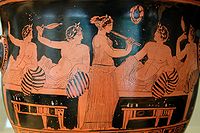
, which mean "dinner-table philosophers" or perhaps "authorities on banquets", survives in fifteen books. The first two books, and parts of the third, eleventh and fifteenth, are extant only in epitome, but otherwise the work seems to be entire. It is an immense store-house of information, chiefly on matters connected with dining, but also containing remarks on music, songs, dances, games, courtesans, and luxury. Nearly 800 writers and 2500 separate works are referred to by Athenaeus; one of his characters (not necessarily to be identified with the historical author himself) boasts of having read 800 plays of Athenian Middle Comedy
alone. Were it not for Athenaeus, much valuable information about the ancient world would be missing, and many ancient Greek authors such as Archestratus
would be almost entirely unknown. Book XIII, for example, is an important source for the study of sexuality in classical
and Hellenistic Greece
.
The Deipnosophistae professes to be an account given by an individual named Athenaeus to his friend Timocrates of a banquet held at the house of Larentius, a wealthy book-collector and patron of the arts. It is thus a dialogue within a dialogue, after the manner of Plato
, but the conversation extends to enormous length. The topics for discussion generally arise from the course of the dinner itself, but extend to literary and historical matters of every description, including abstruse points of grammar. The guests supposedly quote from memory. The actual sources of the material preserved in the Deipnosophistae remain obscure, but much of it probably comes at second-hand from early scholars.
The twenty-nine named guests include individuals called Galen and Ulpian, but they are all probably fictitious personages, and the majority take no part in the conversation. If the character Ulpian is identical with the famous jurist
, the Deipnosophistae may have been written after his death in 228; but the jurist was murdered by the Praetorian guard
s, whereas Ulpian in Athenaeus dies a natural death.
The complete version of the text, with the gaps noted above, is preserved in only one manuscript
, conventionally referred to as A. The epitomized version of the text is preserved in two manuscripts, conventionally known as C and E. The standard edition of the text is Kaibel
's Teubner. The standard numbering is drawn largely from Casaubon
.
The encyclopaedist and author Sir Thomas Browne wrote a short essay upon Athenaeus which reflects a revived interest in the Banquet of the Learned amongst scholars during the 17th century following its publication in 1612 by the Classical scholar Isaac Casaubon
.
s (i.e. exclusive right granted by a government to an inventor to practice his/her invention in exchange for disclosure of the invention). He mentions that in 500 BC, in the Greek city of Sybaris
(located in what is now southern Italy), there were annual culinary competitions. The victor was given the exclusive right to prepare his dish for one year.
Naucratis
Naucratis or Naukratis, , loosely translated as " power over ships" , was a city of Ancient Egypt, on the Canopic branch of the Nile river, 45 mi SE of the open sea and the later capital of Ptolemaic Egypt, Alexandria...
in Egypt, Greek
Greeks
The Greeks, also known as the Hellenes , are a nation and ethnic group native to Greece, Cyprus and neighboring regions. They also form a significant diaspora, with Greek communities established around the world....
rhetorician and grammarian, flourished about the end of the 2nd and beginning of the 3rd century AD. The Suda
Suda
The Suda or Souda is a massive 10th century Byzantine encyclopedia of the ancient Mediterranean world, formerly attributed to an author called Suidas. It is an encyclopedic lexicon, written in Greek, with 30,000 entries, many drawing from ancient sources that have since been lost, and often...
says only that he lived in the times of Marcus Aurelius, but the contempt with which he speaks of Commodus
Commodus
Commodus , was Roman Emperor from 180 to 192. He also ruled as co-emperor with his father Marcus Aurelius from 177 until his father's death in 180. His name changed throughout his reign; see changes of name for earlier and later forms. His accession as emperor was the first time a son had succeeded...
, who died in 192, shows that he survived that emperor.
Several of his publications are lost, but the fifteen volume Deipnosophistae mostly survives.
Publications
Athenaeus himself states that he was the author of a treatise on the thratta — a kind of fish mentioned by ArchippusArchippus
Archippus was an early Christian believer mentioned briefly in the New Testament epistles of Philemon and Colossians.-Role in the New Testament:...
and other comic poets—and of a history of the Syrian kings. Both works are lost.
The Deipnosophistae
The DeipnosophistaeDeipnosophistae
The Deipnosophistae may be translated as The Banquet of the Learned or Philosophers at Dinner or The Gastronomers...
, which mean "dinner-table philosophers" or perhaps "authorities on banquets", survives in fifteen books. The first two books, and parts of the third, eleventh and fifteenth, are extant only in epitome, but otherwise the work seems to be entire. It is an immense store-house of information, chiefly on matters connected with dining, but also containing remarks on music, songs, dances, games, courtesans, and luxury. Nearly 800 writers and 2500 separate works are referred to by Athenaeus; one of his characters (not necessarily to be identified with the historical author himself) boasts of having read 800 plays of Athenian Middle Comedy
Ancient Greek comedy
Ancient Greek comedy was one of the final three principal dramatic forms in the theatre of classical Greece . Athenian comedy is conventionally divided into three periods, Old Comedy, Middle Comedy, and New Comedy...
alone. Were it not for Athenaeus, much valuable information about the ancient world would be missing, and many ancient Greek authors such as Archestratus
Archestratus
Archestratus was an Ancient Greek poet of Gela or Syracuse, in Sicily, who wrote some time in the mid 4th century BCE. His humorous didactic poem Hedypatheia , written in hexameters, advises a gastronomic reader on where to find the best food in the Mediterranean world...
would be almost entirely unknown. Book XIII, for example, is an important source for the study of sexuality in classical
Classical Greece
Classical Greece was a 200 year period in Greek culture lasting from the 5th through 4th centuries BC. This classical period had a powerful influence on the Roman Empire and greatly influenced the foundation of Western civilizations. Much of modern Western politics, artistic thought, such as...
and Hellenistic Greece
Hellenistic Greece
In the context of Ancient Greek art, architecture, and culture, Hellenistic Greece corresponds to the period between the death of Alexander the Great in 323 BC and the annexation of the classical Greek heartlands by Rome in 146 BC...
.
The Deipnosophistae professes to be an account given by an individual named Athenaeus to his friend Timocrates of a banquet held at the house of Larentius, a wealthy book-collector and patron of the arts. It is thus a dialogue within a dialogue, after the manner of Plato
Plato
Plato , was a Classical Greek philosopher, mathematician, student of Socrates, writer of philosophical dialogues, and founder of the Academy in Athens, the first institution of higher learning in the Western world. Along with his mentor, Socrates, and his student, Aristotle, Plato helped to lay the...
, but the conversation extends to enormous length. The topics for discussion generally arise from the course of the dinner itself, but extend to literary and historical matters of every description, including abstruse points of grammar. The guests supposedly quote from memory. The actual sources of the material preserved in the Deipnosophistae remain obscure, but much of it probably comes at second-hand from early scholars.
The twenty-nine named guests include individuals called Galen and Ulpian, but they are all probably fictitious personages, and the majority take no part in the conversation. If the character Ulpian is identical with the famous jurist
Ulpian
Gnaeus Domitius Annius Ulpianus , anglicized as Ulpian, was a Roman jurist of Tyrian ancestry.-Biography:The exact time and place of his birth are unknown, but the period of his literary activity was between AD 211 and 222...
, the Deipnosophistae may have been written after his death in 228; but the jurist was murdered by the Praetorian guard
Praetorian Guard
The Praetorian Guard was a force of bodyguards used by Roman Emperors. The title was already used during the Roman Republic for the guards of Roman generals, at least since the rise to prominence of the Scipio family around 275 BC...
s, whereas Ulpian in Athenaeus dies a natural death.
The complete version of the text, with the gaps noted above, is preserved in only one manuscript
Manuscript
A manuscript or handwrite is written information that has been manually created by someone or some people, such as a hand-written letter, as opposed to being printed or reproduced some other way...
, conventionally referred to as A. The epitomized version of the text is preserved in two manuscripts, conventionally known as C and E. The standard edition of the text is Kaibel
Georg Kaibel
Georg Kaibel was a German classical philologist born in Lübeck.He studied classical philology at the Universities of Göttingen and Bonn. At Bonn he was a pupil of Hermann Usener and Franz Bücheler...
's Teubner. The standard numbering is drawn largely from Casaubon
Casaubon
Casaubon may mean:Real people:* Isaac Casaubon , French classical scholar* Méric Casaubon , French-English classical scholar, son of Isaac* Josh Casaubon American actor in One Life to Live...
.
The encyclopaedist and author Sir Thomas Browne wrote a short essay upon Athenaeus which reflects a revived interest in the Banquet of the Learned amongst scholars during the 17th century following its publication in 1612 by the Classical scholar Isaac Casaubon
Isaac Casaubon
Isaac Casaubon was a classical scholar and philologist, first in France and then later in England, regarded by many of his time as the most learned in Europe.-Early life:...
.
First patents
Athenaeus described what may be considered the first patentPatent
A patent is a form of intellectual property. It consists of a set of exclusive rights granted by a sovereign state to an inventor or their assignee for a limited period of time in exchange for the public disclosure of an invention....
s (i.e. exclusive right granted by a government to an inventor to practice his/her invention in exchange for disclosure of the invention). He mentions that in 500 BC, in the Greek city of Sybaris
Sybaris
Sybaris was an ancient city in Magna Graecia on the western shore of the Gulf of Taranto. The wealth of the city during the 6th century BC was so great that the Sybarites became synonymous with pleasure and luxury...
(located in what is now southern Italy), there were annual culinary competitions. The victor was given the exclusive right to prepare his dish for one year.
Further reading
- Athenaeus and his world: reading Greek culture in the Roman Empire ed. David Braund and John Wilkins. Exeter: University of Exeter Press, 2000. ISBN 0-85989-661-7.
External links
- The Deipnosophists, translated by C. D. Yonge, at The Literature Collection
- The Deipnosophists, long excerpts in searchable HTML format, at attalus.org
- The Deipnosophists, translated up to Book 9 with links to complete Greek original, at LacusCurtius
- Sir Thomas BrowneThomas BrowneSir Thomas Browne was an English author of varied works which reveal his wide learning in diverse fields including medicine, religion, science and the esoteric....
, From a Reading of Athenaeus