

Stendal

Encyclopedia
Stendal (ˈʃtɛndaːl) is a town
in Saxony-Anhalt
, Germany
. It is the capital of Stendal District
and unofficial capital of the Altmark
. Its population in 2001 was 38,900. It is located some 125 km (77.7 mi) west of Berlin
and around 170 km (105.6 mi) east of Hanover
. Stendal has a university, a market and a psychiatric rehabilitation clinic.
Founded by Albrecht the Bear in the 12th century, it quickly became an important member of the Hanseatic League
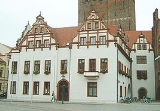
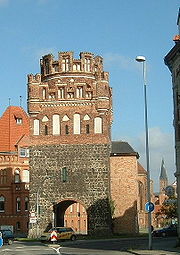
. Magnificent churches, the city hall and the two remaining city gates are still proof of that former wealth.
Previously part of the Margraviate of Brandenburg
, Stendal became part of the Prussian
Province of Saxony
after the Napoleonic Wars
. From 1949 until German reunification
in 1990, Stendal was in the German Democratic Republic
.
The pseudonym "Stendhal
" of the French author Marie-Henri Beyle is generally supposed to be a homage to the German author Johann Joachim Winckelmann
, who was born in Stendal in 1717.
, the founder of classical archaeology
. Its holdings include biographical documents, works, designs and diagrams as well as Greek
sculptures or casts, along with other small artworks from antiquity. Since summer 2003 the museum is the owner of the world's biggest Trojan horse. With its size of 15.60 m high, 13 m long, 9.50 m wide and its weight of 45 tons it offers a beautiful view over Stendal. Exhibitions are held relating to archaeology and the history of art from the 18th and 19th centuries; there is also a modern art museum. The museum is the seat of the Winckelmann-Gesellschaft.
In addition, the museum has exhibits relating to the history and cultural history of the city of Stendal and of the Altmark dating from the prehistoric period through the area's early history right up to the present. There are exhibits on the Hanseatic League, Romanesque art
and local archaeological material.
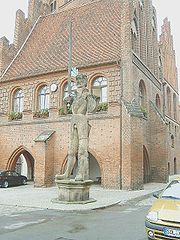
and the two mediaeval town gates. There are also other churches in the area.
Stendal is also part of the Altmark cycle path. Information and maps about this cycle path can be had for free from the tourist information office.
, used the alias Stendhal from 1817 in homage to Johann Joachim Winckelmann.
with:
Lemgo
, Germany
Town
A town is a human settlement larger than a village but smaller than a city. The size a settlement must be in order to be called a "town" varies considerably in different parts of the world, so that, for example, many American "small towns" seem to British people to be no more than villages, while...
in Saxony-Anhalt
Saxony-Anhalt
Saxony-Anhalt is a landlocked state of Germany. Its capital is Magdeburg and it is surrounded by the German states of Lower Saxony, Brandenburg, Saxony, and Thuringia.Saxony-Anhalt covers an area of...
, Germany
Germany
Germany , officially the Federal Republic of Germany , is a federal parliamentary republic in Europe. The country consists of 16 states while the capital and largest city is Berlin. Germany covers an area of 357,021 km2 and has a largely temperate seasonal climate...
. It is the capital of Stendal District
Stendal (district)
Stendal is a district in the north-east of Saxony-Anhalt, Germany. Neighboring districts are Jerichower Land, Börde, Altmarkkreis Salzwedel, the district Lüchow-Dannenberg in Lower Saxony, and the districts Prignitz, Ostprignitz-Ruppin and Havelland in Brandenburg.- History :In the...
and unofficial capital of the Altmark
Altmark
The Altmark is a historic region in Germany, comprising the northern third of Saxony-Anhalt. As the initial territory of the Brandenburg margraves, it is sometimes referred to as the "Cradle of Prussia", as by Otto von Bismarck, a native from Schönhausen near Stendal.- Geography :The Altmark is...
. Its population in 2001 was 38,900. It is located some 125 km (77.7 mi) west of Berlin
Berlin
Berlin is the capital city of Germany and is one of the 16 states of Germany. With a population of 3.45 million people, Berlin is Germany's largest city. It is the second most populous city proper and the seventh most populous urban area in the European Union...
and around 170 km (105.6 mi) east of Hanover
Hanover
Hanover or Hannover, on the river Leine, is the capital of the federal state of Lower Saxony , Germany and was once by personal union the family seat of the Hanoverian Kings of Great Britain, under their title as the dukes of Brunswick-Lüneburg...
. Stendal has a university, a market and a psychiatric rehabilitation clinic.
Founded by Albrecht the Bear in the 12th century, it quickly became an important member of the Hanseatic League
Hanseatic League
The Hanseatic League was an economic alliance of trading cities and their merchant guilds that dominated trade along the coast of Northern Europe...
. Magnificent churches, the city hall and the two remaining city gates are still proof of that former wealth.
Previously part of the Margraviate of Brandenburg
Margraviate of Brandenburg
The Margraviate of Brandenburg was a major principality of the Holy Roman Empire from 1157 to 1806. Also known as the March of Brandenburg , it played a pivotal role in the history of Germany and Central Europe....
, Stendal became part of the Prussian
Kingdom of Prussia
The Kingdom of Prussia was a German kingdom from 1701 to 1918. Until the defeat of Germany in World War I, it comprised almost two-thirds of the area of the German Empire...
Province of Saxony
Province of Saxony
The Province of Saxony was a province of the Kingdom of Prussia and later the Free State of Prussia from 1816 until 1945. Its capital was Magdeburg.-History:The province was created in 1816 out of the following territories:...
after the Napoleonic Wars
Napoleonic Wars
The Napoleonic Wars were a series of wars declared against Napoleon's French Empire by opposing coalitions that ran from 1803 to 1815. As a continuation of the wars sparked by the French Revolution of 1789, they revolutionised European armies and played out on an unprecedented scale, mainly due to...
. From 1949 until German reunification
German reunification
German reunification was the process in 1990 in which the German Democratic Republic joined the Federal Republic of Germany , and when Berlin reunited into a single city, as provided by its then Grundgesetz constitution Article 23. The start of this process is commonly referred by Germans as die...
in 1990, Stendal was in the German Democratic Republic
German Democratic Republic
The German Democratic Republic , informally called East Germany by West Germany and other countries, was a socialist state established in 1949 in the Soviet zone of occupied Germany, including East Berlin of the Allied-occupied capital city...
.
The pseudonym "Stendhal
Stendhal
Marie-Henri Beyle , better known by his pen name Stendhal, was a 19th-century French writer. Known for his acute analysis of his characters' psychology, he is considered one of the earliest and foremost practitioners of realism in his two novels Le Rouge et le Noir and La Chartreuse de Parme...
" of the French author Marie-Henri Beyle is generally supposed to be a homage to the German author Johann Joachim Winckelmann
Johann Joachim Winckelmann
Johann Joachim Winckelmann was a German art historian and archaeologist. He was a pioneering Hellenist who first articulated the difference between Greek, Greco-Roman and Roman art...
, who was born in Stendal in 1717.
Theatre of the Altmark
The area has a theatre named Theater der Altmark, Stendal. It was founded in 1946 and has always had a particular involvement in youth and children's theatre. Theatrical performances and dance events are staged, as well as concerts, conferences and meetings.Winckelmann Museum
The Winckelmann Museum is named after Johann Joachim WinckelmannJohann Joachim Winckelmann
Johann Joachim Winckelmann was a German art historian and archaeologist. He was a pioneering Hellenist who first articulated the difference between Greek, Greco-Roman and Roman art...
, the founder of classical archaeology
Archaeology
Archaeology, or archeology , is the study of human society, primarily through the recovery and analysis of the material culture and environmental data that they have left behind, which includes artifacts, architecture, biofacts and cultural landscapes...
. Its holdings include biographical documents, works, designs and diagrams as well as Greek
Greece
Greece , officially the Hellenic Republic , and historically Hellas or the Republic of Greece in English, is a country in southeastern Europe....
sculptures or casts, along with other small artworks from antiquity. Since summer 2003 the museum is the owner of the world's biggest Trojan horse. With its size of 15.60 m high, 13 m long, 9.50 m wide and its weight of 45 tons it offers a beautiful view over Stendal. Exhibitions are held relating to archaeology and the history of art from the 18th and 19th centuries; there is also a modern art museum. The museum is the seat of the Winckelmann-Gesellschaft.
In addition, the museum has exhibits relating to the history and cultural history of the city of Stendal and of the Altmark dating from the prehistoric period through the area's early history right up to the present. There are exhibits on the Hanseatic League, Romanesque art
Romanesque architecture
Romanesque architecture is an architectural style of Medieval Europe characterised by semi-circular arches. There is no consensus for the beginning date of the Romanesque architecture, with proposals ranging from the 6th to the 10th century. It developed in the 12th century into the Gothic style,...
and local archaeological material.
Fire Brigade Museum
The town also has the Landesfeuerwehrmuseum (Fire Brigade Museum), showing the development of fire fighting and protection from the leather bucket to modern fire engines.Other
Other buildings include the Gothic cathedral, the Town Hall with the statue of RolandRoland
Roland was a Frankish military leader under Charlemagne who became one of the principal figures in the literary cycle known as the Matter of France. Historically, Roland was military governor of the Breton March, with responsibility for defending the frontier of Francia against the Bretons...
and the two mediaeval town gates. There are also other churches in the area.
Stendal is also part of the Altmark cycle path. Information and maps about this cycle path can be had for free from the tourist information office.
Honorary citizens
- Friedrich Hermann Haacke (1824–1899), who dedicated his life to fighting against the choleraCholeraCholera is an infection of the small intestine that is caused by the bacterium Vibrio cholerae. The main symptoms are profuse watery diarrhea and vomiting. Transmission occurs primarily by drinking or eating water or food that has been contaminated by the diarrhea of an infected person or the feces...
epidemics which affected Stendal in the 19th century. The Haacke-Brunnen, a well in Sperlingsberg, honours him. - Gustav NachtigalGustav NachtigalGustav Nachtigal was a German explorer of Central and West Africa. He is further known as the German Empire's consul-general for Tunisia and Commissioner for West Africa. His mission as commissioner resulted in Togoland and Kamerun becoming the first colonies of a German colonial empire...
(1834–1885),doctor and explorer in Africa. He is honored with bust at the Gustav NachtigalGustav NachtigalGustav Nachtigal was a German explorer of Central and West Africa. He is further known as the German Empire's consul-general for Tunisia and Commissioner for West Africa. His mission as commissioner resulted in Togoland and Kamerun becoming the first colonies of a German colonial empire...
Place.
Personalities
- Johann Joachim WinckelmannJohann Joachim WinckelmannJohann Joachim Winckelmann was a German art historian and archaeologist. He was a pioneering Hellenist who first articulated the difference between Greek, Greco-Roman and Roman art...
, the founder of classical archaeology and the history of art. He was born in Stendal in 1717, son of a shoemaker. He is commemorated by the above-named museum.
Literature
The French writer Marie Henri Beyle, who was stationed here as a soldier during the Napoleonic WarsNapoleonic Wars
The Napoleonic Wars were a series of wars declared against Napoleon's French Empire by opposing coalitions that ran from 1803 to 1815. As a continuation of the wars sparked by the French Revolution of 1789, they revolutionised European armies and played out on an unprecedented scale, mainly due to...
, used the alias Stendhal from 1817 in homage to Johann Joachim Winckelmann.
International relations
Stendal is twinnedTown twinning
Twin towns and sister cities are two of many terms used to describe the cooperative agreements between towns, cities, and even counties in geographically and politically distinct areas to promote cultural and commercial ties.- Terminology :...
with:
Lemgo
Lemgo
Lemgo is a city in the Lippe district of North Rhine-Westphalia, Germany, with a population of c. 42,000.It was founded in the 12th century by Bernhard II at the crossroad of two merchant routes. Lemgo was a member of the Hanseatic League, a medieval trading association of free cities in several...
, Germany
Germany
Germany , officially the Federal Republic of Germany , is a federal parliamentary republic in Europe. The country consists of 16 states while the capital and largest city is Berlin. Germany covers an area of 357,021 km2 and has a largely temperate seasonal climate...