

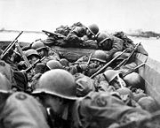
Operation Plunder

Encyclopedia
Commencing on the night of 23 March 1945 during World War II
, Operation Plunder was the crossing of the River Rhine at Rees
, Wesel
, and south of the Lippe River
by the British 2nd Army, under Lieutenant-General Sir Miles Dempsey
(Operations Turnscrew, Widgeon, and Torchlight), and the U.S. Ninth Army
(Operation Flashpoint), under Lieutenant General William Simpson
. XVIII U.S. Airborne Corps, consisting of British 6th Airborne Division and U.S. 17th Airborne Division, conducted Operation Varsity
, parachute landings on the east bank in support of the operation. All of these formations were part of the 21st Army Group under Field Marshal Sir Bernard Montgomery
. This was part of a coordinated set of Rhine crossings.
landing craft
) were hidden by a massive smoke screen from 16 March. The operation commenced on the night of 23 March 1945. It included the Varsity parachute and glider landings near Wesel, and Operation Archway
, by the Special Air Service
. The landing areas were flooded, deserted farmland rising to woodland.
Three Allied formations made the initial assault: the British XXX and XII Corps and the U.S. XVI Corps. One unit, the British 79th Armoured Division
—under Major-General Sir Percy Hobart
—had been at the front of the Normandy landings and provided invaluable help in subsequent operations. They specialised in providing solutions to all situations with specially adapted armoured vehicles (referred to as Hobart's Funnies
). One "funny" was the "Buffalo", an armed and armored amphibious tracked personnel or cargo transporter able to cross soft and flooded ground. These were the transports for the spearhead infantry.
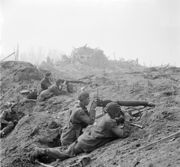 The first part of Plunder was initiated by the 51st (Highland) Infantry Division
, led by the 7th Black Watch
at 21:00 on 23 March, near Rees, followed by the 7th Argyll and Sutherland Highlanders
. At 02:00 on 24 March, the 15th (Scottish) Division landed between Wesel and Rees. At first, there was no opposition, but later they ran into determined resistance from machine-gun nests. The British 1st Commando Brigade entered Wesel.
The U.S. 30th Division landed south of Wesel. The local resistance had been broken by artillery and air bombardment. Subsequently, the 79th Division also landed. U.S. casualties were minimal. German resistance to the Scottish landings continued with some effect, and there were armoured counter-attacks. Landings continued, however, including tanks and other heavy equipment. The U.S. forces had a bridge across by the evening of 24 March.
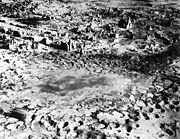 Operation Varsity
started at 10:00 on 24 March, to disrupt enemy communications. Despite heavy resistance to the airdrops and afterward, the airborne troops made progress and repelled counterattacks. The hard lessons of Operation Market Garden
were applied. In the afternoon, 15th Scottish Division linked up with both airborne divisions.
Fierce German resistance continued around Bienen, north of Rees
, where the entire 9th Canadian Brigade was needed to relieve the Black Watch. The bridgehead was firmly established, however, and Allied advantages in numbers and equipment were applied. By 27 March, the bridgehead was 35 mi (56.3 km) wide and 20 mi (32.2 km) deep.
, commanded by General
Alfred Schlemm
, a part of Army Group H. Although this formation was considered to be the most effective German force in the area, it was severely depleted from its previous action in the Reichswald
(Battle of the Reichswald). Unable to withstand Allied pressure, the 1st Parachute Army withdrew northeast toward Hamburg
and Bremen, leaving a gap between it and the German 15th Army, in the Ruhr
.
Joseph Goebbels
was well aware of Plunder′s potential impact from the beginning. On 24 March, he began his diary entry with, "The situation in the West has entered an extraordinarily critical, ostensibly almost deadly, phase." He went on to note the crossing of the Rhine on a broad front, and foresaw Allied attempts to encircle the Ruhr industrial heartland.
On 27 March, command of the 1st Parachute Army was passed to General Günther Blumentritt
, because Schlemm had been wounded. Blumentritt and his superior, Generaloberst
(Colonel General
) Johannes Blaskowitz
, both recognised that the situation was lost. The army′s front was incomplete, there were no reserves, weak artillery, no air support and few tanks. Communications were weak, indeed, one corps was never contacted. The reinforcements were so poor that the generals decided against using them, to avoid needless casualties.
Although Blumentritt had strict orders from Supreme Command to hold and fight, from 1 April, he managed a withdrawal with minimal casualties, eventually withdrawing beyond the Dortmund-Ems Canal
to the Teutoburg Forest
. Within a week of the start of Plunder, the Allies had taken 30,000 prisoners of war north of the Ruhr.
was present at Field Marshal Montgomery′s headquarters near Venlo
on the eve of Plunder (23 March). Subsequently, Churchill and Montgomery watched the Varsity air landings on 24 March.
The next day, 25 March, Churchill and Montgomery visited General Dwight D. Eisenhower
′s headquarters. After lunch and a briefing, the party went to a sandbagged house overlooking the Rhine and a quiet, undefended stretch of the German-held riverbank. After Eisenhower′s departure, Churchill, Montgomery, and a party of U.S. commanders and armed guards commandeered a river launch and landed for 30 minutes in enemy territory, without challenge. They next visited the destroyed railway bridge at Wesel, departing when German artillery appeared to target them.
, Normandy
and after the Battle of the Bulge
. His reputation had further suffered over Operation Market Garden
and the failure to open Antwerp to shipping
until November 1944.
The Plunder crossings had long been intended as the major assault across the Rhine, but at the Malta Conference
in early February 1945, Eisenhower added more crossings to the south of the Ruhr. In advance of these, on 7 March, U.S. troops took advantage of a failed bridge demolition at Remagen to form a threatening bridgehead across the Rhine. General George S. Patton
—a bitter critic of Montgomery—used his 3rd Army to force a bridgehead south of the Main, opposite Oppenheim
. News of this was released "at a time calculated to take some of the luster from the news of Montgomery′s crossing."
Patton made the point that Montgomery's preparations were, in his view, unnecessarily cautious and he demonstrated that the Germans could be "bounced", if caught before they had time to prepare defences. While the Allies prepared, XLVII Panzer Corps
had rested, re-equipped and absorbed reinforcements in relative safety in the Netherlands
. Once needed, they were a fresh formation to oppose the bridgehead. At Bienen and elsewhere, the Anglo-Canadians faced German troops in prepared positions.
The large airborne assault (Varsity) has been criticised as unnecessary and costly in terms of casualties and aircraft lost. Montgomery annoyed Americans by his initial proposal to use U.S. divisions, under his command.
Counter-arguments are that German reserves had been drawn south to seal-off the unexpected American bridgehead Remagen and they would otherwise have been expected to oppose Plunder. The marshy terrain and width of the Rhine at Wesel were serious impediments that required specialised resources. At Remagen, the bridge aided exploitation, and at Oppenheim, Patton was unopposed because the area was isolated from strategic objectives by distance and by the River Main.
World War II
World War II, or the Second World War , was a global conflict lasting from 1939 to 1945, involving most of the world's nations—including all of the great powers—eventually forming two opposing military alliances: the Allies and the Axis...
, Operation Plunder was the crossing of the River Rhine at Rees
Rees, Germany
Rees is a town in the district of Cleves in the state of North Rhine-Westphalia, Germany. It is located on the right bank of the Rhine, approx. 20 km east of Cleves...
, Wesel
Wesel
Wesel is a city in North Rhine-Westphalia, Germany. It is the capital of the Wesel district.-Division of the town:Suburbs of Wesel include Lackhausen, Obrighoven, Ginderich, Feldmark,Fusternberg, Büderich, Flüren and Blumenkamp.-History:...
, and south of the Lippe River
Lippe River
The Lippe is a river in North Rhine-Westphalia, Germany. It is a right tributary of the Rhine and in length.The source is located at the edge of the Teutoburg Forest in Bad Lippspringe close to the city of Paderborn. It runs westward through Paderborn, Lippstadt and then along the northern edge...
by the British 2nd Army, under Lieutenant-General Sir Miles Dempsey
Miles Dempsey
General Sir Miles Christopher Dempsey, GBE, KCB, DSO, MC was commander of the British Second Army during the D-Day landings in the Second World War...
(Operations Turnscrew, Widgeon, and Torchlight), and the U.S. Ninth Army
U.S. Ninth Army
The Ninth United States Army was one of the main U.S. Army combat commands used during the campaign in Northwest Europe in 1944 and 1945. It was commanded from its inception by Lieutenant General William Simpson...
(Operation Flashpoint), under Lieutenant General William Simpson
William Hood Simpson
General William Hood Simpson was a distinguished U.S. Army officer who commanded the U.S. Ninth Army in northern Europe, during World War II, among other roles....
. XVIII U.S. Airborne Corps, consisting of British 6th Airborne Division and U.S. 17th Airborne Division, conducted Operation Varsity
Operation Varsity
Operation Varsity was a successful joint American–British airborne operation that took place toward the end of World War II...
, parachute landings on the east bank in support of the operation. All of these formations were part of the 21st Army Group under Field Marshal Sir Bernard Montgomery
Bernard Montgomery, 1st Viscount Montgomery of Alamein
Field Marshal Bernard Law Montgomery, 1st Viscount Montgomery of Alamein, KG, GCB, DSO, PC , nicknamed "Monty" and the "Spartan General" was a British Army officer. He saw action in the First World War, when he was seriously wounded, and during the Second World War he commanded the 8th Army from...
. This was part of a coordinated set of Rhine crossings.
Background
Preparations (accumulation of supplies, road construction and the transport of 36 Royal NavyRoyal Navy
The Royal Navy is the naval warfare service branch of the British Armed Forces. Founded in the 16th century, it is the oldest service branch and is known as the Senior Service...
landing craft
Landing craft
Landing craft are boats and seagoing vessels used to convey a landing force from the sea to the shore during an amphibious assault. Most renowned are those used to storm the beaches of Normandy, the Mediterranean, and many Pacific islands during WWII...
) were hidden by a massive smoke screen from 16 March. The operation commenced on the night of 23 March 1945. It included the Varsity parachute and glider landings near Wesel, and Operation Archway
Operation Archway
Operation Archway was the codename for one of the largest and most diverse operations carried out by the Special Air Service during the Second World War....
, by the Special Air Service
Special Air Service
Special Air Service or SAS is a corps of the British Army constituted on 31 May 1950. They are part of the United Kingdom Special Forces and have served as a model for the special forces of many other countries all over the world...
. The landing areas were flooded, deserted farmland rising to woodland.
Battle
The opening bombardment was by 4,000 guns firing for four hours. British bombers contributed with attacks on Wesel during the day and night of 23 March.Three Allied formations made the initial assault: the British XXX and XII Corps and the U.S. XVI Corps. One unit, the British 79th Armoured Division
79th Armoured Division
The 79th Armoured Division was a specialist British Army armoured formation created as part of the preparations for the Normandy invasion of 6 June 1944...
—under Major-General Sir Percy Hobart
Percy Hobart
Major-General Sir Percy Cleghorn Stanley Hobart KBE CB DSO MC , also known as "Hobo", was a British military engineer, noted for his command of the 79th Armoured Division during World War II...
—had been at the front of the Normandy landings and provided invaluable help in subsequent operations. They specialised in providing solutions to all situations with specially adapted armoured vehicles (referred to as Hobart's Funnies
Hobart's Funnies
Hobart's Funnies were a number of unusually modified tanks operated during World War II by the United Kingdom's 79th Armoured Division or by specialists from the Royal Engineers. They were designed in light of problems that more standard tanks experienced during the Dieppe Raid, so that the new...
). One "funny" was the "Buffalo", an armed and armored amphibious tracked personnel or cargo transporter able to cross soft and flooded ground. These were the transports for the spearhead infantry.
British 51st (Highland) Infantry Division (World War II)
For the First World War unit, see 51st Division .The 51st Infantry Division was a British Territorial Army division that fought during the Second World War...
, led by the 7th Black Watch
Black Watch
The Black Watch, 3rd Battalion, Royal Regiment of Scotland is an infantry battalion of the Royal Regiment of Scotland. The unit's traditional colours were retired in 2011 in a ceremony led by Queen Elizabeth II....
at 21:00 on 23 March, near Rees, followed by the 7th Argyll and Sutherland Highlanders
Argyll and Sutherland Highlanders
The Argyll and Sutherland Highlanders, 5th Battalion The Royal Regiment of Scotland is an infantry battalion of the Royal Regiment of Scotland....
. At 02:00 on 24 March, the 15th (Scottish) Division landed between Wesel and Rees. At first, there was no opposition, but later they ran into determined resistance from machine-gun nests. The British 1st Commando Brigade entered Wesel.
The U.S. 30th Division landed south of Wesel. The local resistance had been broken by artillery and air bombardment. Subsequently, the 79th Division also landed. U.S. casualties were minimal. German resistance to the Scottish landings continued with some effect, and there were armoured counter-attacks. Landings continued, however, including tanks and other heavy equipment. The U.S. forces had a bridge across by the evening of 24 March.
Operation Varsity
Operation Varsity was a successful joint American–British airborne operation that took place toward the end of World War II...
started at 10:00 on 24 March, to disrupt enemy communications. Despite heavy resistance to the airdrops and afterward, the airborne troops made progress and repelled counterattacks. The hard lessons of Operation Market Garden
Operation Market Garden
Operation Market Garden was an unsuccessful Allied military operation, fought in the Netherlands and Germany in the Second World War. It was the largest airborne operation up to that time....
were applied. In the afternoon, 15th Scottish Division linked up with both airborne divisions.
Fierce German resistance continued around Bienen, north of Rees
Rees, Germany
Rees is a town in the district of Cleves in the state of North Rhine-Westphalia, Germany. It is located on the right bank of the Rhine, approx. 20 km east of Cleves...
, where the entire 9th Canadian Brigade was needed to relieve the Black Watch. The bridgehead was firmly established, however, and Allied advantages in numbers and equipment were applied. By 27 March, the bridgehead was 35 mi (56.3 km) wide and 20 mi (32.2 km) deep.
Impact on German forces and command
The Allied operation was opposed by the German 1st Parachute ArmyGerman 1st Parachute Army
The German 1st Parachute Army was formed in September 1944 to consolidate the various Luftwaffe Fallschirmjäger-Units and the Luftwaffe Field Division...
, commanded by General
General (Germany)
General is presently the highest rank of the German Army and Luftwaffe . It is the equivalent to the rank of Admiral in the German Navy .-Early history:...
Alfred Schlemm
Alfred Schlemm
Alfred Schlemm was a German General der Fallschirmtruppe in the Wehrmacht. His last command in World War II opposed the advance of the First Canadian Army through the Reichswald in February 1945....
, a part of Army Group H. Although this formation was considered to be the most effective German force in the area, it was severely depleted from its previous action in the Reichswald
Reichswald
A Reichswald designates a historic woodland under imperial protection and usage in the lands of the former Holy Roman Empire. It may refer to:* Nürnberger Reichswald — an old cultivated forest with near Nuremberg, which is today a nature reserve....
(Battle of the Reichswald). Unable to withstand Allied pressure, the 1st Parachute Army withdrew northeast toward Hamburg
Hamburg
-History:The first historic name for the city was, according to Claudius Ptolemy's reports, Treva.But the city takes its modern name, Hamburg, from the first permanent building on the site, a castle whose construction was ordered by the Emperor Charlemagne in AD 808...
and Bremen, leaving a gap between it and the German 15th Army, in the Ruhr
Ruhr
The Ruhr is a medium-size river in western Germany , a right tributary of the Rhine.-Description:The source of the Ruhr is near the town of Winterberg in the mountainous Sauerland region, at an elevation of approximately 2,200 feet...
.
Joseph Goebbels
Joseph Goebbels
Paul Joseph Goebbels was a German politician and Reich Minister of Propaganda in Nazi Germany from 1933 to 1945. As one of Adolf Hitler's closest associates and most devout followers, he was known for his zealous oratory and anti-Semitism...
was well aware of Plunder′s potential impact from the beginning. On 24 March, he began his diary entry with, "The situation in the West has entered an extraordinarily critical, ostensibly almost deadly, phase." He went on to note the crossing of the Rhine on a broad front, and foresaw Allied attempts to encircle the Ruhr industrial heartland.
On 27 March, command of the 1st Parachute Army was passed to General Günther Blumentritt
Günther Blumentritt
Günther Blumentritt was a German officer in World War I, who became a Staff Officer under the Weimar Republic and went on to serve as a general for Nazi Germany during World War II...
, because Schlemm had been wounded. Blumentritt and his superior, Generaloberst
Colonel General
Colonel General is a senior rank of General. North Korea and Russia are two countries which have used the rank extensively throughout their histories...
(Colonel General
Colonel General
Colonel General is a senior rank of General. North Korea and Russia are two countries which have used the rank extensively throughout their histories...
) Johannes Blaskowitz
Johannes Blaskowitz
Johannes Albrecht Blaskowitz was a German general during World War II. He was also a recipient of the Knight's Cross of the Iron Cross with Oak Leaves and Swords...
, both recognised that the situation was lost. The army′s front was incomplete, there were no reserves, weak artillery, no air support and few tanks. Communications were weak, indeed, one corps was never contacted. The reinforcements were so poor that the generals decided against using them, to avoid needless casualties.
Although Blumentritt had strict orders from Supreme Command to hold and fight, from 1 April, he managed a withdrawal with minimal casualties, eventually withdrawing beyond the Dortmund-Ems Canal
Dortmund-Ems Canal
The Dortmund–Ems Canal is a 269 km long canal in Germany between the inland port of the city of Dortmund and the sea port of Emden. The artificial southern part of the canal ends after 215 km at the lock of Herbrum near Meppen. From there, the route goes over a length of 45 km over...
to the Teutoburg Forest
Teutoburg Forest
The Teutoburg Forest is a range of low, forested mountains in the German states of Lower Saxony and North Rhine-Westphalia which used to be believed to be the scene of a decisive battle in AD 9...
. Within a week of the start of Plunder, the Allies had taken 30,000 prisoners of war north of the Ruhr.
Winston Churchill
British Prime Minister Winston ChurchillWinston Churchill
Sir Winston Leonard Spencer-Churchill, was a predominantly Conservative British politician and statesman known for his leadership of the United Kingdom during the Second World War. He is widely regarded as one of the greatest wartime leaders of the century and served as Prime Minister twice...
was present at Field Marshal Montgomery′s headquarters near Venlo
Venlo
Venlo is a municipality and a city in the southeastern Netherlands, next to the German border. It is situated in the province of Limburg.In 2001, the municipalities of Belfeld and Tegelen were merged into the municipality of Venlo. Tegelen was originally part of the Duchy of Jülich centuries ago,...
on the eve of Plunder (23 March). Subsequently, Churchill and Montgomery watched the Varsity air landings on 24 March.
The next day, 25 March, Churchill and Montgomery visited General Dwight D. Eisenhower
Dwight D. Eisenhower
Dwight David "Ike" Eisenhower was the 34th President of the United States, from 1953 until 1961. He was a five-star general in the United States Army...
′s headquarters. After lunch and a briefing, the party went to a sandbagged house overlooking the Rhine and a quiet, undefended stretch of the German-held riverbank. After Eisenhower′s departure, Churchill, Montgomery, and a party of U.S. commanders and armed guards commandeered a river launch and landed for 30 minutes in enemy territory, without challenge. They next visited the destroyed railway bridge at Wesel, departing when German artillery appeared to target them.
Military rivalries
Although the operation was successful, it exposed further the irritation, or worse, held by most U.S. generals toward Montgomery. It also showed, perhaps, the downside of Montgomery′s careful approach toward major operations. Montgomery had angered the U.S. commanders repeatedly, in operations in SicilySicily
Sicily is a region of Italy, and is the largest island in the Mediterranean Sea. Along with the surrounding minor islands, it constitutes an autonomous region of Italy, the Regione Autonoma Siciliana Sicily has a rich and unique culture, especially with regard to the arts, music, literature,...
, Normandy
Normandy
Normandy is a geographical region corresponding to the former Duchy of Normandy. It is in France.The continental territory covers 30,627 km² and forms the preponderant part of Normandy and roughly 5% of the territory of France. It is divided for administrative purposes into two régions:...
and after the Battle of the Bulge
Battle of the Bulge
The Battle of the Bulge was a major German offensive , launched toward the end of World War II through the densely forested Ardennes mountain region of Wallonia in Belgium, hence its French name , and France and...
. His reputation had further suffered over Operation Market Garden
Operation Market Garden
Operation Market Garden was an unsuccessful Allied military operation, fought in the Netherlands and Germany in the Second World War. It was the largest airborne operation up to that time....
and the failure to open Antwerp to shipping
Battle of the Scheldt
The Battle of the Scheldt was a series of military operations of the Canadian 1st Army, led by Lieutenant-General Guy Simonds. The battle took place in northern Belgium and southwestern Netherlands during World War II from 2 October-8 November 1944...
until November 1944.
The Plunder crossings had long been intended as the major assault across the Rhine, but at the Malta Conference
Malta Conference (1945)
The Malta Conference was held from January 30 to February 3, 1945 between President Franklin D. Roosevelt of the United States and Prime Minister Winston Churchill of the United Kingdom on the island of Malta...
in early February 1945, Eisenhower added more crossings to the south of the Ruhr. In advance of these, on 7 March, U.S. troops took advantage of a failed bridge demolition at Remagen to form a threatening bridgehead across the Rhine. General George S. Patton
George S. Patton
George Smith Patton, Jr. was a United States Army officer best known for his leadership while commanding corps and armies as a general during World War II. He was also well known for his eccentricity and controversial outspokenness.Patton was commissioned in the U.S. Army after his graduation from...
—a bitter critic of Montgomery—used his 3rd Army to force a bridgehead south of the Main, opposite Oppenheim
Oppenheim
Oppenheim is a town in the Mainz-Bingen district in Rhineland-Palatinate, Germany. The town is well known as a wine town, the site of the German Winegrowing Museum and particularly for the wines from the Oppenheimer Krötenbrunnen vineyards.- Location :...
. News of this was released "at a time calculated to take some of the luster from the news of Montgomery′s crossing."
Patton made the point that Montgomery's preparations were, in his view, unnecessarily cautious and he demonstrated that the Germans could be "bounced", if caught before they had time to prepare defences. While the Allies prepared, XLVII Panzer Corps
XLVII Panzer Corps (Germany)
The XLVII Panzer Corps was a Panzer Corps formed by Field Marshal Günther von Kluge during the Battle for Normandy, and for Operation Lüttich...
had rested, re-equipped and absorbed reinforcements in relative safety in the Netherlands
Netherlands
The Netherlands is a constituent country of the Kingdom of the Netherlands, located mainly in North-West Europe and with several islands in the Caribbean. Mainland Netherlands borders the North Sea to the north and west, Belgium to the south, and Germany to the east, and shares maritime borders...
. Once needed, they were a fresh formation to oppose the bridgehead. At Bienen and elsewhere, the Anglo-Canadians faced German troops in prepared positions.
The large airborne assault (Varsity) has been criticised as unnecessary and costly in terms of casualties and aircraft lost. Montgomery annoyed Americans by his initial proposal to use U.S. divisions, under his command.
Counter-arguments are that German reserves had been drawn south to seal-off the unexpected American bridgehead Remagen and they would otherwise have been expected to oppose Plunder. The marshy terrain and width of the Rhine at Wesel were serious impediments that required specialised resources. At Remagen, the bridge aided exploitation, and at Oppenheim, Patton was unopposed because the area was isolated from strategic objectives by distance and by the River Main.