


Air assault

Unanswered Questions

Encyclopedia
Helicopter
A helicopter is a type of rotorcraft in which lift and thrust are supplied by one or more engine-driven rotors. This allows the helicopter to take off and land vertically, to hover, and to fly forwards, backwards, and laterally...
—to seize and hold key terrain which has not been fully secured, and to directly engage enemy forces. In addition to regular infantry
Infantry
Infantrymen are soldiers who are specifically trained for the role of fighting on foot to engage the enemy face to face and have historically borne the brunt of the casualties of combat in wars. As the oldest branch of combat arms, they are the backbone of armies...
training, air-assault units usually receive training in rappelling and air transportation
Airborne forces
Airborne forces are military units, usually light infantry, set up to be moved by aircraft and 'dropped' into battle. Thus they can be placed behind enemy lines, and have an ability to deploy almost anywhere with little warning...
, and their equipment is sometimes designed or field-modified to allow better transportation within aircraft.
Due to the transport load restrictions of helicopters, air assault forces are usually light infantry
Light infantry
Traditionally light infantry were soldiers whose job was to provide a skirmishing screen ahead of the main body of infantry, harassing and delaying the enemy advance. Light infantry was distinct from medium, heavy or line infantry. Heavy infantry were dedicated primarily to fighting in tight...
, though some armored fighting vehicles, like the Russian BMD-1
BMD-1
The BMD-1 is a Soviet airborne amphibious tracked infantry fighting vehicle, which was introduced in 1969 and first seen by the West in 1970. BMD stands for Boyevaya Mashina Desanta . It can be dropped by parachute and although it resembles the BMP-1 it is in fact much smaller...
are designed to fit most heavy lift helicopters
Heavy Lift Helicopters
Heavy Lift Helicopters, Inc was a helicopter operating company based in Apple Valley, California, United States. Heavy Lift operated a fleet of CH-54 Tarhe and CH-53 Sea Stallion helicopters in aerial Lift Services and aerial firefighting. In addition Heavy Lift operated a FAA Repair Station out...
, which enable assaulting forces to combine air mobility with a certain degree of ground mechanization. Invariably the assaulting troops are highly dependent on aerial fire support
Close air support
In military tactics, close air support is defined as air action by fixed or rotary winged aircraft against hostile targets that are close to friendly forces, and which requires detailed integration of each air mission with fire and movement of these forces.The determining factor for CAS is...
provided by the armed helicopter
Armed helicopter
An armed helicopter is a helicopter equipped with weapons. Most commonly, it is used for attacking targets on the ground. Such helicopter could be either purposely designed for the ground-attack mission—in which case it would be more specifically categorized as an attack helicopter—or could be...
s or fixed-wing aircraft
Fixed-wing aircraft
A fixed-wing aircraft is an aircraft capable of flight using wings that generate lift due to the vehicle's forward airspeed. Fixed-wing aircraft are distinct from rotary-wing aircraft in which wings rotate about a fixed mast and ornithopters in which lift is generated by flapping wings.A powered...
escorting the VTOL.
Air assault should not be confused with air attack, air strike, or air raid, which all refer to attack using solely aircraft (for example bombing, strafing
Strafing
Strafing is the practice of attacking ground targets from low-flying aircraft using aircraft-mounted automatic weapons. This means, that although ground attack using automatic weapons fire is very often accompanied with bombing or rocket fire, the term "strafing" does not specifically include the...
, etc.).
Moreover, air assault should not be confused with an airborne assault
Airborne forces
Airborne forces are military units, usually light infantry, set up to be moved by aircraft and 'dropped' into battle. Thus they can be placed behind enemy lines, and have an ability to deploy almost anywhere with little warning...
, which occurs when paratroopers, and their weapons and supplies, are dropped
Airdrop
An airdrop is a type of airlift, developed during World War II to resupply otherwise inaccessible troops, who themselves may have been airborne forces. In some cases, it is used to refer to the airborne assault itself. Early airdrops were conducted by dropping or pushing padded bundles from...
by parachute
Parachute
A parachute is a device used to slow the motion of an object through an atmosphere by creating drag, or in the case of ram-air parachutes, aerodynamic lift. Parachutes are usually made out of light, strong cloth, originally silk, now most commonly nylon...
from transport aircraft
Military transport aircraft
Military transport aircraft are typically fixed and rotary wing cargo aircraft which are used to deliver troops, weapons and other military equipment by a variety of methods to any area of military operations around the surface of the planet, usually outside of the commercial flight routes in...
, often as part of a strategic offensive operation. Air assault should not be also confused with forms of military transport operations known as air landing, airlift
Airlift
Airlift is the act of transporting people or cargo from point to point using aircraft.Airlift may also refer to:*Airlift , a suction device for moving sand and silt underwater-See also:...
, or airbridge
Airbridge (logistics)
An airbridge is the route and means of delivering material from one place to another by an airlift.An airbridge is the means by which an airhead is kept supplied by overflying enemy held territory...
, that all require an already secured place to land—an airhead
Airhead
An airhead is a designated area in a hostile or threatened territory which, when seized and held, allows the air landing of further troops and material via an airbridge, and provides the maneuver and preparation space necessary for projected operations. Normally it is the area seized in the assault...
.
Organization and employment
Air Assault and Air Mobility are related concepts. However, Air Assault is distinctly a combat insertion rather than transportation to an area in the vicinity of combat. "Air assault operations are not merely movements of soldiers, weapons, and materiel by Army aviation units and must not be construed as such."Air assault units can vary in organization; using helicopters not only in transport but also as close air fire support
Close air support
In military tactics, close air support is defined as air action by fixed or rotary winged aircraft against hostile targets that are close to friendly forces, and which requires detailed integration of each air mission with fire and movement of these forces.The determining factor for CAS is...
, medical evacuation helicopters and resupply missions. Airmobile artillery is often assigned to air assault deployments. Units vary in size, but are typically company
Company (military unit)
A company is a military unit, typically consisting of 80–225 soldiers and usually commanded by a Captain, Major or Commandant. Most companies are formed of three to five platoons although the exact number may vary by country, unit type, and structure...
- or brigade
Brigade
A brigade is a major tactical military formation that is typically composed of two to five battalions, plus supporting elements depending on the era and nationality of a given army and could be perceived as an enlarged/reinforced regiment...
-sized units.
Airmobile units are designed and trained for air insertion and vertical envelopment ("a tactical maneuver in which troops, either air-dropped or air-landed, attack the rear and flanks of a force, in effect cutting off or encircling the force".), air resupply, and if necessary air extraction.
One specific type of air assault unit is the US Army air cavalry. It differs from regular air assault units only in fulfilling a traditional cavalry reconnaissance
Reconnaissance
Reconnaissance is the military term for exploring beyond the area occupied by friendly forces to gain information about enemy forces or features of the environment....
and short raids role. Britain's 16 Air Assault Brigade was formed in 1999 following an amalgamation of elements of 5th Infantry Brigade (5 Airborne Brigade) and 24 Airmobile Brigade, bringing together the agility and reach of airborne forces with the potency of the attack helicopter. Similarly, the US 101st Airborne Division
101st Airborne Division
The 101st Airborne Division—the "Screaming Eagles"—is a U.S. Army modular light infantry division trained for air assault operations. During World War II, it was renowned for its role in Operation Overlord, the D-Day landings on 6 June 1944, in Normandy, France, Operation Market Garden, the...
was originally classed as airborne, then airmobile and now air assault.
History
Air mobility has been a key concept in offensive operations since the 1930s. Initial approaches to air mobility focused on airborne and glider-borne troops. During World War II many assaults were done by military gliderMilitary glider
Military gliders have been used by the military of various countries for carrying troops and heavy equipment to a combat zone, mainly during the Second World War. These engineless aircraft were towed into the air and most of the way to their target by military transport planes, e.g...
s. Following the war faster aircraft led to the abandonment of the flimsy wooden gliders with the then new helicopters taking their place. Four YR-4B helicopters saw limited service in the China Burma India theatre with the 1st Air Commando Group
1st Air Commando Group
The 1st Air Commando Group is an inactive United States Air Force unit. It was last assigned to the Army Service Forces, based at Camp Kilmer, New Jersey. It was inactivated on 3 November 1945....
In 1946, U.S. Marine
United States Marine Corps
The United States Marine Corps is a branch of the United States Armed Forces responsible for providing power projection from the sea, using the mobility of the United States Navy to deliver combined-arms task forces rapidly. It is one of seven uniformed services of the United States...
General Roy S. Geiger
Roy Geiger
General Roy Stanley Geiger was a United States Marine Corps General who, during World War II, became the first Marine to lead an army. Marine Corps base Camp Geiger in North Carolina is named in his honor....
observed the atomic bomb tests at Bikini Atoll
Bikini Atoll
Bikini Atoll is an atoll, listed as a World Heritage Site, in the Micronesian Islands of the Pacific Ocean, part of Republic of the Marshall Islands....
and instantly recognized that atomic bombs could render amphibious landings difficult because of the dense concentrations of troops, ships and material at beachheads. During this time, The Commandant of the Marine Corps
Commandant of the Marine Corps
The Commandant of the Marine Corps is normally the highest ranking officer in the United States Marine Corps and is a member of the Joint Chiefs of Staff...
, Alexander Vandegrift
Alexander Vandegrift
Alexander Archer Vandegrift, KBE, CB was a General in the United States Marine Corps. He commanded the 1st Marine Division to victory in its first ground offensive of World War II — Battle of Guadalcanal. For his actions during the Solomon Islands campaign, he received the Medal of Honor...
, convened a special board known as the Hogaboom Board
Robert E. Hogaboom
Robert Edward Hogaboom was a United States Marine Corps four star general who served as Chief of Staff, Headquarters, U.S. Marine Corps. Hogaboom was promoted to four-star rank upon retirement as a "tombstone general".-Biography:Robert Edward Hogaboom was born on November 13, 1902 in Meridian,...
. This board recommended that the USMC develop transport helicopters in order to allow a diffused attack on enemy shores. It also recommended that the USMC form an experimental helicopter squadron.HMX-1
HMX-1
Marine Helicopter Squadron One , is a United States Marine Corps helicopter squadron responsible for the transportation of the President of the United States, Vice President, Cabinet members and other VIPs...
was commissioned in 1947 with Sikorsky HO3S-1s. In 1948 the Marine Corps Schools came out with Amphibious Operations—Employment of Helicopters (Tentative), or Phib-31, which was the first manual for helicopter airmobile operations. The Marines used the term vertical envelopment instead of air mobility or air assault. HMX-1 performed its first vertical envelopment from the deck of an aircraft carrier in an exercise in 1949.
American forces later used helicopters for support and transport to great effect during the Korean War
Korean War
The Korean War was a conventional war between South Korea, supported by the United Nations, and North Korea, supported by the People's Republic of China , with military material aid from the Soviet Union...
showing that the helicopter could be a versatile and powerful military tool.
First Air Assault
In 1952 the SAS landed a small group of soldiers North of Kuala Lumpar using Dragonfly helicopters. On November 5, 1956 the Royal MarinesRoyal Marines
The Corps of Her Majesty's Royal Marines, commonly just referred to as the Royal Marines , are the marine corps and amphibious infantry of the United Kingdom and, along with the Royal Navy and Royal Fleet Auxiliary, form the Naval Service...
' 45 Commando performed the world's first combat helicopter insertion with air assault during an amphibious landing as part of Operation Musketeer
Suez Crisis
The Suez Crisis, also referred to as the Tripartite Aggression, Suez War was an offensive war fought by France, the United Kingdom, and Israel against Egypt beginning on 29 October 1956. Less than a day after Israel invaded Egypt, Britain and France issued a joint ultimatum to Egypt and Israel,...
, in Suez
Suez
Suez is a seaport city in north-eastern Egypt, located on the north coast of the Gulf of Suez , near the southern terminus of the Suez Canal, having the same boundaries as Suez governorate. It has three harbors, Adabya, Ain Sokhna and Port Tawfiq, and extensive port facilities...
, Egypt
Egypt
Egypt , officially the Arab Republic of Egypt, Arabic: , is a country mainly in North Africa, with the Sinai Peninsula forming a land bridge in Southwest Asia. Egypt is thus a transcontinental country, and a major power in Africa, the Mediterranean Basin, the Middle East and the Muslim world...
. They were flown in Westland Whirlwind Mark 2s of 845 Naval Air Squadron from the deck of the HMS Theseus
HMS Theseus (R64)
HMS Theseus was a Colossus-class light fleet aircraft carrier of the Royal Navy. She was laid down in 1943 by Fairfield at Govan, and launched on 6 July 1944.-Workup and initial service:...
, and Whirlwinds and Bristol
Bristol Aeroplane Company
The Bristol Aeroplane Company, originally the British and Colonial Aeroplane Company, was both one of the first and one of the most important British aviation companies, designing and manufacturing both airframes and aero engines...
Sycamore HC.12s
Bristol Sycamore
-See also:-External links:* on the Bristol Sycamore* on the Bristol Sycamore*...
and HC.14
Bristol Sycamore
-See also:-External links:* on the Bristol Sycamore* on the Bristol Sycamore*...
s of the Joint Experimental Helicopter Unit (JEHU) of the Royal Air Force
Royal Air Force
The Royal Air Force is the aerial warfare service branch of the British Armed Forces. Formed on 1 April 1918, it is the oldest independent air force in the world...
from the deck of HMS Ocean.
Operation Deep Water
Operation Deep Water
Operation Deep Water was a 1957 NATO naval exercise held in the Mediterranean Sea that simulated protecting the Dardanelles from a Soviet invasion. By controlling this bottleneck in a war situation, the Soviet Black Sea Fleet would be prevented from entering the Mediterranean.Operation Deep Water...
was a 1957 NATO naval exercise held in the Mediterranean Sea that involved the first units of the United States Marine Corps
United States Marine Corps
The United States Marine Corps is a branch of the United States Armed Forces responsible for providing power projection from the sea, using the mobility of the United States Navy to deliver combined-arms task forces rapidly. It is one of seven uniformed services of the United States...
to participate in a helicopter-borne vertical envelopment operation during an overseas deployment.
Vietnam War
Army of the Republic of Vietnam
The Army of the Republic of Viet Nam , sometimes parsimoniously referred to as the South Vietnamese Army , was the land-based military forces of the Republic of Vietnam , which existed from October 26, 1955 until the fall of Saigon on April 30, 1975...
(ARVN) troops began 12 days later in Operation Chopper. These were very successful at first but the Viet Cong (VC) began developing counter helicopter techniques, and at the Ap Bac
Battle of Ap Bac
The Battle of Ap Bac was a major battle fought on January 3, 1963, during the Vietnam War. It was fought in Dinh Tuong Province , South Vietnam. On December 28, 1962, U.S...
in January 1963, 13 of 15 helicopters were hit and four shot down. The Army began adding machine guns and rockets to their smaller helicopters and developed the first purpose built gunship with the M-6E3 armament system
U.S. Helicopter Armament Subsystems
The United States military has developed a number of Helicopter Armament Subsystems since the early 1960s. These systems are used for offensive and defensive purposes and make use of a wide variety of weapon types including, but not limited to machine guns, grenade launchers, autocannon, and rockets...
.
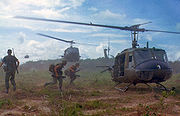
U.S. Marine helicopter squadrons began four month rotations through Vietnam as part of Operation SHUFLY on 15 April 1962. Six days later, they performed the first helicopter assault using U.S. Marine helicopters and ARVN troops. After April 1963, as losses began to mount, U.S. Army UH-1 Huey gunships escorted the Marine transports. The VC again used effective counter landing techniques and in Operation Sure Wind 202 on 27 April 1964, 17 of 21 helicopters were hit and three shot down.
The 2nd Battalion 3rd Marines
2nd Battalion 3rd Marines
2nd Battalion, 3rd Marines is an infantry battalion in the United States Marine Corps based out of Marine Corps Base Hawaii consisting of approximately 1000 Marines and sailors...
made a night helicopter assault in the Elephant Valley south of Da Nang
Da Nang
Đà Nẵng , occasionally Danang, is a major port city in the South Central Coast of Vietnam, on the coast of the South China Sea at the mouth of the Han River. It is the commercial and educational center of Central Vietnam; its well-sheltered, easily accessible port and its location on the path of...
on 12 August 1965 shortly after Marine ground troops arrived in country. On 17 August 1965 in Operation Starlite
Operation Starlite
Operation Starlite was the first offensive military action conducted by a purely U.S. military unit during the Vietnam War. The operation was launched based on intelligence provided by Major General Nguyen Chanh Thi, the commander of the South Vietnamese forces in northern I Corps area. Lieutenant...
the 2nd Battalion 4th Marines
2nd Battalion 4th Marines
2nd Battalion, 4th Marines is an infantry battalion of the United States Marine Corps. The battalion, nicknamed the Magnificent Bastards, is based out of Marine Corps Base Camp Pendleton, California and are a part of the 5th Marine Regiment and 1st Marine Division.-Early years:2nd Battalion, 4th...
landed in three helicopter landing zones (LZs) west of the 1st VC Regiment in the Van Tuong village complex, 12 miles (19.3 km) south of Chu Lai, while the 3rd Battalion 3rd Marines
3rd Battalion 3rd Marines
3rd Battalion 3rd Marines or ' is an infantry battalion in the United States Marine Corps, based out of Kāne'ohe, Hawai'i, and consisting of approximately 800 Marines and sailors.The United States Marine Corps is a part of the Department of the Navy. Traditionally, the Navy has supplied it with...
used seaborne landing craft on the beaches to the east. The transport helicopters were 24 UH-34s from HMM-361 and HMM-261
HMM-261
Marine Medium Tiltrotor Squadron 261 is a United States Marine Corps tiltrotor squadron consisting of MV-22 Osprey transport aircraft. The squadron, known as the "Raging Bulls", is based at Marine Corps Air Station New River, North Carolina and typically falls under the command of Marine Aircraft...
escorted by Marine and Army Hueys. VC losses were 614 killed, Marine losses were 45 KIA and 203 WIA.
The need for a new type of unit became apparent to the Tactical Mobility Requirements Board (normally referred to as the Howze Board
Howze Board
Howze Board is the informal name of the Tactical Mobility Requirements Board that was created at the request of Secretary of Defense Robert McNamara to review and test new concepts integrating helicopters into the United States Army. It gave birth to idea of airmobility. It was named after its...
) of the U.S. Army
United States Army
The United States Army is the main branch of the United States Armed Forces responsible for land-based military operations. It is the largest and oldest established branch of the U.S. military, and is one of seven U.S. uniformed services...
in 1962. The Board met at a difficult time; the bulk of the military hierarchy were focused primary on the Soviet threat to Western Europe, primarily perceived as requiring heavy, conventional units. The creation of new, light airmobile units could only occur at the expense of heavier units. At the same time, the incoming Kennedy administration was placing a much greater emphasis on the need to fight 'small wars', or counter-insurgencies, and was strongly supportive of officers such as General Howze
Hamilton H. Howze
Hamilton Hawkins Howze was born in West Point, New York, while his father, Major General Robert Lee Howze, an 1888 West Point graduate, was serving as Commandant of the West Point.-Early career:...
who were embracing new technologies. The Board concluded that a new form of unit would be required, and commissioned tests - but justified these at the time on the need to fight a conventional war in Europe.
Initially a new experimental unit was formed at Fort Benning, Georgia, the 11th Air Assault Division on 11 February 1963, combining light infantry with integral helicopter transport and air support. Opinions vary as to the level of support for the concept within the Army; some have argued that the initial tests against the context of conventional warfare did not prove promising, and, despite opposition from the Joint Chiefs of Staff, it was primarily the Secretary of Defense Robert McNamara
Robert McNamara
Robert Strange McNamara was an American business executive and the eighth Secretary of Defense, serving under Presidents John F. Kennedy and Lyndon B. Johnson from 1961 to 1968, during which time he played a large role in escalating the United States involvement in the Vietnam War...
who pushed through the changes in 1965, drawing on support from within the Pentagon which had now begun to establish a counter-insurgency doctrine that would require just such a unit. Others have put more weight on the support of newly appointed senior Army commanders, including the new Chief of Staff General Wheeler, in driving through the changes.
Nonetheless, the 11th Air Assault Division assets were merged with the co-located 2nd Infantry Division and reflagged as the 1st Cavalry Division (Airmobile), continuing the tradition of the 1st Cavalry Division. Within several months it was sent to Vietnam
Vietnam
Vietnam – sometimes spelled Viet Nam , officially the Socialist Republic of Vietnam – is the easternmost country on the Indochina Peninsula in Southeast Asia. It is bordered by China to the north, Laos to the northwest, Cambodia to the southwest, and the South China Sea –...
and the concept of air mobility became bound up with the challenges of that campaign, especially its varied terrain
Terrain
Terrain, or land relief, is the vertical and horizontal dimension of land surface. When relief is described underwater, the term bathymetry is used...
- the jungles, mountains, and rivers which complicated ground movement.
The first unit of the new division to see action was the 1st Battalion, 7th Cavalry Regiment, led by Lieutenant Colonel
Lieutenant colonel
Lieutenant colonel is a rank of commissioned officer in the armies and most marine forces and some air forces of the world, typically ranking above a major and below a colonel. The rank of lieutenant colonel is often shortened to simply "colonel" in conversation and in unofficial correspondence...
Harold G. Moore
Hal Moore
Harold Gregory "Hal" Moore, Jr. is a retired lieutenant general in the United States Army and author. Moore is a recipient of the Distinguished Service Cross, which is the second highest military decoration of the United States Army, and was the first of his West Point class to be promoted to...
, an old army paratrooper. The 7th Cavalry was the same regiment that Custer had commanded at the ill fated Battle of the Little Bighorn
Battle of the Little Bighorn
The Battle of the Little Bighorn, also known as Custer's Last Stand and, by the Indians involved, as the Battle of the Greasy Grass, was an armed engagement between combined forces of Lakota, Northern Cheyenne and Arapaho people against the 7th Cavalry Regiment of the United States Army...
. On November 14, 1965, he led his troops in the first large unit engagement of the 1960s Vietnam War, which took place near the Chu Pong massif near the Vietnam-Cambodia
Cambodia
Cambodia , officially known as the Kingdom of Cambodia, is a country located in the southern portion of the Indochina Peninsula in Southeast Asia...
border. It is known today as the Battle of Ia Drang Valley.
This unit gave common currency to the U.S.
United States
The United States of America is a federal constitutional republic comprising fifty states and a federal district...
term "Air Cavalry". Units of this type may also be referred to as "Airmobile" or with other terms that describe the integration of air and ground combat forces within a single unit.
Today
The 10th Mountain Division
10th Mountain Division
The 10th Mountain Division is a light infantry division of the United States Army based at Fort Drum, New York. It is a subordinate unit of the XVIII Airborne Corps and the only division-sized element of the U.S. Army to specialize in fighting under harsh terrain and weather conditions...
Light Infantry regularly perform air assault operations, as do many other US Army infantry units. On September 19, 1994, the 1st Brigade of the 10th Mountain Division conducted the Army’s first air assault from aircraft carrier, USS Dwight D. Eisenhower
USS Dwight D. Eisenhower (CVN-69)
USS Dwight D. Eisenhower is an aircraft carrier currently in service with the United States Navy. Commissioned in 1977, the ship is the second of the ten Nimitz-class supercarriers currently in service, and is the first ship named after the thirty-fourth President of the United States, Dwight D....
. This force consisted of 54 helicopters and almost 2,000 soldiers. This was the Army's largest operation from an aircraft carrier since the Doolittle Raid
Doolittle Raid
The Doolittle Raid, on 18 April 1942, was the first air raid by the United States to strike the Japanese Home Islands during World War II. By demonstrating that Japan itself was vulnerable to American air attack, it provided a vital morale boost and opportunity for U.S. retaliation after the...
of World War II
World War II
World War II, or the Second World War , was a global conflict lasting from 1939 to 1945, involving most of the world's nations—including all of the great powers—eventually forming two opposing military alliances: the Allies and the Axis...
.
All U.S. Marine Corps ground units are trained in basic air assault tactics and capable of performing heliborne operations that require them to fast rope from a hovering helicopter. The U.S. Marines also specialize in conducting air assault that launches from specialized helicopter carrying naval ships
Amphibious assault ship
An amphibious assault ship is a type of amphibious warfare ship employed to land and support ground forces on enemy territory by an amphibious assault...
during amphibious warfare
Amphibious warfare
Amphibious warfare is the use of naval firepower, logistics and strategy to project military power ashore. In previous eras it stood as the primary method of delivering troops to non-contiguous enemy-held terrain...
.
There are other major "conventional" units in the United States Army that have parachute capabilities; the separate 173rd Airborne Brigade Combat Team, based in Italy and Germany, and the Alaska-based 4th Brigade Combat Team, 25th Infantry Division, which has its division headquarters in Hawaii
Hawaii
Hawaii is the newest of the 50 U.S. states , and is the only U.S. state made up entirely of islands. It is the northernmost island group in Polynesia, occupying most of an archipelago in the central Pacific Ocean, southwest of the continental United States, southeast of Japan, and northeast of...
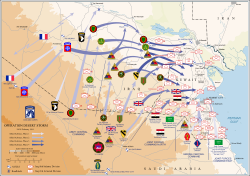
, and the 1st Battalion (Airborne), 509th Infantry Regiment based in Fort Polk, Louisiana supporting the Joint Readiness Training Center as the opposing force for training rotational units. The 173rd ABCT parachuted into Northern Iraq
Iraq
Iraq ; officially the Republic of Iraq is a country in Western Asia spanning most of the northwestern end of the Zagros mountain range, the eastern part of the Syrian Desert and the northern part of the Arabian Desert....
during the invasion of Iraq in 2003. These units are considered regional quick reaction parachute forces for the Pacific and Atlantic regions.
The 16th Air Assault Brigade of the British Army
British Army
The British Army is the land warfare branch of Her Majesty's Armed Forces in the United Kingdom. It came into being with the unification of the Kingdom of England and Scotland into the Kingdom of Great Britain in 1707. The new British Army incorporated Regiments that had already existed in England...
is Britain's main air assault body. It comprises units of paratroopers from the Parachute Regiment and light infantry units trained in helicopter insertion, as well as light tank
FV107 Scimitar
FV107 Scimitar is an armoured reconnaissance vehicle used by the British Army. It is very similar to the FV101 Scorpion but mounts a high velocity 30 mm L21 RARDEN cannon instead of a 76 mm gun. It was issued to Royal Armoured Corps, Armoured Regiments in the Reconnaissance role...
s and artillery
Artillery
Originally applied to any group of infantry primarily armed with projectile weapons, artillery has over time become limited in meaning to refer only to those engines of war that operate by projection of munitions far beyond the range of effect of personal weapons...
.
Britain's 3 Commando Brigade
3 Commando Brigade
3 Commando Brigade is a commando formation of the British Armed Forces and the main manoeuvre formation of the Royal Marines. Its personnel are predominantly Royal Marines, supported by units of Royal Engineers, Royal Artillery, The Rifles, and the Fleet Air Arm, together with other Commando...
Royal Marines
Royal Marines
The Corps of Her Majesty's Royal Marines, commonly just referred to as the Royal Marines , are the marine corps and amphibious infantry of the United Kingdom and, along with the Royal Navy and Royal Fleet Auxiliary, form the Naval Service...
are also highly experienced in air assault, both for boarding ships and in land attacks, see article above.
Units
- 601 Air Assault Regiment
 Kingdom of Bulgaria
- 68th Special Forces Brigade68th Special Forces Brigade (Bulgaria)The 68th Special Forces Brigade is a special operations formation of the Bulgarian Land Forces. The 68th SF Brigade is also Bulgaria's principal paratrooper unit and includes the 101st Alpine Battalion, which has participated in all conflicts involving Bulgaria.It was established in 1942 under the...
, 2nd regiment
 Brazil
- 12th Light Infantry Brigade (Air Assault)
- Canadian Special Operations RegimentCanadian Special Operations RegimentThe Canadian Special Operations Regiment is a battalion-sized, high-readiness special operations unit part of Canadian Special Operations Forces Command...
- 4th Airmobile Brigade
- Airmobile Operations DivisionAirmobile Operations DivisionAirmobile Operations Division is a division of the German Army. Its staff is based at Veitshöchheim near Würzburg. The division was founded on July 1, 2002 and reported for duty October 8, 2002 . It incorporates units from various branches of the German Army. These units are stationed all over...
- Air Assault Brigade 1
- 71st Airmobile Infantry Brigade
- Korps Pasukan Khas Angkatan Udara (Air Force Special Corps)
- Wing I (4 battallions, 4 independent companies)
- Wing II (4 battallions, 2 independent companies)
- Bravo Detachment (Air Force Special Force Unit)
- Kostrad (Army Strategic Command)
- 3rd Air Assault Brigade/ Tri Budi Mahasakti
- 17th Air Assault Brigade/ Kujang I
- 18th Air Assault Bridage/ Trisula
- Friuli Air Assault BrigadeFriuli Air Assault BrigadeThe Friuli Air Assault Brigade is a Air Assault brigade of the Italian Army, based mainly in the north-east of the country.- History :The Friuli Infantry Brigade was formed on 1 November 1884, in Milan and consisted of the 87th Infantry Regiment Friuli and the 88th Infantry Regiment Friuli...
- Folgore Parachute BrigadeFolgore Parachute BrigadeThe Folgore Parachute Brigade is the largest unit of paratroopers of the Italian Army; a second smaller unit is the 4th Alpini Parachutist Regiment. The name Folgore is Italian for lightning....
- 601 Air Cavalry Brigade
- 602 Air Cavalry Brigade
- 603 Air Cavalry Brigade
- 11 Luchtmobiele Brigade11 Luchtmobiele BrigadeThe 11 Luchtmobiele Brigade '7 December is the elite rapid-reaction air assault unit of the Royal Netherlands Army. Its operators are trained to be deployed via helicopters and fixed-wing aircraft , and can be deployed anywhere in the world within 7 to maximally 20 days...
- 44 Parachute Regiment (1999 to present)
- 6 South African Infantry battalion
- Singapore GuardsSingapore GuardsIn the Singapore Armed Forces, the Guards are an elite infantry formation specializing in rapid deployment. Guards are known as elite heliborne troopers. They are well trained in heliborne operations and specialist combat skills that give them an added combat edge...
- Singapore Commandos
- 7th Infantry Brigade
- Air Mobile BrigadeAir Mobile BrigadeAn Air Mobile Brigade is a specialised form of military brigade dedicated to carrying out Air assaults. The units use helicopters to transport its personal and equipment to the combat theater.-List of Air Mobile Brigades:*British Army...
- 61st Air Assault Brigade
- 95th Airmobile Brigade95th Airmobile Brigade (Ukraine)The 95th Separate Airmobile Brigade , the main ground forces component of Ukraine’s rapid reaction force. Brigade is located in Zhytomyr.The brigade is one of the Ukrainian Partnership for Peace units.-History:...
- 79th Airmobile Brigade79th Airmobile Brigade (Ukraine)The 79th Airmobile Brigade is a formation of the Ukrainian Airmobile Forces.Brigade is located in Mykolaiv.For their transport the Brigade uses UAZ fitted with DShK anti-aircraft machine gun, 2B14 Podnos 82mm mortar, SPG-9D, AGS-17 automatic grenade launcher....
- 80th Airmobile Regiment80th Airmobile Regiment (Ukraine)The 80th Airmobile Regiment is an airmobile formation of the Ukrainian Ground Forces. The regiment is part of the 13th Army Corps.-History:...
- 28th Training Battalion28th Training Battalion (Ukraine)The 28th Training Battalion is an airmobile training formation of the Ukrainian Ground Forces.-History:In 1998 the Battalion was relocated to Mykolaiv.In 2005 the Battalion was relocated to urban-type settlement Desna, Chernihiv Oblast....
- UKSF
- 16 Air Assault Brigade
- 3 Commando Brigade3 Commando Brigade3 Commando Brigade is a commando formation of the British Armed Forces and the main manoeuvre formation of the Royal Marines. Its personnel are predominantly Royal Marines, supported by units of Royal Engineers, Royal Artillery, The Rifles, and the Fleet Air Arm, together with other Commando...
- FPGRM
- 101st Airborne Division101st Airborne DivisionThe 101st Airborne Division—the "Screaming Eagles"—is a U.S. Army modular light infantry division trained for air assault operations. During World War II, it was renowned for its role in Operation Overlord, the D-Day landings on 6 June 1944, in Normandy, France, Operation Market Garden, the...
- 1st Brigade Combat Team
- 2nd Brigade Combat Team
- 3rd Brigade Combat Team
- 4th Brigade Combat Team
- VII Corps 'VANGUARD OF NORTHERN ADVANCE' 7th Assault Unit
- 20th Parachute Battalion
See also
- Airborne forcesAirborne forcesAirborne forces are military units, usually light infantry, set up to be moved by aircraft and 'dropped' into battle. Thus they can be placed behind enemy lines, and have an ability to deploy almost anywhere with little warning...
- BattleplanBattleplanBattleplan is a military television documentary series examing various military strategies used in modern warfare since World War I. It is shown on the Military Channel in the U.S. and UKTV History...
(documentary TV series) - Paratroopers
- United States Army Air Assault SchoolUnited States Army Air Assault SchoolThe Sabalauski Air Assault School is a FORSCOM TDA unit located at Fort Campbell, Kentucky. Its primary task is training leaders and soldiers assigned to the 101st Airborne Division , other US Army units and US armed services in several courses annually.- Background :Air Assault School qualifies...
- FireforceFireforceFireforce is a variant of the tactic of vertical envelopment of a target by helicopter-borne and parachute infantry developed by the Rhodesian Security Forces during the Rhodesian Bush War...