


Takeoff

Encyclopedia
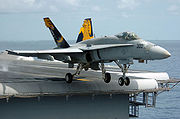
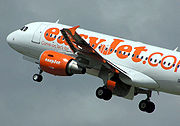
Flight
Flight is the process by which an object moves either through an atmosphere or beyond it by generating lift or propulsive thrust, or aerostatically using buoyancy, or by simple ballistic movement....
in which an aerospace
Aerospace
Aerospace comprises the atmosphere of Earth and surrounding space. Typically the term is used to refer to the industry that researches, designs, manufactures, operates, and maintains vehicles moving through air and space...
vehicle goes from the ground to flying in the air.
For horizontal takeoff aircraft
Aircraft
An aircraft is a vehicle that is able to fly by gaining support from the air, or, in general, the atmosphere of a planet. An aircraft counters the force of gravity by using either static lift or by using the dynamic lift of an airfoil, or in a few cases the downward thrust from jet engines.Although...
this usually involves starting with a transition from moving along the ground (taxiing
Taxiing
Taxiing refers to the movement of an aircraft on the ground, under its own power, in contrast to towing or push-back where the aircraft is moved by a tug...
) on a runway
Runway
According to ICAO a runway is a "defined rectangular area on a land aerodrome prepared for the landing and take-off of aircraft." Runways may be a man-made surface or a natural surface .- Orientation and dimensions :Runways are named by a number between 01 and 36, which is generally one tenth...
. For balloons
Balloon (aircraft)
A balloon is a type of aircraft that remains aloft due to its buoyancy. A balloon travels by moving with the wind. It is distinct from an airship, which is a buoyant aircraft that can be propelled through the air in a controlled manner....
, helicopter
Helicopter
A helicopter is a type of rotorcraft in which lift and thrust are supplied by one or more engine-driven rotors. This allows the helicopter to take off and land vertically, to hover, and to fly forwards, backwards, and laterally...
s and some specialized fixed-wing aircraft (VTOL
VTOL
A vertical take-off and landing aircraft is one that can hover, take off and land vertically. This classification includes fixed-wing aircraft as well as helicopters and other aircraft with powered rotors, such as cyclogyros/cyclocopters and tiltrotors...
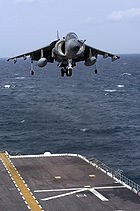
aircraft such as the Harrier), no runway is needed. Takeoff is the opposite of landing
Landing
thumb|A [[Mute Swan]] alighting. Note the ruffled feathers on top of the wings indicate that the swan is flying at the [[Stall |stall]]ing speed...
.
Power settings
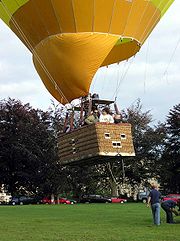
Light aircraft
A light aircraft is an aircraft that has a maximum gross take-off weight of or less.Many aircraft used commercially for freight, sightseeing, photography and scheduled flights are light aircraft.Examples of light aircraft include:...
, usually full power is used during takeoff. Large transport category
Transport category
Transport category is a category of airworthiness applicable to large civil airplanes and large civil helicopters. Any aircraft's airworthiness category is shown on its airworthiness certificate...
(airliner) aircraft may use a reduced power
Flex temp
Flex temp is a technique used to reduce engine wear in large airliners by performing take-off at less than full power.For Airbus and Fokker aircraft the technique is known as flex temp or just flex...
for takeoff, where less than full power is applied in order to prolong engine life, reduce maintenance costs and reduce noise emissions. In some emergency cases, the power used can then be increased to increase the aircraft's performance. Before takeoff, the engines, particularly piston engines, are routinely run up at high power to check for engine-related problems. The aircraft is permitted to accelerate to rotation speed (often referred to as Vr). The term rotation
Rotation (aviation)
In aviation, rotation refers to the action of applying back pressure to a control device, such as a yoke, side-stick or centre stick, to lift the nose wheel off the ground during the takeoff roll...
is used because the aircraft pivots around the axis of its main landing gear
Landing Gear
Landing Gear is Devin the Dude's fifth studio album. It was released on October 7, 2008. It was his first studio album since signing with the label Razor & Tie. It features a high-profile guest appearance from Snoop Dogg. As of October 30, 2008, the album has sold 18,906 copies.-Track...
while still on the ground, usually because of manipulation of the flight controls to make this change in aircraft attitude.
The nose is raised to a nominal 5°
Degree (angle)
A degree , usually denoted by ° , is a measurement of plane angle, representing 1⁄360 of a full rotation; one degree is equivalent to π/180 radians...
–15° nose up pitch
Flight dynamics
Flight dynamics is the science of air vehicle orientation and control in three dimensions. The three critical flight dynamics parameters are the angles of rotation in three dimensions about the vehicle's center of mass, known as pitch, roll and yaw .Aerospace engineers develop control systems for...
attitude to increase lift from the wing
Wing
A wing is an appendage with a surface that produces lift for flight or propulsion through the atmosphere, or through another gaseous or liquid fluid...
s and effect liftoff. For most aircraft, attempting a takeoff without a pitch-up would require cruise speeds while still on the runway.
Fixed-wing aircraft designed for high-speed operation (such as commercial jet aircraft
Jet aircraft
A jet aircraft is an aircraft propelled by jet engines. Jet aircraft generally fly much faster than propeller-powered aircraft and at higher altitudes – as high as . At these altitudes, jet engines achieve maximum efficiency over long distances. The engines in propeller-powered aircraft...
) have difficulty generating enough lift at the low speeds encountered during takeoff. These are therefore fitted with high-lift device
High-lift device
In aircraft design, high-lift devices are moving surfaces or stationary components intended to increase lift during certain flight conditions. They include common devices such as flaps and slats, as well as less common features such as leading edge extensions and blown flaps.-Purpose:Aircraft...
s, often including slats
Leading edge slats
Slats are aerodynamic surfaces on the leading edge of the wings of fixed-wing aircraft which, when deployed, allow the wing to operate at a higher angle of attack. A higher coefficient of lift is produced as a result of angle of attack and speed, so by deploying slats an aircraft can fly at slower...
and usually flaps
Flap (aircraft)
Flaps are normally hinged surfaces mounted on the trailing edges of the wings of a fixed-wing aircraft to reduce the speed an aircraft can be safely flown at and to increase the angle of descent for landing without increasing air speed. They shorten takeoff and landing distances as well as...
, which increase the camber
Camber (aerodynamics)
Camber, in aeronautics and aeronautical engineering, is the asymmetry between the top and the bottom surfaces of an aerofoil. An aerofoil that is not cambered is called a symmetric aerofoil...
and often area of the wing, making it more effective at low speed, thus creating more lift. These are deployed from the wing before takeoff, and retracted during the climb. They can also be deployed at other times, such as before landing.
The speeds needed for takeoff are relative to the motion of the air (indicated airspeed
Indicated airspeed
Indicated airspeed is the airspeed read directly from the airspeed indicator on an aircraft, driven by the pitot-static system. IAS is directly related to calibrated airspeed , which is the IAS corrected for instrument and installation errors....
). A headwind will reduce the ground speed needed for takeoff, as there is a greater flow of air over the wings. Typical takeoff air speeds for jetliners are in the 130–155 knot range (150–180 mph, 240–285 km/h). Light aircraft, such as a Cessna 150
Cessna 150
The Cessna 150 is a two-seat tricycle gear general aviation airplane, that was designed for flight training, touring and personal use.The Cessna 150 is the seventh most produced civilian plane ever, with 23,839 aircraft produced...
, take off at around 55 knots (63 mph, 100 km/h). Ultralights have even lower takeoff speeds. For a given aircraft, the takeoff speed is usually dependant on the aircraft weight; the heavier the weight, the greater the speed needed. Some aircraft specifically designed for short takeoff and landing can take off at speeds below 40 knots (46 mph, 74 km/h), and can even become airborne from a standing start when pointed into a sufficiently strong wind.

Speed required
The takeoff speed required varies with air density, aircraft gross weight, lift coefficientLift coefficient
The lift coefficient is a dimensionless coefficient that relates the lift generated by a lifting body, the dynamic pressure of the fluid flow around the body, and a reference area associated with the body...
, and aircraft configuration (flap and/or slat position, as applicable). Air density is affected by factors such as field elevation and air temperature
Temperature
Temperature is a physical property of matter that quantitatively expresses the common notions of hot and cold. Objects of low temperature are cold, while various degrees of higher temperatures are referred to as warm or hot...
. This relationship between temperature, altitude
Altitude
Altitude or height is defined based on the context in which it is used . As a general definition, altitude is a distance measurement, usually in the vertical or "up" direction, between a reference datum and a point or object. The reference datum also often varies according to the context...
, and air density can be expressed as a density altitude
Density altitude
Density altitude is the altitude in the International Standard Atmosphere at which the air density would be equal to the actual air density at the place of observation, or, in other words, the height when measured in terms of the density of the air rather than the distance from the ground...
, or the altitude in the International Standard Atmosphere
International Standard Atmosphere
The International Standard Atmosphere is an atmospheric model of how the pressure, temperature, density, and viscosity of the Earth's atmosphere change over a wide range of altitudes. It has been established to provide a common reference for temperature and pressure and consists of tables of...
at which the air density would be equal to the actual air density.
Operations with transport category aircraft employ the concept of the takeoff V-Speeds, V1, VR and V2. These speeds are determined not only by the above factors affecting takeoff performance, but also by the length and slope of the runway and any peculiar conditions, such as obstacles off the end of the runway. Below V1, in case of critical failures, the takeoff should be aborted; above V1 the pilot continues the takeoff and returns for landing. After the co-pilot calls V1, he/she will call Vr or "rotate," marking speed at which to rotate the aircraft. The VR for transport category aircraft is calculated such as to allow the aircraft to reach the regulatory screen height at V2 with one engine failed. Then, V2 (the safe takeoff speed) is called. This speed must be maintained after an engine failure to meet performance targets for rate of climb and angle of climb.
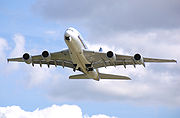
Rejected takeoff
A rejected takeoff or RTO is the situation in which it is decided to abort the takeoff of an airplane...
. In most such aircraft, any engine failure results in a rejected takeoff as a matter of course, since even overrunning the end of the runway is preferable to lifting off with insufficient power to maintain flight.
If an obstacle needs to be cleared, the pilot climbs at the speed for maximum climb angle (Vx), which results in the greatest altitude gain per unit of horizontal distance travelled. If no obstacle needs to be cleared, or after an obstacle is cleared, the pilot can accelerate to the best rate of climb speed (Vy), where the aircraft will gain the most altitude in the least amount of time. Generally speaking, Vx is a lower speed than Vy, and requires a higher pitch attitude to achieve.
Assisted takeoff

Aircraft
An aircraft is a vehicle that is able to fly by gaining support from the air, or, in general, the atmosphere of a planet. An aircraft counters the force of gravity by using either static lift or by using the dynamic lift of an airfoil, or in a few cases the downward thrust from jet engines.Although...
into the air (as opposed to strictly under its own power). The reason it might be needed is due to the aircraft's weight exceeding the normal maximum take off weight, insufficient power, or the available runway
Runway
According to ICAO a runway is a "defined rectangular area on a land aerodrome prepared for the landing and take-off of aircraft." Runways may be a man-made surface or a natural surface .- Orientation and dimensions :Runways are named by a number between 01 and 36, which is generally one tenth...
length may be insufficient, or a combination of all three factors. Assisted take off is also required for gliders
Glider (sailplane)
A glider or sailplane is a type of glider aircraft used in the sport of gliding. Some gliders, known as motor gliders are used for gliding and soaring as well, but have engines which can, in some cases, be used for take-off or for extending a flight...
, which do not have an engine and are unable to take off by themselves.
VTOL
Aircraft
An aircraft is a vehicle that is able to fly by gaining support from the air, or, in general, the atmosphere of a planet. An aircraft counters the force of gravity by using either static lift or by using the dynamic lift of an airfoil, or in a few cases the downward thrust from jet engines.Although...
. This classification includes fixed-wing aircraft
Fixed-wing aircraft
A fixed-wing aircraft is an aircraft capable of flight using wings that generate lift due to the vehicle's forward airspeed. Fixed-wing aircraft are distinct from rotary-wing aircraft in which wings rotate about a fixed mast and ornithopters in which lift is generated by flapping wings.A powered...
that can hover, take off and land
Takeoff and landing
Vehicles that can fly can have different ways to takeoff and land. Conventional aircraft accelerate along the ground until sufficient lift is generated for takeoff, and reverse the process to land. Some aircraft can takeoff at low speed, this a short takeoff. Some aircraft such as helicopters and...
vertically as well as helicopter
Helicopter
A helicopter is a type of rotorcraft in which lift and thrust are supplied by one or more engine-driven rotors. This allows the helicopter to take off and land vertically, to hover, and to fly forwards, backwards, and laterally...
s and other aircraft with powered rotors, such as tiltrotor
Tiltrotor
A tiltrotor is an aircraft which uses a pair or more of powered rotors mounted on rotating shafts or nacelles at the end of a fixed wing for lift and propulsion, and combines the vertical lift capability of a helicopter with the speed and range of a conventional fixed-wing aircraft...
s. Some VTOL aircraft can operate in other modes as well, such as CTOL
CTOL
CTOL is an acronym for conventional take-off and landing, and is the process whereby conventional aircraft take off and land, involving the use of runways. The aircraft will taxi along the runway until its rotation speed is reached, then climb into the air...
(conventional take-off and landing), STOL
STOL
STOL is an acronym for short take-off and landing, a term used to describe aircraft with very short runway requirements.-Definitions:There is no one accepted definition of STOL and many different definitions have been used by different authorities and nations at various times and for a myriad of...
(short take-off and landing), and/or STOVL
STOVL
STOVL is an acronym for short take off and vertical landing.This is the ability of some aircraft to take off from a short runway or take off vertically if it does not have a very heavy payload and land vertically...
(short take-off and vertical landing). Others, such as some helicopters, can only operate by VTOL, due to the aircraft lacking landing gear
Landing Gear
Landing Gear is Devin the Dude's fifth studio album. It was released on October 7, 2008. It was his first studio album since signing with the label Razor & Tie. It features a high-profile guest appearance from Snoop Dogg. As of October 30, 2008, the album has sold 18,906 copies.-Track...
that can handle horizontal motion. VTOL is a subset of V/STOL
V/STOL
Vertical and/or short take-off and landing is a term used to describe aircraft that are able to take-off or land vertically or on short runways. Vertical takeoff and landing describes craft which do not require runways at all...
(vertical and/or short take-off and landing).
Besides the ubiquitous helicopter, there are currently two types of VTOL aircraft in military service: craft using a tiltrotor
Tiltrotor
A tiltrotor is an aircraft which uses a pair or more of powered rotors mounted on rotating shafts or nacelles at the end of a fixed wing for lift and propulsion, and combines the vertical lift capability of a helicopter with the speed and range of a conventional fixed-wing aircraft...
, such as the Bell
Bell Helicopter Textron
Bell Helicopter is an American rotorcraft manufacturer headquartered in Hurst, Texas, near Fort Worth. A division of Textron, Bell manufactures military helicopter and tiltrotor products in and around Fort Worth, as well as in Amarillo, Texas, and commercial rotorcraft products in Mirabel, Quebec,...
Boeing
Boeing
The Boeing Company is an American multinational aerospace and defense corporation, founded in 1916 by William E. Boeing in Seattle, Washington. Boeing has expanded over the years, merging with McDonnell Douglas in 1997. Boeing Corporate headquarters has been in Chicago, Illinois since 2001...
V-22 Osprey
V-22 Osprey
The Bell Boeing V-22 Osprey is an American multi-mission, military, tiltrotor aircraft with both a vertical takeoff and landing , and short takeoff and landing capability...
, and aircraft using directed jet thrust such as the Harrier family
Harrier Jump Jet
The Harrier, informally referred to as the Jump Jet, is a family of British-designed military jet aircraft capable of vertical/short takeoff and landing operations...
.
Rocket launch
A rocket launch is the takeoffTakeoff
Takeoff is the phase of flight in which an aerospace vehicle goes from the ground to flying in the air.For horizontal takeoff aircraft this usually involves starting with a transition from moving along the ground on a runway. For balloons, helicopters and some specialized fixed-wing aircraft , no...
phase of the flight of a rocket
Rocket
A rocket is a missile, spacecraft, aircraft or other vehicle which obtains thrust from a rocket engine. In all rockets, the exhaust is formed entirely from propellants carried within the rocket before use. Rocket engines work by action and reaction...
. Launches for orbital spaceflight
Orbital spaceflight
An orbital spaceflight is a spaceflight in which a spacecraft is placed on a trajectory where it could remain in space for at least one orbit. To do this around the Earth, it must be on a free trajectory which has an altitude at perigee above...
s, or launches into interplanetary space, are usually from a fixed location on the ground, but may also be from a floating platform such as the San Marco platform
San Marco platform
The Luigi Broglio Space Centre is an Italian-owned spaceport near Malindi, Kenya, named after its founder and Italian space pioneer Luigi Broglio. Developed in the 1960s through a partnership between the University of Rome La Sapienza's Aerospace Research Centre and NASA, the BSC served as a...
, or the Sea Launch
Sea Launch
Sea Launch is a spacecraft launch service that uses a mobile sea platform for equatorial launches of commercial payloads on specialized Zenit 3SL rockets...
launch vessel.
See also
- Balanced field takeoffBalanced field takeoffA balanced field takeoff is a condition where the accelerate-stop distance required is equal to the takeoff distance required for the aircraft weight, engine thrust, aircraft configuration and runway condition...
- V speedsV speedsIn aviation, V-speeds are standard terms used to define airspeeds important or useful to the operation of all aircraft including fixed-wing aircraft, gliders, autogiros, helicopters, and dirigibles...
- ClimbClimbthumb|right|An [[Embraer ERJ 145]] climbingIn aviation, the term climb refers both to the actual operation of increasing the altitude of an aircraft and to the logical phase of a typical flight following take-off and preceding the cruise, during which an increase in altitude to a predetermined...
- CruiseCruise (flight)Cruise is the level portion of aircraft travel where flight is most fuel efficient. It occurs between ascent and descent phases and is usually the majority of a journey. Technically, cruising consists of heading changes only at a constant airspeed and altitude...
- DescentDescent (aircraft)A descent during air travel is any portion where an aircraft decreases altitude, and is the opposite of an ascent or climb. Descents are an essential component of an approach to landing...
- LandingLandingthumb|A [[Mute Swan]] alighting. Note the ruffled feathers on top of the wings indicate that the swan is flying at the [[Stall |stall]]ing speed...
- Space launchSpace launchSpace launch is the earliest part of a flight that reaches space. Space launch involves liftoff, when a rocket or other space launch vehicle leaves the ground at the start of a flight...
, the spaceflightSpaceflightSpaceflight is the act of travelling into or through outer space. Spaceflight can occur with spacecraft which may, or may not, have humans on board. Examples of human spaceflight include the Russian Soyuz program, the U.S. Space shuttle program, as well as the ongoing International Space Station...
equivalent