

Cavan

Encyclopedia
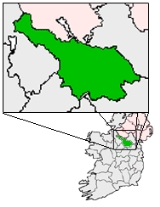
Cavan is the county town
of County Cavan
in the Republic of Ireland
. The town lies in the north central part of Ireland
, near the border with Northern Ireland
. The town is on the main road - the N3 road - linking Dublin (to the south) with Enniskillen
, Ballyshannon
and Donegal Town (to the north).
monastery was also established at around the same time. In the 15th century the local ruler, Bearded Owen O'Reilly set up a market which attracted merchants from Dublin and Drogheda
. King James I
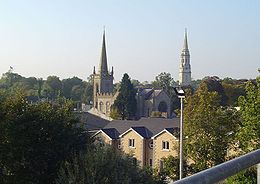
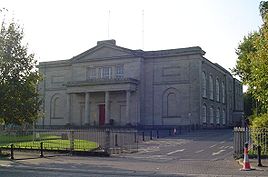
granted the town a charter in 1610. Later during the seventeenth century local administrative influence and power transended to the Maxwell family, decsendants of the Bishop of Kilmore from the 1640's, who later became titled Lords Farnham. Development in Cavan during the early 19th century saw the building of a new wide street that still bears the name Farnham Street. Away from the markets area of the town, Farnham Street was lined with comfortable town houses, public buildings (such as the courthouse which dates from 1825, and churches. The term life of Reilly was credited to the O'Reilly clans due to their great wealth and power, having issued their own currency during the 17th century. From the mid 19th century, Cavan became an important rail junction for the Midland Great Western Railway
(MGWR) and those of the Great Northern Railway
(GNR). The Town Hall was built in 1909. In 1938, work began on the Roman Catholic Cathedral of Saints Patrick and Felim. Five kilometres (3 mi) west of Cavan Town is the Church of Ireland
Kilmore Cathedral, which contains a Romanesque
doorway dating from the 12th century reputed originally to have come from Trinity abbey, located a short distance away upon an island in Lough Oughter . Farnham House, to the northwest of Cavan, is one of the largest houses in the county. It is believed to have been built for the Maxwell family - who held the title of Baron Farnham
- in 1810, and designed by Francis Johnston, a County Armagh
-born, but Dublin-based, architect. It was recently sold by Diana, Lady Farnham (widow of Barry Owen Somerset Maxwell, 12th Lord Farnham) to a local entrepreneur, and the house and estate has now been converted to a luxury hotel and leisure complex under the Radisson SAS international hotel group. On 23 February 1943, a fire at St Joseph's Orphanage
in the town claimed the lives of 35 children and an elderly woman. A Public Enquiry found no culpability on the part of the nuns who ran the orphanage, but the circumstances surrounding the high death toll in the fire remain controversial to this day.
to Dublin (completed and officially opened on 4 June 2010) and type 2 dual carriageway
from Whitegate on the Meath border to Cavan, which will also eventually bypass Virginia. The N3 and N55 eastern bypass around Cavan town was fully completed in March 2006, eliminating the need for heavy traffic to enter the congested town.
 Cavan once had two separate railway stations, linking the Great Northern Railway(GNR) and Midland Great Western Railway
then an end junction of the Belfast-Cavan route linking Clones
with a branch line to Crossdoney and Killeshandra
. With the Cavan-Dublin route, via the Inny Junction and Mullingar
lines. A branch of the Cavan-Leitrim Railway was also indirectly linked to Cavan town via Belturbet
(the C&L terminus) and Ballyhaise
on the GNR line. When the Stormont
Government closed the section of the Belfast line from Portadown
to Glaslough
in 1957, it was found to be uneconomical to keep running the rump section from Monaghan to Cavan. All these lines (including the Cavan-Leitrim Railway) were closed by 1960. The (GNR) Virginia Road Station, from 1863 to 1958 serviced the Drogheda and Navan extension route to Kells and Oldcastle. Cooperation between the Cavan and Westmeath county council's are striving to integrate this into the national and regional development plan. Cavan railway station opened on 8 July 1856, closed for passenger services on 14 October 1957, and finally closed altogether on 1 January 1960.
In accordance with the National Development Plan, development in County Cavan is on course to meet a programme deadline of 2020 for embracing road and telecommunication infrastructures. These will permit a better integration with the neighbouring Dublin and Midlands Gateway
s, also, the Monaghan
, Sligo
, and Ulster
hubs, and thus allowing the promotion of business and tourism within the region.
(formerly Cavan College of Further Studies), which has been located in Cavan since 1985 and is the largest provider of FETAC courses in the northeast region.
. The Wildlife
and Wetlands environment of County Cavan's loughs is nationally and internationally recognised and offers substantial and unique opportunities for Sustainable tourism
development. Lough Oughter
and Killykeen located just a few kilometres from Cavan town already has the core infrastructure for further durable and Ecotourism
development.
with the following places: Jaunay-Clan
, Vienne
, France
From 16–22 August 2010, Cavan hosted the Fleadh which is the premier annual Irish traditional music, song and dance festival and series of competitions, which is run by Comhaltas Ceoltóirí Éireann
(CCÉ). Fleadh 2010 was the 50th annual Fleadh Cheoil na hÉireann, and the first to be carbon neutral. That year it returned to Cavan for the first time since 1954. Up to 250,000 visitors attend the annual Fleadhann, and about 10,000 musicians compete. It is also estimated that the annual All-Ireland Fleadh generates €20-€25 million for the local economy of its host town.
County town
A county town is a county's administrative centre in the United Kingdom or Ireland. County towns are usually the location of administrative or judicial functions, or established over time as the de facto main town of a county. The concept of a county town eventually became detached from its...
of County Cavan
County Cavan
County Cavan is a county in Ireland. It is part of the Border Region and is also located in the province of Ulster. It is named after the town of Cavan. Cavan County Council is the local authority for the county...
in the Republic of Ireland
Republic of Ireland
Ireland , described as the Republic of Ireland , is a sovereign state in Europe occupying approximately five-sixths of the island of the same name. Its capital is Dublin. Ireland, which had a population of 4.58 million in 2011, is a constitutional republic governed as a parliamentary democracy,...
. The town lies in the north central part of Ireland
Ireland
Ireland is an island to the northwest of continental Europe. It is the third-largest island in Europe and the twentieth-largest island on Earth...
, near the border with Northern Ireland
Northern Ireland
Northern Ireland is one of the four countries of the United Kingdom. Situated in the north-east of the island of Ireland, it shares a border with the Republic of Ireland to the south and west...
. The town is on the main road - the N3 road - linking Dublin (to the south) with Enniskillen
Enniskillen
Enniskillen is a town in County Fermanagh, Northern Ireland. It is located almost exactly in the centre of the county between the Upper and Lower sections of Lough Erne. It had a population of 13,599 in the 2001 Census...
, Ballyshannon
Ballyshannon
Ballyshannon is a town in County Donegal, Ireland. It is located where the N3 and N15 cross the River Erne, and claims to be the oldest town in Ireland.-Location:...
and Donegal Town (to the north).
History
The O'Reilly clan (still a very common surname in the area) established a castle in the town in the late 13th century. A FranciscanFranciscan
Most Franciscans are members of Roman Catholic religious orders founded by Saint Francis of Assisi. Besides Roman Catholic communities, there are also Old Catholic, Anglican, Lutheran, ecumenical and Non-denominational Franciscan communities....
monastery was also established at around the same time. In the 15th century the local ruler, Bearded Owen O'Reilly set up a market which attracted merchants from Dublin and Drogheda
Drogheda
Drogheda is an industrial and port town in County Louth on the east coast of Ireland, 56 km north of Dublin. It is the last bridging point on the River Boyne before it enters the Irish Sea....
. King James I
James I of England
James VI and I was King of Scots as James VI from 24 July 1567 and King of England and Ireland as James I from the union of the English and Scottish crowns on 24 March 1603...
granted the town a charter in 1610. Later during the seventeenth century local administrative influence and power transended to the Maxwell family, decsendants of the Bishop of Kilmore from the 1640's, who later became titled Lords Farnham. Development in Cavan during the early 19th century saw the building of a new wide street that still bears the name Farnham Street. Away from the markets area of the town, Farnham Street was lined with comfortable town houses, public buildings (such as the courthouse which dates from 1825, and churches. The term life of Reilly was credited to the O'Reilly clans due to their great wealth and power, having issued their own currency during the 17th century. From the mid 19th century, Cavan became an important rail junction for the Midland Great Western Railway
Midland Great Western Railway
The Midland Great Western Railway was the third largest Irish gauge railway company in Ireland. It was incorporated in 1845 and absorbed into the Great Southern Railway in 1924. It served part of Leinster, County Cavan in Ulster and much of Connaught...
(MGWR) and those of the Great Northern Railway
Great Northern Railway (Ireland)
The Great Northern Railway was an Irish gauge railway company in Ireland.The Great Northern was formed in 1876 by a merger of the Irish North Western Railway , Northern Railway of Ireland, and Ulster Railway. The Ulster Railway was the GNRI's oldest constituent, having opened between Belfast and...
(GNR). The Town Hall was built in 1909. In 1938, work began on the Roman Catholic Cathedral of Saints Patrick and Felim. Five kilometres (3 mi) west of Cavan Town is the Church of Ireland
Church of Ireland
The Church of Ireland is an autonomous province of the Anglican Communion. The church operates in all parts of Ireland and is the second largest religious body on the island after the Roman Catholic Church...
Kilmore Cathedral, which contains a Romanesque
Romanesque architecture
Romanesque architecture is an architectural style of Medieval Europe characterised by semi-circular arches. There is no consensus for the beginning date of the Romanesque architecture, with proposals ranging from the 6th to the 10th century. It developed in the 12th century into the Gothic style,...
doorway dating from the 12th century reputed originally to have come from Trinity abbey, located a short distance away upon an island in Lough Oughter . Farnham House, to the northwest of Cavan, is one of the largest houses in the county. It is believed to have been built for the Maxwell family - who held the title of Baron Farnham
Baron Farnham
Baron Farnham, of Farnham in the County of Cavan, is a title in the Peerage of Ireland. It was created in 1756 for John Maxwell, who had previously represented Cavan Borough in the Irish House of Commons. John Maxwell's son, the second Baron, was created Viscount Farnham in 1760 and Earl of Farnham...
- in 1810, and designed by Francis Johnston, a County Armagh
County Armagh
-History:Ancient Armagh was the territory of the Ulaid before the fourth century AD. It was ruled by the Red Branch, whose capital was Emain Macha near Armagh. The site, and subsequently the city, were named after the goddess Macha...
-born, but Dublin-based, architect. It was recently sold by Diana, Lady Farnham (widow of Barry Owen Somerset Maxwell, 12th Lord Farnham) to a local entrepreneur, and the house and estate has now been converted to a luxury hotel and leisure complex under the Radisson SAS international hotel group. On 23 February 1943, a fire at St Joseph's Orphanage
Cavan Orphanage Fire
In the Cavan Orphanage Fire, a fire broke out at St Joseph's Orphanage in Cavan, Ireland on the night of February 23, 1943. 35 of the children and one adult lay worker died in the fire....
in the town claimed the lives of 35 children and an elderly woman. A Public Enquiry found no culpability on the part of the nuns who ran the orphanage, but the circumstances surrounding the high death toll in the fire remain controversial to this day.
Road
There are about 30,000 people living within a 16 km radius of the town, so infrastructure is very important. Although a more accurate perspective taken from the 2011 national census puts the urban population at 3,607 persons, an 8.3% population decrease on earlier census results. With the rural Cavan population at 7,160 persons an increase of 47.2% since the 2006 census was undertaken. The town is located on the junction of two national routes, the N3 to Dublin and N55 to Athlone. The National Development Plan provides for a major upgrading of the route with a M3 motorway from KellsKells, County Meath
Kells is a town in County Meath, Ireland. The town lies off the M3 motorway, from Navan and from Dublin. In recent years Kells has grown greatly with many Dublin commuters moving to the town....
to Dublin (completed and officially opened on 4 June 2010) and type 2 dual carriageway
2+2 road
A 2+2 road is a specific type of dual-carriageway being built in Ireland and Sweden, consisting of two lanes in each direction separated with a steel cable barrier. They do not have hard shoulders. Junctions are at-grade roundabouts and minor roads cross under or over the mainline without...
from Whitegate on the Meath border to Cavan, which will also eventually bypass Virginia. The N3 and N55 eastern bypass around Cavan town was fully completed in March 2006, eliminating the need for heavy traffic to enter the congested town.
Railway
Midland Great Western Railway
The Midland Great Western Railway was the third largest Irish gauge railway company in Ireland. It was incorporated in 1845 and absorbed into the Great Southern Railway in 1924. It served part of Leinster, County Cavan in Ulster and much of Connaught...
then an end junction of the Belfast-Cavan route linking Clones
Clones
Clones is a small town in western County Monaghan, in the 'border area' of the Republic of Ireland. The area is part of the Border Region, earmarked for economic development by the Irish Government due to its currently below-average economic situation...
with a branch line to Crossdoney and Killeshandra
Killeshandra
Killeshandra or Killashandra is a village in County Cavan, Ireland, located 20 km northwest of Cavan town and is central to County Cavan's lakeland and geopark region, set in the unique Erne catchment environment of rivers, lakes, wetlands and woodland...
. With the Cavan-Dublin route, via the Inny Junction and Mullingar
Mullingar
Mullingar is the county town of County Westmeath in Ireland. The Counties of Meath and Westmeath Act of 1542, proclaimed Westmeath a county, separating it from Meath. Mullingar became the administrative centre for County Westmeath...
lines. A branch of the Cavan-Leitrim Railway was also indirectly linked to Cavan town via Belturbet
Belturbet
Belturbet is a town in County Cavan, Ireland. It is from Cavan town from Dublin city. Belturbet lies on the N3 road. It is from the border with Northern Ireland between the counties of Cavan and Fermanagh and is south of Enniskillen.- History :...
(the C&L terminus) and Ballyhaise
Ballyhaise
-See also:* List of towns and villages in Ireland* List of Market Houses in Ireland...
on the GNR line. When the Stormont
Parliament of Northern Ireland
The Parliament of Northern Ireland was the home rule legislature of Northern Ireland, created under the Government of Ireland Act 1920, which sat from 7 June 1921 to 30 March 1972, when it was suspended...
Government closed the section of the Belfast line from Portadown
Portadown
Portadown is a town in County Armagh, Northern Ireland. The town sits on the River Bann in the north of the county, about 23 miles south-west of Belfast...
to Glaslough
Glaslough
Glaslough is a village and townland in the north of County Monaghan, Ireland, on the R185 regional road south of the border with Northern Ireland and northeast of Monaghan Town. Glaslough won the Irish Tidy Towns Competition in 1978. Castle Leslie, the large Victorian country house and luxury...
in 1957, it was found to be uneconomical to keep running the rump section from Monaghan to Cavan. All these lines (including the Cavan-Leitrim Railway) were closed by 1960. The (GNR) Virginia Road Station, from 1863 to 1958 serviced the Drogheda and Navan extension route to Kells and Oldcastle. Cooperation between the Cavan and Westmeath county council's are striving to integrate this into the national and regional development plan. Cavan railway station opened on 8 July 1856, closed for passenger services on 14 October 1957, and finally closed altogether on 1 January 1960.
In accordance with the National Development Plan, development in County Cavan is on course to meet a programme deadline of 2020 for embracing road and telecommunication infrastructures. These will permit a better integration with the neighbouring Dublin and Midlands Gateway
Midlands Gateway
-Midlands Gateway or Lake-Counties Gateway:Centered between the major Irish airports, of Dublin, Shannon, and Knock, with ever improving ground infrastructure, the Irish government and local authorities plan to alleviate urban problems, by decentralising to growing gateways such as the Midlands...
s, also, the Monaghan
Monaghan
Monaghan is the county town of County Monaghan in Ireland. Its population at the 2006 census stood at 7,811 . The town is located on the main road, the N2 road, from Dublin north to both Derry and Letterkenny.-Toponym:...
, Sligo
Sligo
Sligo is the county town of County Sligo in Ireland. The town is a borough and has a charter and a town mayor. It is sometimes referred to as a city, and sometimes as a town, and is the second largest urban area in Connacht...
, and Ulster
Ulster
Ulster is one of the four provinces of Ireland, located in the north of the island. In ancient Ireland, it was one of the fifths ruled by a "king of over-kings" . Following the Norman invasion of Ireland, the ancient kingdoms were shired into a number of counties for administrative and judicial...
hubs, and thus allowing the promotion of business and tourism within the region.
Education
Vocational Education in County Cavan is coordinated by the Cavan Vocational Educational Committee, while voluntary secondary schools are coordinated by the Department of Education and Science. The town has four second level schools: Saint Patrick's College, Loreto College, Breifne College, and the Royal School. The town is served by a third level college, Cavan InstituteCavan Institute
Cavan Institute is a third level college located in the town of Cavan in the Republic of Ireland. The college provides Further Education and Training Awards Council awards to students....
(formerly Cavan College of Further Studies), which has been located in Cavan since 1985 and is the largest provider of FETAC courses in the northeast region.
County Heritage Plan 2006-2011
The guiding principal as stated by Cavan County Council: "The unique and diverse heritage of County Cavan is conserved, sustained and, above all, cherished and celebrated by the people of the County". The example of Cavan's uniqueness can be best defined by its location in the heart of Irelands lakeland's, a region so diverse that its potential has yet to be determined in a viable Biodiversity Action PlanBiodiversity Action Plan
A Biodiversity Action Plan is an internationally recognized program addressing threatened species and habitats and is designed to protect and restore biological systems. The original impetus for these plans derives from the 1992 Convention on Biological Diversity...
. The Wildlife
Wildlife
Wildlife includes all non-domesticated plants, animals and other organisms. Domesticating wild plant and animal species for human benefit has occurred many times all over the planet, and has a major impact on the environment, both positive and negative....
and Wetlands environment of County Cavan's loughs is nationally and internationally recognised and offers substantial and unique opportunities for Sustainable tourism
Sustainable tourism
Sustainable tourism is tourism attempting to make a low impact on the environment and local culture, while helping to generate future employment for local people. The aim of sustainable tourism is to ensure that development brings a positive experience for local people, tourism companies and the...
development. Lough Oughter
Lough Oughter
Lough Oughter is a lake, or complex of lakes, in County Cavan covering approximately 8931 hectares. It is on the River Erne, and forms the southern part of the Lough Erne complex...
and Killykeen located just a few kilometres from Cavan town already has the core infrastructure for further durable and Ecotourism
Ecotourism
Ecotourism is a form of tourism visiting fragile, pristine, and usually protected areas, intended as a low impact and often small scale alternative to standard commercial tourism...
development.
Twinning
Cavan has been twinnedTown twinning
Twin towns and sister cities are two of many terms used to describe the cooperative agreements between towns, cities, and even counties in geographically and politically distinct areas to promote cultural and commercial ties.- Terminology :...
with the following places: Jaunay-Clan
Jaunay-Clan
Jaunay-Clan is a commune in the Vienne department in the Poitou-Charentes region in western France.-References:*...
, Vienne
Vienne
Vienne is the northernmost département of the Poitou-Charentes region of France, named after the river Vienne.- Viennese history :Vienne is one of the original 83 departments, established on March 4, 1790 during the French Revolution. It was created from parts of the former provinces of Poitou,...
, France
France
The French Republic , The French Republic , The French Republic , (commonly known as France , is a unitary semi-presidential republic in Western Europe with several overseas territories and islands located on other continents and in the Indian, Pacific, and Atlantic oceans. Metropolitan France...
All-Ireland Fleadh
In 2011, Cavan hosted Fleadh Cheoil na hÉireann for the second year in succession. It will also be the venue for the event in 2012.From 16–22 August 2010, Cavan hosted the Fleadh which is the premier annual Irish traditional music, song and dance festival and series of competitions, which is run by Comhaltas Ceoltóirí Éireann
Comhaltas Ceoltóirí Éireann
Comhaltas Ceoltóirí Éireann is the primary Irish organisation dedicated to the promotion of the music, song, dance and the language of Ireland. The name of the organisation is often abbreviated to Comhaltas or CCÉ...
(CCÉ). Fleadh 2010 was the 50th annual Fleadh Cheoil na hÉireann, and the first to be carbon neutral. That year it returned to Cavan for the first time since 1954. Up to 250,000 visitors attend the annual Fleadhann, and about 10,000 musicians compete. It is also estimated that the annual All-Ireland Fleadh generates €20-€25 million for the local economy of its host town.
See also
- List of abbeys and priories in County Cavan.
- List of towns and villages in Ireland
- Cavan Orphanage FireCavan Orphanage FireIn the Cavan Orphanage Fire, a fire broke out at St Joseph's Orphanage in Cavan, Ireland on the night of February 23, 1943. 35 of the children and one adult lay worker died in the fire....