

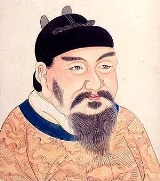
Emperor Gaozong of Tang

Encyclopedia
Emperor Gaozong of Tang (21 July 628 – 27 December 683), personal name Li Zhi (李治), was the third emperor of the Tang Dynasty
in China
, ruling from 649 to 683 (although after January 665 much of the governance was in the hands of his second wife Empress Wu
(later known as Wu Zetian)). Emperor Gaozong was the son of Emperor Taizong
and Empress Zhangsun
.
Emperor Gaozong was aided in his rule by Empress Wu during the later years of his reign after a series of strokes left him incapacitated. Emperor Gaozong delegated all matters of state to his wife and after he died in 683, power fell completely into the hands of Empress Wu, who subsequently became the only reigning Empress of China. After his death, he was interred at the Qianling Mausoleum
along with Wu Zetian.
Historians have generally viewed Emperor Gaozong as a weak ruler, inattentive to the business of the state and leaving such business to his powerful wife Empress Wu. During the first part of his reign, Tang territorial gains, which started with his father Emperor Taizong, continued, including the conquest of Baekje
, Goguryeo
, and Western Tujue, but throughout the 670s, much of those gains were lost to Tufan, Silla
, Khitan
, and Balhae
. Further, territory previously conquered that belonged to both Eastern and Western Tujue were subjected to repeated rebellions.
, and the third son of his mother, Emperor Taizong's wife Empress Zhangsun
. In 631, he was created the Prince of Jin. In 633, he was made commandant of Bing Prefecture (并州, roughly modern Taiyuan
, Shanxi
), but remained at the capital Chang'an
rather than reporting to Bing Prefecture. When Empress Zhangsun died in 636, Emperor Taizong was particularly touched by the grief that Li Zhi displayed, and from that point on particularly favored him. Sometime while he was the Prince of Jin, at the recommendation of his grand aunt Princess Tong'an, he married the grandniece
of Princess Tong'an's husband Wang Yu (王裕) as his wife and princess.
Meanwhile, Li Zhi's two older brothers by Empress Zhangsun, Li Chengqian the Crown Prince
and Li Tai the Prince of Wei, were locked in an intense rivalry, as Li Tai was favored by Emperor Taizong for his talent and was trying to displace Li Chengqian. Li Chengqian, in fear, entered into a conspiracy with the general Hou Junji
, his uncle Li Yuanchang (李元昌) the Prince of Han, the imperial guard commander Li Anyan (李安儼), and his brothers-in-law Zhao Jie (趙節, who was also his cousin) and Du He (杜荷) to overthrow Emperor Taizong. The plot was discovered in 643, and Emperor Taizong deposed Li Chengqian. He was initially going to make Li Tai the new crown prince, but later began to believe that Li Tai's machinations were responsible for Li Chengqian's downfall. The powerful chancellor Zhangsun Wuji
-- Empress Zhangsun's brother—suggested that he make Li Zhi crown prince, a possibility that Li Tai was apprehensive about. Li Tai tried to intimidate Li Zhi, who had been friendly with Li Yuanchang, by pointing out to Li Zhi that Li Yuanchang had been part of the plot and that he should be concerned for himself. When Emperor Taizong noticed Li Zhi worrying about this and was told by Li Zhi of Li Tai's intimidation, Emperor Taizong's mind became set. He exiled Li Tai, and on 30 April, 643, he created Li Zhi the new crown prince. He made Zhangsun and two other senior chancellors, Fang Xuanling
and Xiao Yu
, senior advisors to Li Zhi, and made another chancellor, Li Shiji
, the head of Li Zhi's household. At the advice of another key official, Liu Ji
, who pointed out that the crown prince needed to have a group of well-learned scholars that he was close to, Emperor Taizong appointed Liu, as well as Cen Wenben
, Chu Suiliang
, and Ma Zhou
, to serve as Li Zhi's friends and advisors.
, having two daughters (the later Princesses Yiyang and Gao'an) and one son (Li Sujie
) with her, much to the chagrin of his wife Crown Princess Wang, who was childless and jealous for Consort Xiao. Three other concubines of his bore his other sons Li Zhong
, Li Xiao (李孝), and Li Shangjin (李上金).
Around the same time, however, Emperor Taizong also became concerned that Li Zhi, who was considered kind but weak in character, would not be strong enough to be an emperor, and secretly discussed with Zhangsun Wuji the possibility of making another son by his concubine Consort Yang (daughter of Emperor Yang of Sui
), Li Ke
the Prince of Wu, crown prince. Zhangsun repeatedly opposed the idea, and Emperor Taizong did not carry this out.
In 645, when Emperor Taizong launched a campaign against Goguryeo
, he took Li Zhi with him to Ding Prefecture (定州, roughly modern Baoding
, Hebei
) and then left Li Zhi there to be in charge of logistics, before heading to the front himself. He also left senior officials Gao Shilian
, Liu Ji, Ma Zhou, Zhang Xingcheng
, and Gao Jifu
to assist Li Zhi. After the campaign ended in failure later that year, as Emperor Taizong was leading the army back from the front, Li Zhi went to meet him at Linyu Pass (臨渝關, now Shanhai Pass
). Emperor Taizong suffered an injury during the campaign, and Li Zhi was said to have, as Emperor Taizong's conditions were getting worse, sucked the pus out of his wound, until Emperor Taizong recovered somewhat. In 646, with Emperor Taizong still recovering, he transferred some of the imperial authorities to Li Zhi. Li Zhi stayed at the imperial palace and attended to Emperor Taizong in his illness. That year, when Emperor Taizong was due to visit Ling Prefecture (靈州, roughly modern Yinchuan, Ningxia
) to meet with a number of tribal chiefs who were formerly vassals of Xueyantuo
-- which had collapsed under Tang and Huige attacks earlier that year—he was set to take Li Zhi with him, but at Zhang's suggestion left Li Zhi in charge at Chang'an instead, to allow Li Zhi to become more familiar with the important affairs of state in his absence. After Emperor Taizong returned from Ling Prefecture, he retained for himself the authorities over imperial worship, state guests, military, the commissioning of officers of higher than the fifth rank, and executions, and transferred all other authorities to Li Zhi.
In 647, a commoner named Duan Zhichong (段志沖) submitted a petition to Emperor Taizong, asking him to pass the throne to Li Zhi. Li Zhi, concerned that Emperor Taizong might be offended, was worried and grieving, and Zhangsun suggested that Duan be executed. Emperor Taizong did not take offense and did not punish Duan or Li Zhi. Meanwhile, Li Zhi began to build a Buddhist temple named Daci'en Temple (大慈恩寺) in commemoration of his mother Empress Zhangsun, and the temple was completed in 648.
In 649, while at the summer palace Cuiwei Palace (翠微宮, in the Qin Mountains), Emperor Taizong was gravely ill, and he, while impressed with Li Shiji's abilities, was concerned that Li Shiji was too able and would not submit to Li Zhi. He stated to Li Zhi:
He then demoted Li Shiji to the post of the commandant of Die Prefecture (疊州, roughly modern Gannan Tibetan Autonomous Prefecture
, Gansu
). Li Shiji, realizing what was happening, after receiving the order, departed without hesitation.
As Emperor Taizong's illness was getting more serious, Li Zhi continuously attended to him and wept constantly, often going without food, which touched Emperor Taizong greatly. Emperor Taizong entrusted Li Zhi to Zhangsun and Chu Suiliang, and then died on 10 July, 649. Initially, Li Zhi was so mournful that he could not carry out any actions other than holding onto the necks of Zhangsun and Chu. Zhangsun, while mourning himself, reminded Li Zhi that he was now in charge of the empire and must act accordingly. Zhangsun also ordered that Emperor Taizong's death not be announced for the time being, and then, the next day, accompanied Li Zhi back to Chang'an. Zhangsun issued several edicts in Emperor Taizong's name—including making Yu Zhining
, Zhang, and Gao Jifu chancellors. Two days later, Emperor Taizong's death was officially announced. On 15 July, Li Zhi took the throne (as Emperor Gaozong).
Also in 650, the general Gao Kan (高侃) -- whose army had been launched by Emperor Taizong against the newly reconstituted Eastern Tujue under Chebi Khan
Ashina Hubo prior to Emperor Taizong's death—captured Ashina Hubo and brought him back to Chang'an. Emperor Gaozong spared Ashina Hubo and made him a general, putting his people directly under Tang rule. Meanwhile, with two of the Xiyu states previously conquered by Tang and governed by Tang-installed kings, Qiuzi and Yanqi
in disturbance, Emperor Taizong returned their previously-captured kings, Bai Helibushibi (白訶黎布失畢) and Long Tuqizhi (龍突騎支) respectively, to their thrones.
In 651, the Western Tujue prince Ashina Helu
, who had sought and received protection from Emperor Taizong, broke away from Tang and defeated Western Tujue's Yipishekui Khan, taking over Western Tujue himself and no longer subordinate under Tang. In fall 651, Ashina Helu attacked Tang's Ting Prefecture (庭州, roughly modern Changji Hui Autonomous Prefecture
, Xinjiang
), and Emperor Gaozong responded by commissioning the generals Liang Jianfang (梁建方) and Qibi Heli (契苾何力) to attack Ashina Helu. Liang and Qibi achieved some victories against Ashina Helu's general Zhuxie Guzhu (朱邪孤注), but then withdrew without engaging Ashina Helu.
Meanwhile, as Empress Wang was sonless, her uncle, the chancellor Liu Shi
, suggested to her that she ask Emperor Gaozong to create his oldest son Li Zhong, whose mother Consort Liu was of low birth and therefore she considered nonthreatening, crown prince so that Li Zhong would be grateful of her in the future. Liu also persuaded Zhangsun to suggest the idea as well, and Emperor Gaozong. in fall 652, Emperor Gaozong created Li Zhong crown prince. By this point, however, Empress Wang was facing a major threat from another romantic rival. When Emperor Gaozong was crown prince, he had been attracted by the beauty of one of Emperor Taizong's concubines, Consort Wu
. After Emperor Taizong's death, all of his concubines who did not bear sons were housed at Ganye Temple (感業寺) to be Buddhist nuns. In either 650 or 651, when Emperor Gaozong was visiting Ganye Temple to offer incense to Buddha, when he saw Consort Wu. Both of them wept. When Empress Wang heard this, she, wanting to divert Emperor Gaozong's favor from Consort Xiao, secretly instructed Consort Wu to grow her hair back, while suggesting to Emperor Gaozong that he take her as a concubine. Consort Wu was intelligent and full of machinations, and therefore, when she first returned to the palace, she acted humbly and flattered Empress Wang, who trusted her greatly and recommended her to Emperor Gaozong. Soon, Emperor Gaozong became enamored with Consort Wu.
Meanwhile, Emperor Gaozong's sister Princess Gaoyang and her husband Fang Yi'ai (房遺愛, Fang Xuanling's son), were implicated in 652 of conspiring with another brother-in-law Chai Lingwu (柴令武), the general Xue Wanche (薛萬徹) and Emperor Gaozong's uncle Li Yuanjing (李元景) the Prince of Jing to make Li Yuanjing emperor. Fang, knowing that Zhangsun had long been apprehensive of Li Ke, falsely implicated Li Ke in the plot as well, hoping to ingratiate Zhangsun sufficiently that he would be spared. nevertheless, in spring 653, at the suggestion of Zhangsun and Cui Dunli
-- despite Emperor Gaozong's initial inclination to spare Li Yuanjing and Li Ke—Emperor Gaozong ordered that Fang, Xue, and Chai be executed, and that Li Yuanjing, Li Ke, and the Princesses Gaoyang and Baling (Chai's wife) be forced to commit suicide. Zhangsun took this opportunity to accuse several other officials friendly with Fang or hostile to him—the chancellor Yuwen Jie
, Li Daozong
the Prince of Jiangxia, and the general Zhishi Sili (執失思力) -- of being friendly with Fang and had them exiled. He also deposed and exiled Li Ke's mother Consort Yang and Consort Yang's other son Li Yin (李愔) the Prince of Shu, as well as Fang's brother Fang Yizhi (房遺直) and Xue's brother Xue Wanbei (薛萬備).
By 654, both Empress Wang and Consort Xiao had lost favor with Emperor Gaozong, and the former romantic rivals joined forces against Consort Wu, but to no avail, and as a sign of his love to Consort Wu, in 654 he conferred posthumous honors on her father Wu Shihuo
(武士彠). Later that year, after Consort Wu gave birth to a daughter, Empress Wang visited her—and after Empress Wang left, Consort Wu killed her own daughter and then implicated Empress Wang in the killing. In anger, Emperor Gaozong considered deposing Empress Wang and replacing her with Consort Wu, but wanted to make sure that the chancellors would support this, and so visited Zhangsun's house with Consort Wu, awarding him with much treasure, but when he brought up the topic that Empress Wang was sonless (as an excuse for deposing her), Zhangsun repeatedly found ways to divert the conversation, and subsequent visits by Consort Wu's mother Lady Yang and the official Xu Jingzong
, who was allied with Consort Wu, to seek support from Zhangsun were also to no avail.
In summer 655, Consort Wu accused Empress Wang and her mother Lady Liu of using witchcraft. In response, Emperor Gaozong barred Lady Liu from the palace and demoted Liu Shi. Meanwhile, a faction of officials began to form around Consort Wu, including Li Yifu
, Xu, Cui Yixuan (崔義玄), and Yuan Gongyu (袁公瑜). On an occasion in fall 655, Emperor Gaozong summoned the chancellors Zhangsun, Li Shiji (who by now was using the name Li Ji to observe naming taboo
for Emperor Taizong's name Li Shimin), Yu Zhining
, and Chu to the palace—which Chu deduced to be regarding the matter of changing the empress. Li Ji claimed an illness and refused to attend. At the meeting, Chu vehemently opposed deposing Empress Wang, while Zhangsun and Yu showed their disapproval by silence. Meanwhile, other chancellors Han Yuan
and Lai Ji
also opposed the move, but when Emperor Gaozong asked Li Ji again, Li Ji's response was, "This is your family matter, Your Imperial Majesty. Why ask anyone else?" Emperor Gaozong therefore became resolved. He demoted Chu to be a commandant at Tan Prefecture (潭州, roughly modern Changsha, Hunan
), and then deposed both Empress Wang and Consort Xiao, putting them under arrest and creating Consort Wu empress instead to replace Empress Wang. (Later that year, Empress Wang and Consort Xiao were killed on orders by the new Empress Wu after Emperor Gaozong showed signs of considering their release.) Then, at Xu's suggestion, in spring 656, Emperor Gaozong demoted Li Zhong to be the Prince of Liang and created Empress Wu's oldest son Li Hong
the Prince of Dai crown prince instead.
In 655 as well, Emperor Gaozong commissioned the general Cheng Zhijie (程知節) to attack Ashina Helu, but while the campaign saw some victories over Western Tujue's substituent tribes Geluolu (歌邏祿) and Chuyue (處月), it was hindered by Cheng's inability to restrain his assistant Wang Wendu (王文度) from pillaging and inappropriately halting the army. After the campaign ended in early 657, both Cheng and Wang were deposed from their offices.
, who had served under Cheng Zhijie in the earlier failed campaign, to attack Ashina Helu, assisted by Ren Yaxiang
and Xiao Siye (蕭嗣業). They were joined by the Western Tujue chieftains Ashina Mishe and Ashina Buzhen, who had submitted to Tang during Emperor Taizong's reign. The campaign caught Ashina Helu by surprise, and Su defeated him in several battles, causing him to flee to the kingdom Shi (石國, centering modern Tashkent
, Uzbekistan
), which arrested him and delivered him to Su, thus largely ending Western Tujue as an organized state. (Emperor Gaozong would try to continue Western Tujue's existence as a vassal stage by dividing it in half and creating Ashina Mishe and Ashina Buzhen as khans of the two halves.)
Meanwhile, Xu Jingzong and Li Yifu, aligned with Empress Wu, began to carry out a campaign of reprisal on her behalf. In 657, they accused Han Yuan and Lai Ji of plotting treason with Chu Suiliang, who was then serving as the commandant at Gui Prefecture (桂州, roughly modern Guilin
, Guangxi
). Emperor Gaozong demoted Han and Lai to be prefects of distant prefectures, and demoted Chu and Liu Shi to even more distant prefectures—in Chu's case, to the extremely distant Ai Prefecture (愛州, roughly modern Thanh Hoa Province, Vietnam
), and Chu's subsequent petition, sent from Ai Prefecture, pleading with Emperor Gaozong, fell on deaf ears.
Empress Wu's reprisals did not end there. In 659, Zhangsun Wuji became the next target. At that time, two low level officials, Wei Jifang (韋季方) and Li Chao (李巢) had been accused of improper associations, and when Emperor Gaozong put Xu and Xin Maojiang
of investigating, Xu falsely accused Wei and Li to be part of a treasonous plot by Zhangsun. Emperor Gaozong, without meeting with Zhangsun, believed Xu, and put Zhangsun under house arrest in exile at Qian Prefecture (黔州, roughly modern southeastern Chongqing
). Xu further implicated Chu, Liu, Han, and Yu Zhining in the plot as well. Yu was removed from his post. Chu, who had died in 658, was posthumously stripped of all titles, and his sons Chu Yanfu (褚彥甫) and Chu Yanchong (褚彥沖) were executed. Orders were also issued to execute Liu and Han, although Han died before the execution order reached his location. Meanwhile, Zhangsun, once he reached his place of exile, was forced to commit suicide. It was said that after Han's and Lai's deaths, no official dared to criticize the emperor any further.
Also in 659, a vassal of Western Turkic Kaganate (Pin. Tujue), Duman (都曼), the commander of the Esegel
s (aka Izgil,

 , Ch. Asijie, Sijie 思結) Tribe, rebelled against Tang occupation
, along with Western Tujue's subject kingdoms Shule
(疏勒), Zhujupo (朱俱波), and Yebantuo (謁般陀) (all in modern Kashgar
, Xinjiang
). The joint forces commanded by Duman quickly defeated the Tang vassal Yutian (于田, in modern Hotan, Xinjiang
). In winter 659, Emperor Gaozong sent Su Dingfang against Duman, and once he arrived in the vicinity of Duman's army, he selected 10,000 infantry soldiers and 3,000 cavalry soldiers and made a surprise attack on Duman. When he arrived at Duman's headquarters, Duman was surprised, and after Su initially defeated Duman, Duman was forced to withdraw within the city. Su put the city under siege, and Duman surrendered. In spring 660, Su took Duman back to the eastern capital Luoyang
, where Emperor Gaozong was at the time, to present Duman to him. Some officials requested that Duman be executed, but Su made a plea on Duman's behalf—that he had promised Duman life before Duman surrendered—and Emperor Gaozong stated that while under the law, Duman should die, he would honor Su's promise, and so he spared Duman.
On the other end of the Tang atmosphere of influence, on the Korean Peninsula
, Baekje
had been attacking the Tang vassal Silla
. Once Su returned from the Esegel
campaign, Emperor Gaozong commissioned him to head over the sea to attack Baekje, in conjunction with Silla. Su quickly captured the Baekje capital Sabi
, forcing Baekje's King Uija
and his crown prince Buyeo Yung
to surrender. Emperor Gaozong ordered that Baekje be annexed as Tang territory. Emperor Gaozong then followed up by commissioning Su, along with Qibi Heli, Liu Boying (劉伯英), and Cheng Mingzhen (程名振), to attack Goguryeo.
back from Japan
to serve as king, with Juryu (주류, 周留, in modern Seocheon County
, South Chungcheong) as their headquarters. They put the Tang general Liu Renyuan (劉仁願) under siege in Sabi. Emperor Gaozong sent the general Liu Rengui
, who had previously been demoted to commoner rank for offending Li Yifu, with a relief force, and Liu Rengui and Liu Renyuan were able to fight off the Baekje resistance forces' attacks, but were themselves not strong enough to quell the rebellion, and so for some time the armies were in stalemate.
Meanwhile, Su advanced on the Goguryeo capital Pyongyang
and put it under siege, but was unable to capture it quickly. In spring 662, after the general Pang Xiaotai (龐孝泰) was defeated by Goguryeo forces at Sasu River (蛇水, probably Botong River) and was killed along with his 13 sons, Su ran into harsh snowstorms and withdrew.
Around the same time, after the death of the Huige chief Yaoluoge Porun (藥羅葛婆閏), who had been obedient to Tang, Yaoluoge Porun's nephew Yaoluoge Bisudu (藥羅葛比粟毒) rose in rebellion with the Tongluo (同羅) and Pugu (僕固) tribes in conjunction with other Tiele
Confederation tribes. Emperor Gaozong sent the general Zheng Rentai (鄭仁泰) to attack the Tiele, but while Zheng was initially victorious, his officers became bogged down in pillaging and eventually suffered great losses after being caught in poor weather. Emperor Gaozong instead sent Qibi, who was ethnically Tiele, assisted by Jiang Ke
, to Tiele to try to persuade them to surrender. Qibi was able to do so, and rebel leaders were arrested and turned over to Tang. Qibi executed them and ended the rebellion.
Meanwhile, for reasons unknown, also in 662 Emperor Gaozong sent the general Su Haizheng (蘇海政) to attack Qiuzi and ordered Ashina Mishe and Ashina Buzhen to assist him. Ashina Buzhen, who had a rivalry with Ashina Mishe, falsely informed Su that Ashina Mishe was set to rebel and would attack the Tang army, and Su responded by ambushing Ashina Mishe, killing him and his chief assistants. The Western Tujue tribes, angry over Ashina Mishe's death, largely turned away from Tang and submitted to Tufan instead, and when Ashina Buzhen died later that year, Tang influence in the region was greatly reduced.
During these years, Li Yifu had been, due to favors from Emperor Gaozong and Empress Wu, exceedingly powerful, and he grew particularly corrupt. In 663, after reports of Li Yifu's corruption were made to Emperor Gaozong, Emperor Gaozong had Liu Xiangdao
and Li Ji investigate, finding Li Yifu guilty. Li Yifu was removed from his post and exiled, and would never return to Chang'an.
During the years, Empress Wu had repeatedly, in her dreams, seen Empress Wang and Consort Xiao, in the states they were after their terrible deaths, and she came to believe that their spirits were after her. For that reason, Emperor Gaozong started remodeling a secondary palace, Daming Palace (大明宮), into Penglai Palace (蓬萊宮), and when Penglai Palace's main hall, Hanyuan Hall (含元殿), was completed in 663, Emperor Gaozong and Empress Wu moved to the newly remodeled palace (which was itself later renamed to Hanyuan Palace). (However, Empress Wang and Consort Xiao continued to appear in her dreams even after this, and therefore, late in Emperor Gaozong's reign, he and Empress Wu were often at the eastern capital Luoyang
, not at Chang'an.)
Also in 663, Tufan attacked the Tang vassal Tuyuhun. Tuyuhun's Ledou Khan Murong Nuohebo
, unable to withstand the Tufan attack, took his people and fled into Tang territory to seek protection, thus ending Tuyuhun's existence as a state.
Meanwhile, also in 663, Liu Rengui and Liu Renyuan, in conjunction with Silla's King Munmu
and the former Baekje crown prince Buyeo Yung
, defeated Buyeo Pung and Japanese forces sent to assist him, at the Battle of Baekgang
. Buyeo Pung fled to Goguryeo, ending the Baekje resistance movement. Emperor Gaozong recalled Liu Renyuan, leading Liu Rengui in charge of former Baekje territory, but in 664 sent Liu Renyuan back to Baekje and tried to recall Liu Rengui. Liu Rengui petitioned to remain to prepare for another attack on Goguryeo, and Emperor Gaozong agreed to let him remain.
By 664, Empress Wu, who felt that her power was well established, was extending her influence further in the political arena, and when the eunuch Wang Fusheng (王伏勝) reported to Emperor Gaozong that she had engaged the sorcerer Guo Xingzhen (郭行真) -- an act that was strictly forbidden—Emperor Gaozong, in anger, summoned the chancellor Shangguan Yi
to consult Shangguan. Shangguan suggested that he depose Empress Wu. He agreed, and had Shangguan draft an edict to that effect. However, Empress Wu had received information that that was happening, and she emerged to defend herself. Emperor Gaozong could not carry out the removal, and instead blamed Shangguan. As both Shangguan and Wang had previously served the former crown prince Li Zhong, Empress Wu had Xu Jingzong falsely accuse Shangguan, Wang, and Li Zhong of conspiring against Emperor Gaozong's life. Around the new year 665, Shangguan and Wang were executed, and Li Zhong was forced to commit suicide. From this point on, whenever Emperor Gaozong presided over imperial meetings, Empress Wu would sit behind a pearl screen behind him to hear the reports as well, and political power largely fell into her hands. She and Emperor Gaozong were thereafter referred to as the "Two Saints."
In 665, Emperor Gaozong went to Luoyang and began preparation in earnest to make sacrifices to heaven and earth at Mount Tai
-- a traditional ceremony for emperors that were rarely carried out in history due to the large expenses associated with them. At Empress Wu's request—as she reasoned that the sacrifice to earth also included sacrifices to past empresses (Emperor Gaozong's mother Empress Zhangsun and grandmother Duchess Dou, posthumously honored as an empress), she believed that it would be more appropriate to have females offer the sacrifices rather than male officials, as had been tradition in the past. Emperor Gaozong decreed that the male ministers would offer sacrifices first, but Empress Wu would next offer sacrifices, followed by Princess Dowager Yan, the mother of Emperor Gaozong's younger brother Li Zhen
the Prince of Yue. In winter 665, Emperor Gaozong departed Luoyang and headed for Mount Tai. On the lunar new year (10 February 666), he initiated the sacrifices to heaven, which were not completed until the next day. On 12 February, sacrifices were made to earth. He gave general promotions to the imperial officials, and it was said that starting from this time, promotions of imperial officials, which were strict and slow during the reigns of Emperors Gaozu and Taizong, began to become more relaxed and often excessive. He also declared a general pardon, except for long-term exiles.
died and was initially succeeded as Dae Mangniji by his oldest son Yeon Namsaeng
. As Yeon Namsaeng subsequently carried out a tour of Goguryeo territory, however, rumors began to spread both that Yeon Namsaeng was going to kill his younger brothers Yeon Namgeon
and Yeon Namsan
, whom he had left in charge at Pyongyang, and that Yeon Namgeon and Yeon Namsan were planning to rebel against Yeon Namsaeng. When Yeon Namsaeng subsequently sent officials close to him back to Pyongyang to try to spy on the situation, Yeon Namgeon arrested them and declared himself Dae Mangniji, attacking his brother. Yeon Namsaeng sent his son (later known as Cheon Heonseong/Quan Xiancheng (泉獻誠), as Yeon Namsaeng changed his family name from Yeon (淵) to observe naming taboo
for Emperor Gaozu, whose personal name was the same character) to Tang to seek aid. Emperor Gaozong saw this as the opportunity to destroy Goguryeo, and he initially commissioned Qibi Heli to aid Yeon Namsaeng, and also sent the generals Pang Tongshan (龐同善) and Gao Kan (高侃) to attack Goguryeo.
Meanwhile, Empress Wu's sister, the Lady of Han (who had married the low-level official Helan Yueshi (賀蘭越石)), and her daughter Lady Helan had both been frequently visiting the palace and were said to be "favored" by Emperor Gaozong. When Lady of Han died in 666, Emperor Gaozong created Lady Helan the Lady of Wei, and wanted to let her live in the palace, but hesitated because he thought Empress Wu would be jealous. When Empress Wu heard this, she was indeed jealous, and therefore she poisoned meat offered by her nephews Wu Weiliang (武惟良) and Wu Huaiyun (武懷運), who had been on poor relations with her and whose grandmother were not her mother Lady Yang; she then gave the poisonous meat to Lady Helan, who ate it and died. Empress Wu then implicated Wu Weiliang and Wu Huaiyun in Lady Helan's death and executed them.
Around the new year 667, Emperor Gaozong further commissioned Li Ji to be the overall commander of the attack on Goguryeo, assisted by Hao Chujun
. In fall 667, Li Ji crossed the Liao River
and captured Sinseong (新城, in modern Fushun
, Liaoning
). The Tang forces thereafter fought off counterattacks by Yeon Namgeon and joined forces with Yeon Namsaeng, although they were initially unable to cross the Yalu River
. In spring 668, Li Ji turned his attention to Goguryeo's northern cities, capturing the important city Buyeo (扶餘, in modern Siping
, Jilin
). In fall 668, he crossed the Yalu and put Pyongyang under siege. Yeon Namsan and King Bojang
surrendered, and while Yeon Namgeon continued to resist in the inner city, his general, the Buddhist monk Shin Seong (信誠) turned against him and surrendered the inner city to Tang forces. Yeon Namgeon tried to commit suicide, but was seized and treated. This was the end of Goguryeo, and Tang annexed Goguryeo into its territory, with Xue Rengui
being put initially in charge of former Goguryeo territory as protector general
. However, there was much resistance to Tang rule (fanned by Silla, which was displeased that Tang did not give the Goguryeo territory to it), and in 669, following Emperor Gaozong’s order, a part of the Goguryeo people were forced to move to the region between the Yangtze River
and the Huai River
, as well as the regions south of the Qin Mountains and west of Chang'an, only leaving old and weak inhabitants in the original land.
area, to try to open a second front against Tufan as well as to try to restore the territory previously held by Tuyuhun. However, Guo, who felt himself to be Xue's equal as a general, was displeased at serving as an assistant, and their discord eventually led to a major defeat by Tufan's prime minister Lun Qinling (論欽陵). For the time being, the Xiyu territory was lost. By 672, Emperor Gaozong gave up the hopes of reestablishing Tuyuhun and moved Murong Nuohebo and his people deep into Tang territory.
By 674, Emperor Gaozong was displeased at King Munmu of Silla
encouragement of Goguryeo revival movements
who continued to resist Tang rule over the region and he stripped King Munmu of all Tang-bestowed titles, including the title of King of Silla, and arbitrarily conferred them on King Munmu's brother Kim Immun (金仁問) instead, commissioning Liu Rengui, assisted by Li Bi (李弼, Li Ji's brother) and the ethnically Mohe general Li Jinxing (李謹行), to escort Kim Immun back to Silla territory. However, King Munmu formally apologized and offered tribute, Emperor Gaozong ordered a withdrawal and recalled Kim Immun.
The Sassanian prince Peroz II fled to China during this time around 670. The sister of Peroz II was married to the Chinese Emperor, who allowed Sassanian refugees fleeing from the Arab conquest to settle in China.
Meanwhile, by this time, Emperor Gaozong was continuously suffering from a persistent headache, and he considered making Empress Wu regent
. Both Hao Chujun and Li Yiyan
objected strenuously, and Emperor Gaozong did not make her regent. (The modern Chinese historian Bo Yang
suggested that Emperor Gaozong's illnesses may be the result of long-term poisoning by Empress Wu, but did not provide evidence.) However, this did not prevent Empress Wu from engaging a number of mid-level officials, including Yuan Wanqing (元萬頃) and Liu Yizhi
, known as the "North Gate Scholars" (北門學士, as the palace sat north of the imperial government) to serve as her advisors and to divert the powers of the chancellors.
Also in 675, Li Hong the Crown Prince died suddenly—with traditional historians largely attributing his death to poisoning by Empress Wu, due to her anger that he tried to curb her power grab and had shown sympathy to his two older sisters born of Consort Xiao—Princesses Yiyang and Gao'an. Emperor Gaozong, in grief, posthumously honored Li Hong as an emperor, and he created Empress Wu's second son, Li Xian
the Prince of Yong, crown prince.
Along with the war with Silla, some resistance of Goguryeo people continued to plague Tang rule there. In 676, Xue Rengui
crossed the Yellow Sea
to against Silla. However, Silla navy expelled Tang forces on the coast of western Silla.
Emperor Gaozong order withdrawal of Tang forces from the Korean Peninsula
entirely and moved the Protectorate General to Pacify the East
to Liaodong (遼東, in modern Liaoyang
, Liaoning
) and the commandant of Xiongjin (熊津), who governed the former Baekje territory at Sabi, to Geonan (建安, in modern Yingkou
, Liaoning
), allowing Silla eventually expelled Tang out of the Korean Peninsula
and unified the parts of the peninsula south of the Taedong River
.
In 677, he bestowed on Goguryeo's former King Bojang, Go Jang, the titles of Prince of Chaoxian
and commandant of Liaodong, giving him the forcibly removed Goguryeo people. He also bestowed on Buyeo Yung
the title of Prince of Daifang and commandant of Xiongjin—with the intent of letting Go Jang and Buyeo Yung to rebuild Goguryeo and Baekje as loyal vassals to counteract Silla. To accommodate these movements, the Protectorate General was further moved to Xincheng. (Buyeo Yung was not able to make any headway in leading his people back to Baekje territory, while Go Jang tried to break away from Tang rule in alliance with the Mohe; when this was discovered, Emperor Gaozong recalled him to Chang'an and exiled him to Qiong Prefecture (邛州, part of modern Chengdu
, Sichuan
).)
Meanwhile, Tang had to endure multiple attacks from Tufan, and in 677, he commissioned Liu Rengui, then a chancellor, to take up defense position at Taohe Base (洮河軍, in modern Haidong Prefecture
, Qinghai
), to prepare a counterattack against Tufan. However, Liu's proposals were repeatedly blocked by another chancellor, Li Jingxuan
. In order to retaliate against Li Jingxuan, even though Liu knew that Li Jingxuan was not capable in military matters, he nevertheless recommended that Li Jingxuan take over for himself, and despite Li Jingxuan's attempt to decline, Emperor Gaozong commissioned Li Jingxuan to command the army against Tufan. In fall 678, Li Jingxuan's forces engaged Tufan forces commanded by Lun Qinling, and was soundly defeated, with Li Jingxuan's assistant Liu Shenli (劉審禮) captured by Tufan. Li Jingxuan was only able to escape after being protected by the ethnically Baekje general Heichi Changzhi.
). Emperor Gaozong was ready to commission an army against Ashina Duzhi and Li Zhefu, but the official Pei Jingxian (裴行儉), who had previously served as secretary general at Xi Prefecture (西州, roughly modern Turfan Prefecture, Xinjiang
), opposed—instead proposing that a small detachment be announced to escort the Persian prince Narsieh
back to Persia to contend for regal title. Emperor Gaozong agreed and put Pei in charge of the detachment. When Pei arrived at Xi Prefecture, he, under the guise of a hunting party, summoned a number of tribal chiefs loyal to Tang in the area, and once they arrived, launched a surprise attack on Ashina Duzhi, who, caught by surprise, was forced to surrender; Li Zhefu then surrendered as well. (Narsieh, having been used in this manner, was left in the region to fend for himself.)
Meanwhile, though, another trouble was flaring up for Tang. The former Eastern Tujue territory, over which Tang had established 24 prefectures with the tribal chiefs serving as prefects, rebelled, and, under the leadership of Ashide Wenfu (阿史德溫傅) and Ashide Fengzhi (阿史德奉職), supported Ashina Nishoufu as khan. Emperor Gaozong sent Xiao Siye to attack Ashina Nishoufu, but after Xiao achieved a few victories, he became careless, and a counterattack by Ashina Nishoufu crushed him, advancing as far as Ding Prefecture. Ashina Nishoufu also encouraged the Xi
and the Khitan
to attack Ying Prefecture (營州, roughly modern Zhaoyang, Liaoning
), although those attacks were fought off. Around the new year 680, after Pei returned from the Western Tujue front, Emperor Gaozong commissioned him to attack the Eastern Tujue. Pei defeated and captured Ashide Fengzhi, and Ashina Nishoufu's subordinates killed him and surrendered, ending the rebellion.
Meanwhile, Li Xian's relationship with Empress Wu was deteriorating, as Li Xian heard rumors that he was not born of Empress Wu but her sister Lady of Han, and was fearful. Meanwhile, earlier, Ming Chongyan (明崇儼), a sorcerer trusted by Empress Wu and Emperor Gaozong, had repeatedly stated that he believed Li Xian did not have the abilities to be emperor, that his younger brother Li Zhe
the Prince of Ying had an appearance like Emperor Taizong, and that another younger brother, Li Dan
the Prince of Xiang, had the most honored appearance of all. Knowing that Li Xian was fearful of her, Empress Wu had the North Gate Scholars author teachings on filial piety to give to Li Xian, and also personally rebuked him, further causing him to be alarmed. When Ming was assassinated in 679, Empress Wu suspected Li Xian of carrying out the assassination. She had a report made to Emperor Gaozong that accused Li Xian of assassinating Ming. When the officials Xue Yuanchao
, Pei Yan
, and Gao Zhizhou
were put in charge of investigations, they discovered a number of armors in Li Xian's palace. Empress Wu thus accused Li Xian of treason, and while Emperor Gaozong initially wanted to take no actions against Li Xian, at Empress Wu's insistence he relented. In fall 680, he reduced Li Xian to commoner rank, and created Li Zhe as the new crown prince.
In 681, the Eastern Tujue territory flared up again, as the chieftain Ashina Fu'nian claimed khan title and allied with Ashide Wenfu to attack Chinese territory. Emperor Gaozong again commissioned Pei to attack Eastern Tujue forces. Pei's assistant Cao Huaishun (曹懷舜) was initially defeated by Ashina Fu'nian, but after Pei sent spies to spread rumors, the rumors led to discord between Ashina Fu'nian and Ashide Wenfu. When Pei's forces approached Ashina Fu'nian's position, Ashina Fu'nian arrested Ashide Wenfu and surrendered. (Against Pei's recommendation to spare Ashina Fu'nian, Emperor Gaozong executed him.)
In 682, the Western Tujue chieftain Ashina Chebo (阿史那車薄) rebelled against Tang rule, and Emperor Gaozong initially was to commission Pei again, but before the army could depart, Pei died. However, the commandant at Anxi, Wang Fangyi (王方翼, Empress Wang's cousin) was able to defeat Ashina Chebo and crush the rebellion.
Also in 682, the Eastern Tujue chief Ashina Gudulu rose, in alliance with Ashide Yuanzhen (阿史德元珍), to claim khan title. This, unlike the several earlier rebellions, actually saw the Eastern Tujue khanate being permanently reestablished to Tang's north and persisting for decades, and would plague the last two years of Emperor Gaozong's reign as well as the reigns of his successors.
Late in 683, Emperor Gaozong was seriously ill, and he, who was then at Luoyang, summoned Li Zhe, then in charge of Chang'an, to Luoyang to attend to him. On 27 December, 683, he died. Li Zhe succeeded him (as Emperor Zhongzong), but actual power would be in the hands of Empress Wu, who became empress dowager
.
Tang Dynasty
The Tang Dynasty was an imperial dynasty of China preceded by the Sui Dynasty and followed by the Five Dynasties and Ten Kingdoms Period. It was founded by the Li family, who seized power during the decline and collapse of the Sui Empire...
in China
History of China
Chinese civilization originated in various regional centers along both the Yellow River and the Yangtze River valleys in the Neolithic era, but the Yellow River is said to be the Cradle of Chinese Civilization. With thousands of years of continuous history, China is one of the world's oldest...
, ruling from 649 to 683 (although after January 665 much of the governance was in the hands of his second wife Empress Wu
Wu Zetian
Wu Zetian , personal name Wu Zhao , often referred to as Tian Hou during the Tang Dynasty and Empress Consort Wu in later times, was the only woman in the history of China to assume the title of Empress Regnant...
(later known as Wu Zetian)). Emperor Gaozong was the son of Emperor Taizong
Emperor Taizong of Tang
Emperor Taizong of Tang , personal name Lǐ Shìmín , was the second emperor of the Tang Dynasty of China, ruling from 626 to 649...
and Empress Zhangsun
Empress Zhangsun
Empress Zhangsun , formally Empress Wendeshunsheng or, in short, Empress Wende , was an empress of the Chinese dynasty Tang Dynasty. She was the wife of Emperor Taizong and the mother of Emperor Gaozong...
.
Emperor Gaozong was aided in his rule by Empress Wu during the later years of his reign after a series of strokes left him incapacitated. Emperor Gaozong delegated all matters of state to his wife and after he died in 683, power fell completely into the hands of Empress Wu, who subsequently became the only reigning Empress of China. After his death, he was interred at the Qianling Mausoleum
Qianling Mausoleum
The Qianling Mausoleum is a Tang Dynasty tomb site located in Qian County, Shaanxi province, China, and is northwest from Xi'an, formerly the Tang capital. Built by 684 , the tombs of the mausoleum complex house the remains of various members of the royal Li family. This includes Emperor...
along with Wu Zetian.
Historians have generally viewed Emperor Gaozong as a weak ruler, inattentive to the business of the state and leaving such business to his powerful wife Empress Wu. During the first part of his reign, Tang territorial gains, which started with his father Emperor Taizong, continued, including the conquest of Baekje
Baekje
Baekje or Paekche was a kingdom located in southwest Korea. It was one of the Three Kingdoms of Korea, together with Goguryeo and Silla....
, Goguryeo
Goguryeo
Goguryeo or Koguryŏ was an ancient Korean kingdom located in present day northern and central parts of the Korean Peninsula, southern Manchuria, and southern Russian Maritime province....
, and Western Tujue, but throughout the 670s, much of those gains were lost to Tufan, Silla
Silla
Silla was one of the Three Kingdoms of Korea, and one of the longest sustained dynasties in...
, Khitan
Khitan people
thumb|250px|Khitans [[Eagle hunting|using eagles to hunt]], painted during the Chinese [[Song Dynasty]].The Khitan people , or Khitai, Kitan, or Kidan, were a nomadic Mongolic people, originally located at Mongolia and Manchuria from the 4th century...
, and Balhae
Balhae
Balhae was a Manchurian kingdom established after the fall of Goguryeo. After Goguryeo's capital and southern territories fell to Unified Silla, Dae Jo-yeong, a Mohe general, whose father was Dae Jung-sang, established Jin , later called Balhae.Balhae occupied southern parts of Manchuria and...
. Further, territory previously conquered that belonged to both Eastern and Western Tujue were subjected to repeated rebellions.
Background and life as Prince of Jin
Li Zhi was born in 628. He was the ninth son of his father, Emperor TaizongEmperor Taizong of Tang
Emperor Taizong of Tang , personal name Lǐ Shìmín , was the second emperor of the Tang Dynasty of China, ruling from 626 to 649...
, and the third son of his mother, Emperor Taizong's wife Empress Zhangsun
Empress Zhangsun
Empress Zhangsun , formally Empress Wendeshunsheng or, in short, Empress Wende , was an empress of the Chinese dynasty Tang Dynasty. She was the wife of Emperor Taizong and the mother of Emperor Gaozong...
. In 631, he was created the Prince of Jin. In 633, he was made commandant of Bing Prefecture (并州, roughly modern Taiyuan
Taiyuan
Taiyuan is the capital and largest city of Shanxi province in North China. At the 2010 census, it had a total population of 4,201,591 inhabitants on 6959 km² whom 3,212,500 are urban on 1,460 km². The name of the city literally means "Great Plains", referring to the location where the Fen River...
, Shanxi
Shanxi
' is a province in Northern China. Its one-character abbreviation is "晋" , after the state of Jin that existed here during the Spring and Autumn Period....
), but remained at the capital Chang'an
Chang'an
Chang'an is an ancient capital of more than ten dynasties in Chinese history, today known as Xi'an. Chang'an literally means "Perpetual Peace" in Classical Chinese. During the short-lived Xin Dynasty, the city was renamed "Constant Peace" ; yet after its fall in AD 23, the old name was restored...
rather than reporting to Bing Prefecture. When Empress Zhangsun died in 636, Emperor Taizong was particularly touched by the grief that Li Zhi displayed, and from that point on particularly favored him. Sometime while he was the Prince of Jin, at the recommendation of his grand aunt Princess Tong'an, he married the grandniece
Empress Wang (Gaozong)
Empress Wang was an empress of the Chinese dynasty Tang Dynasty. She was the first wife and empress of Emperor Gaozong and became empress shortly after he became emperor in 649. She, however, did not bear any sons for him and was not favored...
of Princess Tong'an's husband Wang Yu (王裕) as his wife and princess.
Meanwhile, Li Zhi's two older brothers by Empress Zhangsun, Li Chengqian the Crown Prince
Crown Prince
A crown prince or crown princess is the heir or heiress apparent to the throne in a royal or imperial monarchy. The wife of a crown prince is also titled crown princess....
and Li Tai the Prince of Wei, were locked in an intense rivalry, as Li Tai was favored by Emperor Taizong for his talent and was trying to displace Li Chengqian. Li Chengqian, in fear, entered into a conspiracy with the general Hou Junji
Hou Junji
Hou Junji was a major general and chancellor of the Chinese dynasty Tang Dynasty, particularly known for his campaigns against Gaochang and Tuyuhun...
, his uncle Li Yuanchang (李元昌) the Prince of Han, the imperial guard commander Li Anyan (李安儼), and his brothers-in-law Zhao Jie (趙節, who was also his cousin) and Du He (杜荷) to overthrow Emperor Taizong. The plot was discovered in 643, and Emperor Taizong deposed Li Chengqian. He was initially going to make Li Tai the new crown prince, but later began to believe that Li Tai's machinations were responsible for Li Chengqian's downfall. The powerful chancellor Zhangsun Wuji
Zhangsun Wuji
Zhangsun Wuji , courtesy name Fuji , formally Duke of Zhao , was a chancellor of the Chinese dynasty Tang Dynasty during the reigns of his brother-in-law Emperor Taizong and nephew Emperor Gaozong...
-- Empress Zhangsun's brother—suggested that he make Li Zhi crown prince, a possibility that Li Tai was apprehensive about. Li Tai tried to intimidate Li Zhi, who had been friendly with Li Yuanchang, by pointing out to Li Zhi that Li Yuanchang had been part of the plot and that he should be concerned for himself. When Emperor Taizong noticed Li Zhi worrying about this and was told by Li Zhi of Li Tai's intimidation, Emperor Taizong's mind became set. He exiled Li Tai, and on 30 April, 643, he created Li Zhi the new crown prince. He made Zhangsun and two other senior chancellors, Fang Xuanling
Fang Xuanling
Fang Xuanling , formal name Fang Qiao but went by the courtesy name of Xuanling, formally Duke Wenzhao of Liang , was the lead editor of the Book of Jin and one of the most celebrated chancellors of the Chinese dynasty Tang Dynasty, and he and his colleague Du Ruhui, both serving during the reign...
and Xiao Yu
Xiao Yu
Xiao Yu , courtesy name Shiwen , formally Duke Zhenbian of Song , was an imperial prince of the Chinese dynasty Liang Dynasty who later became an official for Sui Dynasty and Tang Dynasty, serving as a chancellor at times during the reigns of Emperor Gaozu of Tang and Emperor Taizong of Tang.-...
, senior advisors to Li Zhi, and made another chancellor, Li Shiji
Li Shiji
Li Shiji , né Xu Shiji , later known in the reign of Emperor Gaozong of Tang as Li Ji , courtesy name Maogong , formally Duke Zhenwu of Ying , was one of the most celebrated generals early in the Chinese Tang Dynasty...
, the head of Li Zhi's household. At the advice of another key official, Liu Ji
Liu Ji (Tang Dynasty)
Liu Ji , courtesy name Sidao , was a chancellor during the reign of Emperor Taizong of Tang, who was particularly relied on by Emperor Taizong late in his reign...
, who pointed out that the crown prince needed to have a group of well-learned scholars that he was close to, Emperor Taizong appointed Liu, as well as Cen Wenben
Cen Wenben
Cen Wenben , courtesy name Jingren , formally Viscount Xian of Jiangling , was a chancellor during the reign of Emperor Taizong of Tang. He was an assistant editor of the Book of Zhou, the official history of Northern Zhou.- Background :Cen Wenben was born in 595, during the reign of Emperor Wen...
, Chu Suiliang
Chu Suiliang
Chu Suiliang , courtesy name Dengshan , formally Duke of Henan , was a chancellor of the Chinese dynasty Tang Dynasty, during the reigns of Emperor Taizong and Emperor Taizong's son Emperor Gaozong...
, and Ma Zhou
Ma Zhou
Ma Zhou , courtesy name Binwang , was a chancellor during the reign of Emperor Taizong of Tang. He was initially a commoner and a guest of the general Chang He , and after Chang submitted suggestions that Ma drafted, Emperor Taizong was impressed and retained Ma as an imperial official,...
, to serve as Li Zhi's friends and advisors.
As Crown Prince
Late in 643, Emperor Taizong issued an edict to select beautiful women among good households to serve as Li Zhi's concubines. However, after Li Zhi declined such treatment, Emperor Taizong cancelled the edict. However, during his years as crown prince, he was said to have favored his concubine Consort XiaoConsort Xiao (Gaozong)
Consort Xiao, imperial consort rank Shufei was a concubine of Emperor Gaozong of Tang...
, having two daughters (the later Princesses Yiyang and Gao'an) and one son (Li Sujie
Li Sujie
Li Sujie , formally the Prince of Xu , was an imperial prince of the Chinese dynasty Tang Dynasty. He was the fourth son of Emperor Gaozong, born of his one-time favorite Consort Xiao...
) with her, much to the chagrin of his wife Crown Princess Wang, who was childless and jealous for Consort Xiao. Three other concubines of his bore his other sons Li Zhong
Li Zhong
Li Zhong is a fictional character in the Water Margin, one of the Four Great Classical Novels of Chinese literature. He ranks 86th of the 108 Liangshan heroes and 50th of the 72 Earthly Fiends. He is nicknamed "Tiger Slaying General".-Background:...
, Li Xiao (李孝), and Li Shangjin (李上金).
Around the same time, however, Emperor Taizong also became concerned that Li Zhi, who was considered kind but weak in character, would not be strong enough to be an emperor, and secretly discussed with Zhangsun Wuji the possibility of making another son by his concubine Consort Yang (daughter of Emperor Yang of Sui
Emperor Yang of Sui
Emperor Yang of Sui , personal name Yang Guang , alternative name Ying , nickname Amo , known as Emperor Ming during the brief reign of his grandson Yang Tong), was the second son of Emperor Wen of Sui, and the second emperor of China's Sui Dynasty.Emperor Yang's original name was Yang Ying, but...
), Li Ke
Li Ke
Li Ke , posthumously known as the Prince of Yulin , often known by his greater title as the Prince of Wu , was an imperial prince of the Chinese dynasty Tang Dynasty...
the Prince of Wu, crown prince. Zhangsun repeatedly opposed the idea, and Emperor Taizong did not carry this out.
In 645, when Emperor Taizong launched a campaign against Goguryeo
Emperor Taizong's campaign against Goguryeo
The First Goguryeo–Tang War started when Emperor Taizong of Tang , the second emperor of Chinese dynasty Tang Dynasty, asserting that a campaign against Goguryeo was necessary to protect Tang's ally Silla, as well as to punish Goguryeo's Dae Mangniji Yeon Gaesomun for his killing of Goguryeo's...
, he took Li Zhi with him to Ding Prefecture (定州, roughly modern Baoding
Baoding
-Administrative divisions:Baoding prefecture-level city consists of 3 municipal districts, 4 county-level cities, 18 counties:-Demographics:The Baoding urban area has a population of around 1,006,000 . The population of the Baoding administrative area is 10,890,000. The considerable majority are...
, Hebei
Hebei
' is a province of the People's Republic of China in the North China region. Its one-character abbreviation is "" , named after Ji Province, a Han Dynasty province that included what is now southern Hebei...
) and then left Li Zhi there to be in charge of logistics, before heading to the front himself. He also left senior officials Gao Shilian
Gao Shilian
Gao Shilian , formal name Gao Jian but went by the courtesy name of Shilian, formally Duke Wenxian of Shen , was a chancellor of the Chinese dynasty Tang Dynasty...
, Liu Ji, Ma Zhou, Zhang Xingcheng
Zhang Xingcheng
Zhang Xingcheng , courtesy name Deli , formally Duke Ding of Beiping , was a chancellor of the Chinese dynasty Tang Dynasty, during the reigns of Emperor Taizong and Emperor Gaozong.- Background :...
, and Gao Jifu
Gao Jifu
Gao Jifu , formal name Gao Feng but went by the courtesy name of Jifu, formally Duke Xian of Tiao , was a chancellor of the Chinese court in the Tang Dynasty, during the reigns of Emperor Taizong and Emperor Gaozong.- Background :Gao Jifu was born in 596...
to assist Li Zhi. After the campaign ended in failure later that year, as Emperor Taizong was leading the army back from the front, Li Zhi went to meet him at Linyu Pass (臨渝關, now Shanhai Pass
Shanhai Pass
Shanhai Pass , or Shanhaiguan, along with Jiayu Pass and Juyong Pass, is one of the major passes of the Great Wall of China It is located in Shanhaiguan District, Qinhuangdao, Hebei. In 1961, Shanhaiguan became a site of China First Class National Cultural Site.It is a popular tourist destination,...
). Emperor Taizong suffered an injury during the campaign, and Li Zhi was said to have, as Emperor Taizong's conditions were getting worse, sucked the pus out of his wound, until Emperor Taizong recovered somewhat. In 646, with Emperor Taizong still recovering, he transferred some of the imperial authorities to Li Zhi. Li Zhi stayed at the imperial palace and attended to Emperor Taizong in his illness. That year, when Emperor Taizong was due to visit Ling Prefecture (靈州, roughly modern Yinchuan, Ningxia
Ningxia
Ningxia, formerly transliterated as Ningsia, is an autonomous region of the People's Republic of China. Located in Northwest China, on the Loess Plateau, the Yellow River flows through this vast area of land. The Great Wall of China runs along its northeastern boundary...
) to meet with a number of tribal chiefs who were formerly vassals of Xueyantuo
Xueyantuo
The Xueyantuo ' or Syr-Tardush were an ancient Tiele people and khanate in central/northern Asia who were at one point vassals of the Gokturks, later aligning with China's Tang Dynasty against the Eastern Gokturks....
-- which had collapsed under Tang and Huige attacks earlier that year—he was set to take Li Zhi with him, but at Zhang's suggestion left Li Zhi in charge at Chang'an instead, to allow Li Zhi to become more familiar with the important affairs of state in his absence. After Emperor Taizong returned from Ling Prefecture, he retained for himself the authorities over imperial worship, state guests, military, the commissioning of officers of higher than the fifth rank, and executions, and transferred all other authorities to Li Zhi.
In 647, a commoner named Duan Zhichong (段志沖) submitted a petition to Emperor Taizong, asking him to pass the throne to Li Zhi. Li Zhi, concerned that Emperor Taizong might be offended, was worried and grieving, and Zhangsun suggested that Duan be executed. Emperor Taizong did not take offense and did not punish Duan or Li Zhi. Meanwhile, Li Zhi began to build a Buddhist temple named Daci'en Temple (大慈恩寺) in commemoration of his mother Empress Zhangsun, and the temple was completed in 648.
In 649, while at the summer palace Cuiwei Palace (翠微宮, in the Qin Mountains), Emperor Taizong was gravely ill, and he, while impressed with Li Shiji's abilities, was concerned that Li Shiji was too able and would not submit to Li Zhi. He stated to Li Zhi:
He then demoted Li Shiji to the post of the commandant of Die Prefecture (疊州, roughly modern Gannan Tibetan Autonomous Prefecture
Gannan Tibetan Autonomous Prefecture
Gannan Tibetan Autonomous Prefecture is an autonomous prefecture in southern Gansu Province, China. It includes Xiahe and the Labrang Monastery, Luqu, Maqu, and other mostly Tibetan towns and villages...
, Gansu
Gansu
' is a province located in the northwest of the People's Republic of China.It lies between the Tibetan and Huangtu plateaus, and borders Mongolia, Inner Mongolia, and Ningxia to the north, Xinjiang and Qinghai to the west, Sichuan to the south, and Shaanxi to the east...
). Li Shiji, realizing what was happening, after receiving the order, departed without hesitation.
As Emperor Taizong's illness was getting more serious, Li Zhi continuously attended to him and wept constantly, often going without food, which touched Emperor Taizong greatly. Emperor Taizong entrusted Li Zhi to Zhangsun and Chu Suiliang, and then died on 10 July, 649. Initially, Li Zhi was so mournful that he could not carry out any actions other than holding onto the necks of Zhangsun and Chu. Zhangsun, while mourning himself, reminded Li Zhi that he was now in charge of the empire and must act accordingly. Zhangsun also ordered that Emperor Taizong's death not be announced for the time being, and then, the next day, accompanied Li Zhi back to Chang'an. Zhangsun issued several edicts in Emperor Taizong's name—including making Yu Zhining
Yu Zhining
Yu Zhining , courtesy name Zhongmi , formally Duke Ding of Yan , was a chancellor of the Chinese dynasty Tang Dynasty, during the reigns of Emperor Taizong and Emperor Gaozong...
, Zhang, and Gao Jifu chancellors. Two days later, Emperor Taizong's death was officially announced. On 15 July, Li Zhi took the throne (as Emperor Gaozong).
Yonghui era (650-656)
Emperor Gaozong's first move as emperor was to cancel a second campaign against Goguryeo that Emperor Taizong had planned for later 649. While Li Tai was disallowed from attending Emperor Taizong's funeral, Emperor Gaozong permitted him to again have a staff and be allowed to use wagons, clothes, and foods of high quality. Emperor Gaozong created his wife Crown Princess Wang empress and created her father Wang Renyou (王仁祐) the Duke of Wei. It was said that early in Emperor Gaozong's reign, he greatly respected both his uncle Zhangsun Wuji and Chu Suiliang and followed their advice, and that therefore, during this part of his reign, the government was organized well and the people were comforted, much like during the reign of Emperor Taizong, although in winter 650, Chu was accused of forcibly purchasing private land and paying below-market price, and was demoted to be a prefectural prefect. (Chu eventually returned to power in 653.)Also in 650, the general Gao Kan (高侃) -- whose army had been launched by Emperor Taizong against the newly reconstituted Eastern Tujue under Chebi Khan
Chebi Khan
Chebi Khagan , personal name Ashina Hubo , full regal title Yizhuchebi Khagan , was a claimant of the title of khan of Eastern Turkic Khaganate after the collapse of...
Ashina Hubo prior to Emperor Taizong's death—captured Ashina Hubo and brought him back to Chang'an. Emperor Gaozong spared Ashina Hubo and made him a general, putting his people directly under Tang rule. Meanwhile, with two of the Xiyu states previously conquered by Tang and governed by Tang-installed kings, Qiuzi and Yanqi
Yanqi
Yanqi may refer to the following in China:Xinjiang*Karasahr , ancient kingdom*Yanqi Hui Autonomous County , in Bayin'gholin Mongol Autonomous PrefectureElsewhere*Yanqi, Beijing , area of Huairou District, Beijing...
in disturbance, Emperor Taizong returned their previously-captured kings, Bai Helibushibi (白訶黎布失畢) and Long Tuqizhi (龍突騎支) respectively, to their thrones.
In 651, the Western Tujue prince Ashina Helu
Shabolüe Khan
Ishbara Qaghan Ishbara Qaghan Ishbara Qaghan (Old Turkic: , Ϊšbara qaγan, 沙缽略可汗/沙钵略可汗, Pinyin: shābōlüè kěhàn, Wade-Giles: sha-po-lüeh k'o-han, personal name Ashina Helu (阿史那賀魯/阿史那贺鲁, āshǐnà hèlǔ, a-shih-na ho-lu) (before 620—658) was a khan of the Western Turkic Khaganate. He had served the...
, who had sought and received protection from Emperor Taizong, broke away from Tang and defeated Western Tujue's Yipishekui Khan, taking over Western Tujue himself and no longer subordinate under Tang. In fall 651, Ashina Helu attacked Tang's Ting Prefecture (庭州, roughly modern Changji Hui Autonomous Prefecture
Changji Hui Autonomous Prefecture
Changji Hui Autonomous Prefecture ) is an autonomous prefecture of Xinjiang in the People's Republic of China. It is located in the northeastern part of Xinjiang...
, Xinjiang
Xinjiang
Xinjiang is an autonomous region of the People's Republic of China. It is the largest Chinese administrative division and spans over 1.6 million km2...
), and Emperor Gaozong responded by commissioning the generals Liang Jianfang (梁建方) and Qibi Heli (契苾何力) to attack Ashina Helu. Liang and Qibi achieved some victories against Ashina Helu's general Zhuxie Guzhu (朱邪孤注), but then withdrew without engaging Ashina Helu.
Meanwhile, as Empress Wang was sonless, her uncle, the chancellor Liu Shi
Liu Shi (chancellor)
Liu Shi , courtesy name Zishao , was a chancellor of the Chinese dynasty Tang Dynasty, during the reign of Emperor Gaozong. His niece was Emperor Gaozong's first wife Empress Wang, and as Emperor Gaozong's favors for her waned, Liu found himself in a precarious position...
, suggested to her that she ask Emperor Gaozong to create his oldest son Li Zhong, whose mother Consort Liu was of low birth and therefore she considered nonthreatening, crown prince so that Li Zhong would be grateful of her in the future. Liu also persuaded Zhangsun to suggest the idea as well, and Emperor Gaozong. in fall 652, Emperor Gaozong created Li Zhong crown prince. By this point, however, Empress Wang was facing a major threat from another romantic rival. When Emperor Gaozong was crown prince, he had been attracted by the beauty of one of Emperor Taizong's concubines, Consort Wu
Wu Zetian
Wu Zetian , personal name Wu Zhao , often referred to as Tian Hou during the Tang Dynasty and Empress Consort Wu in later times, was the only woman in the history of China to assume the title of Empress Regnant...
. After Emperor Taizong's death, all of his concubines who did not bear sons were housed at Ganye Temple (感業寺) to be Buddhist nuns. In either 650 or 651, when Emperor Gaozong was visiting Ganye Temple to offer incense to Buddha, when he saw Consort Wu. Both of them wept. When Empress Wang heard this, she, wanting to divert Emperor Gaozong's favor from Consort Xiao, secretly instructed Consort Wu to grow her hair back, while suggesting to Emperor Gaozong that he take her as a concubine. Consort Wu was intelligent and full of machinations, and therefore, when she first returned to the palace, she acted humbly and flattered Empress Wang, who trusted her greatly and recommended her to Emperor Gaozong. Soon, Emperor Gaozong became enamored with Consort Wu.
Meanwhile, Emperor Gaozong's sister Princess Gaoyang and her husband Fang Yi'ai (房遺愛, Fang Xuanling's son), were implicated in 652 of conspiring with another brother-in-law Chai Lingwu (柴令武), the general Xue Wanche (薛萬徹) and Emperor Gaozong's uncle Li Yuanjing (李元景) the Prince of Jing to make Li Yuanjing emperor. Fang, knowing that Zhangsun had long been apprehensive of Li Ke, falsely implicated Li Ke in the plot as well, hoping to ingratiate Zhangsun sufficiently that he would be spared. nevertheless, in spring 653, at the suggestion of Zhangsun and Cui Dunli
Cui Dunli
Cui Dunli , né Cui Yuanli , courtesy name Anshang , formally Duke Zhao of Gu'an , was an official, general, and diplomat of the Chinese dynasty Tang Dynasty, serving as chancellor during the reign of Emperor Gaozong.- Background :Cui Dunli was born in 596, originally named Cui Yuanli, and his clan...
-- despite Emperor Gaozong's initial inclination to spare Li Yuanjing and Li Ke—Emperor Gaozong ordered that Fang, Xue, and Chai be executed, and that Li Yuanjing, Li Ke, and the Princesses Gaoyang and Baling (Chai's wife) be forced to commit suicide. Zhangsun took this opportunity to accuse several other officials friendly with Fang or hostile to him—the chancellor Yuwen Jie
Yuwen Jie
Yuwen Jie , courtesy name Dali , was an official of the Chinese dynasty Tang Dynasty, serving as chancellor during the reign of Emperor Gaozong....
, Li Daozong
Li Daozong
Li Daozong , courtesy name Chengfan , was an imperial prince of the Chinese dynasty Tang Dynasty. He was a cousin of Emperor Taizong, and in Emperor Taizong's reign commanded forces in campaigns against Eastern Tujue, Tuyuhun, Goguryeo, and Xueyantuo...
the Prince of Jiangxia, and the general Zhishi Sili (執失思力) -- of being friendly with Fang and had them exiled. He also deposed and exiled Li Ke's mother Consort Yang and Consort Yang's other son Li Yin (李愔) the Prince of Shu, as well as Fang's brother Fang Yizhi (房遺直) and Xue's brother Xue Wanbei (薛萬備).
By 654, both Empress Wang and Consort Xiao had lost favor with Emperor Gaozong, and the former romantic rivals joined forces against Consort Wu, but to no avail, and as a sign of his love to Consort Wu, in 654 he conferred posthumous honors on her father Wu Shihuo
Wu Shihuo
Wǔ Shìhuò , was the father of Wu Zetian, the only woman in the history of China to assume the title of Empress Regnant. Posthumously honored with the title of King Zhongxiao, Wu was the son of Wu Hua and became a timber merchant. He was also known as the Duke of Ying and King of Wei serving as army...
(武士彠). Later that year, after Consort Wu gave birth to a daughter, Empress Wang visited her—and after Empress Wang left, Consort Wu killed her own daughter and then implicated Empress Wang in the killing. In anger, Emperor Gaozong considered deposing Empress Wang and replacing her with Consort Wu, but wanted to make sure that the chancellors would support this, and so visited Zhangsun's house with Consort Wu, awarding him with much treasure, but when he brought up the topic that Empress Wang was sonless (as an excuse for deposing her), Zhangsun repeatedly found ways to divert the conversation, and subsequent visits by Consort Wu's mother Lady Yang and the official Xu Jingzong
Xu Jingzong
Xu Jingzong , courtesy name Yanzu , formally Duke Gong of Gaoyang , was a chancellor of the Chinese dynasty Tang Dynasty...
, who was allied with Consort Wu, to seek support from Zhangsun were also to no avail.
In summer 655, Consort Wu accused Empress Wang and her mother Lady Liu of using witchcraft. In response, Emperor Gaozong barred Lady Liu from the palace and demoted Liu Shi. Meanwhile, a faction of officials began to form around Consort Wu, including Li Yifu
Li Yifu
Li Yifu was a chancellor of the Chinese dynasty Tang Dynasty, during the reign of Emperor Gaozong. He became particularly powerful because of his support for Emperor Gaozong's second wife Empress Wu when her ascension was opposed by then-chancellors, and he had a reputation for treachery...
, Xu, Cui Yixuan (崔義玄), and Yuan Gongyu (袁公瑜). On an occasion in fall 655, Emperor Gaozong summoned the chancellors Zhangsun, Li Shiji (who by now was using the name Li Ji to observe naming taboo
Naming taboo
Naming taboo is a cultural taboo against speaking or writing the given names of exalted persons in China and neighboring nations in the ancient Chinese cultural sphere.-Kinds of naming taboo:...
for Emperor Taizong's name Li Shimin), Yu Zhining
Yu Zhining
Yu Zhining , courtesy name Zhongmi , formally Duke Ding of Yan , was a chancellor of the Chinese dynasty Tang Dynasty, during the reigns of Emperor Taizong and Emperor Gaozong...
, and Chu to the palace—which Chu deduced to be regarding the matter of changing the empress. Li Ji claimed an illness and refused to attend. At the meeting, Chu vehemently opposed deposing Empress Wang, while Zhangsun and Yu showed their disapproval by silence. Meanwhile, other chancellors Han Yuan
Han Yuan
Han Yuan , courtesy name Boyu , formally Duke of Yingchuan , was an official of the Chinese dynasty Tang Dynasty, serving as chancellor during the reign of Emperor Gaozong...
and Lai Ji
Lai Ji
Lai Ji was an official of the Chinese dynasty Tang Dynasty, serving as a chancellor during the reign of Emperor Gaozong. He later offended Emperor Gaozong by opposing the ascension of Emperor Gaozong's second wife Empress Wu and was exiled to be a prefect in the extreme western part of the state...
also opposed the move, but when Emperor Gaozong asked Li Ji again, Li Ji's response was, "This is your family matter, Your Imperial Majesty. Why ask anyone else?" Emperor Gaozong therefore became resolved. He demoted Chu to be a commandant at Tan Prefecture (潭州, roughly modern Changsha, Hunan
Hunan
' is a province of South-Central China, located to the south of the middle reaches of the Yangtze River and south of Lake Dongting...
), and then deposed both Empress Wang and Consort Xiao, putting them under arrest and creating Consort Wu empress instead to replace Empress Wang. (Later that year, Empress Wang and Consort Xiao were killed on orders by the new Empress Wu after Emperor Gaozong showed signs of considering their release.) Then, at Xu's suggestion, in spring 656, Emperor Gaozong demoted Li Zhong to be the Prince of Liang and created Empress Wu's oldest son Li Hong
Li Hong
Li Hong , formally Emperor Xiaojing with the temple name of Yizong , was a crown prince of the Chinese dynasty Tang Dynasty...
the Prince of Dai crown prince instead.
In 655 as well, Emperor Gaozong commissioned the general Cheng Zhijie (程知節) to attack Ashina Helu, but while the campaign saw some victories over Western Tujue's substituent tribes Geluolu (歌邏祿) and Chuyue (處月), it was hindered by Cheng's inability to restrain his assistant Wang Wendu (王文度) from pillaging and inappropriately halting the army. After the campaign ended in early 657, both Cheng and Wang were deposed from their offices.
Xianqing era (656-661)
In 657, Emperor Gaozong commissioned the general Su DingfangSu Dingfang
Su Dingfang , formal name Su Lie but went by the courtesy name of Dingfang, formally Duke Zhuang of Xing , was a general of the Chinese dynasty Tang Dynasty who succeeded in destroying the Western Tujue in 657. He was born in Wuyi...
, who had served under Cheng Zhijie in the earlier failed campaign, to attack Ashina Helu, assisted by Ren Yaxiang
Ren Yaxiang
Ren Yaxiang was an official and general of the Chinese dynasty Tang Dynasty, serving as chancellor during the reign of Emperor Gaozong.- Background :...
and Xiao Siye (蕭嗣業). They were joined by the Western Tujue chieftains Ashina Mishe and Ashina Buzhen, who had submitted to Tang during Emperor Taizong's reign. The campaign caught Ashina Helu by surprise, and Su defeated him in several battles, causing him to flee to the kingdom Shi (石國, centering modern Tashkent
Tashkent
Tashkent is the capital of Uzbekistan and of the Tashkent Province. The officially registered population of the city in 2008 was about 2.2 million. Unofficial sources estimate the actual population may be as much as 4.45 million.-Early Islamic History:...
, Uzbekistan
Uzbekistan
Uzbekistan , officially the Republic of Uzbekistan is a doubly landlocked country in Central Asia and one of the six independent Turkic states. It shares borders with Kazakhstan to the west and to the north, Kyrgyzstan and Tajikistan to the east, and Afghanistan and Turkmenistan to the south....
), which arrested him and delivered him to Su, thus largely ending Western Tujue as an organized state. (Emperor Gaozong would try to continue Western Tujue's existence as a vassal stage by dividing it in half and creating Ashina Mishe and Ashina Buzhen as khans of the two halves.)
Meanwhile, Xu Jingzong and Li Yifu, aligned with Empress Wu, began to carry out a campaign of reprisal on her behalf. In 657, they accused Han Yuan and Lai Ji of plotting treason with Chu Suiliang, who was then serving as the commandant at Gui Prefecture (桂州, roughly modern Guilin
Guilin
Guilin is a prefecture-level city in the northeast of the Guangxi Zhuang Autonomous Region of far southern China, sitting on the west bank of the Li River. Its name means "forest of Sweet Osmanthus", owing to the large number of fragrant Sweet Osmanthus trees located in the city...
, Guangxi
Guangxi
Guangxi, formerly romanized Kwangsi, is a province of southern China along its border with Vietnam. In 1958, it became the Guangxi Zhuang Autonomous Region of the People's Republic of China, a region with special privileges created specifically for the Zhuang people.Guangxi's location, in...
). Emperor Gaozong demoted Han and Lai to be prefects of distant prefectures, and demoted Chu and Liu Shi to even more distant prefectures—in Chu's case, to the extremely distant Ai Prefecture (愛州, roughly modern Thanh Hoa Province, Vietnam
Vietnam
Vietnam – sometimes spelled Viet Nam , officially the Socialist Republic of Vietnam – is the easternmost country on the Indochina Peninsula in Southeast Asia. It is bordered by China to the north, Laos to the northwest, Cambodia to the southwest, and the South China Sea –...
), and Chu's subsequent petition, sent from Ai Prefecture, pleading with Emperor Gaozong, fell on deaf ears.
Empress Wu's reprisals did not end there. In 659, Zhangsun Wuji became the next target. At that time, two low level officials, Wei Jifang (韋季方) and Li Chao (李巢) had been accused of improper associations, and when Emperor Gaozong put Xu and Xin Maojiang
Xin Maojiang
Xin Maojiang was an official and general of the Chinese dynasty Tang Dynasty, serving as chancellor for about a year during the reign of Emperor Gaozong.- Background :...
of investigating, Xu falsely accused Wei and Li to be part of a treasonous plot by Zhangsun. Emperor Gaozong, without meeting with Zhangsun, believed Xu, and put Zhangsun under house arrest in exile at Qian Prefecture (黔州, roughly modern southeastern Chongqing
Chongqing
Chongqing is a major city in Southwest China and one of the five national central cities of China. Administratively, it is one of the PRC's four direct-controlled municipalities , and the only such municipality in inland China.The municipality was created on 14 March 1997, succeeding the...
). Xu further implicated Chu, Liu, Han, and Yu Zhining in the plot as well. Yu was removed from his post. Chu, who had died in 658, was posthumously stripped of all titles, and his sons Chu Yanfu (褚彥甫) and Chu Yanchong (褚彥沖) were executed. Orders were also issued to execute Liu and Han, although Han died before the execution order reached his location. Meanwhile, Zhangsun, once he reached his place of exile, was forced to commit suicide. It was said that after Han's and Lai's deaths, no official dared to criticize the emperor any further.
Also in 659, a vassal of Western Turkic Kaganate (Pin. Tujue), Duman (都曼), the commander of the Esegel
Esegel
Esegels were a, possibly,Turkic dynastic tribe that in the Middle Ages joined the Itil Bulgaria state and were assimilated to Bulgars; or was possibly a Bulgar tribe all along, as mentioned by Ibn Fadlan...
s (aka Izgil,
, Ch. Asijie, Sijie 思結) Tribe, rebelled against Tang occupationOccupation
Occupation may refer to:*Job , a regular activity performed for payment, that occupies one's time**Employment, a person under service of another by hire**Career, a course through life**Profession, a vocation founded upon specialized training...
, along with Western Tujue's subject kingdoms Shule
Shule
Shule may refer to:*Kashgar, ancient kingdom in Xinjiang*Shule County, county in Xinjiang*Shule, a minor figure in the Book of Mormon...
(疏勒), Zhujupo (朱俱波), and Yebantuo (謁般陀) (all in modern Kashgar
Kashgar
Kashgar or Kashi is an oasis city with approximately 350,000 residents in the western part of the Xinjiang Uyghur Autonomous Region of the People's Republic of China. Kashgar is the administrative centre of Kashgar Prefecture which has an area of 162,000 km² and a population of approximately...
, Xinjiang
Xinjiang
Xinjiang is an autonomous region of the People's Republic of China. It is the largest Chinese administrative division and spans over 1.6 million km2...
). The joint forces commanded by Duman quickly defeated the Tang vassal Yutian (于田, in modern Hotan, Xinjiang
Xinjiang
Xinjiang is an autonomous region of the People's Republic of China. It is the largest Chinese administrative division and spans over 1.6 million km2...
). In winter 659, Emperor Gaozong sent Su Dingfang against Duman, and once he arrived in the vicinity of Duman's army, he selected 10,000 infantry soldiers and 3,000 cavalry soldiers and made a surprise attack on Duman. When he arrived at Duman's headquarters, Duman was surprised, and after Su initially defeated Duman, Duman was forced to withdraw within the city. Su put the city under siege, and Duman surrendered. In spring 660, Su took Duman back to the eastern capital Luoyang
Luoyang
Luoyang is a prefecture-level city in western Henan province of Central China. It borders the provincial capital of Zhengzhou to the east, Pingdingshan to the southeast, Nanyang to the south, Sanmenxia to the west, Jiyuan to the north, and Jiaozuo to the northeast.Situated on the central plain of...
, where Emperor Gaozong was at the time, to present Duman to him. Some officials requested that Duman be executed, but Su made a plea on Duman's behalf—that he had promised Duman life before Duman surrendered—and Emperor Gaozong stated that while under the law, Duman should die, he would honor Su's promise, and so he spared Duman.
On the other end of the Tang atmosphere of influence, on the Korean Peninsula
Korean Peninsula
The Korean Peninsula is a peninsula in East Asia. It extends southwards for about 684 miles from continental Asia into the Pacific Ocean and is surrounded by the Sea of Japan to the south, and the Yellow Sea to the west, the Korea Strait connecting the first two bodies of water.Until the end of...
, Baekje
Baekje
Baekje or Paekche was a kingdom located in southwest Korea. It was one of the Three Kingdoms of Korea, together with Goguryeo and Silla....
had been attacking the Tang vassal Silla
Silla
Silla was one of the Three Kingdoms of Korea, and one of the longest sustained dynasties in...
. Once Su returned from the Esegel
Esegel
Esegels were a, possibly,Turkic dynastic tribe that in the Middle Ages joined the Itil Bulgaria state and were assimilated to Bulgars; or was possibly a Bulgar tribe all along, as mentioned by Ibn Fadlan...
campaign, Emperor Gaozong commissioned him to head over the sea to attack Baekje, in conjunction with Silla. Su quickly captured the Baekje capital Sabi
Sabi
Sabi was the capital of the Korean kingdom of Baekje from 538 until Baekje's fall to Silla in 660. The site of Sabi is located in modern-day Buyeo County, South Chungcheong Province, in South Korea....
, forcing Baekje's King Uija
Uija of Baekje
Uija of Baekje was the 31st and final ruler of Baekje, one of the Three Kingdoms of Korea. His reign ended when Baekje was conquered by the alliance of the rival Korean kingdom Silla and China's Tang Dynasty.- Background :...
and his crown prince Buyeo Yung
Buyeo Yung
Buyeo Yung was one of the sons of King Uija, the last king of Baekje. He was appointed as heir to the throne in 644, and would have been the kingdom's 32nd ruler....
to surrender. Emperor Gaozong ordered that Baekje be annexed as Tang territory. Emperor Gaozong then followed up by commissioning Su, along with Qibi Heli, Liu Boying (劉伯英), and Cheng Mingzhen (程名振), to attack Goguryeo.
Longshuo and Linde eras (661-666)
Meanwhile, just after Su Dingfang left Baekje territory to attack Goguryeo, the Buddhist monk Dochim (道琛) and the former Baekje general Buyeo Boksin rose to try to revive Baekje. They welcomed the Baekje prince Buyeo PungBuyeo Pung
Buyeo Pung, known as in Japan, was one of the sons of King Uija of Baekje. When Baekje, one of the Three Kingdoms of Korea, fell to the alliance of Silla and Tang Dynasty in 660, he was in the Wa state of Japan to ensure the alliance between Japan and Baekje. However, there is much dispute about...
back from Japan
Japan
Japan is an island nation in East Asia. Located in the Pacific Ocean, it lies to the east of the Sea of Japan, China, North Korea, South Korea and Russia, stretching from the Sea of Okhotsk in the north to the East China Sea and Taiwan in the south...
to serve as king, with Juryu (주류, 周留, in modern Seocheon County
Seocheon County
Seocheon County is a county in Chungcheongnam-do, South Korea. It is famous for its seafood and location near the mouth of the Geum River.-Administrative divisions:...
, South Chungcheong) as their headquarters. They put the Tang general Liu Renyuan (劉仁願) under siege in Sabi. Emperor Gaozong sent the general Liu Rengui
Liu Rengui
Liu Rengui , courtesy name Zhengze , formally Duke Wenxian of Lecheng , was a general and official of the Chinese dynasty Tang Dynasty, serving as chancellor during the reign of Emperor Gaozong and the subsequent regency of his wife Wu Zetian over his sons Emperor Zhongzong and Emperor Ruizong...
, who had previously been demoted to commoner rank for offending Li Yifu, with a relief force, and Liu Rengui and Liu Renyuan were able to fight off the Baekje resistance forces' attacks, but were themselves not strong enough to quell the rebellion, and so for some time the armies were in stalemate.
Meanwhile, Su advanced on the Goguryeo capital Pyongyang
Pyongyang
Pyongyang is the capital of the Democratic People's Republic of Korea, commonly known as North Korea, and the largest city in the country. Pyongyang is located on the Taedong River and, according to preliminary results from the 2008 population census, has a population of 3,255,388. The city was...
and put it under siege, but was unable to capture it quickly. In spring 662, after the general Pang Xiaotai (龐孝泰) was defeated by Goguryeo forces at Sasu River (蛇水, probably Botong River) and was killed along with his 13 sons, Su ran into harsh snowstorms and withdrew.
Around the same time, after the death of the Huige chief Yaoluoge Porun (藥羅葛婆閏), who had been obedient to Tang, Yaoluoge Porun's nephew Yaoluoge Bisudu (藥羅葛比粟毒) rose in rebellion with the Tongluo (同羅) and Pugu (僕固) tribes in conjunction with other Tiele
Tiele people
The Tiele or Tele , were a confederation of nine Turkic peoples living to the north of China and in Central Asia, emerging after the disintegration of the Xiongnu confederacy...
Confederation tribes. Emperor Gaozong sent the general Zheng Rentai (鄭仁泰) to attack the Tiele, but while Zheng was initially victorious, his officers became bogged down in pillaging and eventually suffered great losses after being caught in poor weather. Emperor Gaozong instead sent Qibi, who was ethnically Tiele, assisted by Jiang Ke
Jiang Ke
Jiang Ke , formally the Duke of Yong'an , was an official and general of the Chinese dynasty Tang Dynasty, serving as chancellor for several years during the reign of Emperor Gaozong.- Background :...
, to Tiele to try to persuade them to surrender. Qibi was able to do so, and rebel leaders were arrested and turned over to Tang. Qibi executed them and ended the rebellion.
Meanwhile, for reasons unknown, also in 662 Emperor Gaozong sent the general Su Haizheng (蘇海政) to attack Qiuzi and ordered Ashina Mishe and Ashina Buzhen to assist him. Ashina Buzhen, who had a rivalry with Ashina Mishe, falsely informed Su that Ashina Mishe was set to rebel and would attack the Tang army, and Su responded by ambushing Ashina Mishe, killing him and his chief assistants. The Western Tujue tribes, angry over Ashina Mishe's death, largely turned away from Tang and submitted to Tufan instead, and when Ashina Buzhen died later that year, Tang influence in the region was greatly reduced.
During these years, Li Yifu had been, due to favors from Emperor Gaozong and Empress Wu, exceedingly powerful, and he grew particularly corrupt. In 663, after reports of Li Yifu's corruption were made to Emperor Gaozong, Emperor Gaozong had Liu Xiangdao
Liu Xiangdao
Liu Xiangdao , courtesy name Tongshou , formally Duke Xuan of Guangping , was an official of the Chinese dynasty Tang Dynasty who was briefly chancellor during the reign of Emperor Gaozong.- Background :...
and Li Ji investigate, finding Li Yifu guilty. Li Yifu was removed from his post and exiled, and would never return to Chang'an.
During the years, Empress Wu had repeatedly, in her dreams, seen Empress Wang and Consort Xiao, in the states they were after their terrible deaths, and she came to believe that their spirits were after her. For that reason, Emperor Gaozong started remodeling a secondary palace, Daming Palace (大明宮), into Penglai Palace (蓬萊宮), and when Penglai Palace's main hall, Hanyuan Hall (含元殿), was completed in 663, Emperor Gaozong and Empress Wu moved to the newly remodeled palace (which was itself later renamed to Hanyuan Palace). (However, Empress Wang and Consort Xiao continued to appear in her dreams even after this, and therefore, late in Emperor Gaozong's reign, he and Empress Wu were often at the eastern capital Luoyang
Luoyang
Luoyang is a prefecture-level city in western Henan province of Central China. It borders the provincial capital of Zhengzhou to the east, Pingdingshan to the southeast, Nanyang to the south, Sanmenxia to the west, Jiyuan to the north, and Jiaozuo to the northeast.Situated on the central plain of...
, not at Chang'an.)
Also in 663, Tufan attacked the Tang vassal Tuyuhun. Tuyuhun's Ledou Khan Murong Nuohebo
Murong Nuohebo
Murong Nuohebo , regal title Wudiyebaledou Khan or, in short, Ledou Khan , Tang Dynasty noble title Prince of Qinghai , was the last khan of the Xianbei/Qiang/Tibetan state Tuyuhun...
, unable to withstand the Tufan attack, took his people and fled into Tang territory to seek protection, thus ending Tuyuhun's existence as a state.
Meanwhile, also in 663, Liu Rengui and Liu Renyuan, in conjunction with Silla's King Munmu
Munmu of Silla
Munmu of Silla was the thirtieth king of the Korean kingdom of Silla. He is usually considered to have been the first ruler of the Unified Silla period. Munmu was the son of King Muyeol and Munmyeong, who was the younger sister of Kim Yu-shin...
and the former Baekje crown prince Buyeo Yung
Buyeo Yung
Buyeo Yung was one of the sons of King Uija, the last king of Baekje. He was appointed as heir to the throne in 644, and would have been the kingdom's 32nd ruler....
, defeated Buyeo Pung and Japanese forces sent to assist him, at the Battle of Baekgang
Battle of Baekgang
The Battle of Baekgang, also known as Battle of Baekgang-gu or by the Japanese name Battle of Hakusukinoe , was a battle between Baekje restoration forces and their ally, Yamato Japan, against the allied forces of Silla and the Tang Dynasty of ancient China...
. Buyeo Pung fled to Goguryeo, ending the Baekje resistance movement. Emperor Gaozong recalled Liu Renyuan, leading Liu Rengui in charge of former Baekje territory, but in 664 sent Liu Renyuan back to Baekje and tried to recall Liu Rengui. Liu Rengui petitioned to remain to prepare for another attack on Goguryeo, and Emperor Gaozong agreed to let him remain.
By 664, Empress Wu, who felt that her power was well established, was extending her influence further in the political arena, and when the eunuch Wang Fusheng (王伏勝) reported to Emperor Gaozong that she had engaged the sorcerer Guo Xingzhen (郭行真) -- an act that was strictly forbidden—Emperor Gaozong, in anger, summoned the chancellor Shangguan Yi
Shangguan Yi
Shangguan Yi , courtesy name Youshao , formally Duke of Chu , was an official of the Chinese dynasty Tang Dynasty, serving as chancellor during the reign of Emperor Gaozong...
to consult Shangguan. Shangguan suggested that he depose Empress Wu. He agreed, and had Shangguan draft an edict to that effect. However, Empress Wu had received information that that was happening, and she emerged to defend herself. Emperor Gaozong could not carry out the removal, and instead blamed Shangguan. As both Shangguan and Wang had previously served the former crown prince Li Zhong, Empress Wu had Xu Jingzong falsely accuse Shangguan, Wang, and Li Zhong of conspiring against Emperor Gaozong's life. Around the new year 665, Shangguan and Wang were executed, and Li Zhong was forced to commit suicide. From this point on, whenever Emperor Gaozong presided over imperial meetings, Empress Wu would sit behind a pearl screen behind him to hear the reports as well, and political power largely fell into her hands. She and Emperor Gaozong were thereafter referred to as the "Two Saints."
In 665, Emperor Gaozong went to Luoyang and began preparation in earnest to make sacrifices to heaven and earth at Mount Tai
Mount Tai
Mount Tai is a mountain of historical and cultural significance located north of the city of Tai'an, in Shandong province, People's Republic of China. The tallest peak is the Jade Emperor Peak , which is commonly reported as tall, but is described by the PRC government as .Mount Tai is one of the...
-- a traditional ceremony for emperors that were rarely carried out in history due to the large expenses associated with them. At Empress Wu's request—as she reasoned that the sacrifice to earth also included sacrifices to past empresses (Emperor Gaozong's mother Empress Zhangsun and grandmother Duchess Dou, posthumously honored as an empress), she believed that it would be more appropriate to have females offer the sacrifices rather than male officials, as had been tradition in the past. Emperor Gaozong decreed that the male ministers would offer sacrifices first, but Empress Wu would next offer sacrifices, followed by Princess Dowager Yan, the mother of Emperor Gaozong's younger brother Li Zhen
Li Zhen (Tang Dynasty)
Li Zhen , formally Prince Jing of Yue , posthumously known during Wu Zetian's reign as Hui Zhen , was an imperial prince of the Chinese dynasty Tang Dynasty who, along with his son Li Chong rose against Wu Zetian, then empress dowager and regent, as they feared that she was about to slaughter the...
the Prince of Yue. In winter 665, Emperor Gaozong departed Luoyang and headed for Mount Tai. On the lunar new year (10 February 666), he initiated the sacrifices to heaven, which were not completed until the next day. On 12 February, sacrifices were made to earth. He gave general promotions to the imperial officials, and it was said that starting from this time, promotions of imperial officials, which were strict and slow during the reigns of Emperors Gaozu and Taizong, began to become more relaxed and often excessive. He also declared a general pardon, except for long-term exiles.
Qianfeng and Zhongzhang eras (666-670)
In summer 666, Yeon GaesomunYeon Gaesomun
Yeon Gaesomun was a powerful and controversial military dictator and Generalissimo in the waning days of Goguryeo, which was one of the Three Kingdoms of ancient Korea. Yeon is also remembered for a number of successful resistance in military conflicts with Tang Dynasty under Emperor Li Shimin and...
died and was initially succeeded as Dae Mangniji by his oldest son Yeon Namsaeng
Yeon Namsaeng
Yeon Namsaeng was the eldest son of the Goguryeo Dae Mangniji Yeon Gaesomun . In 665, Yeon Namsaeng succeeded his father and became the 2nd Dae Magniji of Goguryeo.- Background :...
. As Yeon Namsaeng subsequently carried out a tour of Goguryeo territory, however, rumors began to spread both that Yeon Namsaeng was going to kill his younger brothers Yeon Namgeon
Yeon Namgeon
Yeon Namgeon was the second son of the Goguryeo military leader and dictator Yeon Gaesomun , and third Dae Magniji of Goguryeo during the reign of Goguryeo's last ruler, King Bojang-The Fall of Goguryeo:...
and Yeon Namsan
Yeon Namsan
Yeon Namsan was the third son of the Goguryeo military leader and dictator Yeon Gaesomun .The course of his career shadowed closely that of his elder brother Yeon Namsaeng...
, whom he had left in charge at Pyongyang, and that Yeon Namgeon and Yeon Namsan were planning to rebel against Yeon Namsaeng. When Yeon Namsaeng subsequently sent officials close to him back to Pyongyang to try to spy on the situation, Yeon Namgeon arrested them and declared himself Dae Mangniji, attacking his brother. Yeon Namsaeng sent his son (later known as Cheon Heonseong/Quan Xiancheng (泉獻誠), as Yeon Namsaeng changed his family name from Yeon (淵) to observe naming taboo
Naming taboo
Naming taboo is a cultural taboo against speaking or writing the given names of exalted persons in China and neighboring nations in the ancient Chinese cultural sphere.-Kinds of naming taboo:...
for Emperor Gaozu, whose personal name was the same character) to Tang to seek aid. Emperor Gaozong saw this as the opportunity to destroy Goguryeo, and he initially commissioned Qibi Heli to aid Yeon Namsaeng, and also sent the generals Pang Tongshan (龐同善) and Gao Kan (高侃) to attack Goguryeo.
Meanwhile, Empress Wu's sister, the Lady of Han (who had married the low-level official Helan Yueshi (賀蘭越石)), and her daughter Lady Helan had both been frequently visiting the palace and were said to be "favored" by Emperor Gaozong. When Lady of Han died in 666, Emperor Gaozong created Lady Helan the Lady of Wei, and wanted to let her live in the palace, but hesitated because he thought Empress Wu would be jealous. When Empress Wu heard this, she was indeed jealous, and therefore she poisoned meat offered by her nephews Wu Weiliang (武惟良) and Wu Huaiyun (武懷運), who had been on poor relations with her and whose grandmother were not her mother Lady Yang; she then gave the poisonous meat to Lady Helan, who ate it and died. Empress Wu then implicated Wu Weiliang and Wu Huaiyun in Lady Helan's death and executed them.
Around the new year 667, Emperor Gaozong further commissioned Li Ji to be the overall commander of the attack on Goguryeo, assisted by Hao Chujun
Hao Chujun
Hao Chujun , formally Duke of Zengshan , was an official and general of the Chinese dynasty Tang Dynasty, serving as chancellor during the reign of Emperor Gaozong. He was known for his honesty and willingness to advise Emperor Gaozong against actions he considered unwise...
. In fall 667, Li Ji crossed the Liao River
Liao River
The Liao River is the principal river in northeast China . The province of Liaoning and the Liaodong Peninsula derive their names from the river....
and captured Sinseong (新城, in modern Fushun
Fushun
Fushun is a city in Liaoning, China, about 45 km east from Shenyang, with a population about 2,138 090 inhabitants at the 2010 census and an area of 11,271 km2, including 713 km2 of the city proper. Fushun is situated on the Hun He . It was formerly called Fouchouen in French...
, Liaoning
Liaoning
' is a province of the People's Republic of China, located in the northeast of the country. Its one-character abbreviation is "辽" , a name taken from the Liao River that flows through the province. "Níng" means "peace"...
). The Tang forces thereafter fought off counterattacks by Yeon Namgeon and joined forces with Yeon Namsaeng, although they were initially unable to cross the Yalu River
Yalu River
The Yalu River or the Amnok River is a river on the border between North Korea and the People's Republic of China....
. In spring 668, Li Ji turned his attention to Goguryeo's northern cities, capturing the important city Buyeo (扶餘, in modern Siping
Siping
Siping is a process of cutting thin slits across a rubber surface to improve traction in wet or icy conditions.Siping was invented and patented in 1923 under the name of John F. Sipe The story told on various websites is that, in the 1920s, Sipe worked in a slaughterhouse and grew tired of...
, Jilin
Jilin
Jilin , is a province of the People's Republic of China located in the northeastern part of the country. Jilin borders North Korea and Russia to the east, Heilongjiang to the north, Liaoning to the south, and Inner Mongolia to the west...
). In fall 668, he crossed the Yalu and put Pyongyang under siege. Yeon Namsan and King Bojang
Bojang of Goguryeo
Bojang of Goguryeo was the 28th and last king of Goguryeo the northernmost of the Three Kingdoms of Korea. He was placed on the throne by the military leader Yeon Gaesomun...
surrendered, and while Yeon Namgeon continued to resist in the inner city, his general, the Buddhist monk Shin Seong (信誠) turned against him and surrendered the inner city to Tang forces. Yeon Namgeon tried to commit suicide, but was seized and treated. This was the end of Goguryeo, and Tang annexed Goguryeo into its territory, with Xue Rengui
Xue rengui
Xue Ren'gui , formal name Xue Li but went by the courtesy name of Rengui, was one of the most famous Chinese generals during the early Tang Dynasty, due to references to him in popular literature...
being put initially in charge of former Goguryeo territory as protector general
Protectorate General to Pacify the East
The Protectorate-General to Pacify the East was a short-lived military government established at Pyongyang by Tang Dynasty China in 668. It played an important role in the turbulent events of the peninsula in the late 7th century....
. However, there was much resistance to Tang rule (fanned by Silla, which was displeased that Tang did not give the Goguryeo territory to it), and in 669, following Emperor Gaozong’s order, a part of the Goguryeo people were forced to move to the region between the Yangtze River
Yangtze River
The Yangtze, Yangzi or Cháng Jiāng is the longest river in Asia, and the third-longest in the world. It flows for from the glaciers on the Tibetan Plateau in Qinghai eastward across southwest, central and eastern China before emptying into the East China Sea at Shanghai. It is also one of the...
and the Huai River
Huai River
The Huai River is a major river in China. The Huai River is located about mid-way between the Yellow River and Yangtze River, the two largest rivers in China, and like them runs from west to east...
, as well as the regions south of the Qin Mountains and west of Chang'an, only leaving old and weak inhabitants in the original land.
Xianheng era (670-674)
In summer 670, Tufan captured the 18 prefectures that Tang had established over the Xiyu region, and Emperor Gaozong, in response, commissioned Xue Rengui, assisted by Ashina Daozhen (阿史那道真) and Guo Daifeng (郭待封), to attack the Qinghai LakeQinghai Lake
Qinghai Lake , is a saline lake situated in the province of Qinghai, and is the largest lake in China. The names Qinghai and Kokonor both mean "Blue/Teal Sea/Lake" in Chinese and Mongolian. It is located about west of the provincial capital of Xining at 3,205 m above sea level in a depression...
area, to try to open a second front against Tufan as well as to try to restore the territory previously held by Tuyuhun. However, Guo, who felt himself to be Xue's equal as a general, was displeased at serving as an assistant, and their discord eventually led to a major defeat by Tufan's prime minister Lun Qinling (論欽陵). For the time being, the Xiyu territory was lost. By 672, Emperor Gaozong gave up the hopes of reestablishing Tuyuhun and moved Murong Nuohebo and his people deep into Tang territory.
By 674, Emperor Gaozong was displeased at King Munmu of Silla
Munmu of Silla
Munmu of Silla was the thirtieth king of the Korean kingdom of Silla. He is usually considered to have been the first ruler of the Unified Silla period. Munmu was the son of King Muyeol and Munmyeong, who was the younger sister of Kim Yu-shin...
encouragement of Goguryeo revival movements
Goguryeo revival movements
The Goguryeo revival movements were started in 668, upon the fall of Pyeongyang Fortress to the Silla-Tang alliance. After 668, several different revival movements were initiated throughout the former territories of Goguryeo and some even in Tang territory. A new theory among Korean historians...
who continued to resist Tang rule over the region and he stripped King Munmu of all Tang-bestowed titles, including the title of King of Silla, and arbitrarily conferred them on King Munmu's brother Kim Immun (金仁問) instead, commissioning Liu Rengui, assisted by Li Bi (李弼, Li Ji's brother) and the ethnically Mohe general Li Jinxing (李謹行), to escort Kim Immun back to Silla territory. However, King Munmu formally apologized and offered tribute, Emperor Gaozong ordered a withdrawal and recalled Kim Immun.
The Sassanian prince Peroz II fled to China during this time around 670. The sister of Peroz II was married to the Chinese Emperor, who allowed Sassanian refugees fleeing from the Arab conquest to settle in China.
Shangyuan and Yifeng eras (674-679)
In 675, Li Jinxing reached Silla territory with Mohe forces that submitted to Tang. However, Tang forces were repelled by Silla army at Maeso fortress.Meanwhile, by this time, Emperor Gaozong was continuously suffering from a persistent headache, and he considered making Empress Wu regent
Regent
A regent, from the Latin regens "one who reigns", is a person selected to act as head of state because the ruler is a minor, not present, or debilitated. Currently there are only two ruling Regencies in the world, sovereign Liechtenstein and the Malaysian constitutive state of Terengganu...
. Both Hao Chujun and Li Yiyan
Li Yiyan
Li Yiyan was an official of the Chinese dynasty Tang Dynasty, serving as a chancellor during the reign of Emperor Gaozong.- Background :It is not known when Li Yiyan was born...
objected strenuously, and Emperor Gaozong did not make her regent. (The modern Chinese historian Bo Yang
Bo Yang
This article is about the Chinese writer. His name in Western languages is homonymic with Bó Yáng .Boyang , also sometimes called Baiyang, was a Chinese language writer based in Taiwan...
suggested that Emperor Gaozong's illnesses may be the result of long-term poisoning by Empress Wu, but did not provide evidence.) However, this did not prevent Empress Wu from engaging a number of mid-level officials, including Yuan Wanqing (元萬頃) and Liu Yizhi
Liu Yizhi
Liu Yizhi , courtesy name Ximei , was an official of the Chinese dynasty Tang Dynasty, serving as chancellor during the first reign of Emperor Ruizong...
, known as the "North Gate Scholars" (北門學士, as the palace sat north of the imperial government) to serve as her advisors and to divert the powers of the chancellors.
Also in 675, Li Hong the Crown Prince died suddenly—with traditional historians largely attributing his death to poisoning by Empress Wu, due to her anger that he tried to curb her power grab and had shown sympathy to his two older sisters born of Consort Xiao—Princesses Yiyang and Gao'an. Emperor Gaozong, in grief, posthumously honored Li Hong as an emperor, and he created Empress Wu's second son, Li Xian
Li Xian
Li Xian , courtesy name Mingyun , formally Crown Prince Zhanghuai , named Li De from 672 to 674, was a crown prince of the Chinese Tang Dynasty. He was the sixth son of Emperor Gaozong, and the second son of his second wife Empress Wu...
the Prince of Yong, crown prince.
Along with the war with Silla, some resistance of Goguryeo people continued to plague Tang rule there. In 676, Xue Rengui
Xue rengui
Xue Ren'gui , formal name Xue Li but went by the courtesy name of Rengui, was one of the most famous Chinese generals during the early Tang Dynasty, due to references to him in popular literature...
crossed the Yellow Sea
Yellow Sea
The Yellow Sea is the name given to the northern part of the East China Sea, which is a marginal sea of the Pacific Ocean. It is located between mainland China and the Korean Peninsula. Its name comes from the sand particles from Gobi Desert sand storms that turn the surface of the water golden...
to against Silla. However, Silla navy expelled Tang forces on the coast of western Silla.
Emperor Gaozong order withdrawal of Tang forces from the Korean Peninsula
Korean Peninsula
The Korean Peninsula is a peninsula in East Asia. It extends southwards for about 684 miles from continental Asia into the Pacific Ocean and is surrounded by the Sea of Japan to the south, and the Yellow Sea to the west, the Korea Strait connecting the first two bodies of water.Until the end of...
entirely and moved the Protectorate General to Pacify the East
Protectorate General to Pacify the East
The Protectorate-General to Pacify the East was a short-lived military government established at Pyongyang by Tang Dynasty China in 668. It played an important role in the turbulent events of the peninsula in the late 7th century....
to Liaodong (遼東, in modern Liaoyang
Liaoyang
Liaoyang is a city in China, Liaoning province, located in the middle of the Liaodong Peninsula. The city is situated on the T'ai-tzu River and forms with Anshan a built up area of 2,057,200 inhabitants in 2010....
, Liaoning
Liaoning
' is a province of the People's Republic of China, located in the northeast of the country. Its one-character abbreviation is "辽" , a name taken from the Liao River that flows through the province. "Níng" means "peace"...
) and the commandant of Xiongjin (熊津), who governed the former Baekje territory at Sabi, to Geonan (建安, in modern Yingkou
Yingkou
Yingkou is located in the northwestern portion of the Liaodong Peninsula, and on the left bank of the Daliao River, which enters the sea in the city. To the west is the Liaodong Bay of the Bohai Gulf, and the city thus looks across to Jinzhou and Huludao...
, Liaoning
Liaoning
' is a province of the People's Republic of China, located in the northeast of the country. Its one-character abbreviation is "辽" , a name taken from the Liao River that flows through the province. "Níng" means "peace"...
), allowing Silla eventually expelled Tang out of the Korean Peninsula
Korean Peninsula
The Korean Peninsula is a peninsula in East Asia. It extends southwards for about 684 miles from continental Asia into the Pacific Ocean and is surrounded by the Sea of Japan to the south, and the Yellow Sea to the west, the Korea Strait connecting the first two bodies of water.Until the end of...
and unified the parts of the peninsula south of the Taedong River
Taedong River
The Taedong River is a large river in North Korea. It rises in the Rangrim Mountains of the country's north. It then flows southwest into Korea Bay at Namp'o. In between, it runs through the country's capital, Pyongyang. Along the river are landmarks such as the Juche Tower and Kim Il-sung...
.
In 677, he bestowed on Goguryeo's former King Bojang, Go Jang, the titles of Prince of Chaoxian
Korea
Korea ) is an East Asian geographic region that is currently divided into two separate sovereign states — North Korea and South Korea. Located on the Korean Peninsula, Korea is bordered by the People's Republic of China to the northwest, Russia to the northeast, and is separated from Japan to the...
and commandant of Liaodong, giving him the forcibly removed Goguryeo people. He also bestowed on Buyeo Yung
Buyeo Yung
Buyeo Yung was one of the sons of King Uija, the last king of Baekje. He was appointed as heir to the throne in 644, and would have been the kingdom's 32nd ruler....
the title of Prince of Daifang and commandant of Xiongjin—with the intent of letting Go Jang and Buyeo Yung to rebuild Goguryeo and Baekje as loyal vassals to counteract Silla. To accommodate these movements, the Protectorate General was further moved to Xincheng. (Buyeo Yung was not able to make any headway in leading his people back to Baekje territory, while Go Jang tried to break away from Tang rule in alliance with the Mohe; when this was discovered, Emperor Gaozong recalled him to Chang'an and exiled him to Qiong Prefecture (邛州, part of modern Chengdu
Chengdu
Chengdu , formerly transliterated Chengtu, is the capital of Sichuan province in Southwest China. It holds sub-provincial administrative status...
, Sichuan
Sichuan
' , known formerly in the West by its postal map spellings of Szechwan or Szechuan is a province in Southwest China with its capital in Chengdu...
).)
Meanwhile, Tang had to endure multiple attacks from Tufan, and in 677, he commissioned Liu Rengui, then a chancellor, to take up defense position at Taohe Base (洮河軍, in modern Haidong Prefecture
Haidong Prefecture
Haidong Prefecture is a prefecture of Qinghai province in Western China. Its name literally means "east of the Lake."-Geography:...
, Qinghai
Qinghai
Qinghai ; Oirat Mongolian: ; ; Salar:) is a province of the People's Republic of China, named after Qinghai Lake...
), to prepare a counterattack against Tufan. However, Liu's proposals were repeatedly blocked by another chancellor, Li Jingxuan
Li Jingxuan
Li Jingxuan , formally Duke Wenxian of Zhao , was an official of the Chinese dynasty Tang Dynasty, serving as chancellor during the reign of Emperor Gaozong. He was famed for his knack of organizing the civil service system efficiently, but his downfall began in 678, when he, over his objection,...
. In order to retaliate against Li Jingxuan, even though Liu knew that Li Jingxuan was not capable in military matters, he nevertheless recommended that Li Jingxuan take over for himself, and despite Li Jingxuan's attempt to decline, Emperor Gaozong commissioned Li Jingxuan to command the army against Tufan. In fall 678, Li Jingxuan's forces engaged Tufan forces commanded by Lun Qinling, and was soundly defeated, with Li Jingxuan's assistant Liu Shenli (劉審禮) captured by Tufan. Li Jingxuan was only able to escape after being protected by the ethnically Baekje general Heichi Changzhi.
Tiaolu, Yonglong, Kaiyao, Yongchun, and Hongdao eras (679-683)
Meanwhile, the Western Tujue chieftain Ashina Duzhi had claimed the title of Shixing Khan and was allied with another chieftain, Li Zhefu (李遮匐), and they pillaged Anxi (i.e., SuyabSuyab
Suyab was an ancient Silk Road city located some 50 km east from Bishkek, and 8 km west southwest from Tokmok, in the Chui River valley, present-day Kyrgyzstan.- History :...
). Emperor Gaozong was ready to commission an army against Ashina Duzhi and Li Zhefu, but the official Pei Jingxian (裴行儉), who had previously served as secretary general at Xi Prefecture (西州, roughly modern Turfan Prefecture, Xinjiang
Xinjiang
Xinjiang is an autonomous region of the People's Republic of China. It is the largest Chinese administrative division and spans over 1.6 million km2...
), opposed—instead proposing that a small detachment be announced to escort the Persian prince Narsieh
Narsieh
Narsieh was a Persian-Chinese general stationed in the Tang military garrison. He was son of prince Peroz III and grandson of Yazdgerd III, the last Sassanid king of Persia....
back to Persia to contend for regal title. Emperor Gaozong agreed and put Pei in charge of the detachment. When Pei arrived at Xi Prefecture, he, under the guise of a hunting party, summoned a number of tribal chiefs loyal to Tang in the area, and once they arrived, launched a surprise attack on Ashina Duzhi, who, caught by surprise, was forced to surrender; Li Zhefu then surrendered as well. (Narsieh, having been used in this manner, was left in the region to fend for himself.)
Meanwhile, though, another trouble was flaring up for Tang. The former Eastern Tujue territory, over which Tang had established 24 prefectures with the tribal chiefs serving as prefects, rebelled, and, under the leadership of Ashide Wenfu (阿史德溫傅) and Ashide Fengzhi (阿史德奉職), supported Ashina Nishoufu as khan. Emperor Gaozong sent Xiao Siye to attack Ashina Nishoufu, but after Xiao achieved a few victories, he became careless, and a counterattack by Ashina Nishoufu crushed him, advancing as far as Ding Prefecture. Ashina Nishoufu also encouraged the Xi
Kumo Xi
The Kumo Xi ) were a Mongolic steppe people located in current Manchuria from 207 AD to 907 AD. After the death of their ancestor Tadun in 207 they were no longer called Wuhuan but joined the Khitan Xianbei in submitting to the Yuwen Xianbei. Their history is widely linked to the more famous Khitan...
and the Khitan
Khitan people
thumb|250px|Khitans [[Eagle hunting|using eagles to hunt]], painted during the Chinese [[Song Dynasty]].The Khitan people , or Khitai, Kitan, or Kidan, were a nomadic Mongolic people, originally located at Mongolia and Manchuria from the 4th century...
to attack Ying Prefecture (營州, roughly modern Zhaoyang, Liaoning
Liaoning
' is a province of the People's Republic of China, located in the northeast of the country. Its one-character abbreviation is "辽" , a name taken from the Liao River that flows through the province. "Níng" means "peace"...
), although those attacks were fought off. Around the new year 680, after Pei returned from the Western Tujue front, Emperor Gaozong commissioned him to attack the Eastern Tujue. Pei defeated and captured Ashide Fengzhi, and Ashina Nishoufu's subordinates killed him and surrendered, ending the rebellion.
Meanwhile, Li Xian's relationship with Empress Wu was deteriorating, as Li Xian heard rumors that he was not born of Empress Wu but her sister Lady of Han, and was fearful. Meanwhile, earlier, Ming Chongyan (明崇儼), a sorcerer trusted by Empress Wu and Emperor Gaozong, had repeatedly stated that he believed Li Xian did not have the abilities to be emperor, that his younger brother Li Zhe
Emperor Zhongzong of Tang
Emperor Zhongzong of Tang , personal name Lǐ Xiǎn , at times during his life Li Zhe and Wu Xian , was the fourth Emperor of the Tang Dynasty of China, ruling briefly in 684 and again from 705 to 710.Emperor Zhongzong was the son of Emperor Gaozong of Tang and Empress Wu...
the Prince of Ying had an appearance like Emperor Taizong, and that another younger brother, Li Dan
Emperor Ruizong of Tang
Emperor Ruizong of Tang , personal name Lǐ Dàn , known at times during his life as Li Xulun , Li Lun , Wu Lun , and Wu Dan , was the fifth and ninth emperor of Tang Dynasty...
the Prince of Xiang, had the most honored appearance of all. Knowing that Li Xian was fearful of her, Empress Wu had the North Gate Scholars author teachings on filial piety to give to Li Xian, and also personally rebuked him, further causing him to be alarmed. When Ming was assassinated in 679, Empress Wu suspected Li Xian of carrying out the assassination. She had a report made to Emperor Gaozong that accused Li Xian of assassinating Ming. When the officials Xue Yuanchao
Xue Yuanchao
Xue Yuanchao , formal name Xue Zhen but went by the courtesy name of Yuanchao, formally Baron of Fenyin , was an official of the Chinese dynasty Tang Dynasty who served as a chancellor during the reign of Emperor Gaozong....
, Pei Yan
Pei Yan
Pei Yan , courtesy name Zilong , was an official of the Chinese dynasty Tang Dynasty, serving as a chancellor during the reign of Emperor Gaozong, as well as regency by his wife Empress Wu over their sons Emperor Zhongzong and Emperor Ruizong...
, and Gao Zhizhou
Gao Zhizhou
Gao Zhizhou was an official of the Chinese dynasty Tang Dynasty, serving as chancellor during the reign of Emperor Gaozong.Gao Zhizhou was born in 602, during the reign of Emperor Wen of Sui, the founding emperor of Tang's predecessor Sui Dynasty. His family was from what would become Chang...
were put in charge of investigations, they discovered a number of armors in Li Xian's palace. Empress Wu thus accused Li Xian of treason, and while Emperor Gaozong initially wanted to take no actions against Li Xian, at Empress Wu's insistence he relented. In fall 680, he reduced Li Xian to commoner rank, and created Li Zhe as the new crown prince.
In 681, the Eastern Tujue territory flared up again, as the chieftain Ashina Fu'nian claimed khan title and allied with Ashide Wenfu to attack Chinese territory. Emperor Gaozong again commissioned Pei to attack Eastern Tujue forces. Pei's assistant Cao Huaishun (曹懷舜) was initially defeated by Ashina Fu'nian, but after Pei sent spies to spread rumors, the rumors led to discord between Ashina Fu'nian and Ashide Wenfu. When Pei's forces approached Ashina Fu'nian's position, Ashina Fu'nian arrested Ashide Wenfu and surrendered. (Against Pei's recommendation to spare Ashina Fu'nian, Emperor Gaozong executed him.)
In 682, the Western Tujue chieftain Ashina Chebo (阿史那車薄) rebelled against Tang rule, and Emperor Gaozong initially was to commission Pei again, but before the army could depart, Pei died. However, the commandant at Anxi, Wang Fangyi (王方翼, Empress Wang's cousin) was able to defeat Ashina Chebo and crush the rebellion.
Also in 682, the Eastern Tujue chief Ashina Gudulu rose, in alliance with Ashide Yuanzhen (阿史德元珍), to claim khan title. This, unlike the several earlier rebellions, actually saw the Eastern Tujue khanate being permanently reestablished to Tang's north and persisting for decades, and would plague the last two years of Emperor Gaozong's reign as well as the reigns of his successors.
Late in 683, Emperor Gaozong was seriously ill, and he, who was then at Luoyang, summoned Li Zhe, then in charge of Chang'an, to Luoyang to attend to him. On 27 December, 683, he died. Li Zhe succeeded him (as Emperor Zhongzong), but actual power would be in the hands of Empress Wu, who became empress dowager
Empress Dowager
Empress Dowager was the title given to the mother of a Chinese, Korean, Japanese or Vietnamese emperor.The title was also given occasionally to another woman of the same generation, while a woman from the previous generation was sometimes given the title of Grand empress dowager. Numerous empress...
.
Era names
- Yonghui (永徽 yǒng huī) 650-656
- Xianqing (顯慶 xiǎn qìng) 656-661
- Longshuo (龍朔 lóng shuò) 661-663
- Linde (麟德 lín dé) 664-666
- Qianfeng (乾封 qián fēng) 666-668
- Zongzhang (總章 zǒng zhāng) 668-670
- Xianheng (咸亨 xián hēng) 670-674
- Shangyuan (上元 shàng yuán) 674-676
- Yifeng (儀鳳 yí fèng) 676-679
- Tiaolu (調露 tiáo lù) 679-680
- Yonglong (永隆 yǒng lóng) 680-681
- Kaiyao (開耀 kāi yào) 681-682
- Yongchun (永淳 yǒng chún) 682-683
- Hongdao (弘道 hóng dào) 683
Chancellors during reign
- Zhangsun WujiZhangsun WujiZhangsun Wuji , courtesy name Fuji , formally Duke of Zhao , was a chancellor of the Chinese dynasty Tang Dynasty during the reigns of his brother-in-law Emperor Taizong and nephew Emperor Gaozong...
(649-659) - Chu SuiliangChu SuiliangChu Suiliang , courtesy name Dengshan , formally Duke of Henan , was a chancellor of the Chinese dynasty Tang Dynasty, during the reigns of Emperor Taizong and Emperor Taizong's son Emperor Gaozong...
(649-650, 652-655) - Xu JingzongXu JingzongXu Jingzong , courtesy name Yanzu , formally Duke Gong of Gaoyang , was a chancellor of the Chinese dynasty Tang Dynasty...
(649-670) - Gao JifuGao JifuGao Jifu , formal name Gao Feng but went by the courtesy name of Jifu, formally Duke Xian of Tiao , was a chancellor of the Chinese court in the Tang Dynasty, during the reigns of Emperor Taizong and Emperor Gaozong.- Background :Gao Jifu was born in 596...
(649-653) - Zhang XingchengZhang XingchengZhang Xingcheng , courtesy name Deli , formally Duke Ding of Beiping , was a chancellor of the Chinese dynasty Tang Dynasty, during the reigns of Emperor Taizong and Emperor Gaozong.- Background :...
(649-653) - Yu ZhiningYu ZhiningYu Zhining , courtesy name Zhongmi , formally Duke Ding of Yan , was a chancellor of the Chinese dynasty Tang Dynasty, during the reigns of Emperor Taizong and Emperor Gaozong...
(649-659) - Li JiLi ShijiLi Shiji , né Xu Shiji , later known in the reign of Emperor Gaozong of Tang as Li Ji , courtesy name Maogong , formally Duke Zhenwu of Ying , was one of the most celebrated generals early in the Chinese Tang Dynasty...
(649-669) - Yuwen JieYuwen JieYuwen Jie , courtesy name Dali , was an official of the Chinese dynasty Tang Dynasty, serving as chancellor during the reign of Emperor Gaozong....
(651-653) - Liu ShiLiu Shi (chancellor)Liu Shi , courtesy name Zishao , was a chancellor of the Chinese dynasty Tang Dynasty, during the reign of Emperor Gaozong. His niece was Emperor Gaozong's first wife Empress Wang, and as Emperor Gaozong's favors for her waned, Liu found himself in a precarious position...
(651-654) - Han YuanHan YuanHan Yuan , courtesy name Boyu , formally Duke of Yingchuan , was an official of the Chinese dynasty Tang Dynasty, serving as chancellor during the reign of Emperor Gaozong...
(652-657) - Lai JiLai JiLai Ji was an official of the Chinese dynasty Tang Dynasty, serving as a chancellor during the reign of Emperor Gaozong. He later offended Emperor Gaozong by opposing the ascension of Emperor Gaozong's second wife Empress Wu and was exiled to be a prefect in the extreme western part of the state...
(652-657) - Cui DunliCui DunliCui Dunli , né Cui Yuanli , courtesy name Anshang , formally Duke Zhao of Gu'an , was an official, general, and diplomat of the Chinese dynasty Tang Dynasty, serving as chancellor during the reign of Emperor Gaozong.- Background :Cui Dunli was born in 596, originally named Cui Yuanli, and his clan...
(653-656) - Li YifuLi YifuLi Yifu was a chancellor of the Chinese dynasty Tang Dynasty, during the reign of Emperor Gaozong. He became particularly powerful because of his support for Emperor Gaozong's second wife Empress Wu when her ascension was opposed by then-chancellors, and he had a reputation for treachery...
(655-658, 662-663) - Du ZhenglunDu ZhenglunDu Zhenglun was an official of the Chinese dynasties Sui Dynasty and Tang Dynasty, serving as chancellor during the reign of Emperor Gaozong of Tang.- During Sui Dynasty :...
(656-658) - Xin MaojiangXin MaojiangXin Maojiang was an official and general of the Chinese dynasty Tang Dynasty, serving as chancellor for about a year during the reign of Emperor Gaozong.- Background :...
(658-659) - Xu YushiXu YushiXu Yushi , formally Duke Jian of Ping'en , was briefly a chancellor of the Chinese dynasty Tang Dynasty, during the reign of Emperor Gaozong....
(659-662) - Ren YaxiangRen YaxiangRen Yaxiang was an official and general of the Chinese dynasty Tang Dynasty, serving as chancellor during the reign of Emperor Gaozong.- Background :...
(659-662) - Lu ChengqingLu ChengqingLu Chengqing , courtesy name Ziyu , formally Duke Ding of Fanyang , was an official of the Chinese dynasty Tang Dynasty, serving as chancellor during the reign of Emperor Gaozong.- Background :...
(659-660) - Shangguan YiShangguan YiShangguan Yi , courtesy name Youshao , formally Duke of Chu , was an official of the Chinese dynasty Tang Dynasty, serving as chancellor during the reign of Emperor Gaozong...
(662-664) - Liu XiangdaoLiu XiangdaoLiu Xiangdao , courtesy name Tongshou , formally Duke Xuan of Guangping , was an official of the Chinese dynasty Tang Dynasty who was briefly chancellor during the reign of Emperor Gaozong.- Background :...
(664) - Dou DexuanDou DexuanDou Dexuan , formally Baron Gong of Julu , was an official of the Chinese dynasty Tang Dynasty, serving as chancellor during the reign of Emperor Gaozong of Tang.- Background :...
(664-666) - Le YanweiLe YanweiLe Yanwei , courtesy name Degui , was an official of the Chinese dynasty Tang Dynasty, serving briefly as chancellor during the reign of Emperor Gaozong.Le Yanwei was from the Tang capital Chang'an...
(664-665) - Sun ChuyueSun ChuyueSun Chuyue , alternative name Sun Maodao and/or Sun Daomao , was an official of the Chinese dynasty Tang Dynasty, serving briefly as chancellor during the reign of Emperor Gaozong of Tang....
(664-665) - Jiang KeJiang KeJiang Ke , formally the Duke of Yong'an , was an official and general of the Chinese dynasty Tang Dynasty, serving as chancellor for several years during the reign of Emperor Gaozong.- Background :...
(665-672) - Lu DunxinLu DunxinLu Dunxin was briefly a chancellor of the Chinese dynasty Tang Dynasty, during the reign of Emperor Gaozong.Little is known about Lu Dunxin's career before or after his brief stint as chancellor, as, atypical for a chancellor, he did not have a biography in either the Book of Tang or the New Book...
(665-666) - Liu RenguiLiu RenguiLiu Rengui , courtesy name Zhengze , formally Duke Wenxian of Lecheng , was a general and official of the Chinese dynasty Tang Dynasty, serving as chancellor during the reign of Emperor Gaozong and the subsequent regency of his wife Wu Zetian over his sons Emperor Zhongzong and Emperor Ruizong...
(665-670, 672-683) - Yang HongwuYang HongwuYang Hongwu was an official of the Chinese dynasty Tang Dynasty, serving as a chancellor during the reign of Emperor Gaozong.- Background :...
(667-668) - Dai ZhideDai ZhideDai Zhide , formally Duke Gong of Dao , was an official of the Chinese dynasty Tang Dynasty, serving as chancellor during the reign of Emperor Gaozong.- Background :...
(667-679) - Li AnqiLi AnqiLi Anqi was an official of the Chinese dynasty Tang Dynasty who briefly served as chancellor during the reign of Emperor Gaozong.- Background :It is not known when Li Anqi was born...
(667) - Zhao RenbenZhao RenbenZhao Renben was an official of the Chinese dynasty Tang Dynasty, serving as chancellor during the reign of Emperor Gaozong.- Background :...
(667-670) - Zhang WenguanZhang WenguanZhang Wenguan , courtesy name Zhigui , was an official of the Chinese dynasty Tang Dynasty, serving as a chancellor during the reign of Emperor Gaozong. He was acclaimed for his fairness while serving as the chief judge of the supreme court.- Background :Zhang Wenguan was born in 606, during the...
(667-678) - Yan LibenYan LibenYan Liben , formally Baron Wenzhen of Boling , was a Chinese painter and government official of the early Tang Dynasty. His most renowned work is the Thirteen Emperors Scroll...
(668-673) - Li JingxuanLi JingxuanLi Jingxuan , formally Duke Wenxian of Zhao , was an official of the Chinese dynasty Tang Dynasty, serving as chancellor during the reign of Emperor Gaozong. He was famed for his knack of organizing the civil service system efficiently, but his downfall began in 678, when he, over his objection,...
(669-670, 670-680) - Hao ChujunHao ChujunHao Chujun , formally Duke of Zengshan , was an official and general of the Chinese dynasty Tang Dynasty, serving as chancellor during the reign of Emperor Gaozong. He was known for his honesty and willingness to advise Emperor Gaozong against actions he considered unwise...
(669-681) - Lai HengLai HengLai Heng was an official of the Chinese dynasty Tang Dynasty, serving as chancellor during the reign of Emperor Gaozong.- Background :...
(676-678) - Xue YuanchaoXue YuanchaoXue Yuanchao , formal name Xue Zhen but went by the courtesy name of Yuanchao, formally Baron of Fenyin , was an official of the Chinese dynasty Tang Dynasty who served as a chancellor during the reign of Emperor Gaozong....
(676-683) - Li YiyanLi YiyanLi Yiyan was an official of the Chinese dynasty Tang Dynasty, serving as a chancellor during the reign of Emperor Gaozong.- Background :It is not known when Li Yiyan was born...
(676-683) - Gao ZhizhouGao ZhizhouGao Zhizhou was an official of the Chinese dynasty Tang Dynasty, serving as chancellor during the reign of Emperor Gaozong.Gao Zhizhou was born in 602, during the reign of Emperor Wen of Sui, the founding emperor of Tang's predecessor Sui Dynasty. His family was from what would become Chang...
(676-679) - Zhang Da'anZhang Da'anZhang Da'an was an official of the Chinese dynasty Tang Dynasty, serving as a chancellor during the reign of Emperor Gaozong.Zhang Da'an was one of the sons of Zhang Gongjin , a key follower of Li Shimin the Prince of Qin, a son and major general of Tang's founder Emperor Gaozu, who supported Li...
(677-680) - Wang DezhenWang DezhenWang Dezhen was an official of the Chinese dynasty Tang Dynasty, briefly serving as a chancellor on two occasions -- once during the reign of Emperor Gaozong, and once during the first reign of Emperor Ruizong, when Emperor Gaozong's wife Empress Wu served as empress dowager and regent.-...
(680) - Pei YanPei YanPei Yan , courtesy name Zilong , was an official of the Chinese dynasty Tang Dynasty, serving as a chancellor during the reign of Emperor Gaozong, as well as regency by his wife Empress Wu over their sons Emperor Zhongzong and Emperor Ruizong...
(680-683) - Cui ZhiwenCui ZhiwenCui Zhiwen , courtesy name Liren , was an official of the Chinese dynasty Tang Dynasty, serving as a chancellor during the reign of Emperor Gaozong.- Background :...
(680-683) - Guo DaijuGuo DaijuGuo Daiju was an official of the Chinese dynasty Tang Dynasty, serving as a chancellor during the reign of Emperor Gaozong as well as the regency of Emperor Gaozong's wife Empress Wu over their sons Emperor Zhongzong and Emperor Ruizong.Despite Guo's high status, little is firmly established...
(682-683) - Cen ChangqianCen ChangqianCen Changqian , briefly known as Wu Changqian during the reign of Wu Zetian, formally the Duke of Deng , was an official of the Chinese dynasty Tang Dynasty and Wu Zetian's Zhou Dynasty, serving as chancellor during the reign of Emperor Gaozong, as well as Wu Zetian's reign and her earlier...
(682-683) - Guo ZhengyiGuo ZhengyiGuo Zhengyi was an official of the Chinese dynasty Tang Dynasty, serving as a chancellor during the reign of Emperor Gaozong and the regency of Emperor Gaozong's wife Empress Wu over their son Emperor Zhongzong.- Background :It is not known when Guo Zhengyi was born...
(682-683) - Wei XuantongWei XuantongWei Xuantong , courtesy name Hechu , was an official of the Chinese dynasty Tang Dynasty, serving as chancellor during the reign of Emperor Gaozong and the regency of his wife Empress Wu over their sons Emperor Zhongzong and Emperor Ruizong...
(682-683) - Liu JingxianLiu JingxianLiu Jingxian , né Liu Qixian , was an official of the Chinese dynasty Tang Dynasty, serving as chancellor late in the reign of Emperor Gaozong and the subsequent regency of Emperor Gaozong's wife Empress Dowager Wu over their sons Emperor Zhongzong and Emperor Ruizong...
(682-683)
Personal information
- Father
- Emperor Taizong of TangEmperor Taizong of TangEmperor Taizong of Tang , personal name Lǐ Shìmín , was the second emperor of the Tang Dynasty of China, ruling from 626 to 649...
- Emperor Taizong of Tang
- Mother
- Empress ZhangsunEmpress ZhangsunEmpress Zhangsun , formally Empress Wendeshunsheng or, in short, Empress Wende , was an empress of the Chinese dynasty Tang Dynasty. She was the wife of Emperor Taizong and the mother of Emperor Gaozong...
- Empress Zhangsun
- Wives
- Empress WangEmpress Wang (Gaozong)Empress Wang was an empress of the Chinese dynasty Tang Dynasty. She was the first wife and empress of Emperor Gaozong and became empress shortly after he became emperor in 649. She, however, did not bear any sons for him and was not favored...
(created 650, deposed and executed 655) - Empress WuWu ZetianWu Zetian , personal name Wu Zhao , often referred to as Tian Hou during the Tang Dynasty and Empress Consort Wu in later times, was the only woman in the history of China to assume the title of Empress Regnant...
(created 655), mother of Crown Princes Hong, Xián, and Zhe, Prince Dan, Princess Taiping, and an unnamed princess
- Empress Wang
- Major Concubines
- Consort XiaoConsort Xiao (Gaozong)Consort Xiao, imperial consort rank Shufei was a concubine of Emperor Gaozong of Tang...
(deposed and executed 655), mother of Prince Sujie, Princess Yiyang, and Princess Xuancheng - Consort Liu, mother of Crown Prince Zhong
- Consort Zheng, mother of Prince Xiao
- Consort Yang, mother of Prince Shangjin
- Consort Xiao
- Children
- Li ZhongLi ZhongLi Zhong is a fictional character in the Water Margin, one of the Four Great Classical Novels of Chinese literature. He ranks 86th of the 108 Liangshan heroes and 50th of the 72 Earthly Fiends. He is nicknamed "Tiger Slaying General".-Background:...
(李忠) (b. 643), originally the Prince of Chen (created 646), later the Crown Prince (created 652), later demoted to Prince of Liang (demoted 656), later demoted to commoner rank (demoted 660, forced to commit suicide 665) - Li Xiao (李孝), Prince Dao of Xu (created 650, d. 664), later posthumously honored as Prince Dao of Yuan
- Li Shangjin (李上金), originally the Prince of Qi (created 650), later the Prince of Bi (created 684), later the Prince of Ze (created 684, committed suicide 690)
- Li SujieLi SujieLi Sujie , formally the Prince of Xu , was an imperial prince of the Chinese dynasty Tang Dynasty. He was the fourth son of Emperor Gaozong, born of his one-time favorite Consort Xiao...
(李素節) (b. 645), originally the Prince of Yong (created 650), later the Prince of Xun (created 656), demoted to Prince of Poyang (demoted 676), later the Prince of Ge (created 684), later the Prince of Xu (created 684, executed 690) - Li HongLi HongLi Hong , formally Emperor Xiaojing with the temple name of Yizong , was a crown prince of the Chinese dynasty Tang Dynasty...
(李弘) (b. 652), originally the Prince of Dai (created 653), later the Crown Prince (created 656, died 675), posthumously honored Emperor Xiaojing with the temple name Yizong - Li Xián (李賢) (note different tone than his brother) (b. 653), name changed to Li De (李德) 672, changed back to Li Xián 674), originally the Prince of Lu (created 655), later the Prince of Pei (created 661), later the Prince of Yong (created 672), later the Crown Prince (created 675), later demoted to commoner rank (demoted 680, forced to commit suicide 684), posthumously initially honored the Prince of Yong, later honored Crown Prince Zhanghuai
- Li XiǎnEmperor Zhongzong of TangEmperor Zhongzong of Tang , personal name Lǐ Xiǎn , at times during his life Li Zhe and Wu Xian , was the fourth Emperor of the Tang Dynasty of China, ruling briefly in 684 and again from 705 to 710.Emperor Zhongzong was the son of Emperor Gaozong of Tang and Empress Wu...
(李顯) (note different tone than his brother) (b. 655), name changed to Li Zhe (李哲) 677, changed back to Li Xiǎn 698, changed to Wu Xian (武顯) 700, changed back to Li Xian 705, initially the Prince of Zhou (created 656), later the Prince of Ying (created 677), later the Crown Prince (created 680), later Emperor Zhongzong of TangEmperor Zhongzong of TangEmperor Zhongzong of Tang , personal name Lǐ Xiǎn , at times during his life Li Zhe and Wu Xian , was the fourth Emperor of the Tang Dynasty of China, ruling briefly in 684 and again from 705 to 710.Emperor Zhongzong was the son of Emperor Gaozong of Tang and Empress Wu...
(enthroned 684), later demoted to Prince of Luling (demoted 684), later the Crown Prince (created 698), later emperor again (705) - Li Dan (李旦), né Li Xulun (李旭輪) (b. 662), name changed to Li Lun (李輪) 669, changed again to Li Dan 678, changed again to Wu Lun (武輪) 690, changed again to Wu Dan (武旦) 698, changed back to Li Dan 705, originally the Prince of Yin (created 662), later the Prince of Yu (created 666), later the Prince of Ji (created 669), later the Prince of Xiang (created 675), later the Prince of Yu (created 678), later Emperor Ruizong of TangEmperor Ruizong of TangEmperor Ruizong of Tang , personal name Lǐ Dàn , known at times during his life as Li Xulun , Li Lun , Wu Lun , and Wu Dan , was the fifth and ninth emperor of Tang Dynasty...
(enthroned 684), later demoted to Crown Prince (demoted 690), later demoted to Prince of Xiang (demoted 698), later emperor again (710) - Unnamed princess (daughter of Empress Wu)
- Princess Yiyang
- Princess Xuancheng, later Princess Gao'an
- Princess TaipingPrincess TaipingPrincess Taiping was a princess of the Chinese dynasty Tang Dynasty and her mother Wu Zetian's Zhou Dynasty. She was the youngest daughter of Wu Zetian and Emperor Gaozong and was powerful during the reigns of her mother and her elder brothers Emperor Zhongzong and Emperor Ruizong , particularly...
(forced to commit suicide 713)
- Li Zhong