


Rano Raraku

Encyclopedia
Rano Raraku is a volcanic crater formed of consolidated volcanic ash
, or tuff
, and located on the lower slopes of Terevaka
in the Rapa Nui National Park
on Easter Island
. It was a quarry
for about 500 years until the early eighteenth century, and supplied the stone from which about 95% of the island's known monolithic sculptures (moai
) were carved. Rano Raraku is a visual record of moai design vocabulary and technological innovation, where 397 moai remain. Rano Raraku is in the World Heritage Site
of Rapa Nui National Park and gives its name to one of the seven sections of the park.
s, which is bordered by nga'atu or totora
reeds. These plants, once thought as evidence of contact with the South American mainland, are now known to have been growing on the island for at least 30,000 years and were used by the Rapanui
for thatched shelter and swimming aids.
Some of the incomplete moai seem to have been abandoned after the carvers encountered inclusions of very hard rock in the material.
Others may be sculptures that were never intended to be separated from the rock in which they are carved.
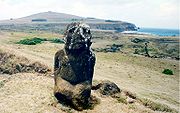
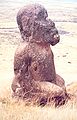 Tukuturi is an unusual moai. Its beard and kneeling posture distinguish it from standard moai.
Tukuturi is made of red scoria
from Puna Pau
, but sits at Rano Raraku, the tuff
quarry. It is possibly related to the Tangata manu
cult, in which case it would be one of the last moai ever made.
Volcanic ash
Volcanic ash consists of small tephra, which are bits of pulverized rock and glass created by volcanic eruptions, less than in diameter. There are three mechanisms of volcanic ash formation: gas release under decompression causing magmatic eruptions; thermal contraction from chilling on contact...
, or tuff
Tuff
Tuff is a type of rock consisting of consolidated volcanic ash ejected from vents during a volcanic eruption. Tuff is sometimes called tufa, particularly when used as construction material, although tufa also refers to a quite different rock. Rock that contains greater than 50% tuff is considered...
, and located on the lower slopes of Terevaka
Terevaka
Ma′unga Terevaka is the largest, tallest and youngest of three main extinct volcanoes that form Rapa Nui...
in the Rapa Nui National Park
Rapa Nui National Park
Rapa Nui National Park is a World Heritage Site located on Easter Island, Chile. The park is divided into seven sections:*Rano Kau *Puna Pau ....
on Easter Island
Easter Island
Easter Island is a Polynesian island in the southeastern Pacific Ocean, at the southeasternmost point of the Polynesian triangle. A special territory of Chile that was annexed in 1888, Easter Island is famous for its 887 extant monumental statues, called moai, created by the early Rapanui people...
. It was a quarry
Quarry
A quarry is a type of open-pit mine from which rock or minerals are extracted. Quarries are generally used for extracting building materials, such as dimension stone, construction aggregate, riprap, sand, and gravel. They are often collocated with concrete and asphalt plants due to the requirement...
for about 500 years until the early eighteenth century, and supplied the stone from which about 95% of the island's known monolithic sculptures (moai
Moai
Moai , or mo‘ai, are monolithic human figures carved from rock on the Chilean Polynesian island of Easter Island between the years 1250 and 1500. Nearly half are still at Rano Raraku, the main moai quarry, but hundreds were transported from there and set on stone platforms called ahu around the...
) were carved. Rano Raraku is a visual record of moai design vocabulary and technological innovation, where 397 moai remain. Rano Raraku is in the World Heritage Site
World Heritage Site
A UNESCO World Heritage Site is a place that is listed by the UNESCO as of special cultural or physical significance...
of Rapa Nui National Park and gives its name to one of the seven sections of the park.
Physical description
The sides of Rano Raraku crater are high and steep except on the north and northwest, where they are much lower and gently sloping. The interior contains one of the island's three freshwater crater lakeCrater lake
A crater lake is a lake that forms in a volcanic crater or caldera, such as a maar; less commonly and with lower association to the term a lake may form in an impact crater caused by a meteorite. Sometimes lakes which form inside calderas are called caldera lakes, but often this distinction is not...
s, which is bordered by nga'atu or totora
Totora (plant)
Totora is a subspecies of the giant bulrush sedge. It is found in South America - notably on Lake Titicaca, the middle coast of Perú and on Easter Island in the Pacific Ocean...
reeds. These plants, once thought as evidence of contact with the South American mainland, are now known to have been growing on the island for at least 30,000 years and were used by the Rapanui
Rapanui
The Rapa Nui or Rapanui are the native Polynesian inhabitants of Easter Island, or Rapa Nui, in the Pacific Ocean. The easternmost Polynesian culture, the Rapa Nui people make up 60% of Easter Island's population, with some living also in mainland Chile...
for thatched shelter and swimming aids.
Incomplete moai in the quarry
The incomplete statues in the quarry are remarkable both for their number, for the inaccessibility of some that were high on the outside crater wall and for the size of the largest; at 21.6 m (71 feet) in height, almost twice that of any moai ever completed and weighing an estimated 270 tonnes, many times the weight of any transported.Some of the incomplete moai seem to have been abandoned after the carvers encountered inclusions of very hard rock in the material.
Others may be sculptures that were never intended to be separated from the rock in which they are carved.
Standing moai at Ranu Raraku
On the outside of the quarry are a number of moai, some of which are partially buried to their shoulders in the spoil from the quarry. They are distinctive in that their eyes were not hollowed out, they do not have pukao and they were not cast down in the island's civil wars. For this last reason, they supplied some of the most famous images of the island.Tukuturi
Tukuturi is made of red scoria
Scoria
Scoria is a volcanic rock containing many holes or vesicles. It is most generally dark in color , and basaltic or andesitic in composition. Scoria is relatively low in mass as a result of its numerous macroscopic ellipsoidal vesicles, but in contrast to pumice, all scoria has a specific gravity...
from Puna Pau
Puna Pau
Puna Pau is a quarry in a small crater or cinder cone on the outskirts of Hanga Roa in the south west of Easter Island...
, but sits at Rano Raraku, the tuff
Tuff
Tuff is a type of rock consisting of consolidated volcanic ash ejected from vents during a volcanic eruption. Tuff is sometimes called tufa, particularly when used as construction material, although tufa also refers to a quite different rock. Rock that contains greater than 50% tuff is considered...
quarry. It is possibly related to the Tangata manu
Tangata manu
The Tangata manu , was the winner of a traditional competition on Rapa Nui . The ritual was an annual competition to collect the first Sooty Tern egg of the season from the islet of Motu Nui, swim back to Rapa Nui and climb the sea cliff of Rano Kau to the clifftop village of Orongo.-Myth:In the...
cult, in which case it would be one of the last moai ever made.
Further reading
- P.E. Baker (1968) "Preliminary Account of Recent Geological Investigations on Easter Island." Geological Magazine 104 (2): 116-122
- J.R. Flenley, S.M. King, J.T. Teller, M.E. Prentice, J. Jackson and C. Chew (1991). "The Late Quaternary Vegetational and Climatic History of Easter Island." Journal of Quaternary Science 6:85-115.
- Jo Anne Van Tilburg (1994). "Easter Island Archaeology, Ecology and Culture." London and Washington, D.C. British Museum Press and Smithsonian Institution Press ISBN 0-7141-2504-0 http://www.sscnet.ucla.edu/ioa/eisp/
- Alfred MetrauxAlfred MetrauxAlfred Métraux was a Swiss anthropologist and human rights leader.-Early life:Born in Lausanne, Switzerland, Metraux spent much of his childhood in Argentina where his father was a well known surgeon resident in Mendoza. His mother was a Georgian from Tbilisi...
http://www.davidmetraux.com/daniel/docs/alfred/alfred_metraux_mysteries_of_easter_island.pdf
- Katherine RoutledgeKatherine RoutledgeKatherine Maria Routledge, née Pease was a British archaeologist who initiated the first true survey of Easter Island....
. 1919. The Mystery of Easter Island. The story of an expedition. London.