
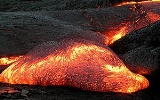
Magma is a mixture of molten
rockIn geology, rock or stone is a naturally occurring solid aggregate of minerals and/or mineraloids.The Earth's outer solid layer, the lithosphere, is made of rock. In general rocks are of three types, namely, igneous, sedimentary, and metamorphic...
,
volatilesIn planetary science, volatiles are that group of chemical elements and chemical compounds with low boiling points that are associated with a planet's or moon's crust and/or atmosphere. Examples include nitrogen, water, carbon dioxide, ammonia, hydrogen, and methane, all compounds of C, H, O...
and solids that is found beneath the surface of the
EarthEarth is the third planet from the Sun, and the densest and fifth-largest of the eight planets in the Solar System. It is also the largest of the Solar System's four terrestrial planets...
, and is expected to exist on other terrestrial planets. Besides molten rock, magma may also contain suspended crystals and dissolved gas and sometimes also gas bubbles. Magma often collects in
magma chamberA magma chamber is a large underground pool of molten rock found beneath the surface of the Earth. The molten rock in such a chamber is under great pressure, and given enough time, that pressure can gradually fracture the rock around it creating outlets for the magma...
s that may feed a
volcano2. Bedrock3. Conduit 4. Base5. Sill6. Dike7. Layers of ash emitted by the volcano8. Flank| 9. Layers of lava emitted by the volcano10. Throat11. Parasitic cone12. Lava flow13. Vent14. Crater15...
or turn into a
plutonA pluton in geology is a body of intrusive igneous rock that crystallized from magma slowly cooling below the surface of the Earth. Plutons include batholiths, dikes, sills, laccoliths, lopoliths, and other igneous bodies...
. Magma is capable of intrusion into adjacent rocks, extrusion onto the surface as
lavaLava refers both to molten rock expelled by a volcano during an eruption and the resulting rock after solidification and cooling. This molten rock is formed in the interior of some planets, including Earth, and some of their satellites. When first erupted from a volcanic vent, lava is a liquid at...
, and explosive ejection as
tephra200px|thumb|right|Tephra horizons in south-central [[Iceland]]. The thick and light coloured layer at center of the photo is [[rhyolitic]] tephra from [[Hekla]]....
to form
pyroclastic rockPyroclastic rocks or pyroclastics are clastic rocks composed solely or primarily of volcanic materials. Where the volcanic material has been transported and reworked through mechanical action, such as by wind or water, these rocks are termed volcaniclastic...
.
Magma is a complex high-temperature fluid substance. Temperatures of most magmas are in the range 700 °C to 1300 °C (or 1300 °F to 2400 °F), but very rare
carbonatiteCarbonatites are intrusive or extrusive igneous rocks defined by mineralogic composition consisting of greater than 50 percent carbonate minerals. Carbonatites may be confused with marble, and may require geochemical verification....
melts may be as cool as 600 °C, and
komatiiteKomatiite is a type of ultramafic mantle-derived volcanic rock. Komatiites have low silicon, potassium and aluminium, and high to extremely high magnesium content...
melts may have been as hot as 1600 °C. Most are
silicateA silicate is a compound containing a silicon bearing anion. The great majority of silicates are oxides, but hexafluorosilicate and other anions are also included. This article focuses mainly on the Si-O anions. Silicates comprise the majority of the earth's crust, as well as the other...
mixtures.
Environments of magma formation and compositions are commonly correlated. Environments include subduction zones, continental rift zones,
mid-ocean ridgeA mid-ocean ridge is a general term for an underwater mountain system that consists of various mountain ranges , typically having a valley known as a rift running along its spine, formed by plate tectonics. This type of oceanic ridge is characteristic of what is known as an oceanic spreading...
s and hot spots. Despite being found in such widespread locales, the bulk of the Earth's crust and
mantleThe mantle is a part of a terrestrial planet or other rocky body large enough to have differentiation by density. The interior of the Earth, similar to the other terrestrial planets, is chemically divided into layers. The mantle is a highly viscous layer between the crust and the outer core....
is not molten. Rather, most of the Earth takes the form of a
rheidIn geology, a rheid is a solid material that deforms by viscous flow. The term has the same Greek root as rheology, the science of viscoelasticity and nonlinear flow.-Types of rheids:...
, a form of solid that can move or deform under pressure. Magma, as liquid, preferentially forms in high temperature, low pressure environments within several kilometers of the Earth's surface.
Magma compositions may evolve after formation by
fractional crystallizationFractional crystallization is one of the most important geochemical and physical processes operating within the Earth's crust and mantle. Fractional crystallization is the removal and segregation from a melt of mineral precipitates; except in special cases, removal of the crystals changes the...
, contamination, and magma mixing. By definition rock formed of solidified magma is called
igneous rockIgneous rock is one of the three main rock types, the others being sedimentary and metamorphic rock. Igneous rock is formed through the cooling and solidification of magma or lava...
.
While the study of magma has historically relied on observing magma in the form of lava outflows, magma has been encountered in situ three times during drilling projects—twice in Iceland, and once in Hawaii.
Partial melting
Melting of solid rocks to form magma is controlled by three physical parameters: its temperature, pressure, and composition. Mechanisms are discussed in the entry for
igneous rockIgneous rock is one of the three main rock types, the others being sedimentary and metamorphic rock. Igneous rock is formed through the cooling and solidification of magma or lava...
.
When rocks melt they do so incrementally and gradually; most rocks are made of several minerals, all of which have different melting points, and the physical/chemical relationships controlling melting are complex. As a rock melts, its volume changes. When enough rock is melted, the small globules of melt (generally occurring in between mineral grains) link up and soften the rock. Under pressure within the earth, as little as a fraction of a percent partial melting may be sufficient to cause melt to be squeezed from its source.
Melts can stay in place long enough to melt to 20% or even 35%, but rocks are rarely melted in excess of 50%, because eventually the melted rock mass becomes a crystal and melt mush that can then ascend
en masse as a
diapirA diapir is a type of intrusion in which a more mobile and ductily-deformable material is forced into brittle overlying rocks. Depending on the tectonic environment, diapirs can range from idealized mushroom-shaped Rayleigh-Taylor instability-type structures in regions with low tectonic stress...
, which may then cause further decompression melting.
Geochemical implications of partial melting
The degree of partial melting is critical for determining what type of magma is produced. The degree of partial melting required to form a melt can be estimated by considering the relative enrichment of incompatible elements versus compatible elements.
Incompatible elementsIn geochemistry, compatibility is a measure of how readily a particular trace element substitutes for a major element within a mineral.Compatibility of an ion is controlled by two things: its valence and its ionic radius. Both must approximate those of the major element for the trace element to be...
commonly include
potassiumPotassium is the chemical element with the symbol K and atomic number 19. Elemental potassium is a soft silvery-white alkali metal that oxidizes rapidly in air and is very reactive with water, generating sufficient heat to ignite the hydrogen emitted in the reaction.Potassium and sodium are...
,
bariumBarium is a chemical element with the symbol Ba and atomic number 56. It is the fifth element in Group 2, a soft silvery metallic alkaline earth metal. Barium is never found in nature in its pure form due to its reactivity with air. Its oxide is historically known as baryta but it reacts with...
,
caesiumCaesium or cesium is the chemical element with the symbol Cs and atomic number 55. It is a soft, silvery-gold alkali metal with a melting point of 28 °C , which makes it one of only five elemental metals that are liquid at room temperature...
,
rubidiumRubidium is a chemical element with the symbol Rb and atomic number 37. Rubidium is a soft, silvery-white metallic element of the alkali metal group. Its atomic mass is 85.4678. Elemental rubidium is highly reactive, with properties similar to those of other elements in group 1, such as very rapid...
.
Rock types produced by small degrees of partial melting in the Earth's mantle are typically alkaline (
CaCalcium is the chemical element with the symbol Ca and atomic number 20. It has an atomic mass of 40.078 amu. Calcium is a soft gray alkaline earth metal, and is the fifth-most-abundant element by mass in the Earth's crust...
,
NaSodium is a chemical element with the symbol Na and atomic number 11. It is a soft, silvery-white, highly reactive metal and is a member of the alkali metals; its only stable isotope is 23Na. It is an abundant element that exists in numerous minerals, most commonly as sodium chloride...
), potassic (
KPotassium is the chemical element with the symbol K and atomic number 19. Elemental potassium is a soft silvery-white alkali metal that oxidizes rapidly in air and is very reactive with water, generating sufficient heat to ignite the hydrogen emitted in the reaction.Potassium and sodium are...
) and/or peralkaline (high aluminium to silica ratio). Typically, primitive melts of this composition form
lamprophyreLamprophyres are uncommon, small volume ultrapotassic igneous rocks primarily occurring as dikes, lopoliths, laccoliths, stocks and small intrusions...
,
lamproiteLamproites are ultrapotassic mantle-derived volcanic and subvolcanic rocks. They have low CaO, Al2O3, Na2O, high K2O/Al2O3, a relatively high MgO content and extreme enrichment in incompatible elements....
,
kimberliteKimberlite is a type of potassic volcanic rock best known for sometimes containing diamonds. It is named after the town of Kimberley in South Africa, where the discovery of an diamond in 1871 spawned a diamond rush, eventually creating the Big Hole....
and sometimes
nephelineNepheline, also called nephelite , is a feldspathoid: a silica-undersaturated aluminosilicate, Na3KAl4Si4O16, that occurs in intrusive and volcanic rocks with low silica, and in their associated pegmatites...
-bearing mafic rocks such as
alkaliIn chemistry, an alkali is a basic, ionic salt of an alkali metal or alkaline earth metal element. Some authors also define an alkali as a base that dissolves in water. A solution of a soluble base has a pH greater than 7. The adjective alkaline is commonly used in English as a synonym for base,...
basaltBasalt is a common extrusive volcanic rock. It is usually grey to black and fine-grained due to rapid cooling of lava at the surface of a planet. It may be porphyritic containing larger crystals in a fine matrix, or vesicular, or frothy scoria. Unweathered basalt is black or grey...
s and
essexiteEssexite , also called nepheline monzogabbro , is a dark gray or black holocrystalline plutonic igneous rock. Its name is derived from the type locality in Essex County, MA.Modern petrology identifies rocks according to mineralogical criteria...
gabbros or even
carbonatiteCarbonatites are intrusive or extrusive igneous rocks defined by mineralogic composition consisting of greater than 50 percent carbonate minerals. Carbonatites may be confused with marble, and may require geochemical verification....
.
PegmatiteA pegmatite is a very crystalline, intrusive igneous rock composed of interlocking crystals usually larger than 2.5 cm in size; such rocks are referred to as pegmatitic....
may be produced by low degrees of partial melting of the crust. Some
graniteGranite is a common and widely occurring type of intrusive, felsic, igneous rock. Granite usually has a medium- to coarse-grained texture. Occasionally some individual crystals are larger than the groundmass, in which case the texture is known as porphyritic. A granitic rock with a porphyritic...
-composition magmas are eutectic (or cotectic) melts, and they may be produced by low to high degrees of partial melting of the crust, as well as by fractional crystallization. At high degrees of partial melting of the crust, granitoids such as
tonaliteTonalite is an igneous, plutonic rock, of felsic composition, with phaneritic texture. Feldspar is present as plagioclase with 10% or less alkali feldspar. Quartz is present as more than 20% of the rock. Amphiboles and pyroxenes are common accessory minerals.In older references tonalite is...
,
granodioriteGranodiorite is an intrusive igneous rock similar to granite, but containing more plagioclase than orthoclase-type feldspar. Officially, it is defined as a phaneritic igneous rock with greater than 20% quartz by volume where at least 65% of the feldspar is plagioclase. It usually contains abundant...
and
monzoniteMonzonite is an intermediate igneous intrusive rock composed of approximately equal amounts of sodic to intermediate plagioclase and orthoclase feldspars with minor amounts of hornblende, biotite and other minerals...
can be produced, but other mechanisms are typically important in producing them.
Primary melts
When a rock melts, the liquid is a
primary melt. Primary melts have not undergone any differentiation and represent the starting composition of a magma. In nature it is rare to find primary melts. The leucosomes of
migmatiteMigmatite is a rock at the frontier between igneous and metamorphic rocks. They can also be known as diatexite.Migmatites form under extreme temperature conditions during prograde metamorphism, where partial melting occurs in pre-existing rocks. Migmatites are not crystallized from a totally...
s are examples of primary melts. Primary melts derived from the mantle are especially important, and are known as
primitive melts or primitive magmas. By finding the primitive magma composition of a magma series it is possible to model the composition of the mantle from which a melt was formed, which is important in understanding evolution of the mantle.
Parental melts
Where it is impossible to find the primitive or primary magma composition, it is often useful to attempt to identify a parental melt. A parental melt is a magma composition from which the observed range of magma chemistries has been derived by the processes of igneous differentiation. It need not be a primitive melt.
For instance, a series of basalt flows are assumed to be related to one another. A composition from which they could reasonably be produced by fractional crystallization is termed a
parental melt. Fractional crystallization models would be produced to test the hypothesis that they share a common parental melt.
At high degrees of partial melting of the mantle,
komatiiteKomatiite is a type of ultramafic mantle-derived volcanic rock. Komatiites have low silicon, potassium and aluminium, and high to extremely high magnesium content...
and picrite are produced.
Migration
Magma develops within the
mantleThe mantle is a part of a terrestrial planet or other rocky body large enough to have differentiation by density. The interior of the Earth, similar to the other terrestrial planets, is chemically divided into layers. The mantle is a highly viscous layer between the crust and the outer core....
or
crustIn geology, the crust is the outermost solid shell of a rocky planet or natural satellite, which is chemically distinct from the underlying mantle...
when the temperature-pressure conditions favor the molten state. Magma rises toward the Earth's surface when it is less dense than the surrounding rock and when a structural zone allows movement. Magma develops or collects in areas called
magma chamberA magma chamber is a large underground pool of molten rock found beneath the surface of the Earth. The molten rock in such a chamber is under great pressure, and given enough time, that pressure can gradually fracture the rock around it creating outlets for the magma...
s. Magma can remain in a chamber until it cools and crystallizes forming igneous rock, it erupts as a
volcano2. Bedrock3. Conduit 4. Base5. Sill6. Dike7. Layers of ash emitted by the volcano8. Flank| 9. Layers of lava emitted by the volcano10. Throat11. Parasitic cone12. Lava flow13. Vent14. Crater15...
, or moves into another magma chamber.
Cooling of magmas
There are two known processes by which magma ceases to exist, by volcanic eruption or by crystallization within the crust or mantle to form a
plutonA pluton in geology is a body of intrusive igneous rock that crystallized from magma slowly cooling below the surface of the Earth. Plutons include batholiths, dikes, sills, laccoliths, lopoliths, and other igneous bodies...
. In both cases the bulk of the magma eventually cools and forms
igneous rockIgneous rock is one of the three main rock types, the others being sedimentary and metamorphic rock. Igneous rock is formed through the cooling and solidification of magma or lava...
s.
When magma cools it begins to form solid mineral phases, some of them settles at the bottom of the magma chamber forming
cumulatesCumulate rocks are igneous rocks formed by the accumulation of crystals from a magma either by settling or floating. Cumulate rocks are named according to their texture; cumulate texture is diagnostic of the conditions of formation of this group of igneous rocks.-Formation:Cumulate rocks are the...
that might form mafic layered intrusions. Magma that cools slowly within a magma chamber usually ends up as forming bodies of plutonic rocks such as
gabbroGabbro refers to a large group of dark, coarse-grained, intrusive mafic igneous rocks chemically equivalent to basalt. The rocks are plutonic, formed when molten magma is trapped beneath the Earth's surface and cools into a crystalline mass....
,
dioriteDiorite is a grey to dark grey intermediate intrusive igneous rock composed principally of plagioclase feldspar , biotite, hornblende, and/or pyroxene. It may contain small amounts of quartz, microcline and olivine. Zircon, apatite, sphene, magnetite, ilmenite and sulfides occur as accessory...
and
graniteGranite is a common and widely occurring type of intrusive, felsic, igneous rock. Granite usually has a medium- to coarse-grained texture. Occasionally some individual crystals are larger than the groundmass, in which case the texture is known as porphyritic. A granitic rock with a porphyritic...
depending on the composition of the magma, while if the magma is erupted it forms
volcanic rockVolcanic rock is a rock formed from magma erupted from a volcano. In other words, it is an igneous rock of volcanic origin...
s such as
basaltBasalt is a common extrusive volcanic rock. It is usually grey to black and fine-grained due to rapid cooling of lava at the surface of a planet. It may be porphyritic containing larger crystals in a fine matrix, or vesicular, or frothy scoria. Unweathered basalt is black or grey...
,
andesiteAndesite is an extrusive igneous, volcanic rock, of intermediate composition, with aphanitic to porphyritic texture. In a general sense, it is the intermediate type between basalt and dacite. The mineral assemblage is typically dominated by plagioclase plus pyroxene and/or hornblende. Magnetite,...
and
rhyoliteThis page is about a volcanic rock. For the ghost town see Rhyolite, Nevada, and for the satellite system, see Rhyolite/Aquacade.Rhyolite is an igneous, volcanic rock, of felsic composition . It may have any texture from glassy to aphanitic to porphyritic...
(the extrusive equivalents of gabbro, diorite and granite respectively).
Volcanism
During a volcanic eruption the magma that leaves the underground is called
lavaLava refers both to molten rock expelled by a volcano during an eruption and the resulting rock after solidification and cooling. This molten rock is formed in the interior of some planets, including Earth, and some of their satellites. When first erupted from a volcanic vent, lava is a liquid at...
. Lava cools and solidifies relatively quickly compared to underground bodies of magma. This fast cooling does not allow crystals to grow large, and a part of the melt does not crystallize at all, becoming glass. Rock largely composed of volcanic glass include
obsidianObsidian is a naturally occurring volcanic glass formed as an extrusive igneous rock.It is produced when felsic lava extruded from a volcano cools rapidly with minimum crystal growth...
,
scoriaScoria is a volcanic rock containing many holes or vesicles. It is most generally dark in color , and basaltic or andesitic in composition. Scoria is relatively low in mass as a result of its numerous macroscopic ellipsoidal vesicles, but in contrast to pumice, all scoria has a specific gravity...
and
pumicePumice is a textural term for a volcanic rock that is a solidified frothy lava typically created when super-heated, highly pressurized rock is violently ejected from a volcano. It can be formed when lava and water are mixed. This unusual formation is due to the simultaneous actions of rapid...
.
Before and during volcanic eruptions,
volatilesIn chemistry and physics, volatility is the tendency of a substance to vaporize. Volatility is directly related to a substance's vapor pressure. At a given temperature, a substance with higher vapor pressure vaporizes more readily than a substance with a lower vapor pressure.The term is primarily...
such as CO
2 and H
2O partially leave the melt through a process known as exsolution. Magma with low water content becomes increasingly
viscousViscosity is a measure of the resistance of a fluid which is being deformed by either shear or tensile stress. In everyday terms , viscosity is "thickness" or "internal friction". Thus, water is "thin", having a lower viscosity, while honey is "thick", having a higher viscosity...
. If massive exsolution occurs when magma heads upwards during a volcanic eruption, the resulting eruption is usually explosive.
Composition, melt structure and properties
Silicate melts are composed mainly of
siliconSilicon is a chemical element with the symbol Si and atomic number 14. A tetravalent metalloid, it is less reactive than its chemical analog carbon, the nonmetal directly above it in the periodic table, but more reactive than germanium, the metalloid directly below it in the table...
,
oxygenOxygen is the element with atomic number 8 and represented by the symbol O. Its name derives from the Greek roots ὀξύς and -γενής , because at the time of naming, it was mistakenly thought that all acids required oxygen in their composition...
,
aluminiumAluminium or aluminum is a silvery white member of the boron group of chemical elements. It has the symbol Al, and its atomic number is 13. It is not soluble in water under normal circumstances....
, alkalis (
sodiumSodium is a chemical element with the symbol Na and atomic number 11. It is a soft, silvery-white, highly reactive metal and is a member of the alkali metals; its only stable isotope is 23Na. It is an abundant element that exists in numerous minerals, most commonly as sodium chloride...
,
potassiumPotassium is the chemical element with the symbol K and atomic number 19. Elemental potassium is a soft silvery-white alkali metal that oxidizes rapidly in air and is very reactive with water, generating sufficient heat to ignite the hydrogen emitted in the reaction.Potassium and sodium are...
,
calciumCalcium is the chemical element with the symbol Ca and atomic number 20. It has an atomic mass of 40.078 amu. Calcium is a soft gray alkaline earth metal, and is the fifth-most-abundant element by mass in the Earth's crust...
),
magnesiumMagnesium is a chemical element with the symbol Mg, atomic number 12, and common oxidation number +2. It is an alkaline earth metal and the eighth most abundant element in the Earth's crust and ninth in the known universe as a whole...
and
ironIron is a chemical element with the symbol Fe and atomic number 26. It is a metal in the first transition series. It is the most common element forming the planet Earth as a whole, forming much of Earth's outer and inner core. It is the fourth most common element in the Earth's crust...
. Silicon atoms are in tetrahedral coordination with oxygen, as in almost all
silicate mineralsThe silicate minerals make up the largest and most important class of rock-forming minerals, constituting approximately 90 percent of the crust of the Earth. They are classified based on the structure of their silicate group...
, but in melts atomic order is preserved only over short distances. The physical behaviours of melts depend upon their atomic structures as well as upon temperature and pressure and composition.
ViscosityViscosity is a measure of the resistance of a fluid which is being deformed by either shear or tensile stress. In everyday terms , viscosity is "thickness" or "internal friction". Thus, water is "thin", having a lower viscosity, while honey is "thick", having a higher viscosity...
is a key melt property in understanding the behaviour of magmas. More silica-rich melts are typically more polymerized, with more linkage of silica tetrahedra, and so are more viscous. Dissolution of water drastically reduces melt viscosity. Higher-temperature melts are less viscous.
Generally speaking, more mafic magmas, such as those that form
basaltBasalt is a common extrusive volcanic rock. It is usually grey to black and fine-grained due to rapid cooling of lava at the surface of a planet. It may be porphyritic containing larger crystals in a fine matrix, or vesicular, or frothy scoria. Unweathered basalt is black or grey...
, are hotter and less viscous than more silica-rich magmas, such as those that form
rhyoliteThis page is about a volcanic rock. For the ghost town see Rhyolite, Nevada, and for the satellite system, see Rhyolite/Aquacade.Rhyolite is an igneous, volcanic rock, of felsic composition . It may have any texture from glassy to aphanitic to porphyritic...
. Low viscosity leads to gentler, less explosive eruptions.
Characteristics of several different magma types are as follows:
- Ultramafic (picritic)
- SiO2 < 45%
- Fe-Mg >8% up to 32%MgO
- Temperature: up to 1500°C
- Viscosity: Very Low
- Eruptive behavior: gentle or very explosive (kimberilites)
- Distribution: divergent plate boundaries, hot spots, convergent plate boundaries; komatiite
Komatiite is a type of ultramafic mantle-derived volcanic rock. Komatiites have low silicon, potassium and aluminium, and high to extremely high magnesium content...
and other ultramafic lavas are mostly ArcheanThe Archean , also spelled Archeozoic or Archæozoic) is a geologic eon before the Paleoproterozoic Era of the Proterozoic Eon, before 2.5 Ga ago. Instead of being based on stratigraphy, this date is defined chronometrically...
and were formed from a higher geothermal gradientGeothermal gradient is the rate of increasing temperature with respect to increasing depth in the Earth's interior. Away from tectonic plate boundaries, it is 25–30°C per km of depth in most of the world. Strictly speaking, geo-thermal necessarily refers to the Earth but the concept may be applied...
and are unknown in the present
- Mafic
Mafic is an adjective describing a silicate mineral or rock that is rich in magnesium and iron; the term is a portmanteau of the words "magnesium" and "ferric". Most mafic minerals are dark in color and the relative density is greater than 3. Common rock-forming mafic minerals include olivine,...
(basaltBasalt is a common extrusive volcanic rock. It is usually grey to black and fine-grained due to rapid cooling of lava at the surface of a planet. It may be porphyritic containing larger crystals in a fine matrix, or vesicular, or frothy scoria. Unweathered basalt is black or grey...
ic)
- SiO2 < 50%
- FeO and MgO typically < 10 wt%
- Temperature: up to ~1300°C
- Viscosity: Low
- Eruptive behavior: gentle
- Distribution: divergent plate boundaries, hot spots, convergent plate boundaries
- Intermediate (andesitic
Andesite is an extrusive igneous, volcanic rock, of intermediate composition, with aphanitic to porphyritic texture. In a general sense, it is the intermediate type between basalt and dacite. The mineral assemblage is typically dominated by plagioclase plus pyroxene and/or hornblende. Magnetite,...
)
- SiO2 ~ 60%
- Fe-Mg: ~ 3%th
- Temperature: ~1000°C
- Viscosity: Intermediate
- Eruptive behavior: explosive or effusive
- Distribution: convergent plate boundaries, island arcs
- Felsic
The word "felsic" is a term used in geology to refer to silicate minerals, magma, and rocks which are enriched in the lighter elements such as silicon, oxygen, aluminium, sodium, and potassium....
(rhyolitic)
- SiO2 >70%
- Fe-Mg: ~ 2%
- Temp: < 900°C
- Viscosity: High
- Eruptive behavior: explosive or effusive
- Distribution: common in hot spots in continental crust (Yellowstone National Park
Yellowstone National Park, established by the U.S. Congress and signed into law by President Ulysses S. Grant on March 1, 1872, is a national park located primarily in the U.S. state of Wyoming, although it also extends into Montana and Idaho...
) and in continental rifts
Temperature
At any given pressure and for any given composition of rock, a rise in temperature past the
solidusIn chemistry, materials science, and physics, the solidus is the locus of temperatures below which a given substance is completely solid...
will cause melting. Within the solid earth, the temperature of a rock is controlled by the
geothermal gradientGeothermal gradient is the rate of increasing temperature with respect to increasing depth in the Earth's interior. Away from tectonic plate boundaries, it is 25–30°C per km of depth in most of the world. Strictly speaking, geo-thermal necessarily refers to the Earth but the concept may be applied...
and the
radioactive decayRadioactive decay is the process by which an atomic nucleus of an unstable atom loses energy by emitting ionizing particles . The emission is spontaneous, in that the atom decays without any physical interaction with another particle from outside the atom...
within the rock. The geothermal gradient averages about 25 °C/km with a wide range from a low of 5-10 °C/km within oceanic trenches and subduction zones to 30-80 °C/km under mid-ocean ridges and volcanic arc environments.
Pressure
As magma buoyantly rises it will cross the
solidusSolidus may refer to:*Solidus , the "⁄" grammatical punctuation character, also used in mathematics*Slash a sign, "/" used as a punctuation mark and for various other purposes...
-liquidus and its temperature will reduce by adiabatic cooling. At this point it will liquefy and if erupted onto the surface will form lava. Melting can also occur due to a reduction in pressure by a process known as decompression melting.
Composition
It is usually very difficult to change the bulk composition of a large mass of rock, so composition is the basic control on whether a rock will melt at any given temperature and pressure. The composition of a rock may also be considered to include
volatile phases such as
waterWater is a chemical substance with the chemical formula H2O. A water molecule contains one oxygen and two hydrogen atoms connected by covalent bonds. Water is a liquid at ambient conditions, but it often co-exists on Earth with its solid state, ice, and gaseous state . Water also exists in a...
and
carbon dioxideCarbon dioxide is a naturally occurring chemical compound composed of two oxygen atoms covalently bonded to a single carbon atom...
.
The presence of volatile phases in a rock under pressure can stabilize a melt fraction. The presence of even 0.8% water may reduce the temperature of melting by as much as 100 °C. Conversely, the loss of water and volatiles from a magma may cause it to essentially freeze or solidify.
Also a major portion of all magma is silica, which is a compound of silicon and oxygen. Magma also contains gases, which expand as the magma rises. Magma that is high in silica resists flowing, so expanding gases are trapped in it. Pressure builds up until the gases blast out in a violent, dangerous explosion. Magma that is relatively poor in silica flows easily, so gas bubbles move up through it and escape fairly gently.