


Dimension stone

Encyclopedia
Rock (geology)
In geology, rock or stone is a naturally occurring solid aggregate of minerals and/or mineraloids.The Earth's outer solid layer, the lithosphere, is made of rock. In general rocks are of three types, namely, igneous, sedimentary, and metamorphic...
that has been selected and fabricated (i.e., trimmed, cut, drilled, ground, or other) to specific sizes or shapes. Color, texture
Texture (geology)
Texture in geology refers to the physical appearance or character of a rock, such as grain size, shape, arrangement, and pattern at both the megascopic or microscopic surface feature level. This includes the geometric aspects and relations amongst the component particles or crystals which is called...
and pattern, and surface finish of the stone are also normal requirements. Another important selection criterion is durability: the time measure of the ability of dimension stone to endure and to maintain its essential and distinctive characteristics of strength, resistance to decay, and appearance.
Quarries that produce dimension stone or crushed stone
Crushed stone
Crushed stone or angular rock is a form of construction aggregate, typically produced by mining a suitable rock deposit and breaking the removed rock down to the desired size using crushers...
(used as construction aggregate
Construction Aggregate
Construction aggregate, or simply "aggregate", is a broad category of coarse particulate material used in construction, including sand, gravel, crushed stone, slag, recycled concrete and geosynthetic aggregates. Aggregates are the most mined material in the world...
) are interconvertible. Since most quarries can produce either one, a crushed stone quarry can be converted to dimension stone production. However, first the stone shattered by heavy and indiscriminate blasting must be removed. Dimension stone is separated by more precise and delicate techniques, such as diamond wire saws, diamond belt saws, burners (jet-piercers), or light and selective blasting with Primacord
Primacord
Primacord is a registered trademark of detonating cord used in blasting, originally manufactured by the Ensign-Bickford Company. Ensign Bickford sold the trademark to Dyno Nobel Inc in 2003 and it is now manufactured in Graham, Kentucky...
, a weak explosive.
Stone and Rock types
A variety of igneous, metamorphicMetamorphic rock
Metamorphic rock is the transformation of an existing rock type, the protolith, in a process called metamorphism, which means "change in form". The protolith is subjected to heat and pressure causing profound physical and/or chemical change...
, and sedimentary rock
Sedimentary rock
Sedimentary rock are types of rock that are formed by the deposition of material at the Earth's surface and within bodies of water. Sedimentation is the collective name for processes that cause mineral and/or organic particles to settle and accumulate or minerals to precipitate from a solution....
s are used as structural and decorative dimension stone. These rock types are more commonly known as granite
Granite
Granite is a common and widely occurring type of intrusive, felsic, igneous rock. Granite usually has a medium- to coarse-grained texture. Occasionally some individual crystals are larger than the groundmass, in which case the texture is known as porphyritic. A granitic rock with a porphyritic...
, limestone
Limestone
Limestone is a sedimentary rock composed largely of the minerals calcite and aragonite, which are different crystal forms of calcium carbonate . Many limestones are composed from skeletal fragments of marine organisms such as coral or foraminifera....
, marble
Marble
Marble is a metamorphic rock composed of recrystallized carbonate minerals, most commonly calcite or dolomite.Geologists use the term "marble" to refer to metamorphosed limestone; however stonemasons use the term more broadly to encompass unmetamorphosed limestone.Marble is commonly used for...
, travertine
Travertine
Travertine is a form of limestone deposited by mineral springs, especially hot springs. Travertine often has a fibrous or concentric appearance and exists in white, tan, and cream-colored varieties. It is formed by a process of rapid precipitation of calcium carbonate, often at the mouth of a hot...
, quartz-based stone (sandstone
Sandstone
Sandstone is a sedimentary rock composed mainly of sand-sized minerals or rock grains.Most sandstone is composed of quartz and/or feldspar because these are the most common minerals in the Earth's crust. Like sand, sandstone may be any colour, but the most common colours are tan, brown, yellow,...
, quartzite
Quartzite
Quartzite is a hard metamorphic rock which was originally sandstone. Sandstone is converted into quartzite through heating and pressure usually related to tectonic compression within orogenic belts. Pure quartzite is usually white to gray, though quartzites often occur in various shades of pink...
) and slate
Slate
Slate is a fine-grained, foliated, homogeneous metamorphic rock derived from an original shale-type sedimentary rock composed of clay or volcanic ash through low-grade regional metamorphism. The result is a foliated rock in which the foliation may not correspond to the original sedimentary layering...
. Other varieties of dimension stone that are normally considered to be special minor types include alabaster
Alabaster
Alabaster is a name applied to varieties of two distinct minerals, when used as a material: gypsum and calcite . The former is the alabaster of the present day; generally, the latter is the alabaster of the ancients...
(massive gypsum
Gypsum
Gypsum is a very soft sulfate mineral composed of calcium sulfate dihydrate, with the chemical formula CaSO4·2H2O. It is found in alabaster, a decorative stone used in Ancient Egypt. It is the second softest mineral on the Mohs Hardness Scale...
), soapstone
Soapstone
Soapstone is a metamorphic rock, a talc-schist. It is largely composed of the mineral talc and is thus rich in magnesium. It is produced by dynamothermal metamorphism and metasomatism, which occurs in the areas where tectonic plates are subducted, changing rocks by heat and pressure, with influx...
(massive talc
Talc
Talc is a mineral composed of hydrated magnesium silicate with the chemical formula H2Mg34 or Mg3Si4O102. In loose form, it is the widely-used substance known as talcum powder. It occurs as foliated to fibrous masses, its crystals being so rare as to be almost unknown...
), serpentine and various products fashid from natural stone.
A variety of finishes can be applied to dimension stone to achieve diverse architectural and aesthetic effects. These finishes include, but are not limited to, the following. A polished finish gives the surface a high luster and strong reflection of incident light (almost mirror-like). A honed finish provides a smooth, satin-like ("eggshell"), nonreflective surface. More textured finishes include bush-hammered, sandblasted, and thermal. A bush-hammered finish, similar to a houndstooth
Houndstooth
Houndstooth, houndstooth check or hound's tooth , also known as dogstooth, dogtooth or dog's tooth, is a duotone textile pattern characterized by broken checks or abstract four-pointed shapes, often in black and white, although other colours are used...
pattern, creates a rough, but uniformly patterned surface with impact tools varying in coarseness. A sandblasted surface provides an irregular pitted surface by impacting sand or metal particles at high velocity against a stone surface. A thermal (or flamed) finish produces a textured, nonreflective surface with only a few reflections from cleavage faces, by applying a high-temperature flame. This finish may change the natural color of the stone depending on mineralogical composition, particularly with stones containing higher levels of iron.
The most easily accessible general (non-graphic) references are the latest Minerals Yearbook Chapter (production and foreign trade, with statistics), and the latest (Issue 31) Dimension Stone Advocate News (new "building green" developments and demand statistics); see below. The most comprehensive, graphic references are Natural Stone Database by Abraxas Verlag (www.natural-stone-database.com), "Dimension Stones of the World, Volumes I & II" (Marble Institute of America) and "Natural Stones Worldwide CD" (Abraxas Verlag GmbH).
Major applications
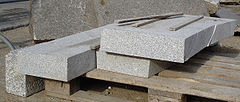
Stone (usually granite
Granite
Granite is a common and widely occurring type of intrusive, felsic, igneous rock. Granite usually has a medium- to coarse-grained texture. Occasionally some individual crystals are larger than the groundmass, in which case the texture is known as porphyritic. A granitic rock with a porphyritic...
) countertop
Countertop
Countertop usually refers to a horizontal worksurface in kitchens or other food preparation areas, bathrooms or lavatories, and workrooms in general. It is frequently installed upon and supported by cabinets...
s and bathroom vanities both involve a finished slab of stone, usually polished but sometimes with another finish (such as honed or sandblasted). Industry standard thicknesses in the United States are 3/4" (2 cm) and 1.25" (3 cm). Often 2 cm slabs will be laminated at the edge to create the appearance of a thicker edge profile. The slabs are cut to fit the top of the kitchen or bathroom cabinet, by measuring, templating or digital templating
CAx
Computer-aided technologies is a broad term that means the use of computer technology to aid in the design, analysis, and manufacture of products....
. Countertop slabs are commonly sawn from rough blocks of stone by reciprocating gangsaws using steel shot as abrasive. More modern technology utilizes diamond wire saws which use less water and energy. Multi-wire saws with as many as 60 wires can slab a block in less than two hours. The slabs are finished (i.e., polished, honed), then sealed with resin to fill micro-fissures and surface imperfections typically due to the loss of poorly bonded elements such as biotite
Biotite
Biotite is a common phyllosilicate mineral within the mica group, with the approximate chemical formula . More generally, it refers to the dark mica series, primarily a solid-solution series between the iron-endmember annite, and the magnesium-endmember phlogopite; more aluminous endmembers...
. The fabricators shop cuts these slabs down to final size and finishes the edges with equipment such as hand-held routers, grinder
Grinder
-Machinery:*Angle grinder, hand held power tool*Grinding machine, used in a machining operation to refine the surface of materials*Tool and cutter grinder, a machine used to manufacture or resharpen cutting tools*Coffee grinder, a machine used for grinding coffee...
s, CNC equipment, or polishers
Polishing
Polishing is the process of creating a smooth and shiny surface by rubbing it or using a chemical action, leaving a surface with a significant specular reflection In some materials polishing is also able to reduce diffuse reflection to...
. There has been a recent (2008) hubbub about radon emission from granite countertops; the National Safety Council states that the contributions of radon to inside air come from the soil and rock around the residence (69%), the outdoor air and the water supply (28%), and only 2.5% from all building materials-including granite countertops. A concerned homeowner can employ ASTM radon mitigation and removal techniques. The stone for countertops or vanities is usually granite, but often is marble (especially for vanity tops), and sometimes limestone or slate. The majority of the stone for this application is produced in Brazil
Brazil
Brazil , officially the Federative Republic of Brazil , is the largest country in South America. It is the world's fifth largest country, both by geographical area and by population with over 192 million people...
, Italy
Italy
Italy , officially the Italian Republic languages]] under the European Charter for Regional or Minority Languages. In each of these, Italy's official name is as follows:;;;;;;;;), is a unitary parliamentary republic in South-Central Europe. To the north it borders France, Switzerland, Austria and...
, and China
China
Chinese civilization may refer to:* China for more general discussion of the country.* Chinese culture* Greater China, the transnational community of ethnic Chinese.* History of China* Sinosphere, the area historically affected by Chinese culture...
.

Tile
A tile is a manufactured piece of hard-wearing material such as ceramic, stone, metal, or even glass. Tiles are generally used for covering roofs, floors, walls, showers, or other objects such as tabletops...
is a thin modular stone unit, commonly 12 in. square (30.5 cm) and 3/8 in. (10 mm) deep. Other popular sizes are 15 in. square (38 cm), 18 in. square (46 cm), and 24 in. square (61 cm); these will usually be deeper than the 12 in. square. The majority of tile has a polished finish, but other finishes such as honed are becoming more common. Almost all stone tile is mass-produced by automated tile lines to identical size, finish, and close tolerances. Exceptions include slate flooring tile and special orders: tile with odd sizes or shapes, unusual finishes, or inlay work. In summary, the automated tile line is a complicated complex of cutting and calibrating machines, honing-polishing machines, edging machines that put on flat or rounded edges, and interconnecting conveyors to move the stone from the slab input to the final tile product. The stone for tiles is most commonly marble, but often is granite, and sometimes limestone, slate, or quartz-based stone. Common colors are white and light earth colors. Much of the stone for this application is produced in Italy and China.
Stone monument
Monument
A monument is a type of structure either explicitly created to commemorate a person or important event or which has become important to a social group as a part of their remembrance of historic times or cultural heritage, or simply as an example of historic architecture...
s include tombstones, grave markers or as mausoleum
Mausoleum
A mausoleum is an external free-standing building constructed as a monument enclosing the interment space or burial chamber of a deceased person or persons. A monument without the interment is a cenotaph. A mausoleum may be considered a type of tomb or the tomb may be considered to be within the...
s. After being gangsawed into big deep (up to 10 ft (3 m). wide and over 6 in. deep) slabs, smaller saws or guillotines (they break the granite and make the rough edges commonly seen on monuments) shape the monuments. The fronts and backs are usually polished. The individual monuments are then carved, shaped, and further defined by hand tools and sandblasting equipment. At this time, the stone for monuments is most commonly granite, sometimes marble (as in military cemeteries), and rarely others. An old rose quartz tombstone stands in a Harpers Ferry cemetery. Sandstone was common in the nineteenth century but is no longer used due to rapid rates of erosion. Most common monument colors for granite are gray, then black, then mahogany; for marble it is white. Today, the majority of the stone used in North America in this application is imported from countries such as India
India
India , officially the Republic of India , is a country in South Asia. It is the seventh-largest country by geographical area, the second-most populous country with over 1.2 billion people, and the most populous democracy in the world...
and China
China
Chinese civilization may refer to:* China for more general discussion of the country.* Chinese culture* Greater China, the transnational community of ethnic Chinese.* History of China* Sinosphere, the area historically affected by Chinese culture...
. This has depressed traditional North American monument centers such as Georgia
Georgia (U.S. state)
Georgia is a state located in the southeastern United States. It was established in 1732, the last of the original Thirteen Colonies. The state is named after King George II of Great Britain. Georgia was the fourth state to ratify the United States Constitution, on January 2, 1788...
and Quebec
Quebec
Quebec or is a province in east-central Canada. It is the only Canadian province with a predominantly French-speaking population and the only one whose sole official language is French at the provincial level....
.

Ashlar
Ashlar is prepared stone work of any type of stone. Masonry using such stones laid in parallel courses is known as ashlar masonry, whereas masonry using irregularly shaped stones is known as rubble masonry. Ashlar blocks are rectangular cuboid blocks that are masonry sculpted to have square edges...
, or other shapes. Veneer is a non load-bearing facing of stone attached to a backing, of an ornamental nature though it protects and insulates. Ashlar is a square block of stone, often brick-sized, for facing of walls (primarily exterior). The other shapes are rectangular blocks used for stair treads, sills, and coping
Coping (architecture)
Coping , consists of the capping or covering of a wall.A splayed or wedge coping slopes in a single direction; a saddle coping slopes to either side of a central high point....
(coping is sometimes nonrectangular). The shapes subject to foot traffic will usually have an abrasive finish such as honed or sandblasted. The stone is mostly limestone, but often is quartz-based stone (sandstone), or even marble or granite. Roofing slate is a thin-split shingle-sized piece of slate, and when in place forms the most permanent kind of roof; slate is also used as countertops and flooring tile. Traffic-related stone is that which is used for curbing (vehicular) and flagstone
Flagstone
Flagstone, is a generic flat stone, usually used for paving slabs or walkways, patios, fences and roofing. It may be used for memorials, headstones, facades and other constructions. The name derives from Middle English flagge meaning turf, perhaps from Old Norse flaga meaning slab.Flagstone is a...
(pedestrian). Curbing is thin stone slabs used along streets or highways to maintain the integrity of sidewalks and borders. Flagstone is a shallow naturally irregular-edged slab of stone, sometimes sawed into a rectangular shape, used as paving (almost always pedestrian). For curbing, the stone is almost always granite, and for flagstone the stone is almost always quartz-based stone (sandstone or quartzite).
There are several other applications resembling flagstone in using rough dimension (or crushed) stone, usually as quarried, sometimes made smaller (i.e. by a jackhammer), often simply put in place: dry stone
Dry stone
Dry stone is a building method by which structures are constructed from stones without any mortar to bind them together. Dry stone structures are stable because of their unique construction method, which is characterized by the presence of a load-bearing facade of carefully selected interlocking...
and riprap
Riprap
Riprap — also known as rip rap, rubble, shot rock or rock armour or "Rip-rap" — is rock or other material used to armor shorelines, streambeds, bridge abutments, pilings and other shoreline structures against scour, water or ice erosion.It is made from a variety of rock types, commonly granite or...
.
The stone used in these applications usually has to have certain properties, or meet a standard specification. The American Society for Testing and Materials (ASTM) has such specifications for granite, marble, limestone, quartz-based dimension stone (C616), slate (C629), travertine (C1527), and serpentine (C1526).
Production
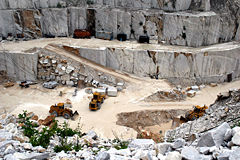
According to the USGS, 2007 U.S. dimension stone production was 1.39 million tons valued at $275 million, compared to 1.33 million tons (revised) valued at $265 million in 2006. Of these, granite production was 453,000 tons valued at $106 million in 2007 and 428,000 tons valued at $105 million in 2006, and limestone was 493,000 tons valued at $93.3 million in 2007 and 559,000 tons valued at $96.1 million in 2006. The United States is at best a mid-level dimension stone producer on the world scene; Portugal produces twice as much dimension stone annually.
World comparison for dimension stone demand: The DSAN World Demand Index for (finished) Granite was 227 in 2006, 247 in 2007, and 249 in 2008, and the World Demand Index for (finished) Marble was 200 in 2006, 248 in 2007, and 272 in 2008. The DSAN World Demand for (finished) Granite Index showed a growth of 12% annually for the 2000-2008 period, compared to 14% annually for the 2000-2007 period, and compared to 15% annually for the 2000-2006 period. The DSAN World Demand for (finished) Marble Index showed a growth of 13.5% annually for the 2000-2008 period, compared to 14.0% annually for the 2000-2007 period, and compared to 12.5% annually for the 2000-2006 period. The indexes show world demand for granite has clearly been weakening since 2006, while the world demand for marble only weakened from 2007 to 2008. Other DSAN indexes for 2008 indicate that the 2000-2008 growth was down from the 2000-2007 growth.
The DSAN U.S. Ceramic Tile Demand Index shows a drop of 4.8% annually for the 2000-2007 period, compared to growth of 5.0% annually for the 2000-2006 period. The "traditional" major ceramic tile suppliers, Italy and Spain, have been losing markets to new entrants Brazil and China. The same thing has been happening with dimension stone with increasing supplies from Brazil, China and India.
In 2008, Chinese exports of granite countertops and marble tile increased from 2007, while those of Italy and Spain did not (see above, world demand) In early 2009, the Chinese Government has a hands-off policy towards its dimension stone industry.
"Building green" with dimension stone
Green building
Green building refers to a structure and using process that is environmentally responsible and resource-efficient throughout a building's life-cycle: from siting to design, construction, operation, maintenance, renovation, and demolition...
or environmentally friendly construction with natural materials, is an idea that has been around for several decades. Energy price increases and the need for energy conservation when heating or cooling buildings have recently brought it to the fore. This resulted in the formation in 1993 of the U.S. Green Building Council (USGBC), which has developed a building rating system called Leadership in Energy and Environmental Design (LEED
Leadership in Energy and Environmental Design
Leadership in Energy and Environmental Design consists of a suite of rating systems for the design, construction and operation of high performance green buildings, homes and neighborhoods....
). Educational institutions (colleges, universities, grade, and high schools) are often requiring new buildings to be green, and a few jurisdictions (i.e., some cities) have some rules pushing green building. When "building green", dimension stone has a big advantage over steel
Steel
Steel is an alloy that consists mostly of iron and has a carbon content between 0.2% and 2.1% by weight, depending on the grade. Carbon is the most common alloying material for iron, but various other alloying elements are used, such as manganese, chromium, vanadium, and tungsten...
, concrete
Concrete
Concrete is a composite construction material, composed of cement and other cementitious materials such as fly ash and slag cement, aggregate , water and chemical admixtures.The word concrete comes from the Latin word...
, glazed glass and laminated plastics, whose productions are all energy intensive and create significant air and water pollution. As an entirely natural product, dimension stone also has an advantage over synthetic/artificial stone products, as well as composite and space-age materials.
One LEED requirement provides that the dimension stone used in a green building be quarried within a 500 miles (804.7 km) radius of the building being constructed. This gives a clear advantage to domestic dimension stone, plus some quarried near the U.S. borders with Canada and Mexico. A current problem is how to consider stone quarried domestically, sent to China or Italy for finishing, and shipped back to be used in a project. When demolishing a structure, dimension stone is 100% reusable and can be salvaged for new construction, used as paving or crushed for use as aggregates. There are also "green" methods of stone cleaning either in development or already in use, such as removing the black gypsum crusts that form on marble and limestone by applying sulfate-reducing bacteria to the crust to gasify it, breaking up the crust for easy removal. See DSAN for updates on "building green" and dimension stone recycling.
The Federal Trade Commission (FTC) in America is re-examining and will probably update its "Green Guides" used to regulate green advertising claims. The updating will emphasize green building, including the products it involves, such as dimension stone. When the new requirements are finalized, the FTC will go after firms that violate the new requirements, in order to establish legal precedents.
The Natural Stone Council has a library of information on building green with dimension stone, including life-cycle inventory data for each major dimension stone, giving the amount of energy, water, other inputs, and processing emissions, plus some best practice studies (see below). In addition, it has shown ways that dimension stone can contribute LEED points, such as using a light-colored dimension stone to reduce heat-island effects, using dimension stone's thermal mass to impact indoor ambient air temperature thereby increasing energy efficiency, and especially by reusing dimension stone rather sending it to the landfill.
Sustainability of dimension stone
Dimension stone is one of the most sustainable of the industrial minerals since it is created by separating it from the natural bedrock underlying all land on every continent. Dimension stone rates very well in terms of the criteria on the ASTM checklist for sustainabilitySustainability
Sustainability is the capacity to endure. For humans, sustainability is the long-term maintenance of well being, which has environmental, economic, and social dimensions, and encompasses the concept of union, an interdependent relationship and mutual responsible position with all living and non...
of building products: there are no toxic materials used in its processing, there are no direct greenhouse gas emissions during processing, the dust created is controlled, the water used is almost completely recycled (per OSHA/MSHA regulation), and it is a perpetual resource (virtually inexhaustible in a human time scale). Dimension stone in use can last many generations, even centuries, so the dimension stone manufacturers have not needed a product recycling program. However, there are practical qualifications to and constraints on that sustainability. The dimension stone color and pattern can be changed by weathering when it is very near the surface. The color and pattern can also be changed by proximity to an igneous rock body or by the presence of circulating groundwater charged with carbon dioxide (i.e., limestone
Limestone
Limestone is a sedimentary rock composed largely of the minerals calcite and aragonite, which are different crystal forms of calcium carbonate . Many limestones are composed from skeletal fragments of marine organisms such as coral or foraminifera....
, travertine
Travertine
Travertine is a form of limestone deposited by mineral springs, especially hot springs. Travertine often has a fibrous or concentric appearance and exists in white, tan, and cream-colored varieties. It is formed by a process of rapid precipitation of calcium carbonate, often at the mouth of a hot...
, marble
Marble
Marble is a metamorphic rock composed of recrystallized carbonate minerals, most commonly calcite or dolomite.Geologists use the term "marble" to refer to metamorphosed limestone; however stonemasons use the term more broadly to encompass unmetamorphosed limestone.Marble is commonly used for...
). On the other hand, changes in color and/or pattern can be positive. For example, there are at least 14 separately trade-named varieties of Carrara Marble with many patterns (or no patterns) ranging in shade from white to gray. The presence of faults or closely spaced joints can render the stone unusable. These faults and joints do not have to be at odd angles in the stone mass. Closely spaced, wrongly spaced, or nonparallel bedding planes can make the stone unusable, particularly if the bedding planes are planes of weakness. If part of the stone in one area is unusable, there will be another usable part of the stone elsewhere in the formation. A quarry is not a short-term project unless it encounters one of these constraints. Examples of big, old quarries operating for more than a century include the Barre (VT) granite quarry, the Georgia Marble quarry at Tate, several of the Carrara (Italy) marble quarries, and the Penrhyn (Wales) slate quarry. A quarry will produce dust, noise, and some water pollution, but these can be remedied without too much trouble. The landscape may also have to be restored if quarry waste is temporarily or permanently placed on adjacent land.
Stone Recycling and reuse
Construction Aggregate
Construction aggregate, or simply "aggregate", is a broad category of coarse particulate material used in construction, including sand, gravel, crushed stone, slag, recycled concrete and geosynthetic aggregates. Aggregates are the most mined material in the world...
in the form of concrete. The material most likely to be recycled is concrete
Concrete
Concrete is a composite construction material, composed of cement and other cementitious materials such as fly ash and slag cement, aggregate , water and chemical admixtures.The word concrete comes from the Latin word...
, and this represents the largest volume of recycled construction material. Not too many structures incorporate dimension stone, and even fewer of them have dimension stone worth saving. Stone recycling is usually done by specialists that monitor local demolition activity, looking for stone-containing houses, buildings, bridge abutments, and other dimension stone structures scheduled for demolition. Particularly treasured are old hand-carved stone pieces with the chisel marks still on them, local stones no longer quarried or that are quarried in a different shade of color or appearance. There is no national or regional trade in reclaimed stone, so a large storage yard is required, since the recovered stone may not be quickly sold and reused. The recycled dimension stone is used in old stone buildings being renovated (to replace deteriorated stone pieces), in fireplace mantels, benches, veneer, or for landscaping (like for retaining walls).

Deconstruction
Deconstruction is a term introduced by French philosopher Jacques Derrida in his 1967 book Of Grammatology. Although he carefully avoided defining the term directly, he sought to apply Martin Heidegger's concept of Destruktion or Abbau, to textual reading...
and reconstruction of a stone building. The building is taken apart stone block by stone block and the location and orientation of each block is carefully noted. Any roofing slate and interior stone in place is catalogued and moved in the same fashion. After the blocks, slate, and other stone used have been transported to the new location, they are put back in place where and how they were originally, thus reassembling the building. This has been a very uncommon occurrence, but will probably become more common in the future.
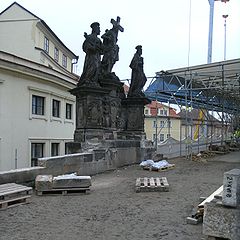
Dimension stone is also reused. Buildings immediately spring to mind, but such things as the ornate stone walls, arches, stairways and balustrades alongside a boulevard can also be renovated and reused. Sometimes the old interior of the building is kept as is, after repair. Sometimes the old building is gutted, leaving only a shell or facade and the space inside reconfigured and modernized. The stone work will usually need attention too.
The old stone work may only need cleaning or sandblasting, but it may need more. Firstly, the building exterior (facade) needs to be inspected for unsafe conditions. Next, the building walls need to be inspected for water leakages. The most likely needs are mortar restoration (repointing), applying consolidants to the old stone, or replacing pieces of stone that are deteriorated (damaged) beyond the point of any repair. The repointing is the removal of existing damaged mortar from the outer portion of the joint between stone units and its replacement by new mortar matching the appearance of the old. The consolidants re-establish the original natural bonding between the stone particles that weathering has removed. Deteriorated pieces of stone work are replaced with pieces of stone that match the original as much as possible. Exterior dimension stone will often change color after exposure to weather over time. For example, Indiana Limestone will weather from a tan to an attractive light yellow. Interior dimension stone can sometimes change its shade a little over time too. For both, it may not be possible to find an exact match, even from the original quarry. Stone will often change its appearance from location to location in the same quarry. If the dimension stone renovationist is truly fortunate, the original builder put aside some spare pieces of the stone for future need.
Stone: life-cycle assessment and best practices
As in every economic sector, the construction industry's purchases of materials and services creates a whole chain of processes from raw material selecting in situ, removal from the earth, usually proceeding to cutting, finishing, or processing/manufacturing, then transport, and retailing. All of these activities have significant upstream (off-site) environmental impacts, whether in terms of energy and raw resource use or emissions to air, land, or water impacting living organisms or the Earth's surface (non-organic). Life cycle assessmentLife cycle assessment
A life-cycle assessment is a technique to assess environmental impacts associated with all the stages of a product's life from-cradle-to-grave A life-cycle assessment (LCA, also known as life-cycle analysis, ecobalance, and cradle-to-grave analysis) is a technique to assess environmental impacts...
is a method for estimating and comparing a range of environmental performance measures (e.g. global warming
Global warming
Global warming refers to the rising average temperature of Earth's atmosphere and oceans and its projected continuation. In the last 100 years, Earth's average surface temperature increased by about with about two thirds of the increase occurring over just the last three decades...
, acidification potential, toxicity, ozone depletion
Ozone depletion
Ozone depletion describes two distinct but related phenomena observed since the late 1970s: a steady decline of about 4% per decade in the total volume of ozone in Earth's stratosphere , and a much larger springtime decrease in stratospheric ozone over Earth's polar regions. The latter phenomenon...
potentials) over the full life cycle of a product, a building assembly, or a whole building. As such, it provides a comprehensive means for evaluating and comparing products rather than prescriptive measures of individual product characteristics.
The ASTM has some relevant standards, particularly a guide on environmental life cycle assessment of building materials/products (E1991) that shows how to minimize the subjectivity that commonly mars and confuses environmental decision making. In particular, this guide describes the inventory analysis phase that requires data that is suitable for its intended purpose, thus covering data quality (such as completeness, reliability, accuracy, and credibility) as well as the allocation of the data (for multiple inputs and outputs), among other things. Results have to be on a common basis to allow a statistically significant comparison of alternative building product differences in the interpretation.
The Natural Stone Council (NSC) has commissioned some life-cycle inventory data for use in life cycle assessments. Almost 90% of the effort in doing a life cycle assessment involves getting reliable data. For example, the NSC has data that the Global Warming Potential for granite quarrying is 100 kg of carbon dioxide equivalents and for granite processing is 500 (same units); and the Global Warming Potential for limestone quarrying is 20 kg carbon dioxide equivalents while for limestone processing it is 80 (same units). The data on energy and water use include everything back to removal of overburden in the dimension stone quarry and upstream production of energy and fuels, and forward to packaging of finished dimension stone product or slabs for shipment and transport, or to moving scrap stone to storage or reclamation and to capturing and treatment of dust and waste water. The data is then placed in an impact category (i.e. changes to air, changes to water), characterized as to the contribution of the item to the impact compared to other items, and then the impact categories are assigned weights among themselves to show their relative importance.
The Natural Stone Council has also commissioned four Best Practices. One is on water consumption, treatment, and reuse while extracting and processing dimension stone, including dust mitigation, sludge management, and maximizing water recycling. Another is on site maintenance and quarry closure, including minimizing dust, noise, vibration and keeping the operation clean and tidy, both of which help in restoring the surface upon quarry closure. A third one is on solid waste management, including overburden, damaged stone unsaleable as product, sludge deposited from waste water, spent or spilled petroleum products, or metal scrap. The fourth one is on efficiently transporting stone to be finished as products, then transporting the products to consumers by centralizing freight management, consolidating small loads, choosing appropriate trucks, balancing and securing the load, and packaging with sustainable materials.
Stone selection and cleaning
The selector of dimension stone begins by considering stone colorColor
Color or colour is the visual perceptual property corresponding in humans to the categories called red, green, blue and others. Color derives from the spectrum of light interacting in the eye with the spectral sensitivities of the light receptors...
and appearance, and how the stone will match its surroundings. The selector has literally thousands of options to choose from, and should examine many options. In addition to many hundreds of different stones with different colors and patterns, each stone can change radically in color and appearance when a different finish is put on it. A polished finish accentuates the color and makes any pattern more vivid, and the rougher finishes (i.e. honed, thermal) lighten the color and make the patterns more subdued. With thousands of possibilities, the selector must start by looking at many stones in many different finishes, or photos of them. Such photos can be found on some dimension stone websites, and on DSAN's Architects Stone Selection Helper.
In addition to selecting a stone color and pattern, the suitability of its properties for the intended use must be considered. Stone being chosen for countertops or vanities should be nonabsorptive, resist stains, and be heat and impact resistant. Stone being used in tiles should be sealed
Stone sealer
Sealing is the application of a surface treatment to retard staining . All natural stone is porous since it is made up of countless interconnected capillary pores through which liquids and gases can move. Natural stone includes; granite, basalt, marble, limestone, travertine, sandstone and slate...
in order to resist staining by spilled liquids. Stone being used for flooring, paving, or surfaces subject to foot or vehicular traffic ought to have a semiabrasive finish for slip resistance, such as bush-hammered or thermal. A glossy polished finish will be slick. Most flagstone surfaces are rough enough to be naturally slip-resistant.
Dimension stone requires some specialized methods for cleaning and maintenance. Abrasive cleaners should not be used on a polished stone finish because it will wear the polish off. Acidic cleaners can not be used on marble
Marble
Marble is a metamorphic rock composed of recrystallized carbonate minerals, most commonly calcite or dolomite.Geologists use the term "marble" to refer to metamorphosed limestone; however stonemasons use the term more broadly to encompass unmetamorphosed limestone.Marble is commonly used for...
or limestone
Limestone
Limestone is a sedimentary rock composed largely of the minerals calcite and aragonite, which are different crystal forms of calcium carbonate . Many limestones are composed from skeletal fragments of marine organisms such as coral or foraminifera....
because it will remove (i.e. dissolve
Dissolution (chemistry)
Dissolution is the process by which a solid, liquid or gas forms a solution in a solvent. In solids this can be explained as the breakdown of the crystal lattice into individual ions, atoms or molecules and their transport into the solvent. For liquids and gases, the molecules must be compatible...
) the finish. Textured finishes (thermal, bush-hammered) can be treated with some mildly abrasive cleaners but not bleach or an acidic cleaner (if marble or limestone). Stains are another consideration; stains can be organic (food, grease, or oil) or metallic (iron, copper). Stains require some special removal techniques, such as the poultice method. A new method of cleaning stone on ancient buildings (mediaeval and renaissance) has been developed in Europe: sulfur-reducing bacteria are used on the black gypsum-containing crusts that form on such buildings to convert the sulfur to a gas that dissipates, thus destroying the crust while leaving the patina produced by aging on the underlying stone. This method is still in development and not yet commercially available.
Stone finishes
The surface of a stone may be finished in a variety of ways. Below are some typical terms:- Polished finish - a glossy surface which brings out the full color and character of the stone.
- Hone finish - a satin smooth surface finish with little or no gloss. This is recommended for commercial floors.
- Thermal finish - a surface treatment applied by intense heat flaming.
- Diamond sawed - finish produced by sawing with a diamond toothed saw.
- Rough sawn - a surface finish resulting from the gang sawing (or frame saw) process.
- Bush-hammered - a mechanical process which produces textured surfaces. Texture varies from subtle to rough.
See also
- Construction aggregateConstruction AggregateConstruction aggregate, or simply "aggregate", is a broad category of coarse particulate material used in construction, including sand, gravel, crushed stone, slag, recycled concrete and geosynthetic aggregates. Aggregates are the most mined material in the world...
- Deconstruction (building)Deconstruction (building)In the context of physical construction, deconstruction is the selective dismantlement of building components, specifically for re-use, recycling, and waste management. It differs from demolition where a site is cleared of its building by the most expedient means. Deconstruction has also been...
- Green buildingGreen buildingGreen building refers to a structure and using process that is environmentally responsible and resource-efficient throughout a building's life-cycle: from siting to design, construction, operation, maintenance, renovation, and demolition...
- MarbleMarbleMarble is a metamorphic rock composed of recrystallized carbonate minerals, most commonly calcite or dolomite.Geologists use the term "marble" to refer to metamorphosed limestone; however stonemasons use the term more broadly to encompass unmetamorphosed limestone.Marble is commonly used for...
- Stones of IndiaStones of IndiaIndia possesses a wide spectrum of dimensional stones that include granite, marble, sandstone, limestone, slate, and quartzite, spread out all over the country....
- LimestoneLimestoneLimestone is a sedimentary rock composed largely of the minerals calcite and aragonite, which are different crystal forms of calcium carbonate . Many limestones are composed from skeletal fragments of marine organisms such as coral or foraminifera....
- Stone carvingStone carvingStone carving is an ancient activity where pieces of rough natural stone are shaped by the controlled removal of stone. Owing to the permanence of the material, evidence can be found that even the earliest societies indulged in some form of stone work....
- Stone sealerStone sealerSealing is the application of a surface treatment to retard staining . All natural stone is porous since it is made up of countless interconnected capillary pores through which liquids and gases can move. Natural stone includes; granite, basalt, marble, limestone, travertine, sandstone and slate...