
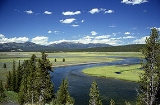
The
Yellowstone Caldera is the
volcanic2. Bedrock3. Conduit 4. Base5. Sill6. Dike7. Layers of ash emitted by the volcano8. Flank| 9. Layers of lava emitted by the volcano10. Throat11. Parasitic cone12. Lava flow13. Vent14. Crater15...
calderaA caldera is a cauldron-like volcanic feature usually formed by the collapse of land following a volcanic eruption, such as the one at Yellowstone National Park in the US. They are sometimes confused with volcanic craters...
located in
Yellowstone National ParkYellowstone National Park, established by the U.S. Congress and signed into law by President Ulysses S. Grant on March 1, 1872, is a national park located primarily in the U.S. state of Wyoming, although it also extends into Montana and Idaho...
in the
United StatesThe United States of America is a federal constitutional republic comprising fifty states and a federal district...
, sometimes referred to as the
Yellowstone SupervolcanoA supervolcano is a volcano capable of producing a volcanic eruption with an ejecta volume greater than 1,000 cubic kilometers . This is thousands of times larger than most historic volcanic eruptions. Supervolcanoes can occur when magma in the Earth rises into the crust from a hotspot but is...
. The caldera is located in the northwest corner of
WyomingWyoming is a state in the mountain region of the Western United States. The western two thirds of the state is covered mostly with the mountain ranges and rangelands in the foothills of the Eastern Rocky Mountains, while the eastern third of the state is high elevation prairie known as the High...
, in which the vast majority of the park is contained. The major features of the caldera measure about 34 by.
Volcanism
Yellowstone lies over a
hotspotThe places known as hotspots or hot spots in geology are volcanic regions thought to be fed by underlying mantle that is anomalously hot compared with the mantle elsewhere. They may be on, near to, or far from tectonic plate boundaries. There are two hypotheses to explain them...
where light, hot, molten
mantleThe mantle is a part of a terrestrial planet or other rocky body large enough to have differentiation by density. The interior of the Earth, similar to the other terrestrial planets, is chemically divided into layers. The mantle is a highly viscous layer between the crust and the outer core....
rock rises towards the surface. While the
Yellowstone hotspotThe Yellowstone hotspot, also referred to as the Snake River Plain-Yellowstone hotspot, is a volcanic hotspot responsible for large scale volcanism in Oregon, Nevada, Idaho, and Wyoming, United States. It created the eastern Snake River Plain through a succession of caldera forming eruptions...
is now under the
Yellowstone PlateauThe Yellowstone Plateau volcanic field is a geological feature found in the U.S. state of Wyoming. It is a popular site for tourists.The plateau developed through three volcanic cycles spanning two million years that included some of the world's largest known eruptions...
, it previously helped create the eastern
Snake River PlainThe Snake River Plain is a geologic feature located primarily within the state of Idaho in the United States of America. It stretches about westward from northwest of the state of Wyoming to the Idaho-Oregon border. The plain is a wide flat bow-shaped depression, and covers about a quarter of Idaho...
(to the west of Yellowstone) through a series of huge volcanic eruptions. Although the hotspot's apparent motion is to the east-northeast, the
North American PlateThe North American Plate is a tectonic plate covering most of North America, Greenland, Cuba, Bahamas, and parts of Siberia, Japan and Iceland. It extends eastward to the Mid-Atlantic Ridge and westward to the Chersky Range in eastern Siberia. The plate includes both continental and oceanic crust...
is really moving west-southwest over the stationary hotspot in the Earth's mantle.
Over the past 18 million years or so, this hotspot has generated a succession of violent eruptions and less violent
floods of basaltic lavaA flood basalt or trap basalt is the result of a giant volcanic eruption or series of eruptions that coats large stretches of land or the ocean floor with basalt lava. Flood basalts have occurred on continental scales in prehistory, creating great plateaus and mountain ranges...
. Together these eruptions have helped create the eastern part of the
Snake River PlainThe Snake River Plain is a geologic feature located primarily within the state of Idaho in the United States of America. It stretches about westward from northwest of the state of Wyoming to the Idaho-Oregon border. The plain is a wide flat bow-shaped depression, and covers about a quarter of Idaho...
from a once-mountainous region. At least a dozen of these eruptions were so massive that they are classified as supereruptions. Volcanic eruptions sometimes empty their stores of
magmaMagma is a mixture of molten rock, volatiles and solids that is found beneath the surface of the Earth, and is expected to exist on other terrestrial planets. Besides molten rock, magma may also contain suspended crystals and dissolved gas and sometimes also gas bubbles. Magma often collects in...
so swiftly that they cause the overlying land to collapse into the emptied
magma chamberA magma chamber is a large underground pool of molten rock found beneath the surface of the Earth. The molten rock in such a chamber is under great pressure, and given enough time, that pressure can gradually fracture the rock around it creating outlets for the magma...
, forming a geographic depression called a
calderaA caldera is a cauldron-like volcanic feature usually formed by the collapse of land following a volcanic eruption, such as the one at Yellowstone National Park in the US. They are sometimes confused with volcanic craters...
. Calderas formed from explosive supereruptions can be as wide and deep as mid- to large-sized lakes and can be responsible for destroying broad swaths of mountain ranges.
The oldest identified caldera remnant straddles the border near
McDermitt, Nevada-OregonMcDermitt is an unincorporated community straddling the Nevada–Oregon border, in Humboldt County, Nevada, and Malheur County, Oregon in the United States. For statistical purposes, the census bureau has allocated McDermitt two census-designated places , McDermitt NV and Fort McDermitt NV...
, although there are
volcaniclasticPyroclastic rocks or pyroclastics are clastic rocks composed solely or primarily of volcanic materials. Where the volcanic material has been transported and reworked through mechanical action, such as by wind or water, these rocks are termed volcaniclastic...
piles and arcuate faults that define caldera complexes more than 60 km (37.3 mi) in diameter in the
Carmacks GroupThe Carmacks Group is a Late Cretaceous volcanic group in southwest-central Yukon, Canada, located between the communities of Dawson City and Whitehorse. It consists of flood basalts, course volcaniclastic rocks and sandy tuffs interbedded with subordinate andesite and basaltic lava flows...
of southwest-central
YukonYukon is the westernmost and smallest of Canada's three federal territories. It was named after the Yukon River. The word Yukon means "Great River" in Gwich’in....
,
CanadaCanada is a North American country consisting of ten provinces and three territories. Located in the northern part of the continent, it extends from the Atlantic Ocean in the east to the Pacific Ocean in the west, and northward into the Arctic Ocean...
, which is interpreted to have formed 70 million years ago by the Yellowstone hotspot. Progressively younger caldera remnants, most grouped in several overlapping
volcanic fieldA volcanic field is an area of the Earth's crust that is prone to localized volcanic activity. They usually contain 10 to 100 volcanoes, such as cinder cones and are usually in clusters. Lava flows may also occur...
s, extend from the
NevadaNevada is a state in the western, mountain west, and southwestern regions of the United States. With an area of and a population of about 2.7 million, it is the 7th-largest and 35th-most populous state. Over two-thirds of Nevada's people live in the Las Vegas metropolitan area, which contains its...
-
OregonOregon is a state in the Pacific Northwest region of the United States. It is located on the Pacific coast, with Washington to the north, California to the south, Nevada on the southeast and Idaho to the east. The Columbia and Snake rivers delineate much of Oregon's northern and eastern...
border through the eastern Snake River Plain and terminate in the Yellowstone Plateau. One such caldera, the Bruneau-Jarbidge caldera in southern
IdahoIdaho is a state in the Rocky Mountain area of the United States. The state's largest city and capital is Boise. Residents are called "Idahoans". Idaho was admitted to the Union on July 3, 1890, as the 43rd state....
, was formed between 10 and 12 million years ago, and the event dropped ash to a depth of one foot (30.48 cm) 1000 miles (1,609.3 km) away in northeastern
NebraskaNebraska is a state on the Great Plains of the Midwestern United States. The state's capital is Lincoln and its largest city is Omaha, on the Missouri River....
and killed large herds of
rhinocerosRhinoceros , also known as rhino, is a group of five extant species of odd-toed ungulates in the family Rhinocerotidae. Two of these species are native to Africa and three to southern Asia....
, camel, and other animals at
Ashfall Fossil BedsThe Ashfall Fossil Beds of Antelope County in northeastern Nebraska are among the rare preservation sites called lagerstätten, which preserve ecological "snapshots" from a moment in time, due to extraordinary local conditions that have preserved a range of fossilized organisms undisturbed.The...
State Historical Park. Within the past 17 million years, 142 or more caldera-forming eruptions have occurred from the Yellowstone hotspot.
The loosely defined term '
supervolcanoA supervolcano is a volcano capable of producing a volcanic eruption with an ejecta volume greater than 1,000 cubic kilometers . This is thousands of times larger than most historic volcanic eruptions. Supervolcanoes can occur when magma in the Earth rises into the crust from a hotspot but is...
' has been used to describe volcanic fields that produce exceptionally large volcanic eruptions. Thus defined, the Yellowstone Supervolcano is the volcanic field which produced the latest three supereruptions from the Yellowstone hotspot. The three super eruptions occurred 2.1 million, 1.3 million, and 640,000 years ago, forming the
Island Park CalderaThe volcanic feature commonly called the Island Park Caldera in the states of Idaho and Wyoming, U.S., is actually two calderas, one nested inside the other. The Island Park Caldera is the older and much larger caldera, with approximate dimensions of 58 miles by 40 miles...
, the
Henry's Fork CalderaThe Henry's Fork Caldera in Idaho is a caldera located an area known as Island Park west of Yellowstone National Park. The caldera was formed by one of the world's supervolcanos in an eruption of more than 280 cubic kilometers 1.3 million years BP, and is the source of the Mesa Falls Tuff.The...
, and Yellowstone calderas, respectively. The
Island Park CalderaThe volcanic feature commonly called the Island Park Caldera in the states of Idaho and Wyoming, U.S., is actually two calderas, one nested inside the other. The Island Park Caldera is the older and much larger caldera, with approximate dimensions of 58 miles by 40 miles...
supereruption (2.1 million years ago), which produced the
Huckleberry Ridge TuffThe Huckleberry Ridge Tuff is a tuff formation created by the Huckleberry Ridge eruption that formed the Island Park Caldera that lies partially in Yellowstone Park, Wyoming and stretches westward into Idaho into a region known as Island Park...
, was the largest and produced 2,500 times as much ash as the 1980 Mount St. Helens eruption. The next biggest supereruption formed the Yellowstone Caldera (640,000 years ago) and produced the
Lava Creek TuffLava Creek Tuff is a tuff formation, in Wyoming, created when the Yellowstone Caldera erupted about 640,000 years ago.The Lava Creek Tuff distributed in a radial pattern around the caldera and is formed of of ash in pyroclastic flows....
. The
Henry's Fork CalderaThe Henry's Fork Caldera in Idaho is a caldera located an area known as Island Park west of Yellowstone National Park. The caldera was formed by one of the world's supervolcanos in an eruption of more than 280 cubic kilometers 1.3 million years BP, and is the source of the Mesa Falls Tuff.The...
(1.2 million years ago) produced the smaller
Mesa Falls TuffThe Mesa Falls Tuff is a tuff formation created by the Mesa Falls eruption that formed the Henry's Fork Caldera that is located in Idaho west of Yellowstone Park. It is the second most recent caldera forming eruption from the Yellowstone hotspot and ejected of 280 km³ of material...
but is the only caldera from the SRP-Y hotspot that is plainly visible today.
Non-explosive eruptions of
lavaLava refers both to molten rock expelled by a volcano during an eruption and the resulting rock after solidification and cooling. This molten rock is formed in the interior of some planets, including Earth, and some of their satellites. When first erupted from a volcanic vent, lava is a liquid at...
and less-violent explosive eruptions have occurred in and near the Yellowstone caldera since the last supereruption. The most recent lava flow occurred about 70,000 years ago, while a violent eruption excavated the West Thumb of Lake Yellowstone around 150,000 years ago. Smaller steam explosions occur as well; an explosion 13,800 years ago left a 5 kilometer diameter
craterA volcanic crater is a circular depression in the ground caused by volcanic activity. It is typically a basin, circular in form within which occurs a vent from which magma erupts as gases, lava, and ejecta. A crater can be of large dimensions, and sometimes of great depth...
at Mary Bay on the edge of
Yellowstone LakeYellowstone Lake is the largest body of water in Yellowstone National Park, The lake is 7,732 feet above sea level and covers with 110 miles of shoreline. While the average depth of the lake is 139 feet its deepest spot is at least 390 feet...
(located in the center of the caldera). Currently, volcanic activity is exhibited via numerous
geothermal ventThe geothermal areas of Yellowstone include several geyser basins in Yellowstone National Park as well as other geothermal features such as hot springs, mud pots, and fumaroles...
s scattered throughout the region, including the famous
Old Faithful GeyserOld Faithful is a cone geyser located in Wyoming, in Yellowstone National Park in the United States. Old Faithful was named in 1870 during the Washburn-Langford-Doane Expedition and was the first geyser in the park to receive a name...
, plus recorded ground swelling indicating ongoing inflation of the underlying magma chamber.
The volcanic eruptions, as well as the continuing geothermal activity, are a result of a great cove of magma located below the caldera's surface. The magma in this cove contains gases that are kept dissolved only by the immense pressure that the magma is under. If the pressure is released to a sufficient degree by some geological shift, then some of the gases bubble out and cause the magma to expand. This can cause a runaway reaction. If the expansion results in further relief of pressure, for example, by blowing crust material off the top of the chamber, the result is a very big gas explosion.
Earthquakes
Due to the volcanic and tectonic nature of the region, the Yellowstone Caldera experiences between 1000 and 2000 measurable earthquakes a year, though most are relatively minor, measuring a magnitude of 3 or weaker. Occasionally, numerous earthquakes are detected in a relatively short period of time, an event known as an
earthquake swarmEarthquake swarms are events where a local area experiences sequences of many earthquakes striking in a relatively short period of time. The length of time used to define the swarm itself varies, but the United States Geological Survey points out that an event may be on the order of days, weeks, or...
. In 1985, more than 3000 earthquakes were measured over several months. More than 70 smaller swarms have been detected between 1983 and 2008. The USGS states that these swarms could be caused more by slips on pre-existing faults than by movements of magma or hydrothermal fluids.
In December 2008, continuing into January 2009, more than 500 quakes were detected under the northwest end of
Yellowstone LakeYellowstone Lake is the largest body of water in Yellowstone National Park, The lake is 7,732 feet above sea level and covers with 110 miles of shoreline. While the average depth of the lake is 139 feet its deepest spot is at least 390 feet...
over a seven day span, with the largest registering a magnitude of 3.9. The most recent swarm started in January 2010 after the
Haiti earthquakeThe 2010 Haiti earthquake was a catastrophic magnitude 7.0 Mw earthquake, with an epicentre near the town of Léogâne, approximately west of Port-au-Prince, Haiti's capital. The earthquake occurred at 16:53 local time on Tuesday, 12 January 2010.By 24 January, at least 52 aftershocks...
and before the
Chile earthquakeThe 2010 Chile earthquake occurred off the coast of central Chile on Saturday, 27 February 2010, at 03:34 local time , having a magnitude of 8.8 on the moment magnitude scale, with intense shaking lasting for about three minutes. It ranks as the sixth largest earthquake ever to be recorded by a...
. With 1620 small earthquakes between January 17, 2010 and February 1, 2010, this swarm was the second largest ever recorded in the Yellowstone Caldera. The largest of these shocks was a magnitude 3.8 on January 21, 2010 at 11:16 PM MST. This swarm reached the background levels by 21 February.
Volcanic hazards
The last full-scale eruption of the Yellowstone Supervolcano, the
Lava CreekLava Creek Tuff is a tuff formation, in Wyoming, created when the Yellowstone Caldera erupted about 640,000 years ago.The Lava Creek Tuff distributed in a radial pattern around the caldera and is formed of of ash in pyroclastic flows....
eruption which happened nearly 640,000 years ago, ejected approximately 240 cubic miles (1,000.4 km³) of rock and dust into the sky.
Geologists are closely monitoring the rise and fall of the
Yellowstone PlateauThe Yellowstone Plateau volcanic field is a geological feature found in the U.S. state of Wyoming. It is a popular site for tourists.The plateau developed through three volcanic cycles spanning two million years that included some of the world's largest known eruptions...
, which measures on average 0.6 inches (1.5 cm) yearly, as an indication of changes in magma chamber pressure.
The upward movement of the Yellowstone caldera floor—almost 3 inches (7.6 cm) each year between 2004 and 2008—was more than three times greater than ever observed since such measurements began in 1923. From mid-Summer 2004 through mid-Summer 2008, the land surface within the caldera moved upwards, as much as 8 inches (20.3 cm) at the White Lake GPS station. By the end of 2009, the uplift had slowed significantly and appeared to have stopped. In January 2010, the USGS stated "that uplift of the Yellowstone Caldera has slowed significantly" and uplift continues but at a slower pace. The U.S. Geological Survey, University of Utah and National Park Service scientists with the Yellowstone Volcano Observatory maintain that they "see no evidence that another such cataclysmic eruption will occur at Yellowstone in the foreseeable future. Recurrence intervals of these events are neither regular nor predictable."
Hydrothermal explosion hazard
Studies and analysis may indicate that the greater hazard comes from hydrothermal activity which occurs independently of volcanic activity. Over 20 large craters have been produced in the past 14,000 years, resulting in such features as Mary Bay, Turbid Lake, and Indian Pond which was created in an eruption about 1300 BCE.
Lisa Morgan, a USGS researcher, explored this threat in a 2003 report, and in a talk postulated that an earthquake may have displaced more than 77 Mcuft (576,000,000 US gallons) of water in Yellowstone Lake, creating colossal waves that unsealed a capped geothermal system leading into the hydrothermal explosion that formed Mary Bay.
Further research shows that earthquakes from great distances do reach and have effects upon the activities at Yellowstone, such as the 1992 7.3 magnitude
Landers earthquakeThe 1992 Landers earthquake was a magnitude 7.3 earthquake that occurred on June 28, 1992 with an epicenter near the town of Landers, California...
in California’s Mojave Desert that triggered a swarm of quakes from more than 800 miles (1,287.5 km) away and the
Denali fault earthquakeThe 2002 Denali earthquake occurred at 22:12:41 UTC November 3, 2002, with an epicenter 66 km ESE of Denali National Park, Alaska, United States. This 7.9 Mw earthquake was the largest recorded in the interior of the United States for more than 150 years. The shock was the strongest ever...
2000 miles (3,218.7 km) away in Alaska that altered the activity of many geysers and hot springs for several months afterwards.
The head of the Yellowstone Volcano Observatory, Jake Lowenstern, has proposed major upgrades and extended monitoring since the U.S. Geological Survey classified Yellowstone as a “high-threat” system.
Yellowstone Hotspot Origin
The source of the Yellowstone hotspot is controversial. Some geoscientists hypothesize that the Yellowstone hotspot is the effect of an interaction between local conditions in the
lithosphereThe lithosphere is the rigid outermost shell of a rocky planet. On Earth, it comprises the crust and the portion of the upper mantle that behaves elastically on time scales of thousands of years or greater.- Earth's lithosphere :...
and upper
mantle convectionMantle convection is the slow creeping motion of Earth's rocky mantle caused by convection currents carrying heat from the interior of the Earth to the surface. The Earth's surface lithosphere, which rides atop the asthenosphere , is divided into a number of plates that are continuously being...
. Others prefer a deep mantle origin (
mantle plumeA mantle plume is a hypothetical thermal diapir of abnormally hot rock that nucleates at the core-mantle boundary and rises through the Earth's mantle. Such plumes were invoked in 1971 to explain volcanic regions that were not thought to be explicable by the then-new theory of plate tectonics. Some...
). Part of the controversy is due to the relatively sudden appearance of the hotspot in the geologic record. Additionally, the
Columbia Basalt flowsThe Columbia River Basalt Group is a large igneous province that lies across parts of the Western United States. It is found in the U.S. states of Washington, Oregon, Idaho, Nevada, and California...
appeared at the same approximate time, causing speculation about their origin.
See also
- Long Valley Caldera
Long Valley Caldera is a depression in eastern California that is adjacent to Mammoth Mountain. The valley is one of the largest calderas on earth, measuring about long and wide . The elevation of the floor of the caldera is in the east and in the west...
, Valles Caldera, La Garita CalderaLa Garita Caldera is a large volcanic caldera located in the San Juan volcanic field in the San Juan Mountains near the town of Creede in southwestern Colorado, United States. It lies to the west of the town of La Garita, Colorado...
: examples of other calderas close to but not related to Yellowstone.
- Iceland hotspot
The Iceland hotspot is a hotspot which is partly responsible for the high volcanic activity which has formed the island of Iceland.-Description:...
and Iceland plumeThe Iceland Plume is a postulated upwelling of anomalously hot rock in the Earth's mantle beneath Iceland. Its origin is thought to lie deep in the mantle, perhaps at the boundary between the core and the mantle at ca. 2880 km depth. Opinions differ as to whether seismic studies have imaged...
describes aspects of volcanic processes
External links