

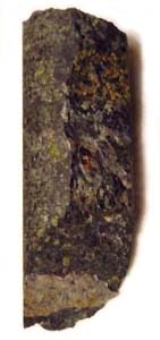
Kimberlite

Encyclopedia
Kimberlite is a type of potassic volcanic rock
best known for sometimes containing diamond
s. It is named after the town of Kimberley
in South Africa
, where the discovery of an 83.5 carats (16.7 g) diamond in 1871 spawned a diamond rush, eventually creating the Big Hole
.
Kimberlite occurs in the Earth's crust
in vertical structures known as kimberlite pipes
. Kimberlite pipes are the most important source of mined diamonds today. The consensus on kimberlites is that they are formed deep within the mantle
. Formation occurs at depths between 150 and 450 km (93.2 and 279.6 mi), from anomalously enriched exotic mantle compositions, and are erupted rapidly and violently, often with considerable carbon dioxide
and other volatile
components. It is this depth of melting and generation which makes kimberlites prone to hosting diamond xenocrysts.
Kimberlite has attracted more attention than its relative volume might suggest that it deserves. This is largely because it serves as a carrier of diamonds and garnet peridotite
mantle
xenolith
s to the Earth's surface. Its probable derivation from depths greater than any other igneous rock
type, and the extreme magma
composition that it reflects in terms of low silica content and high levels of incompatible trace element
enrichment, make an understanding of kimberlite petrogenesis
important. In this regard, the study of kimberlite has the potential to provide information about the composition of the deep mantle and about melting processes occurring at or near the interface between the craton
ic continental lithosphere
and the underlying convecting asthenospheric
mantle.
The morphology of kimberlite pipes, and the classical carrot shape, is the result of explosive diatreme
volcanism
from very deep mantle-derived sources. These volcanic explosions produce vertical columns of rock that rise from deep magma reservoirs. The morphology of kimberlite pipes is varied but generally includes a sheeted dyke complex of tabular, vertically dipping feeder dykes in the root of the pipe which extends down to the mantle. Within 1.5–2 km (0.93205910497471–1.2 mi) of the surface, the highly pressured magma explodes upwards and expands to form a conical to cylindrical diatreme
, which erupts to the surface. The surface expression is rarely preserved, but is usually similar to a maar volcano
. The diameter of a kimberlite pipe at the surface is typically a few hundred meters to a kilometer (up to 0.6 mile).
Two Jurassic
kimberlite dikes
exist in Pennsylvania
. One, the Gates-Adah Dike, outcrops on the Monongahela River
on the border of Fayette
and Greene
Counties. The other, the Dixonville-Tanoma Dike in central Indiana
County, does not outcrop at the surface and was discovered by miners.
Historically, kimberlites have been subdivided into two distinct varieties termed 'basaltic' and 'micaceous' based primarily on petrographic observations (Wagner, 1914). This was later revised by Smith (1983) who re-named these divisions Group I and Group II based on the isotopic affinities of these rocks using the Nd, Sr and Pb systems. Mitchell (1995) later proposed that these group I and II kimberlites display such distinct differences, that they may not be as closely related as once thought. He showed that Group II kimberlites actually show closer affinities to lamproites than they do to Group I kimberlites. Hence, he reclassified Group II kimberlites as orangeites to prevent confusion.
, magnesian ilmenite
, chromium pyrope, almandine-pyrope, chromium diopside (in some cases subcalcic), phlogopite
, enstatite
and of Ti-poor chromite
. Group I kimberlites exhibit a distinctive inequigranular texture caused by macrocrystic (0.5–10 mm (0.0196850393700787–0.393700787401575 in)) to megacrystic (10–200 mm (0.393700787401575–7.9 in)) phenocrysts of olivine, pyrope
, chromian diopside, magnesian ilmenite and phlogopite, in a fine to medium grained groundmass.
The groundmass mineralogy, which more closely resembles a true composition of the igneous rock, contains forsteritic olivine
, pyrope
garnet, Cr-diopside
, magnesian ilmenite
and spinel
.
macrocrysts and microphenocrysts, together with groundmass micas that vary in composition from phlogopite to "tetraferriphlogopite" (anomalously Fe-rich phlogopite). Resorbed olivine macrocrysts and euhedral primary crystals of groundmass olivine are common but not essential constituents.
Characteristic primary phases in the groundmass include: zoned pyroxenes (cores of diopside rimmed by Ti-aegirine); spinel-group minerals (magnesian chromite
to titaniferous magnetite
); Sr- and REE-rich perovskite
; Sr-rich apatite
; REE-rich phosphates (monazite
, daqingshanite); potassian barian hollandite group minerals; Nb-bearing rutile
and Mn-bearing ilmenite
.
, chromian diopside (a pyroxene
), chromium spinels, magnesian ilmenite, and garnets rich in pyrope
plus chromium, are generally absent from most other igneous rocks, making them particularly useful as indicators for kimberlites.
These indicator minerals are generally sought in stream sediments in modern alluvial material
. Their presence may indicate the presence of a kimberlite within the erosional watershed which produced the alluvium.
s. Only about 1 in 200 kimberlite pipes contain gem-quality diamonds.
The deposits occurring at Kimberley, South Africa
were the first recognized and the source of the name. The Kimberley diamond
s were originally found in weathered
kimberlite which was colored yellow by limonite
, and so was called yellow ground. Deeper workings encountered less altered rock, serpentinized
kimberlite, which miners call blue ground
.
See also Udachnaya pipe
.
The blue and yellow ground were both prolific producers of diamonds. After the yellow ground had been exhausted, miners in the late 19th century accidentally cut into the blue ground and found gem quality diamonds in quantity. The economic importance of the time is that with flood of diamonds being found, the miners were undercutting each other's price of the diamonds and eventually decreased the diamonds' value down to cost in a short time.
Volcanic rock
Volcanic rock is a rock formed from magma erupted from a volcano. In other words, it is an igneous rock of volcanic origin...
best known for sometimes containing diamond
Diamond
In mineralogy, diamond is an allotrope of carbon, where the carbon atoms are arranged in a variation of the face-centered cubic crystal structure called a diamond lattice. Diamond is less stable than graphite, but the conversion rate from diamond to graphite is negligible at ambient conditions...
s. It is named after the town of Kimberley
Kimberley, Northern Cape
Kimberley is a city in South Africa, and the capital of the Northern Cape. It is located near the confluence of the Vaal and Orange Rivers. The town has considerable historical significance due its diamond mining past and siege during the Second Boer War...
in South Africa
South Africa
The Republic of South Africa is a country in southern Africa. Located at the southern tip of Africa, it is divided into nine provinces, with of coastline on the Atlantic and Indian oceans...
, where the discovery of an 83.5 carats (16.7 g) diamond in 1871 spawned a diamond rush, eventually creating the Big Hole
Big Hole
The Big Hole, Open Mine or Kimberley Mine is an open-pit and underground mine in Kimberley, South Africa, and claimed to be the largest hole excavated by hand.-History:...
.
Kimberlite occurs in the Earth's crust
Crust (geology)
In geology, the crust is the outermost solid shell of a rocky planet or natural satellite, which is chemically distinct from the underlying mantle...
in vertical structures known as kimberlite pipes
Volcanic pipe
Volcanic pipes are subterranean geological structures formed by the violent, supersonic eruption of deep-origin volcanoes. They are considered to be a type of diatreme. Volcanic pipes are composed of a deep, narrow cone of solidified magma , and are usually largely composed of one of two...
. Kimberlite pipes are the most important source of mined diamonds today. The consensus on kimberlites is that they are formed deep within the mantle
Mantle (geology)
The mantle is a part of a terrestrial planet or other rocky body large enough to have differentiation by density. The interior of the Earth, similar to the other terrestrial planets, is chemically divided into layers. The mantle is a highly viscous layer between the crust and the outer core....
. Formation occurs at depths between 150 and 450 km (93.2 and 279.6 mi), from anomalously enriched exotic mantle compositions, and are erupted rapidly and violently, often with considerable carbon dioxide
Carbon dioxide
Carbon dioxide is a naturally occurring chemical compound composed of two oxygen atoms covalently bonded to a single carbon atom...
and other volatile
Volatiles
In planetary science, volatiles are that group of chemical elements and chemical compounds with low boiling points that are associated with a planet's or moon's crust and/or atmosphere. Examples include nitrogen, water, carbon dioxide, ammonia, hydrogen, and methane, all compounds of C, H, O...
components. It is this depth of melting and generation which makes kimberlites prone to hosting diamond xenocrysts.
Kimberlite has attracted more attention than its relative volume might suggest that it deserves. This is largely because it serves as a carrier of diamonds and garnet peridotite
Peridotite
A peridotite is a dense, coarse-grained igneous rock, consisting mostly of the minerals olivine and pyroxene. Peridotite is ultramafic, as the rock contains less than 45% silica. It is high in magnesium, reflecting the high proportions of magnesium-rich olivine, with appreciable iron...
mantle
Mantle (geology)
The mantle is a part of a terrestrial planet or other rocky body large enough to have differentiation by density. The interior of the Earth, similar to the other terrestrial planets, is chemically divided into layers. The mantle is a highly viscous layer between the crust and the outer core....
xenolith
Xenolith
A xenolith is a rock fragment which becomes enveloped in a larger rock during the latter's development and hardening. In geology, the term xenolith is almost exclusively used to describe inclusions in igneous rock during magma emplacement and eruption...
s to the Earth's surface. Its probable derivation from depths greater than any other igneous rock
Igneous rock
Igneous rock is one of the three main rock types, the others being sedimentary and metamorphic rock. Igneous rock is formed through the cooling and solidification of magma or lava...
type, and the extreme magma
Magma
Magma is a mixture of molten rock, volatiles and solids that is found beneath the surface of the Earth, and is expected to exist on other terrestrial planets. Besides molten rock, magma may also contain suspended crystals and dissolved gas and sometimes also gas bubbles. Magma often collects in...
composition that it reflects in terms of low silica content and high levels of incompatible trace element
Trace element
In analytical chemistry, a trace element is an element in a sample that has an average concentration of less than 100 parts per million measured in atomic count, or less than 100 micrograms per gram....
enrichment, make an understanding of kimberlite petrogenesis
Petrogenesis
Petrogenesis, also known as petrogeny, is a branch of petrology dealing with the origin of igneous rocks. Petrology is the branch of geology dealing with the origin, occurrence, structure and history of igneous, metamorphic, and sedimentary rocks....
important. In this regard, the study of kimberlite has the potential to provide information about the composition of the deep mantle and about melting processes occurring at or near the interface between the craton
Craton
A craton is an old and stable part of the continental lithosphere. Having often survived cycles of merging and rifting of continents, cratons are generally found in the interiors of tectonic plates. They are characteristically composed of ancient crystalline basement rock, which may be covered by...
ic continental lithosphere
Lithosphere
The lithosphere is the rigid outermost shell of a rocky planet. On Earth, it comprises the crust and the portion of the upper mantle that behaves elastically on time scales of thousands of years or greater.- Earth's lithosphere :...
and the underlying convecting asthenospheric
Asthenosphere
The asthenosphere is the highly viscous, mechanically weak and ductilely-deforming region of the upper mantle of the Earth...
mantle.
Morphology and volcanology
Kimberlites occur as carrot-shaped, vertical intrusions termed 'pipes'. This classic carrot shape is formed due to a complex intrusive process of kimberlitic magma which inherits a large proportion of both CO2 and H2O in the system, which produces a deep explosive boiling stage that causes a significant amount of vertical flaring (Bergman, 1987). Kimberlite classification is based on the recognition of differing rock facies. These differing facies are associated with a particular style of magmatic activity, namely crater, diatreme and hypabyssal rocks (Clement and Skinner 1985, and Clement, 1982).The morphology of kimberlite pipes, and the classical carrot shape, is the result of explosive diatreme
Volcanic pipe
Volcanic pipes are subterranean geological structures formed by the violent, supersonic eruption of deep-origin volcanoes. They are considered to be a type of diatreme. Volcanic pipes are composed of a deep, narrow cone of solidified magma , and are usually largely composed of one of two...
volcanism
Volcanism
Volcanism is the phenomenon connected with volcanoes and volcanic activity. It includes all phenomena resulting from and causing magma within the crust or mantle of a planet to rise through the crust and form volcanic rocks on the surface....
from very deep mantle-derived sources. These volcanic explosions produce vertical columns of rock that rise from deep magma reservoirs. The morphology of kimberlite pipes is varied but generally includes a sheeted dyke complex of tabular, vertically dipping feeder dykes in the root of the pipe which extends down to the mantle. Within 1.5–2 km (0.93205910497471–1.2 mi) of the surface, the highly pressured magma explodes upwards and expands to form a conical to cylindrical diatreme
Diatreme
A diatreme is a breccia-filled volcanic pipe that was formed by a gaseous explosion. Diatremes often breach the surface and produce a tuff cone, a filled relatively shallow crater known as a maar, or other volcanic pipes.- Word origin :...
, which erupts to the surface. The surface expression is rarely preserved, but is usually similar to a maar volcano
Maar
A maar is a broad, low-relief volcanic crater that is caused by a phreatomagmatic eruption, an explosion caused by groundwater coming into contact with hot lava or magma. A maar characteristically fills with water to form a relatively shallow crater lake. The name comes from the local Moselle...
. The diameter of a kimberlite pipe at the surface is typically a few hundred meters to a kilometer (up to 0.6 mile).
Two Jurassic
Jurassic
The Jurassic is a geologic period and system that extends from about Mya to Mya, that is, from the end of the Triassic to the beginning of the Cretaceous. The Jurassic constitutes the middle period of the Mesozoic era, also known as the age of reptiles. The start of the period is marked by...
kimberlite dikes
Dike (geology)
A dike or dyke in geology is a type of sheet intrusion referring to any geologic body that cuts discordantly across* planar wall rock structures, such as bedding or foliation...
exist in Pennsylvania
Pennsylvania
The Commonwealth of Pennsylvania is a U.S. state that is located in the Northeastern and Mid-Atlantic regions of the United States. The state borders Delaware and Maryland to the south, West Virginia to the southwest, Ohio to the west, New York and Ontario, Canada, to the north, and New Jersey to...
. One, the Gates-Adah Dike, outcrops on the Monongahela River
Monongahela River
The Monongahela River is a river on the Allegheny Plateau in north-central West Virginia and southwestern Pennsylvania in the United States...
on the border of Fayette
Fayette County, Pennsylvania
Fayette County is a county located in the U.S. state of Pennsylvania. As of the2010 census, the population was 136,606. The county is part of the Pittsburgh Metropolitan Statistical Area....
and Greene
Greene County, Pennsylvania
-Demographics:As of the census of 2000, there were 40,672 people, 15,060 households, and 10,587 families residing in the county. The population density was 71 people per square mile . There were 16,678 housing units at an average density of 29 per square mile...
Counties. The other, the Dixonville-Tanoma Dike in central Indiana
Indiana County, Pennsylvania
-Government and politics:As of November 2008, there are 58,077 registered voters in Indiana County .* Democratic: 26,653 * Republican: 24,159 * Other Parties: 7,265 -County commissioners:*Rodney Ruddock, Chairman, Republican...
County, does not outcrop at the surface and was discovered by miners.
Petrology
Both the location and origin of kimberlitic magmas are areas of contention. Their extreme enrichment and geochemistry has led to a large amount of speculation about their origin, with models placing their source within the sub-continental lithospheric mantle (SCLM) or even as deep as the transition zone. The mechanism of enrichment has also been the topic of interest with models including partial melting, assimilation of subducted sediment or derivation from a primary magma source.Historically, kimberlites have been subdivided into two distinct varieties termed 'basaltic' and 'micaceous' based primarily on petrographic observations (Wagner, 1914). This was later revised by Smith (1983) who re-named these divisions Group I and Group II based on the isotopic affinities of these rocks using the Nd, Sr and Pb systems. Mitchell (1995) later proposed that these group I and II kimberlites display such distinct differences, that they may not be as closely related as once thought. He showed that Group II kimberlites actually show closer affinities to lamproites than they do to Group I kimberlites. Hence, he reclassified Group II kimberlites as orangeites to prevent confusion.
Group I kimberlites
Group-I kimberlites are of CO2-rich ultramafic potassic igneous rocks dominated by a primary mineral assemblage of forsteritic olivineOlivine
The mineral olivine is a magnesium iron silicate with the formula 2SiO4. It is a common mineral in the Earth's subsurface but weathers quickly on the surface....
, magnesian ilmenite
Ilmenite
Ilmenite is a weakly magnetic titanium-iron oxide mineral which is iron-black or steel-gray. It is a crystalline iron titanium oxide . It crystallizes in the trigonal system, and it has the same crystal structure as corundum and hematite....
, chromium pyrope, almandine-pyrope, chromium diopside (in some cases subcalcic), phlogopite
Phlogopite
Phlogopite is a yellow, greenish, or reddish-brown member of the mica family of phyllosilicates. It is also known as magnesium mica.Phlogopite is the magnesium endmember of the biotite solid solution series, with the chemical formula KMg3AlSi3O102. Iron substitutes for magnesium in variable amounts...
, enstatite
Enstatite
Enstatite is the magnesium endmember of the pyroxene silicate mineral series enstatite - ferrosilite . The magnesium rich members of the solid solution series are common rock-forming minerals found in igneous and metamorphic rocks...
and of Ti-poor chromite
Chromite
Chromite is an iron chromium oxide: FeCr2O4. It is an oxide mineral belonging to the spinel group. Magnesium can substitute for iron in variable amounts as it forms a solid solution with magnesiochromite ; substitution of aluminium occurs leading to hercynite .-Occurrence:Chromite is found in...
. Group I kimberlites exhibit a distinctive inequigranular texture caused by macrocrystic (0.5–10 mm (0.0196850393700787–0.393700787401575 in)) to megacrystic (10–200 mm (0.393700787401575–7.9 in)) phenocrysts of olivine, pyrope
Pyrope
The mineral pyrope is a member of the garnet group. Pyrope is the only member of the garnet family to always display red colouration in natural samples, and it is from this characteristic that it gets its name: from the Greek for fire and eye. Despite being less common than most garnets, it is a...
, chromian diopside, magnesian ilmenite and phlogopite, in a fine to medium grained groundmass.
The groundmass mineralogy, which more closely resembles a true composition of the igneous rock, contains forsteritic olivine
Olivine
The mineral olivine is a magnesium iron silicate with the formula 2SiO4. It is a common mineral in the Earth's subsurface but weathers quickly on the surface....
, pyrope
Pyrope
The mineral pyrope is a member of the garnet group. Pyrope is the only member of the garnet family to always display red colouration in natural samples, and it is from this characteristic that it gets its name: from the Greek for fire and eye. Despite being less common than most garnets, it is a...
garnet, Cr-diopside
Diopside
Diopside is a monoclinic pyroxene mineral with composition MgCaSi2O6. It forms complete solid solution series with hedenbergite and augite, and partial solid solutions with orthopyroxene and pigeonite. It forms variably colored, but typically dull green crystals in the monoclinic prismatic class...
, magnesian ilmenite
Ilmenite
Ilmenite is a weakly magnetic titanium-iron oxide mineral which is iron-black or steel-gray. It is a crystalline iron titanium oxide . It crystallizes in the trigonal system, and it has the same crystal structure as corundum and hematite....
and spinel
Spinel
Spinel is the magnesium aluminium member of the larger spinel group of minerals. It has the formula MgAl2O4. Balas ruby is an old name for a rose-tinted variety.-Spinel group:...
.
Group II kimberlites
Group-II kimberlites (or orangeites) are ultrapotassic, peralkaline rocks rich in volatiles (dominantly H2O). The distinctive characteristic of orangeites is phlogopitePhlogopite
Phlogopite is a yellow, greenish, or reddish-brown member of the mica family of phyllosilicates. It is also known as magnesium mica.Phlogopite is the magnesium endmember of the biotite solid solution series, with the chemical formula KMg3AlSi3O102. Iron substitutes for magnesium in variable amounts...
macrocrysts and microphenocrysts, together with groundmass micas that vary in composition from phlogopite to "tetraferriphlogopite" (anomalously Fe-rich phlogopite). Resorbed olivine macrocrysts and euhedral primary crystals of groundmass olivine are common but not essential constituents.
Characteristic primary phases in the groundmass include: zoned pyroxenes (cores of diopside rimmed by Ti-aegirine); spinel-group minerals (magnesian chromite
Chromite
Chromite is an iron chromium oxide: FeCr2O4. It is an oxide mineral belonging to the spinel group. Magnesium can substitute for iron in variable amounts as it forms a solid solution with magnesiochromite ; substitution of aluminium occurs leading to hercynite .-Occurrence:Chromite is found in...
to titaniferous magnetite
Magnetite
Magnetite is a ferrimagnetic mineral with chemical formula Fe3O4, one of several iron oxides and a member of the spinel group. The chemical IUPAC name is iron oxide and the common chemical name is ferrous-ferric oxide. The formula for magnetite may also be written as FeO·Fe2O3, which is one part...
); Sr- and REE-rich perovskite
Perovskite
A perovskite structure is any material with the same type of crystal structure as calcium titanium oxide , known as the perovskite structure, or XIIA2+VIB4+X2−3 with the oxygen in the face centers. Perovskites take their name from this compound, which was first discovered in the Ural mountains of...
; Sr-rich apatite
Apatite
Apatite is a group of phosphate minerals, usually referring to hydroxylapatite, fluorapatite, chlorapatite and bromapatite, named for high concentrations of OH−, F−, Cl− or Br− ions, respectively, in the crystal...
; REE-rich phosphates (monazite
Monazite
Monazite is a reddish-brown phosphate mineral containing rare earth metals. It occurs usually in small isolated crystals. There are actually at least four different kinds of monazite, depending on relative elemental composition of the mineral:...
, daqingshanite); potassian barian hollandite group minerals; Nb-bearing rutile
Rutile
Rutile is a mineral composed primarily of titanium dioxide, TiO2.Rutile is the most common natural form of TiO2. Two rarer polymorphs of TiO2 are known:...
and Mn-bearing ilmenite
Ilmenite
Ilmenite is a weakly magnetic titanium-iron oxide mineral which is iron-black or steel-gray. It is a crystalline iron titanium oxide . It crystallizes in the trigonal system, and it has the same crystal structure as corundum and hematite....
.
Kimberlitic indicator minerals
Kimberlites are peculiar igneous rocks because they contain a variety of mineral species with peculiar chemical compositions. These minerals such as potassic richteriteRichterite
Richterite is a sodium calcium magnesium silicate mineral belonging to the amphibole group. If iron replaces the magnesium within the structure of the mineral, it is called ferrorichterite; if fluorine replaces the hydroxyl, it is called fluororichterite. Richterite crystals are long and prismatic,...
, chromian diopside (a pyroxene
Pyroxene
The pyroxenes are a group of important rock-forming inosilicate minerals found in many igneous and metamorphic rocks. They share a common structure consisting of single chains of silica tetrahedra and they crystallize in the monoclinic and orthorhombic systems...
), chromium spinels, magnesian ilmenite, and garnets rich in pyrope
Pyrope
The mineral pyrope is a member of the garnet group. Pyrope is the only member of the garnet family to always display red colouration in natural samples, and it is from this characteristic that it gets its name: from the Greek for fire and eye. Despite being less common than most garnets, it is a...
plus chromium, are generally absent from most other igneous rocks, making them particularly useful as indicators for kimberlites.
These indicator minerals are generally sought in stream sediments in modern alluvial material
Alluvium
Alluvium is loose, unconsolidated soil or sediments, eroded, deposited, and reshaped by water in some form in a non-marine setting. Alluvium is typically made up of a variety of materials, including fine particles of silt and clay and larger particles of sand and gravel...
. Their presence may indicate the presence of a kimberlite within the erosional watershed which produced the alluvium.
Geochemistry
The geochemistry of Kimberlites is defined by the following parameters:- Ultramafic; MgO >12% and generally >15%
- Ultrapotassic; Molar K2O/Al2O3 >3
- Near-primitive Ni (>400 ppm), Cr (>1000 ppm), Co (>150 ppm)
- REERare earth elementAs defined by IUPAC, rare earth elements or rare earth metals are a set of seventeen chemical elements in the periodic table, specifically the fifteen lanthanides plus scandium and yttrium...
-enrichment - Moderate to high LILE enrichment; ΣLILE = >1,000 ppm
-
- LILE = large ion lithophile elements
- High H2O and CO2
- LILE = large ion lithophile elements
Economic importance
Kimberlites are the most important source of primary diamonds. Many kimberlite pipes also produce rich alluvial or eluvial diamond placer depositPlacer deposit
In geology, a placer deposit or placer is an accumulation of valuable minerals formed by gravity separation during sedimentary processes. The name is from the Spanish word placer, meaning "alluvial sand". Placer mining is an important source of gold, and was the main technique used in the early...
s. Only about 1 in 200 kimberlite pipes contain gem-quality diamonds.
The deposits occurring at Kimberley, South Africa
South Africa
The Republic of South Africa is a country in southern Africa. Located at the southern tip of Africa, it is divided into nine provinces, with of coastline on the Atlantic and Indian oceans...
were the first recognized and the source of the name. The Kimberley diamond
Diamond
In mineralogy, diamond is an allotrope of carbon, where the carbon atoms are arranged in a variation of the face-centered cubic crystal structure called a diamond lattice. Diamond is less stable than graphite, but the conversion rate from diamond to graphite is negligible at ambient conditions...
s were originally found in weathered
Weathering
Weathering is the breaking down of rocks, soils and minerals as well as artificial materials through contact with the Earth's atmosphere, biota and waters...
kimberlite which was colored yellow by limonite
Limonite
Limonite is an ore consisting in a mixture of hydrated iron oxide-hydroxide of varying composition. The generic formula is frequently written as FeO·nH2O, although this is not entirely accurate as limonite often contains a varying amount of oxide compared to hydroxide.Together with hematite, it has...
, and so was called yellow ground. Deeper workings encountered less altered rock, serpentinized
Serpentinite
Serpentinite is a rock composed of one or more serpentine group minerals. Minerals in this group are formed by serpentinization, a hydration and metamorphic transformation of ultramafic rock from the Earth's mantle...
kimberlite, which miners call blue ground
Blue ground
In reconnaissance for diamond mining, blue ground refers to a layer of nonoxidized kimberlite. Kimberlites are a class of igneous rocks commonly associated with diamond mining. Before the advent of modern geophysical probes, the ideal way to find a kimberlite pipe was to search for "yellow ground",...
.
See also Udachnaya pipe
Udachnaya pipe
Udachnaya pipe is a diamond deposit in the Daldyn-Alakit kimberlite field in Sakha Republic, Russia. It is an open-pit mine, and is located just outside the Arctic circle at . Udachnaya was discovered on June 15, 1955, just two days after the discovery of the diamond pipe Mir by Soviet...
.
The blue and yellow ground were both prolific producers of diamonds. After the yellow ground had been exhausted, miners in the late 19th century accidentally cut into the blue ground and found gem quality diamonds in quantity. The economic importance of the time is that with flood of diamonds being found, the miners were undercutting each other's price of the diamonds and eventually decreased the diamonds' value down to cost in a short time.
Related rock types
- LamproiteLamproiteLamproites are ultrapotassic mantle-derived volcanic and subvolcanic rocks. They have low CaO, Al2O3, Na2O, high K2O/Al2O3, a relatively high MgO content and extreme enrichment in incompatible elements....
, LamprophyreLamprophyreLamprophyres are uncommon, small volume ultrapotassic igneous rocks primarily occurring as dikes, lopoliths, laccoliths, stocks and small intrusions...
, Nepheline syeniteNepheline syeniteNephelene syenite is a holocrystalline plutonic rock that consists largely of nepheline and alkali feldspar. The rocks are mostly pale colored, grey or pink, and in general appearance they are not unlike granites, but dark green varieties are also known... - Ultrapotassic igneous rocks
- Kalsititic rocks
External links
- Introduction to Kimberlite, EOS.UBC.ca
- Kimberlite hosted diamonds, em.gov.BC.ca