
An
acid is a substance which reacts with a
baseFor the term in genetics, see base A base in chemistry is a substance that can accept hydrogen ions or more generally, donate electron pairs. A soluble base is referred to as an alkali if it contains and releases hydroxide ions quantitatively...
. Commonly, acids can be identified as tasting sour, reacting with metals such as
calciumCalcium is the chemical element with the symbol Ca and atomic number 20. It has an atomic mass of 40.078 amu. Calcium is a soft gray alkaline earth metal, and is the fifth-most-abundant element by mass in the Earth's crust...
, and bases like
sodium carbonateSodium carbonate , Na2CO3 is a sodium salt of carbonic acid. It most commonly occurs as a crystalline heptahydrate, which readily effloresces to form a white powder, the monohydrate. Sodium carbonate is domestically well-known for its everyday use as a water softener. It can be extracted from the...
. Aqueous acids have a
pHIn chemistry, pH is a measure of the acidity or basicity of an aqueous solution. Pure water is said to be neutral, with a pH close to 7.0 at . Solutions with a pH less than 7 are said to be acidic and solutions with a pH greater than 7 are basic or alkaline...
of less than 7, where an acid of lower pH is typically stronger, and turn blue
litmus paperLitmus or litmus test may refer to:* Litmus test, a common pH test* Litmus , a test case management tool maintained by Mozilla* "Litmus" , an episode in the first season of the television series...
red. Chemicals or substances having the property of an acid are said to be
acidic.
Common examples of acids include
acetic acidAcetic acid is an organic compound with the chemical formula CH3CO2H . It is a colourless liquid that when undiluted is also called glacial acetic acid. Acetic acid is the main component of vinegar , and has a distinctive sour taste and pungent smell...
(in
vinegarVinegar is a liquid substance consisting mainly of acetic acid and water, the acetic acid being produced through the fermentation of ethanol by acetic acid bacteria. Commercial vinegar is produced either by fast or slow fermentation processes. Slow methods generally are used with traditional...
),
sulfuric acidSulfuric acid is a strong mineral acid with the molecular formula . Its historical name is oil of vitriol. Pure sulfuric acid is a highly corrosive, colorless, viscous liquid. The salts of sulfuric acid are called sulfates...
(used in
car batteriesAn automotive battery is a type of rechargeable battery that supplies electric energy to an automobile. Usually this refers to an SLI battery to power the starter motor, the lights, and the ignition system of a vehicle’s engine...
), and
tartaric acidTartaric acid is a white crystalline diprotic organic acid. It occurs naturally in many plants, particularly grapes, bananas, and tamarinds; is commonly combined with baking soda to function as a leavening agent in recipes, and is one of the main acids found in wine. It is added to other foods to...
(used in baking). As these three examples show, acids can be solutions, liquids, or solids. Gases such as
hydrogen chlorideThe compound hydrogen chloride has the formula HCl. At room temperature, it is a colorless gas, which forms white fumes of hydrochloric acid upon contact with atmospheric humidity. Hydrogen chloride gas and hydrochloric acid are important in technology and industry...
can be acids as well. Strong acids and some concentrated weak acids are corrosive, but there are exceptions such as
carboraneA carborane is a cluster composed of boron and carbon atoms. Like many of the related boranes, these clusters are polyhedra and are similarly classified as closo-, nido-, arachno-, hypho-, etc...
s and
boric acidBoric acid, also called hydrogen borate or boracic acid or orthoboric acid or acidum boricum, is a weak acid of boron often used as an antiseptic, insecticide, flame retardant, as a neutron absorber, and as a precursor of other chemical compounds. It exists in the form of colorless crystals or a...
.
There are three common definitions for acids: the Arrhenius definition, the Brønsted-Lowry definition, and the Lewis definition. The Arrhenius definition states that acids are substances which increase the concentration of
hydroniumIn chemistry, a hydronium ion is the cation , a type of oxonium ion produced by protonation of water. This cation is often used to represent the nature of the proton in aqueous solution, where the proton is highly solvated...
ions (H
3O
+) in solution. The Brønsted-Lowry definition is an expansion: an acid is a substance which can act as a proton donor. Most acids encountered in everyday life are aqueous solutions, or can be dissolved in water, and these two definitions are most relevant. The reason why pHs of acids are less than 7 is that the concentration of hydronium ions is greater than 10
−7 molesThe mole is a unit of measurement used in chemistry to express amounts of a chemical substance, defined as an amount of a substance that contains as many elementary entities as there are atoms in 12 grams of pure carbon-12 , the isotope of carbon with atomic weight 12. This corresponds to a value...
per liter. Since pH is defined as the negative logarithm of the concentration of hydronium ions, acids thus have pHs of less than 7. By the Brønsted-Lowry definition, any compound which can easily be deprotonated can be considered an acid. Examples include alcohols and amines which contain O-H or N-H fragments.
In chemistry, the Lewis definition of acidity is frequently encountered. Lewis acids are electron-pair acceptors. Examples of Lewis acids include all metal
cationsAn ion is an atom or molecule in which the total number of electrons is not equal to the total number of protons, giving it a net positive or negative electrical charge. The name was given by physicist Michael Faraday for the substances that allow a current to pass between electrodes in a...
, and electron-deficient molecules such as
boron trifluorideBoron trifluoride is the chemical compound with the formula BF3. This pungent colourless toxic gas forms white fumes in moist air. It is a useful Lewis acid and a versatile building block for other boron compounds.-Structure and bonding:...
and aluminium trichloride. Hydronium ions are acids according to all three definitions. Interestingly, although alcohols and amines can be Brønsted-Lowry acids as mentioned above, they can also function as Lewis bases due to the lone pairs of electrons on their oxygen and nitrogen atoms.
Definitions and concepts
Modern definitions are concerned with the fundamental chemical reactions common to all acids.
Arrhenius acids
The Swedish chemist
Svante ArrheniusSvante August Arrhenius was a Swedish scientist, originally a physicist, but often referred to as a chemist, and one of the founders of the science of physical chemistry...
attributed the properties of acidity to
hydrogenHydrogen is the chemical element with atomic number 1. It is represented by the symbol H. With an average atomic weight of , hydrogen is the lightest and most abundant chemical element, constituting roughly 75% of the Universe's chemical elemental mass. Stars in the main sequence are mainly...
in 1884. An
Arrhenius acid is a substance that increases the concentration of the hydronium ion, H
3O
+, when dissolved in water. This definition stems from the equilibrium dissociation of water into hydronium and hydroxide (OH
−) ions:
- H2O(l) + H2O(l) H3O+(aq) + OH−(aq)
In pure water the majority of molecules exist as H
2O, but a small number of molecules are constantly dissociating and re-associating. Pure water is neutral with respect to acidity or basicity because the concentration of hydroxide ions is always equal to the concentration of hydronium ions. An Arrhenius
baseFor the term in genetics, see base A base in chemistry is a substance that can accept hydrogen ions or more generally, donate electron pairs. A soluble base is referred to as an alkali if it contains and releases hydroxide ions quantitatively...
is a molecule which increases the concentration of the hydroxide ion when dissolved in water. Note that chemists often write H
+(
aq) and refer to the
hydrogen ionHydrogen ion is recommended by IUPAC as a general term for all ions of hydrogen and its isotopes.Depending on the charge of the ion, two different classes can be distinguished: positively charged ions and negatively charged ions....
when describing acid-base reactions but the free hydrogen nucleus, a
protonThe proton is a subatomic particle with the symbol or and a positive electric charge of 1 elementary charge. One or more protons are present in the nucleus of each atom, along with neutrons. The number of protons in each atom is its atomic number....
, does not exist alone in water, it exists as the hydronium ion, H
3O
+ .
Brønsted-Lowry acids
While the Arrhenius concept is useful for describing many reactions, it is also quite limited in its scope. In 1923 chemists
Johannes Nicolaus BrønstedJohannes Nicolaus Brønsted born in Varde was a Danish physical chemist.He received a degree in chemical engineering in 1899 and his Ph. D. in 1908 from the University of Copenhagen. He was immediately appointed professor of inorganic and physical chemistry at Copenhagen.In 1906 he published his...
and Thomas Martin Lowry independently recognized that acid-base reactions involve the transfer of a proton. A
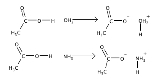
Brønsted-Lowry acid (or simply Brønsted acid) is a species that donates a proton to a Brønsted-Lowry base. Brønsted-Lowry acid-base theory has several advantages over Arrhenius theory. Consider the following reactions of
acetic acidAcetic acid is an organic compound with the chemical formula CH3CO2H . It is a colourless liquid that when undiluted is also called glacial acetic acid. Acetic acid is the main component of vinegar , and has a distinctive sour taste and pungent smell...
(CH
3COOH), the
organic acidAn organic acid is an organic compound with acidic properties. The most common organic acids are the carboxylic acids, whose acidity is associated with their carboxyl group –COOH. Sulfonic acids, containing the group –SO2OH, are relatively stronger acids. The relative stability of the conjugate...
that gives
vinegarVinegar is a liquid substance consisting mainly of acetic acid and water, the acetic acid being produced through the fermentation of ethanol by acetic acid bacteria. Commercial vinegar is produced either by fast or slow fermentation processes. Slow methods generally are used with traditional...
its characteristic taste:

Both theories easily describe the first reaction: CH
3COOH acts as an Arrhenius acid because it acts as a source of H
3O
+ when dissolved in water, and it acts as a Brønsted acid by donating a proton to water. In the second example CH
3COOH undergoes the same transformation, in this case donating a proton to ammonia (NH
3), but cannot be described using the Arrhenius definition of an acid because the reaction does not produce hydronium. Brønsted-Lowry theory can also be used to describe
molecular compoundsA molecule is an electrically neutral group of at least two atoms held together by covalent chemical bonds. Molecules are distinguished from ions by their electrical charge...
, whereas Arrhenius acids must be
ionic compoundsAn ion is an atom or molecule in which the total number of electrons is not equal to the total number of protons, giving it a net positive or negative electrical charge. The name was given by physicist Michael Faraday for the substances that allow a current to pass between electrodes in a...
.
Hydrogen chlorideThe compound hydrogen chloride has the formula HCl. At room temperature, it is a colorless gas, which forms white fumes of hydrochloric acid upon contact with atmospheric humidity. Hydrogen chloride gas and hydrochloric acid are important in technology and industry...
(HCl) and ammonia combine under several different conditions to form
ammonium chlorideAmmonium chloride NH4Cl is an inorganic compound with the formula NH4Cl. It is a white crystalline salt that is highly soluble in water. Solutions of ammonium chloride are mildly acidic. Sal ammoniac is a name of natural, mineralogical form of ammonium chloride...
, NH
4Cl. In aqueous solution HCl behaves as
hydrochloric acidHydrochloric acid is a solution of hydrogen chloride in water, that is a highly corrosive, strong mineral acid with many industrial uses. It is found naturally in gastric acid....
and exists as hydronium and chloride ions. The following reactions illustrate the limitations of Arrhenius's definition:
- H3O+(aq) + Cl−(aq) + NH3 → Cl−(aq) + NH4+(aq)
- HCl(benzene) + NH3(benzene) → NH4Cl(s)
- HCl(g) + NH3(g) → NH4Cl(s)
As with the acetic acid reactions, both definitions work for the first example, where water is the solvent and hydronium ion is formed. The next two reactions do not involve the formation of ions but are still proton transfer reactions. In the second reaction hydrogen chloride and ammonia (dissolved in
benzeneBenzene is an organic chemical compound. It is composed of 6 carbon atoms in a ring, with 1 hydrogen atom attached to each carbon atom, with the molecular formula C6H6....
) react to form solid ammonium chloride in a benzene solvent and in the third gaseous HCl and NH
3 combine to form the solid.
Lewis acids
A third concept was proposed in 1923 by
Gilbert N. LewisGilbert Newton Lewis was an American physical chemist known for the discovery of the covalent bond , his purification of heavy water, his reformulation of chemical thermodynamics in a mathematically rigorous manner accessible to ordinary chemists, his theory of Lewis acids and...
which includes reactions with acid-base characteristics that do not involve a proton transfer. A
Lewis acid is a species that accepts a pair of electrons from another species; in other words, it is an electron pair acceptor. Brønsted acid-base reactions are proton transfer reactions while Lewis acid-base reactions are electron pair transfers. All Brønsted acids are also
Lewis acid]The term Lewis acid refers to a definition of acid published by Gilbert N. Lewis in 1923, specifically: An acid substance is one which can employ a lone pair from another molecule in completing the stable group of one of its own atoms. Thus, H+ is a Lewis acid, since it can accept a lone pair,...
s, but not all Lewis acids are Brønsted acids. Contrast the following reactions which could be described in terms of acid-base chemistry.

In the first reaction a
fluoride ionFluoride is the anion F−, the reduced form of fluorine when as an ion and when bonded to another element. Both organofluorine compounds and inorganic fluorine containing compounds are called fluorides. Fluoride, like other halides, is a monovalent ion . Its compounds often have properties that are...
, F
−, gives up an
electron pairIn chemistry, a lone pair is a valence electron pair without bonding or sharing with other atoms. They are found in the outermost electron shell of an atom, so lone pairs are a subset of a molecule's valence electrons...
to
boron trifluorideBoron trifluoride is the chemical compound with the formula BF3. This pungent colourless toxic gas forms white fumes in moist air. It is a useful Lewis acid and a versatile building block for other boron compounds.-Structure and bonding:...
to form the product
tetrafluoroborateTetrafluoroborate is the anion BF4−. This tetrahedral species is isoelectronic with tetrafluoromethane, CF4 and tetrafluoroammonium NF4+, and is valence isoelectronic with many stable and important species including the closely related anion perchlorate, ClO4−...
. Fluoride "loses" a pair of
valence electronIn chemistry, valence electrons are the electrons of an atom that can participate in the formation of chemical bonds with other atoms. Valence electrons are the "own" electrons, present in the free neutral atom, that combine with valence electrons of other atoms to form chemical bonds. In a single...
s because the electrons shared in the B—F bond are located in the region of space between the two atomic
nucleiThe nucleus is the very dense region consisting of protons and neutrons at the center of an atom. It was discovered in 1911, as a result of Ernest Rutherford's interpretation of the famous 1909 Rutherford experiment performed by Hans Geiger and Ernest Marsden, under the direction of Rutherford. The...
and are therefore more distant from the fluoride nucleus than they are in the lone fluoride ion. BF
3 is a Lewis acid because it accepts the electron pair from fluoride. This reaction cannot be described in terms of Brønsted theory because there is no proton transfer. The second reaction can be described using either theory. A proton is transferred from an unspecified Brønsted acid to ammonia, a Brønsted base; alternatively, ammonia acts as a Lewis base and transfers a lone pair of electrons to form a bond with a hydrogen ion. The species that gains the electron pair is the Lewis acid; for example, the oxygen atom in H
3O
+ gains a pair of electrons when one of the H—O bonds is broken and the electrons shared in the bond become localized on oxygen. Depending on the context, a Lewis acid may also be described as an oxidizer or an
electrophileIn general electrophiles are positively charged species that are attracted to an electron rich centre. In chemistry, an electrophile is a reagent attracted to electrons that participates in a chemical reaction by accepting an electron pair in order to bond to a nucleophile...
.
The Brønsted-Lowry definition is the most widely used definition; unless otherwise specified acid-base reactions are assumed to involve the transfer of a proton (H
+) from an acid to a base.
Dissociation and equilibrium
Reactions of acids are often generalized in the form HA H
+ + A
−, where HA represents the acid and A
− is the
conjugate baseWithin the Brønsted–Lowry acid-base theory , a conjugate acid is the acid member, HX, of a pair of two compounds that transform into each other by gain or loss of a proton. A conjugate acid can also be seen as the chemical substance that releases, or donates, a proton in the forward chemical...
. Acid-base conjugate pairs differ by one proton, and can be interconverted by the addition or removal of a proton (
protonationIn chemistry, protonation is the addition of a proton to an atom, molecule, or ion. Some classic examples include*the protonation of water by sulfuric acid:*the protonation of isobutene in the formation of a carbocation:2C=CH2 + HBF4 → 3C+ + BF4−*the protonation of ammonia in the...
and
deprotonationDeprotonation is the removal of a proton from a molecule, forming the conjugate base.The relative ability of a molecule to give up a proton is measured by its pKa value. A low pKa value indicates that the compound is acidic and will easily give up its proton to a base...
, respectively). Note that the acid can be the charged species and the conjugate base can be neutral in which case the generalized reaction scheme could be written as HA
+ H
+ + A. In solution there exists an
equilibriumIn a chemical reaction, chemical equilibrium is the state in which the concentrations of the reactants and products have not yet changed with time. It occurs only in reversible reactions, and not in irreversible reactions. Usually, this state results when the forward reaction proceeds at the same...
between the acid and its conjugate base. The
equilibrium constant K is an expression of the equilibrium concentrations of the molecules or the ions in solution. Brackets indicate concentration, such that [H
2O] means
the concentration of H2O. The
acid dissociation constantAn acid dissociation constant, Ka, is a quantitative measure of the strength of an acid in solution. It is the equilibrium constant for a chemical reaction known as dissociation in the context of acid-base reactions...
Ka is generally used in the context of acid-base reactions. The numerical value of
Ka is equal to the concentration of the products divided by the concentration of the reactants, where the reactant is the acid (HA) and the products are the conjugate base and H
+.

The stronger of two acids will have a higher
Ka than the weaker acid; the ratio of hydrogen ions to acid will be higher for the stronger acid as the stronger acid has a greater tendency to lose its proton. Because the range of possible values for
Ka spans many orders of magnitude, a more manageable constant, p
Ka is more frequently used, where p
Ka = -log
10 Ka. Stronger acids have a smaller p
Ka than weaker acids. Experimentally determined p
Ka at 25°C in aqueous solution are often quoted in textbooks and reference material.
Nomenclature
In the classical naming system, acids are named according to their anions. That ionic suffix is dropped and replaced with a new suffix (and sometimes prefix), according to the table below.
For example, HCl has
chlorideThe chloride ion is formed when the element chlorine, a halogen, picks up one electron to form an anion Cl−. The salts of hydrochloric acid HCl contain chloride ions and can also be called chlorides. The chloride ion, and its salts such as sodium chloride, are very soluble in water...
as its anion, so the -ide suffix makes it take the form
hydrochloric acidHydrochloric acid is a solution of hydrogen chloride in water, that is a highly corrosive, strong mineral acid with many industrial uses. It is found naturally in gastric acid....
. In the IUPAC naming system, "aqueous" is simply added to the name of the ionic compound. Thus, for hydrogen chloride, the IUPAC name would be aqueous hydrogen chloride. The prefix "hydro-" is added only if the acid is made up of just hydrogen and one other element.
Classical naming system:
| Anion prefix |
Anion suffix |
Acid prefix |
Acid suffix |
Example |
| per |
ate |
per |
ic acid |
perchloric acid Perchloric acid is the inorganic compound with the formula HClO4. Usually encountered as an aqueous solution, this colourless compound is a strong acid comparable in strength to sulfuric and nitric acids. It is a powerful oxidizer, but its aqueous solutions up to appr. 70% are remarkably inert,... (HClO4) |
|
ate |
|
ic acid |
chloric acid Chloric acid, HClO3, is an oxoacid of chlorine, and the formal precursor of chlorate salts. It is a strong acid and oxidizing agent.... (HClO3) |
|
ite |
|
ous acid |
chlorous acid Chlorous acid is an inorganic compound with the formula HClO2. It is a weak acid. Chlorine has oxidation state +3 in this acid. The pure substance is unstable, disproportionating to hypochlorous acid and chloric acid :Although the acid is difficult to obtain in pure substance, the conjugate base,... (HClO2) |
| hypo |
ite |
hypo |
ous acid |
hypochlorous acid Hypochlorous acid is a weak acid with the chemical formula HClO. It forms when chlorine dissolves in water. It cannot be isolated in pure form due to rapid equilibration with its precursor... (HClO) |
|
ide |
hydro |
ic acid |
hydrochloric acidHydrochloric acid is a solution of hydrogen chloride in water, that is a highly corrosive, strong mineral acid with many industrial uses. It is found naturally in gastric acid.... (HCl) |
Acid strength
The strength of an acid refers to its ability or tendency to lose a proton. A strong acid is one that completely dissociates in water; in other words, one
moleThe mole is a unit of measurement used in chemistry to express amounts of a chemical substance, defined as an amount of a substance that contains as many elementary entities as there are atoms in 12 grams of pure carbon-12 , the isotope of carbon with atomic weight 12. This corresponds to a value...
of a strong acid HA dissolves in water yielding one mole of H
+ and one mole of the conjugate base, A
−, and none of the protonated acid HA. In contrast a weak acid only partially dissociates and at equilibrium both the acid and the conjugate base are in solution. Examples of
strong acidA strong acid is an acid that ionizes completely in an aqueous solution by losing one proton, according to the equationFor sulfuric acid which is diprotic, the "strong acid" designation refers only to dissociation of the first protonMore precisely, the acid must be stronger in aqueous solution than...
s are
hydrochloric acidHydrochloric acid is a solution of hydrogen chloride in water, that is a highly corrosive, strong mineral acid with many industrial uses. It is found naturally in gastric acid....
(HCl), hydroiodic acid (HI),
hydrobromic acidHydrobromic acid is a strong acid formed by dissolving the diatomic molecule hydrogen bromide in water. "Constant boiling" hydrobromic acid is an aqueous solution that distills at 124.3 °C and contains 47.6% HBr by weight, which is 8.89 mol/L. Hydrobromic acid has a pKa of −9, making it a...
(HBr),
perchloric acidPerchloric acid is the inorganic compound with the formula HClO4. Usually encountered as an aqueous solution, this colourless compound is a strong acid comparable in strength to sulfuric and nitric acids. It is a powerful oxidizer, but its aqueous solutions up to appr. 70% are remarkably inert,...
(HClO
4),
nitric acidNitric acid , also known as aqua fortis and spirit of nitre, is a highly corrosive and toxic strong acid.Colorless when pure, older samples tend to acquire a yellow cast due to the accumulation of oxides of nitrogen. If the solution contains more than 86% nitric acid, it is referred to as fuming...
(HNO
3) and
sulfuric acidSulfuric acid is a strong mineral acid with the molecular formula . Its historical name is oil of vitriol. Pure sulfuric acid is a highly corrosive, colorless, viscous liquid. The salts of sulfuric acid are called sulfates...
(H
2SO
4). In water each of these essentially ionizes 100%. The stronger an acid is, the more easily it loses a proton, H
+. Two key factors that contribute to the ease of deprotonation are the
polarityIn chemistry, polarity refers to a separation of electric charge leading to a molecule or its chemical groups having an electric dipole or multipole moment. Polar molecules interact through dipole–dipole intermolecular forces and hydrogen bonds. Molecular polarity is dependent on the difference in...
of the H—A bond and the size of atom A, which determines the strength of the H—A bond. Acid strengths are also often discussed in terms of the stability of the conjugate base.
Stronger acids have a larger
Ka and a more negative p
Ka than weaker acids.
Sulfonic acids, which are organic oxyacids, are a class of strong acids. A common example is toluenesulfonic acid (tosylic acid). Unlike sulfuric acid itself, sulfonic acids can be solids. In fact,
polystyrenePolystyrene ) also known as Thermocole, abbreviated following ISO Standard PS, is an aromatic polymer made from the monomer styrene, a liquid hydrocarbon that is manufactured from petroleum by the chemical industry...
functionalized into polystyrene sulfonate is a solid strongly acidic plastic that is filterable.
SuperacidAccording to the classical definition superacid is an acid with an acidity greater than that of 100% pure sulfuric acid, which has a Hammett acidity function of −12. According to the modern definition, superacid is a medium, in which the chemical potential of the proton is higher than in pure...
s are acids stronger than 100% sulfuric acid. Examples of superacids are
fluoroantimonic acidFluoroantimonic acid is a mixture of hydrogen fluoride and antimony pentafluoride in various ratios. The 1:1 combination forms the strongest known superacid, which has been demonstrated to protonate even hydrocarbons to afford carbocations and H2....
,
magic acidMagic acid , is a superacid consisting of a mixture, most commonly in a 1:1 molar ratio, of fluorosulfonic acid and antimony pentafluoride...
and
perchloric acidPerchloric acid is the inorganic compound with the formula HClO4. Usually encountered as an aqueous solution, this colourless compound is a strong acid comparable in strength to sulfuric and nitric acids. It is a powerful oxidizer, but its aqueous solutions up to appr. 70% are remarkably inert,...
. Superacids can permanently protonate water to give ionic, crystalline
hydroniumIn chemistry, a hydronium ion is the cation , a type of oxonium ion produced by protonation of water. This cation is often used to represent the nature of the proton in aqueous solution, where the proton is highly solvated...
"salts". They can also quantitatively stabilize
carbocationA carbocation is an ion with a positively-charged carbon atom. The charged carbon atom in a carbocation is a "sextet", i.e. it has only six electrons in its outer valence shell instead of the eight valence electrons that ensures maximum stability . Therefore carbocations are often reactive,...
s.
Polarity and the inductive effect
Polarity refers to the distribution of electrons in a
bondA chemical bond is an attraction between atoms that allows the formation of chemical substances that contain two or more atoms. The bond is caused by the electromagnetic force attraction between opposite charges, either between electrons and nuclei, or as the result of a dipole attraction...
, the region of space between two atomic nuclei where a pair of electrons is shared. When two atoms have roughly the same
electronegativityElectronegativity, symbol χ , is a chemical property that describes the tendency of an atom or a functional group to attract electrons towards itself. An atom's electronegativity is affected by both its atomic number and the distance that its valence electrons reside from the charged nucleus...
(ability to attract electrons) the electrons are shared evenly and spend equal time on either end of the bond. When there is a significant difference in electronegativities of two bonded atoms, the electrons spend more time near the nucleus of the more electronegative element and an electrical dipole, or separation of charges, occurs, such that there is a partial negative charge localized on the electronegative element and a partial positive charge on the electropositive element. Hydrogen is an electropositive element and accumulates a slightly positive charge when it is bonded to an electronegative element such as
oxygenOxygen is the element with atomic number 8 and represented by the symbol O. Its name derives from the Greek roots ὀξύς and -γενής , because at the time of naming, it was mistakenly thought that all acids required oxygen in their composition...
or
bromineBromine ") is a chemical element with the symbol Br, an atomic number of 35, and an atomic mass of 79.904. It is in the halogen element group. The element was isolated independently by two chemists, Carl Jacob Löwig and Antoine Jerome Balard, in 1825–1826...
. As the
electron densityElectron density is the measure of the probability of an electron being present at a specific location.In molecules, regions of electron density are usually found around the atom, and its bonds...
on hydrogen decreases it is more easily abstracted, in other words, it is more acidic. Moving from left to right across a row on the
periodic tableThe periodic table of the chemical elements is a tabular display of the 118 known chemical elements organized by selected properties of their atomic structures. Elements are presented by increasing atomic number, the number of protons in an atom's atomic nucleus...
elements become more electronegative (excluding the noble gases), and the strength of the
binary acidBinary acids are certain molecular compounds in which hydrogen is combined with a second nonmetallic element. Examples:*HF*HCl*HBr*HITheir strengths depend on the solvation of the initial acid, the H-X bond energy, the electron affinity energy of X, and the solvation energy of X...
formed by the element increases accordingly:
| Formula |
Name |
pKa |
| HF |
hydrofluoric acidHydrofluoric acid is a solution of hydrogen fluoride in water. It is a valued source of fluorine and is the precursor to numerous pharmaceuticals such as fluoxetine and diverse materials such as PTFE ....
|
3.17 |
| H2O |
water |
15.7 |
| NH3 |
ammoniaAmmonia is a compound of nitrogen and hydrogen with the formula . It is a colourless gas with a characteristic pungent odour. Ammonia contributes significantly to the nutritional needs of terrestrial organisms by serving as a precursor to food and fertilizers. Ammonia, either directly or...
|
38 |
| CH4 |
methane Methane is a chemical compound with the chemical formula . It is the simplest alkane, the principal component of natural gas, and probably the most abundant organic compound on earth. The relative abundance of methane makes it an attractive fuel...
|
48 |
The electronegative element need not be directly bonded to the acidic hydrogen to increase its acidity. An electronegative atom can pull electron density out of an acidic bond through the
inductive effectIn chemistry and physics, the inductive effect is an experimentally observable effect of the transmission of charge through a chain of atoms in a molecule by electrostatic induction...
. The electron-withdrawing ability diminishes quickly as the electronegative atom moves away from the acidic bond. The effect is illustrated by the following series of halogenated butanoic acids.
ChlorineChlorine is the chemical element with atomic number 17 and symbol Cl. It is the second lightest halogen, found in the periodic table in group 17. The element forms diatomic molecules under standard conditions, called dichlorine...
is more electronegative than
bromineBromine ") is a chemical element with the symbol Br, an atomic number of 35, and an atomic mass of 79.904. It is in the halogen element group. The element was isolated independently by two chemists, Carl Jacob Löwig and Antoine Jerome Balard, in 1825–1826...
and therefore has a stronger effect. The hydrogen atom bonded to the oxygen is the acidic hydrogen. Butanoic acid is a
carboxylic acidCarboxylic acids are organic acids characterized by the presence of at least one carboxyl group. The general formula of a carboxylic acid is R-COOH, where R is some monovalent functional group...
.
As the chlorine atom moves further away from the acidic O—H bond, its effect diminishes. When the chlorine atom is just one carbon removed from the carboxylic acid group the acidity of the compound increases significantly, compared to butanoic acid (a.k.a.
butyric acidButyric acid , also known under the systematic name butanoic acid, is a carboxylic acid with the structural formula CH3CH2CH2-COOH. Salts and esters of butyric acid are known as butyrates or butanoates...
). However, when the chlorine atom is separated by several bonds the effect is much smaller. Bromine is much more electronegative than either carbon or hydrogen, but not as electronegative as chlorine, so the p
Ka of 2-bromobutanoic acid is slightly greater than the p
Ka of 2-chlorobutanoic acid.
The number of electronegative atoms adjacent an acidic bond also affects acid strength.
OxoacidAn oxoacid is an acid that contains oxygen. To be more specific, it is an acid that:#contains oxygen#contains at least one other element#has at least one hydrogen atom bound to oxygen#forms an ion by the loss of one or more protons....
s have the general formula HOX where X can be any atom and may or may not share bonds to other atoms. Increasing the number of electronegative atoms or groups on atom X decreases the electron density in the acidic bond, making the loss of the proton easier. Perchloric acid is a very strong acid (p
Ka ≈ -8) and completely dissociates in water. Its chemical formula is HClO
4 and it comprises a central
chlorineChlorine is the chemical element with atomic number 17 and symbol Cl. It is the second lightest halogen, found in the periodic table in group 17. The element forms diatomic molecules under standard conditions, called dichlorine...
atom with three chlorine-oxygen double bonds (Cl=O) and one chlorine-oxygen single bond (Cl—O). The singly bonded oxygen bears an extremely acidic hydrogen atom which is easily abstracted. In contrast,
chloric acidChloric acid, HClO3, is an oxoacid of chlorine, and the formal precursor of chlorate salts. It is a strong acid and oxidizing agent....
(HClO
3) is a weaker acid, though still quite strong (p
Ka = -1.0), while
chlorous acidChlorous acid is an inorganic compound with the formula HClO2. It is a weak acid. Chlorine has oxidation state +3 in this acid. The pure substance is unstable, disproportionating to hypochlorous acid and chloric acid :Although the acid is difficult to obtain in pure substance, the conjugate base,...
(HClO
2, p
Ka = +2.0) and
hypochlorous acidHypochlorous acid is a weak acid with the chemical formula HClO. It forms when chlorine dissolves in water. It cannot be isolated in pure form due to rapid equilibration with its precursor...
(HClO, p
Ka = +7.53) acids are weak acids.
Carboxylic acidCarboxylic acids are organic acids characterized by the presence of at least one carboxyl group. The general formula of a carboxylic acid is R-COOH, where R is some monovalent functional group...
s are
organic acidAn organic acid is an organic compound with acidic properties. The most common organic acids are the carboxylic acids, whose acidity is associated with their carboxyl group –COOH. Sulfonic acids, containing the group –SO2OH, are relatively stronger acids. The relative stability of the conjugate...
s that contain an acidic hydroxyl group and a
carbonylIn organic chemistry, a carbonyl group is a functional group composed of a carbon atom double-bonded to an oxygen atom: C=O. It is common to several classes of organic compounds, as part of many larger functional groups....
(C=O bond). Carboxylic acids can be
reducedRedox reactions describe all chemical reactions in which atoms have their oxidation state changed....
to the corresponding alcohol; the replacement of an electronegative oxygen atom with two electropositive hydrogens yields a product which is essentially non-acidic. The reduction of
acetic acidAcetic acid is an organic compound with the chemical formula CH3CO2H . It is a colourless liquid that when undiluted is also called glacial acetic acid. Acetic acid is the main component of vinegar , and has a distinctive sour taste and pungent smell...
to
ethanolEthanol, also called ethyl alcohol, pure alcohol, grain alcohol, or drinking alcohol, is a volatile, flammable, colorless liquid. It is a psychoactive drug and one of the oldest recreational drugs. Best known as the type of alcohol found in alcoholic beverages, it is also used in thermometers, as a...
using LiAlH
4 (
lithium aluminium hydrideLithium aluminium hydride, commonly abbreviated to LAH or known as LithAl, is an inorganic compound with the chemical formula LiAlH4. It was discovered by Finholt, Bond and Schlesinger in 1947. This compound is used as a reducing agent in organic synthesis, especially for the reduction of esters,...
or LAH) and
etherDiethyl ether, also known as ethyl ether, simply ether, or ethoxyethane, is an organic compound in the ether class with the formula . It is a colorless, highly volatile flammable liquid with a characteristic odor...
is an example of such a reaction.

The p
Ka for ethanol is 16, compared to 4.76 for acetic acid.
Atomic radius and bond strength
Another factor that contributes to the ability of an acid to lose a proton is the strength of the
bondA chemical bond is an attraction between atoms that allows the formation of chemical substances that contain two or more atoms. The bond is caused by the electromagnetic force attraction between opposite charges, either between electrons and nuclei, or as the result of a dipole attraction...
between the acidic hydrogen and the atom that bears it. This, in turn, is dependent on the size of the atoms sharing the bond. For an acid HA, as the size of atom A increases, the strength of the bond decreases, meaning that it is more easily broken, and the strength of the acid increases. Bond strength is a measure of how much
energyIn chemistry, bond energy is the measure of bond strength in a chemical bond. It is the heat required to break one Mole of molecules into their individual atoms. For example, the carbon-hydrogen bond energy in methane E is the enthalpy change involved with breaking up one molecule of methane into...
it takes to break a bond. In other words, it takes less energy to break the bond as atom A grows larger, and the proton is more easily removed by a base. This partially explains why hydrofluoric acid is considered a weak acid while the other hydrohalic acids (HCl, HBr, HI) are strong acids. Although fluorine is more electronegative than the other halogens, its
atomic radiusThe atomic radius of a chemical element is a measure of the size of its atoms, usually the mean or typical distance from the nucleus to the boundary of the surrounding cloud of electrons...
is also much smaller, so it shares a stronger bond with hydrogen. Moving down a column on the periodic table atoms become less electronegative but also significantly larger, and the size of the atom tends to dominate its acidity when sharing a bond to hydrogen.
Hydrogen sulfideHydrogen sulfide is the chemical compound with the formula . It is a colorless, very poisonous, flammable gas with the characteristic foul odor of expired eggs perceptible at concentrations as low as 0.00047 parts per million...
, H
2S, is a stronger acid than water, even though oxygen is more electronegative than sulfur. Just as with the halogens, this is because sulfur is larger than oxygen and the H—S bond is more easily broken than the H—O bond.
Monoprotic acids
Monoprotic acids are those acids that are able to donate one
protonThe proton is a subatomic particle with the symbol or and a positive electric charge of 1 elementary charge. One or more protons are present in the nucleus of each atom, along with neutrons. The number of protons in each atom is its atomic number....
per molecule during the process of
dissociationDissociation in chemistry and biochemistry is a general process in which ionic compounds separate or split into smaller particles, ions, or radicals, usually in a reversible manner...
(sometimes called ionization) as shown below (symbolized by HA):
-
-
-
-
- HA(aq) + H2O(l) H3O+(aq) + A−(aq) Ka
Common examples of monoprotic acids in
mineral acidA mineral acid is an acid derived from one or more inorganic compounds. A mineral acid is not organic and all mineral acids release hydrogen ions when dissolved in water.-Characteristics:...
s include
hydrochloric acidHydrochloric acid is a solution of hydrogen chloride in water, that is a highly corrosive, strong mineral acid with many industrial uses. It is found naturally in gastric acid....
(HCl) and
nitric acidNitric acid , also known as aqua fortis and spirit of nitre, is a highly corrosive and toxic strong acid.Colorless when pure, older samples tend to acquire a yellow cast due to the accumulation of oxides of nitrogen. If the solution contains more than 86% nitric acid, it is referred to as fuming...
(HNO
3). On the other hand, for organic acids the term mainly indicates the presence of one
carboxylic acidCarboxylic acids are organic acids characterized by the presence of at least one carboxyl group. The general formula of a carboxylic acid is R-COOH, where R is some monovalent functional group...
group and sometimes these acids are known as monocarboxylic acid. Examples in organic acids include
formic acidFormic acid is the simplest carboxylic acid. Its chemical formula is HCOOH or HCO2H. It is an important intermediate in chemical synthesis and occurs naturally, most notably in the venom of bee and ant stings. In fact, its name comes from the Latin word for ant, formica, referring to its early...
(HCOOH),
acetic acidAcetic acid is an organic compound with the chemical formula CH3CO2H . It is a colourless liquid that when undiluted is also called glacial acetic acid. Acetic acid is the main component of vinegar , and has a distinctive sour taste and pungent smell...
(CH
3COOH) and
benzoic acidBenzoic acid , C7H6O2 , is a colorless crystalline solid and the simplest aromatic carboxylic acid. The name derived from gum benzoin, which was for a long time the only source for benzoic acid. Its salts are used as a food preservative and benzoic acid is an important precursor for the synthesis...
(C
6H
5COOH).
Polyprotic acids
Polyprotic acids, also known as polybasic acids, are able to donate more than one proton per acid molecule, in contrast to monoprotic acids that only donate one proton per molecule. Specific types of polyprotic acids have more specific names, such as diprotic acid (two potential protons to donate) and triprotic acid (three potential protons to donate).
A diprotic acid (here symbolized by H
2A) can undergo one or two dissociations depending on the pH. Each dissociation has its own dissociation constant, K
a1 and K
a2.
-
-
-
-
- H2A(aq) + H2O(l) H3O+(aq) + HA−(aq) Ka1
-
-
-
-
- HA−(aq) + H2O(l) H3O+(aq) + A2−(aq) Ka2
The first dissociation constant is typically greater than the second; i.e.,
Ka1 >
Ka2. For example,
sulfuric acidSulfuric acid is a strong mineral acid with the molecular formula . Its historical name is oil of vitriol. Pure sulfuric acid is a highly corrosive, colorless, viscous liquid. The salts of sulfuric acid are called sulfates...
(H
2SO
4) can donate one proton to form the bisulfate anion (HSO
4−), for which
Ka1 is very large; then it can donate a second proton to form the
sulfateIn inorganic chemistry, a sulfate is a salt of sulfuric acid.-Chemical properties:...
anion (SO
42-), wherein the
Ka2 is intermediate strength. The large
Ka1 for the first dissociation makes sulfuric a strong acid. In a similar manner, the weak unstable
carbonic acidCarbonic acid is the inorganic compound with the formula H2CO3 . It is also a name sometimes given to solutions of carbon dioxide in water, because such solutions contain small amounts of H2CO3. Carbonic acid forms two kinds of salts, the carbonates and the bicarbonates...
(H
2CO
3) can lose one proton to form
bicarbonateIn inorganic chemistry, bicarbonate is an intermediate form in the deprotonation of carbonic acid...
anion (HCO
3−) and lose a second to form
carbonateIn chemistry, a carbonate is a salt of carbonic acid, characterized by the presence of the carbonate ion, . The name may also mean an ester of carbonic acid, an organic compound containing the carbonate group C2....
anion (CO
32-). Both
Ka values are small, but
Ka1 >
Ka2 .
A triprotic acid (H
3A) can undergo one, two, or three dissociations and has three dissociation constants, where
Ka1 >
Ka2 >
Ka3.
-
-
-
-
- H3A(aq) + H2O(l) H3O+(aq) + H2A−(aq) Ka1
-
-
-
-
- H2A−(aq) + H2O(l) H3O+(aq) + HA2−(aq) Ka2
-
-
-
-
- HA2−(aq) + H2O(l) H3O+(aq) + A3−(aq) Ka3
An inorganic example of a triprotic acid is orthophosphoric acid (H
3PO
4), usually just called
phosphoric acidPhosphoric acid, also known as orthophosphoric acid or phosphoric acid, is a mineral acid having the chemical formula H3PO4. Orthophosphoric acid molecules can combine with themselves to form a variety of compounds which are also referred to as phosphoric acids, but in a more general way...
. All three protons can be successively lost to yield H
2PO
4−, then HPO
42-, and finally PO
43-, the orthophosphate ion, usually just called
phosphateA phosphate, an inorganic chemical, is a salt of phosphoric acid. In organic chemistry, a phosphate, or organophosphate, is an ester of phosphoric acid. Organic phosphates are important in biochemistry and biogeochemistry or ecology. Inorganic phosphates are mined to obtain phosphorus for use in...
. An
organicAn organic compound is any member of a large class of gaseous, liquid, or solid chemical compounds whose molecules contain carbon. For historical reasons discussed below, a few types of carbon-containing compounds such as carbides, carbonates, simple oxides of carbon, and cyanides, as well as the...
example of a triprotic acid is
citric acidCitric acid is a weak organic acid. It is a natural preservative/conservative and is also used to add an acidic, or sour, taste to foods and soft drinks...
, which can successively lose three protons to finally form the
citrateA citrate can refer either to the conjugate base of citric acid, , or to the esters of citric acid. An example of the former, a salt is trisodium citrate; an ester is triethyl citrate.-Other citric acid ions:...
ion. Even though the positions of the protons on the original molecule may be equivalent, the successive
Ka values will differ since it is energetically less favorable to lose a proton if the conjugate base is more negatively charged.
Although the subsequent loss of each hydrogen ion is less favorable, all of the conjugate bases are present in solution. The fractional concentration,
α (alpha), for each species can be calculated. For example, a generic diprotic acid will generate 3 species in solution: H
2A, HA
-, and A
2-. The fractional concentrations can be calculated as below when given either the pH (which can be converted to the [H
+]) or the concentrations of the acid with all its conjugate bases:
A pattern is observed in the above equations and can be expanded to the general
n -protic acid that has been deprotonated
i -times:

where K
0 = 1 and the other K-terms are the dissociation constants for the acid.
Neutralization
Neutralization is the reaction between an acid and a base, producing a salt and neutralized base; for example, hydrochloric acid and sodium hydroxide form sodium chloride and water:
-
- HCl(aq) + NaOH(aq) → H2O(l) + NaCl(aq)
Neutralization is the basis of
titrationTitration, also known as titrimetry, is a common laboratory method of quantitative chemical analysis that is used to determine the unknown concentration of an identified analyte. Because volume measurements play a key role in titration, it is also known as volumetric analysis. A reagent, called the...
, where a
pH indicatorA pH indicator is a halochromic chemical compound that is added in small amounts to a solution so that the pH of the solution can be determined visually. Hence a pH indicator is a chemical detector for hydronium ions or hydrogen ions in the Arrhenius model. Normally, the indicator causes the...
shows equivalence point when the equivalent number of moles of a base have been added to an acid. It is often wrongly assumed that neutralization should result in a solution with pH 7.0, which is only the case with similar acid and base strengths during a reaction.
Neutralization with a base weaker than the acid results in a weakly acidic salt. An example is the weakly acidic
ammonium chlorideAmmonium chloride NH4Cl is an inorganic compound with the formula NH4Cl. It is a white crystalline salt that is highly soluble in water. Solutions of ammonium chloride are mildly acidic. Sal ammoniac is a name of natural, mineralogical form of ammonium chloride...
, which is produced from the strong acid
hydrogen chlorideThe compound hydrogen chloride has the formula HCl. At room temperature, it is a colorless gas, which forms white fumes of hydrochloric acid upon contact with atmospheric humidity. Hydrogen chloride gas and hydrochloric acid are important in technology and industry...
and the weak base
ammoniaAmmonia is a compound of nitrogen and hydrogen with the formula . It is a colourless gas with a characteristic pungent odour. Ammonia contributes significantly to the nutritional needs of terrestrial organisms by serving as a precursor to food and fertilizers. Ammonia, either directly or...
. Conversely, neutralizing a weak acid with a strong base gives a weakly basic salt, e.g.
sodium fluorideSodium fluoride is an inorganic chemical compound with the formula NaF. A colorless solid, it is a source of the fluoride ion in diverse applications. Sodium fluoride is less expensive and less hygroscopic than the related salt potassium fluoride....
from
hydrogen fluorideHydrogen fluoride is a chemical compound with the formula HF. This colorless gas is the principal industrial source of fluorine, often in the aqueous form as hydrofluoric acid, and thus is the precursor to many important compounds including pharmaceuticals and polymers . HF is widely used in the...
and
sodium hydroxide.
Weak acid/weak base equilibria
In order to lose a proton, it is necessary that the pH of the system rise above the p
Ka of the protonated acid. The decreased concentration of H
+ in that basic solution shifts the equilibrium towards the conjugate base form (the deprotonated form of the acid). In lower-pH (more acidic) solutions, there is a high enough H
+ concentration in the solution to cause the acid to remain in its protonated form, or to protonate its conjugate base (the deprotonated form).
Solutions of weak acids and salts of their conjugate bases form
buffer solutionA buffer solution is an aqueous solution consisting of a mixture of a weak acid and its conjugate base or a weak base and its conjugate acid. It has the property that the pH of the solution changes very little when a small amount of strong acid or base is added to it. Buffer solutions are used as a...
s.
Applications of acids
There are numerous uses for acids. Acids are often used to remove rust and other corrosion from metals in a process known as
picklingTarnision is a metal surface treatment used to remove impurities, such as stains, inorganic contaminants, rust or scale from ferrous metals, copper, and aluminum alloys. A solution called Tarnision liquor, which contains strong acids, is used to remove the surface impurities...
. They may be used as an electrolyte in a wet cell battery, such as
sulfuric acidSulfuric acid is a strong mineral acid with the molecular formula . Its historical name is oil of vitriol. Pure sulfuric acid is a highly corrosive, colorless, viscous liquid. The salts of sulfuric acid are called sulfates...
in a
car batteryAn automotive battery is a type of rechargeable battery that supplies electric energy to an automobile. Usually this refers to an SLI battery to power the starter motor, the lights, and the ignition system of a vehicle’s engine...
.
Strong acids, sulfuric acid in particular, are widely used in mineral processing. For example, phosphate minerals react with sulfuric acid to produce
phosphoric acidPhosphoric acid, also known as orthophosphoric acid or phosphoric acid, is a mineral acid having the chemical formula H3PO4. Orthophosphoric acid molecules can combine with themselves to form a variety of compounds which are also referred to as phosphoric acids, but in a more general way...
for the production of phosphate fertilizers, and
zincZinc , or spelter , is a metallic chemical element; it has the symbol Zn and atomic number 30. It is the first element in group 12 of the periodic table. Zinc is, in some respects, chemically similar to magnesium, because its ion is of similar size and its only common oxidation state is +2...
is produced by dissolving zinc oxide into sulfuric acid, purifying the solution and electrowinning.
In the chemical industry, acids react in neutralization reactions to produce salts. For example,
nitric acidNitric acid , also known as aqua fortis and spirit of nitre, is a highly corrosive and toxic strong acid.Colorless when pure, older samples tend to acquire a yellow cast due to the accumulation of oxides of nitrogen. If the solution contains more than 86% nitric acid, it is referred to as fuming...
reacts with
ammoniaAmmonia is a compound of nitrogen and hydrogen with the formula . It is a colourless gas with a characteristic pungent odour. Ammonia contributes significantly to the nutritional needs of terrestrial organisms by serving as a precursor to food and fertilizers. Ammonia, either directly or...
to produce
ammonium nitrate, a fertilizer. Additionally,
carboxylic acidCarboxylic acids are organic acids characterized by the presence of at least one carboxyl group. The general formula of a carboxylic acid is R-COOH, where R is some monovalent functional group...
s can be esterified with
alcoholIn chemistry, an alcohol is an organic compound in which the hydroxy functional group is bound to a carbon atom. In particular, this carbon center should be saturated, having single bonds to three other atoms....
s, to produce
esterEsters are chemical compounds derived by reacting an oxoacid with a hydroxyl compound such as an alcohol or phenol. Esters are usually derived from an inorganic acid or organic acid in which at least one -OH group is replaced by an -O-alkyl group, and most commonly from carboxylic acids and...
s.
Acids are used as additives to drinks and foods, as they alter their taste and serve as preservatives.
Phosphoric acidPhosphoric acid, also known as orthophosphoric acid or phosphoric acid, is a mineral acid having the chemical formula H3PO4. Orthophosphoric acid molecules can combine with themselves to form a variety of compounds which are also referred to as phosphoric acids, but in a more general way...
, for example, is a component of
colaCola is a carbonated beverage that was typically flavored by the kola nut as well as vanilla and other flavorings, however, some colas are now flavored artificially. It became popular worldwide after druggist John Pemberton invented Coca-Cola in 1886...
drinks. Acetic acid is used in day to day life as vinegar. Carbonic acid is an important part of some cola drinks and soda.
Citric acid is used as a preservative in sauces and pickles.
Tartaric acidTartaric acid is a white crystalline diprotic organic acid. It occurs naturally in many plants, particularly grapes, bananas, and tamarinds; is commonly combined with baking soda to function as a leavening agent in recipes, and is one of the main acids found in wine. It is added to other foods to...
is an important component of some commonly used foods like unripened mangoes and tamarind. Natural fruits and vegetables also contain acids.
Citric acidCitric acid is a weak organic acid. It is a natural preservative/conservative and is also used to add an acidic, or sour, taste to foods and soft drinks...
is present in oranges, lemon and other citrus fruits.
Oxalic acidOxalic acid is an organic compound with the formula H2C2O4. This colourless solid is a dicarboxylic acid. In terms of acid strength, it is about 3,000 times stronger than acetic acid. Oxalic acid is a reducing agent and its conjugate base, known as oxalate , is a chelating agent for metal cations...
is present in tomatoes, spinach, and especially in
carambolaCarambola, also known as starfruit, is the fruit of Averrhoa carambola, a species of tree native to the Philippines, Indonesia, Malaysia, India, Bangladesh and Sri Lanka. The fruit is a popular food throughout Southeast Asia, the South Pacific and parts of East Asia...
and
rhubarbRhubarb is a group of plants that belong to the genus Rheum in the family Polygonaceae. They are herbaceous perennial plants growing from short, thick rhizomes. They have large leaves that are somewhat triangular-shaped with long fleshy petioles...
; rhubarb leaves and unripe carambolas are toxic because of high concentrations of oxalic acid.
Ascorbic acidAscorbic acid is a naturally occurring organic compound with antioxidant properties. It is a white solid, but impure samples can appear yellowish. It dissolves well in water to give mildly acidic solutions. Ascorbic acid is one form of vitamin C. The name is derived from a- and scorbutus , the...
(Vitamin C) is an essential vitamin required in our body and is present in such foods as amla, lemon, citrus fruits, and guava.
Certain acids are used as drugs. Acetylsalicylic acid (Aspirin) is used as a pain killer and for bringing down fevers.
Acids play very important roles in the human body. The hydrochloric acid present in our stomach aids in digestion by breaking down large and complex food molecules. Amino acids are required for synthesis of proteins required for growth and repair of our body tissues. Fatty acids are also required for growth and repair of body tissues. Nucleic acids are important for the manufacturing of DNA, RNA and transmission of characters to offspring through genes. Carbonic acid is important for maintenance of pH equilibrium in the body.
Acid catalysis
Acids are used as catalysts in industrial and organic chemistry; for example,
sulfuric acidSulfuric acid is a strong mineral acid with the molecular formula . Its historical name is oil of vitriol. Pure sulfuric acid is a highly corrosive, colorless, viscous liquid. The salts of sulfuric acid are called sulfates...
is used in very large quantities in the
alkylationAlkylation is the transfer of an alkyl group from one molecule to another. The alkyl group may be transferred as an alkyl carbocation, a free radical, a carbanion or a carbene . Alkylating agents are widely used in chemistry because the alkyl group is probably the most common group encountered in...
process to produce gasoline. Strong acids, such as sulfuric, phosphoric and hydrochloric acids also effect
dehydrationIn chemistry and the biological sciences, a dehydration reaction is usually defined as a chemical reaction that involves the loss of water from the reacting molecule. Dehydration reactions are a subset of elimination reactions...
and
condensation reactionA condensation reaction is a chemical reaction in which two molecules or moieties combine to form one single molecule, together with the loss of a small molecule. When this small molecule is water, it is known as a dehydration reaction; other possible small molecules lost are hydrogen chloride,...
s. In biochemistry, many
enzymeEnzymes are proteins that catalyze chemical reactions. In enzymatic reactions, the molecules at the beginning of the process, called substrates, are converted into different molecules, called products. Almost all chemical reactions in a biological cell need enzymes in order to occur at rates...
s employ acid catalysis.
Biological occurrence
Many biologically important molecules are acids.
Nucleic acidNucleic acids are biological molecules essential for life, and include DNA and RNA . Together with proteins, nucleic acids make up the most important macromolecules; each is found in abundance in all living things, where they function in encoding, transmitting and expressing genetic information...
s, which contain acidic
phosphate groupsA phosphate, an inorganic chemical, is a salt of phosphoric acid. In organic chemistry, a phosphate, or organophosphate, is an ester of phosphoric acid. Organic phosphates are important in biochemistry and biogeochemistry or ecology. Inorganic phosphates are mined to obtain phosphorus for use in...
, include
DNADeoxyribonucleic acid is a nucleic acid that contains the genetic instructions used in the development and functioning of all known living organisms . The DNA segments that carry this genetic information are called genes, but other DNA sequences have structural purposes, or are involved in...
and
RNARibonucleic acid , or RNA, is one of the three major macromolecules that are essential for all known forms of life....
. Nucleic acids contain the genetic code that determines many of an organism's characteristics, and is passed from parents to offspring. DNA contains the chemical blueprint for the synthesis of
proteinProteins are biochemical compounds consisting of one or more polypeptides typically folded into a globular or fibrous form, facilitating a biological function. A polypeptide is a single linear polymer chain of amino acids bonded together by peptide bonds between the carboxyl and amino groups of...
s which are made up of
amino acidAmino acids are molecules containing an amine group, a carboxylic acid group and a side-chain that varies between different amino acids. The key elements of an amino acid are carbon, hydrogen, oxygen, and nitrogen...
subunits.
Cell membraneThe cell membrane or plasma membrane is a biological membrane that separates the interior of all cells from the outside environment. The cell membrane is selectively permeable to ions and organic molecules and controls the movement of substances in and out of cells. It basically protects the cell...
s contain
fatty acidIn chemistry, especially biochemistry, a fatty acid is a carboxylic acid with a long unbranched aliphatic tail , which is either saturated or unsaturated. Most naturally occurring fatty acids have a chain of an even number of carbon atoms, from 4 to 28. Fatty acids are usually derived from...
esterEsters are chemical compounds derived by reacting an oxoacid with a hydroxyl compound such as an alcohol or phenol. Esters are usually derived from an inorganic acid or organic acid in which at least one -OH group is replaced by an -O-alkyl group, and most commonly from carboxylic acids and...
s such as phospholipids.
An α-amino acid has a central carbon (the α or
alpha carbon) which is covalently bonded to a carboxyl group (thus they are
carboxylic acidCarboxylic acids are organic acids characterized by the presence of at least one carboxyl group. The general formula of a carboxylic acid is R-COOH, where R is some monovalent functional group...
s), an
aminoAmines are organic compounds and functional groups that contain a basic nitrogen atom with a lone pair. Amines are derivatives of ammonia, wherein one or more hydrogen atoms have been replaced by a substituent such as an alkyl or aryl group. Important amines include amino acids, biogenic amines,...
group, a hydrogen atom and a variable group. The variable group, also called the R group or side chain, determines the identity and many of the properties of a specific amino acid. In
glycineGlycine is an organic compound with the formula NH2CH2COOH. Having a hydrogen substituent as its 'side chain', glycine is the smallest of the 20 amino acids commonly found in proteins. Its codons are GGU, GGC, GGA, GGG cf. the genetic code.Glycine is a colourless, sweet-tasting crystalline solid...
, the simplest amino acid, the R group is a hydrogen atom, but in all other amino acids it is contains one or more carbon atoms bonded to hydrogens, and may contain other elements such as sulfur, oxygen or nitrogen. With the exception of glycine, naturally occurring amino acids are
chiralA chiral molecule is a type of molecule that lacks an internal plane of symmetry and thus has a non-superimposable mirror image. The feature that is most often the cause of chirality in molecules is the presence of an asymmetric carbon atom....
and almost invariably occur in the
L-configuration.
PeptidoglycanPeptidoglycan, also known as murein, is a polymer consisting of sugars and amino acids that forms a mesh-like layer outside the plasma membrane of bacteria , forming the cell wall. The sugar component consists of alternating residues of β- linked N-acetylglucosamine and N-acetylmuramic acid...
, found in some
bacteriaBacteria are a large domain of prokaryotic microorganisms. Typically a few micrometres in length, bacteria have a wide range of shapes, ranging from spheres to rods and spirals...
l
cell wallThe cell wall is the tough, usually flexible but sometimes fairly rigid layer that surrounds some types of cells. It is located outside the cell membrane and provides these cells with structural support and protection, and also acts as a filtering mechanism. A major function of the cell wall is to...
s contains some
D-amino acids. At physiological pH, typically around 7, free amino acids exist in a charged form, where the acidic carboxyl group (-COOH) loses a proton (-COO
−) and the basic amine group (-NH
2) gains a proton (-NH
3+). The entire molecule has a net neutral charge and is a
zwitterionIn chemistry, a zwitterion is a neutral molecule with a positive and a negative electrical charge at different locations within that molecule. Zwitterions are sometimes also called inner salts.-Examples:...
, with the exception of amino acids with basic or acidic side chains.
Aspartic acidAspartic acid is an α-amino acid with the chemical formula HOOCCHCH2COOH. The carboxylate anion, salt, or ester of aspartic acid is known as aspartate. The L-isomer of aspartate is one of the 20 proteinogenic amino acids, i.e., the building blocks of proteins...
, for example, possesses one protonated amine and two deprotonated carboxyl groups, for a net charge of -1 at physiological pH.
Fatty acids and fatty acid derivatives are another group of carboxylic acids that play a significant role in biology. These contain long hydrocarbon chains and a carboxylic acid group on one end. The cell membrane of nearly all organisms is primarily made up of a phospholipid bilayer, a
micelleA micelle is an aggregate of surfactant molecules dispersed in a liquid colloid. A typical micelle in aqueous solution forms an aggregate with the hydrophilic "head" regions in contact with surrounding solvent, sequestering the hydrophobic single tail regions in the micelle centre. This phase is...
of hydrophobic fatty acid esters with polar, hydrophilic
phosphateA phosphate, an inorganic chemical, is a salt of phosphoric acid. In organic chemistry, a phosphate, or organophosphate, is an ester of phosphoric acid. Organic phosphates are important in biochemistry and biogeochemistry or ecology. Inorganic phosphates are mined to obtain phosphorus for use in...
"head" groups. Membranes contain additional components, some of which can participate in acid-base reactions.
In humans and many other animals,
hydrochloric acidHydrochloric acid is a solution of hydrogen chloride in water, that is a highly corrosive, strong mineral acid with many industrial uses. It is found naturally in gastric acid....
is a part of the
gastric acidGastric acid is a digestive fluid, formed in the stomach. It has a pH of 1 to 2 and is composed of hydrochloric acid , and large quantities of potassium chloride and sodium chloride...
secreted within the
stomachThe stomach is a muscular, hollow, dilated part of the alimentary canal which functions as an important organ of the digestive tract in some animals, including vertebrates, echinoderms, insects , and molluscs. It is involved in the second phase of digestion, following mastication .The stomach is...
to help hydrolyze
proteinProteins are biochemical compounds consisting of one or more polypeptides typically folded into a globular or fibrous form, facilitating a biological function. A polypeptide is a single linear polymer chain of amino acids bonded together by peptide bonds between the carboxyl and amino groups of...
s and
polysaccharidePolysaccharides are long carbohydrate molecules, of repeated monomer units joined together by glycosidic bonds. They range in structure from linear to highly branched. Polysaccharides are often quite heterogeneous, containing slight modifications of the repeating unit. Depending on the structure,...
s, as well as converting the inactive pro-enzyme, pepsinogen into the
enzyme'Digestive enzymes' are enzymes that break down polymeric macromolecules into their smaller building blocks, in order to facilitate their absorption by the body. Digestive enzymes are found in the digestive tract of animals where they aid in the digestion of food as well as inside the cells,...
,
pepsinPepsin is an enzyme whose precursor form is released by the chief cells in the stomach and that degrades food proteins into peptides. It was discovered in 1836 by Theodor Schwann who also coined its name from the Greek word pepsis, meaning digestion...
. Some organisms produce acids for defense; for example, ants produce
formic acidFormic acid is the simplest carboxylic acid. Its chemical formula is HCOOH or HCO2H. It is an important intermediate in chemical synthesis and occurs naturally, most notably in the venom of bee and ant stings. In fact, its name comes from the Latin word for ant, formica, referring to its early...
.
Acid-base equilibrium plays a critical role in regulating
mammalMammals are members of a class of air-breathing vertebrate animals characterised by the possession of endothermy, hair, three middle ear bones, and mammary glands functional in mothers with young...
ian breathing. Oxygen gas (O
2) drives
cellular respirationCellular respiration is the set of the metabolic reactions and processes that take place in the cells of organisms to convert biochemical energy from nutrients into adenosine triphosphate , and then release waste products. The reactions involved in respiration are catabolic reactions that involve...
, the process by which animals release the chemical
potential energyIn physics, potential energy is the energy stored in a body or in a system due to its position in a force field or due to its configuration. The SI unit of measure for energy and work is the Joule...
stored in food, producing
carbon dioxideCarbon dioxide is a naturally occurring chemical compound composed of two oxygen atoms covalently bonded to a single carbon atom...
(CO
2) as a byproduct. Oxygen and carbon dioxide are exchanged in the lungs, and the body responds to changing energy demands by adjusting the rate of
ventilationIn respiratory physiology, ventilation is the rate at which gas enters or leaves the lung. It is categorized under the following definitions:-Sample values:...
. For example, during periods of exertion the body rapidly breaks down stored
carbohydrateA carbohydrate is an organic compound with the empirical formula ; that is, consists only of carbon, hydrogen, and oxygen, with a hydrogen:oxygen atom ratio of 2:1 . However, there are exceptions to this. One common example would be deoxyribose, a component of DNA, which has the empirical...
s and
fatFats consist of a wide group of compounds that are generally soluble in organic solvents and generally insoluble in water. Chemically, fats are triglycerides, triesters of glycerol and any of several fatty acids. Fats may be either solid or liquid at room temperature, depending on their structure...
, releasing CO
2 into the blood stream. In aqueous solutions such as blood CO
2 exists in equilibrium with
carbonic acidCarbonic acid is the inorganic compound with the formula H2CO3 . It is also a name sometimes given to solutions of carbon dioxide in water, because such solutions contain small amounts of H2CO3. Carbonic acid forms two kinds of salts, the carbonates and the bicarbonates...
and
bicarbonateIn inorganic chemistry, bicarbonate is an intermediate form in the deprotonation of carbonic acid...
ion.
- CO2 + H2O H2CO3 H+ + HCO3−
It is the decrease in pH that signals the brain to breathe faster and deeper, expelling the excess CO
2 and resupplying the cells with O
2.
Cell membraneThe cell membrane or plasma membrane is a biological membrane that separates the interior of all cells from the outside environment. The cell membrane is selectively permeable to ions and organic molecules and controls the movement of substances in and out of cells. It basically protects the cell...
s are generally impermeable to charged or large, polar molecules because of the lipophilic fatty acyl chains comprising their interior. Many biologically important molecules, including a number of pharmaceutical agents, are organic weak acids which can cross the membrane in their protonated, uncharged form but not in their charged form (i.e. as the conjugate base). For this reason the activity of many drugs can be enhanced or inhibited by the use of antacids or acidic foods. The charged form, however, is often more soluble in blood and
cytosolThe cytosol or intracellular fluid is the liquid found inside cells, that is separated into compartments by membranes. For example, the mitochondrial matrix separates the mitochondrion into compartments....
, both aqueous environments. When the extracellular environment is more acidic than the neutral pH within the cell, certain acids will exist in their neutral form and will be membrane soluble, allowing them to cross the phospholipid bilayer. Acids that lose a proton at the
intracellular pHAll cells contain an intracellular fluid whose pH value is known as the intracellular pH . The pHi plays a critical role in the function of the cell, and close regulation is required for cells to survive...
will exist in their soluble, charged form and are thus able to diffuse through the cytosol to their target.
IbuprofenIbuprofen is a nonsteroidal anti-inflammatory drug used for relief of symptoms of arthritis, fever, as an analgesic , especially where there is an inflammatory component, and dysmenorrhea....
,
aspirinAspirin , also known as acetylsalicylic acid , is a salicylate drug, often used as an analgesic to relieve minor aches and pains, as an antipyretic to reduce fever, and as an anti-inflammatory medication. It was discovered by Arthur Eichengrun, a chemist with the German company Bayer...
and
penicillinPenicillin is a group of antibiotics derived from Penicillium fungi. They include penicillin G, procaine penicillin, benzathine penicillin, and penicillin V....
are examples of drugs that are weak acids.
Mineral acids (inorganic acids)
- Hydrogen halides and their solutions: hydrochloric acid
Hydrochloric acid is a solution of hydrogen chloride in water, that is a highly corrosive, strong mineral acid with many industrial uses. It is found naturally in gastric acid....
(HCl), hydrobromic acidHydrobromic acid is a strong acid formed by dissolving the diatomic molecule hydrogen bromide in water. "Constant boiling" hydrobromic acid is an aqueous solution that distills at 124.3 °C and contains 47.6% HBr by weight, which is 8.89 mol/L. Hydrobromic acid has a pKa of −9, making it a...
(HBr), hydroiodic acid (HI)
- Halogen oxoacids: hypochlorous acid
Hypochlorous acid is a weak acid with the chemical formula HClO. It forms when chlorine dissolves in water. It cannot be isolated in pure form due to rapid equilibration with its precursor...
(HClO), chlorous acidChlorous acid is an inorganic compound with the formula HClO2. It is a weak acid. Chlorine has oxidation state +3 in this acid. The pure substance is unstable, disproportionating to hypochlorous acid and chloric acid :Although the acid is difficult to obtain in pure substance, the conjugate base,...
(HClO2), chloric acidChloric acid, HClO3, is an oxoacid of chlorine, and the formal precursor of chlorate salts. It is a strong acid and oxidizing agent....
(HClO3), perchloric acidPerchloric acid is the inorganic compound with the formula HClO4. Usually encountered as an aqueous solution, this colourless compound is a strong acid comparable in strength to sulfuric and nitric acids. It is a powerful oxidizer, but its aqueous solutions up to appr. 70% are remarkably inert,...
(HClO4), and corresponding compounds for bromine and iodine
- Sulfuric acid
Sulfuric acid is a strong mineral acid with the molecular formula . Its historical name is oil of vitriol. Pure sulfuric acid is a highly corrosive, colorless, viscous liquid. The salts of sulfuric acid are called sulfates...
(H2SO4)
- Fluorosulfuric acid
Fluorosulfuric acid is the inorganic compound with the formula HSO3F. It is one of the strongest acids commercially available and is a superacid. The formula HFSO3 emphasizes its relationship to sulfuric acid, H2SO4; HSO3F is a tetrahedral molecule.-Chemical properties:Fluorosulfuric acid is a...
(HSO3F)
- Nitric acid
Nitric acid , also known as aqua fortis and spirit of nitre, is a highly corrosive and toxic strong acid.Colorless when pure, older samples tend to acquire a yellow cast due to the accumulation of oxides of nitrogen. If the solution contains more than 86% nitric acid, it is referred to as fuming...
(HNO3)
- Phosphoric acid
Phosphoric acid, also known as orthophosphoric acid or phosphoric acid, is a mineral acid having the chemical formula H3PO4. Orthophosphoric acid molecules can combine with themselves to form a variety of compounds which are also referred to as phosphoric acids, but in a more general way...
(H3PO4)
- Fluoroantimonic acid
Fluoroantimonic acid is a mixture of hydrogen fluoride and antimony pentafluoride in various ratios. The 1:1 combination forms the strongest known superacid, which has been demonstrated to protonate even hydrocarbons to afford carbocations and H2....
(HSbF6)
- Fluoroboric acid
Fluoroboric acid is the chemical compound with the formula HBF4. It is the conjugate acid of tetrafluoroborate. It is available commercially as a solution in water and other solvents such as diethyl ether...
(HBF4)
- Hexafluorophosphoric acid
Hexafluorophosphoric acid is the chemical compound with the chemical formula HPF6. This strong Brønsted acid features a non-coordinating anion, hexafluorophosphate . It is formed from the reaction of hydrogen fluoride with phosphorus pentafluoride....
(HPF6)
- Chromic acid
The term chromic acid is usually used for a mixture made by adding concentrated sulfuric acid to a dichromate, which may contain a variety of compounds, including solid chromium trioxide. This kind of chromic acid may be used as a cleaning mixture for glass. Chromic acid may also refer to the...
(H2CrO4)
- Boric acid
Boric acid, also called hydrogen borate or boracic acid or orthoboric acid or acidum boricum, is a weak acid of boron often used as an antiseptic, insecticide, flame retardant, as a neutron absorber, and as a precursor of other chemical compounds. It exists in the form of colorless crystals or a...
(H3BO3)
Sulfonic acids
- Methanesulfonic acid
Methanesulfonic acid is a colorless liquid with the chemical formula CH3SO3H. It is the simplest of the alkylsulfonic acids. Salts and esters of methanesulfonic acid are known as mesylates. Methanesulfonic acid is used as an acid catalyst in organic reactions because it is non-volatile, strong acid...
(or mesylic acid, CH3SO3H)
- Ethanesulfonic acid (or esylic acid, CH3CH2SO3H)
- Benzenesulfonic acid
Benzenesulfonic acid is an organosulfur compound with the formula C6H5SO3H. It is the simplest aromatic sulfonic acid. It forms colorless deliquescent sheet crystals or a white waxy solid that is soluble in water and ethanol, slightly soluble in benzene and insoluble in carbon disulfide and diethyl...
(or besylic acid, C6H5SO3H)
- p-Toluenesulfonic acid
p-Toluenesulfonic acid or tosylic acid is an organic compound with the formula CH3C6H4SO3H. It is a white solid that is soluble in water, alcohols, and other polar organic solvents. The 4-CH3C6H4SO2- group is known as the Tosyl group and is often abbreviated as Ts or Tos...
(or tosylic acid, CH3C6H4SO3H)
- Trifluoromethanesulfonic acid
Trifluoromethanesulfonic acid, also known as triflic acid, TFMS, TFSA, HOTf or TfOH, is a sulfonic acid with the chemical formula CF3SO3H. It is one of the strongest acids. Triflic acid is mainly used in research as a catalyst for esterification.-Properties:Triflic acid is a hygroscopic, colorless...
(or triflic acid, CF3SO3H)
- Polystyrene sulfonic acid (sulfonated polystyrene
Polystyrene ) also known as Thermocole, abbreviated following ISO Standard PS, is an aromatic polymer made from the monomer styrene, a liquid hydrocarbon that is manufactured from petroleum by the chemical industry...
, [CH2CH(C6H4)SO3H]n)
Carboxylic acids
- Acetic acid
Acetic acid is an organic compound with the chemical formula CH3CO2H . It is a colourless liquid that when undiluted is also called glacial acetic acid. Acetic acid is the main component of vinegar , and has a distinctive sour taste and pungent smell...
(CH3COOH)
- Citric acid
Citric acid is a weak organic acid. It is a natural preservative/conservative and is also used to add an acidic, or sour, taste to foods and soft drinks...
(C6H8O7)
- Formic acid
Formic acid is the simplest carboxylic acid. Its chemical formula is HCOOH or HCO2H. It is an important intermediate in chemical synthesis and occurs naturally, most notably in the venom of bee and ant stings. In fact, its name comes from the Latin word for ant, formica, referring to its early...
(HCOOH)
- Gluconic acid
Gluconic acid is an organic compound with molecular formula C6H12O7 and condensed structural formula HOCH24COOH. It is one of the 16 stereoisomers of 2,3,4,5,6-pentahydroxyhexanoic acid....
HOCH2-(CHOH)4-COOH
- Lactic acid
Lactic acid, also known as milk acid, is a chemical compound that plays a role in various biochemical processes and was first isolated in 1780 by the Swedish chemist Carl Wilhelm Scheele. Lactic acid is a carboxylic acid with the chemical formula C3H6O3...
(CH3-CHOH-COOH)
- Oxalic acid
Oxalic acid is an organic compound with the formula H2C2O4. This colourless solid is a dicarboxylic acid. In terms of acid strength, it is about 3,000 times stronger than acetic acid. Oxalic acid is a reducing agent and its conjugate base, known as oxalate , is a chelating agent for metal cations...
(HOOC-COOH)
- Tartaric acid
Tartaric acid is a white crystalline diprotic organic acid. It occurs naturally in many plants, particularly grapes, bananas, and tamarinds; is commonly combined with baking soda to function as a leavening agent in recipes, and is one of the main acids found in wine. It is added to other foods to...
(HOOC-CHOH-CHOH-COOH)
See also
Chemistry
- Acid-base extraction
Acid-base extraction is a procedure using sequential liquid–liquid extractions to purify acids and bases from mixtures based on their chemical properties....
- Acid value
- Acid salt
Acid salt is a somewhat obscure term for a class of salts formed by the partial neutralization of diprotic or polyprotic acids. Because the parent acid is only partially neutralized, one or more replaceable hydrogen atoms remain. Typical acid salts have one or more alkali metal ions as well as one...
- Base
For the term in genetics, see base A base in chemistry is a substance that can accept hydrogen ions or more generally, donate electron pairs. A soluble base is referred to as an alkali if it contains and releases hydroxide ions quantitatively...
- Basic salt
- Binary acid
Binary acids are certain molecular compounds in which hydrogen is combined with a second nonmetallic element. Examples:*HF*HCl*HBr*HITheir strengths depend on the solvation of the initial acid, the H-X bond energy, the electron affinity energy of X, and the solvation energy of X...
- Hard and soft acids and bases (HSAB theory)
- Titration
Titration, also known as titrimetry, is a common laboratory method of quantitative chemical analysis that is used to determine the unknown concentration of an identified analyte. Because volume measurements play a key role in titration, it is also known as volumetric analysis. A reagent, called the...
- Vitriol
Environment
- Acid rain
Acid rain is a rain or any other form of precipitation that is unusually acidic, meaning that it possesses elevated levels of hydrogen ions . It can have harmful effects on plants, aquatic animals, and infrastructure. Acid rain is caused by emissions of carbon dioxide, sulfur dioxide and nitrogen...
- Acid sulfate soil
Acid sulfate soils are naturally occurring soils, sediments or organic substrates that are formed under waterlogged conditions. These soils contain iron sulfide minerals or their oxidation products. In an undisturbed state below the water table, acid sulfate soils are benign...
- Ocean acidification
Ocean acidification is the name given to the ongoing decrease in the pH and increase in acidity of the Earth's oceans, caused by the uptake of anthropogenic carbon dioxide from the atmosphere....
External links
- Science Aid: Acids and Bases Information for High School students
- Curtipot: Acid-Base equilibria diagrams, pH
In chemistry, pH is a measure of the acidity or basicity of an aqueous solution. Pure water is said to be neutral, with a pH close to 7.0 at . Solutions with a pH less than 7 are said to be acidic and solutions with a pH greater than 7 are basic or alkaline...
calculation and titrationTitration, also known as titrimetry, is a common laboratory method of quantitative chemical analysis that is used to determine the unknown concentration of an identified analyte. Because volume measurements play a key role in titration, it is also known as volumetric analysis. A reagent, called the...
curves simulation and analysis - freewareFreeware is computer software that is available for use at no cost or for an optional fee, but usually with one or more restricted usage rights. Freeware is in contrast to commercial software, which is typically sold for profit, but might be distributed for a business or commercial purpose in the...
- A summary of the Properties of Acids for the beginning chemistry student
- The UN ECE Convention on Long-Range Transboundary Air Pollution
- Chem 106 - Acidity Concepts