

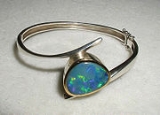
Opal

Encyclopedia
Opal is an amorphous form of silica
related to quartz
, a mineraloid
form, not a mineral. 3% to 21% of the total weight is water
, but the content is usually between 6% to 10%. It is deposited at a relatively low temperature and may occur in the fissures of almost any kind of rock
, being most commonly found with limonite
, sandstone
, rhyolite
, marl
and basalt
. Opal is the national gemstone of Australia
, which produces 97% of the world's supply.
Opal's internal structure makes it diffract
light; depending on the conditions in which it formed it can take on many colors. Opal ranges from clear through white, gray, red, orange, yellow, green, blue, magenta, rose, pink, slate, olive, brown, and black. Of these hues, the reds against black are the most rare, whereas white and greens are the most common. It varies in optical density from opaque to semi-transparent. For gemstone use, its natural color is often enhanced by placing thin layers of opal on a darker underlying stone, like basalt
.
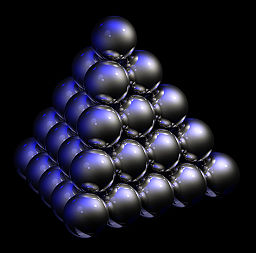 Precious opal shows a variable interplay of internal colors and even though it is a mineraloid
, it does have an internal structure. At micro scales precious opal is composed of silica spheres some 150 to 300 nm
in diameter in a hexagonal or cubic close-packed
lattice
. These ordered silica spheres produce the internal colors by causing the interference and diffraction
of light passing through the microstructure of the opal. It is the regularity of the sizes and the packing of these spheres that determines the quality of precious opal. Where the distance between the regularly packed planes of spheres is approximately half the wavelength of a component of visible light, the light of that wavelength may be subject to diffraction
from the grating
created by the stacked planes. The spacing between the planes and the orientation of planes with respect to the incident light determines the colors observed. The process can be described by Bragg's Law
of diffraction.
Visible light of diffracted wavelengths cannot pass through large thicknesses of the opal. This is the basis of the optical band gap
in a photonic crystal
, of which opal is the best known natural example. In addition, microfractures may be filled with secondary silica and form thin lamellae inside the opal during solidification. The term opalescence
is commonly and erroneously used to describe this unique and beautiful phenomenon, which is correctly termed play of color
. Contrarily, opalescence is correctly applied to the milky, turbid
appearance of common or potch opal. Potch does not show a play of color.
The veins of opal displaying the play of color are often quite thin, and this has given rise to unusual methods of preparing the stone as a gem. An opal doublet
is a thin layer of opal, backed by a swart mineral such as ironstone
, basalt
, or obsidian
. The darker backing emphasizes the play of color, and results in a more attractive display than a lighter potch.
Combined with modern techniques of polishing, doublet opal produces similar effect of black or boulder opals at a mere fraction of the price. Doublet opal also has the added benefit of having genuine opal as the top visible and touchable layer, unlike triplet opals.
The triplet-cut opal backs the colored material with a dark backing, and then has a domed cap of clear quartz
or plastic on top, which takes a high polish and acts as a protective layer for the opal. The top layer also acts as a magnifier, to emphasize the play of color of the opal beneath, which is often of lower quality. Triplet opals therefore have a more artificial appearance, and are not classed as precious opal.
varieties that show a play of color, there are other kinds of common opal such as the milk
opal, milky bluish to greenish (which can sometimes be of gemstone quality); resin
opal, which is honey-yellow with a resinous luster; wood opal, which is caused by the replacement of the organic material in wood
with opal; menilite
, which is brown or grey; hyalite
, a colorless glass-clear opal sometimes called Muller's Glass; geyserite
, also called siliceous sinter, deposited around hot springs
or geyser
s; and diatomite or diatomaceous earth
, the accumulations of diatom
shells or tests.
in Mexico; these opals are commonly called Mexican fire opals. Fire opals that do not show play of color are sometimes referred to as jelly opals.
Peruvian opal (also called blue opal) is a semi-opaque to opaque blue-green stone found in Peru which is often cut to include the matrix in the more opaque stones. It does not display pleochroism.
The town of Coober Pedy
in South Australia
is a major source of opal. The world's largest and most valuable gem opal "Olympic Australis" was found in at the "Eight Mile" opal field in Coober Pedy. It weighs 17,000 carats (3450 grams) and is 11 inches (279.4 mm) long, with a height of 4+3/4 in and a width of 4+1/2 in. It is valued at AUD$2,500,000
Mintabie Opal Fields located approximately 250 km north west of Coober Pedy has also produced large quantities of Crystal opal and also the rarer black opal. Over the years it has been sold overseas incorrectly as Coober Pedy Opal. The black opal is said to be some of the best examples found in Australia.
Andamooka in South Australia is also a major producer of matrix opal, crystal opal, and black opal. Another Australian town, Lightning Ridge
in New South Wales
, is the main source of black opal, opal containing a predominantly dark background (dark-gray to blue-black displaying the play of color). Boulder opal consists of concretions and fracture fillings in a dark siliceous ironstone
matrix. It is found sporadically in western Queensland, from Kynuna in the north, to Yowah and Koroit
in the south. The rarest type of Australian opal is "pipe" opal, closely related to boulder opal, which forms in sandstone with some iron-ore content, usually as fossilized tree roots. Its largest quantities are found around Jundah in South West Queensland. Australia also has opalised fossil remains, including dinosaur bones in New South Wales, and marine creatures in South Australia.
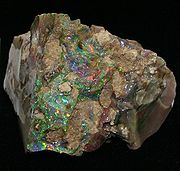 The Virgin Valley opal fields of Humboldt County
in northern Nevada
produce a wide variety of precious black, crystal, white, fire, and lemon opal. The black fire opal is the official gemstone of Nevada. Most of the precious opal is partial wood replacement. Miocene age opalised teeth, bones, fish, and a snake head have been found. Some of the opal has high water content and may desiccate and crack when dried. The largest black opal in the Smithsonian Institution
comes from the Royal Peacock opal mine in the Virgin Valley.
Another source of white base opal or creamy opal in the United States is Spencer, Idaho
. A high percentage of the opal found there occurs in thin layers.
Other significant deposits of precious opal around the world can be found in the Czech Republic, Slovakia, Hungary, Turkey, Indonesia, Brazil (in Pedro II, Piauí), Honduras, Guatemala, Nicaragua and Ethiopia.
In late 2008, NASA
announced that it had discovered opal deposits on Mars
.
under UV
light. Synthetics are also generally lower in density and are often highly porous.
Two notable producers of synthetic opal are the companies Kyocera
and Inamori of Japan. Most so-called synthetics, however, are more correctly termed "imitation opal", as they contain substances not found in natural opal (e.g., plastic stabilizers). The imitation opals seen in vintage jewelry are often foiled glass, glass-based "Slocum stone
", or later plastic materials.
Other research in macroporous structures have yielded highly ordered materials that have similar optical properties to opals and have been used in cosmetics.
, there is no unit cell that describes the structure of opal. Nevertheless, opals can be roughly divided into those that show no signs of crystalline order (amorphous opal) and those that show signs of the beginning of crystalline order, commonly termed cryptocrystalline
or microcrystalline opal. Dehydration experiments and infrared spectroscopy
have shown that most of the H2O in the formula of SiO2·nH2O of opals is present in the familiar form of clusters of molecular water. Isolated water molecules, and silanol
s, structures such as Si-O-H, generally form a lesser proportion of the total and can reside near the surface or in defects inside the opal.
The structure of low-pressure polymorphs of anhydrous silica consist of frameworks of fully corner bonded tetrahedra of SiO4. The higher temperature polymorphs of silica cristobalite
and tridymite
are frequently the first to crystallize from amorphous anhydrous silica, and the local structures of microcrystalline opals also appear to be closer to that of cristobalite
and tridymite
than to quartz. The structures of tridymite and cristobalite are closely related and can be described as hexagonal and cubic close-packed layers. It is therefore possible to have intermediate structures in which the layers are not regularly stacked.
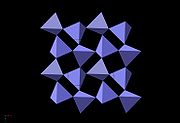
 -cristobalite with a lot of stacking disorder. Typical water content is about 1.5wt%.
is another name for this.
Non-crystalline silica in siliceous sediments is reported to gradually transform to opal-CT and then opal-C as a result of diagenesis
, due to the increasing overburden pressure in sedimentary rocks, as some of the stacking disorder is removed.
word úpala.
References to the gem are made by Pliny the Elder
. It is suggested it was adapted it from Ops
, the wife of Saturn
and goddess of fertility. The portion of Saturnalia
devoted to Ops was "Opalia", similar to opalus.
Another common claim that the term is adapted from the Greek word, opillos. This word has two meanings, one is related to "seeing" and forms the basis of the English words like "opaque", the other is "other" as in "alias" and "alter". It is claimed that opalus combined these uses, meaning "to see a change in color". However, historians have noted that the first appearances of opillos do not occur until after the Romans had taken over the Greek states in 180 B.C., and they had previously used the term paederos.
However, the argument for the Sanskrit origin is strong. The term first appears in Roman references around 250 B.C., at a time when the opal was valued above all other gems. The opals were supplied by traders from the Bosporus
, who claimed the gems were being supplied from India. Before this the stone was referred to by a variety of names, but these fell from use after 250.
and held in the hand. Following the publication of Sir Walter Scott
's Anne of Geierstein
in 1829, however, opal acquired a less auspicious reputation. In Scott's novel, the Baroness of Arnheim wears an opal talisman
with supernatural powers. When a drop of holy water
falls on the talisman, the opal turns into a colorless stone and the Baroness dies soon thereafter. Due to the popularity of Scott's novel, people began to associate opals with bad luck and death. Within a year of the publishing of Scott's novel in April 1829, the sale of opals in Europe dropped by 50%, and remained low for the next twenty years or so.
Even as recently as the beginning of the 20th century, it was believed that when a Russian saw an opal among other goods offered for sale, he or she should not buy anything more since the opal was believed to embody the evil eye
.
Opal is considered the birthstone for people born in October or under the sign of Scorpio
and Libra
.
, Isaac Newton
, Georg Agricola
etc.
Silicon dioxide
The chemical compound silicon dioxide, also known as silica , is an oxide of silicon with the chemical formula '. It has been known for its hardness since antiquity...
related to quartz
Quartz
Quartz is the second-most-abundant mineral in the Earth's continental crust, after feldspar. It is made up of a continuous framework of SiO4 silicon–oxygen tetrahedra, with each oxygen being shared between two tetrahedra, giving an overall formula SiO2. There are many different varieties of quartz,...
, a mineraloid
Mineraloid
A mineraloid is a mineral-like substance that does not demonstrate crystallinity. Mineraloids possess chemical compositions that vary beyond the generally accepted ranges for specific minerals. For example, obsidian is an amorphous glass and not a crystal. Jet is derived from decaying wood under...
form, not a mineral. 3% to 21% of the total weight is water
Water
Water is a chemical substance with the chemical formula H2O. A water molecule contains one oxygen and two hydrogen atoms connected by covalent bonds. Water is a liquid at ambient conditions, but it often co-exists on Earth with its solid state, ice, and gaseous state . Water also exists in a...
, but the content is usually between 6% to 10%. It is deposited at a relatively low temperature and may occur in the fissures of almost any kind of rock
Rock (geology)
In geology, rock or stone is a naturally occurring solid aggregate of minerals and/or mineraloids.The Earth's outer solid layer, the lithosphere, is made of rock. In general rocks are of three types, namely, igneous, sedimentary, and metamorphic...
, being most commonly found with limonite
Limonite
Limonite is an ore consisting in a mixture of hydrated iron oxide-hydroxide of varying composition. The generic formula is frequently written as FeO·nH2O, although this is not entirely accurate as limonite often contains a varying amount of oxide compared to hydroxide.Together with hematite, it has...
, sandstone
Sandstone
Sandstone is a sedimentary rock composed mainly of sand-sized minerals or rock grains.Most sandstone is composed of quartz and/or feldspar because these are the most common minerals in the Earth's crust. Like sand, sandstone may be any colour, but the most common colours are tan, brown, yellow,...
, rhyolite
Rhyolite
This page is about a volcanic rock. For the ghost town see Rhyolite, Nevada, and for the satellite system, see Rhyolite/Aquacade.Rhyolite is an igneous, volcanic rock, of felsic composition . It may have any texture from glassy to aphanitic to porphyritic...
, marl
Marl
Marl or marlstone is a calcium carbonate or lime-rich mud or mudstone which contains variable amounts of clays and aragonite. Marl was originally an old term loosely applied to a variety of materials, most of which occur as loose, earthy deposits consisting chiefly of an intimate mixture of clay...
and basalt
Basalt
Basalt is a common extrusive volcanic rock. It is usually grey to black and fine-grained due to rapid cooling of lava at the surface of a planet. It may be porphyritic containing larger crystals in a fine matrix, or vesicular, or frothy scoria. Unweathered basalt is black or grey...
. Opal is the national gemstone of Australia
Australia
Australia , officially the Commonwealth of Australia, is a country in the Southern Hemisphere comprising the mainland of the Australian continent, the island of Tasmania, and numerous smaller islands in the Indian and Pacific Oceans. It is the world's sixth-largest country by total area...
, which produces 97% of the world's supply.
Opal's internal structure makes it diffract
Diffraction
Diffraction refers to various phenomena which occur when a wave encounters an obstacle. Italian scientist Francesco Maria Grimaldi coined the word "diffraction" and was the first to record accurate observations of the phenomenon in 1665...
light; depending on the conditions in which it formed it can take on many colors. Opal ranges from clear through white, gray, red, orange, yellow, green, blue, magenta, rose, pink, slate, olive, brown, and black. Of these hues, the reds against black are the most rare, whereas white and greens are the most common. It varies in optical density from opaque to semi-transparent. For gemstone use, its natural color is often enhanced by placing thin layers of opal on a darker underlying stone, like basalt
Basalt
Basalt is a common extrusive volcanic rock. It is usually grey to black and fine-grained due to rapid cooling of lava at the surface of a planet. It may be porphyritic containing larger crystals in a fine matrix, or vesicular, or frothy scoria. Unweathered basalt is black or grey...
.
Precious opal
Mineraloid
A mineraloid is a mineral-like substance that does not demonstrate crystallinity. Mineraloids possess chemical compositions that vary beyond the generally accepted ranges for specific minerals. For example, obsidian is an amorphous glass and not a crystal. Jet is derived from decaying wood under...
, it does have an internal structure. At micro scales precious opal is composed of silica spheres some 150 to 300 nm
Nanometre
A nanometre is a unit of length in the metric system, equal to one billionth of a metre. The name combines the SI prefix nano- with the parent unit name metre .The nanometre is often used to express dimensions on the atomic scale: the diameter...
in diameter in a hexagonal or cubic close-packed
Close-packing
In geometry, close-packing of equal spheres is a dense arrangement of congruent spheres in an infinite, regular arrangement . Carl Friedrich Gauss proved that the highest average density – that is, the greatest fraction of space occupied by spheres – that can be achieved by a regular lattice...
lattice
Crystal structure
In mineralogy and crystallography, crystal structure is a unique arrangement of atoms or molecules in a crystalline liquid or solid. A crystal structure is composed of a pattern, a set of atoms arranged in a particular way, and a lattice exhibiting long-range order and symmetry...
. These ordered silica spheres produce the internal colors by causing the interference and diffraction
Diffraction
Diffraction refers to various phenomena which occur when a wave encounters an obstacle. Italian scientist Francesco Maria Grimaldi coined the word "diffraction" and was the first to record accurate observations of the phenomenon in 1665...
of light passing through the microstructure of the opal. It is the regularity of the sizes and the packing of these spheres that determines the quality of precious opal. Where the distance between the regularly packed planes of spheres is approximately half the wavelength of a component of visible light, the light of that wavelength may be subject to diffraction
Diffraction
Diffraction refers to various phenomena which occur when a wave encounters an obstacle. Italian scientist Francesco Maria Grimaldi coined the word "diffraction" and was the first to record accurate observations of the phenomenon in 1665...
from the grating
Diffraction grating
In optics, a diffraction grating is an optical component with a periodic structure, which splits and diffracts light into several beams travelling in different directions. The directions of these beams depend on the spacing of the grating and the wavelength of the light so that the grating acts as...
created by the stacked planes. The spacing between the planes and the orientation of planes with respect to the incident light determines the colors observed. The process can be described by Bragg's Law
Bragg's law
In physics, Bragg's law gives the angles for coherent and incoherent scattering from a crystal lattice. When X-rays are incident on an atom, they make the electronic cloud move as does any electromagnetic wave...
of diffraction.
Visible light of diffracted wavelengths cannot pass through large thicknesses of the opal. This is the basis of the optical band gap
Band gap
In solid state physics, a band gap, also called an energy gap or bandgap, is an energy range in a solid where no electron states can exist. In graphs of the electronic band structure of solids, the band gap generally refers to the energy difference between the top of the valence band and the...
in a photonic crystal
Photonic crystal
Photonic crystals are periodic optical nanostructures that are designed to affect the motion of photons in a similar way that periodicity of a semiconductor crystal affects the motion of electrons...
, of which opal is the best known natural example. In addition, microfractures may be filled with secondary silica and form thin lamellae inside the opal during solidification. The term opalescence
Opalescence
Opalescence is a type of dichroism seen in highly dispersed systems with little opacity. The material appears yellowish-red in transmitted light and blue in the scattered light perpendicular to the transmitted light. The phenomenon is named after the appearance of opals.There are different degrees...
is commonly and erroneously used to describe this unique and beautiful phenomenon, which is correctly termed play of color
Iridescence
Iridescence is generally known as the property of certain surfaces which appear to change color as the angle of view or the angle of illumination changes...
. Contrarily, opalescence is correctly applied to the milky, turbid
Turbidity
Turbidity is the cloudiness or haziness of a fluid caused by individual particles that are generally invisible to the naked eye, similar to smoke in air. The measurement of turbidity is a key test of water quality....
appearance of common or potch opal. Potch does not show a play of color.
The veins of opal displaying the play of color are often quite thin, and this has given rise to unusual methods of preparing the stone as a gem. An opal doublet
Doublet (lapidary)
A doublet is a type of gem composed in two sections. It is sometimes used to imitate other, more expensive gems.A garnet and glass doublet uses a top portion of natural garnet fused to any color of glass to imitate a gem. The color of glass used in the doublet is all that is seen, as the garnet...
is a thin layer of opal, backed by a swart mineral such as ironstone
Ironstone
Ironstone is a sedimentary rock, either deposited directly as a ferruginous sediment or created by chemical repacement, that contains a substantial proportion of an iron compound from which iron either can be or once was smelted commercially. This term is customarily restricted to hard coarsely...
, basalt
Basalt
Basalt is a common extrusive volcanic rock. It is usually grey to black and fine-grained due to rapid cooling of lava at the surface of a planet. It may be porphyritic containing larger crystals in a fine matrix, or vesicular, or frothy scoria. Unweathered basalt is black or grey...
, or obsidian
Obsidian
Obsidian is a naturally occurring volcanic glass formed as an extrusive igneous rock.It is produced when felsic lava extruded from a volcano cools rapidly with minimum crystal growth...
. The darker backing emphasizes the play of color, and results in a more attractive display than a lighter potch.
Combined with modern techniques of polishing, doublet opal produces similar effect of black or boulder opals at a mere fraction of the price. Doublet opal also has the added benefit of having genuine opal as the top visible and touchable layer, unlike triplet opals.
The triplet-cut opal backs the colored material with a dark backing, and then has a domed cap of clear quartz
Quartz
Quartz is the second-most-abundant mineral in the Earth's continental crust, after feldspar. It is made up of a continuous framework of SiO4 silicon–oxygen tetrahedra, with each oxygen being shared between two tetrahedra, giving an overall formula SiO2. There are many different varieties of quartz,...
or plastic on top, which takes a high polish and acts as a protective layer for the opal. The top layer also acts as a magnifier, to emphasize the play of color of the opal beneath, which is often of lower quality. Triplet opals therefore have a more artificial appearance, and are not classed as precious opal.
Common opal
Besides the gemstoneGemstone
A gemstone or gem is a piece of mineral, which, in cut and polished form, is used to make jewelry or other adornments...
varieties that show a play of color, there are other kinds of common opal such as the milk
Milk
Milk is a white liquid produced by the mammary glands of mammals. It is the primary source of nutrition for young mammals before they are able to digest other types of food. Early-lactation milk contains colostrum, which carries the mother's antibodies to the baby and can reduce the risk of many...
opal, milky bluish to greenish (which can sometimes be of gemstone quality); resin
Resin
Resin in the most specific use of the term is a hydrocarbon secretion of many plants, particularly coniferous trees. Resins are valued for their chemical properties and associated uses, such as the production of varnishes, adhesives, and food glazing agents; as an important source of raw materials...
opal, which is honey-yellow with a resinous luster; wood opal, which is caused by the replacement of the organic material in wood
Wood
Wood is a hard, fibrous tissue found in many trees. It has been used for hundreds of thousands of years for both fuel and as a construction material. It is an organic material, a natural composite of cellulose fibers embedded in a matrix of lignin which resists compression...
with opal; menilite
Menilite
Menilite is a greyish-brown form of the mineraloid opal. It is also known as liver opal or leberopal , due to its color. It is called menilite because it was first described from Ménilmontant , France, where it occurs in concretions of Tertiary shale....
, which is brown or grey; hyalite
Hyalite
Hyalite is a form of opal with a glassy and clear appearance which exhibits an internal play of colors and has natural inclusions. It is also called Muller's glass, water opal and jalite. Its Mohs hardness is 5.5 to 6 and it has a specific gravity of 2.1. It is an amorphous form of silica . Its...
, a colorless glass-clear opal sometimes called Muller's Glass; geyserite
Geyserite
Geyserite is a form of opaline silica that is often found around hot springs and geysers. Botryoidal geyserite is known as fiorite. It is sometimes referred to as sinter.-References:*...
, also called siliceous sinter, deposited around hot springs
Hot Springs
Hot Springs may refer to:* Hot Springs, Arkansas** Hot Springs National Park, Arkansas*Hot Springs, California**Hot Springs, Lassen County, California**Hot Springs, Modoc County, California**Hot Springs, Placer County, California...
or geyser
Geyser
A geyser is a spring characterized by intermittent discharge of water ejected turbulently and accompanied by a vapour phase . The word geyser comes from Geysir, the name of an erupting spring at Haukadalur, Iceland; that name, in turn, comes from the Icelandic verb geysa, "to gush", the verb...
s; and diatomite or diatomaceous earth
Diatomaceous earth
Diatomaceous earth also known as diatomite or kieselgur/kieselguhr, is a naturally occurring, soft, siliceous sedimentary rock that is easily crumbled into a fine white to off-white powder. It has a particle size ranging from less than 1 micrometre to more than 1 millimetre, but typically 10 to...
, the accumulations of diatom
Diatom
Diatoms are a major group of algae, and are one of the most common types of phytoplankton. Most diatoms are unicellular, although they can exist as colonies in the shape of filaments or ribbons , fans , zigzags , or stellate colonies . Diatoms are producers within the food chain...
shells or tests.
Other varieties of opal
Girasols, more commonly called fire opals, are transparent to translucent opals with warm body colors of yellow, orange, orange-yellow or red. They do not usually show any play of color, although occasionally a stone will exhibit bright green flashes. The most famous source of fire opals is the state of QuerétaroQuerétaro
Querétaro officially Estado Libre y Soberano de Querétaro de Arteaga is one of the 31 states which, with the Federal District, comprise the 32 Federal Entities of Mexico. It is divided into 18 municipalities and its capital city is Santiago de Querétaro....
in Mexico; these opals are commonly called Mexican fire opals. Fire opals that do not show play of color are sometimes referred to as jelly opals.
Peruvian opal (also called blue opal) is a semi-opaque to opaque blue-green stone found in Peru which is often cut to include the matrix in the more opaque stones. It does not display pleochroism.
Sources of opal
Australia produces around 97% of the world's opal. 90% is called 'light opal' or white and crystal opal. White makes up 60% of the opal productions but cannot be found in all of the opal fields. Crystal opal or pure hydrated silica makes up 30% of the opal produced, 8% is black and only 2% is boulder opal.The town of Coober Pedy
Coober Pedy, South Australia
Coober Pedy is a town in northern South Australia, 846 kilometres north of Adelaide on the Stuart Highway. According to the 2006 census, its population was 1,916 . The town is sometimes referred to as the "opal capital of the world" because of the quantity of precious opals that are mined there...
in South Australia
South Australia
South Australia is a state of Australia in the southern central part of the country. It covers some of the most arid parts of the continent; with a total land area of , it is the fourth largest of Australia's six states and two territories.South Australia shares borders with all of the mainland...
is a major source of opal. The world's largest and most valuable gem opal "Olympic Australis" was found in at the "Eight Mile" opal field in Coober Pedy. It weighs 17,000 carats (3450 grams) and is 11 inches (279.4 mm) long, with a height of 4+3/4 in and a width of 4+1/2 in. It is valued at AUD$2,500,000
Mintabie Opal Fields located approximately 250 km north west of Coober Pedy has also produced large quantities of Crystal opal and also the rarer black opal. Over the years it has been sold overseas incorrectly as Coober Pedy Opal. The black opal is said to be some of the best examples found in Australia.
Andamooka in South Australia is also a major producer of matrix opal, crystal opal, and black opal. Another Australian town, Lightning Ridge
Lightning Ridge, New South Wales
Lightning Ridge is a town in north-western New South Wales, Australia, in Walgett Shire, near the southern border of Queensland. The Lightning Ridge area is a world epicentre of the mining of black opals and other opal gemstones. Lightning Ridge has the largest known deposits of black opals in the...
in New South Wales
New South Wales
New South Wales is a state of :Australia, located in the east of the country. It is bordered by Queensland, Victoria and South Australia to the north, south and west respectively. To the east, the state is bordered by the Tasman Sea, which forms part of the Pacific Ocean. New South Wales...
, is the main source of black opal, opal containing a predominantly dark background (dark-gray to blue-black displaying the play of color). Boulder opal consists of concretions and fracture fillings in a dark siliceous ironstone
Ironstone
Ironstone is a sedimentary rock, either deposited directly as a ferruginous sediment or created by chemical repacement, that contains a substantial proportion of an iron compound from which iron either can be or once was smelted commercially. This term is customarily restricted to hard coarsely...
matrix. It is found sporadically in western Queensland, from Kynuna in the north, to Yowah and Koroit
Koroit opal field
The Koroit opal field is an opal mining area in Paroo Shire in southwest Queensland, Australia. The Koroit opal field is located about 80 km north northwest of Cunnamulla.It is not a town. It has neither electricity nor running water...
in the south. The rarest type of Australian opal is "pipe" opal, closely related to boulder opal, which forms in sandstone with some iron-ore content, usually as fossilized tree roots. Its largest quantities are found around Jundah in South West Queensland. Australia also has opalised fossil remains, including dinosaur bones in New South Wales, and marine creatures in South Australia.
Humboldt County, Nevada
Humboldt County is a county located in the U.S. state of Nevada. As of 2007, the population was estimated to be 18,052. Its county seat is Winnemucca.The county was the site of an arrest in 2000 that led to the U.S. Supreme Court decision Hiibel v...
in northern Nevada
Nevada
Nevada is a state in the western, mountain west, and southwestern regions of the United States. With an area of and a population of about 2.7 million, it is the 7th-largest and 35th-most populous state. Over two-thirds of Nevada's people live in the Las Vegas metropolitan area, which contains its...
produce a wide variety of precious black, crystal, white, fire, and lemon opal. The black fire opal is the official gemstone of Nevada. Most of the precious opal is partial wood replacement. Miocene age opalised teeth, bones, fish, and a snake head have been found. Some of the opal has high water content and may desiccate and crack when dried. The largest black opal in the Smithsonian Institution
Smithsonian Institution
The Smithsonian Institution is an educational and research institute and associated museum complex, administered and funded by the government of the United States and by funds from its endowment, contributions, and profits from its retail operations, concessions, licensing activities, and magazines...
comes from the Royal Peacock opal mine in the Virgin Valley.
Another source of white base opal or creamy opal in the United States is Spencer, Idaho
Spencer, Idaho
Spencer is a city in Clark County, Idaho, United States. The population was 38 at the 2000 census.The city is noted as being the "Opal Capital of America"...
. A high percentage of the opal found there occurs in thin layers.
Other significant deposits of precious opal around the world can be found in the Czech Republic, Slovakia, Hungary, Turkey, Indonesia, Brazil (in Pedro II, Piauí), Honduras, Guatemala, Nicaragua and Ethiopia.
In late 2008, NASA
NASA
The National Aeronautics and Space Administration is the agency of the United States government that is responsible for the nation's civilian space program and for aeronautics and aerospace research...
announced that it had discovered opal deposits on Mars
Mars
Mars is the fourth planet from the Sun in the Solar System. The planet is named after the Roman god of war, Mars. It is often described as the "Red Planet", as the iron oxide prevalent on its surface gives it a reddish appearance...
.
Synthetic opal
As well as occurring naturally, opals of all varieties have been synthesized experimentally and commercially. The discovery of the ordered sphere structure of precious opal led to its synthesis by Pierre Gilson in 1974. The resulting material is distinguishable from natural opal by its regularity; under magnification, the patches of color are seen to be arranged in a "lizard skin" or "chicken wire" pattern. Furthermore, synthetic opals do not fluoresceFluorescence
Fluorescence is the emission of light by a substance that has absorbed light or other electromagnetic radiation of a different wavelength. It is a form of luminescence. In most cases, emitted light has a longer wavelength, and therefore lower energy, than the absorbed radiation...
under UV
Ultraviolet
Ultraviolet light is electromagnetic radiation with a wavelength shorter than that of visible light, but longer than X-rays, in the range 10 nm to 400 nm, and energies from 3 eV to 124 eV...
light. Synthetics are also generally lower in density and are often highly porous.
Two notable producers of synthetic opal are the companies Kyocera
Kyocera
is a multinational manufacturer based in Kyoto, Japan. It was founded as in 1959 by Kazuo Inamori and renamed in 1982. The company has diversified its founding technology in ceramic materials through internal development as well as strategic mergers and acquisitions...
and Inamori of Japan. Most so-called synthetics, however, are more correctly termed "imitation opal", as they contain substances not found in natural opal (e.g., plastic stabilizers). The imitation opals seen in vintage jewelry are often foiled glass, glass-based "Slocum stone
Slocum stone
Slocum stone is an early opal simulant which was briefly popular prior to the introduction of synthetics and less expensive simulants. It was named after its inventor, John S. Slocum of Rochester, Michigan....
", or later plastic materials.
Other research in macroporous structures have yielded highly ordered materials that have similar optical properties to opals and have been used in cosmetics.
Local atomic structure of opals
The lattice of spheres of opal that cause the interference with light are several hundred times larger than the fundamental structure of crystalline silica. As a mineraloidMineraloid
A mineraloid is a mineral-like substance that does not demonstrate crystallinity. Mineraloids possess chemical compositions that vary beyond the generally accepted ranges for specific minerals. For example, obsidian is an amorphous glass and not a crystal. Jet is derived from decaying wood under...
, there is no unit cell that describes the structure of opal. Nevertheless, opals can be roughly divided into those that show no signs of crystalline order (amorphous opal) and those that show signs of the beginning of crystalline order, commonly termed cryptocrystalline
Cryptocrystalline
Cryptocrystalline is a rock texture made up of such minute crystals that its crystalline nature is only vaguely revealed even microscopically in thin section by transmitted polarized light. Among the sedimentary rocks, chert and flint are cryptocrystalline. Carbonado, a form of diamond, is also...
or microcrystalline opal. Dehydration experiments and infrared spectroscopy
Infrared spectroscopy
Infrared spectroscopy is the spectroscopy that deals with the infrared region of the electromagnetic spectrum, that is light with a longer wavelength and lower frequency than visible light. It covers a range of techniques, mostly based on absorption spectroscopy. As with all spectroscopic...
have shown that most of the H2O in the formula of SiO2·nH2O of opals is present in the familiar form of clusters of molecular water. Isolated water molecules, and silanol
Silanol
Silanol, also known as silyl alcohol, is a chemical with formula SiH3OH. It is the simplest silicon alcohol, and is a heavy, volatile, colorless, flammable liquid. At room temperature it is a polar liquid...
s, structures such as Si-O-H, generally form a lesser proportion of the total and can reside near the surface or in defects inside the opal.
The structure of low-pressure polymorphs of anhydrous silica consist of frameworks of fully corner bonded tetrahedra of SiO4. The higher temperature polymorphs of silica cristobalite
Cristobalite
The mineral cristobalite is a high-temperature polymorph of silica, meaning that it has the same chemical formula, SiO2, but a distinct crystal structure. Both quartz and cristobalite are polymorphs with all the members of the quartz group which also include coesite, tridymite and stishovite...
and tridymite
Tridymite
Tridymite is a high-temperature polymorph of quartz and usually occurs as minute tabular white or colorless pseudo-hexagonal triclinic crystals, or scales, in cavities in acidic volcanic rocks. Its chemical formula is SiO2. Tridymite was first described in 1868 and the type location is in Hidalgo,...
are frequently the first to crystallize from amorphous anhydrous silica, and the local structures of microcrystalline opals also appear to be closer to that of cristobalite
Cristobalite
The mineral cristobalite is a high-temperature polymorph of silica, meaning that it has the same chemical formula, SiO2, but a distinct crystal structure. Both quartz and cristobalite are polymorphs with all the members of the quartz group which also include coesite, tridymite and stishovite...
and tridymite
Tridymite
Tridymite is a high-temperature polymorph of quartz and usually occurs as minute tabular white or colorless pseudo-hexagonal triclinic crystals, or scales, in cavities in acidic volcanic rocks. Its chemical formula is SiO2. Tridymite was first described in 1868 and the type location is in Hidalgo,...
than to quartz. The structures of tridymite and cristobalite are closely related and can be described as hexagonal and cubic close-packed layers. It is therefore possible to have intermediate structures in which the layers are not regularly stacked.
Microcrystalline opal
Opal-CT has been interpreted as consisting of clusters of stacking of cristobalite and tridymite over very short length scales. The spheres of opal in opal-CT are themselves made up of tiny microcrystalline blades of cristobalite and tridymite. Opal-CT has occasionally been further subdivided in the literature. Water content may be as high as 10 wt%. Lussatite is a synonym. Opal-C, also called Lussatine, is interpreted as consisting of localized order of-cristobalite with a lot of stacking disorder. Typical water content is about 1.5wt%.Non-crystalline opal
Two broad categories of non-crystalline opals, sometimes just referred to as "opal-A", have been proposed. The first of these is opal-AG consisting of aggregated spheres of silica, with water filling the space in between. Precious opal and potch opal are generally varieties of this, the difference being in the regularity of the sizes of the spheres and their packing. The second "opal-A" is opal-AN or water-containing amorphous silica-glass. HyaliteHyalite
Hyalite is a form of opal with a glassy and clear appearance which exhibits an internal play of colors and has natural inclusions. It is also called Muller's glass, water opal and jalite. Its Mohs hardness is 5.5 to 6 and it has a specific gravity of 2.1. It is an amorphous form of silica . Its...
is another name for this.
Non-crystalline silica in siliceous sediments is reported to gradually transform to opal-CT and then opal-C as a result of diagenesis
Diagenesis
In geology and oceanography, diagenesis is any chemical, physical, or biological change undergone by a sediment after its initial deposition and during and after its lithification, exclusive of surface alteration and metamorphism. These changes happen at relatively low temperatures and pressures...
, due to the increasing overburden pressure in sedimentary rocks, as some of the stacking disorder is removed.
Naming
The word opal is adapted from the Roman term opalus, but the origin of this word is a matter of debate. However, most modern references suggest it is adapted from the SanskritSanskrit
Sanskrit , is a historical Indo-Aryan language and the primary liturgical language of Hinduism, Jainism and Buddhism.Buddhism: besides Pali, see Buddhist Hybrid Sanskrit Today, it is listed as one of the 22 scheduled languages of India and is an official language of the state of Uttarakhand...
word úpala.
References to the gem are made by Pliny the Elder
Pliny the Elder
Gaius Plinius Secundus , better known as Pliny the Elder, was a Roman author, naturalist, and natural philosopher, as well as naval and army commander of the early Roman Empire, and personal friend of the emperor Vespasian...
. It is suggested it was adapted it from Ops
Ops
In ancient Roman religion, Ops or Opis, was a fertility deity and earth-goddess of Sabine origin.-Mythology:Her husband was Saturn, the bountiful monarch of the Golden Age. Just as Saturn was identified with the Greek deity Cronus, Opis was identified with Rhea, Cronus' wife...
, the wife of Saturn
Saturn (mythology)
In ancient Roman religion and myth, Saturn was a major god presiding over agriculture and the harvest time. His reign was depicted as a Golden Age of abundance and peace by many Roman authors. In medieval times he was known as the Roman god of agriculture, justice and strength. He held a sickle in...
and goddess of fertility. The portion of Saturnalia
Saturnalia
Saturnalia is an Ancient Roman festival/ celebration held in honour of Saturn , the youngest of the Titans, father of the major gods of the Greeks and Romans, and son of Uranus and Gaia...
devoted to Ops was "Opalia", similar to opalus.
Another common claim that the term is adapted from the Greek word, opillos. This word has two meanings, one is related to "seeing" and forms the basis of the English words like "opaque", the other is "other" as in "alias" and "alter". It is claimed that opalus combined these uses, meaning "to see a change in color". However, historians have noted that the first appearances of opillos do not occur until after the Romans had taken over the Greek states in 180 B.C., and they had previously used the term paederos.
However, the argument for the Sanskrit origin is strong. The term first appears in Roman references around 250 B.C., at a time when the opal was valued above all other gems. The opals were supplied by traders from the Bosporus
Bosporus
The Bosphorus or Bosporus , also known as the Istanbul Strait , is a strait that forms part of the boundary between Europe and Asia. It is one of the Turkish Straits, along with the Dardanelles...
, who claimed the gems were being supplied from India. Before this the stone was referred to by a variety of names, but these fell from use after 250.
Historical superstitions
In the Middle Ages, opal was considered a stone that could provide great luck because it was believed to possess all the virtues of each gemstone whose color was represented in the color spectrum of the opal. It was also said to confer the power of invisibility if wrapped in a fresh bay leafBay leaf
Bay leaf refers to the aromatic leaf of the bay laurel . Fresh or dried bay leaves are used in cooking for their distinctive flavor and fragrance. The leaves are often used to flavor soups, stews, braises and pâtés in Mediterranean cuisine...
and held in the hand. Following the publication of Sir Walter Scott
Walter Scott
Sir Walter Scott, 1st Baronet was a Scottish historical novelist, playwright, and poet, popular throughout much of the world during his time....
's Anne of Geierstein
Anne of Geierstein
Anne of Geierstein, or The Maiden of the Mist is a novel by Sir Walter Scott. It is set in Central Europe, mainly in Switzerland, shortly after the Yorkist victory at the Battle of Tewkesbury...
in 1829, however, opal acquired a less auspicious reputation. In Scott's novel, the Baroness of Arnheim wears an opal talisman
Amulet
An amulet, similar to a talisman , is any object intended to bring good luck or protection to its owner.Potential amulets include gems, especially engraved gems, statues, coins, drawings, pendants, rings, plants and animals; even words said in certain occasions—for example: vade retro satana—, to...
with supernatural powers. When a drop of holy water
Holy water
Holy water is water that, in Catholicism, Anglicanism, Eastern Orthodoxy, Lutheranism, Oriental Orthodoxy, and some other churches, has been sanctified by a priest for the purpose of baptism, the blessing of persons, places, and objects; or as a means of repelling evil.The use for baptism and...
falls on the talisman, the opal turns into a colorless stone and the Baroness dies soon thereafter. Due to the popularity of Scott's novel, people began to associate opals with bad luck and death. Within a year of the publishing of Scott's novel in April 1829, the sale of opals in Europe dropped by 50%, and remained low for the next twenty years or so.
Even as recently as the beginning of the 20th century, it was believed that when a Russian saw an opal among other goods offered for sale, he or she should not buy anything more since the opal was believed to embody the evil eye
Evil eye
The evil eye is a look that is believed by many cultures to be able to cause injury or bad luck for the person at whom it is directed for reasons of envy or dislike...
.
Opal is considered the birthstone for people born in October or under the sign of Scorpio
Scorpio (astrology)
|Infobox align="right" style="border:3px solid white;"||style="text-align: center;"|Scorpio is the eighth astrological sign in the Zodiac, which spans the zodiac between the 210th and 239th degree of celestial longitude. Generally, the Sun transits this area of the zodiac between 24 October and...
and Libra
Libra (astrology)
Libra is the seventh astrological sign in the Zodiac, originating from the constellation of Libra. In astrology, Libra is considered a "masculine", positive sign. It is also considered an air sign and is one of four cardinal signs...
.
Famous opals
- The Olympic AustralisOlympic AustralisThe Olympic Australis Opal is largest and most valuable opal yet found, valued at AUD$2,500,000. It was found in 1956 at the Eight Mile opal field in the outback opal gemstone mining town of Coober Pedy in South Australia, where during the Australian summer months the temperature can reach 40°...
, The world's largest and most valuable gem opal - The Andamooka OpalAndamooka OpalThe Andamooka Opal is a famous opal which was presented to Queen Elizabeth II in the 1950s on the occasion of her first visit to Australia. It was discovered in Andamooka, South Australia, an historic opal mining town....
, presented to Queen Elizabeth II, also known as the Queen's Opal - "The Burning of Troy", an opal presented to Joséphine de BeauharnaisJoséphine de BeauharnaisJoséphine de Beauharnais was the first wife of Napoléon Bonaparte, and thus the first Empress of the French. Her first husband Alexandre de Beauharnais had been guillotined during the Reign of Terror, and she had been imprisoned in the Carmes prison until her release five days after Alexandre's...
by Napoleon I of France - The Flame Queen OpalFlame Queen OpalThe Flame Queen Opal is perhaps the most famous of all opals. It is the best-known example of “eye-of-opal”, an eye-like effect created when opal in-fills a cavity....
- The Halley's Comet OpalHalley's Comet OpalThe Halley's Comet Opal is the largest uncut black opal in the world, according to the Guinness Book of World Records. It is so named because it was unearthed in 1986, a year when Halley's Comet could be seen from Earth. It is the third largest gem grade black opal ever recorded, the largest one...
, the world's largest uncut black opal - The clock faces above the information stand in Grand Central TerminalGrand Central TerminalGrand Central Terminal —often incorrectly called Grand Central Station, or shortened to simply Grand Central—is a terminal station at 42nd Street and Park Avenue in Midtown Manhattan in New York City, United States...
Manhattan, New York - The Roebling Opal, Smithsonian Institution
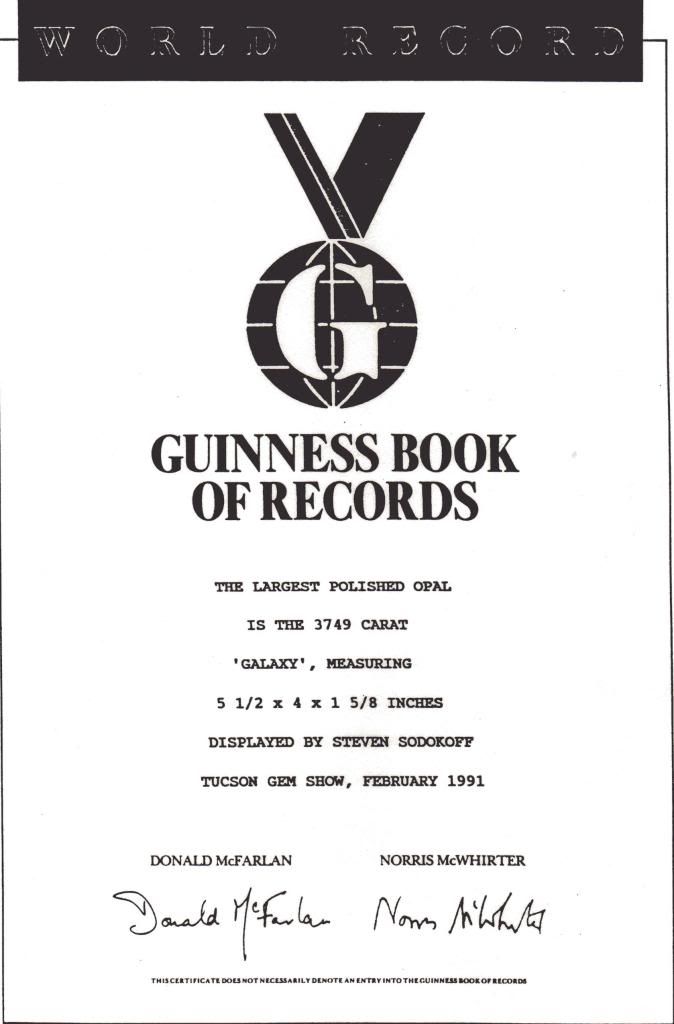
- The Galaxy OpalGalaxy OpalThe Galaxy is the world's largest polished opal, certified by the Guinness Book of World Records in 1992. It was found at the Boi Morto Mine in north eastern Brazil in 1976. It is today part of a private collection. The finished opal weighs approximately 3,749 carats, or 0.75 kg...
– The World's Largest Polished Opal – 1992 The Guinness Book of Records
External links
*Farlang opal Hist. References Localities, anecdotes by TheophrastusTheophrastus
Theophrastus , a Greek native of Eresos in Lesbos, was the successor to Aristotle in the Peripatetic school. He came to Athens at a young age, and initially studied in Plato's school. After Plato's death he attached himself to Aristotle. Aristotle bequeathed to Theophrastus his writings, and...
, Isaac Newton
Isaac Newton
Sir Isaac Newton PRS was an English physicist, mathematician, astronomer, natural philosopher, alchemist, and theologian, who has been "considered by many to be the greatest and most influential scientist who ever lived."...
, Georg Agricola
Georg Agricola
Georgius Agricola was a German scholar and scientist. Known as "the father of mineralogy", he was born at Glauchau in Saxony. His real name was Georg Pawer; Agricola is the Latinised version of his name, Pawer meaning "farmer"...
etc.
- ICA's Opal Page: International Colored Stone Association